Wednesday, October 01, 2025

Kirigami parachute suitable for humanitarian missions unveiled


Polytechnique Montréal research project published in Nature


Polytechnique Montréal

Frédérick Gosselin, Danick Lamoureux and David Mélançon with a prototype of their kirigami-patterned plastic parachute. 

image: 

Frédérick Gosselin, Danick Lamoureux and David Mélançon with a prototype of their kirigami-patterned plastic parachute.They published their results in the article Kirigami-inspired parachutes with programmable reconfiguration, which was published online in Nature on October 1st 2025.

view more 

Credit: (Photo credit: LM2)


Kirigami is a technique that modifies the mechanical properties of a sheet of material by making precise folds and cuts to it. Children use it to make snowflakes out of paper, and engineers have used it to create extensible structures, flexible medical devices and deployable spatial structures. However, kirigami techniques have never been applied to parachute production.

The Polytechnique Montréal research team has now changed all that.

A parachute cut from a plastic sheet

Through a groundbreaking project, led by professors David Mélançon and Frédérick Gosselin from Polytechnique Montréal’s Mechanical Engineering Department, a new type of parachute made from a plastic sheet cut in a “closed-loop” kirigami pattern as been developed.

The pattern used gives the sheet of plastic new mechanical properties. In free fall, it assumes the shape of an upside-down bell when any type of weight or object is attached to its centre.

“One advantage of this parachute is that it quickly stabilizes and doesn’t pitch, regardless of the release angle,” says Mélançon, co-author of the article. “And unlike conventional parachutes, it follows a strict ballistic descent trajectory.”

The research team believes these characteristics could be useful for purposes ranging from parcel delivery in remote areas to exploration of Mars in outer space. However, in their view, the most likely and practical application in the near future is

humanitarian aid deliveries of water, food and medicine, particularly since the parachute has a very low production cost.

“We made these parachutes by laser cutting, but a simple die-cutting press would also do the trick,” Mélançon says. “What’s more, the parachute is seamless and is attached to the payload by a single suspension line, making it easy to use and to deploy.”

The researchers tested their concept through numerical simulations, wind-tunnel tests, laboratory drops and outdoor drops from a drone. The tests point towards a considerable potential that has yet to be explored.

“The parachute’s behaviour doesn’t change even when the size of the device is augmented,” says Frédérick Gosselin. “This suggests that it could be scaled up for larger applications.”

The Polytechnique Montréal research team is now working on identifying new cutting patterns to endow the parachutes with different and new properties. “We want to change the patterns in order to go even further: the parachutes could descend in a spiral, for example, or glide before dropping,” says Mélançon. “We would also like to be able to vary the trajectory of descent depending on the payload, so the cargo could be sorted as the parachutes come down to earth. This is a whole new design endeavour that opens up a multitude of possibilities.”

Learn more about this story:

https://www.polymtl.ca/carrefour-actualite/en/news/parachute-polytechnique-montreal-lands-nature

Nature article:

Kirigami-inspired parachutes with programmable reconfiguration

Media kit:

https://polymtl.info/hpcuz 


Arnold Schwarzenegger downplays Trump and backs Vatican initiative to 'terminate' global warming

Arnold Schwarzenegger attends a press conference at the Vatican.
Copyright AP Photo/Gregorio Borgia

By NICOLE WINFIELD with AP
Published on 

His Schwarzenegger Climate Initiative is one of the backers of the Vatican conference, which is being held at the Holy See’s newly inaugurated environmental educational centre.

Arnold Schwarzenegger downplayed the Trump administration’s climate scepticism on Tuesday and threw his weight behind the Vatican’s environmental initiative, saying individual choice, local regulations and the Catholic Church's moral leadership were far more important to “terminate” global warming.

Schwarzenegger was at the Vatican to headline a three-day climate conference marking the 10th anniversary of Pope Francis’s landmark 2015 environmental encyclical, Laudato Si (Praised Be).

The document, one of Francis' main legacies, cast saving God’s creation as an urgent moral imperative and launched a broad, grassroots movement that Pope Leo XIV has fully embraced and made his own.

Schwarzenegger, the former Republican governor of California, has devoted time to environmental causes since leaving political office in 2011.

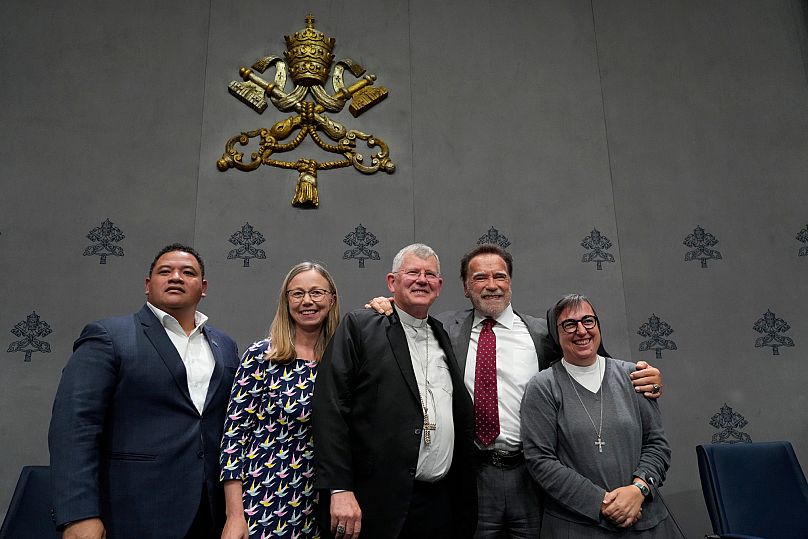
From left, Tuvalu's Climate Minister Maina Talia, Laudato Si' Executive Director Lorna Gold, Cardinal Jaime Spengler, Arnold Schwarzenegger, and sister Alessandra Smerilli.
From left, Tuvalu's Climate Minister Maina Talia, Laudato Si' Executive Director Lorna Gold, Cardinal Jaime Spengler, Arnold Schwarzenegger, and sister Alessandra Smerilli. AP Photo/Gregorio Borgia

His Schwarzenegger Climate Initiative is one of the backers of the Vatican conference, which is being held at the Holy See’s newly inaugurated environmental educational centre in Castel Gandolfo, south of Rome.

'An easy way out'

At a news conference, Schwarzenegger was asked about President Donald Trump’s recent comments to the UN General Assembly, where he falsely said that climate change was a "con job".

Trump has long been a critic of climate science and policies aimed at helping the world transition to green energies like wind and solar. His administration has rolled back landmark regulations, withdrawn climate project funding and instead bolstered support for oil and gas production in the name of an “American energy dominance” agenda.

“Don’t use the federal government as an excuse,” Schwarzenegger told the Vatican briefing. “It’s an easy way out.”

He recalled his legal battles with the Bush administration over California’s environmental regulations when he was governor, and a particular victory where “we said ‘Hasta la vista, baby,’” Schwarzenegger said, quoting his famous line from “Terminator 2.”

Schwarzenegger said far more important were individual choices about turning off lights when you leave a room and state policies promoting solar power.

With its 1.4 billion people, 400,000 priests, the Catholic Church also has a critical mass of people who can back environmental initiatives, he said.

Island communities press for “all hands on deck” response to climate crisis


A new, first-of-its-kind survey sheds light on public opinion about climate change in the world’s small island states


University of California - Santa Barbara


Despite being among the most climate vulnerable regions in the world, public opinion from small island states and territories across the South Pacific, Indian Ocean and Caribbean has long been absent from the global discussions of the climate crisis. These countries face disproportionate climate impacts — from sea-level rise to intensifying storms to fresh water contamination, increasing diseases and other health risks — even though they bear virtually no responsibility for the climate crisis.

new study published in the Proceedings of the National Academy of Sciences fills this gap. Led by a team of UC Santa Barbara researchers in partnership with scholars at Stanford University, University of Pennsylvania, UC San Diego and UCLA, it represents the first global climate survey of these regions. The study found that there is near-universal acceptance of human-caused climate change, high levels of concern about climate-linked environmental threats, and that small-island respondents support an “all hands on deck” approach to addressing the climate crisis.

“We began this work after we discovered that 30 countries in the world had never been included in a global climate survey — and that these were the countries at the frontlines of climate impacts,” said Matto Mildenberger, an associate professor of political science at UCSB and the lead author on the paper. “This has meant that voices from the most climate vulnerable countries and territories in the world have been missing from opinion research.”

This lack of opinion research means that the beliefs and preferences of communities across small island countries and territories have not been accounted for in global climate policy development. 

“Our research arrives at a critical moment as the international community seeks to redress the impacts of climate change on the world’s most climate-exposed societies,” added co-author Paasha Mahdavi, an associate professor of political science at UCSB. “We directly measure the attitudes and preferences of individuals in small island states regarding whom they see as responsible for solving climate change.” 

Between June and July 2022, the research team led a Facebook advertising campaign in 55 small island states and territories that directed respondents to a survey — delivered in the most common language of the area — that asked their opinion on climate change. Survey participants were asked about their experiences with extreme weather, attitude around climate change, opinion on climate adaptation policies, as well as their perceptions on global climate politics, displacement and migration, and how they would assign responsibility for addressing the climate crisis.

Researchers found that there are very high levels of belief in human-caused climate change, ranging from a low of 89% in Anguilla to 100% in Marshall Islands, Turks and Caicos. “Not only do residents of small-island countries face some of the highest vulnerability to climate change around the world, they also have among the highest belief in climate change and level of concern that we’ve ever observed,” said Gabriel De Roche, a postdoctoral fellow at UCSB and a co-author on the paper. “We find very high levels of concern not just for their own neighbors and countries, but for people the world over.” 

Large majorities in every country or territory were also worried about their personal vulnerability to climate impacts, including extreme weather, sea-level rise, coastal erosion and, to a lesser extent, drinking water contamination. Additionally, climate-vulnerable residents perceive that residents of rich countries will also be impacted by climate change, seeing the problem as universal and severe for countries other than their own. 

“Interestingly, while many residents in places like the United States view climate change as primarily affecting other countries, we found that residents of small island states and territories view impacts of the climate crisis as a global phenomenon,” said Mildenberger. “Respondents indicated that they view climate impacts as proximate for themselves as well as for distant communities and more developed countries.”  

Critically, the study found that respondents generally favor an “all hands on deck” approach to the climate crisis, with responsibility for solving climate change falling on countries who are historic or current major sources of climate pollution, as well as former colonial powers and home-country governments. This finding is important as global discussions around how to assign responsibility for addressing the climate crisis increase.

“A July 2025 ruling by the International Court of Justice — the highest court of the United Nations — has for the first time recognized that people whose lives are upended by climate change may be entitled to ‘climate reparations’ from large emitters like the United States and China,” said Mahdavi. “Our findings paint a nuanced and complex picture that reveals grassroots belief in responsibility not just for large emitters, but also smaller-emitting colonial powers like Spain and the Netherlands, as well as fossil fuel producers like Saudi Arabia. We see these nuances as an important empirical component for policy discussions moving forward in light of the ICJ ruling.”

Their findings, the researchers assert, indicate that communities in small island states and territories similarly favor an “all hands on deck” approach — supporting global climate action, as well as efforts from their local governments — given the urgency of the climate crisis. 

“Our research finds an urgent demand for ambitious climate action from residents of small island states and territories,” said De Roche. “This population, among the most affected by climate change’s negative impacts, is calling for all hands on deck action on climate adaptation and resilience. We see a clear opportunity for leaders from these small island states to push for ambitious policy on climate adaptation and resilience by large current polluters, former colonial powers, and within their own governments.”  


Farming’s environmental footprint shrinks — but progress uneven across England, study finds


Greenhouse gas emissions, acidification and eutrophication potential all declined over the past decade, though reductions vary widely between regions


Rothamsted Research


England’s farms have significantly reduced their environmental footprint over the past decade, according to new modelling that suggests greenhouse gas emissions and other forms of pollution are on a downward trend.

The study, which assessed intensive farming systems between 2010 and 2021 over 72,000 km² of farmland, found median reductions of 18% in both short- and long-term global warming potential, alongside a 21% drop in acidification potential. Eutrophication potential — the nutrient run-off that can pollute rivers and lakes — fell by 13%.

The changes reflect a marked restructuring of English agriculture. The area of land devoted to general cropping rose by nearly 4%, while land used for dairy contracted by 2%. Registered cattle numbers fell sharply, down by almost a quarter by 2016 and by 30% by 2021 compared with 2010 levels. Sheep and lamb numbers dropped even more dramatically, by more than 40%.

However, the improvements are uneven. While some water management catchments recorded reductions of up to 76% in certain environmental indicators, others saw little progress, with less than 5% improvement.

There were some significant changes between 2016 to 2021 for some crops and land use, including an increase for rotational grass, spring barley, peas and fodder crops and a substantial decrease in the area under permanent grass. There were also more minority crops being introduced as the area of land used for the ‘Other crops’ category expanded dramatically. There was also evidence for increased specialisation and intensification as, relatively speaking, more arable crops were in cereal farms, more cattle on dairy farms and more sheep and lambs on lowland grazing farms by 2021.

The findings underline both the potential and the limitations of current farming practices in meeting climate and environmental targets. Researchers caution that it remains difficult to link modelled trends directly with on-the-ground monitoring data and stress the need for regular strategic assessments to inform national agricultural policy.

With climate change, energy insecurity and resource depletion creating mounting pressure on food systems, the authors argue that policy makers must combine regulation, financial incentives and practical advice to help farmers and land managers continue to cut their environmental impact.

“Farming is indispensable to feeding a growing population, but it must also become more sustainable,” according to Dr Yusheng Zhang who led the study. “Routine assessment of environmental footprints will be critical to building a climate-resilient and economically viable agricultural industry.”

Study co-author Professor Adie Collins added, “Farm structure changes such as reduction in livestock counts and of embedded emissions in agrochemicals and fuels have contributed to the modelled results. Whilst spatial variations in the magnitude of change were inevitably predicted across the country, the findings clearly demonstrate, in the context of the current policy debate surrounding a potential Land Use Framework for England, how structural change in farms can deliver appreciable environmental benefits.”