Friday, October 03, 2025


Greenpeace Blockade Forces LNG Tanker Diversions From Belgian Terminal

Greenpeace activists from 17 countries blockaded Belgium’s Zeebrugge LNG terminal on Thursday, forcing at least three tankers to divert. Protesters in kayaks, inflatables, and small craft occupied the channel, demanding an end to both Russian and U.S. LNG flows. 

Fluxys, which operates the terminal, told Reuters that operations inside remain unaffected, though tanker access was restricted and the blockade was expected to continue through Sunday.

The Megara and Rias Baixas Knutsen, both carrying U.S. LNG, along with the LNG Phecda carrying a Russian cargo, were among the ships that changed course, according to LSEG vessel tracking cited by Reuters. Zeebrugge, which serves not only as a Belgian import terminal but also as a re-export hub, sees Russian volumes frequently redirected from there to markets in Spain, Italy, and Asia.

Belgium imported roughly 2.3 million tonnes of Russian LNG in the first eight months of 2025, second only to France, customs data show. Despite efforts to cut ties, Europe remains a significant buyer: Russian gas supplied over 40% of EU imports in 2021, a share that dropped to below 19% by 2024. 

Brussels has proposed phasing out Russian gas entirely by 2027, with the first-ever EU sanctions on Russian LNG due to take effect in January 2027. Still, NGO estimates suggest the bloc has sent €8.1 billion to Moscow this year through LNG purchases.

Europe’s reliance on LNG is growing. The IEA projects EU imports will rise 25% in 2025, with U.S. cargoes capturing more than half of incremental supply. New German terminals at Wilhelmshaven and Brunsbüttel, alongside expanded facilities in the Netherlands, France, and Spain, are anchoring this trend. Storage levels remain tight, with inventories only 39% full at mid-year, well below seasonal averages.

On Thursday, the Dutch TTF gas benchmark fell by more than 3%, slipping to 10.82, even as traders monitored disruptions from French LNG strikes and the Zeebrugge blockade. The decline reflects broader softness in European gas markets, though physical risks remain elevated.

By Charles Kennedy for Oilprice.com

Belgian LNG Terminal Blocked by Greenpeace Protestors
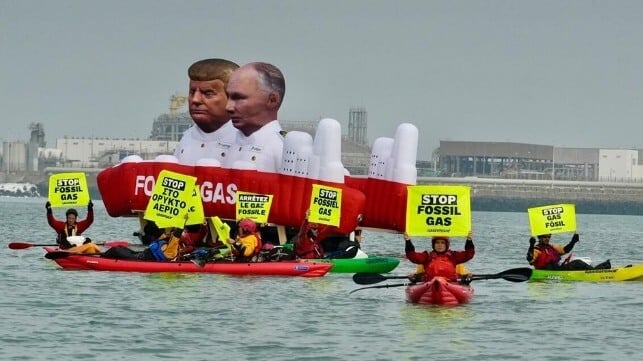
Greenpeace protest Belgium
Greenpeace is blocking Belgium's LNG terminal calling for an end to Russian and U.S. LNG imports (© Eric De Mildt / Greenpeace)

Published Oct 1, 2025 1:34 PM by The Maritime Executive


The Fluxys LNG terminal at the port of Zeebrugge, Belgium, is once again being blockaded by Greenpeace protestors. The group estimates as many as 70 activists took to small boats, rafts, and kayaks to call attention to its demands to end Russian and U.S. LNG imports into the European Union.

Media reports indicate the group was hiding at various points around the port early this morning, October 1, and launched the protest shortly after an LNG carrier departed the terminal. The terminal appears to be empty now, and the protestors are in the inner harbor area, but a cruise ship (AIDAperla), several RoRos, and general cargo ships are in other areas of the port near the protest.

Greenpeace’s sailing ship Witness (74 feet/22.5 meters) was positioned at the entrance to the LNG terminal and is displaying a large banner with images of Vladimir Putin and Donald Trump reading “They love gas, you pay the price.” In addition, the group installed a 10-meter (33-foot) inflatable also portraying the Russian and U.S. presidents represented atop a gas carrier. The small boats and kayaks were surrounding the display, also showing banners. A police boat was standing by in the harbor.

The protest is reported to be the last in a series of displays the group has staged around Europe and is timed to the discussions of the 19th EU sanction package tied to the war in Ukraine. The European Commission is proposing a ban on Russian gas imports to be completed by January 2027, but Greenpeace is also calling for a freeze on all new contracts from U.S. suppliers and a commitment by the EU and its member states to phase out all fossil gas by 2035 at the latest.
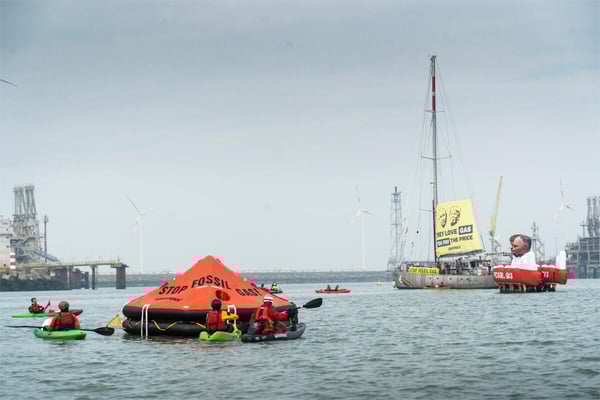
 

Greenpeace says it is blockading the LNG import terminal calling for an end to Russian and U.S. LNG shipments (© Eric De Mildt / Greenpeace)


“Replacing Russian gas with fracked gas from the U.S. keeps Europe trapped in dangerous dependencies,” said Lisa Göldner, fossil fuel campaigner from Greenpeace Germany. “We are here today because accelerating the transition to renewable energy is no longer just an environmental imperative; it is a matter of security.”

Greenpeace Belgium released data where it calculates that between 2022 and 2024, the Russian company Yamal LNG, the largest exporter of Russian gas to Europe, earned an estimated $40 billion and paid $9.5 billion in profit tax to the Russian state. The group asserts that from 2022 to June 2025, France, Spain, Belgium, and the Netherlands spent more on liquified gas imports from Russia (€34.3 billion) than they provided in bilateral aid to Ukraine (€21.2 billion).

The LNG terminal in Zeebrugge is one of the largest, with agreements for Eni, EDF, and Total. Operator Fluxys Belgium highlights that demand for natural gas flows from Belgium to Germany and the Netherlands increased significantly in the first half of 2025 compared to 2024. Fluxys reports shipping traffic at the terminal hit an unprecedented high in the first half of 2025, with nearly 80 ships unloading LNG in Zeebrugge. On June 6, flows from the terminal into the Belgian grid set a new record at 716 GWh.

Greenpeace has targeted the terminal during previous protests. In March, protestors circled the Marshall Islands-registered gas carrier Marvel Swallow operated by Japan’s Mitsui O.S.K. Lines as it was arriving. Hours later, they attempted to stop Dynagas’ Cyprus-flagged tanker Fedor Litke

As of the evening of October 1, the standoff is continuing in the harbor with the police boat and the Greenpeace vessel both sitting near the entrance of the Fluxys’ terminal.

IRONY

Solar Could Help Iraq Boost Oil Exports by 250,000 Bpd

Iraq could ramp up its crude oil exports by some 250,000 barrels daily as it saves this amount from local consumption with the help of several solar power projects.

Zawya reported the news, citing a government official, who said that “Iraq consumes nearly a quarter million bpd of crude oil for energy use…switching to renewable energy will save this quantity.”

“This will allow Iraq to export more crude and boost revenues…switching to renewable energy is a significant step, but it does not mean Iraq will shift away from fossil fuels,” Abdul Baqi Khalaf, an advisor at the Iraqi oil ministry, also said.

Solar power currently supplies less than 1% of Iraq’s electricity. Most of it is generated using natural gas, of which a lot is imported from Iran. Iraq also imports electricity from its neighbor directly, or it did, until recently, when the U.S. canceled a sanctions waiver for Baghdad.

Plans for solar are ambitious, and the first steps are already being taken. French TotalEnergies earlier this year broke ground on a 1-GW solar power installation. The first part of the installation, with a capacity of 250 MW, should be ready to start generating by the end of the year.

The Iraqi government plans to build as much as 12 GW of solar power capacity by the end of this decade—up from just 42 MW at the end of 2024.

Meanwhile, earlier this week, oil minister Hayan Abdul-Ghani announced the government had plans to ramp up crude oil production to 5.5 million barrels daily by the end of the year. Iraq’s current production rate averages 4.4 million barrels daily. By 2030, the government in Baghdad eyes production of 7 million barrels daily, according to an earlier statement by an oil ministry official. The plan suggests Iraq wants to make the most of its massive oil reserves and do that sooner rather than later.

By Irina Slav for Oilprice.com


Why Iraq Could Make or Break the Next Oil Price Move

  • OPEC+ has begun unwinding its second tranche of cuts ahead of schedule, with a modest 137,000 bpd increase likely in November.

  • Iraq’s compliance with steep compensation cuts will be pivotal in maintaining the credibility of OPEC+’s strategy.

  • Kazakhstan has backloaded its compensation schedule, proposing to cut by only 35k b/d in December 2025, before increasing to 100 kb/d in January 2026, 300 kb/d in February, 450 kb/d in March, 490 kb/d in April, 550 kb/d in May, and 650 kb/d in June 2026.

Last month, OPEC+ agreed to increase oil output from October by 137,000 barrels per day, a much lower clip compared to the 555,000 bpd increase announced for August and September and 411,000 bpd in June and July. That meant that the group has started unwinding the second tranche of 1.65 million bpd in production cuts more than a year ahead of schedule, having fully unwound the first tranche of 2.5 million bpd since April. The eight members of OPEC+ are set to meet virtually on Sunday, 5th October, to determine the next course of action in unwinding production cuts. The consensus is for a further 137 thousand barrels per day (kb/d) increase in loadings for November, in the absence of any significant news. Media reports in late September claimed that the group might consider an accelerated rewinding programme, with the remainder being divided into three monthly increases of 500 kb/d. Judging by the still bearish sentiment in oil markets, the second scenario would likely result in an oil price selloff with concerns of oversupply returning to the forefront.

However, it’s more likely that OPEC+ will stick to its former plan, in which case all eyes will turn to Iraq. As expected, OPEC+ outlined the proposed compensation cuts for overproduced volumes by six members, led by Iraq, which has proposed an immediate 130 kb/d adjustment from August 2025 through January 2026, before slowing to 122 kb/d in June 2026. Commodity analysts at Standard Chartered have noted that Iraq will do most of the heavy lifting in OPEC+’s latest round of unwinding, with the country’s cuts alone nearly enough to neutralize the increase by the rest of the members. 

In contrast, Kazakhstan has backloaded its compensation schedule, proposing to cut by only 35k b/d in December 2025, before increasing to 100 kb/d in January 2026, 300 kb/d in February, 450 kb/d in March, 490 kb/d in April, 550 kb/d in May, and 650 kb/d in June 2026 for a total of 2.63 mb/d.  The analysts have predicted that Iraq's compliance will be critical for setting market sentiment around the legitimacy of compensation cuts.StanChart notes that Kazakhstan’s plan to backload most of its cuts goes contrary to previous plans to frontload them. Further, the analysts have pointed out that Iraq’s total contribution includes exports from the Kurdistan region (KRG), which is likely to return from suspension imminently, further complicating adherence to compensation cuts.

Meanwhile, the UN has reimposed sanctions on Iran, completing the ‘snapback’ process that was initiated by the UK, France and Germany, marking the effective end of the 2015 nuclear deal (JCPOA). Last week’s meetings on the subject by the United Nations General Assembly (UNGA) were largely unproductive, forcing the UN to restore six former resolutions, including requiring Iran to terminate nuclear activities and enrichment of uranium. However, the most significant for the oil market is a resolution that authorizes the seizure of vessels, including oil tankers, suspected of arms or technology smuggling. Historically, many countries have in the past been reluctant to exercise this seizure authority because it often results in tit-for-tat vessel seizures. According to Kpler data, Iran currently exports ~1.5 million barrels of crude per day, down from 2.3 mb/d it managed before the latest raft of sanctions but more than triple the volumes it did at the end of Trump’s first term in office. A cross-section of analysts has argued that the snapback will have little effect in limiting Iran’s oil exports or its economy:

"I see a limited economic impact, especially when it comes to energy," Rachel Ziemba, senior advisor at political risk consultancy Horizon Engage, told Argus Media. "This is due to the limited scope of the [returning] UN sanctions, the extent of existing US sanctions, and the breadth of the illicit trading relations," she added.

Meanwhile, Europe’s gas stores continue filling up, with inventories rising by 0.84 billion cubic metres (bcm) w/w to reach 96.22bcm over the past week. Despite high demand due to the cold weather, Europe’s gas has been trading in a narrow range around €31–€33 per megawatt-hour over the past week to settle at €31.01/MWh in Thursday’s session. EU inventories currently stand at 82.3% of total capacity, with Germany at 76.6% while France and Italy are above 90%.

By Alex Kimani for Oilprice.com


U.S. Backs Historic Deal to Keep Kurdish Oil Moving

The U.S. Administration wants to ensure that the just-restarted oil exports from Iraq’s semi-autonomous region of Kurdistan continue to flow via pipeline to Turkey in the long run, an anonymous official at the U.S. Department of State told Bloomberg on Friday.

The Trump Administration is working toward the goal of keeping Kurdistan’s crude flowing in the long term to boost the Iraqi economy, counter Iran’s influence in the region, and benefit U.S. companies operating in Iraq, according to the official.   

The U.S. has played a role in the deal that allowed the resumption of the exports from Kurdistan, the official told Bloomberg.

U.S. Secretary of State Marco Rubio commented last week on the agreement to restart exports, saying on X “We welcome the announcement that the Government of Iraq has reached an agreement with the Kurdistan Regional Government and international companies to reopen the Iraq-Türkiye pipeline. This deal, facilitated by the United States, will bring tangible benefits for both Americans and Iraqis while reaffirming Iraq’s sovereignty.”

Kurdistan’s oil exports resumed on Saturday, September 27, following a two and a half year suspension of the flows via the pipeline from northern Iraq to the Turkish Mediterranean coast.

Eight foreign companies operating in Kurdistan have signed agreements with the Kurdistan Regional Government (KRG) and the Federal Government of Iraq to enable the restart of international crude exports from Kurdistan.

This agreement paved to way to the restart of exports, which were halted for two and a half years, after they were shut in in March 2023 due to a dispute over who should authorize the Kurdish exports.

The federal government in Baghdad and the regional Kurdish government in Erbil squabbled for more than two years over who should be responsible for the oil exports and the subsequent revenue distribution. 

Under the agreement, hailed as historic by Iraq’s federal government, KRG is delivering about 190,000 barrels per day (bpd) of crude to Iraqi state marketing company SOMO. Kurdistan is also entitled to keep 50,000 bpd to use for local consumption.

By Tsvetana Paraskova for Oilprice.com


Fire Erupts at Chevron Refinery in California

Following an explosion of a yet-to-be-determined nature, a large fire broke out on Thursday night at Chevron’s El Segundo refinery in the Los Angeles area. 

The fire, which was first seen at around 9:30 p.m. on Thursday, was later contained, the police in El Segundo said, adding there wasn’t a call for residents to evacuate. 

Authorities have not received any reports of injuries of fatalities, El Segundo Mayor Chris Pimentel told local news station KCAL News

Chevron’s 280,000-barrels-per-day refinery in El Segundo has its own fire department, which responded first to the incident. 

“We were able to respond with Chevron fire immediately, our station is about a .25 mile away from the gates of Chevron,” El Segundo’s Pimentel said. 

“Obviously, we are very concerned, and there is a lot of investigative work to be done to see what has happened.”

As of the early hours in LA on Friday, there were no updates about the cause of the massive fire. 

The fire has been contained and “there is no cause for alarm for El Segundo or the surrounding areas,” LA County Supervisor Holly Mitchell told KCAL News. 

The El Segundo Refinery, which began operations in 1911, is one of the biggest on the U.S. West Coast. It is one of the few that oil majors aren’t closing due to California’s assault on the oil and gas sector in recent years. 

Several major refiners have decided to discontinue gasoline production at refineries in the state, due to the Californian mandates for clean energy vehicles and changed market dynamics. 

Phillips 66, for example, has started shutting down its 139,000-bpd Los Angeles-area refinery. Units at the plant will idle in phases through Q4 2025, with the facility permanently offline by year-end.  

Between Phillips 66’s LA facility and Valero’s Benicia refinery, scheduled to close in 2026, the state is set to lose roughly 17% of its refining capacity—and that’s likely to drive the high gasoline prices even higher.    

By Tsvetana Paraskova for Oilprice.com 

Southeast Asia’s Onshore Wind Market Set for Fourfold Growth by 2030

  • Onshore wind capacity in Southeast Asia is forecast to rise from 6.5 GW in 2024 to 26 GW by 2030, led by Vietnam, the Philippines, and Thailand.

  • Auctions, attractive feed-in tariffs, and cheaper Chinese turbines are fueling expansion, alongside demand from energy-intensive industries like data centers.

  • Policy inconsistency, grid bottlenecks, and payment disputes - particularly in Vietnam - threaten investor confidence and long-term stability.

The onshore wind sector has historically witnessed mild growth in Southeast Asia (SEA) since the start of the decade due to a combination of regulatory hurdles, weak grid infrastructure, high costs associated with developing local supply chains, and persistent reliance on cheaper fossil fuels like coal, which are perceived as more stable. However, this could change, with Rystad Energy’s analysis projecting onshore wind capacity in SEA to climb from 6.5 gigawatts (GW) in 2024 to 26 GW by 2030, an increase of 19.5 GW. This resurgence is fueled by a combination of short-term policy initiatives such as auctions, project awards and attractive feed-in tariffs (FITs) alongside the rising acceptance of mainland Chinese wind turbines.

This acceleration in onshore wind installations comes at a crucial time, as countries across the region aim to expand renewable energy adoption and advance their energy transition. Government policies are further boosting momentum, with several new regulations introduced this year to support development. With more mature technology, falling equipment costs and improved performance even at lower wind speeds, onshore wind is increasingly a competitive option for meeting renewable energy targets. An additional consideration is leveraging these projects to power data centers, as onshore wind can offer a favorable generation profile for many 24/7 applications, further enhancing their value.

Raksit Pattanapitoon, Lead Renewables & Power Analyst, APAC, Rystad Energy

Though far outpacing the 1.1 GW addition seen in SEA between 2021 and 2024, a closer look identifies some new trends, with Vietnam continuing to be the largest market despite policy-driven fluctuations, and the Philippines and Thailand following closely behind. Meanwhile, Laos is turning to onshore wind energy for the first time to diversify its power mix and enhance export capacity, following the commissioning of Southeast Asia’s largest wind project in August, built solely with the purpose of exporting power to Vietnam.

Despite recent momentum, Southeast Asia stands to make significant gains by learning from previous boom-and-bust policy cycles. Unlike solar, which benefits from a relatively simple and modular supply chain, wind power projects demand more complex logistics, infrastructure and technical expertise – necessitating time for ecosystem development and a steady project pipeline for sustained growth.

Countries such as Laos, Cambodia and potentially Indonesia have an opportunity to learn from the experiences of Vietnam, Thailand and the Philippines. In these markets, a rapid rollout of initial projects (about 4 GW in Vietnam, 1.5 GW in Thailand and 400 MW in the Philippines) within a short timeframe was followed by a prolonged project drought due to a lack of policy continuity, resulting in no new construction in Vietnam since 2021, in Thailand since 2019, and in the Philippines since 2015.

Additionally, recent payment disputes in Vietnam between state utility Vietnam Electricity (EVN) and wind project developers have further undermined investor confidence. Most of these challenges stem from proposals to retroactively reduce Feed-in-tariff (FIT) rates for operational projects by imposing new acceptance requirements. This further compounded grid curtailment issues affecting both solar and wind projects that came online during the boom years between 2018 and 2021.

While Southeast Asia’s onshore wind sector is poised for rapid expansion, its long-term success will hinge on consistent policies, stronger grid integration, and establishing local supply chains. Continued government support and collaboration within the industry are crucial to building a resilient wind market and ensuring wind energy becomes a key pillar of the region’s renewable transition.

By Rystad Energy


Dept. of Justice Tells Court BOEM Will Review Atlantic Shores COP Approval

New Jersey shoreline
DOJ filed in a lawsuit by a local group challenging the approval for the New Jersey offshore wind farm (public domain photo)

Published Oct 1, 2025 6:56 PM by The Maritime Executive


The Department of Justice told a federal district court that it plans to review and likely change the approval of the Construction and Operation Plan for New Jersey’s Atlantic Shores South offshore wind farm. While the project has largely been abandoned for months, the move is symbolic because it was where candidate Donald Trump, during a 2024 campaign stop, vowed to bring an end to the offshore wind energy sector.

The filing, which was made on September 27, is similar to others the Department of Justice has made as part of pending lawsuits against wind farm projects from Massachusetts to Maryland. In each of the cases, DOJ has asked the court to stay the pending litigation brought by local activist groups, saying it was “potentially needless or wasteful litigation.” The Department of the Interior and its Bureau of Ocean Energy Management are involved in the cases as the local opposition repeatedly challenges the approvals given to the projects.

The Atlantic Shores South project, which would consist of two large offshore wind farms, received its final approval from BOEM in October 2024 for a project that would have been off the southern New Jersey coast. It called for 197 turbines that would have been at least 8.7 miles from Long Beach Island as part of a project to provide 2.8 GW of energy to the state. 

The project was a joint venture between Shell and EDF Renewables. Despite having gained all its necessary federal approvals, it, however, had yet to gain a power agreement with the state’s utilities. The project had been entered into New Jersey’s fourth round solicitation, but the state ended the round in February without selecting projects.

Trump singled out the project on the campaign trail, and shortly after returning to office, his Environmental Protection Agency challenged an air quality permit granted for the construction of the project. By June, the project told the state it was no longer economical, although EDF had said it planned to pursue the project, while Shell announced it was backing away from the office wind energy sector.

The opponents had lost earlier court challenges but renewed their fight in a case filed in July. DOJ, in its filing to the court last week, said the plan was for BOEM to reconsider the permitting for the project.

The filing states, “At the conclusion of BOEM’s reconsideration proceedings, BOEM will likely make a new agency action, and that action may affect—and potentially moot—plaintiffs’ claims.”  

Earlier, Interior Secretary Doug Burgum had said the government was reviewing five offshore wind projects, inferring that each would be canceled. While the departments have filed motions to stay the local cases for the projects, the administration, however, suffered a setback in its efforts to challenge Ørsted’s Revolution Wind project. A court barred the government’s efforts to enforce a stop work order on the project, which is 80 percent installed. The Danish company has reported that work resumed while the court cases proceed. The company has also said it was in discussions with the government to resolve the concerns over the project.

Bloomberg reported that BOEM today, October 1, also filed with another federal district court announcing that it will also be reviewing the COP approval for Empire Wind 2, a second project planned by Empire Wind off the coast of New Jersey. The company is working on its phase 1 project after a stop work order in the spring, but it has said that phase 2 was unlikely to proceed at this time because of the changed regulatory environment.


SCI-FI-TEK 70 YRS IN THE MAKING

ITER's Control Building completed

Fusion for Energy - the ITER Organisation's European domestic agency - and its contractor Demathieu Bard have completed the Control Building for the International Thermonuclear Experimental Reactor at Cadarache in south-eastern France.

(Image: F4E)

French engineering firm Demathieu Bard designed and constructed the building, which has a 3,500-square-metre footprint. The works lasted five years, totalling more than 200,000 person-hours.

Besides the main control room and server rooms, the Control Building has offices, a command post, a gallery for visitors and a dining room. Staff will enter it from the ITER headquarters (just outside the platform) via a footbridge. 

Once the structure was finished, the teams started installing services like ventilation, electricity or fire protection, whilst ITER Organisation’s contractors set up all the computer hardware. In total, there are 80 cubicles containing electronic systems to process the massive volume of information.

The 800-square-metre control room is equipped with 30 workstations and the first workers have started moving in. The various temporary control rooms, in charge of monitoring the plant systems under commissioning, will now be relocated in the new building.

"Unlike the rest of the industrial buildings, this one is made to host people during the 24 hours, so we included many provisions for accessibility and ergonomics, such as noise reduction and natural indirect light," noted Eric Brault, F4E's Project Manager.

"We are proud to deliver another ITER building, especially one with such symbolic value, as the future centre of operations," said Sébastien Berne, Major Project Director of Demathieu Bard. "We designed its layout and services to offer the best work experience. We then executed it meeting the complex requirements in a challenging schedule, thanks to the good planning and collaboration with F4E, as well as ITER Organisation and their suppliers."

ITER is a major international project to build a tokamak fusion device designed to prove the feasibility of fusion as a large-scale and carbon-free source of energy. The goal of ITER is to operate at 500 MW (for at least 400 seconds continuously) with 50 MW of plasma heating power input. It appears that an additional 300 MWe of electricity input may be required in operation. No electricity will be generated at ITER.

Thirty-five nations are collaborating to build ITER - the European Union is contributing almost half of the cost of its construction, while the other six members (China, India, Japan, South Korea, Russia and the USA) are contributing equally to the rest. Construction began in 2010 and the original 2018 first plasma target date was put back to 2025 by the ITER council in 2016. However, in June last year, a revamped project plan was announced which aims for "a scientifically and technically robust initial phase of operations, including deuterium-deuterium fusion operation in 2035 followed by full magnetic energy and plasma current operation".

Germany boosts funding for fusion research

The German cabinet has approved the federal government's action plan aimed at accelerating commercial fusion deployment in Germany. By 2029, more than EUR2 billion (USD2.3 billion) will be invested in fusion research, as well as the development of new research infrastructures and pilot projects.
 
(Image: noelsch / Pixabay)

The Fusion Action Plan implements a flagship measure of the High-Tech Agenda Germany - announced in July by the Federal Ministry of Research, Technology and Space (BMFTR) - in fusion, identified as one of six critical future technologies for the country.

"Fusion energy could be an important component in the power grid of the future," the action plan says. "However, significant technological challenges still need to be overcome on the path to the first fusion power plant. The technologies required for a power plant must be researched and developed to market readiness in a joint effort by industry and science."

The Federal Government's adopted action plan identifies eight fields of action and measures that should be addressed in order to realise a fusion power plant in Germany.

Firstly, it will strengthen research funding by increasing public funding within the framework of the Fusion 2040 funding programme and the announced joint energy research programme to a total of about EUR1.7 billion during this legislative period.

The government will also promote the development of a fusion ecosystem comprising science and industry. thereby supporting the transfer of knowledge from research to companies, which can then assume the leading role on the path to fusion power plants. At the same time, it will promote the comprehensive development of value chains for a fusion power plant in Germany.

Funds will be allocated for the establishment and expansion of research infrastructures and pilot projects, even beyond the current financial planning, so that the goals agreed upon in the action plan can be achieved. In this legislative period alone, funds amounting to up to EUR755 million are to be used from the special infrastructure fund.

The Federal Government will, within the scope of its federal structure, support the training and further education of specialists and will regularly engage in dialogue with the states on this matter.

The action plan calls for the Federal Government to continue to regulate fusion within the framework of the Radiation Protection Act and not within the framework of the Atomic Energy Act. This, it says, provides a reliable framework for companies and investors and thus supports necessary investments, including private capital.

The Federal Government will advocate for the protection of intellectual property and support efforts towards internationally harmonised standardization. It will also enter into long-term and strategic international cooperation with value-based partners that will further accelerate the already internationally positioned fusion research.

"Recent years have clearly shown us all that our energy supply is facing challenges," said Federal Minister for Research, Technology and Space Dorothee Bär. "It is the foundation for competitiveness, value creation, and sovereignty. Our energy of tomorrow should be safe, environmentally compatible, climate-friendly, and affordable for everyone. In the future, the key technology of fusion could help fulfill this demand. With the Fusion Action Plan, we are paving the way for the world's first fusion power plant in Germany."

In September 2023, then Federal Research Minister Bettina Stark-Watzinger announced that Germany would significantly increase research funding for fusion with an additional EUR370 million over the next five years. Together with funds already earmarked for research institutions, the ministry will provide more than EUR1 billion for fusion research by 2028. The move was aimed at paving the way for the first fusion power plant to be constructed in Germany by 2040.

World Nuclear News