Next-generation quantum communication
University of Warsaw, Faculty of Physics
image:
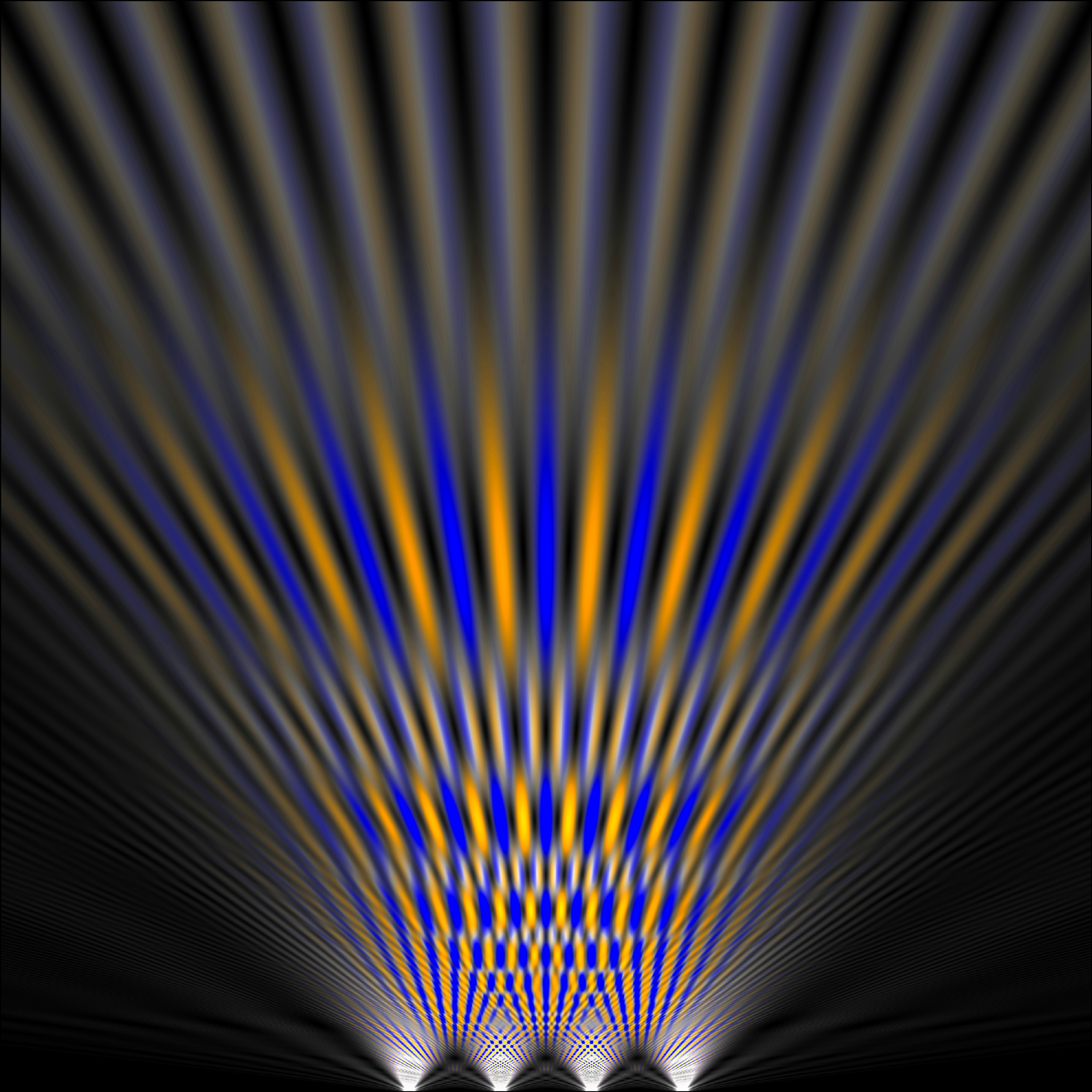
Detection of time-bin superpositions with the temporal Talbot carpet (visualisation: Maciej Ogrodnik, University of Warsaw).
view moreCredit: Maciej Ogrodnik, University of Warsaw
Next-Generation Quantum Communication
In the era of instant data exchange and growing risks of cyberattacks, scientists are seeking secure methods of transmitting information. One promising solution is quantum cryptography – a quantum technology that uses single photons to establish encryption keys. A team from the Faculty of Physics at the University of Warsaw has developed and tested in urban infrastructure a novel system for quantum key distribution (QKD). The system employs so-called high-dimensional encoding. The proposed setup is simpler to build and scale than existing solutions, while being based on a phenomenon known to physicists for nearly two centuries – the Talbot effect. The research results have been published in prestigious journals: “Optica Quantum”, “Optica”, and “Physical Review Applied”.
“Our research focuses on quantum key distribution (QKD) – a technology that uses single photons to establish a secure cryptographic key between two parties,” says Dr. Michał Karpiński, head of the Quantum Photonics Laboratory at the Faculty of Physics, University of Warsaw. “Traditionally, QKD employs so-called qubits – the simplest units of quantum information. While this method is already well tested, it does not always meet the requirements of more demanding applications. That’s why researchers are now working on multidimensional encoding. Instead of qubits, which yield one of two measurement outcomes, we use more complex quantum states that can take on multiple values.”
At the Quantum Photonics Laboratory, researchers focus on time-bin superpositions of photons – situations where a photon is neither “earlier” nor “later” but exists in a combination of these states. The detection time of a single photon in such a superposition yields a random outcome. Such a state encodes information using the relation between earlier and later pulses, i.e., in the phase of the light wave.
“Until now, efficient detection of superpositions of two pulses – earlier and later – was possible. We went a step further: we are interested in cases with more time bins, ranging from two to four or even more,” adds Dr. Karpiński.
The Temporal Talbot Effect
The researchers drew inspiration from the Talbot effect – a classical optics phenomenon first described in 1836 by Henry Fox Talbot, a pioneer of photography.
“When light passes through a diffraction grating, its image repeats itself at regular intervals – as if it ‘revives’ at a certain distance. Interestingly, the same effect occurs not only in space but also in time, provided that a regular train of light pulses propagates in a dispersive medium such as an optical fiber,” explains Maciej Ogrodnik, a PhD student at the Faculty of Physics, UW.
“Thanks to the space-time analogy in optics, we can apply the Talbot effect to short light pulses, including single photons – thereby gaining new capabilities for analyzing and processing quantum states. In our case, a sequence of light pulses acts like a diffraction grating and can ‘self-reconstruct’ in time under dispersion after traveling some distance in an optical fiber. Moreover, the way pulses interfere depends on their phase, which allows us to detect different types of superpositions.”
The UW research team developed an experimental four-dimensional QKD system.
“Importantly, the entire setup is built using commercially available components. The key trick is that the system requires only a single photon detector to register superpositions of many pulses – instead of a complex network of interferometers,” says Adam Widomski, a PhD student at the Faculty of Physics, UW.
“This significantly reduces the complexity and cost of the measurement system. Moreover, our method does not require separate, often time-consuming and challenging calibration of the receiver.”
“Traditionally, to detect phase differences between pulses, we use a multi-interferometer setup – something like a tree, where pulses are split and delayed. Unfortunately, such systems are inefficient, since some measurement outcomes are useless. The efficiency drops with the number of pulses, and the receiver requires precise calibration and stabilization,” explains Ogrodnik.
“The advantage of our method is its high efficiency, as all photon detection events are useful. The drawback is relatively high measurement error rates. However, these do not prevent QKD, as we showed in collaboration with researchers working on the theory of quantum cryptography. Furthermore, we do not need to rebuild the setup for different dimensions of superpositions – we can detect 2D and 4D superpositions without changing hardware or stabilizing the receiver. This is a huge advantage compared to earlier methods,” adds Widomski.
Not Only Speed, But Also Security
The researchers tested their solution both in laboratory optical fibers and in the fiber infrastructure of the University of Warsaw over distances of several kilometers.
“Thanks to the new method using the temporal Talbot effect, we successfully demonstrated QKD with two- and four-dimensional encoding, using the same transmitter and receiver. Despite errors inherent to the simple experimental approach, our results confirm the higher information efficiency of the system resulting from high-dimensional encoding,” says Widomski.
The main advantage of QKD is its theoretical security, which can be proven under basic assumptions. For this reason, from the start of the project, UW researchers collaborated with groups in Italy and Germany specializing in QKD security proofs.
“A closer analysis shows that the standard description of many QKD protocols is incomplete, which attackers could exploit. Unfortunately, our method shares this vulnerability. We took part in efforts to solve this issue. Our collaborators found that a certain modification of the receiver allows for collecting more data, thus eliminating the vulnerability. The security proof of the new protocol was published in Physical Review Applied, and in our latest paper we discuss its application to our experiment,” says Ogrodnik.
This research not only produced new scientific results but also built expertise in cutting-edge quantum photonic technologies at the Faculty of Physics, UW.
The project was carried out within the QuantERA international cooperation program on quantum technologies, coordinated by the National Science Centre (NCN, Poland). The research used infrastructure of the National Laboratory for Photonics and Quantum Technologies (NLPQT) at the Faculty of Physics, University of Warsaw (nlpqt.fuw.edu.pl).
Faculty of Physics, University of Warsaw
Physics and astronomy at the University of Warsaw date back to 1816, within the Faculty of Philosophy. In 1825, the Astronomical Observatory was established. Today, the Faculty of Physics comprises the Institutes of Experimental Physics, Theoretical Physics, Geophysics, the Chair of Mathematical Methods in Physics, and the Astronomical Observatory. Research spans nearly all areas of modern physics, from the quantum to the cosmological scale. The Faculty employs over 250 academic staff and educates more than 1,100 students and about 170 PhD candidates. In Shanghai’s Global Ranking of Academic Subjects, the University of Warsaw ranks among the top 300 worldwide in physics.
SCIENTIFIC PUBLICATION:
Maciej Ogrodnik, Adam Widomski, Dagmar Bruß, Giovanni Chesi, Federico Grasselli, Hermann Kampermann, Chiara Macchiavello, Nathan Walk, Nikolai Wyderka, Michał Karpiński, High-dimensional quantum key distribution with resource-efficient detection, Optica Quantum 3, 372–380 (2025) https://doi.org/10.1364/OPTICAQ.560373
Adam Widomski, Maciej Ogrodnik, Michał Karpiński, Efficient detection of multidimensional single-photon time-bin superpositions, Optica 11, 926 (2024) https://doi.org/10.1364/OPTICA.503095
Federico Grasselli, Giovanni Chesi, Nathan Walk, Hermann Kampermann, Adam Widomski, Maciej Ogrodnik, Michał Karpiński, Chiara Macchiavello, Dagmar Bruß, Nikolai Wyderka, Quantum key distribution with basis-dependent detection probability, Physical Review Applied 23, 044011 (2025), https://doi.org/10.1103/PhysRevApplied.23.044011
RELATED WWW WEBSITES:
www.fuw.edu.pl
Faculty of Physics, University of Warsaw
https://photon.fuw.edu.pl/
Quantum Photonics Laboratory, Faculty of Physics, UW
GRAPHIC MATERIALS:
FUW251001b_fot01
https://www.fuw.edu.pl/tl_files/press/images/2025/FUW251001b_fot01.png
Detection of time-bin superpositions with the temporal Talbot carpet (visualisation: Maciej Ogrodnik, University of Warsaw).
Journal
Optica Quantum
Article Title
High-dimensional quantum key distribution with resource-efficient detection
Hanbat National University study finds quantum computing can make homes smarter and greener
Quantum reinforcement learning for HVAC control in residential buildings combines real-time occupancy detection with quantum computing principles
image:
The world’s first quantum HVAC system is expected to deliver massive energy savings for homeowners.
view moreCredit: Professor Sangkeum Lee from Hanbat National University
Residential heating, ventilation, and air conditioning (HVAC) systems constitute a significant proportion of energy usage in buildings, necessitating energy management optimization. In this context, occupancy aware HVAC control is a promising option with 20-50% energy savings in homes. However, occupancy sensing technology suffers from long payback times, privacy issues, and poor comfort. Moreover, there is an increasing need for further advanced technologies that help regulate indoor air quality in addition to energy control.
To meet these expectations, scientists have recently turned to intelligent control methods such as quantum reinforcement learning (QRL) based on quantum computing principles. Such approaches can notably accelerate the machine learning process as well as handle the complexity of real-world building dynamics.
In a new breakthrough, a group of researchers from the Republic of Korea, led by Sangkeum Lee, Assistant Professor of Computer Engineering at Hanbat National University, have presented the first demonstration of continuous-variable, quantum-enhanced reinforcement learning for residential HVAC and home power management. Their innovative findings were made available online on 16 June 2025 and published in Volume 21 of the journal Energy and AI on 01 September 2025.
Dr. Lee highlights the novelty of their work. “Unlike conventional reinforcement learning techniques, QRL leverages quantum computing principles to efficiently handle high dimensional state and action spaces, enabling more precise HVAC control in multi-zone residential buildings. Our framework integrates real-time occupancy detection using deep learning with operational data, including power consumption patterns, air conditioner control data, and external temperature variations.”
Furthermore, the proposed technology integrates features such as multi-zone cooling—to control temperature of individual zones in building—and clustering—to group similar data points and adjust cooling. In this way, a single controller jointly optimizes comfort, energy cost, and carbon signals in real time.
The researchers performed simulations based on real world data from 26 residential households over a three-month period. They found that QRL HVAC control significantly outperforms deep deterministic policy gradient method as well as proximal policy optimization algorithm, while maintaining thermal comfort, achieving 63% and 62.4% reductions in power consumption, respectively, and 64.4% and 62.5% decrease in electricity costs, respectively.
The present approach comes with many more benefits. It is retrofit-friendly and works with standard temperature, occupancy, and CO₂ sensors and common HVAC equipment and thermostats. It is also robust to uncertainty, easily handling noisy forecasts on weather and occupancy and device constraints. In addition, it has a generalizable framework that can be extended from apartments to small buildings and microgrids.
Dr. Lee talks about the potential applications of their innovation. “It can be utilized in smart thermostats and autonomous home energy management systems that co-optimize comfort, bills, and emissions without manual tuning and rooftop photovoltaics and home battery scheduling. Our framework is also useful for utility demand-response and time-of-use programs with automated control.”
QRL based HVAC control can notably be applied at community or campus scale through grid-interactive efficient buildings and virtual power plants (VPPs). Herein, millions of homes can coordinate as VPPs to stabilize renewables-heavy grids. It can also ensure personalized indoor environmental quality within carbon budgets and integrate advanced intelligent control options.
As hardware matures in the coming years, quantum-accelerated policy search could facilitate faster training for complex multi-energy systems such as HVAC, electric vehicles, and energy storage systems. In the long term, this work is expected to guide the path toward standardized secure controllers that can be certified and deployed at a wide scale!
***
Reference
DOI: 10.1016/j.egyai.2025.100541
About the institute
Established in 1927, Hanbat National University (HBNU) is a university in Daejeon, South Korea. As a leading national university in the region, HBNU strives to take the lead in solving problems in the local community and solidifying its cooperation with industries. The university’s vision is to become “an Innovation Platform University integrating local community, industry, academia, and research.” With its focus on practical education and regional impact, HBNU continually advances technological solutions grounded in creative thinking and real-world relevance.
Website: https://www.hanbat.ac.kr/eng/index.do
About the author
Professor Sangkeum Lee is an Assistant Professor of Computer Engineering at Hanbat National University, South Korea, where he heads the EcoAI Lab. His research expertise lies in the integration of reinforcement learning, optimization, and quantum machine learning to improve energy efficiency and reliability in buildings, factories, and smart grids. He partners with both industry and national labs on projects ranging from factory energy management and anomaly detection to grid-interactive building control. His contributions in AI-driven energy systems and autonomous process control are documented in numerous peer-reviewed papers and patents.
Journal
Energy and AI
Method of Research
Computational simulation/modeling
Subject of Research
Not applicable
Article Title
Continuous variable quantum reinforcement learning for HVAC control and power management in residential building