Moscow Reaches Out To Buddhists Abroad But Faces Problems With Them At Home – Analysis
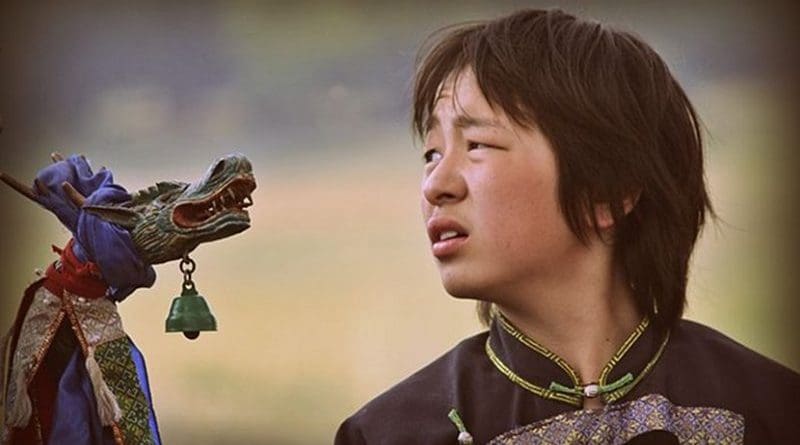
A Buryat boy in a shaman ritual in Siberia, Russia. Photo Credit: Аркадий Зарубин, Wikimedia Commons.
By Paul Goble
Of Russia’s four traditional faiths, Buddhism, the third largest, garners far less attention than any of the others. This gives Moscow a greater opportunity to sell its version of Buddhist life in the Russian Federation without being challenged, as it does with Russian Orthodoxy, Islam, and Judaism. Unsurprisingly, the Kremlin has long exploited this situation to influence Buddhist countries.
As its influence elsewhere has slipped since Russian President Vladimir Putin began his expanded war against Ukraine, Moscow has stepped up its efforts to shore up or win additional support among Buddhist countries abroad. Just how far the Kremlin is prepared to go was signaled last week when it attracted more than 7,000 Buddhists from across the world to the Third International Buddhist Forum that Moscow organized in Kalmykia and to which Putin sent an effusively warm message (Asia Russia, September 27; III Mezhdunarodniy Buddiyskiy Forum, September 28).
Moscow media coverage of the event, unsurprisingly, was uniformly upbeat. This did little to conceal the growing anger and divisions within the Buddhist community in Russia, however, which have now become so intense that some Buddhists there describe their faith as having become “a protest religion” (Ekho, January 29, 2023). Nor could it obscure the ways Moscow has been forced to tailor its policies toward Buddhists within the country to cope with Kremlin concerns about the reactions of Mongolia which supports Buddhist dissidents from Russia, and of the Peoples Republic of China (PRC), which, because it is concerned about Buddhism in Tibet, favors a more repressive line (Window on Eurasia, February 5, 2023, August 8; see China Brief, September 19).
As a result, and despite the Moscow headlines, the latest forum has only complicated the Kremlin’s relations with the Buddhists both inside the Russian Federation and abroad, with some of the former now pursuing independence from Moscow and some of the latter increasingly alienated by it (Readovka, September 26).
The Buddhists of the Russian Federation number approximately 1.5 million, far fewer than the Russian Orthodox or the Muslims, but more than the Jews. Most of them live in Kalmykia in the North Caucasus or in Buryatia and Tyva, east of the Urals along the Mongolian border. In the 1920s and 1930s, the Soviet government banned Buddhism in the Soviet Union, making it the only major religion to be treated in this manner. When Stalin restored the Russian Orthodox Church leadership during World War II, however, he also sought to revive the Buddhist communities. Between the end of that war and until very recently, the center of Russian Buddhism was in Buryatia (Lyudi Baikala, February 14, 2023).
Problems with the longtime head of that faith in that region, Moscow’s fears that Ulaanbaatar was exploiting Buddhism to promote pan-Mongolism at Russia’s expense, and concerns about the PRC reaction to the Buddhist leadership given Buryatia’s ties with the Dalai Lama and Tibetan Buddhism, however, led to a change (Window on Eurasia, February 10, 2024).
After forcing out the Buddhist leader of Kalmykia, who was also too close to the Buddhists of Tibet, Moscow allowed the renewed Buryatia Buddhist leadership to open an office in Moscow and challenge the Buryat Buddhists for dominance of that faith in Russia (Window on Eurasia, August 8, 2024).
The Kremlin also sought to regain control of the Buddhist community in Tyva, which had become increasingly independent-minded and where Buddhism appears to have played a huge role in helping to maintain and strengthen national identity (Window on Eurasia, June 4, 2021).
These problems had been intensifying since the 1990s, largely because Buddhism had played the role of a national religion in the three republics where it was dominant. They became much more serious, however, after Putin launched his expanded invasion of Ukraine in 2022 (The Moscow Times, January 13; Meduza, August 6).
Buryats, Kalmyks, and Tyvans were just as divided about the war as other nations in the Russian Federation. Their religious leaders were even more so than most, despite the reputation Buryats who did join the Russian army have acquired in the Russian and Western media for being especially savage fighters (Window on Eurasia, February 16, 2023; January 19).
Many Buddhists—the exact number is unknown but likely totals several thousand or more—opposed to the war in all three republics fled to Mongolia, where they were welcomed (Window on Eurasia, October 28, 2022, February 3, 2024, August 8). At the same time, Moscow’s increasing reliance on the PRC made it ever more sensitive to and prepared to address Beijing’s concerns about contacts between Buddhists in the Russian Federation and those in Tibet, as well as Tibetan emigration (Readovka, September 26).
While speakers avoided these topics in their official presentations, it is certain that the representatives of Buddhists from more than 35 countries there could see what is animating the three Buddhist nations in the Russian Federation and how Moscow is trying to rein them in (III Mezhdunarodniy Buddiyskiy Forum, accessed October 2).
Moscow is employing its traditional divide-and-rule strategy by holding the meeting in Kalmykia, rather than the traditional center of Buryatia, and by announcing plans to open a Russian Buddhist University not in either of those regions, but in Tyva. These delegates also certainly heard an earful from some Buddhists of the Russian Federation on the sidelines, and the visitors could see by who was not present—anyone from the Tibetan Buddhist community of the Dalai Lama—how Moscow was seeking to meet Beijing’s demands.
The world’s Buddhists appear to be aware that the three Buddhist republics in Russia are radicalizing rapidly. In Buryatia, for example, there have been a series of demonstrations against Putin’s war against Ukraine and even calls for carrying passports to prove citizenship so that Russian nationalists will not attack Buryats (Astra Press, June 14; seePromethean Liberation, July 29).
In Kalmykia, some anti-war activists have even joined a unit that has gone to Ukraine to fight the Russian invaders, and a survey there has found that even the security forces in Kalmykia would actively support a post-Soviet and anti-Russian regime (Kavkaz Realii, August 24, 2023; Vot Tak, February 1).
In Tyva, official statistics now show that the republic has become the place where residents and visitors are the most likely to suffer as a result of violence (Esli Bit Tochnim, August 18, 2023). To add insult to injury, Moscow has declared the national movements of all three terrorist organizations (Mediazona; Govorit Nemoskva, January 11).
Even taken together, this does not mean that the three Buddhist republics are about to declare independence, despite the hopes and even the predictions of some activists (Window on Eurasia, June 25, 2023). They are very small, isolated from one another, and landlocked. If the nationalist movements in them continue to grow and Moscow is forced to impose an even more repressive regime, however, the three will become even more radical, something that will be obvious to the world’s Buddhist community.
Moscow’s increasing deference to the PRC in its treatment of Buddhist faithful will also be visible. Those factors combined will make it unlikely that the Kremlin will gain the influence it seeks among Buddhists abroad, however many conferences, such as the one in Elista, it convenes.
- This article was published at The Jamestown Foundation’s Eurasia Daily Monitor Volume: 22 Issue: 131

Paul Goble
Paul Goble is a longtime specialist on ethnic and religious questions in Eurasia. Most recently, he was director of research and publications at the Azerbaijan Diplomatic Academy. Earlier, he served as vice dean for the social sciences and humanities at Audentes University in Tallinn and a senior research associate at the EuroCollege of the University of Tartu in Estonia. He has served in various capacities in the U.S. State Department, the Central Intelligence Agency and the International Broadcasting Bureau as well as at the Voice of America and Radio Free Europe/Radio Liberty and at the Carnegie Endowment for International Peace. Mr. Goble maintains the Window on Eurasia blog and can be contacted directly at paul.goble@gmail.com .
