Saturday, October 04, 2025

UN-backed climate banking alliance ceases operations

IT WAS ALWAYS GREENWASHING


By AFP
October 3, 2025


JP Morgan Chase was among six major US banks that quite the UN-back banking alliance following Trump's election - Copyright AFP/File Jim WATSON


BenoƮt PELEGRIN

The Net-Zero Banking Alliance, a UN-backed initiative seeking carbon neutral investments by banks, announced Friday its immediate shutdown — at a time of faltering climate commitments in the United States and Europe.

Launched in 2021 under the UN Environment Programme’s Finance Initiative, the NZBA aimed to get banks to slash the carbon footprint of their loans and investments, and help drive the transition to a net-zero economy by 2050.

At its peak, the group counted nearly 150 members.

But the alliance had been losing members since late last year, after Donald Trump won the US presidential election with his “drill, baby, drill” mantra promoting oil and gas production.

The NZBA had paused its activities in late August while waiting for the result of a vote by its members.

“Members of the Net-Zero Banking Alliance (NZBA) have voted to transition from a member-based alliance and to establish its guidance as a framework,” an NZBA spokesperson said in a statement.

“As a result of this decision, NZBA will cease operations immediately,” the spokesperson said.

The NZBA said banks can still use the initiative’s “Guidance for Climate Target Setting for Banks”, which focuses on decarbonisation targets.

“Individual banks worldwide can continue to use and reference these resources to help develop and deliver on their own net-zero transition plans,” it said.


– ‘Bitterly disappointing’ –


ShareAction, a London-based charity that advocates for responsible investment, lamented the end of the alliance.

“It’s bitterly disappointing to see the biggest banks in the world vote to step away from accountability around their commitments to prevent the worst effects of global heating,” said Jeanne Martin, co-Director of Corporate Engagement at ShareAction.

“Senior bankers need to be far more courageous in this decisive moment for all our futures and must use their influence to push up standards for accountability on climate if we are to stand any chance of making the clean energy transition happen,” Martin said.

Six major US banks — including JPMorgan Chase, Goldman Sachs and Bank of America — had already quit the alliance following Trump’s election, followed by Canadian and Japanese lenders.

British banking giant Barclays was one the latest to quit the alliance in August.

“With the departure of most of the global banks, the organisation no longer has the membership to support our transition,” it said at the time.

Earlier this year, NZBA softened its language on climate goals, turning “guidelines” into “guidance” and requirements into recommendations, according to internal documents seen by AFP.
French air traffic controllers cancel three-day strike


By AFP
October 4, 2025


French air traffic controllers have demanded better pay and conditions - Copyright AFP Michaela STACHE

French air traffic controllers have called off a three-day strike that threatened to disrupt European skies next week, a top union said on Saturday.

The main union in the sector, the SNCTA, announced the suspension of its “strike notice for October 7, 8 and 9” following consultations with the Civil Aviation Authority and “agreements reached” with the management.

The union has pushed for better pay and conditions.

The statement also referred to a promise by new Prime Minister Sebastien Lecornu not to ram his austerity budget through parliament without a vote, seen as a key concession to the opposition.

No other details were provided.

French air traffic controllers had initially planned to stage a strike in September and had later pushed it back to October.

The union has called for “a profound change in the management of operations”, complaining of “mistrust, punitive practices and humiliating management methods”.

On Friday, Ryanair, Europe’s largest airline by passenger numbers, said Europe’s worst performing air traffic controllers were in France, Spain, Germany, the UK, and Greece.

“Their governments refuse to ensure their ATC services are properly staffed and managed,” the airline said in a statement.

In early July, French air traffic controllers staged a strike that brought chaos to European skies. Then, flights booked by hundreds of thousands of people were cancelled at the start of the summer vacation period.

The industrial action in July was launched by smaller unions, while the SNCTA abstained.


Wall Street Warns of Nuclear Tech Bubble

  • Billions of dollars are being invested in advanced nuclear technologies, driven by increasing energy demand from AI and broad bipartisan support.

  • Despite significant investment, some Wall Street analysts are concerned about a potential bubble, citing a disconnect between fundamentals and valuations, leading to downgrades for some startups.

  • While near-term challenges exist, including supply chain bottlenecks, the long-term outlook for next-gen nuclear remains positive with global pledges to triple nuclear capacity by 2050.

Billions of dollars are flowing into cutting-edge nuclear technologies, from nuclear fusion experiments to small modular reactors and microreactors that backers say will catalyze a global nuclear power renaissance. But after years of buzz and successful funding rounds, these Wall Street darlings have yet to send any of their promised carbon-free energy to the grid. 

In 2024, investments in advanced nuclear companies from both private equity and venture capital hit an all time high. According to S&P Global, last year's investments “surpassed the total deal value of the past 15 years combined.” The push for next-gen nuclear energy has accelerated on the back of growing energy demand projections driven by the proliferation of AI integration.

“The single biggest driver in the paradigm shift we're seeing right now in the power sector comes down to data centers,” Jackson Morris, director of state power sector policy at the Natural Resources Defense Council, was recently quoted by Marketplace. “Load growth for electricity that we had already forecasted is now coming 10 years sooner and five times as fast because of data centers and these facilities largely being built by the big hyper scalers like Amazon, Google, Microsoft, etc.”

In addition to the AI boost, nuclear energy startups have benefitted enormously from the political upheaval currently ensnaring renewable energy technologies. For now, nuclear power remains one of very few carbon-free energy sources with broad bipartisan support, both in the United States and abroad. In the past few months, nuclear holdouts in Europe have started to loosen nuclear restrictions and publicly adopt a more pro-nuclear stance, and the United States and the United Kingdom unveiled a new nuclear partnership. An, just this week, United States Energy Secretary Chris Wright “cast a renewed vote of confidence in cutting-edge nuclear power technology this week” according to reporting from Semafor. 

However, this confidence is being undercut by some Wall Street analysts, who smell a bubble in the making. Semafor reports that “in general, the hysteria around power demand is pushing the valuations of many newly public energy startups beyond what they will realistically be able to deliver.” Dimple Gosai, head of U.S. clean tech equity research at Bank of America, told the news outlet that “the disconnect between fundamentals and valuation is too wide to ignore.”

Related: OPEC+: Reuters Leaks on Oil Plans Again

Oklo, a small modular reactor (SMR) startup backed by AI bigwig Sam Altman, may prove to be such a cautionary tale. While the company’s share values have fared well since its 2024 IPO, the Bank of America downgraded its rating from “buy” to “neutral” just this week. It also downgraded NuScale, another SMR startup, NuScale, from “neutral” to “underperform.”

Axios Pro has also begun to report on investors looking to make a hasty exit from the market via SPAC mergers. SPACs, sometimes referred to as “blank check companies” are shell companies with no existing assets or operations at the time that they go public, making them an ideal “escape hatch” for investors getting cold feet about next-gen nuclear startup companies who want to offload the risk elsewhere. “This is the epitome of dumping on retail investors," a venture funder told Axios Pro.

This isn’t to say that next-gen nuclear is a lost cause. It still has enormous potential, and will likely be a critical component of the clean energy transition in coming years – but not this year. The sector must first overcome significant bottlenecks “including limited supply chains for nuclear fuel and containment vessels, and the familiar red tape for construction permitting and grid interconnection.” But while investors may have gotten ahead of themselves in terms of near-term bullishness, the policy environment is encouraging for those with a longer-term outlook. Dozens of countries have pledged to triple nuclear capacity by 2050, and startup-backed SMRs and microreactors are sure to be a significant part of that global push. 

What’s Next for Energy Markets? 

A new conflict in the Middle East... a surprise OPEC+ decision... a massive shift in Chinese demand. Most investors only react to the headlines.

Oilprice Intelligence brings you the signals before they become front-page news. This is the same expert analysis read by veteran traders and political advisors. Get it free, twice a week, and you'll always know why the market is moving before everyone else.

You get the geopolitical intelligence, the hidden inventory data, and the market whispers that move billions—and we’ll send you $389 in premium energy intelligence, on us, just for subscribing. Join 400,000+ readers today. Get access immediately by clicking here. 

By Haley Zaremba for Oilprice.com


Norway’s Aggressive Push for Electric Planes

  • Norway conducted its first intercity electric test flight with the Alia CX300, aiming to replace hundreds of short-haul fossil-fuel flights.

  • The government is investing in charging infrastructure and adapting its 44 airports to support a nationwide rollout of electric aviation.

  • With EV adoption already the highest in the world, Norway is positioning itself as a global leader in green transport and sustainable aviation.

Norway is looking to launch a domestic electric plane service to replace the dozens of daily fossil-fuelled flights to its many islands. If successful, this could encourage other countries to launch similar domestic services. This follows successful test runs of various electric flights in several countries that signal a new era of electric flight in the coming years, although the commercial rollout of electric passenger planes may still be several years away.

In September, Norway conducted a pilot flight of its electric-powered Alia CX 300, making it the first electric plane to fly from one major city to another in Norway. The flight carried empty cardboard boxes, representing cargo, and the aim is to make the aircraft suitable for carrying passengers. While the 160-km journey would take roughly four hours using two ferries, the Alia would reduce the journey time to 55 minutes.

Despite being Europe’s largest oil producer, after Russia, and the fourth-largest natural gas exporter globally, Norway has long invested in a shift away from fossil fuels to green alternatives to power domestic power, heating, and transport. The government is supporting a nationwide electrification campaign, targeting net-zero carbon emissions. This will be achieved by making oil and gas production electric-powered, continuing to invest in green electricity for power, and shifting to a green transport sector, which has been more challenging.

The Scandinavian country already uses electric ferries to transport passengers from island to island, and its airport authority, Avinor, is supporting the shift to electric commercial flight for the short-hop flights known as “milk run routes”. There are roughly 560 domestic flights in Norway, and over 75 percent of these travel fewer than 400 km.

Beta Technologies, the helicopter company Bristow, and Avinor ran the first Alia CX300 pilot flight test this month and hope it will be the first of many. The Alia, developed in Vermont by Beta Technologies, has a wingspan of just 15 metres and can reach a speed of just over 200 km an hour, powered by five batteries.

Related: New Quantum Breakthrough Could Lead to Super-Efficient ElectronicsOne of the main drawbacks to electric flight is the weight of the batteries needed to power an aircraft, which can weigh around 50 times as much as the conventional fuel used to power it for the same amount of energy. In addition, because the battery remains on board throughout the flight, as it discharges, it does not get any lighter, unlike spent fuel. The lifecycle of such large batteries is also limited, as experts warn that they may degrade quickly with regular charging. Extreme weather conditions, such as ice and strong winds, may add to this rapid degradation.

However, if operators can successfully develop batteries suitable for flight and recharge, electric aircraft could be significantly cheaper to maintain than conventional planes, as they don’t have components such as a gearbox or hydraulic system, which are expensive to maintain. To date, Beta’s longest successful flight on a single charge has been 622 km. The battery can be charged using a standard electric vehicle fast charger in just 20 to 40 minutes, which shows great promise for the refuelling turnaround.

Related: EU and NATO Consider Denying Russia Baltic Access

The government supports the shift to green flight and invested $5 million in support of the pilot test. It plans to continue investing in the sector, aiming to adapt Norway’s 44 airports for electric flight. Norway’s airport authority has already constructed an electric charging station at Stavanger airport.

Norway’s electric vehicle (EV) uptake has soared in recent years, as many consumers support a shift to green. In 2024, EVs in Norway contributed 88.9 percent of new cars sold, marking an increase from 82 percent in 2023, the highest uptake percentage of EVs in the world, according to the Norwegian Road Federation. There are now over 10,100 public EV chargers across the country. This suggests that most Norwegian consumers would be open to electric flights, as the electrification of the country’s transport sector is already well underway.

Norway is not the only country trialling electric flights, as Beta Technologies also completed a pilot 200-km flight between SĆønderborg and Copenhagen in neighbouring Denmark in July with its ALIA CTOL. The Danish government aims to launch its first fully electric flight route in 2025 and hopes to make all domestic routes fossil fuel-free by 2030. It recently introduced a $2 charge per passenger on flights to help finance research and development into sustainable domestic flight. Several European countries have introduced targets for sustainable aviation and are testing electric aircraft from various emerging companies.

Meanwhile, in the U.S., Beta is gaining traction, and its competitor Archer Aviation recently announced that its flagship Midnight eVTOL aircraft completed its longest piloted flight yet, travelling with a pilot for 31 minutes across 88 km. Several other startups are expected to test similar domestic flights across the U.S. in the coming years.

What’s Next for Energy Markets? 

A new conflict in the Middle East... a surprise OPEC+ decision... a massive shift in Chinese demand. Most investors only react to the headlines.

Oilprice Intelligence brings you the signals before they become front-page news. This is the same expert analysis read by veteran traders and political advisors. Get it free, twice a week, and you'll always know why the market is moving before everyone else.

You get the geopolitical intelligence, the hidden inventory data, and the market whispers that move billions—and we’ll send you $389 in premium energy intelligence, on us, just for subscribing. Join 400,000+ readers today. Get access immediately by clicking here. 

By Felicity Bradstock for Oilprice.com


Mali army holds back 70 Allied Gold trucks as militants block fuel imports

Sadiola gold mine is located in southwest Mali. (Image courtesy of IAMGOLD)

Mali’s military has prevented about 70 fuel trucks from travelling to Allied Gold’s Sadiola mine after al Qaeda-linked militants imposed a blockade on fuel imports to the landlocked country, two people familiar with the matter said.

Fuel supplies are dwindling at the remote gold mine, located some 650 km (400 miles) from the capital Bamako, they said.

Mali’s military government, which took power after coups in 2020 and 2021, is facing growing pressure from militant groups who analysts say are trying to encircle cities and towns in the Sahel region.

“We are telling all traders who import diesel and gasoline into Mali, whether from Ivory Coast, Guinea, Senegal, or Mauritania, to stop doing so until further notice,” a Jama’at Nusrat al-Islam wal-Muslimin (JNIM) militant spokesperson said in a video announcing the blockade in early September.

“Why? Because these bandits in power are persecuting people, closing their gas stations, and cutting off fuel to villagers under the pretext that they are supplying jihadists.”

In recent weeks, armed forces have kept many of the fuel tankers destined for Sadiola in the town of Diboli on the border with Senegal, while several others are being held in the town of Kayes, about 75 km north of Sadiola, until soldiers can escort the trucks to the site, both sources said.

Three tankers managed to reach the site under military escort this week, one of the sources said.

In Mali, companies can sometimes wait weeks or months to secure military escorts due to limited availability.

Spokespeople for Allied Gold and for the Malian military did not immediately respond to requests for comment.

Last month, at least 40 fuel tankers were destroyed when insurgents attacked a convoy of more than 100 vehicles under military escort heading for Bamako.

In May, militants attacked a convoy transporting heavy mining equipment from Bamako to Sadiola, underscoring widening security risks facing mining companies operating in a military-led country struggling to contain jihadist groups.

(By Portia Crowe; Editing by Robbie Corey-Boulet and Mark Heinrich)


Anglo American takes Peabody to arbitration over failed $3.8B deal


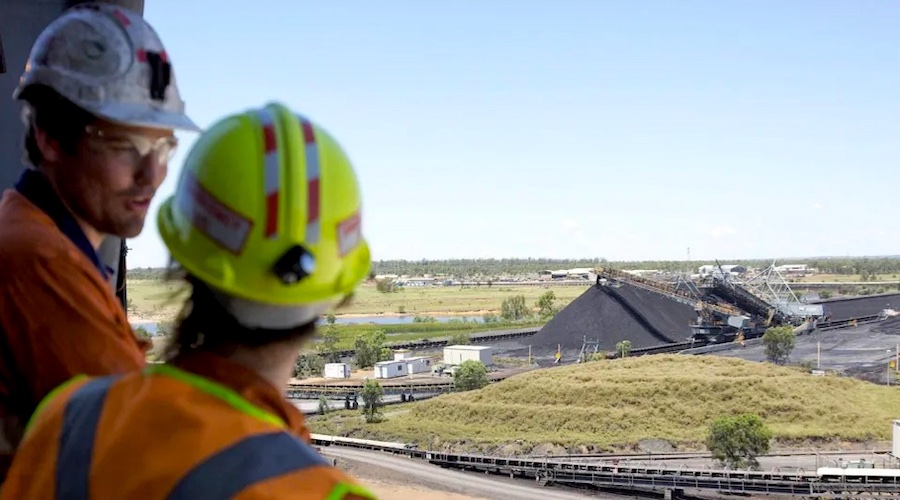
Moranbah North coal mine. (Image courtesy of Anglo American.)

Anglo American (LON: AAL) has launched arbitration proceedings against Peabody Energy (NYSE: BTU) after the US coal producer pulled out of a $3.8 billion agreement to acquire its Australian steelmaking coal assets.

The deal collapsed in August when Peabody invoked a “material adverse change” clause following a fire at Anglo’s Moranbah North mine in Queensland. The underground blaze, triggered by high gas levels, forced operations to halt in April and gave Peabody grounds to withdraw under the contract.

Anglo had planned to sell the Bowen Basin mines, located in the world’s top steelmaking coal region, as part of a broader strategy to divest non-core assets following last year’s failed takeover attempt by BHP (ASX: BHP).

Peabody said in a regulatory filing Friday that it remains confident the mine fire qualified as a material adverse change, justifying the deal’s termination. The company also revealed Anglo has so far refunded $29 million of a $75 million deposit and demanded repayment of the remainder “without further delay.”

Analysts have warned arbitration could drag on until late 2026 and force Anglo, the world’s third-largest seaborne exporter of steelmaking coal, to restart the sales process in a weaker price environment.

For Peabody, the acquisition would have expanded its footprint in metallurgical coal, critical to steelmaking. Still, analysts had questioned the $3.8 billion price tag, which nearly doubled the market value of the St. Louis-based miner at the time.

Shares of Peabody jumped nearly 10% Friday to $32.20, giving the company a $3.93 billion market capitalization. Anglo’s stock rose 1.44% to 2,804p in London, valuing the miner at £33.24 billion ($45 billion).


U.S. Navy Scales Up Additive Manufacturing for Critical Sub Parts

Lincoln
Courtesy Lincoln Additive Manufacturing

Published Oct 1, 2025 9:15 PM by The Maritime Executive


Welding equipment manufacturer Lincoln Electric has been a big player in U.S. Navy shipbuilding since at least the Second World War, when a massive construction effort drove demand for its arc welding technology. Today, it has also become a leading player in 3D metal printing, not by selling equipment, but by manufacturing printed parts from start to finish - and once again the Navy is tapping Lincoln's technology to accelerate shipbuilding needs.

Additive manufacturing (3D printing) is usually picked for rapid prototyping, complex part shapes or small production runs. Its per-unit costs tend to be higher than casting methods, but the fixed costs for setup and tooling are lower, and the turnaround is much faster. For the U.S. Navy's submarine industrial base, speed and quality are more important than price, and the service is looking for any means possible to de-bottleneck its supply chain for the Virginia-class and Columbia-class nuclear submarine programs. Additive manufacturing fits the bill and will soon be put to the test in a large-scale contract. 

Sponsored by the Navy's Maritime Industrial Base Program, sub builder Electric Boat will begin buying unspecified critical components made by Lincoln Electric at its factory in Cleveland, the company announced Tuesday. The project is big enough to require four large-scale wire arc additive manufacturing printers. It is Lincoln's largest government-backed capital investment to date in additive manufacturing. 

"Material availability continues to drive construction delays across the submarine enterprise," said Ken Jeanos, vice president of supply chain at General Dynamics Electric Boat. “3D-printed parts have the potential to accelerate construction and delivery of submarines to the U.S. Navy by cutting lead times for critical components.” Electric Boat's engineering teams have been working with additive manufacturing technology for some years, Jeanos said, and the firm has a longstanding relationship with Lincoln. 

The welding firm has already been 3D-printing unspecified submarine components for some time under contract to engineering giant Bechtel. Early last year, Lincoln announced that it had won an award to print 10-foot-wide propulsion parts weighing up to 20,000 pounds each. 


Colonna’s Shipyard Invests $79 Million in Norfolk

Colonna's Shipyard

Published Oct 4, 2025 8:17 AM by The Maritime Executive

 
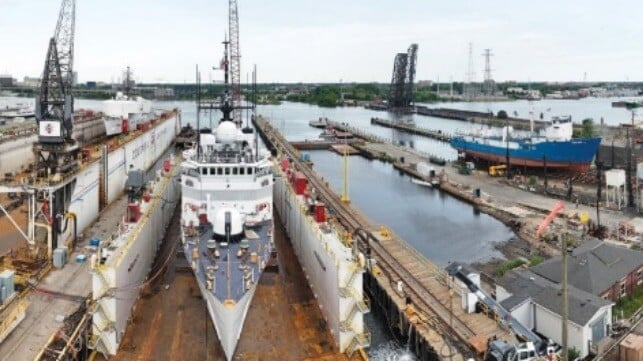
Colonna’s Shipyard, Inc. (CSI) is acquiring its fourth drydock, marking a significant milestone for the oldest continuously operating family-owned shipyard in the United States. According to company officials, the new drydock represents a major company investment of over $79 million. Drydock #4 is expected to have an approximate lifting capacity of 25,000 tons, positioning CSI to further enhance its capabilities in providing critical ship repair and maintenance services to a diverse range of maritime clients. 

“‘Made in America’ means ‘Made in Virginia,’ and with this major investment by Colonna’s Shipyard, that is especially true for America’s naval shipbuilding and commercial maritime industry,” said Governor Glenn Youngkin. “The acquisition of this new drydock is not just an investment in infrastructure, it’s an investment in the long-term strength of our national defense and commercial fleet support. I congratulate CSI on this exciting new chapter and applaud their ongoing commitment to growth in the Commonwealth of Virginia. Together, we’re ensuring that Virginia remains the premier hub for shipbuilding and repair on the East Coast and across the nation.” 

“I’ve witnessed first-hand the growth and success of Colonna’s Shipyard over the years,” said Secretary of Transportation W. Sheppard Miller III. “As home to the world’s largest military installation, a best-in-class port and other top-tier infrastructure, there’s no better place for Colonna’s Shipyard to make this strategic investment. I’m excited to see shipbuilding continue to thrive in the Commonwealth as our nation renews focus on this critically important industry.”  

“This new drydock acquisition is a testament to our continued dedication to quality service, on-time delivery, and our steadfast focus on the future,” said Randall Crutchfield, Chairman & CEO of Colonna’s Shipyard, Inc. “The expansion of our drydock capacity will further strengthen our ability to serve both our commercial and government clients, ensuring that we can meet their ever-evolving needs with unmatched expertise and reliability. This investment is also a continued commitment to our employees and the economic vitality of Norfolk’s industrial working waterfront, which has been an integral part of our success for over a century.” 

“Colonna’s Shipyard has been a cornerstone of Norfolk’s economy and maritime identity for more than 145 years,” said Norfolk Mayor Kenny Alexander. “This $79 million investment not only strengthens Norfolk’s position as a national leader in ship repair and innovation, but also reflects the company’s enduring commitment to our people, our port, and our future. The expansion of Colonna’s drydock capacity will create opportunity, sustain good-paying jobs, and ensure our city’s working waterfront continues to thrive for generations to come.” 

The Drydock #4 Project is slated for delivery in the first half of 2028, continuing CSI’s ongoing efforts to expand and modernize its facilities to meet the growing demand for ship repair and conversion services. Over the past decade, Norfolk-based CSI has invested more than $150 million to grow shipbuilding and sustainment capacity within its U.S. facilities.
 

Note: Colonna's Shipyard was featured in the May/June 2025 issue of The Maritime Executive. 

The products and services herein described in this press release are not endorsed by The Maritime Executive.


Despite Sanctions, Russia's Arctic LNG 2 Plant is Up and Running

The site for Arctic LNG 2 in the Gulf of Ob, early in construction (Novatek)

Published Oct 2, 2025 10:10 PM by The Maritime Executive


With extensive help from Chinese interests, Russian gas producer Novatek is making headway in its efforts to circumvent Western sanctions on its Arctic LNG 2 plant in the Siberian Arctic. 

The remote Arctic LNG 2 facility was designed to be assembled at a large shipyard in three sections, each built on floating concrete pontoons. One by one, the pontoons would be towed into place at a terminal on the Gulf of Ob, then permanently sunk to rest on the bottom of a specially-prepared berth. This plan was moving smoothly until 2022, when Russia invaded Ukraine and the west imposed stringent sanctions on the plant's construction. Train 1 was installed in 2024, but Train 2 was delayed because of export bans on key parts from Western suppliers. The second train finally started operations just last month. 

China's government (through state-owned enterprises) holds a 20 percent share in Arctic LNG 2. At present, Chinese gas companies are the plant's only customers, drawn by discounted prices - and undeterred by the threat of American sanctions. 

This week, the LNG carrier Arctic Vostok arrived in Beihai and offloaded Arctic LNG 2's seventh cargo. As the winter ice season approaches in the Russian Arctic, it may be among the last this year, but that has not stopped Novatek from reaching for new records. On Wednesday, Bloomberg reported that the plant averaged 18 million cubic meters of gas liquefaction per day during September, about 14 percent above the previous record. The surge may be short-lived, as Arctic LNG 2 will have to shut down when the eastbound navigation season is over.

Novatek had planned to create a wider seasonal window for shipping Arctic LNG 2's product by building a fleet of icebreaking LNG carriers, as it did to enable exports from the neighboring Yamal LNG terminal. Sanctions scuttled this project as well: South Korean shipbuilder Samsung Heavy Industries paused work on a joint 15-ship construction venture with Russian yard Zvezda in February 2022, as soon as Western restrictions began to kick in. Zvezda retaliated by canceling the project and filing a lawsuit, and SHI reciprocated by terminating the contract. Without Korean assistance, the pace of construction at Zvezda has languished, and none of the ships in the series have yet entered commercial service. The first, Aleksey Kosygin, began sea trials this year but was back in drydock again by mid-July, according to Arctic consultant Ben Seligman.  


Helsinki Court Dismisses Charges in Case of Cable Damage by Tanker Eagle S

Tanker detained in Finland
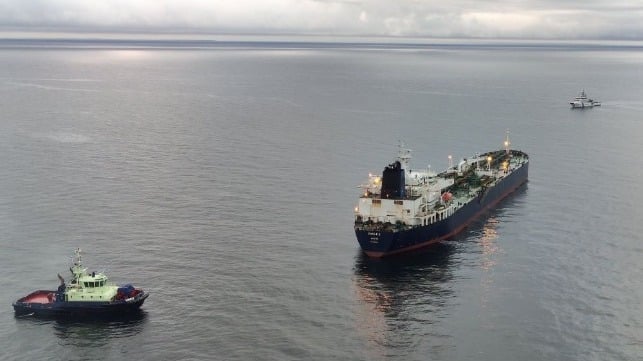
Tanker Eagle S was detained till March 2025 as the investigation proceeded (Finnish Coast Guard)

Published Oct 3, 2025 12:47 PM by The Maritime Executive


The Helsinki District Court issued a surprise judgment on Friday, October 3, in the case of the master and two officers from the tanker Eagle S who had been charged with aggravated vandalism related to the damage to subsea cables. While saying the damage had occurred due to the failure of the anchor mechanism, the court ruled that it lacked jurisdiction and that it was not possible to apply Finnish criminal law to the case.

The master of the product tanker Eagle S, along with the first and second officers, was on trial for the damage to five subsea cables caused by the tanker dragging its anchor for nearly 60 miles along the Baltic seafloor. The incident took place on December 25, 2024, and Finland became the first European country to pursue legal charges, with the trial beginning at the end of August.

After six months of investigation and more than a month of court testimony, the District Court found that anchor loss was due to a failure of the anchor securing mechanism. Prosecutors had argued the officers should have been aware of the poor maintenance of the vessel and said the anchor incident was an accident “waiting to happen,” due to the condition of the ship. They argued negligence in the officers’ duties, saying they should have realized the anchor had fallen and was dragging and corrected it sooner.

The charges were brought due to the consequences for Finland’s power supply from the one damaged cable, as well as the interruption to communications from the four damaged internet cables. The court ruled, however, that the consequences of the incident did not result in the level of damage required to satisfy the statutory definition of criminal mischief or aggravated criminal mischief.

The court concluded that the incident should be classified as a navigation incident, and as such, it falls under the United Nations Convention on the Law of the Sea. While it happened within Finland’s Exclusive Economic Zone, the damage would have to be in the country for the criminal law to apply. Instead, under the UN treaty, the legal jurisdiction lies with the flag state of the vessel, in this case, the Cook Islands, or the defendant’s native state. The master and first officer are Georgians, and the second officer is from India.

Prosecutors argued the officers were responsible and should have been aware when the speed of the vessel suddenly declined. The defense argued it was an accident and that the chief engineer said the speed decline was due to an engine problem. They also blamed heavy weather for contributing to the loss of the anchor.

The Eagle S stopped in Finland and was boarded by Finnish forces the day after the incident. They held the vessel till March 2025 for safety violations as the investigation into the cable damage proceeded. Eight crewmembers and the master were also ordered not to leave Finland, with one released the following month and five more released at the end of February. The Helsinki District Court lifted the travel ban for the master and the two officers in September at the end of the trial, and they have all left Finland. 

The court noted that there was no allegation in the case of the defendants’ having intentionally damaged the five subsea cables. Further, while there had been wide speculation linking the incident to Russia, there was no discussion of Russia in the charges. However, it came out in court that the vessel’s Voyage Data recorder was not functioning, and there were allegations that the ship’s manager told the master to destroy communications and not provide information during the investigation.

The jurisdictional issues raised in Finnish law cast doubt on other efforts to prosecute similar instances of cable damage despite the allegation that it is part of a cloaked hybrid form of war. There have been several unresolved cases of damage in the Baltic and elsewhere. Taiwan prosecuted a captain of a Chinese-owned cargo ship in a case of cable damage, and China has started a trial related to an October 2023 incident when a Chinese-owned containership, the NewNew Polar Bear, also dragged its anchor in the Baltic, damaging a gas and telecom pipeline connecting Finland and Estonia.

The incident with the Eagle S created a new level of awareness and concern over the potential damage to undersea assets. The Scandinavian and Baltic countries, NATO, and the UK have all increased their monitoring of assets. This week, the Europeans announced new efforts aimed at the shadow fleet of tankers after new allegations that the vessels are linked to drone incidents taking place over Northern Europe. Russia has vowed to protect the tankers and called the inspections interference and piracy, while the EU is intent on interrupting the vessel to protect the environment, guard against possible sabotage, and disrupt Russia’s income from the oil trade.