Saturday, October 04, 2025

Trump isn't just retreating from the world — here's how he's helping to end it

 Common Dreams
October 3, 2025 


Ours would be the normal story of imperial powers rising and falling on Planet Earth — nothing new there, of course — if it weren’t for one thing: the fact that this world, too, is now falling.


Unfortunately, nothing is truly normal about this planet of ours anymore, as the slow-motion equivalent of atomic weaponry goes off in our already distinctly overheating atmosphere. And though he’s seldom thought of that way, President Trump, the — who would once have believed it? — second time around, should be considered an all-too-literal embodiment of some mad human urge to turn this planet into a (once almost unimaginable) disaster zone. He would, in fact, be truly unbelievable, if what’s happening to this planet at this very moment weren’t even more so.

We’re distinctly in a 21st century from hell and yet “our” president continues to act as if this were still the 20th (if not the 19th) century. Under other circumstances, it might seem little short of amusing, but not on this planet, not in 2025, not in a world drying out at a remarkably rapid pace, not on a planet to whose atmosphere we humans have “added about 200 billion more tons of carbon dioxide-equivalent greenhouse gases” just between 2020 and 2024. (And if you’re already sweating, I don’t blame you!)

If you want to know what century Donald Trump is in, check out his recent visit (his second!) to — yes! — Great Britain to meet King Charles III and Queen Camilla. And what a dinner the king and queen threw for him with “some of the wealthiest, most influential, and best connected people in the world all together at one long table inside a nearly-thousand-year-old castle.”

It was so wonderfully 20th, if not 19th, century! Of all places to pay the only visit of his second term in office so far, Trump chose to travel back in time, which is, of course, no small thing, to an era when Great Britain and its royalty mattered globally in order to offer an imperial bow to a planet that functionally no longer exists.


But honestly, you shouldn’t have been surprised. Though you might not have noticed — few have made a point of it — Trump is indeed living in the wrong century. In his brain, I suspect, he’s still in the era when, after the Soviet Union collapsed in 1991, this country became the planet’s sole superpower. He’s still in the century in which Elvis was king. He’s still in the time when tariffs (“I am a Tariff Man“) actually mattered.


Oh wait, wasn’t that the 19th century of President William McKinley who, as Trump has claimed, “made our country very rich through tariffs and through talent”?

Admittedly, the president did go to Great Britain accompanied by AI executives, and that certainly made him look reasonably modern, but don’t be fooled, not for a second. Strange as he may be in some deeper sense, he distinctly is Donald J. (Been There, Done That) Trump. And in retrospect (if, of course, there even is a retrospect), I think it will be all too clear that, by identifying with Big Oil, Big Gas, and Big Coal, and turning his back on climate change and the 21st century, while putting tariffs from another age on much of other nations’ economic dealings with the United States, he will have turned this very planet of ours over to the place — China — that’s producing twice as much green power as the rest of the world combined and madly developing the equipment to produce more of it (not to speak of electric vehicles), while already starting to sell its green products around the world. Phew!

Trump, on the other hand, has essentially declared war on green energy and, in doing so, has in his own strange fashion declared war on the American people, modernity, and the future of this country, not to speak of this planet. And yet, all too sadly, doing exactly that got him elected president a second time.


After all, he ran his winning presidential campaign in 2024 on, above all else, a slogan that couldn’t have been blunter about his vision of the future — “drill, baby, drill“ — and he now seems intent on ensuring that the world-record profits of the five big oil companies and the estimated investment by banks of almost $7 trillion in the fossil-fuel industry since the Paris Climate Agreement went into effect in 2016, will indeed remain a, if not the, crucial part of our future, not our past. (Only recently, at the United Nations, he called climate change “the greatest con job ever perpetrated on the world,” while praising “clean, beautiful coal.”) And that should be considered his way of turning that very future over to China.

He’s also using tariffs from another age, in his own striking fashion, to reject and cut the U.S. off economically from much of the rest of this planet, while giving China the economic edge it needs to thrive — at least to the degree that anyplace can thrive on a world that’s literally going to hell in a handbasket (even if in relatively slow motion). Long ago, in 2017, New York Times columnist Thomas Friedman suggested, however tongue-in-cheekily, that Trump might actually be a Chinese agent. He pointed out then that, in his first weeks in office, the president had already taken his “Make China Great campaign to a new level … by rejecting the science on climate change and tossing out all Obama-era plans to shrink our dependence on coal-fired power.”

Drill Baby Drill

Now, more than eight years later, Trump seems, if anything, intent on doubling down when it comes to rejecting any thought of dealing with climate change, while still focusing remarkable energy (and I use that word advisedly) on helping the oil, natural gas, and coal industries prosper.

Think of the drill-baby-drill president as, in his own way, a satanic force (since the result will be heat of an unparalleled nature). China, on the other hand, continues to put striking amounts of money and (again, excuse the word) energy into the creation of a green-energy economy. Yes, I know that it also continues to produce and use staggering amounts of coal at record rates (though its use of carbon energy is expected to peak soon), but it’s already beginning to sell green-energy equipment — wind turbines, solar panels, and electric cars — globally in a fashion not faintly equaled by any other country.

In that sense, it visibly represents the future (if there is to be any future) on planet Earth, while Trump’s version of America represents an increasingly devastating past. Typically, for instance, while doing his damnedest to get rid of wind power in this country, Trump only recently made a deal with the European Union in which he forced those countries to agree to buy another $750 billion of American natural gas and oil by the end of his second term in office (and while such sales may, in the end, prove something of a fantasy, the point remains).


If the American people had declined Trump the second time around, we might be in a somewhat different situation, but (explain it as you will) no such luck. Whether we realize it or not, we Americans are, it seems, still living somewhere in the 20th century in energy (and perhaps other) terms.

Yet you may not even know it, since he’s so intent on making the free press into the freeze press, both by working hard to restrict what information reporters can get from his world and by suing anyone who writes something that displeases him. Add to that his functional takeover of the Justice Department (which past presidents had given a certain level of independence) and you know that we’re in a new world in a sense that no one who once used that phrase to describe America would recognize.

So, welcome to an American present and future that’s functionally a terrifying version of the past, Trump-style. In fact, get used to it, since over (minimally) the next three years and three months, if you’re living in the United States, we’re going to have quite a ride ahead of us. (And remember, he’s never ruled out a third term in office. To hell with the Constitution!)

Who Knows What’s Ending?


Give us all the credit we deserve. We humans are distinctly strange creatures. We’re creative in so many ways and yet, historically speaking, we seem to have been and continue to be incapable of not making war on one another. And bad as that may have been once upon a time, it’s even worse today, since militaries, even at peace but especially when making war, pour startling amounts of greenhouse gases into the atmosphere. (Keep in mind, for instance, that a 2024 study indicated “the U.S. military’s carbon output as of 2022 exceeded that of nearly 140 national governments.”)

And don’t think that Trump is an exception to the rule (any rule) on planet Earth right now when it comes to creating future atmospheric chaos. After all, at this very moment, there are three major wars occurring that have relatively little to do with the United States. There’s Russia’s war on Ukraine, Israel’s war on Gaza and surrounding areas (admittedly, heavily supported by the Trump administration, which is now planning to send another $6.4 billion in weaponry to that country), and a disastrous civil war in Sudan (largely ignored by the rest of the world).


Worse yet, none of them show any signs of ending any time soon. Only recently, of course, India and Pakistan also briefly went to war with each other. And if you want to ensure that this planet grows ever hotter ever faster, there’s hardly a better way to do it than by making war, since such conflicts pour greenhouse gases into the atmosphere at a remarkable rate.

And of course, Trump is cementing his singular power in place in ever more significant ways. They range from deploying at least 35,000 National Guard and other troops to American cities and the border with Mexico to going after seemingly random ships in the Caribbean Sea and blowing them to smithereens, while gathering American naval and air power there in preparation for a possible war on Venezuela — and who knows where else?

In short, in a remarkable fashion, in significantly less than a year of his second term in office, Trump has succeeded in steering what not so long ago was the greatest power on planet Earth to the planetary margins in a big-time, possibly even historically unique fashion. And count on this (but take a breath first): with at least three-plus years to go, he (or do I mean He?) is only beginning. Yes, this is just the start of … well, who really knows what? The only thing you can truly count on is that, whatever it may be, it’s already guaranteed to be a historical disaster of the first order for this country (and, unfortunately, the rest of the planet, too).

It’s hard even to imagine having a president at this very moment who is literally incapable of taking in the most dangerous and devastating thing that may ever have happened on or to planet Earth. I mean, honestly, just try to take that in yourself for a moment.


Think of Donald Trump (though he’d hate it!) as the Surrender President who, in his own striking fashion, is turning the U.S. into a distinctly declinist power on a distinctly declinist planet.

And all of this is indeed and all too literally something new under — yes! — the sun (and nothing but the sun). Welcome, in short (or, given the nature of climate change, do I mean “in long”?), to Donald Trump’s (ever)hot(ter) world. Think of him, in fact, as both the surrender and the hell-on-earth president.


Tom Engelhardt, co-founder of the American Empire Project, runs the Type Media Center's TomDispatch.com. His books include: "A Nation Unmade by War" (2018, Dispatch Books), "Shadow Government: Surveillance, Secret Wars, and a Global Security State in a Single-Superpower World" (2014, with an introduction by Glenn Greenwald), "Terminator Planet: The First History of Drone Warfare, 2001-2050"(co-authored with Nick Turse), "The United States of Fear" (2011), "The American Way of War: How Bush's Wars Became Obama's" (2010), and "The End of Victory Culture: a History of the Cold War and Beyond" (2007).
'You didn’t congratulate us!' World leaders burst into laughter mocking Trump at meeting


Travis Gettys
October 2, 2025 
RAW ST0RY


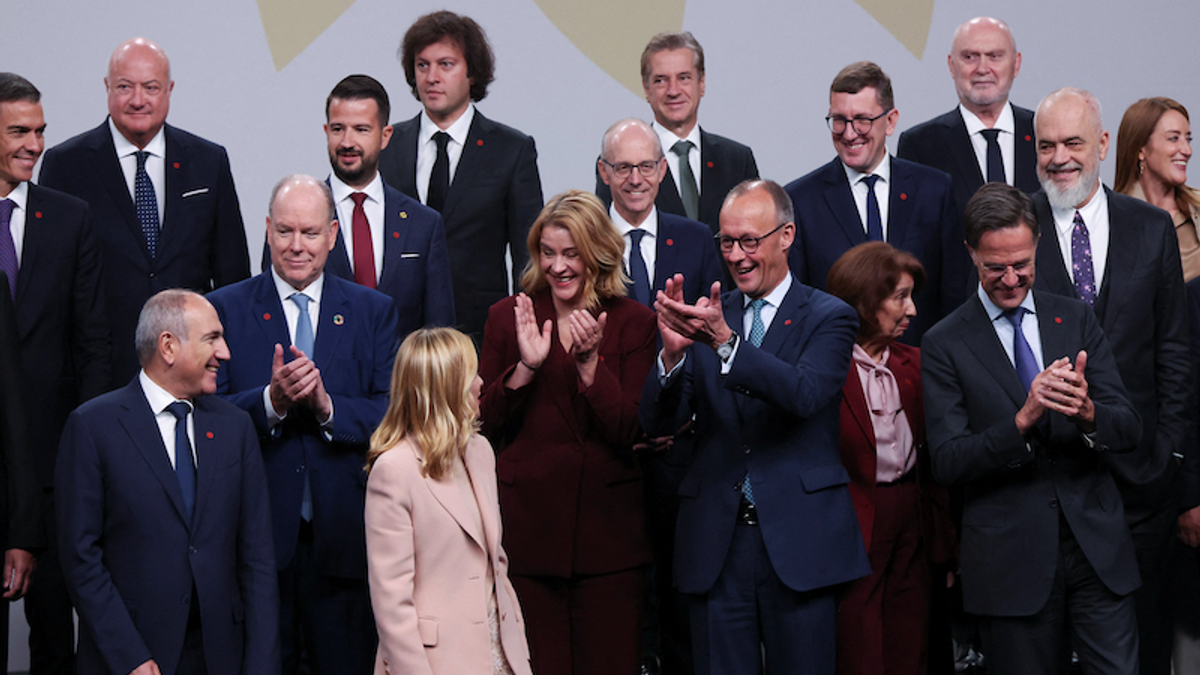
Italian Prime Minister Giorgia Meloni, German Chancellor Friedrich Merz, NATO Secretary General Mark Rutte, Spanish Prime Minister Pedro Sanchez, Albania's Prime Minister Edi Rama react as they pose for a family photo at the European Political Community summit, in Copenhagen, Denmark, October 2, 2025. REUTERS/Suzanne Plunkett/Pool


Several world leaders made fun of President Donald Trump's boasts about ending a war between their countries.

Albanian Prime Minister Edi Rama was caught on video mocking the U.S. president Thursday with French President Emmanuel Macron and Azerbaijan President Ilham Aliyev at a European Political Community summit in Denmark, reported Politico.

“You should make an apology … to us because you didn’t congratulate us on the peace deal that President Trump made between Albania and Azerbaijan,” Rama told Macron in the video, and Aliyev burst out laughing.

"I'm sorry for that," Macron replied, drawing more laughter from bystanders.

"He worked very hard," Rama added.

Trump has repeatedly mixed up Armenia and Albania when claiming to have resolved long-standing tensions between Armenia and Azerbaijan – the latter of which he has been unable to properly pronounce – to angle for a Nobel Peace Prize.

“I solved wars that was unsolvable. Azerbaijan and Albania," Trump told Fox News last month. "It was going on for many, many years, I had the prime ministers and presidents in my office."

The president did broker a deal at the White House in August between the leaders of Armenia and Azerbaijan to end decades of fighting, and he frequently – and falsely – boasts to have ended at least six other conflicts.


'Wild to see': CNN anchor astonished by hurricane forecast

JUST ANOTHER REASON TO SAVE NOAA

Travis Gettys
October 1, 2025 
RAW STORY


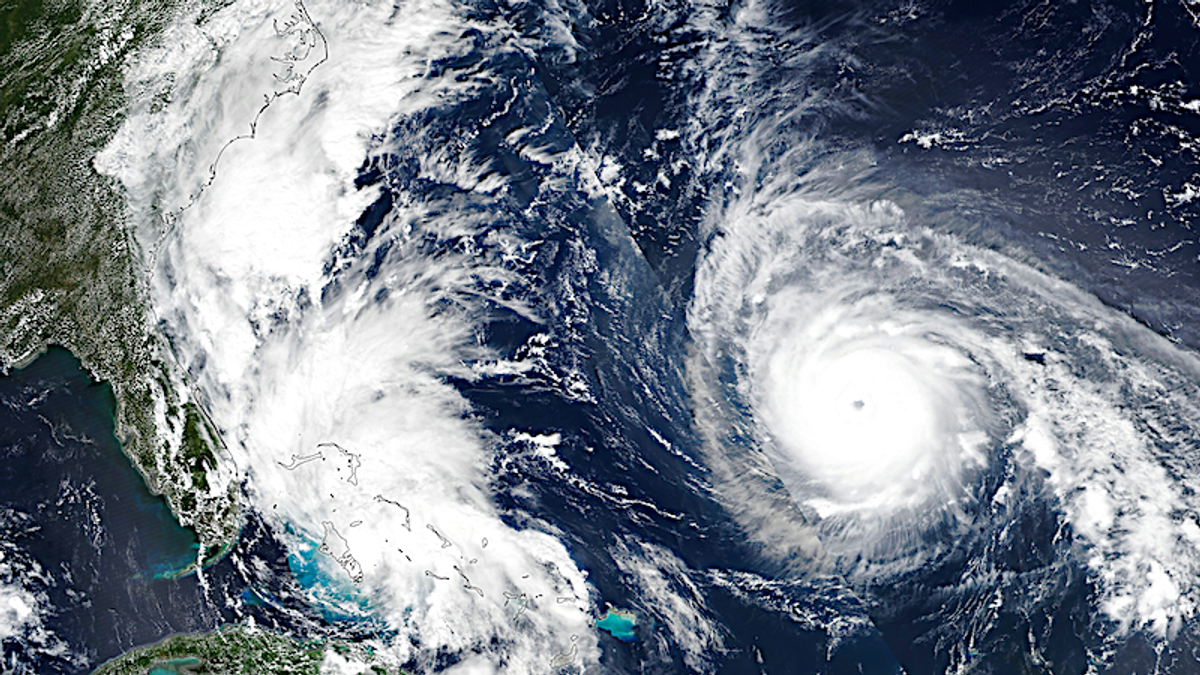
Hurricanes Humerto and Imelda/NASA

A pair of hurricanes are churning up dangerous rip currents and huge waves along the Atlantic coast and battering Bermuda with a powerful one-two punch.

Hurricanes Imelda and Humberto are spinning in the western Atlantic Ocean this week after collapsing five unoccupied houses along North Carolina’s Outer Banks, and CNN's Derek Van Dam told viewers what to expect from the powerful storms.

"It's amazing that this was the straw that broke the camel's back," Van Dam said, as video footage showed the collapsed beachfront homes. "Remember, we've had several powerful offshore storms this hurricane season. Hurricane Erin a couple of weeks ago, an unnamed coastal storm. They are really eroding our coastal defenses, so we are watching in real time this slow-motion climate disaster that continues to threaten the same areas as these large, powerful storm systems work their way offshore, and that is the situation we have right now.

"Believe it or not, it was Humberto waves, long-period swells, and that consistent northeasterly wind that set up behind these two hurricanes that battered the Outer Banks and threatened once again those coastal communities and those coastal homes, inevitably allowing them to fall back into the ocean. Remember a couple of years ago, a couple decades ago, they had prime beachfront, real estate, right?"

"All right, so look at what's happening with Imelda, and that still, that northeasterly flow battering the same regions, the Chesapeake Bay," Van Dam continued. "Look out, Norfolk, Virginia Beach, the Outer Banks, 40- to 50-mile-per-hour wind gusts today from the northeast, continuing over the next 36 hours. You add on top of that high tide that's a little bit higher than what we've experienced the past couple of days, so we're going to combine all these with these long-period swells developing from both Humberto and Imelda, and that means we have the potential for coastal erosion in the same locations.

"Hopefully we don't get any more of this, because what a mess. Look how difficult that is to clean up. We're so thankful that no one was inside and no one was hurt, but look at the rip current risk all along that 2,000 miles of coastal real estate on the East Coast, and guess what? The threat is not done in terms of a landfalling hurricane."

"Imelda has got its eyes set on Bermuda tonight," the weather anchor added. "That's go time, overnight tonight, we could be in the eye of yet another hurricane in Bermuda. That island taking yet another beating. What a thing. Look at the satellite, Kate. Some eye candy to leave you with."

CNN's Kate Bolduan was astonished by the satellite images showing the two hurricanes massing over the ocean, "wrapping around each other," as Van Dam described them.

"It is wild to see those two huge storms churning so closely together," she said. "It is wild, wild to see."
Global farm productivity growth stalls, raising risks for food and markets


By Dr. Tim Sandle
DIGITAL JOURNAL
October 2, 2025


Farmers in many regions are already experiencing longer dry spells, unseasonable heatwaves and erratic weather due to climate change - Copyright AFP/File STR

Innovation in agriculture is falling dangerously behind the demands placed on farmers and agri-food systems. This is the stark headline from a new academic report. The report discusses straining future supplies of critical products such as eggs, cotton, and corn- and soy-based biofuels.

The report, titled Global Agricultural Productivity (GAP) Report, comes from Viginia Tech.

At the centre of the report is total factor productivity (TFP), an efficiency measure that tracks how effectively agricultural inputs such as land, labour, and capital are converted into outputs.

The TFP model organises existing and emerging technologies, practices, and management tactics into four domains, helping investors, policymakers, researchers, and innovators pinpoint what is holding growth back — and where opportunities lie.

TFP growth is widely regarded as a barometer of innovation in agriculture. However, global TFP growth has dropped to just 0.76 percent annually during the past decade, barely a third of the 2 percent target needed to sustainably meet demand by mid-century.

Addressing this problematic TFP growth plateau is essential to keeping food and agricultural products available and affordable, ensuring farmers are profitable, and protecting environmental systems, according to the report’s authors.

This will be challenging since these goals face obstacles in the form of global trade disruptions and declining public research investment slow progress.

Problems with U.S. agriculture

Take the case of the U.S. Here productivity growth of the past decade has fallen behind its competitors. Between 2011-20, U.S. agricultural productivity growth declined, decreasing an average 0.05 percent annually, while China surged ahead with 1.9 percent annual growth, fuelled by double the research and development (R&D) investment of the U.S.

The risk is that without renewed gains, farmers will not be able to make a sustainable living providing vital goods to the economy. To counterbalance this, the report argues for a step-change in public research spending and innovation systems so that farmers have affordable, effective productivity-enhancing tools.

The report offers four recommendations to reinvigorate U.S. growth:

Reignite public R&D investment

Public R&D spending is the cornerstone of sustainable productivity growth. Decades of underinvestment have slowed the pace of discovery. Evidence suggests that pushing out the TFP Growth Frontier will require increasing public agricultural R&D investment by $2.2 billion, comparable to the post–World War II expansion of the U.S. research enterprise.

Close the adoption chasm

Accelerating the adoption of productivity-enhancing technologies, practices, and management tactics across all scales of production is essential to reaching the TFP Growth Frontier. Closing the gap between innovation and adoption requires a revitalized agricultural knowledge and innovation system with coordinated support across financial, infrastructure, and human capital dimensions.

Strengthen the regulatory environment

A modern, efficient, and science-based regulatory framework is critical to reducing innovation bottlenecks and ensuring the timely deployment of productivity-enhancing technologies. For example, the current Coordinated Framework for Biotechnology, established in 1987, has not kept pace with scientific advancements, resulting in prolonged and costly approval processes for genetically engineered traits and crop-protection technologies

Foster public-private collaboration

Bridge the “valley of death” between research and widespread adoption through close collaboration between public and private stakeholders. Public investment often catalyses breakthroughs, while the private sector excels at scaling and deployment.

Using data to lead sustainable growth

In terms of the practical value of the report, the introduction states that investors, decision-makers, and policymakers must be able to identify the causes of productivity growth stagnation in unique contexts around the world, and implement evidence-based approaches that remove barriers, expand productivity growth ceilings, and shift agricultural systems into new domains and opportunities.

One of the answers to this is with using rich streams of data. Such data needs to be not only accurate but also actionable, so it can be used to overcome obstacles that are preventing the growth necessary to secure a sustainable future. Data acquisition has been supported by Google Public Sector and Appnovation, in order to develop a tool in the form of the GAP IQ is a next-generation data intelligence platform. This AI platform is designed to improve decision-making in agriculture.


Written ByDr. Tim Sandle

Dr. Tim Sandle is Digital Journal's Editor-at-Large for science news. Tim specializes in science, technology, environmental, business, and health journalism. He is additionally a practising microbiologist; and an author. He is also interested in history, politics and current affairs
'Anxiousness and frustration' hits red state as Trump serves 'bitter pill': rural leader


Cami Koons,
 Iowa Capital Dispatch
October 4, 2025 


Tom Adam, Iowa Soybean Association president, farms near Harper, Iowa, in Keokuk County.
 (Photo by Joclyn Kuboushek/Iowa Soybean Association)

Iowa Soybean Association President Tom Adam urged the Trump administration, in a statement Thursday, to prioritize a trade deal with China and to support soybean farmers who are without their biggest market.

China typically buys 60% of global soybean exports, and the U.S. used to be China’s preferred supplier until it turned to Brazil during the trade wars of the first Trump administration.

Now, China appears to have turned to Argentina for its soybeans, and U.S. farmers worry they’ll be stuck with a bountiful harvest and nowhere to sell it.

China placed an order with Argentina shortly after the U.S. agreed to a $20 billion bailout deal with the South American country. According to the American Soybean Association, China typically purchases soybeans from the U.S. before harvest begins. A couple weeks into the harvest season in Iowa, and China has not placed an order, presumably in protest of U.S. tariffs on Chinese goods.

“Agriculture thrives when America leads on trade,” Adam said in the statement. “We can’t afford to let uncertainty and political maneuvering erode the markets farmers have spent decades cultivating.”

Adam said the mood in rural Iowa is one of “anxiousness and frustration” because of “trade policy that’s severely straining relationships” with key trade partners.

Adam, who also farms near Harper, said President Donald Trump’s current trade policies are a “bitter pill” for farmers, despite the fact that many farmers voted to elect Trump.

“With strong yields and a nearly ideal harvest season underway across Iowa and large sections of rural America, grain bins will soon be filled with quality U.S. soy that needs to find a home,” Adam wrote.

An Iowa State University report from July estimated that reciprocal tariffs – where the country places the same tariff amount on U.S. goods as the U.S. has placed on their goods — could cause losses between $191 million and $1.49 billion to the Iowa soybean industry.

While soybeans stand to lose the most, according to the report, the corn, ethanol and hog industries in Iowa were also projected to lose hundreds of millions because of the reciprocal tariffs.

ISA urged the administration to broker a trade agreement with China that “immediately expedites soybean purchases.”

President Trump has expressed plans to meet with Chinese President Xi Jinping at a trade summit at the end of October, but Adam said every day without a Chinese trade deal “closes the window tighter” on the “critical” sales period for soybeans between October through February.

The release from Iowa Soybean Association said this year, Iowa farmers are set to harvest about 550 million bushels of soybeans across 9.3 million acres.

With no soybean sales to China currently on the books, farmers are worried they’ll have to find a place to store their crops, or find a different market.

Adam also urged Congress to “provide immediate trade mitigation funding” to farmers to tide them over until a deal can be reached.

U.S. Sen. Chuck Grassley said Tuesday that farmers would rather have a market to sell into than rely on a government payout. He also said the administration might find a solution using tariff money instead of congressionally allocated funds.

Adam said a federal farm payment was “not ideal” but that it would “enable many farmers to survive another year.”

Finally, the Iowa Soybean Association president asked the administration to finalize Renewable Volume Obligations – something EPA proposed earlier this year – to boost the biofuels industry. A boost in this industry would give farmers another soybean market to sell into.


“The crop is here,” Adam said. “The quality is proven. The demand exists. What’s missing is the resolve to reconnect America’s farmers with a world of buyers who want to purchase our soybeans.”

This story was originally produced by Iowa Capital Dispatch, which is part of States Newsroom, a nonprofit news network that includes Missouri Independent, and is supported by grants and a coalition of donors as a 501c(3) public charity.


'We've lost a lot of contracts': GOP senator admits Trump trade policy now hurting farmers


Alexander Willis
October 3, 2025 

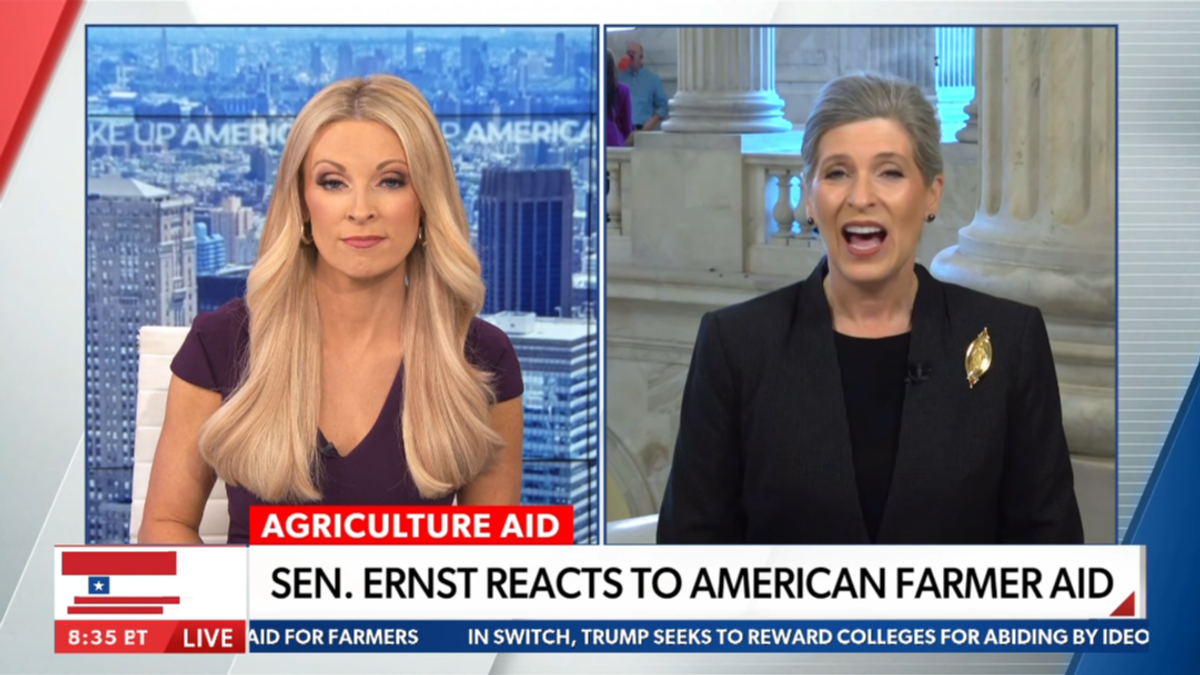
Screengrab / Newsmax

China’s recent boycott of American soybeans may end up costing American farmers billions of dollars, and, according to one Republican senator, blame should be placed directly on President Donald Trump’s trade policy.

“China is just not budging on this, and unfortunately, we've lost a lot of soybean contracts due to these... elongated negotiations,” Sen. Joni Ernst (R-IA) admitted Friday while appearing on Newsmax.

China announced the boycott following Trump’s on-and-off again tariffs on the Asian nation, which in April were raised to as high as 125% before being brought back down as a temporary tariff truce. Given China is, by far, the largest importer of American-grown soybeans, the boycott has left farmers enraged, with Trumpreportedly in panic, considering providing farmers with a $10 billion bailout.

Asked about the potential bailout for farmers, Ernst said farmers were not happy with the offer, and stressed the need to find a way to end China’s boycott, rather than subsidize American crop growers.

“Unfortunately, our farmers do need that assistance,” Ernst said. “They don't like it, they do consider it welfare, they want trade not aid, and so we really need to see some of these new markets opening up around the globe. We need to see additional domestic consumption of our commodities like soybeans and corn.”

Ernst has had a tumultuous relationship with the MAGA movement, with critics accusing the Iowa Republicans of “trying on a MAGA suit” to mixed results. She’s demonstrated a strong allegiance to Trump and frequently votes in accordance with his agenda, though has faced scrutiny from MAGA figures for being insufficiently loyal to the president, particularly after reports that she was skeptical of Trump’s pick for Defense secretary, Pete Hegseth.

Perhaps in an effort to signal her continued loyalty to Trump, Ernst’s parting words on the matter of the potential bailout for farmers were ones of praise for the president.

“But if there's anybody that can make a deal, it's President Trump, so we'll continue to hope for the best and we'll help our farmers where and how we can,” Ernst said.


US farmers hit by trade war to get ‘substantial’ aid: Treasury chief

TOO LITTLE, TOO LATE, IF AT ALL

By AFP
October 2, 2025


Farmers are a key political support base for President Donald Trump, but have been caught in the crossfire as Washington and Beijing traded barbs - Copyright AFP/File JIM WATSON

US Treasury Secretary Scott Bessent signaled Thursday that “substantial support” for farmers would be announced next week, particularly for those growing soybeans, as they struggle with fallout from President Donald Trump’s trade conflicts.

Worries have been growing for weeks of a major hit to farmers, a key part of Trump’s political base, as exports to China dry up over tariffs instituted by Beijing in retaliation to US levies.

“You should expect some news on Tuesday on substantial support for our farmers, especially the soybean farmers,” Bessent told CNBC early Thursday.

The Wall Street Journal also reported Thursday that President Donald Trump is mulling $10 billion or more in aid to American farmers as the trade tensions take a toll.

The Trump administration is considering using revenue collected from the president’s tariffs to fund much of this support, the Journal reported, with the money potentially distributed in the upcoming months.

Asked about the matter, White House spokesperson Anna Kelly said Trump and Agriculture Secretary Brooke Rollins “are always in touch about the needs of our farmers, who played a crucial role in the President’s November (election) victory.”

“He has made clear his intention to use tariff revenue to help our agricultural sector, but no final decisions on the contours of this plan have been made,” she told AFP.

Bessent did not provide figures in his interview with CNBC either, but said: “They’ve had President Trump’s back, and we’ve got their back.”

Farmers have been particularly caught in the crossfire as Washington and Beijing imposed tit-for-tat tariffs on each other’s exports.

On Wednesday, Trump said that he planned to push Chinese President Xi Jinping on purchases of US soybeans when they meet in the coming weeks.

The leaders of the world’s two biggest economies are expected to speak in around four weeks, on the sidelines of an Asia-Pacific Economic Cooperation (APEC) summit in South Korea.

The American Soybean Association warned in August that Beijing’s retaliatory tariffs were shutting US farmers out of their biggest export market going into the 2025 harvest — with China being a top global buyer of soybeans.

But Beijing’s counter tariffs, after Trump targeted Chinese goods with fresh duties, has stunted sales to the country. Instead, Chinese buyers have relied more on other exporters like Brazil and Argentina.

“Nobody wants to trade with us,” said Jonathan Driver, a soybean farmer in Arkansas.

While farmers can still sell their crops, he warned that many are selling them for a loss.

“It’s going to put several people out of business,” he told AFP. “And we’ve had prices of everything continue to go up.”
Leaked messages reveal stunning plan to deploy elite military division to Dem city

Alexander Willis
October 4, 2025 
RAW STORY


Top Trump administration officials were discussing plans to deploy an elite military division to Portland, Oregon, according to leaked text messages reviewed and reported on by the Minnesota Star Tribune late Friday.

“Between you and I, I think [Defense Secretary] Pete [Hegseth] just wants the top cover from the boss if anything goes sideways with the troops there,” wrote Patrick Weaver, Hegseth’s advisor, in a text message on the encrypted messaging app Signal, according to the Minnesota Star Tribune.

“82nd is like our top tier [quick reaction force] for abroad. So it will cause a lot of headlines. Probably why he wants [Trump] to tell him to do it.”

Hegseth has already deployed 200 National Guard troops into Portland at the direction of President Donald Trump. But, according to Weaver’s messages, plans were actively being discussed to deploy the Army’s 82nd Airborne infantry division, an elite military unit that specializes in rapid deployment and parachute assaults.

Weaver’s messages were sent to Deputy Homeland Security Advisor Anthony Salisbury and other high-level officials, with Salisbury receiving said messages and responding – sometimes “profanely” – while in “clear view of others” during an event in Minnesota, leading one individual who was “troubled by seeing sensitive military planning discussed so openly” to contact the Minnesota Star Tribune with images of the text messages, and under the condition of anonymity.

White House spokesperson Abigail Jackson declined to comment on the subject matter of the test messages to the Minnesota Star Tribune, but did chastise the outlet for “shamefully” reporting on the information, and called its reporters “morally bankrupt.”

The 82nd Airborne division has been deployed in both world wars, and most subsequent wars the United States has been involved in. While its deployment in Portland would be unprecedented, Hegseth – according to the Minnesota Star Tribune’s reporting – was at least actively considering it, and awaiting explicit approval from Trump to give the order.Trump has justified his order to deploy troops to Portland by calling the city “war-ravaged,” with the deployment coming after deployments in Chicago, Illinois, Washington, D.C. and Los Angeles, California


Air traffic controllers warn of US shutdown strain

DON'T FLY U$ SKIES


By AFP
October 1, 2025


The funding halt means some 13,300 US air traffic controllers and thousands of other essential aviation safety officials must work without pay 
- Copyright AFP/File ANDREW CABALLERO-REYNOLDS

Aviation groups urged US political leaders to quickly resolve a budget impasse Wednesday, warning that the government shutdown strains air travel and delays key upgrades.

The closure has led to staff furloughs throughout the government, even as vital functions such as aviation safety proceed.

Some 13,300 US air traffic controllers and thousands of other essential safety officials must work without pay, according to a Department of Transportation (DOT) operational plan.

The shutdown could delay key initiatives to recruit additional air traffic control staff and undertake a multi-billion modernization of the US air traffic control system, said the National Air Traffic Controllers Association.

“Congress must act now to end this shutdown,” said NATCA President Nick Daniel.

“When the federal government shuts down it introduces unnecessary distractions and our entire aviation system is weakened. Congress must restore federal funding so that the safety and efficiency of our National Airspace System is not compromised.”

NATCA said 2,350 aviation professionals in its membership have been furloughed, including aircraft certification engineers and aerospace engineers.

In all, the Federal Aviation Administration has furloughed more than 11,300 out of its 44,800 employees, according to the DOT shutdown plan.

It listed activities that will “cease” during the funding gap including aviation rulemaking, air traffic performance analysis, investment planning, and financial analysis and audit.

Airlines for America, which represents leading US carriers, urged congressional leaders to quickly remedy the situation.

“When federal employees who manage air traffic, inspect aircraft and secure our nation’s aviation system are furloughed or working without pay, the entire industry and millions of Americans feel the strain,” the trade group said.

“We appreciate the men and women who will be going to work, despite not receiving a paycheck, to ensure the safety and security of the traveling and shipping public.”
Deepfake political scam ads surge on Meta platforms, watchdog says


By AFP
October 1, 2025


Meta: — © AFP RONALDO SCHEMIDT
Anuj CHOPRA

Scammers are among the top political ad spenders on Meta’s platforms, using deepfake videos of American politicians — including President Donald Trump — to promote fake government benefits, a watchdog group said Wednesday.

The nonprofit Tech Transparency Project said it identified 63 scam advertisers that collectively spent $49 million on Facebook and Instagram, often targeting seniors with ads promoting fake stimulus checks, government spending cards and healthcare payments.

The ads have reached tens of thousands of the platforms’ users.

“The findings show how scammers are taking advantage of advances in artificial intelligence technology, public confusion around the status of social safety net programs, and lax Meta content moderation to target new victims,” TTP said in a report.

“Meta is allowing this activity even though it prohibits scams and says it invests in scam prevention to keep users safe,” it added.

Meta did not immediately respond to AFP’s request for comment
.


US consumers face an explosion of online fraud, with surveys showing a growing number of adults experiencing scams or attacks – Copyright AFP SEBASTIEN BOZON

TTP’s report quoted a Meta statement saying that the company would “invest in building new technical defenses” as scammers “constantly evolve their tactics to try to evade detection.”

According to Meta’s rules, advertisers who seek to run political ads in the United States have to undergo a special authorization process, which involves submitting an official ID such as a driver’s license along with a US mailing address.

TTP said all of the 63 scam advertisers — who accounted for over 150,600 political ads — had their advertisements removed by Meta within the past 12 months for violating the tech giant’s policies. Still, nearly half of them continued to advertise as of Tuesday.

Meta appeared to disable 35 ad accounts, but only after they ran dozens — and in some cases hundreds — of ads. Six of the accounts spent over $1 million before they were disabled or deleted, the report said.

One advertiser identified by TTP — called the Relief Eligibility Center —- ran an ad on Meta platforms in April and May featuring a deepfake video of Trump falsely promising stimulus checks to Americans.

The video matched a speech by Trump in the White House’s Rose Garden in early April, but TTP found that the words in the ad did not match the official transcript from the event.

The ad, which directed users to a website to get a “FREE $5,000 Check from Trump,” appeared to target men and women over the age of 65 in more than 20 US states, TTP said.

For years, professional fact-checkers have warned about bogus stimulus check offers circulating on social media platforms.

The latest findings underscore the explosion of online fraud, with surveys showing a growing number of American adults experiencing internet scams or impersonation attacks.

In August, the Federal Trade Commission reported a more than four-fold increase since 2020 in complaints from older adults who lost $10,000 or more — sometimes their entire life savings — to scammers impersonating trusted government agencies or businesses.
Open wide: AI receptionists are becoming more popular for dental practices


ByDr. Tim Sandle
DIGITAL JOURNAL
October 1, 2025


Dr. Miguel Herrera installs dental implants for an American patient at the Rubio Dental Group offices Algodones, Mexico - Copyright AFP / File Chris DELMAS

Since May 2025, some 65 UK dental practices have deployed a 24/7 AI receptionist, following advances with access to large language models and conversational AI technology. Since May 2025, the joint 24/7 AI receptionist has answered over 50,000 patient calls. Other areas of impact, according to collated data, include:Zero missed calls, previously up to one in three patients could not get through
£9M in revenue recovered
2,000 staff hours freed from call handling
Stronger patient satisfaction and retention

In terms of efficiency, 96% of calls fully resolved by AI, 4% escalated to staff. Furthermore, across the pilot sites 500 new patients were booked monthly, with booking rates rising from 18% to 70%.

These figures appear to present the advantages of AI cutting costs and boosting financial outcomes as well ascustomer experience simultaneously.

The development comes from Wildix, who create AI-powered business communications solutions, and RoboReception, a UK based healthcare software provider. The two companies state that the rollout demonstrates how agentic voice automation relieves frontline pressure, improves patient experience and provides measurable value.

Missed calls remain one of healthcare’s biggest problems. Over a third of new patient calls go unanswered and most never call back in the field of dentistry. Those who get through face long waits and low booking rates, leaving practices with lost revenue and patients without timely care.

To address this, AI style receptionist can provide a workable solution. Wildix–RoboReception system seeks to close this gap by combining Wildix’s UCaaS platform powered by Wilma AI and RoboReception’s dentist-designed agentic workflows. Unlike traditional systems, this configuration gives practices oversight: determining when AI engages, when staff intervene and how records are updated, with seamless escalation to a live agent.

According to Grant McAree, co-founder, RoboReception: “We were never taught business at dental school, only how to serve patients. Yet every missed call meant a patient lost and pressure piling on our teams.”

McAree expands on this: “I’ve lived that moment, drill in hand, while the phone rang unanswered. That’s why we built RoboReception, not a plug-and-play gadget, but a controllable system created by clinicians for clinicians. Together with Wildix, we’ve proven AI can work hand-in-hand with staff, giving practices back control and patients the access they deserve.”

The system replaces fragmented front-desk tools with a single platform that connects to patient records, CRM and scheduling to book appointments, update records and transfer calls in real time. Focus CX credited Wildix’s open APIs and engineering support for rollout in weeks, a speed described as “unheard of” in healthcare technology.
Dutch warning over ‘annoying’ chatbots


By AFP
October 2, 2025


Chatbots are seen as one of the greatest annoyances 
- Copyright AFP OLIVIER MORIN

Dutch authorities told companies and organisations on Thursday they should not rely solely on chatbots to communicate with consumers, describing their use as “one of the biggest annoyances” customers face.

“Organisations that use chatbots in their services must always offer people the option to speak with a representative,” said the Dutch Data Protection Authority (AP) in a statement.

Firms must also ensure consumers are aware they are interacting with chatbots and that the machines do not provide evasive or incorrect answers, the AP said.

The watchdog voiced concern about the growing use of AI-powered chatbots and warned that regulators would be looking into stricter rules.

“Chatbots are becoming the main point of contact and the path towards human content is fading,” the AP said in a new report.

Increasingly advanced chatbot technology means consumers do not know whether they are speaking to a human or a machine, the report said.

After an initial unsatisfying interaction with a chatbot, consumers are often re-directed not to a human but to another chatbot, increasing frustration, said the AP.

Officials are seeing a “rapid increase” in complaints about chatbots, said the Dutch Authority for Consumers and Market (ACM).

“Recent research by the ACM shows that the lack of human interaction in customer service is one of the biggest annoyances.”

The Dutch authorities urged the European Commission to establish clear guidelines for the design of AI-powered chatbots.

“These must be fair, recognisable, and accessible. And people must not be misled,” said the AP.