Monday, October 06, 2025

Water scarcity forces a rethink of Tehran's dominance

Water scarcity forces a rethink of Tehran's dominance
Water scarcity forces a rethink of Tehran's dominance. / bne IntelliNews
By bnm Tehran bureau October 3, 2025

When Iran’s President Masoud Pezeshkian broached the idea of relocating Iran's capital southward to the Persian Gulf coast in 2024, he was ridiculed. This year, on October 1, during a visit to Hormozgan province, Iran's president returned to the theme with renewed urgency. The proposal, he insisted, is no longer a matter of choice but of survival. Tehran is running out of water­ — fast.

A plan to move the economic and political capital of more than 9mn people in the main metropolitan area has been on the card for decades, but thanks in part to poor planning, overuse of resources and climate change, the plan to shift the bulk of the population away from the foot of the Alborz mountain range is gaining momentum backed by the presidency.

Discussing the matter with the Supreme Leader Ali Khamenei’s office (which is also in Tehran), he apparently stressed the urgency of the move in the next few years before the Iranian capital hits what South Africa already discovered, “day zero”, the day when the last drop of water comes out of the tap.

Last year, the capital received just 140mm of rainfall, barely half the 260mm threshold considered sustainable. Groundwater depletion has caused land subsidence of up to 30cm annually in some districts. Importing water from the south would cost €4 per cubic metre — about IRR5mn, or roughly $10 at current exchange rates.

"If we cannot establish this balance," Pezeshkian warned, "our development is doomed to failure."

His diagnosis goes beyond hydrology. Tehran, Karaj and Qazvin suffer from what the president calls "development without regard to the balance between resources and consumption" — decades of unplanned growth that have created a megacity of 16mn-18mn people in an increasingly arid region. Before the 1979 revolution, planners reportedly recommended shifting 60% of the population towards the Persian Gulf. Instead, development concentrated around Tehran. The result is a cautionary tale in urban planning gone awry.

Pezeshkian's solution involves not merely relocating government offices but fundamentally reorienting Iran's economic geography. He has sought permission from Khamenei to engage foreign consultants in designing comprehensive development plans for the south — hundred-year blueprints, he suggests, or even two-hundred-year ones. No concrete action has yet materialised.

The economic logic is compelling and needed. Iran produces 8mn barrels of oil and gas daily. A 10% reduction in consumption would save 800,000 barrels per day (bpd), worth $16bn-18bn annually. "We haggle over $1bn today," the president remarked to Hormozgan's business community, highlighting the magnitude of potential savings through efficiency alone.

Yet fiscal indiscipline undermines such rational planning. President Pezeshkian acknowledged that the government and parliament bear joint responsibility for inflation. "One of the main causes of inflation is precisely this development without financial backing," he explained. "We define development when we have no money, then we print money to cover costs—and that means inflation." The result: diminished purchasing power and deeper poverty.

During the Hormozgan visit, the government approved 287bn tomans ($5.7m) in provincial credits, with 44 projects signed across energy, education, health and water sectors. Foreign investment of €178m and domestic investment exceeding 80bn tomans were also finalised. Many expatriate Hormozganis, the president noted, stand ready to invest in their home province — if only the government provides the right conditions.

In September last year, the president said: "We have no choice but to move the country's political and economic centre closer to the southern waters." He said that continuing the current trend of development in Tehran is unsustainable, particularly given the water scarcity.

Whether this marks a genuine turning point or mere rhetoric remains uncertain. Iran has announced grand development schemes before, only to see them fueled by sanctions, mismanagement and competing priorities.

UPDATED: Security forces repel attempt to storm Georgian presidential palace

UPDATED: Security forces repel attempt to storm Georgian presidential palace
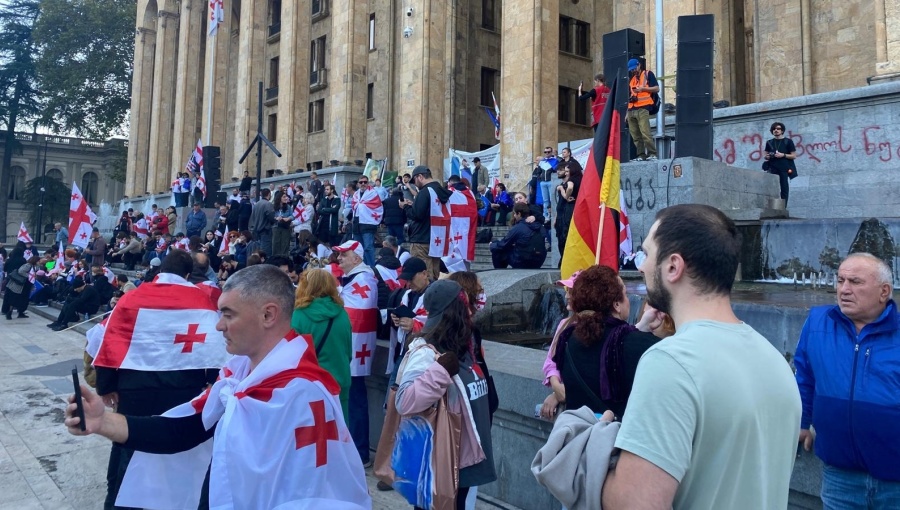
Protesters gathered outside Georgia's presidential palace ahead of a mass rally on October 4. / bne IntelliNews
By bne IntelliNews October 4, 2025

Protesters in Georgia attempted to storm the presidential palace in Tbilisi on the evening of October 4, video reports from the site showed. The dramatic scenes came as tens of thousands of people gathered for a huge demonstration on the day of the country’s local elections. 

Opposition activists had hoped the huge demonstration on local election day would revitalise the protest movement that has endured for almost a year, and had called in advance for a “peaceful overthrow” of the government. 

However, while the numbers — an estimated 100,000 — were high, the opposition did not mobilise to achieve this goal, and the crowds were dispersed by 9pm. 

This keeps Georgia in its months-long stalemate between the protesters and government, in which the government continues to have the upper hand and consolidate its grip on power. 

Election boycott 

The protest took place on the day of Georgia’s local elections, which many opposition parties are boycotting in protest at what they call the authoritarian rule of the Georgian Dream party and its founder, billionaire Bidzina Ivanishvili. 

Figures from the Central Election Commission (CEC) showed that as of 5pm local time, just three hours before polls were due to close, the turnout was just over 33%. 

Instead of going to vote, thousands of people began gathering along Rustaveli Avenue and Liberty Square in central Tbilisi. Ahead of the demonstration, organisers vowed to overthrow the government and promised to announce a “technical government” by the evening.

An estimate from bne IntelliNews’ reporter on the ground suggested that as many as 100,000 people converged on central Tbilisi, filling the area along Rustaveli Avenue from Liberty Square to the parliament building. 

As the 4pm start time for the rally approached, protesters draped in Georgian and EU flags gathered quietly outside parliament, chatting and smoking beneath walls plastered with anti-government posters and graffiti. Caricatures of Ivanishvili and Russian President Vladimir Putin, both marked with red crosses, symbolised anger at what many see as Georgia’s drift back toward Moscow’s orbit.

Presidential palace attacked 

Reports from several sources said protesters clashed with security forces at the gates of the presidential palace, and were forced back. Reports of arrests have not yet been confirmed. 

Georgian news outlets published footage showing demonstrators attempting to force their way through the main gate. Security forces moved in shortly after, and dispersed the crowd using tear gas. 

Several thousand protesters tried to make their way to the presidential palace, but were blocked by a phalanx of riot police. 

Tensions rose when police put up fences across the road leading to the presidential palace. At one point flames shot into the air when demonstrators set fire to items. A small number of fireworks were also set off. 

Protesters shouted and banged on police shields, holding their ground until massive reinforcements of riot police moved in. 

Georgia’s fifth president, Salome Zurabishvili, commented on Twitter that she suspected the attack was a false flag operation intended to discredit the protest. 

“I’m on Rustaveli Avenue on the 310th day of peaceful protest for Georgia’s European future. The regime’s staged “takeover” of the Presidential Palace is a provocation. We won’t fall for it — we stand for free and fair elections and a European Georgia,” she wrote on X. 

Crowds dispersed 

At around 9pm local time, police used tear gas on the crowd near the flower market on Liberty Square, quickly dispersing protesters. 

bne IntelliNews observed that most of the crowd were young and middle aged people, many of them female, rather than hardcore fighters. 

The line of hardcore younger people at the front of the crowd numbered just a few dozen, too few to fight the police, who were ranged in eight or nine ranks in front of protesters. 

The local elections — boycotted by most of the opposition forces — has become a flashpoint in a crisis that has dragged on for nearly a year. 

Mass demonstrations erupted in late 2024 after disputed parliamentary elections. They became a daily event after the government’s decision to suspend talks on joining the European Union.

Since then, protests have continued across the country, though turnout has waned in the face of a crackdown by security, with arrests of opposition leaders and other protesters and heavy fines. 

The government warned ahead of the protest of the “harshest response” to any attempt at unrest, with several opposition leaders detained in recent days.

Zurabishvili said earlier she would boycott the vote and join Saturday’s rally instead. She is seen by many within Georgia as the country’s legitimate president. They refuse to accept the Georgian Dream-dominated parliament's appointment of its own candidate, former footballer Mikheil Kavelashvili, to the presidency. 

“I will not go to the polls tomorrow — I will be with my people at the peaceful rally, like I have been at other important protests, and will remain there as long as necessary,” she said at a briefing. 

She rejected Prime Minister Irakli Kobakhidze’s claims that the rally might involve attempts to overthrow the government, calling them “lies and intimidation”. Zurabishvili said the upcoming vote “is not free or fair” and described it as “a farce and a mockery of citizens who have protested peacefully for over 300 days”. 

While opposition leaders and activists push for fresh elections and a return to the EU path, ordinary Georgians express exhaustion and frustration.

Gregory, a taxi driver in Tbilisi, said he had lost faith in the country’s leadership. “You can go to university and get a degree for when you come out [but] one of the few jobs you can get with the salary is working for the police and they pay only between $300 and $600 a month,” he said. 

“How can you live on that? There’s no prospect for anything better. All the money is controlled by those with the money and for the rest of us, we just get on with our lives.”

He, like many other ordinary Georgians, seems resigned to the fact that Georgia’s democracy is no longer functioning.

Western diplomats have warned that a violent crackdown on protesters could jeopardise Georgia’s relations with the European Union, which has already frozen accession talks and threatened sanctions over what it describes as democratic backsliding. There has been a wave of arrests in the run-up to the local election. 

The government, meanwhile, insists it remains committed to stability and warns that attempts to seize power through street action will be met with forc

China mounts major rescue in Everest blizzard

China mounts major rescue in Everest blizzard

/ Julius Zetzsche - Unsplash
By bno Chennai Office October 6, 2025

China’s Tibet region authorities have launched large scale rescue efforts after a sudden blizzard on Mount Everest’s eastern slope stranded nearly 1,000 people at high-altitude camps on October 5, 2025. The snowstorm struck at over 4,900 metres, leaving several climbers with hypothermia and collapsing tents under drifts reported to exceed 10 metres. According to Tibet’s Mount Everest Scenic Area staff as cited by HK01, hundreds of villagers and workers have been clearing snow and using bulldozers to reopen blocked passages.

Authorities said some groups were rescued between the evening of October 4 and the early hours of October 5, though many remained trapped. Accounts shared online described worsening conditions from October 3, when snow began and intensified overnight. A climber identified as Mr Sun said he left his 4,950-metre camp on October 4 before the storm sealed the route. He later learnt that Tibet’s Blue Sky Rescue Team had arrived to coordinate emergency operations.

Local media as cited by HK01 reported that the team received a distress call at 5:00 a.m. on October 5, estimating around 1,000 individuals still stranded in several camps. Some were said to be in critical condition due to prolonged exposure. China’s Shigatse authorities confirmed that Tibet’s Dingri County Party Committee and County Government had dispatched teams for support, ensuring supplies were delivered and tourists assisted.

Officials stated that first responders were already providing reception services. The rare October blizzard has highlighted the risks faced by climbers and tourists on Mount Everest, as weather patterns in the Himalayas grow increasingly unpredictable.

SEE  Almost 1,000 trapped on Tibetan side of Mount Everest by blizzard


Sunday, October 05, 2025

Jefferson’s War On The Barbary Pirates Is An Unjustified Password For Military Intervention – Analysis

LIBERTARIAN ANTI-IMPERIALISM


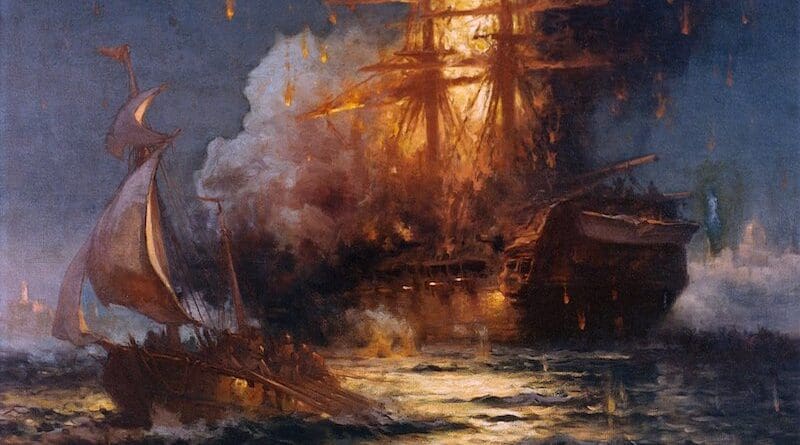
An 1897 painting of the burning of the USS Philadelphia. Credit: Wikipedia Commons

October 6, 2025
MISES
By Joshua Mawhorter


A few early episodes of US history are commonly employed as alleged historical precedents and justifications for modern US foreign interventionism in foreign policy. One such episode is Jefferson’s dealings with the Barbary pirates during his administration without a congressional declaration of war.

This is important because this episode, among others, is used as something of a historic “rhetorical password”—an attempt to superficially raise a point in one’s favor, masquerading as evidence—in order to avoid further argumentation. Readers are surely familiar with several rhetorical passwords and attempts to use them. For example, often when defending freedom of speech, one will often hear, “But you can’t yell ‘fire!’ in a crowded theater.” Such passwords often are disanalogous to the topic debated and usually ignorant of key historical context. Whether used consciously or not, rhetorical passwords act as counterpoints without true argumentation and are usually an attempt to move beyond a point made.

Historical examples can be and are used to draw lessons for the present, in fact, knowledge of history is crucial regarding domestic and foreign policy. However, superficial uses of historical events—often with little knowledge of the history—are used as rhetorical passwords and often obscure rather than clarify. In attempts to justify modern foreign policy interventions, it is common to hear, more or less elaborately, “Well, George Washington did it.” This is also the case with Jefferson and the brief war with the Barbary pirates. Arthur Schlesinger, Jr. wrote in the New York Times in 1951, “[American presidents] repeatedly committed American armed forces abroad without prior Congressional consultation or approval.”

We should note several things before proceeding to the history itself. For one, even if Jefferson did go to war with the Barbary pirates without congressional approval, and even if this situation is analogous to the current situation one wants to justify, it does not follow that just because Jefferson did something that it was justified. That would be like saying you know someone who played Russian roulette and lived, therefore, there’s no danger in playing Russian roulette now. Further, there are often significant overlooked disanologies—breaks in continuity—between a current situation and a historical event. For a historical event to be valid as a precedent, there has to be significant situational and contextual overlap. A single point of contact—that an American president deployed military action without a congressional declaration of war—is insufficient to demonstrate a valid analogy, especially when key differences are prevalent.

Using the Barbary Pirates

This episode of American history is often utilized to justify three, often-related, points in modern American foreign policy: 1) the legitimate ability of the president to take military action without a congressional declaration of war; 2) the need to violently confront radical Islam abroad to avoid being attacked at home; and, 3) the dangers of attempting peace through “appeasement.”

One article says, “While Muslim terrorists kidnapped and killed innocent people around the world as they do today, Thomas Jefferson knew exactly how to end radical Islam’s bloodshed – with a classic American take-no-prisoners smackdown.” The article is titled, “Tough guy Thomas Jefferson crushed Muslim terrorists.” Popular historian, David Barton (whose degree is actually in religious education, not history), said of this episode,

The willingness to use force and inflict casualties is the kind of attitude it will take to answer this challenge because historically, that’s the kind of attitude that will make the Muslims say, “The price for us is too high to pay. We’ll back off and leave you guys alone.” Unfortunately, even if we do that, Muslims may not necessarily leave the others [sic] guys alone.

Apparently, the lessons to be learned by implication from Jefferson’s brief war with the Barbary pirates are that it is often necessary for presidents to take unilateral military actions without the approval of Congress despite what the Constitution stipulates, that radical Islam must be combatted abroad to avoid fighting them here, and that military interventionism is always a superior alternative to “appeasement.” However, these lessons cannot be legitimately drawn from the war with the Barbary pirates. Instead, we see that the cost-benefit analysis does not make it obvious that war was the only obvious option, there are significant disanalogies between this event and modern War on Terror, and the fact that—while the war was limitedly successful—tribute was still paid to other states following this episode.

Cost-Benefit Analysis


Determined as we are to avoid, if possible, wasting the energies of our people in war and destruction, we shall avoid implicating ourselves with the powers of Europe, even in support of principles which we mean to pursue. They have so many other interests different from ours, that we must avoid being entangled in them. We believe we can enforce these principles as to ourselves by peaceable means, now that we are likely to have our public councils detached from foreign views. (Thomas Jefferson to Thomas Paine, as quoted in The Life and Writings of Thomas Jefferson, p. 215)

Unlike most modern wars, addressing the Barbary pirates in the Mediterranean involved discussions of cost-benefit analysis. In other words, officials actually attempted to weigh whether the costs of war would be greater or less than the cost of continuing to pay tribute and the costs of the capture and ransom of American soldiers. Prior to the Jefferson administration, previous administrations had dealt with similar problems from the pirates but elected to pay tribute rather than go to war, not because they wimped out, but because they recognized that the costs of war often outweigh the costs of tribute and the possible benefits from a war.

After 1787, though the Confederation Congress had concluded a favorable treaty with Morocco, the other Barbary States demanded higher tribute-taxes from American ships. Patrick Newman writes,


Minister to France Jefferson, usually cognizant of the cost of war, urged armed confrontation. Far more cogent was Minister to Great Britain John Adams, who wisely noted that tribute was less expensive than war. Secretary for Foreign Affairs John Jay, reactionary to the core, hoped to exploit the opportunity and develop a strong navy.


During the Jefferson presidential administration, after having decreased government spending by 27 percent from 1800 to 1802, Newman explains the following events and how even Jefferson rejected the cost-benefit analysis of Gallatin and Randolph that war would cost more than tribute,


When Tripoli of the Barbary States demanded more tribute, the new president refused and the US entered another naval war. Jefferson failed to secure a congressional declaration of war, setting an atrocious precedent for executive overreach. In vain, Gallatin and Randolph protested to Jefferson that Congress should pay Tripoli because the cost of war would be greater than tribute and interfere with their retrenchment goals. But the adamant Jefferson pushed military spending back up. After collapsing 73 percent from 1800 to 1802, naval expenditures had increased 75 percent by 1805. Gallatin believed part of the splurge was due to Secretary Smith’s shipping background and he later accused the Smiths of embezzling war appropriations to their mercantile firm Smith & Buchanan. In addition, the Tripoli War forced Gallatin to request a slight increase in tariffs. Proponents argued for the tariff increases on the grounds that they would only be temporary, but Congress ended up making them permanent. (emphasisadded)

This war did benefit pro-navy Federalists, especially northern merchants. In 1803, John Randolph opined that there were many “who pant for military command and the emoluments of office” which would be brought about by the war. While that may sound cynical, it would be naive to overlook, especially in discussing cost-benefit analysis, the many beneficiaries of a war. In wars, there are always people who benefit from the war spending—transferred from the taxpayer, directly or indirectly, to individuals who provide goods and services deemed necessary for the war. It is not uncommon that these beneficiaries have historically agitated for war. In fact, earlier in 1785, John Jay wrote upon hearing of Algiers declaring war against American shipping,

This war does not strike me as a great evil. The more we are ill-treated abroad, the more we shall unite and consolidate at home. Besides, as it may become a nursery for seamen, and lay the foundation for a respectable navy, it may eventually prove more beneficial than otherwise.


Disanalogy between the Barbary War and Present Circumstances

It ought to go without saying, but it is necessary to point out the fact that Jefferson’s limited military response against the aggressions of the Barbary pirates—while it may have some superficial similarities—is so significantly dissimilar to the modern War on Terror or post-WWII wars without congressional declaration that it becomes irrelevant as an example. The differences in scope, constitutional process, scale of forces, and geopolitical context are so great that the example becomes almost meaningless. To cite Jefferson’s brief naval actions as justification for contemporary wars is to ignore the massive disanalogies that make the comparison historically misleading.

Jefferson may arguably have set a bad precedent going forward, however, he did approach Congress and limited himself to congressional approval, even if there was no declaration of war. That Jefferson’s request for a declaration of war was rejected by Congress does not mean Jefferson simply ignored Congress. Political scientist and constitutional law expert, Louis Fisher, wrotein response to Arthur Schlesinger, Jr.’s attempt (above) to use Jefferson’s actions to justify Truman’s actions in the Korean War,

As valid precedent for Truman’s actions in the Korean War, Schlesinger pointed to Jefferson’s use of ships to repel the Barbary pirates. In fact, Jefferson took limited defensive actions in the Mediterranean and came to Congress to seek authority for anything that went “beyond the line of defense.” And Congress enacted ten statutes to authorize military action by Presidents Jefferson and Madison in the Barbary wars. There is no connection between the actions of Jefferson and Truman. Truman seized the full warmaking authority––defensive and offensive––and never came to Congress for authority. Jefferson respected congressional prerogatives and constitutional limits. Truman did neither. None of the examples cited by Schlesinger were of a magnitude to justify or legalize what Truman did in Korea.

In fact, Jefferson said in his First Annual Message (December 8, 1801),

I communicate all material information on this subject, that in the exercise of this important function confided by the Constitution to the Legislature exclusively their judgment may form itself on a knowledge and consideration of every circumstance of weight.

Congress soon after passed “An Act for the protection of the Commerce and Seamen of the United States, against the Tripolitan Cruisers” (February 6, 1802) that allowed Jefferson “to equip, officer, man, and employ such of the armed vessels of the United States as may be judged requisite by the President of the United States, for protecting effectually the commerce and seamen thereof on the Atlantic ocean, the Mediterranean and adjoining seas.” The president would also be able to “instruct the commanders of the respective public vessels aforesaid, to subdue, seize and make prize of all vessels, goods and effects, belonging to the Bey of Tripoli, or to his subjects,…” Section 3 further enabled “owners of private armed vessels…like authority for subduing, seizing, taking, and bringing into port, any Tripolitan vessel, goods or effects,…”

Jefferson’s brief naval response to the Barbary pirates bears only superficial resemblance to modern wars, especially the War on Terror, and the differences are decisive. His campaign was narrowly circumscribed, involving only a handful of frigates and marines operating in the Mediterranean, not multi-theater deployments with thousands of troops and permanent occupation through military bases for decades. Jefferson acknowledged constitutional limits, insisting that only Congress could authorize offensive action, and Congress, in fact, passed multiple statutes explicitly empowering limited naval hostilities—unlike post-WWII presidents who have waged prolonged wars without congressional declarations. The Barbary conflict lasted only a few years (1801-1805) and cost a few million dollars, whereas the War on Terror has extended for decades and cost trillions and thousands of lives. Its purpose was limited—to defend commerce and end tribute demands—not regime change, counterinsurgency, or global ideological struggle. Even its conclusion was modest: Tripoli agreed to peace in 1805, but the United States continued paying tribute to other Barbary states until 1816. To equate Jefferson’s constrained naval defense with modern open-ended wars is to erase the vast disanalogies in scope, cost, objectives, and constitutional process. In fact, if Jefferson’s war could be termed a success, it may be said that modern users of Jefferson’s actions attempt to borrow capital from Jefferson’s success to justify their failures.

If the US wants to effectively reduce radical Islamic terror, it ought to consider the foreign policy history of the last five decades, explore the significant connection between foreign occupation and suicide terrorism, and stop funding radical Islamic jihadists abroad when they are perceived to be fighting in US interests.


About the author: Joshua Mawhorter is assistant editor of Mises.org. He was a summer fellow at the Mises Institute (2023) and a government/economics and US history teacher since 2016. Josh has a bachelor’s degree in political science from California State University, Bakersfield, a master’s in political science from Southern New Hampshire University, and a master’s in Austrian economics from the Mises Graduate School (2023). He has self-published a few books, including The First Constitution: The Articles of Confederation, Tyrannosaurus Debt: The Student Loan Crisis and How to Survive, and “An Austrian Critique of Modern Monetary Theory”, his thesis. He also enjoys teaching in the areas of theology, the Old Testament, church history, apologetics, and philosophy.
Source: This article was published by the Mises Institute


MISES
The Mises Institute, founded in 1982, teaches the scholarship of Austrian economics, freedom, and peace. The liberal intellectual tradition of Ludwig von Mises (1881-1973) and Murray N. Rothbard (1926-1995) guides us. Accordingly, the Mises Institute seeks a profound and radical shift in the intellectual climate: away from statism and toward a private property order. The Mises Institute encourages critical historical research, and stands against political correctness.


California partnership aided COVID-19 response and health equity, report finds


STOP COVID-19 CA showed how researchers and communities can work together to tackle health disparities


University of California - Riverside


RIVERSIDE, Calif. -- The COVID-19 pandemic did not affect everyone equally. Communities of color, especially Latino (including undocumented persons), Black, and Native American groups, as well as people with low incomes, experienced much higher rates of infection, hospitalization, and death. 

Research has shown that several key factors worsened health inequalities during the COVID-19 pandemic. Crowded housing, dense neighborhoods, and location played a major role in how the virus spread. Systemic racism, discrimination, and unstable jobs made some communities even more at risk.

A new report, published in Health Expectations, highlights how the Share, Trust, Organize, Partner COVID-19 California Alliance, known as STOP COVID-19 CA, helped address these challenges. Formed in 2020 as part of the federal pandemic response, the network brought together 11 universities, including the University of California, Riverside, and more than 75 community organizations across 14 counties. Together, they focused on reaching communities most affected by COVID-19 and improving access to reliable information, testing, and vaccination, while laying the foundation for long-term health equity.

“Our evaluation looks at how a state-wide network helped strengthen partnerships between communities and researchers so they could work together to tackle health inequalities in underserved communities during the COVID-19 pandemic,” said Ann Cheney, senior author of the report and a professor of social medicine, population, and public health in the UC Riverside School of Medicine. “What made this network different was its community-first approach. Local organizations and grassroots leaders didn’t just participate; they led.” 

From shaping research questions to collecting data and writing reports, community partners contributed at every step, helping ensure that the work stayed grounded in real-life community needs and socio-cultural and economic contexts, rather than being driven by academic theory alone.

Between August 2020 and December 2021, STOP COVID-19 CA surveyed more than 11,000 Californians, conducted dozens of focus groups, participated in clinical trials, and organized hundreds of events — from town halls to vaccination clinics. Community health workers, known as promotoras, helped design and deliver health information in ways that resonated with local culture and language.

Cheney explained that in 2024 the network used a participatory and community-based evaluation method called Ripple Effects Mapping to better understand the network’s impact. The method showed that the network not only improved COVID-19 response efforts, but also strengthened relationships between community and academic partners, improved communication, and built lasting skills for future collaboration.

“Our report also points to bigger lessons,” Cheney said. “While the network made significant progress, participants noted the need for broader changes, especially in how universities work with community groups and how funding is shared. Ultimately, STOP COVID-19 CA showed that when communities are respected as leaders and equal partners, the results are more effective and more lasting.” 

The report found the network helped communities not only respond to an emergency but also begin to reshape public health responses to better serve those most impacted by inequality. According to the report, STOP COVID-19 CA remains a model for how researchers and communities can work together to advance health equity. 

“By combining academic expertise with local knowledge and leadership, the network showed what is possible when collaboration is rooted in trust, respect, and shared purpose,” Cheney said. “Beyond helping with urgent needs like COVID-19 testing and vaccines, the network also laid the groundwork for lasting changes to support ongoing community involvement in health equity research. It stands as a model for how diverse communities — across cultures, languages, and regions — can come together with researchers to tackle health disparities.”

Cheney’s coauthors on the report are academic partners at UCR and UC San Diego, as well as community partners at Conchita Servicios de la Comunidad in Mecca, California, and Global Action Research Center in San Diego. 

The research was supported by a grant from the National Heart, Lung, and Blood Institute of the National Institutes of Health.

The title of the paper, led by first author Evelyn Vázquez who was formerly at UCR, is “Ripple Effects Mapping: Evaluating Multilevel Perspectives and Impacts of a State-Wide Community Academic Partnership Network on COVID-19 Health Disparities.”

The University of California, Riverside is a doctoral research university, a living laboratory for groundbreaking exploration of issues critical to Inland Southern California, the state and communities around the world. Reflecting California's diverse culture, UCR's enrollment is more than 26,000 students. The campus opened a medical school in 2013 and has reached the heart of the Coachella Valley by way of the UCR Palm Desert Center. The campus has an annual impact of more than $2.7 billion on the U.S. economy. To learn more, visit www.ucr.edu.