It’s possible that I shall make an ass of myself. But in that case one can always get out of it with a little dialectic. I have, of course, so worded my proposition as to be right either way (K.Marx, Letter to F.Engels on the Indian Mutiny)
A fire at Vistra Corp’s 300-MW Moss Landing battery facility has triggered widespread safety concerns, prompting local moratoriums on new large-scale battery energy storage systems (BESS) in several U.S. states.
Public opposition is rising, with officials warning that lithium-ion systems pose unacceptable fire risks — even as experts argue these are growing pains in a rapidly maturing technology.
The controversy coincides with new legislation (OBBBA) that could slash U.S. battery output by 75% and EV sales by 40% by 2030.
Back in January, a massive fire ripped through Vistra Corp’s (NYSE:VST) giant battery storage facility in Moss Landing in Northern California, leading to the evacuation of hundreds of people after toxic fumes polluted the air. While the cause of the fire is still under investigation, a key factor that has so far been identified is the failure of the fire suppression system, which allowed the fire to spread rapidly.The building that housed 300 megawatts of battery capacity was completed five years ago, around the time the U.S. utility scale lithium-ion battery storage sector was taking off, with battery safety standards having been updated multiple times since. And now the sector is having to deal with the fallout of the accident, with a growing number of leaders now strongly opposed to the construction of battery storage facilities in their localities.
“We’re not guinea pigs for anybody ... we are not going to experiment, we’re not going to take risk,” said Michael McGinty, the mayor of Island Park, New York, after passing a moratorium in July for a battery storage system proposed near the village line. In August, Environmental Protection Agency (EPA) Administrator Lee Zeldin visited New York and complained that the state was rushing approvals to meet “delusional” clean energy goals. New York has set an ambitious goal to add 6,000 megawatts of energy storage over the next five years, equivalent to half of its large-scale systems
“This is more than a fire, this a wake-up call for the industry. If we’re going to be moving ahead with sustainable energy, we need to have a safe battery system in place,” said Glenn Church, Monterey County Supervisor.
Battery moratoriums refer to a temporary halt on the approval and construction of new Battery Energy Storage Systems (BESS), often a local or state measure enacted to address public safety concerns related to fires and other hazards associated with lithium-ion batteries. These moratoriums gained traction starting in 2023 and 2024, driven by community opposition to proposed BESS projects near homes and schools, high-profile fires, and a perceived lack of comprehensive safety standards for the technology.
However, the experts have pointed out that BESS detractors could be overreacting, and the nascent industry is merely going through teething problems. “This is a relatively immature technology that is maturing quickly, so I think that there are a lot of really thoughtful researchers and other stakeholders who are trying to improve the overall safety of these systems,” Ofodike Ezekoye, a mechanical engineering professor and combustion expert at the University of Texas at Austin, said.
Fire risks and growing opposition are just some of the headwinds facing the U..S. battery storage sector.A recent analysis by the International Council on Clean Transportation found that the One, Big, Beautiful Bill Act (OBBBA), coupled with cuts to other climate policies, could slash U.S. battery production by ~75% by 2030 to 250 GWh from the previously projected 1,050 gigawatt-hours, and EV sales by 40%. According to the report, the new policies could eliminate 130,000 potential jobs in the EV sector by 2030, with the majority in battery manufacturing. Following the passing of the IRA in 2022, companies have announced a total of 128 U.S. facilities for battery manufacturing, with more than half yet to begin construction. Red and purple states including Texas, Michigan, Nevada, Tennessee, Kentucky and Georgia, would be the most adversely impacted.
Interestingly, even Rep. Buddy Carter of Georgia, home to Hyundai’s new $5.5B EV and battery manufacturing plant, threw his weight behind the bill, calling it “fantastic.” According to estimates by the experts, the project will create $4-5 billion in fresh investments in Bartow County as well as 3,500 new jobs. Over the past five years, EV-related projects in Georgia have created ~$17 billion in investments and more than 22,800 new jobs.
Meanwhile, the pivotal solar sector would face setbacks under OBBBA. According to a study by the Rhodium Group and Massachusetts Institute of Technology, the solar sector has recorded more than $160B in large solar and battery storage projects since the IRA was passed three years ago, marking one of the sector’s most productive periods in recent times. Solar and battery storage have been the fastest growing energy source in the U.S., with the pair expected to account for 81% of new power additions to the grid in the current year.
OBBBA favors solar manufacturing through provisions that incentivize domestic production and streamline the tax credit process, while also setting deadlines for construction and placement in service of solar projects. Specifically, it maintains and clarifies the tax credits for solar projects under Sections 48E and 45Y, while also phasing them out for wind and solar projects placed in service after December 31, 2027, unless construction began within 12 months of the Act's enactment.
Prime Minister Nikol Pashinyan confirmed that Armenia’s next nuclear plant will be a small modular reactor.
Yerevan is in talks with five countries—Russia, the U.S., China, France, and South Korea—to secure the best economic deal.
The Metsamor plant is nearing the end of its lifespan, making replacement plans increasingly urgent.
The Armenian government is playing the field in search of the best deal to construct a new nuclear power plant to replace the aging Metsamor facility.
Prime Minister Nikol Pashinyan announced during a question-and-answer session in parliament that negotiations are ongoing with several nations. He added that the government had already decided that Metsamor’s replacement will be a “small modular” reactor.
“Now the next question is: with whom will we build, with whom will we cooperate?” he said.
Pashinyan went on to list five countries that have been engaged in discussions – Russia, the United States, China, France and South Korea. He asserted that the government will award the contract purely on the basis of economic considerations.
“We absolutely do not put a political component into it. We must focus on which of the proposals will suit us best in terms of commercial and economic benefits, and based on this, make a choice,” he said.
When Pashinyan was in Moscow in late September, Russian officials, including Kremlin kingpin Vladimir Putin, lobbied the prime minister hard for Rosatom, the Russian nuclear entity, to get the job. Just a few days later, Armenian officials announced they are striving to finalize a “123 agreement” with the United States to enable nuclear cooperation and the transfer of sensitive technologies.
Armenia’s existing Metsamor nuclear plant is on its last legs and has a maximum extended lifespan of about another decade.
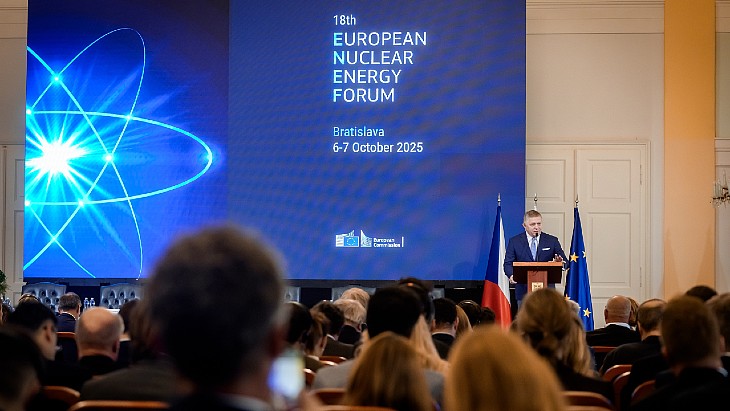
Slovakia’s Prime Minister Robert Fico says his government has approved a proposed intergovernmental agreement with the USA on the construction of a new unit at the Bohunice nuclear power plant.
(Image: Slovakia Government website)
Speaking at the European Nuclear Energy Forum in Bratislava, Fico spoke about European Union energy policy, saying there must be "common sense" and "it simply will not work without nuclear energy. If we want stable, affordable and ecological energy sources, we must not only preserve nuclear energy, but also further develop it".
According to the government website's report of the speech, ministers approved in September the wording of an intergovernmental agreement with the US "on the construction of a new nuclear unit in Jaslovské Bohunice, which will be state-owned and will have an output of more than 1,000 MW".
It quoted him as saying: "This project will be important not only for Slovakia, but also for the whole of Central Europe. We need new energy sources if we want to remain competitive and respond to growing consumption."
The Slovak government officially approved plans in May 2024 for a 1.2 GWe unit near the existing Bohunice nuclear power plant, with South Korea, the USA and France at the time seen as potential partners.
In August Fico said the European Commission had "positively assessed" a draft agreement between the governments of the Slovak Republic and the USA on cooperation in the field of nuclear energy, which he added was a prerequisite for the conclusion of an intergovernmental agreement on the construction of a new Westinghouse unit in Bohunice.
According to the country's energy department, negotiations with the USA continued after the Slovak government approved the wording of the agreement on 10 September. On 16 September it quoted Deputy Prime Minister Denisa Saková as saying: "Negotiations are progressing and we are gradually approaching the signing of the agreement. I believe that nuclear energy can be a great opportunity for both countries - in addition to helping us strengthen energy security, it will advance research and open the door to new projects and cooperation."
During his speech Fico also highlighted cooperation between Slovakia’s JAVYS and Newcleo on the latter's lead-cooled small modular reactors which are powered by reused nuclear fuel: "If we succeed in this project, Slovakia will become a leader in innovations in the nuclear field," he said.
He also criticised the European Union’s RePowerEU proposals, which are designed to "end dependency on Russian energy", saying that "if nuclear fuel is included in RePowering, it will threaten the energy security of the entire European Union".
Slovakia currently has five nuclear reactors - three at Mochovce and two at Bohunice - generating half of its electricity, and it has one more at Mochovce under construction. Both plants are operated by Slovenske Elektrarne.
Cold testing of second San'ao unit completed
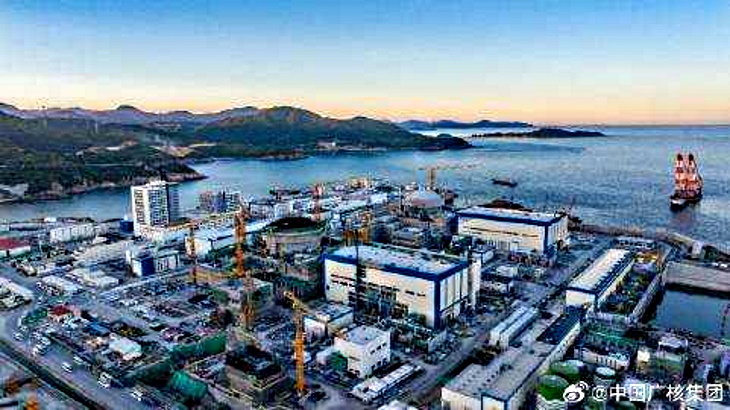
Cold functional tests have been completed at unit 2 of the San'ao nuclear power plant in China's Zhejiang province, China General Nuclear has announced. The unit is the second of six HPR1000s (Hualong Ones) planned at the site.
(Image: CGN)
Cold functional tests are carried out to confirm whether components and systems important to safety are properly installed and ready to operate in a cold condition. The main purpose of these tests is to verify the leak-tightness of the primary circuit and components - such as pressure vessels, pipelines and valves of both the nuclear and conventional islands - and to clean the main circulation pipes. The tests mark the first time the reactor systems are operated together with the auxiliary systems.
"At 20:25 on 5 October, on the occasion of the Mid-Autumn Festival, the cold performance test of Unit 2 of the CGN Zhejiang Sanmao Nuclear Power Project was successfully completed," China General Nuclear (CGN) said. "The primary circuit pressure boundary of the unit was intact and well sealed."
Cold testing will now be followed by hot functional tests, which involve increasing the temperature of the reactor coolant system and carrying out comprehensive tests to ensure that coolant circuits and safety systems are operating as they should. Carried out before the loading of nuclear fuel, such testing simulates the thermal working conditions of the power plant and verifies that nuclear island and conventional equipment and systems meet design requirements.
In September 2020, the executive meeting of China's State Council approved the construction of units 1 and 2 as the first phase of the San'ao plant. China's National Nuclear Safety Administration issued a construction permit for the two units on 30 December that year and first concrete for unit 1 was poured the following day. The first concrete for San'ao 2 was poured on 30 December 2021.
San'ao 1 and 2 are scheduled to begin supplying electricity in 2026 and 2027, respectively. Colding testing of unit 1 was completed in November 2024, with hot tests completed in June this year.
The construction site on San'ao 1 and 2 (Image CGN)
The San'ao plant is the first nuclear power project in China's Yangtze River Delta region to adopt the Hualong One reactor design. A total of six Hualong One units are planned for the San'ao site. In August last year, the State Council approved the construction of San'ao Phase II (units 3 and 4).
The San'ao project marks the first Chinese nuclear power project involving private capital, with Geely Technology Group taking a 2% stake in the plant. CGN holds 46% of the shares of the project company Cangnan Nuclear Power, with other state-owned enterprises holding the remainder.
Costain to reduce height of Trawsfynydd reactor buildings
Infrastructure solutions company Costain has been awarded a GBP70 million (USD94 million) contract to halve the height of the two reactor buildings at the shut-down Trawsfynydd Magnox nuclear power plant in Gwynedd, North Wales, UK.
How the reactor buildings will change during the project (Image: Costain)
The contract was awarded by Nuclear Restoration Services (NRS), a subsidiary of the Nuclear Decommissioning Authority (NDA). Set to begin later this year, the project will reshape the site's iconic skyline through the partial removal of the upper sections of both reactor buildings, lowering them from about 54 metres to 25 metres.
The work will recover about 15,000 cubic metres of concrete and brickwork and remove about 10 overhead cranes, including two which weigh more than a Boeing 747.
Costain previously delivered enabling works at Trawsfynydd to facilitate the decommissioning process, including the installation of a new capping roof on both the reactor buildings, major de-planting of the primary boiler sections, and rerouting of electrical supplies.
The company will also deliver civils and remedial works to ensure that the buildings are in a safe and stable condition for the commencement of subsequent decommissioning activity on the site.
The programme is expected to take around four years.
Costain is also working with NRS on a six-year decommissioning programme across 11 UK sites, and delivering decommission and asset care work for Sellafield as part of the Decommissioning Delivery Partnership.
"This is a pivotal moment for Trawsfynydd," said NRS CEO Rob Fletcher. "After years of careful planning and preparation, we're now moving into the delivery phase of one of the most complex and ambitious decommissioning projects in the UK. We're delighted to be working with our supply chain partners to shape this next stage in the site's journey, ensuring the work is undertaken safely, securely and sustainably for all our futures."
NDA group CEO David Peattie added: "This is a tangible step forward in one of the most significant projects in the NDA group's portfolio and really embodies our commitment to delivering on a safer, cleaner future for generations to come. Reduction of the reactor buildings will not only advance our mission but also create first-of-its-kind opportunities for Wales, showcasing innovation and leadership in nuclear decommissioning."
Sam White, managing director, natural resources at Costain, said: "Whether it's designing the infrastructure that will produce the next generation of advanced nuclear fuel, plant optimisation or managing large-scale decommissioning programmes, Costain has decades of experience delivering predictable, best-in class solutions across the entire nuclear energy lifecycle.
"This work is all part of creating a sustainable future, and we're looking forward to deepening our relationship with NRS and working collaboratively with our local supply chain to complete this complex decommissioning project to the highest safety and quality standards."
The 392 MWe Trawsfynydd Magnox nuclear power plant began operation in 1965 and was retired in 1991, with defueling completed by 1997. In July 2020, the NDA announced its intention to pursue a rolling programme of decommissioning aimed at accelerating Magnox reactor sites decommissioning with Trawsfynydd identified as the 'lead and learn' site.
GVH, Samsung C&T form BWRX-300 strategic alliance
The two companies will work together to advance the deployment of BWRX-300 small modular reactors in strategic global markets outside North America, with a focus on developing the supply chain and project delivery solutions. They will also work together in the potential deployment of five BWRX-300s in Sweden.
Jason Cooper (CEO Advanced Nuclear, GVH), Se-chul Oh (Samsung C&T CEO), Maví Zingoni (CEO Power, GE Vernova) and Jung E. Kim (SVP, Nuclear Sales & Business Development, Samsung C&T) at the signing ceremony (Image: GVH)
GE Vernova Hitachi Nuclear Energy (GVH) is GE Vernova's nuclear energy business, and is a GE Vernova-led joint venture with Hitachi Ltd. Its first BWRX-300 small modular reactor (SMR) is under construction at Ontario Power Generation’s Darlington site in Canada, with completion expected by the end of the decade.
Korean-headquartered multi-business company Samsung C&T’s Engineering & Construction Group has more than 40 years of engineering and construction experience operating throughout the world including in the nuclear energy sector with expertise across all areas of the nuclear industry, including delivery of the Barakah Nuclear Power Plant in the United Arab Emirates.
"With the first unit of our BWRX-300 under construction in Canada, we are well positioned to lead the deployment and scale of the SMR industry," said Maví Zingoni, CEO Power, GE Vernova. "This collaboration with a leading player like Samsung C&T, which has a solid track record of helping to deliver nuclear projects safely, on-time and on-budget, will further strengthen the BWRX-300 position among the most advanced, deployment-ready, and lowest-risk SMR technology available today."
Samsung C&T CEO Se-chul Oh said Samsung C&T and GVH aim to become global leaders in the nuclear power segment through strategic collaboration. "The collaboration will capitalise on Samsung C&T's extensive experience in nuclear power and infrastructure project execution, combined with GVH's validated technological expertise," he said.
The BWRX-300 is a 300 MWe water-cooled, natural circulation SMR with passive safety systems that leverages the design and licensing basis of GE Hitachi's ESBWR boiling water reactor, and has been earmarked for potential construction projects in several countries. The Tennessee Valley Authority has submitted an application to US regulators to construct a unit at Clinch River in Tennessee, while Orlen Synthos Green Energy has selected Włocławek as the site for Poland’s first SMR.
It is one of two SMR designs shortlisted by Vattenfall for new nuclear capacity to be built adjacent to its Ringhals plant site on the Värö Peninsula in Sweden: the other is the Rolls-Royce SMR.
In April, Samsung C&T's Engineering & Construction Group signed a teaming agreement with Estonia's Fermi Energia to collaborate on the deployment of two BWRX-300 small modular reactors in Estonia.
Arkansas to consider nuclear new-build
The US State of Arkansas has formally engaged consultancy firm Excel Services Corporation to conduct a comprehensive feasibility study on the development of new nuclear energy generation within the state.
The Arkansas Nuclear One plant (Image: Entergy)
The scope of the study encompasses a rigorous evaluation of the advantages and disadvantages associated with nuclear power in Arkansas, including economic, environmental, and workforce considerations. The assessment will further address optimal siting, safety protocols, advanced technology options, including large, small modular, and micro reactors.
Other areas of consideration include critical infrastructure requirements, such as transmission and transportation capabilities. Rockville, Maryland-based Excel Services will provide interim findings, a draft report, and a final report within a ten-month period.
"We are honoured by the confidence placed in us by the Arkansas legislature," said Excel Services founder, President and CEO Donald Hoffman. "Nuclear power presents a significant opportunity to enhance the state's energy independence, support industrial growth, and foster long-term workforce development. We are committed to delivering an assessment that is both practical and forward-looking."
Representative Jack Ladyman commented: "Arkansas is committed to exploring every avenue to secure our energy future. This feasibility study will ensure that our decisions are informed by the best available expertise and analysis. We selected Excel because of its experience and expertise and look forward to reviewing the findings on how nuclear energy can contribute to our state's prosperity and resilience."
Arkansas is currently home to two pressurised water reactors at the Arkansas Nuclear One plant - near Russellville in Pope County - which is owned and operated by Entergy. The plant provides about 24% of the state's electricity. Arkansas Nuclear One units 1 and 2 are licensed to operate until 2034 and 2038, respectively.
Peru minister touts Saudi mining interest and Chevron offshore potential
Peru is pursuing major investments from Saudi Arabia and US oil giant Chevron to develop its mining and energy resources, part of a broad strategy to revitalize the sector, a top minister said on Tuesday.
The push comes as Peru, the world’s third-largest copper producer, seeks to jumpstart investment, which has slowed in recent years amid political uncertainty and persistent social conflicts.
In an interview with Reuters, Energy and Mines Minister Jorge Luis Montero said he expected to sign a memorandum of understanding with Saudi Arabia in November to develop projects for lithium and other strategic minerals.
He described the Middle Eastern kingdom as seeking a “reliable strategic partner” in Peru.
Montero said he would travel to Saudi Arabia next month with Peru’s foreign minister to also sign broader economic agreements with Gulf countries.
He added the Saudi interest extended to “investing in mining and energy activities… even in seawater desalination plants for the mining sector in the future.”
A parallel effort is underway to overhaul Peru’s energy sector. A key component involves Chevron, which is set to begin drilling early next year in three offshore blocks.
“The expectation is for production that could reach 250,000-300,000 barrels per day or more,” Montero said, assuming the potential reserves in those blocks are confirmed.
He projected such a volume could allow Peru, currently a net oil importer, to cease imports within three years, saving the country around $5 billion annually.
To further bolster its energy strategy, Peru is finalizing a commercial and infrastructure agreement with neighboring Ecuador. State-owned oil companies Petroperu and Petroecuador are scheduled to sign the deal on October 24.
The agreement will link oil fields in southern Ecuador with Peru’s underutilized Norperuano pipeline, allowing Ecuadorean crude to be transported to and processed at Petroperu’s recently modernized Talara refinery.
Montero said the deal would be a lifeline for financially troubled Petroperu, ensuring a steady supply to keep reservoirs full and the Talara refinery “working 24 hours a day.”
(By Marco Aquino; Editing by Sarah Morland and Jamie Freed)
Solar energy is now the world’s cheapest source of power, a Surrey study finds
Solar energy is now so cost-effective that, in the sunniest countries, it costs as little as £0.02 to produce one unit of power, making it cheaper than electricity generated from coal, gas or wind, according to a new study from the University of Surrey.
Professor Ravi Silva, co-author of the study and Director of the ATI at the University of Surrey, said:
“Even here in the UK, a country that sits 50 degrees north of the equator, solar is the cheapest option for large-scale energy generation. Globally, the total amount of solar power installed passed 1.5 terawatts in 2024 – twice as much as in 2020 and enough to power hundreds of millions of homes. Simply put, this technology is no longer a moonshot prospect but a foundational part of the resilient, low-carbon energy future that we all want to bring to reality.”
The research team also found that the price of lithium-ion batteries has fallen by 89% since 2010, making solar-plus-storage systems as cost-effective as gas power plants. These hybrid setups, which combine solar panels with batteries, are now standard in many regions and allow solar energy to be stored and released when needed, turning it into a more reliable, dispatchable source of power that helps balance grid demand.
Despite many reasons to be optimistic, the ATI research team points to several challenges – particularly connecting large amounts of solar power to existing electricity networks. In some regions, such as California and China, high solar generation has led to grid congestion and wasted energy when supply exceeds demand.
Dr Ehsan Rezaee, co-author of the study from the University of Surrey, comments:
“Connecting growing levels of solar power to electricity networks is now one of the biggest challenges. Smart grids, artificial intelligence forecasting and stronger links between regions will be vital to keep power systems stable as renewable energy use rises.”
Professor Silva added:
“With the integration of energy storage and smart grid technologies, solar is now capable of delivering reliable, affordable and clean power at scale. Innovations in materials such as perovskite solar cells could boost energy output by up to 50% without increasing land use.
“However, progress will depend on consistent, long-term policy support. Initiatives such as the Inflation Reduction Act in the US, the EU’s REPowerEU plan and India’s Production Linked Incentive scheme show how clear direction can drive investment and innovation. Sustained commitment and international collaboration will be essential if we are to accelerate the world’s transition to a clean and reliable energy system.”
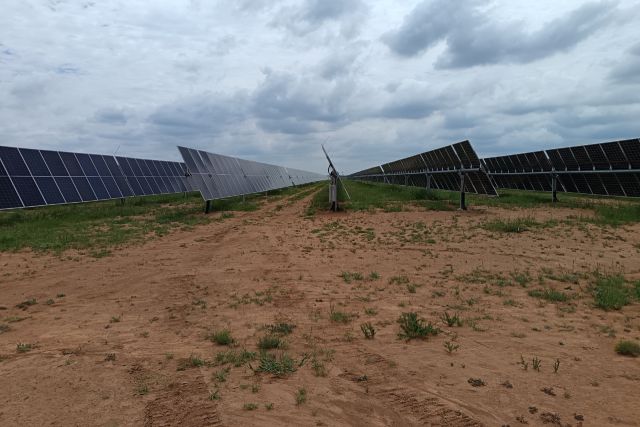
South African miner Sibanye-Stillwater (JSE: SSW, NYSE: SBSW) has taken another step in its decarbonization journey with the achievement of commercial operation at the Springbok solar photovoltaic project.
Situated in Free State Province, Springbok represents Sibanye’s first solar wheeling project, and the second renewable energy project supplying its mine operations to reach commercial operation this year.
The 150 megawatt alternating current (representing 195 MWp in peak direct current) solar project is developed and financed by the SOLA Group, a South African independent power producer. Sibanye is an anchor off-taker of the project and will procure 75MW (50%) of the plant’s capacity for a 10-year period, with an option to extend the duration through a power purchase agreement with SOLA.
Key benefits of the solar project, according to Sibanye, include cost savings relative to prevailing state-owned Eskom utility rates and escalating at consumer price index (CPI), resulting in expected yearly cost savings of more than R60 million across its South African operations.
In addition, the company expects the Springbok project to generate approximately 4% of its annual energy requirements in South Africa and result in the immediate reduction of 229,000 tonnes of carbon dioxide equivalent (3.6% of group Scope 1 and 2 emissions) each year.
The start of commercial operations at Springbok is a “further milestone in the establishment of its portfolio of privately developed renewable energy projects,” Sibanye stated in a press release.
“This is the second project to achieve commercial operation in our 407MW portfolio of contracted renewable energy projects, contributing to our goal of achieving carbon neutrality by 2040,” Richard Stewart, Sibanye’s CEO, said.
In April, the company also started operations at the 89MW Castle wind farm. Together, the two projects have brought 164MW of renewable energy projects involving Sibanye-Stillwater online in 2025, Sibanye said.


_51647.jpg)
_51796.jpg)
_27359.jpg)
_61234.jpg)