Tuesday, October 07, 2025


Once dominant, US agricultural exports falter amid trade disputes and rising competition


University of Illinois College of Agricultural, Consumer and Environmental Sciences


A combine harvester moves through a large, golden field under a blue sky; farm buildings are visible in the background 

image: 

Row crops are the backbone of U.S. agriculture, but export markets are shrinking.

view more 

Credit: University of Illinois


URBANA, Ill. – The U.S. has traditionally been an agricultural powerhouse with a healthy trade surplus. But global dynamics are changing due to a confluence of political and economic factors. U.S. agricultural imports now exceed exports, and the trade deficit is projected to worsen in the coming years. In a new study, researchers from the University of Illinois Urbana-Champaign and Texas Tech University discuss recent developments affecting the U.S. trade in row crops such as corn, soybeans, wheat, and cotton.

“For most of recent history, the U.S. was a net agricultural exporter. But in the last couple of years, that has reversed, and what used to be a persistent surplus has turned into a persistent and growing deficit, where we're importing much more than we export. Current projections estimate that the agricultural trade deficit will reach $49 billion by the end of 2025,” said lead author William Ridley, associate professor in the Department of Agricultural and Consumer Economics, part of the College of Agricultural, Consumer and Environmental Sciences at U. of I. He conducted the study with Stephen Devadoss, professor of agricultural and applied economics at Texas Tech.

The researchers noted that imports have increased considerably, particularly fruits and vegetables, such as avocados from Mexico, and canola oil from Canada. The U.S. continues to be a major producer of agricultural commodities, like corn, oilseeds, and cotton, but exports are stagnant or declining.

“Row crops are the backbone of U.S. agricultural exports, but markets are shifting as trade conflicts create uncertainty and instability. One of the main factors causing exports to nosedive is the ongoing trade dispute with China,” Ridley said.

As the U.S. imposed tariffs on Chinese imports, China retaliated with tariffs on U.S. agricultural commodities such as soybean, wheat, corn, and cotton. These products were strategically targeted by China due to their importance for U.S. exports, and because they are primarily produced in states that support the Republican administration, the researchers noted.

From 2017 to 2018, the trade dispute resulted in U.S.–China export values declining by $9 billion (73%) for soybeans, $431.7 million (67%) for wheat, $92.6 million (61%) for corn, and $312.5 million (37%) for sorghum. The total value of lost agricultural exports amounted to around $14 billion.

The Phase One trade deal that was negotiated in 2020 briefly increased Chinese agricultural imports from the U.S., but trade quickly collapsed again, and China has effectively stopped buying soybeans, corn, cotton, and sorghum from the U.S., after finding trade partners elsewhere.

At the same time, the U.S. is losing its competitive edge to other big grain producers like Brazil, Canada, Australia, and Ukraine.

In their study, Ridley and Devadoss estimate the comparative advantage of major crop producers, taking into account factors such as productivity growth, export and trade infrastructure, and government support for agriculture. They find that while U.S. agricultural productivity has remained stable, other countries have been catching up.

For example, Brazil’s soybean production has rapidly evolved due to expansions in farmland, dramatic improvements in productivity, and government investments in transportation infrastructure, and they have solidly surpassed the U.S. as the world’s leading soybean producer and exporter.

Furthermore, China is not only buying from other suppliers; the country is undertaking massive efforts to bolster its self-sufficiency, including major investments in research and development and expanding the use of genetically modified crop varieties.

“U.S. row crop exports are trending in a negative direction, and forecasts predict the downward trend will continue. Producers may look to other markets, but there’s only one China, and they're not coming back tomorrow. Even if you pulled these tariffs back right now, sales would not resume. And other markets have barriers to trade; for example, the EU has tight restrictions on imports of genetically modified crops,” Ridley stated.

The researchers also highlight other factors influencing agricultural production and exports, including cuts in public funding for university research.

“There's a strong link between research funding and productivity, and productivity affects the position of the U.S. agricultural sector globally. That also includes funding of research to mitigate the effects of climate change on the agricultural industry,” Ridley said.

If there is a glimmer of hope on the horizon, he added, it is that the U.S. is working on new bilateral trade agreements with different countries.

“Economists view expanded access for our exports as a good thing to strive for if you want to ensure the viability of U.S. agriculture. Negotiating trade agreements isn't an easy thing to do, but it's something we should continue to pursue.”

The paper, “Row Crops and the U.S. Agricultural Trade Deficit: Recent Trends and Policy Issues,” is published in Applied Economic Perspectives and Policy [DOI:10.1002/aepp.70022].

This work was supported by the National Institute of Food and Agriculture, Agricultural and Food Research Initiative Competitive Program, Agriculture Economics and Rural Communities, grant no. 2022-67023-36382.

Trump reverses Biden block on Alaska project; US takes 10% stake to unlock critical minerals

Trump admin aims to reduce  dependence on China for critical industries
FOXBusiness


NioCorp CEO Mark Smith told 'Mornings with Maria' the Pentagon’s $10M grant will boost Nebraska’s rare earth project as the U.S. races to rebuild supply chains vital for security and the economy.

The Trump administration on Monday announced two major steps aimed at boosting domestic access to critical minerals, including reversing a Biden-era decision, and taking a stake in a Canadian mining company.


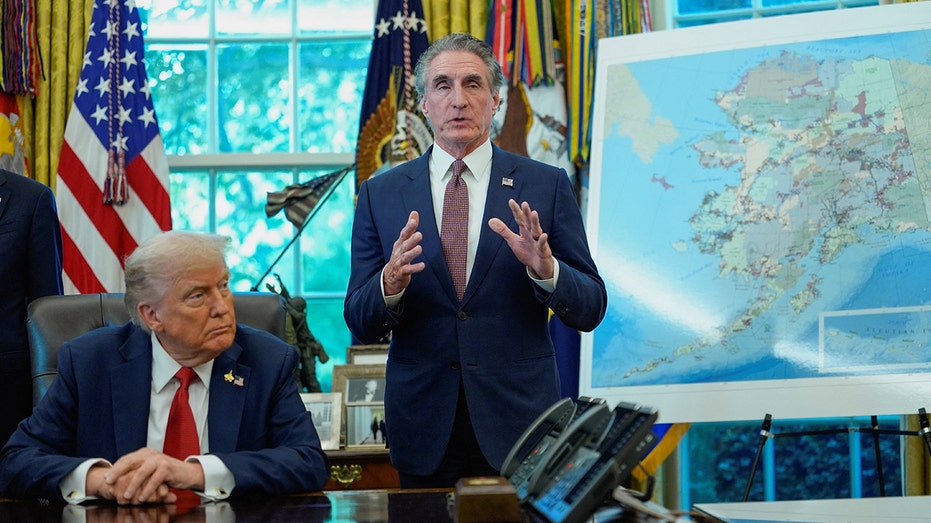
President Donald Trump said he signed an executive order to overturn President Joe Biden’s decision to block construction of a 211-mile access road to Alaska's Ambler mining district. The road is considered key to unlocking U.S. reserves of copper and other essential minerals.

"This is something that should have been long operating and making billions of dollars for our country and supplying a lot of energy and minerals and everything else that we are talking about," Trump said during the signing ceremony in the Oval Office.

Alongside the executive order, the White House announced a $35.6 million investment in Trilogy Metals, a Canada-based company potentially developing part of the Ambler district. The deal gives the U.S. a 10% equity stake, with warrants to purchase another 7.5%.


President Donald Trump listens to Secretary of the Interior Doug Burgum speak during the signing of an executive order related to mining operations in Alaska, at the White House, in Washington, D.C., Oct. 6, 2025. (Kent Nishimura / Reuters Photos)

Biden had blocked the road in 2024 over his Interior Department’s concerns that mining could threaten caribou and fish populations that provide subsistence to dozens of Native communities.


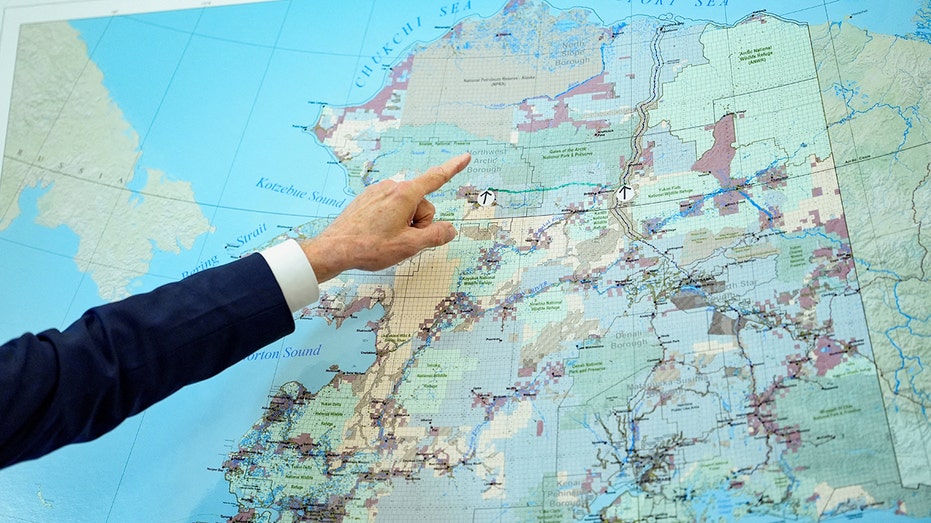
A geographic map of northern Alaska is shown in the Oval Office as President Donald Trump signs an executive order authorizing the construction of an access road to the Ambler mining district on Oct. 6, 2025. (Kent Nishimura / Reuters Photos)

The move is part of Trump’s broader push to reduce U.S. reliance on China for vital materials across industries such as energy, semiconductors and defense.


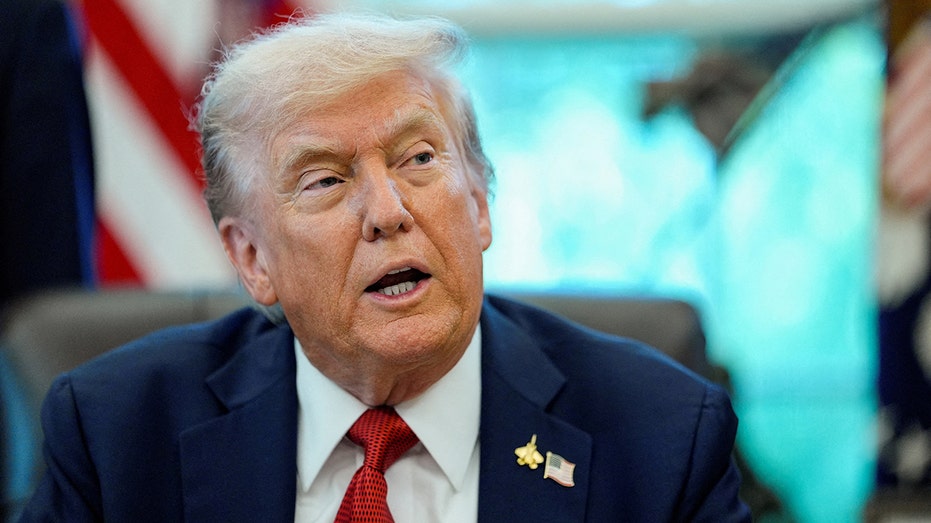
President Donald Trump delivers remarks during an event at the White House on Oct. 6, 2025. (Kent Nishimura / Reuters Photos)

Last month, the Department of Energy restructured a deal with Lithium Americas to receive penny warrants for a 5% stake in the company and warrants for a 5% economic stake in the Thacker Pass lithium project joint venture with General Motors.

In August, the U.S. government acquired a 9.9% stake in chipmaker Intel through a warrant and common stock agreement worth about $8.9 billion.

The Pentagon invested $400 million of preferred stock in MP Materials in July to build an end-to-end U.S. rare-earth magnet supply chain. The company owns the only operational rare earth mine in the U.S., located at Mountain Pass, California.


Federal Court Throws Out Biden's Offshore E&P "Withdrawal" Areas

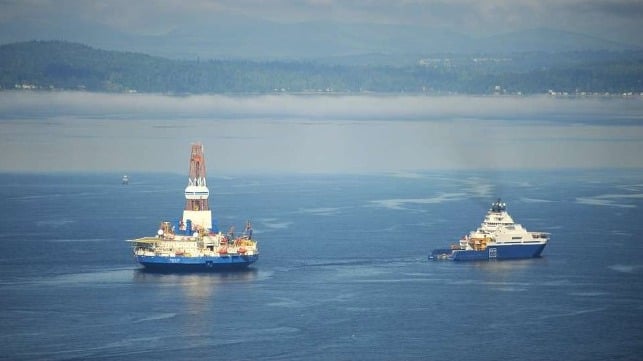
The ruling could make it possible to expand the reach of future drilling activity to include more areas off the West Coast and Alaska (USCG file image)

Published Oct 6, 2025 8:20 PM by The Maritime Executive


A federal judge has thrown out the Biden administration's sweeping ban on offshore oil and gas lease sales outside of the Gulf of Mexico and the North Slope of Alaska, allowing future lease sales to proceed in new geographies. 

The "withdrawal," released in the final weeks of Biden's time in office, covered all of the lease planning areas of the West and East Coasts of the lower 48 states, parts of the Bering Sea, the Straits of Florida, and the eastern Gulf of Mexico. In all, more than 625 million acres of federal seabed were withdrawn from leasing using the president's authority under the U.S. Outer Continental Shelf Lands Act (OCSLA), and Biden's memorandum claimed that this status would last "indefinitely."

The declaration was the largest lease area withdrawal in U.S. history; however, it only covered areas without active E&P activity. All of the regions with significant oil and gas interest - the central U.S. Gulf, Cook Inlet, and Alaska's Arctic coastline - were not withdrawn. 

Multiple oil-producing states joined the American Petroleum Institute in a lawsuit to reverse the withdrawal, but faced a hurdle in the form of an earlier precedent. In 2019, a federal judge ruled that based on the text of the law, a sitting president cannot reverse a previous OCSLA withdrawal once made. The plain language of the statute is mute on this question: unlike several comparable laws governing onshore federal land, it does not explicitly address the question of reversals. 

On Thursday, US District Court Judge James D. Cain, Jr. - a Reagan appointee in the Western District of Louisiana - disagreed with the 2019 court opinion and ruled in favor of E&P interests, striking down Biden's declaration. 

"The language of [OCSLA] itself establishes that withdrawals must be subject to reversal or modification. The statute specifies that the president may exercise this authority 'from time to time,' which courts have recognized as encouraging an ongoing duty to revisit and amend regulations," he wrote. "Presidents have exercised this authority to modify the withdrawals of prior administrations. The orders of President Obama and President Biden, on the other hand, purported to apply for 'a period of time without specific expiration,' i.e., indefinitely. To the extent these were indeed supposed to overcome the power of subsequent executives to revoke or modify their withdrawals, they constituted a departure from the executive branch’s longstanding practice and exceed the authority granted under § 12(a)."

In a statement, the American Petroleum Institute said that the court's ruling would be positive for the energy economy. 

"We welcome the court’s decision to vacate this politically motivated decision and ensure our nation’s vast offshore resources remain a critical source of affordable energy, government revenue and stability around the world. This ruling marks another important step in advancing a robust new five-year offshore leasing program and ensuring the U.S. can meet rising energy demand," said API SVP and General Counsel Ryan Meyers.


EU Plans to Sanction Providers of False Flags to Russia’s Shadow Fleet

The EU plans to impose sanctions on three companies that have provided false flags to tankers of the Russian shadow fleet, Bloomberg reported on Tuesday, citing documents it has reviewed. 

The companies have provided false flags of Aruba, Curacao, and Sint-Maarten to at least eight tankers sanctioned by the EU, according to the documents.  

The potential sanctions against the entities enabling the shadow fleet are part of the European Union’s 19th sanctions package, which the EU member states are currently discussing. 

Earlier this year, the Netherlands warned the International Maritime Organization (IMO) that companies were providing “fraudulent certificates” on behalf of Sint Maarten, Bloomberg notes. 

The sanctions on the suppliers of false flags would come into effect when the EU adopts the whole sanction package, which needs unanimous approval from all 27 member states. 

The European Commission’s proposed sanctions package also accelerates the timeline for phasing out Russian LNG imports into the bloc—from the end of 2027 to January 1, 2027, one year earlier than planned.

The sanctions package also removes all remaining exemptions on Russian oil producers Rosneft and Gazprom Neft, and expands sanctions on Russia’s shadow fleet and its enablers, including on 118 new vessels. 

European Commission President Ursula von der Leyen said upon proposing the new sanctions package that “Russia's war economy is sustained by revenues from fossil fuels. We want to cut these revenues.”

“It is time to turn off the tap. We are prepared for this. We have been saving energy, diversifying supplies and investing in low-carbon sources of energy like never before,” von der Leyen added.

While the EU debates the sanctions package, some individual member states are tightening controls and inspections to intercept shadow fleet vessels. 

Denmark on Monday said it is intensifying inspections on oil tankers passing through its waters, which are the gateway to and from the Baltic Sea, in a move to counter Russia’s shadow fleet movements.   

By Michael Kern for Oilprice.com


Denmark Increases Inspections of Shadow Fleet’s “Old and Worthless” Ships

tankers anchored off Denmark
Denmark will be inspecting vessels in the Skagen Red anchorage which it calls the gateway to the Baltic (DanPilot)

Published Oct 6, 2025 6:49 PM by The Maritime Executive


Denmark announced that it will be taking further steps to reduce the dangers from “old and worthless” ships navigating through its busy sea lanes by targeting environmental inspections at one of the key anchorages in the region. It extends Denmark’s previous efforts to monitor high-risk vessels and is part of the emerging effort across the EU to target the shadow tanker fleet.

"We know that there is a lot of traffic consisting of older ships sailing through Danish waters, and they pose a particular risk to our marine environment,” said Environment Minister Magnus Heunicke. “That is why we are now tightening controls with very basic environmental rules so that we can take more effective and consistent action against tankers and the Russian shadow fleet."

Denmark highlights that several thousand ships pass through its waters each year, and a large number of them anchor in an area known as Skagen Red, at the northern tip of Denmark, as the North Sea ends on the passage toward the Baltic. It is one of the largest and busiest anchorages in the Nordic region.

The Danish Maritime Authority, in collaboration with the Danish Environmental Protection Agency, will carry out more environmental inspections of the ships to ensure that they comply with environmental regulations. They will be looking at elements including waste management, scrapping certificates, ballast water management, discharge of scrubber water, and follow fuel requirements. 

The report that more ships will be boarded while they are in the anchorage, Environmental inspections will be carried out together with port state controls. The EU has already authorized member countries to inspect documentation and demand proof of insurance from passing vessels.

"We must put an end to Putin's war machine. This also applies to the Russian shadow fleet,” said Minister of Industry and Trade Morten Bødskov. “We are using all tools. We know from our safety checks at Skagen Red that among these ships, there are old and worn-out ships sailing around. That is why our authorities are now intensifying the controls so that we look after Denmark and Danish waters."

Another part of the effort will use the so-called “sniffer” on the Great Belt Bridge. Till en end of the year, they will be measuring sulfur content in the ship’s emissions to ensure compliance with the rules of the IMO-designated SOx (Sulphur Oxide) and NOx (Nitrogen Oxide) Emission Control Area (ECA). In the past, countries in the region worked with the European Maritime Safety Agency for enforcement using sniffer drones.

The new effort follows calls last week by France’s President Emmanuel Macron to interfere with the operations of the shadow fleet. France detained a vessel suspected of operating under a false flag, holding it for nearly a week before it was released.

Russia continues to react strongly to the efforts, calling them piracy. It began escorting tankers in the Gulf of Finland and the Baltic in response to the Baltic countries' efforts to inspect shadow fleet tankers. 

The Singularity Myth: Unpacking AI's Future

  • Sam Altman, CEO of OpenAI, has made and subsequently shifted predictions regarding the achievement of Artificial General Intelligence (AGI), moving the timeline from 2023 to 2025 and now to 2030, while others predict 2026.

  • The article argues that current AI approaches, particularly those relying on large language models (LLMs), will never achieve AGI due to the inherent imprecision of language, the lack of lived experience and judgment in machines, and the fact that AI models are merely "maps" not "territory."

  • While AI, such as ChatGPT, offers viable and profitable applications and can be useful to experts for routine tasks, it cannot replace human generalized skills, expertise, or the nuanced understanding derived from lived experience and context.


Sam Altman is the CEO of the most visible artificial intelligence (AI) organization on the planet, OpenAI, the purveyors of the popular ChatGPT AI interface. His job is to keep the investment dollars flowing into OpenAI, tens of billions of them. So, it's pretty important for Altman to keep investors interested and to promise them breakthroughs...and also, apparently, to reschedule those breakthroughs when they don't occur.

Now, something that most people don't understand about OpenAI is that despite being recently valued at $500 billion, OpenAI loses money, reportedly $5 billion last year on sales of $3.7 billion. Back in 2023 Altman was telling the public that OpenAI had achieved artificial general intelligence (AGI). For those who don't know, AGI means intelligence capable of learning and executing all the tasks that humans can do. No one appears to know how exactly to measure whether a machine can do the totality of things a human can do, but it sounds very cool to talk about it. And, it's the kind of talk that keeps investors excited. The implication, of course, is that the investor class won't have to put up with pesky employees much longer for most jobs.

The moment when this happens, when machines become smarter than humans and start running everything for us —as if they don't already—is sometimes called the singularity, usually with a capital "S." Now, singularity has a specific meaning in physics. In this context it refers to a nonreligious, tech version of the rapture in which technological advancement becomes very rapid as machines take over and iterate on technical innovation. We know what happens to people in the religious version of the rapture—some ascend to heaven and others are left behind. But we aren't exactly sure what is to become of humans after the so-called singularity version of the rapture since supposedly there won't be much work to do. AI will be doing it.

But we may not have to concern ourselves with such things for the moment. Apparently, Altman's 2023 proclamation that AGI had been achieved didn't stick. But Altman was back in December 2024 telling the public that AGI would be achieved in 2025. Admittedly, 2025 isn't over, so I suppose AGI could be achieved by December 31. But Altman apparently sees the writing on the wall and isn't waiting for the end of the year to move the goalposts once again, this time to 2030. However, 2026 remains a popular prediction among many others.

Just so you know, predictions of this momentous event are all over the place, some reaching out to 2060, and, not surprisingly, the predictions change over time. But I'm willing to make the following outlandish prediction that under current approaches which rely on so-called large language models (LLMs), AGI will happen never.

There are several reasons I say this—apart from the difficulty of defining what "intelligence" means which would require an entire essay by itself. Before getting to those reasons let me say that I believe current AI development will result in some viable and possibly profitable applications. Clearly, people are using AI interfaces such as ChatGPT and gaining some benefit from them. But that is a far cry from LLMs taking on the lion's share of tasks currently performed by humans. I remember when people said the introduction of the automated bank teller would lead to the extinction of tellers. It's been 50 years and I can report that bank tellers are still working in the lobby of my bank. Machines, even machines directed by AI, are good at specific tasks. But they are unlikely anytime soon to replace the generalized skills of humans.

So, here's why the LLMs that power current AI are limited in what they can do. First, they are based on language. Language is an inherently imprecise tool of communication. Words have multiple meanings. Just look in any dictionary. And those meanings drift over time based on actual usage. That's why dictionaries are constantly updated.

And, words are always understood in context. Context means the entire cultural and physical setting to which the words apply. Humans have a natural talent for language and they learn language within specific cultural and physical settings, relating that language to all five senses and placing the meaning of specific words and sets of words in the context of gestures and attitudes which accompany their utterance.

Machines don't have the chance to learn language in this way; nor do they have the full set of senses (and it's not clear what it would mean if they did). In fact, LLMs simply hoover up a lot of text from a so-called "training set" and use that text to predict what the next word will be regarding the subject about which someone requests information.

Humans can put language and other symbols in the context of their own lived experience. Machines by definition are not capable of lived experience in the manner of humans. Humans' lived experience becomes the basis for judgement, something machines cannot develop. Within judgement I include hunches, intuitions and vague remembrances and connections that often inform human decisions and sometimes form the basis for new ideas and discoveries.

Second, the language of computers is code. Code is a seriously pared down version of language and so much more limited in the ways it can represent reality. I can tell from the current discourse that the biggest boosters of AI almost certainly read few novels (except perhaps some science fiction novels). If they did read more serious non-science fiction novels, they would understand what a monumental task it is to try to describe reality to a reader in words and why the attempt will always fail.

Instead, what great authors do is provide enough of just the right details about settings, characters, dialogue and action to ignite the imagination and lived experience of readers who then create in their minds a version of the world that the author is trying to convey. In other words, humans can create models of the world in their minds and consider possible meanings and trajectories that flow from those models. That's a very complex task. Machines, no matter how sophisticated, cannot imagine a world based on such clues as an author might give them because they do not "live" in the world the way humans do.

Third, there is a very important corollary to points one and two, namely, the map is not the territory. It's a simple concept really. But it is easy to forget when you are a person who is marooned in the land of bits and bytes and computer animation and believe that computers are somehow giving you an accurate representation of the reality we live in. What AI tells us is based on models, not lived reality, models based on imprecise and ever changing language. AI may provide some useful information because of its ability to synthesize huge amounts of text, but it cannot convey understanding. It is merely giving us a map and a very partial and often mistaken one at that.

Fourth, AI is not going to replace human expertise. The idea that AI is going to become expert at every topic is already being shown to be nonsense. Humans embody expertise and share some of that in books, articles, recorded speeches and interviews, and graphics. But we could not produce the next generation of chemists using only books about chemistry.

Knowledge is not just words on a page. Knowledge is something that is embodied in those who have it in the inflections they use in speech, the physical moves they make in the lab, the relationships they develop with their students and colleagues, the ideas they choose to emphasize in their work, and the overall style of their lives. Try learning how to operate in a restaurant kitchen without ever actually going into one. The same goes for a laboratory, both for students and expert researchers. In addition, there are many bits of knowledge that might have been written down but which never make it to the page. Written documents are an outline or prompt to knowledge. They cannot be all-inclusive.

A friend who is a practicing attorney uses AI to compose routine contracts and agreements, models for which abound on the internet and which are therefore available for AI to sweep into its databases. And, of course, the law generally prescribes narrow parameters for such documents. That makes AI less error-prone in composing them. Nevertheless, this attorney has to correct things which are wrong and, of course, modify text where the AI engine has not quite gotten the nuance right. AI is useful to her, but it cannot replace her expertise; and someone who has no expertise and yet uses such raw output, presenting it as authoritative, is a positive danger to society. AI will be useful to experts, but it cannot replace them.

Many investors are betting that Sam Altman will be right about the advent of AGI. When they figure out that he's not, the curtain will come down on the AI stock bubble and probably take the whole economy with it. That's usually what happens when it becomes clear that the new era prophesied by the industry gurus of the latest "big thing" is just like old eras; there may be some genuine progress, but the value of the progress has been poorly understood and greatly overestimated.

"Trees do not grow to the sky" is an old German proverb. Nor do AI stocks rise forever. Every generation must learn the hard way that financial manias always end badly even if the underlying companies provide some value that must be marked down to its actual contribution to society.

By Kurt Cobb via Resource Insights

First Phase Of Game-Changing Iraq Project To Start Early Next Year

  • TotalEnergies’ $27 billion mega-project in Iraq has entered full execution, with first output expected by early 2026.

  • The gas capture initiative aims to curb Iraq’s reliance on Iranian gas and electricity by processing associated gas from five major southern oilfields.

  • The Common Seawater Supply Project (CSSP) will inject treated seawater into southern oilfields to maintain reservoir pressure and free freshwater for agriculture.

The foundation stone for the re-entry of several major Western energy firms into Iraq was the US$27-billion four-pronged mega-project finally ratified by France’s TotalEnergies in 2023. The project was particularly aimed at addressing two critical issues that had dogged Iraq’s development for decades and whose resolution had been stymied by bureaucracy and corruption at senior levels across several governments in Baghdad, as analysed in full in my latest book on the new global oil market order. One of these crucial issues was dramatically increasing the amount of gas captured during the process of drilling for oil (‘associated gas’). And the other was stabilising and then boosting the pressure at Iraq’s key oil wells through the treatment and redirection of seawater to these sites through the ‘Common Seawater Supply Project’ (CSSP). The two other projects of the four are the full redevelopment of the Ratawi oil field and the construction of a 1.25 gigawatt-peak solar complex. In recent days, TotalEnergies chief executive officer Patrick Pouyanné announced the start of the construction of the CSSP and the Ratawi development. This means that all four major prongs of the US$27 billion project are now in their execution phase and, according to Pouyanné, the mega-project is on track to deliver its first oil, gas and solar output as soon as early 2026.

By far the most geopolitically important of the four projects is that which will capture associated gas. This might sound overblown to some outside the energy sector, or even within it, but because Iraq did not address this issue seriously earlier it was unable to use the gas for its own domestic power generation. This meant that for years that it has relied on neighbouring Iran to bridge that gap, which it did through increasingly large imports of gas and electricity. This reliance on Tehran for its power needs made Baghdad even more willing to cooperate with its neighbour on supporting pro-Shia militia groups across the Middle East and beyond, and in enabling Iran to continue to export its oil despite long-running international sanctions. The former was often focused on an anti-U.S. and anti-West insurgency that claimed dozens of military and related personnel over the years, even after the formal end of Washington’s mission in Iraq in December 2021. The latter has been achieved through a combination of shared oil fields between the two countries, forged documents, and illegal shipping practices. In turn, these elements were also part of the wider Iran-Iraq alliance that drove the influence of the ‘Shia Crescent of Power’ through the region, as also detailed in my latest book.  This alliance held an extraordinary sway up until very recently over the political, economic, and security trajectories of the Middle East. With Iran at its ideological centre, the Crescent comprised key strategic assets in Iraq, Syria, Lebanon, and Yemen, with inroads being made in Azerbaijan (75% Shia and a Former Soviet Union state), Turkey (25% Shia and still furious at not being accepted fully into the European Union), Bahrain (75% Shia), and Pakistan (up to 25% Shia and a home to multiple terrorist groups antagonistic to the West). Key elements in this Shia Crescent alliance were also instrumental in Iran’s plan to build a ‘land bridge’ that would run via Iraq all the way to the Mediterranean coast, which would then be used by Tehran to increase arms shipments to its militant proxies for use against Israel. The gas capture part of TotalEnergies’ mega-project is aimed at cutting this particular strand of Iraqi reliance on Iran. It involves collecting and refining gas that is currently burned off during oil drilling at the five southern Iraq oilfields of West Qurna 2, Majnoon, Tuba, Luhais, and Ratawi.

If the gas capture programme is the most geopolitically important of TotalEnergies’ four projects then the CSSP is the most important for the energy sector. The basic plan was always that the programme would be used initially to supply around six million bpd of water to at least five southern Basra fields and one in Maysan Province and then built out for use in further fields. Both the longstanding stal­wart Iraq fields of Kirkuk and Rumaila – the former beginning production in the 1920s and the latter in the 1950s, with both having produced around 80% of Iraq’s cumulative oil production – require major ongoing water injection. The reservoir pressure at the former dropped signifi­cantly after output of only around 5% of the oil in place (OIP). Rumaila, in the meantime, produced more than 25% of its OIP before water injection was required because its main reservoir forma­tion (at least its southern part) connects to a very large natural aquifer that has helped to push the oil out of the reservoir. Although the water requirements for most of Iraq’s oilfields fall between these two cases, the needs for oilfield injection are highest in south­ern Iraq, in which water resources are also the least available, according to the International Energy Agency (IEA). To reach and then sustain Iraq’s future crude oil production targets over any meaningful period, the country will have total water injection needs equating to around 2% of the combined average flows of the Tigris and Euphrates rivers or 6% of their combined flow during the low season. These demands might not appear too onerous, but these water sources will also have to continue to satisfy other, much larger, end-use sectors, including agriculture. The first phase of TotalEnergies’ CSSP programme will be built on the coast near the town of Um Qasr and is set to process and transport 5 million barrels of seawater per day to the main oil fields in southern Iraq, according to the French firm. Treated seawater will replace freshwater withdrawals from the Tigris, Euphrates, and aquifers to maintain pressure in the oil wells, freeing up to 250,000 cubic metres per day of freshwater for irrigation and local agriculture needs in the water-stressed region.

The CSSP is also crucial to ensuring the longevity of additional reserves due to be brought online in the coming years, which could make Iraq the world’s top crude oil producer. Back in 2012, as also examined in full in my latest book on the new global oil market order, then-Iraq Prime Minister Nouri al-Maliki received a confidential report (the ‘Integrated National Energy Strategy’) showing exactly how Iraq could increase its oil output from just over 3 million bpd at that point to a plateau of 13 million bpd in the ‘High Production’ scenario by 2017. The ‘Medium Production’ scenario plotted a course to 9 million bpd plateau by 2020, while the ‘Low Production’ scenario planned for 6 million bpd by 2025. The key to achieving this was a fully functioning CSSP. The output involved might also be sustained and boosted by the programme with the addition of new reserves that remain as yet untapped but have long been thought to dwarf official 145 billion barrels of proved crude oil reserves held by Iraq.  In fact, in October 2010, Iraq’s Oil Ministry stated that Iraq’s undiscovered resources amounted to around 215 billion barrels. However, even this figure did not include the parts of northern Iraq in the semi-autonomous region of Kurdistan. As highlighted by the IEA, most of these had been drilled during a period before the 1970s began when technical limits and low oil prices gave a narrower definition of what constituted a commercially successful well than would be the case now. Overall, the IEA projected that the level of ultimately recoverable resources across all of Iraq (including the Kurdistan region) was around 246 billion barrels (crude and natural gas liquids).

By Simon Watkins for Oilprice.com