Tuesday, October 14, 2025


North Sea Oil: Booming in Norway and Doomed in the UK

  • Norway continues to expand oil and gas exploration, offering fiscal stability and generous tax refunds for exploration losses.

  • The UK faces an industry exodus amid shifting tax regimes and political uncertainty.

  • The UK’s windfall tax and scrapped investment allowances have driven out major producers like Ineos and Apache, with 2025 set to be the first year since 1960 without a single new exploration well in the UK North Sea.

The UK and Norway, two neighboring jurisdictions in the North Sea, have chosen starkly different paths to handle their oil and gas resources. The net-zero-obsessed UK is driving investors away with regulatory and tax uncertainty, while Norway – also aiming for net zero – backs further exploration and cashes in on the massive royalties.

The result of the different approaches to the North Sea’s oil and gas has become glaringly evident this decade.

The UK imports growing volumes of oil and gas as its mature fields are depleting and no new licenses are being awarded. Norway has boosted oil and gas production, has become Europe’s (and the UK’s) top gas supplier, auctions acreage every year, and plans to do so for the foreseeable future to help its allies increase energy security. 

A Tale of Two North Seas

“There is a huge difference between the two countries’ approach and it has become bigger over the past five years,” Tom Erik Kristiansen, an energy specialist at Nordic-focused investment bank Pareto, told The Telegraph.

“In Norway, you have two or three of the biggest parties agreeing not to touch [the oil and gas industry]. In the UK it is much more party political.”

For decades, successive governments in Norway have supported the oil and gas industry and the domestic supply chain, acknowledging that these create jobs and economic opportunities.

Norway, unlike the UK, strongly supports oil and gas development and exploration for undiscovered resources on its shelf, not only in the North Sea, but also in the Norwegian Sea and the Arctic waters in the Barents Sea.

Related: Egypt is Making a $6 Billion Bet on Crude Oil

The Norwegian government has started to plan its 26th oil and gas licensing round in little-explored frontier areas as Norway looks to boost exploration and resources to stem an expected decline in production from the early 2030s.

In Norway, companies can get refunds of 71.8% of losses associated with exploration. The taxes in Norway are high, but they have been this way since the 1990s, providing long-term certainty to operators.

This is so unlike in the UK, where the tax regime has changed every year since 2022 by both Conservative and Labour governments, making any investment plans so unpredictable that companies are quitting the UK North Sea.

Since the Energy Profits Levy (EPL), or the windfall tax, was initially introduced by the Conservative government at the height of the energy crisis in 2022, oil and gas companies operating in the UK North Sea have been calling for certainty in the regulatory and tax framework. Recent changes in policies and the rising taxes imposed by the current Labour government have driven away operators, who say that a lack of North Sea investments would only make the UK more dependent on oil and gas imports.

Late last year, as Labour further raised the windfall tax, it also removed the 29% investment allowance on oil and gas operations, further stifling UK North Sea investment.

The result has been an exodus of companies, a decline in production, and a slump in exploration drilling.

In fact, due to the fiscal turmoil in recent years, 2025 is set to become the first year since 1960 without a single exploration well in the UK North Sea, according to energy consultancy Wood Mackenzie.

What The Future Holds

The UK’s unpredictable regulatory and tax regime has already pushed operators away from the UK North Sea.

At the end of last year, U.S. oil producer Apache said it would cease oil production at its assets in the UK North Sea by 2030, saying that “the expected returns do not economically support making investments required under the combined impact of the regulations.”

In a major blow to the UK industry, Ineos Energy this summer ended UK investment, after warning a few months earlier that the tax is “the most unstable fiscal regime in the world.”

The UK’s “current tax regime, its over-regulation and the negative political attitude towards oil and gas are barriers that would deter any investor at the moment,” Ineos Energy chairman Brian Gilvary, a former chief financial officer at BP, said last December.

The UK government has launched consultations on what type of tax regime should come next and on whether to award licenses in the North Sea. Decisions are expected later this autumn.

The main offshore energy industries association, OEUK, urges the government to replace the Energy Profits Levy with a permanent profits-based tax system and update licensing rules “to provide predictable access to new resources, ensuring infrastructure is fully utilised rather than decommissioned prematurely.”

The loss of investment is reducing oil and gas production—it has plunged by 40% in the past five years and is on track to halve again by 2030, OEUK warns.

While the UK is in a race against time to save its oil and gas industry and its industrial capabilities from demise, Norway is enjoying higher oil and gas production as new fields come online.

But Western Europe’s largest oil and gas producer, Norway, is not complacent. It is aware that it needs more exploration and new field developments to keep output at high levels while the world still needs it.

The current and past Norwegian governments have continuously bet on the oil and gas industry and the massive revenues it raises for the country and its sovereign wealth fund, the world’s largest. Government Pension Fund Global, which is commonly referred to as ‘Norway’s oil fund’ because it was created with oil and gas revenues, has $2 trillion worth of assets and holds on average 1.5% of all listed companies in the world.

“Norway wants to be a long-term supplier of oil and gas to Europe, while the Norwegian continental shelf will continue to create value and jobs for our country,” Energy Minister Terje Aasland said in August, announcing the plans for a new licensing round.

“We need new discoveries to ensure that Norway can remain a stable and predictable supplier of oil and gas to Europe,” Aasland said earlier this year.

By Tsvetana Paraskova for Oilprice.com


EDP Launches New Hybrid Wind-Solar Park in Portugal’s Algarve

EDP has taken another major step toward accelerating the energy transition with the launch of its new Charneca das Lebres/Bordeira hybrid park in Portugal’s Algarve region. The facility combines wind and solar technologies with a total installed capacity of 39.3 megawatts (MW) — marking a significant milestone in the company’s strategy to integrate multiple renewable sources for greater efficiency and sustainability.

The new project adds 15.3 MW of solar capacity at Charneca das Lebres to the existing 24 MW of wind generation at the Bordeira wind farm. Together, the hybrid site will increase renewable energy production by 41%, reaching 83.1 gigawatt-hours (GWh) annually — enough to supply power to approximately 24,000 households each year while preventing 64,000 tonnes of CO? emissions.

As with other hybrid projects operated by EDP, the Charneca das Lebres/Bordeira park utilizes existing infrastructure from the wind site, reducing environmental impact and optimizing grid use by avoiding new construction. The installation includes 26,000 solar modules integrated with wind assets, exemplifying EDP’s approach to maximizing energy yield while minimizing land and resource use.

“This project reinforces EDP’s commitment to the Iberian Peninsula and to developing clean, innovative, and efficient solutions that support national decarbonization goals,” said Pedro Vasconcelos, CEO of EDP España. He stressed the importance of stable regulatory frameworks, investment incentives, and continued grid expansion to accelerate renewable deployment across the region.

In Spain, EDP currently operates five hybrid parks — Cruz de Hierro, Villacastín, Castillo de Garcimuñoz, Rabosera, and Las Lomillas — totaling 229.55 MW. In Portugal, the company’s hybrid capacity now reaches 696.43 MW across five major projects: Alto Rabagão, Alqueva, Sabugal, Monte de Vez, and the newly inaugurated Charneca das Lebres/Bordeira. These projects integrate technologies such as bifacial solar panels, wind turbines, hydroelectric generation, and battery storage, underscoring EDP’s role as a pioneer in renewable hybridization in Europe.

By combining multiple renewable energy sources, EDP continues to strengthen its position as one of the leading utilities driving Europe’s clean energy transition, aligning with both EU and Iberian climate targets.

By Charles Kennedy for Oilprice.com


Aurubis held talks with US on support for new smelter, CEO says

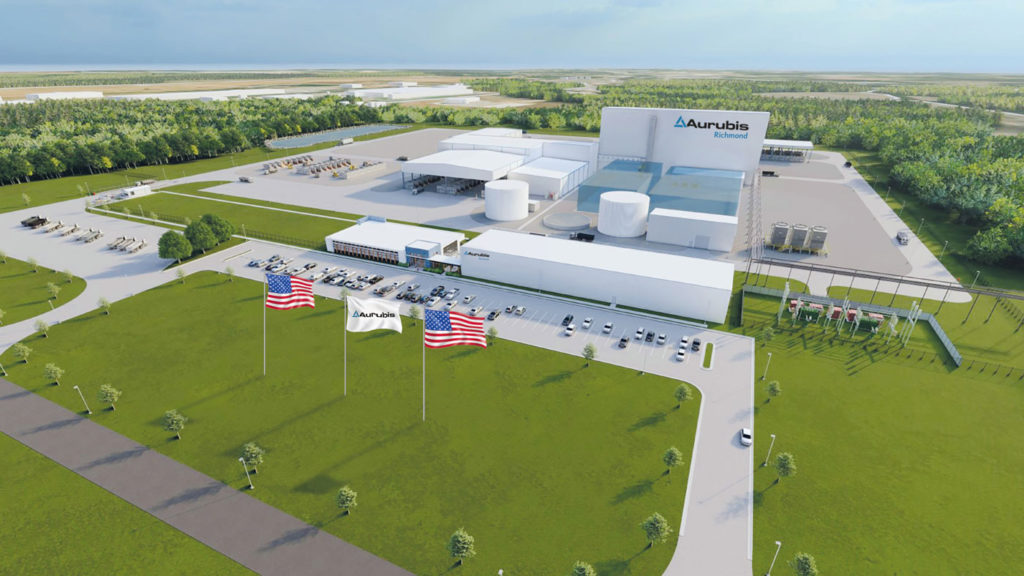
Animation of the Aurubis Richmond plant. Credit: Aurubis

Germany’s Aurubis has held preliminary talks with the US government about support for a new copper smelter in the United States following the launch of a recycling plant there, its CEO said on Tuesday.

A new smelter is one of three options Europe’s biggest copper producer is considering to take advantage of a US drive to boost domestic output of the metal, after President Donald Trump in July announced a 50% tariff on copper products but left out ores, concentrates and cathodes.

“First we have to lay out options and come up with more concrete proposals. But we have positive signs from the US government that they would potentially support this,” CEO Toralf Haag told Reuters during metals industry gathering LME Week.

Big US demand

Last month Aurubis started production at its new recycling plant in the US state of Georgia, the first greenfield plant it has built in 115 years, which will ramp up to annual output of 70,000 metric tons of high-grade blister copper.

The US is only able to supply about half of its refined copper demand of 1.7 million tons from domestic production, with the gap widening in coming years as demand is due to jump by two-thirds to 2.3 million by 2035, Aurubis has said.

“There are 60 smelters in China, 15 in Europe, and now with us, only three in the US. So there’s a big demand for smelting capacity,” Haag said.

Building a new smelter would be a long-term project, but two other options could come to fruition in three to four years without government support, he added.

The first would be to expand the current US recycling operation by building an anode furnace and tank house to produce cathodes and possibly rods, Haag said.

The second would be to build another recycling plant on the US west coast to take advantage of higher scrap availability after the tariff ruling limited exports.

The US recycling market is expected to climb by 26% over the next decade to 555,000 metric tons a year, Aurubis has said.

Higher platinum, antimony production

Aurubis also plans to boost platinum and antimony output by building a new precious metal refinery and complex recycling plant in Hamburg together costing about 500 million euros ($577.7 million), Haag said.

Firm demand and worries about supply shortages enabled Aurubis to lift the premium it will charge European customers next year to a record $315 per metric ton, up 38% from last year, Reuters reported last week.

Supply worries from mine disruptions in Indonesia, Chile and Congo helped drive benchmark copper on the London Metal Exchange to a 16-month peak of $11,000 a ton last week. It was down 2.7% at $10,525 a ton on Tuesday morning.

($1 = 0.8656 euros)

(By Eric Onstad; Editing by Jan Harvey)

Titan Mining to produce graphite concentrate at New York facility

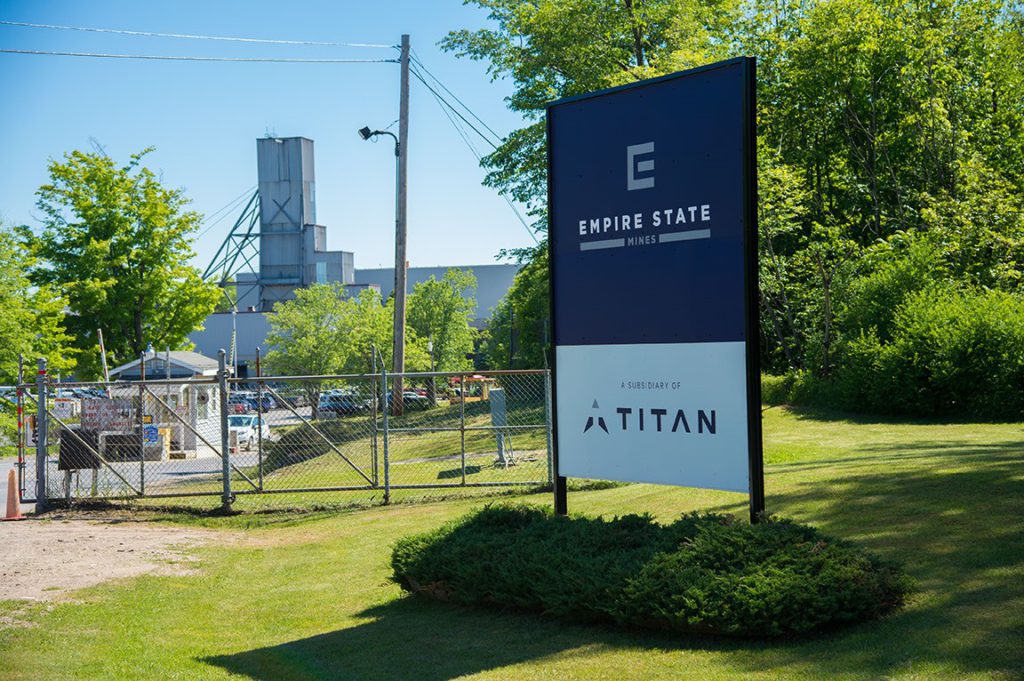
Empire State Mine in New York state. Credit: Augusta Corp.

Titan Mining said on Tuesday it will begin production of graphite concentrate at its Empire State Mines in New York, days after China expanded export limits on rare earth minerals.

The Canadian miner is targeting ramp-up to a 40,000-tonne-per-year commercial graphite facility, which the company said would be capable of supplying about half of current US natural graphite demand.

“China’s decision to tighten graphite exports underscores the importance of having a secure domestic supply of natural graphite,” said Titan CEO Rita Adiani.

China already tightly controlled its exports of rare earths, but last week added five new elements, bringing the total that are subject to restrictions to 12.

It also limited the export of dozens of pieces of equipment and material used to mine and refine rare earths, processes in which it is the world leader.

In March, US President Donald Trump invoked emergency powers to accelerate domestic production of critical minerals such as aluminum, cobalt, lithium, graphite, neodymium and dysprosium.

Titan said the facility will produce natural flake graphite in micronized and high-purity forms sourced from the company’s Kilbourne deposit.

(By Katha Kalia; Editing by Sahal Muhammed)


First Quantum hits back at ESG report on “blocked” La Granja

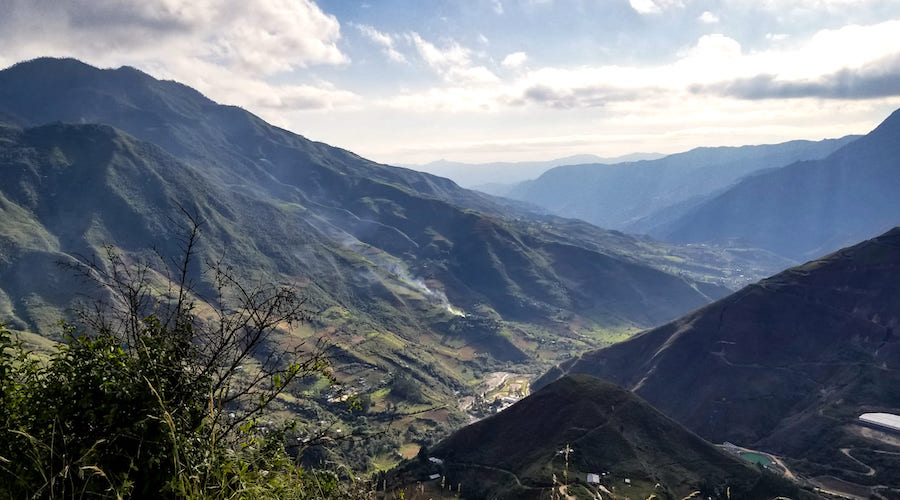
La Granja project, in the Querocoto district of the northern region of Cajamarca. (Image courtesy of First Quantum.)

First Quantum Minerals (TSX: FM) has pushed back against claims that its La Granja copper project in northern Peru is stalled due to public opposition, calling the allegations outdated and misleading.

The comments come in response to a study by GEM Mining Consulting, which suggests the project remains “blocked by public distrust.” First Quantum responded this week, stating La Granja is progressing “decisively and transparently” under strict environmental, social, and governance (ESG) standards.

The company noted that GEM’s study relies on community opposition sources that are nearly two decades old and no longer reflect the current state of the project or its relationship with local stakeholders.

La Granja, a joint venture between First Quantum (55%) and Rio Tinto (45%), sits in the district of Querocoto, Cajamarca. The project entered a new development phase in September 2023, focusing on advanced exploration and in-depth technical and socio-environmental studies. With an inferred mineral resource of 4.32 billion tonnes at 0.51% copper and room for further expansion, the site is viewed as a major copper asset


First Quantum highlighted ongoing regulatory inspections by Peruvian authorities, none of which have identified non-compliance. It also cited its participatory environmental monitoring program, which includes local community representatives.

ESIA in the works

The miner described its relationship with surrounding communities as strong, pointing to local employment, use of regional suppliers, and a permanent community information office in Querocoto. 

According to First Quantum, perception studies show that a majority of residents view La Granja favourably and consider it a key driver of regional development.

Support from local, regional and national authorities further reinforces the project’s strategic importance to Peru’s economy, the company added.

The miner said part of its $546 million initial funding is being invested in an Environmental and Social Impact Assessment (ESIA), which is expected to be completed in the next two years.

“La Granja is a model of responsible mining where agriculture, livestock, and mining coexist harmoniously,” First Quantum said. “Far from being ‘blocked,’ the project continues to advance, grounded in dialogue, trust, and environmental stewardship.”


Over 25% of global copper supply trapped by ESG roadblocks — study

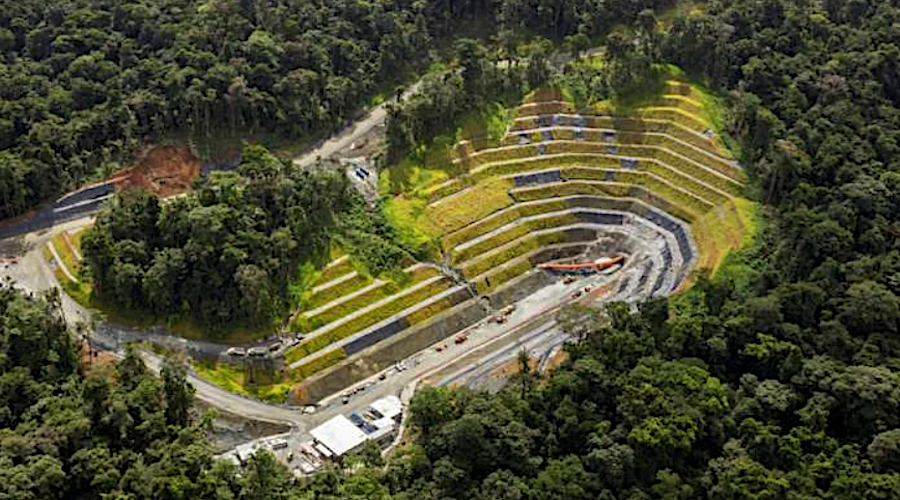
Cobre panama giant copper mine has remained idled since November 2023. (Image courtesy of First Quantum Minerals.)

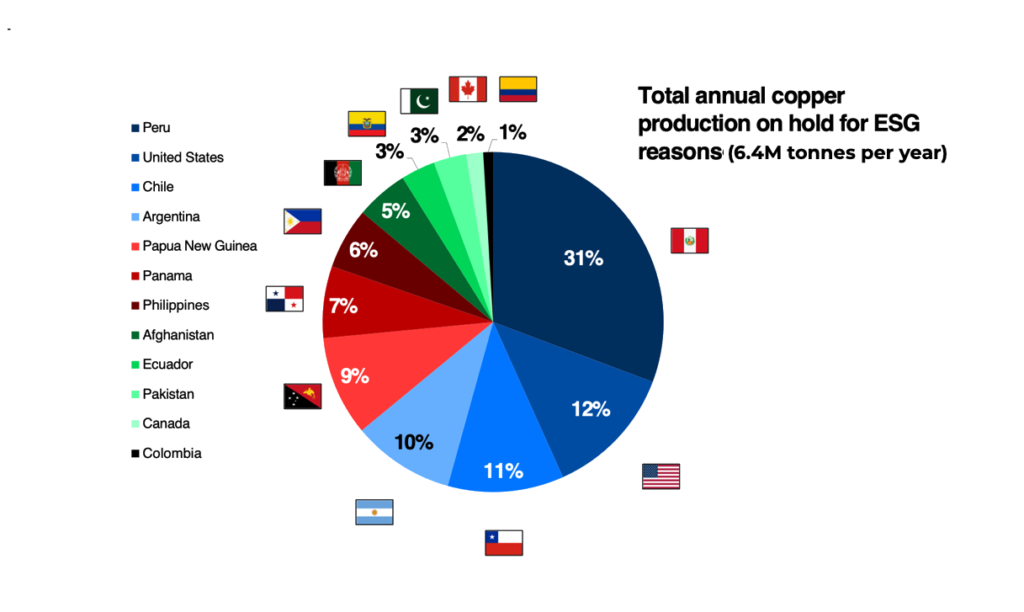
About 6.4 million tonnes of copper production capacity, equal to more than 25% of global mine output, is stalled or suspended due to environmental, social, and governance (ESG) issues, a new study shows.

These bottlenecks, unlike geological or technical barriers, stem from conflicts that could be resolved through stronger governance, deeper community engagement, and more sustainable practices, according to analysts at GEM Mining Consulting. The findings come as demand for copper continues to surge, driven by electrification, renewable energy growth, and the digital economy.

Countries including Chile, Peru and the United States hold some of the largest copper reserves now off the market. Unlocking even a fraction of these projects could ease looming supply shortages during the energy transition, Patricio Faúndez, head of economics at GEM, says.

Source: GEM Mining Consulting. (Research based on various public sources).

Peru accounts for the largest share of untapped copper, roughly 31% or 1.8 million tonnes annually, followed by the US with 0.8 million tonnes, Chile with 0.7 million tonnes, and Argentina and Papua New Guinea (PNG) with about 0.6 million tonnes each. 

Peru’s halted output nearly matches its current annual production. If released, the country could reclaim its position as the world’s second-largest copper producer, surpassing the Democratic Republic of Congo with more than 4 million tonnes per year, the study notes.

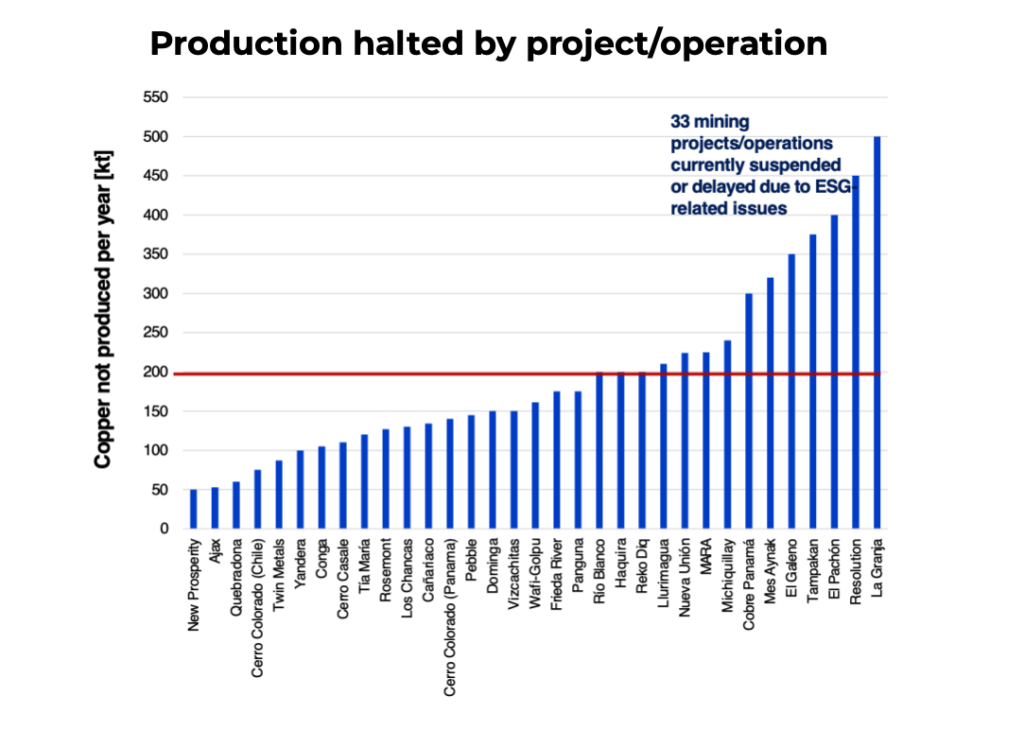
Source: GEM Mining Consulting. (Research based on various public sources).

In the US, restarting suspended projects could narrow the gap between domestic production and rising consumption, strengthening supply security and reducing import dependence.

In Chile, the stalled copper could finally break a decades-long production ceiling of around 5.5 million tonnes per year, pushing output beyond 6 million tonnes and reinforcing the country’s leadership in global supply.

Three telling cases

Among the 33 projects paralyzed by ESG factors, three stand out: La Granja in Peru, Resolution Copper in the US, and El Pachón in Argentina. 

La Granja, owned by Rio Tinto (ASX: RIO) and First Quantum Minerals (TSX: FM), has faced some headwinds over alleged contamination and land use since 2006. While te report says the projects remains “blocked”, the companies said La Granja, ranked as the world’s fifth-largest copper deposit, is currently advancing according to plans.

In Arizona, Rio Tinto’s Resolution Copper project has been stalled for more than two decades due to Indigenous and environmental opposition over the sacred Oak Flat site, located on federally owned land. 

Over 25% of global copper supply trapped by ESG roadblocks — study
Resolution Copper has faced Indigenous and environmental opposition over the sacred Oak Flat site. (Image by Wendy Kenin |Flickr Commons.)

El Pachón in Argentina, held by Glencore (LON: GLEN), has been delayed by glacier-protection rules and permitting hurdles, though new incentives under President Javier Milei’s RIGI regime may revive development.

GEM’s report does not mention an iconic copper mine that has remained idled since November 2023: First Quantum’s Cobre Panamá. Before Panama’s Supreme Court declared the mine’s operating contract unconstitutional and forced it to shut down, it ranked among the world’s largest copper producers, yielding 350,000 tonnes in 2022, its final full year of operations. The mine contributed about 5% of Panama’s GDP, and First Quantum estimates the suspension has cost the country up to $1.7 billion in lost economic activity.

Perfect storm

Panguna in Papua New Guinea stands as a stark reminder of how ESG concerns,  such as water use, biodiversity loss, Indigenous rights, consultation failures and local protests can collide. 

Once one of the world’s largest copper-gold mines, the mine operated by Rio Tinto’s unit by Bougainville Copper, closed in 1989 after a violent civil conflict over environmental destruction and inequitable profit sharing. More than three decades later, redevelopment remains uncertain.

While some projects may eventually progress, Faúndez warns that many remain frozen for years, out of sync with surging demand. Rebuilding trust, enforcing higher environmental standards, and stabilizing governance, he said, will be crucial to unlocking the copper needed for the global energy transition.


Freeport to break away from copper benchmark it set for decades

Freeport-McMoRan’s Atlantic Copper smelter. Credit: Freeport-McMoRan

Freeport McMoRan Inc. plans to break away from the benchmark pricing system underpinning global sales of mined copper ores to protect the profitability of smelters, the company’s top commercial executive said in an interview.

The global copper industry has long relied on a single benchmark for sales of semi-processed ores known as concentrates. Copper smelters receive processing fees called treatment and refining charges, or TC/RCs, to turn concentrates into metal.

These fees — which are deducted from the value of the metal contained in concentrates — are crucial to keep the furnaces running, as they typically account for almost one-third of smelters revenues.

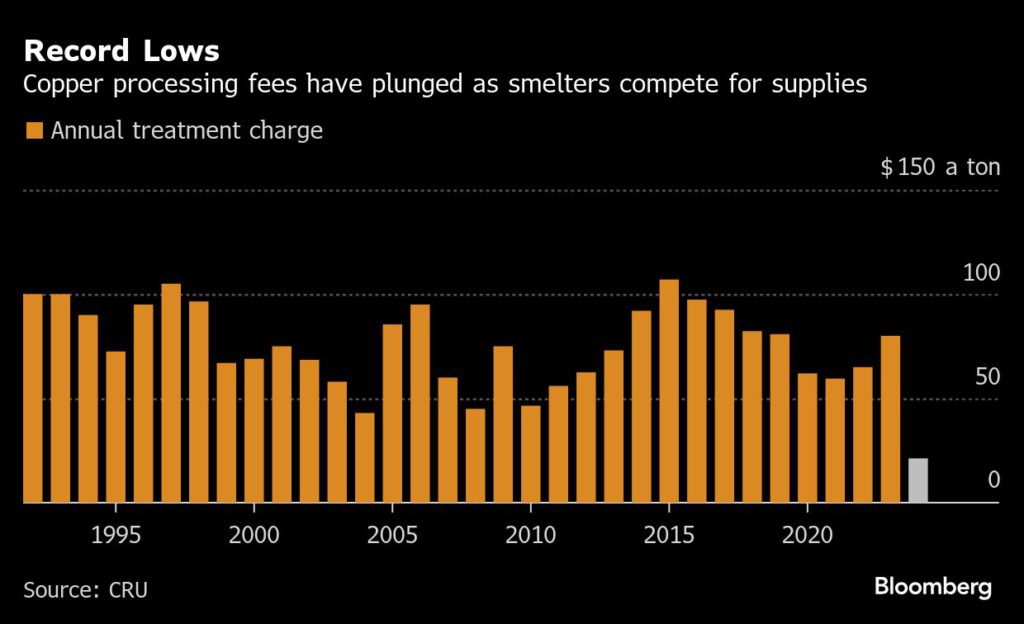
But unprecedented supply disruptions, smelting expansions, as well as strong buying interest from traders, have pushed benchmark TC/RCs to record lows in 2025.

“Over the last 35 years, I have never seen anything like this this,” said Javier Targhetta, Freeport’s senior vice-president for sales and marketing. “We, Freeport, are not happy our customers are losing money.”

Many expect the benchmark to plunge even further in 2026, potentially turning negative — which would effectively mean that the charges are added to the cost of concentrates, rather than deducted from them.

In such an outcome, Freeport would likely elect not to follow the benchmark next year, and would instead strike individual supply deals that would better protect smelters’ margins, Targhetta said.

“The market is evolving away from the benchmark system, now more than ever,” he said in an interview as benchmark negotiations for TC/RCs kicked off during LME Week in London.

The comments stand out because for more than three decades, Targhetta was in charge of signing massive supply deals with smelters that have routinely provided the global TC/RC benchmark.

The company stepped back from the process in deals for this year, after building another smelter of its own that left fewer concentrates available to other buyers. Chilean miner Antofagasta Plc took the helm, and set a record-low benchmark with a treatment charge of $21.25 per ton of ore processed, and a refining charge of 2.125 cents per pound of metal produced.

Targhetta is also the chairman of Freeport’s Atlantic Copper smelter in Spain, which sources concentrates from Freeport’s own mines, as well as third parties. That adds to Targhetta’s concerns about the steep decline in processing fees.

In one recent tender, traders were offering TC/RCs of less than -$100/-10 to secure supplies next year, according to people familiar with the matter.

“We don’t call those numbers benchmark; they are nonsense,” Targhetta said, referring to recent spot transactions. “Atlantic Copper would not accept a zero tolling fee.”

(By Julian Luk and Mark Burton)


Video: U.S. Destroys Boat off Venezuela Accused of Narcotrafficking

destruction of small boat
US released a video showing the destruction of another small boat of Venezuela

Published Oct 14, 2025 7:38 PM by The Maritime Executive


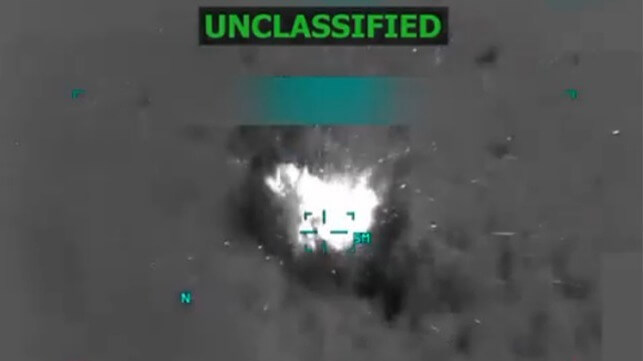
The U.S. has released another video of the destruction of a small boat, which it says was off the coast of Venezuela. Later media reports are saying six men were killed aboard the boat, which Donald Trump accused in a social media posting of being associated with the drug cartels.

The video appears to show a stationary boat before the attack from the air. It explodes, and most of the video shows the boat burning.

“Intelligence confirmed the vessel was tracking narcotics, was associated with illicit naracoterrorist networks, and was transiting along a known DTO Route,” Trump wrote on his social media posting. It is the fifth attack, according to Fox News, while the Pentagon and Trump have released four videos. The previous release was on October 3. 


Questions have arisen in Congress over the authority to proceed with these attacks, and it has been noted that the administration has not publicly or privately provided proof of its assertions that these were known drug trafficking. The first attack in September raised questions due to the number of people aboard the boat and reports that it might have been a fishing excursion.

Trump and the White House counter by saying the president, in February, designated some of the known drug cartels as “foreign terrorist organizations.” In today’s announcement of the strike, Trump writes that the strike was on his “Standing Authority as Commander-in-Chief.” He writes that the boat was “affiliated with a Designated Terrorist Organization” and was “conducting narcotrafficking.”

The strike comes days after Pete Hegseth announced the formation of a new counter-narcotics Joint Task Force in the Southern Command area. It is under the Marine Expeditionary Force with a mission to synchronize and augment counter-narcotics efforts across the Western Hemisphere. 

Trump speaking to reporters during a White House event today, October 14, accused Venezuela of being “a big purveyor of drugs.” He has said the strikes will continue until the cartels are stopped. Hegseth wrote on social media, “If you traffic drugs toward our shores, we will stop you cold.”

Venezuela is accusing the United States of an “ulterior motive,” and said the U.S. has spent 26 years seeking to advance “regime change.” Venezuela has written to the United Nations’ Security Council requesting an emergency meeting.


India’s Cochin Shipyard Secures Mega Order from CMA CGM for First Boxships

Cochin India shipbuilding
Cochin has received India's first international order for ocean-going container ship construction

Published Oct 14, 2025 2:23 PM by The Maritime Executive


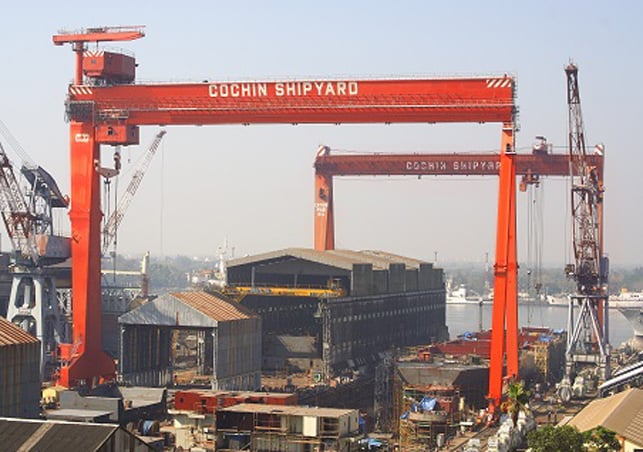
India’s efforts to break into the leadership in global shipbuilding are taking a large step forward with Cochin Shipyard securing its first-ever international order for ocean-going containerships. India has been courting the major shipping companies to secure work to support the government’s plan to develop shipbuilding as a major industry and exporter.

Cochin, in a regulatory filing, announced what it terms a “mega order,” with the value being reported between $225 million to possibly over $300 million. The company said that it had signed a letter of Intent on October 14 and will proceed to a formal shipbuilding contract with “a prominent European client.” 

Media reports immediately identified the client as CMA CGM. It follows meetings with the company at its headquarters in France last February, including a presentation by President Rodolphe Saadé to the Indian Prime Minister Narendra Modi and French President Emmanuel Macron. There were follow-up sessions in India, which led to CMA CGM announcing it was reflagging vessels to India for its local feeder operations. The CMA CGM Vitoria was transferred to the Indian flag in April, marking the first time a large international carrier had flagged a containership in India.

Cochin reports it will design and build six feeder container vessels. Each will have a capacity of 1,700 TEU and will be powered by liquified natural gas. No timeline has been announced for the construction. India’s Economic Times says the new vessels may also be flagged in India.

Already the country’s largest shipbuilder, the company has been busy with government work, including India’s first domestically built aircraft carrier. It has also executed contracts for niche vessels for international customers, including currently building SOVs for North Star and Pelagic Wind Services. The shipyard also recently signed a cooperation agreement with South Korea’s HD Hyundai, which is designed to expand its shipbuilding capabilities. As its work for the navy is completed, Cochin will have the capacity to expand into commercial shipbuilding.

India is currently ranked 16th in shipbuilding, but the government has committed to expanding the industry. Modi said India would break into the top 10 by 2030 and the top 5 by 2047. The government recently enacted a series of financial programs to support the shipbuilders and has a plan to develop both the existing companies as well as new yards into a series of shipbuilding clusters around India.

The government has also met with both Maersk and MSC Mediterranean Shipping to promote its shipbuilding and repair capabilities. Maersk has already said it was exploring the yards for repairs. Analysts are saying now that the first order has been received, it will open the door for Maersk, MSC, and others to follow suit.


Icebreaker Nuyina Touches Bottom During Survey in Southern Ocean

Nuyina in Hobart (AAD file image)

Published Oct 14, 2025 4:28 PM by The Maritime Executive


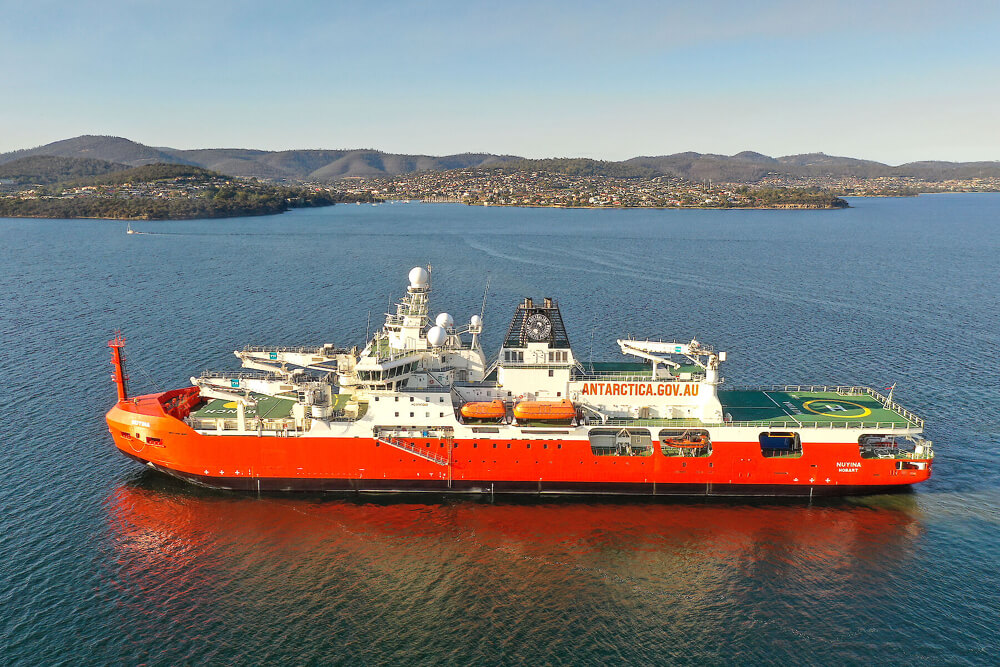
It is not unheard-of for ships to touch bottom and carry on with their voyage, and if the ground is soft enough the contact may cause no harm at all. It is a less desirable outcome, however, for a high-spec research vessel in an ultra-remote location, thousands of miles from aid. On Monday morning, Australia's research icebreaker Nuyina "made contact" with the seabed off Heard Island, a remote outcropping in the Southern Ocean some 2,000 nautical miles from the nearest inhabited shore.

Nuyina is operating near Heard Island as part of a two-month research, conservation and resupply mission to Antarctica. The first stop was at Casey Station, an Australian research outpost, where the ship dropped off an expedition party. Her mission at Heard Island was scheduled to last 10 days, followed by a resupply trip to the Davis Station outpost. 

On Monday, the Nuyina was conducting seabed mapping off Heard Island when the hull "made contact with the ocean floor," the Australian Antarctic Division (AAD) said. Coast survey operations often come with a heightened level of risk, as they are often needed most in poorly-charted areas of variable depth and close proximity to shoaling. This was the activity that the lost Royal New Zealand Navy ship Manawanui was engaged in just prior to its grounding and sinking. 

According to the AAD, the crew aboard sfelt minor vibrations when the ship made contact with the bottom. No injuries were reported, and all personnel are safe. The icebreaker has moved further offshore so that divers could conduct a hull and underwater equipment assessment, and an evaluation is under way. 

"As a vessel featuring state-of-the-art design and protections, with Polar Class 3 icebreaking capabilities, initial assessments indicate the damage is superficial and the vessel is safe to continue delivering on its mission of enabling voyage objectives," said contract operator Serco in a statement. "Additional thorough, internal inspections are ongoing to ensure this, as well as shore-side consultation with experts and AMSA."

Nuyina has had a bumpy start to her operational life. Mechanical issues delayed her entry into service by several years, continuing after formal delivery. In addition, her owners found that the icebreaker would not be allowed under Hobart's Tasman Bridge because of inadequate safety margins in the width of the main span. The bridge had been felled by an errant merchant ship once before, and the harbormaster believed that the risk of Nuyina hitting a pier would be too high. This left the ship without access to the bunkering pier in her home port, even though it was just two nautical miles away from her pier. Instead, the ship must transit about 360 nautical miles to the port of Burnie for fueling for each Antarctic voyage, at least until an alternative system is worked out. The Tasmanian government is soliciting proposals for a fuel barge or pipeline system to deliver bunkering services at a reachable location.