It’s possible that I shall make an ass of myself. But in that case one can always get out of it with a little dialectic. I have, of course, so worded my proposition as to be right either way (K.Marx, Letter to F.Engels on the Indian Mutiny)
Tuesday, October 14, 2025
SPACE/COSMOS
The tides are changing for white dwarfs
Old stars in binary systems may be even hotter than previously thought
Impression of the 6.9 minute double white dwarf binary J1539+5027, composed of a tidally heated white dwarf (yellow) and its more compact companion (blue). It is about to start mass transferring.
Kyoto, Japan -- White dwarfs are the compact remnants of stars that have stopped nuclear burning, a fate that will eventually befall our sun. These extremely dense objects are degenerate stars because their structure is counterintuitive: the heavier they are, the smaller they are.
White dwarfs often form binary systems, in which two stars orbit one another. The majority of these are ancient even by galactic standards, and have cooled to surface temperatures of about 4,000 degrees Kelvin. However, recent studies have revealed a class of short period binary systems in which the stars orbit each other faster than once per hour. Contrary to theoretical models, these stars are inflated to twice the size as expected due to surface temperatures of 10 to 30 thousand degrees Kelvin.
This inspired a team of researchers, led by Lucy Olivia McNeill of Kyoto University, to investigate the theory of tides and use it to predict the temperature increase of white dwarfs in short period binary orbits. Tidal forces often deform celestial bodies in binary orbits, determining their orbital evolution.
"Tidal heating has had some success in explaining temperatures of Hot Jupiters and their orbital properties with their host stars. So we wondered: to what extent can tidal heating explain the temperatures of white dwarfs in short period binaries?" asks McNeill.
The researchers constructed a theoretical framework accounting for the temperature increase of white dwarfs in short-period binaries. This framework is completely generalized, allowing the prediction of past and future temperature evolution as well as the orbital evolution of white dwarf stars in binary systems.
The results revealed that tidal forces can strongly influence the evolution of such white dwarfs. Specifically, the tidal pull of a small white dwarf affects the internal heating of its larger but less massive companion, causing it to inflate and increasing its surface temperature to at least 10,000 degrees Kelvin.
Due to this inflation, the team predicts that white dwarfs should typically be twice as large as theory predicts when they begin to interact, or mass transfer. Consequently, short period white dwarf binaries can start interacting at orbital periods that are three times longer than previously expected.
"We expected tidal heating would increase the temperatures of these white dwarfs, but we were surprised to see how much the orbital period reduces for the oldest white dwarfs when their Roche lobes come into contact," says McNeill.
White dwarfs in binary systems with such short orbital periods will eventually interact and emit gravitational radiation, and are thought to cause astronomical phenomena like type Ia supernovae and cataclysmic variables.
In the future, the team plans to apply their framework to binary systems with carbon-oxygen white dwarfs and potentially learn about type Ia explosion progenitors, paying particular attention to whether or not realistic temperatures favor the so-called double degenerate, or merger scenario.
###
The paper "Tidal heating in detached double white dwarf binaries" appeared on 10 October 2025 in The Astrophysical Journal, with doi: 10.3847/1538-4357/ae045f
About Kyoto University
Kyoto University is one of Japan and Asia's premier research institutions, founded in 1897 and responsible for producing numerous Nobel laureates and winners of other prestigious international prizes. A broad curriculum across the arts and sciences at undergraduate and graduate levels complements several research centers, facilities, and offices around Japan and the world. For more information, please see: http://www.kyoto-u.ac.jp/en
In the Crab Nebula, a rapidly rotating neutron star, or pulsar (white dot near the center), powers the dramatic activity seen by Chandra. The inner X-ray ring is thought to be a shock wave that marks the boundary between the surrounding nebula and the flow of matter and antimatter particles from the pulsar. Energetic particles move outward to brighten the outer ring and produce an extended X-ray glow. The jets perpendicular to the ring are due to matter and antimatter particles spewing out from the poles of the pulsar. The fingers, loops and bays visible on the outer boundary of the nebula are likely caused by confinement of the high-energy particles by magnetic forces.
Pulsars suggest that ultra–low-frequency gravitational waves are rippling through the cosmos. The signal seen by international pulsar timing array collaborations in 2023 could come from a stochastic gravitational-wave background—the sum of many distant sources—or from a single nearby binary of supermassive black holes. To tell these apart, Hideki Asada, theoretical physicist and Professor at Hirosaki University, and Shun Yamamoto, researcher at the Graduate School of Science and Technology, Hirosaki University, propose a method that exploits beat phenomena between gravitational waves at nearly the same frequency, searching for their imprint in the tiny shifts of pulsars’ radio-pulse arrival times.
Their work has just been published in the Journal of Cosmology and Astroparticle Physics JCAP.
The sky is filled with exquisitely precise “cosmic clocks”: pulsars, neutron stars that emit radio pulses at regular intervals, like a steady tick-tock. Radio telescopes on Earth monitor their periodicity—not only to study pulsars themselves, but also to use them as tools to probe the universe.
If something invisible—almost a “cosmic ghost”—distorts spacetime along the path from a pulsar to Earth, the pulses’ regularity changes. The anomaly isn’t random: similar deviations appear across pulsars in certain sky regions, as if an undulating ripple were sweeping through.
“In 2023 several pulsar timing array collaborations—NANOGrav in the US, and European teams—announced strong evidence for nanohertz gravitational waves,” Asada notes. Nanohertz means wave periods of months to years, with wavelengths of several light-years. To probe such scales, we rely on distant, stable pulsars hundreds to thousands of light-years away. “The signal was statistically reliable but below the 5-sigma threshold that particle physicists usually require,” he continues. “It’s ‘strong evidence’ but not yet a confirmed detection, but the cosmology and astrophysics community believes we are approaching the first detection of nanohertz gravitational waves.”
For now, certainty is below the gold-standard threshold; if future data corroborate it, Asada argues, the next challenge is to identify the source. “There are two main candidate sources for nanohertz gravitational waves,” he explains. “One is cosmic inflation, which would have created spacetime fluctuations in the very early universe, later stretched to cosmic scales. The other is supermassive black hole binaries, which form when galaxies merge. Both scenarios could generate nanohertz gravitational waves.”
The difficulty is that the correlation patterns in pulsar data—the way timing residuals from different pulsars correlate—were long thought to look the same in both cases. “In our paper, we explored the situation where a nearby pair of supermassive black holes produces a particularly strong signal,” Asada says. “If two such systems have very similar frequencies, their waves can interfere and create a beat pattern, like in acoustics. That feature could, in principle, allow us to distinguish them from the stochastic background of inflation.”
Asada and Yamamoto therefore leverage a familiar acoustic effect: beats. When two waves have almost—but not exactly—the same frequency, their superposition produces periodic strengthening and weakening. Applied to gravitational waves, two supermassive-black-hole binaries with similar frequencies would imprint a characteristic modulation in the pulsar-timing signal. The method is to look for this modulation—the “beat”—in the pulsar correlation patterns. If it’s present, that strongly suggests the signal is not a diffuse background but arises from specific, relatively nearby binaries.
We now await stronger confirmation of the pulsar signal’s nature. “I think once a confirmed detection at 5-sigma is achieved, maybe within a few years, the next step will be to ask: what is the origin of the waves? At that point, our method could be useful to distinguish whether they come from inflation or from nearby supermassive black hole binaries,” Asada concludes.
Journal
Journal of Cosmology and Astroparticle Physics
Method of Research
Data/statistical analysis
Article Title
Can we hear beats with pulsar timing arrays?
Article Publication Date
15-Oct-2025
Mysterious gullies on Mars appear to have been dug, but by whom or what?
Mars dune with gullies in the Matara crater. The erratic course is probably due to disturbances such as wind ridges in the sand bed, sending the blocks in a different direction each time. Pits at the bottom of the slope mark the end of the process.
Credit: Image taken by HiRISE (ESP_030528_1300_RED), NASA/JPL/University of Arizona.
Did life really exist on Mars after all? Unfortunately, there is no conclusive evidence for this yet. Nevertheless, it would seem that some form of life was the driving force behind the mysterious Martian dune gullies. Earth scientist Dr Lonneke Roelofs from Utrecht University has investigated how these gullies were formed. In a test setup, she observed that blocks of CO2 ice ‘dug’ these gullies in a unique way. “It felt like I was watching the sandworms in the film Dune.” Her findings are published in Geophysical Research Letters.
Other researchers had previously suspected that these blocks could play a role in the formation of the gullies. Roelofs has now proven this by having CO2 ice blocks actually dig those gullies in an experiment – a phenomenon that we do not know here on Earth and that had never been observed by anyone before.
Sublimation
Ice forms on the dunes during the Martian winter when it is minus 120 degrees Celsius. At the end of winter, the dune slopes heat up and blocks of ice break off, some of which are up to a metre long. Due to the thin atmosphere and the large temperature difference between the warm dune sand and the ice, the bottom side of the ice immediately turns into gas, a process referred to as sublimation. As a kilo of gas requires far more space than the same weight of ice, the ice explodes, so to speak. “In our simulation, I saw how this high gas pressure blasts away the sand around the block in all directions”, says Roelofs. As a result, the block digs itself into the slope and becomes trapped in a hollow surrounded by small ridges of settled sand. “However, the sublimation process continues, and so the sand keeps on being blasted in all directions.” Due to this process, the block gradually moves downwards, leaving a long, deep gully with small sand ridges on either side behind it. This is exactly the type of gully that is also found on the Red Planet.
Landscape formation
Lonneke Roelofs investigates the processes that form the landscape on the planet Mars. For example, last year she published her research into sublimation of CO2 ice as a driver of Martian debris flows. These flows cut deep gullies on crater walls. “But the gullies from this research looked different”, explains Roelofs. “Therefore, a different process was behind this, but which? That is what I set out to discover.”
Mars chamber
Together with master student Simone Visschers, she travelled to the English city of Milton Keynes to solve the mystery behind these unusual sand gullies. The Open University has a ‘Mars chamber’: a facility for simulating Martian conditions. Financial support from the British Society of Geomorphology made the visit possible. ”We tried out various things by simulating a dune slope at different angles of steepness. We let a block of CO2 ice fall from the top of the slope and observed what happened”, states the researcher. “After finding the right slope, we finally saw results. The CO2 ice block began to dig into the slope and move downwards just like a burrowing mole or the sandworms from Dune. It looked very strange!”
From ice to gullies
But how exactly do these blocks of ice form? “The CO2 ice blocks form on the desert dunes halfway down the southern hemisphere of Mars. During the winter, a layer of CO2 ice forms over the entire surface of the dune field, sometimes up to a thickness of 70 cm! In spring, this ice begins to warm up and sublimate. The last remnants of this ice are located on the shaded side of the dune tops, and that is where the blocks break off from once the temperature is high enough. Once the blocks reach the bottom of the slope and stop moving, the ice continues to sublimate until all the CO2 has evaporated. What remains is a hollow in the sand at the bottom of the dune.”
Why Mars?
Why does this planet fascinate people so much? “Mars is our nearest neighbour. It is the only rocky planet close to the ‘green zone’ of our solar system. This zone lies exactly far enough from the Sun to make the presence of liquid water possible, which is a prerequisite for life. Questions about the origin of life, and possible extra-terrestrial life, could therefore be solved here”, says Roelofs. “Also, conducting research into the formation of landscape structures of other planets is a way of stepping outside the frameworks used to think about the Earth. This allows you to pose slightly different questions, which in turn can deliver new insights for processes here on our planet.”
Mars dune with gullies in the Russell crater. On their way down, the ice blocks threw up levees.
Credit
Image taken by HiRISE (PSP_001440_1255_RED), NASA/JPL/University of Arizona.
The setup prior to the experiment in the Mars Chamber.
After the experiment, when the CO2 ice (still visible at the bottom) has left a trail through the sand, with the characteristic levees on the sides of the gully. The bend in the gully is probably due to a small disturbance in the sand bed.
Dr Lonneke Roelofs preparing her experiments in the Mars Chamber
The research described in this paper gives proof of the assumption, previously made by other researchers, that blocks of CO2ice can play a role in the creation of dune gullies on Martian dunes. However, how these blocks carved the peculiar dune gullies remained unknown. Experiments performed by the authors showed, for the first time, how blocks of CO2can indeed create such gullies – a process that does not occur here on Earth and that had never been observed before.
Any life on Mars in the past, present, or future would have to contend with challenging conditions including, among others, shock waves from meteorite impacts and soil perchlorates—highly oxidizing salts that destabilize hydrogen bonds and hydrophobic interactions. Purusharth I. Rajyaguru and colleagues subjected Saccharomyces cerevisiae, which is a widely used model yeast, to shock waves and perchlorates. The authors chose the yeast in part because it has already been studied in space. When stressed, yeast, humans, and many other organisms form ribonucleoprotein (RNP) condensates, structures made of RNA and proteins that protect RNA and affect the fates of mRNAs. When the stressor passes, the RNP condensates, which include subtypes known as stress granules and P-bodies, disassemble. The authors simulated Martian shock waves at the High-Intensity Shock Tube for Astrochemistry (HISTA) housed in the Physical Research Laboratory in Ahmedabad, India. Yeast exposed to 5.6 Mach intensity shock waves survived with slowed growth, as did yeast subjected to 100 mM sodium salt of perchlorate (NaClO4)—a concentration similar to that in Martian soils. Yeast cells also survived exposure to the combined stress of shock waves and perchlorate stress. In both cases, the yeast assembled RNP condensates. Shock waves induced the assembly of stress granules and P-bodies; perchlorate caused yeast to make P-bodies but not stress granules. Mutants incapable of assembling RNP condensates were poor at surviving the Martian stress condition. Transcriptome analysis identified specific RNA transcripts perturbed by Mars-like conditions. According to the authors, the results show the importance of yeast and RNP condensates in understanding the effects of Martian conditions on life.
Journal
PNAS Nexus
Article Title
Ribonucleoprotein (RNP) condensates modulate survival in response to Mars-like stress con
Astronomers Find Mystery Dark Object In Distant Universe
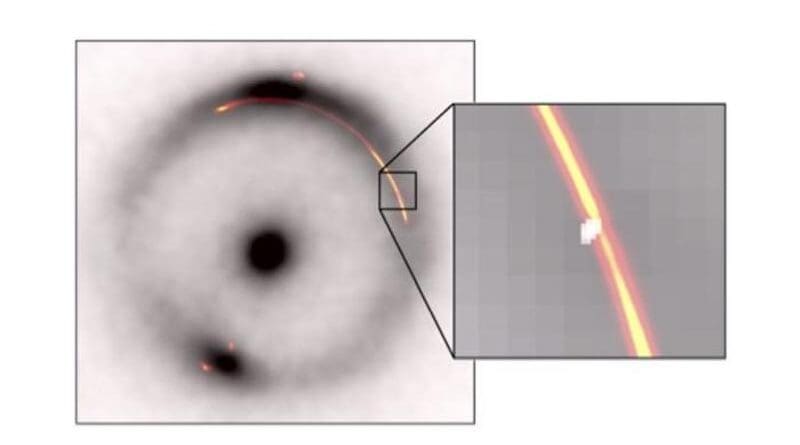
The black ring and central dot show infrared image of a distant galaxy distorted by a gravitation lens. Orange/reg shows radio waves from the same object. The inset shows a pinch caused by another, much smaller, dark gravitational lens (white blob). CREDIT: Devon Powell, Max Planck Institute for Astrophysics
Using a global network of telescopes, astronomers have detected the lowest-mass dark object yet found in the universe. Finding more such objects and understanding their nature could rule out some theories about the nature of dark matter, the mystery substance that makes up about a quarter of the universe.
The work is described in two papers published in Nature Astronomy and Monthly Notices of the Royal Astronomical Society.
Because the object does not emit any light or other radiation, it was detected by the way its gravity distorts light passing through or near it. This effect is called gravitational lensing. Based on the distortion, astronomers can infer the amount of matter in the unseen object.
In fact, the new object is so small that it was detected by inducing a small pinch in the distorted image caused by a much larger object, like a flaw in a funhouse mirror.
“It’s an impressive achievement to detect such a low mass object at such a large distance from us,” said Chris Fassnacht, professor in the Department of Physics and Astronomy at the University of California, Davis, who is a co-author on the Nature Astronomy paper. “Finding low-mass objects such as this one is critical for learning about the nature of dark matter.”
The mystery object has a mass about 1 million times that of our Sun. Its nature is unknown: It could be a clump of dark matter 100 times smaller than any previously detected, or it might be a very compact, inactive dwarf galaxy.
Although imperceptible except for its gravitational effects, dark matter is thought to shape the distribution of galaxies, stars and other visible bodies across the sky. A key question for astronomers is whether dark matter can exist in small clumps without any stars. This could confirm or refute some theories about the nature of dark matter.
Using telescopes worldwide
The team used instruments including the Green Bank Telescope (GBT), West Virginia; the Very Long Baseline Array (VLBA), Hawaiʻi; and the European Very Long Baseline Interferometric Network (EVN), which includes radio telescopes in Europe, Asia, South Africa and Puerto Rico to create an Earth-sized super-telescope, to capture the subtle signals of gravitational lensing by the dark object.
It is by a hundred-fold the lowest mass object yet found by this technique, suggesting that the method could be used to find other, similar objects.
“Given the sensitivity of our data, we were expecting to find at least one dark object, so our discovery is consistent with the so-called ‘cold dark matter theory’ on which much of our understanding of how galaxies form is based,” said lead author Devon Powell at the Max Planck Institute for Astrophysics (MPA), Germany. “Having found one, the question now is whether we can find more and whether the numbers will still agree with the models.”
The team is further analyzing the data to better understand the nature of the dark object, and also looking for more examples of such dark objects in other parts of the sky.
SpaceX successfully launches 11th test flight of giant Starship rocket
By Euronews
Published on
Starship carried up eight mock satellites mimicking SpaceX’s Starlinks. The entire flight lasted just over an hour, originating from Starbase near the Mexican border.
SpaceX launched its mammoth Starship rocket on a test flight for the 11th time on Monday, successfully making it halfway around the world while releasing mock satellites.
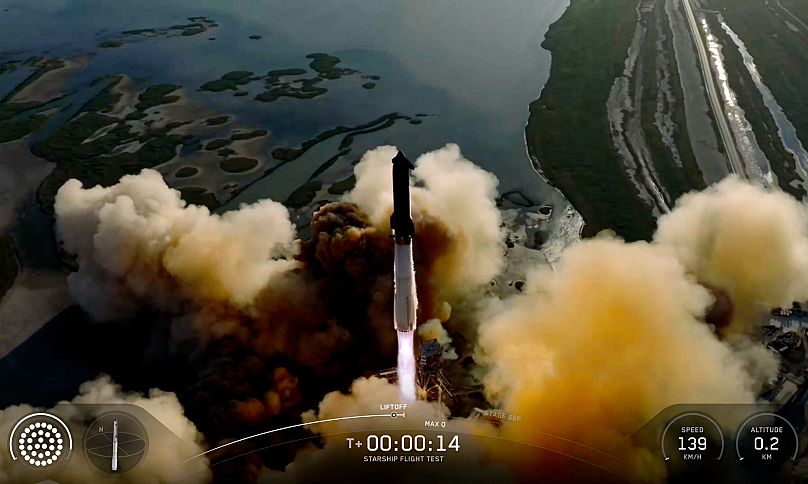
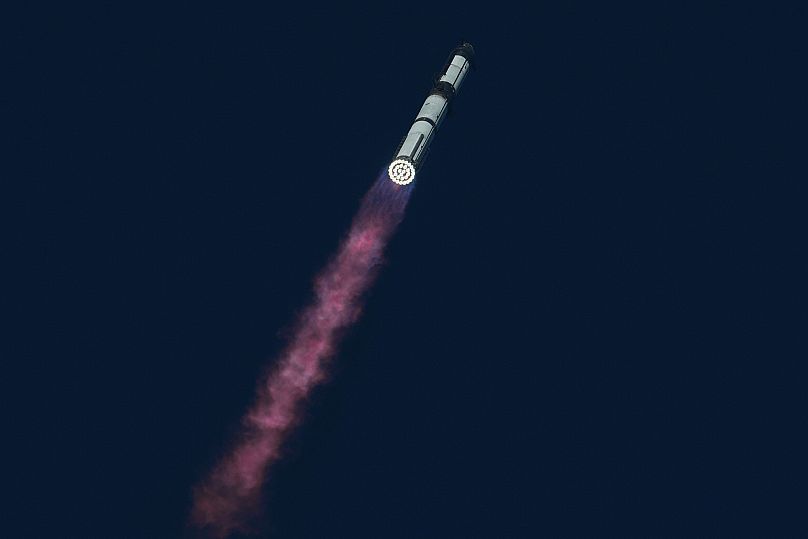
Starship is the biggest and most powerful rocket ever built. It thundered into the evening sky from the southern tip of Texas, before the booster peeled away and made a controlled entry into the Gulf of Mexico as planned.
The spacecraft skimmed space before descending into the Indian Ocean. Nothing was recovered.
“Hey, welcome back to Earth, Starship,” SpaceX's Dan Huot announced as employees cheered. “What a day.”
This image made from video provided by SpaceX shows Starship's 11th flight test launching from Starbase, Texas, Monday, Oct. 13, 2025. SpaceX via AP
SpaceX founder and CEO Elon Musk intends to use Starship to send people to Mars. NASA’s need is more immediate. The space agency cannot land astronauts on the moon by decade's end without the 123-metre spacecraft, the reusable vehicle meant to get them from lunar orbit down to the surface and back up.
Instead of remaining inside Launch Control as usual, Musk said that for the first time he was going outside to watch — “much more visceral.”
The previous test flight occurred in August, succeeding after a string of explosive failures. It followed a similar path with similar goals, but this time more maneuvering was built, especially for the spacecraft. SpaceX conducted a series of tests during the spacecraft's entry over the Indian Ocean as practice for future landings back at the launch site.
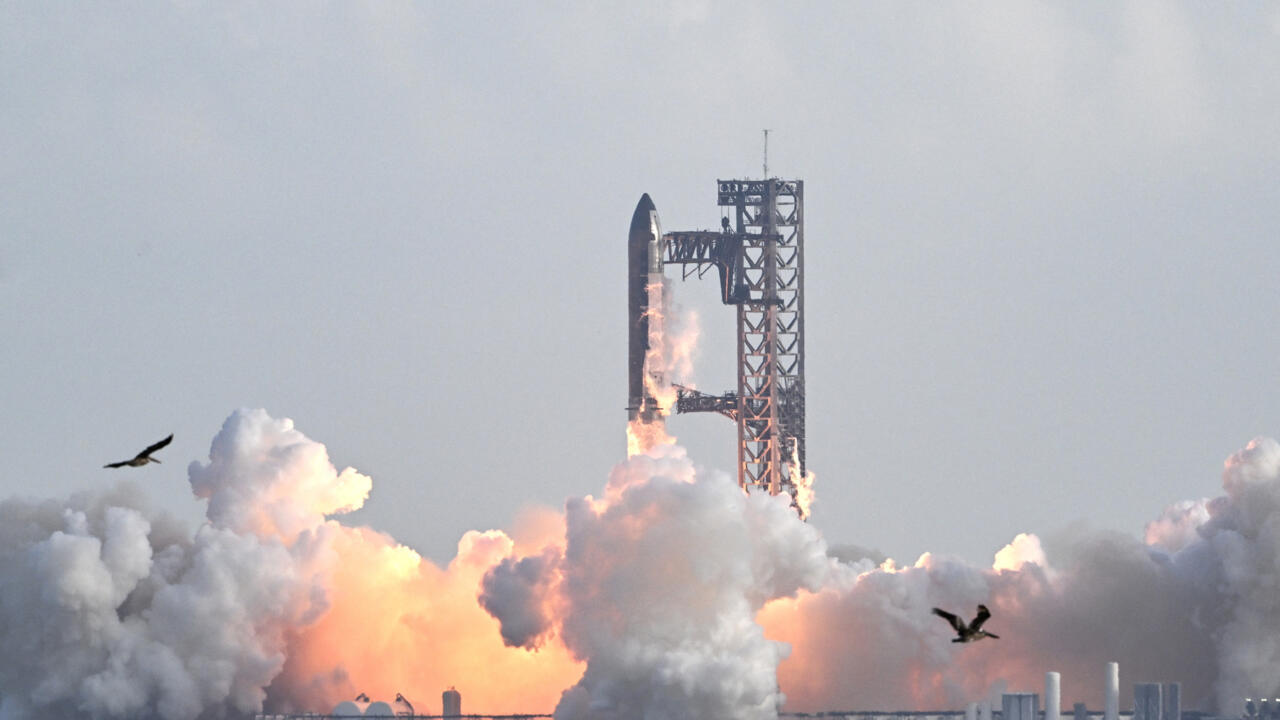
SpaceX's mega rocket Starship makes a test flight from Starbase, Texas, Monday, Oct. 13, 2025. AP Photo/Eric Gay
Like before, Starship carried up eight mock satellites mimicking SpaceX’s Starlinks. The entire flight lasted just over an hour, originating from Starbase near the Mexican border.
NASA’s acting administrator Sean Duffy praised Starship’s progress. “Another major step toward landing Americans on the moon’s south pole,” he said via X.
SpaceX is modifying its Cape Canaveral launch sites to accommodate Starships, in addition to the much smaller Falcon rockets used to transport astronauts and supplies to the International Space Station for NASA.
SpaceX’s Starship rocket lifts off in latest
test flight as Musk eyes Mars
SpaceX’s giant Starship rocket blasted off Monday on its latest test flight, as Elon Musk’s company aims to prove critics wrong about its ability to deliver NASA’s lunar missions and pursue Mars ambitions. The reusable rocket is central to NASA’s Moon plans and Musk’s interplanetary vision.
SpaceX's massive Starship rocket soared into its latest test flight Monday, as the US company vies to defy critics who say its technology might not be on track to deliver NASA's lunar projects and fulfill Elon Musk's Mars ambitions.
The US space agency plans to use the mammoth Starship – the world's largest and most powerful rocket – in its efforts to return astronauts to the Moon. It is also key to Musk's zealous vision to take humans to Mars.
In its 11th test voyage, the enormous rocket took off Monday from Space X's south Texas launch facilities just after 6:25pm local time (2325 GMT), according to a live video feed.
Its rocket booster landed in Gulf waters as planned as the Spacecraft cruised through space and began running through tests. It's set to splash into the Indian Ocean approximately an hour after liftoff.
SpaceX's last test mission in August was chalked up as a success. But that followed a series of spectacular explosions that raised concerns Starship might not live up to its promises – at least not on the timeline lawmakers and the scientific community had hoped for.
The US space agency's Artemis programme aims to return humans to the Moon as China forges ahead with a rival effort that's targeting 2030 at the latest for its first crewed mission.
US President Donald Trump's second term in the White House has seen the administration pile pressure on NASA to accelerate its progress – efforts Starship is key to.
Musk's company has a multibillion-dollar federal contract to develop a modified version of Starship as a lunar lander.
The manned Artemis III mission is intended for mid-2027 – but a NASA safety advisory panel has warned it could be "years late," according to Space Policy Online.
And former NASA administrator Jim Bridenstine told a Senate panel recently that "unless something changes, it is highly unlikely the United States will beat China's projected timeline".
'Second space race'
NASA's acting administrator Sean Duffy has insisted the US will still win the "second space race", telling reporters last month that "America has led in space in the past, and we are going to continue to lead in space in the future," while dismissing the notion that China could get there first.
Previous tests of the enormous Starship rocket have resulted in explosions of the upper stage, including twice over the Caribbean and once after reaching space. In June, the upper stage blew up during a ground test.
But during August's successful flight, SpaceX for the first time managed to deploy eight dummy Starlink internet satellites, with onboard cameras beaming back live views of a robotic mechanism pushing each out one by one.
Musk has identified developing a fully reusable orbital heat shield as the toughest task, noting it took nine months to refurbish the Space Shuttle's heat shield between flights.
Another hurdle is proving Starship can be refueled in orbit with super-cooled propellant -- an essential but untested step for the vehicle to carry out deep-space missions.
NASA's Aerospace Safety Advisory Panel has emphasised "threats" related to ensuring that vital transfer can be carried out, with member Paul Hill saying the timeline is "significantly challenged".
(FRANCE 24 with AFP)
Distributed Energy Could Be the Key to Faster Data Center Rollouts
The rapid expansion of AI is creating significant strain on global energy grids, leading to substantial delays in bringing new data centers online due to insufficient grid capacity.
Distributed energy resources (DERs), such as rooftop solar and battery storage, offer a viable solution by providing localized power, reducing the burden on existing grids, and accelerating data center deployment.
The adoption of DERs is projected to increase sharply, offering a critical stopgap to balance energy needs, potentially lower energy costs for consumers, and incentivize tech companies to invest in faster connectivity.
The rapid rise of artificial intelligence is placing unprecedented strain on global energy sources and grid infrastructure. In response to runaway projected growth trends, public and private investors are fast-tracking new data center projects at a massive scale. According to the International Energy Agency (IEA), global investment in data centers reached half a trillion dollars in 2024, representing a nearly two-fold increase over the course of two years. But this rate data center addition has produced a new problem, as their construction is currently outpacing grid capacity additions, leading to critical delays in bringing new data centers online.
The IEA’s Energy and AI report, released earlier this year, estimates that as many as one in five data center projects are at risk of delay thanks to the enormous strain on global energy grids. “Grid connection queues for both supply and consumption projects, including data centres, are long and complex,” states the report. “Building new transmission lines can take four to eight years in advanced economies and wait times for critical grid components such as transformers and cables have doubled in the past three years.”
Grids in the United States were already aging and under strain even before the AI boom. Now, with the addition of data center demand growth, the scale of the updates needed would be difficult to overstate. The United States Department of Energy estimates that the country will need a whopping 47,300 gigawatt-miles of new power lines by 2035. To put this enormous increase in perspective, that’s a 57 percent expansion of current grid capacities. Meeting that lofty target will require today’s rate of construction to double.
Compounding the issue, data centers are being built in areas where other data centers have already been constructed, and therefore where grids are already strained. In the United States, half of all data centers currently under construction are additions to pre-existing clusters. In order to ease the burden on electricity grids, increase project efficiency, and avoid localized bottlenecks, it would be far more beneficial to construct new data centers in areas where grids have spare capacity.
Distributed energy resources, or DERs, present another potential solution. DERs are small-scale energy resources such as rooftop solar panels and battery storage. Unlike typical grids, which frequently transmit energy over enormous distances from power plants to end users, DERs tend to be located very close to where the energy is consumed. Creating more of these disperse energy hubs, and helping to connect them to utilities, could be a critical stopgap for bringing data centers online faster and balancing the energy needs of localized grids at peak hours by offering supplemental energy resources.
“If done right, such a solution could bring more compute capacity online faster using existing distribution equipment, transmission lines, and power plants,” argues a recent report from Utility Dive. “At the same time, it could reduce energy bills for local residents and businesses,” the article goes on to say.
The potential for DERs to lower energy rates would be critical at a time when energy poverty is creeping up in the United States and around the world. Under the current model, consumers are bearing the financial burden of near-ubiquitous AI integration, whether they benefit from it or not. DERs could shift this balance by incentivising tech companies to cough up more cash in exchange for faster connectivity.
“The higher the amount paid, the higher the incentives could be for participating DER owners, and the faster DER capacity can be enrolled,” reports Utility Dive. “This means more money in the pockets of consumers.”
The development of DERs is already sharply on the rise as their unique utility becomes increasingly evident for tech moguls and grid operators alike. Wood Mackenzie estimates that hundreds of gigawatts of DERs will be added to the grid by 2027, nearly as much as utility-scale resource installations expected over the same time period.
The rapid growth of AI and data centers is causing a significant increase in demand for electricity, leading to a global shortage of gas turbines needed for new power generation capacity.
Despite the urgent need, many gas turbine manufacturers are cautious about dramatically increasing production due to past experiences where oversupply led to market crashes, and the long lead times for building these precision machines.
The imbalance between supply and demand is driving up costs and extending wait times for new gas-fired power plants globally, highlighting a critical challenge in meeting the energy requirements of the expanding AI industry.
The cautious stance of major manufacturers like Siemens Energy and Mitsubishi Power is understandable given their history, yet the consequences of underestimating this demand are profound. While the wait times for new combined-cycle turbines stretch toward seven years, the competitive landscape is subtly shifting.
For GE Vernova, currently focused on leveraging its existing fleet and service contracts, the strategic challenge is balancing near-term profitability against the long-term risk of market share erosion if its rivals manage a successful, sustained ramp-up.
The ultimate question for the industry's Big Three is this: Is the threat of a price crash from oversupply in five years greater than the certainty of losing billions in delayed orders right now, especially as the demand for dispatchable power for new data centers shows no signs of abatement?
The Turbine Supply Crisis
Bloomberg was one of the publications warning about a turbine shortage earlier this year. The outlet reported that some data center operators, notably Stargate, were deploying single-cycle gas turbines to secure generation for their facilities in the absence of enough combined-cycle turbines being manufactured fast enough.
“There is a high level of urgency in the industry to get power fast,” a senior executive from Crusoe, the company that is building the first Stargate project, told Bloomberg. “We have tried to be creative about the energy component of data centers.”
However creative one might try to get, there is a limited pool of options. And turbines take a long time to be built because they are precision machines, and building precision machines cannot be rushed. What compounds the supply problem is the fact that data center operators are not the only ones in need of more gas turbines. Gas, for all the bad rap it has been getting from climate activists, is what the developing world is replacing coal with, so that growth in demand for turbines is a global trend.
Transition advocacy outlet the Institute for Energy Economics and Financial Analysis recently reported that the imbalance between supply and demand for gas turbines was driving costs for new gas-fired power plants higher in Vietnam and the Philippines and extending wait times to seven or even eight years. The outlet recommended “the rapid expansion of low-cost renewables and storage”, which “could ultimately limit the long-term role for gas and liquefied natural gas (LNG).”
The problem is, they can’t. If they could, data center operators would be causing a shortage of solar panels and inverters. Instead, the shortage is looming in gas turbines because there is one fundamental difference between wind/solar and gas: the latter generates dispatchable electricity, and that is the kind that data center operators need.
Manufacturers’ Caution: The Ghosts of Internet Past
In such a context, turbine makers should be rushing to boost their production capacity, or so some would assume. Yet that is not what they are doing—at least not all of them. “How do we manage what’s real, what’s not?” the chief executive of Mitsubishi Power Americas, Bill Newsom, said recently, as quoted by the Wall Street Journal, expressing concern that all the bombastic forecasts about AI and the related electricity demand surge may turn out to be wrong.
It has happened before, the Wall Street Journal noted in its report. About 20 years ago, gas turbine makers rushed to boost output in expectations that the internet would drive a surge in electricity demand. That surge never materialized, sinking some manufacturers and leaving others with surplus capacity. What makes things even more uncertain is the possibility that it would only take one manufacturer to boost capacity to tank prices for everyone, even with all the bombastic demand forecasts.
“If nobody increases their output, prices will stay really high. If one person raises their output, it could crash the prices for everybody,” Enverus’s director of energy transition research, Ryan Luther, told the Wall Street Journal.
Yet this may be too cautious an outlook. According to Bloomberg, some $400 billion worth of new gas-fired generation capacity could face delays or even cancellation because of the shortage in gas turbines. This does not, on the face of it, sound like a situation where one manufacturer raising capacity could tank prices for all the rest of them. Indeed, one turbine major is trying to ramp up capacity, and it has not tanked prices—because the ramp-up will take a while.
The Looming Test of the AI Hype
The major trying to boost capacity is Mitsubishi Heavy Industries, one of the three companies dominating the global gas turbine market alongside Siemens and GE Vernova. “It’s not so easy to ramp up,” Joern Schmuecker, a vice president at Siemens Energy told Bloomberg in an interview earlier this month. “The whole supply chain is struggling to also keep pace.”
Challenging as this may be for Big Tech and adjacent industries, the time factor could provide the ultimate test of how serious the world is about AI and whether reality would live up to the hype or not.
Iraq has exported around 2.5 million barrels of crude oil from the Kurdistan Region since flows resumed on September 27, following a two-and-a-half-year suspension, according to Hamdi Shingali, deputy director of the State Oil Marketing Organization (SOMO). Shipments, averaging 190,000 barrels per day, are being transported through the Fishkhabur–Ceyhan pipeline to Türkiye, marking a major milestone in Iraq’s efforts to restore its northern exports.
Shingali told Shafaq News that operations have “returned to normal” and that Baghdad, Erbil, and international oil companies are likely to renew their tripartite export agreement before year-end. The deal, signed earlier this year, allows SOMO to oversee and market Kurdish crude through Türkiye’s Ceyhan port — a move that ended a long-standing standoff between the federal and regional governments.
Exports were halted in March 2023 after the International Chamber of Commerce (ICC) ruled that Ankara had breached a 1973 treaty by loading Kurdish crude without Baghdad’s consent. The decision forced Turkey to halt shipments, disrupting a pipeline that once accounted for 0.5% of global oil supply and costing both Iraq and the Kurdistan Regional Government (KRG) billions in lost revenue.
Under the renewed arrangement, 50,000 barrels per day will be allocated to Kurdish refineries, while the remaining 250,000–260,000 barrels per day will go to SOMO for export. Iraqi Oil Minister Hayan Abdul-Ghani said the agreement is a “step toward a unified national energy policy” and could serve as a foundation for longer-term cooperation between Baghdad and Erbil.
The resumption of Kurdish crude exports not only restores a vital revenue stream for both governments but also signals a rare moment of alignment in Iraq’s often fraught oil politics — one that could strengthen its position as a reliable regional supplier.
New Report Finds Clean Energy Progress Lagging Despite Record 2024 Growth
A new report issued on Tuesday by the International Renewable Energy Agency (IRENA), in collaboration with the COP30 Brazilian Presidency and the Global Renewables Alliance (GRA), claims that the world is moving too slowly on renewable energy and efficiency to meet its near-term climate goals.
Launched at a high-level event in Brasília ahead of COP30, the report titled Delivering on the UAE Consensus: Tracking progress toward tripling renewable energy capacity and doubling energy efficiency by 2030 finds that, despite record deployment in 2024, current trajectories fall far short of what is needed to meet the COP28-mandated UAE Consensus targets.
While global renewable capacity additions hit 582 GW in 2024, the UAE Consensus goal of 11.2 TW of renewable capacity by 2030 now implies that annual additions must reach 1,122 GW per year from 2025 onward, which would be a sustained growth rate of 16.6% annually.
The report also flags significant underperformance in efficiency, with the improvement in global energy intensity in 2024 being around 1%, which is well short of the roughly 4% annual gains needed to meet the UAE Consensus.
A central theme of the report is that structural and systemic bottlenecks are slowing the clean energy transition. Among the obstacles cited are underinvestment, grid infrastructure delays, supply chain fragility, and regulatory hurdles.
To close these gaps, the authors urge that countries embed even more ambitious and binding renewable and efficiency targets in the lead-up to COP30.
The report projects that G20 countries will account for over 80% of global renewable capacity by 2030, with the G7 making up roughly 20% of global capacity. It also emphasises the role of developed economies in providing sufficient climate finance, meeting a $300 billion annual floor under the new collective quantified goal and scaling toward the $1.3 trillion aspiration set at COP29.
While global renewable energy growth remains impressive, this latest report highlights the gap between reality and expectations, outlining the scale of the task ahead if the COP 2030 climate goals are to be met.
U.S. EV sales surged a record 40% in Q3, driven by a rush to buy before the $7,500 federal tax credit expired at the end of September.
The end of subsidies threatens the EV industry’s profitability, with Ford, GM, and Stellantis all losing money on electric models.
BloombergNEF: 14 million fewer EVs could be sold by 2030 under current policies.
Sales of electric vehicles in the United States hit an all-time high in the third quarter. Normally a welcome piece of news for EV makers, the record was prompted by the end of tax incentives for EV buyers, which expired at the end of September. From now on, it’s likely to be bad news for car companies with EV plans.
Kelley Blue Book reported sales of electric cars in the quarter to September shot up by 40.7% on the previous quarter and by 29.6% on the year. This trend pushed the average car price for the third quarter of the year to over $50,000 for the first time, Bloomberg reported, noting that this aggravated an affordability problem in the car sector. The surge, however, was far from organic. It was mostly the result of the Trump administration’s policies that have involved rollbacks of most of the Biden administration’s emission reduction initiatives, notably the $7,500 tax credit for EV buyers.
The rush to buy EVs before the tax credit expired will likely show up on carmakers’ balance sheets: battery maker LG Energy Solution said it expected to book a 34% increase in profits for the third quarter, driven by the EV sales jump. Not only this, but third-quarter profit for the South Korean battery maker would have been a third of the actual expected sum had it not been in a position to benefit from Biden-era subsidies, LG Energy Solution also said in a regulatory filing, as quoted by Reuters.
This does not bode well either for EV battery makers or for EV makers. It suggests that with the subsidies gone, the industry would not be able to survive – and indeed, Ford’s chief executive recently issued a warning to just that effect.
“I wouldn’t be surprised if EV sales in the US go down to 5%,” Jim Farley said at the end of September. It could end up being “way smaller than we thought.” Currently, EVs represent a 10th of the U.S. car market, rising to 10.5% in the third quarter thanks to the record sales. Yet EVs are still losing money for most carmakers. Ford itself lost $1.3 billion on its EVs in the second quarter and has projected its total EV-related losses could hit $5.5 billion for the full year.
GM and Stellantis are also losing money on every EV they make, even though, per the latest Kelley Blue Book numbers, GM, along with Volkswagen, enjoyed a more than twofold increase in EV sales in the third quarter. Other carmakers, including Hyundai, Porsche, and Volvo, also saw their car sales jump considerably in the three-month period. Again, this is about to change.
Earlier this year, BloombergNEF predicted that the Trump administration’s policies in the EV space could reduce total sales until 2030 by as much as 14 million. Indeed, EV sales in the second quarter of the year actually slipped, even though incentives were still very much available to prospective buyers. So, EV battery makers, at least, are looking for new business opportunities.
“The market for grid-scale batteries and backup power isn’t just expanding, it’s becoming essential infrastructure,” a GM VP in charge of batteries, propulsion, and sustainability said recently. “Electricity demand is climbing, and it’s only going to accelerate. To meet that challenge, the U.S. needs energy storage solutions that can be deployed quickly, economically, and made right here at home. GM batteries can play an integral role. We’re not just making better cars — we’re shaping the future of energy resilience.”
Obviously, battery storage is one potential growth avenue for EV battery manufacturers, but it does not seem to be a very big avenue. One energy transition advocacy outlet has forecast that U.S. EV battery production could drop by 75% by 2030. New wind and solar installations are also slowing down because of Trump’s One Big, Beautiful Bill. It might be time to diversify in other directions for car and battery makers.