Thursday, October 16, 2025

BANNED IN AMERIKA, MADE IN CANADA

Antifa: A Graphic History of its Origins

 October 16, 2025

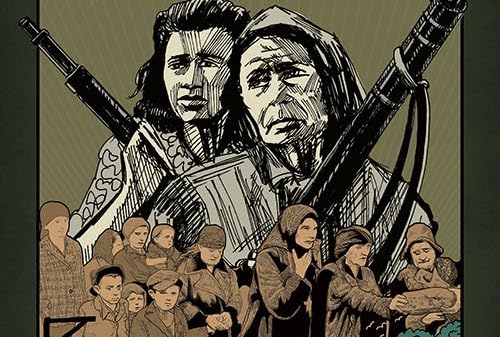
Cover art for the graphic novel Partisans: A Graphic History of Anti-fascist Resistance edited by Paul Buhle and Raymond Tyler

Leonard Cohen sings a song called “The Partisan”. It tells the story of an antifascist fighter in the heart of the war against Nazism. Beautifully rendered by Cohen on his 1969 album Songs From a Room, it tells the story of an antifascist fighter and his squad in what I assume to be the French countryside. By the time the tune is over, the teller of the tale is the only survivor. In the middle verses, the listener is introduced to a woman who gives the three fighters shelter and “Kept us hidden in the garret/Then the soldiers came/She died without a whisper.” The tragedy in this verse, so beautifully told, represents the facts of resisting fascists; fascists whose concern for the lives of those whose opinions they don’t share is virtually non-existent and is perhaps exceeded only by the anonymity of those who bomb and kill from the sky.

Recently, the Trump regime made the modern antifascist movement—known as antifa—a primary target in its establishment of a fascist USA. Although my immediate reaction to the announcement labeling antifa as a domestic terrorist organization involved at least a couple jokes regrading the essential ignorance of the White House declaration, it was underlined by the potentially greater danger that ignorance created for opponents of the trumpist movement. Because there is no actual entity that is antifa, the forces of law and order can label anyone opposed to Trump and his authoritarian program a domestic terrorist. Once an individual or organization is labeled in such a manner, even the pretense of civil rights and liberties pretty much disappears. Likewise, so do people.

Fighting fascism is a serious business. The recent case of writer and scholar Mark Bray is but one example of this. Bray’s primary work opposing fascism was to write a book titled Antifa: The Antifascist Handbook discussing fascism’s modern manifestations and the nature of the opposition to it. Right wing students at Rutgers University where he taught began a campaign of harassment in an ultimately successful campaign to force him out of his job. The harassment included threats to his family and himself; threats that convinced him they should leave the United States. For people who know the history of those opponents of Nazism who left Germany during the early years of the so-called Third Reich, Bray’s exile can’t help but make them wonder who will be next. Or how far will the installation of fascism progress around the world in the current period. When does the opposition to fascism require more than sarcasm, more than protest and how would that opposition look?

Of course, only time will give us the answers to those questions. In the meantime, it seems like a good practice would be to familiarize oneself with the history of resistance to fascism. There are dozens of texts, films and websites that are quite instructive for that pursuit. Some are fictive in nature and others are straight-up history and analysis. One recent addition to this collection of antifascist history is a supremely rendered graphic history titled Partisans: A Graphic History of Anti-Fascist Resistance. Edited by comics writer Raymond Tyler and longtime leftist historian Paul Buhle, this collection of handsomely depicted histories of various elements of the resistance to European fascism during World War Two is an inviting introduction to this under acknowledged aspect of the war against fascism in the twentieth century. The artwork, which ranges from the vivid colors of Seth Tobocman’s portrayal of the Yugoslav partisans under the leadership of Josip Broz Tito to the classical black and white cartoon panels of Daniel Selig’s entry on the French Partisans, invites readers young and old into a history that is simultaneously informative and inspirational. The narratives bend from the first person narrative of David Lasky’s water colored story of a Jewish uprising in eastern Europe to a story about the Soviet Partisans written and drawn by Raymond Tyler that reminded this reviewer of vintage Our Army at War comics from my 1960s childhood.

The different politics of various partisan groups is part of the conversation in several of the dozen stories in this collection. So are the differences based on ethnicity and religious beliefs. Women’s roles in the resistance are mentioned. Indeed, longtime comics writer Trina Robbins’ (the creator of Wimmen’s Comix) collaboration with artist Anne Timmons tells the story of three young Dutch women who served with the partisans in the Netherlands. Another story titled “Piccola Staffetta:My Small Contribution to the Resistance Against Mussolini” composed by Franca Bannerman, Isabella Bannerman, and Luisa Caetti is a tale about a girl who realizes she has been brainwashed by the fascists and joins the resistance performing small but important tasks. While reading this particular chapter, I was reminded of Hans Fallada’s novel about Nazi Germany and the small acts of resistance of a middle-aged couple, Every Man Dies Alone.

The moral of these stories and the watchword for any opposition to fascism is simple and evident throughout this graphic history. It’s not any kind of heroism that matters, but the resistance itself.

Ron Jacobs is the author of several books, including Daydream Sunset: Sixties Counterculture in the Seventies published by CounterPunch Books. His latest book, titled Nowhere Land: Journeys Through a Broken Nation, is now available. He lives in Vermont. He can be reached at: ronj1955@gmail.com


Partisans

A Graphic History of Anti-Fascist Resistance
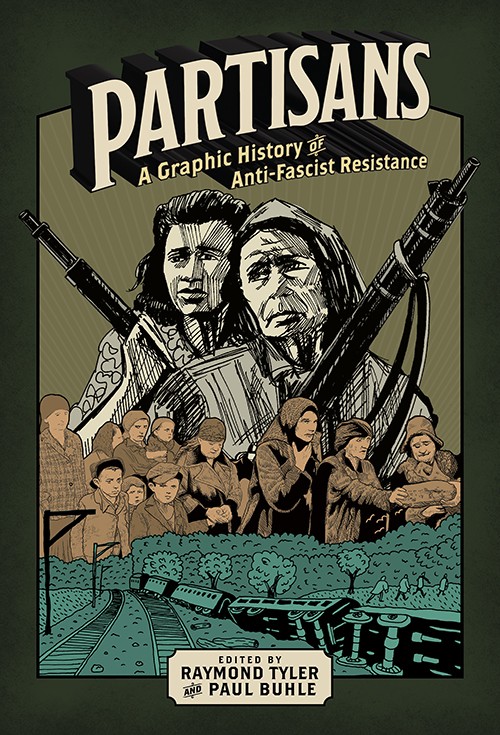
Edited by Raymond Tyler and Paul Buhle


Add to Cart 
Paperback
Ebook
$34.95

148 pages
 ISBN 9781771136525
 Published August 2025

With eleven brand new comics created by legendary and upcoming writers and comics artists, Partisans flips a new page in the popular understanding of anti-Nazi and anti-fascist resistance. Through vivid illustrations and compelling narratives, Partisans brings to life the struggles and triumphs of those who resisted fascism. Within these pages, readers will encounter stories of resistance from the rugged mountains of the Balkans to the urban landscapes of occupied Europe. This comics collection reminds us that the fight against fascism is far from over and that the courage and sacrifices of those who came before us continue to light the way. Partisans is a must-read for anyone interested in history, social justice, and the transformative power of history and art.


Praise


“Vibrant, compelling stories of personal bravery and collective struggle—Partisans provides much-needed insights into the struggle for a better world.”
– Kate Evans, author of Red Rosa: A Graphic Biography of Rosa Luxemburg


“A stellar collection documenting the brief history of anti-fascists in Europe. By the end, you too will be excited to slap a fascist or two.”
– Yazan Al-Saadi, author of Lebanon is Burning and Other Dispatches


“Partisans, a graphic novel anthology of anti-fascist resistance, covers a wide scope of heroic activity by Russians, Ukrainians, Yugoslavians, Greeks, French, and others. It relies upon the latest research, which highlights the efforts of a variety of actors, including children, and illuminates the backdrop for armed struggle. Explaining this little-known though extremely compelling part of history to new readers will go far to puncture anti-Left myths and recover the real story, as lived first by the veterans of the Spanish Civil War and culminating with those who contributed to the final defeat of the Axis. The outstanding comic art both entertains and educates, political proof of an emerging and powerful form of storytelling.”
– Oliver Stone and Peter Kuznick, coauthors of The Untold History of the United States


“Partisans is masterful. Tyler and Buhle encapsulate complicated histories in compelling and easily understood narratives that burst to life through gorgeous illustrations. There is much to learn and enjoy in this book for young readers, newcomers to anti-fascist history, and even knowledgeable historians and activists.”
– Mark Bray, author of Antifa: The Anti-Fascist Handbook


“Vital history, the lessons of which should inform our thinking on what resistance can look like in the present.”
– Michael DeForge, author of Holy Lacrimony


“Partisans is a powerful, visually stunning tribute to the resisters who defied totalitarian regimes. Through evocative graphic novel chapters, each by a different artist, this book brings to life the stories of Partisans from all walks of life—young and old, women and men—from across the many lands darkened by fascism. You will learn their names. You will remember their courage. Historically rich and visually arresting, Partisans does more than explain the past; it will inspire readers to resist injustice now.”
– Diana Garvin, University of Oregon; author of Feeding Fascism: The Politics of Women's Food Work


“Partisans were a vital, but often overlooked, part of the defeat of Nazi Germany and its Axis allies during World War II. In every occupied country, Partisan groups waged anti-fascist guerrilla war against the Nazi invaders, carrying out raids, ambushes, and widespread sabotage. Partisans highlights different aspects of this struggle with a variety of art styles and stories ranging from personal accounts to historical overviews of Partisans in various countries, including Holland, Hungary, France, Yugoslavia, and the Soviet Union. A valuable contribution to the history of Partisan anti-fascist resistance.”
– Gord Hill, author of The Antifa Comic Book


“Don’t let the comic-book format fool you. This is a gut-wrenching story of people from all walks of life who made moral choices they never thought they would have to make. Especially notable is the emphasis on the role of women. From teenagers in Holland to an internationally known star such as Josephine Baker, these women, too, risked all. Most US leftists know about the Partisans of the Abraham Lincoln Brigade and the French Resistance. Now they’ll know about those in other places who are too often forgotten.”
– Maxine Phillips, coeditor of religioussocialism.org; former executive editor of Dissent Magazine


“Visually stunning and deeply informative, Partisans demonstrates why comics are such a powerful and potent art form. This book brilliantly delivers the histories that will give us the heart to fight current threats to democracy at home and abroad.”
– Peter Kuper, author of Insectopolis: A Natural History


Contents

Partisans: An Introduction
Raymond Tyler and Paul Buhle

World War II in Europe: A Timeline
Veterans of the Spanish Civil War
Sharon Rudahl

The Hungarian Resistance
story by Sander Feinberg, art by Summer McClinton

Freedom or Death: The French Partisans
story and art by Daniel Selig

Secret Agent
story and art by Sharon Rudahl

Tito’s Partisans
story and art by Seth Tobocman

Piccola Stafetta
story by Franca Bannerman and Luisa Cetti, art by Isabella Bannerman

Andartiko: Fighting Fascism in Greece
story and art by David Lester

Three Dutch Girls: Teenage Partisans in Holland
story by Trina Robbins, art by Anne Timmons

Uprising: A Jewish Partisan in Eastern Europe
story and art by David Lasky

Spomenik
story and art by Kevin Pyle

Soviet Partisans
story by Raymond Tyler, art by Gary and Laura Dumm

Afterword
Paul Buhle and Raymond Tyler
Acknowledgments
References
Contributors


The Antifa Comic Book: Revised and Expanded


Show Details

By Gord Hill
Foreword by Mark Bray
Paperback CAD $24.95

Read Excerpt (PDF)

Media   CBC comics list includes The Antifa Comic Book: Revised and Expanded


Description

With fascism in our midst, Indigenous artist Gord Hill revises and expands his brilliant graphic history of fascism and anti-fascist movements

When it was first published in 2018, Gord Hill's The Antifa Comic Book was heralded for its searing imagery documenting the history of fascism and anti-fascist movements over the last century. In the years since its publication, the term "antifa" has been co-opted by the right to falsely describe far-left political extremism and even terrorism. But the role played by antifa movements in fighting fascism and racism around the world remains as relevant and important as ever.

For this expanded edition, Gord Hill adds new material depicting more recent flashpoints of fascist activity, including the January 6, 2021, US Capitol attack, the murderous spree by Norwegian terrorist Anders Breivik, the infamous 2022 Canadian convoy protests, and Islamophobic and anti-migrant sentiment in a growing number of fascist governments in Europe. At the same time, Hill depicts the important work being done by anti-fascist individuals and organizations to combat this worrisome trend, made all the more crucial by Donald Trump's return to the White House.

Powerful and inspiring, The Antifa Comic Book is an important reminder of fascism in our midst and what can be done to stop it.

The book includes a new foreword by Mark Bray, historian and author of Antifa: The Anti-Fascist Handbook.

Reviews

Gord Hill's The Antifa Comic Book is so vitally important because it crafts a visual hymn to the everyday heroes, past and present, who put their bodies on the line to crush the ambitions of would-be fascist supermen. -Mark Bray, from the foreword

The Fate of Dying Empires: An Interview with Historian and Activist Roxanne Dunbar-Ortiz


 October 16, 2025

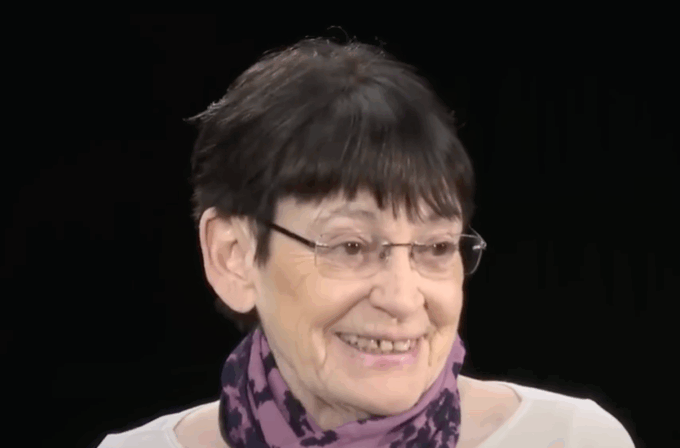
Roxanne Dunbar-Ortiz.

Recently, I’ve been in the habit of getting together for coffee and conversations with author and activist, Roxanne Dunbar-Ortiz, though I have known about her and have read her impassioned scholarship for years. In person, and at the age of 87, she tends to be soft-spoken, albeit keenly aware of her surroundings, whether on the street, a neighborhood or a cafe. In some ways, Roxanne was an outlier in the Sixties – she wasn’t born to a military clan, or an Old Left family, but she was in the thick of the protests and the anti-war and feminist movements that erupted in the Vietnam era. On her birth certificate, she is ‘Roxy,” though her father insisted he named her “Roxey. She disliked the name, whatever spelling. When she moved to San Francisco, and got to know some of the Beat poets and writers, they called her “Roxanne,” after the Roxanne of Cyrano de Bergerac, and it stuck. The name Dunbar comes from her paternal grandfather; the name Ortiz from her former husband, Simon, an enrolled member of the Pueblo of Acoma. She has a grown daughter with whom she is close.

For much of her life, Roxanne has been a historian and the author of several widely read and influential books about Indians, guns, violence, genocide, resistance and more. They are: Indigenous Peoples’ History of the US; Loaded: A Disarming History of the Second Amendment; Not a Nation of Immigrants: Settler Colonialism, White Supremacy, A History of Erasure and ExclusionIndigenous Peoples’ History of the US has just been published in a “graphic interpretation,” by Paul Peart-Smith edited by Paul Buhle with Dylan Davis and put in print by Beacon Press, her “go-to publishers.”

Dunbar-Ortiz has written three memoirs that deftly weave together the personal and the political, public and private worlds: Red Dirt: Growing Up Okie (Verso and the University of Oklahoma Press)Outlaw Woman: A Memoir of the War Years, 1960–75 (City Lights Books); and Blood on the Border: A Memoir of the Contra War, (University of Oklahoma Press.) After I read Outlaw Woman, I told Roxanne that she didn’t seem to be a real American outlaw in the mold of Bonnie and Clyde or Pretty Boy Floyd and Annie Oakley. “The title reflects more of what I wanted to be than who I actually was,” she said. Still, one might call her a maverick when it comes to scholarship. She rejects accepted wisdom. Roxanne and I gather for coffee at Caffe Trieste in North Beach or at an unpretentious place on Polk Street near her home on Russian Hill; we’ve eaten together and I’ve learned that she’s a vegetarian. The shelves in her apartment are lined with books. With readers of CounterPunch in mind – Dunbar-Ortiz reads it daily— I emailed her twelve questions. She wrote back her answers; here they are, edited for brevity.

Q: Is this a unique period in American history? Does it have precedents? Does the more things change the more they remain the same?

A: I think it is a unique period in US history, a sort of end time, the US, the wealthiest and most powerful nation state experiencing the fate of dying empires turning inward fomenting civil divisions and disturbances, while the wealth gap has produced a trillionaire cabal. Capitalism unrestrained can and seems to be nurturing a form of nationalism that tends toward fascism that is always a component of capitalism.

The United States was founded on genocide of the Indigenous to take the continent and great wealth achieved by land sales and enslaved labor, creating an order of white supremacy. As freedom struggles have gained some restitution and equality, fortified by post 1950s immigrations of people from all over the world, liberals hailing the idea of “a nation of immigrants,” the white backlash brought us Trump and Trumpism, the systematic unraveling of laws and practices that favor equality, a chilling future.

Q: How does now compare with the Red Scares of the past we’ve had?

A: Well, it’s not come to the point of executions as with the Rosenbergs in the 1950s, but it does feel like a coming civil war. Although adhering to socialism or communism is more tolerated today—they’re sort of used as cuss words—the big scare now on the right is immigration, transphobia, women’s rights, all particularly attacked by right wing Christian Nationalists who have the support of the US President.

Red Scares of the past involved a supposed foreign enemy that was said to have infiltrated the population, as imagined in the 1956 film Invasion of the Body Snatchers, with McCarthyism raising the horror of subversives among us, and paranoia brilliantly exposed by Richard Hofstadter in his 1964 book, The Paranoid Style in American Politics.

I recall a large map in our rural school in Oklahoma that featured a flood of red, indicating communism, pouring over the North Pole, reaching the northern border of the US. Now, Trumpism is sort of like a cartoon version to scare the population into paranoia, even calling Democrats “communists.” It resonates with some older white people who remember the era as I do, but I don’t think it’s working that well. Still, Christian evangelicals are opportunistically predicting end times, Trump as the savior, and Charlie Kirk as a martyr. White nationalism and White Christian nationalism have replaced the Red Scare.

Q: How does the history of your own family of origin provide you with insights into American culture and society? 

A: I grew up in a small rural county in central Oklahoma, fourth child of a landless farming family who were sharecroppers. My paternal grandfather, Emmett Dunbar, had moved the family from rural Missouri in 1907, the year of Oklahoma statehood, and the year my father was born. My grandfather was a large-animal veterinarian and also owned land that he farmed. He joined the Socialist Party and was elected, on the Socialist Party ticket as County Commissioner of the county.

In that period, Socialists were surging, not only in Chicago and other cities, but also in a number of rural towns and counties in Oklahoma, Missouri, Kansas, and Texas. My grandfather named my father Moyer Haywood Scarberry Pettibone Dunbar after the leaders of the Socialist Party who were on trial for sedition. President Woodrow Wilson launched a war against the Socialist Party—William D. Haywood, George A. Pettibone, Charles H. Moyer—including re-organizing the KKK to attack Catholics and Socialists.

My grandfather died before I was born, but my father told me stories about my brave grandfather, although my father became a racist and a conservative in the 1950s, convinced by McCarthyism. Knowing those stories of my valiant socialist grandfather drove me to be a left wing activist who called myself a revolutionary in the 1960s, pretty much estranged from most of my family and community, moving to San Francisco.

At San Francisco State (then college, now university), I felt like an outsider on the white left, that seemed to hate poor white and working class people. When the Black Power movement kicked out the white organizers, telling them to organize white people, they balked. One of my mentors, the late Anne Braden, was concerned about the problem facing white organizers who had worked in the South for the freedom rides and voter registration drives in Black communities. Braden said, “they just don’t like white people. You can’t organize people if you don’t like them.”

Q: Why are you writing now about white nationalism, other than the fact that your editor asked you to do it? What do you hope to accomplish or reveal or show us?

A: I’m writing a book of essays on white nationalism, but also white Christian nationalism, which we saw on display with the funeral service for the white Christian youth evangelist, Charlie Kirk. I grew up religious with a devoted and active Southern Baptist mother, filled with the fiery words of traveling evangelicals and stadium sermons by Billy Graham, and radio evangelists. I’m bringing my own stories into the essays. Most of the people who have backgrounds like mine don’t go to college or become professors as I did. I did go to college and lost my religion there when I took a required course in physical anthropology, where I learned that the Christian Bible was poetry, not history. In my rural school, like others in the US, some even now, especially homeschoolers, are told the Bible is the gospel.

Q: Is the American Civil War, when white men slaughtered other white men, an aberration given that white men have historically slaughtered people of color? 

A: It was an aberration. Why Reconstruction failed, with the former Confederacy implementing Jim Crow totalitarian segregation for nearly another century, is rarely convincingly explained. The elephant in the room of the query is an absence of historical narrative, including that of the great Black writer, W. E. B. Du Bois.

The Army in the decades leading up to the Civil War was divided into seven departments, all engaged in counterinsurgency against indigenous nations and a two-year war against Mexico, seizing the northern half. After the end of the Civil War, the Union Army was repositioned in the Southeast to help implement the political empowerment of the formerly enslaved Black people, now US citizens.

By 1870, six of the seven war departments, comprising 183 companies, had been transferred west of the Mississippi; a colonial army fighting the native nations and seizing their land. That left only one department to occupy the defeated Confederate states and to enforce freedom and equality. In the Spring of 1877, federal troops were withdrawn and sent west, marking the end of Reconstruction and the implementation of forced segregation.

Q: You have actual experience with guns. How has that helped you frame/understand our gun crazy society? 

A: I tried to understand US gun craziness while researching and writing my 2018 book Loaded: A Disarming History of the Second Amendment. I grew up with guns that my father and brothers owned; shotguns and .22 rifles for hunting, but never for protection as most gun hoarders claim they need. I doubt they were even aware of the Second Amendment. It’s a tricky and much debated amendment: “A well regulated militia being necessary to the security of a free State, the right of the People to keep and bear arms shall not be infringed.”

The National Rifle Association and its constituency argue that the Second Amendment guarantees the right for every individual to bear arms, while gun-control advocates maintain that the Second Amendment is about states continuing to have their own militias. They emphasize the language of “well regulated.” State militias, later called the National Guard, were already provided for in the Constitution.

Capitalism and white racial panic have much to do with the proliferations of guns in the US. Guns, like gold and silver, are shiny objects that give the sense of power especially to men. I had that experience with guns during the late Sixties and early Seventies as we formed liberation groups and thought we needed guns for self-defense. But, guns are not really for self-defense, because you have to shoot first. US people feel vulnerable and powerless and think a firearm can protect them.

Q: What did you mean when you called your book, “Not a Nation of Immigrants?” Was that in response to something, or some idea? After all, people have come to our shores from China, Russia, Peru, Scotland, England, India, Japan, Ghana, Brazil and….

A: Declaring the US a “Nation of Immigrants,” is a liberal dodge to not acknowledge genocidal settler-colonialism and the brutal land theft of indigenous nations that created the richest country in the world.  Immigration laws did not exist until the continent was fully conquered. Only, with the full development of industrial capitalism were workers recruited from Scandinavia and Eastern and Southern Europe and Mexico to work in the factories and fields. Anglos and Scots were early settlers. German immigrants came next and brought socialism.

Q: The term “settler colonialism” seems to be getting traction right now more than ever before. Why is that? 

A: Yes, it’s been an important concept to academics and students to understand power relations in the world, along with whiteness as power. As the late Patrick Wolfe emphasized in his groundbreaking research, settler colonialism is a structure, not an event.

Wolfe was an Australian anthropologist and historian, one of the initial theorists and historians of settler colonialism. He researched, wrote, taught, and lectured internationally on race, colonialism, Indigenous peoples’ and Palestinian histories, imperialism, genocide, and critical history of anthropology. He was also a human rights activist who used his scholarship and voice to support the rights of oppressed peoples.

In the United States, settler colonialism was more than a colonial structure that developed and replicated itself over time in the 170 years of British colonization in North America and preceding the founding of the United States. The founders were not an oppressed, colonized people. They were British citizens being restrained by the monarch from expanding the thirteen colonies to enrich themselves. They were imperialists who visualized the conquest of the continent and gain access to the Pacific and China. Achieving that goal required land, wealth, and settler participation.

Q; You live in and write in San Francisco. How does this place inform and shape the ways you see the world and the USA?

A: I don’t think that living in San Francisco informs me or shapes how I see the world and the USA, but I love San Francisco. It’s a safe haven. I first moved here from Oklahoma when I was 21, but have lived in many different places—Los Angeles, Mexico, Boston, New Orleans, Houston, New Mexico, New York—finally settling in San Francisco in 1977.

I conceive of San Francisco as a city-state, sort of separated from the rest of the country. There are people from all over the world who live here, and I love living near the Chinese community, a people so ostracized and abused, and now thriving.

San Francisco is a kind of world in itself. I would rather live in New York, but I tried that for a year, and it was too fast-paced for me. I like to visit and have many friends there. I feel safe living alone in San Francisco, walking, and riding public transportation. I like the sense of being on the edge of the continent, love the ocean, a kind of freedom that is precious and that I never tire of. It was the first twenty-one years of my life growing up poor in rural Oklahoma that formed the way I see the world and the USA, my identification and support of the poor and working class.

Q:  Are you an ist of some kind, anarchist, internationalist, communist, feminist? Why so? If not, then why not?

A: I was first a child of rural poor white Christian people. I wanted nothing more than to grow up and move to a city, which I did at age 16. It was Red Scare time, but I seemed to attract left-wing mentors when I graduated and enrolled at the University of Oklahoma, which the majority of right-wing Oklahomans called a hotbed of communism.

I met left-wing and foreign students, including a Palestinian who taught me about colonialism, then married into a liberal trade union family. It was the beginning of the era of decolonization, which thrilled me. At eighteen, I began reading James Baldwin and other critics of racism, capitalism and imperialism. Moving to San Francisco, I finished college at San Francisco State during the time of the Du Bois Club, the youth group of the Communist Party, that was active on campuses, many members traveling to the South to support the desegregation movement.

I admired them, but did not get invited to join them. The highlight for me at that time was Malcolm X speaking at San Francisco State, and again at the University of California at Berkeley during my first year of graduate school. I transferred to UCLA and majored in history in the mid-1960s, and became active in the antiwar movement.

I was one of the founders of the surge of the women’s liberation movement, becoming a full-time organizer in the late 1960s and early 70s. Our feminist movement changed the world and I am proud to have contributed to that. I’ve done international human rights work since 1977, mostly meeting at UN headquarters in Geneva, Switzerland. I lived there for a year, and until the pandemic traveled there at least twice a year for meetings and conferences. I guess I would call myself an anti-colonial, anti-racist socialist-feminist.

Q. Are there members of the Sixties generation you regard as heroes and heroic?

A: Of course, we were all flawed, but I greatly admire so many comrades from the Sixties generation, including yourself, some that I knew and worked with, but mostly from afar. Above all, I idolized Fidel Castro and Che Guevara. There was the heroic Palestinian, Leila Khaled, who I actually got to meet when I attended the UN Conference on Women in Copenhagen in 1980. I admired Amilcar Cabral, who founded and led the The African Party for the Independence of Guinea and Cape Verde (PAIGC) that ousted the Portuguese colonizers. Angela Davis was hired to teach at UCLA when I was a graduate student there, the beginning of her persecution and prosecution, activating multi-racial and feminist organizing and protests. She was and is a great hero to me and many around the world.

Q: What about other generations? Do they offer icons of revolt and revolution?

A: Individuals and communities that are oppressed or exploited find ways to resist and often gain power, however harsh the conditions. As a historian, I have focused on oppression and resistance, particularly against European and US colonization and imperialism. Enslaved African resistance in the US is mind-boggling. In such a closed capitalist system, like no other, they resisted, from small gestures, such as wrecking tools and slow downs, to escaping and forming resistant communities: the 1739 Stone rebellion, Gabriel’s Rebellion in 1800, the German Coast Uprising (1811), Denmark Vesey’s Conspiracy (1822), Nat Turner’s Rebellion (1831), and above all John Brown’s rebellion. Imagine ”weird”  John Brown leading a rebellion! Novelist Herman Melville called him “The meteor of the war.”

Jonah Raskin is the author of Beat Blues, San Francisco, 1955.

Trump’s Imperialism—Working for American Dominance, but Failing

Sunday 12 October 2025, by Dan La Botz


President Donald Trump is trying to reassert U.S. global dominance, leading to a greater threat of wars that could endanger what little stability remains in international relations.

The United States was from its founding always making war and expanding its territory. It warred against the native American peoples, against Mexico (taking half its territory), then against Spain, taking Cuba, Puerto Rico, and the Philippines. The United States had become a great power by the outbreak of World War I and the dominant world power at the end of World War II. In the post-war period, it carried out coups in Iran, Guatemala, and Chile and waged war in Vietnam.

But in the twenty-first century, the United States was challenged economically by China everywhere and militarily by Russia in Europe. Trump is now trying to restore the United States to its former power, to Make American Imperialism Great Again. But so far, he is failing

In the big picture, at the level of global inter-imperialist conflicts, Trump is engaged in trying to stifle the Chinese economy and to maneuver Russia into some sort of partnership. Trump hit China with an astronomical 50 percent tariff and restricted technology transfers while China responded with restrictions on rare earths. But Trump has not forced China to submit.

The United States and NATO took no action when Russia took Crimea from Ukraine in 2014 and failed at first to respond to Russia’s full-scale invasion of Ukraine in February 2022. The United States has reaffirmed its commitment to NATO whose member nations are rearming. Meanwhile Trump failed to end the Russian war on Ukraine and repeatedly tried to flatter, entice, and bluff President Vladimir Putin of Russia, with no success—and now Russian drones are flying not only over Ukraine and Moldova, but also over Estonia, Latvia, Lithuania, Denmark, Norway, Romania, Poland, Germany and France. The war goes on in Ukraine with the ever-present threat of a European nuclear war breaking out.

Hoping to reestablish U.S. dominance in the Middle East, Trump brokered the Abraham Accords, initially signed by Israel, the United Arab Emirates, Bahrain, and Morocco in 2020. But Hamas’ October 7 attack on Israel—killing1,139 people and kidnapping about 200—detonated Israel’s two-year genocidal war on Gaza with 67,000 Palestinians known to be dead, 20,000 of them children, and thousands more under the rubble. Trump, after the U.S. provided at least $21.7 billion to Israel for the war, is now being lauded for ending the conflict. But the war, which may not actually end, sabotaged Trump’s plan for the reorganization of the region.

In Latin America, where China is a big competitor and Russia a small one, Trump has made some of his strongest moves to take control. He recently ordered the destruction of four boats in the Caribbean, saying it was an “armed conflict” with “narco-terrorist organizations” but without proof that they carried drugs, murdering 21 people in violation of international law. This seems to be preparation for overthrowing the government of Nicolás Maduro in Venezuela, on whose head he has put a $50 million bounty. The awarding of the Nobel Peace Prize to Maria Corina Machado, a far-right politician who has encouraged Trump to invade, may make a U.S.-backed coup easier. Mexico, which Trump has threatened to bomb to destroy drug cartels, watches warily. Trump, intervening in Brazil’s internal politics, has placed a 40 percent tariff on the country because its courts convicted far-right former president Jair Bolsonaro of organizing an armed coup to overthrow the government of Luiz Inacio Lula da Silva. And in Argentina, to support another far-right president, Javier Milei, who is up for reelection, Trump is arranging a $20 billion bailout for his government.

Trump is attempting to once again make the United States the top dog, but so far, he is failing.

12 October 2025


Attached documentstrump-s-imperialism-working-for-american-dominance-but_a9213-2.pdf (PDF - 905.5 KiB)
Extraction PDF [->article9213]


Dan La Botz was a founding member of Teamsters for a Democratic Union (TDU). He is the author of Rank-and-File Rebellion: Teamsters for a Democratic Union (1991). He is also a co-editor of New Politics and editor of Mexican Labor News and Analysis.


International Viewpoint is published under the responsibility of the Bureau of the Fourth International. Signed articles do not necessarily reflect editorial policy. Articles can be reprinted with acknowledgement, and a live link if possible.