Tuesday, October 21, 2025

Myanmar Junta Says It Seized 30 Starlink Receivers In Scam Center Raid


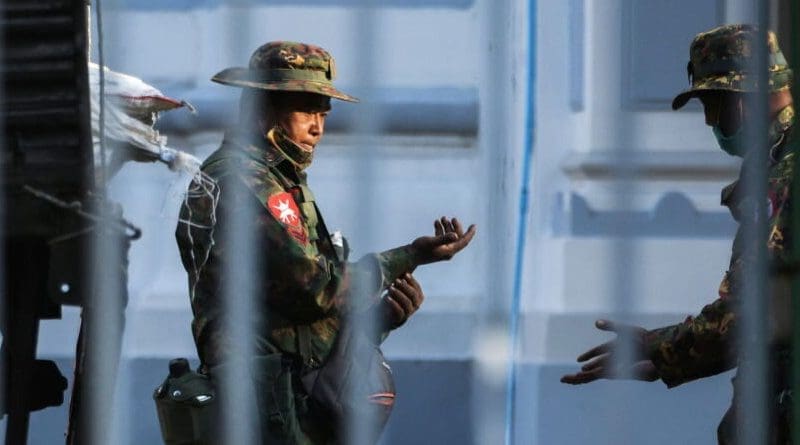
Members of Myanmar's Tatmadaw military. Photo Credit: Mehr News Agency

October 21, 2025 
By RFA

Myanmar’s junta said on Monday it raided one of the country’s most notorious cyberscam centers and seized Starlink satellite internet devices.

Myanmar government media The Global New Light of Myanmar said the military “conducted operations in KK Park near Myanmar-Thai border” and had “seized 30 sets of Starlink receivers and accessories,” according to the AFP news agency.

AFP said that number is only a fraction of the Starlink devices they identified using satellite imagery and drone photography. On the roof of one building alone in KK Park, images showed nearly 80 of the internet dishes.

The Global New Light of Myanmar also said junta troops had occupied around 200 buildings and found nearly 2,200 workers at the site, while 15 “Chinese scammers” had been arrested for involvement in “online gambling, online fraud and other criminal activities” around KK Park.

A crackdown by Thai, Chinese and Myanmar authorities starting in February saw thousands of suspected scammers repatriated, with experts saying some in the scam industry participate willingly while others are forced to by organized criminal groups.

The U.S. Congress’ Joint Economic Committee told the AFP news agency they have begun an investigation into Starlink’s involvement with the centers. While it can call owner Elon Musk to a hearing, it cannot compel him to testify.

Starlink parent company SpaceX did not immediately respond to a request for comment on Monday.

Online scamming centers have proliferated across Southeast Asia in recent years, especially in some of the more lawless parts of Myanmar, as well as in neighboring Laos and Cambodia.

The centers are often run by Chinese gangs and are notorious for luring unsuspecting people into jobs that entail going online to contact and defraud people, many in China.

Chinese authorities are keen to get the rackets based over the border in Myanmar shut down, and so action against them has become a key factor for rival factions in Myanmar, from the junta to its insurgent enemies and other militias, as they vie for China’s favor.


RFA

Radio Free Asia’s mission is to provide accurate and timely news and information to Asian countries whose governments prohibit access to a free press. Content used with the permission of Radio Free Asia, 2025 M St. NW, Suite 300, Washington DC 20036


Myanmar: Notorious cyberscam center KK Park raided by army
DW, AP, local media
1 hour ago1 hour ago

Unlicensed Starlink terminals were siezed and more than 2,000 people detained following the raid at KK Park.


The military confiscated Starlink tech from the facilityImage: The Myanmar Military True News Information Team/AP/dpa/picture alliance

Myanmar's military have closed down an online scamming operation, detaining more than 2000 people, according to state media on Monday.

During the raid, which took place near the border with Thailand, dozens of Starlink satellite internet terminals were also seized.

Myanmar is notorious for hosting cyberscam operations which have been responsible for taking money from people all over the world through scams which usually involve gaining victims' confidence online with romantic ploys or other ruses.

Cyberscam centers on the rise

In recent years, cyberscam centers have become infamous for recruiting workers from other countries under false pretenses. The individuals are promised legitimate jobs and then held captive and forced to carry out criminal activities.

Freed captives describe scam operations in Myanmar  03:28

On Monday, the army raided KK Park which is a well-documented cybercrime center, according to report in the Myanma Alinn newspaper.

The move came as part of operations that begun in early September to suppress online fraud, illegal gambling, and cross-border cybercrime.


Unlicensed Starlink terminals siezed

KK Park is located on the outskirts of Myawaddy, a major trading town on the border with Thailand in Myanmar's Kayin state.

The area is only loosely under the control of Myanmar's junta but also falls under the influence of ethnic minority militias.

Further details of the report said the army ascertained that more than 260 buildings were unregistered, and equipment including 30 sets of Starlink satellite internet terminals seized.

Starlink is part of Elon Musk's SpaceX company and the terminals link to its satellites, but the company is not licensed for operations in Myanmar. Hundreds of terminals are said to have been smuggled into the southeast Asian nation in recent years.

Additionally, 2,198 individuals were also detained during the raid at KK Park, although their nationalities were not known.
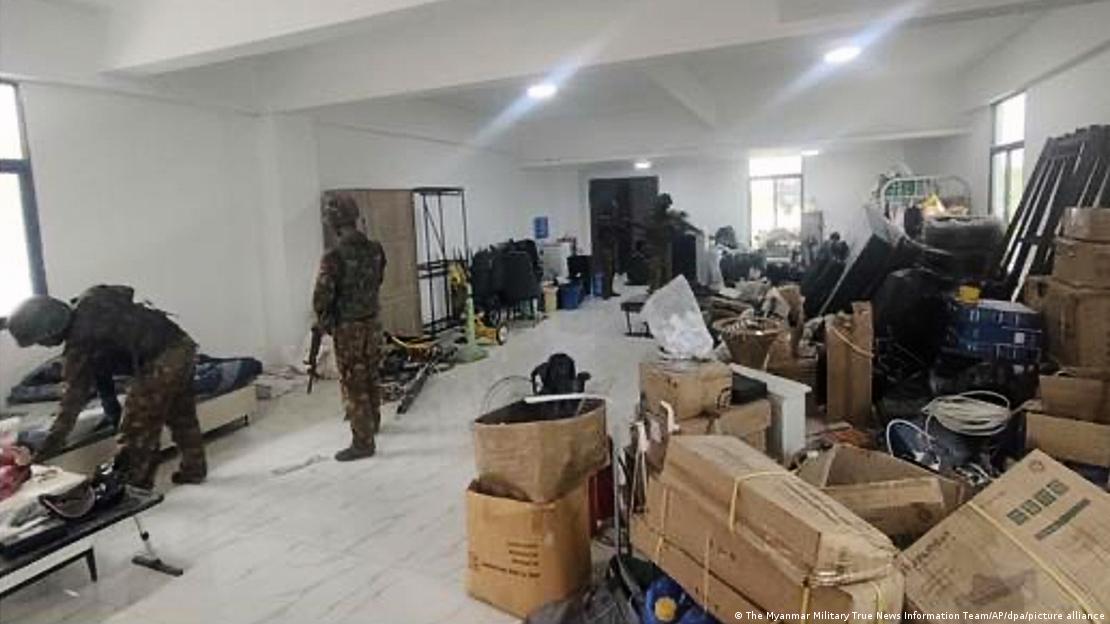
Myanmar's army has accused an armed ethnic organization of running scam centers
Image: The Myanmar Military True News Information Team/AP/dpa/picture alliance

Army accuses armed ethnic organization of running cybercrime center

Major General Zaw Min Tun, the spokesperson for the military government, claimed in a statement that the top leaders of the Karen National Union were involved in the scam projects at KK Park.

Karen are an armed ethnic organization opposed to army rule and are part of the larger armed resistance movement in Myanmar's civil war.

They have denied any involvement in the scams. The claims against them are based on the fact that the group allegedly owns and leases the land KK Park sits on.

Edited by: Elizabeth Schumacher

Kalika Mehta Sports reporterJourno_K


Europe’s answer to Starlink? Airbus, Thales, and Leonardo reportedly agree to satellite merger

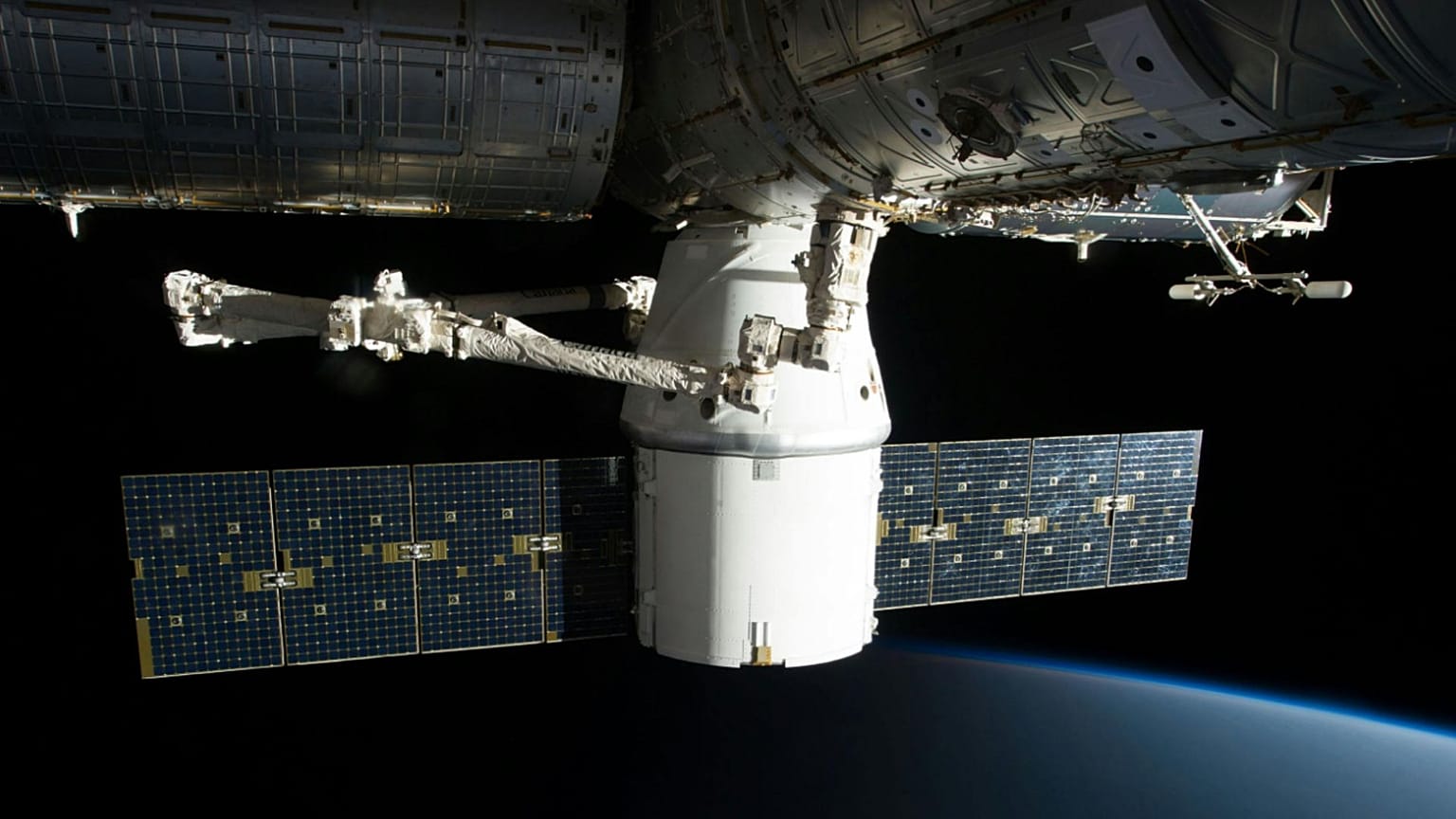
SpaceX satellite
Copyright SpaceX imagery Pixabay

By Euronews
Published on 

The reported merger comes as Elon Musk’s Starlink marked its 10,000 satellite launch into orbit

European aerospace companies Leonardo, Airbus and Thales will be merging their satellite businesses, according to Reuters.

The three companies have reportedly reached a framework deal that will allow them to create “Project Bromo,” a satellite manufacturing company to compete with rivals in China and the United States, notably Elon Musk’s Starlink.

Euronews Next is working to independently verify the Reuters report.

A report surfaced of their proposed satellite company last year, when officials told Reuters that a new company would combine satellite assets instead of having one partner buying assets from the rest.

One of the companies that Project Bromo aims to rival is Musk’s SpaceX which has rolled out the Starlink megaconstellation that launched its 10,000 satelliteinto orbit over the weekend. Approximately 8,680 of these satellites are in orbit, according to astronomer Jonathan MacDowell who tracks operational satellites.

In 2021, the United States’s Federal Communications Commission approved Musk’s plan to deploy at least 12,000 satellites by 2026.

Starlink is used throughout Europe in places such as Ukraine, where an estimated 50,000 terminals in use to keep the country’s railways, schools, and hospitals online in the event of a power outage.

The country’s leading telecommunications company also signed a deal with the company earlier this year to start testing direct satellite-to-cellphone service.

Other companies are also working to compete with Starlink, such as Eutelsat, which recently received a €1.35 billion cash injection from the French government, according to the French newspaper Le Monde.

The European Space Agency is also working on a megaconstellation with Thales called the High-throughput Digital and Optical Network (HydRON) project, where satellites will transmit laser signals between each other and a few optical networks on the ground to deliver internet speeds up to a terabyte per second.


Georgian Dream Turning Totalitarian


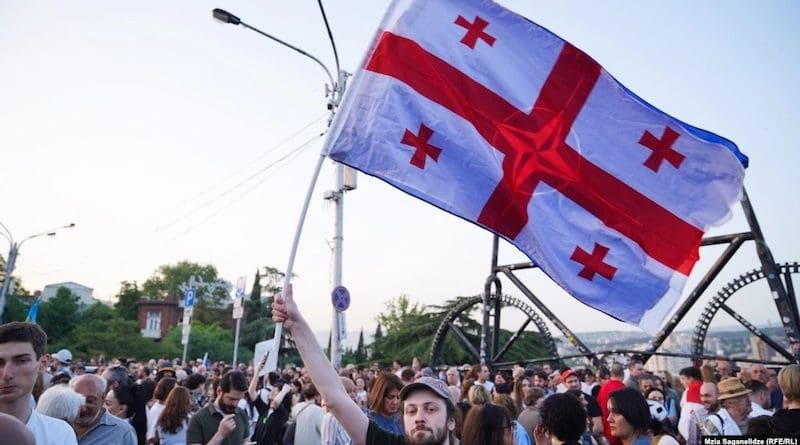
Protest in Georgia. Photo Credit: RFE/RL

October 21, 2025 
By Eurasianet

(Eurasianet) — The Georgian Dream-led counter-revolution in Tbilisi seems to be moving rapidly from an authoritarian phase to a totalitarian era.

Over the past few weeks, since claiming a convincing victory in municipal elections that were never competitive, the country’s Georgian Dream leadership has drastically intensified efforts to stifle all forms of dissent. Special forces squads have started conducting late-night security sweeps, bursting into private residences and taking suspected anti-government agitators into custody. Dozens of individuals, arrested in successive waves, now face criminal charges in connection with a protest outside the presidential residence in Tbilisi on October 4.

Meanwhile, the rubber-stamp parliament has adopted legislation significantly tightening criminal penalties covering expressions of dissent. Offenses, such as “illegally blocking a road,” once punishable with fines, now carry a potential jail sentence of up to 15 days, and a repeat offender can face up to a year behind bars.

Among those detained under the tightened criminal code is Vakho Sanaia, lead anchor at Formula TV, a broadcaster critical of the government, who attended a protest on October 18.

Parliament also has adopted a law allowing the Constitutional Court to dissolve political parties and ban individuals from engaging in political activity or founding new parties. Critics view it as part of the ruling party’s ongoing effort to outlaw opposition.

“No Georgian citizen is safe as long as [Bidzina] Ivanishvili holds power,” read a statement issued by the Lelo opposition coalition, referring to Georgian Dream’s founder and financier.

Amid Georgian Dream’s totalitarian turn, some erstwhile party loyalists are finding themselves on the wrong side of the power divide.

On October 18, the State Security Service announced it had raided 24 properties linked to former prime minister Irakli Gharibashvili (who still is GD party chair), former State Security Service head Grigol Liluashvili, former prosecutor general Otar Partskhaladze, and five other figures. Authorities reportedly seized around $7 million in cash, hundreds of pieces of jewelry and watches and several expensive paintings.

Gharibashvili, a longtime Ivanishvili loyalist, had served in a variety of top governmental posts before resigning just last year. Some government critics see Garibashvili’s evident fall from grace as potentially signaling the start of a “purge” period within the ruling party.

Georgia’s Rose Revolution in 2003 was a groundbreaking event in Eurasia’s post-Soviet history, ushering in an era of hope that rule of law could start to take root in a region steeped in traditions of arbitrary rule and grand corruption. Over the ensuring two decades, Georgia made major democratization strides. Georgian Dream’s rejection of liberal values and the restoration of a one-party system has occurred with stunning speed. The European Union offered Tbilisicandidate status less than two years ago. Now, Georgian Dream leaders seem to treat the EU, and Western-oriented institutions in general, as mortal enemies.

On October 16, the ruling party fined the OSCE Chairperson-in-Office, Finnish Foreign Minister Elina Valtonen, 5,000 GEL (around $1,850) for “blocking a road” on Rustaveli Avenue. Meanwhile, on October 19, the German Foreign Ministry announced it was recalling Berlin’s envoy to Tbilisi, citing Georgian Dream’s persistent “agitating against the EU.” Also on October 19, a pro-government television channel, Imedi TV, broadcast a report accusing the EU of violating Georgia law to finance anti-government activity.


Eurasianet

Originally published at Eurasianet. Eurasianet is an independent news organization that covers news from and about the South Caucasus and Central Asia, providing on-the-ground reporting and critical perspectives on the most important developments in the region. A tax-exempt [501(c)3] organization, Eurasianet is based at Columbia University’s Harriman Institute, one of the leading centers in North America of scholarship on Eurasia. Read more at eurasianet.org.

Russia: Another Jehovah’s Witness Tortured During Arrest – Analysis


Anna Safronova. Photo Credit: Jehovah's Witnesses

October 21, 2025 
F18News
By Victoria Arnold

Armed National Guard personnel tortured 58-year-old Jehovah’s Witness Mikhail Proshenkov with a stun gun while searching his home on 3 September. Proshenkov was one of five Jehovah’s Witnesses arrested during early-morning raids on several households in Saratov. Investigators subsequently charged the five with organising the activities of a banned “extremist” organisation for continuing to meet for worship.

Proshenkov’s wife has appealed to prosecutors and other state agencies to investigate the assault. It is unknown whether any criminal case has yet been opened (see below).

The National Guard (Rosgvardiya) – which reports to the President – typically provides armed support to investigators in such situations.

Forum 18 wrote to the Saratov Region branches of the Federal Security Service (FSB) and National Guard, asking:
– why they had considered it necessary to use physical force against Proshenkov;
– why officers had allegedly tortured him with a stun gun;
– and whether the personnel involved had been suspended or placed under investigation.
The Saratov Region FSB responded, telling Forum 18 to submit questions online to the FSB headquarters in Moscow. The Saratov Region National Guard did not respond (see below).

Forum 18 also wrote to the Saratov Region Investigative Committee, Saratov Region Prosecutor’s Office, the General Prosecutor’s Office, and both the federal and regional human rights commissioners asking:
– whether an investigation had been opened;
– and whether the officers who allegedly tortured Proshenkov had been suspended from duty and arrested.
Only the Saratov Region Human Rights Commissioner Nadezhda Sukhova responded, stating only that “your request has been declined” (see below).


Jehovah’s Witnesses have frequently reported experiencing physical assault, inhumane treatment, and threats during raids by Police, the Federal Security Service (FSB) or other state agencies. Officials are also known to have inflicted torture during some interrogations and in some prison system institutions (see below).

According to Jehovah’s Witness lawyers, none of the perpetrators has been subject to criminal investigation or has faced any consequences, and no victim has received any form of compensation (see below).

Jehovah’s Witnesses describe the case of 60-year-old jailed Anna Safronova as a “particularly telling example” of “inhumane treatment”. In 2024 and 2025, the correctional colony administration repeatedly placed Safronova in a punishment cell for “fabricated violations” and failed to give her proper treatment when she fell ill. Jehovah’s Witnesses attributed this treatment to Safronova’s refusal to wear an orange and black St George’s ribbon (seen as a sign of support for the Russian Armed Forces). Jehovah’s Witnesses believe they should remain politically neutral (see below).

In March 2025, Zelenokumsk prison officials forced Safronova to stand for ten hours in an empty, windowless room, under threat of a penalty if she sat on the floor. She suffered badly swollen legs after standing for so long, and was forced to stand again for thirteen hours the following day, during which she was permitted to use the toilet only once (see below).

Despite Safronova subsequently finding it hard to walk, the administration did not allow her to see a doctor, and she was only treated after her lawyer called an ambulance. Officials rejected her lawyer’s request for the Interior Ministry to carry out a forensic medical examination and initiate a criminal case against the correctional colony administration (see below).

On 29 September, Russia formally withdrew from the Council of Europe’s European Convention for the Prevention of Torture and Inhuman or Degrading Treatment or Punishment. The European Union’s European External Action Service called this “one more step in Russia’s complete disengagement from its international commitments and clearly demonstrates Russia’s disregard for the protection of human rights” (see below).
Banned and punished as “extremists”

Russia’s Supreme Court declared the Jehovah’s Witness Administrative Centre “extremist” and banned its activities in 2017. In the years since then, 845 people have faced prosecution for continuing to meet for prayer and Bible study (see forthcoming F18News article).

Raids on Jehovah’s Witness homes have continued throughout 2025. These are usually led by the Investigative Committee or the Federal Security Service (FSB) – the agencies responsible for investigations of Jehovah’s Witnesses for “continuing the activities of a banned extremist organisation” – and often involve armed troops of the National Guard (see forthcoming F18News article).

The consequences of prosecution can go beyond imprisonment or restrictions. At least four Jehovah’s Witnesses who became Russian citizens by naturalisation have had their citizenship revoked because of their criminal convictions. Officials subsequently expelled three of these from Russia. Those with foreign citizenship, who have lived legally in Russia for decades, may be subject to deportation upon completion of their sentences (see forthcoming F18News article).

Jehovah’s Witnesses are prosecuted because they continue to meet to pray, sing hymns, and read the Bible together. Some have also been charged with “financing extremist activity” (Criminal Code Article 282.3, Part 1), and “Inclination, recruitment or other involvement of a person in an extremist organisation” (Criminal Code Article 282.2, Part 1.1).

Similarly, Muslims who meet to study the writings of the late Turkish theologian Said Nursi are also prosecuted under the Extremism Law. They are accused of organising or participating in the activities of “Nurdzhular”, which the Supreme Court banned as an “extremist” organisation in 2008. Muslims in Russia deny any such formal organisation ever existed.
Russia’s obligations under Convention against Torture

Russia is a party to the United Nations Convention against Torture and Other Cruel, Inhuman or Degrading Treatment or Punishment. This defines torture as “any act by which severe pain or suffering, whether physical or mental, is intentionally inflicted on a person for such purposes as obtaining from him or a third person information or a confession, punishing him for an act he or a third person has committed or is suspected of having committed, or intimidating or coercing him or a third person, or for any reason based on discrimination of any kind, when such pain or suffering is inflicted by or at the instigation of or with the consent or acquiescence of a public official or other person acting in an official capacity.”

Under the Convention, Russia is obliged both to arrest any person suspected on good grounds of having committed, instigated or acquiesced to torture “or take other legal measures to ensure his [sic] presence”, and also to try them under criminal law which makes “these offences punishable by appropriate penalties which take into account their grave nature”.

On 29 September 2025, Russia formally withdrew from the Council of Europe’s European Convention for the Prevention of Torture and Inhuman or Degrading Treatment or Punishment, which it had ratified in 1998.

In a statement on 30 September, the European Union’s European External Action Service called this “one more step in Russia’s complete disengagement from its international commitments and clearly demonstrates Russia’s disregard for the protection of human rights”.
Saratov: Officers torture Jehovah’s Witness with stun gun

On the night of 3 and 4 September, Federal Security Service (FSB) investigators, accompanied by armed officers of the National Guard’s Special Rapid Response Unit, raided five households in the city of Saratov and the village of Anastasino in Saratov Region.

The National Guard (Rosgvardiya) – which reports directly to the President – typically provides armed support to investigators in such situations.

At the home of Mikhail Nikolayevich Proshenkov (born 14 April 1967), armed men forced him face-down onto the floor, breaking his glasses in the process, relatives told the European Association of Jehovah’s Witnesses. When Proshenkov refused to give up the password to his computer, they threatened him and his son with violence. When he refused again, they gave him six shocks with a stun gun to his leg and abdomen.

After searching Proshenkov’s home, investigators took him away for interrogation. They then placed him in custody, firstly in a temporary detention centre, then Saratov’s Investigation Prison No. 1. “The stress of the search has caused him to develop tremors, and there are still marks from the stun gun on his body,” the European Association of Jehovah’s Witnesses reported on 12 September.
Saratov: Officials fail to respond to torture allegations

On 10 September, Mikhail Proshenkov’s wife, Irina Proshenkova, wrote to the Saratov Region branch of the Federal Penitentiary Service (FSIN), requesting an urgent medical examination for her husband. She also submitted complaints about the alleged torture to the Saratov Region Investigative Committee, Saratov Region Prosecutor’s Office, the General Prosecutor’s Office, and both the federal and regional human rights commissioners.

The Military Prosecutor’s Office of Saratov Garrison and the Human Rights Commissioner for Saratov Region have since responded to Proshenkova. Both stated that prosecutors had passed on her complaint to the Investigative Committee’s Military Investigative Department for Saratov Garrison, Jehovah’s Witness lawyers told Forum 18 on 14 October.

Forum 18 wrote to all of these agencies on 29 September, asking:
– whether an investigation had been opened;
– and whether the officers who allegedly tortured Proshenkov had been suspended from duty and arrested.
Only the Saratov Region Human Rights Commissioner Nadezhda Sukhova responded, on 14 October, stating only that “your request has been declined”.

Forum 18 also wrote to the Saratov Region branches of the Federal Security Service (FSB) and National Guard, asking:
– why they had considered it necessary to use physical force against Proshenkov;
– why officers had allegedly tortured him with a stun gun;
– and whether the personnel involved had been suspended or placed under investigation.
The regional FSB directed Forum 18 to submit an enquiry via a webform on the federal-level FSB website. Forum 18 did this on 8 October, but had no response by the afternoon of the working day in Moscow of 20 October. Forum 18 had also received no response by then from the National Guard in Saratov.
Saratov: FSB-launched case targets five

On 9 October, Saratov Regional Court upheld Mikhail Proshenkov’s appeal against his detention and placed him instead under house arrest until 28 October.

Judge Artyom Anikanov concluded that, as Proshenkov has “no criminal record, a permanent place of residence, and strong social ties .. detention is, from the standpoint of reasonableness, excessive and not in accordance with the aims of criminal proceedings, the rule of respect for personal freedom, or the presumption of innocence”, according to the written decision, published on the regional court’s website.

Judge Anikanov nevertheless agreed with investigators that “there are sufficient grounds to believe that [Proshenkov] may abscond from the preliminary investigation”. He therefore put Proshenkov under house arrest, barring him from contacting anyone else involved in the criminal case, sending or receiving letters, and using the phone and the internet.

Three fellow Jehovah’s Witnesses who were arrested on the same night – Aleksey Sergeyevich Kazakov (born 21 February 1969), Filipp Valeryevich Ombysh (born 5 July 1985), and Aleksandr Nikolayevich Akelin (born 20 August 1966) – had already been transferred to house arrest on 24 September, according to Saratov Regional Court’s website. A fifth man, Sergey Yuryevich Yefremov (born 24 September 1995), has been under house arrest since two days after the raids.

Senior Investigator Major A. Pridatko of the Saratov Region FSB opened a criminal case against the five men on 28 February 2025.

Investigators have since charged the five men under Criminal Code Article 282.2, Part 1 (“Organisation of the activity of a social or religious association or other organisation in relation to which a court has adopted a decision legally in force on liquidation or ban on the activity in connection with the carrying out of extremist activity”).
No redress for Jehovah’s Witnesses tortured during arrest or behind bars

Jehovah’s Witnesses have frequently reported experiencing physical assault, inhumane treatment, and threats during raids by Police, the Federal Security Service (FSB) or other state agencies. Officials are also known to have inflicted torture during some interrogations and in some prison system institutions.

“In all publicly known cases of abuse, believers have been denied the initiation of criminal proceedings regarding acts of torture,” Jehovah’s Witness lawyers told Forum 18 on 14 October. Some victims have gone to court to challenge decisions not to prosecute the perpetrators, but unsuccessfully.

“No actual consequences have followed for those who carried out the torture. Not a single believer has received any form of compensation”, the lawyers noted.
“A particularly telling example” of torture

“A particularly telling example”, they added, is the case of Anna Arnoldovna Safronova (born 22 July 1965). She is serving a 6-year prison sentence after a court convicted her under Criminal Code Article 282.2, Part 2 (“Participating in a banned extremist organisation”) and Article 282.3, Part 1 (“Financing extremist activity”).

Officials have subjected Safronova to “inhumane treatment” in her correctional colony, yet Interior Ministry officials have decided that this did not constitute a “significant violation of her rights” and refused to open a criminal case against the correctional colony administration.

Trusovsky District Court in Astrakhan handed Safronova the longest prison termyet given to a Jehovah’s Witness woman on 25 January 2022. Between early July 2022 and the beginning of September 2025, she was held in Stavropol Region’s Correctional Colony No. 7 in Zelenokumsk.

In 2024 and 2025, the correctional colony administration repeatedly placed Safronova in a punishment cell for “fabricated violations” and failed to give her proper treatment when she fell ill, according to the European Association of Jehovah’s Witnesses. The Association attributed this treatment to Safronova’s refusal to wear an orange and black St George’s ribbon (seen as a sign of support for the Russian Armed Forces). Jehovah’s Witnesses believe they should remain politically neutral.

On 22 March 2025, officials forced Safronova to stand for ten hours in an empty, windowless room, under threat of a penalty if she sat on the floor.

“After receiving a penalty, a prisoner loses the right to early release, and the conditions of detention are also toughened,” Safronova’s lawyer commented to the European Association of Jehovah’s Witnesses.

Safronova suffered badly swollen legs after standing for so long, and was forced to stand again for thirteen hours the following day, during which she was permitted to use the toilet only once. Despite her subsequently finding it hard to walk, the administration did not allow her to see a doctor, and she was only treated after her lawyer called an ambulance.

“When she asked why she was being tortured like this, she was told: ‘You haven’t been tortured yet’,” her lawyer said. The lawyer wrote to Interior Ministry officials in Zelenokumsk, asking that they carry out a forensic medical examination and initiate a criminal case against the correctional colony administration. Officials later rejected the request.

Officials transferred Safronova out of Correctional Colony No. 7 at the start of September 2025. As of late September, she was still in transit to another correctional colony, so far unknown. She is due to be released in August 2027.


F18News

Forum 18 believes that religious freedom is a fundamental human right, which is essential for the dignity of humanity and for true freedom.


Op-Ed: When unreality rules – Trump’s impossible position on Ukraine is destroying America’s credibility


By Paul Wallis   

EDITOR AT LARGE

 DIGITAL JOURNAL
October 20, 2025


The Donetsk region has become one of the main flashpoints of the fighting. — © AFP Genya SAVILOV

The many falling idols of America now seem to include, above all, routine total ignorance or understanding of the interests of American allies and total lack of interest in America’s enemies. Never mind the Tomahawks. Trump’s insistence on a Russian “win” in Ukraine is antagonizing allies and making America look weak.

The bizarre global headlines regarding the recent Zelensky meeting with Trump make it clear how much of an incoherent mess American foreign policy has become. This meeting was even worse than the one in February, and at least equally counterproductive.

The Ukrainians have said from day one they won’t cede territory, and that they want the 2014 borders restored. They have absolutely no reason to even consider any compromise. 

They’re winning

.
Moscow has kept up its attacks on Ukraine despite efforts by the United States to broker a ceasefire – Copyright AFP –

The military and geopolitical facts tell a very unambiguous story:

Military

The military situation has been tracked since day one. The current situation is obvious. Russian offensives have monotonously failed for years and continue to do so, even with North Korean “help”. Casualties on the Russian side are appalling.

The Russian army has taken extraordinary casualties and defeats far beyond any level of acceptance for modern military forces.

The vaunted bombardment of Ukraine is largely because they can’t do much else.

The Ukrainians are responding effectively to every Russian move, and in fact retaking territory.

The Russian position in Crimea is untenable, a total tactical and strategic liability.

Even the upkeep of Russian forces seems unsustainable. Logistics have been terrible since 2023.

Troop effectiveness is highly questionable. The forces being deployed haven’t even been effective enough to move 20km in any direction and hold ground.

Tactical agility and mobility are bordering on absurd. Russian troops are using mules, quad bikes, and pickup trucks due to a lack of dedicated military transport.

On what basis is Russia “winning” anything at all? This war is turning into one of the worst, most prolonged defeats of a major army in history.

Geopolitical

A February 28 meeting between US President Donald Trump and Ukraine’s Volodymyr Zelensky saw a spectacular and fiery exchange between the world leaders – Copyright AFP/File SAUL LOEB

This geopolitical position must and will change.

On whatever absurd basis, Trump has taken a unilaterally pro-Russian and anti-Ukrainian stance. This is in diametric opposition to the new European stance, which is anti-Russian and pro-Ukrainian.

Last time this sort of catastrophic failure happened, the Soviet Union collapsed. The Afghanistan war was lost, and the USSR was broke, as Russia now seems to be becoming. The entire Soviet economy broke down suddenly and permanently.

Russian separatists are gnawing at the fringes of the Russian Federation. A long history of various groups indicates some level of resistance inside Russia. The Moscow Times also ran a story on Russia banning a “non-existent anti-Russian separatist movement”. Anyone’s guess what that means in practice.

Nor is the administration’s constantly dismissive view of Ukraine in line with any known reality. Ukraine isn’t some bit player. The Ukrainians are now front and center in global realpolitik. Ukraine has many friends and allies around the world.

The really strange thing is this.

There is absolutely no direct or indirect current or future benefit to the US in promoting Russian demands.

The world has had enough of drama queens.

_____________________________________________________________________

Disclaimer
The opinions expressed in this Op-Ed are those of the author. They do not purport to reflect the opinions or views of the Digital Journal or its members.

Here’s Why Russia’s Vladimir Putin Is Fixated On Ukraine’s Donbas – Analysis


Map of Ukraine with Donbas region highlighted. Credit: Peggy Frierson, DOD

October 21, 2025 
 RFE RL
By Mike Eckel

At a tense White House meeting with Volodymyr Zelenskyy, US President Donald Trump pushed the Ukrainian leader, telling him he would probably have to give up swaths of Ukrainian land to end the war with Russia.

“We think that what they should do is just stop at the lines where they are, the battle lines,” Trump told reporters aboard Air Force One two days later. “The rest is very tough to negotiate if you’re going to say, ‘You take this, we take that.'”

“Let it be cut the way it is. It’s cut up right now. I think 78 percent of the land is already taken by Russia,” he said on October 19. “You leave it the way it is right now. They can…negotiate something later on down the line.”

Trump was referring in large part to land in a section of eastern and southeastern Ukraine known as the Donbas.

Last spring, Zelenskyy backed Trump’s call for a cease-fire that would leave Russia in control of parts of the Donbas and other regions for the time being.

But for the overwhelming majority of Ukrainians, giving up the Donbas or any other territory formally or permanently is out of the question: “We will not leave the Donbas. We cannot do that,” Zelenskyy said in August.

Trump’s suggestion that Ukraine would have to give up land appeared to diverge from his remarks last month, when he claimed Kyiv was “in a position to fight and WIN all of Ukraine back in its original form.”

While the White House may be shifting in its thinking about Ukrainian territory, the Kremlin is not.

The Donbas remains central to Putin’s political and military priorities — the entire region is scarred by a long section of the zigzagging 1,100-kilometer front line. To Moscow, its importance — economic, cultural, and historic — stretches back decades, if not centuries.

So why exactly is the Kremlin fixated on the Donbas?
Industrial Heartland

A geographic term deriving from the Donets River and the word “basin” — as in coal basin — the Donbas encompasses the entirety of two Ukrainian regions — Luhansk and Donetsk. By some definitions, it also includes small parts of the neighboring regions of Kharkiv, Dnipropetrovsk, and Zaporizhzhya.

It’s Ukraine’s industrial heartland — home to coal mines, smelters, metallurgical plants, ports, railways, and other heavy industry.

At around 52,000 square kilometers, the region is roughly the size of Croatia.

The Donbas’s southern stretches include some of the rich agriculture lands that Ukraine is famous for. The Sea of Azov coastline in southern Donetsk is home to the port of Mariupol and to Azovstal –until 2022, one of the largest steel facilities in the world.

Soviet leaders saw the Donets River region — its coal and its smelters — as the engine for crash-course industrialization, to haul the Soviet Union toward economic parity with European industrial powers like Germany.

After the economic shock of the Soviet collapse in 1991, the region began a slow decline, taking on a Rust Belt quality, suffering from outdated infrastructure, a lack of investment, a shift in production capacity, and competition from global markets and world trade.

Some of Ukraine’s wealthiest businessmen hailed from the Donbas, bankrolling the Party of the Regions political bloc and its leader, Viktor Yanukovych, who served stints as president and prime minister.

Yanukovych fled to Russia in February 2014 after months of mass demonstrations in Kyiv culminated in violent street clashes.

In the months that followed, Russia launched an insurgency and campaign of sabotage and destabilization in the Donbas, seizing military installations and key buildings, including the region’s unofficial capital, Donetsk. Russia also sent regular troops into full battle against Ukraine’s under-equipped and undermanned forces in several battles.

Russia-backed forces declared “people’s republics” in Donetsk and Luhansk, which later became the basis for Putin’s 2022 declaration to have annexed the two regions, along with two other regions.

Prior to February 2022, Russia’s proxies controlled around 42,000 square kilometers of Ukrainian territory, entirely in the Donbas, plus the Black Sea peninsula of Crimea, which was seized eight years earlier.
The Donbas Fortress Belt

Russian forces captured several key Donbas cities in the first year of the all-out invasion.

Mariupol fell in May 2022 after a brutal three-month siege; Syevyerodonetsk, to the north, was captured the following month. A year later, Bakhmut — a Donetsk region city whose defense Zelenskyy and his commanders had prioritized — fell to Russian troops.

After Bakhmut’s fall, Ukrainian planners prioritized a “fortress belt” of fortifications along two stronghold cities — Slovyansk and Kramatorsk — along with the rail juncture city of Kostyantynivka, further to the south.

Stretching roughly 50 kilometers in total, the belt is a sinuous line of defenses — trenches, anti-tank obstacles, bunkers, minefields — woven into the urban sprawl around the cities.

For Russia, overcoming the fortress belt would allow forces to move quickly west to the border of the Donetsk region, putting the Kremlin priority — seizing the entirety of the Donbas — within reach.

Losing the fortress belt would pose a longer-term risk for Ukrainian forces, paving the way for new Russian operations in the future — something Zelenskyy alluded to in August: “The Donbas is a springboard for a future new offensive.”

“The demands on Ukraine to hand over the remaining part of the Donetsk region are unrealistic from the point of view of Ukraine’s future defense capabilities,” Kirill Martynov, the editor in chief of the exiled Russia newspaper Novaya Gazeta Europe, told Current Time.

“Putin has been trying to conquer the Donetsk region for 11 years. And handing over to him those fortified areas that remain under Ukrainian control is effectively a path to Kharkiv and Dnipro,” he said referring to two capitals of neighboring regions. “And, by and large, a path to a new war in which it will be even easier for Putin to win.”
Novorossia

The roots of the Kremlin’s claims on the Donbas — not to mention most of Ukraine — date in part to the 18th century when Catherine the Great expanded Russia’s imperial conquests south to the Black Sea coast and west toward the Balkans.

Termed Novorossia, or New Russia, the concept was embraced by modern-day Russian nationalists and philosophers — Aleksandr Dugin most prominently — who also promoted the wider idea of a Russky Mir, or Russian World. Putin took up the idea publicly shortly after the seizure of Crimea, a territory that holds deep emotional resonance for many Russians.

In the Donbas, ethnic Ukrainians were the dominant nationality until the years after World War II, when Soviet planners started importing ethnic Russians to repopulate the region and build an industrial labor force.

By the time of the Soviet collapse, the Donbas had a higher proportion of people reporting themselves as ethnic Russians than any other region, though still the minority.

Prior to the outbreak of war in 2014, the Russian language was widely used in the Donbas and other parts of Ukraine. Zelenskyy, who hails from the south-central city of Kryviy Rih, grew up speaking Russian as his first language, for example.

Over the years, Ukrainian nationalists periodically sought to downgrade Russian across the country, and there were sporadic unsuccessful referendum efforts to cement the Russian language as a state language alongside Ukrainian.

Russian nationalists have claimed that the Donbas’s ethnic Russians want to secede and unify with Russia itself, which is contradicted by several elections and referendums held over the years.

The region was home to around 6 million people prior to 2022. In the run-up to the invasion, the Kremlin sought to justify its war in part by portraying the ethnic Russian minority as being victims of a state campaign of discrimination.

In his televised address on February 24, 2022, announcing the invasion, Putin spoke falsely of a “genocide that almost 4 million people are being subjected to.” Two years later, Russia filed a claim with the United Nations’ highest court, alleging genocide in the Donbas.

Mike Eckel is a senior international correspondent reporting on political and economic developments in Russia, Ukraine, and around the former Soviet Union, as well as news involving cybercrime and espionage. He’s reported on the ground on Russia’s invasion of Ukraine, the wars in Chechnya and Georgia, and the 2004 Beslan hostage crisis, as well as the annexation of Crimea in 2014.


Trump Meets With Zelenskyy: No Tomahawk Missiles – OpEd


October 21, 2025 
By Liberty Nation
By Dave Patterson

Ukrainian President Volodymyr Zelensky visited the White House to persuade US President Donald Trump to provide Tomahawk cruise missiles that would reach farther into Russia. But Zelensky’s timing could not have been worse. His request came on the heels of a phone conversation between Trump and Russian President Vladimir Putin. That call presented the spark of hope for a ceasefire, again. The phone call also resulted in plans for a one-on-one meeting between Trump and Putin in the near future. Apparently, the call also persuaded Trump to hold off on providing Tomahawk missiles to Ukraine.

Following the Trump-Zelensky cabinet room meeting, President Trump did not have a separate press conference nor a public farewell for the Ukrainian president. Nonetheless, Trump characterized the meeting with Zelensky in the following Truth Social post:

“The meeting with President Volodymyr Zelenskyy of Ukraine was very interesting and cordial, but I told him, as I likewise strongly suggested to President Putin, that it is time to stop the killing and make a DEAL! Enough blood has been shed, with property lines being defined by War and Guts. They should stop where they are.”

In other words, President Trump believes Ukraine should give up all the territory that Russia occupies to stop the fighting. But for many, that would mean all the lives lost by Ukraine in attempting to thwart the Russian unprovoked invasion would have been for naught. That is not likely to be Kyiv’s preferred solution.

Long-Range Russian Weapons Still Strike Ukraine

Meanwhile, Russian ballistic and cruise missiles, as well as drones and glide bombs, are being used against Ukraine routinely. Still, Ukraine does not have the weapons capabilityto return the destruction to Russia in kind. Consequently, Zelensky came to meet with President Trump seeking Tomahawk cruise missiles. The potential for the US to provide such weapons has been the subject of debate among foreign policy wonks and the press lately. “The missiles were part of a lengthy news cycle regarding the prospects of their handover, which could have enabled Ukraine to escalate its strikes on infrastructure in the Russian interior,” Just the News observed. It was, however, the notion that Ukraine having and using the longer-range Tomahawk cruise missiles would escalate the conflict between Ukraine and Russia that persuaded President Trump not to provide the weapons.

It would seem that with the daily pounding Ukraine is taking, the result of Russian long-range weapons, the fighting has already escalated. It’s just one-sided favoring Russia. Worrying about escalating the conflict was precisely the argument the Biden administration used for piecemealing to Ukraine first MIG-29s, then Patriot air defense missiles, then M1-A1 Abrams tanks, and then the Army Tactical Missiles Systems. That didn’t work well for bringing about a ceasefire. Please note: The Russians are using long-range weapons against Ukraine without concern about “escalating” the conflict. Without a concomitant response by Ukraine holding military targets and infrastructure at risk deeper inside Russia, Kyiv’s forces are at a significant disadvantage. Nevertheless, as The New York Times observed, “But Mr. Trump expressed trepidation about providing Kyiv with the long-range Tomahawk missiles it is seeking, suggesting he first wanted to see Ukraine and Russia renew peace negotiations. ‘We’d much rather have them not need Tomahawks,’ Mr. Trump said of Ukraine ahead of the private meeting.”

Threatening to provide Ukraine with Tomahawk missiles should have prompted Putin to be serious about working toward a ceasefire and ultimate peace agreement. What history tells us is that threatening to provide Ukraine with more capable weapons results in Putin requesting an in-person meeting or phone call with President Trump. The discussions prompt short-term optimism that there could be follow-on substantive talks at high levels to achieve a halt to the fighting. But those high-level talks end up just allowing the Russian side to reiterate their demands that are unrealistic and that Ukraine has rejected.
Not Possessing Tomahawk Missiles Concedes Negotiating Advantage

Furthermore, making it known that the US will not provide Ukraine with the more capable Tomahawk missile system gives away any negotiating advantage Ukraine might have had before any negotiations could take place. The better position for the US and Ukraine would have been to have used the Tomahawk or similar longer-range weapons, demonstrating to Moscow what Ukraine has suffered under the continuous Russian bombardment. In other words, it provides Russia with a taste of its own medicine.

As it stands, Russia will continue to use its long-range weapons against Ukraine. However, the beginning of substantive talks about an end to the war will begin. US Secretary of State Marco Rubio will meet with his counterpart, Russian Foreign Minister Sergey Lavrov, to iron out preparations for a Trump-Putin in-person meeting reportedly to take place in Budapest, Hungary. No precise date has been set for the summit, but reports are that it will take place soon, perhaps within the next two weeks. One hopes more comes from the Budapest meeting than from the August meeting between Trump and Putin in Alaska.

The views expressed are those of the author and not of any other affiliate.


About the author: National Security Correspondent at LibertyNation.Com. Dave is a retired U.S. Air Force Pilot with over 180 combat missions in Vietnam. He is the former Principal Deputy Under Secretary of Defense, Comptroller and has served in executive positions in the private sector aerospace and defense industry. In addition to Liberty Nation, Dave’s articles have appeared in The Federalist and DefenseOne.com

Source: This article was published by Liberty Nation

Liberty Nation

Liberty Nation is a project of One Generation Away, a non-profit 501(c)(3) organization. Liberty Nation is true to the OneGen organizational mission: to apply America’s founding principles to the issues of today. Liberty Nation does not endorse political candidates, nor endorse specific legislation, but offers commentary, analysis and opinions – the good, the bad and the ugly — on all things related to the American political discourse.

Ukraine’s growing energy crisis promises a cold and dark winter

This is no longer a war of weapons – it is a war of engineers.

Ukraine’s growing energy crisis promises a cold and dark winter
Russia has increased the intensity of its attacks on Ukraine's energy sector. Nearly half the regions are already under emergency power regimes and the heating season has not yet formally begun. / bne IntelliNews
By Ben Aris in Berlin October 20, 2025

Since the summer, Kyiv has changed tactics. Given the almost complete failure of Western oil sanctions to curb Russian oil exports, the Armed Forces of Ukraine (AFU) has increasingly been targeting one of the main sources of Russia’s export revenues: Russian refineries. Russia has retaliated with a devastating campaign to take out more of Ukraine’s heating and power facilities that threatens to plunge the country into darkness just as the heating season gets underway.

According to various estimates, Ukraine’s campaign targeting Russian oil refineries have reduced production by 10%-30% and is impacting the budget, where the estimates for the full year budget deficit has more than tripled since the start of the year.

However, Russia’s retaliatory campaign has seen gas production fall by some 60%, according to comments by Naftogaz last week, and ten regions out of a total of 24 are already suffering from blackouts or have been put on emergency power supply regimes, according to Ukrenergo.

Ukraine was already short of gas supplies to get through the winter, with some 11bcm of gas in storage against the 13bcm it needs to heat and light the country until March. Ukraine produces some 20bcm of gas domestically each year and will be forced to import the rest. However, with German gas tanks only 75% full – by far the largest in Europe after Ukraine’s – ahead of an EU November 1 deadline to have 90%, the rest of Europe is also short of gas as the mercury starts to fall.

Ukrainian President Volodymyr Zelenskiy's trip to Washington was important where he asked US President Donald Trump for the powerful long-range Tomahawk cruise missiles, but was refused. Kyrylo Budanov, Ukraine’s spy master and chief of the Main Directorate of Intelligence of the Ministry of Defence of Ukraine said last week that 99% of the strikes on Russian refineries were carried out by Ukrainian drones, but as Russian refineries were hard-topped during the Cold War, the damage drones can do is limited. US-made Tomahawks, on the other hand, are powerful enough to flatten a refinery. Bankova also wants to hit other military strategic facilities inside Russia such as their drone factories.

Tensions rising in Bankova

Tensions are rising amongst Ukraine’s top officials as they struggle to cope with the Russian drone and missile barrage on their energy facilities.

Zelenskiy convened a tense meeting with the leadership of his Office, the Foreign Ministry, the Defence Ministry and other key departments on 10 October to dig into the details of the energy sector. That same day, the Russians struck two thermal power plants in Kyiv leaving half the city without electricity and water. The previous meeting on October 6 had ended in a tense discussion, with raised voices, Ukrainska Pravda reports.

“At some point, Zelenskiy, in a righteous fury, resorts to shouting to compel officials to speak plainly, stop repeating empty phrases and stop passing the buck,” Ukrainska Pravda reported. The president demanded to know which energy facilities are properly protected, which need to be shut down to prevent the country from plunging into darkness and which are at risk of failing entirely.

When he asked, "who's to blame for such a large part of the network being so poorly secured?", ministers and heads of relevant state agencies usually have no answer other than: "our predecessors,” Ukrainska Pravda reports, adding that it is taking longer to complete new protective measures than their "predecessors" took to build them. The central issue is the problem of protecting gas production, massive heat and power generation facilities or gas storage sites.

The situation is becoming dire. According to Naftogaz Group, Ukraine's largest national oil and gas company, Russia has launched three major strikes on Ukraine's gas facilities over the past week and the city of Kyiv and nine other oblasts are already experiencing rolling power outages.

“The next heating season could, under certain scenarios, prove more difficult and problematic than the winter of 2022-2023, when Ukraine endured dozens of heavy strikes, nationwide power outages and simultaneous power cuts that left over 10mn people without electricity,” Ukrainska Pravda reports. “Sources in the energy sector told Ukrainska Pravda that the nature of recent strikes and the scale of the damage show the Russians are this time prepared to act even more cynically.”

Russia has also changed its tactics. Whereas in 2023-24, it relied on carpet bombing multiple sites across the country – most notably Sumy and Chernihiv oblasts – this year Russia is more specifically methodically trying to destroy the energy system and gas targets and has expanded its target zone to include Odesa, Mykolaiv and Dnipropetrovsk oblasts. Local generation, Ukrenergo transmission lines and substations, and even distribution within large cities via oblast operator substations.

Another change is that instead of sending one large wave of drones and missiles, now Russia is striking in series, sending a few drones every hour to prevent repairs. Drone strikes to deplete air defence measures are followed by heavy missile attacks on generation facilities.

“The Russians' overarching aim remains unchanged: to destabilise the system and trigger a cascading failure – a blackout,” Ukrainska Pravda reports. “The intention is to create a deficit in Ukraine's east – historically the region with higher consumption and where almost all local generation has been damaged – and to gradually paralyse the west‑to‑east flow of electricity… Experience from recent years shows that in one or two attacks the Russians can knock out more generation than Ukraine can restore over an entire summer.”

Bankova is now anticipating strikes on dispatchable generation in Ukraine's western thermal power plants, followed by attacks on the distribution equipment of nuclear power plants. The Zaporizhzhia nuclear power plant (ZNPP), the largest in Europe, has already been taken offline due to missile strikes on its power feeds.

Building defences

Under former commander in chief General Valerii Zaluzhnyi, a three-tier defence was built up:

  • Installing sand-filled gabions around facilities;
  • Building concrete and metal structures to shield large transformers at key substations; and
  • Entire substations were sealed within reinforced concrete and steel topped with a layer of earth.

In total, around 80 key transformer substations, that form the energy backbone for the country, need protection to ensure the stability of the entire power system. In the first pass some 20 of these substations were fully protected, but the work has not been finished. Russia has at the same time increased its production of drones and missiles as part of its missile war to the point where it can still overwhelm Ukraine’s defences.

The work got bogged down in accusation of corruption: then Prime Minister Denys Shmyhal asked why the second-level protective structures built by the Agency for Restoration cost two to three times more than similar facilities built by Ukrenergo. This dispute led to endless meetings, arguments, funding delays, missed deadlines and other internal system failures, Ukrainska Pravda reports.

"This winter will certainly be one of shortages. Emergency outages are already in effect across almost the whole country. Most likely, in winter we will face a '4×2' scenario: four hours without power, two hours with it," a representative of one state energy company told the newswire.

Zelenskiy has constantly been calling for more air defence ammo and systems to protect Ukraine’s power supplies. When 30 to 50 Russian drones and missiles target a single facility, even the best defence won’t intercept them all. “It only takes one precise strike to disable a power unit at a plant. In the case of substations, the damage can be repaired technically within two or three weeks, but that means little if there is no generation," the state energy company official said.

Another new tactic is Russia is now also targeting Ukraine's gas infrastructure – the extraction facilities, underground storage compressors and regional distribution networks. The idea is to also cut off the fuel supplies used by the power plants.

"This is no longer a war of weapons – it is a war of engineers. On both sides, energy experts are monitoring strikes, calculating megawatts and reserves. Some are building, others destroying. The front line now cuts not only through trenches but also through control rooms," another company representative told Ukrainska Pravda.

Bulgaria Willing To Offer Air Corridor For Putin To Meet Trump In Budapest


Bulgaria and Hungary are currently both members of the International Criminal Court, which has issued an arrest warrant for Putin 

October 21, 2025 
EurActiv
By Thomas Moller-Nielsen


(EurActiv) — Bulgaria will allow a plane carrying Vladimir Putin to fly through its airspace to facilitate a planned meeting between the Russian leader and Donald Trump in Budapest later this month, the country’s foreign minister said on Monday.

“When efforts are made to achieve peace, if the condition for this is to have such a meeting, it is most logical that such a meeting should be mediated in [all] possible ways,” Georg Georgiev toldreporters on the sidelines of a meeting of EU foreign ministers in Luxembourg.

“How is it proposed to hold the meeting if one of the participants cannot get to it?” he added.

No request has yet been made by Moscow to allow Putin’s aircraft to pass over the Black Sea nation, a Bulgarian official confirmed.

Bulgaria does not share a border with Hungary. However, Hungary and Bulgaria both border Serbia, which has strong historic links with Moscow. Passing through Bulgaria on his way to Budapest would cut Putin’s flight time considerably.

The only other route that does not involve flying over EU or Ukrainian airspace involves flying over the Mediterranean, and then passing over Montenegro or Albania before reaching Budapest via Serbia.

The summit, which was announced by Trump following a phone call with Putin last week and for which the date has not yet been fixed, has drawn a mixed reaction from EU leaders.

The EU’s top diplomat, Kaja Kallas, and many Eastern EU countries have criticised the scheduled meeting for excluding Ukrainian President Volodymyr Zelenskyy.

But ministers from many Western EU member states, including the Netherlands, Germany, and France, have expressed tentative support for the meeting, which would be the first in-person summit between Trump and Putin since they met in Alaska in August.

Hungary’s right-wing leader, Viktor Orbán, has repeatedly criticised the EU’s support for Ukraine and has fostered strong ties with both Putin and Trump since resuming his country’s premiership in 2010.

Bulgaria and Hungary are currently both members of the International Criminal Court, which has issued an arrest warrant for Putin for his involvement in the deportation of Ukrainian children during the war.

Hungary, however, announced its withdrawal from the ICC in April this year. Its withdrawal will become legally effective from June 2026.
EU on track to end Russian gas imports by end of 2027

Energy ministers from the 27-nation bloc meeting in Luxembourg have approved a plan by the European Commission to phase out both pipeline gas and liquefied natural gas (LNG) imports from Russia by the end of 2027.


Issued on: 20/10/2025 - RFI


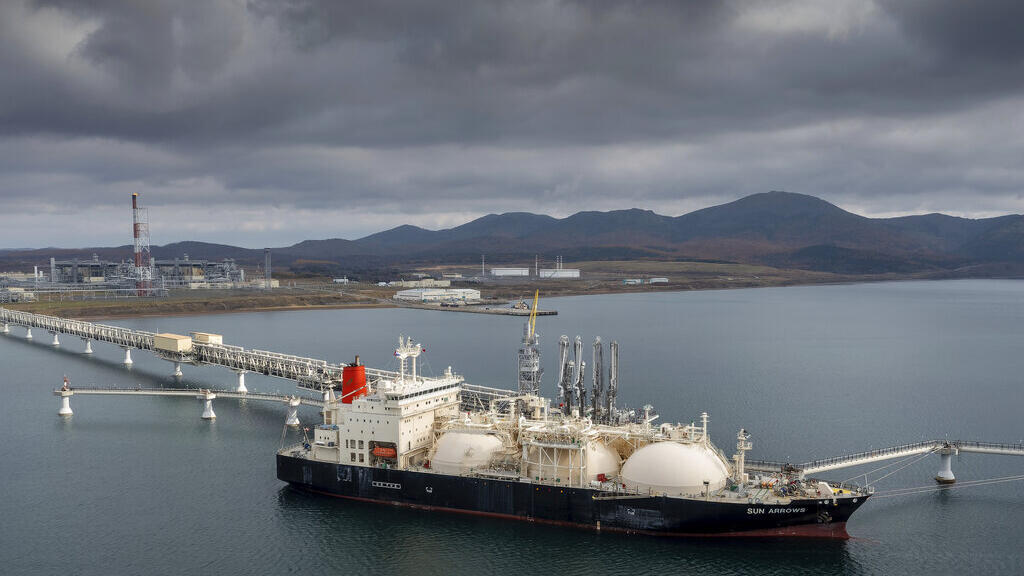
The tanker Sun Arrows loads its cargo of liquefied natural gas from the Sakhalin-2 project in the port of Prigorodnoye, Russia, 29 October 2021. AP


Lars Aagaard, energy minister of Denmark, which holds the EU's rotating presidency, called it a crucial step to make Europe energy independent.

"Although we have worked hard and pushed to get Russian gas and oil out of Europe in recent years, we are not there yet," Aagaard said.

The plan, which must be approved by the bloc's parliament, is part of a broader EU strategy to wean EU countries bloc off Russian energy supplies.

The commission is in parallel pushing for LNG imports to be phased out one year earlier, by January 2027, as part of a new package of sanctions aimed at sapping Moscow's finances during its war with Ukraine.

But sanctions need unanimous approval from all of the EU's members. Trade restrictions like those approved on Monday instead require the backing of 15 of the 27 countries.
Geographical constraints

All but Hungary and Slovakia, which are diplomatically closer to Russia and still import Russian gas via pipeline, supported the latest move, according to diplomats.

"The real impact of this regulation is that our safe supply of energy in Hungary is going to be killed," Budapest's top diplomat, Peter Szijjarto, told reporters.

His government says the landlocked country needs to import gas from Russia due to geographical constraints

Under the proposal approved on Monday, Russian gas imports under new contracts will be banned as of 1 January, 2026.

Existing contracts will benefit from a transition period, with inflows under short-term contracts allowed until 17 June 17 2026 and those under long-term contracts until 1 January 2028.

Although gas imports from Russia via pipeline have fallen sharply since the invasion of Ukraine in February 2022, several European countries have increased their purchases of Russian LNG transported by sea.

Russian gas still accounts for an estimated 13 percent of EU imports in 2025, worth more than €15 billion euros annually, according to Brussels.