It’s possible that I shall make an ass of myself. But in that case one can always get out of it with a little dialectic. I have, of course, so worded my proposition as to be right either way (K.Marx, Letter to F.Engels on the Indian Mutiny)
Wednesday, October 22, 2025
Pioneering green chemistry: Light and air combine to build key molecules for future medicines
The University of Osaka researchers unveil a groundbreaking method for producing key chemical bonds using only light, oxygen, and a vanadium catalyst
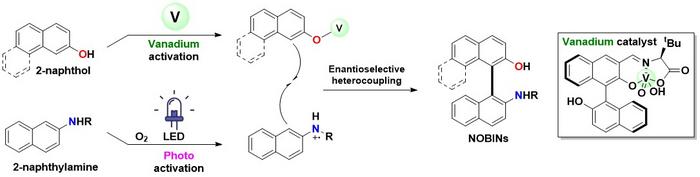
A research group led by The University of Osaka has achieved a world-first in catalytic asymmetric synthesis, developing an innovative method for efficiently producing NOBIN, a valuable molecule used in pharmaceuticals. Their approach combines a vanadium catalyst, LED light, and oxygen, drastically reducing waste by eliminating byproduct formation common in conventional methods, and establishing a highly sustainable synthetic pathway.
Many modern medicines and functional materials depend on molecules that come in “right-” and “left-handed” forms, known as chiral molecules. Traditionally, making these molecules requires multiple steps and often produces unwanted chemical waste. In the case of NOBIN, previous methods always produced additional unwanted byproducts, reducing efficiency and increasing environmental burden.
The team's innovation lies in cooperatively combining a vanadium catalyst and light. The catalyst selectively converts 2-naphthol into a radical species. Concurrently, LED light under oxygen generates a cationic radical species from 2-naphthylamine via a charge-transfer complex. These two radicals then efficiently couple, exclusively yielding NOBIN derivatives. This allows for an ideal 1:1 input ratio of starting materials and utilizes low-energy LED light, significantly minimizing environmental impact and making the synthesis highly sustainable.
This clean process yields only water as a byproduct, showcasing exceptional environmental compatibility and waste reduction. Activating molecules using light is energy-saving and safe, accelerating next-generation asymmetric synthesis research. Professor Shinobu Takizawa, senior author of the study states, "This achievement opens new avenues in chemical synthesis, with applications anticipated for more complex molecules and drug candidates. Cooperative catalysis, combining light and metal catalysts, embodies a sustainable chemical process. This study is a major step towards creating an environmentally harmonious future society."
###
The article, “Enantioselective Heterocoupling of 2-Naphthylamines with 2-Naphthol Derivatives via Cooperative Photoactivation and Chiral Vanadium(V) Catalysis,” was published in ACS Catalysisat DOI: https://doi.org/10.1021/acscatal.5c05038
About The University of Osaka
The University of Osaka was founded in 1931 as one of the seven imperial universities of Japan and is now one of Japan's leading comprehensive universities with a broad disciplinary spectrum. This strength is coupled with a singular drive for innovation that extends throughout the scientific process, from fundamental research to the creation of applied technology with positive economic impacts. Its commitment to innovation has been recognized in Japan and around the world. Now, The University of Osaka is leveraging its role as a Designated National University Corporation selected by the Ministry of Education, Culture, Sports, Science and Technology to contribute to innovation for human welfare, sustainable development of society, and social transformation.
Schematic illustrations of: (a) the methods dealing with pH for the classic CHE model and the electric field (EF) pH-dependent model; (b) surface coverage on Pt (111) revealed by the electric field model: HO* dominates under alkaline conditions, while H* prevails under acidic conditions; (c) simplified pH-dependent activity volcano.
The pH, or the acidity or alkalinity of an environment, has long been known to affect how efficiently catalysts drive key electrochemical reactions. Yet despite decades of research, the atomic-scale mechanisms behind these pH effects have eluded scientists.
A new study sheds light on this mystery by decoding how electric fields, surface properties, and charge dynamics intertwine to govern catalytic performance. The findings mark a significant step toward rationally designing catalysts that perform efficiently in a range of environments, paving the way for next-generation clean energy technologies.
Details were published in the Journal of Materials Chemistry A on 26 September 2025.
Traditional models have explained pH-dependent activity mainly through the computational hydrogen electrode (CHE) model and the Nernst equation. These frameworks linked shifts in activity to changes in potential and proton concentration. However, the new research shows that the reality is far more complex, involving a web of interfacial electric fields and molecular interactions that standard models cannot fully capture.
Recent advances in both experimental and computational methods have revealed that properties such as dipole moments, polarizability, and the potential of zero charge (PZC) play a critical role. These factors determine how molecules and ions interact with catalyst surfaces, directly influencing reaction rates and selectivity.
By bringing together insights from electrochemistry, physics, and computational modeling, the research highlights how these interfacial effects manifest across a wide array of reactions, including hydrogen evolution (HER), oxygen reduction (ORR), carbon dioxide reduction (CO₂RR), and nitrate reduction (NO₃RR). These are among the most important reactions for renewable energy conversion, fuel generation, and environmental remediation.
These new models offer scientists a powerful toolkit for predicting and optimizing catalyst behavior at the atomic scale. By integrating experimental data with computational simulations, researchers are now able to map how subtle changes in pH shift reaction pathways and determine overall efficiency.
Looking ahead, the research team plans to combine molecular dynamics with machine learning potentials to simulate reaction conditions in real time. This approach could unlock even deeper insights into how catalysts evolve during operation, further accelerating the design of high-performance materials for a sustainable energy future.
About the World Premier International Research Center Initiative (WPI)
The WPI program was launched in 2007 by Japan's Ministry of Education, Culture, Sports, Science and Technology (MEXT) to foster globally visible research centers boasting the highest standards and outstanding research environments. Numbering more than a dozen and operating at institutions throughout the country, these centers are given a high degree of autonomy, allowing them to engage in innovative modes of management and research. The program is administered by the Japan Society for the Promotion of Science (JSPS).
Advanced Institute for Materials Research (AIMR) Tohoku University Establishing a World-Leading Research Center for Materials Science AIMR aims to contribute to society through its actions as a world-leading research center for materials science and push the boundaries of research frontiers. To this end, the institute gathers excellent researchers in the fields of physics, chemistry, materials science, engineering, and mathematics and provides a world-class research environment.
Patients with advanced lung or skin cancer who received a COVID-19 mRNA vaccine within 100 days of starting immunotherapy drugs lived significantly longer than those who did not get the vaccine, researchers have found.
The observation by researchers at the University of Florida and the University of Texas MD Anderson Cancer Center is a defining moment in a decade-plus of research testing mRNA-based therapeutics designed to “wake up” the immune system against cancer. Building on a previous UF study, the observation also marks a significant step toward a long-awaited universal cancer vaccine to boost the tumor-fighting effects of immunotherapy.
The findings from an analysis of more than 1,000 patients’ records at MD Anderson are preliminary, but if validated in a randomized clinical trial now in design, the study could have a widespread clinical impact.
“The implications are extraordinary — this could revolutionize the entire field of oncologic care,” said co-senior author Elias Sayour, M.D., Ph.D., a UF Health pediatric oncologist and the Stop Children’s Cancer/Bonnie R. Freeman Professor for Pediatric Oncology Research. “We could design an even better nonspecific vaccine to mobilize and reset the immune response, in a way that could essentially be a universal, off-the-shelf cancer vaccine for all cancer patients.”
Jeff Coller, Ph.D., a leading mRNA scientist and professor at Johns Hopkins University, said the findings point to yet another way Operation Warp Speed — part of the federal government’s early response to COVID-19 — continues to save Americans’ lives in “unique and unexpected ways.”
“The results from this study demonstrate how powerful mRNA medicines truly are and that they are revolutionizing our treatment of cancer,” Coller said.
Published today in Nature, the findings build upon Sayour’s eight years of work combining lipid nanoparticles and mRNA. Short for messenger RNA, mRNA molecules are found in every cell and carry the genetic information needed to make proteins.
Notably, Sayour’s lab reported a surprising finding in July: that to prompt a strong antitumor reaction, they needn’t go after a specific target protein in a tumor; instead, they could simply rev up the immune system — as if fighting a virus.
Like a one-two punch, pairing Sayour’s patented experimental “nonspecific” mRNA vaccine with common anticancer drugs called immune checkpoint inhibitors triggered a strong antitumor response in lab mice. The experimental vaccine was nonspecific to COVID spike protein or any other virus or cancer but rooted in similar technology to the COVID vaccines.
Would the COVID-19 mRNA vaccine work like the nonspecific vaccine?
To find out, the research team analyzed existing data from patients with Stage 3 and 4 non-small cell lung cancer and metastatic melanoma treated at MD Anderson from 2019 to 2023.
What they found was that receiving a COVID mRNA vaccine within 100 days of starting immunotherapy drugs was associated with living longer by a significant amount.
The most dramatic difference, Sayour said, was in patients not expected to have a strong immune response, based on their tumors’ molecular makeup and other factors.
As with any observational study, the findings require confirmation from a prospective and randomized clinical trial.
Nonetheless, the discovery is pivotal.
“Although not yet proven to be causal, this is the type of treatment benefit that we strive for and hope to see with therapeutic interventions — but rarely do,” said Duane Mitchell, M.D., Ph.D., Grippin’s doctoral mentor and director of the UF Clinical and Translational Science Institute. “I think the urgency and importance of doing the confirmatory work can’t be overstated.”
In lung and skin cancers, doctors commonly engage the immune system with drugs designed to “release the brakes” and recognize and attack cancer cells more effectively. In advanced disease stages, however, most patients don’t respond well and often have exhausted other treatment options like radiation, surgery and chemotherapy.
The new study involved records of 180 advanced lung cancer patients who received a COVID vaccine within a 100-day period before or after starting immunotherapy drugs and 704 treated with the same drugs who did not receive the vaccine. Getting the vaccine was associated with a near doubling of median survival, from 20.6 months to 37.3 months.
Of the metastatic melanoma patients, 43 received a vaccine within 100 days of initiating immunotherapy, while 167 patients did not receive a vaccine. With the vaccine, median survival increased from 26.7 months to a range of 30 to 40 months; at the time the data were collected, some patients were still alive, meaning the vaccine effect could be even stronger.
Receiving non-mRNA pneumonia or flu vaccines resulted in no changes in longevity.
To back their findings, UF researchers then used mouse models to pair immunotherapy drugs with an mRNA vaccine targeted specifically at COVID spike protein. Those experiments showed they could turn unresponsive cancers into responsive ones, thwarting tumor growth.
“One of the mechanisms for how this works is when you give an mRNA vaccine, that acts as a flare that starts moving all of these immune cells from bad areas like the tumor to good areas like the lymph nodes,” Sayour said.
The next step is to launch a large clinical trial through the UF-led OneFlorida+ Clinical Research Network, a consortium of hospitals, health centers and clinics in Florida, Alabama, Georgia, Arkansas, California and Minnesota.
“One of our key motivations at OneFlorida is to move discoveries from academic settings out into the real world and the places where patients get care,” said Betsy Shenkman, Ph.D., who leads the consortium.
If confirmed, the new findings unlock numerous possibilities, and the researchers said an even better nonspecific universal vaccine could be designed. For patients with advanced cancers, the increased survival from such a universal vaccine could provide a priceless benefit: more time.
“If this can double what we’re achieving currently, or even incrementally — 5%, 10% — that means a lot to those patients, especially if this can be leveraged across different cancers for different patients,” said Sayour, an investigator with UF’s McKnight Brain Institute.
The study was funded by the National Cancer Institute and multiple foundations.
Sayour, Grippin and Mitchell hold patents related to UF-developed mRNA vaccines that are licensed by iOncologi Inc., a biotech company born as a “spinout” from UF in which Mitchell holds interest.
SARS-CoV-2 mRNA vaccines sensitize tumours to immune checkpoint blockade
Article Publication Date
22-Oct-2025
COI Statement
Sayour, Grippin and Mitchell hold patents related to UF-developed mRNA vaccines that are licensed by iOncologi Inc., a biotech company born as a “spinout” from UF in which Mitchell holds interest.
Backyard birders in South Africa may continue to enjoy biodiversity in visiting birds under climate change scenarios, while climate change and declining biodiversity may decrease birding in protected public parks
Backyard birders in South Africa may continue to enjoy biodiversity in visiting birds under climate change scenarios, while climate change and declining biodiversity may decrease birding in protected public parks.
Article Title: Climate change impacts the non-market value of nature: A case study of birding cultural ecosystem services in South Africa
Author Countries: United States
Funding: This work was supported by the Ridge to Reef NSF Research Traineeship, Award DGE-1735040 to KM. The funders had no role in study design, data collection and analysis, decision to publish, or preparation of the manuscript.