Friday, October 24, 2025


In the Shadows of History: Death and Destruction in South Sudan


Much of the world is rightly transfixed by the genocide in Gaza, the unimaginable horrors experienced by its Palestinian inhabitants, the callous antics of those who would ‘develop’ its ruins (Trump, Blair, Kushner, etc.), and the strong likelihood of more of the same to come for the West Bank.

But what is it that explains why one humanitarian tragedy commands global attention while others that have entailed as much or more suffering for as long or longer seem less deserving of the world’s interest and go relatively unnoticed and unremarked upon?

The case of South Sudan

If international humanitarian interest in a country was simply a function of the extent of death, destruction, and human misery there, then the scorecard for South Sudan would place it among the most deserving of cases.

More than 20 years ago, in 2002, I was employed via an NGO to carry out a short consultancy for the South Sudan rebel government in waiting, the Sudan People’s Liberation Movement, which was the political wing of the Sudan People’s Liberation Army. My field work was carried out in the heart of rebel-held territory in the town of Rumbek. Tellingly, I was accommodated in a US special forces tented camp alongside Rumbek’s murram air strip. The presence of the US military in the middle of nowhere was a mark of the post-9/11 frenzied hunt for Al Qaeda, in a country that had once provided shelter to Osama bin Laden and was – and, according to some, still is – a stronghold of radical Islam. No prizes for guessing where the NGO’s funding probably came from.

In my final report, among others, I noted as follows:

For almost half a century [1955-2005], the people of Southern Sudan have been engaged in a bitter liberation struggle with the Government of Sudan based in Khartoum. It is a war that has resulted in the deaths of at least two million Southern Sudanese and the displacement from their homes of many millions more. There have been horrifying human rights violations on a grand scale. With the exception of large parts of western Equatoria, where war damage is relatively limited and has resulted mainly from sporadic bombings, there has been widespread destruction of, or serious damage to, physical infrastructure. The institutional infrastructure of government has been completely destroyed.

… it is also a war that has not impinged greatly on the economic or strategic self-interests of the major world powers and has therefore failed to attract their serious attention or that of the international media. Accordingly, it is a war that for the most part has been conducted in the shadows of history – a war that has resulted in more death, destruction and suffering than many conflicts whose causes and casualties for other reasons have been widely publicised by the world’s media (Blunt, 2002).

An indicator of the magnitude and severity of the effects of the protracted liberation struggle was that there were estimated to be twice as many women as men in the adult population of South Sudan (UNICEF, 2000 in Blunt, 2002). By comparison, after WWII, the country that had suffered the most casualties, Soviet Russia, had a female to male ratio of 1.3 to 1.0.

The atrocities that were committed during the 50-year civil war and since then bear an eerie resemblance to some of the main features of the Israeli genocide in Gaza – as if they were drawn from the same playbook.

Ironically, confirmation of this can be found in the account given by The US Holocaust Memorial Museum:

In both the south and west, the Sudanese government established a pattern of assaults against civilians. They killed, tortured, raped, and displaced millions. Assault tactics included:

  • Mass starvation and forcible displacement;

  • Blocking humanitarian aid;

  • Harassment of internally displaced persons;

  • Bombing of hospitals, clinics, schools, and other civilian sites;

  • Use of rape as a weapon against targeted groups;

  • Employing a divide-to-destroy strategy to pit ethnic groups against each other, causing enormous loss of civilian life;

  • Training and support for ethnic militias who commit atrocities;

  • Destruction of indigenous cultures;

  • Enslavement of women and children by government-supported militias; and

  • Impeding and failing to fully implement peace agreements.

Since gaining independence in 2011, civil wars have raged more or less continuously in South Sudan, killing tens of thousands more civilians. Much of the conflict and abuse has been funded by oil companies and European banks.

In 2024, the humanitarian crisis there was depicted by Human Rights Watch as one of the worst in the world (which it probably had been for at least the previous half century):

… driven by the cumulative and compounding effects of years of conflict, intercommunal violence, food insecurity, the climate crisis, and displacement following the April [2023] outbreak of conflict in Sudan. An estimated 9.4 million people [out of a total population of about 13 million] in South Sudan, including 4.9 million children and over 300,000 refugees, mostly driven south from the Sudan conflict, needed humanitarian assistance.

According to Oxfam (2025): “Reduced attention and [already grossly inadequate] funding to the country is further deepening the humanitarian crisis and putting millions of lives at immediate risk.”

A ‘sleeper’ in the New Great Game
Setting aside for the moment the fact that the death and destruction in South Sudan is and has been happening in the heart of darkest Africa to some of its blackest inhabitants — people who therefore would be classified among the most unworthy of victims — consider the following (typical) ingredients of the ‘civilised’ world’s calculations in such matters.

Though landlocked and largely inaccessible, South Sudan is a large and attractive piece of real estate (about twice the size of Germany) that has an estimated 5 billion barrels of oil reserves (the third largest in Africa); significant deposits of gold and other minerals such as iron ore, dolomite, and aluminium, which are largely untapped; approximately 33 million acres of mostly (94%) uncultivated arable land; and a wealth of renewable natural resources, primarily fish (in the massive wetlands known as the Sud), forests, and wildlife (World Bank, 2025).

However, it is South Sudan’s neighbour to the north – Sudan – that has a geostrategically vital 500-mile border on the Red Sea and controls access to world markets via Port Sudan for its landlocked neighbour, making it a critical piece in the New Great Game.

For now, while undoubtedly registered as a target of high potential, the considerable plunder and profit to be had in South Sudan is probably too difficult to extract, and the US is too heavily embroiled elsewhere, for it warrant the serious immediate attention of the current godfather of savage capitalism in the US.

The difficulties of extraction are made so by the incessant civil conflicts in South Sudan since independence in 2011, which are stoked by bitter ethnic rivalries that now threaten to cause another outbreak of violence; the absence or parlous state of South Sudan’s physical and institutional infrastructure and the inaccessibility of its natural resources; its extreme flood proneness and vulnerability to climate change (the highest in the world); and the choke hold on its exports, and trade generally, exercised by Sudan’s control of Port Sudan.

Regarding the latter, crucially, there are only two crude oil pipelines from the oil fields of South Sudan to Port Sudan. Their vulnerability is a function of their length – each of about 1,000 miles through inhospitable and lawless terrain – and their reliance on power plants in Port Sudan that supply electricity to the pipelines’ pumping stations, which have been subject to recent drone strikes.

For the US et al., all this could change very quickly of course if the already substantial Chinese interests in oil and infrastructure development in South Sudan continue to grow and US-supported strikes against those interests escalate. China is already South Sudan’s biggest export market and one of its main trading partners and donors, giving China a foothold in the country and region that the US would no doubt not want to become too firm.

Whatever the case, Black lives don’t matter

We can infer from this snapshot of the ‘property development’ potential and strategic significance of South Sudan an answer to the question posed at the beginning of this essay. An answer that many readers of this journal will be unsurprised by, but is worth repeating, nonetheless. Namely, that – per se – humanitarian crises and death and destruction on a massive scale lasting for decades clearly count for nothing in the mercenary and cynically self-interested calculus of the so-called ‘civilised world’. This is particularly so of course when the victims are among the darker races, as I have argued elsewhere and the likes of Chris Hedges and Caitlin Johnstone assert so emphatically.

Indeed, when the balance tips in favour of more intense US-led Western intervention in South Sudan, as eventually it is bound to (and South Sudan becomes newsworthy), these failed state conditions will be ‘refined’ or augmented (with ‘development assistance’ and more direct and brutal means of persuasion) to produce the type of ‘investment climate’ that results from the ‘shock therapy’ referred to by Naomi Klein (2008). That is, a catatonic condition and tabula rasa in the subject nation that clears the way for ‘free market fundamentalism’ and natural resource predation, as was the case in Iraq and other places.

As now, when that time comes, the humanitarian crises in South Sudan will be the subject of attention only in so far as they serve to embellish or decorate whatever narrative the corporate media have been told to run in support of greater Western intervention or only in so far as they provide an exotic curiosity for the entertainment of their indoctrinated Western audiences.

Peter Blunt is Honorary Professor, School of Business, University of New South Wales (Canberra), Australia. He has held tenured full professorships of management in universities in Australia, Norway, and the UK, and has worked as a consultant in development assistance in 40 countries, including more than three years with the World Bank in Jakarta, Indonesia. His commissioned publications on governance and public sector management informed UNDP policy on these matters and his books include the standard works on organisation and management in Africa and, most recently, (with Cecilia Escobar and Vlassis Missos) The Political Economy of Bilateral Aid: Implications for Global Development (Routledge, 2023) and The Political Economy of Dissent: A Research Companion (Routledge, forthcoming 2026). Read other articles by Peter.

Extending the Cultural Boycott of Apartheid South Africa to Israel 

I have been informed by the leadership of what might best be described as the “black consciousness movement” of Azania (South Africa) that a formal call to include Israel in the “cultural boycott” of South Africa will be issued from inside South Africa within the next few weeks.

The Black Consciousness Movement was started under the leadership of Steve Biko (whose life and murder by the Pretoria regime was the basis for the film “Cry Freedom”) and was the first organization to call for a cultural boycott of South Africa.

This call, sent out especially to pop musical groups, eventually generated the formation of “Artists United Against Apartheid.” The cultural boycott of South Africa was probably the first major effort successfully to draw pop and rock musicians into an anti-racist campaign.

The next logical step, which some of us have been struggling to implement, has been the inclusion of the racist, colonial, settler, Zionist regime of Israel in the cultural boycott.

Recently, a British pop-reggae band called UB40 spent some time here in Hawaii. Known for the radical political content of many of their songs, UB40 had a song go to no. 1 on the pop music charts in the US in 1988.

UB40 has agreed to cancel their Israel tour (a loss of over $500,000) in protest of the racist policies of the Zionist occupation forces in Israel and in support of the intifadah of the indigenous Arab youth of Palestine. Finally, the lines have been drawn. With UB40 setting an example, the call will be going out to all the major pop and rock groups to honor the cultural boycott of South Africa-Israel or risk being “boycotted” themselves.

UB40 has taken a very courageous stand. Those of us familiar with the music business know only too well how dominant outright Zionists and supporters of Israel are in the industry, Many of us remember the near destruction of Miriam Makeba’s career some 20 years ago when she took a stand opposing Zionism and supporting the Palestinian people’s right to self-determination.

What we are saying is, from the frontlines of South Africa to the frontlines of Palestine, apartheid-Zionism is racism. Support the cultural boycott! Say “no” to Israel and Apartheid South Africa!

Thomas C. Mountain is an educator and historian, living and reporting from Eritrea from 2006-2021. At one time he was the most widely distributed independent journalist in Africa with columns running in Ghana, Nigeria, Liberia, Cameroon, Somalia, Kenya, Tanzania amongst others as well as in the Eritrean diaspora. He is best reached at thomascmountain@gmail.comRead other articles by Thomas.

Huge crowds attend rallies to mark Hungary's 1956 anti-Soviet (STALIN) uprising

Huge crowds attend rallies to mark Hungary's 1956 anti-Soviet uprising
/ Facebook - Peter Magyar
By bne IntelliNews October 24, 2025

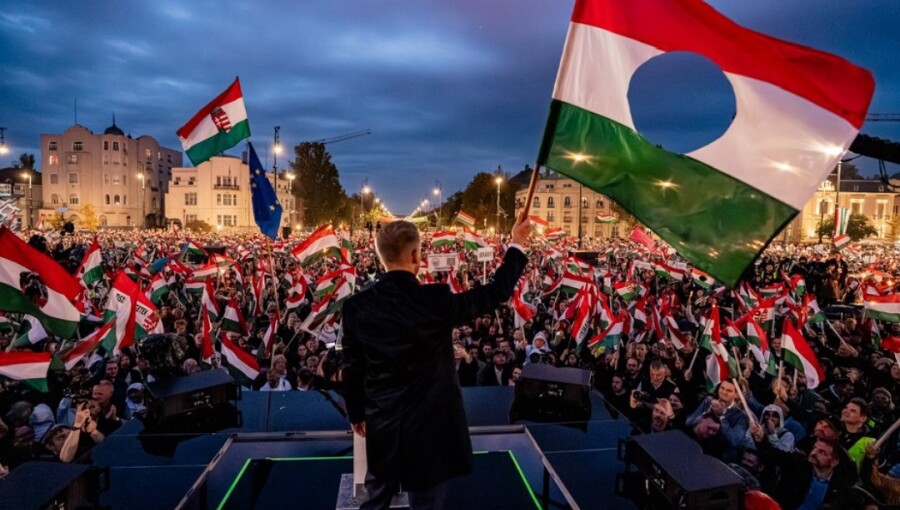
Hundreds of thousands of people took part in rallies on the October 23 national holiday in Hungary, commemorating the 69th anniversary of the 1956 anti-Soviet uprising, as both Fidesz and its rival Tisza Party sought to show force by bringing out as many supporters as possible less than six months before the election. 

Hungarian opposition leader Péter Magyar has called for a peaceful regime change and described it as the most important national holiday since the fall of Communism, according to leftist broadsheet Népszava. Viktor Orban said that those "misguided" people who are in favour of change of government are supporting the war.

The opposition leader argued that the majority of Hungarians recognise that the country is on a dangerous path, one that could lead to another national tragedy unless there is a fundamental shift in leadership.

He drew comparisons between the current political situation and Hungary's oppressive past, warning that the country is being led by what he described as a "Kádár-like" regime, referencing János Kádár, the communist leader who ruled Hungary from the end of 1956 until his death in 1989. Magyar claimed that under the current leadership, those who disagree with the government are marginalised and demonised, accusing the ruling party of labelling dissenters as "enemies" and using divisive language to paint those seeking freedom and prosperity as "criminals" or "insects."

The opposition leader also criticised the government for deviating from the democratic principles that the 1956 revolution sought to uphold. He accused the prime minister of centralising power, suppressing the press, and ruling through fear. Magyar pointed out that in 1989, Orban, as a young opposition figure, had spoken out against centralised power, but now, as Prime Minister, he has created a similar system that suppresses dissent and democratic values.

The 44-year-old opposition leader, a former Fidesz cadre member, made several references to Viktor Orban’s historic speech delivered in June 1989, during the reburial of martyred Prime Minister Imre Nagy and his followers. Many view this speech as marking the beginning of the fall of Hungary's Communist Party. Orban’s bold address catapulted him to prominence, where he called for the withdrawal of Russian troops stationed in Hungary since 1945.

Magyar continued, asserting that Hungary can only remain free and independent if its leaders do not bow to foreign powers in exchange for political gains or photo opportunities. He called for responsible leadership that prioritises Hungary’s sovereignty over external pressures.

The opposition leader also used the occasion to outline his party’s commitments for the upcoming elections, which include restoring judicial independence, joining the European Public Prosecutor’s Office, opening agent files, and introducing a national reconciliation law. He further outlined policies to protect national security, sovereignty, and democratic freedoms, as well as tax reductions, pension increases, and the introduction of a new child protection law.

"In just over 170 days, we will wake up in a free and smiling country," he said, referring to next year's general election. "For that to happen, we'll need humility, humanity, hard work and a great deal of patriotism," he said, announcing that he will set off on another nationwide tour dubbed the "Road to Victory".

Most independent polls show the Tisza Party is leading by double digits, except for those controlled by the government, which still forecast a slight Fidesz lead.

Meanwhile, Fidesz also went to great length to demonstrate its strength with a mass rally ahead of the April elections. With extensive party infrastructure and communication channels, the ruling party mobilised voters from across Hungary, including bus loads of people from smaller settlements. Opposition media reported seeing leaflets offering free food vouchers to participants, and numerous vehicles bearing Ukrainian and Serbian license plates were also spotted in central Budapest.

Orban’s supporters gathered on the Buda side of Margaret Bridge and marched through the city to Kossuth Square, where the Prime Minister delivered his speech. Before the rally, Orban expressed frustration that, despite his requests, EU summits often coincide with Hungary's national holiday. After the event, he flew to Brussels to attend the meeting.

Orban referred to the rally, dubbed the "Peace March," as the largest pro-government rally ever, describing it as "Europe’s largest patriotic movement." He urged supporters to stand firm against Brussels, which he claimed seeks to drag Hungary into war. He emphasised Hungary’s unique position as the only country in Europe to have maintained a "Christian, conservative, and nationally-minded" government for over sixteen years, stressing the importance of defending the nation’s sovereignty against external pressures, particularly from Brussels.

In his address, Orban reaffirmed Hungary’s role in defending peace, describing the country as the "capital of peace" in Europe. He called on his supporters to engage with "misled Hungarians" who favour a change of government, arguing that those voters are supporting policies that align with war. Fidesz is expected to continue the narrative in the election campaign that the Tisza Party is a puppet of Brussels.

Orban also referenced the legacy of the 1956 revolution, drawing parallels between the resistance against Soviet oppression then and Hungary's current opposition to what he called the "liberal and global forces" in Brussels. He repeated his accusations that the EU was blocking Donald Trump’s peace efforts regarding the war in Ukraine, remaining undeterred by the news that the Trump-Putin meeting had been called off.

The news of the postponement of the Trump-Putin meeting, which had placed both the government and Orban in the international spotlight for several days, caught the government and its media off guard.

Following the rallies, debates intensified over the size of the turnout at the two events. Political analysts and online commentators engaged in discussions, with both sides claiming their rallies had a larger crowd. Social media platforms were flooded with images and estimates, further fuelling the ongoing political discourse. 

While Fidesz successfully filled Kossuth Square in front of Parliament, the Tisza rally saw Budapest's iconic Heroes' Square packed to capacity, with people stretching along Andrassy Boulevard leading to the square. A Facebook post of a photo shot from a commercial plane depicting that image went viral on social media.

Peter Magyar later posted: "We are the majority."


... Germany in 1953. Then, in March of 1955, Rákosi was brought back. Poland ... 4 Quoted in Chris Harman, Bureaucracy and Revolution in Eastern Europe ...


LIBERTARIAN SOCIALIST VIEWS
Libcom.orgfiles.libcom.org/files/The Hungarian Revolution 1956.pdf

... Hungary '56 articles. [11,000 words]. For a short history, we recommend ... Andy Anderson: Hungary '56, Solidarity (London) 19^4. Books on Hungary 1956 


The Hungarian Revolution

This Day in Anarchist History

This Day in Anarchist History, October 23rd 1956 we remember the Hungarian Revolution when student protesters and the broader Hungarian working classes took on the Secret Police and the Red Army.

After days of striking and rioting that boiled into a firefight, protesters were able to defeat the country’s Secret Police and even negotiated the withdrawal of the Red Army from Hungary… for a time, that is.

Impromptu proletarian militias wasted no time looting factories to arm themselves. Unfortunately time was in too short supply as the Red Army tanks were sent back just days later, this time with orders to brutally crush the revolt. 3,000 Hungarians were killed, about 20,000 were imprisoned and hundreds of thousands more fled. There was very little dissent from Hungary for the rest of the USSR’s existence.

SubMedia is directed and produced by Frank Lopez. Read other articles by subMedia, or visit subMedia's website.

Mar 27, 2023 ... In June 1953, workers across East Germany rose in the first major rebellion in the Eastern Bloc. For a brief period, the iron grip of ...

Juni 1953 ) was an uprising that occurred over the course of two days in the German Democratic Republic (GDR) from 16 to 17 June 1953. It began with strike ...

In the USSR there were strikes in the great slave camps. In East Germany and Pilzen in Czechoslovakia in 1953 and in Poznan in Poland strikes led to bitter ...


Chris Harman is the editor of International Socialism journal. (www.isj.org ... Revolution: Germany. 1918 to 1923 and Revolution in the 21st Century.

Nov 10, 2009 ... Down the years the books kept coming – the phenomenal Lost Revolution, The Fire Last Time, the extraordinary People's History of the World, and ...


How Gratuitous Talk About Values and Identity Become Canada’s Raison d’État


Draw the Line action, Ottawa, September 20, 2025, part of a country-wide day of action against the Carney government’s anti-social pro-war agenda.

The measures taken by the Carney government since it took over power after the last election confirm this government’s adherence to the methods Carney and several of his ministers and point men of the state learned at Goldman Sachs. Previous employment in that institution seems to be in fashion at this time.

To see how Carney rules over not only his cabinet, but also the Liberal caucus, the House of Commons and Canada as a whole, it is enough to look at the “One Goldman Sachs” approach: “Leveraging its collective intellectual capital and diverse talent to serve clients. Key principles include prioritizing client interests above all else, upholding the highest ethical standards [as per his British colonial values of course — TML Ed. Note], striving for superior results, fostering a culture of teamwork and professional growth, and cultivating a diverse workforce.”

All of the above is what Carney claims represents the interests of the polity and Canada’s raison d’état – reason of state. Carney is proudly restructuring the state at the fastest speed possible, serving the interests of what are called “stakeholders,” which match his own.

He deprives the many and varied different interests which exist in the society of meaning and renders them as values directed at identifying with whatever he says is the national interest at this time. The people are told that the national interest of the U.S., or Britain, or Canada, or the European Union, is the interest of the world’s people for peace, democracy, and rights. The conception is that there must be no challenges whatsoever to the direction of this raison d’état and its national interest. That is how talk about values and identity become about raison d’état.

Carney’s rendering of democracy is one of passive individuals who have no claims on society. Individuals and collectives are effaced while  what are called are given recognition and the interests said to serve these “stakeholders” are validated; collectively aggregated to uphold the legitimacy of Carney’s reasoning of state, for what is called capitalist democracy.


It underscores the important challenge currently facing the working class and people of this country. Among other things, it is important to discuss how Carney’s definition of national interest is used to trump the public interest. There is a process on the basis of which, through sleight of hand, talk about values and identity become about raison d’état (reasoning of the state). Talk about values and identity are used to establish a nation-wrecking definition of national interest. To see through the actions of the Carney government, look at this definition of national interest which discards the legitimate claims of the working class and people on society. By creating all kinds of advisory groups comprised of “stakeholders,” this government is denying the peoples’ right to conscience and to speak, thereby denying the existence of the peoples’ right to self-determination itself.

Carney’s neo-liberal banker’s mindset is stuck in the Covenant Thesis expounded by Thomas Hobbes in the 17th century which defined the Supreme Power above the rule of law. It is stuck in the 18th century philosophy expounded by the Philosophes in France which established the relationship of individuals to the state in pre-revolutionary France to favour a raison d’état and “civilized” rule of law over the “noble savage.” It is also stuck in dogmas rendered by the Vatican and various Popes in the past 80 years to maintain the Catholic Church’s anti-communist and pro-Nazi crusades against the movements of the peoples to empower themselves.

Finally, besides treasuring the “do or die” values of empire espoused by 19th century Victorian England, despite his talk about a “rupture” that the world faces at this time, his government pursues Cold War policies, practices and forms of organization, wrapped in pretentious bafflegab. It ignores that the conditions are no longer those imposed on the world under the auspices of the Anglo-American imperialists with the U.S. leading the way after World War II.

What is called for by the situation, especially amidst all the threats of war, environmental crises and impoverishment of the whole society, is a modern definition of democracy. This does not mean looking up the definition from some dictionary. Definition has to do with the actual functioning and sorting out of the real problems that exist in society as a result of the people’s disempowerment. The sorting out is how one harmonizes the individual and collective interests that are in conflict with one another — the interests of individuals in their collectives, and of the collectives within the ensemble of the general interest. This problem must be argued out. By exercising freedom of speech — speaking freely — modern definitions and the arguments which bring them into being are brought to centre stage.


Human reasoning and arguing have to be brought forward. A logic must be provided that it is possible to sort out the relations which exist and which create a clash between conditions and authority. It requires people having their own agenda, their own organizations, their own outlook, writing their own constitutions which guarantee their rights so that they can resolve problems, and express their own conscience against all the assaults of a state power whose raison d’état is to deprive them of power. It entails finding the ways and means to deprive those in positions of power and privilege of the power to forbid discussion by citing the arrogance that they, not the people themselves, represent what the people want.

A modern definition of democracy is required which is in line with the requirements that are created by the mighty productive forces and the relations that have come from them, which underlie the interests in conflict. This is where the real transition lies which is inherent in the ensemble of relations between humans and humans and humans and nature.

Without blinking an eye, the Carney government’s pursuit of a government run like a boardroom comprised of those who represent narrow supranational private interests suppresses the right to speak of workers and people in this country. Doing so in the name of the national interest, of raison d’état, of high ideals, will not wash. Workers and democratic and anti-war forces from coast to coast to coast are seeing to that.


Toronto, September 20

Sudbury, September 20

Montreal, September 27

Pauline Easton is a political analyst and editor-in-chief of TML publications, where this article first was published. Read other articles by Pauline, or visit Pauline's website.
TML STANDS FOR THE MARXIST LENINIST, IT IS THE PAPER OF THE COMMUNIST PARTY OF CANADA (MARXIST LENINIST) UNAPOLOGETIC STALINISTS