(RNS) — On the Sunday after conservative activist Charlie Kirk was assassinated, I sat in an evangelical Christian church in the upper Midwest thinking about the First Great Awakening.
This 18th-century religious revival, led by itinerant preachers such as George Whitefield and theologian-pastors such as Jonathan Edwards, swept up England’s 13 colonies. Americans, as many colonists would become, not only joined churches in large numbers, claiming to be “born again” by the power of the Holy Spirit, but also they were unified in their commitment (or recommitment) to God.
The Great Awakening also bred great division, as some preachers, notably a New Jersey Presbyterian pastor named Gilbert Tennent, exhorted preachers to identify fellow ministers who did not testify to an evangelical conversion experience.
This is what brought the Great Awakening to mind as I worshipped with Midwestern hosts a few weeks ago. The minister condemned political violence, lamented the current state of political polarization and spoke about the need for Christians to serve as agents of reconciliation in the world. But he did not mention Kirk by name.
According to some evangelical leaders, neither I nor the congregants around me should continue to attend this church. “If your church didn’t address the demonic murder of Charlie Kirk this weekend, the pastor is a coward and needs to repent or resign,” Arizona pastor Mark Driscoll wrote on Facebook on Sept. 16. Driscoll, the subject of Christianity Today’s wildly popular podcast “The Rise and Fall of Mars Hill,” believes Kirk was a martyr and that his murder has triggered an evangelical revival in America.
Eric Metaxas, an author and host of a daily talk show on the Salem Radio Network, had a similar message for recipients of his email newsletter: “If your church…didn’t mention Charlie Kirk BY NAME on Sunday, find a new church.” Metaxas added, “If you don’t leave any church that refused to openly condemn evil, YOU are yourself part of the larger problem. It’s time to wake up and get in the fight.”
Metaxas, too, believes spiritual revival is consuming America in the wake of Kirk’s murder: “There are times in history when you can see God’s hand more clearly. I believe that’s happening now, and that we are experiencing something that we haven’t seen before: REAL REVIVAL.”
Driscoll and Metaxas could take lessons from Tennent’s fate after fomenting religious conflict in the mid-1700s. In a sermon he preached in 1739, published as “The Danger of an Unconverted Ministry” the following year, Tennent called on parishioners to leave their churches if their pastors could not testify to an evangelical conversion experience. They should seek out a minister who was preaching a message centered on the “New Birth.”
Church splits followed. In some villages, new meeting houses were erected for those who took Tennent’s advice and left their congregations. Colonial newspapers ran stories on their front pages about the controversy. Denominations broke up into Old Side (anti-revival) and New Side (pro-revival) factions.
The major difference between the First Great Awakening’s upheavals and those inspired by Charlie Kirk is that, in the 1700s, Christian leaders were arguing over spiritual matters. Today, Metaxas, Driscoll and others want people to leave their churches not because their pastor is unsaved, but because he or she did not sufficiently toe the MAGA line on Kirk’s murder. The division here is not over the proper way to get to heaven but evangelical Christians’ loyalty to the MAGA brand of GOP politics.
When politics and religion mix in religious communities, it is the spiritual health of congregations that suffers.
Tennent’s story, however, might offer the possibility of hope. Eventually acknowledging his divisiveness and repenting of most of the things he wrote in “The Danger of an Unconverted Ministry,” in February 1742, he sent a letter to Jonathan Dickinson, the prominent pastor of the First Presbyterian Church at Elizabethtown, New Jersey, apologizing for the “excessive heat of temper which has sometimes appeared in my conduct.”
Tennent claimed to have developed a “clear view of the danger of every thing which tends to enthusiasm and divisiveness in the visible church.” He expressed regret over the role he played in dividing churches and his “pernicious” practice of declaring fellow ministers unconverted. Over the next decades, he published essays and sermons with titles such as “The Danger of Spiritual Pride Represented,” “Brotherly Love Recommended,” and “Blessedness of Peacemakers Represented.”
There is “nothing more amiable,” Tennent wrote in one sermon, “than to see Brethren, who have been broken from one another by Division, and prejudiced against one another by angry Debate, seeking the Lord in UNION and Harmony.” He continued: “There is nothing more efficacious, to excite Mankind to embrace the Gospel than the mutual Love and Unity of the Professors of it.”
(John Fea is distinguished professor of history at Messiah University and a visiting fellow in history at the Lumen Center in Madison, Wisconsin. The views expressed in this commentary do not necessarily reflect those of Religion News Service.)
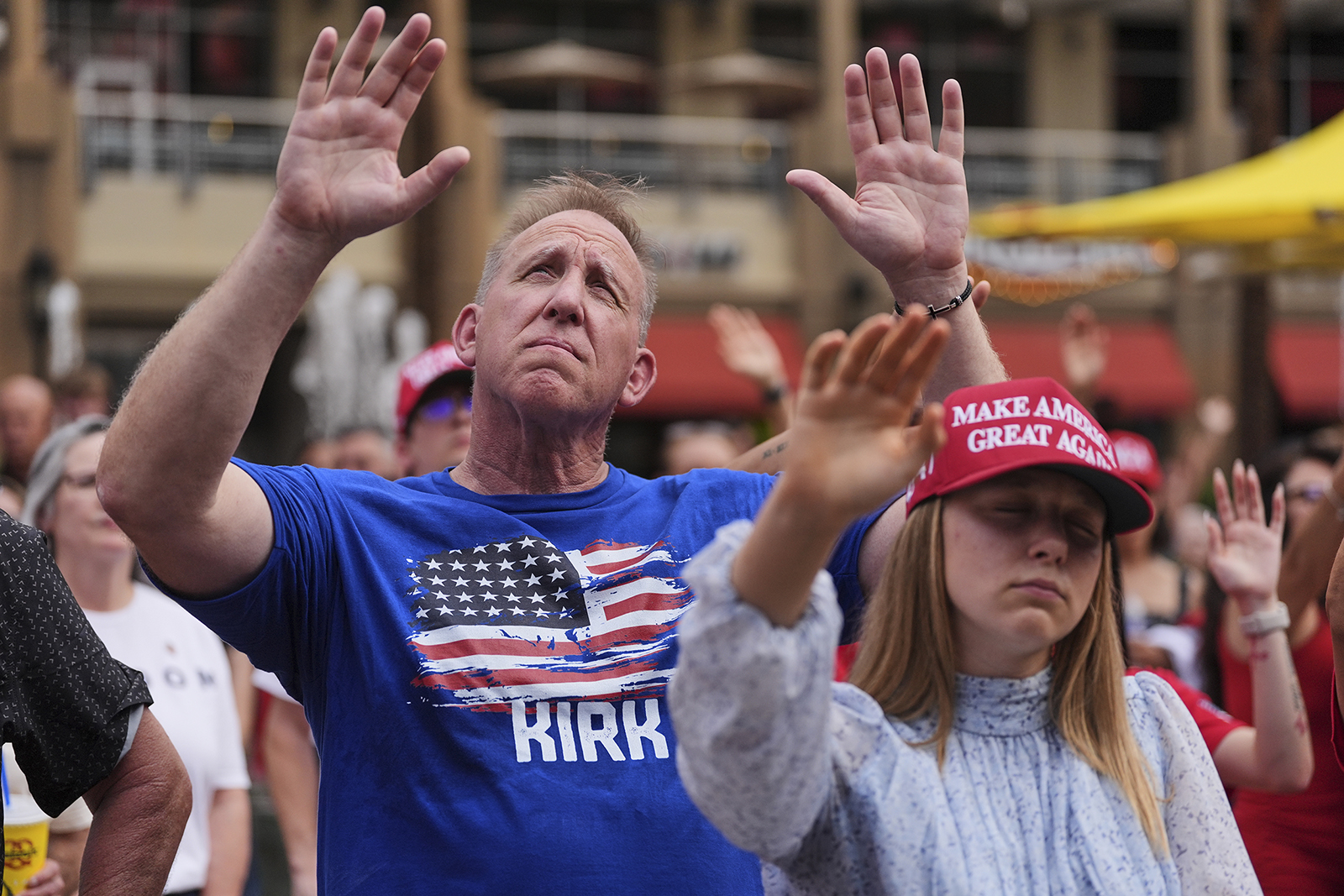
People listen to a worship song in the overflow area outside before a memorial for conservative activist Charlie Kirk, Sept. 21, 2025, at State Farm Stadium in Glendale, Ariz. (AP Photo/Jae C. Hong)
Andre Henry
October 14, 2025
(RNS) — In the weeks since Charlie Kirk’s assassination, American Christians have chosen strange epitaphs to memorialize the popular conservative pundit.
“If Charlie Kirk lived in the biblical times, he would have been the 13th disciple,” said U.S. Rep. Troy Nehls in a recent hearing on Capitol Hill. Pastor Mark Driscoll dubbed Kirk “an evangelist” in remarks to his congregation. “This guy is a modern day St. Paul,” Cardinal Timothy Dolan told Fox News.
That any Christians agree with these attempts to sanitize Kirk exposes a perilous consensus among many Christians that the faith should be the bedrock of authoritarianism in the United States. This means the fight against American authoritarianism requires an organized effort to shift this Christian consensus.
What we accept as normal or even correct doesn’t arrive as a law of nature. In our larger society, this idea of normal is crafted, story by story, custom by custom, song by song, headline by headline, ad by ad. For Christians it is tradition, the church, liturgy, clergy, and Scripture that shape a common idea of what it means to be true to the faith. Its symbols, stories and rituals shape what and whom we venerate, what we do and refuse to do in our daily lives and what political agendas we support.
If Kirk was an evangelist, his call apparently wasn’t to amplify the traditions, stories and rituals that followed from what Jesus preached. Jesus preached that one of the two greatest commandments from God is to love one’s neighbor. He demonstrated this himself by waging scandalous spectacles of welcome, accepting known “sinners” and outcasts into the kingdom of God and combating the pervasive culture of purity depicted in the Gospels. See, for instance, the famous story in which Jesus pardons a woman “caught” committing adultery.
Compare this to Kirk’s show of antagonizing transgender people, making liberal use of the slur “tranny.” He broadcast anti-Blackness, wielding statistics to propagandize us as “prowling Blacks” targeting our white neighbors for sport. He stoked Islamophobia, warning conservatives that “Marxism” and “woke-ism” were “combining with Islamism to go after what we call the American way of life.”
He sanctified gun culture, saying, “some gun deaths every single year so that we can have the Second Amendment to protect our other God-given rights. That is a prudent deal. It is rational.” His words show that Kirk was certainly a missionary for conservative values, but that’s not the same thing as a proponent of Jesus’ gospel.
That so many Christians aren’t scandalized by Kirk’s ascent to apostolic status speaks volumes about the Christian culture at work behind their silence or vocal approval. The version of the religion that his Turning Point USA organization now vows to carry forward has normalized bigotry not only as acceptable, but aspirational.
That should concern more than Christians. Kirk’s cruel campaigning for conservatism is a formidable political force. His view of Christianity shapes what they do at the ballot box, how they behave in their communities. Until this consensus shifts, authoritarian elements will continue to benefit from it.
The good news is that such shifts are possible. Once upon a time in the United States, it was common to hold African people as lifelong slaves. Jim Crow apartheid was normal. These attitudes were changed by organized civil resistance movements. The same must happen to combat the Christian consensus that supports authoritarianism.
The Civil Rights Movement didn’t just shut down cities with peaceful marches and win Supreme Court cases. It directly confronted the theological supports for systemic racism. Integrated civil rights groups infiltrated all-white churches and performed kneel-ins when told to leave. Signs reading “Segregation is a Sin” were spotted among the crowds of children who marched in Birmingham as part of the 1963 Project C desegregation campaign. The Rev. Martin Luther King Jr.’s famous Letter from a Birmingham Jail was addressed to a group of white Alabama pastors who opposed his activism.
Civil rights activists of the time understood that America’s idea of itself was just as much their terrain as the seats at a cafeteria counter or the steps of a government building. Today’s non-MAGA churches have the same approach, intentionally seeking to change the Christian imagination so that it’s less like to yield praise for champions of oppression.
Christians can be practical about the quest to shift common understanding of what Christians’ purpose is in the public debate. Any movement has an easier time winning victories when it has “passive popular support” from the public, meaning about 50% of the population agrees with the movement.
This doesn’t mean we put the Christian message to a vote. The effort to shift the Christian consensus needs to be nonpartisan, not a movement to simply create more Christian leftists and progressives. It needs to be a diverse coalition of Christians, an alliance between leftists and liberals, calling their compatriots to something higher than partisan activism, but to faithful Christian witness through public spectacle, storytelling, liturgies and public displays of repentance.
Charlie Kirk is indisputably a martyr, just not for what Jesus’ disciples called the gospel. That should be something all Christians can see, and believe.
DALLAS (RNS) — The 'Share the Arrows' conference founded by commentator Allie Beth Stuckey emboldened women to carry on Charlie Kirk's conservative fight.
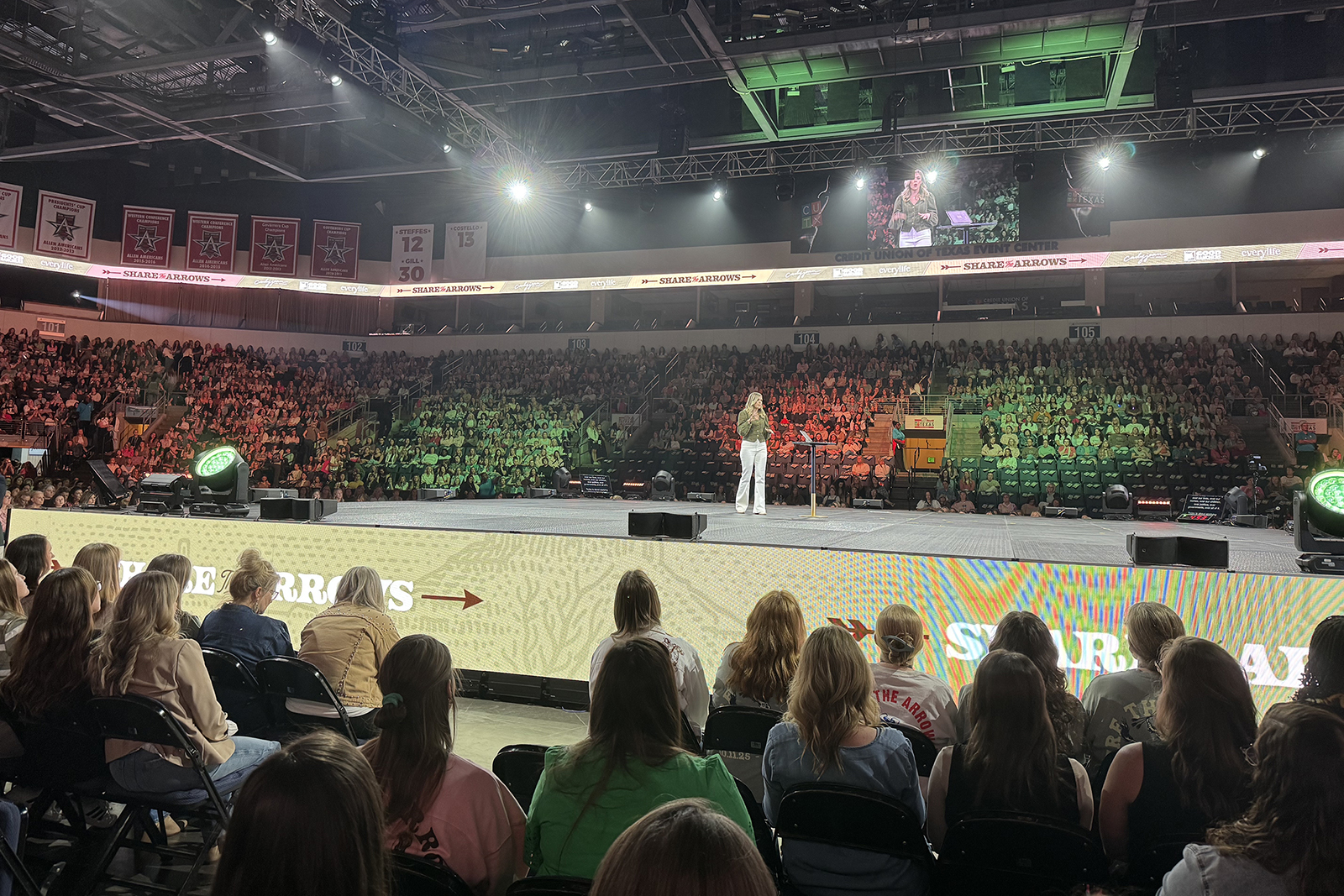
Allie Beth Stuckey speaks during the “Share the Arrows” women’s conference, Saturday morning, Oct. 11, 2025, at the Credit Union of Texas Event Center in Allen, Texas. (RNS photo/Kathryn Post)
Kathryn Post
October 13, 2025
DALLAS (RNS) — “Welcome to the fight,” said commentator Allie Beth Stuckey as she greeted the 6,700 conservative Christian women assembled in the Dallas, Texas, arena on Saturday morning (Oct. 11): “The fight for truth, the fight for our Christian faith, the fight for our children, the fight for the nation.”
Among Stuckey’s hundreds of thousands of social media followers, that fight is often waged in podcast recordings, comment sections, PTA meetings and local elections. But this weekend, the battle converged in the Dallas suburbs during Stuckey’s second annual “Share the Arrows” women’s conference, where throngs of Bible-wielding Christian women gathered at the Credit Union Texas Event Center to be inspired in person by their favorite online influencers, including Jinger Duggar Vuolo from the hit show “19 Kids and Counting” and homeschooling “momfluencer” Abbie Halberstadt.
Held just one month since the assassination of Charlie Kirk, the event also served as a rallying cry for women whose faith has been reignited by the death of the far-right political activist
“There’s a new ache in all of our hearts since Charlie passed, and we’re just so excited to keep this fire burning. This is a great way to rekindle that in all of us,” Rachel Jonson, a 28-year-old mother from Corinth, Texas, told RNS as she sat near the back of the arena, rocking the infant wrapped to her chest.
To these women, Kirk was an evangelist turned martyr who died for defending conservative beliefs about Scripture, family, abortion, gender and sexuality that they, too, hold sacred. In the weeks after Kirk’s passing, the conference saw a swell of more than 2,000 women purchase tickets. And the conference aimed to equip these women to boldly enter the fray of the culture wars. Though Stuckey argues the battle is primarily about defending biblical truths, she says political engagement is a byproduct.
“This is a fight to which every single Christian is called, and it’s not fought on a physical battlefield or even only in the public square,” said Stuckey from the conference stage. “This is a spiritual battle that is waged in our homes and in our neighborhoods, at school, at your job.”

“Share the Arrows” women’s conference attendees line up before doors open early Saturday, Oct. 11, 2025, at the Credit Union of Texas Event Center in Allen, Texas. (RNS photo/Kathryn Post)
An hour before the event’s 9 a.m. start, thousands of women formed a line wrapping around the event center, clutching notebooks and the clear bags dictated by security protocols. Once inside, attendees were greeted warmly by sponsors in pastel-colored stalls peddling natural cosmetics, Bibles, nutritional supplements and merch with quippy sayings like “you bet your stretch marks.”
Nearly everyone who spoke with RNS said they were excited to be with likeminded women. Waiting in her seat before the event, Anna Tumulty, 40, from Springtown, Texas, said she brought her daughter Lily to the conference for her 16th birthday “to help prepare her for her future walk with Christ, and to prepare her to face the problems in today’s culture.”
Carolina Graver, 29, flew in from Palmer, Alaska, to see Stuckey in person. Listening to Stuckey’s hit podcast, “Relatable,” in 2020 inspired her to serve on her local city council, she told RNS. Though she attended the conference alone, Graver said her fellow conferencegoers were an “extension” of her local faith community.
“I don’t know them, but they’re still in the same family of Christians as I am,” said Graver.

Carolina Graver. (RNS photo/Kathryn Post)
The “Share the Arrows” conference was designed with women like Graver in mind. Stuckey, who is best known for her sharp political, cultural and theological commentary and who authored the 2024 book “Toxic Empathy: How Progressives Exploit Christian Compassion,” told RNS that the idea for the event was born in the wake of 2020, when many conservative women feared speaking their minds. Despite President Donald Trump’s 2024 election win, this year’s event wasn’t framed as a victory lap. The phrase “share the arrows” refers to the idea that when a conservative believer is attacked, likeminded Christians should rally around them. And Kirk’s assassination was cited repeatedly as evidence that conservative views remain under threat.
“The pattern that we see of Christianity for the past 2,000 years, much to the disappointment of the tyrants that have tried to stop us, is that Christians tell the truth, Christians are persecuted, Christians multiply,” Stuckey said during the conference.
The values being targeted, according to the event speakers, include convictions about the dangers of “transgenderism” and queer identity, the belief that abortion is murder, and the upholding of traditional roles for men and women in marriage.
Satan was frequently described as the one slinging the “arrows,” though it was often fellow Christians, rather than the secular left, who were accused of distorting what the conference framed as objective biblical truths. Alisa Childers, the former Christian musician turned author and apologist, condemned longtime NIH director and evangelical Francis Collins for supporting fetal tissue research, LGBTQ+ rights, DEI and “Darwinian evolution.” Childers then received laughter and applause for calling out evangelical author Jen Hatmaker, who is also LGBTQ-affirming.
“We have groups of people that call themselves Christians, that will say, ‘Well, the Bible doesn’t really mean what we thought it meant for 2,000 years. Words don’t have objective meaning,’” Childers said during her talk.
Hillary Morgan Ferrer, founder of nonprofit Mama Bear Apologetics, described progressives not as enemies, but as captives.
“We have to realize that people have ideological Stockholm Syndrome, especially when it comes to the whole alphabet brigade, because they think these ideas are the things that give me purpose. They give me acceptance,” Ferrer said, in reference to the LGBTQ+ acronym.

Roughly 6,700 people attend the “Share the Arrows” women’s conference, Saturday, Oct. 11, 2025, at the Credit Union of Texas Event Center in Allen, Texas. (RNS photo/Kathryn Post)
Children’s Rights nonprofit founder Katy Faust noted that it’s possible to love gay people without compromising conservative convictions but also framed same-sex marriage as a justice issue that deprives children of a mother or father. She rejected no-fault divorce, IVF and surrogacy, saying these practices prioritize parental preferences over the rights of children.
The talks took place on the main stage of the arena and were interspersed by worship sets that featured anthems like “In Christ Alone” and the more recent hit, “Holy Forever.” Twice, Christian musician Francesca Battistelli led attendees in the hymn “This Is My Father’s World” — which includes the line “the battle is not done.”
But while cultural battles were a throughline of the conference, there were lighthearted moments, too; speakers peppered their conversations with jokes about chicken coops and sourdough starters, and panels on motherhood and health dolled out practical advice on how to control children’s access to social media and avoid processed foods.
Uniting the speakers wasn’t just a conservative, evangelical worldview, but an aesthetic; all nine featured speakers were white women in their 30s-50s. Most attendees, too, were white women who seemed to embrace an unspoken uniform of jeans or long skirt and casual top, with hair worn down. The event’s sponsors — including a Texas-based, antibiotic-free meat company; a pro-life, chemical-free baby essentials brand; and a sustainable fashion brand — revealed a significant overlap with MAHA mothers (Make America Healthy Again) or, as Childers put it, moms of the “crunchy” variety.
Stuckey told RNS that “Share the Arrows” has a “pretty narrow” theology and politics, and that unlike other Christian women’s conferences “who dabble in the social and racial justice,” Stuckey has “zero tolerance” for that.
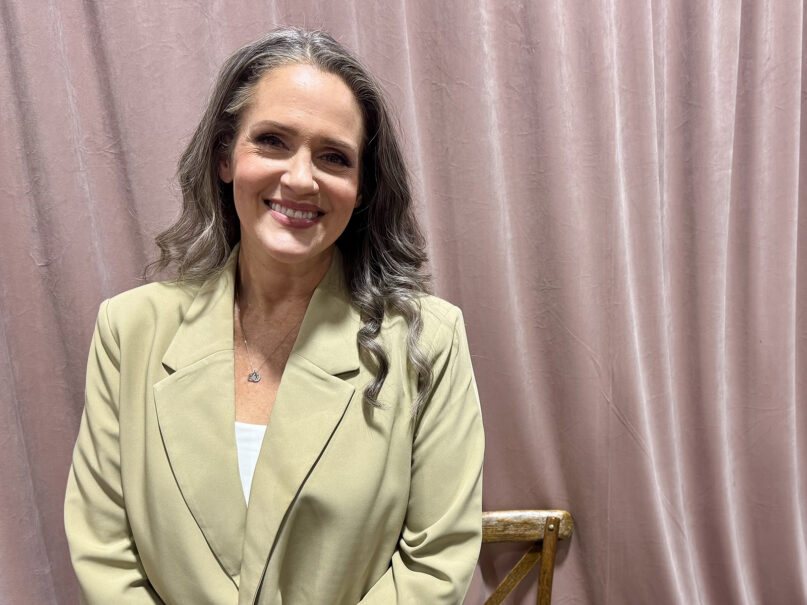
Alisa Childers. (RNS photo/Kathryn Post)
Despite the specific conservative audience, “this is probably one of the biggest Christian women’s conferences out there, too, and it’s only our second year,” Stuckey observed. “I do think that tells us a little bit about where Christian women are headed.”
In the wake of Kirk’s passing, Stuckey has joined many conservative faith leaders in talking about the possibility of revival. In her speech, Childers hinted at Stuckey’s role in that movement, describing Stuckey as “exactly like a female Charlie Kirk” who had “rallied together 6,500 Charlie Kirks to come together.”
Stuckey, though, insisted that Kirk was an anomaly.
“I and maybe 100 other people represent a sliver of what Charlie was,” Stuckey told RNS. “If I am part of the team that takes the baton of evangelizing and being an apologist for the faith in the conservative realm, I will be honored to take that.”

Roughly 6,700 people attend the “Share the Arrows” women’s conference, Saturday, Oct. 11, 2025, at the Credit Union of Texas Event Center in Allen, Texas. (RNS photo/Kathryn Post)