Friday, October 24, 2025

Global trade system risks coming off the rails: UN chief

By AFP
October 22, 2025


Image: — © AFP/File Philip FONG
Robin MILLARD

The rules-based international trade system is in danger, UN chief Antonio Guterres warned Wednesday, amid spiralling debt, heavy tariffs and financial insecurity for emerging nations.

Guterres said too many countries were trapped in a debt crisis, spending more money on servicing creditors than funding health and education.

“Global debt has soared. Poverty and hunger are still with us. The international financial architecture is not providing an adequate safety net for developing countries. And the rules-based trading system is at risk of derailment,” Guterres said at the 16th UN Conference on Trade and Development (UNCTAD) in Geneva.


UN Secretary-General Antonio Guterres said global debt was soaring – Copyright AFP/File Sameer Al-DOUMY

Guterres said trade and development were facing a “whirlwind of change”, with three-quarters of global growth now coming from the developing world, services trade surging and new technologies boosting the global economy.

However, he said geopolitical divisions, inequalities, conflicts and the climate crisis were limiting progress.

– ‘In turmoil’ –

Furthermore, US President Donald Trump’s administration has imposed wide-ranging tariffs on other nations, triggering trade tensions around the globe.

Guterres acknowledged that “protectionism might be, in some situations, inevitable” but “at least it should be rational”.

He warned that developing countries “continue to be short-changed”, with uncertainty rising, investment retreating and supply chains “in turmoil”.

“Trade barriers are rising, with some least-developed countries facing extortionate tariffs of 40 percent, despite representing barely one percent of global trade flows,” he said.

“We see a rising risk of trade wars for goods” while “military expenditure trends show that we are increasingly investing more in death than in people’s prosperity and well-being”.

Guterres outlined four priorities for international action: a “fair global trade and investment system”, financing for developing countries, technology and innovation to stimulate the economy, and aligning trade policies with climate objectives.

– Crushed by debt –

Guterres announced the creation of a Sevilla Forum on Debt, aimed at tackling an entrenched crisis in developing countries.

Calling for lower borrowing costs and risks, and quicker support for countries facing debt distress, he said some states were being “crushed” by debt.

Global public debt reached $102 trillion last year, with developing countries owing $31 trillion and paying $921 billion in interest, UNCTAD said.

The Sevilla Forum is aimed at unlocking financing for developing countries, strengthening the ability to mobilise domestic funding, leveraging more private finance and tripling the lending power of multilateral development banks.

Its first meeting should be held next year.

UNCTAD says 3.4 billion people are living in countries that spend more on debt servicing than on health or education.

“It’s a slow erosion of development, one budget cut at a time,” said the agency’s chief Rebeca Grynspan.

“True stability means countries can plan beyond the next payment, invest in their future and build, not just survive. What we have now is perpetual crisis management dressed up as normality,” she said.

The Sevilla Forum, she said, would build a framework where “debt serves development instead of consuming it”.


Car giant VW warns of production hit from Nexperia chips row


By AFP
October 22, 2025


Volkswagen has struggled with the shift to electric vehicles - Copyright AFP/File Yuichi YAMAZAKI

Germany’s Volkswagen warned Wednesday that its car production could be hit by a shortage of Nexperia semiconductors amid a deepening row between China and the Netherlands over the chipmaker.

Dutch officials invoked a Cold War-era law last month to effectively take control of the Netherlands-based but Chinese-owned Nexperia, citing national security concerns, as the sector increasingly becomes a focus of geopolitical tensions.

The company then said Beijing had banned it from exporting certain goods from China since early October — potentially a serious problem for carmakers as its chips are widely used in vehicles’ electronic control units.

Volkswagen, Europe’s biggest carmaker, confirmed some Nexperia components are used in its vehicles but said production was “currently unaffected”.

“However given the dynamic nature of the situation, an impact on production cannot be ruled out in the short term,” added the company, whose 10 brands range from Audi to Seat and Skoda, without giving further details.

It said production of the VW Golf and Tiguan would be suspended on Friday as part of planned measures and would resume the following week, though it denied earlier media reports that this was linked to the chip shortage.

Germany’s Bild newspaper reported that the chip shortage would lead to the suspension of production at key VW factories from next week.


Volkswagen has warned it could be affected by the fallout from a row over chipmaker Nexperia – Copyright AFP Brendan SMIALOWSKI

However, a spokesman for the company’s Zwickau plant told AFP this was “incorrect”.

Talks were due to take place later Wednesday between auto industry leaders and the German economy ministry on the fallout from the chip shortages, industry sources confirmed to AFP.

Hildegard Mueller, president of Germany’s VDA auto industry association, had warned Tuesday that the fallout “could lead to significant production restrictions in the near future, and possibly even to production stoppages”.

“The current focus should be on finding quick and pragmatic solutions,” she said.

VW’s share price tumbled over two percent in Frankfurt on Wednesday after reports emerged of the potential stoppages at its plants.

Stefan Bratzel, an auto industry expert at the Center of Automotive Management in Germany, told AFP that carmakers were making “attempts to switch to other suppliers”.

“But it is not easy to find other suppliers at short notice,” he said.
Online search a battleground for AI titans


ByAFP
October 23, 2025


ChatGPT was touted as 'the heart' of OpenAI's new Atlas browser, as tech firms seek to challenge Google Chrome's supremacy - Copyright AFP/File Kirill KUDRYAVTSEV
Thomas URBAIN

Tech firms battling for supremacy in artificial intelligence are out to transform how people search the web, challenging the dominance of the Chrome browser at the heart of Google’s empire.

Chatbots that started out as AI-powered assistants have gradually merged with web browsers and can independently scour the internet for detailed answers to questions.

OpenAI fired the latest salvo this week with the debut of what chief executive Sam Altman called an AI-powered web browser built around ChatGPT.

During a demonstration, members of the OpenAI team had the Atlas browser come up with a shopping list for a dinner based on a specified dish and number of guests.

Atlas joins Perplexity’s Comet, Microsoft’s Copilot-enabled Edge and newcomers Dia and Neon in this new breed of chatbot-browser hybrid.

“So many services and apps are browser-based that it makes a lot of sense to have agentic AI acting in the browser,” said Techsponential lead analyst Avi Greengart.

Whereas early AI assistants simply returned answers, focus has shifted to enabling them to act as “agents,” independently handling computer or online tasks such as setting schedules, making reservations or ordering pizza.

Now, AI makers are keen to usurp the role of the browser and streamline users’ interactions with the web.

“We used to download a lot of applications to our computers,” said SuRo Capital principal Evan Schlossman.

“You don’t download that many programs anymore; things are moving to the browser.”

As online exploration tools evolve with AI, they have yet to stray far from how people are already navigating the internet themselves.

“I think they don’t want to change the core experience too much,” Greengart said.

“Agentic AI following you around and offering help every time you do anything probably isn’t right for everyone.”

– Google has a hold –

Despite its prowess when it comes to AI, Google has yet to go all-in with agentic features in Chrome on par with those touted by challengers.

The internet colossus has added AI Overviews that provide summaries of online query results, and offers the option of using an “AI Mode” for searches with advanced reasoning, thinking and multimodal capabilities.

Chrome currently accounts for more than 70 percent of the browser market and Google’s name has become synonymous with search.

Futurum Group chief executive Daniel Newman does not see that shifting in the short term given how deeply ingrained Chrome use is in modern lifestyles.

But Thomas Thiele, a partner at consulting firm Arthur D. Little, said OpenAI could gain an advantage by combining what it learns from people’s ChatGPT exchanges with the Atlas browser.

“Gathering this information together, you can have more clues about persons than any time before,” Thiele said.

“We’d at least have a high chance that we’d see the birth of a new Google here.”

More insights into people can translate into better targeting of online ads, Google’s main source of revenue.

– Defining tomorrow –

By taking control of the browser, an AI company could define how people will interact with the technology in the future, Thiele reasoned.

“In the long run, the browser is not necessarily where everything happens,” Newman said, noting smart glasses or other wearable devices for engaging with the internet could catch on.

“We’re shaping behavior; winning where users currently are is going to be critical for that long-term market share that they are all fighting for.”

But SuRo Capital’s Schlossman anticipates the AI fight to unfold directly within chatbots rather than browsers.

He recalled a recent demo that featured apps moving into ChatGPT. OpenAI is “trying to control the user interface and optimize and streamline it,” Schlossman said.
HIC HONI SOIT 

After altar wine becomes popular in bars, Kenya's Catholic bishops order proprietary brand

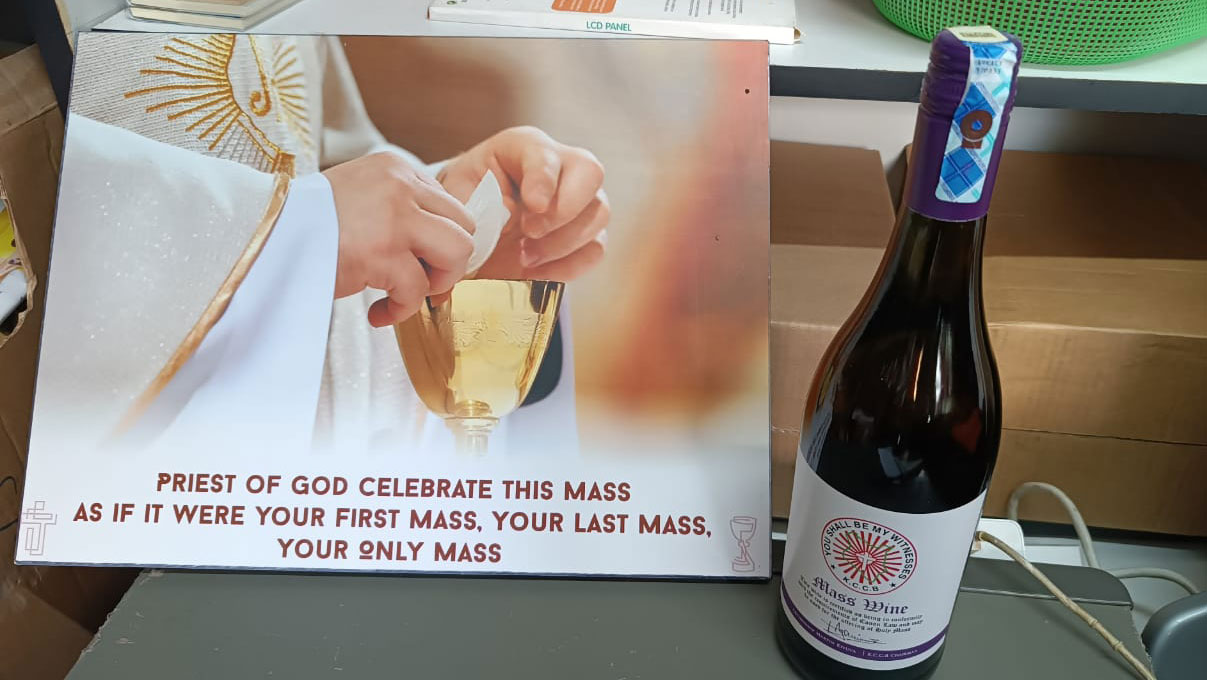
NAIROBI, Kenya (RNS) — 'This is (the) only wine going forward that will be used in the celebration Mass in the whole of the country. Kindly, don’t buy the other one,' said Archbishop Maurice Muhatia Makumba, chairman of the Kenya Conference of Catholic Bishops.


The new sacramental wine is a proprietary brand created for Kenya's Catholic Bishops. Photo courtesy Fredrick Nzwili

Fredrick Nzwili
October 20, 2025

NAIROBI, Kenya (RNS) — As part of a new national policy on drugs and alcohol, Kenyan government officials have been considering raising the drinking age to 21, from 18. But one new brand of imported South African wine is restricted to an even more select buyer: Catholic priests.

The wine is a proprietary brand the country’s Catholic bishops have adopted after bars and liquor stores began selling the wine Catholic churches had long dispensed at Communion.

“You can’t buy it unless you are a priest or you have a letter from your church. Those are my instructions,” said an attendant at the Holy Family Basilica in Nairobi, where the wine is sold at the gift shop.

Before adopting the new brand, Kenyan bishops had no control over the wine used at Mass, which was supplied by the Kenya Wine Agencies, a partly government-owned entity. It is readily available at Christian bookshops, gift shops and churches, where it was labeled altar wine with a cross prominently stamped on the bottle, but without specifying any ownership by a religious denomination. It sells for about 1,100 Kenya shillings, or 13 U.S. dollars.


ARCHIVE: Vatican City consumes more wine per capita than any other country

But a few years ago, the altar wine began appearing in supermarkets and other places alcohol is sold. “We felt this was a kind of abuse or an act of sacrilege,” said the Rev. Joachim Omolo Ouko, a priest in the Archdiocese of Kisumu, in a recent telephone interview. “So that is why the bishops opted to change not the label, but completely to a different wine.”

Some sources said Kenya Wine Agencies also had trouble matching the church’s demand for sacramental wine.

Archbishop Maurice Muhatia Makumba, chairman of the Kenya Conference of Catholic Bishops, announced the change Oct. 4 to thousands of Catholics gathered for the church’s 38th National Prayer Day at Subukia National Shrine, a Catholic retreat center northwest of Nairobi.

“This is (the) only wine going forward that will be used in the celebration Mass in the whole of the country. Kindly, don’t buy the other one,” Makumba said in his announcement.


The wine can only be purchased by Kenya’s Catholic priests for use as altar wine. Courtesy Fredrick Nzwili

The new wine is produced by Lutzville Vineyards in Western Cape Province in South Africa and will be imported by the church, according to church sources. Priests using the wine will need to confirm that it bears the bishops’ conference emblem and the signature of the chairman of the conference before use. It will be sold only to priests or those who can prove they have the authority from a church or a priest.

According to the Rev. Gerald Matolo, a priest in the Diocese of Wote, in Eastern Kenya, the sacredness of the old altar wine was also compromised as Kenya has liberalized its market over the past few decades, allowing alcoholic drinks from many sources to flow into the country.

According to the country’s Alcoholic Beverages Association, the sale of products packaged to look like the genuine brands and sold at cheaper prices is outpacing that of legal products. Experts blame the situation on weak enforcement of alcohol control policies, corruption and the inability of the enforcement officers to identify counterfeits when the products are being released into the market.

Matolo said the counterfeiting included the wine used on the altar. “I think some people have collected used bottles and put some other alcoholic beverages in them. We may have been using ethanol in our sacraments,” he said.

While sacramental wine used in Catholic churches must be made only from grapes and be pure, there are no other restrictions on its color or its qualities as wine. Nor is it considered to be sacred until it is consecrated during the Eucharistic celebration. But in Kenya, where some 80% of residents are Christian and half the Christians are Catholic, even the unconsecrated wine is highly respected.

Charles Onyango, a Catholic from Kajiado Diocese, said he had heard that the wine used at Mass was the same as that sold in nearby bars but didn’t want to believe it.

Some Kenyan Catholics said the bishops had been aware that the wine had been making its way to recreational drinking spots for years but took time to act. “The bishops were told about it, but the only thing is that our bishops are too slow in deciding,” said Omolo. “It takes them time. So, it’s been almost four or six years.”
Mexican artisans turn clay into Trees of Life that are celebrated worldwide

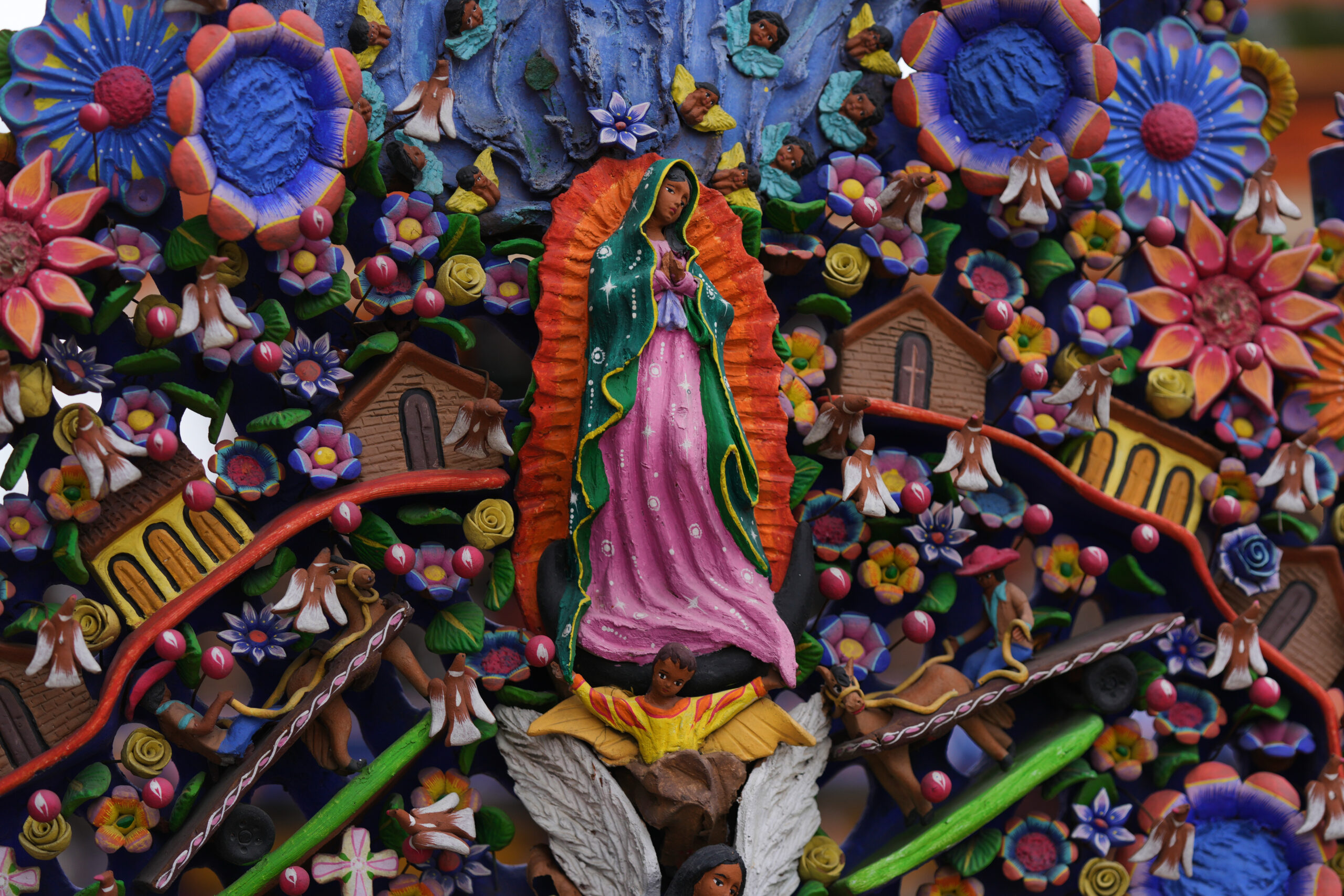
METEPEC, Mexico (AP) — Known as a Tree of Life, it belongs to a tradition that flourished in the hands of artisans in the mid-20th century and is considered a symbol of identity in Metepec.


MarÍa Teresa HernÁndez
October 20, 2025

METEPEC, Mexico (AP) — The first time he met a pope, Mexican craftsman Hilario Hernández could not believe his luck. He did not travel to the Vatican as a guest, but as the guardian of the fragile ceramic piece he had created as a gift for Benedict XVI.

“No one really planned to take me along,” Hernández said. “But a Tree of Life can easily break, so I got the chance to bring it myself.”

The work he was commissioned to create for the pope in 2008 is a celebrated expression of Mexican craftsmanship.


Trossard is a 'moaner', but I love that - Arteta

Known as a Tree of Life, it belongs to a tradition that flourished in the hands of artisans in the mid-20th century and is considered a symbol of identity in Hernández’s hometown.

In Metepec, where he lives and runs a family workshop about 40 miles (65 kilometers) southwest of Mexico City, dozens of craftsmen devote themselves to creating Trees of Life. Their designs vary, but most share a common motif: the biblical scene of Genesis, with Adam and Eve at the center, separated by the tree’s trunk and a coiled snake.

“The tree allows you to express whatever you want,” said Carolina Ramírez, a guide at Metepec’s Clay Museum. “It’s a source of pride for us, as it has become part of the town’s identity and charm.”

The museum holds an annual contest that encourages artisans from across Mexico to submit their versions of the tree. It now houses more than 300 pieces and displays a permanent selection of them.

Aside from Adam and Eve, the trees display a variety of figures like Catrinas — skeletal female figures that have become a symbol of Mexico’s Day of the Dead celebrations — and Xoloitzcuintles, hairless dogs sacred to ancient Nahua people.

“A tree’s theme draws from our culture and traditions,” Ramírez said. “And for the people who buy them, they’ve become a source of identity.”

Heritage in clay

Hernández’s ancestors have crafted clay pieces for as long as he can remember. His grandfather, now 103, still creates pots in Metepec.

“We’re the fifth generation of potters and artisans,” said Felipe, one of Hilario’s younger brothers. “Our knowledge is passed down by word-of-mouth.”

All five siblings trained for technical careers. None went on to practice them, choosing to become full-time artisans instead.

Hilario — the eldest — became his brothers’ mentor. Their tasks now rotate among them. While one shapes leaves for the trees, another attaches them or paints. All take pride in their family’s legacy.

Luis, now 34, said he has crafted Trees of Life since age 12. “This workshop was my playground,” he recalled. “What I initially thought of as a game, later became my job.”

Another local artisan, Cecilio Sánchez, also inherited his father’s skills and went on to found his own workshop. Now his wife, two children and other relatives work together to create a tradition of their own.

His technique is known as pigmented clay and consists of mixing clay with oxides. “Some fellow artisans add industrial pigments to their pieces, but our work is about preserving what the earth itself gives us,” he said.

Where tradition meets myth

While making his first tree for a pope, Hilario pushed his own limits as an artisan.

Drawing on his father’s ancestral wisdom, he fired the 2-meter-tall (6.6-foot-tall) clay piece at just the right temperature. To transport it, he wrapped it like a giant mummy using 200 rolls of toilet paper to cushion and seal every hollow space.

Then there was the design. For six months, he and his family patiently crafted figures on both sides — a challenge rarely faced in the business. One face told the story of Mexico’s most revered saints; the other, the origins of Metepec’s Tree of Life.

The details of that history are unclear. Yet experts agree that such trees might have played a role in evangelization after the Spanish Conquest in the 16th century.

According to Ramírez, the first artisans to reinterpret them in modern times incorporated elements distinctive to Metepec. One of them is known as the Tlanchana, a half-woman, half-serpent figure who, legend has it, once ruled the waters around the town.

“It was thought that her coming out of the water brought abundance,” Ramírez said. “For our ancestors, deities were bound to fire, water and nature.”

The Tlanchana figures in Hernández’s Trees of Life, though, no longer resemble snakes. Given that the reptile is regarded as a representation of evil, temptation and death within the Catholic worldview, its tail was replaced. In her current form as a mermaid, she is perhaps Metepec’s most iconic symbol alongside the Tree of Life.

Faith in his hands

Hilario keeps a special frame on his worktable: a photograph of the day he met a pope for the second time.

On that occasion he didn’t travel to the Vatican. In 2015, a stranger knocked on his door and asked him to create another Tree of Life — this time, for another pope. Francis was soon to visit Mexico and the president wanted the artisan to present him with a masterpiece.

Hilario’s new assignment took three months of hard, family work. Francis’ tree would not be as tall as the one made for Benedict. But the design presented challenges of its own, as it was to portray the pope’s life.

The craftsman visited nearby chapels, spoke to priests and read as much as he could. In February 2016, when he met the pope inside Mexico’s Presidential Palace, he realized he still had much to learn.

“He ended up explaining to me his own tree,” he said. “And he added: ‘I know you didn’t do this on your own, so God bless your family and your hands.’”

The meeting had a life-changing effect on him. It made him reflect on his purpose in life and reaffirmed his calling to his craft.

“Making Trees of Life is a commitment,” he said. “It’s how we make a living, but it’s also how we keep our culture alive.”

____

Associated Press religion coverage receives support through the AP’s collaboration with The Conversation US, with funding from Lilly Endowment Inc. The AP is solely responsible for this content.
ICYMI
Rejecting comments by Vance and Musk, UK cathedral paints graffiti show as 'meaningful'

LONDON (RNS) — The exhibition is not the first time that English medieval cathedrals have resorted to unconventional installations to encourage visitors.


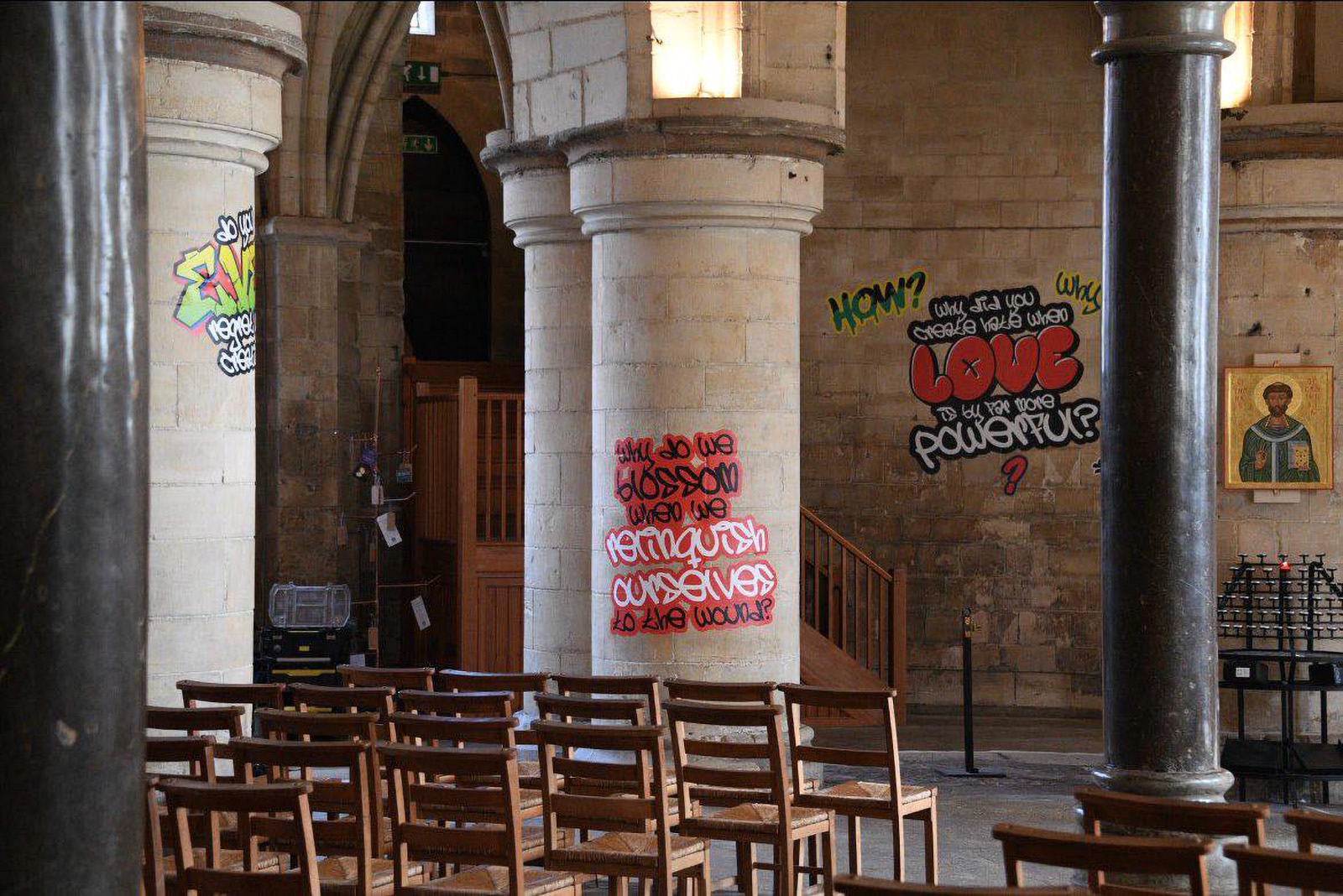
Parts of the “Hear Us” exhibition at Canterbury Cathedral in Canterbury, England. (Photo © Canterbury Cathedral)


Catherine Pepinster
October 15, 2025


(RNS) — A controversial exhibition of graffiti art opening Friday (Oct. 17) at one of Britain’s most famous medieval cathedrals has already attracted the ire of U.S. Vice President JD Vance and billionaire Elon Musk, both of whom called the show “ugly.”

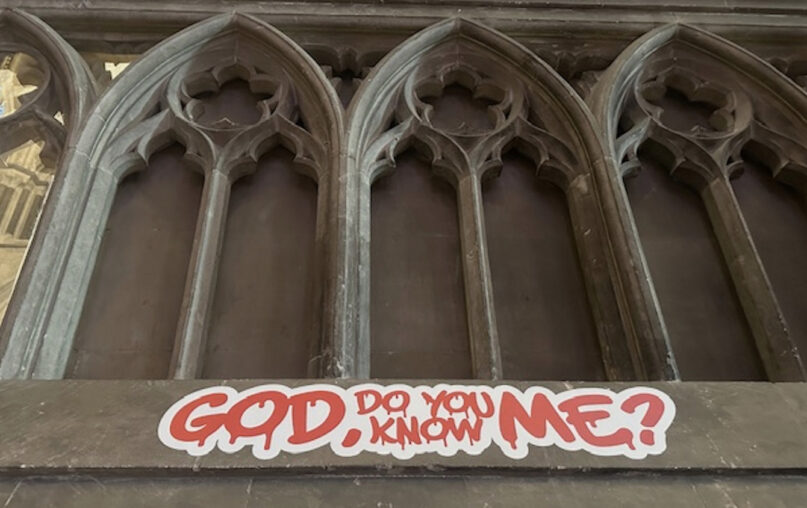
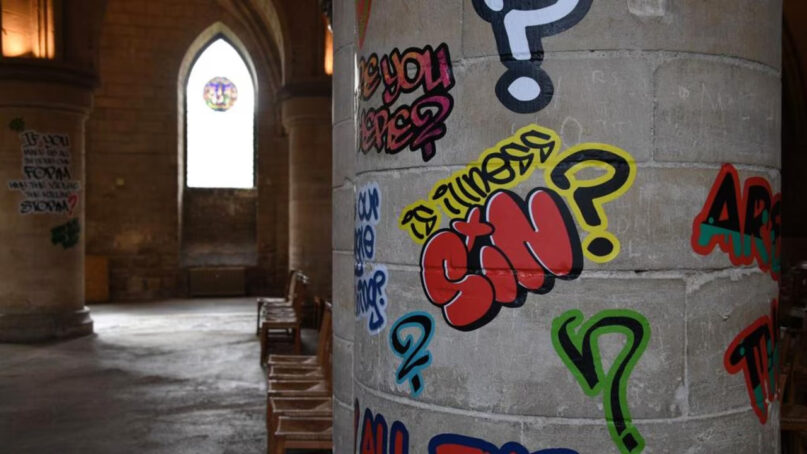
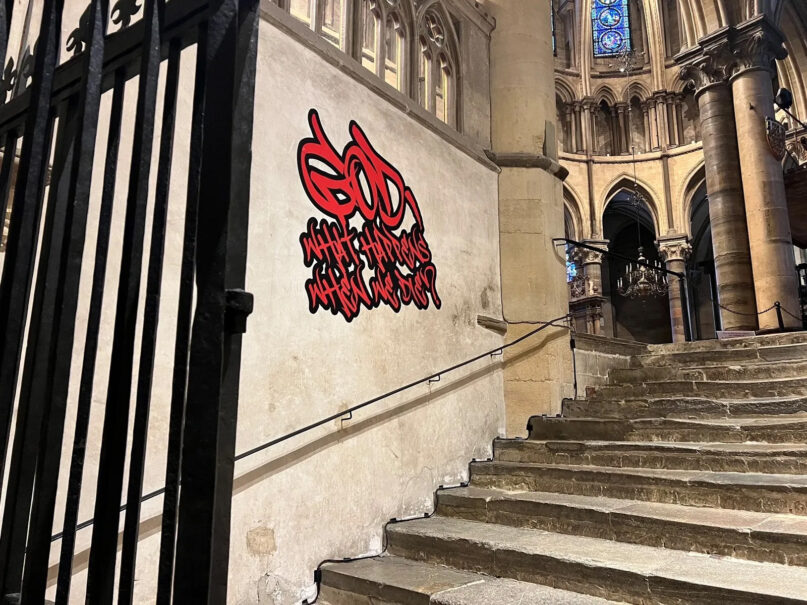
Called “Hear Us,” the exhibition at Canterbury Cathedral, the seat of the Church of England’s primate, has tagged the 11th-century building’s stones with graffiti in easily removable paints. Created by representatives of marginalized U.K. communities, the inscriptions contain messages to God such as “Why did you create hate when love is by far more powerful?” and “Are you there?”

Vance, writing on X after seeing details of the exhibition preview, said the installation “had made a beautiful building really ugly.” Musk reposted Vance’s comment with the words “really ugly.”

They weren’t alone. Canterbury’s decision to install contemporary graffiti has shocked many on social media, with some churchgoers calling it sacrilegious.

As the mother church of the Church of England and the wider Anglican Communion, Canterbury has attracted uncountable thousands of pilgrims since an earlier structure was built in 597. It gained further fame after Bishop Thomas Becket was martyred there in 1170. The appointment of the new archbishop of Canterbury, the Rt. Rev. Sarah Mullally, was announced at the cathedral a fortnight ago, and her installation will take place there in March.

While it is known throughout the Anglican Communion, many locals don’t feel the cathedral is a place for them, according to the exhibition’s curator, Jacquiline Creswell, and the graffiti exhibition is intended to invite more of Britain’s public into the sacred space. The artists featured are members of the Indian and Caribbean diaspora, neurodivergent and LGBTQIA+ groups.


Part of the “Hear Us” exhibition at Canterbury Cathedral in Canterbury, England. (Photo © Canterbury Cathedral)

The dean of the cathedral, the Very Rev. David Monteith, called graffiti “the language of the unheard,” noting that even as it is often “an act of vandalism, division or intimidation,” it can also furnish “a way for the powerless to challenge injustice or inequity.”

“We could easily have rendered the questions to God as medieval-style calligraphy,” said Monteith, “neatly hung on canvas within the cathedral, but they would likely have gone unnoticed and unremarked upon — with few, if any, choosing to engage with the questions of faith and meaning at their heart.

The graffiti is also part of a long tradition of graffiti in the cathedral. The artisans and construction crews who worked the vaulting Gothic building left their own marks, while simple crosses make evident the faith of pilgrims.

A team of volunteers has been surveying the historic graffiti in the cathedral as part of a project begun in 2018, and this autumn it will be running tours of the masons and pilgrims’ work.

According to the British Pilgrimage Trust, a charity that encourages pilgrimage in the U.K., the older graffiti in cathedrals is highly popular with visitors. “Pilgrim graffiti is a cherished part of sacred heritage and many churches and cathedrals around Britain,” said the trust’s co-founder Guy Hayward, “with crosses carved into walls and doorframes and stone altars by pilgrims setting off on their long journeys, with one straight line for when they leave and one line to complete the cross on their return.


Parts of the “Hear Us” exhibition at Canterbury Cathedral in Canterbury, England. (Photo © Canterbury Cathedral)

“When I show pilgrim crosses to visiting pilgrims they often get more excited than with the more standard objects, as it personalizes and gives heart to the whole practice of pilgrimage,” said Hayward.

But the dean has acknowledged that public opinion has been split over the modern graffiti’s appearance in the cathedral. “Seeing this graffiti imagery juxtaposed against the cathedral’s stonework – much of which is covered with centuries-old scrawled religious markings and historic graffiti – is undoubtedly jarring and will be unacceptable for some,” he said.

“But rather than react just on the basis of a few online comments,” he added, “I would encourage people to come and experience the artworks for themselves and to make up their own minds. Rather than be distracted by the aesthetics of the graffiti lettering, I hope that people will want to think deeply about the questions posed within the artworks and experience the sense of meaningful encounter that we want all who come to the cathedral to have.”

The exhibition is not the first time that English medieval cathedrals have resorted to unconventional installations to encourage visitors. In 2019, a spiral slide known as a helter skelter was installed inside Norwich Cathedral, which was finished in 1145, drawing criticism. The cathedral staff said it made the space more welcoming and less intimidating. The same year, Rochester Cathedral installed a nine-hole mini-golf course in its nave in an attempt to draw young people.

Another popular venture for cathedrals has been the “silent disco,” a dance party whose participants listen to the music on headphones. Canterbury has already held one, and others are coming up in Chelmsford and Durham, the latter a renowned medieval cathedral with its shrine to St. Cuthbert.


Part of the “Hear Us” exhibition at Canterbury Cathedral in Canterbury, England. (Photo © Canterbury Cathedral)

The Very Rev. Philip Plyming, dean of Durham, said, “We host a range of events throughout the year, in which we welcome people who would not otherwise come to church, and which raise revenue to maintain our Norman building for future generations to enjoy. Durham Cathedral is one of the only major cathedrals which does not charge an entry fee to visitors, and revenue raising events are an important way of enabling us to maintain this commitment.”

Plyming said the cathedral’s “daily rhythm of worship and prayer” was not disturbed by the events, adding, “we are clear that we are primarily a place of pilgrimage, prayer and proclamation.”

The latest statistics for Anglican cathedrals for 2024 showed weekly attendance rose to 31,900, an increase of 11% compared with 2023. Visitor numbers surpassed pre-pandemic levels for the first time in 2024, reaching 9.87 million.


A spokesman for the Association of English Cathedrals said its members “are doubly pleased to support all the cathedrals in their endeavors to play their part in engaging with their communities where they are, and being a space for all people of all faiths and none, in whatever way and for whatever reason, especially as we continue to consolidate and grow our visitor and worshipping numbers back after the challenges of the pandemic.”


Is there religious PROTESTANT Revival among Gen Z?

PITTSBURGH (RNS) — There’s a swell in Christian devotion at the University of Pittsburgh amid claims of national revival, but some researchers say ‘revival’ is too strong a word.

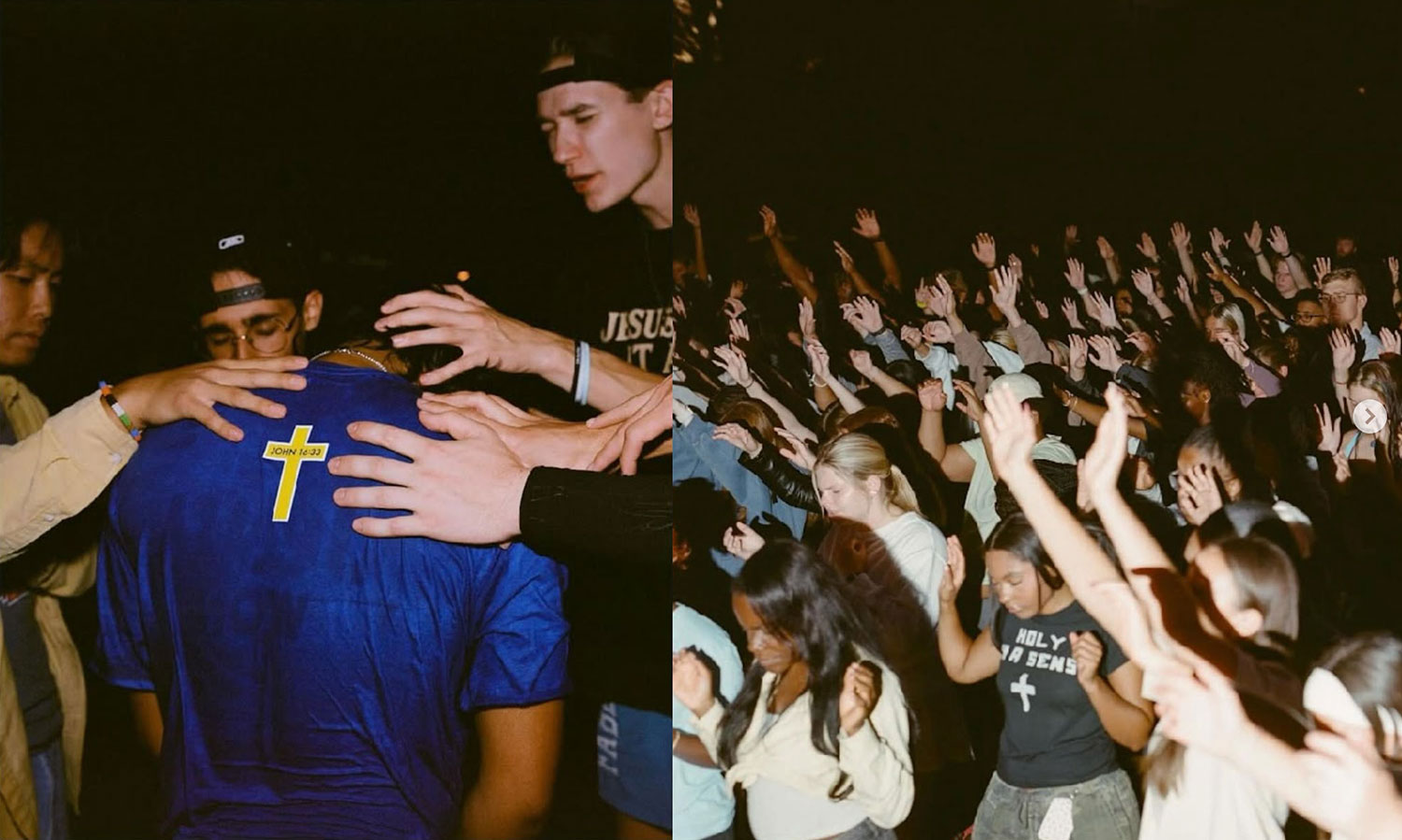
Students pray together as part of the Pitt for Jesus campus event launched by football players at the University of Pittsburgh. (Photos courtesy @pittpurpose/IG)


Kathryn Post
October 21, 2025


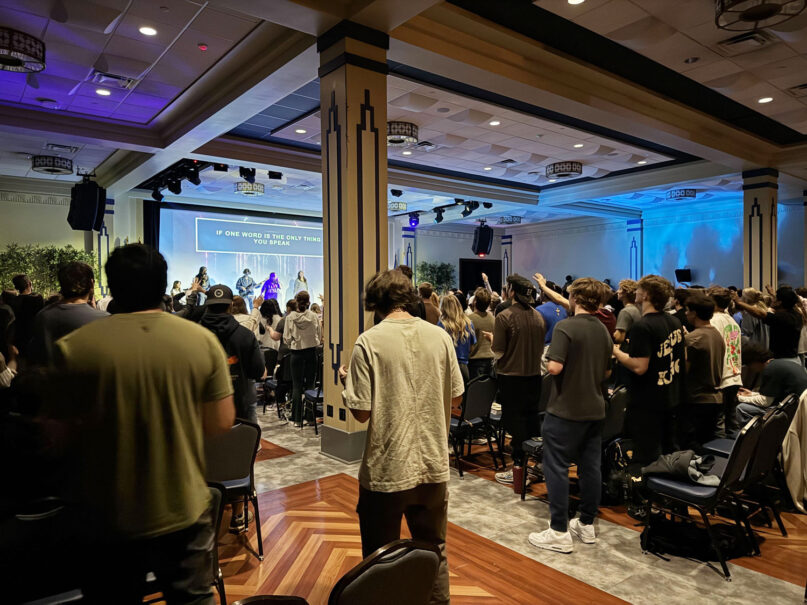
PITTSBURGH (RNS) — It’s 9 p.m. on Oct. 13, a Monday, on the University of Pittsburgh’s campus. There are two NFL games on TV and fall midterms are this week — but roughly 300 students are packed into a room in the student union building, clapping or raising their hands in worship.

“No treasure of this life could ever satisfy,” the students sing, some standing, others kneeling in the back. “God, you are my everything.”

Moments later, the group’s founder, 34-year-old Jordan Kolarik, grabs a mic and heads to the front of the room to deliver a message on devotion. He’s nearly buzzing with energy as he reads aloud a passage from Matthew 26 about a woman anointing Jesus with expensive perfume.

“You can believe the right things, you can say the right things, you can kind of go to church, but never have real devotion to Jesus,” he says.

In fall 2022, Kolarik, a Pittsburgh native and former high school teacher, launched this chapter of Chi Alpha with just eight volunteers. This year, the student chapter, which is affiliated with the charismatic, evangelical denomination Assemblies of God, has 77 student small group leaders leading hundreds of students.

“It’s sort of like a pyramid scheme for Jesus,” Kolarik joked.

Though the chapter’s growth is striking, students say it’s part of a broader stirring on campus. The Pittsburgh Oratory, a Catholic campus ministry serving several Pittsburgh universities, recently began hosting Sunday Mass in a larger chapel due to surging student attendance. In September, the University of Pittsburgh football team made national headlines for spearheading what some called a campuswide “revival”; roughly 65 students reportedly professed faith in Christ and 80 were baptized.

And the displays of devotion aren’t exclusive to Pittsburgh. The Ohio State football team has drawn national attention for baptizing dozens of students at public “Invitation to Jesus” events. The campus movement UniteUS, which brings large-scale evangelical worship and baptism events to colleges, reports that 13,000 college students have made “decisions to receive Christ” since 2023.

Now, in the wake of the assassination of conservative activist Charlie Kirk, claims of nationwide revival are escalating.

“Charlie started a political movement but unleashed a spiritual revival,” Defense Secretary Pete Hegseth declared at Kirk’s memorial service. Political commentators, TPUSA spokespeople and Christian worship leaders have also linked Kirk’s passing with revival, especially among young people.

No points for Horford but a big performance - Celtics coach

But while Fox News has claimed that members of Generation Z are returning to church in astounding numbers, religious trends researcher Ryan Burge said assertions of revival are largely overblown: “We’re not seeing anything at the scale that would even begin to point me in the direction of a sustained, significant, substantive revival in America right now,” he told RNS. “It’s not a return to religion among Gen Z. It’s just they’re not leaving as fast as millennials did when they were in their late teens and early 20s.”

Recent data from the evangelical Christian polling firm Barna Group has been widely cited to support revival claims. While most data about religion and young people shows that Gen Zers are the least likely to attend services, Barna’s model found that among those already attending church, Gen Zers attend more regularly than other generations of churchgoers — 1.9 times per month, just slightly more frequently than millennial churchgoers (1.8 times). Barna CEO David Kinnaman also told RNS there’s “a higher percentage of Gen Zers today than five years ago who are saying they have made a commitment to Christ.”

Still, while Kinnaman said he’s personally praying for revival, as a researcher he’s using the language of “renewal” to describe what he’s seeing so far. And Barna has also reported counter trends, with Gen Z women being increasingly likely to identify as religiously unaffiliated.


Students worship at a Chi Alpha service at the University of Pittsburgh. (RNS photo/Kathryn Post)

Conflicting claims of revival could be due in part to different definitions of the term. Some use “revival” to describe a high-octane religious event; the Rev. Adam Miller, a pastor of Pittsburgh’s Life Church and mentor to several Pitt football players, said revival is, “at a base level,” a movement “from death to life” that also “goes beyond a moment.”

Burge said that from a research standpoint, it would require overwhelming evidence from multiple sources to demonstrate revival.

“If we talk about the First Great Awakening and the Second Great Awakening … the entire trajectory of religion in America changed in those moments,” said Burge. “My definition of revival is a whole lot more people going to a house of worship this weekend than a year ago. And by a whole lot, I don’t mean 100,000 nationwide or 500,000 nationwide. I mean 5 million, 10 million, 15 million. That’s what a revival is like.”

Still, on the ground, there seems to be a shift in how Gen Z is engaging with religion. Liz Bucar, a professor of religion at Northeastern University in Boston, said that from where she sits, it’s clear the syncretic, ad hoc, New Age approach to spirituality by some older generations “has not been satisfying to Zoomers.” In response to the instability of today’s world — global wars, climate change, COVID-19 — she’s seeing a desire for more structured community, and for moral frameworks that can help Zoomers navigate a suffering world. Some Gen Zers are seeking that outside the institutional church, she said, while others may be attracted to the unambiguous answers offered by more traditional faith communities.

Jake Overman, a 6-foot-4-inch senior tight end on the University of Pittsburgh football team, told RNS the gospel of Jesus has been a source of purpose and fulfillment among his teammates. Overman grew up in a nondenominational Christian church and said that while praying in his room earlier this year, he clearly heard God tell him, “It’s time.”

In response, he started a Bible study with his teammates. Called “The Pitt Men of God,” the group meets weekly, typically in the football facilities after practice. “It was so clear that there was a hunger on this team for God,” said Overman, who also launched the Pitt for Jesus campus event that made national headlines last month. “They’ve tried girls, they’ve tried drugs, they’ve tried alcohol, they’ve tried parties, they’ve tried going to see therapists. … They’ve tried all of these things, yet they still were coming up empty.”


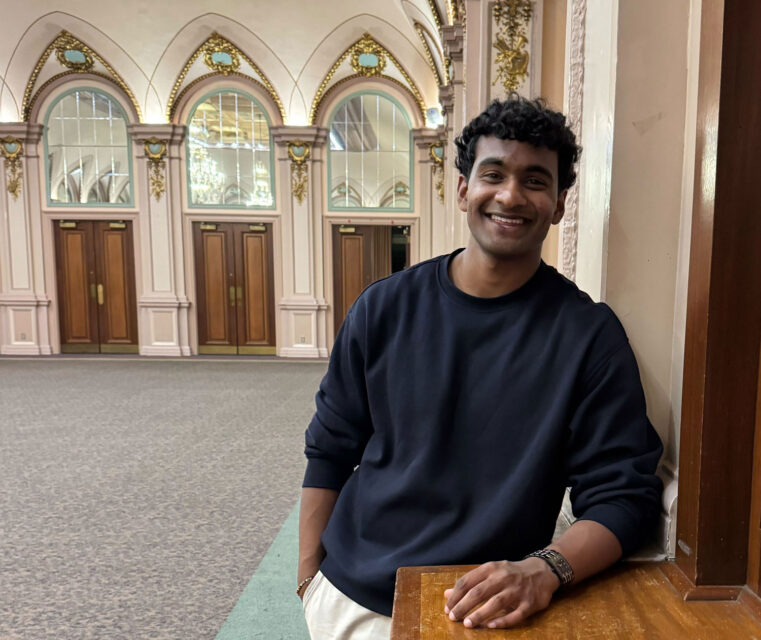
Joshua Raj is a 20-year-old junior and Chi Alpha small group leader at the University of Pittsburgh. (RNS photo/Kathryn Post)

Joshua Raj, a 20-year-old junior and Chi Alpha small group leader at the University of Pittsburgh, said he thinks faith has appealed to many of his Gen Z peers amid the “chaos” of global events. “There has to be something more,” he said.


Raj was among several Chi Alpha students RNS spoke with who said they’d developed a transformational relationship with God, saying they felt deeply known and loved. They also said that transformation has had outward manifestations, too. Chi Alpha small group leaders pledge to refrain from alcohol, and, according to senior small group leader Katie McLean, the group sends out evangelism teams on Friday nights and hosts tailgates and Halloween parties free from alcohol.

Though Pitt’s Chi Alpha chapter has been home to a handful of new Christian converts, most participants were once “culturally Christian,” according to group founder Kolarik. The group is known for its high-energy events (glow-in-the-dark parties, flag football tournaments) and for its intentional discipleship of student leaders. “We are excellent at reaching kids from a Christian home, but they themselves are not really following Jesus,” he said.

The renewed Christian devotion among some Pittsburgh college students could be a microcosm of what Burge calls a “concentration of commitment.” He compared the phenomenon to a reduction on the stove. “The amount of liquid goes down, but the concentration of flavors goes up,” he said. “That’s what’s happening with young Christianity in America. It’s fewer people, but they’re much more committed to what they believe, much more engaged in the behavior of being religious.”

Miller, the pastor who mentors Overman and several other Pitt football players, said the team’s devotion was also reflective of broader demographic trends among Gen Z. While historically, women have been more religiously devout than their peers, researchers are pointing to a closing of that gender gap, with Gen Z women now leaving the church at faster rates, while men are staying.

As researchers continue to map out where these religious shifts are happening and to what degree, it remains to be seen whether they are tied to political changes and which pockets of Christianity are stabilizing or seeing growth. Though the data doesn’t support narratives of a nationwide, youth-led surge in church attendance, the plateauing of religious decline in America is noteworthy; and while local stories of renewal may not be currently linked to quantifiable revival, they provide a glimpse of the desires and motivations shaping Zoomers’ spiritual lives.

“Gen Z is hungry. And I think when people show up with passion and purpose, Gen Z responds loudly,” said Kolarik. “Gen Z really does want to make their life count.”


New Age spiritual group Eckankar will soon have its first new leader in 44 years

(RNS) — This weekend (Oct. 25) marks 60 years since the founding of Eckankar, a New Age American faith movement.


The Temple of ECK, the home of Eckankar, is located in Chanhassen, MN, and is open to the public for visits, tours, and spiritual events. Photo courtesy Eckankar


Richa Karmarkar
October 24, 2025
RNS


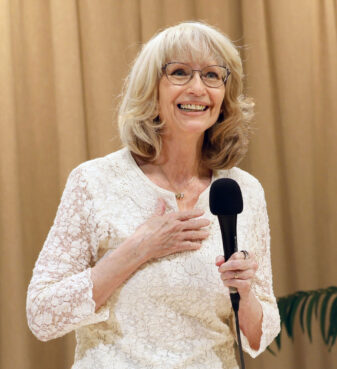
(RNS) — In 1970s New England, then-25-year-old Sharon Kunin, a pastor’s daughter, was full of out-of-the-box questions her Presbyterian upbringing didn’t quite answer — a typical countercultural shift seen in her generation.

“I had my own little truth detector,” Kunin told RNS. “I looked at so many different paths, and then I’d come to, like, a cul-de-sac where it would end, or there was something that wasn’t quite fitting.”

But everything changed when Kunin found a book by Paul Twitchell, the founder of the 1965-born American new religious movement Eckankar, also known as the Path of Spiritual Freedom. Inspired by Eastern mysticism, Eckankar, which means “coworker with God,” is a Western spiritual path that teaches that each unique soul can connect directly with God through personal experience — a belief, Kunin said, that can coexist with any religion

“I actually started trembling because I was thinking, ‘Oh, my God, these are my thoughts,'” she said. “This is what I think, they’re addressing the very questions that I have. And I thought, ‘I have found it.'”


Sharon Kunin speaks on the theme of “Connect with the God Current” at a spiritual event at the Temple of ECK, home of Eckankar, in July 2025. Photo courtesy Eckankar

A few years later, Kunin moved to be near the Temple of ECK in rural Minnesota, the headquarters for thousands of what are known as ECKists worldwide. She is now a senior cleric and spiritual educator. In her role, Kunin facilitates workshops to help ECKists connect with God through chanting the sacred mantra HU (pronounced “hyoo”), analyzing dreams and “soul travel,” or one’s consciousness moving beyond the physical plane into higher spiritual realms.

“All kinds of people come here, and they want to talk about a spiritual experience that they had — an awakening, a dream, some miraculous coincidence, something that changed them,” she said. “They are so grateful that they can share their journey with people in Eckankar who just nod and smile and say, ‘yeah.’ What we offer is understanding, openness, acceptance and validation.”

This Saturday (Oct. 25), some of the world’s ECKists, who reside in more than 120 countries, predominately in Europe and Africa, will converge at the temple for their annual Worldwide Soul Adventure seminar. This year, they will also celebrate 60 years since Eckankar’s founding and ring in a new spiritual year, themed “the year of light and sound.”

But this year’s gathering is significant for another reason: Sri Harold Klemp, the living ECK master, will formally introduce his successor, marking the first transition in Eckankar’s leadership in more than four decades. An unknown male considered to be part of Klemp’s spiritual lineage, to be announced at the event, is to carry the group into the next 60-year cycle.

The transition lining up at the 60-year mark is pure “divine coincidence,” Kunin said, decided between the Mahanta, another name for the leader, and God.

“This transition doesn’t happen until that’s what’s needed for the consciousness of the worlds to take another step, which isn’t something necessarily visible to human eyes, ears, hearts or understanding,” said Kunin, who has worked closely with the 83-year-old Klemp. “But no matter what happens in the world or around us, there is always a path to inner peace and purpose and the rightness of life and living, and it’s waiting to be awakened. The living ECK master’s job is to awaken that love and knowledge for the divine things that are already in the beating human heart.”


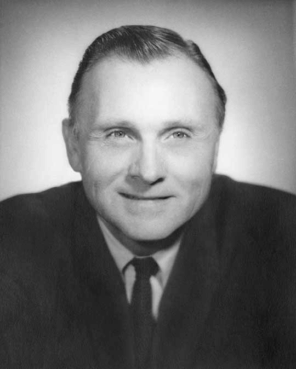
Paul Twitchell, modern-day founder of Eckankar, in the late 1960s. Photo courtesy Eckankar

Kentucky-born Twitchell, who wrote that he studied with Indian spiritual teachers before forming his own group, is said to have been influenced by Sant Mat, a 19th-century Indian spiritual movement that blended elements of Sikh and Hindu mysticism. Like Sant Mat and other Dharmic traditions, Eckankar uses Sanskrit terminology, emphasizing karma, reincarnation, guru-student relationships and divine sound chanting, which the group believes links the soul to God.

The movement was once estimated to include 50,000 students. And although exact figures are unknown, over the last 60 years, even after the initial boom of Eastern philosophies in America, many are still involved in weekly services, discussion groups and classes geared toward all ages, Kunin said.

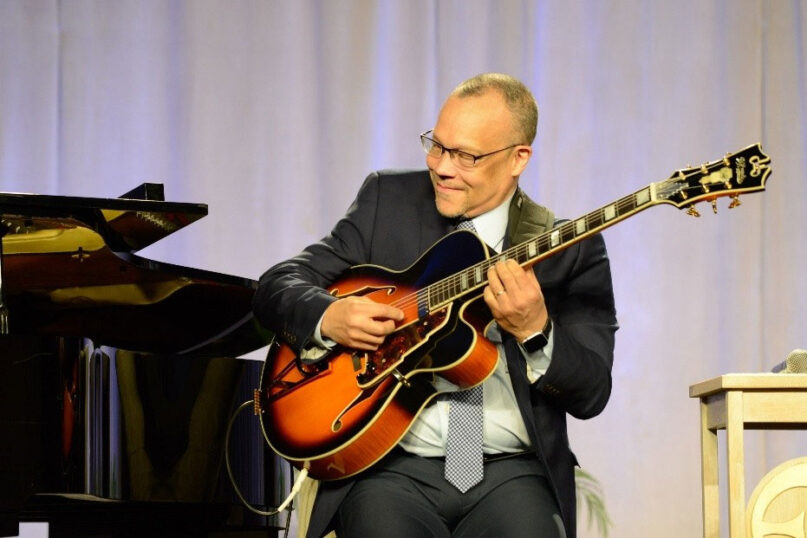
Longtime ECKist Rodney Jones, a decorated jazz guitarist and Juilliard School professor who once played alongside musician Dizzy Gillespie and on “The Rosie O’Donnell Show,” said whoever is named the new master, “whatever his approach is, and whatever his particular way of sharing it is, my work is the same.”

“The work is to be in service to all life, to make contact consciously with the divine spirit, to be a channel for that, to be a good neighbor, to be someone who honors other people’s pasts, and to see the good in everyone,” Jones told RNS. “(One’s) soul is on a journey to unfold and to experience more of God’s love, and to ultimately become a conduit and a vehicle for that love for others. The purpose of life is to learn to give and receive this love to that end.”

Like Kunin, Jones was raised by a Christian minister, Lawrence Jones, who served as the dean of Howard University’s divinity school for over a decade. Jones was initiated into Eckankar in 1978, after coming across an ECK book that resonated with him. However, he has not abandoned the faith of his upbringing. “The heart of God flows through many different rivers,” Jones said. “You don’t fit yourself to the teachings of Eckankar. You fit them to you.”

“I know for a fact that God is in the church, God is at an ECK seminar, God is at a temple, God is in a mosque, God is in a field and God is in a pet store, and I don’t put a separation on that,” he said. “What does make a difference is (asking), what is the channel through which divine spirit is working with me and helping me to unfold and serve life as best I can? And that’s an individual choice that’s sacred for every person.”


Rodney Jones performs at the 2019 Eckankar Worldwide Seminar in Minneapolis. Photo courtesy Eckankar

And through music, which is essential to the Eckankar tradition, Jones said God has designated his soul’s unique purpose to create a “doorway, portal and beautiful canvas” for others to “find their next step in whatever way that is, or maybe just have a sense of peace.”

Sam Woodward, a 28-year-old Maine native, was born and raised in a 30-person Eckankar congregation near his home, thanks to his father, who found the local branch in the 1980s. Though Woodward left the faith in 2019 after his father died, the teachings of Eckankar, Woodward said, undoubtedly shaped his moral compass as a young person.

“A lot of the teachings just have to do with caring for other people and understanding that what you see on the surface isn’t actually the reality of the way that people are thinking about you,” he said. “All of the people were just truly, insanely kind. Some of them had a lot, and some of them had nothing, but they all had just a very deep sense of compassion.”

Unlike institutional religions, he said, there are no strict rules in the Eckankar community, and most of the time ECKists spend together is in sharing and confiding in one another about their lives and meditating on HU. And though he is unsure if a wave of young people will revive Eckankar in this age — partially due to its open-door, rather than recruitment, policy — Woodward said the tradition is a possible spiritual answer today’s youth seem to be seeking.

“I think that any sort of community that gives people hope and that looks for something more than what is physically in front of us can have beneficial effects on people because I think that being nihilistic is hard for your mental well-being,” he said.

The Erie Canal: How a ‘big ditch’ transformed America’s economy, culture and even religion


(The Conversation) — Two hundred years ago, the Erie Canal was often derided as a ‘folly.’ Yet the waterway went on to transform the American frontier.


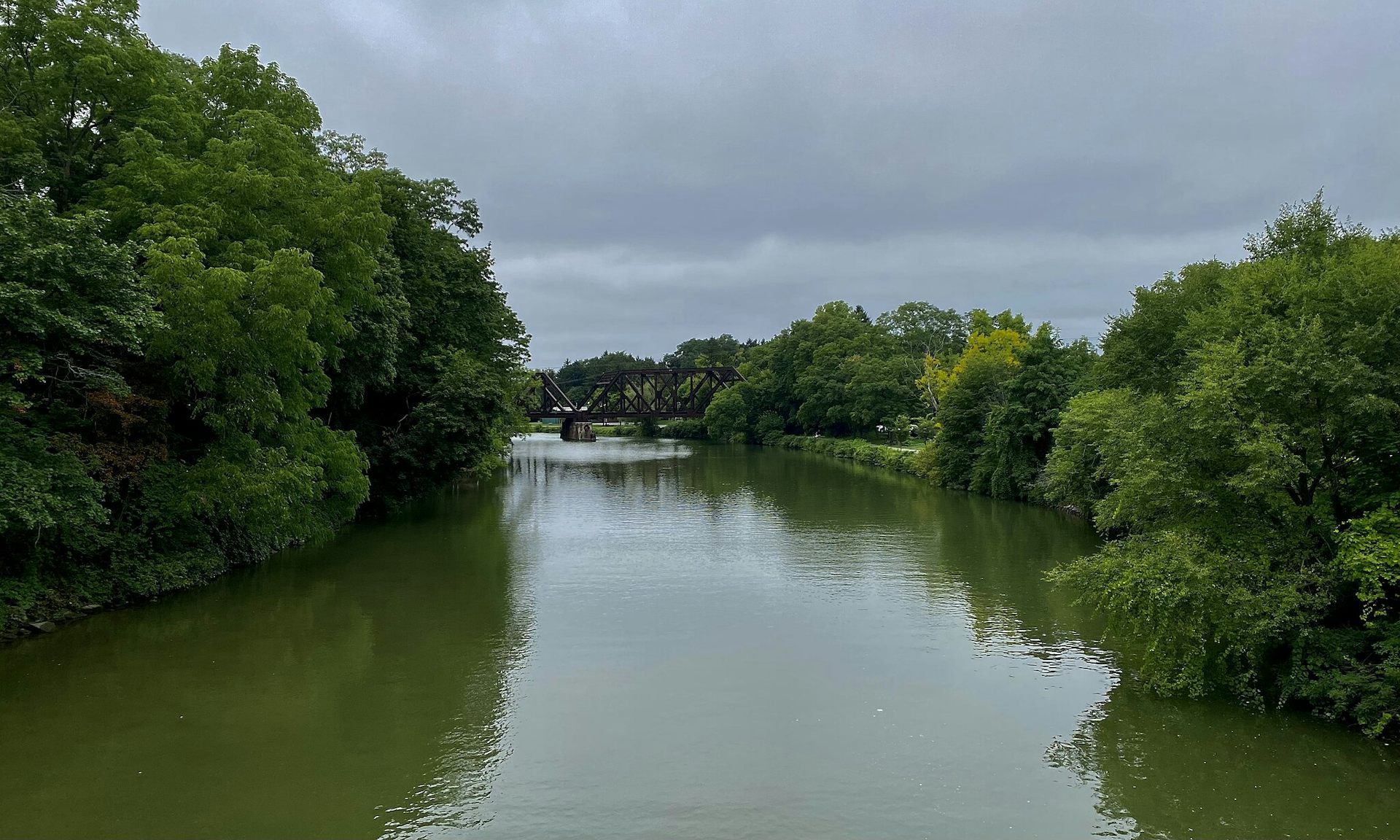
The Erie Canal, seen here in Pittsford, N.Y., opened up western regions to trade, immigration and social change. (Andre Carrotflower via Wikimedia Commons, CC BY-SA)

Matthew Smith
October 22, 2025

(The Conversation) — Two hundred years ago, on Oct. 26, 1825, New York Gov. DeWitt Clinton boarded a canal boat by the shores of Lake Erie. Amid boisterous festivities, his vessel, the Seneca Chief, embarked from Buffalo, the westernmost port of his brand-new Erie Canal.

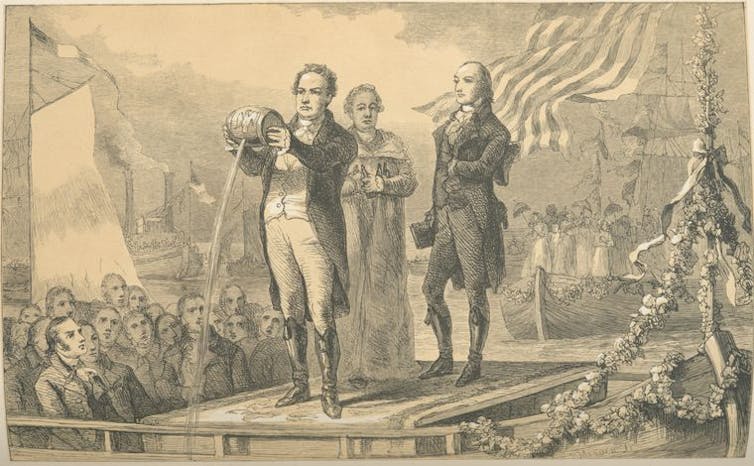
Clinton and his flotilla made their way east to the canal’s terminus in Albany, then down the Hudson River to New York City. This maiden voyage culminated on Nov. 4 with a ceremonial disgorging of barrels full of Lake Erie water into the brine of the Atlantic: pure political theater he called “the Wedding of the Waters.”


DeWitt Clinton pouring water from Lake Erie into the Atlantic, engraved by Philip Meeder.
The New York Public Library via Wikimedia Commons


The Erie Canal, whose bicentennial is being celebrated all month, is an engineering marvel – a National Historic Monument enshrined in folk song. Such was its legacy that as a young politician, Abraham Lincoln dreamed of becoming “the DeWitt Clinton of Illinois.”

As a historian of the 19th-century frontier, I’m fascinated by how civil engineering shaped America – especially given the country’s struggles to fix its aging infrastructure today. The opening of the Erie Canal reached beyond Clinton’s Empire State, cementing the Midwest into the prosperity of the growing nation. This human-made waterway transformed America’s economy and immigration while helping fuel a passionate religious revival.

But like most big achievements, getting there wasn’t easy. The nation’s first “superhighway” was almost dead on arrival.
Clinton’s folly

The idea of connecting New York City to the Great Lakes originated in the late 18th century. Yet when Clinton pushed to build a canal, the plan was controversial.

The governor and his supporters secured funding through Congress in 1817, but President James Madison vetoed the bill, considering federal support for a state project unconstitutional. New York turned to state bonds to finance the project, which Madison’s ally Thomas Jefferson had derided as “madness.”

Some considered “Clinton’s big ditch” blasphemy. “If the Lord had intended there should be internal waterways,” argued Quaker minister Elias Hicks, “he would have placed them there.”


Construction began on July 4, 1817. Completed eight years later, the canal stretched some 363 miles (584 kilometers), with 18 aqueducts and 83 locks to compensate for elevation changes en route. All this was built with only basic tools, pack animals and human muscle – the latter supplied by some 9,000 laborers, roughly one-quarter of whom were recent immigrants from Ireland.


An 1832 lithograph by David H. Burr shows elevation changes along the Erie Canal.
David Rumsey Map Collection via Wikimedia Commons
Boomtowns

Despite its naysayers, the Erie Canal paid off – literally. Within a few years, shipping rates from Lake Erie to New York City fell from US$100 per ton to under $9. Annual freight on the canal eclipsed trade along the Mississippi River within a few decades, amounting to $200 million – which would be more than $8 billion today.

Commerce drove industry and immigration, enriching the canal towns of New York – transforming villages like Syracuse and Utica into cities. From 1825-1835, Rochester was the fastest-growing urban center in America.

By the 1830s, politicians had stopped ridiculing America’s growing canal system. It was making too much money. The hefty $7 million investment in building the Erie Canal had been fully recouped in toll fees alone.


Religious revival

Nor was its legacy simply economic. Like many Americans during the Industrial Revolution, New Yorkers struggled to find stability, purpose and community. The Erie Canal channeled new ideas and religious movements, including the Second Great Awakening: a nationwide movement of Christian evangelism and social reform, partly in reaction to the upheavals of a changing economy.

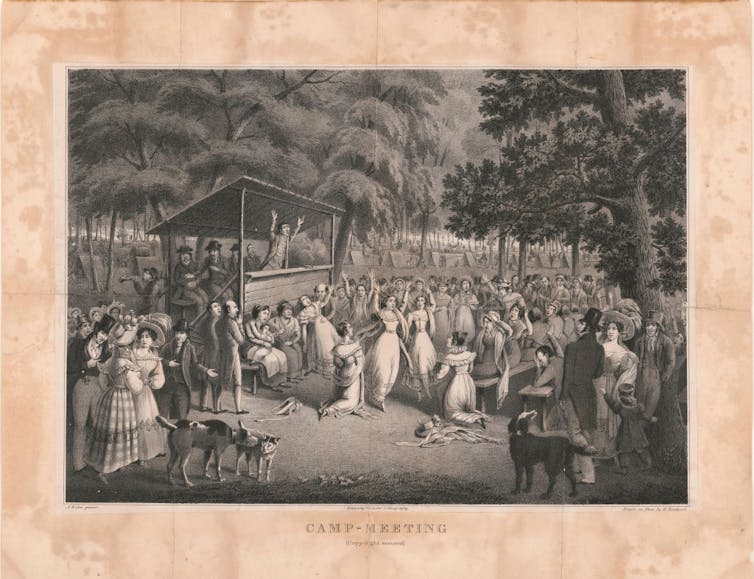
Though the movement began at the turn of the century, it flourished in the hinterlands along the Erie Canal, which became known as the “Burned-Over District.” Revivalists like Charles Grandison Finney – America’s most famous preacher at the time – found a lively reception along this “psychic highway,” as one author later dubbed upstate New York
.

Some denominations, like the Methodists, grew dramatically. But the “Burned-Over District” also gave birth to new churches after the canal’s creation. Joseph Smith founded the Church of Jesus Christ of Latter-day Saints, often known as Mormons, in Fayette, New York, in 1830. The teachings of William Miller, who lived near the Vermont border, spread west along the canal route – the roots of the Seventh-day Adventist Church.


A camp revival meeting of the Methodists , circa 1829.
Fine Art Images/Heritage Images/Getty Images


Door to the West

As Clinton predicted, the Erie Canal was “a bond of union between the Atlantic and Western States,” uniting upstate New York and the agrarian frontier of the Midwest to the urban markets of the Eastern seaboard.

In the mid-1820s, Ohio Gov. Ethan Allen Brown praised America’s canals “as veins and arteries to the body politic” and commissioned two canals of his own: one to link the Ohio River to the Erie Canal, completed in 1832; and another to link the Miami River, completed in 1845. These canals in turn connected to numerous smaller waterways, creating an extensive network of trade and transportation.

Like New York, Ohio had its canal towns, including Middletown: the birthplace of Vice President JD Vance and a city emblematic of America’s shifting industrial fortunes.

While America’s canal boom brought prosperity, this wealth came at a cost to many Indigenous communities – a cost that is only slowly being acknowledged. The Haudenosaunee, often known by the name “Iroquois,” especially paid the price for the Erie Canal. The confederacy of tribes was pressured into ceding lands to the state of New York, and further displaced by ensuing frontier settlement.

Past and future

As the U.S. nears its 250th birthday on July 4, 2026, the official website of this commemoration urges Americans “to pause and reflect on our nation’s past … and look ahead toward the future we want to create for the next generation and beyond.”

As the recent federal government shutdown suggests, however, the nation’s political system is struggling.

Overcoming gridlock demands bipartisan consensus on basic concerns. Technology changes, but the demands of infrastructure – from rebuilding roads and bridges to expanding broadband and sustainable energy networks – and the will needed to address them, persist. As the Erie Canal reminds us, American democracy has always been built upon concrete foundations.

(Matthew Smith, Visiting Assistant Professor of History, Miami University. The views expressed in this commentary do not necessarily reflect those of Religion News Service.)


The Conversation religion coverage receives support through the AP’s collaboration with The Conversation US, with funding from Lilly Endowment Inc. The Conversation is solely responsible for this content.
'In Guns We Trust' challenges white evangelicals to rethink their alliance with firearms

(RNS) — Veteran reporter William J. Kole said those who are ‘pro-life’ should take gun reforms seriously.


(Photo by GMSJS90/Pixabay/Creative Commons)


Kathryn Post
October 16, 2025


(RNS) — Pastor Philip Thornton strode onto the platform of his Legacy Faith Church in Susquehanna Township, Pennsylvania, on Sept. 28 with an AR-15-style rifle strapped to his chest, an American flag emblazoned on the magazine.

“There’s nothing in it, praise the Lord,” Thornton told worshippers. “So, fear not, everybody. Praise the Lord if that was your concern.”

Thornton was using the unloaded weapon as a sermon illustration. At points, he hoisted it up and pointed it at his congregation.

Veteran reporter William J. Kole called the incident alarming, but not surprising. He’s spent the last year researching some Christians’ embrace of gun rights for his new book, “In Guns We Trust: The Unholy Trinity of White Evangelicals, Politics, and Firearms,” released Oct. 14 by Broadleaf Books.

RNS spoke with Kole about why he doesn’t think guns belong in church, why some evangelicals are so enthusiastic about gun ownership and what he believes is at stake in gun reform debates. The interview has been edited for length and clarity.
You wrote you were New England bureau chief for The Associated Press when the mass shooting at Sandy Hook Elementary School happened. How did that impact your view on faith and guns?

When that horrible massacre happened, it was traumatizing. Journalists are cynical, and we fancy ourselves as rather tough, and this broke a lot of us. Definitely there was an expectation nationally that it would be this transcendent moment where everything would change. And in fact, nothing changed. I was the first to show up for a service and a time of mourning and intercession for the people of Newtown, Connecticut. And I remember weeping in that service for Sandy Hook’s children and for our own kids. But it never really went beyond that stage, from the church’s perspective.
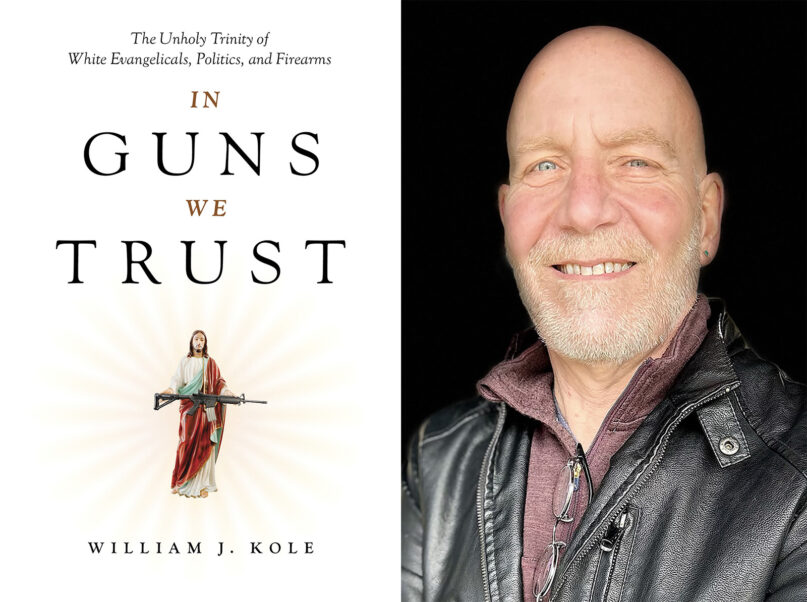

“In Guns We Trust: The Unholy Trinity of White Evangelicals, Politics, and Firearms” and author William J. Kole. (Photo by Terry DeYonker Kole)
In your view, why is it such a problem for Christians to bring guns to church?

For me, it’s a sticking point because I feel like the historical Jesus is objectively nonviolent. I understand that evangelicals will cherry-pick Scripture to find a few verses to help them feel more comfortable with gun culture, but I find it completely unbiblical. The churches that are embracing gun culture now were almost entirely pacifist up until the late ’60s and early ’70s, when a shift began. Even the Assemblies of God, where I served as a lay missionary for three years in Europe, was officially pacifist in its constitution and bylaws. So, they’ve had to pivot, and it’s a perplexing pivot for me. I just don’t see how weapons have anything to do with a faith tradition that is rooted in nonviolence.
Can you give some examples of churches that have gone out of their way to promote gun use?

I write about a pastor in Kentucky who actively promoted a bring-your-gun-to-church day. It began as a celebration of Second Amendment rights and freedoms, and the church’s insurance company abruptly canceled the church’s policy because that’s not going to inspire confidence when you’ve got a few hundred people with guns coming into a building.

I also went to Alabama to a church that built a firing range on the church property. This was a way for people to have quality time firing their AR-15s together on the church property, and they even used it for outreach — come use our firing range, shoot guns with us and then come to church. Why settle for a potluck supper when you can fellowship over pistol practice?


While writing the book, what did you discover about why white evangelicals are so enthusiastic about gun ownership?

There’s this narrative that the world, quote-unquote, is out to get us as evangelicals. It’s been around for a long time. But it’s this idea that there’s a hostility toward evangelicals and that they are being actively pursued by this intangible entity — which, to my mind, doesn’t even exist — who’s conspiring to take away their guns, take away their Bibles, come for their children and ultimately threaten their very way of life. It’s a very persistent narrative that many evangelicals cling to, and that’s why you even have so many evangelicals overlapping into QAnon conspiracies. Fear is really driving this gun culture, and this evangelical ethos of protecting one’s family and children from harm. It’s laudable, but it breeds this unrealistic arming of whole communities, of families. And there’s a lot of mythology there, too, because as I painfully detail in the book, your home is less safe, not more safe, the moment you bring a gun inside.

A common refrain among some gun-owning evangelicals is that “guns don’t kill people, people kill people.” How do you respond when folks say that?

Sure, people kill people, but they would not be able to kill without the ready availability of these tools. And it’s not just about mass shootings or even homicides, which are top of mind when we think about our gun crisis. A huge number of gun deaths in the United States are suicides. If you’re part of a faith community that claims to respect the sanctity of life, then why would you argue for more guns, which people are using to take their own lives?

Accidental deaths by gun are the No. 1 killer of children in this country, more even than car crashes, which, to me, is incredible. So, we really have a problem here. I lived internationally for the better part of two decades, and you just don’t find this level of gun violence anywhere else in the world because you just don’t have the ready access to firearms. It’s not complicated.

Can you talk about some of the evangelical-owned gun manufacturers?

A notable example is a company called Daniel Defense, which is based in Georgia. Its founder and former CEO, Marty Daniel, is a very vocal evangelical. He founded the company on three key values: faith, family and firearms. They claim to essentially make AR-15-style weapons for the glory of God. This is a company that manufactured the rifles used in the massacre in Uvalde, Texas, at Robb Elementary School a few years ago, and some of the rifles that were used in what is still the worst mass shooting in U.S. history, which was that horrible slaughter of music revelers on the Las Vegas Strip. This is a company that’s involved in numerous lawsuits, and they’ve incorporated some of the central imagery of Christianity into their gun making. A couple of Easters ago, they had a social media post with a photo of an open Bible, an AR-15-style military rifle across the Bible, a crucifix, and the post said, “He is risen.” White evangelicals play an outsized role in the gun manufacturing industry.

Did writing this book have any impact on how you’re thinking about your spirituality these days?

Oh, completely. I had to immerse myself into not just the gun culture, but Christian nationalism in the 12 or 14 months that I spent researching and writing the book. It has been a very dismaying time. It’s led me to question what I believe and what I don’t believe. I’m very much deconstructing my faith. I’m also trying to reconstruct it because faith remains important to me. I just can’t, in good conscience, continue in the evangelical tradition.

And it’s not just guns. It’s LGBTQ+ human beings. It’s migrants. Evangelicals seem determined to be on the wrong side of history. My early days experiencing evangelical Christianity were filled with joy and laughter, and now I find the tradition filled with complicity and hypocrisy. Still, as I say in the early pages of the book, these are my people. I really wanted to pull the curtain back to show everyone what’s going on here, but also to try and challenge my evangelical friends to take a second look at some of this.

It’s not just a question of evangelicals owning more weapons than any other subset of the U.S. population, which is true. It’s not even a question of white evangelicals running some of the major gun companies. The issue here is that there are somewhere between 45 million and 60 million people who identify as evangelical among white Americans, and they are consistently blocking progress toward common-sense gun restrictions, like universal background checks and a ban on these military-style assault rifles. Since Uvalde, Texas, in 2022, state legislatures have enacted more laws expanding access to guns than restricting access to guns. We’re going in the wrong direction here.