Friday, October 24, 2025

Disney drops out in latest exodus from Paris store hosting Shein


By AFP
October 23, 2025


Disneyland Paris had been slated to open a pop-up store in BHV Marais and stage "It's a small world" themed window displays for the holidays - Copyright AFP/File Chris DELMAS

The company behind bringing Asian e-commerce giant Shein to a landmark Parisian department store suffered another setback Thursday as Disneyland Paris abandoned plans to open a pop-up boutique.

Anger has been boiling since fast-fashion giant Shein announced earlier this month that it would open its first permanent physical store in November at BHV Marais, an iconic building that has stood across from Paris City Hall since 1856.

The move prompted some French brands to announce they would leave BHV Marais, and a French state-owned bank pulled out of talks with the operator of the department store to purchase the building.

Disneyland Paris had been slated to open a pop-up store in BHV Marais and stage “It’s a small world” themed window displays for the holidays, but announced Thursday it was pulling out.

“Conditions are no longer exist to calmly hold Christmas events,” the company told AFP, confirming information originally reported by the Parisian daily.

Trade unions at BHV Marais, which have gone on strike and publicly protested against Shein’s arrival, called the decision by Disneyland Paris a “hammer blow” against the department store following the departure of numerous other retailers.

“The end of the year is ruined,” said the trade unions,

Shein also announced plans to open shops at Galeries Lafayette department stores in the cities of Dijon, Reims, Grenoble, Angers and Limoges, which are also operated by SGM, which manages BHV Marais.

SGM previously denounced “political pressure” against it over bringing Shein into France, but declined to comment on Thursday.

The office of France’s new minister for small and medium-sized businesses said Thursday that Shein’s arrival sends “a bad signal that should be avoided.”

Founded in China and now based in Singapore, Shein sells a wide variety of products at ultra-competitive prices.

But it has also been under global scrutiny over its business model’s impact on the environment and labour conditions at its textile factories.
US oil giants produce mainly at home but send more tax dollars overseas


By AFP
October 23, 2025


Pump jacks operate at dusk near Loco Hills on April 23, 2020 in Eddy County, New Mexico - Copyright AFP NICOLAS TUCAT

US fossil fuel giants produce most of their oil and gas domestically but pay billions more in taxes overseas than they do at home because of subsidies that have only grown during President Donald Trump’s second term, a report said Thursday.

The analysis, titled “America-Last and Planet-Last: How US Tax Policy Subsidizes Oil and Gas Extraction Abroad,” looked at disclosures from 11 publicly traded US companies since 2017, finding they paid an effective current-year tax rate of 12.1 percent — far below the statutory 21 percent corporate tax rate.

In the case of Chevron this fell to 7.9 percent.


The US has assumed the mantle of the world’s largest oil and gas producer in recent years. But even though the companies studied produced 51 percent of their output domestically, they owed just 18 percent of their total taxes in the United States.

In one example, American’s biggest oil company, ExxonMobil, was found to have paid $11.5 billion to the United Arab Emirates across 2023 and 2024 — nearly five times the amount it paid to the United States in the same time.

Another leading US giant, ConocoPhillips, paid more than twice as much tax to Libya as it did to the US, despite producing more than 70 percent of its oil and gas domestically.


“The headline finding of our report is that these companies are indeed very lightly taxed. They are under-taxed relative to any kind of number of metrics,” author Zorka Milin, of the nonprofit Financial Accountability and Corporate Transparency (FACT) Coalition told AFP.

“These policies make no sense economically, environmentally, or ethically,” she added. “It’s time for Congress to close these loopholes.”

These low rates are driven by a web of industry-specific subsidies and rules that allow companies to offset US taxes with payments to foreign governments, including in countries plagued by corruption or weak oversight.

The oil and gas industry has benefited from tax subsidies dating back more than a century, when the US tax code was in its infancy.

But it has continually pressed for more, including spending $20 million on lobbying efforts in the six months leading to the passage of the “Big Beautiful Bill,” which undid corporate tax reform measures put in place under former president Joe Biden.
Aid to Gaza still a fraction of promised amounts: UN data


By AFP
October 23, 2025


Aid trucks surrounded by desperate Palestinians in Gaza on October 12 - Copyright AFP/File Tolga Akmen
Laetitia COMMANAY

Fewer than a hundred aid trucks operated by the UN and its partners have entered Gaza each day since a ceasefire earlier this month, a fraction of the total 600 trucks a day promised under the plan brokered by US President Donald Trump, data analysed by AFP shows.

Israel has authorised an average of 1,011 tonnes of aid — or 94 trucks — to enter Gaza each day between October 10, when the ceasefire took effect, and October 21, according to preliminary data from the United Nations.

This marks an increase compared to the 700 tonnes (or 62 trucks) supplied daily by the UN and partner NGOs between May 19 and October 9, though it is still far from the large-scale deliveries the UN has planned for in the immediate aftermath of the ceasefire.

“The situation still remains catastrophic because what’s entering is not enough,” World Health Organization chief Tedros Adhanom Ghebreyesus told reporters on Thursday, lamenting that “there is no dent in hunger because there is not enough food”.

The International Court of Justice said Wednesday that Israel was obliged to ease the passage of aid into famine-wracked Gaza, stressing it had to provide Palestinians with the “basic needs” to survive.

The data analysed by AFP is compiled by the UN’s “2720 Mechanism for Gaza”, which has monitored and tracked humanitarian aid entering Gaza since May 19, the day after the end of Israel’s two-month blockade of Gaza which prevented humanitarian aid from entering.

The program’s tracking — which relies on monitors verifying aid arrivals and collections for further distribution at Israeli checkpoints and in Gaza — excludes commercial trucks as well as some private aid groups, such as the US- and Israel-backed Gaza Humanitarian Foundation.

The busiest day for humanitarian aid coming in through the UN2720 Mechanism was October 16, with 206 trucks entering Gaza.

On October 15, UN Humanitarian chief Tom Fletcher said that the aid entering in the previous few days was “a fraction of what’s needed,” with just “tens of trucks on a good day rather than the hundreds of trucks required.”

At least 190,000 tonnes of aid have been positioned by the UN and partner NGOs to enter Gaza as soon as possible, though much of it is still waiting for clearance by Israel.

If the daily supply of aid continues at the pace it has been delivered since the ceasefire, it would take over six months for all of that aid to be delivered, according to an AFP analysis.


– Food and nutrition –


More than 93 percent of aid seen by the UN as it enters Gaza is food, with 1.7 percent made up of nutrition supplies — which is specific food such as high-calorie supplements given to vulnerable people like malnourished children or pregnant women.

On August 22, the UN declared a famine in Gaza, the first in the Middle East, after experts warned 500,000 people faced “catastrophic” conditions.

Since then, close to 1,000 tonnes of nutrition supplies have been sent to Gaza.

The UN’s World Food Programme (WFP), operating almost 70 percent of all aid trucks tracked by the UN2720 Mechanism since May, said it has delivered “enough (food) for close to half a million people for two weeks” since the ceasefire, according to a WFP spokesperson.

At an average of 850 tonnes a day from October 10-21 according to UN2720, which includes aid sent by the WFP as well as other actors, the amount of food arriving in Gaza is still well below the WFP’s target of around 2,000 tonnes daily.

Other types of aid sent in the past weeks include water and sanitation products, shelter supplies, solid fuels such as wood pellets used for cooking, and health-related supplies.

On top of aid tracked by UN2720, an average of 164,000 litres of fuel have entered Gaza each day since the ceasefire, compared to 68,000 litres per day in the 30 days before, the UN Office of Project Services (UNOPS) told AFP on Tuesday.

The UN has said it expects 1.9 million litres of fuel would be needed in Gaza each week (around 270,000 per day) to properly operate its post-ceasefire humanitarian relief plan.

Since tracking began on May 19, UN2720 data shows much of the humanitarian aid sent into Gaza does not make it to its intented destination, with some aid reportedly intercepted “either peacefully by hungry people or forcefully [by] armed actors during transit in Gaza,” according to the UN2720 Mechanism’s website.
EU parliament adopts curbs on plastic pellet pollution


By AFP
October 23, 2025


Plastic waste has been found from the bottom of the seas to the tops of mountains - Copyright AFP Christopher Furlong, Alfredo ESTRELLA

The European Parliament on Thursday definitively adopted rules clamping down on pollution from the tiny pellets that constitute the building blocks of most plastic products.

The text introduces new rules to hold handling and transport firms accountable for spills of the lentil-sized pellets, called nurdles, which are used in everything from car bumpers to salad bowls.

The proposal was approved without a vote after being backed by a wide majority in the parliament’s environment committee earlier this week.

Made from fossil fuels, plastic pellets often spill into the environment, polluting beaches and oceans.

According to European Commission data, up to 180,000 tonnes of pellets per year — the equivalent of 20 truckloads each day — are dispersed into nature across the 27-nation bloc due to mishandling.

Transport companies will have to act quickly to report and contain pellet leaks and handle the clean-up if necessary. And they will have to provide an estimate, within 30 days, of the amount of microplastics spilled into the environment.

“These rules mean they can no longer say, ‘It wasn’t me,” said the socialist lawmaker Cesar Luena, who shepherded the legislation through the parliament.

“We are holding them responsible — it is up to them to alert the authorities.”

Land freight companies will have two years to comply, with three years for maritime freight — which faces specific new obligations despite a push from some EU countries for it to be excluded from the legislation.


A worker holds a plastic nurdle which washed up at Vilar beach in Corrubedo, northwestern Spain, in 2024 – Copyright AFP GREG BAKER

The rules will require freight companies to ensuring packaging of sufficient quality, and to clearly label cargo as containing microplastics.

The rules will apply to all companies transporting more than five tonnes of microplastics per year within the EU — whether or not the firms themselves are European.

And all firms involved in the manufacture, transport or transformation of pellets will have to carry out risk assessments to prevent spills — and clean up if they occur.
Burned bodies with missing limbs wash ashore after Trump's anti-drug boat strikes

Matthew Chapman
October 23, 2025 
RAW STORY 


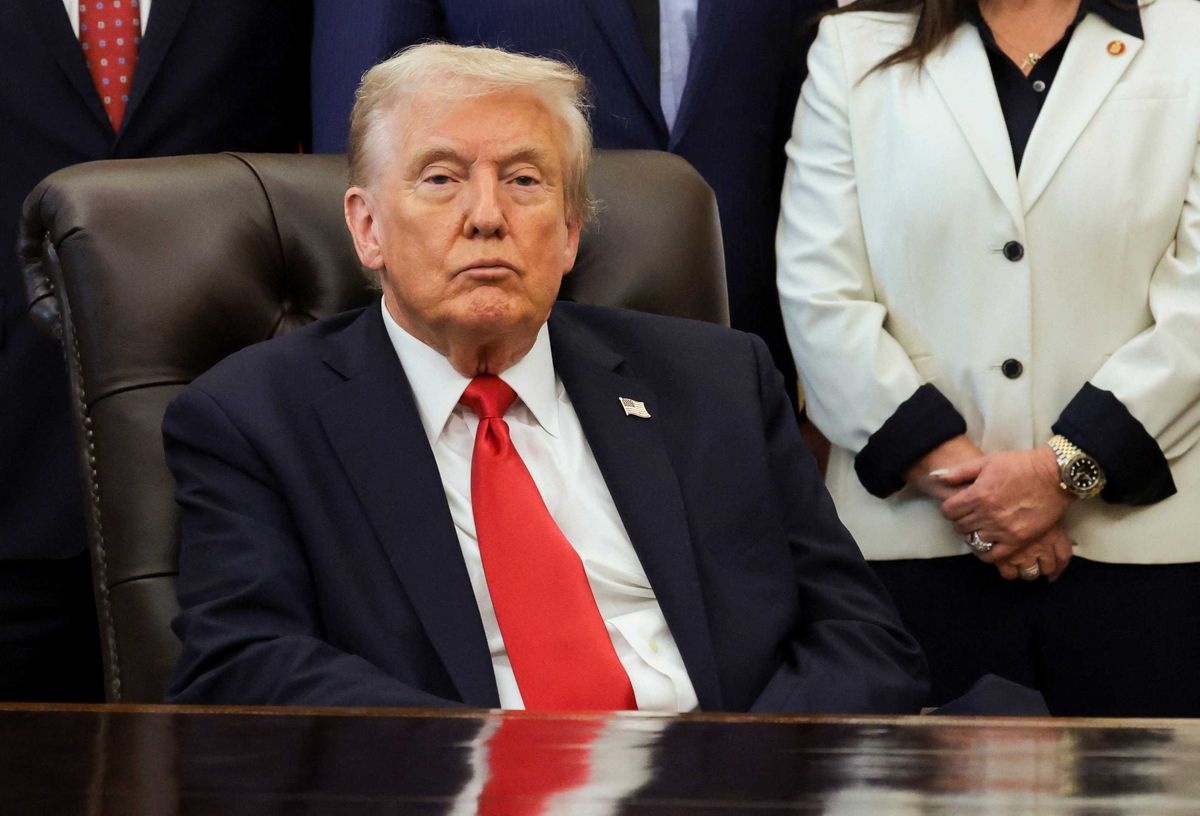
President Donald Trump looks on during an event to make announcements on fertility treatment coverage, in the Oval Office at the White House in Washington, D.C. on Oct. 16, 2025. REUTERS/Jonathan Ernst

A series of dark discoveries in the waters of the Caribbean prompted further questions about President Donald Trump's military strikes on boats alleged to be operated by drug traffickers.

"The first body washed ashore on Trinidad’s northeastern coast soon after the United States carried out its first strike in September on a boat in the Caribbean. Villagers said the corpse had burn marks on its face and was missing limbs, as if it had been mangled by an explosion," reported Simon Romero and Prior Beharry. "The tides deposited another corpse on a nearby beach days later, drawing a wake of vultures. Its face was similarly unrecognizable, and its right leg appeared to have been blown off."

The bodies have not been definitively tied to the U.S. airstrikes on boats, the report noted — but it has heightened tensions in Trinidad itself, where Prime Minister Kamla Persad-Bissessar "is explicitly supporting the strikes on boats that U.S. officials say are carrying drugs" — one of the only politicians in the Caribbean to do so.

“There’s no question in my mind that these men are casualties of war,” local water utilities employee Lincoln Baker told The Times, one of many in Trinidad who fear their government isn't seeking proper answers from the United States about the bodies.

Trump's strikes on boats, which have been going on for weeks, are a radical departure from both international law and longstanding U.S. policy. Typically, suspected drug trafficking vessels are interdicted and their crews arrested, rather than treated as active military combatants.

Even a number of right-wing legal figures are upset over the strikes. John Yoo, the former DOJ lawyer who wrote the George W. Bush administration's infamous memo justifying torture, said, “We can’t just consider anything that harms the country to be a matter for the military. Because that could potentially include every crime.” And former Supreme Court Justice Antonin Scalia's law clerk Ed Whelan proclaimed the strikes are "very likely illegal."

Are US strikes hurting Latin America’s drug trade?


By AFP
October 23, 2025


More Latin American drugs are exported via the Pacific than the Caribbean -- the main focus of US strikes so far - Copyright AFP/File JOAQUIN SARMIENTO
Lina VANEGAS

US military strikes that Washington claims have targeted “narco-terrorists” ferrying drugs to American soil are having little to no impact on Latin America’s bustling narcotics trade, experts say.

The strikes have killed at least 37 people, most of them in Caribbean waters, according to US figures.

Relatives and the home governments of many of the dead deny involvement in drug-running, but experts say the killings are illegal even if they target known narcotics traffickers.

The operations have raised questions in the region about US President Donald Trump’s endgame.

Is this truly another battle in the global war on drugs — and if so, is the United States going after the right people? Or is this something geopolitically broader?


– Wrong target? –


The US administration’s actions in the Caribbean “will have zero impact on drug trafficking,” said Laura Bonilla of the Pares research center in Colombia, the world’s biggest cocaine producer — most of it destined for the United States.

More drugs are exported via the Pacific — from ports in Colombia, Mexico, Peru and Ecuador — than via the Caribbean Sea, where the strikes have been focused thus far.

According to the government in Ecuador, which is plagued by drug gangs, 70 percent of the cocaine destined for the rest of the world leaves from its Pacific ports.

After several strikes in the Caribbean, the United States on Wednesday announced its first attack in the Pacific, with at least two people reported dead.

Experts point out that transnational cartels are the primary buyers and distributors of drugs — not the Venezuelan or Colombian groups blamed by the Trump administration.

Neither Venezuela nor Colombia, whose citizens have been targeted in the strikes, are major exporters in their own right.

Bonilla said she questions the Pentagon’s assertion that guerrilla fighters from Colombia’s leftist National Liberation Army (ELN) were among those killed by US forces.

“A total lie…. The ELN doesn’t take boats out in the Caribbean because the ELN doesn’t own the business,” she said.


– Political goals? –


Leaders, analysts and citizens alike have questioned Washington’s motives.

Some see the campaign as a distraction from Trump’s policy problems at home, while others suspect an attempt to oust leftist Latin American leaders with whom Trump has clashed.

“This is not about Latin America. This is part of his (Trump’s) narrative to justify the destruction of… competitive democracy,” said Bonilla.

Venezuelan President Nicolas Maduro — whose last two reelection victories have been widely disputed — has accused Washington of plotting “regime change,” while Colombia’s Gustavo Petro has suggested the idea of “a coup d’etat against me.”

“Politically, Trump’s actions are clear, as he aims to influence… the 2026 presidential elections in Colombia,” Juana Cabezas, a researcher specializing in armed conflicts at non-governmental organization Indepaz, told AFP.

“But also, he seeks to establish a maximum point of control and exert power over the region in relation to Venezuela. So, clearly, there is an important geopolitical issue here.”


– Counterproductive? –


In the midst of the strikes, Colombian drug traffickers have remained active on TikTok, glorifying their trade in music videos set amid coca leaf crops and drug laboratories.

“There is no perception that people are concerned,” a 45-year-old former coca grower told AFP in the Cauca province, where much of Colombia’s cocaine comes from.

“Those people (the narcos) are indifferent, they see it as an international show (…) that does not really affect the illicit economy.”

Others say the drug lords may even benefit, if the threat of supply problems push up prices.

The strikes “do not affect anything, they continue (to produce drugs) as always,” a person with close ties to an armed drug group told AFP.

“Moreover, they may even benefit as it becomes more expensive.”
DEAR AMERIKA; YOU ARE SO FUCKED!
Trump completes demolition of White House East Wing: satellite images

By AFP
October 23, 2025


This handout satellite photo obtained on October 23, 2025 from Planet Labs PBC and dated October 23, 2025 shows the White House in Washington, DC, after the demolition of the East Wing - Copyright 2025 Planet Labs PBC/AFP Handout
Danny KEMP

Demolition workers have finished tearing down the White House’s entire East Wing to make way for US President Donald Trump’s giant new $300 million ballroom, satellite pictures showed Thursday.

The completion of the wrecking work came as the White House released a list of donors to the ballroom including Apple, Google and Meta.

A gray and brown patch of rubble can now be seen in the area that used to be occupied by the iconic building, according to the images shared with AFP by Planet Labs PBC and dated Thursday.

Satellite photos taken just under a month earlier show the wing that housed the offices of the US first lady intact.

The complete destruction of part of one of the world’s most famous landmarks is a far more extensive demolition than previously announced by Trump — and happened virtually without warning.

When the former property magnate unveiled his plans in July, Trump said that the 90,000-square-foot ballroom “won’t interfere with the current building” and that it would be “near it but not touching it.”

But after work started this week, Trump said Wednesday that he had decided after consulting architects that “really knocking it down” was preferable to a partial demolition.

He insists the 1,000-seat ballroom is essential because state dinners and other large events currently have to be held in tents that are temporarily erected on the White House lawn.

Trump also said that the new ballroom would cost $300 million, raising the cost from the $250 million quoted by the White House days before, and the $200 million it cited in July.

White House Press Secretary Karoline Leavitt told an AFP reporter in a briefing that $300 million was now the definitive number but said that “it’s not going to cost the taxpayers a dime.”


– Tech donors –


Billionaire Trump says the ballroom will be funded entirely by private donors and by himself.

The White House released a list of the donors to AFP on Thursday. They include US tech titans Amazon, Apple, Google, Meta and Palantir, as well as defense giant Lockheed Martin.

Individual donors include the family of Trump’s Commerce Secretary Howard Lutnick and twins Cameron and Tyler Winklevoss, who were made famous as jilted investors in the movie “The Social Network” about the birth of Facebook.

“How much am I donating? I won’t be able to tell you until it’s finished,” Trump told reporters on Thursday. “I’ll donate whatever’s needed, I’ll tell you that.”

Many US presidents have carried out upgrades to the White House but Trump’s ballroom is the biggest in more than a century.

While lower profile than the West Wing where the president works, the East Wing had stood in one form or another for 123 years since the presidency of Theodore Roosevelt.

It received a major makeover in 1942 from President Franklin Roosevelt and was until this week home to the first lady’s offices. It was also the main point of entry for guests for tours and parties.

As criticism mounted about the demolition, the White House Historical Association — an independent group that helps preserve the history of the presidential home — said it had been helping with preservation work.

The association had carried out a “comprehensive digital scanning project and photography to create a historic record,” it said in an email to members obtained by AFP.

It added that “historic artifacts have been preserved and stored.”

Trump’s wrecking of the East Wing has provoked howls of outrage led by his Democratic opponents, including former first lady and 2016 presidential election rival Hillary Clinton.

Another top US historic group, however, the National Trust for Historic Preservation, had urged Trump to pause the demolition.

It said in a letter on Tuesday that it was “deeply concerned that the massing and height of the proposed new construction will overwhelm the White House itself” and urged the plans be put before the agency that oversees work on government buildings in Washington.

The White House argues that Trump had the authority to go ahead with the demolition without needing the agency’s sign-off.


Trump's billionaires' ballroom is a signpost to something very dark for us all

Robert Reich
October 23, 2025 
RAW STORY


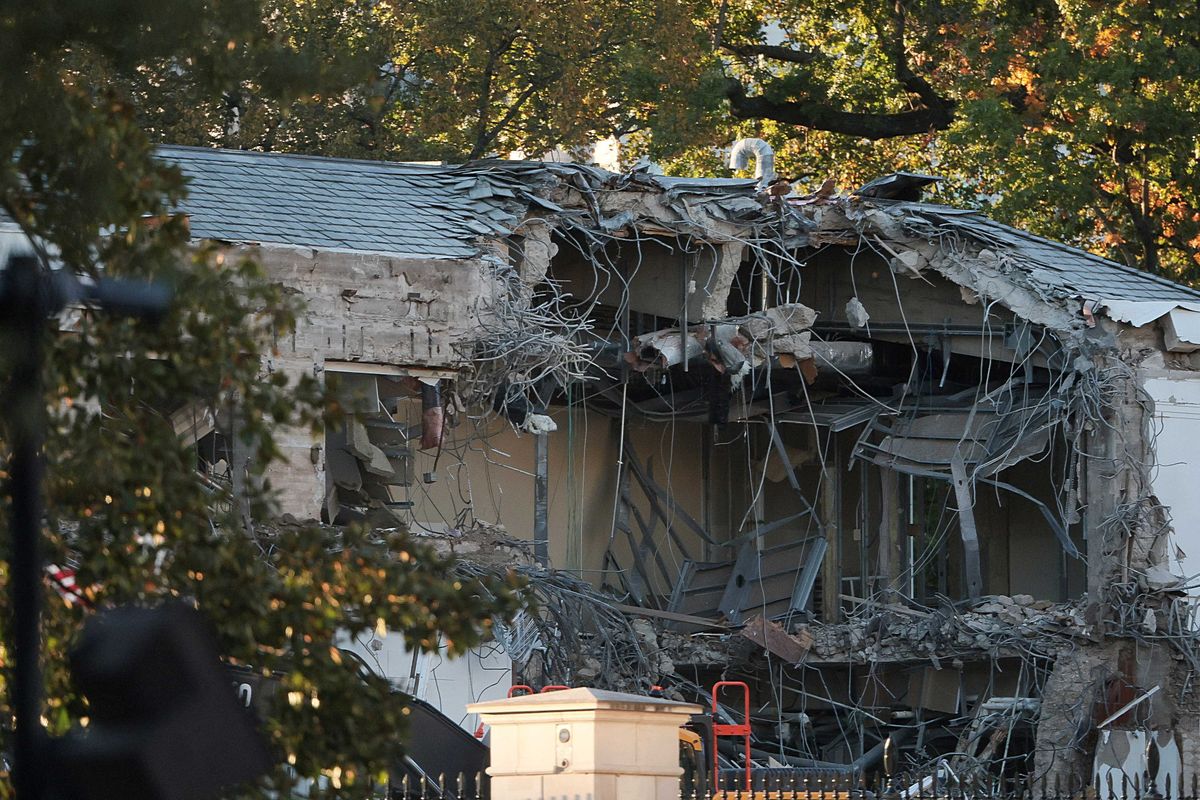
Ongoing demolition on the East Wing of the White House. 
REUTERS/Jessica Koscielniak

In the first Gilded Age, which ran from the 1890s through the 1920s, captains of American industry were dubbed “robber barons” for using their baronial wealth to bribe lawmakers, monopolize industry, and rob average Americans of the productivity of their labors

Now, in a second Gilded Age, a new generation of robber barons is using their wealth to do the same — and to entrench their power.

The first Gilded Age was an era of conspicuous consumption. The second is an era of conspicuous influence.

The new robber barons are having their names etched into the pediments of the giant new ostentatious ballroom Trump is adding to the White House.

They already own — and influence — much of the news Americans receive. And they are eager to promote their views.

Marc Benioff, the billionaire founder and CEO of Salesforce, told The New York Times that Trump should send the National Guard to San Francisco. (After his remarks drew condemnation from many of the city’s civic leaders, he apologized. He seems about to get his wish nonetheless.)

Marc Rowan, the billionaire chief executive of Apollo Global Management, is the force behind Trump’s recent “compact” calling on universities to limit international students, protect conservative speech, require standardized testing for admissions, and adopt policies recognizing “that academic freedom is not absolute,” among other conditions. The Trump regime dangled “substantial and meaningful federal grants” for universities that agree.

(It didn’t work. Seven of the nine universities approached rejected the deal.)

Billionaire Stephen A. Schwarzman, the chief executive of Blackstone, is also shaping the Trump regime’s campaign to upend American higher education. Schwarzman has emerged as a key intermediary between Trump and Harvard University.

Other of America’s new robber barons are rapidly consolidating their control over what Americans read, hear, and learn about what’s occurring in our country and the world. They include Jeff Bezos; Larry Ellison and his son, David; Mark Andreessen; Rupert Murdoch; Charles Koch; Tim Cook; Mark Zuckerberg; and, of course, Elon Musk.

Perhaps the new robber baron’s most lasting impression on the U.S. government will be the lavish White House ballroom Trump is constructing — a 90,000-square-foot, gold-leafed, glass-walled banquet room that will literally overshadow the so-called People’s House.

It will not be an assembly hall, dance hall, music hall, dining hall, village hall, or town hall. It will be a giant banquet and ballroom designed to accommodate 650 wealthy VIPs.

Trump claims that the East Room, the largest room in the White House, is too small. Its capacity is 200 people. He doesn’t like the idea of hosting kings, queens, and prime ministers in pavilions on the South Lawn.

Trump’s real intention is to have the White House resemble Versailles.

Potential billionaire donors have already received pledge agreements for “The Donald J. Trump Ballroom at the White House.” In return for donations, contributors are eligible for “recognition associated with the White House Ballroom.”

Their names will be etched in the ballroom’s brick or stone edifice.

Trump last week hosted a dinner at the White House for the project’s donors, which included representatives from Microsoft, Google, Palantir, and other companies, as well as Schwarzman, Cameron and Tyler Winklevoss, and other billionaires.

Meredith O’Rourke, a top political fundraiser for Trump, is leading the effort, paired with the Trust for the National Mall, an organization that supports the National Park Service.

The trust’s nonprofit status means donations come with a federal tax write-off.

Construction began Monday. Trump is now literally taking a wrecking ball to the White House — sending parts of the East Wing’s roof, the building’s exterior, and portions of its interior crumbling to the ground.

It seems fitting that in this second Gilded Age — an age of conspicuous influence and affluent access — the People’s House will be replaced by the Billionaires' House.
Robert Reich is a professor of public policy at Berkeley and former secretary of labor. His writings can be found at https://robertreich.substack.com/

Robert Reich's new memoir, Coming Up Short, can be found wherever you buy books. You can also support local bookstores nationally by ordering the book at bookshop.org


'White House is not his house': Ex-Trump official bashes president's fancy new ballroom

Robert Davis
October 23, 2025 
RAW STORY


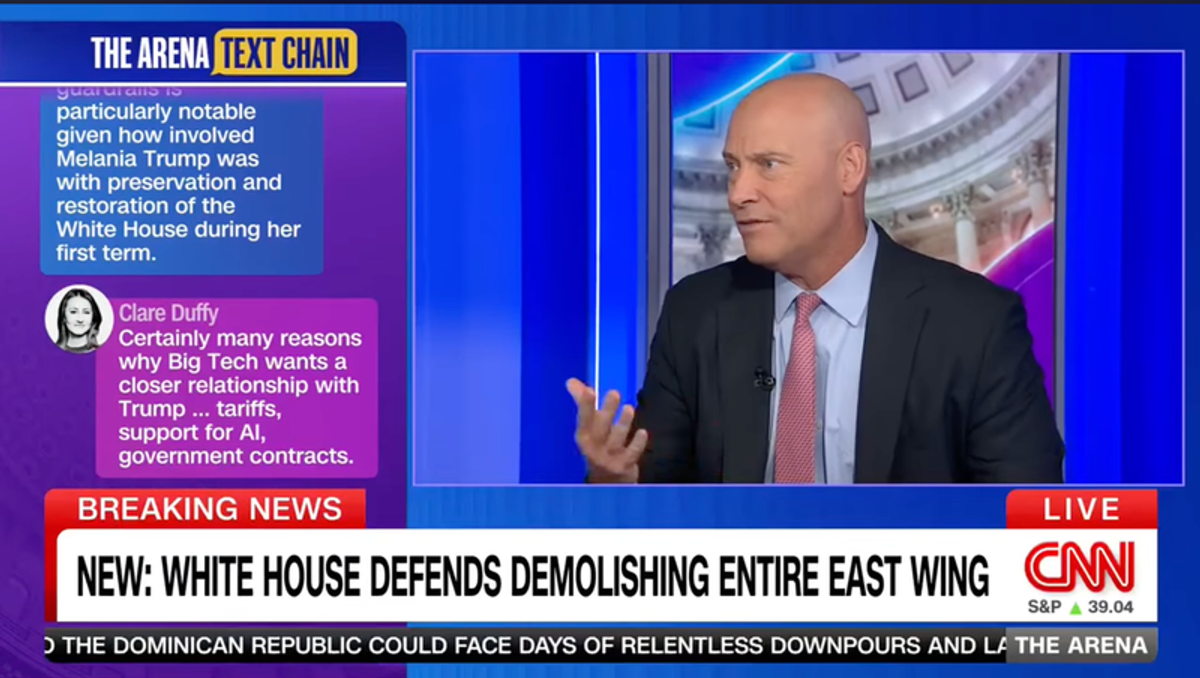
CNN screenshot

Former White House official Marc Short bashed President Donald Trump's ballroom project, which included the complete demolition of the East Wing, during an interview on CNN on Thursday.

Short, the chief of staff to former Vice President Mike Pence, discussed the project on CNN's "The Arena with Kasie Hunt." Short argued that the White House likely prefers that the media continue to focus on the story because of all the other problems the administration is dealing with, such as the tenuous peace deal in the Middle East and Trump's handling of the Jeffrey Epstein files.

"The White House is not his personal house," Short said. "It belongs to the American people, and it's the American taxpayer who pays for it. So the fact you have other people donating, I think, is a little bit of a canard, but I also think it's clear the White House is on the defensive right now."

"They probably also would rather you cover this than the fact that farmers and ranchers are actually now rising up about the president's trade agenda," Short said to host Kasie Hunt.

"He's going to China because the trade agenda is that much in disarray," he continued. "You have nine months of trying to coax Putin, and you actually have disruption, and you have to sanction Russia. You have a so-called peace deal in Israel that seems to be falling apart. And so there are a lot of big issues that impact the American people daily, and to be covering this is probably preferable for them."


'Reeks of bribery': Ex-Trump aide warns Trump's fancy ballroom a money laundering scheme

Sarah K. Burris
October 23, 2025
RAW STORY


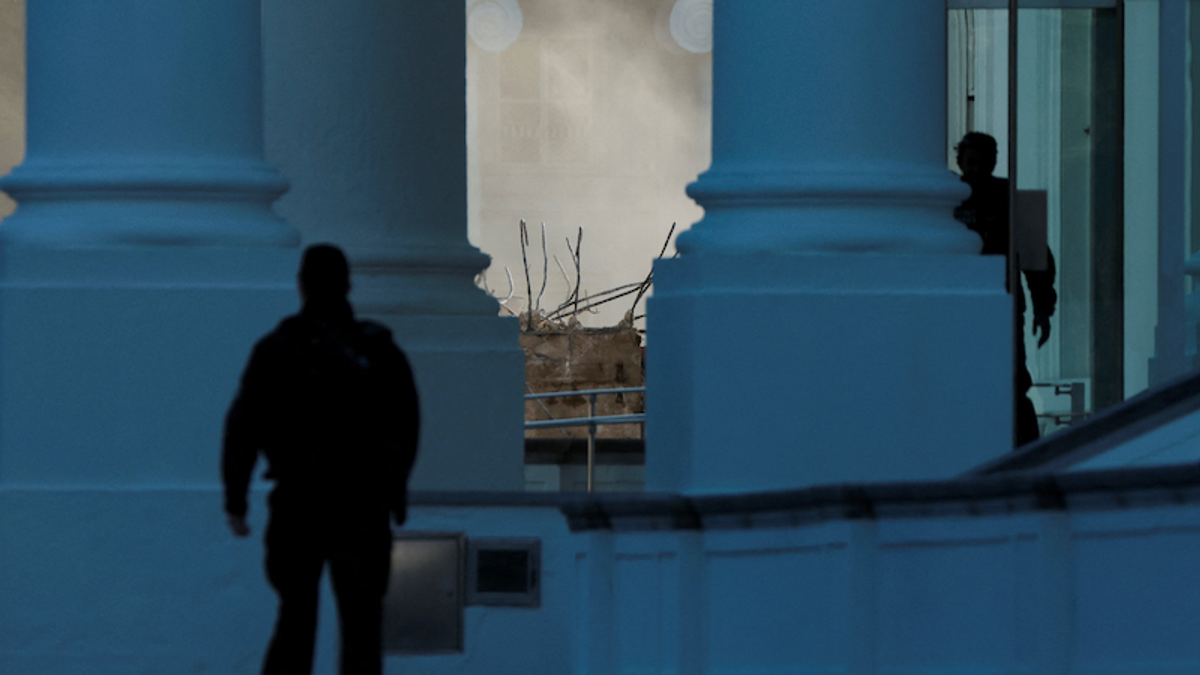
U.S. Secret Service officers patrol near where a demolition crew continues to remove the East Wing of the White House, where U.S. President Donald Trump's proposed ballroom is being built, seen through columns of the North Portico of the White House in Washington, D.C., U.S., October 23, 2025. REUTERS/Jonathan Ernst

President Donald Trump's former White House aide shredded him for demolishing the East Wing of the iconic, centuries-old building that represents the American presidency, and warned the project "reeks of bribery and corruption."

Speaking to MSNBC's Chris Jansing, former Trump deputy press secretary Sarah Matthews sounded the alarm about the "corruption" involved in the project itself.

Trump claimed his planned, $250 million ballroom would not be built at taxpayer expense. First, he claimed he would pay for it himself, but now he's recruiting "friends" like Meta, Amazon and Palantir Technologies to donate funds for the project, and Matthews lamented the East Wing's destruction.

"I think for the American people, this is tough to watch. We look at these images of the East Wing just being completely destroyed," Matthews said after remembering her time working in the structure for first lady Melania Trump. "This is not Trump's house, this is the people's house, and there can be arguments to be made if this ballroom was necessary. [Then] he could have gone through the proper channels for this to get approved."

Matthews said that the broader discussion about the project "just reeks of this broader narrative of the reckless destruction taking place under this administration, and not just that, but the corruption. Because you look at the list of these donors, you see companies like Meta, Amazon, Palantir. These are all companies that have bent the knee to him and then have been awarded contracts, and so it just reeks of bribery and corruption."

She went on to call it "disappointing" that the historic building was "going to be replaced with this monument to lavishness and the gaudiness of Trump."

Interior designer Sarah Boardman has spent the last several days on Threads calling attention to possible corruption around the project.

"I ran these numbers in August. Just as a note, this ballroom costing $200 million and supposedly 90,000 ft is about $2,200 a square foot," she wrote Tuesday evening. "In D.C., let's say a level four, maybe a level 5 finish commercial is about $600 a square foot. Let's say on the outside it's $800 a square foot because it's literally being constructed by Craftsman. That other 120 million that'll end up in his pocket. Signed a builder."

She later noted that the price was increased to $250 million. On Wednesday afternoon from the Oval Office, Trump raised the cost estimate to $300 million.

"It is not permitted. They did not get planning permission," Boardman continued. "There are no records that any EPA permits were done. Any testing, soil testing, building testing. This is absolutely a money laundering grift. And it won't cost $250 million. It will be three times that and there's no way that it's going to be done in 3 years."


'Most beautiful ballroom anywhere!' Trump's project just got an eye-popping new price tag

Matthew Chapman
October 23, 2025 
RAW STORY

The cost of President Donald Trump's ballroom addition to the White House has gone up, from its original stated price of $200 million to nearly double that, the president admitted while speaking to reporters on Thursday.

"Have you raised the full $300 million needed to fund your ballroom, and how much specifically are you donating to this construction?" asked a reporter.

"Actually, we raised, I think, $350 million, all donor money, and money that we put up, uh, we've raised, it's going to be, it's going to cost right in the neighborhood of $300 million," said Trump. "It's been expanded and made, absolutely, it'll be the most beautiful ballroom anywhere in the world, I think."

"And how much specifically are you donating to it personally?" reporters followed up.

"How much am I donating? I won't be able to tell you until I finish, but I'll donate whatever is needed. I'll tell you that," said Trump.

The ballroom project, which has already resulted in demolition work on parts of the East Wing despite previous promises it would not alter any existing structure, has triggered outrage from observers who fear Trump is reshaping the White House too aggressively in his own image, as well as those angry he is focusing on a vanity project for his own residence at a moment when the federal government is shut down over a standoff about extending health care funding for millions of people.


Trump just sent a sinister message with 'appalling' ballroom design: Nobel laureate

Adam Lynch, 
Alternet
October 24, 2025 


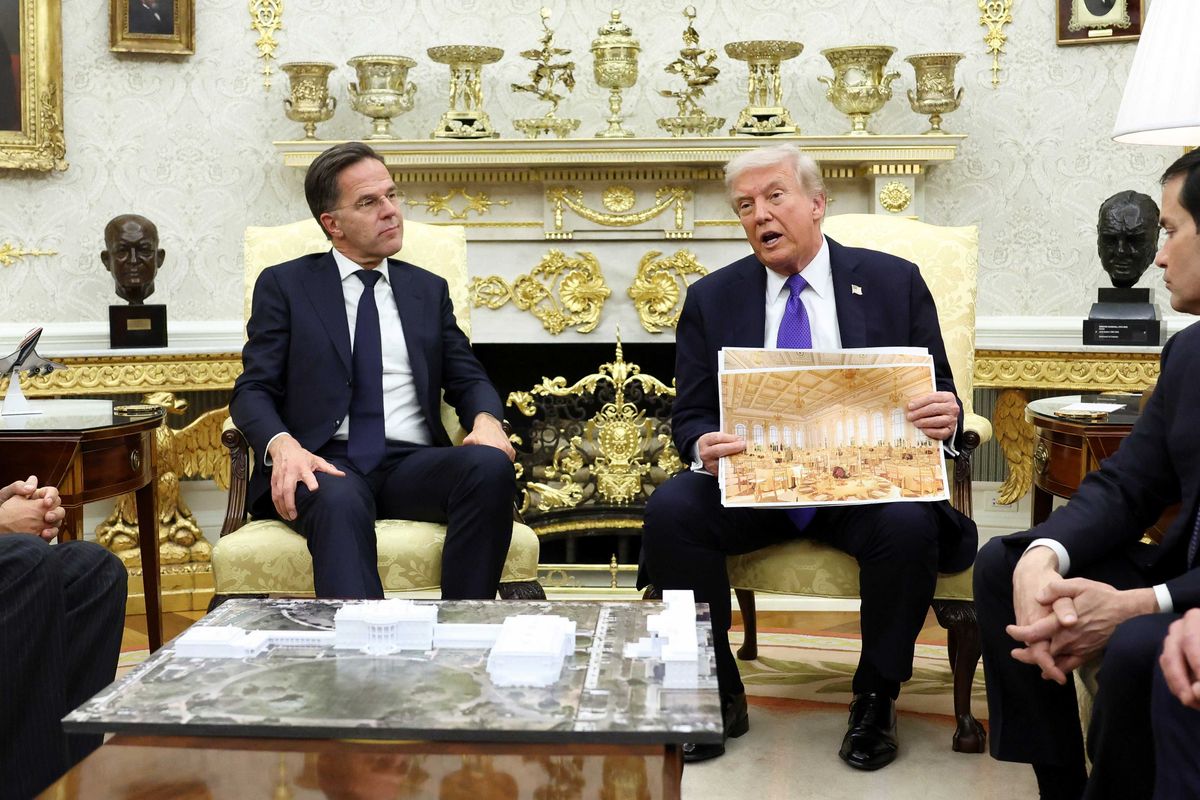
U.S. President Donald Trump holds an image of a rendering of the new White House ballroom to be built, as he meets with Secretary General of the North Atlantic Treaty Organization (NATO) Mark Rutte in the Oval Office of the White House in Washington, D.C., U.S., October 22, 2025. REUTERS/Kevin Lamarque


Economist Paul Krugman said President Donald Trump’s removal of a whole White House wing is typical Trumpian style: an “act of vandalism" being paid for by large corporate donors — mostly tech and crypto companies — seeking to buy Trump’s favor.


“I am sure there will be a Trump meme-coin dispenser installed on every table,” Krugman said.

But the vandalism is a symbol of an even bigger destruction, warned the Nobel laureate. Trump’s demolition of the White House “isn’t a remodeling or building an addition, it’s a teardown." And he added it’s a “highly visual metaphor for the way MAGA is tearing down almost everything good about our country.”


“Masked government agents are snatching people off the street. The National Guard has been sent into major cities on the obviously false pretext that these cities are in chaos. The U.S. military is essentially murdering people on the high seas. Huge tariffs are, in addition to their economic costs, undermining a system of alliances former presidents spent generations building,” Krugman said. “Green energy is being eviscerated, vindictive prosecutions are the norm, and many millions are on course to lose their health insurance.”

So why does Krugman talk about Trump’s "appalling design sense"?


“… [B]ecause tackiness and tyranny go hand in hand,” he said. “Yes, Trump has terrible taste and probably would even if he didn’t have power and, thanks to that power, wealth. But the grotesqueness of his White House renovations is structural as well as personal. For the excess and ugliness serve a political purpose: to humiliate and intimidate. The tawdry grandiosity serves not only to glorify Trump’s fragile ego, but also to send the message that resistance is futile.”

“… And that ballroom’s hideousness is an equally good metaphor for all the political ugliness that lies in our future,” Krugman said. “… The ballroom is a sign, not just of Trump’s personal vulgarity, but of the collapse of small-r republican norms. Trump is turning the people’s house into a palace fit for a despot partly because that’s his taste, but also to show everyone that he can. L’etat, c’est moi (I am the state).”

Spying Trump’s handiwork, Krugman said he now finds himself “frequently thinking of how the Roman Republic degenerated into a dictatorship.”

“What happened? Modern historians of the Roman Republic and the Roman Empire mostly agree upon one explanation for the Republic’s collapse – namely that the enormous loot from Rome’s conquests created a class of incredibly wealthy oligarchs who were too wealthy and powerful to be constrained by republican norms, institutions and laws.”

“The modern parallels are obvious,” said Krugman, who posted a photo of Jeff Bezos’s $250 million yacht, with its large pool, jacuzzi and personal “beach club.”

Read Krugman’s full essay on his Substack here.

Ivorian brothers dream of transforming cocoa industry


By AFP
October 24, 2025


The Ivorian brothers dream of transforming the cocoa industry - Copyright US Treasury Department/AFP HANDOUT
Marietou BÂ

In a factory in southern Ivory Coast, where machines hum to produce chocolate bars and spreads, twin brothers dream of becoming “giants of cocoa processing”.

Ivory Coast, which holds its presidential election this Saturday, is the world’s leading cocoa producer but only processes about 40 percent locally while the rest is exported.

Fousseni and Alahassane Diakite, 33, opened a processing factory in August in their hometown of Divo, situated in a cocoa-dependent region some 200 kilometres (124 miles) from the economic capital Abidjan, with hopes of closing the gap.

Stored in jute sacks, the beans are roasted to unleash their aroma, shelled, and then ground.

The factory has a processing capacity of 36,000 tons annually, with a target of 80,000 tons.

Comparatively, US giant Cargill, Switzerland’s Barry Callebaut, and Singapore’s Olam each process between 100,000 and 200,000 tons of cocoa annually in the west African nation.

The twins’ added value lies in “the quality of our products, our services,” and their story, they told AFP.

Sons of a producer, “we are the pure products of Ivorian cocoa,” said Fousseni, asserting that they are now realising their “dream”.

“We were sure that what we were going to do was not just for us, but also to inspire other generations,” he said.

A few years after earning their high school diplomas, they created a union of cooperatives bringing together over 4,000 producers.

They then founded their first company to create products for the pharmaceutical and cosmetic industries, such as cocoa butter, from the inedible parts of a cocoa pod.

Later, a second company was launched to process cocoa for food products.

Alahassane earned a business degree in Abidjan and has now pursued training at the HEC Paris business school.

Fousseni, meanwhile, has taken up practical training in agroforestry and agronomy.

“We complement each other,” Alahassane said.

While their cosmetic materials are exported “where there is demand”, he said, their chocolate for consumption is sold in Ivory Coast at competitive prices.

In stores, most chocolate bars, often European brands, cost between 2,500 and 4,000 CFA francs ($4 to $7), while the brothers’ bar costs 1,200 francs ($2).

Their small jar of spread is sold at the unbeatable price of 100 francs.

At a time of growing demand for ethical products, “all our productions are traceable,” assured Alahassane, while his brother specified that the factory’s machines run on renewable energy.


– Creating jobs –


Cocoa accounts for five million jobs in Ivory Coast, or one-sixth of the population.

The government-set price of cocoa paid to growers is at a record level of 2,800 CFA francs per kilo.

A few kilometres from Divo, in a shaded plantation carpeted with cocoa tree leaves, Kanga Prudence N’Guessan was cutting yellow pods with a machete.

“Our wish… is not to send our cocoa outside our country… when processing is done there, it becomes two or three times more expensive,” he said.

At another plantation, 49-year-old grower Harouna Ouattara agreed, saying, “local processing is insufficient.”

“The first obstacle to cocoa processing is the issue of financing,” explained Fousseni.

Their factory cost nearly 50 million euros ($58 million), the brothers noted, without specifying the source of the funds.

The second obstacle has been the lack of qualified labour.

Still, the brothers said their factory has created 1,000 direct and indirect jobs, primarily for locals.

Technical jobs are held by young people trained in major cities.

Salimata Ouattara, a 35-year-old chemist, studied in the southern port city of San Pedro.

In her white coat, between analyses, she said she wants to “help the youth here who don’t have much knowledge about industrialisation.”
Women sue over sexual abuse in Australian military

THE WARRIOR ETHIC(C)(R)(TM)

By AFP
October 24, 2025


The case was served against the Australian government on behalf of women subjected to abuse at any time in a 21-year period between November 2003 and May 2025 - Copyright AFP/File Brendan Smialowski

Women in Australia’s defence forces launched a class action lawsuit Friday alleging widespread and systematic sexual violence, harassment and discrimination.

The case was served against the Australian government on behalf of women subjected to abuse at any time in a 21-year period between November 2003 and May 2025.

“The threat of war often isn’t the biggest safety fear for female ADF personnel, it is the threat of sexual violence in their workplace,” said lawyer Josh Aylward of legal firm JGA Saddler.

“Australians will be shocked by the reports of sexual violence and harassment, victimisation, rape and physical threats but even more disturbing are the brutal assaults against those women who dare make a complaint,” he said in a statement.

The case, lodged at the Federal Court in Sydney, is being pursued on an opt-out basis, meaning all women serving during that time are included unless they declare that they have not suffered from the alleged abuse.

Thousands of women were expected to join the class action, the firm said.

Australia’s Department of Defence said it was aware of the complaint.

“All Defence personnel have a right to be respected and deserve to have a positive workplace experience,” a department spokesperson said.

“There is no place for sexual violence or misconduct in Defence,” the spokesperson added.

“Defence acknowledges there is work to be done.”


– ‘Demand for action’ –


The government said it was implementing “as a priority” recommendations related to sexual violence made in 2024 after an inquiry into defence and veteran suicide.

It was also working to implement a “comprehensive sexual misconduct prevention strategy”.

One of four lead applicants in the case alleged she woke up after an on-base party naked, in pain, with bruises and scratches, and later was told she had left with four servicemen.

She underwent a sexual assault examination in a storage room, according to a statement by JGA Saddler.

As a result of her complaint, the woman’s movements were restricted while the alleged perpetrator was left free, it said.

She was also allegedly barred from using shared base amenities, received abusive messages from servicemen, and was later posted to a different base.

The class action claims the defence force is “vicariously liable” due to its failure to protect women from sexual harassment during their service.

Repeated reports into sexual harassment, followed by commitments to cultural reform, had “never” resulted in meaningful change, the legal firm said.

“This legal case is a demand for action, for accountability and for real change,” said Aylward.
UK court rules Apple abused App Store dominance


By AFP
October 23, 2025


The Competition Appeal Tribunal found that Apple shut out competition in the app distribution market and charged app developers 'excessive and unfair' commissions - Copyright AFP/File Chris DELMAS

Apple lost a UK lawsuit Thursday which accuses the US tech giant of abusing the dominant position of its App Store, with claimants seeking more than £1.5 billion ($2 billion) in damages.

The Competition Appeal Tribunal found that Apple had shut out competition in the app distribution market and charged app developers “excessive and unfair” commissions.

Apple said it “strongly disagrees” with the ruling and intended to appeal.

This is the second setback in two days for Apple.

On Wednesday, the UK’s competition watchdog said it had “strategic market status” in smartphones and tablets alongside Google, due to the two firms’ dominant positions.

The Competition and Markets Authority said Apple and Google would face tougher regulation of services on their mobile platforms, which it said risked “limiting innovation and competition”.

The new measures are similar to a tech competition law from the European Union, the Digital Markets Act, which carries the potential for hefty financial penalties — and could force the tech giants to open up their platforms.

The app store case was brought by King’s College London academic Rachael Kent and the law firm Hausfeld & Co on behalf of millions of UK iPhone and iPad users.

Under UK law, in this type of class action all potentially affected persons are included in the procedure by default, and may benefit from possible compensation, unless they voluntarily opt out.

– YouTube and Candy Crush –

At the hearings, which opened in January, claimants argued that Apple users were overcharged by the company “due to its ban on rival app store platforms.”

A 30-percent surcharge that the company “imposes” on apps purchased through Apple’s App Store leads to consumers “paying more”, they said.

At the heart of the claimants’ case was that Apple used the App Store to exclude competitors, forcing users to use its system and boosting profits in the process.

Apple’s “restrictions cannot sensibly be justified as being necessary or proportionate to deliver the benefits which Apple puts forward as flowing from its objective of an integrated and centralised system,” the Tribunal found.

It ruled that in cases where Apple overcharged app developers and passed on the extra costs to consumers, users were entitled to a refund with interest.

Law firm Hausfeld hailed the judgement as a “great outcome for UK consumers and businesses”.

It “highlights the importance of the collective actions regime for UK consumers and businesses,” the firm said in a statement, adding that the refund could apply to popular apps like Candy Crush and YouTube.

Apple, which had denounced the trial as “baseless”, maintained that its App Store “faces vigorous competition from many other platforms” and insisted that 85% of apps on the App Store were free.

Regulators around the world have increased scrutiny and investigations of Apple’s practices in recent years, particularly regarding its app store.

The American giant is facing another £785 million lawsuit in the United Kingdom over the fees charged to developers.

In April, Apple was also fined €500 million (£436 million) in the EU for preventing developers from steering customers outside its App Store to access cheaper deals, in violation of the bloc’s rules.

Apple has appealed the fine.
SpaceX says ‘disabled’ 2,500 Stadevices at Myanmar scam centres


By AFP
October 22, 2025


SpaceX has cut service to more than 2,500 Starlink internet devices at Myanmar scam centres, a company executive said - Copyright AFP/File Lillian SUWANRUMPHA

SpaceX has cut service to more than 2,500 Starlink internet devices at Myanmar scam centres, a company executive said Wednesday, after AFP revealed that their use had exploded in the illicit industry.

Sprawling compounds where internet tricksters target foreigners with romance and business cons have thrived along Myanmar’s loosely governed border during its civil war, sparked by a 2021 coup.

A highly publicised crackdown starting in February saw around 7,000 workers repatriated and Thailand enact a cross-border internet blockade.

But an AFP investigation this month revealed construction has continued apace, while Starlink receivers have been installed en masse, seeming to connect the hubs to the Elon Musk-owned satellite internet network.

SpaceX’s vice-president of Starlink business operations, Lauren Dreyer, said the company “disabled over 2,500 Starlink Kits in the vicinity of suspected ‘scam centers'” in Myanmar.

Her post on X did not say when the terminals were disconnected.

The online scam industry has boomed across Southeast Asia, conning victims out of an estimated $37 billion annually in 2023, according to a United Nations Office on Drugs and Crime report.

This weekend, Cambodia deported 64 South Koreans accused of links to scam networks, with police seeking arrest warrants for most on their return.

Thailand’s deputy finance minister Vorapak Tanyawong resigned on Wednesday following allegations linking him to Cambodia-based cyberscam networks.

Myanmar’s border regions with Thailand and China have become particularly fertile ground for the fraud factories where some workers are lured or trafficked, while others go willingly.

– ‘Leaving in chaos’ –

Myanmar’s junta said this week it had raided KK Park — one of the country’s most notorious scam centres — and seized Starlink terminals.

Locals there said raids were continuing on Wednesday, and an AFP reporter saw more than 1,000 people travelling north away from the site by foot, on motorbikes and crammed into pickup trucks.

“Around 10:00 am Myanmar military soldiers in four trucks arrived to our site,” said one employee leaving KK Park, who declined to give his name for security reasons.

“Workers are leaving in chaos,” he added. “Our company didn’t arrange anything.”

Experts say Myanmar’s military turns a blind eye to scam centres which profit its militia allies in the region who are crucial in the civil war.

But the junta has also faced pressure to shut down the scam operations from its military backer China, irked at the number of its citizens both participating in and being targeted by the scams.

The haul of Starlink terminals the junta said it seized this week numbered only 30, a fraction of the thousands which independent analysts have documented at KK Park.

Nathan Ruser, an analyst at the Australian Strategic Policy Institute, said the Myanmar military is attempting a “balancing act” to please both China and the militias aligned with the junta — “tokenistically” taking action “while actually not doing anything”.

But as night fell on Wednesday, a resident of Mae Sot, just over the border in Thailand, said KK Park appeared largely abandoned.

“Usually at this time in the evening it is lit up brightly,” they told AFP, speaking anonymously for security reasons.

“Today I only see some lights along the fence and a few buildings. I don’t see the lights on in the dormitory buildings.”