It’s possible that I shall make an ass of myself. But in that case one can always get out of it with a little dialectic. I have, of course, so worded my proposition as to be right either way (K.Marx, Letter to F.Engels on the Indian Mutiny)
Saturday, October 25, 2025
'Dystopian': Protester decries arrest after blasting Darth Vader's theme at Trump troops
A protester who claims to have been arrested for exercising his First Amendment rights against the Trump administration spoke out to MSNBC's Jason Johnson on Friday.
The protester, Sam O'Hara, was briefly detained by the Metropolitan Police Department in Washington, D.C. for following behind National Guard troops Trump deployed to the city, blasting "The Imperial March," an iconic Star Wars track also known colloquially as Darth Vader's theme. The song is heavily associated in pop culture with villainy and totalitarianism.
O'Hara is now filing suit over his treatment by authorities.
"So first off, Sam, I want to thank you as both a D.C. resident and a Star Wars fan for what you've done," said Johnson. "I have followed you on social media. I was very, very impressed. I just — I want you to take us to that day, and how did it feel? I mean, you're playing music and essentially they come up to you and say, 'You're a member of the Rebel Alliance and a traitor, goodbye.' And they take you away."
"How did that feel?" Johnson pressed him. "Were you afraid? Did you feel comfortable because other people were around? What was that moment like?"
"Yeah. Thank you for having me. And you nailed it," said O'Hara. "I mean, that's that's kind of how it felt. It felt like they were upset with what I was doing as a form of protest. They threatened to call the MPD. And then the MPD did what they shouldn't have done, which is they stopped me, they handcuffed me."
"It felt surreal, dystopian, bad," he added. "It just felt real bad that this is where we are right now."
IMPERIAL MARCH
NATIONAL REVIEW
Conservative editorial board rips Trump’s ploy to pay himself $230M as 'obscene'
U.S. President Donald Trump and U.S. Attorney General Pam Bondi react during Trump's announcement regarding his administration's policies against cartels and human trafficking, from the State Dining Room at the White House in Washington, D.C., U.S., October 23, 2025. REUTERS/Jonathan Ernst
The conservative editorial board for the National Review delivered choice words regarding President Donald Trump’s strategy to charge U.S. taxpayers $230 million over his prosecution for alleged criminal behavior.
“Donald Trump is in the odd position, by his own admission, of ‘suing myself,’” the Board notes. “It’s a case he should drop. … Trump reached for whatever legal levers he could grasp to fight back."
This included filing administrative claims against the Justice Department for “alleged violations of his rights by the FBI in the Russiagate investigation and the search of Mar-a-Lago," the Board adds.
Two of the prosecutions against Trump, including his incitement of a Jan. 6 mob to destroy the Capitol and his theft (and refusal to return) classified documents after leaving the White House, were never fully litigated, and could have ended with conviction had Trump not won re-election and effectively ended the prosecution.
“The legal strength of these claims, which were always beside the point, were questionable,” the Board says. “The government has many defenses to such suits. At the time, however, Trump was a private citizen with federal, state, and local authorities arrayed against him, so a counteroffensive made a certain kind of sense even when the odds were long.”
The settlement would be approved and paid by the same DOJ that answers to Trump himself, the Board notes.
“Trump says that ‘I’m not looking for money,’ but anything else he could ask for — public vindication, the firing of misbehaving agents, changes in how DOJ and the FBI do business — he has either obtained by winning reelection and ending the cases against him, or can obtain by his position overseeing the Justice Department,” the Board writes. “… So, it comes to money. Which Trump doesn’t need, and which would be obscene to shell out in any nontrivial amount on the taxpayers’ dime.”
The only “proper end to this is for Trump to declare victory and abandon the claims,” the Board says.
“But this is the sort of ethical conflict that cannot be eliminated by procedure. Sometimes, our system actually needs leaders to act ethically, and can punish them only through political processes. This is one of those situations,” the Board argued. “Trump should do the right thing, both ethically and politically, and stop suing himself.”
Read the full National Review report at this link.
New data shows that insurance fraud has seen the largest percentage increase of any sector over the past seven years, growing by 211% since 2017 in the UK.
The analysis was conducted by global identity and fraud intelligence firm GBG and it examined identity fraud cases across different sectors between 2017 and 2024, showing significant shifts in how criminals are targeting victims and which industries are most at risk.
Insurance fraud has experienced the most significant growth, with cases jumping from 4,215 in 2017 to 13,108 in 2024, representing a 211% increase. This sector has moved up one place in the rankings and now accounts for 5.47% of all identity fraud cases compared to just 2.42% in 2017.
The communications sector ranks second for growth, with cases rising from 16,973 to 36,453, which is a 114.77% increase.
This sector has moved from accounting for the fourth-highest percentage of all identity fraud cases to the third highest, now representing 15.20% of all cases, up from 9.73% in 2017.
Asset finance fraud showed the third highest percentage increase at 60.82%, though it remains relatively small in volume with 1,560 cases in 2024 compared to 970 in 2017.
Plastic card fraud continues to dominate in terms of the number of cases, with 94,111 cases in 2024 compared to 58,788 in 2017, equating to a 60.09% increase. This sector has maintained its position as the most common type of identity fraud, now accounting for 39.25% of all cases, up from 33.68% seven years ago.
Online retail fraud rounds out the top five growth areas with a 58.42% increase, rising from 11,729 cases in 2017 to 18,581 in 2024. This sector has moved up one place in the ranking to fourth and now represents 7.75% of all identity fraud cases.
The all-in-one category saw an increase of 31.11% but remained the least common type of fraud with just 59 cases in 2024, representing 0.02% of all identity fraud.
Bank account fraud remains the second most common type of identity fraud but has seen more modest growth of 12.42%, increasing from 51,544 cases to 57,944.
This sector now represents 24.17% of all identity fraud cases, down from 29.53% in 2017.
Sectors ranked by percentage increase in identity fraud cases (2017-2024)
Sector
Cases: 2017
Proportion: 2017
Cases: 2024
Proportion: 2024
Changes in cases
Percentage change in cases
Insurance
4,215
2.42%
13,108
5.47%
8,893
210.98%
Communications
16,973
9.73%
36,453
15.20%
19,480
114.77%
Asset finance
970
0.56%
1,560
0.65%
590
60.82%
Plastic card
58,788
33.68%
94,111
39.25%
35,323
60.09%
Online retail
11,729
6.72%
18,581
7.75%
6,852
58.42%
All-in-one
45
0.03%
59
0.02%
14
31.11%
Bank account
51,544
29.53%
57,944
24.17%
6,400
12.42%
Loan
20,082
11.51%
15,631
6.52%
-4,451
-22.16%
Mortgage
45
0.03%
30
0.01%
-15
-33.33%
Mortgage fraud cases decreased by 33.33%, dropping from 45 cases to 30. Though small in number, this decline suggests potential improvements in security within the mortgage sector.
Loan fraud has seen a notable decline of 22.16%, with cases falling from 20,082 to 15,631. This sector has dropped from third to fifth in the rankings and now represents 6.52% of all identity fraud cases, down from 11.51% in 2017.
Looking at more recent changes between 2023 and 2024, the study revealed some notable shifts in criminal tactics:
The communications sector saw a significant increase of 72.72% in the past year, reinforcing its position as a primary target for fraudsters.
Online retail fraud saw a significant reversal, dropping by 25.41% in the past year despite its longer-term upward trend. Similarly, asset finance fraud plummeted by 80.09% in just one year.
Between 2023 and 2024 alone, cases increased by 4.9%, rising from 237,682 to 249,417, showing that while the rate of increase may be slowing, identity fraud continues to grow as a threat.
New building material is strong, cheap, and sustainable
Construction site (London, UK). Image by Tim Sandle.
Engineers in Australia (RMIT University) have developed a new building material with about one-quarter of concrete’s carbon footprint, while reducing the level of waste going to landfill.
The development is a cement-free construction material made by using only cardboard, soil, and water (hence the name for the aterial, which is ‘cardboard-confined rammed earth’). The material is strong enough for low-rise buildings and it can be formed on-site, making it ideal for remote areas. In addition, the thermal properties naturally cool buildings.
Overall, the rammed earth core significantly enhances the structural performance of cardboard by more than tenfold.
Process
The cardboard-confined rammed earth can be made on the construction site by compacting the soil and water mixture inside the cardboard formwork, either manually or with machines. With the soil, earth is pre-processed through desiccation and sieving to regulate moisture content and grain size distribution for sample preparation. The cardboard tubes serve as permanent formwork, confining the rammed earth core.
The mechanical strength of the novel material varies based on the thickness of the cardboard tubes. To enhance the process, an AI an analytical model was developed to predict the compressive strength of the material cylinders with varying dimensions.
For the study, four cardboard tube thicknesses—1 mm, 2 mm, 3 mm, and 4 mm—were used to examine how varying tube thickness impacts the mechanical performance of the CCRE cylinders. The tubes had a consistent height of 200 mm and an inner diameter of 100 mm across all samples, with each thickness category having three specimens for a series of repetitive tests.
The compression tests are conducted using a hydraulic testing machine with a constant loading rate of 500 Newtons. A Newton is a measure of pressure, where a Newton equates to the force that accelerates a mass of one kilogram at one metre per second squared. The measurement of global strain was obtained by dividing the recorded displacement of the loading platen by the initial specimen height.
In a second study, carbon fibre was combined with rammed earth, proving it had a comparable strength to high-performance concrete.
Application
Rammed earth buildings are ideal in hot climates because their high thermal mass naturally regulates indoor temperatures and humidity, reducing the need for mechanical cooling and cutting carbon emissions.
Sustainable
The researchers hope the material will provide a step toward greener, more resilient architecture. Cardboard-confined rammed earth eliminates the need for cement and it can be produced at under one third of the cost, compared to concrete.
The material is described in the journal Composite Structures, with the paper titled “CFRP-confined rammed earth towards high-performance earth construction.”
Porsche loses almost one billion euros on shift back to petrol
Porsche 964 with a livery paying tribute to Bob Garretson's Apple Computer-sponsored Kremer 935 K3 that raced in the 1980 World Sportscar Championship. Image by Matti Blume - Own work, CC BY-SA 4.0.
German sports car maker Porsche sunk to a third-quarter loss of almost one billion euros ($1.16 billion), the firm said Friday, as it grappled with the costs returning to petrol and delaying its electric vehicle (EV) rollout.
Operating profit — which strips out some costs such as tax — fell to 40 million euros for the first nine months of the year.
Porsche said in July it had made an operating profit of 1.0 billion euros since the start of the year, meaning it lost about 960 million euros in the months after.
Finance chief Jochen Breckner said the results reflected the cost of Porsche reworking its product portfolio to shift back to petrol vehicles in the face of tepid EV demand.
“This year’s results reflect the impact of our strategic realignment,” he said. “These measures are essential.”
Porsche in September said it would delay the introduction of some fully electric cars and extend the life of some combustion engine and hybrid models.
Its parent company, the Volkswagen Group, booked a 5.1 billion euro hit to its profit for the year based on the costs of Porsche’s product rejig as well as it cutting profit targets.
Porsche has come under intense pressure from competitors in top market China and is particularly vulnerable to US President Donald Trump’s tariffs as it has no manufacturing footprint in the United States.
Breckner told analysts and investors on a call that “tariff-related costs” had so far amounted to over 500 million euros.
Brazil's President Luiz Inacio Lula da Silva speaks during a press conference with Malaysia's Prime Minister Anwar Ibrahim after a bilateral meeting in Putrajaya, outside Kuala Lumpur on October 25, 2025 - Copyright POOL/AFP Vincent Thian
Brazilian President Luiz Inacio Lula da Silva took a swipe Saturday at the United Nations and other multilateral institutions, saying they “stopped working” and failed to protect Gaza’s war victims.
Lula was speaking after meeting Malaysia’s Prime Minister Anwar Ibrahim, ahead of a major regional summit where the Brazilian leader would likely meet US President Donald Trump.
“Who can accept the genocide that has been going on in the Gaza Strip for so long?” Lula told reporters after the bilateral meeting to deepen ties between the two nations.
“The multilateral institutions that were created to try to prevent these things from happening have stopped working. Today, the UN Security Council and the UN no longer function,” Lula said.
Lula also appeared to take a swipe at Trump, saying “for a leader, walking with their head held high is more important than a Nobel Prize.”
Trump departed Washington Friday for Asia and high-stakes talks with Chinese leader Xi Jinping in South Korea on Thursday, the last day of his trip.
But first, the US president is expected to witness the signing of a peace deal between Thailand and Cambodia on Sunday, which he — in part — helped to broker.
The White House lashed out this month at the Norwegian Nobel Committee after it awarded the peace prize to Venezuelan opposition leader Maria Corina Machado and overlooked Trump.
Since returning to the White House for his second term in January, Trump had repeatedly insisted that he deserved the Nobel for his role in resolving numerous conflicts — a claim observers say is broadly exaggerated.
Meanwhile, Trump and Lula have begun to patch up their differences after months of bad blood over the trial and conviction of Trump’s ally, the far-right former Brazilian president Jair Bolsonaro.
Trump has instituted a 50-percent tariff on many Brazilian products and imposed sanctions on several top officials, including a top Supreme Court judge, to punish Brazil for what he termed a “witch hunt” against Bolsonaro.
Brazil’s Supreme Court sentenced Bolsonaro in September to 27 years in prison for his role in a botched coup bid after his 2022 election loss to Lula.
But relations between Trump and Lula began to thaw when the two 79-year-old leaders had a brief meeting on the sidelines of the UN General Assembly in September.
They then spoke by phone on October 6 and first raised the possibility of meeting at the ASEAN summit.
EU accuses Meta, TikTok of breaking digital content rules
The European Commission said Meta's Facebook and Instagram platforms and TikTok breached the Digital Services Act - Copyright POOL/AFP Martin LELIEVRE
The EU accused Meta and TikTok on Friday of breaking the bloc’s digital content rules, putting the companies at risk of hefty fines.
The European Union has a bolstered legal armoury that demands Big Tech prevent the spread of illegal content and ensure digital markets are open to competition.
On Friday the European Commission said Meta’s Facebook and Instagram platforms and TikTok breached the Digital Services Act (DSA), the EU’s content moderation law attacked by US President Donald Trump’s administration.
It is the first time the commission has accused Meta of breaching the DSA, which the US giant rejected.
Although the announcement includes TikTok, owned by China’s ByteDance, it risks angering Trump, who has threatened to impose fresh tariffs on countries with regulations that seek to “harm” American technology.
Despite his threats, the EU has said it will enforce its rules.
Brussels said in its preliminary view that Meta and TikTok were failing to grant researchers “adequate access to public data”.
EU regulators insist the rules are not just about transparency but ensuring researchers are able to carry out essential work, such as understanding how much children are exposed to dangerous content on popular platforms.
TikTok insisted it was “committed to transparency”.
“We are reviewing the European Commission’s findings, but requirements to ease data safeguards place the DSA and GDPR in direct tension,” a TikTok spokesperson said, referring to the bloc’s landmark data protection rules.
“If it is not possible to fully comply with both, we urge regulators to provide clarity on how these obligations should be reconciled,” the spokesperson said.
– Risk of fines –
The EU also said Meta’s platforms Facebook and Instagram were not providing user-friendly mechanisms to flag illegal content, and not providing effective systems for their users to challenge content-moderation decisions.
Regulators accused Facebook and Instagram of suspected deceptive practices — known as “dark patterns” when it comes to the “Notice and Action” mechanisms.
“Such practices can be confusing and dissuading,” the commission said.
The DSA stipulates that platforms must explain content-moderation decisions, which Facebook and Instagram have been failing to do, the EU said.
Meta said: “We disagree with any suggestion that we have breached the DSA” and continued its talks with the EU.
“In the European Union, we have introduced changes to our content reporting options, appeals process, and data access tools since the DSA came into force and are confident that these solutions match what is required under the law,” it said in a statement.
– ‘Protecting free speech’ –
Meta and TikTok will now be able to access the EU’s files and offer commitments that address Brussels’ concerns.
If Brussels is not satisfied with the giants’ proposals, it can impose fines on the companies per breach per platform.
EU digital spokesman Thomas Regnier pushed back on Friday against accusations, especially from the United States, that the DSA is a tool of censorship.
“When accused of censorship, we prove that the DSA is doing the opposite. It is protecting free speech, allowing citizens in the EU to fight back against unilateral content moderation decisions taken by Big Tech,” he said.
Both Meta and TikTok are under investigation in several EU probes, including one looking into concerns they are not doing enough to combat the addictive nature of their platforms for children.
UN members to sign cybercrime treaty opposed by rights groups
The location for the signing has also raised eyebrows, given Vietnam’s record of crackdowns on dissent. By AFP October 24, 2025
Countries sign their first UN treaty targeting cybercrime in Hanoi on Saturday, despite opposition from an unlikely band of tech companies and rights groups warning of expanded state surveillance.
The new global legal framework aims to strengthen international cooperation to fight digital crimes, from child pornography to transnational cyberscams and money laundering.
Vietnam’s President Luong Cuong has described the signing as a “historic milestone”.
It sends “a strong message about our determination to fight cybercrime and build a world of peace, justice, and the rule of law, for the benefit of today’s and future generations”, he said last month.
The UN Convention against Cybercrime was first proposed by Russian diplomats in 2017, and approved by consensus last year after lengthy negotiations.
Critics say its broad language could lead to abuses of power and enable the cross-border repression of government critics.
“There were multiple concerns raised throughout the negotiation of the treaty around how it actually ends up compelling companies to share data,” said Sabhanaz Rashid Diya, founder of the Tech Global Institute think tank.
“It’s almost rubber-stamping a very problematic practice that has been used against journalists and in authoritarian countries,” she told AFP.
– ‘Weak’ safeguards –
The convention will enter into force when ratified by 40 member states, following the signing ceremony in the Vietnamese capital attended by UN chief Antonio Guterres.
Vietnam’s government said this week that 60 countries were registered for the official signing, without disclosing which ones.
But the list will probably not be limited to Russia, China and their allies.
“Cybercrime is a real issue across the world,” Diya said. “I think everybody’s kind of grappling with it.”
The far-reaching online scam industry, for example, has ballooned in Southeast Asia in recent years, with thousands of scammers estimated to be involved and victims worldwide conned out of billions of dollars annually.
“Even for the most democratic states, I think they need some degree of access to data that they’re not getting under existing mechanisms,” Diya told AFP.
Democratic countries might describe the UN convention as a “compromise document”, as it contains some human rights provisions, she added.
But these safeguards were slammed as “weak” in a letter signed by more than a dozen rights groups and other organisations.
– Tech sector –
Big technology companies have also raised concerns.
The Cybersecurity Tech Accord delegation to the treaty talks, representing more than 160 firms including Meta, Dell and India’s Infosys, will not be present in Hanoi, its head Nick Ashton-Hart said.
Among other objections, those companies previously warned that the convention could criminalise cybersecurity researchers and “allows states to cooperate on almost any criminal act they choose”.
Potential overreach by authorities poses “serious risks to corporate IT systems relied upon by billions of people every day”, they said during the negotiation process.
In contrast, an existing international accord, the Budapest Convention on Cybercrime, includes guidance on using it in a “rights-respecting” way, Ashton-Hart said.
The location for the signing has also raised eyebrows, given Vietnam’s record of crackdowns on dissent.
“Vietnamese authorities typically use laws to censor and silence any online expression of views critical of the country’s political leadership,” said Deborah Brown of Human Rights Watch.
“Russia has been a driving force behind this treaty and will certainly be pleased once it’s signed,” she told AFP.
“But a significant amount of cybercrime globally comes from Russia, and it has never needed a treaty to tackle cybercrime from within its borders,” Brown added.
“This treaty can’t make up Russia’s lack of political will in that regard.”
SCI-FI-TEK 70 YRS OF TRYING,STILL TRYING
Permitting of US fusion power plant progresses
Fusion energy developer Helion Energy has been granted a Conditional Use Permit by Chelan County, clearing the way for permitting and construction of the fusion generator building of its Orion fusion power plant in Malaga in Washington State.
The Orion construction site (Image: Helion)
Helion said it was granted the permit for construction of a High Impact Utility Facility for the generation of power through fusion following a public notice, period of public comment, and a subsequent decision by the Chelan County hearing examiner.
"This is another important step toward a future of abundant, clean, safe, affordable energy," said Helion co-founder and CEO David Kirtley. "As a company of builders with a single-minded focus on making electricity from fusion commercially practical, we couldn’t be more excited to move into this next phase of construction for the Orion power plant."
In July this year, Helion began construction of buildings to support the Orion fusion plant on land it is leasing from the Chelan County Public Utilities District, following a Mitigated Determination of Non-Significance through Washington's comprehensive environmental review process, the State Environmental Policy Act.
"Early on in the permitting processes, Helion reached out to Chelan County, in an effort to get a better understanding of our processes and gather feedback," said Chelan County Commissioner Kevin Overbay, who represents the Malaga area. "I applaud their willingness to engage the community, to understand and address the questions and concerns, and their commitment to doing their homework, which aided Helion in getting to this important point in the permitting process. This speaks to the character of not only the individuals working for Helion, but also the entity as a whole. Central Washington is known as the Buckle of the Power Belt for its foresight decades ago of bringing hydropower to the state. To be the home of fusion energy would enhance the legacy of our area as a continued leader in clean energy production."
Helion is developing what it says is a cost-effective, zero-carbon electrical power plant using its patented pulsed, non-ignition fusion technology. The company says its fusion power plant will provide "flexible, scalable, baseload power that is affordable, providing the world a new path to full decarbonisation of electricity generation".
Helion says its approach to fusion energy differs in three main ways from other approaches. Firstly, it uses a pulsed fusion system, which helps overcome the hardest physics challenges, keeps its fusion device smaller than other approaches, and allows it to adjust the power output based on need. Secondly, its system is built to directly recover electricity, while other fusion systems heat water to create steam to turn a turbine which loses a lot of energy in the process. Thirdly, it uses deuterium and helium-3 as fuel, which helps keep its system small and efficient.
The company has previously built seven working prototypes and in June 2021 became the first private fusion company to reach 100-million-degree plasma temperatures with its sixth fusion generator prototype, Trenta.
It earlier said that it expects Orion, its first power plant, to be online by 2028 and will target power generation of 50 MWe or greater after a one-year ramp-up period.
"Having now secured the Conditional Use Permit for the site, Helion remains on track to meet that goal," the company said.
In May 2023, Microsoft signed an agreement with Helion for the provision of electricity from its first fusion power plant. Constellation Energy will serve as the power marketer and will manage transmission for the project.
OPG secures government equity financing for SMR project
Two government agencies are to invest a total of CAD3 billion (USD2.1 billion) and take "meaningful" minority stakes in Ontario Power Generation's Darlington New Nuclear Project, helping to de-risk the construction and operation of the small modular reactors.
Skilled trades workers on site at the Darlington New Nuclear Project (Image: OPG)
Canada Growth Fund Inc - a CAD15 billion arm's-length investment vehicle designed to attract private capital to build Canada's clean economy - has committed to invest up to CAD2 billion in the project, while Building Ontario Fund - a Crown agency with a mandate to catalyse investment in revenue-generating infrastructure projects across Ontario, backed by CAD8 billion in funding from the province - will invest CAD1 billion. Canada Growth Fund will acquire 15% ownership in the project, and Building Ontario Fund 7.5%. Ontario Power Generation (OPG) will continue to be the majority owner and operator.
The Province of Ontario on 8 May announced its final investment decision to give the green light to OPG for construction of what is expected to be the first operating commercial small modular reactor (SMR) in any G7 country. The plan is to eventually have four of GE Vernova Hitachi Nuclear Energy's BWRX-300 SMRs at the site, delivering up to 1,200 MW of reliable, affordable, and low-carbon electricity - enough to power 1.2 million homes, according to OPG - with a total projected cost of CAD20.9 billion.
Canada Growth Fund and Building Ontario Fund said they are leveraging their unique investment mandates and "bringing forward innovative financial arrangements to temporarily share certain risks that currently limit private sector interest today". This will pave the way to spur private sector and Indigenous investment in the project over time, they said.
Last month, the Darlington New Nuclear Project (DNNP) was named as one of the first projects to be reviewed by the Major Projects Office, set up by the federal government to help fast-track major projects.
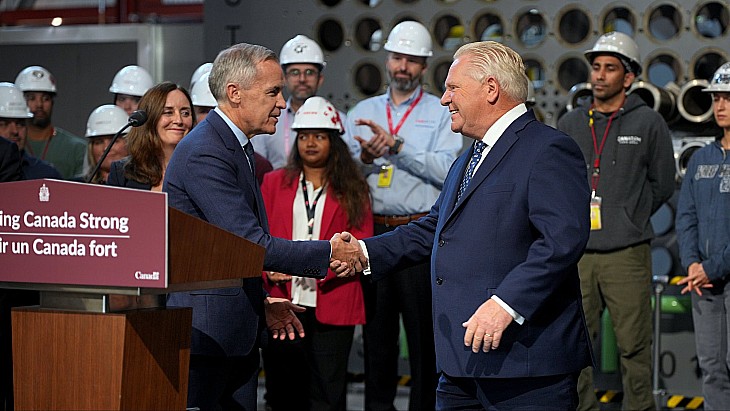
Mark Carney and Doug Ford announced the funding deals during a visit to the Darlington Nuclear Generating Station (Image: Doug Ford/X)
Announcing the investments alongside Ontario Premier Doug Ford, Canadian Prime Minister Mark Carney said the project would create thousands of high-paying careers and power hundreds of thousands of homes in Ontario with clean energy. "This is a generational investment that will build lasting security, prosperity, and opportunities," he said.
Ford described the investment as a down payment on Ontario's nuclear energy future. "We're protecting Ontario by supporting good-paying, long-term jobs for Ontario workers and building the energy infrastructure - including both SMRs and new, large-scale nuclear – needed to make Ontario an energy superpower," he said.
Provided conditions are satisfied, Canada Growth Fund (CGF) and Building Ontario Fund's capital will be made available to OPG in two tranches. The first tranche will comprise initial capital funding for the first unit, referred to as SMR 1; the second tranche of additional capital to fund the next three SMRs will be made available once certain project milestones have been met.
OPG has said it expects to complete construction of SMR 1 by the end of the decade and connect it to the grid by the end of 2030. Construction on SMRs 2-4 is expected to be completed in the mid-2030s.
"As a first-of-its-kind project, DNNP has a higher risk profile that limits access to traditional financing. In line with their mandates, CGF and BOF are investing at a stage where the Project is exposed to certain construction and technological risks," OPG, Canada Growth Fund and Building Ontario Fund (BOF) said. The funds' investments aim to de-risk the Darlington project "and advance it to a point where private sector participation can be efficiently catalysed in this essential energy infrastructure asset".
"DNNP represents a compelling opportunity for CGF and BOF to invest in a large-scale rate-regulated asset with rates subject to oversight and approval by the Ontario Energy Board," they said, adding that Canada Growth Fund and Building Ontario Fund will benefit from market-based investment governance, facilitating future participation from private investors.
Yannick Beaudoin, President and CEO of Canada Growth Fund Investment Management Inc, said there is "significant potential" for these first-of-a-kind SMRs to be replicated across Canada and globally. "We look forward to building upon this financing model to attract further interest from private investors committed to developing low-carbon energy infrastructure in Ontario and across Canada," he said.
Site progress
Since receiving the go-ahead from the provincial government in May, OPG has marked several milestones at the Darlington site where early preparation activities began in 2022.
The components of the project's tunnel boring machine, named Harriet Brooks after Canada's first female nuclear physicist, arrived on site in July, ready for assembly in early 2026. The 6.97-metre-width machine will be used to bore and line a 3.4-kilometre-long tunnel for the project's condenser cooling water system.
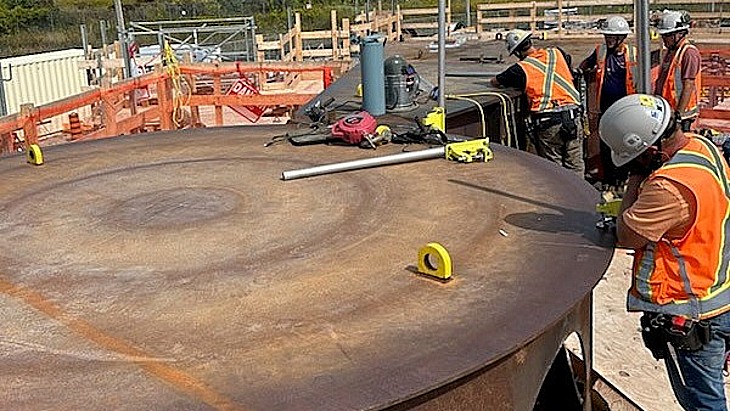
One of the components for the basemat module (Image: OPG)
The first assemblies that will make up the Basemat module - the foundation of the reactor building - are being delivered to site. The completed Basemat will eventually be craned into position at the bottom of the reactor building shaft, 35 metres deep.
The on-site pre-assembly building, which will support the final assembly of reactor building structural components for the first SMR unit, is complete, as is the fabrication building, where final assembly of modular building components will take place. Foundation work for the radiation waste building and control and service buildings has also been completed.
Excavation work is continuing on the reactor building shaft, forebay shaft, and the condenser cooling water launch shaft, while site grading for three additional SMR units has now been completed.
In pictures: Reactor vessel delivered for El Dabaa unit I
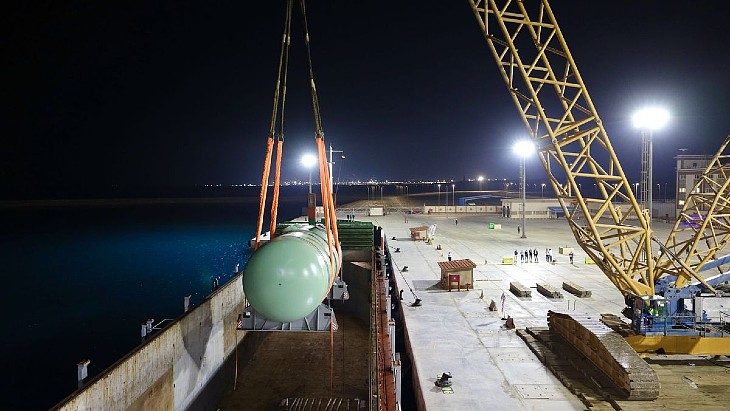
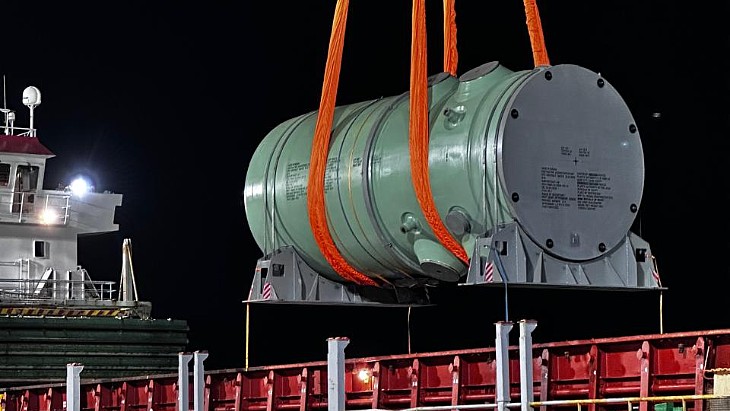
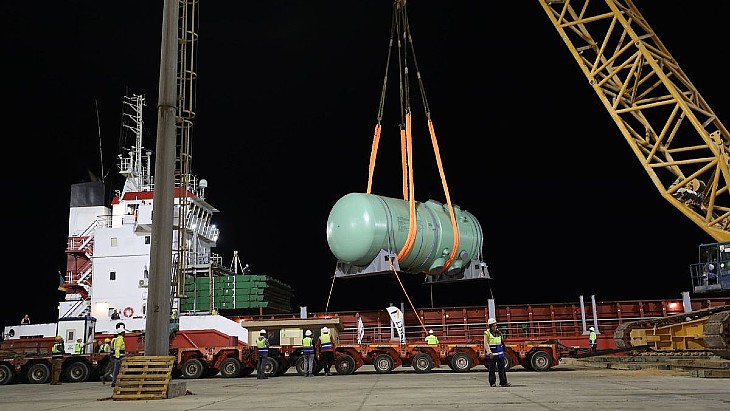
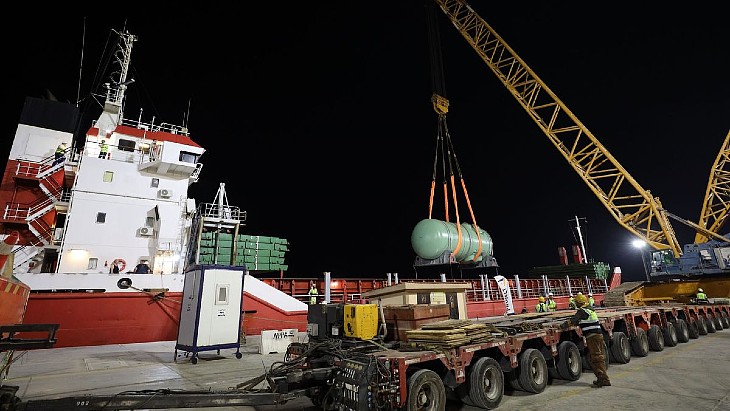
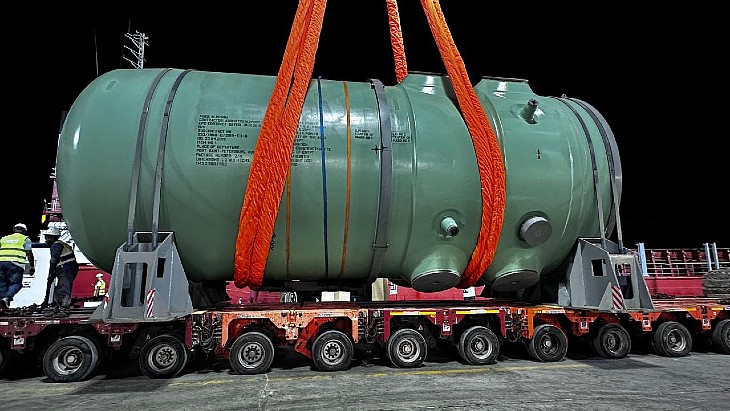
The first reactor vessel has been delivered to the El Dabaa construction site of Egypt's first nuclear power plant.
(Image: Rosatom)
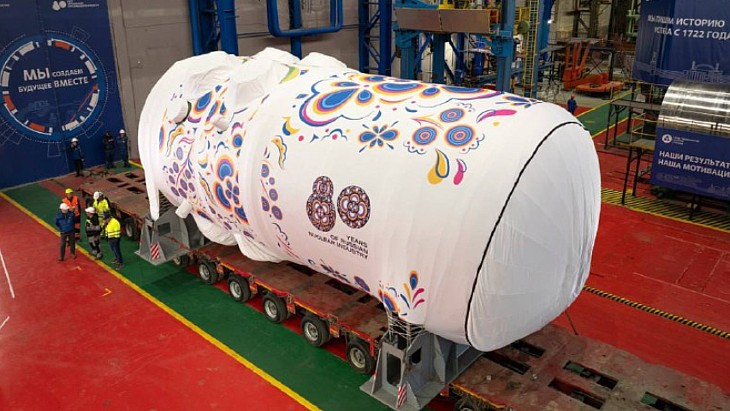
The 330-tonne reactor vessel was manufactured at Rosatom's Izhora plant, in a process which took 41 months. The reactor vessel is about 13 metres long and 4.5 metres in diameter. The service life is for an initial 60 years, with the possible extension to 80 years.
The cylindrical steel reactor vessel which houses the reactor core ensures a hermetic seal and withstands high pressures and temperatures, ensuring the safety and reliability of the power unit.
A ceremony held before the reactor pressure vessel was shipped (Image: Rosatom)
It was transported by a specially adapted cargo vessel (Image: Rosatom)
It was delivered by sea on 21 October after a 20-day journey from St Petersburg (Image: NPPA)
A giant crane was on hand to lift it off the ship (Image: Rosatom)
The port has been specially designed for large-scale deliveries (Image: Rosatom)
The last leg of the journey will be on land (Image: NPPA)
Sherif Helmy, Chairman of Egypt's Nuclear Power Plants Authority, said: "The reactor vessel for Unit 1 has been delivered to the specialised port at the El Dabaa NPP construction site, built by the Egyptian side for receiving large-scale equipment. Installation of the reactor vessel is scheduled for mid-November, and our teams are working tirelessly to achieve this key milestone."
Alexey Kononenko, Vice President of JSC Atomstroyexport and Director of the El Dabaa NPP Construction Project, said it was a "milestone" moment for the project and was "a reflection of the effective collaboration of our international team". He added: "We are now on the threshold of the year's most important production event - the installation of the reactor vessel for Unit 1 into its design position."
Background
El Dabaa will be Egypt's first nuclear power plant, and the first in Africa since South Africa's Koeberg was built nearly 40 years ago. The Rosatom-led project, about 320 kilometres north-west of Cairo, will comprise four VVER-1200 units, like those already in operation at the Leningrad and Novovoronezh nuclear power plants in Russia, and the Ostrovets plant in Belarus.
Under the 2017 contracts, Rosatom will not only build the plant, but will also supply Russian nuclear fuel for its entire life cycle, including building a storage facility and supplying containers for storing used nuclear fuel. It will also assist Egyptian partners in training personnel and plant maintenance for the first 10 years of its operation. Rosatom said last month that it is aiming for a future service life of 100 years for nuclear power plants.
The four units are being built almost concurrently, with first concrete at unit 1 in July 2022, followed in turn by the others, concluding with first concrete at unit 4 in January 2024. Egypt's aim is for 9% of electricity to be generated by nuclear by 2030, which would be achieved by the commercial operation of the first two units by that time, directly displacing oil and gas.
Outer dome installed at Lufeng unit 5
The outer containment dome has been installed at unit 5 of the Lufeng nuclear power plant in China's Guangdong province. It is the first of two HPR1000 (Hualong One) units under construction at the site, where four CAP1000s are also planned.
(Image: Lufeng Nuclear Power Co)
On 18 October, the outer containment dome steel formwork module - measuring 51 metres in diameter, 13 metres in height, and weighing 261.8 tonnes - was raised using a 2,000-tonne crawler crane equipped with a laser target dynamic guidance system and placed on top of the walls of the double containment structure. The hoisting process took just 94 minutes to complete.
"This successful installation marked the first time that CGN completed the modular installation of the outer dome steel formwork for the Hualong One reactor, creating crucial conditions for subsequent containment pressure testing and nuclear island installation for unit 5," China General Nuclear (CGN) subsidiary CGN Lufeng Nuclear Power Company said.
In April 2022 the State Council approved construction of two Hualong One units at Lufeng as units 5 and 6. First concrete was poured for unit 5 on 8 September 2022 and that for unit 6 on 26 August 2023. Units 5 and 6 are expected to be connected to the grid in 2028 and 2029, respectively. The inner containment dome was installed at unit 5 in April 2024 and at unit 6 in July this year.
The dome is located on top of the nuclear island. Its main function is to ensure the integrity and leak tightness of the reactor building, and it plays a key role in the containment of radioactive substances.
The proposed construction of four 1250 MWe CAP1000 reactors (units 1-4) at the Lufeng site was approved by China's National Development and Reform Commission in September 2014. However, the construction of units 1 and 2 did not receive State Council approval until 19 August last year. The first safety-related concrete was poured for the nuclear island of unit 1 at the Lufeng plant on 24 February this year. Approval for units 3 and 4 is still pending.
Regulatory milestone for Wyoming advanced reactor
The US Nuclear Regulatory Commission has completed its Environmental Impact Statement for TerraPower's Natrium project and recommended that a construction permit be issued for Kemmerer Unit 1.
(Image: TerraPower)
TerraPower submitted an application to the US regulator for a permit that would allow the construction of Kemmerer Unit 1 in Lincoln County, Wyoming, in March 2024. The first-of-a-kind Natrium project is being developed through the US Department of Energy’s Advanced Reactor Demonstration Program (ARDP) public-private partnership.
According to the Environmental Impact Statement (EIS), Kemmerer Unit 1 would demonstrate an advanced sodium-cooled reactor, with one 840 MWt pool-type sodium fast reactor connected to a molten salt energy storage system that enables a variable energy supply of up to 500 MWe (net). The storage technology is designed to keep base output steady, ensuring constant reliability and can quickly ramp up when demand peaks: TerraPower says it is the only advanced reactor design with this unique feature.
The Environmental Impact Statement evaluates the environmental impacts of the proposed plant, which would demonstrate the Natrium advanced reactor while ultimately replacing electricity generation capacity following the planned retirement of existing coal-fired facilities. It says: "After weighing the environmental, economic, technical, and other benefits against environmental and other costs, and considering reasonable alternatives, the NRC staff recommends, unless safety issues mandate otherwise, that the NRC issue the requested Construction Permit to [TerraPower subsidiary] USO."
TerraPower President and CEO Chris Levesque said the announcement from the NRC was a "testament" to the team's dedication and rigour in meeting all federal licensing requirements. "The Natrium plant in Wyoming, Kemmerer Unit 1, is now the first advanced reactor technology to successfully complete an environmental impact statement for the NRC, bringing us another step closer to delivering America's next nuclear power plant," he said.
Earlier this year the NRC said it intended to accelerate its schedule to complete the review of TerraPower's construction permit application six months earlier than originally envisaged. The next step will be the completion of the final safety evaluation, which is anticipated by the end of December, the company said.
Construction of the non-nuclear portions of the site began in June 2024.




_95927.jpg)
_87584.jpg)

_25135.jpg)
_88774.jpg)