Saturday, October 25, 2025


Regional ocean dynamics can be better emulated with AI models


University of California - Santa Cruz
Storm rolling in the Gulf of Mexico 

image: 

Storm rolling in the Gulf of Mexico

view more 

Credit: NOAA Weather in Focus Photo Contest 2015/ Stephanie Gentle


The Gulf of Mexico, a regional ocean, is hugged by the southeastern United States and a large stretch of the Mexican coast, making it very important for both countries. The area helps bring goods to local and global markets, produces power for the country with off-shore oil rigs, and hosts a myriad of vacation-worthy beaches—so modeling and predicting its dynamics is a critical task. 

Research from applied mathematicians at the University of California, Santa Cruz, presents new AI-powered methods for modeling the Gulf. They achieve higher accuracy than traditional models for short-term predictions, and successfully emulate 10-year dynamics without any AI “hallucination”—a physically impossible scenario.

This research is a result of a collaboration between the UC Santa Cruz Baskin School of Engineering researchers led by Assistant Professor of Applied Mathematics Ashesh Chattopadhyay, industry partner Fujitsu’s Converging Technologies Laboratory, and a research group at North Carolina State University. Their work is published in a study in the Journal of Geophysical Research: Machine Learning and Computation.

This work drives forward critical management of natural resources in the U.S. and Mexico, and advances the technology for modeling gulf streams around the world—a major feature of the global oceans—and demonstrates the improving efficacy of AI in the earth sciences. 

“The ability to resolve the Gulf Stream and its dynamics properly, has been an open challenge for many years in oceanography,” Chattopadhyay said. “That’s why the Gulf of Mexico becomes an important test case whenever we’re trying to evaluate new algorithms and new models for high-resolution regional ocean dynamics.”

The team’s collaboration among academics and industry aims to make the products of their research ready for real-world use. 

“The ocean emulators developed with UC Santa Cruz deliver a combination of speed, accuracy, and lightweight design that enables seamless operational integration into maritime platforms,” said Subhashis Hazarika, principal researcher at Fujitsu Research of America. “This supports interactive system design for applications ranging from port operations management to ship weather routing and extreme event monitoring. Our collaboration with UC Santa Cruz marks an important step toward bringing rigorously validated AI-for-Science models into real-world industrial applications.”

Modeling the Gulf

The Gulf of Mexico hosts important maritime industries like energy production and cargo shipping, making the modeling of this region an important safety and economic issue. Large eddies from the Gulf stream break in this area, creating rogue waves that sometimes hit the areas where people are working on oil rigs—so it’s critically important to be able to model these waves and other dynamics. 

It’s been historically very difficult to model regional oceans, especially in areas near the coast. Waves crashing near the shore, along with other factors, makes measuring and modelling complex. 

Traditional tools for ocean modeling, that are still the gold standard in industry, are high-resolution, physics-based models that are expensive, power hungry, and relatively slow—and not always highly accurate.  

AI models require more investment up front to train, but work up to 100,000 times faster than traditional models. AI has also been limited by “hallucinations,” when models drift away from true physical dynamics when emulating dynamics at long timescales. Chattopadhyay’s work focuses on eliminating hallucinations by integrating physics into the AI models, particularly to better capture dynamics that are physically smaller and happen on a shorter timescale. 

Zooming in

To do this, the research team constructed an AI model that works with two main components. One takes a “zoomed out” view, focusing on ocean events that can be observed from eight kilometers of resolution, and happen over longer timescales. The second component takes these zoomed out predictions and enhances them to four kilometers of resolution. 

Chattopadhyay compared this process, called “downscaling,” to zoom enhancement of a photo. 

“You can take an old picture and enhance it, basically improving the quality and resolution using a generative model,” Chattopadhyay said. “We’re using basically the same technology here to be able to downscale predictions to four kilometers, and we’re making sure that we’re not just enhancing it unrealistically.”

Using this technique, the team found their system had better performance than traditional physics-based models at shorter timescales, such as making predictions 30 days ahead—beating the highly accurate traditional models. 

Additionally, they found that their models can emulate up to 10 years ahead without any hallucinations. The team achieved this by rigorously integrating physics constraints into the “zoomed out” emulations, an effort led by graduate student Leonard Lupin-Jimenez.

Chattopadhyay says that their system’s improved accuracy fits in with a larger trend of AI models in the sciences besting traditional models. 

“I think this was one of these instances, and it’s been happening more and more in this field of AI and science, that AI models are starting to outperform physics-based models,” Chattopadhyay said.

Collaboration for at-sea impact

Several of Chattopadhyay’s graduates are hosted by Fujitsu’s Converging Technologies Laboratory as an ongoing collaboration to support interdisciplinary research—a unique partnership between physical science-academics and industry.

Lupin-Jimenez spent time at the company to focus on this project under the mentorship of Fujitsu’s Subhashis Hazarika and Anthony Wong, and together they shaped the work for both research and operational use.

“There was a good amount of freedom in being able to experiment with different methods, processing, and pipeline frameworks to see what works best,” Lupin-Jimenez said.

Throughout the process, they emphasized making the software as useful as possible, which meant making the system operable on a ship at sea. 

“It’s actually going to translate to end users who might not be either experts in physics or experts in AI, but they still want to be able to do this modeling,” Chattopadhyay said. “In our group, we are trying to keep our research aligned with needs of the market and industry, especially with AI, so that research and ready-for-market tools are not divorced.”

Nutritional supplements boost baby coral survival


Feeding coral larvae a coral “baby food” can dramatically increase their chances of survival, a new study finds


University of Technology Sydney

Nutritional supplements boost baby coral survival 

image: 

Feeding coral larvae a coral “baby food” can dramatically increase their chances of survival, a new study finds.

view more 

Credit: Image: Hadley England


Feeding coral larvae a coral “baby food” can dramatically increase their chances of survival, offering a new avenue for reef restoration as climate change continues to threaten coral ecosystems, a new study finds.

Researchers from the University of Technology Sydney (UTS) have discovered that coral larvae fed with tailored lipid supplements, including omega-3-rich oils and essential sterols, are stronger, faster, and more likely to survive and settle onto reefs.

The research, led by marine biologist Dr Jennifer Matthews and published today in Communications Biology, marks a major advance for coral aquaculture and restoration science.

Reef restoration projects often focus on increasing larval supply, yet they are frequently hampered by low post-settlement survival.

“Less than one per cent of coral larvae typically survive their first year,” said Dr Matthews. “Developing the right nutritional strategies and providing the correct balance of lipids, such as sterols, could provide a practical way to improve these outcomes.”

The study revealed that coral larvae actively consume and metabolise these essential fats, confirming that early nutrition plays a key role in coral development and resilience.

“We’ve shown that specific lipid supplements, especially sterols, enhance larval performance and help juvenile corals cope with stress,” said Dr Matthews. “This opens up exciting possibilities for restoration projects, where every extra surviving coral can make a real difference to reef recovery.”

The UTS research team is now taking this innovation from the lab to the reef, working in partnership with Indigenous Sea Rangers, Dr Eric Fisher from GBR Biology and Reef Magic, to trial these nutritional interventions directly on the Great Barrier Reef.

“These field trials are helping us understand how nutritional support can be scaled up to real-world restoration,” said Dr Matthews. “It’s a wonderful collaboration between researchers, Traditional Owners and reef practitioners, with everyone working together to give corals a fighting chance.”

While no single solution can halt reef decline, Dr Matthews believes nutritional science could become a vital tool in the broader restoration toolkit.

“As oceans warm, we need every advantage we can give these corals,” she said. “Enhancing their early survival through better nutrition could help tip the balance toward recovery rather than loss.”

WAIT, WHAT?!

Baltic countries lead the way in supporting media freedom internationally, according to new index


University of East Anglia


The Baltic states have emerged as global leaders in promoting media freedom internationally, according to a new Index on International Media Freedom Support (IMFS).

The IMFS Index evaluates countries on how actively they support media freedom beyond their borders through diplomatic, funding and safety efforts.

It is published by an independent group of academics at the University of East Anglia and City St George’s, University of London.

Lithuania topped the Index, reflecting its strong diplomatic efforts to advance media freedom and its visa program supporting journalists in exile, including from Belarus and Russia.

Estonia ranked 4th, while Latvia came 9th out of the 30 countries measured.

Report author Prof Martin Scott, from the University of East Anglia, said: “The Baltic states’ strong focus on supporting media freedom internationally likely reflects their political histories and mounting concerns about the threats of misinformation and propaganda.”

In a joint statement at the United Nations General Assembly in November last year, the Baltic countries stated: “Democracies need to act together to address disinformation, especially spread by foreign actors who seek to undermine our institutions and societies”.

Sweden ranked second in the Index, largely due to its strong financial support for independent journalism abroad. It allocated 0.9 per cent of its foreign aid to media support in 2023, well above the 0.16 per cent average among the 30 countries assessed.

However, for many larger countries, the results show a significant gap between their public commitments to supporting media freedom internationally and their actual support.

Four G7 members - the United Kingdom, United States, Italy, and Japan - were placed in the lowest ‘bronze’ category, scoring 10 points or less in the Index.

Prof Mel Bunce, one of the report authors at City St George’s, University of London, said: “Many G7 countries make commitments on the global stage to support media freedom financially and diplomatically. But they do not always deliver.”

Although the United States ranked equal 12th in the Index, a time lag in reporting means that this does not capture its significant cuts to aid spending in 2025, which have had a substantial impact on international media assistance.

About the Index

The Index on International Media Freedom Support (IMFS) is the first index to evaluate countries' foreign policy support for media freedom. It includes all 30 countries that are members of both the OECD Development Assistance Committee and the Media Freedom Coalition. The Index was produced by an independent research team from City St George's, University of London, and the University of East Anglia.

The Index draws on 2024 data for diplomatic and safety measures, with financial data from 2023 due to reporting lags. Therefore, it does not yet reflect the substantial cuts to media development funding announced in 2025 by the United States, United Kingdom, Germany, and France.

The Index on International Media Freedom Support (IMFS) is being launched on Friday 24th October, 2025, at the 2025 IPI World Congress and Media Innovation Festival in Vienna. 

About the Centre for Journalism and Democracy 

The index is published by the newly launched Centre for Journalism and Democracy at City St George’s.

The centre investigates the threats facing journalism, the impact of these on civil life, and designs interventions to help address them.

It partners with journalists, thinktanks, NGOs, and policymakers to explore how ethical, public interest news can be reimagined and protected for future generations.

I Became ‘Antifa’ as a Child; I Never Looked Back

“Never again” means each of us taking a stance. This starts with protecting and using our words.


Demonstrators hold protest signs during a march from the Atlanta Civic Center to the Georgia State Capitol on October 18, 2025 in Atlanta, Georgia.
(Photo by Julia Beverly/Getty Images)

Maria Perez
Oct 24, 2025
Common Dreams

I became a member of “Antifa” at 5 years old; at my auntie’s house watching The Sound of Music a hundred times over. I wasn’t exactly sure what fascism meant, but I knew that the guys throwing up their arm in a heil salute were terrifying, and that resistance to that salute was dangerous. Very dangerous. Chills ran down my spine each time I watched Captain von Trapp ripping up that Nazi flag because I understood he was risking his life with that simple act of defiance.

In the fifth grade, I got the historical context and political analysis I was lacking when I was assigned to read The Diary of Anne Frank. A first-hand story from a girl my age in real time—a girl who was ultimately found and killed by the same fascists I feared. After that experience, I was “Antifa” all the way. It permanently shifted my perspective as I saw fascism always lurking in the shadows waiting to pounce. It is the dark side of human nature. Some people will always believe that they are better than other people, and justify murder and other heinous acts out of self-interest. I heard the phrase “never again” being used in reference to the Holocaust as a young girl. I promised myself that I would live by that promise.


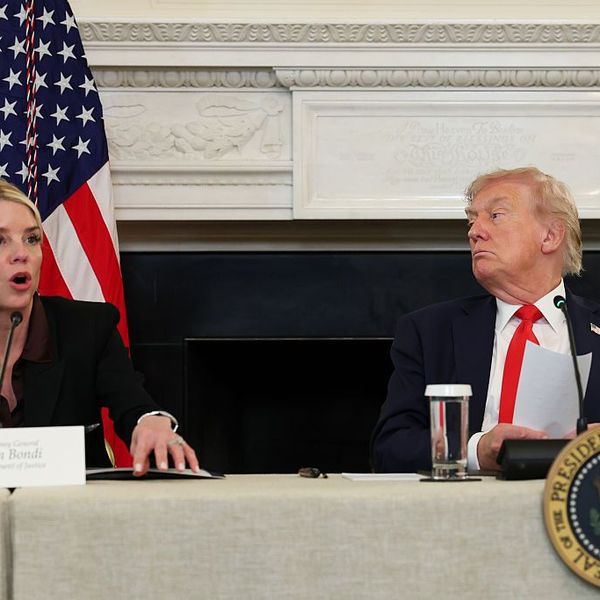
Bondi: Trump Admin Will Take ‘Same Approach’ to Antifa as Drug Cartels, Which It Repeatedly Bombed


House Democrats Blast Trump’s Antifa Designation and Terrorism Memo Targeting Critics

Some 40 years later, I find myself living in the reality that brought Captain von Trapp to his breaking point. The fascists are taking over, and we are not responding accordingly! People being abducted to other countries they may have never known; covering up a decades-long child sex trafficking ring to protect the aristocracy; firing public servants while destroying the institutions that make our society even marginally work. These are fascist moves—as is policing our language and our right to peacefully protest.


While there is little we feel we can do as individuals about what Immigration and Customs Enforcement or the Department of Justice are doing in our communities, we each can and must deny our consent to their insistence that we don’t use our words.

Words help clarify as a society what we stand for and who we are. Words are the first and most powerful tool that we have against tyranny and violence. If we can’t communicate clearly with each other about what is happening, about what we think, about what we might be able to do, then we will certainly lose.

Our federal government has scrubbed websites and other documents of words like “women”, “diversity”, “identity”, “race,” “climate,” and “science.” Giant publicly-funded projects like cancer research, food for children, and clean water are losing their funding because their grant reports include these words.

In recent days, President Donald Trump declared through Executive Order that “Antifa”—not an actual group, but an ideology that fascism is bad—is now a terrorist organization. Think about this. An ideology opposing fascism is deemed a threat to our country. Our words, our political beliefs are acts of terrorism.

“Never again” means each of us taking a stance. This starts with protecting and using our words. This, like Captain von Trapp’s destruction of the Nazi flag, are simple but powerful acts of resistance. Your words are a collaboration between your mind, your spirit, and your tongue. You call the shots. Say the words: I am “Antifa.” Because we should all oppose fascism.


Our work is licensed under Creative Commons (CC BY-NC-ND 3.0). Feel free to republish and share widely.

Maria Perez
Maria Perez is the cofounder of Democracy Rising, a national nonprofit working toward a more functional, representative democracy for all of us.
Full Bio >


Trump Nominee for South Africa Ambassador Won’t Say If He Believes Black Americans Should Be Allowed to Vote

“A window into the truly radical nature of the people Trump is nominating.”


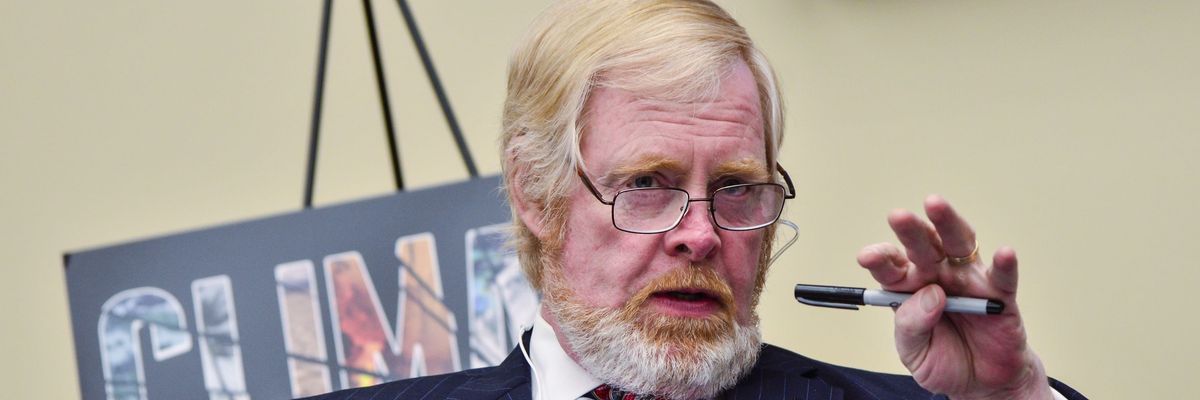
Brent Bozell, founder and president of the Media Research Center, speaks during the “Climate Hustle” panel discussion in Washington, DC.

(Photo by Kris Connor/Getty Images)

Brad Reed
Oct 24, 2025
COMMON DREAMS

President Donald Trump’s nominee to be ambassador to South Africa this week refused to say whether he would support or oppose repealing laws allowing Black Americans to vote.

During a Thursday Senate confirmation hearing, Sen. Chris Murphy (D-Conn.) asked Trump nominee Brent Bozell, a right-wing media critic and founder of the conservative Media Research Center, about his support for Trump administration plans that limit refugee admissions almost exclusively to white Afrikaners.
.

Trump to Slash Refugee Numbers to Record Low, With White South Africans Taking Most Spots


“Senator, I don’t make that policy,” Bozell replied.

Murphy, however, did not accept this attempt at evasion.

“If I were to ask this question of virtually any nominee to be an ambassador, prior to this panel, that would be an easy layup answer: ‘No, no, of course we don’t support having a refugee policy where we only admit white people,’” said Murphy. “So why can’t you give me your personal view on that?”

“Because, senator, I am here to serve America and to do what the president is asking me to do,” Bozell said.

Murphy then asked him if he would support bringing back “laws in this country to only allow white people to vote.”

Bozell again refused to answer.

“Senator, I’m going to serve as ambassador to South Africa, and I’m going to focus on that,” he said.


“You will not share your personal views on whether it is right or wrong to reinstitute discriminatory policies in this country to prevent Black people from voting?” Murphy pressed.

“Senator, my personal views are irrelevant,” Bozell insisted. “I am serving here to do what the president is asking me to do in South Africa.”

Murphy rejected this premise, however, and informed Bozell that the entire point of the Senate confirmation process was to learn more about a nominee’s personal views so that senators can make informed decisions about their qualifications.

“We wouldn’t have this process if your personal views were not relevant,” Murphy said. “That is pretty stunning that you will not share your views, not only on whether we should have a refugee admissions process that is race-based, but you won’t share your personal views on whether we should reimpose discriminatory treatment against Black Americans. That is absolutely relevant to your qualifications to serve. And your refusal to answer it, I hope, is something that every member of this committee will think about.”

Commenting on the exchange afterward, Murphy wrote on Bluesky that Bozell’s answers to his questions offer “a window into the truly radical nature of the people Trump is nominating.”

Trump has falsely accused the South African government of committing “genocide” against its white citizens, and his administration has given white South Africans priority for resettlement in the US.

South Africa has a long history of racial injustice, as the apartheid system that lasted for more than four decades in the country brutally oppressed its majority Black population to ensure white minority rule.

Several wealthy Trump backers, including Tesla CEO Elon Musk, Palantir founder Peter Thiel, and venture capitalist David Sacks, were all either born in or spent time growing up in South Africa when it was still under the apartheid regime.
TRUMP'S WORLD

Trump’s new Time cover draws 'chilling' parallels to infamous Nazi portrait


Photo Illustration by The Daily Beast - Stephen Voss/TIME Magazine and Arnold Newman

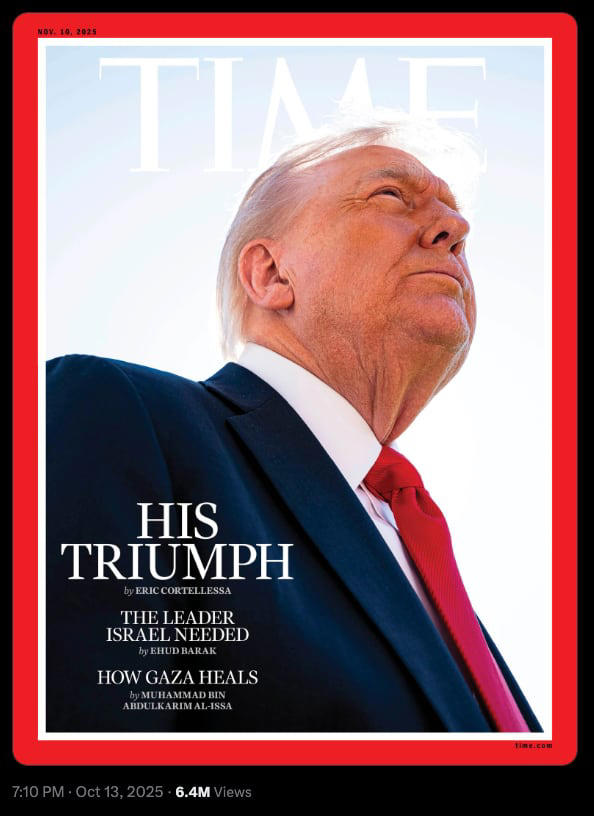
President Donald Trump’s latest Time magazine cover owes its visual language to one of the most chilling portraits of the 20th century, the Daily Beast has learned.

The Time image—released online ahead of next week’s print issue—depicts the 79-year-old president behind the Resolute Desk. He is leaning forward into a power pose that obscures his often bruised right hand and his loose neck skin. Above the image, which was shot by Washington-based photographer Steven Voss, the headline declares, “TRUMP’S WORLD.”


The cover was unveiled just days after Trump himself lashed out at a Time cover picture of him, which showed an unflattering perspective on his 79-year-old neck. He has yet to give his take on his new one, but his chief communications officer is clearly enamored by it. “TRUMP’S WORLD,” Steven Cheung wrote on X, sharing the image.


Other photographer's on Instagram were quick to recognize the homage to an infamous photo / Photo composition by The Daily Beast/Images from TIME Magazine (left) and Arnold Newman (right)

It comes as Time’s billionaire owner, Salesforce CEO Marc Benioff, outed himself as a Trump super-fan, declaring that he “fully supports” the president’s plot to send National Guard troops to San Francisco. “We don’t have enough cops, so if they can be cops, I’m all for it,” he said.

The Daily Beast has learned that the composition on the new Time cover is inspired by Arnold Newman’s 1963 photograph of Alfred Krupp, the German industrialist and convicted Nazi war criminal. That portrait, published by Newsweek, has long been considered among the most psychologically charged images ever produced for a weekly news magazine.

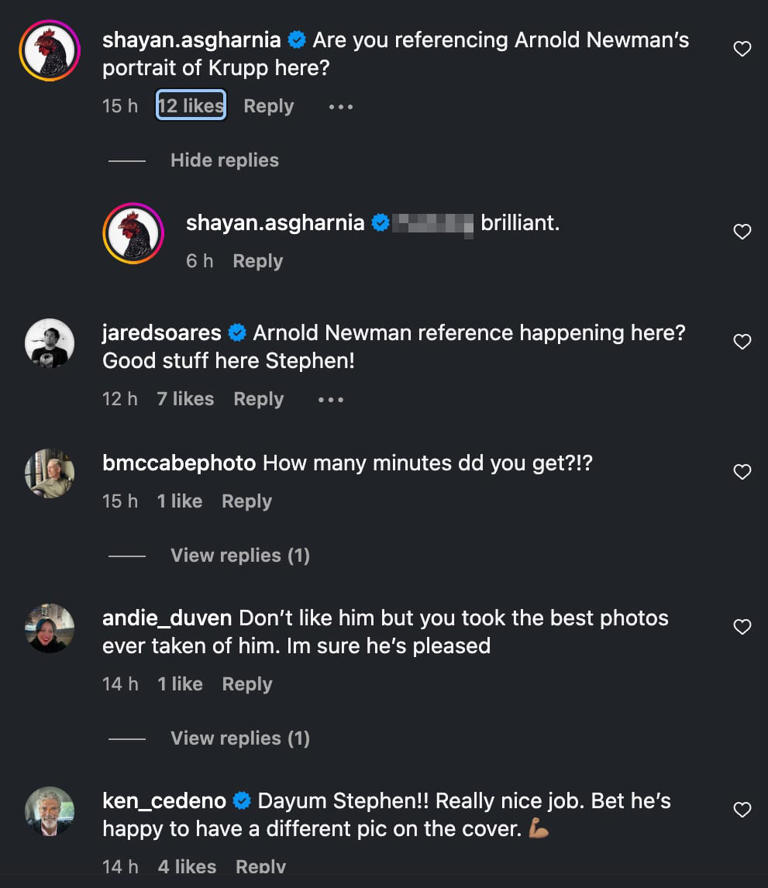
Voss appeared to confirm the reference by liking comments on Instagram where followers had asked him if the two images were linked. “Are you referencing Arnold Newman’s portrait of Krupp here?” one fellow photographer asked. Once Voss had liked the comment, Shayan Asgharnia replied again. “F-----g brilliant,” he said.


Screenshot of the comment section of Time Magazine's Instagram post of their cover of Donald Trump. Commenters compared the portrait of the president to one of Alfred Krupp taken by Arnold Newman / Screenshot/Instagram

Newman, a Jewish photographer born in Manhattan in 1918, had originally resisted the assignment to photograph a Nazi war criminal on ethical grounds. “When the editors asked me to photograph him, I refused,” he later told American Photo magazine. “I said, ‘I think of him as the devil.’ They said, ‘Fine—that’s what we think.’ So I was stuck with the job.”


Krupp, the heir to Germany’s most notorious arms-manufacturing dynasty, oversaw factories that used more than 100,000 enslaved laborers during World War II, many of whom were brought in on trains from Eastern Europe. Among the laborers were also prisoners of war, concentration camp inmates and children.

His plants built tanks, artillery, and the massive “Big Bertha” howitzer that became synonymous with the Nazi war machine. He was convicted of war crimes by an American military tribunal at Nuremberg in 1948. He was sentenced to twelve years in prison, but was released after serving less than three years when his sentence was commuted by the U.S. High Commissioner for Germany.

When Newman finally agreed to photograph Krupp, he did so on his own terms. He placed the industrialist on a raised platform amid a bleak industrial backdrop, told him to clasp his hands and lean forward, and lit his face from below—a technique more often reserved for horror films than portraiture.


The photograph, taken by Arnold Newman, taken in 1963, of Alfred Krupp, a convicted Nazi war criminal and German industrialist. / Arnold Newman

The Krupp photograph depicted a businessman whose wealth and industrial empire were inseparable from political brutality. Voss’s effort shows a president who, despite brokering a peace deal in the Middle East, faces constant criticism for the division he sows domestically.

The lighting, coupled with the industrial background in Newman’s image, creates a menacing result. Krupp’s expression seemed to curl into a smirk, his eyes gleaming in the half-light. “My hair stood on end,” Newman recalled. “He looked like the devil.”

Voss’s cover accompanies a feature on Trump’s role in brokering a Gaza peace deal. Yet the portrait’s aesthetic lineage—and the deliberate nod to one of history’s most infamous images—invites a reading that goes far beyond the headline.

The photograph situates Trump squarely within the symbolic framework Time has cultivated for over a century. Since its founding in 1923, the magazine’s cover has been the ultimate arbiter of power’s visual narrative—its red border as instantly recognizable as its subjects.

Time’s covers have defined how presidents are seen, always calculated to capture the prevailing mood of authority. For Trump, who has long obsessed over his own image, the relationship with Time has been fraught.

In August 2015, when Trump as the leader of the free world was still only just a possibility, he tussled with an American bald eagle during a shoot for the magazine. The moment the bird, named Uncle Sam, lashed out at the business magnate and ruffled his hair was captured on camera. “How’s my hair look?” the self-conscious presidential candidate asked.

After yet another Trump cover was published earlier this month, he lashed out on Truth Social. Online commentators dubbed the loose skin shown beneath his chin a “neck vagina.”

“Time Magazine wrote a relatively good story about me, but the picture may be the Worst of All Time,” Trump posted. He complained that the low angle was unflattering and made his hair look like it wasn’t fixed to his head.


The cover of TIME magazine that Trump hated. / X.com/Time

The new image, by contrast, is carefully composed, with the president leaning forward into the light—an assertive tableau meant to project power. But one that harks back to the chilling Newman shot.

Steven Voss, the photographer behind the shoot, is a veteran of Time’s political portraiture. His work is held in the permanent collections of the Library of Congress and the D.C. Commission on the Arts and Humanities, and he has received multiple honors from the White House News Photographers Association. His portfolio includes portraits of Democratic figures Alexandria Ocasio-Cortez, Ilhan Omar, and Bernie Sanders—images composed to create a quiet intensity.


Trump’s body language in the Voss composition usefully covers up a hand often ravaged by bruises, as well as protecting the president’s fragile ego by obscuring his neck. However, the image also speaks to a macabre history with the Krupp nod.

The Nazi industrialist’s influence remains to this day. Steel from his plants was used to cap the Chrysler Building in Newman’s native Manhattan. The metal also stretches over the U.S. in miles and miles of railroad.

Harvard University, too, still boasts a fellowship and a professorship named for Krupp. An endowment from the Krupp Foundation allows students whose research focuses on Europe to travel abroad for their dissertations. In the 70s, the philanthropic arm of the Nazi dynasty provided the equivalent of $12 million, adjusted for inflation.


Barack Obama on the cover of Time Magazine, November 29, 2007. / TIME

Time covers, meanwhile, have a long history of subversion. They have frequently blurred the line between veneration and critique: Nixon in chiaroscuro, Bush framed against smoke, Obama bathed in radiant light.

Trump’s new portrait both acknowledges and unsettles this legacy. It is unclear if Time bosses are aware of the macabre link, but for Newman, photography was never neutral.


George W. Bush on the cover of Time Magazine's May 24, 2004 issue. / Arthur Hochstein/TIME

“The surroundings had to add to the composition and the understanding of the person,” he said in 2000. Newman died of a stroke six years later in Mount Sinai Hospital, just a 10 minute subway ride from the Chrysler Building.

Steven Cheung, the White House communications director, told theDaily Beast. “President Trump brokered a historic peace agreement in the Middle East and Time Magazine wanted to commemorate that achievement with a cover story and photo. This is the President’s 48th cover on Time, and he is well on his way to break the all-time record.”

Time has been contacted for comment.

With these race remarks, Trump and the GOP are raising a frightening specter from history

 Minnesota Reformer
October 24, 2025

It’s here and it’s happening. The recent revelations about Republicans “joking” about an affinity for Nazism should wake us up to the reality of the moment. When President Donald Trump says immigrants have “bad genes” and are “poisoning the blood of our country,” he has raised the specter of eugenics that thrived in our country and of course in Germany during the 1930s. There’s a direct line from this thinking to the Holocaust.

We need look no further than Minnesota for insight into this ugly history. During the early 20th century, Minnesota and many other states passed eugenics laws to support so-called racial purification. Laws in 31 states allowed the sterilization of mentally disabled and “feeble-minded” people, epileptics and more. Minnesota passed a sterilization law in 1925, and more than 2,000 people — mostly women — were sterilized. In California around 20,000 were sterilized from 1917 to 1952.

Through the 1930s, American scientists at the prestigious Cold Spring Harbor Lab in New York promoted eugenics and maintained a Eugenics Record Office. David Starr Jordan, who wrote early major works on the fishes of North America and was president of Stanford University, was a white supremacist and supported forced sterilization programs aimed at poor Black, Indigenous and Hispanic women as well as the mentally disabled.

We know that Charles Lindbergh, the Minnesotan famous for his solo flight across the Atlantic, was a eugenicist and talked of preserving the inheritance of European blood and guarding against its dilution by foreign races. He praised Hitler. Margaret Sanger, who was the first president of Planned Parenthood, was a eugenicist.

The Minnesota Eugenics Society was founded in 1923 by Charles F. Dight, who served as president until his death in 1938. He actively promoted reproduction of the “fit” and race betterment (the State Fair held “fit family” contests).

During the 1930s, Dight communicated with Hitler, praising him for his plan to “stamp out mental inferiority among the German people” and “advance the eugenics movement.” If carried out effectively, Dight wrote, “it will make him the leader of the greatest national movement for human betterment the world has ever seen.”

Our country has had a history of restricting immigrants, e.g. the Chinese Exclusion Act of 1882 and the 1924 Johnson-Reed Act that limited immigrants from eastern and southern Europe and Japan.

Trump castigates immigrants as criminals and insane, even though immigrants have lower crime rates than that of American citizens.

How could the President release 1,500 convicted insurrectionists yet push to deport immigrants? He’s likely a true believer in the nonsensical race science that was predominant a century ago.

Episcopal Bishop Mariann Budde, who spent a quarter-century in Minnesota, told Trump at the now famous prayer service early this year, “The people who pick our crops and clean our office buildings; who labor in poultry plants and meatpacking plants; who wash the dishes after we eat in restaurants and work the night shifts in hospitals — they may not be citizens or have the proper documentation. But the vast majority of immigrants are not criminals. They pay taxes and are good neighbors.”

Aren’t we all the immigrants or the descendants of immigrants? And don’t we all have defects?

Let us not forget: We are called to protect the vulnerable, to treat everyone as equals, to “do unto others as we would have them do unto us.”

Judy Helgen, PhD, is a retired research scientist with the Minnesota Pollution Control Agency. She lives in Falcon Heights.