Saturday, October 25, 2025

US Threatens Invasion of Venezuela, Expands ‘Drug’ War to Colombia


Devin B. Martinez24 Oct 2025


As US warships inch towards Colombia and Venezuela, Petro denounces Trump’s airstrikes in the Caribbean as “extrajudicial executions”


The world’s largest aircraft carrier, USS Gerald R. Ford (CVN 78), has just been deployed to the Caribbean by "Secretary of War" Pete Hegseth. Photo: US Navy

As the US continues to escalate threats and military pressure against Venezuela and now Colombia as well. On Friday, October 24, “Secretary of War” Pete Hegseth announced the deployment of aircraft carrier USS Gerald R. Ford (CVN-78), to the Caribbean. The most capable and lethal strike platform in the world adds to the already massive military buildup in the Caribbean of 10,000 US troops, at least eight war ships, P-8 surveillance planes, and F-35 jets deployed amid the Trump administration’s alleged counter-narcotics operations. US troops are also reportedly deploying to Trinidad and Tobago, mere miles from Venezuela, for five days of coordinated “military exercises”.

“It’s past time for Maduro to go. Keep it up, President Trump,” said Senator Lindsay Graham in an X post on Friday, October 24.

Venezuela is “a candidate for decisive military action on land, sea, or air” because it has for years been “a safe haven for drug cartels poisoning America,” Graham added.

During a White House address on October 23, US President Donald Trump said, “Now they’re coming in by land … I told them the land is gonna be next.”

“It’s very hard to find any floating vessel right now. In the Pacific or in the gulf,” Trump added.

Acknowledging the escalation that a land invasion would represent, Trump said, “We may go to the Congress and tell them about it but I can’t imagine they’ll have any problem with it.

On October 21 and 22, the US military also expanded their maritime operations to Colombia’s Pacific Coast, striking two boats near the South American country. The attacks marked the eighth and ninth such vessels blown up by the US, allegedly targeting drugs, but the first beyond the Caribbean Sea. Colombian President Gustavo Petro has called these attacks “murders” and violations of the country’s sovereignty.

At least 43 people have been extrajudicially executed in a total of ten boat bombings since September.

Petro defies Trump

Colombian President Gustavo Petro has been one of the most outspoken defenders of Venezuela amid the latest bout of US aggression, condemning the US military attacks in the region. At the UN General Assembly in September, Petro said the passengers on the boats were not narco traffickers but rather “poor young people from Latin America”. He went as far as to call for legal investigations into the US President for the extrajudicial killings:

“Criminal proceedings must be opened against those officials, who are from the US, even if it includes the highest-ranking official who gave the order: President Trump.”

Friction was already present then, especially after the US revoked the Colombian president’s visa over his remarks at the UNGA. Yet the tension sharply escalated this week. In a press conference last weekend, Petro declared, “Oil greed is behind the strategy that is firing missiles at fishermen.”

The Colombian head of state asserted that the US military aggression in the Caribbean and against Venezuela has nothing to do with fentanyl or drugs.

“What they want is Venezuela’s oil.”

To that end, the leftist president accused, the US is conducting “extrajudicial executions” in the Caribbean, in violation of international law. He also made a post on X, directly implicating the White House in the killing of a Colombian fisherman, in one of its missile strikes on a Caribbean vessel in mid-September.

“US government officials have committed a murder and violated our sovereignty in territorial waters,” Petro wrote.

The Latin American leader said that fisherman Alejandro Carranza “had no ties to the drug trade”, and emphasized that the small Colombian vessel had experienced an engine failure and “had its distress signal up”, seeking help when it was targeted by the US.

Trump unleashes threats on Colombia, and bombs off its coast

Petro’s comments aggravated US President Trump, who took to his Truth Social platform to call the Colombian president an “illegal drug leader” on Sunday.

In an apparent threat of direct military confrontation, Trump said Petro “better close up these killing fields immediately, or the United States will close them up for him, and it won’t be done nicely.”

In response to Trump’s threats, Colombia recalled its ambassador to the US and asserted that Colombian troops would not support a potential military intervention in Venezuela.

“What Colombian would help invade where their own family lives, only to see them killed like in Gaza?” Petro said.

The diplomatic row continued through the week, with Trump announcing on Wednesday that all funds to Colombia had been cut and threatening higher tariffs.

“What happens if they take away aid? In my opinion, nothing,” Petro said in a news conference on Thursday. Confident in his country’s ability to mitigate the effects of tariffs, he claimed that Trump is unlikely to raise tariffs on oil and coal because of the potential consequences. Since these industries represent 60% of Colombia’s exports to the US, the majority of their trade is relatively safe, while alternative markets exist for other industries that may be more vulnerable.

Trump also doubled-down on his characterization of the Colombian president as a drug leader this week, as well as his threats of military confrontation.

“They’re doing very poorly, Colombia. They make cocaine. They have cocaine factories … he better watch it or we’ll take serious action against him and his country,” Trump said.

On October 24, US Treasury Secretary Scott Bessent announced that he was levying sanctions against Petro and members of his family, alleging “cocaine production in Colombia has exploded to the highest rate in decades, flooding the United States and poisoning Americans.” Bessent insisted that “President Petro has allowed drug cartels to flourish and refused to stop this activity.”

In response, Petro declared that he would take legal action in the US justice system against Trump’s accusations.

“I will defend myself judicially with American lawyers in the American justice system” from the ‘slanders’ by high-ranking officials, said the leftist leader.

Although Washington decertified Colombia’s efforts to combat drug trafficking in September, claiming that the country is not doing enough in counter-narcotics, Petro says 17,000 cocaine factories have been destroyed under his government.

He has also pointed out that drug trafficking is concentrated in Ecuador. “It already seems that most of the export of cocaine through the Pacific is being made from the ports of Ecuador” turning it into the “largest cocaine export platform in the region.”

Amid the threats and accusations from the White House against Petro and his country, the US military targeted two small boats off the coast of Colombia this week, expanding its war at sea from the Caribbean into the Pacific.

Attempts to bolster the Colombian far-right ahead of elections

Another significant accusation that President Gustavo Petro has levied against the US, is that Trump’s military and diplomatic pressure against Colombia aims to boost far-right forces in the country ahead of elections.

Colombia’s presidential election is scheduled for May 31, 2026, and legislative elections will be held in March.

Petro, Colombia’s first leftist president, was elected in 2022. Since Colombia’s constitution doesn’t allow consecutive re-election, Petro will be leaving office next year. While his administration pursued major reforms in labor, social welfare, and foreign policy, many of those reforms have struggled in a divided Congress and a deeply polarized country.

In this context, the nation’s next president could have a major impact on whether Petro’s agenda and direction for the country continues, is slowed, or totally reversed.

Leading up to the elections, voters are undoubtedly paying close attention to how well this administration manages diplomatic crises, economic policy, and security. At such a critical time, threats, condemnations, and mischaracterizations from the US could feed opposition narratives about a leftist government being incompetent, “soft” on security, or uncooperative with counter-narcotics and the US military. Cuts in aid also represent a form of pressure, reducing the state’s capacity and even security in some cases, opening opportunities for the far right.

On the other hand, Washington’s aggression also risks provoking deeper unity in the country behind the leftist, sovereigntist direction. As Petro frames the US missile strikes as “violations of sovereignty” while the US continues to threaten confrontation or invasion, an anti-imperialist sentiment could quickly grow among his base.

At a critical moment for Colombia, Petro has argued that the purported “drug-trafficking operations” are instead a political tactic that aims to tip the scales internally in favor of US interests.

Regional solidarity with Colombia and Venezuela 

The solidarity between Colombia and Venezuela has taken center stage this week as both countries find themselves under increasing pressure from the US. But there is a wave of solidarity growing across Latin America and the Caribbean and the rest of the world amidst the escalating aggression.

“The U.S. president has unleashed a series of lies and falsehoods aimed at linking President Petro and his government to illicit drug production,” denounced the Bolivarian Alliance for the Peoples of Our America (ALBA-TCP) in a statement released October 21.

The US is launching “threats of military action and unilateral coercive measures that constitute a flagrant violation of Colombia’s national sovereignty,” the regional forum declared.

On October 22, Venezuela’s Minister of Defense Vladimir Padrino Lopez announced that Colombia has the full support of the Bolivarian National Armed Forces.

“Anyone who refuses to kneel before US imperialism risks being called a narcotrafficker,” he said. The insult “offends not only [Petro] but also the Colombian people.”

In a televised address, Nicólas Maduro said, “Colombia knows that we are one … If they touch Venezuela they touch Colombia, we are one homeland of the heart.”

Courtesy: Peoples Dispatch

Baghdad to Caracas: Washington Manual on Sanctions & War


Manolo De Los Santos 


The recent US airstrikes in the Caribbean and military threats against Venezuela are a continuation of decades (or even centuries) of US policy on the region, not a departure from it.

Over the last several weeks, Washington has escalated threats and hostilities against Venezuela, and US President Donald Trump openly confirmed that he authorized the CIA to carry out covert action against the country. These actions are concerning and represent a serious intensification of the war drive against the Caribbean country, and they also confirm what many have been saying for years, the US is heavily invested in what happens in Venezuela and is not afraid to use all tools at its disposal to impose its interests.

“Can anyone really believe the CIA hasn’t already been operating in Venezuela for 60 years?” Venezuelan President Nicolás Maduro asked, after Trump announced the authorization of CIA activity in his country.

The answer, when viewed through the historical record of two centuries, confirms a pattern of continuous interference aimed at asserting US dominance over the entire hemisphere. The escalating threats of war emanating from the Trump administration against Caracas represent not a new policy, but the culmination of a longstanding project of regime change, one that bears profound and disturbing similarities to the drive for war against Iraq under the Bush administration.

Washington has always viewed Latin America and the Caribbean through the lens of the Monroe Doctrine, unilaterally reserving the region for US geopolitical dominance. The last two hundred years confirm a pattern of repeated, aggressive intervention. The most notorious recent examples, where US involvement spanned political support, intelligence operations, and direct military intervention, include the 1954 coup against Jacobo Arbenz in Guatemala, the 1965 invasion of Dominican Republic that thwarted the return of a progressive government led by Juan Bosch, the 1973 coup that dismantled Salvador Allende’s socialist project in Chile, the 1983 plot to overthrow the government of Maurice Bishop and the invasion of Grenada, and the repeated overthrow of Haitian President Jean-Bertrand Aristide in 1991 and 2004. The 2009 coup in Honduras against the government of Mel Zelaya continued this tradition.

However, Venezuela has become the definitive target, facing more US-backed attempts at regime change than any other Latin American country in the last quarter-century. The obsession with reclaiming control over the country began shortly after Hugo Chávez’s election in 1998, a victory that signaled a radical shift away from US-sponsored neoliberal policies and the beginning of a period of major transformations from poverty reduction to regional integration led by a wave of left governments in Latin America. Washington actively supported numerous efforts to remove Chávez, notably a military coup in 2002 that was defeated by a mass uprising and the crippling 2002–2003 oil lockout aimed at shutting down the country’s most important source of revenue.

Under both George W. Bush and Barack Obama, millions of dollars were funneled to drive Venezuela’s right-wing groups, often lacking a social base, into direct confrontation with the Venezuelan government through tactics that ranged from assassination plots to terrorist actions. This funding stream supported groups and leaders who, while posing as democratic opposition or non-governmental organizations, have consistently advocated for the violent removal of the country’s democratically elected government. One notable recipient of US funds, María Corina Machado, the far-right leader who was recently awarded the Nobel Peace Prize, built her political career on decades of advocacy for US and Israeli foreign intervention.

The pattern of support for regime change continued after Chávez’s suspicious death in 2013, which prompted many to wonder about a CIA plot. After the election of Nicolás Maduro, the Obama administration backed a violent protest wave in 2014, called guarimbas, marked by racist lynchings of Black supporters of the government by right-wing mobs. Maduro faced another sustained period of US-backed violent protests in 2017. A 21-year-old Afro-Venezuelan Orlando Figuera, was attacked and burned alive in Caracas by opposition activists in May 2017.

Economic siege intensified

In 2015, President Obama escalated rhetorical and economic pressure by declaring Venezuela an “extraordinary and unusual threat to US national security.” This charge was widely recognized as having no factual basis and was initially rejected even by some Venezuelan opposition leaders. Yet, the declaration provided the legal pretext for the imposition of sanctions, which initiated the collapse of the oil industry and devastated the Venezuelan economy.

Within a year of Trump’s first term, the US imposed even harsher sanctions, directly targeting Venezuela’s oil sector. Prior to the 2017 sanctions, the average monthly decline in oil production was approximately 1%. Following the August 2017 executive order to block Venezuela’s access to US financial markets, the rate of decline plummeted, falling at more than three times the previous rate. The August 2019 sanctions created the “legal” framework to seize billions in Venezuela’s foreign assets and specifically targeting the state oil company PDVSA and prohibiting exports to the US market, which previously absorbed over a third of Venezuela’s oil, delivered a catastrophic shock.

The Washington Office on Latin America (WOLA) documented that these sanctions caused the Venezuelan state to lose between USD 17 billion and USD 31 billion in potential oil revenue. This loss of hard currency directly reduced the state’s capacity to import food, medicine, and essential goods, increasing mortality rates and creating a real humanitarian crisis. The intensification of US sanctions, particularly those beginning in 2017, contributed to Venezuela experiencing the largest economic contraction in recorded Latin American history, with its Gross Domestic Product shrinking by an estimated 74.3% between 2014 and 2021.

The Iraq playbook, updated: sanctions as economic warfare

The first Trump administration applied a policy of “maximum pressure” to topple Maduro, formalizing the goal of regime change with unparalleled aggression. Apart from the application of punishing oil sanctions, it also led to the farcical backing of Juan Guaidó’s self-declaration as president in January 2019. This also led to the deployment then of US warships and the designation of the Maduro government as a “narco-terrorist” entity, echoing the pretexts for the 2003 invasion of Iraq. This culminated in the subsequent financing of Operation Gideon, an inept maritime invasion by US-backed mercenaries in May 2020 that is now remembered as a “bay of piglets”.

The rhetorical parallels between the two campaigns are striking. In 2003, the Bush administration justified war on the basis of fabricated claims regarding Saddam Hussein’s possession of “weapons of mass destruction” (WMD) and alleged links to terrorism. Similarly, the Trump administration has sought to justify military and covert action in Venezuela by invoking the “narco-terrorism” narrative. Both were attempts to transform a political conflict into a pre-emptive security threat requiring military response.

Yet, the most profound similarity lies in the strategy of economic strangulation used against both nations. From 1990 until the 2003 invasion, comprehensive multilateral sanctions were imposed on Iraq, devastating its civilian population while failing to remove Saddam Hussein. These measures placed severe restrictions on Iraq’s oil exports and strictly controlled the import of goods. The effect was a humanitarian catastrophe, with studies estimating that the sanctions contributed to the deaths of hundreds of thousands of children under the age of five due to malnutrition and a lack of clean water and medicine. Former Assistant Secretary of the United Nations, Denis Halliday, who resigned in protest, called the sanctions “genocidal.” The policy’s brutality was infamously summarized by then-US Ambassador to the UN Madeleine Albright, who, when asked if the deaths of half a million Iraqi children were “worth it,” replied, “We think the price is worth it.”

The sanctions on Venezuela, particularly those imposed in 2019 targeting the oil industry, replicated this collective punishment strategy with even greater initial severity. Unlike Iraq, which eventually received some relief through the UN-administered Oil-for-Food Program (despite US and UK efforts to block vital humanitarian supplies under a “dual-use” rationale), the Venezuelan government was immediately cut off from its primary source of foreign exchange. The Center for Economic and Policy Research (CEPR) argued that the sweeping nature of the 2019 sanctions created a near-total trade embargo that was possibly “more draconian” than the pre-war Iraq sanctions, noting the absence of any comparable humanitarian mechanism to mitigate the loss of billions in oil revenue.

Hegemony and the ideological challenge

The US interest in Venezuela extends beyond just taking control of the world’s largest oil reserves. The primary objective is ideological and political: overthrowing an independent government in Venezuela that has been both a source of support for other progressive governments and a stumbling block for US plans to impose far-right governments in the region. Venezuela’s government represents a node of resistance, and its successful overthrow would reassert the dominance of US foreign policy in the region, sending a clear message to other nations considering charting an independent political and economic course. The threat of intervention is thus not only about economics, but about defending the ideological integrity of the Monroe Doctrine in the 21st century.

The latest round of escalation of hostility toward Venezuela under Trump represents an acute and dangerous phase, marked by recent extrajudicial strikes in the Caribbean and explicit threats of land strikes. So far, at least 32 people have been killed in at least seven such attacks since early September. Some of the victims have been confirmed as citizens of Colombia and Trinidad and Tobago. The administration has accused the victims of being “narcoterrorists” without providing concrete proof, with their families asserting those killed were fishermen.

The campaign against Venezuela is fundamentally a continuation of a two-century effort to maintain imperial control over the region. Trump’s mad, relentless drive to topple Nicolás Maduro as part of a historical compulsion to assert dominance, not only through sanctions and support for internal unrest, but now through extrajudicial killings at sea and threats of land operations, has brought the region to the brink of a massive conflict. Such a war would not only be a disaster requiring a vast deployment of troops, but would almost certainly destabilize all of Latin America and spill far beyond Venezuela’s borders. However, a majority of the American people have shown they oppose using military force to invade Venezuela and a bipartisan resolution was raised by California Senator Adam Schiff and Kentucky Senator Rand Paul to block Trump from using force against Venezuela. Yet, the ultimate check on this dangerous adventure may yet rest with the American public, who must demand transparency and an immediate end to the march toward another disastrous war.

Manolo De Los Santos is Executive Director of The People’s Forum and a researcher at Tricontinental: Institute for Social Research. His writing appears regularly in Monthly Review, Peoples Dispatch, CounterPunch, La Jornada, and other progressive media. He coedited, most recently, Viviremos: Venezuela vs. Hybrid War (LeftWord, 2020), Comrade of the Revolution: Selected Speeches of Fidel Castro (LeftWord, 2021), and Our Own Path to Socialism: Selected Speeches of Hugo Chávez (LeftWord, 2023).

Courtesy: Peoples Dispatch


Trump Chooses War Over Diplomacy in the Caribbean


Devin B. Martinez 


After killing 21 people in a series of airstrikes on boats off the coast of Venezuela, the US closes all diplomatic channels and prepares for further military aggression in the region.

On October 6, US President Donald Trump ordered the termination of diplomacy with Venezuela. Richard Grenell, special presidential envoy, was directed by Trump to halt all diplomatic outreach and talks with Venezuelan President Nicolás Maduro.

The move follows multiple US missile strikes on boats in the Caribbean Sea. Washington claims the operations target drug traffickers, but regional leaders and legal experts say they are escalating into an undeclared war against Venezuela.

Caracas calls for diplomacy, US abandons it for war

Grenell had previously been the primary negotiator between the two governments and was involved in US-Venezuela policy decisions in general.

Back in September, President Maduro sent a letter directly to Trump, calling for diplomacy and refuting the drug-trafficking accusations the White House has levied. He pointed out how crucial Grenell’s work had been in overcoming false reports and misunderstandings that had emerged around deportation flights from the US.

“This issue was swiftly resolved and clarified during discussions with Mr. Richard Grenell. This channel has functioned flawlessly to date,” the letter stated.

Maduro cited UN data demonstrating the country’s “impeccable record in the fight against international drug trafficking”.

“This and other matters will always be open for direct and frank discussion with your special envoy Grenell, so that we can overcome media noise and fake news.”

Weeks later, Grenell’s communication with Caracas was ceased completely by President Trump.

Washington’s total diplomatic disengagement suggests that hardliners like Secretary of State Marco Rubio, who have openly called for regime change in Venezuela, are now freely leading a more aggressive, militaristic approach toward the most oil-rich nation on earth.

On Thursday, October 9, Maduro filed a complaint with the UN Security Council, requesting an emergency session over US military actions in the Caribbean.

Airstrikes at sea

The US military has now carried out airstrikes on at least four small boats in the Caribbean, raising the reported death toll of Washington’s current military aggression in the region to 21. Officials say the campaign aims to combat alleged drug trafficking but have provided no evidence for the claim.

Airstrikes began on September 2, when 11 people – later identified as fishermen – were killed in a missile strike on the first targeted ship off the coast of Venezuela.

Colombian President Gustavo Petro recently announced that the fourth bombed boat was a Colombian vessel, accusing Trump of opening a “war scenario” in the region.

“This is no war against smuggling,” Petro said. “It is a war against oil and it must be stopped by the world.”

The Trump administration has denied Petro’s allegation that the vessel was Colombian, however, an anonymous US official confirmed to the New York Times that Colombian citizens were on board.

The uncharged, untried, and largely unidentified victims of the last month of US aggression are accused of being narcotraffickers by the Trump administration.

The US has deployed at least eight warships, a nuclear-powered attack submarine, several P-8 surveillance planes, and 4,000 military personnel to the waters of the Caribbean, as well as F-35 fighter jets to Puerto Rico.

The scale and level of aggression, combined with the lack of evidence for drug trafficking accusations, has raised questions about Washington’s true intentions with Venezuela. Sources inside the Trump administration told NBC News in September, “The goal is to force Maduro to make rash decisions that could ultimately lead to his ouster – without American boots on the ground.”

US is waging an “armed conflict” against “unlawful combatants”, declares Trump

Legal experts, US lawmakers, and anti-war groups have asserted that military force in international waters is illegal, violating both international and US law, bypassing due process and law enforcement norms, and lacking any clear justification.

In an apparent attempt to provide some legal basis for the hostilities, President Trump sent a report to Congress last week declaring that the US military is engaged in a “non-international armed conflict” with drug cartels and has killed “unlawful combatants” in the Caribbean.

The president has “designated [cartels] as terrorist organizations, and determined that their actions constitute an armed attack against the United States,” Earl Matthews, the Pentagon’s general counsel told lawmakers, as reported by CNN.

The report sent to Congress is required by law (Section 1543a United States Code) whenever US military forces are engaged in hostilities, but it doesn’t automatically grant or expand the legal basis for a military campaign.

However, Secretary of War Pete Hegseth already cited the recent “legal justification” by President Trump when pressed on Sunday about the most recent airstrike at sea. “We have every authorization needed,” Hegseth told Fox News. “These [cartels] are designated as foreign terrorist organizations.”

Although some senators have questioned “the legal rationale, the mission itself, and the intel surrounding the strikes”, a war powers bill that would have limited Trump’s power, halting further airstrikes on boats without authorization from Congress, was voted down on Thursday, October 9.

The White House insists that its “armed conflict” is legal and constitutional. Yet experts and critics say Trump is waging a secret war against undefined enemies, without fully informing Congress or the people of the US – who overwhelmingly reject US intervention in Venezuela. Polls show that only 16% of Americans would support a US invasion of the country.

Threats of land strikes

Despite widespread opposition, President Trump has openly threatened a direct US attack on Venezuela. During an event on October 5 at Naval Station Norfolk in Virginia, he praised the Navy for how successful the missile strikes on alleged drug boats have been.

“We’ll have to start looking about the land because they’ll be forced to go by land,” he said.

The threat came days after NBC News reported that US military officials had in fact already drawn up plans for drone strikes within Venezuelan territory.

Venezuela belongs to Venezuelans, declares Maduro

Caracas has attempted to open dialogue with special envoy Richard Grenell, President Trump himself, and now the UN Security Council. Amid its diplomatic efforts, the country has also made massive efforts to increase its security and defense capabilities.

On October 6, Maduro announced that Venezuelan security forces had foiled a “false flag” plot by local extremists to bomb the US embassy in Caracas, in an apparent attempt to justify US military provocation. Maduro assured that his administration would reinforce security measures to protect the embassy “despite all the differences we have had with the governments of the United States.”

As soon as the US military deployment was announced by Marco Rubio in August, Venezuela mobilized its 4.5 million members of the Bolivarian National Militia. However, after enlistment campaigns calling on the Venezuelan people to defend the country’s sovereignty against US aggression, 8 million people signed up to join the militia, raising the total size of the force to over 12 million civilian combatants, according to the government. The country has conducted advanced training across the entire territory and the Caribbean Sea to consolidate its defense forces and prepare for any US attack.

“What they want is war in the Caribbean and South America. For a regime change to impose a puppet government and steal the oil, gas, and gold,” the president of the Bolivarian Republic proclaimed during the inauguration of a massive hospital in Caracas.

“But we have news for the North American empire,” he continued. “That oil, that gas, that gold, this land, and this people will continue to belong to Venezuelans. And we will never allow our homeland to be violated or touched. Never!”

Courtesy: Peoples Dispatch


Dictators and kings build monumental architecture to buttress their egos. Sound familiar?

The Conversation
October 25, 2025 

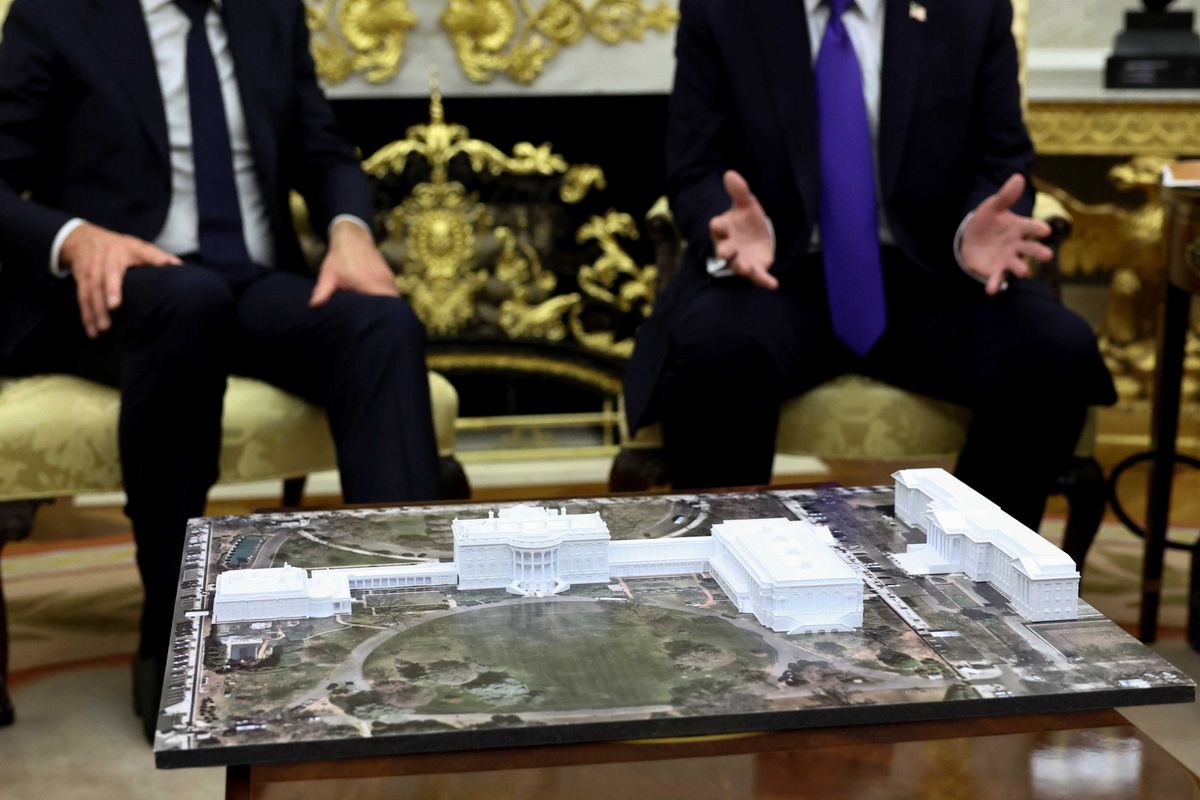
Donald Trump speaks near a model of the new White House ballroom. 
REUTERS/Kevin Lamarque

By R. Grant Gilmore III, Director, 
Historic Preservation and Community Planning Program, College of Charleston

From ancient Egypt to Washington, D.C., rulers have long used architecture and associated stories to project power, control memory and shape national identity. As 17th-century French statesman Jean-Baptiste Colbert observed:
“In the absence of brilliant deeds of war, nothing proclaims the greatness and spirit of princes more than building works.”

Today, the Trump administration is mobilizing heritage and architecture as tools of ideology and control. In U.S. historic preservation, “heritage” is the shared, living inheritance of places, objects, practices and stories — often plural and contested — that communities value and preserve. America’s architectural heritage is as diverse as the people who created, inhabited and continue to care for it.

As an archaeologist with three decades of practice, I read environments designed by humans. Enduring modifications to these places, especially to buildings and monuments, carry power and speak across generations.

In his first term as president, and even more so today, Donald Trump has pushed to an extreme legacy-building through architecture and heritage policy. He is remaking the White House physically and metaphorically in his image, consistent with his long record of putting his name on buildings as a developer.

In December 2020, Trump issued an executive order declaring classical and traditional architectural styles the “preferred” design for new federal buildings. The order derided Brutalist and modernist structures as inconsistent with national values.

Now, Trump is seeking to roll back inclusive historical narratives at U.S. parks and monuments. And he is reviving sanitized myths about America’s history of slavery, misogyny and Manifest Destiny, for use in museums, textbooks and public schools.

Yet artifacts don’t lie. And it is the archaeologist’s task to recover these legacies as truthfully as possible, since how the past is remembered shapes the choices a nation makes about its future.

Architecture as political power and legacy

Dictators, tyrants and kings build monumental architecture to buttress their own egos, which is called authoritarian monumentalism. They also seek to build the national ego — another word for nationalism.

Social psychologists have found that the awe we experience when we encounter something vast diminishes the “individual self,” making viewers feel respect and attachment to creators of awesome architecture. Authoritarian monumentalism often exploits this phenomenon. For example, in France, King Louis XIV expanded the Palace of Versailles and renovated its gardens in the mid-1600s to evoke perceptions of royal grandeur and territorial power in visitors.

Many leaders throughout history have built “temples to power” while erasing or overshadowing the memory of their predecessors — a practice known as damnatio memoriae, or condemnation to oblivion.

In the ancient world, the Sumerians, Babylonians, Egyptians, Romans, Chinese dynasties, Mayans and Incas all left behind architecture that still commands awe in the form of monuments to gods, rulers and communities. These monuments conveyed power and often served as instruments of physical and psychological control.

In the 19th century, Napoleon fused conquest with heritage. Expeditions to Egypt and Rome, and the building of Parisian monuments — the Arc de Triomphe and the Vendôme Column, both modeled on Roman precedents — reinforced his legitimacy.

Albert Speer’s and Hermann Giesler’s monumental neoclassical designs in Nazi Germany, such as the party rally grounds in Nuremberg, were intended to overwhelm the individual and glorify the regime. And Josef Stalin’s Soviet Union suppressed avant-garde experimentation in favor of monumental “socialist realist” architecture, projecting permanence and centralized power.

Now, Trump has proposed building his own triumphal arch in Arlington, Virginia, just across the Potomac River from the Lincoln Memorial, as a symbol to mark the 250th anniversary of the Declaration of Independence.

An American alternative

Born of Enlightenment ideals of John Locke, Voltaire and Adam Smith, the American Revolution rejected the European idea of monarchs as semi-divine rulers. Instead, leaders were expected to serve the citizenry.

That philosophy took architectural form in the Federal style, which was dominant from about 1785 to 1830. This clear, democratic architectural language was distinct from Europe’s ornate traditions, and recognizably American.

Its key features were Palladian proportions — measurements rooted in classical Roman architecture — and an emphasis on balance, simplicity and patriotic motifs.

James Hoban’s White House and Thomas Jefferson’s Monticello embodied this style. Interiors featured lighter construction, symmetrical lines, and motifs such as eagles, urns and bellflowers. They rejected the opulent rococo styles associated with monarchy.

Americans also recognized preservation’s political force. In 1816, the city of Philadelphia bought Independence Hall, which was constructed in 1753 and was where the Declaration of Independence and the Constitution were debated and signed, to keep it from being demolished. Today the building is a U.S. National Park and a UNESCO World Heritage Site.

Early preservationists saved George Washington’s home, Mount Vernon, Jefferson’s Monticello, and other landmarks, tying democracy’s endurance to the built environment.

Architecture, memory and Trump

In remaking the White House and prescribing the style and content of many federal sites, Trump is targeting not just buildings but the stories they tell.

By challenging narratives that depart from white, Anglo-Saxon origin myths, Trump is using his power to roll back decades of work toward creating a more inclusive national history.

These actions ignore the fact that America’s strength lies in its identity as a nation of immigrants. The Trump administration has singled out the Smithsonian Institution — the world’s largest museum, founded “for the increase and diffusion of knowledge — for ideological reshaping. Trump also is pushing to restore recently removed Confederate monuments, helping to revive "Lost Cause” mythology about the Civil War.

Trump’s 2020 order declaring classical and traditional architectural styles the preferred design for government buildings echoed authoritarian leaders like Adolf Hitler and Stalin, whose governments sought to dictate aesthetics as expressions of ideology. The American Institute of Architects publicly opposed the order, warning that it imposed ideological restrictions on design.

Trump’s second administration has advanced this agenda by adopting many recommendations in the Heritage Foundation’s Project 2025 blueprint. Notably, Project 2025 calls for repealing the 1906 Antiquities Act — which empowers presidents to quickly designate national monuments on federal land — and for shrinking many existing monuments. Such rollbacks would undercut the framework that has safeguarded places like Devils Tower in Wyoming and Muir Woods in California for over a century.

Trump’s new ballroom is a distinct departure from the core values embodied in the White House’s Federal style. Although many commentators have described it as rococo, it is more aligned with the overwrought and opulent styles of the Gilded Age — a time in American history, from about 1875 through 1895, with many parallels to the present.

In ordering its construction, Trump has ignored long-standing consultation and review procedures that are central to historic preservation. The demolition of the East Wing may have ignored processes required by law at one of the most important U.S. historic sites. It’s the latest illustration of his unilateral and unaccountable methods for getting what he wants.

Instruments of memory and identity

When leaders push selective histories and undercut inclusive ones, they turn heritage into a tool for controlling public memory. This collective understanding and interpretation of the past underpins a healthy democracy. It sustains a shared civic identity, ensures accountability for past wrongs and supports rights and participation.

Heritage politics in the Trump era seeks to redefine America’s story and determine who gets to speak. Attacks on so-called “woke” history seek to erase complex truths about slavery, inequality and exclusion that are essential to democratic accountability.

Architecture and heritage are never just bricks and mortar. They are instruments of memory, identity and power.


'So little respect': Trump 'pillages' as he turns the White House into a 'shipwreck'


October 25, 2025 | ALTERNET


The White House East Wing existed, in different forms, for 123 years. The East Wing was unveiled in its original form under Republican President Teddy Roosevelt in 1902 before undergoing a major expansion and renovation under Democratic President Franklin Delano Roosevelt 40 years later. But in late October, the East Wing was demolished altogether on orders from President Donald Trump — who is planning to replace it with a massive ballroom.

In her October 25 opinion column, the New York Times' Maureen Dowd points to the demolition of the East Wing as symbolic of a broader problem: Trump, during his second presidency, is "governing" by "whims" and has tossed aside the United States' long "We the People" tradition.

"Trump has so little respect for this 123-year-old symbol of American history that he didn't check with federal planning officials or Congress before he obliterated one side of the White House," Dowd argues. "As if he's tearing down a gas station. When I visited the White House with my mom as a kid, we loved overhearing foreign tourists ooh and ahh about how relatively small and modest the house was. Its simplicity was part of its charm…. Trump does not do small or modest. He does big, flashy odes to self."

The demolition of the East Wing, Dowd adds, is only one example of Trump's indifference to the views of others.

"It's a slam-dance presidency that delights in transgressing and provoking," Dowd laments. "Build a $300 million, 90,000-square-foot gilt ballroom — which will overshadow the central edifice — while the government is shut and people have been thrown out of work; plaster tacky gold all over the Oval; sue everyone willy-nilly; put foes through legal torture; send troops to American cities; shrug off due process and blow alleged drug runners out of the water…. After turning the Justice Department into his own vigilante posse, Trump now wants to warp the once-esteemed department even more…. Trump once thought nothing of aiming to overthrow the government he ran. Now, he thinks nothing of threatening to sue the government he runs if he isn't allowed to pay himself a quarter-billion dollars."

Dowd continues, "'We the People' is quaint. Now, we are governed by the whims of one person."

Trump, the New York Times columnist emphasizes, "can indulge any crazy impulse, and nobody is able to check him."

"Congress is adrift," Dowd writes. "The White House is a shipwreck. Trump is marauding in the Caribbean. (Former FBI Director) James Comey and (New York State Attorney General) Letitia James are being forced to walk the plank, and next up could be (former special counsel) Jack Smith and (Sen.) Adam Schiff. We are awash in nautical metaphors as the president plunders and pillages. He’s a pirate — and not the fun Halloween kind."

Maureen Dowd's full New York Times column is available at this link (subscription required).


Why Trump is really tearing down the White House


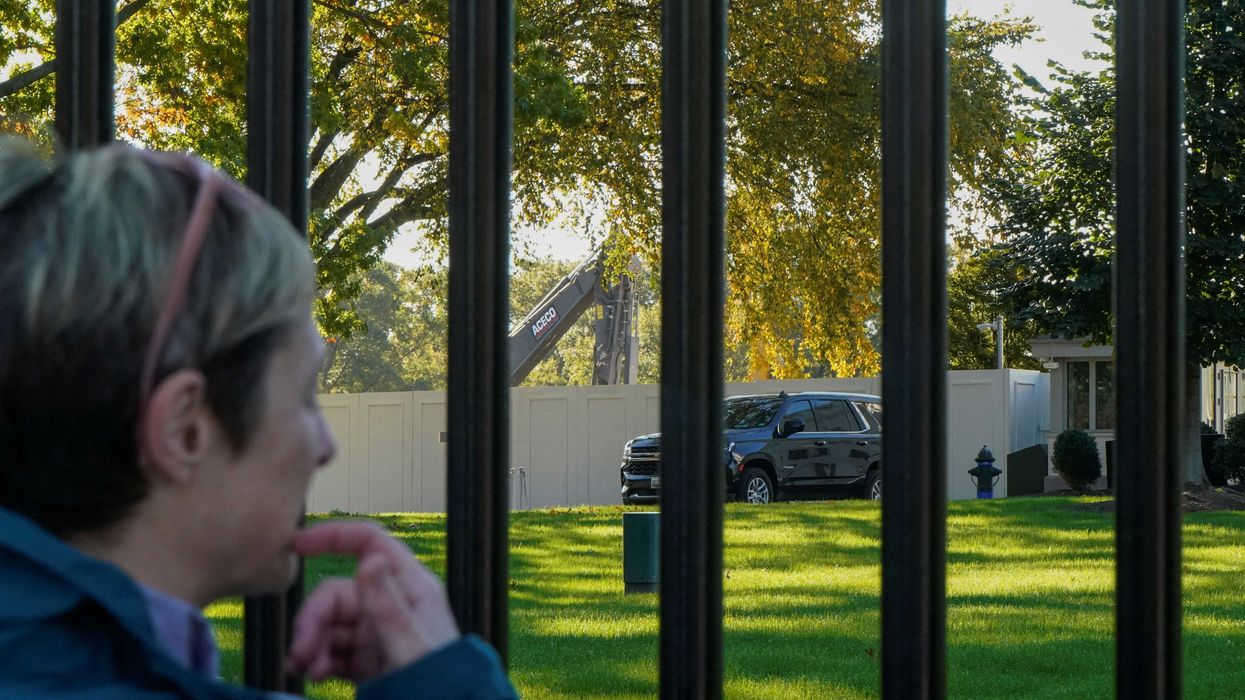
A person looks through the fence at Pennsylvania Avenue, as demolition work continues at the East Wing of the White House, where U.S. President Donald Trump's proposed ballroom is being built, in Washington, D.C., U.S., October 24, 2025. 
REUTERS/Elizabeth Frantz
October 25, 2025 
ALTERNET

Adam Gopnik tells the New Yorker that Trump destroying the White House is a performance display broadcasting his unbroken power over the presidency.

“After months marked by corruption, violence, and the open perversion of law, to gasp in outrage at the loss of a few tons of masonry and mortar might seem oddly misjudged,” said Gopnik. “And yet it isn’t. We are creatures of symbols, and our architecture tells us who we are.”

A nation writes its history in books, but its buildings is a kind of enduring book itself. The Eiffel Tower is an expression of a nation’s history, as is the Lincoln Memorial. The White House’s East Wing, however, was a place of accomplishment. Franklin Roosevelt created room for staff and military protection. Eleanor Roosevelt hosted women journalists. It was there that Jacqueline Kennedy presided founded the White House Historical Association. Rosalynn Carter established an office there and used it for a host of benevolent endeavors, including mental health advocacy and humanitarian work, including helping pass the Mental Health Systems Act of 1980 and global human rights initiatives.

“All of that is now gone,” said Gopnik. “The act of destruction is precisely the point: a kind of performance piece meant to display Trump’s arbitrary power over the Presidency, including its physical seat. He asks permission of no one, destroys what he wants, when he wants. As many have noted, one of Trump’s earliest public acts, having promised the Metropolitan Museum of Art the beautiful limestone reliefs from the façade of the old Bonwit Teller building, was to jackhammer them to dust in a fit of impatience.”

Trump apologists argue that Jimmy Carter installed solar panels and Barack Obama put in a basketball court, but that’s “mismatched matching,” said Gopnik.

“[These] … earlier alterations were made incrementally, and only after much deliberation,” Gopnik said. “When Harry Truman added a not very grand balcony to the Executive Residence, the move was controversial, but the construction was overseen by a bipartisan commission. By contrast, [Trump’s] project — bankrolled by Big Tech firms and crypto moguls — is one of excess and self-advertisement. The difference between the Truman balcony and the Trump ballroom is all the difference in the world. It is a difference of process and procedure — two words so essential to the rule of law and equality, yet doomed always to seem feeble beside the orgiastic showcase of power.”

Architecture embodies values, argued Gopnik.

“The shock that images of the destruction provoke — the grief so many have felt — is not an overreaction to the loss of a beloved building. It is a recognition of something deeper: the central values of democracy being demolished before our eyes. Now we do not only sense it. We see it,” Gopnik said.


Read the New Yorker report at this link.


OPINION

Trump's new gilded ballroom is perfect


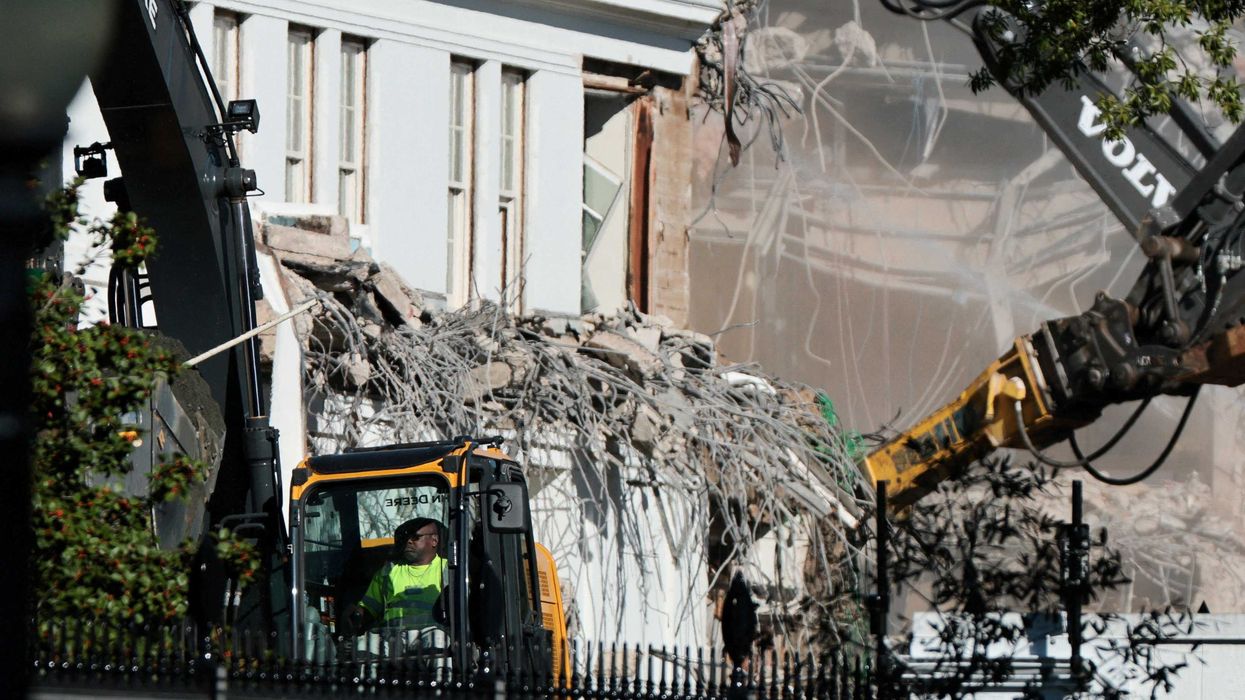
A demolition crew takes apart the facade of the East Wing of the White House, where U.S. President Donald Trump's proposed ballroom is being built, in Washington, D.C., U.S.,
 October 21, 2025. REUTERS/Jonathan Ernst

October 23, 2025 | ALTERNET

In the first Gilded Age, which ran from the 1890s through the 1920s, captains of American industry were dubbed “robber barons” for using their baronial wealth to bribe lawmakers, monopolize industry, and rob average Americans of the productivity of their labors.

Now, in a second Gilded Age, a new generation of robber barons is using their wealth to do the same — and to entrench their power.

The first Gilded Age was an era of conspicuous consumption. The second is an era of conspicuous influence.

The new robber barons are having their names etched into the pediments of the giant new ostentatious ballroom Trump is adding to the White House.

They already own — and influence — much of the news Americans receive. And they are eager to promote their views.

Marc Benioff, the billionaire founder and CEO of Salesforce, told The New York Times that Trump should send the National Guard to San Francisco. (After his remarks drew condemnation from many of the city’s civic leaders, he apologized. He seems about to get his wish nonetheless.)

Marc Rowan, the billionaire chief executive of Apollo Global Management, is the force behind Trump’s recent “compact” calling on universities to limit international students, protect conservative speech, require standardized testing for admissions, and adopt policies recognizing “that academic freedom is not absolute,” among other conditions. The Trump regime dangled “substantial and meaningful federal grants” for universities that agree.

(It didn’t work. Seven of the nine universities approached rejected the deal.)

Billionaire Stephen A. Schwarzman, the chief executive of Blackstone, is also shaping the Trump regime’s campaign to upend American higher education. Schwarzman has emerged as a key intermediary between Trump and Harvard University.

Other of America’s new robber barons are rapidly consolidating their control over what Americans read, hear, and learn about what’s occurring in our country and the world. They include Jeff Bezos; Larry Ellison and his son, David; Mark Andreessen; Rupert Murdoch; Charles Koch; Tim Cook; Mark Zuckerberg; and, of course, Elon Musk.

Perhaps the new robber baron’s most lasting impression on the U.S. government will be the lavish White House ballroom Trump is constructing — a 90,000-square-foot, gold-leafed, glass-walled banquet room that will literally overshadow the so-called People’s House.

It will not be an assembly hall, dance hall, music hall, dining hall, village hall, or town hall. It will be a giant banquet and ballroom designed to accommodate 650 wealthy VIPs.

Trump claims that the East Room, the largest room in the White House, is too small. Its capacity is 200 people. He doesn’t like the idea of hosting kings, queens, and prime ministers in pavilions on the South Lawn.

Trump’s real intention is to have the White House resemble Versailles.

Potential billionaire donors have already received pledge agreements for “The Donald J. Trump Ballroom at the White House.” In return for donations, contributors are eligible for “recognition associated with the White House Ballroom.”

Their names will be etched in the ballroom’s brick or stone edifice.

Trump last week hosted a dinner at the White House for the project’s donors, which included representatives from Microsoft, Google, Palantir, and other companies, as well as Schwarzman, Cameron and Tyler Winklevoss, and other billionaires.

Meredith O’Rourke, a top political fundraiser for Trump, is leading the effort, paired with the Trust for the National Mall, an organization that supports the National Park Service.

The trust’s nonprofit status means donations come with a federal tax write-off.

Construction began Monday. Trump is now literally taking a wrecking ball to the White House — sending parts of the East Wing’s roof, the building’s exterior, and portions of its interior crumbling to the ground.

It seems fitting that in this second Gilded Age — an age of conspicuous influence and affluent access — the People’s House will be replaced by the Billionaire’s House.

Robert Reich is a professor of public policy at Berkeley and former secretary of labor. His writings can be found at https://robertreich.substack.com/.

‘We’ve put the blindfolds on’: Economist warns of dire economic path under Trump


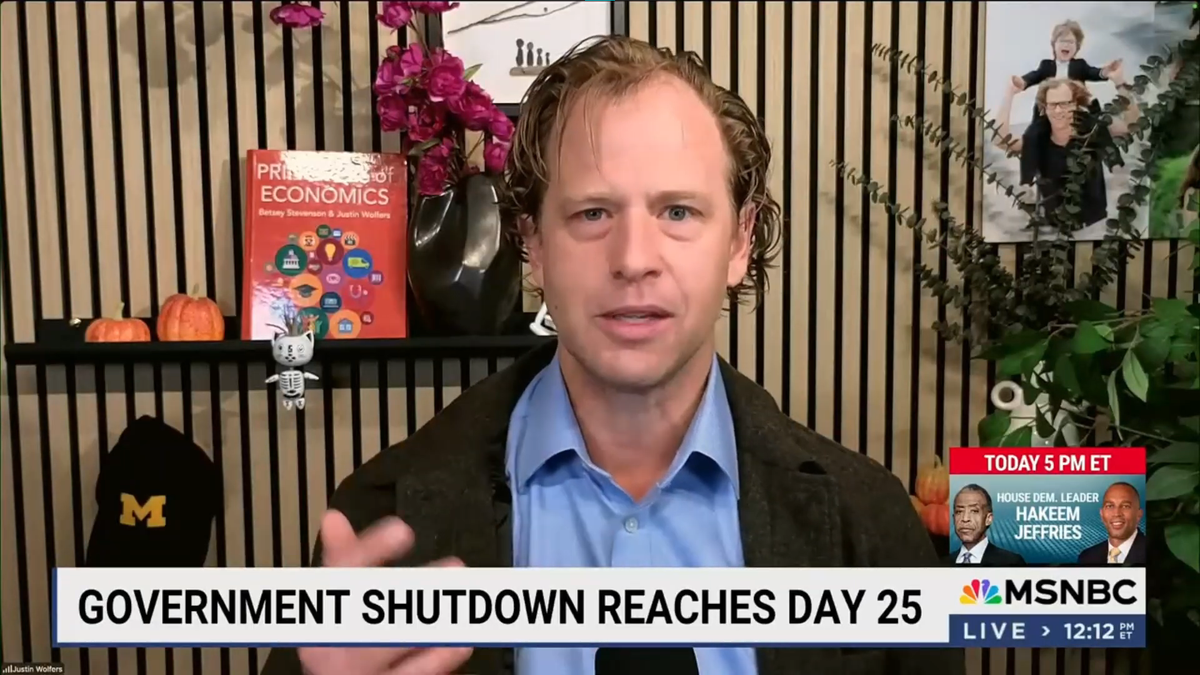
Economist Justin Wolfers appears on MSNBC, Oct. 25, 2025. (MSNBC/Screengrab)

Australian economist Justin Wolfers issued a dire warning Saturday on the direction of the economy under President Donald Trump, equating the administration’s freeze on releasing key economic data to steering a ship through fog wearing “blindfolds.”

“It becomes very hard to know how to steer the ship when you don't have a lot of data,” Wolfers said, appearing on MSNBC’s “Velshi.”

Lapses in the release of key economic data include the monthly jobs report from the Bureau of Labor Statistics, which was withheld after Trump fired BLS Administrator Erika McEntarfer over a poor jobs report in August, and the monthly inflation report, the release of which has been postponed, likely until December at the earliest.


The Federal Reserve – responsible for setting interest rates – must manage Trump’s unpredictable policy decisions, Wolfers said, already a difficult task. But coupled with the lack of reliable and comprehensive economic data, he said, will only exacerbate the already precarious position of the U.S. economy.

“So already the job is hard, we're steering through fog at a critical moment; it could be that the economy's on the cusp of recession, it literally could be the economy's on the cusp of an AI-driven boom,” Wolfers said.

“Then, what we've done is we've put the blindfolds on [and] said 'no more data for you!' Our best numbers, the most reliable numbers are completely missing right at the point where we could be at a turning point.”

The Federal Reserve is expected to cut interest rates again next week based on inflation rising at a lower-than-expected rate. With several recession indicators “flashing bright red,” however, the Fed will essentially be “blindfolded” in how to best approach the coming months, Wolfers warned.


“The Fed is going to try to steer our economy through the fog, [and] there's extra fog because there's so much change,” Wolfers said. “Tariffs are on one day, they're off the next, fiscal policy is changing day to day, the president's changing his mind on just about every issue on any day that happens to end in a 'Y.'


These insane ICE weapons buys reveal something truly sinister about Trump's intentions

Sabrina Haake
October 25, 2025
RAW STORY


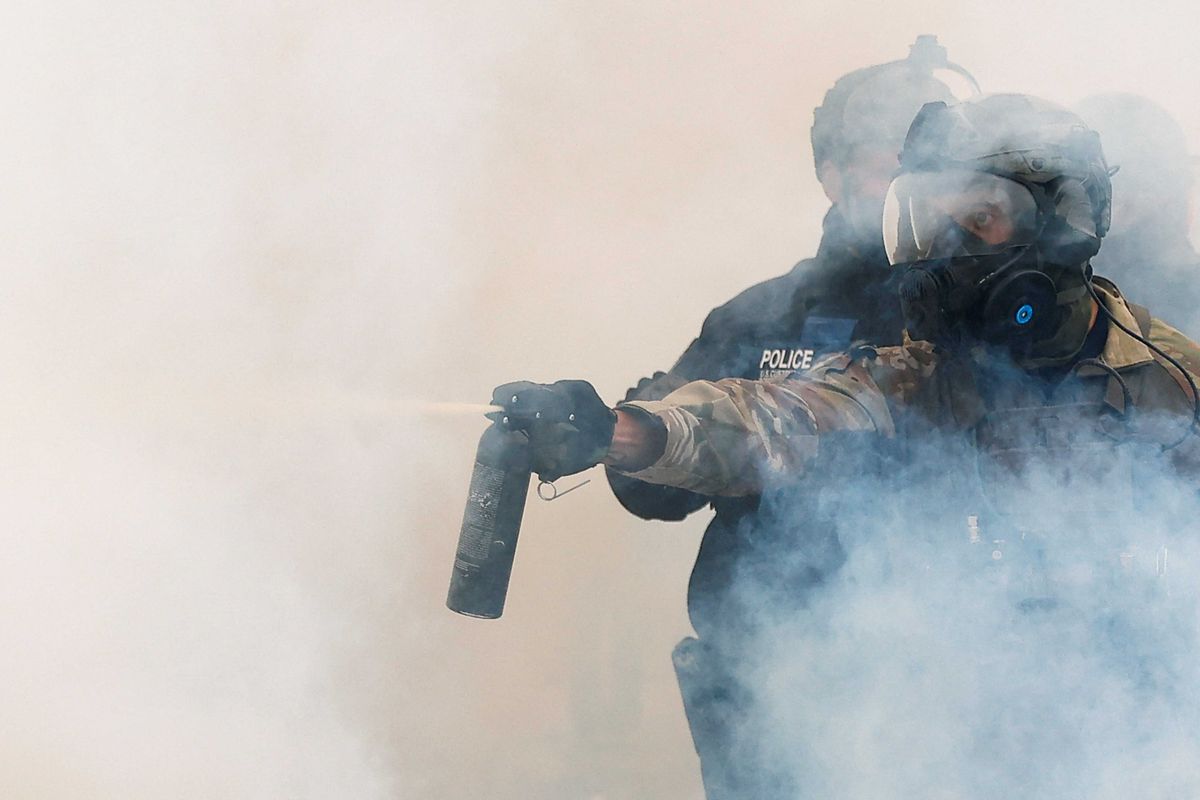
A Federal agent sprays pepper spray through tear gas at an ICE facility in Portland. REUTERS/John Rudoff


Back in February, the thinking public scratched its collective head as Elon Musk and DOGE took a chainsaw to agencies that serve the public. Federal agencies created to protect public health, serve veterans, advance education, maintain infrastructure, keep the public informed, and protect the safety of air and water were largely dismantled. Even before the government shutdown, those agencies were either closed or not functioning, operating with skeleton crews.

This month, the reason for the mass destruction crystallized: Trump and Russell Vought, architect of authoritarian cookbook Project 2025, stripped federal service budgets in order to move those dollars to another ledger, the one that funds federal agencies that control, police and punish the public. Those budgets have exploded, none more than that of the U.S. Immigration and Customs Enforcement (ICE).

Analysis of government procurement data first reported by Popular Information shows a 700 percent increase in weapons spending by ICE this year. From January to October 2024, ICE spent under $10 million on weapons. For the same period ending this month, that amount jumped to more than $71 million.

Even more alarming than the amount is what ICE spent it on. Public data from the Federal Procurement Data System (FPDS) show that ICE procured chemical weapons, “guided missile warheads” and other explosive components. (Note: Wired reports some confusion over how the purchase was categorized and concludes that ICE “probably” didn’t purchase guided missile components, but the entry on the procurement system says they did.)
WTF does ICE want with such weapons?

Americans who watch something other than Fox News’ curated reality show have already seen videos of masked ICE agents engaging in wildly disproportionate violence against members of the media and public. Over the past few weeks, federal officers shot a woman five times in Chicago, killed a man during an arrest attempt in the suburbs, and shot a priest in the head with a pepper ball, knocking him to the ground, even as he was holding his arms up in prayer.

If shooting, body slamming, and menacing members of the public at close range wasn’t enough, now ICE will have access to even more chemical weapons. ICE has already lobbed chemical irritants like tear gas, pepper spray, HC smoke grenades, and pepper balls at peaceful protesters just to create the appearance of chaos for right-wing consumption; it is unclear what an unhinged and vengeful president might order them to do with nerve agent-adjacent chemicals.

Purchasing guided missile components for ICE would be equally astounding. A “guided missile” is any missile that uses a guidance system to steer toward a target. Such missiles can destroy a target with conventional, chemical, or biological warheads. “Guided” just means the missile can navigate and adjust its flight path to a chosen target along the way, using technologies like GPS and terrain mapping.

Since Kristi Noem keeps repeating false claims that ICE only engages in brutality when agents feel threatened, query what legitimate need those agents could possibly have to strike a person, car or building that’s miles away.

A toddler with the nuclear codes

Trump, who openly fantasizes about shitting on and destroying half the county, even as he literally destroys the White House like he owns it, probably thinks he could nuke California and get away with it. Never mind that California has the world’s fourth-largest economy, contributing $81 billion more to the federal government than it receives — long-term, mid-term and even immediate consequences are not accessible to Trump’s pre-frontal cortex.

ICE is also building a public surveillance system that would make Vladimir Putin and Xi Jinping salivate. The “crowd control” surveillance system features iris scanners that photograph and record facial measurements. The system includes phone hacking and tracking, and facial recognition tools loading data into AI.


ICE has partnered with Palantir Technologies, a software company co-founded by JD Vance’s BFF and anti-democracy mentor, Peter Thiel. Palantir plans to use artificial intelligence and data mining to identify, track, and deport suspected noncitizens, collecting data on US citizens along the way. According to Business Insider, ICE is paying Palantir $30 million for the platform; Palantir was slated to deliver a prototype of the ImmigrationOS platform in September.

Keep in mind that Trump has increased spending on deadly weapons for ICE by over 700 percent, yet ICE continues to claim it can’t afford bodycams for its masked agents.

Judd Legum at Popular Information sums it up: “If the immigration enforcement apparatus of the United States were its own national military, it would be the 13th-most heavily funded in the world. This puts it higher than the national militaries of Poland, Italy, Australia, Canada, Turkey, and Spain — and just below Israel.”

Trump is building a police state to keep himself in power

Stephen Miller recently told assembled law enforcement officers in Memphis, Tennessee, that they should now consider themselves “unleashed.” Addressing a “crime task force” comprised of ICE, local police, the FBI, U.S. Marshals, and the Bureau of Alcohol, Tobacco, Firearms and Explosives, Miller encouraged them to go forward and “police aggressively,” concluding his talk with praise for their anticipated ruthlessness.

It’s the same unhinged directive for “unrestrained lethality” Secretary of Defense Pete Hegseth delivered to military generals at Quantico last month.


It’s all of a piece: deploying the military against US citizens, pitting red states against blue, and arming masked ICE agents with sophisticated tools of war signal that Trump is building his own domestic paramilitary force to try to remain in power past 2028.

We have to admit this reality before we can prepare to meet it.


Sabrina Haake is a columnist and 25+ year federal trial attorney specializing in 1st and 14th A defense. Her Substack, The Haake Take, is free.


'Not a joke': Internet aghast as Trump orders higher tariffs because Canada 'made him sad'


David McAfee
October 25, 2025 
 RAW STORY


Donald Trump Saturday announced higher tariff rates on Canada, specifically because of an anti-tariff ad using Ronald Reagan's own words, and spurred outrage from observers.

The president has for days raged about the ad, which plays the words of Reagan talking about the dangers of imposing too many barriers to trade on other countries. Then, Trump imposed real consequences over the weekend.

"Canada was caught, red handed, putting up a fraudulent advertisement on Ronald Reagan’s Speech on Tariffs," Trump claimed. "The Reagan Foundation said that they, 'created an ad campaign using selective audio and video of President Ronald Reagan. The ad misrepresents the Presidential Radio Address,' and 'did not seek nor receive permission to use and edit the remarks. The Ronald Reagan Presidential Foundation and Institute is reviewing its legal options in this matter.' The sole purpose of this FRAUD was Canada’s hope that the United States Supreme Court will come to their 'rescue' on Tariffs that they have used for years to hurt the United States."

He then announced the 10% boost to tariffs for Canada.

That didn't sit well with onlookers, including White House correspondent Andrew Feinberg, who said, "Let’s be clear about what this is. Canada isn’t paying a godd---- thing."

"He’s increasing taxes on Americans by executive fiat because he didn’t like an advertisement that quoted Reagan’s (accurate) views on tariffs," he then added. "You (and I) are paying these taxes — not Canada."

MeidasTouch chimed in with, "Trump says he’s increasing tariffs on imports of Canadian goods by 10% because Ontario’s commercial that accurately used Ronald Reagan’s words about tariffs made him sad."

Economist Justin Wolfers said, "It just got 10% dumber."

"Not a joke: Trump just imposed an additional 10 percent tariff on Canada because he still doesn't understand that Reagan was a vehement free trader," he then added.

Tax analyst Erica York said, "The President should not have the power to arbitrarily impose tariffs."

"Is the new 10% tariff on imports from Canada related to the fentanyl emergency or the reciprocal trade emergency or are hurt feelings also now a national emergency?" she further added.

'Fraud': Trump announces higher tariff rates on key ally over latest 'hostile act'

David McAfee
October 25, 2025 4:55PM ET
RAW STORY

Donald Trump on Saturday announced a new, higher tariff rate on Canada after the airing of an advertisement that used Ronald Reagan's words against the current president.

The president has for days raged about the ad, which plays the words of Reagan talking about the dangers of imposing too many tariffs on other countries.

Now, he is imposing real consequences.

"Canada was caught, red handed, putting up a fraudulent advertisement on Ronald Reagan’s Speech on Tariffs," Trump claimed. "The Reagan Foundation said that they, 'created an ad campaign using selective audio and video of President Ronald Reagan. The ad misrepresents the Presidential Radio Address,' and 'did not seek nor receive permission to use and edit the remarks. The Ronald Reagan Presidential Foundation and Institute is reviewing its legal options in this matter.' The sole purpose of this FRAUD was Canada’s hope that the United States Supreme Court will come to their 'rescue' on Tariffs that they have used for years to hurt the United States."

Trump then added, "Now the United States is able to defend itself against high and overbearing Canadian Tariffs (and those from the rest of the World as well!)."

"Ronald Reagan LOVED Tariffs for purposes of National Security and the Economy, but Canada said he didn’t! Their Advertisement was to be taken down, IMMEDIATELY, but they let it run last night during the World Series, knowing that it was a FRAUD," he further claimed. "Because of their serious misrepresentation of the facts, and hostile act, I am increasing the Tariff on Canada by 10% over and above what they are paying now. Thank you for your attention to this matter!"

Read the post here.