Monday, October 27, 2025


Almonty buys US tungsten project in bid to resume local supply


Credit: Almonty Industries

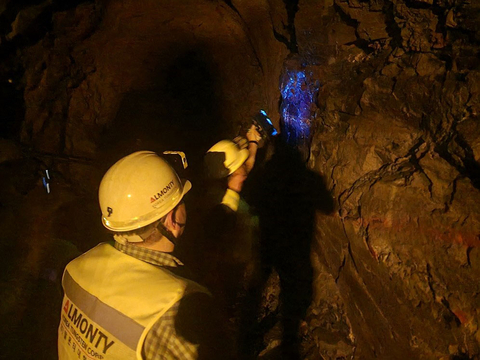
Almonty Industries Inc. agreed to buy a tungsten project in Montana, with plans to quickly turn it into the first US mine in a decade to produce a metal used in weapons and semiconductors.

The Toronto-based company is acquiring the Gentung-Browns Lake project, which was formerly operated by Union Carbide Corp., paying with stock and cash, it said Monday, without identifying the seller. Almonty shares pared declines on the news.

Subject to obtaining an extraction permit, Almonty could restart mining there as soon as late-2026 using reconditioned equipment from its facilities in Spain. Water rights and pipes are already in place.

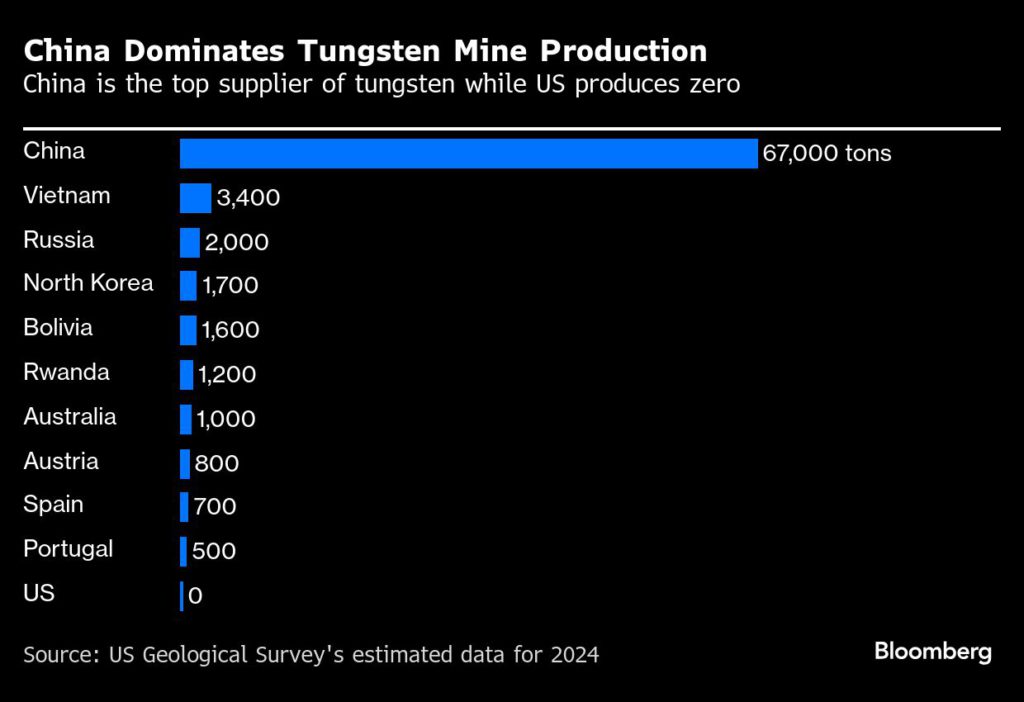
Almonty is joining the US push to reduce its reliance on China for the super-dense niche metal used in armor-piercing munitions as part of a broader push for critical-mineral independence. President Donald Trump has exempted tungsten from his country-based tariffs given the US ceased commercial production a decade ago amid falling prices. Since then, it’s relied on imports and recycling.

The acquisition is Almonty’s latest effort to boost its US presence after listing shares on the Nasdaq in July and announcing plans to redomicile to Delaware. It’s also holding supply talks with the Department of Defense, chief executive officer Lewis Black said.

Almonty sees the purchase of an existing asset in the US as a good complement to its large-scale project in South Korea, which is about to start producing, and a smaller mine in Portugal.

Tungsten concentrate produced in the US could be sold to companies such as Global Tungsten & Powders Corp., Kennametal Inc. or Buffalo Tungsten Inc., where it would be processed into a powder and then into a carbide and other tungsten-bearing alloys.

Besides the asset purchase, Almonty has also been in discussions for the past several months with US agencies, including the Defense Advanced Research Projects Agency, or Darpa, Black said.

Rather than seeking funding or bringing in the Pentagon as a shareholder, Almonty is proposing state purchases of tungsten using transparent, market-based prices.

The firm’s shares are up more than 600% in the past year as trade tensions stoke tungsten supply concerns. The stock was down 3% at 3:26 a.m. in New York on Monday after falling as much as 11%.

(By James Attwood)

Milei’s win cements US partnership (OWNERSHIP) in Argentina’s mining

MINING.COM Editor | October 27, 2025 | 4:49 am Battery Metals Energy Markets Latin America USA Copper Lithium Oil and Gas 

President Javier Milei’s party pulled off a surprisingly strong victory in the legislative elections. (Image: Screenshot from 20minutos report.)

Argentina’s bid to unlock its vast lithium, copper, oil and gas reserves has gained fresh momentum after President Javier Milei led his far-right party to a landslide victory in Sunday’s midterm elections. 

The sweeping win consolidates his hold on power and strengthens his alliance with Washington, analysts say. It follows two turbulent years marked by Milei’s radical spending cuts and deregulation measures aimed at stabilizing the economy. The victory also comes after a campaign in which US President Donald Trump announced a $20-billion bailout for Argentina and tied continued aid to Milei’s success at the polls.

As Milei’s administration embarks on the second half of its term, analysts say the political stability provided by this result could prove decisive for Argentina’s efforts to develop its energy and mining potential.

Milei rose to power on a wave of outsider appeal but without an established political base. His coalition, La Libertad Avanza, remains fragile, and a 14-point defeat in Buenos Aires province exposed the limits of his combative style. 

“Milei understands he must now build consensus,” political reporter Gabriel Ziblat said ahead of the elections. “He can’t govern by aggression alone.”

Despite earlier political uncertainty, Argentina’s economy has shown rare signs of stability. The US Treasury’s support package underscored Washington’s initial strategic bet on Milei’s reforms and the country’s mineral wealth, a bet that could potentially reach $40 billion. “It’s a major wager,” Ryan Berg of the Center for Strategic and International Studies, said last week. “If Argentina succeeds, it could become the model for deeper US partnerships across Latin America.”

Before the midterms, analysts had cautioned that a loss of more than 10 points could trigger market volatility and weaken Milei’s congressional leverage. Instead, his decisive win gives him the political space to continue his reform program and pursue deeper ties with Washington.

Lithium, oil and gas

For investors, Argentina’s natural resources remain a powerful draw, provided infrastructure and political stability catch up. “The provinces are where the real opportunities lie,” Argentine journalist Guadalupe Vázquez said. “But none of it works if the macroeconomy collapses.”

Ziblat argued that credible macroeconomic management and deeper provincial engagement from foreign investors, especially from the US, will decide whether the mining sector accelerates or stalls. Berg described Washington’s $20-billion Exchange Stabilization Fund commitment as both a strategic gamble on Milei’s reform path and a signal that Argentina can offer predictable conditions for large-scale projects. Confidence, he noted, is crucial in mining, where long lead times and heavy capital costs demand policy continuity.

Not since the free-market revolutions of 1990s Eastern Europe has a leader attempted to rewrite the investment playbook so completely, and so quickly, as Milei. Already, he’s witnessed the $4.1-billion BHP (ASX: BHP) and Lundin Mining (TSX: LUN) tie-up over Filo Corp. in the country, as well as Rio Tinto’s (ASX: RIO) $6.7-billion purchase of Arcadium, which has two of its three lithium projects in Argentina.

Infrastructure and stability

Infrastructure, however, remains the sector’s main bottleneck, the panellists said. Many high-grade deposits sit far from paved roads and export hubs, inflating costs and slowing timelines. Analysts pointed to the revival of the Belgrano Cargas state-owned freight network, now moving to tender with open-access rules that allow mining firms to operate their own trains, as evidence that the government is prioritizing logistics to connect northern mining provinces with ports.

Integrating rail into mining production enables the sector to move large volumes of raw materials and key components required for the installation and operation of mining projects, a costly process demanding major investment, they said.

Clear rules

Regulatory stability is emerging as the other critical pillar. The government’s Regime for Large Investments (RIGI) seeks to anchor multibillion-dollar projects with tax and legal certainty while promoting coordination with provincial governors, who control key mining permits under Argentina’s federal system. Panellists said US firms should “go local,” following China’s province-level strategy that has led to swift deals often bundled with infrastructure.

If the current policy mix endures, analysts expect an industrial and export surge led by the Vaca Muerta shale formation. Oil alone could generate about $30 billion annually within five years, which is roughly on par with Argentina’s historic soy exports. Shale gas, lithium and potential copper output could further strengthen the country’s role in global energy transition supply chains.

However, market jitters over exchange-rate policy and election outcomes can quickly unsettle financing conditions, panellists warned. Sustained coalition-building and disciplined communication will be as vital as the legal framework itself.

The consensus is that Argentina’s geology offers a rare opportunity, but only consistent rules, reliable infrastructure and a durable US–Argentina alignment will turn resources into revenues. 

With a strengthened mandate and unprecedented US financial backing, Milei now faces his greatest challenge yet: translating political dominance into lasting economic transformation.


Rio Tinto flags uncertain future at Australia’s largest aluminum smelter

Credit: Rio Tinto

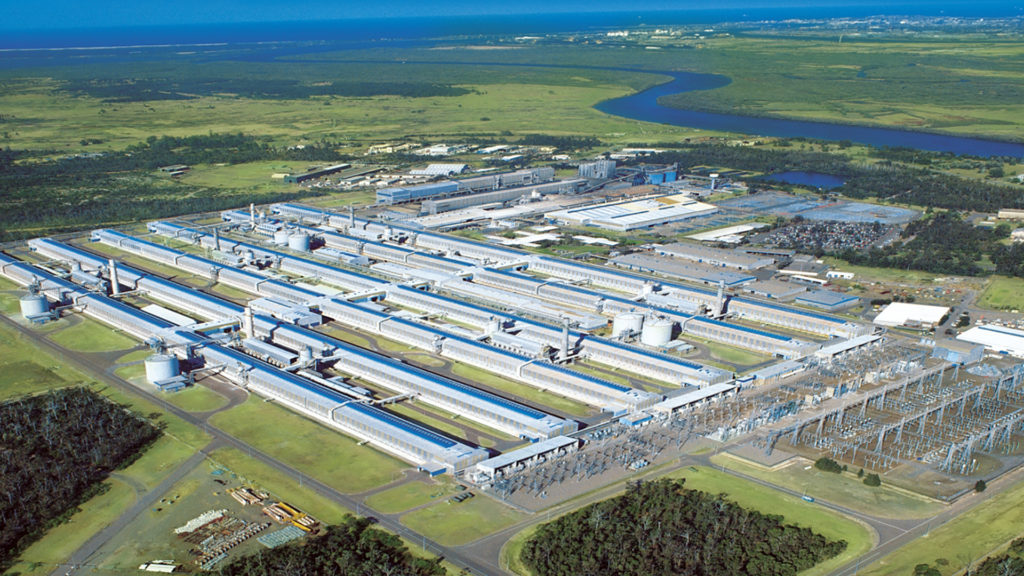
Rio Tinto warned on Tuesday that Australia’s largest aluminum smelter, Tomago, may be forced to shut down as it struggles to source power at commercially viable rates beyond 2028 when its current power deal expires.

Tomago Aluminium is the biggest power user in New South Wales state, and like a slew of Australian smelters that are struggling with high energy prices as the country transitions to renewables, it was built last century to take advantage of Australia’s plentiful and cheap coal.

Power makes up more than 40% of Tomago’s operating costs, and both coal-fired and renewable options are expected to rise sharply in price once its existing contract expires, jeopardizing the smelter’s commercial future, Rio Tinto said.

“Finding competitively priced energy remains the central challenge,” Rio Tinto said.

Despite months of consultations, and with its electricity supply contract with AGL Energy expiring in December 2028, Tomago has been unable to lock in an economically viable electricity deal beyond 2028, Rio Tinto said. AGL did not immediately respond to a request for comment.

The warning underscores the growing strain high energy costs are placing on Australia’s heavy industries, particularly those that rely on large, steady power supplies.

Australia’s metals processing sector has been squeezed by rising energy and labour costs. Earlier this month, the country announced a A$600 million ($390 million) bailout over three years for Glencore’s Mount Isa copper smelter and Townsville refinery. Trafigura’s Nyrstar lead and zinc operations and the Whyalla steel plant have also received government support.

“Unfortunately, all market proposals received so far show future energy prices are not commercially viable, and there is significant uncertainty about when renewable projects will be available at the scale we need,” Tomago Aluminium CEO Jerome Dozol said in a statement.

Rio Tinto has said that decarbonizing the assets needs solutions supported by state and federal governments.

Rio Tinto has started consulting with employees on the potential future of its operations, but has yet to reach a decision. Tomago has more than 1,000 full-time staff and 200 contractors.

The process is open until November 21 and will allow employees and union representatives to provide feedback on the proposal before making a final decision.

In February, former Rio chief Jakob Stausholm said he could not provide assurance on the future of Tomago due to high power prices and was aiming for clarity at mid-year.

Tomago is majority owned by Rio Tinto with a 51.55% stake, while Gove Aluminium holds 36.05% and Norsk Hydro has 12.4%.

AGL Energy and Norsk Hydro did not immediately respond to a request for comment. Gove Aluminium could not immediately be reached.

($1 = 1.5389 Australian dollars)

(By Shivangi Lahiri, Rishav Chatterjee and Melanie Burton; Editing by Anil D’Silva, Alan Barona and Richard Chang)


Rio Tinto launches corruption inquiry at Oyu Tolgoi


The underground expansion of Oyu Tolgoi is Rio’s most important growth project. (Image courtesy of Turquoise Hill.)

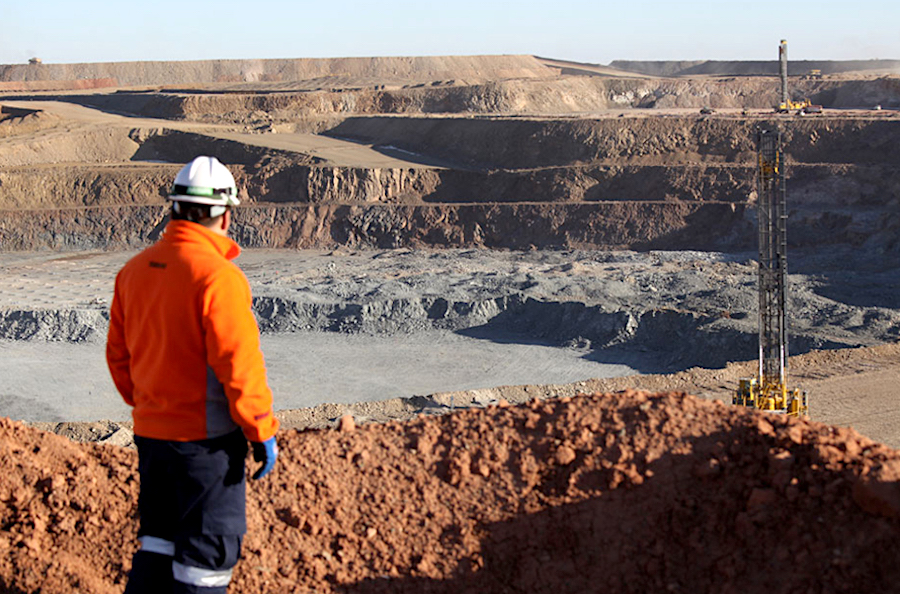
Rio Tinto Group subsidiary Oyu Tolgoi LLC is conducting an internal investigation into allegations of corruption and unethical conduct at its copper operations in Mongolia and has sought help from law enforcement.

“We are aware of allegations involving procurement-related activities, and conducting a comprehensive internal investigation, and have sought cooperation of law enforcement authorities,” Oyu Tolgoi said in a statement on social media. “As the investigation is ongoing, we are unable to provide further comment at this time.”

Rio owns 66% of Oyu Tolgoi LLC and operates the underground deposit, which it plans to make the world’s fourth-largest copper mine by 2030, with the Mongolian government holding the remainder. The site is one of Rio’s biggest and most valuable growth assets and while production soared 78% over the last quarter, development has been marred by year’s of political turbulence, cost overruns and delays.

Copper is pivotal to the Rio’s goal of reducing its reliance on iron ore while increasing exposure to the red metal used in electrification — demand for which is set to soar due to the energy transition and rise of data centers.


American Cruise Lines Announces 10 New U.S. Built Ships Through 2028

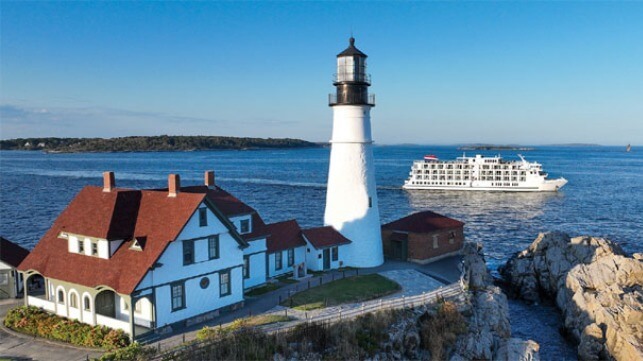
American Cruise Lines Patriot Class: American Pioneer.
American Cruise Lines Patriot Class: American Pioneer

Published Oct 27, 2025 7:31 PM by The Maritime Executive


[By American Cruise Lines]

American Cruise Lines is pleased to announce 10 new ships for the U.S. market beginning with American Pioneer debuting in Florida on October 31st. American Pioneer is the 2nd new Patriot Class ship the company has launched this year. The balance of the order will be delivered over the next 3 years, underscoring the company's commitment to the development and modernization of the U.S. market. All American's new boats will continue to sail domestically, operating itineraries across the Line's growing portfolio, including the Mississippi River, Alaska, and the East Coast. The new ships will also accelerate American's expansion into new niche markets such as the Great Lakes, the Arkansas River, and National Parks cruises.

"American's order book reflects our confidence in the domestic cruise market and the product we have pioneered in the U.S.," said Charles B. Robertson, President & CEO of American Cruise Lines. "The new ships will roll out at an average pace of one every four months and keep us on a disciplined growth trajectory."

Following American Pioneer's inaugural sailing, the company's orderbook will feature 5 new American Riverboats, and 4 more Patriot Class ships which are a part of the Line's ongoing Project Blue series. The Project Blue ships to date have included 4 innovative new Coastal Cats and Patriot Class flagship, American Patriot, which launched in June 2025.

American Cruise Lines 10 New Ships Through 2028:

  • American Pioneer, small Patriot Class ship, 2025
  • American Encore, modern American Riverboat™, 2026
  • American Maverick, small Patriot Class ship, 2026
  • American Ranger, small Patriot Class ship, 2026
  • American Anthem, modern American Riverboat™, 2027
  • American Mariner, small Patriot Class ship, 2027
  • American Navigator, small Patriot Class ship, 2027
  • American Grace, modern American Riverboat™, 2028
  • (American's 29th ship): modern American Riverboat™, 2028
  • (American's 30th ship): modern American Riverboat™, 2028


New Patriot Class Ships:

This week, American Pioneer begins sailing the company's new 16-Day Grand Florida Coast & Keys cruise, from Amelia Island to St. Petersburg, Florida. Both American Pioneer and American Patriot will be sailing several of the company's popular, new Florida coastal itineraries through April 2026.

The next 4 new Patriot Class ships are American Maverick and American Ranger, launching in 2026, and American Mariner and American Navigator, launching in 2027. American Maverick and American Ranger will begin sailing the company's domestic East Coast itineraries in June and September 2026, respectively. American Mariner and American Navigator will also sail an array of the company's East Coast itineraries beginning in June and July 2027.

Featured amenities include: 130 guest capacity; 5 decks; luxurious Singles, Doubles, and Suites with private balconies; multiple guest lounges, including a top deck lounge with fresh-air walking track; bow terrace/observation area; fitness center; a grand dining room and casual café; complimentary laundry room; and elevator access to all decks.

New Modern American Riverboats:

American Cruise Lines launched American Song in 2018, the flagship in the company's acclaimed American Riverboat™ series and the first modern riverboat in the country. Following its debut, American Song was lauded by TIME Magazine as one of The World's Greatest Places. Since then, the company has introduced 5 more American Riverboats, including 2023's American Encore—the first U.S. built riverboat to be named Best New Riverboat of the Year by Cruise Critic.

2026 will mark the highly anticipated debut of American's 7th new modern riverboat, American Encore. The 180-guest riverboat will sail the Columbia and Snake Rivers beginning in May 2026. American Encore is the latest iteration in the company's growing fleet of state-of-the-art new American Riverboats for U.S. cruising, and will be quickly followed by sister ships, American Anthem in 2027 and American Grace in 2028 (also slated to operate on the Columbia and Snake Rivers where demand continues to grow, especially for American's exclusive National Parks cruises). Two more presently unnamed American Riverboats will follow American Grace in 2028.

Featured amenities include: 180 guest capacity; 5 decks; stunning multi-story glass atrium at the center of the ship; 100% private balcony accommodations, including the first-ever Signature Suite (1,000 sq/ft); a grand dining room and casual café; multiple indoor and outdoor lounges, including top deck lounge and outdoor walking track; fitness center; complimentary laundry room; and elevator access to all passenger decks. 

American's cruises, including those operated by these new ships, are open to book now.

The products and services herein described in this press release are not endorsed by The Maritime Executive.


US Navy Investigates Fuel After Loss of Two Aircraft from USS Nimitz

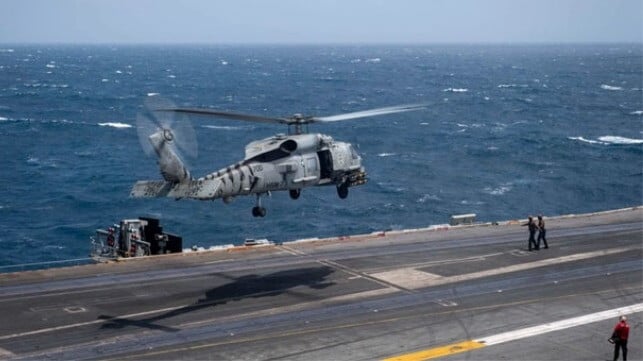
Helicopter leaving flight deck of USS Nimitz
Picture from June 2025 showing a helicopter on flight operations from USS Nimitz (US Navy photo)

Published Oct 27, 2025 12:38 PM by The Maritime Executive


The U.S. Pacific fleet announced late on October 26 that it had lost two aircraft, a helicopter and a fighter jet, while on routine missions from the carrier USS Nimitz. Speaking to reporters, Donald Trump said the Navy was investigating the fuel after the two aircraft went down within 30 minutes of each other on Sunday.

A U.S. Navy MH-60R Sea Hawk helicopter was the first to go down. The report said it was lost around 2:45 pm local time. It was in the area of the South China Sea, conducting routine operations, when it was lost. A search and rescue team safely recovered the three crewmembers who were aboard the helicopter.

While they were recovering the helicopter crew, an F/A-18F Super Hornet also operating from the Nimitz declared an emergency, and the two crewmembers ejected. The plane was also lost in the South China Sea, while the crew was safely recovered by a search and rescue team.

Asked about the incident while traveling from Malaysia to Japan, Donald Trump told reporters that the incident was “very unusual.” He went on to say, “They think it might be bad fuel. We’re gonna find out.”

The incident came as the Nimitz is on her last tour of duty, as the carrier, which was commissioned in 1975, is scheduled to stand down in 2026. She deployed in March from the U.S. West Coast and spent most of her tour in the Middle East during the battle and security efforts against the Houthis. At the beginning of this month, it was reported that she had repositioned into Asia and the South China Sea region. 

The Navy’s current plan is for the Nimitz to return to Newport News, Virginia, in 2026, where she will begin the process of standing down. By 2027, she is scheduled to move into the shipyard to begin defueling her nuclear plant and be officially deactivated.  

The Navy completed the sale of the first nuclear carrier, USS Enterprise, after years of inactivity, and she is due to begin a complex dismantling process. The Navy has said the process followed for the Enterprise was a prototype for the subsequent carriers. Deactivation of the Nimitz was delayed from 2025 to 2026, but her sistership, the nuclear carrier Dwight D. Eisenhower, is to follow in 2027. Further, the third ship of the subclass, USS Carl Vinson, is also expected to follow shortly thereafter, as she is only five years younger than the Ike.


Rolls-Royce Tests First High-Speed Methanol Marine Engine

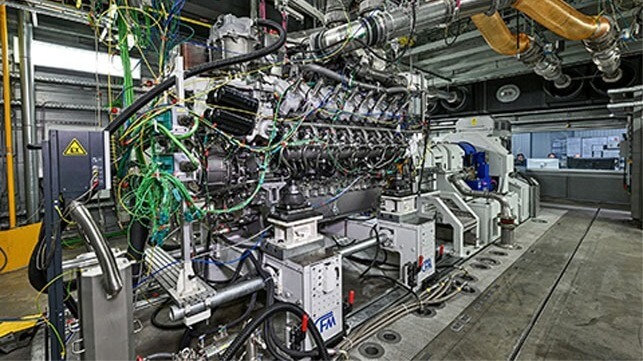
Rolls Royce methanol engine
Rolls-Royce, injection system specialist Woodward L’Orange, and the WTZ Roßlau technology and research center have been working o the engine (Rolls Royce)

Published Oct 27, 2025 7:35 PM by The Maritime Executive


Rolls-Royce has successfully tested the world’s first high-speed marine engine powered exclusively by methanol on its test bench in Friedrichshafen. Together with their partners in the meOHmare research project, Rolls-Royce engineers have thus reached an important milestone on the road to climate-neutral and environmentally friendly propulsion solutions for shipping.

“This is a genuine world first,” said Dr. Jörg Stratmann, CEO of Rolls-Royce Power Systems AG. “To date, there is no other high-speed engine in this performance class that runs purely on methanol. We are investing specifically in future technologies in order to open up efficient ways for our customers to reduce CO2 emissions and further expand our leading role in sustainable propulsion systems.”

Rolls-Royce’s goal is to offer customers efficient ways to reduce their CO2 emissions, in-line with the ‘lower carbon’ strategic pillar of its multi-year transformation programme. The project also aligns with the strategic initiative in Power Systems to grow its marine business.

The joint project meOHmare is funded by the German Federal Ministry for Economic Affairs and Energy and combines the expertise of Rolls-Royce, injection system specialist Woodward L’Orange, and the WTZ Roßlau technology and research center. The goal is to develop a comprehensive concept for a CO2-neutral marine engine based on green methanol by the end of 2025.
 

The products and services herein described in this press release are not endorsed by The Maritime Executive.


StormGeo’s Voyage Intelligence Connects Efficiency and Decarbonization

StormGeo

Published Oct 27, 2025 12:38 PM by StormGeo


Shipping today faces mounting challenges, from rising fuel costs and stricter carbon regulations to unpredictable weather, congested ports, and shifting trade routes. In this complex environment, every operational decision carries financial and environmental weight.

That’s why StormGeo empowers operators to turn data into decisive action. Voyage Intelligence, StormGeo’s digital backbone for smarter shipping operations, provides shipowners, operators, and charterers a clear way to save fuel, reduce emissions, and stay compliant — all within one integrated platform.

Efficiency Is the Fastest Route to Decarbonization

“As the industry adopts new energy sources and technologies, innovation will continue to optimize how ships operate,” says Petter Andersen, VP Shipping at StormGeo. “For every vessel, improving operational efficiency remains the fastest and most cost-effective way to reduce emissions and strengthen performance.” 

Voyage Intelligence delivers exactly that. It connects weather forecasts, vessel performance data, and fuel analytics to identify the most efficient routes, speeds, and bunker strategies for every voyage. The result: measurable fuel savings that immediately translate into both lower costs and lower carbon output.

“In 2024, StormGeo supported more than 75,000 voyages worldwide, helping our customers save around 0.6 million tonnes of fuel and 1.8 million tonnes of CO2,” says Andersen.  “Those reductions were achieved through smarter decision-making, voyage by voyage.”

From Weather Routing to Integrated Intelligence

With more than 25 years of expertise in maritime forecasting, StormGeo has evolved from weather routing to a connected decision platform that spans the entire voyage lifecycle.

Voyage Intelligence combines predictive analytics, machine learning, and vessel-specific models with real-time weather and compliance data. The platform enables teams to plan, monitor, and evaluate voyages with precision by improving safety, optimizing bunker procurement, and aligning with regulations such as the Carbon Intensity Indicator (CII) and EU Emissions Trading System (EU ETS).

“Efficiency and sustainability aren’t competing priorities,” says Andersen. “Every drop of fuel saved supports both profitability and compliance.”

Seamless Integration for Ship and Shore Operations

Digitalization has given operators more data than ever, but not always more clarity. Performance reports, fuel logs, and emissions data often sit in disconnected systems. Voyage Intelligence brings all that information together in a single environment, ensuring that bridge teams, operators, and commercial managers work from the same set of validated insights.

“When everyone, from the master to the commercial manager, sees the same data, decisions become faster and more aligned,” says Andersen. “The outcome is greater efficiency, lower risk, and stronger operational performance.”


Understanding the True Cost of Every Voyage

Every voyage involves a series of decisions. They range from route and speed to timing, weather strategy, and compliance, each carrying financial and environmental consequences. 

Voyage Intelligence links route optimization, fuel planning, and compliance exposure so operators can see how daily choices affect fuel use, schedule reliability, and carbon exposure across the entire voyage lifecycle. By integrating route optimization, vessel performance, weather, and regulatory data, the system models multiple operational scenarios in real time.

It helps teams evaluate the full impact of each decision, considering time, cost, and emissions, and choose the option that delivers the greatest overall efficiency.

Human Expertise, Enhanced by Technology

Although Voyage Intelligence automates much of the analysis, human expertise remains central. With expert route validation from StormGeo’s route analysts, customers can ensure that safety, compliance, and practicality always come first.

“Automation is transforming how we operate, and in most cases delivers exactly what is needed,” says Andersen. “Our role is to combine intelligent automation with human expertise, ensuring every decision is both efficient and safe.” 

Compliance That Drives Performance

Regulatory frameworks such as CII, EU ETS, and FuelEU Maritime are redefining operational strategy. With Voyage Intelligence, compliance becomes an integral part of voyage planning rather than an afterthought.

Operators can forecast emissions, efficiency ratings, and carbon costs before a voyage begins, transforming compliance from an administrative task into a performance advantage. Companies that can demonstrate verifiable, efficient operations are already better positioned to attract cargo owners, financing, and partnerships.

From Operational Insight to Fuel Transition

“As shipping explores alternative fuels and hybrid propulsion, one truth remains: technology alone won’t deliver the transition — intelligence will,” says Andersen. “Voyage Intelligence is designed to evolve with emerging fuel and propulsion technologies, providing the digital foundation that connects today’s operations with tomorrow’s energy landscape.”

StormGeo continues to invest in artificial intelligence and simulation tools that help operators model routes, fuel types, and cost scenarios before departure. These capabilities help fleets make data-driven decisions that balance long-term planning with optimized performance, safety, and sustainability today.

From Efficiency Gains to Sustainable Growth

In an environment where every tonne of fuel and every tonne of carbon carry a cost, efficiency is more than good practice. It’s good business.

Voyage Intelligence helps fleets improve efficiency, simplify compliance, and move confidently toward decarbonization.

For StormGeo, the strategy is clear: every step toward efficiency strengthens both profitability and sustainability. “Smarter voyages mean stronger returns for the industry and the planet alike,” Andersen concludes.


This article is sponsored by StormGeo. For more information, visit StormGeo online.
 

The opinions expressed herein are the author's and not necessarily those of The Maritime Executive.