Saturday, November 01, 2025

AU

Fresnillo enters Canada with $556M Probe Gold acquisition
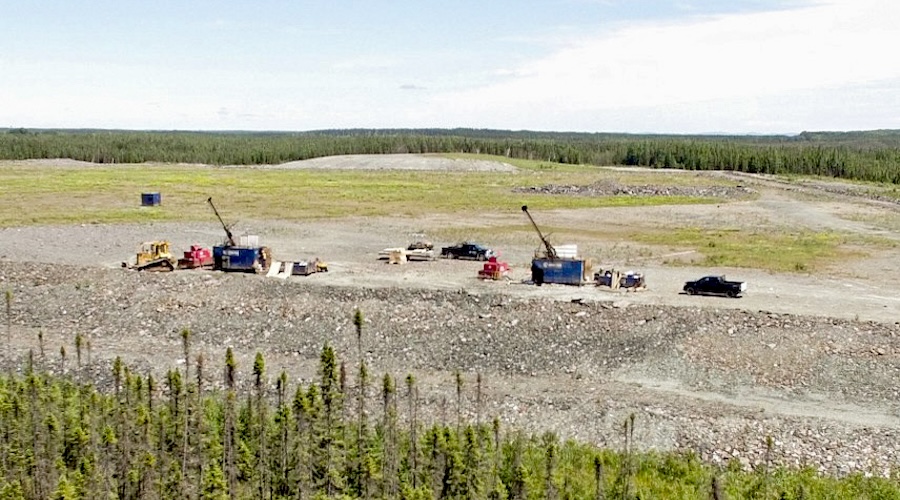

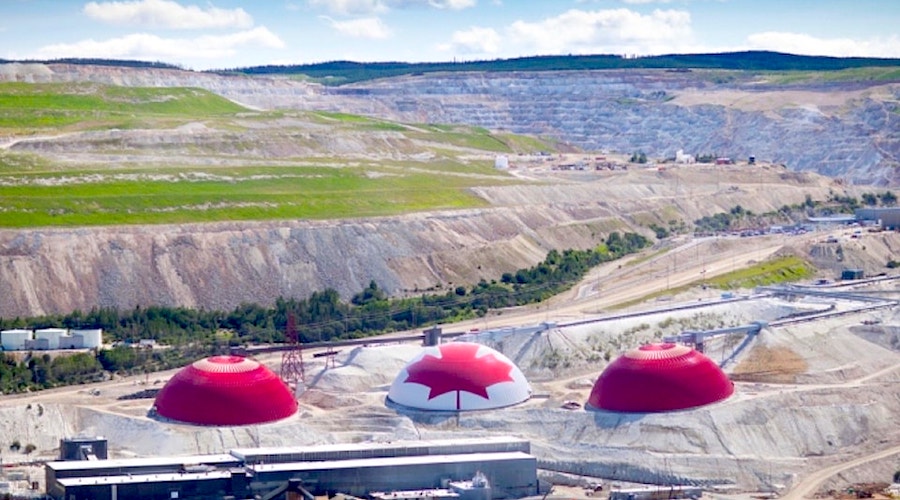
Novador gold project. (Image courtesy of Probe Gold.)

Mexican precious metals miner Fresnillo (LON: FRES) is acquiring Canada’s Probe Gold (TSX: PRB) for C$780 million ($556 million) in cash, marking the company’s first entry into Canada.

Fresnillo will pay C$3.65 per share, representing a 39% premium to Probe Gold’s last closing price and 24% above its 30-day average as of Oct. 30. The deal gives Fresnillo access to Probe’s 10 million ounces of gold reserves, including 8 million ounces at the Novador project in Quebec’s Val-d’Or Mining Camp.

The acquisition also includes the early-stage Detour Gold Quebec property, which Fresnillo said could benefit from its technical expertise and exploration experience.

Shares in Fresnillo, the world’s largest silver producer and one of Mexico’s biggest gold miners, rose 1.7% to 22.86p in early London trading. The stock has surged more than 250% this year, buoyed by a 50% rise in gold prices, which climbed above $4,030 a troy ounce in early Friday trade, as well as by a 70% rise in silver prices this year to $49.04 per ounce as of Friday.

Focus on Mexico

Fresnillo CEO Octavio AlvĂ­drez said the acquisition aligns with the company’s strategy of pursuing disciplined, value-driven mergers and acquisitions, while focusing on early-stage precious metals projects that complement its core operations.

He added that Probe’s assets would “meaningfully” strengthen Fresnillo’s project pipeline, with Mexico remaining central to its growth strategy.

Probe Gold CEO David Palmer said in a separate statement that after nearly a decade of development, it was time to hand over Novador to a more experienced operator capable of advancing it through permitting and construction. The project is expected to produce more than 200,000 ounces of gold annually for over a decade.

Fresnillo said it plans to continue developing Novador following the deal’s completion. The company currently operates eight mines and holds exploration projects in Peru and Chile.

All directors and officers of Probe, along with Eldorado Gold (TSX: ELD)(NYSE: EGO), which collectively owns about 12% of the company, have agreed to support the transaction.


China ends gold tax break in setback for key bullion market
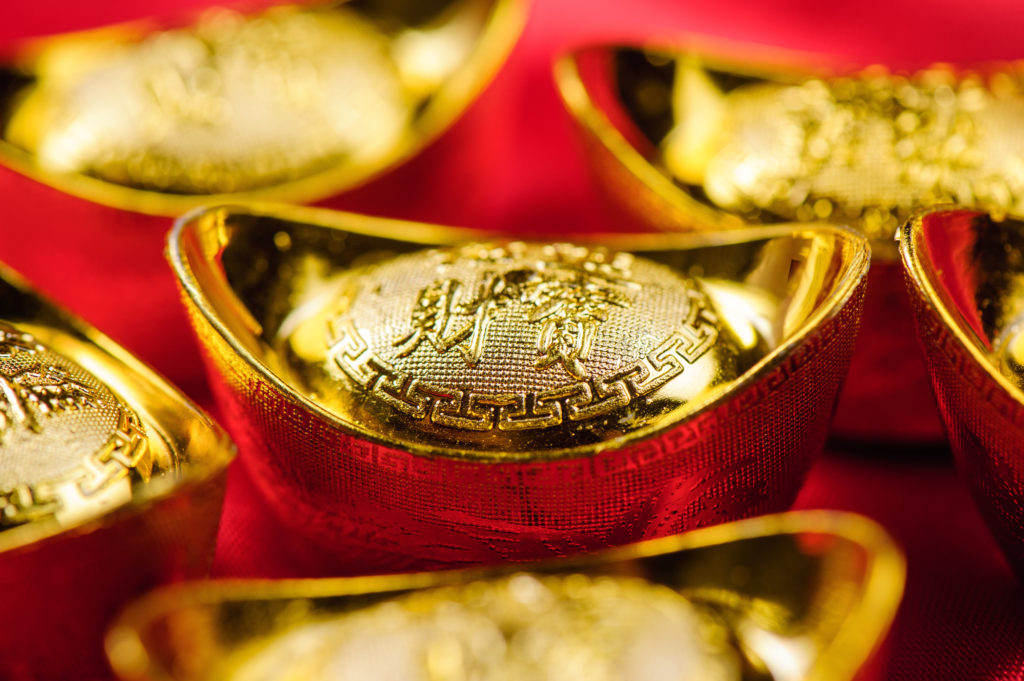
Chinese gold ingot. Stock image.

China is scrapping a long-standing gold tax incentive in a potential setback for consumers in one of the world’s top bullion markets.

Starting on Nov. 1, Beijing will no longer allow retailers to offset a value-added tax when selling gold they bought from the Shanghai Gold Exchange, whether sold directly or after processing, according a new legislation from the Ministry of Finance.

The rule covers both investment products – such as high-purity gold bars and ingots, as well as coins approved by the People’s Bank of China – and non-investment uses including jewelry and industrial materials.

The move should bolster government revenue at a time when a sluggish property market and weak economic growth have strained public coffers. But the changes will also likely increase the cost of buying gold for Chinese consumers.

A buying frenzy among retail investors around the world recently helped gold’s record-breaking rally move to overbought territory, setting the precious metal up for an abrupt correction.

Gold’s worst rout in more than a decade coincided with a reversal of relentless buying through exchange-traded-funds, which had been on the rise since late May. It also matched the end of seasonal buying linked to festivities in India. A trade truce between the US and China, meanwhile, eased demand for bullion as a haven asset.

But gold is still holding near the $4,000-an-ounce milestone it breached earlier in October, and many of the fundamentals that pushed it higher are expected to remain: buying by global central banks, US interest-rate cuts, and a host of global uncertainties that still make its perceived safety appealing to investors.

Many in the industry still see prices nearing $5,000 an ounce in about a year.

(By Yihui Xie)


GNOMES OF ZURICH

Record gold profit adds shine to Swiss National Bank’s results
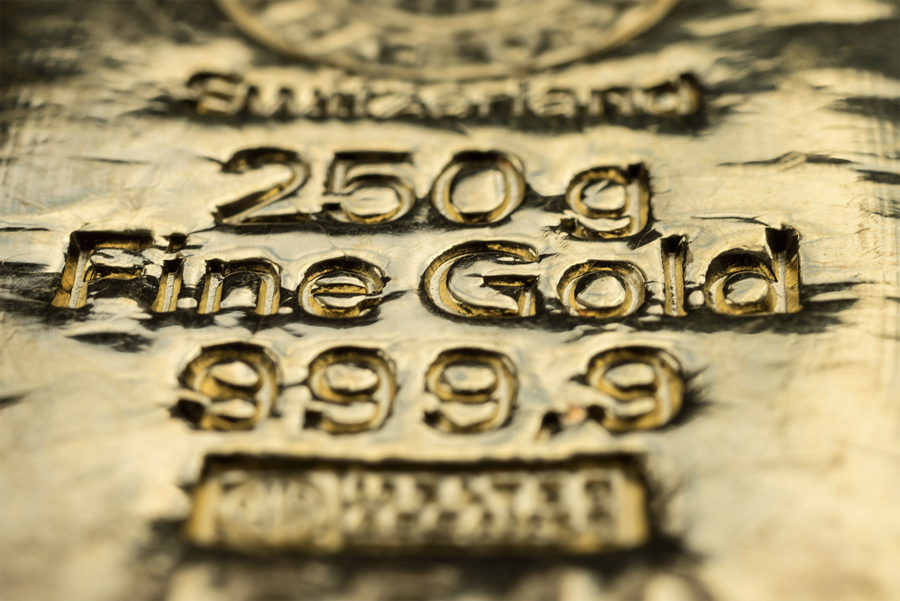
Stock image.

The Swiss National Bank reported on Friday a third-quarter profit of 27.93 billion Swiss francs ($35 billion), helped by the booming value of its gold reserves.

The central bank posted a valuation gain of 14.33 billion francs on its gold holdings between June and September, up from the 4.41 billion franc gain on the precious metal last year.

It is a record gold profit since the SNB started using the market value of the metal in its profit calculations in 2000.

It was also significantly more than the average quarterly profit the central bank has made from its gold holdings over the last 10 years, which was less than 2 billion francs, according to UBS calculations.

Safe-haven demand

The SNB, with unchanged gold holdings of 1,040 metric tons, has benefited from gold prices, which have risen by 53% this year as investors hedged against increased political and geopolitical uncertainties.

The weakening US dollar has also made gold cheaper for holders of other currencies, boosting demand, while rate cuts by the Federal Reserve have reduced the yield from other less risky assets like US. Treasuries, making gold more attractive.

“It’s very unusual for the SNB to make so much profit from gold, but the gains reflect the big price gains gold has had this year,” said UBS economist Florian Germanier.

“The profit is purely a nice side effect of having an asset which is considered the ultimate safe haven and which the SNB is required to hold to diversify its holdings and to carry out monetary policy,” he added.

During the third quarter, the SNB also reported a gain of 13.63 billion francs from its foreign currency positions, the bonds and stocks it has bought with foreign currencies it has purchased.

As a result, the central bank improved its third-quarter profit to 27.93 billion francs, up from a 5.67 million franc profit a year earlier.

($1 = 0.7931 Swiss francs)

(By John Revill; Editing by Ludwig Burger, Mark Potter and Emelia Sithole-Matarise)

Global gold demand climbs 3% to quarterly record as investment soars, WGC says
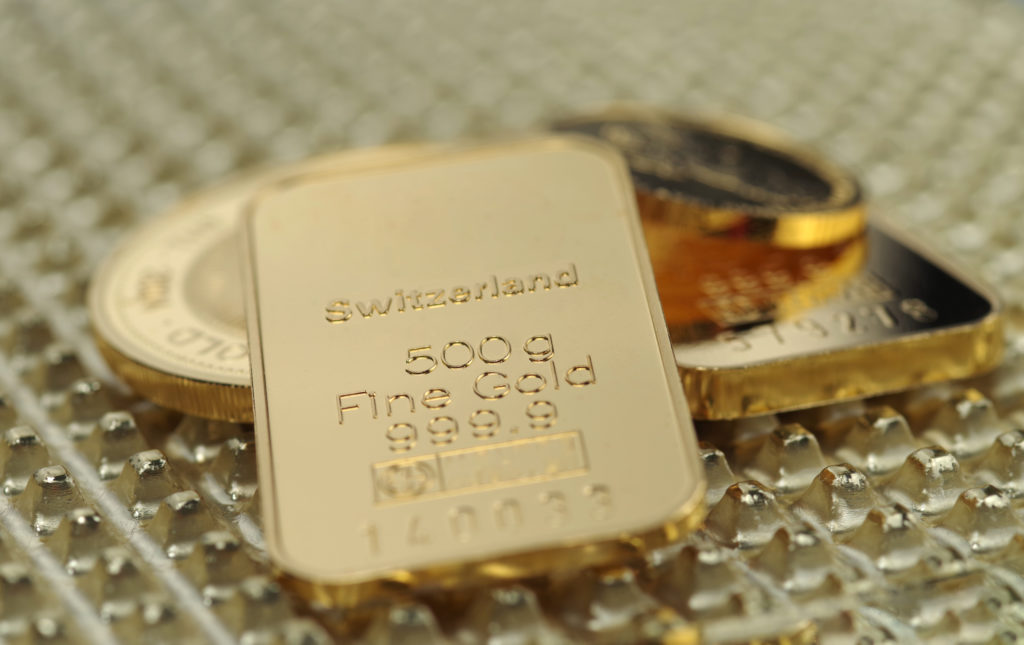
Gold bars and gold coins. Stock image.

Global gold demand rose by 3% year-on-year to 1,313 metric tons, the highest quarterly number on record, in the third quarter as investment demand soared, the World Gold Council said on Thursday.

Spot gold prices are up 50% so far this year after hitting a record high of $4,381 an ounce on October 20 on safe-haven demand driven by geopolitical tensions, US tariff uncertainty and more recently a wave of fear-of-missing-out or “FOMO” buying.

“The outlook for gold remains optimistic, as continued US dollar weakness, lower interest rate expectations, and the threat of stagflation could further propel investment demand,” said Louise Street, senior markets analyst at the World Gold Council.

“Our research indicates the market is not yet saturated.”

Demand for gold bars and coins rose 17% in the third quarter, led by India and China, while inflows into physically backed gold exchange-traded funds jumped by 134%, said the WGC, an industry body whose members are global gold miners.

Together these categories offset a continuing sharp fall in gold jewellery fabrication, the largest category of physical demand, which fell 23% to 419.2 tons as high prices affected purchases by buyers all other the world.

Central banks, another major source of gold demand, increased purchases by 10% to 219.9 tons in the third quarter, the WGC estimated, based on reported purchases and its assessment of unreported buying.

Central banks have bought 634 tons in January-September, “trailing behind the exceptional highs of the last three years, but comfortably above pre-2022 levels,” the WGC said.

On the supply front, recycling added 6% and mine production increased by 2% in the third quarter, bringing the quarterly gold supply to a record high.

(By Polina Devitt; Editing by Ronojoy Mazumdar)


Vianode to build $2B synthetic graphite plant in Ontario

Stock image.

Norwegian battery materials producer Vianode announced Friday that its first large-scale production facility for low-emission synthetic anode graphite will be developed in Ontario, Canada.

Synthetic graphite is an essential component in lithium-ion batteries and is critical for a range of defence and industrial applications.

Vianode’s production facility was featured as part of Canada’s leadership in the G7 Critical Minerals Production Alliance and will contribute to the diversification of resilient, domestic supply chains.

The project is structured as a phased, multi‑billion‑dollar investment, starting with an initial investment of over C$2 billion ($1.4 billion). Over time, planned expansions will bring total capacity to as much as 150,000 tons annually, the company said.

“North American supply chains are heavily reliant on graphite sourced from China for lithium-ion batteries, defence technologies, nuclear technology and more,” Vianode CEO Burkhard Straube said in a news release.

“A large-scale facility in Ontario delivering high-performance anode graphite solutions will provide Canada with domestic capacity that will make supply chains more resilient,” Straube said. “This scalable project is a key building block that aligns with recent shifts in trade policy and supports our ambition to be a leading and trusted supplier for G7 supply chains.”

Vianode said its planned facility will establish a resilient and sustainable battery supply chain in North America and enhance the region’s access to strategic materials, in addition to creating around 300 highly skilled jobs in the initial phase and up to 1,000 at full capacity.

“Canada is proud to support Vianode in advancing critical mineral development that aligns with our national priorities and international commitments, and proud they chose Canada for North America’s first large-scale low-emission synthetic graphite production facility,” Tim Hogdson, Canada’s Minister of Energy and Natural Resources, said in a statement.

“Through the Critical Minerals Production Alliance, we are working with trusted partners to deploy sovereign tools, mobilize investments and financing, and secure offtake arrangements to accelerate the development of secure, resilient critical minerals supply chains,” Hogdson continued.

“These minerals will power the clean energy transition, strengthen our defence and manufacturing capabilities, and position Canada as a trusted supplier to our allies.”

Canada backs 25 critical minerals projects in G-7 initiative


Teck’s Highland Valley in British Columbia is Canada’s largest copper operation. (Image courtesy of Highland Valley Copper 2040: Project Overview.)

Rio Tinto Group and Nouveau Monde Graphite Inc. are among more than a dozen companies set to benefit from a Group of Seven initiative to strengthen access to critical minerals.

Canadian Prime Minister Mark Carney’s government announced 25 new investments, partnerships and measures totaling C$1.4 billion ($1 billion) at the Group of Seven energy ministers’ meeting in Toronto on Friday. The support is part of a G-7 initiative launched in June to focus on bolstering investments in raw materials key to defense, clean energy and advanced manufacturing.

“We have an incredible set of cards in our critical mineral resources. We have not effectively developed those in the past,” Canadian Energy Minister Tim Hodgson told reporters in Toronto. “These actions, with the support of our allies, are designed to do that and make sure Canada has all the cards it needs in a world where access to critical minerals is becoming a tool of political and geopolitical coercion.”

The deals aim to bolster projects across Canada, with an eye to securing supplies outside of China, which controls a large swath of the global supply chain for these strategic materials. The US and Canada, along with its allies, have sought to secure access to metals such as copper, lithium and nickel, as well as rare earth elements, that are key ingredients in manufacturing, electronics and military equipment.

The announcement includes C$25 million for a Rio Tinto plant in Quebec that will produce scandium, a niche metal used in aluminum alloys for aerospace and defense manufacturing. Ucore Rare Metals Inc. received a conditional C$36.3 million to expand its rare earths processing plant in Ontario. Other recipients include Northern Graphite Corp., Focus Graphite Inc. and Torngat Metals Ltd.

Nouveau Monde Graphite jumped as much as 24% following the announcement of a future supply deal with Canada, Panasonic Holdings Corp. and Traxys North America LLC, before paring gains to close 13% higher in Toronto. Shares of Northern Graphite, which operates North America’s only producing graphite mine, rose 29%.

Not all funding is guaranteed: Norway’s Vianode AS, which aims to build a synthetic graphite facility in Ontario, received a letter of interest for as much as $500 million in potential financing from Canada, along with $300 million from the German government.

Hodgson also said Canada issued an order designating critical minerals as essential to Canadian defense and national interests, enabling the nation to start its own stockpiling regime and support multilateral caching efforts.

Some of the announced deals include future supply contracts with the Canadian government that will allow the nation to stockpile minerals for use in sectors including automaking and the military. Hodgson said the government will stockpile three different types of critical minerals, without specifying which ones.

“These measures will strengthen our capabilities in strategic sectors and contribute to NATO and defense spending commitments,” Hodgson said in prepared comments. “By protecting domestic production under volatile global conditions, we ensure a secure supply of critical minerals to Canadian and allied defense industries.”

(By Jacob Lorinc and Danielle Bochove)


Japan’s Sojitz begins importing heavy rare earths from Australia

(Image courtesy of Lynas.)

Japan’s Sojitz has begun importing heavy rare earths from Australia’s Lynas Rare Earths, Sojitz said on Thursday, the first such imports produced from Australian ore separated and refined in Malaysia.

The move aims to help Japan secure supplies of key materials used in electric vehicles and renewable energy from sources other than China, which dominates the market.

As Beijing tightens export controls on critical minerals, Japan, the United States, and their allies have been working to build supply chains outside China.

“We’ll continue promoting diversification of the rare earth supply chain and contribute to a stable supply of critical materials,” Sojitz CEO Kosuke Uemura told reporters.

The company declined to disclose import volumes or prices.

US President Donald Trump and Japanese Prime Minister Sanae Takaichi this week signed a framework agreement to secure the supply of critical minerals and rare earths through mining and processing.

Sojitz, with the state-owned Japan Organization for Metals and Energy Security, signed an exclusive sales deal with Lynas in 2011 for light rare earths such as neodymium used in magnets for the Japanese market.

They have since made multiple investments and provided financing to Lynas. In 2023, they secured supplies of heavy rare earths dysprosium and terbium, used in magnets.

“Through our partnership with Lynas, we have built a robust supply chain network,” Uemura said, noting that Sojitz has a market share of more than 70% of neodymium sales in Japan.

Sojitz has also established mass production systems for medium and heavy rare earths, scarce elements essential for next-generation energy and EV motors, in collaboration with Lynas, Uemura said.

Beyond rare earths, Sojitz is exploring the feasibility of producing gallium with Alcoa at the US company’s alumina refinery in Western Australia. Gallium is a critical mineral for semiconductor and defence technologies and is subject to China’s export controls.

Uemura said that government subsidies were needed, adding that China’s dominance distorts market mechanisms, sometimes making prices economically irrational relative to costs such as mining, separation, and wastewater treatment.

(By Yuka Obayashi; Editing by Clarence Fernandez and Mark Potter)


Malaysia’s ban on raw rare earths exports remains despite US deal

Klang, Malaysia. Stock image.

Malaysia will maintain a ban on the export of raw rare earths to protect its domestic resources, despite signing a critical minerals deal with the United States this week, the trade minister said on Wednesday.

Speaking in parliament, Minister Tengku Zafrul Aziz dismissed allegations that Malaysia will allow the export of critical minerals and rare earths to the United States in pursuit of immediate profits or strategic goals.

“We no longer want to be a country that only digs and ships out cheap raw materials like in the past,” Tengku Zafrul said, reiterating that Malaysia will instead encourage foreign investment and technology sharing for the mining and processing of raw rare earths.

“Our policy is not to prevent trade forever,” he said. “Our policy is to prevent the export of cheap unprocessed raw materials so that value is added to Malaysia.”

Malaysia has some 16.1 million metric tons of rare earth deposits, according to government estimates, but lacks the technology to mine and process them. Rare earth materials are essential for high-tech manufacturing, including electric vehicles, semiconductors and missiles.

Reuters reported earlier this month that Malaysia was in talks with China on rare earths processing, saying Malaysian sovereign wealth fund Khazanah Nasional would partner with a Chinese firm to build a refinery in Malaysia.

The United States signed separate deals with Malaysia and Thailand during US President Donald Trump’s visit to Kuala Lumpur on Sunday, seeking cooperation to diversify critical minerals supply chains amid competing efforts from China.

According to a joint statement by the United States and Malaysia, the Southeast Asian country agreed to refrain from banning or imposing quotas on exports of critical minerals or rare earth elements to the United States.

(By Danial Azhar; Editing by David Stanway)


US approves first cleanup of abandoned, contaminated uranium mines

DISA Genbravo deployed in the field in Utah. Image: DISA Technologies.

The environmental legacy impacts of Project Manhattan – a US-led World War II program to develop nuclear energy capabilities before foreign adversaries could – are still felt across the United States.

For decades, thousands of sites associated with abandoned uranium mine waste have remained contaminated — hundreds on or near Navajo and tribal lands — with no clear regulatory pathway for cleanup.

On September 30, the US Nuclear Regulatory Commission (NRC) issued a license to Wyoming-based DISA Technologies, authorizing the company to clean up abandoned uranium mine sites across the West and recycle the uranium for domestic energy use — the first license of its kind ever granted by the NRC.

Uranium is a crucial source of reliable baseload power as nuclear energy, and the US requires an estimated 32 million pounds of uranium annually for its current nuclear reactors.

In 2024, the US purchased 50 million pounds of uranium, but only produced 677,000 pounds, according to the Energy Information Administration. Russia supplies a quarter of the enriched uranium needed by America’s fleet of 94 nuclear reactors, which generate about a fifth of US electricity.

Last month, when US Energy Secretary Chris Wright said the US should look to boost its strategic uranium reserve to buffer against dependence on Russian supplies and increase confidence in the long-term prospects of nuclear power generation, it signalled a call to Project Manhattan 2.0. That’s according to the CEO of the company controlling the largest mineable uranium deposit in the US.

The 2.0 path forward

DISA said its new license can unlock hundreds of millions of pounds of uranium-bearing material stranded in legacy waste piles— resources that could be recovered safely, under federal oversight, while eliminating environmental hazards that have persisted since the Cold War.

Its technology – the only validated technology for uranium treatment of these abandoned uranium mines  – is high-pressure slurry ablation (HPSA), DISA Technologies CEO Greyson Buckingham told MINING.COM in an interview.

“The US EPA estimates there’s 15,000 sites associated with abandoned uranium mine waste throughout the West,” Buckingham said. “This was really largely the responsibility of the US government, which was the Atomic Energy Commission, which is now the Department of Energy.

“And during the Cold War, we said we needed to get as much uranium as possible, so the US government was just incentivizing uranium mine production,” he said.

“There were a lot of smaller mom-and-pop shops that came to be. And there were really no regulations until the passage of the 1954 Atomic Energy Act and then other regulations with 1983 that the EPA promulgated. So none of these sites were even bonded.”

 Buckingham said a mining rush of sorts ensued on small mines.

“They’d take the economic ore to a uranium mill. The uneconomic material, they would leave on site. And then when the bust happened, all those companies went bankrupt, and there were no bonds there. So those waste piles of that uneconomic material just became abandoned and discarded,” he said.

“And it wasn’t until about two decades ago, studies through the NIH and other studies that we realized the longer we leave this material sit on site, the more it degrades.”

Buckingham said the uranium oxidizes leach into the water, dust particles blow into population centers, and noted there are 523 Superfund sites that are abandoned uranium mines on the Navajo Nation.

“For our abandoned uranium mine treatment, we’re going to be building 50 and 110 per hour units. On average, the sites that we’re looking at are around 30,000 tons of material.”

“We’ve been working with the Navajo Nation for over five years now. We have a contract in place with the to remediate the first site on the Navajo Nation. We did a treatability study on the Navajo Nation on three different sites in 2022 that was sponsored by the US EPA.”

Buckingham said billions of dollars were sitting in a fund for over 10 years to clean up these sites and no cleanups have happened because, until now, the only options were to bury everything or to haul it all off site.

“Navajo don’t want the material buried on site because they want these contaminants off their land. And to haul it off site is prohibitively expensive,” he said.

Buckingham said the plan is to recycle the uranium and put it to productive use.

Wyoming Senator support

The DISA cleanup initiative and NRC approval is supported by Wyoming Senator Cynthia Lummis.

“An expedited approval process demonstrates what’s possible when innovative companies are empowered by federal regulators to establish clear, first-of-its-kind frameworks that prioritize both safety and efficiency, and I am so excited that through DISA, Wyoming is leading the way,” Senator Lummis said in an emailed statement to MINING.COM.

“Abandoned mines continue to threaten the health of our families and land in western states and on tribal land,” Lummis said.

“This license is a critical step in allowing DISA to move forward with its critical remediation and not only address these health and safety concerns but recover valuable materials in the process.”

The Navajo perspective

Mining companies blasted nearly 4 million tons of uranium out of Navajo land between 1944 and 1986, and the legacy impacts remain. It was a period that saw Navajo people working in the mines under conditions where the health risks of radiation were not fully understood.

Navajo Country, which spans parts of Arizona, New Mexico and Utah, is surrounded by hundreds of abandoned uranium mines that powered America’s nuclear arms race with the USSR and spewed toxic waste into the land.

The Navajo Nation has put a lot of effort into finding a solution, over four decades and through two congressional hearings, Stephen B. Etsitty, executive director at the Navajo Nation and the Environmental Protection Agency, told MINING.COM in an interview.

Etsitty, who was a witness in the 2007 congressional hearing, confirmed the Navajo’s support of the initiative. He has worked for years with the NRC on licensing of emerging technologies for remediation of mine waste.

Etsitty hopes abandoned uranium sites can be reclassified as brownfields; areas where contamination can be mitigated and land restored.

“We’ve spent the last 40 years looking for technology for the abandoned sites on Navajo lands, and we haven’t turned a shovel of dirt,” Etsitty said.

Etsitty said the aim is to separate heavy metals from host rocks into two waste streams – and manage those streams effectively.

A recent bench-level report confirmed new technology shows promise, but it must now be tested and regulated at commercial scale.

“We have been in the mode for a while to integrate this technology. We are looking forward to the results – we are excited to see what can be done. Some of this we’re hoping to recycle. With this technology we’re hoping to be able to do that,” he said.

Etsitty said the focus now is to start testing DISA’s technology on larger volumes – tonnes of waste instead of pounds.

The Navajo Nation is also calling for a dedicated low-level waste repository near their communities, in a location that makes transport economically feasible.

“We need a low-level waste repository far enough away,  but not 500 miles away…and a transport highway risk analysis,” Etsitty said.

“Our communities want this waste material removed – taken away – we want this communicated to Secretary [of the Interior] Doug Burgum and we’re hoping the federal government can help.”


Iran Steps Up Imports of Chinese Rocket Fuel Material

Bandar Abbas, Iran
Shipments of the chemicals arrive in the Bandar Abbas port (Mehr News / CC BY SA 4.0)

Published Oct 31, 2025 2:43 PM by The Maritime Executive


Iran appears to have accelerated the import of sodium perchlorate, the primary material used to manufacture ammonium perchlorate, which in turn makes up 70 percent of the standard fuel load of most of Iran’s solid-fueled ballistic missiles.

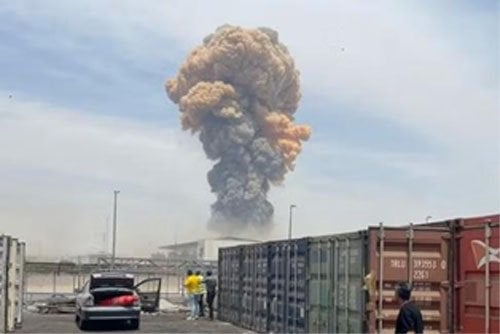
Before the 12-Day War, The Maritime Executive tracked the progress of two Islamic Republic of Iran Shipping Lines (IRISL) cargo ships, the MVs Golbon and Jairan, as they shipped a total of 58 containers of sodium perchlorate from the port of loading in Shanghai to Bandar Abbas. These two consignments brought in sufficient sodium perchlorate, probably about 1,000 tons, to fuel 240 missiles. Both ships had unloaded their consignments by the end of March into the Shahid Rajaei container park in the Bandar Abbas Commercial Port, and these are believed to have been the source of the explosion that devastated the port area on April 26.

In the pellet form it is being shipped in, sodium perchlorate is classified in the United States as a hazardous product, with explosive risks, and the fumes from which can cause breathing difficulties and kidney failure. Besides being the feedstock for ammonium perchlorate, it can also be used as an oxidizing agent in engraving processes and in the manufacture of livestock fattening agents. But as a dual-use product, and specifically because it is being conveyed by IRISL, the shipment should fall under the provisions of UN Security Council Resolution 1929, which cautions states to be aware of IRISL’s sanctions-breaking activities and its role in supporting Iran’s missile development, manufacture, and maintenance activities. These sanctions have been strengthened since snap-back sanctions were re-imposed by the UN Security Council on September 28.

Post the safe return of MVs Golbon and Jairan, the U.S. Treasury announced on April 29 that it had sanctioned an additional six companies and six individuals based in Iran and China for their roles in the network procuring ballistic missile propellant ingredients on behalf of the IRGC. Besides those sanctioned in Iran, five Chinese companies based in Hunan and Shandong Provinces involved in the manufacture of dual-use chemicals have been sanctioned: Yanling Chuanxing Chemical, Dongying Weiaien Chemical, China Chlorate Tech, Shenzhen Amor Logistics, and Yanling Lingfeng Chlorate. 


The explosion at Bandar Abbas Commercial Port on April 26 (Tasnim News Agency - CC by 4.0)


When MVs Golbon and Jairan left Shanghai, The Wall Street Journal (WSJ) noted that a further 185 20-foot containers of sodium perchlorate had been ordered by Iran, sufficient to fuel a further 800 ballistic missiles. At the time, The Maritime Executive spotted that three medium-sized container ships owned by IRISL were waiting to load in the CMK/K14 anchorage off Shanghai, namely MVs Barzin (IMO 9820269), Rayen (IMO 9820245), and Behta (IMO 9349590), all previously sanctioned.

New information published by CNN and based on unnamed European intelligence sources, named four ships, all sanctioned, carrying a total of 2,000 tons of sodium perchlorate that had been tracked making the trip between China and Bandar Abbas in September and October. CNN reported that these ships carried sufficient material to fuel about 500 ballistic missiles. The ships named, all of which have been sanctioned by the United States and others, had all loaded at ports in Guangdong province, whereas MVs Golbon and Jairan and the earlier shipments had left from the Shanghai area, implying that the Iranians have since diversified their purchases to bring on board new suppliers. CNN also suggested that some Chinese suppliers were based in the northeastern city of Dalian, from which no ship movements were noted.

The ships involved in the latest shipments are believed to be MV Basht (IMO 9346536, ex Zhuhai on September 15, arrived Bandar Abbas September 29), MV Barzin (IMO 9820269, ex Gaolan on October 2, arrived in Bandar Abbas October 16), MV Artavand (IMO 9193214, ex Liuheng, arrived in Bandar Abbas October 12), and MV Elyana (IMO: 9165827, ex Changjiangkou September 18, arrived Bandar Abbas October 12). Most of these ships are already on their way back to China for additional shuttles.

MV Elyana had been spotted in May making an extremely suspicious visit to the port of Tobruk in Libya, probably carrying arms.


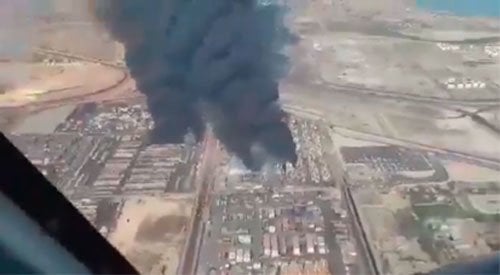
Fires burning in the Rajaei Port container park days after the initial explosion on April 26 


The upsurge of sodium perchlorate can be attributed to several factors. The originally-detected consignment was destroyed in the Bandar Abbas explosion in April, and fuel for 240 missiles was lost. The 12-Day War has expended stocks of missiles, which need to be replaced. The war also identified gaps both in Iranian air defense cover and in ballistic missile effectiveness, both deficiencies which need to be corrected with additional deployments of new solid fuel missiles. Finally, Iran is shipping as many missiles as it can muster across the Caspian Sea to Russia, to help in the prosecution of its invasion of Ukraine.

To what extent the Chinese government is knowingly feeding this increased Iranian appetite for sodium perchlorate is unclear, especially since it does have innocent civilian dual uses. But if there is a rapprochement between the United States and China on trade matters, and given that materials are dual-use and carried on IRISL ships, then the Chinese government is likely to be less inclined to turn a blind eye to continued exports of sodium perchlorate to Iran.
 

The opinions expressed herein are the author's and not necessarily those of The Maritime Executive.


COSCO Continues Spending with $1.7B in Orders for 29 More Vessels

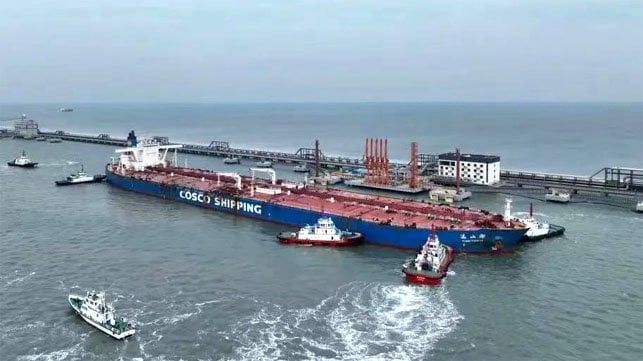
COSCO Shipping large tanker
China's COSCO continues its expansion with a further $1.7 billion in orders for tankers and bulkers (COSCO)

Published Oct 31, 2025 12:34 PM by The Maritime Executive


China’s sprawling state-owned shipping company COSCO unveiled plans for a further $1.7 billion in new shipbuilding contracts, continuing a spending spree aimed at fleet expansion and modernization currently estimated at over $7.5 billion in total. News of the orders came just a day after the U.S. reportedly agreed to postpone its investigation into China’s shipbuilding business practices and the fees imposed on China-built, owned, or operated vessels.

COSCO and its subsidiary OOCL were seen as among the most vulnerable companies to the U.S. port fee program. In the first week of the program, COSCO and OOCL reportedly paid over $40 million in special port fees in the U.S., according to estimates by the Journal of Commerce. They estimated that annually, the port fee bill could top $2 billion for the two Chinese carriers.

Even before the implementation of the new port fees, COSCO Shipping, the container shipping division of the company, reported earnings under pressure. During the first nine months of the year, the company reported in a filing on October 30 that total revenues were down more than four percent while profits were down by nearly 30 percent. The declines accelerated in the third quarter of 2025, with revenues down over 20 percent and profits cut in half.

COSCO shipping cited volatile container rates, “persistent spillover effects of tariff policies,” and intensified geopolitical uncertainties contributing to the results, in addition to a slowdown in global trade. The company, however, pointed to “resilient growth,” while emphasizing a strategy of expanded integrated services. As examples, it cited the purchase of the Laem Chabang Terminal in Thailand, network optimization, and new routes between Asia, Mexico, Latin America, and more. COSCO Shipping reported a six percent increase in container volume to over 20 million TEU in nine months and a total throughput of 113 million TEU, up 5.6 percent.

The group announced its expansion strategy in 2024 along with plans for fleet modernization and steps to reduce the environmental impact. It has already placed larger orders in China for newbuild containerships and dry bulk carriers. It highlighted during 2025 that COSCO Shipping completed the maiden voyage of COSCO Shipping Yangpu, China’s first methanol dual-fuel-powered container vessel, and the retrofit of COSCO Shipping Libra into a methanol dual-fuel system containership, “providing invaluable experience for green and low-carbon operation of large container vessels.”

COSCO continues these efforts, announcing that it has ordered six 307,000 dwt Very Large Drude Carriers. It will spend approximately $715 million to build the vessels at the China State Shipbuilding Industry yard in Dalian. Due for delivery between April 2027 and November 2028, the new tankers will be methanol and LNG dual-fuel ready on delivery.

The bulk of the new orders is valued at over $1 billion for 23 new dry bulk carriers. The vessels, which will be 87,000 dwt, will be built by Dalian Shipbuilding Industry Corp (DSIC). Delivery will be between May 2027 and the end of 2028.

COSCO’s strategy calls for expansion in all parts of its shipping operations. The company reports it is the largest in dry bulk and crude oil shipping, while it ranks fourth overall in container capacity. It emphasizes that its focus is on steady development and actively expanding its integrated approach to shipping, ports, and logistics, the same points cited by the US Trade Representative when it announced the fee program in April 2025.


Two Detained Stowaways Jump off Docked Cargo Ship into Italian Harbor

Roro cargo ship Stena Shipper
The RoRo cargo ship had arrived from Tunisia when the two stowaways jumped overboard (Stena)

Published Oct 31, 2025 2:29 PM by The Maritime Executive


Italian authorities reported a search operation after two stowaways who had been discovered on an arriving cargo ship escaped and jumped overboard. The body of one of the two individuals was later recovered, with reports that the young male had likely been struck by the propeller of a passing ferry, while the second individual was still missing.

The incident began when the Stena Shipper, an 11,320-dwt RoRo, arrived at the Italian port of Livorno. The ship, which is 633 feet in length, was acquired by Stena Line in January and operates from Radès, Tunisia. The ship docked in Italy around 0700 on October 30 and was scheduled for a standard inspection by the Maritime Border Police (Polmare).

While the ship was being inspected, two individuals were discovered, reportedly in a container. They had no identifying papers and claimed to be Moroccan, but the police believed they were likely Tunisian. In cases where stowaways are discovered on a ship, the normal procedure is to detain them and place them in the custody of the ship, which must return them to the point of origin.

According to media reports, the captain of the Stena Shipper locked the two young men in a cabin. While the crew was distracted, the men forced the lock on the door and were seen jumping overboard into Livorno harbor.

The police and Coast Guard were alerted, and a search began with patrol boats and fireboats. On shore, the police also began searching in case the men made it onto land. The search was being complicated by heavy rains in the region, which had washed mud and debris into the harbor. Also, the harbor has a depth of 15 meters (49 feet). They also reported a strong current in the harbor pushing toward the breakwater.

The harbormaster ordered marine traffic to be suspended in the area of the port. The containership MSC Agadir was blocked from exiting the port while the inbound RoRo cargo ship Eco Napoli was diverted to a different berth in the harbor. 

The authorities later reported the recovery of the body of one individual. They were continuing to search the harbor and the surrounding area for the other person.


Svitzer and Cochin Shipyard to Work on New Generation of Electric Tugs

tugboat
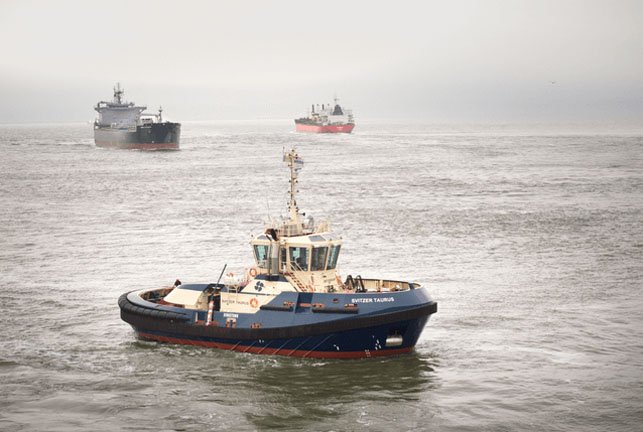
Svitzer Taurus is a 26 meter conventional diesel powered TRAnsverse tug design (Svitzer)

Published Oct 31, 2025 7:32 PM by The Maritime Executive


India’s Cochin Shipyard has secured another major agreement to work with a leading international shipping company. A.P. Moller Holding’s Svitzer becomes the latest company to look to the emerging capabilities, with the agreement announced as India’s Maritime Week 2025 came to a close.

Svitzer and Cochin signed a Letter of Intent to construct a new generation of electric TRAnsverse tugs in India. The companies will collaborate on the plans to build the new electric tugs, which they are calling one of the most advanced and environmentally progressive tug designs. They will, in part, be used to “green” India’s ports and to achieve green towage ambitions.

Svitzer CEO Kasper Nilaus called the agreement part of a “decisive step on our electrification journey.” Svitzer celebrated the commissioning of its first electric tug, Svitzer Ingrid, named by Her Majesty Queen Mary at a ceremony in Copenhagen in September. Svitzer Ingrid has a battery capacity equivalent to that of 23 modern electric cars (1,808 kWh) and can perform approximately 90 percent of tasks using electricity, thereby reducing annual CO2 emissions by 600 to 900 tonnes.

The company, which operates a fleet of over 450 tugboats, noted that it has a second electric tugboat ordered for delivery in 2026. Svitzer has operated four hybrid tugs in Australia since 2016, and said during the September event that it is also in the market for an additional four electric tugboats. 

The project with Cochin focuses on the TRAnsverse concept, which they said is known for exceptional maneuverability and efficiency. The design provides precise control in confined water.

The vessels they plan to develop with Cochin are intended for Svitzer’s global fleet renewal and to support growth. They anticipate they will also create the opportunity for a locally built, world-class design to be deployed in Indian ports and terminals. 

The project coincides with the Indian government’s plans for port expansion, decarbonization, and the development of the shipbuilding industry. During Maritime Week, the government said to promote green port operations it was launching the Green Tug Programme. It calls for deploying 100 eco-friendly tugs by 2040, with an investment of about ?12,000 crore ($1.3 billion), supporting India’s transition to cleaner and energy-efficient maritime logistics.

Commenting on the agreement with Svitzer, Madhu S Nair, Chairman and Managing Director, Cochin Shipyard Limited, said, “This collaboration will showcase CSL’s world?class capabilities, deepen local supply chains and talent, and accelerate the availability of green, high?performance tugboats for ports at home and abroad.”

It is the second major deal for the shipyard in recent weeks with a Western company. CMA CGM announced plans to build six new 1700 TEU dual-fuel LNG containerships built in India with Cochin. 

The Indian government seeks to expand its shipbuilding industry to become a player in the international market. Its goal is to be among the top five countries for shipbuilding worldwide by 2047