Saturday, November 01, 2025

 LI

CATL taps outside suppliers for lithium ore as flagship mine stays closed
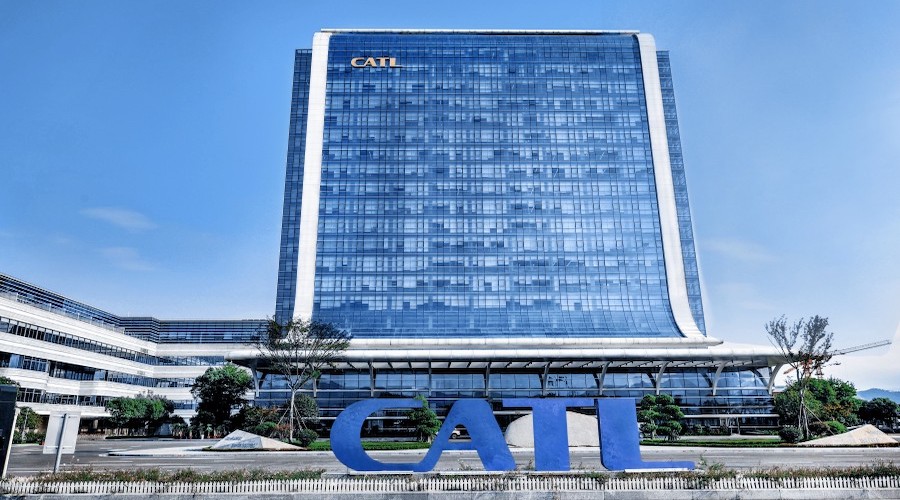
CATL’s headquarters in Ningde, in China’s Fujian Province. (Image courtesy of CATL.)

China’s CATL has placed orders with external suppliers for lithium ore in November, sources say, as the battery giant seeks alternative feedstock while its flagship Jianxiawo mine is closed.

A CATL subsidiary and joint venture producing lithium carbonate in Yichun, near where the mine is located, made the orders with traders earlier this month, according to two sources with direct knowledge who requested anonymity as they were not authorized to speak publicly.

The two companies would rarely do that when the mine was operating at full capacity, one of the sources said.

CATL did not respond to a request for comment.

Mining at CATL’s Jianxiawo site, one of several lithium assets it owns in Yichun in Jiangxi province, has been suspended since early August after its mining license expired.

CATL said in August it was applying to renew the license as soon as possible. A month later, Chinese newspaper Securities Times reported that the mine was set to reopen soon. However, CATL has yet to announce such a move.

The Jianxiawo mine has annual production capacity equivalent to about 46,000 metric tons of lithium carbonate, accounting for 3% of 2025 global output, according to data from Australian government.

The mine closed last year, reopening in February before being shut again in August. Lithium prices have reacted sharply each time given the mine’s importance to global supply.

(Editing by Mark Potter)

Arkansas aims to become US lithium hub, overcoming Chinese competition, tech challenges

The State Capitol of Little Rock. Stock image.

Arkansas faces stiff Chinese competition, sagging market prices and technological challenges as it vies to become the hub for US lithium production, obstacles that state officials and industry executives said this week are surmountable.

The southern state, the birthplace of former US President Bill Clinton, sits atop the Smackover, an underground geological formation stretching from Florida to Texas filled with salty brines containing more than 5 million metric tons of lithium, according to the US Geological Survey.

That is enough lithium to make millions of electric vehicle batteries and other devices if the metal can be filtered using direct lithium extraction (DLE), something that has never before been done at commercial scale.

Lithium prices plunging

Beyond technical challenges, Arkansas must contend with a lithium price drop of more than 80% in the past 18 months, according to Benchmark Mineral Intelligence, a fall fueled by oversupply from Chinese rivals.

“What we’re all trying to do is make Arkansas as competitive as it possibly can be,” Patrick Howarth, who runs Exxon Mobil’s lithium business, told the Arkansas Lithium Innovation Summit in Little Rock.

Exxon, which has delayed by at least a year its lithium production plans to 2028, Standard Lithium and Chevron are among the companies rushing to prove DLE can work in Arkansas despite low prices.

Arkansas is betting its workforce’s industrial expertise, electricity rates among the lowest in the US and a permissive regulatory scheme will help it become the country’s lithium hub. The only US lithium mine is in Nevada, operated by Albemarle.

“We spend a lot of time persuading people outside of Arkansas that this opportunity is real, that it can be low cost in terms of production, that it can become a credible supply of lithium chemicals for North America for decades to come,” said Andy Robinson, president of Standard Lithium, which is developing an Arkansas DLE project with Equinor.

Governor sees DLE succeeding

Roughly 860 people attended the summit, an increase of 15% from a similar event held last year.

Arkansas Governor Sarah Huckabee Sanders said in an interview she is confident DLE can succeed.

“Big companies like that don’t put hundreds of millions of dollars into things if they don’t feel like they see a path forward,” said Sanders, who was press secretary for President Donald Trump during his first term and elected as governor in 2022.

The governor said she does not believe the state’s lithium industry needs government to guarantee a minimum price for its product – something Trump officials have discussed for critical minerals.

Sanders added she does not think it is a disconnect that she wants Arkansas to be a major lithium producer but does not own an EV.

“I don’t own rockets, but it’s still something we’re really good at manufacturing,” Sanders said, referring to the state’s rocket industry.

“I don’t think you have to own a product to be able to make it in your state, to be able to sell it and to create an environment where those businesses can really do well.”

(By Ernest Scheyder; Editing by Rod Nickel)

Imerys in talks to sell minority stake in lithium mine project
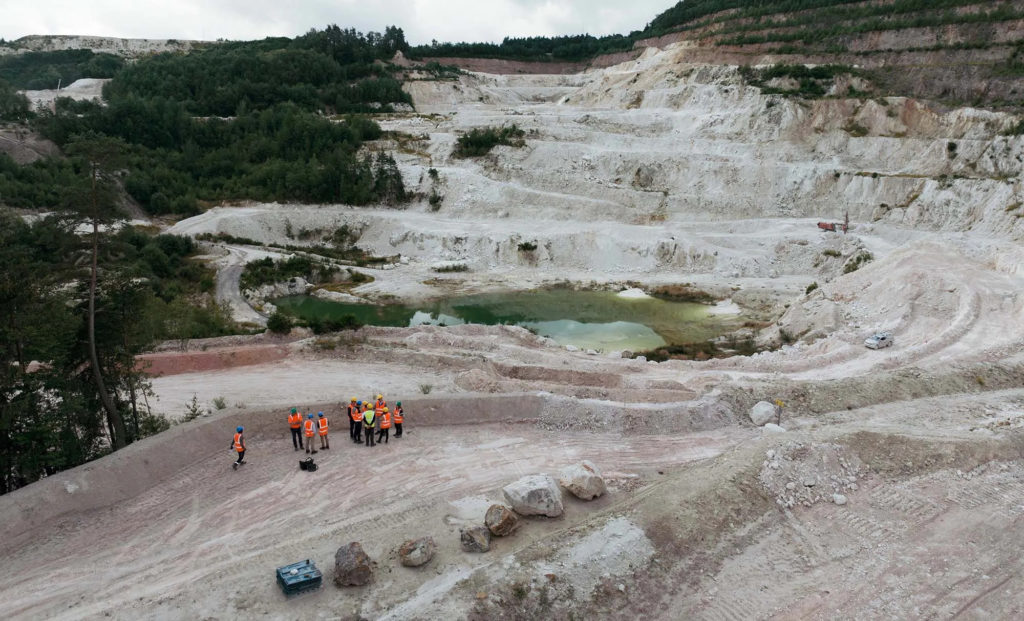
Credit: Imerys

Imerys is in exclusive talks with a potential investor to sell a minority stake in its lithium mine project in central France, with the specialist minerals firm confident it can conclude a deal by the end of January, its finance chief said on Thursday.

Presenting Imerys’ third-quarter results, chief financial officer Sebastien Rouge declined to give any details on the potential investor. Imerys said in July it would seek a partner for the project, whose cost has risen to an estimated 1.8 billion euros ($2.10 billion) from 1 billion initially.

($1 = 0.8575 euros)

(By Gus Trompiz; Editing by Elaine Hardcastle)


CU

African copper exports to China disrupted amid Tanzania unrest

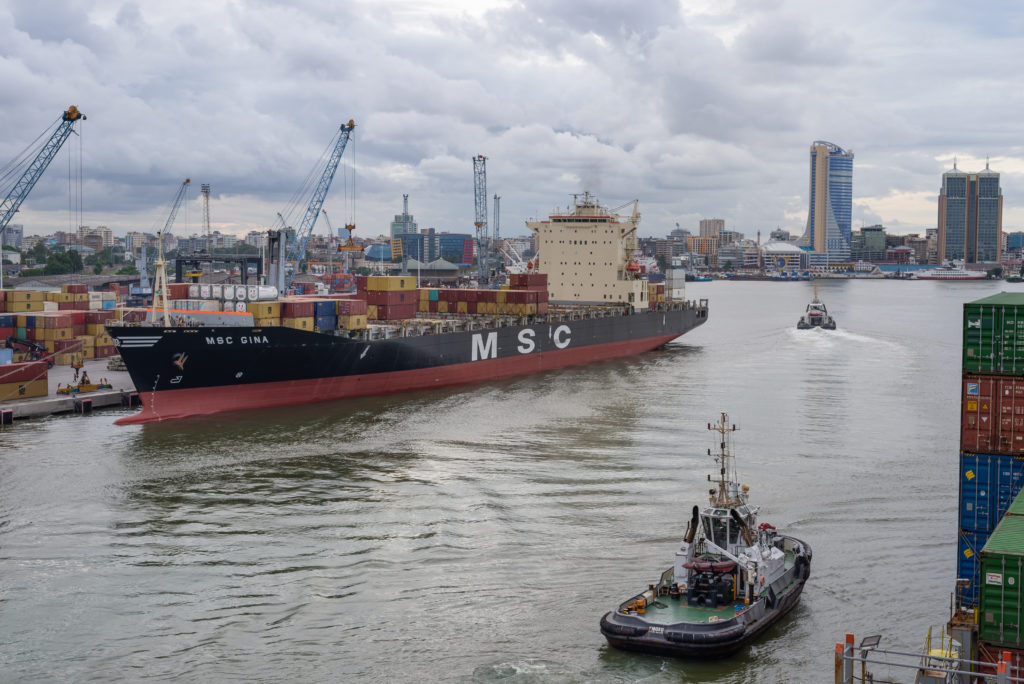
Dar es Salaam port. Stock image.

African copper shipments to China are being disrupted by the temporary closure of a crucial exporting port in Tanzania following election unrest.

Copper traders and producers in the central Africa copperbelt are now seeking to reroute cargoes from the Port of Dar es Salaam, leading to congestion at other ports including Durban, in South Africa, according to several people involved in the market. The port closure also means that copper already delivered to the port is stuck there for now, some of the people said, asking not to be identified discussing private business matters.

The Port of Dar es Salaam is the heart of the copper and cobalt trade from mines in the Democratic Republic of Congo and Zambia to China, which consumes more than half of the world’s copper production. The port has attracted growing flows of metal by offering more competitive freight rates for China-bound shipments.

One senior copper trader estimated that roughly two-thirds of African copper shipments to China typically move through Dar es Salaam.

Logistics firm C Steinweg Group, which operates warehouses at the port, said on Thursday that its facilities would be closed through at least Friday.

Speaking privately, representatives from two producers and three traders said they were hoping that the disruptions would be short-lived, but some have already re-routed copper to Durban, as well as to Namibia’s Walvis Bay and Mozambique’s Beira ports.

(By Julian Luk)

Copper mining costs in Chile fall in first half-year, reversing trend

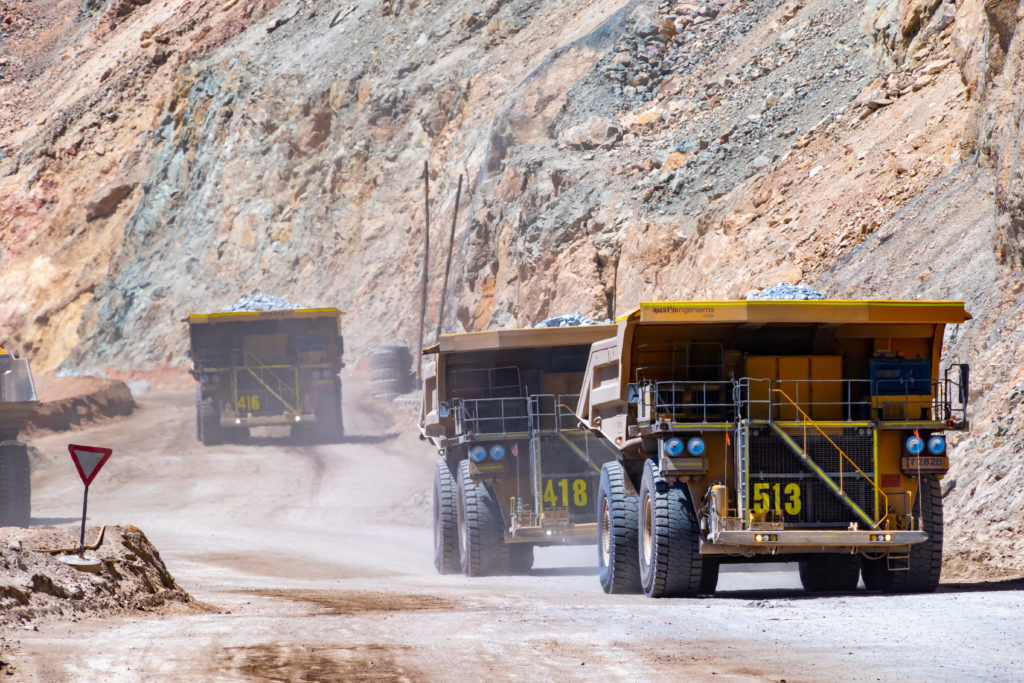
Big haul truck and machinery working in Chuquicamata. Stock image.

Direct production costs at Chile’s large copper mines fell in the first half of the year, the state-run Chilean Copper Commission (Cochilco) said on Thursday, marking a reversal of the upward trend of recent years.

The agency said in a report that the reduction was due to a fall in treatment and refining costs, as well as an increase in gold and silver prices during the period, by 39% and 26%, respectively. The price of copper on the London Metal Exchange also rose 15.4% during the first half of 2025.

The cash cost for the world’s largest producer of the red metal fell to $1,767 per pound, from $1,912 in the first half of 2024, it said.

The state commission measured 21 copper mining operations representing about 94% of the country’s mining production.

(By Fabián Andrés Cambero and Leila Miller; Editing by Edmund Klamann)

Eurasian Resources, Mercuria sign $100 million copper deal

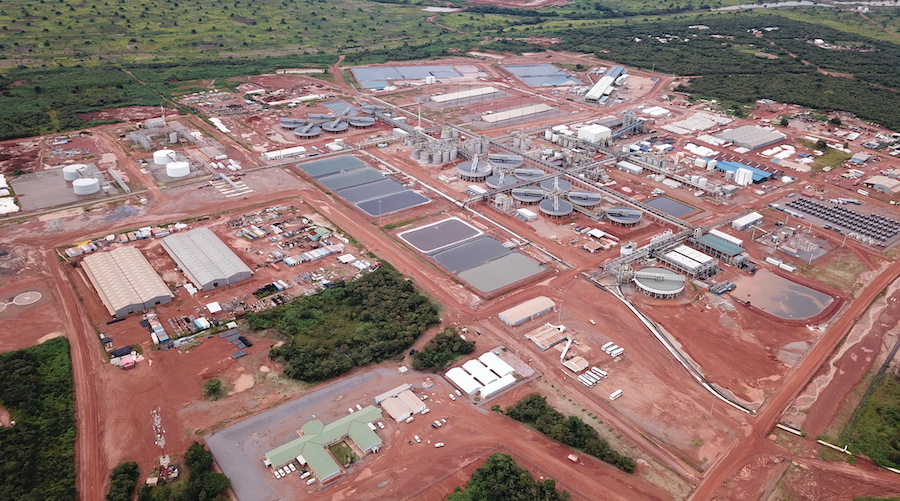
Metalkol facility in Kolwezi, DRC. (Image by Eurasian Resources Group).

Mercuria Energy Trading SA will provide up to $100 million in prepayments to Eurasian Resources Group as part of a three-year supply agreement for copper from Democratic Republic of Congo.

The financing will help Luxembourg-registered ERG develop its copper projects in the central African nation, the company said in an emailed statement Thursday.

Mercuria is expanding aggressively into metals, with a keen focus on Central Africa’s copper-rich nations. The firm’s new metals division is up by around $300 million in trading profits so far this year, Bloomberg News reported earlier this month.

“The facility will strengthen ERG’s asset development in the Democratic Republic of the Congo — a region of growing strategic relevance to Mercuria,” Kostas Bintas, the Switzerland-based trader’s global head of metals and minerals, said in the statement.

Another Mercuria unit agreed this month to team up with Gecamines, Congo’s state miner, to trade its portion of output from copper and cobalt joint ventures. Congo is the world’s second biggest source of copper and biggest cobalt producer.

Mercuria also announced a metals trading partnership late last year with Zambia, Africa’s biggest copper producer after Congo.

“This marks an important step in deepening our collaboration with global partners as we work to realize the full potential of our core operations in the DRC,” Shukhrat Ibragimov, ERG’s chairman and chief executive, said in the statement.

ERG is 40% owned by the Kazakhstan government.

(By Michael J. Kavanagh)


Indonesia to give Amman Mineral 400,000t copper concentrate export quota

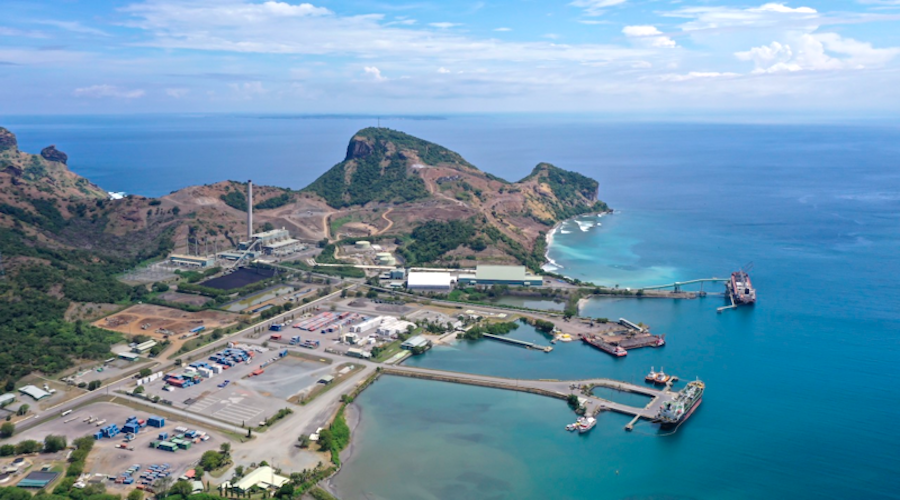
Port facility in Benete. (Image courtesy of Amman Mineral.)

Indonesia will give copper miner Amman Mineral Internasional an export quota of about 400,000 metric tons for its concentrate that will be valid for six months, local media reported on Thursday, citing an energy ministry official.

Indonesia banned exports of copper concentrate and other raw minerals from mid-2023 to boost the domestic metal processing industry, though the government let Amman continue exporting until December last year after commissioning a new smelter in West Nusa Tenggara province.

But Amman temporarily stopped operations at the facility this year due to damage on its flash converting furnace and sulfuric acid plant units, it said, requesting another export permit from the government.

The quota of about 400,000 tons quota was reported by several local media outlets, quoting remarks made on Wednesday by energy ministry official Tri Winarno.

Both Tri and an energy ministry spokesperson did not immediately respond to requests for comment. An Amman spokesperson said the firm could not provide comment.

In a Thursday stock exchange filing, Amman said the smelter was now operating partially while it was being fixed, with completion targeted in the first half of 2026.

Amman said in the filing that it had submitted a request to export concentrate, without mentioning the volume.

Amman reported in the filing that its concentrate output was at 310,143 tons between January and September 2025, a 51% drop from the same period last year.

Amman said its copper cathode output in the same period was 41,052 tons, while copper cathode sales reached 39,805 tons.

(By Stanley Widianto and Bernadette Christina; Editing by David Stanway and Martin Petty)


Anglo sees Chile copper mine returning to full output in 2027

Collahuasi copper mine in Chile. (Image courtesy of Minera Collahuasi.)

Anglo American Plc expects its flagship copper mine in Chile to return to normal output levels in 2027 after grappling with a period of lower quality ore that’s set to constrain production next year.

Annual output at Collahuasi, in which Anglo and Glencore Plc each hold 44%, probably will get back to to about 600,000 metric tons in 2027, Anglo’s chief operating officer Ruben Fernandes said in an interview. That’s as the operation enters richer areas of the open pit and a new desalination plant comes fully on-line next year.

“Water will no longer be a problem,” Fernandes said Tuesday on the sidelines of a conference in Salvador, Brazil. “By the end of the second half, we’ll reach areas with higher-grade material, allowing Collahuasi to return to regular production.”

At full capacity, Collahuasi is one of the world’s biggest copper mines and a key asset in Anglo’s portfolio. In its latest quarterly update, Anglo warned that Collahuasi’s output will likely be lower than expected next year, compounding tightness in the copper market. The metal reached a record high on Wednesday partly because of mounting concerns over supply setbacks.


The mine is also central to Anglo’s planned merger with Teck Resources Ltd. Collahuasi’s high-grade ore would be supplied to Teck’s neighboring Quebrada Blanca mine, potentially adding 175,000 tons of copper a year and boosting profitability by an estimated $1.4 billion annually.

Fernandes said talks with the Collahuasi partners — which include Mitsui & Co.-led consortium that owns the remaining 12% — would only begin once regulatory and antitrust approvals are secured for the Anglo-Teck corporate tie-up.

“That’s when we’ll have all the green-lights to proceed with the integration,” he said.

Fernandes remains upbeat about copper’s long-term outlook, citing surging demand from the energy transition and data centers tied to artificial intelligence, even as major producers face setbacks in Indonesia, Chile and the Democratic Republic of the Congo.

“Bringing a new copper project on-line takes 15 to 20 years,” he said. “If demand grows 2.5% to 3% annually over the next two decades, it’s about 30 to 40 new mines the size of Quellaveco in Peru — each producing about 300,000 tons a year. That’s a lot of copper.”

(By Mariana Durao)

Codelco weighs fate of marginal copper assets in strategy shift

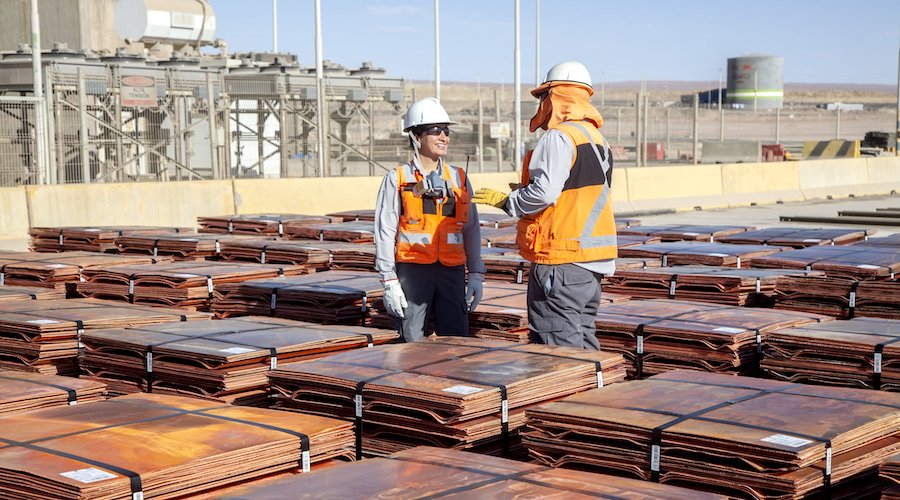
Copper cathodes at Gabriela Mistral mine. (Image courtesy of Codelco.)

Codelco is scrutinizing operational and investment options for the coming years as some officials at the Chilean state copper behemoth push for a shift toward prioritizing profit over production.

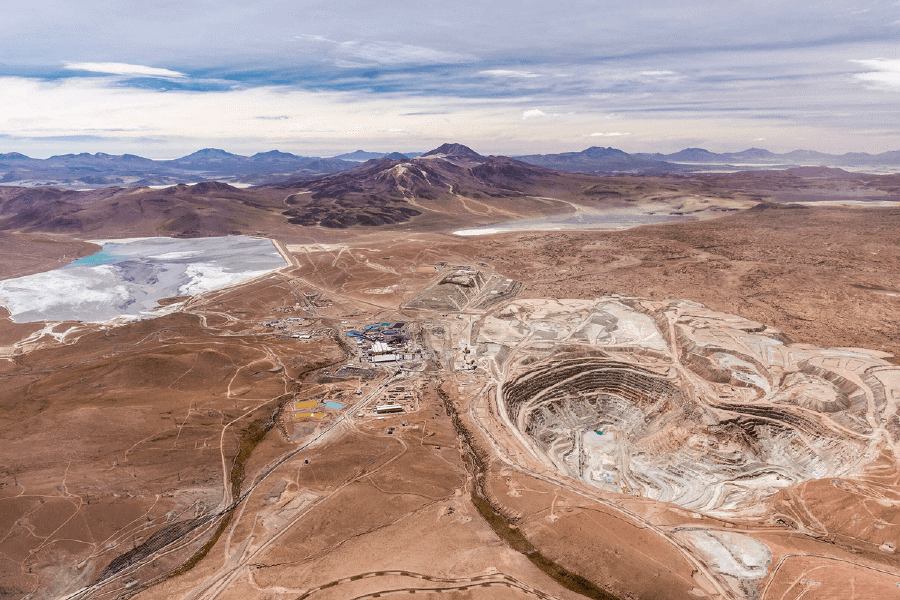
Annual planning sessions this year include a review of options for marginal assets, such as its lowest quality mine, Gabriela Mistral, and century-old smelter Potrerillos, said people with knowledge of the matter. No decisions have been been made and the company may opt to proceed with existing plans for the assets, especially with copper prices at record highs.

While asset reviews are standard practice in the industry, the scrutiny of low-return investments reflects a shift in approach at Codelco, where the focus has been churning out as much as possible to maximize inflows to state coffers and avoiding politically sensitive closures. A collapse at its most profitable mine has further dimmed the financial outlook and undermined its chances of returning to pre-pandemic production levels.

A Codelco spokesperson declined to comment.

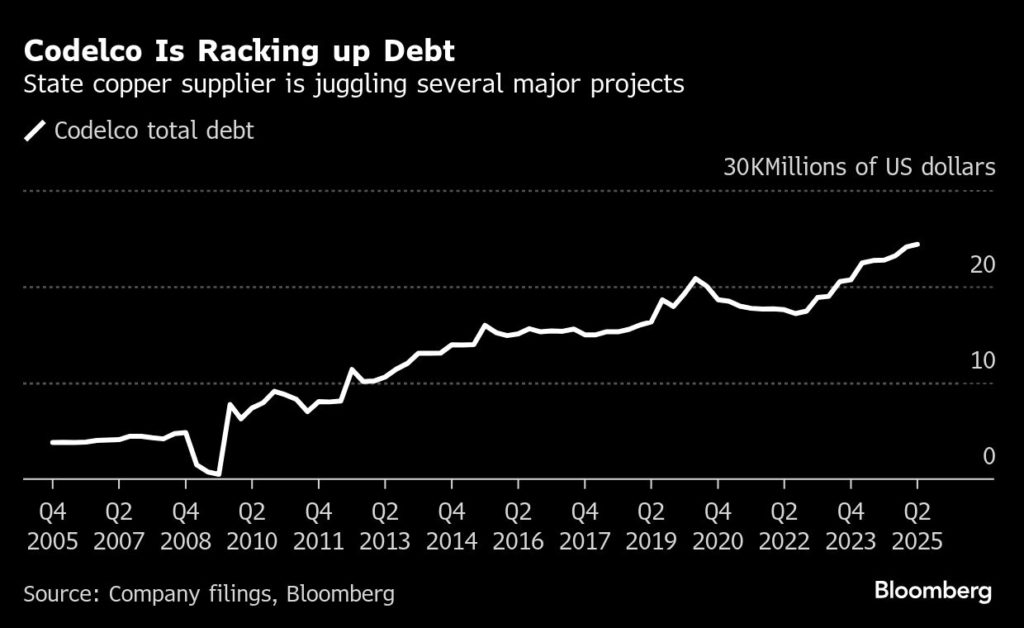
The talks come as Codelco is saddled with an enormous debt load that’s hurt prospects even as the copper market rallies. Analysts have criticized project strategies and execution at the company.

For the copper market, a shift by Codelco toward value over volume would be felt just as supply is set to tighten due to new demand from the energy transition and data-center boom.

Management is exploring ways to reduce the cost of an $800 million-plus project to extend the Gabriela Mistral mine, dubbed Gaby, said the people, asking not to be identified discussing non-public talks. Some within the company are leaning toward Gaby being mothballed once its life ends in 2028 — which would further complicate the task of returning annual production to 1.7 million tons by 2030 from about 1.4 million now. There’s also debate over the future of Potrerillos amid global smelting overcapacity.

Options for Gaby and Potrerillos are being discussed as part of business and development planning, the results of which will be presented to the board next month for further debate.

Also being debated are options for the giant El Teniente underground mine, which suffered a deadly collapse on July 31. That includes which of the remaining inactive areas should be restarted and whether gains can be squeezed out of unaffected areas to offset the impact, the people said.

Codelco has been spending unprecedented sums in recent years to overhaul aging mines and reverse a protracted output slump. Projects have come in late and over budget, pushing debt levels above $24 billion.

A potential cautionary tale for Codelco is the Salvador mine. Rather than closing its smallest operation as ore quality depleted, the company opted to sink more than $1 billion into an problematic overhaul that has yet to bear much fruit.

The Gaby open-pit project came online in 2008 and last year produced 103,000 metric tons, or about 0.5% of the world’s mined copper production. Among Codelco’s fully owned mines, Gaby has the lowest grades, resources and reserves, according to the latest annual report.

In December, the company filed a request with Chile’s environmental agency to extend Gaby’s operations until 2055, with an investment that was estimated at the time at about $800 million. Approval is pending for a project that includes a new water source and a new kind of leaching for sulfide ores. If the company decided not to proceed with the extension, it would be the first time a Codelco mine has been deactivated.

Gaby’s concession area spans a whopping 73,000 hectares (180,000 acres) in northern Chile. With a full-time staff of about 500, it was the first Codelco mine to operate with all autonomous trucks. It uses a type of processing that depends heavily on fluctuating sulfuric acid prices.

Another marginal asset coming under scrutiny is the Potrerillos smelter and refinery complex, which has been offline since mid-June due to a chimney collapse and maintenance work.

The mishap stoked debate over the pros and cons of shutting it down as a global smelting glut puts pressure on older, higher-cost plants. One possibility is to continue smelting operations there but halt refining and instead use spare capacity at another plant.

Much will depend on whether copper prices remain elevated, as well as the outcome of Chilean elections. The country’s new president will appoint three directors to the board after taking office in March, with the leading presidential candidates at opposite ends of the political spectrum.

(By James Attwood)


Ghana orders first major audit of mining firms in a decade

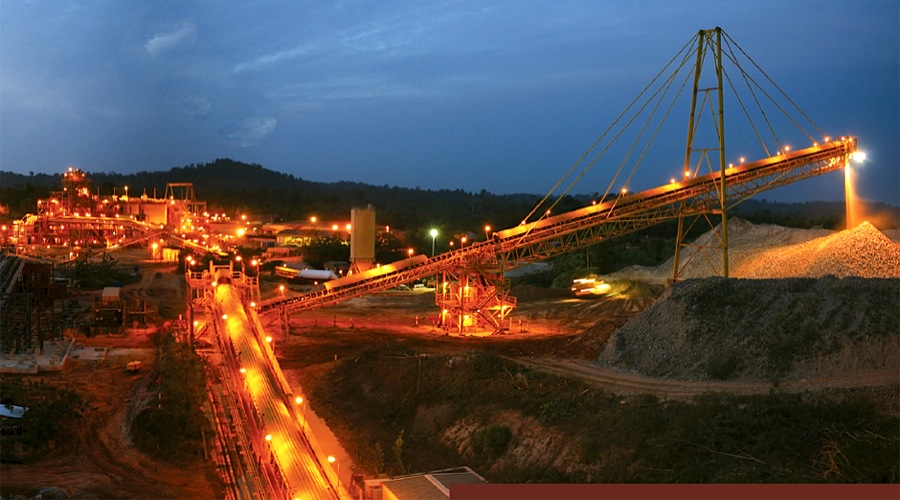
Crushed ore stock pile at Damang Gold mine in Ghana. (Image courtesy of Gold Fields)

Ghana, Africa’s top gold producer, has launched its most aggressive mining audit in a decade, targeting top miners to recover lost revenue and tighten oversight, a government letter seen by Reuters shows.

Governments across West Africa are intensifying scrutiny of mining firms to enforce compliance with regulations and safeguard revenue from soaring commodity prices.

Spot gold prices hit a record above $4,380 an ounce on October 20.

The audit will cover major gold miners including top producer Newmont, AngloGold Ashanti, Gold Fields, Perseus, Asante Gold and China’s Zijin.

It will be led by government auditors, forensic accountants, and independent consultants, according to an October 13 government letter from the regulatory Minerals Commission sent to mining companies via the Ghana Chamber of Mines.

Industry regulator, the Minerals Commission, is deploying teams for the nationwide physical and financial audit from November 1 to June 2026 to scrutinize production volumes, mineral flows, tax and royalty payments, and environmental compliance.

Miners must submit 10 years’ worth of production logs, 3 years of financial records, all permits, stockpiles and shipping manifests by October 31.

Company-specific reports are due within 30 days of each site visit, the letter said.

The Minerals Commission declined to comment. The mines ministry did not immediately respond to a request for comment.

True revenue potential

Mining is key to the world’s second-largest cocoa producer, generating 17.7 billion Ghanaian cedis ($1.68 billion) in 2024, driven by a 25.1% surge in gold output that helped stabilize the economy after its worst crisis in a generation.

Ghana, which also exports bauxite, diamonds and manganese, expects gold output to rise to 5.1 million ounces this year from 4.8 million.

The commission’s letter details a phased audit starting with Gold Fields’ Damang mine and Perseus in November, ending with Canada-based Xtra-Gold’s Kibi unit in late June 2026.

Individual companies have received letters detailing the schedule, an executive of one of the companies said, asking not to be named.

AngloGold Ashanti, Asante Gold, Gold Fields, Newmont, Perseus, Xtra-Gold and Zijin did not immediately respond to requests for comment.

The Chamber of Mines also did not immediately respond.

Ghana last audited its mining sector in 2015 with help from external investigators, but some companies challenged the findings, a source familiar with the process told Reuters.

Special audits should be done every year, not periodically, Said Boakye, an economist and research fellow at the Accra-based Institute for Fiscal Studies, told Reuters.

“It’s the only way to inform sound tax policy and unlock the sector’s true revenue potential.”

The government is pushing sweeping reforms to boost returns. Its mines minister said the country planned to shorten licence terms and enforce direct revenue-sharing with host communities, the most ambitious mining law overhaul in nearly 20 years.

($1 = 10.5500 Ghanian cedi)

(By Maxwell Akalaare Adombila; Editing by Pratima Desai and Jason Neely)


Newmont CEO says Ghana’s fiscal stability key as $900M gold mine opens

The Ahafo North gold mine. (Image courtesy of Newmont.)

Fiscal stability and fair tax and royalty systems are vital if countries want to attract mining investment, Newmont CEO Tom Palmer told Reuters as the company opened its $900 million Ahafo North mine in Ghana.

In Africa, Newmont now only operates in Ghana, one of the continent’s most stable mining jurisdictions, offering stability agreements for firms to lock in royalties for five to 15 years, although the government plans tighter oversight of mining companies.

Newmont’s investment decisions hinge on “very stable fiscal regimes” and “robust, fair tax and royalty systems,” Palmer said in an interview with Reuters on Thursday following the inauguration of the Ahafo North mine, its second mine in Ghana after selling the Akyem mine to China’s Zijin last year.

“It is important that we see a regime that is fair and transparent … If not, capital will go elsewhere,” he said.

Reuters reported this week that Ghana, Africa’s top gold producer, has ordered sweeping audits of mining firms, including US-based Newmont, AngloGold Ashanti, Gold Fields and China’s Zijin.

Ghana is also preparing major legal reforms, as West African states push for greater control over natural resources amid a global commodity boom. Palmer said the investment climate was still attractive.

“Ghana is a key place,” he said. “We’re in Australia, Canada, the United States, Peru, Argentina, Mexico, Suriname, all of those locations are very deliberately chosen and all of those locations we choose to go there for the very long term because we can be confident that we can build and maintain lasting relationships.”

Newmont now operates two mines in Ghana – Ahafo South and Ahafo North – which Palmer described as “cornerstones” of the company’s global portfolio.

“We’ve been here 30 years. I expect Newmont will be here at least another 30.”

Ghana’s Vice President Jane Naana Opoku-Agyemang said the Ahafo North mine marks a new phase of inclusive growth for Ghana’s economy.

“This partnership must go beyond profit. It must deliver lasting value to the people of Ghana, especially those in the host communities,” she said.

Ghana’s regulatory environment is more stable than other parts of Africa where military-led governments in Burkina FasoMali, Niger and Guinea, also rich with gold, uranium, bauxite, lithium and iron ore resources, are tightening fiscal regimes to boost state revenues.

Spot gold prices hit a record above $4,380 an ounce on October 20, boosting miners’ revenue.

The Ahafo North mine, located 30 km (19 miles) from Newmont’s Ahafo South operation, is expected to produce 50,000 ounces of gold this year, ramping up to 275,000–325,000 ounces annually over its 13-year life.

The mine will employ about 1,000 permanent workers, Palmer said. Newmont produced around 800,000 ounces of gold in Ghana in 2024.

(By Emmanuel Bruce and Maxwell Akalaare Adombila; Editing by Pratima Desai and Susan Fenton)


World Bank arbitration body rejects Barrick expedition request in Mali case

The Mali-based Loulo-Gounkoto complex includes Loulo underground mines, Yalea Gara and the Gounkoto open pit mine. (Image by Randgold Resources)

A request by Barrick Mining to expedite its international arbitration case against Mali has been rejected, two people familiar with the matter told Reuters on Friday.

The West African country’s government has been in fraught negotiations with Barrick since 2023 over the implementation of a new mining code that raises taxes and gives the government a greater share of its gold mines.

Barrick launched arbitration proceedings with the World Bank’s arbitration court, known as ICSID, in December 2024.

It had wanted ICSID to urgently address issues including the ongoing detention of four of its staff members, the appointment of a provisional administrator to operate the Loulo-Gounkoto complex after Barrick had suspended operations amid the dispute, and the expiration of the Loulo mine’s licence in 2026.

The request was rejected this week, the two sources said.

ICSID said on its website that it had issued an order concerning “provisional measures” on Wednesday, without giving further detail.

Barrick declined to comment on the situation. ICSID and the Malian mines ministry did not respond to requests for comment.

(By Portia Crowe and Divya Rajagopal; Editing by Alexander Smith)