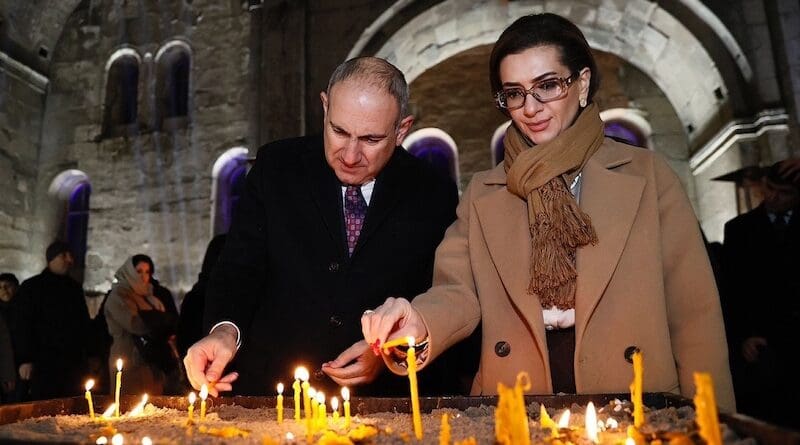
Armenia's Prime Minister Nikol Pashinyan and his wife Anna Hakobyan at the St. Gregory Church in Aruch on June 1. (Photo: primeminister.am)
November 6, 2025
IDN
By Benoit Lannoo
While President Ilham Aliyev of Azerbaijan is ramping up his claim to the neighbouring country again, the conflict in Armenia between the government of Nikol Pashinyan and the Armenian Apostolic Church continues to fester.
In recent weeks, Garegin II celebrated the 26th anniversary of his election as Catholicos of All Armenians by the Synod of the Armenian Apostolic Church (on October 27, 1999) and of his enthronement in Etchmiadzin, the ‘Vatican’ of the Armenian Apostolic Church (on November 4, 1999). But it was a celebration in a dire circumstance, since the Armenian Prime Minister, Nikol Padhinyan, openly advocates for the removal of the Catholicos. Moreover, Garegin’s brother and two of his nephews are behind bars, as are several other Armenian apostolic prelates and priests and many political opponents of PM Pashinyan.
The prosecutors find different charges for each arrest that occurs. Businessperson Samvel Karapetyan was arrested in mid-June because his words “[intervene] in our way ” used during an interview would indicate a “hybrid operation [with the support of Russia]” against Armenia. The Karapetyan family meanwhile has started a political movement under the name ‘Our way’, aiming to weigh in on the parliamentary elections of June next year. Vice chairperson and nephew Narek Karapetyan of Tashir Group, the family’s business empire, was recently questioned about it by the American television ghost Carlson Tucker in an interview that is available on Facebook since Tuesday, November 4.
Archbishops
Archbishop Bagrat Galstanyan, Primate of Tavush, has often spoken out against the government’s policy of giving up the Armenian enclave of Artsakh. That enclave in Azerbaijan was ethnically cleansed by the Azerbaijanis two years ago; there are no Armenians left anymore. Galstanyan’s ‘Tavush for our Fatherland’ movement refuses to accept this: “In Artsakh there is, among other things, the Amaras monastery, which was founded by Gregory the Illuminator and where the holy monk Mesrop Mashtots invented the Armenian alphabet in the early fifth century,” Galstanyan reminded us in November 2023. “Artsakh is ours!” Result: Galstanyan nowadays remains behind bars.
The same goes for the Primate of Shirak, Archbishop Mikael Ażapahjan: the prelate had himself filmed in the courtroom while he was found guilty of an attempted coup and he was sentenced to two years in prison. But Ażapahjan did not give in to the intimidation by Pashinyan & Co. “I don’t understand what makes you participate in such a sham,” he snapped at his judges. “One day, I will be justified. And you will remain guilty. Your children will be ashamed.” In the meantime, Mkrtich Proshyan, Primate of the diocese of Aragatsotn and a nephew of the Catholicos, was also arrested on charges of “obstructing the exercise of the right to vote by abusing an official position”.
Opposition
A brother and another nephew of Catholicos Garegin II were recently arrested with similar accusations. They are no clerics, but politicians in Vagharshapat, the city where Etchmiadzin is located. The number of politicians in jail on the basis of fantasized accusations can no longer be counted on a single hand. Among them, the mayor of Armenia’s second largest city, Gyumri, Vartan Ghukasyan, imprisoned on charges of corruption. His fellow mayor of the smaller town Masis south of Yerevan, Davit Hambardzumjan, was also arrested last month for allegedly attacking protesters against the government in… 2018 (sic).
All those detentions are part of the same clash in Armenian society. What about the loss of Artsakh? What with the so-called peace agreement with Azerbaijan and the so-called thaw in relations with Türkiye? What with the Washington deal of US President Donald Trump of August 8, 2025? And what with the relations with Armenia’s traditional ally, Russia? The former journalist Nikol Pashinyan, who took power with the ‘Velvet Revolution’ in the spring of 2018, was very popular among European neoliberal politicians, such as Boris Johnston in the United Kingdom, Emmanuel Macron in France, or Charles Michel in Belgium. But what has its turn to the West brought to Armenia?
The Artsakh issue
When Pashinyan was re-elected in 2021, he explicitly promised to watch over Armenian territorial sovereignty, including the enclave of Artsakh. As far as the latter is concerned, the PM has not succeeded. Baku did not do what was agreed on with the ceasefire imposed by Russian President Vladimir Putin after the 44-day war, on November 10, 2020. The Azeris had the Laçin corridor, the only access to the enclave, blocked by so-called environmental activists in December 2022. And after nine months of blockade, they suddenly attacked Artsakh again. Putin was already occupying Ukraine at that time; the Russian peacekeepers on the ground in the Caucasus did nothing.
End of September 2023, the last hundred thousand Artsakhis fled the enclave; Azerbaijan had made it sufficiently clear to them that they were no longer safe in their homeland. Meanwhile, international bodies – the European Parliament and many others – explicitly pleaded for their return, but did no more than issuing declarations. However, speaking about Artsakh is annoying of Pashinyan, because the Artsakh issue threatens to complicate his re-election in June 2026. That is why Pashinyan is trying to silence anyone who stirs up the issue. And he shifts attention through deals with his new allies, even though those deals contain de facto the complete surrender of Armenia.
Business deal
Pashinyan indeed surrendered to the American President Donald Trump, who is keen to do business in the region without being disturbed by Russia in the north nor by Iran in the south. That is the purpose of the so-called Zangezur corridor; note that the dealmakers are not even picky enough to name it in Armenian, but that the Azerbaijani name of the southern Armenian province of Syunik is used. In a mood of modesty, the connection from the mainland to the Azerbaijani exclave of Nakhchivan in Washington was also called the Trump Route for International Peace and Prosperity (Tripp).
The American president is not interested in peace, but only in transporting resources from Azerbaijan to the West via Türkeye. The day after the Washington Memorandum of understanding was signed at the White House, Trump was even not able to pronounce correctly the names of the two countries where he had forced ‘peace’: he called them “Albania and Azer-bian”. When in the Oval Office Pashinyan pointed out to him that there are still more than twenty political prisoners from Artsakh in prison in Baku, Trump promised that he would address this issue to his Azerbaijani colleague Ilham Aliyev – “a great leader” because in power for 22 years. Nothing has been heard about it since then.
Coca-Cola
What very well can be heard, is that Aliyev is not at all inclined to curb his aggression towards Armenia, since he was rewarded for that aggression by Donald Trump at the White House. In a speech for the 80th anniversary of the Azerbaijani Academy of Sciences, last Monday, the Baku dictator again called his neighbour “West Azerbaijan” and pretended that “Lake Sevan must become Lake Goycha, because this name figures at an early twelfth-century map from Tsarist Russia”. Aliyev also announced his intention to promote “the return of Azeris to their historic homeland”.
One has to admit that throughout the South Caucasus, Christian Armenians have lived together for a long time with the various Islamic peoples who now make up Azerbaijan. But to claim that Etchmiadzin is on Azeri land – as recently did Sheikh Allahshukur Pashazade of the Muslim Council on the Caucasus – or that even the 2800-year-old Yerevan is an Azeri city – as Aliyev claims it all the time – is of course utter nonsense. The Armenian quip that “Coca-Cola is older than Azerbaijan” is more in line with reality: Azerbaijan was created when the empire of the Tsars fell apart in the early 20th century.
Aliyev
But anti-Armenian resentment is a pillar of the Aliyev regime. Father Heydar Aliyev – a former local Soviet politician – seized power after Azerbaijan was defeated during a previous war with Armenia (1988-94) followed the collapse of the Soviet Union. If the Armenian politicians at that time had concluded a peace agreement in which Azerbaijan is not humiliated, a lot of suffering in the South Caucasus might have been avoided. Since then, however, the Aliyev family has built a strong Azerbaijan with the money they earned with the extraction of the mineral resources under the Caspian Sea, with a ruthless repression of any opposition and with a vehement anti-Armenian rhetoric.
Baku’s superiority is so impressive that Armenia did not stand a chance when Azerbaijan attacked Artsakh in 2020. And without international support, Pashinyan could not make any fist when the Laçin corridor was blocked from December 2022 on, nor when the Azeris attacked the enclave again in September 2023. But you do not win elections by admitting that you are powerless. That explains why Pashinyan tries to sweep the entire Artsakh issue off the table, and why he is totally capitulating for the stronger Presidents Trump in Washington, Aliyev in Baku and Recep Tayyib Erdoğan in Ankara, hoping that economic prosperity can soon satisfy the Armenian electorate.
Ararat
However, the Armenian Apostolic Church continues to bother him. The Church and politicians who lean towards the Church, refuse to forget the past, continue to stand up for the right of return of the hundred thousand refugees from Artsakh, and do not trust at all the neighbouring countries Azerbaijan nor Türkeye. I can understand them, because neither Ankara nor Baku have ever given an inch to the Armenians. In Türkeye, the Armenian genocide of a hundred years ago is still invariably denied. Just as Aliyev continues to claim that the Artsakhis fled the enclave of their own free will two years ago…
But I do not understand why Prime Minister Pashinyan is bringing this conflict to such a head. Why on earth suddenly his government announces that Mount Ararat – the symbol par excellence of Armenian identity, even it is on Turkish territory – will disappear from the visa stamps of those entering Armenia? Why on earth is PM Pashinyan ostentatiously attending the liturgy presided over by a priest who openly apostatizes the Catholicos and who has therefore been suspended by the Armenian apostolic hierarchy? Pashinyan apparently counts on growing popularity by daring to say that Garegin II is not taking his celibacy promise too seriously.
Apathy
“But those rumours about the hypocrisy and luxurious lifestyle of many church leaders are nothing new,” an Armenian language student tells me in Gyumri. “Why rekindle them now, unless to discredit the Armenian Apostolic Church?” And why discredit the Church now? Perhaps because the Church is the only stabilizing and connecting factor in Armenian history, with all the drama that this history entails. To Medz Yeghern (the ‘Great Crime’) of 1915, in which one and a half million Armenians were put to the sword by Turkish extremists, to the ethnic cleansing of Artsakh, is now added… the apathy of most of the ordinary Armenian men and women.
The capital Yerevan, where a third of the Armenian population lives, is known for its bling and selfies. Ordinary Armenians try to live an everyday life, far away from nationalist stories about war and humiliation, far away also from the message of the Gospel or from Church institutions. Christianity in Armenia is an identity more than a practice. The PM nowadays seduces only one Armenian voter in five, but the apathy among Armenians is immeasurably greater. And since the opposition remains divided, Pashinyan’s strategy has a chance of success: he spreads division and reinforces the apathy that keeps disappointed people at home when it comes to going to the urns.
By Benoit Lannoo
While President Ilham Aliyev of Azerbaijan is ramping up his claim to the neighbouring country again, the conflict in Armenia between the government of Nikol Pashinyan and the Armenian Apostolic Church continues to fester.
In recent weeks, Garegin II celebrated the 26th anniversary of his election as Catholicos of All Armenians by the Synod of the Armenian Apostolic Church (on October 27, 1999) and of his enthronement in Etchmiadzin, the ‘Vatican’ of the Armenian Apostolic Church (on November 4, 1999). But it was a celebration in a dire circumstance, since the Armenian Prime Minister, Nikol Padhinyan, openly advocates for the removal of the Catholicos. Moreover, Garegin’s brother and two of his nephews are behind bars, as are several other Armenian apostolic prelates and priests and many political opponents of PM Pashinyan.
The prosecutors find different charges for each arrest that occurs. Businessperson Samvel Karapetyan was arrested in mid-June because his words “[intervene] in our way ” used during an interview would indicate a “hybrid operation [with the support of Russia]” against Armenia. The Karapetyan family meanwhile has started a political movement under the name ‘Our way’, aiming to weigh in on the parliamentary elections of June next year. Vice chairperson and nephew Narek Karapetyan of Tashir Group, the family’s business empire, was recently questioned about it by the American television ghost Carlson Tucker in an interview that is available on Facebook since Tuesday, November 4.
Archbishops
Archbishop Bagrat Galstanyan, Primate of Tavush, has often spoken out against the government’s policy of giving up the Armenian enclave of Artsakh. That enclave in Azerbaijan was ethnically cleansed by the Azerbaijanis two years ago; there are no Armenians left anymore. Galstanyan’s ‘Tavush for our Fatherland’ movement refuses to accept this: “In Artsakh there is, among other things, the Amaras monastery, which was founded by Gregory the Illuminator and where the holy monk Mesrop Mashtots invented the Armenian alphabet in the early fifth century,” Galstanyan reminded us in November 2023. “Artsakh is ours!” Result: Galstanyan nowadays remains behind bars.
The same goes for the Primate of Shirak, Archbishop Mikael Ażapahjan: the prelate had himself filmed in the courtroom while he was found guilty of an attempted coup and he was sentenced to two years in prison. But Ażapahjan did not give in to the intimidation by Pashinyan & Co. “I don’t understand what makes you participate in such a sham,” he snapped at his judges. “One day, I will be justified. And you will remain guilty. Your children will be ashamed.” In the meantime, Mkrtich Proshyan, Primate of the diocese of Aragatsotn and a nephew of the Catholicos, was also arrested on charges of “obstructing the exercise of the right to vote by abusing an official position”.
Opposition
A brother and another nephew of Catholicos Garegin II were recently arrested with similar accusations. They are no clerics, but politicians in Vagharshapat, the city where Etchmiadzin is located. The number of politicians in jail on the basis of fantasized accusations can no longer be counted on a single hand. Among them, the mayor of Armenia’s second largest city, Gyumri, Vartan Ghukasyan, imprisoned on charges of corruption. His fellow mayor of the smaller town Masis south of Yerevan, Davit Hambardzumjan, was also arrested last month for allegedly attacking protesters against the government in… 2018 (sic).
All those detentions are part of the same clash in Armenian society. What about the loss of Artsakh? What with the so-called peace agreement with Azerbaijan and the so-called thaw in relations with Türkiye? What with the Washington deal of US President Donald Trump of August 8, 2025? And what with the relations with Armenia’s traditional ally, Russia? The former journalist Nikol Pashinyan, who took power with the ‘Velvet Revolution’ in the spring of 2018, was very popular among European neoliberal politicians, such as Boris Johnston in the United Kingdom, Emmanuel Macron in France, or Charles Michel in Belgium. But what has its turn to the West brought to Armenia?
The Artsakh issue
When Pashinyan was re-elected in 2021, he explicitly promised to watch over Armenian territorial sovereignty, including the enclave of Artsakh. As far as the latter is concerned, the PM has not succeeded. Baku did not do what was agreed on with the ceasefire imposed by Russian President Vladimir Putin after the 44-day war, on November 10, 2020. The Azeris had the Laçin corridor, the only access to the enclave, blocked by so-called environmental activists in December 2022. And after nine months of blockade, they suddenly attacked Artsakh again. Putin was already occupying Ukraine at that time; the Russian peacekeepers on the ground in the Caucasus did nothing.
End of September 2023, the last hundred thousand Artsakhis fled the enclave; Azerbaijan had made it sufficiently clear to them that they were no longer safe in their homeland. Meanwhile, international bodies – the European Parliament and many others – explicitly pleaded for their return, but did no more than issuing declarations. However, speaking about Artsakh is annoying of Pashinyan, because the Artsakh issue threatens to complicate his re-election in June 2026. That is why Pashinyan is trying to silence anyone who stirs up the issue. And he shifts attention through deals with his new allies, even though those deals contain de facto the complete surrender of Armenia.
Business deal
Pashinyan indeed surrendered to the American President Donald Trump, who is keen to do business in the region without being disturbed by Russia in the north nor by Iran in the south. That is the purpose of the so-called Zangezur corridor; note that the dealmakers are not even picky enough to name it in Armenian, but that the Azerbaijani name of the southern Armenian province of Syunik is used. In a mood of modesty, the connection from the mainland to the Azerbaijani exclave of Nakhchivan in Washington was also called the Trump Route for International Peace and Prosperity (Tripp).
The American president is not interested in peace, but only in transporting resources from Azerbaijan to the West via Türkeye. The day after the Washington Memorandum of understanding was signed at the White House, Trump was even not able to pronounce correctly the names of the two countries where he had forced ‘peace’: he called them “Albania and Azer-bian”. When in the Oval Office Pashinyan pointed out to him that there are still more than twenty political prisoners from Artsakh in prison in Baku, Trump promised that he would address this issue to his Azerbaijani colleague Ilham Aliyev – “a great leader” because in power for 22 years. Nothing has been heard about it since then.
Coca-Cola
What very well can be heard, is that Aliyev is not at all inclined to curb his aggression towards Armenia, since he was rewarded for that aggression by Donald Trump at the White House. In a speech for the 80th anniversary of the Azerbaijani Academy of Sciences, last Monday, the Baku dictator again called his neighbour “West Azerbaijan” and pretended that “Lake Sevan must become Lake Goycha, because this name figures at an early twelfth-century map from Tsarist Russia”. Aliyev also announced his intention to promote “the return of Azeris to their historic homeland”.
One has to admit that throughout the South Caucasus, Christian Armenians have lived together for a long time with the various Islamic peoples who now make up Azerbaijan. But to claim that Etchmiadzin is on Azeri land – as recently did Sheikh Allahshukur Pashazade of the Muslim Council on the Caucasus – or that even the 2800-year-old Yerevan is an Azeri city – as Aliyev claims it all the time – is of course utter nonsense. The Armenian quip that “Coca-Cola is older than Azerbaijan” is more in line with reality: Azerbaijan was created when the empire of the Tsars fell apart in the early 20th century.
Aliyev
But anti-Armenian resentment is a pillar of the Aliyev regime. Father Heydar Aliyev – a former local Soviet politician – seized power after Azerbaijan was defeated during a previous war with Armenia (1988-94) followed the collapse of the Soviet Union. If the Armenian politicians at that time had concluded a peace agreement in which Azerbaijan is not humiliated, a lot of suffering in the South Caucasus might have been avoided. Since then, however, the Aliyev family has built a strong Azerbaijan with the money they earned with the extraction of the mineral resources under the Caspian Sea, with a ruthless repression of any opposition and with a vehement anti-Armenian rhetoric.
Baku’s superiority is so impressive that Armenia did not stand a chance when Azerbaijan attacked Artsakh in 2020. And without international support, Pashinyan could not make any fist when the Laçin corridor was blocked from December 2022 on, nor when the Azeris attacked the enclave again in September 2023. But you do not win elections by admitting that you are powerless. That explains why Pashinyan tries to sweep the entire Artsakh issue off the table, and why he is totally capitulating for the stronger Presidents Trump in Washington, Aliyev in Baku and Recep Tayyib Erdoğan in Ankara, hoping that economic prosperity can soon satisfy the Armenian electorate.
Ararat
However, the Armenian Apostolic Church continues to bother him. The Church and politicians who lean towards the Church, refuse to forget the past, continue to stand up for the right of return of the hundred thousand refugees from Artsakh, and do not trust at all the neighbouring countries Azerbaijan nor Türkeye. I can understand them, because neither Ankara nor Baku have ever given an inch to the Armenians. In Türkeye, the Armenian genocide of a hundred years ago is still invariably denied. Just as Aliyev continues to claim that the Artsakhis fled the enclave of their own free will two years ago…
But I do not understand why Prime Minister Pashinyan is bringing this conflict to such a head. Why on earth suddenly his government announces that Mount Ararat – the symbol par excellence of Armenian identity, even it is on Turkish territory – will disappear from the visa stamps of those entering Armenia? Why on earth is PM Pashinyan ostentatiously attending the liturgy presided over by a priest who openly apostatizes the Catholicos and who has therefore been suspended by the Armenian apostolic hierarchy? Pashinyan apparently counts on growing popularity by daring to say that Garegin II is not taking his celibacy promise too seriously.
Apathy
“But those rumours about the hypocrisy and luxurious lifestyle of many church leaders are nothing new,” an Armenian language student tells me in Gyumri. “Why rekindle them now, unless to discredit the Armenian Apostolic Church?” And why discredit the Church now? Perhaps because the Church is the only stabilizing and connecting factor in Armenian history, with all the drama that this history entails. To Medz Yeghern (the ‘Great Crime’) of 1915, in which one and a half million Armenians were put to the sword by Turkish extremists, to the ethnic cleansing of Artsakh, is now added… the apathy of most of the ordinary Armenian men and women.
The capital Yerevan, where a third of the Armenian population lives, is known for its bling and selfies. Ordinary Armenians try to live an everyday life, far away from nationalist stories about war and humiliation, far away also from the message of the Gospel or from Church institutions. Christianity in Armenia is an identity more than a practice. The PM nowadays seduces only one Armenian voter in five, but the apathy among Armenians is immeasurably greater. And since the opposition remains divided, Pashinyan’s strategy has a chance of success: he spreads division and reinforces the apathy that keeps disappointed people at home when it comes to going to the urns.
Benoit Lannoo is an expert in Communication, Ecumenical, Interfaith & Interreligious Dialogue & Policy Strategies bases in Antwerp (Belgium). He is travelling regularly in Armenia.

IDN
IDN-InDepthNews offers news analyses, features, reports and viewpoints that impact the world and its peoples. It has been online since 2009. Its network spans countries around the world.
IDN
IDN-InDepthNews offers news analyses, features, reports and viewpoints that impact the world and its peoples. It has been online since 2009. Its network spans countries around the world.