Friday, November 07, 2025

America, Incorporated: The Era Of The Portfolio State – Analysis

STATE CAPITALI$M BY ANY OTHER NAME


 Foreign Policy Research Institute
By Mohammed Soliman


(FPRI) — For much of the last century, the American state has intervened directly in the economy only in times of extraordinary crisis. During World War II, Washington commandeered entire industries to serve the war effort. In 2008, it took ownership stakes in banks, automakers, and insurers to stabilize the financial system. These interventions were temporary, emergency-driven, and designed to unwind once the immediate danger had passed.

What is happening today is different. The state is no longer waiting for crisis. It is proactively buying into the commanding heights of the 21st-century economy. This shift is not simply about regulation or subsidy, but about ownership. America is beginning to look less like the free-market exemplar of the neoliberal era and more like a strategic shareholder, assembling a portfolio of national assets across semiconductors and minerals that will expand to energy and biotechnology, and other industries of interest.

A few months ago, something unprecedented happened: The US government quietly bought an equitystake in Intel. This was done using pre-allocated subsidies from the CHIPS and Science Act, and it occurred without any sort of emergency. A few weeks before the Intel deal, the then Department of Defense, now Department of War, also acquired a 15 percent stake in MP Materials, positioning the company as a rare earth national champion. These decisions are not isolated events. They reflect the birth of a new industrial paradigm: the Portfolio State.

The End of the Neoliberal Consensus

For 40 years, American industrial policy was guided by market fundamentalism. The private sector was the engine of innovation, while the state served as a light-handed regulator and an enabler of globalization, providing market access for geopolitical alignment. Silicon Valley flourished. Capital moved freely. Manufacturing was offshored in pursuit of financial returns with Washington effectively outsourcing its industrial base to the invisible hand of the market. But that model has begun to crack. Recent events, such as the COVID-19 pandemic, the semiconductor shortage, and the rise of China as the techno-industrial superpower exposed America’s deep vulnerabilities. Chief among them is its lack of industrial scale in strategic sectors, areas where volume, speed, and competitiveness are required for national resilience and preserving a leading global position. This shortfall reflects a broader American tendency to assume that our perceived sense of technological superiority—which is already eroding vis-à-vis China—can compensate for material and industrial deficiencies, a belief at odds with industrial reality.

Industrial Policy in Historical Perspective

This is not the first time the United States has abandoned laissez-faire orthodoxy in favor of direct state intervention. During World War I, President Woodrow Wilson established the War Industries Board to coordinate the allocation of raw materials and standardize production to support the war efforts. The government nationalized railways and exerted control over telegraph networks to guarantee reliable transport and secure communication for the war efforts against Imperial Germany.

By World War II, Washington’s role was even more sweeping. President Theodore Roosevelt’s War Production Board converted entire sectors of the civilian economy to military use—automobile plants churned out tanks and aircraft, rubber and gasoline were rationed, and steel was funneled into shipbuilding. The government also imposed price controls and even nationalized industries such as coal mining when strikes threatened production. The United States became the “arsenal of democracy” by producing a massive amount of military goods. This extraordinary mobilization raised real GDP by 72 percent between 1940 and 1945, and at its peak, a large portion of US economic activity was managed or steered by federal authorities to sustain the war effort.

In the late 1980s, facing competition from Japan’s semiconductor industry, the US government and 14 tech companies formed a public-private consortium called SEMATECH. Funded by the Department of Defense and its members, SEMATECH’s goal was to improve US semiconductor manufacturing, a collaboration that helped the United States regain its leadership position by the mid-1990s. And during the COVID-19 pandemic, the federal government intervened at an unprecedented scale. Through Operation Warp Speed, it directly funded the development and manufacturing of vaccines, and it also guaranteed airline payrolls, injected liquidity into markets, and authorized the Federal Reserve to purchase corporate bonds.

The through line is clear: when national security or systemic stability is at risk, the United States has never hesitated to use the full weight of the state to direct markets, sustain industries, or even seize assets in the name of the national interest. The difference today is not whether Washington intervenes, but how. First came export controls on advanced chips to China in October 2022. Then came the CHIPS and Science Act, allocating over $52 billion to subsidize semiconductor manufacturing. Next came targeted loan programs, tax credits, and partnerships for critical minerals. These steps reflected a strategy of de-risking—not full decoupling, but reducing dependence on China while restoring industrial sovereignty.

And now, under the Trump administration, there is a shift from subsidies to equity—from carrots to ownership. The United States is no longer just underwriting industry—it is becoming a shareholder in it. This marks the clearest break yet with the neoliberal consensus and the strongest signal that a new model is emerging—a model this piece will later define as the Portfolio State.

Intel and MP Materials: From National Champion to National Stake

Intel once defined American semiconductor leadership. Under pioneers like Robert Noyce, Gordon Moore, and Andy Grove, the company invented the modern microchip, scaled it, and dominated global computing. By the 2000s, Intel’s dominance began to slip, largely due to a series of strategic miscalculations. The company missed the fundamental shift to mobile computing, as its chips weren’t designed to compete with the low-​power ARM architecture that powered the smartphone revolution. At the same time, it failed to recognize the emerging market for artificial intelligence (AI), allowing rivals like NVIDIA to become the leaders in specialized chips for AI data centers.

These setbacks were compounded by internal challenges. Intel fell behind in manufacturing, struggling with costly delays in developing its next-generation technology while competitors, such as Taiwan’s TSMC and South Korea’s Samsung, pulled ahead in advanced chip manufacturing. This shift was particularly dangerous as TSMC came to dominate an estimated 90 percent of the market for the most advanced AI chips. As the AI compute wave hits, the world’s dependency on these chips will only increase, making the need for a domestic alternative like Intel a top priority for national security. In a world where compute is foundational to technological supremacy, this was an unacceptable strategic liability. The Biden administration began with subsidies and procurement contracts, but the Trump administration went even further: it bought in.

This is why, in August, the US government acquired approximately a 10 percent equity stake in Intel—an $8.9 billion investment funded by the remaining $5.7 billion in CHIPS Act grants and $3.2 billion from the Secure Enclave program. This investment is in addition to the $2.2 billion in CHIPS grants Intel has already received, bringing total federal support to $11.1 billion. This stake in Intel signals more than confidence in one company. It is the scaffolding for a new model of techno-industrial policy where the state doesn’t just fund innovation—it holds shares in it.

On the other side of the technology stack lies the raw material: rare earths. MP Materials operates the Mountain Pass mine in California. Rare earth elements are critical to everything from electric vehicles and wind turbines to precision-guided missiles and smartphones. Yet for decades, the United States ceded this sector to China, which now has a monopoly over global processing capacity. In February, the Department of Defense announced a $35 million cost-sharing agreement with MP Materials to design and build a facility to process heavy rare earth elements at the company’s Mountain Pass site in California. This partnership expanded even further: the Department of Defense is now MP Materials’ largest shareholder, holding a 15 percent stake in the company as part of a multibillion-dollar package to accelerate domestic magnet production.

What’s different this time is the logic. This is not just a loan or subsidy. It is a deliberate move to reassert sovereign control over a key input in the technology, defense and energy transition supply chains. In its own way, MP is the mining equivalent of Intel: a national asset operating in a strategic bottleneck. It is not hard to imagine a future where the US government, or a coalition of industrial funds, acquires equity stakes in critical mineral producers.

The Portfolio State


What unites Intel and MP Materials is not sector or technology, but logic. The United States is no longer just subsidizing innovation but also building a portfolio of national assets—companies that sit at the apex of geoeconomic power. It is a Portfolio State: not a command economy in the Chinese mold, but a shareholder model in which public capital is deployed to achieve both commercial success and national interest. This new approach is finding a consensus between the populist left and the populist right. The Trump administration’s shift toward state intervention, most notably with the Intel deal, is being openly supportedby progressives like Sen. Bernie Sanders, who had previously advocated for a similar approach as an amendment to the CHIPS Act.

Of course, industrial policy is not new to America, but the modern Portfolio State is different. It is shaped not only by geopolitical competition and techno-industrial urgency, but also by the growing influence of venture capitalist culture on American politics and, by extension, technology policy. As David Sacks put it when discussing the Intel deal, “if you are going to hand out billions of dollars to these companies, you’re better off at least again getting something for it, having the taxpayers have some upside in it, allowing the government to recoup and creating the right incentive for these companies.” That logic—placing bets, managing risk, and demanding returns—is straight out of Sand Hill Road.

Sacks made the point even sharper: “We don’t really want our companies going to the federal government to try and get bailed out. And at least if they have to give up equity or warrants, things like that, there’s a cost to it. We would rather that these companies get financed privately. But that didn’t happen here.” In other words, Washington is beginning to act like a venture capital firm by providing capital, but also demanding equity, and seeking geopolitical and commercial upside.

This shift is reinforced by personnel. Vice President JD Vance is a venture capitalist. Sriram Krishnan, a former Andreessen Horowitz partner, serves as an AI advisor in the Trump White House. The number of senior officials drawn directly from the venture capital ecosystem, or from its broader circle of influence, is unprecedented. Personnel is policy. And in this administration, the policy reflects the worldview of venture investors: scale fast, take equity, export your stack.

This logic is already visible in America’s AI Action Plan, which makes scaling and exporting the American AI stack the centerpiece of national strategy. Commercial success is now the core of America’s geopolitical position. Within this line of thinking, if American firms dominate the infrastructure and application layers of AI, then Washington can set the terms of global technological competition and its broader geopolitical position. In that sense, the United States is leveraging commerce itself as a geopolitical instrument.

The Case for an American Wealth Fund

That raises a larger question: If Washington acquires more and more equity stakes in companies, how should these stakes be managed? It makes little sense to allocate shares in Intel or future strategic firms on an ad hoc basis. Instead, to build a fully integrated model for this era of industrial policy, the United States should consider managing them through a sovereign wealth fund—one that aligns financial firepower with national priorities and blends commercial returns with strategic statecraft.

A US sovereign wealth fund could institutionalize the Portfolio State and link investment flows directly to government priorities: AI, biotechnology, materials science, space, and energy technologies. Rather than treating each crisis as a one-off bailout, Washington could operate with foresight and discipline—turning public capital into a long-term lever of national strategy.

Intel and MP Materials are just the bookends of this emerging model. The US government’s equity stake in these companies signals something deeper: America’s techno-industrial playbook, filtered through the grammar of venture capital and, potentially, the architecture of a sovereign wealth fund. This is the Portfolio State.


About the author Mohammed Soliman is a Non-Resident Senior Fellow in the National Security Program at the Foreign Policy Research Institute. He is also the director of the Strategic Technologies and Cyber Security Program at the Middle East Institute and a visiting fellow with the National Security Program at Third Way. He can be found on X at @Thisissoliman.


Source: This article was published by FPRI

Published by the Foreign Policy Research Institute

Founded in 1955, FPRI (http://www.fpri.org/) is a 501(c)(3) non-profit organization devoted to bringing the insights of scholarship to bear on the development of policies that advance U.S. national interests and seeks to add perspective to events by fitting them into the larger historical and cultural context of international politics.
WAR IS ECOCIDE
Battlefields To Wastelands: UN Warns Conflicts Are Destroying Ecosystems Worldwide

NOT A WWI TRENCH

Ukrainian soldier in trench near Bakhmut, Donbas in Ukraine. Photo Credit: Mil.gov.ua, Wikipedia Commons

November 7, 2025 
By UN News

From Gaza to Ukraine and beyond, conflict has caused widespread death and destruction, but it has also devastated natural resources such as water systems, farmland and forests.

The impacts affect livelihoods, and fuel displacement as well as ongoing instability. Moreover, they can linger even after the fighting has ended.

In Sierra Leone, for example, “when the guns fell silent in 2002 after a decade of conflict, our primary forests and savannahs also fell silent,” deputy foreign minister Francess Piagie Alghali told the UN Security Council on Thursday.

“We witnessed loss of biodiversity, the forced migration of wildlife, and the abandonment of agricultural fields and swamps, all direct consequences of the armed conflict.”
Long-term implications

Sierra Leone holds the rotating Security Council presidency this month and Ms. Alghali presided over a debate on the environmental impact of armed conflict and climate-driven security risks.

It was held as more armed conflicts rage across the planet than at any time since the end of the Second World War, and two billion people – a quarter of the global population – live in conflict-affected areas.


“Environmental damage caused by conflicts continues to push people into hunger, into disease and into displacement and thereby increasing insecurity,” said Inger Andersen, Executive Director of the UN Environment Programme (UNEP).

Conflicts lead to pollution, waste, and the destruction of critical ecosystems, with long-term implications for food security, water security, the economy and health, she explained

Meanwhile, climate change “exacerbates tensions” and can even contribute to conflict – over water or land resources, for example.
Crop loss, contamination and flooding

Ms. Andersen highlighted several examples including the destruction of Gaza, where two years of war have caused the loss of 97 per cent of tree crops, 95 per cent of shrubland and more than 80 per cent of annual crops.

“Freshwater and marine ecosystems are polluted by munitions, by untreated sewage and other contaminants,” she said, while “over 61 million tonnes of debris must now be cleared, with sensitivity to avoid further contamination.”

In Ukraine, the June 2023 destruction of the Kakhova Dam “led to the flooding of more than 600 km² of land, resulting in severe loss of natural habitats, plant communities, and species, through prolonged inundation of ecosystems,” she added.
Legal offensive

The debate took place on the International Day for Preventing the Exploitation of the Environment in War and Armed Conflict and amid growing recognition of the need for global action.

“Significant efforts are being made to strengthen the international legal framework to protect the environment,” said law professor Charles C. Jalloh, a member of the International Law Commission (ILC), a UN body.

While no single binding universal treaty yet exists, he pointed to some of the “so-called soft law instruments” that have made contributions to date, including the ILC’s set of 27 draft principles, adopted in 2022.

“The principles, rooted in the law of armed conflict, international environmental law and international human rights law, sought to strengthen the protection of the environment before, during and after armed conflict, including in situations of occupation,” he said.
Strengthening links

Maranatha Dinat of the humanitarian organization World Relief delivered a message from Haiti, “where the combined impacts of environmental degradation, climate change and socio-political instability reinforce one another, undermining peace, security and sustainable development.”

She stressed the need to “strengthen the links between humanitarian action, climate adaptation, and peacebuilding” in order to boost resilience, promote social cohesion and ensure lasting stability.

Ms. Andersen outlined how the international community can assist conflict-affected countries, starting with rebuilding their capacity for environmental management.

Such support “enables governments to manage natural resources for sustainable development, for economic recovery, and for climate adaptation, thus reducing poverty, hunger and aid dependency.”
Climate adaptation and mitigation

She also called for increased investments in climate adaptation. UNEP released its latest Emissions Gap Report this week, which revealed that the world is struggling to limit global temperature rise to 1.5 degrees Celsius above pre-industrial levels.

“As we head to Belém, therefore, for COP30, high ambition is needed both on adaptation and on mitigation,” she said.

“Every fraction of a degree matters, and every fraction of a degree avoided means lower losses for people and ecosystems – and greater opportunities for peace and prosperity.”


Erdogan Condemns Netanyahu While Waging His Own War On The Kurds – OpEd


November 7, 2025 

By Fair Observer
By Robin Fakhari


Turkish President Recep Tayyip Erdogan has recently denounced Israeli Prime Minister Benjamin Netanyahu for the “continued attacks on Palestinian civilians” and warnedof a “humanitarian catastrophe in Gaza.” By presenting himself as a human rights defender, Erdogan seeks to position Turkey as a moral voice in the region. Yet for many Kurds, such remarks ring hollow — an example of the Kurdish saying, “the raven calls the other raven black,” the Kurdish equivalent of “the pot calling the kettle black.”


Erdogan’s hypocrisy

Since 2016, the Turkish government — now a self-styled champion of Palestinians — has carried out repeated military operations in the Kurdish-administered region of northern Syria, known in Kurdish as Rojava. Operations such as Olive Branch (2018) and Peace Spring(2019), among others, drew allegations from Amnesty Internationalof “serious human rights violations,” including arbitrary detention, torture and enforced disappearances.

Erdogan’s rhetoric on Gaza often resembles political opportunism more than moral conviction. In 2017, he warned that Kurds in Iraq “must give up on independence or go hungry.” While just a year earlier, he had called for Palestinian statehood at the United Nations. Now, in 2025, he accuses Netanyahu of using famine as a “weapon” in Gaza — the very threat he once directed at Kurds pursuing the same right: self-determination.

The contradictions extend further. After Netanyahu’s recent strike on a hospital in Gaza, Erdogan condemned Israel for “relentlessly destroying humanity.” Yet Amnesty International documented in 2019 the civilian costs of Turkey-backed operations in Syria, describing “an utterly callous disregard for civilian lives,” including unlawful strikes on residential areas. The Human Rights Watch also noted in 2022 that Turkish strikes on civilian infrastructure “exacerbate the humanitarian crisis” and “endanger basic rights.”

These abuses are well-documented. The Human Rights Watch’s 2024 findings detailed abductions, arbitrary arrests, sexual violence and torture committed by factions of the Turkey-backed Syrian National Army. The report also notes “Human Rights Watch … found that Turkish Armed Forces and intelligence agencies were involved in carrying out and overseeing abuses.”

In addition, a preliminary 2025 report by the European Association of Lawyers for Democracy and World Human Rights accused Turkey of “committing war crimes and crimes against humanity in Rojava.”

To condemn the Israeli government, Erdogan warns that “those who shed innocent blood will drown in it,” yet his own government stands accused of shedding that same blood. In this regard, the deeper question is why Kurdish and Palestinian struggles receive such unequal treatment. The answer lies less in humanitarian principles than in political calculations.

Erdogan’s political maneuvering

Regarding Erdogan’s recent political statements, some explanationspoint to his long-standing hostility toward Israel, his ties to the Muslim Brotherhood and neo-Ottoman ambitions. This point recalls earlier warnings.

In 2015, the Institute for Strategic, Political, Security and Economic Consultancy in Berlin reported that Turkey “support[s] other countries’ designated terrorist groups [such as] Muslim Brotherhood, Hamas, ETIM/TIP, Al Nusra, and other Al Qaeda affiliates.”
Financial software

In 2025, Israel’s Meir Amit Intelligence and Terrorism Information Center described Turkey as “a center for planning, funding, and directing terrorist attacks,” noting Erdogan’s ruling Justice and Development Party’s (AKP) ideological ties to Hamas.

In addition, the Counter Extremism Project observed that Turkey “maintains open relations with internationally sanctioned extremist groups and harbors internationally sanctioned and wanted extremists affiliated with the Taliban, the Muslim Brotherhood, and Hamas.”

At home, Erdogan faces mounting disillusionment. A 2025 Turkish Minutes poll showed that 67% of people in Turkey want the “Erdogan era to end.” A 2024 Pew Research Center survey found that 55% of Turkish adults hold an “unfavorable opinion” of him.

A similar distrust is also mirrored in Israel, where The Times of Israelreported that 70% of Israelis “do not trust” Netanyahu’s government. In such a condition that civilians are paying the price, Erdogan’s moral posturing toward Israel appears less like a principled stand than a striking case of the pot calling the kettle black.


The views expressed in this article are the author’s own and do not necessarily reflect Fair Observer’s editorial policy.

About the author: Robin Fakhari is an independent writer, researcher and artist. He holds a bachelor’s degree in English Literature and a master’s degree in American Studies, and is currently specializing in Kurdish Studies. His research interests include political studies, cultural studies, discourse analysis, power relations, sovereignty and identity, sociology of art, literary studies and critical theory. A trained classical pianist, he has over a decade of experience as a music instructor and has contributed to art scholarship as Editor-in-Chief of Contemporary Arts magazine, published by the University of Kurdistan, and as editor of The History of Contemporary Kurdish Art and Chiya Aesthetics. His master’s thesis, “The Birth of Music from the Soul of Tragedy: An Afro-American Study,” examines the emergence of jazz music through the frameworks of jazz diplomacy, power relations and Foucaultian theory.

Source: This article was published by Fair Observer

Fair Observer

Fair Observer is an independent, nonprofit media organization that engages in citizen journalism and civic education. Fair Observer's digital media platform has 2,500 contributors from 90 countries, cutting across borders, backgrounds and beliefs. With fact-checking and a rigorous editorial process, Fair Observer provides diversity and quality in an era of echo chambers and fake news. Fair Observer's education arm runs training programs on subjects such as digital media, writing and more. In particular, Fair Observer inspires young people around the world to be more engaged citizens and to participate in a global discourse.
A Question Of Needlessness: Selling Iron Dome To Australia – OpEd


November 7, 2025 

By Binoy Kampmark


The world of defence policy is truly another planet. There, budgets are given to astronomical burgeoning and bizarre readings. Threats can be invented or exaggerated. Insecurity can be inflated. Decisions for the next project supposedly more lethal and more effective than ever can be made with cavalier disregard to realities. And the next cockeyed, buffoonish idea can be given a run for other people’s money. Those other people are, as always, the good tax paying citizenry of a country.

Australia has been doing superbly of late in this regard. It has given over territory and money to the United States, its appointed arch defender, so that the security of Washington’s imperium can be assured. It has done so in a manner suggesting advanced dementia, its politicians and strategists drivelling about the need to combat the barbarian yellow-red hordes to the north in a “changing security environment”.

First came the AUKUS trilateral security pact with the US and the United Kingdom, which enshrines the costly fantasy of nuclear-powered submarines Australia may never get and certainly does not need. Nor is there an obligation on the part of the US to part with any, a prospect ever more unlikely given the failure of its own submarine base to keep pace with annual production. Let’s not even start on the prospects of an AUKUS-designed submarine, which will be lucky to make it to the construction stage without sinking.

To itemise any number of foolish ventures and items being pursued by the Australian defence department would be injurious to one’s well being. This is largely because they keep coming in their risible daftness. Of late, the idea that Australia needs an anti-missile defence shield along the lines of Israel’s Iron Dome system is becoming more than a flirtation. And it’s being given a sense of frisson by Rafael Advanced Defense Systems, the Israeli company responsible for implementing and maintaining it.

The chance for Rafael to shine came at the Indo Pacific International Maritime Exposition, an event running from November 4 to 6. Its presence, along with the Australian subsidiary of Israel’s primary unmanned vehicle manufacturer Elbit Systems, had piqued activists from the Palestine Action Group (PAG), who gathered just before the opening of the exposition to protest that fact.

A predictably muscular reaction from the New South Wales police followed. According to PAG organiser Josh Lees, they “immediately attacked” the peaceful gathering with pepper spray and horses. The NSW Premier Chris Minns, for his part, was enthralled by the economic prospects of the gathering: defence exports were there to be grown, deals to be made. That these were with merchants of death was no big matter. “They’re not selling nuclear weapons … we want to see the industry grow.”

For its part, Rafael had pulled out the bells and whistles. The company, according to its display, offered “an integrated, combat-proven portfolio that delivers end-to-end protection and impactful projection for Australia’s naval forces, ensuring freedom of action in Australia’s northern approaches and across vital sea lines of communication.”

In an interview at the exposition, the company’s vice president of international business development, Gideon Weiss, hawked Iron Dome’s technology with salesmanship enthusiasm. “The perception that Australia is far and distant and isolated is completely untrue,” he remarked with stern certitude. “There’s absolutely no reason in the world why any Australian would think… that in a conflict, Australia would not be attacked.” The unasked question here is why Australia would make itself an appealing target to begin with. But Weiss did not break his stride: “Your enemies have a great arsenal of ballistic missiles, hypersonic ballistic missiles, cruise missiles, and long-range UAVs [unmanned aerial vehicles]. Why wouldn’t they use them against you if they wanted to?”

Asked whether the company’s message had bitten in Canberra, Weiss was assured. The “capability and the maturity of the technology” had been noted by Australia’s defence wonks and Rafael was always keen to focus on “sovereignty, about the Australian industrial context.” There was “infrastructure which to Australianise, if you will, these technologies.”

The company has shown ample familiarity with the soil they wish to till. The Australian Defence Strategic Review of 2023 declared the need to “deliver a layered integrated air and missile system (IAMD) operation capability urgently. This must comprise a suite of appropriate command and control systems, sensors, air defence aircraft and surface (land and maritime) based missile systems.” The current program to develop a “common IAMD capability” was “not structured to deliver a minimum viable capability in the shortest period of time but is pursuing a long-term near perfect solution at an unaffordable cost.”

Defence analysts called upon to comment on the matter are slavering. Jennifer Parker, a regular talking head on the subject, rues the fact that Australia can never, given its geographical size, be protected in its entirety. “Unlike Israel, where they can defend the entire country against missiles broadly … that’s not feasible for Australia because of our size.” Focus, she suggests, on the “critical infrastructure elements that we need to protect, like HMAS Stirling, Pine Gap and bases around Darwin, and design integrated air and missile defence around that concept”.

The United States Studies Centre, an Australian outpost soddenly friendly to the military-industrial complex and the needs of the imperium, is also unrelenting about the need for a more expansive missile defence system. Peter Dean, senior advisor on defence strategy, cites “the lack of effective ground-based air defence and an Integrated Air and Missile Defence system” as “the most critical gap in the achievement of Australia’s strategic goals.”

Another outfit most friendly to US interests, the Australian Strategic Policy Institute, is also much in love with missile interception. “If we want to get serious about integrated missile defence,” ASPI senior analyst Malcolm Davis posits, “we need to have long-range, ground-based interceptor missiles that can handle threats like intermediate range ballistic missiles launched by China.”

The next wasteful program of military expenditure looms happily on the horizon, leaving the question of need unanswered. Weiss has good reasons to be optimistic that a train has been set in motion. “I wouldn’t want to name names,” he says with confidence, “but everyone knows us very well.”


Binoy Kampmark

Binoy Kampmark was a Commonwealth Scholar at Selwyn College, Cambridge. He lectures at RMIT University, Melbourne. Email: bkampmark@gmail.com
SNAP Cuts Disproportionately Hurt People With Disabilities – Analysis


November 7, 2025 
By Hayley Brown


The ongoing shutdown of the US federal government threatens the distribution of Supplemental Nutrition Assistance Program (SNAP) benefits this November. States, localities, and anti-hunger organizations are scrambling to fill the gap in federal assistance amid a massive wave of food insecurity.

While two federal judges have ruled that the United States Department of Agriculture (USDA) must use contingency funds to keep SNAP flowing, the Trump administration announced on November 3rd that it will only cover a fraction of the usual benefits. As of November 4, President Trump stated that SNAP benefits would be suspended entirely until the shutdown ends, leaving the program’s immediate future uncertain. Meanwhile, conservatives have seized upon this uncertainty to deride SNAP recipients and to characterize the program as a waste of resources. These claims are both morally hollow and factually off-base.

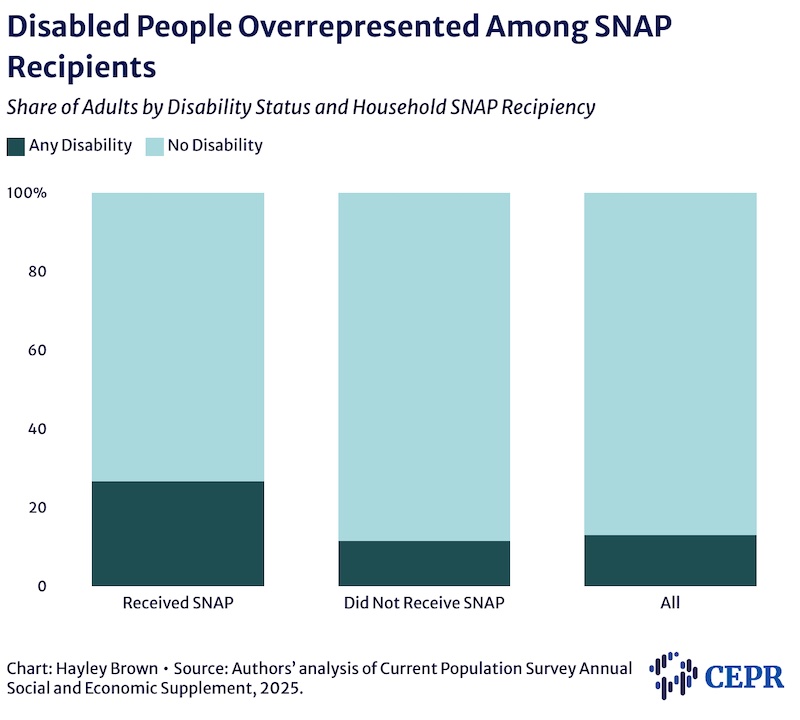
One thing these conservatives scarcely mention is that a disproportionate share of SNAP recipients have at least one type of disability (Figure 1). Adults with disabilities make up about 25 percent of SNAP recipients, nearly twice their share in the overall population (around 13 percent). About one in four SNAP recipients reports a disability, compared with about one in nine non-recipients. The imbalance reflects deep and persistent economic barriers that make it harder for people with disabilities to meet basic needs without support.
Figure 1

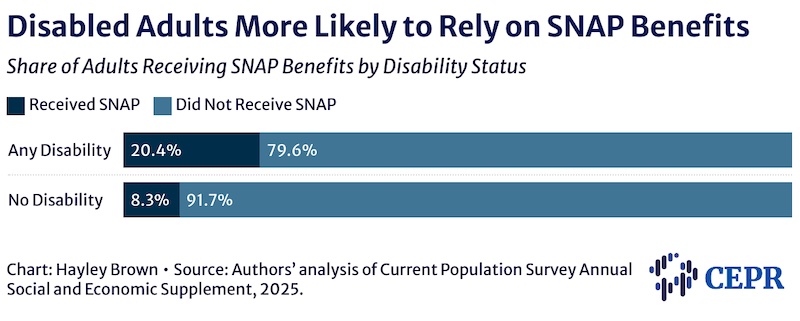
Disabled adults participate in SNAP at more than double the rate of those without disabilities (Figure 2). While only 8.3 percent of those without disabilities lived in households that relied on SNAP assistance, 20.4 percent of those with disabilities did. People with disabilities may also be more likely to rely on food delivery services, which is one reason why SNAP coverage of such services is so important.
Figure 2

Of course, the way disability is measured has a major impact on the statistics. In the Current Population Survey Annual Social and Economic Supplement (CPS ASEC), disability status is determined via a short series of yes-or-no questions about six types of “serious” functional difficulty: vision, hearing, cognition, mobility, self-care, and independent living. Respondents who report at least one type of difficulty are classified as having a disability. This approach captures more people than administrative records but still undercounts disabled adults, tending to exclude those with chronic illnesses (such as Long COVID or autoimmune diseases that can flare) or episodic impairments that do not fit neatly into these categories. It is also worth noting that disability prevalence in the CPS ASEC is lower relative to other national surveys that use the same question set.
Financial software


Nevertheless, surveys that rely on a broad set of functional questions consistently find that more than twice as many SNAP recipients have a disability compared with estimates using narrower administrative definitions. The stricter administrative measures tend to count only those receiving disability benefits, leaving out millions of people whose conditions limit their daily activities but who are not formally recognized by Social Security or similar programs. The administrative undercount obscures the true extent of disability among households receiving food assistance. It also reinforces norms that harm disabled people, as many of the qualifying benefits programs treat disability and labor force participation as mutually exclusive. The US’ approach stands in sharp contrast to those of other countries, which prioritize labor force inclusion for people with disabilities.


In the US, many who do not qualify as “officially” disabled under stringent program rules still face significant economic barriers, including but not limited to maintaining steady employment. This highlights the flaws in conservative efforts to impose or expand work requirements, including those in this year’s One Big Beautiful Bill Act, which are scheduled to take effect this week despite the ongoing shutdown. When policymakers tie access to food assistance to strict work hour thresholds, they risk cutting off people with disabilities who cannot meet those standards but still need to eat. Evidence from states that have imposed such requirements shows that they tend to balloon program costs via administrative bloat without meaningfully increasing employment. The result is greater hardship rather than increased labor force participation.

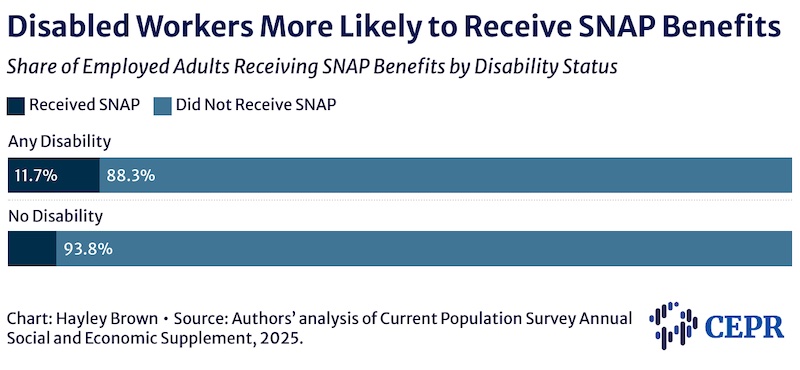
Even among employed adults, those with disabilities are nearly twice as likely to live in households that receive SNAP benefits as those without disabilities (Figure 3). Almost 12 percent of employed adults with at least one functional difficulty receive SNAP benefits, compared with about 6 percent of employed adults without a disability. This gap highlights the persistent income disadvantage faced by disabled workers, even when they are employed.
Figure 3

Disabled people are more likely to experience other forms of economic disadvantage, including unemployment, underemployment, higher medical expenses, and barriers to education and transportation. These barriers can make it difficult for many disabled workers to achieve food security without assistance. The overlapping and compounding challenges disabled people face make federal programs like SNAP essential for food security and economic stability.

Economic justice for people with disabilities cannot exist if disabled people are denied access to basic necessities. Lawmakers who care about the well-being of disabled people should make inclusive food assistance a core policy goal.


This article was published by CEPR


Hayley Brown

Hayley Brown is a Research Associate at the Center for Economic and Policy Research. Her research spans a wide range of subject matter, including labor, disability, inequality, and the role of the social state in creating an inclusive economy. Hayley recently served as the President of the Nonprofit Professional Employees Union, which represents the staff at CEPR and many other nonprofits throughout the United States. She previously worked in the Research, Markets, and Regulations division of the Consumer Financial Protection Bureau, and for the Brookings Institution’s Metropolitan Policy Program. She studied geographical sciences and philosophy at the University of Maryland, College Park.

DECRIMINALIZE DRUGS

Opium output down in Afghanistan as synthetic drug trade increases: UN

Opium output down in Afghanistan as synthetic drug trade increases: UN
/ Tim Cooper - Unsplash
By bno - Taipei Office November 6, 2025

Afghanistan’s opium cultivation fell sharply this year, yet the United Nations has warned that the country’s illicit economy is increasingly shifting towards synthetic drugs, The Khaama Press News Agency, reports.

According to a report released on November 6 by the United Nations Office on Drugs and Crime (UNODC), opium poppy cultivation declined by 20% in 2025 compared with the previous year, reflecting the continuing impact of the Taliban’s nationwide ban. The total area under cultivation fell to around 10,200 hectares, down from 12,800 hectares in 2024 and a fraction of the 232,000 hectares recorded in 2022 before the prohibition came into effect the report added.

Production fell even faster, dropping by nearly a third to an estimated 296 tonnes. The downturn has had a pronounced effect on farmers’ incomes, which plunged from about $260mn to $134mn as many switched to wheat and other legal crops. However, poor rainfall and persistent drought left more than 40% of farmland unplanted, deepening hardship across rural regions.

UNODC regional representative Oliver Stolpe said Afghanistan’s long-term recovery “depends on sustained international investment and viable economic alternatives”, urging equal attention to farmer livelihoods, demand reduction and the dismantling of trafficking networks.

The return of nearly 4mn Afghans from neighbouring countries has further strained already limited resources and employment opportunities, while cuts in humanitarian aid risk pushing vulnerable communities back into opium cultivation.

Although the price of dry opium dropped by 27% to about $570 per kilogram, it remains roughly five times higher than before the 2022 ban, keeping the trade lucrative for some growers.

At the same time, UNODC noted a rapid expansion of methamphetamine production, with seizures rising by around 50% by the end of 2024. The agency said criminal networks are increasingly turning to synthetic narcotics because of lower production costs, easier concealment and reduced vulnerability to environmental shocks.


South Korean lawmaker sparks outcry over country insult bill

South Korean lawmaker sparks outcry over country insult bill
/ William Warby - Unsplash
By bno - Busan Office November 7, 2025

A lawmaker from South Korea’s Democratic Party has triggered a fierce debate after proposing changes to the Criminal Act that would allow individuals to be jailed for insulting a foreign country, its citizens, or an ethnic group, Chosun Daily reports. Representative Yang Bu nam submitted the amendment early last month, supported by nine party colleagues and one independent lawmaker aligned with the government.

The plan responds to a rise in public demonstrations and online posts containing derogatory language aimed at certain countries, particularly China. The proposal highlights the tension in South Korea between national security sensitivities, regional geopolitical pressure, and the country’s strong democratic tradition of free expression.

In the explanation attached to the bill, Yang argued that existing laws only protect identifiable individuals from slander or verbal abuse, leaving a gap when entire groups or nationalities are targeted. He pointed to a recent anti-China protest where participants used offensive language and shared allegations linking Chinese nationals to election interference and a recent fire incident. According to Yang, this illustrates how some activists exploit legal loopholes by directing their claims at countries rather than specific people.

The amendment would broaden the current defamation and insults framework to include collective targets. Those found guilty of spreading false information about a country or its citizens could face up to five years in prison, disqualification from certain positions for up to ten years, or fines of up to KRW10mn ($6,900). Making insulting remarks would carry penalties of up to one year in prison or fines up to KRW2mn.

Opposition politicians and commentators say the proposal risks curbing civil liberties by removing the requirement for a complaint from a victim. Critics warn the law could enable politically motivated investigations and erosion of freedom of expression. Yang’s office stated that the bill is not aimed solely at China and would apply to all countries.


What we know about China's first domestically made aircraft carrier, the Fujian


Copyright AP Photo

By Euronews
Published on 07/11/2025 

Beijing commissioned its first home-built aircraft carrier, the Fujian, highlighting Beijing's push to modernise its military and contest US influence in the Indo-Pacific.

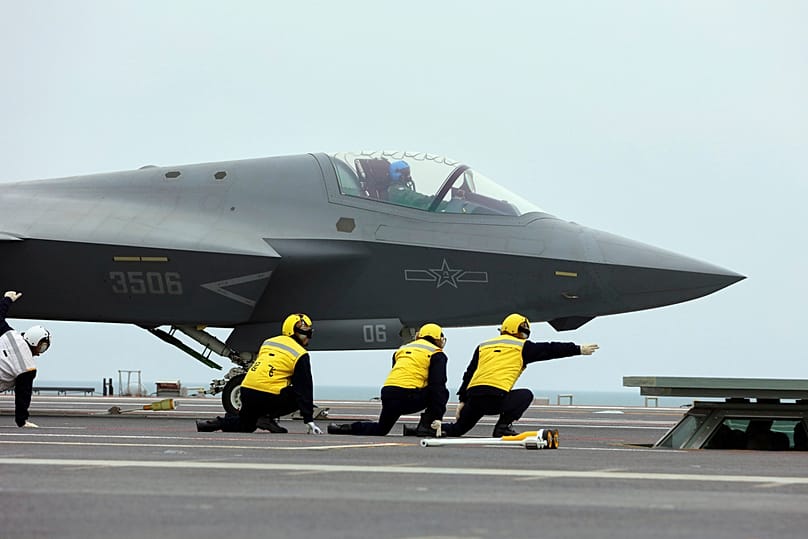
China commissioned its first domestically engineered aircraft carrier, the Fujian, at a ceremony attended by President Xi Jinping on Hainan island, marking a significant advance in Beijing's ambition to build a "world-class" military capable of challenging US naval dominance by mid-century.

The carrier, China's third and first domestically built from scratch, represents one of the most visible examples of Xi's military modernisation campaign targeting a fully modernised force by 2035, state news agency Xinhua reported Friday.

"Carriers are key to the Chinese leadership's vision of China as a great power with a blue-water navy," said Greg Poling, director of the Asia Maritime Transparency Initiative at the Center for Strategic and International Studies, referring to forces capable of projecting power far from coastal waters.

The Pentagon's latest congressional report identifies China's "increasingly capable military" and ability to "project power globally" as reasons it remains "the only competitor to the United States with the intent and, increasingly, the capacity to reshape the international order."

According to experts, Beijing aims to dominate near waters including the South China Sea, East China Sea and Yellow Sea around the First Island Chain running south through Japan, Taiwan and the Philippines. Deeper into the Pacific, China seeks to contest control of the Second Island Chain, where the US maintains military facilities on Guam and elsewhere.

"A carrier doesn't really help you in the First Island Chain, but it's key to that contest, if you want one, with the Americans in the wider Indo-Pacific," Poling said.

How does the Fujian carrier stack up against US and Europe?

The Fujian bypasses steam catapult technology used on most US carriers, employing an electromagnetic launch system found only on the latest US Navy Ford-class carriers. The system causes less aircraft and ship stress, allows more precise speed control and can launch a wider aircraft range than steam systems.

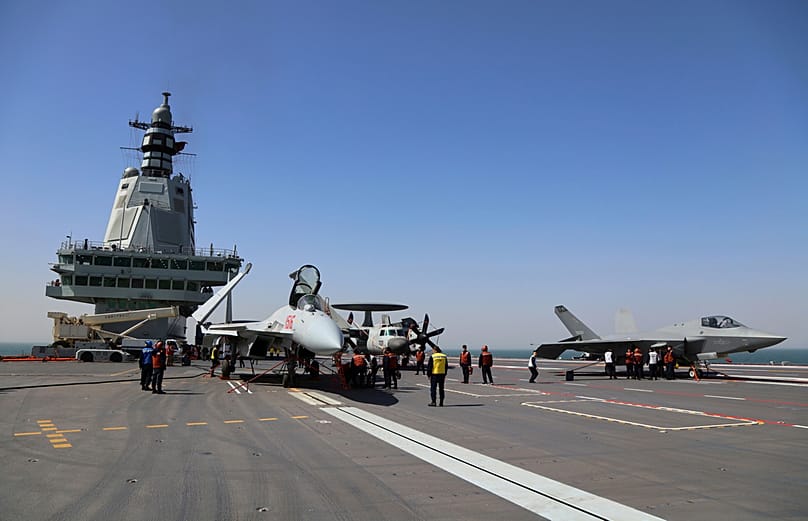
Unlike China's first two carriers using older ski-jump launch systems, the Fujian can launch heavier aircraft with full fuel loads, including the KJ-600 early warning and control plane successfully tested during sea trials.

The carrier also launched the latest J-35 stealth fighter and J-15T heavy fighter, giving it "full-deck operation capability," according to the Chinese navy.


FILE: The flight deck of China's third conventionally powered aircraft carrier, the Fujian AP Photo

The ability to carry reconnaissance aircraft means the Fujian will not operate blind beyond land-based support range, enabling operations of China's most advanced aircraft far afield including the Second Island Chain.

"The Fujian carrier is a big leapfrog for China in terms of the capabilities of its aircraft carriers compared to the first two," said Brian Hart, deputy director of CSIS' China Power Project.

China has only three carriers, compared to the US Navy's 11, with all Chinese carriers conventionally powered, while American carriers use nuclear power, allowing almost indefinite operations without refuelling.

Europe currently operates four dedicated aircraft carriers: France's nuclear-powered Charles de Gaulle—the only non-US nuclear carrier in service—and the UK's two Queen Elizabeth-class carriers HMS Queen Elizabeth and HMS Prince of Wales.

Italy operates two light carriers, the Cavour and the recently commissioned Trieste, whilst Spain operates the Juan Carlos I amphibious assault ship capable of launching F-35B jets.

France is developing the PA-NG (Porte-Avions de Nouvelle Génération), which at 78,000 tonnes would become Europe's largest warship when commissioned around 2038, featuring electromagnetic launch systems comparable to the latest US Ford-class carriers.
More carriers to come?

Evidence suggests China is building another carrier, with shipyards capable of simultaneous construction and producing vessels at a pace the US cannot currently match.

"Really across the board, China's closing the gap," Hart said. "They're fielding and building more aircraft carriers, they're fielding more nuclear-powered subs, they are fielding more, larger destroyers and other vessels that carry a larger number of missiles."

Japanese Chief Cabinet Secretary Minoru Kihara, a former defence minister, said the commissioning underscores that China is "extensively and rapidly strengthening its military power without transparency." Japan would "calmly but decisively respond" if necessary, he told reporters.

The flight deck of China's third conventionally powered aircraft carrier, the Fujian during the electromagnetic catapult-assisted takeoff training at an undisclosed location AP Photo

One concern in foreign capitals involves a possible Chinese blockade or invasion of democratically self-governed Taiwan, which Beijing claims as its territory and which Xi has not ruled out taking by force, although US President Donald Trump said recently said the Chinese leader gave him his assurances this would not happen during his mandate.

"He has openly said, and his people have openly said at meetings, 'We would never do anything while President Trump is president,' because they know the consequences," Trump said in an interview with CBS last Sunday.


Singapore-based analyst Tang Meng Kit cautioned that sophisticated equipment does not necessarily translate to military readiness, noting China has not fought a war since 1979 and that carefully choreographed parades excel at "amplifying perceptions of strength."

"It is possible that China's capabilities are overstated, as real-world operational readiness lags behind its showcased arsenal," he said.

The September World War II Victory Day parade in Beijing showcased the three aircraft alongside hypersonic glide vehicles, aerial and underwater drones and electronic warfare systems.

The parade signalled "China's broader strategic intent, which is to deter major powers, pressure regional actors, expand its global influence, and reinforce its domestic legitimacy," Tang said.


Commission unveils nearly €3bn to scale up green fuels for aviation and maritime transport

	Aaron Favila
Copyright Aaron Favila/Copyright 2019 The AP. All rights reserved.


By Marta Pacheco
Published on 

The plan to step up financing for sustainable fuels in shipping and aviation by 2027 comes as the bloc is falling short of decarbonising heavy transport by 2050.

The European Commission announced a €2.9 billion plan to scale up investments in green fuels by 2027 to curb carbon dioxide emissions from aviation and maritime transport, which together account for roughly 26.4% of EU transport-sector emissions.

With the EU's binding climate goal of achieving climate-neutrality by 2050, compared to 1990 levels, slashing emissions in aviation and maritime transport is both essential and challenging for the EU27.

Commercial planes and ships are the hardest transports to decarbonise, and to this day they are still powered mainly by fossil fuels, despite EU legislation meant to help the shipping and aviation sectors to become climate-neutral.

"The package is about strengthening Europe’s competitiveness while moving decisively towards a net-zero future. By investing in scaling up renewable and low-carbon fuels, we are making Europe’s transport system cleaner, more resilient and more affordable for citizens," said Commissioner for Sustainable Transport and Tourism Apostolos Tzitzikostas.

The EU executive estimates that around 20 million tonnes of sustainable fuels, including biofuels and e-fuels, will be needed by 2035 to meet green fuel targets for aviation and maritime transport. Achieving this will require an estimated €100 billion in investment, the Commission stated.

The nearly €3 billion announced on Wednesday is expected to be disbursed from the EU's multiannual budget, running until 2027, to be invested in renewable and low-carbon fuel technologies.

Under existing EU law, the maritime sector must reduce its greenhouse gas (GHG) emissions by 2% from 2025, compared to 2020 levels. By 2050, shipping is expected to reduce its GHG intensity by 80%.

The aviation sector is expected to have 20% of sustainable aviation fuel (SAF) — feedstocks like used cooking oil, agricultural waste and captured carbon — supplied at EU airports from 2035. Five per cent needs to be e-SAF — a type of synthetic jet fuel made from carbon dioxide, water, and renewable electricity.

By 2050, green fuels for aviation must account for 70%, of which 35% must be eSAF.

However, available and estimated volumes of bio and e-SAF are far from meeting the post-2030 green fuel needs for aviation, according to the Commission.

"Mandates alone do not create a functioning SAF market, and it is high time we collectively admit that and take action to accelerate affordable SAF,” Ourania Georgoutsakou, managing director of the aviation lobby group Airlines for Europe (A4E), said in a statement.

"Ultimately, reducing SAF costs is essential to ensuring air travel remains accessible to all while reinforcing the competitiveness of European airlines," A4E stated.

Francisco Seco Francisco Seco/Copyright 2020 The Associated Press. All rights reserved

e-fuels and biofuels

More than 40 e-fuel production projects are at a planning stage in the EU, but none have yet reached a final investment decision, the Commission said.

Challenges in scaling up e-fuels are hampered by the availability, cost and maturity of renewable energy, eligible carbon storage and capture technologies and the energy intensity linked to generating green hydrogen.

Antony Froggatt, senior director for aviation, shipping and energy at the campaign group T&E, welcomed the Commission's plan and the inclusion of e-fuels.

“For the first time, the EU will develop an effective financial instrument to kickstart production. The EU must now follow through on these commitments if it is to help preserve Europe’s technological leadership in e-fuels," Froggatt said.

Concerns were raised about the use of biofuels, which Froggatt said would only "detract from" commitments to e-fuels.

"It is crucial that only e-fuels be eligible for the auctions as there are no market barriers for biofuels production", T&E stated, in reference to the European Hydrogen Bank auction due by the end of the year with a €300 million window for aviation and maritime projects. This is part of the €2.9 billion unveiled by the Commission.

Jim Corbett, World Shipping Council’s (WSC) environmental director, said the Commission's plan was a "promising first step" to accelerate the energy transition in shipping in Europe.

"WSC is eager to work with the Commission to ensure the Sustainable Transport Investment Plan translates to concrete measures that bridge the cost gap between renewable marine fuels and conventional bunkers. Without this, production and uptake will stall despite significant fleet investments already made by the liner shipping sector," read the statement.