Friday, November 07, 2025


What Wider War in Venezuela Would Bring


Russia, and possibly even China, would feel obligated to enhance military support in response to a missile, air, or even drone strike on sovereign Venezuelan territory. Escalation would be almost inevitable.

Reprinted from Consortium News:


ALERT MEMORANDUM FOR: The President
FROM: Veteran Intelligence Professionals for Sanity (VIPS)
SUBJECT: What Wider War in Venezuela Would Bring

Dear President Trump:

We are deeply concerned about where the United States seems to be headed in its Venezuela policy and urge you to demand that the Intelligence Community give you clear, unfiltered, “truth-to-power” analysis, as well as covert action options in Venezuela.

Flying blind into an unprovoked war against a Latin American government, even one weakened by years of U.S. “maximum-pressure” sanctions, risks a conflagration that could draw Russia into the conflict and offers zero probability of establishing a legitimate, pro-U.S. successor government.

We see a classic storm of politicization brewing in the Intelligence Community, to which we devoted our careers, as a result of blatant pressures that it give you the “right” answer – fabricating or exaggerating a pretext for direct military intervention in Venezuela.

The State Department’s cancellation of views that don’t coincide with its own, and the intelligence community leadership’s firing of senior analysts whose classified, honest analysis contradicted unfounded Administration allegations that Venezuelan President Nicolás Maduro controls the Tren de Aragua gang and is using it to attack the United States have chilled collectors’ and analysts’ willingness to provide you unbiased, neutral, accurate intelligence.

We have seen this before – during numerous intelligence and foreign policy debacles, including the fake allegations about weapons of mass destruction in Iraq. And we remember the disastrous consequences for the country and its leaders.

There is room for some debate on the rationale for some sanctions on Venezuela. Maduro’s management of elections has been correctly questioned, for example. But U.S. opposition to the changes ushered in by the late President Chávez’s election in 1999 has been, for most of these 26 years, implacable.

The U.S. government, under Presidents from both parties, has imposed sanctions to paralyze the country’s economy; identified, trained, and funded opponents, including some who have resorted to violence similar to that we accuse the government of; and – even more important – has supported several failed attempts to overthrow the Chávez and Maduro Governments (with varying levels of involvement), including a blatant attempt to assassinate Maduro in plain daylight.

The results have been disastrous for U.S. interests.

  • Maduro has been better at mobilizing support on the street than at managing the economy, but U.S. sanctions – aimed to destroy an oil industry that accounts for 90 percent of national revenues – have been the overwhelming driver of the exodus of millions of Venezuelans to neighboring countries and the United States.
  • Popular exhaustion from U.S. sanctions and, more recently, fear of U.S. military attacks have indeed fueled desperation among some Venezuelan citizens – who might welcome peace even at the expense of a coup – but Washington policies have actually unified Maduro’s leadership team.
  • The military officers, who the U.S. apparently is counting on to rise up, fear what U.S. justice and a successor government will do to them. The administration’s designation of Maduro as the capo of the Cartel de los Soles, the existence of which is unproven, and as a “narcoterrorist” as president of a country that produces no drugs and has no direct hand in their transport, is evidence to the military that Washington could eventually make up whatever “facts” it wants to hunt them down too.
  • An opposition coalition did well in the last national elections, but the U.S.-favored faction and its leaders have split it so badly that it’s extremely unlikely that they will be able to unite the nation and government. Their rhetoric features pro-democracy slogans, but almost all serious analysts see little evidence that they would have the discipline to resist strong temptations to unbridled power – and revenge.
  • U.S. “maximum-pressure” policies and saber-rattling in the Caribbean make us look like bullies throughout Latin America if not the world – a hegemon desperate to show it can act ruthlessly and with impunity in what it considers its backyard.
  • The Administration has provided no evidence that the fast boats that it has destroyed were carrying drugs to the United States, while most evidence points to the conclusion that they were not. Although some Latin American governments haven’t concealed their dislike of Maduro, they are embarrassed that the United States resorts only to sticks, including threats of military attack, with no credible prospect of negotiations or carrots. They know history better than we do: What we do to their neighbors is in our arsenal against them eventually – if they ever dare to cross us. That fear makes for false allies.

Threats of coups and military intervention are the most counterproductive.

  • Perhaps U.S. intelligence operatives are telling you that they have assets in place who can kidnap or assassinate Maduro in a lightning operation, but we suggest that you demand proof.
  • C.I.A. apparently convinced then-National Security Advisor John Bolton that people in the military were ready to launch when U.S.-designated President Juan Guaidó called on them to rise up in April 2019 to complete the “final phase” of overthrowing Maduro. It was a massive failure.
  • Caracas and each military command is Maduro’s territory, so anyone claiming to make clean recruitments right under his nose must demonstrate that they actually have.
  • U.S. history in Latin America shows, moreover, that U.S.-instigated and supported coups do not lead to stability, democracy, or human rights. The same appears obvious if the overthrow is effected by U.S. special operations personnel and a figurehead is installed.
  • Most dangerous, of course, is the prospect of war – a wider and/or “forever” war – with Venezuela and its foreign supporters. We believe that Russia, and possibly even China, would feel obligated to enhance military support in response to a missile, air, or even drone strike on sovereign Venezuelan territory and military and civilian installations. Escalation would be almost inevitable.
  • U.S. warships off the coast are not immune to anti-ship coastal missiles. If just one pierced the Navy’s formidable air-defense systems, you may have to decide whether to mount another ill-advised, benighted, Bay-of-Pigs-type operation.
  • Despite what others may tell you, this would be a singularly bad idea. We hope you know that in 1961 C.I.A. analysts were not asked for precisely the kind of intelligence assessment we believe you should require of the intelligence community now on Venezuela.
  • Keeping C.I.A. analysts in the dark, then-C.I.A. Director Allen Dulles deceived President Kennedy by claiming the Cuban people would overthrow Castro once Dulles’s ragtag forces landed on the beach. Forty years later, one of George W. Bush advisers on Iraq predicted that the war would be a “cake walk”.
  • U.S. boots on the ground would put U.S. men and women into an insecure environment, with armed popular resistance, and into another fundamentally political war for which they are ill-prepared. U.S. forces are good at destroying governments and structures but not establishing new ones. Our troops would be bloodied and humiliated – and, in our view, fail again.

We appreciate that individuals in your administration want to “win one” for you and, in doing so, advance their own political credibility.

But 26 years of failed policy toward Venezuela are not a sound foundation for making even bigger mistakes.

For the Steering Group
Veteran Intelligence Professionals for Sanity (VIPS)


  • Fulton Armstrong, National Intelligence Officer for Latin America (ret.)
  • William Binney, NSA Technical Director for World Geopolitical & Military Analysis; Co-founder of NSA’s Signals Intelligence Automation Research Center (ret.)
  • Marshall Carter-Tripp, Foreign Service Officer (ret.) and Division Director, State Department Bureau of Intelligence and Research
  • Graham E. Fuller, Vice-Chair, National Intelligence Council (ret.)
  • Philip Giraldi, C.I.A., Operations Officer (ret.)
  • Matthew Hoh, former Capt., USMC, Iraq & Foreign Service Officer, Afghanistan (associate VIPS)
  • Larry Johnson, former C.I.A. Intelligence Officer & former State Department Counter-Terrorism Official (ret.)
  • John Kiriakou, former C.I.A. Counterterrorism Officer and former senior investigator, Senate Foreign Relations Committee
  • Karen Kwiatkowski, former Lt. Col., U.S. Air Force (ret.), at Office of Secretary of Defense watching the manufacture of lies on Iraq, 2001-2003
  • Edward Loomis, Cryptologic Computer Scientist, former Technical Director at NSA (ret.)
  • Ray McGovern, former U.S. Army infantry/intelligence officer & C.I.A. analyst; C.I.A. Presidential briefer (ret.)
  • Elizabeth Murray, former Deputy National Intelligence Officer for the Near East, National Intelligence Council & C.I.A. political analyst (ret.)
  • Scott Ritter, former MAJ., USMC, former UN Weapon Inspector, Iraq
  • Coleen Rowley, F.B.I. Special Agent and former Minneapolis Division Legal Counsel (ret.)
  • Sarah G. Wilton, CDR, USNR, (ret.)/D.I.A., (ret.)
  •  Robert Wing, former Foreign Service Officer (associate VIPS)
  • Ann Wri 

    Venezuela’s Oil, US-Led Regime Change, and America’s Gangster Politics


    The flimsy moral pretext today is the fight against narcotics, yet the real objective is to overthrow a sovereign government, and the collateral damage is the suffering of the Venezuelan people. If this sounds familiar, that’s because it is.

    by  and  | Nov 6, 2025 | ANTIWAR.COM

    The United States is dusting off its old regime-change playbook in Venezuela. Although the slogan has shifted from “restoring democracy” to “fighting narco-terrorists,” the objective remains the same, which is control of Venezuela’s oil. The methods followed by the US are familiar: sanctions that strangle the economy, threats of force, and a $50 million bounty on Venezuelan President Nicolás Maduro as if this were the Wild West.

    The US is addicted to war. With the renaming of the Department of War, a proposed Pentagon budget of $1.01 trillion, and more than 750 military bases across some 80 countries, this is not a nation pursuing peace. For the past two decades, Venezuela has been a persistent target of US regime change. The motive, which is clearly laid out by President Donald Trump, is the roughly 300 billion barrels of oil reserves beneath the Orinoco belt, the largest petroleum reserves on the planet.

    In 2023, Trump openly stated“When I left, Venezuela was ready to collapse. We would have taken it over, we would have gotten all that oil… but now we’re buying oil from Venezuela, so we’re making a dictator very rich.” His words reveal the underlying logic of US foreign policy that has an utter disregard for sovereignty and instead favors the grabbing of other country’s resources. .

    What’s underway today is a typical US-led regime-change operation dressed up in the language of anti-drug interdiction. The US has amassed thousands of troops, warships, and aircraft in the Caribbean Sea and the Pacific Ocean. The president has boastfully authorized the CIA to conduct covert operations inside Venezuela.

    On October 26, 2025, Sen. Lindsey Graham (R-S.C.) went on national television to defend recent US military strikes on Venezuelan vessels and to say land strikes inside Venezuela and Colombia are a “real possibility.” Florida Sen. Rick Scott, in the same news cycle, mused that if he were Nicolás Maduro he’d “head to Russia or China right now.” These senators aim to normalize the idea that Washington decides who governs Venezuela and what happens to its oil. Remember that Graham similarly champions the US fighting Russia in Ukraine to secure the $10 trillion of mineral wealth that Graham fatuously claims are available for the US to grab.

    Nor are Trump’s moves a new story vis-à-vis Venezuela. For more than 20 years, successive US administrations have tried to submit Venezuela’s internal politics to Washington’s will. In April 2002, a short-lived military coup briefly ousted then-President Hugo Chávez. The CIA knew the details of the coup in advance, and the US immediately recognized the new government. In the end, Chávez retook power. Yet the US did not end its support for regime change.

    In March 2015, Barack Obama codified a remarkable legal fiction. Obama signed Executive Order 13692, declaring Venezuela’s internal political situation an “unusual and extraordinary threat” to US national security to trigger US economic sanctions. That move set the stage for escalating coercion by the US. The White House has maintained that claim of a US “national emergency” ever since. Trump added increasingly draconian economic sanctions during his first term. Astoundingly, in January 2019, Trump declared Juan Guaidó, then an opposition figure, to be Venezuela’s “interim president,” as if Trump could simply name a new Venezuelan president. This tragicomedy of the US eventually fell to pieces in 2023, when the US dropped this failed and ludicrous gambit.

    The US is now starting a new chapter of resource grabbing. Trump has long been vocal about “keeping the oil.” In 2019, when discussing Syria, President Trump said “We are keeping the oil, we have the oil, the oil is secure, we left troops behind only for the oil.” To those in doubt, US troops are still in the northeast of Syria today, occupying the oil fields. Earlier in 2016, on Iraq’s oil, Trump said, “I was saying this constantly and consistently to whoever would listen, I said keep the oil, keep the oil, keep the oil, don’t let somebody else get it.”

    Now, with fresh military strikes on Venezuela vessels and open talk of land attacks, the administration is invoking narcotics to justify regime change. Yet Article 2(4) of the United Nations Charter expressly prohibits “the threat or use of force against the territorial integrity or political independence of any state.” No US theory of “cartel wars” remotely justifies coercive regime change.

    Even before the military strikes, US coercive sanctions have functioned as a siege engine. Obama built the sanctions framework in 2015, and Trump further weaponized it to topple Maduro. The claim was that “maximum pressure” would empower Venezuelans. In practice, the sanctions have caused widespread suffering. As economist and renowned sanctions expert Francisco Rodríguez found in his study of the “Human Consequences of Economic Sanctions,” the result of the coercive US measures has been a catastrophic decline in Venezuelan living standards, starkly worsening health and nutrition, and dire harm to vulnerable populations.

    The flimsy moral pretext today is the fight against narcotics, yet the real objective is to overthrow a sovereign government, and the collateral damage is the suffering of the Venezuelan people. If this sounds familiar, that’s because it is. The US has repeatedly undertaken regime-change operations in pursuit of oil, uranium, banana plantations, pipeline routes, and other resources: Iran (1953), Guatemala (1954), Congo (1960), Chile (1973), Iraq (2003), Haiti (2004), Syria (2011), Libya (2011), and Ukraine (2014), just to name a few such cases. Now Venezuela is on the block.

    In her brilliant book Covert Regime Change (2017), Professor Lindsay O’Rourke details the machinations, blowbacks, and disasters of no fewer than 64 US covert regime-change operations during the years 1947-1989! She focused on this earlier period because many key documents for that era have by now been declassified. Tragically, the pattern of a US foreign policy based on covert (and not-so-covert) regime-change operations continues to this day.

    The calls by the US government for escalation reflect a reckless disregard for Venezuela’s sovereignty, international law, and human life. A war against Venezuela would be a war that Americans do not want, against a country that has not threatened or attacked the US, and on legal grounds that would fail a first-year law student. Bombing vessels, ports, refineries, or soldiers is not a show of strength. It is the epitome of gangsterism.

    Reprinted from Common Dreams.

    Jeffrey D. Sachs is a University Professor and Director of the Center for Sustainable Development at Columbia University, where he directed The Earth Institute from 2002 until 2016. He is also President of the UN Sustainable Development Solutions Network and a commissioner of the UN Broadband Commission for Development. He has been advisor to three United Nations Secretaries-General, and currently serves as an SDG Advocate under Secretary-General Antonio Guterres. Sachs is the author, most recently, of A New Foreign Policy: Beyond American Exceptionalism (2020). Other books include: Building the New American Economy: Smart, Fair, and Sustainable (2017), and The Age of Sustainable Development, (2015) with Ban Ki-moon.

    Sybil Fares is a specialist and advisor in Middle East policy and sustainable development at SDSN.ght
    , Col., U.S. Army (ret.); Foreign Service Officer (resigned in opposition to the war on Iraq)


Trump’s Reckless War Drums in Nigeria Stink of Islamophobia and Imperial Arrogance

For the sake of Nigerian lives and the American soul, we must not allow Trump to drag America into a quagmire of his own making.


Chloe Atkinson
Nov 07, 2025

Common Dreams


In yet another display of the same divisive rhetoric that defined his first term, US President Donald Trump has once again pulled the United States into the crosshairs of global instability, this time by saber rattling over Nigeria’s complex ethnic and religious conflict. Trump not only threatened to slash US aid, but he also said he might order “fast and vicious” military strikes against what he calls “Islamic terrorists” slaughtering Christians. Aside from the fact that Trump is wrong, he is ranting xenophobic ideas, platforming American exceptionalism, and demonstrating a blatant disregard for the lives of millions caught in the cross fire of what is simply a resource war with colonial-era grudges.

Let’s be clear: The violence taking place today in Nigeria is heartbreaking and must end. Boko Haram’s extremism, clashes between farmers and herders, and general hooliganism have claimed over 20,000 civilian lives since 2020. It is true that Christian communities in the north-central regions have suffered unimaginable horrors as raids have left villages in ashes, children murdered in their beds, and churches reduced to rubble. The April massacre in Zike and the June bloodbath in Yelwata are prime examples of the atrocities taking place in Nigeria. These incidents are grave reminders that the international community must pay more attention to this crisis.


Echoes of Obama Libya Strikes as Trump Argues Boat Bombings Are Immune From War Powers Law


‘They’re Going to Be, Like, Dead’: Trump Says Land Strikes on Venezuela Are Next

But Trump’s response is crude and wrong. Painting all Muslims as genocidal monsters is not the answer. Calling Nigeria a failed state ripe for American liberation is not the solution, especially since the data shows otherwise. According to the Armed Conflict Location and Event Data Project, more Muslims than Christians have been targeted in recent years. Boko Haram has massacred worshipers in mosques, torched markets in Muslim-majority areas, and threatened their own co-religionists.

The crisis in Nigeria is not a holy war against Christianity. Instead, it’s a devastating cocktail of poverty, climate-driven land disputes, and radical ideologies that prey on everyone and not just any distinct group. By framing Nigeria’s conflict as an existential threat to Christians alone, Trump is not shining a spotlight on the victims. Instead, he is weaponizing right-wing conspiracy theories to stoke Islamophobia, the same toxic playbook he used to fuel his ban on Muslims, and which left refugee families shattered at America’s borders.

Americans must reject Trump’s imperial fantasy and instead demand congressional oversight on any military action.

Nigeria’s leaders are right to be astonished and furious. Presidential spokesperson Bayo Onanuga said he was “shocked” over Trump’s invasion musings, while President Bola Tinubu decried the religious intolerance label as a distortion of their “national reality.” Even opposition voices, like Labour Party spokesperson Ken Eluma Asogwa, admit the government’s security lapses but reject Trump’s extermination narrative as baseless fearmongering.

Trump should indeed be viewed as a warmonger, seeking every opportunity to sow discord and destruction in his wake. He sees every crisis as a photo op for his machismo and self-promotion. His first term was a disaster and now, in his second term, he wants to unleash drones and troops on Africa’s most populous nation, destabilizing a key partner in counterterrorism and migration management.

Unilateral strikes will only inflame the conflict’s root causes like resource scarcity and ethnic tensions. If anything, Trump’s misguided ideas to resolve the crisis will only exacerbate it by creating new waves of refugees and sowing even more discord throughout Nigeria. The country needs real solutions, not Trump’s wrong-headed conspiracy theories. He should be saving those who are vulnerable, not bombing them into submission.

A real solution would involve surging humanitarian aid to displaced families, partnering with the United Nations and African Union for joint security training, and pressuring Nigeria’s government through incentives, not threats. Real strength is in building bridges. Trump shows his weakness by building bunkers.

The Nigerian crisis is a clarion call for the world, but especially for America. Trump’s rhetoric is not just wrong; it is a betrayal of American values. Americans must reject Trump’s imperial fantasy and instead demand congressional oversight on any military action. America must recommit to a foreign policy that heals rather than divides. The world is watching, and for the sake of Nigerian lives and the American soul, we must not allow Trump to drag America into a quagmire of his own making. Nigeria deserves better.


Our work is licensed under Creative Commons (CC BY-NC-ND 3.0). Feel free to republish and share widely.


Chloe Atkinson
Chloe Atkinson is a climate activist focused on US and European domestic policies.
Full Bio >


Nigeria's Ondo State announces $50bn investment framework for proposed 500,000bpd refinery, free trade zone

REAL REASON TRUMP WANTS TO INVADE NIGERIA

Nigeria's Ondo State announces $50bn investment framework for proposed 500,000bpd refinery, free trade zone
/ bne IntelliNews
By Brian Kenety November 6, 2025

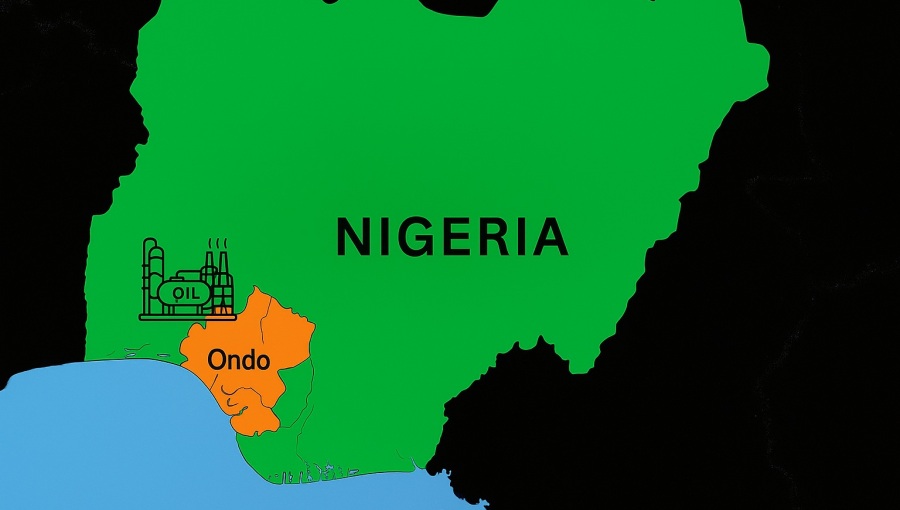
Nigeria’s Ondo State Government said on Wednesday (November 5) it has signed a $50bn investment agreement with a consortium of international firms under the Sunshine Infrastructure Joint Venture to establish a 500,000 barrel-per-day (bpd) oil refinery and free trade zone, The Punch reports.

Earlier this week, Backbone Infrastructure Nigeria Limited said it has secured expressions of interest for up to NGN71.8 trillion ($50bn) in funding to develop a refinery and build out the 1,471-hectare Sunshine Free Trade Zone in Ilaje, Ondo State.

The initiative follows a memorandum of understanding (MoU) signed between the Nigerian company and the Ondo State Government in July. The State government said on Wednesday it signed an agreement with a consortium that includes Backbone Infrastructure, China Harbour Engineering Company (CHEC), and Honeywell OUP. 

CHEC, a subsidiary of China Communications Construction Company (HK:1800; SHA:601800), typically acts as an engineering, procurement, and construction (EPC) contractor rather than a primary project financier. Honeywell OUP is a private real estate and industrial development arm of Honeywell Group.

“The funding followed the successful execution of the Memorandum of Understanding between the Joint Venture and the state government through the Ondo State Investment Promotion Agency,” said Governor Lucky Aiyedatiwa’s press secretary, Ebenezer Adeniyan, in a statement. “This investment marks a new dawn for Ondo State. It will fast-track industrial development, attract more investors and create jobs for our people.”

Backbone earlier stated that the planned development would include storage, loading and transport infrastructure to position the zone as a refining and export hub. The private Nigerian infrastructure and project development firm said it was working with strategic partner NEFEX Holding Limited, a Canadian company that operates across key sectors of the global energy and logistics chain.

The investment scale represents a major increase from estimates publicised in mid-2025, when Backbone described the refinery concept as a 100,000-bpd project with an indicative cost of around $15bn. The larger figure reflects a fivefold expanded capacity and broader integrated zone development.

Sunshine Infrastructure JV managing director Henry Owonka is quoted by The Punch as saying that the Ondo refinery-free trade zone project’s initial valuation, which he put at $30bn, has been revised upwards to $50bn following an expansion to cover broader infrastructure and community-driven programmes. The refinery would supply petroleum products locally and internationally, he added.

The Nigerian government has prioritised domestic refining to reduce fuel imports and preserve foreign exchange. However, large-scale private refinery projects have frequently faced delays linked to financing conditions, FX volatility, and crude supply arrangements.

If realised, the proposed 500,000bpd refinery project in Ondo would significantly expand Nigeria’s private downstream refining capacity, alongside the 650,000bpd Dangote refinery, which was commissioned in 2024 and last month announced plans to double its capacity.

Dangote said on November 1 it is ramping up gasoline and diesel output to meet domestic demand, after the government last week approved a 15% import duty on refined petroleum products.

Meanwhile, as bne intelliNews reported, the Nigerian National Petroleum Company Limited (NNPCL) has begun a fresh review of the country’s three state-owned refineries, Port Harcourt, Warri and Kaduna, signalling yet another attempt to revive facilities that have remained largely idle despite repeated rehabilitation efforts.

World War Gorka

Mr. President: No One Voted for This

by  | Nov 5, 2025 | ANTIWAR.COM

Reprinted from The Realist Review.

News comes this weekend that the ‘Department of War’ now has Nigeria in its crosshairs. Taking to Truth Social on Saturday, Trump let loose on the Nigerian government, warning that,

…If the Nigerian Government continues to allow the killing of Christians, the U.S.A. will immediately stop all aid and assistance to Nigeria, and may very well go into that now disgraced country, ‘guns-a-blazing,’ to completely wipe out the Islamic Terrorists who are committing these horrible atrocities, I am hereby instructing our Department of War to prepare for possible action. If we attack, it will be fast, vicious, and sweet, just like the terrorist thugs attack our CHERISHED Christians.”

In this administration some Christians are more cherished than others; Trump and Co. have shown zero sympathy for the scores of Palestinian Christians murdered by the IDF and Benjamin Netanyahu, a frequent and honored guest at the White House and on Capitol Hill. That aside, the planned Nigeria operation is clearly the product of the capacious imagination of Sebastian Gorka, Trump’s chief counter-terrorism adviser.

Who is this Gorka?

Before coming to the White House he was a radio host (“America First with Sebastian Gorka”) and a pitchman for Relief Factor, a dietary supplement. America First? An odd name for a program hosted by someone with British, Hungarian and American citizenship – and with probable ties to foreign intelligence. Those ties cost him a job during Trump’s first term. After his ignominious exit from the White House in 2017, Gorka spent the Biden interregnum glued to Trump’s side, appearing alongside a gaggle of future Trump II officials during Trump’s trial in New York.

If he has any talent at all (itself a debatable proposition) it is for ass-kissing. Here he is on Facebook in late September posting about Secretary of State Marco Rubio’s eulogy for Charlie Kirk:

I was born a Catholic and have walked this Earth for 54 years. Before dedicating a quarter of a century to Counterterrorism, my first degree was in Philosophy and Theology.

But I will say for the record, I have never seen a human being encapsulate in 90 seconds the meaning of Jesus Christ like Acting National Security Adviser and Secretary of State Marco Rubio.

Thank you Sir.

No. Thank you, Sebastian.

Gorka is not merely a fool. He is a religious fanatic (there being significant overlap between the two categories).

Gorka believes he and his fellow zealots are “not the lambs of the Bible; that is Jesus, our savior. We turn over the tables of the moneylenders. We are there when he calls, ‘Sell everything you own and buy a sword.’” Gorka’s advice to Netanyahu after October 7th was”: “Kill every single one of them. God bless Israel. God bless Judeo-Christian civilization.”

The scholar Michael Vlahos has described Gorka as “a subaltern mini-me of the emperor himself.”

But is the emperor now taking his cues from the subaltern? Perhaps. Only 2 months into Trump II, the New York Times reported deepening divisions between the newly christened counterterrorism chief, Gorka, and elements within the interagency over whether and how to respond to an Islamist insurgency in Somalia. Gorka eventually won out. During the first week of August, U.S. Africa Command (AFRICOM), conducted airstrikes in central Somalia.

Turning close to home: Why, one wonders, is the peace president with the Nobel Prize very much on his mind, conducting a drone war in the Caribbean? Well, appearing on Newsmax this weekend, Gorka informed viewers that, “The connections of that regime, the Maduro regime, to other bad actors, other states, other nations who, for example, have been plotting to target members of this administration, including the president. Iran’s tentacles into this hemisphere go straight through Caracas and Venezuela.” Echoing Gorka, Sen. Lindsey Graham, reliable war propagandist that he is, took to the airwaves and called Maduro’s Venezuela a “drug caliphate.” The implications are impossible to miss, as the likes of Gorka and Graham seek to marry the War on Drugs with the War on Terror.

Call it World War Gorka.

James W. Carden is the editor of The Realist Review.  He is a columnist and former adviser to the US-Russia Bilateral Presidential Commission at the U.S. Department of State. His articles and essays have appeared in a wide variety of publications including The Nation, The American Conservative, Responsible Statecraft, The Spectator, UnHerd, The National Interest, Quartz, The Los Angeles Times, and American Affairs.


Trump: Sincerity and Verisimilitude


US president Donald Trump is apparently trying to burnish his Christian bona fides on Truth Social:

If the Nigerian Government continues to allow the killing of Christians, the U.S.A. will immediately stop all aid and assistance to Nigeria, and may very well go into that now disgraced country, “guns-a-blazing,” to completely wipe out the Islamic Terrorists who are committing these horrible atrocities. I am hereby instructing our Department of War to prepare for possible action. If we attack, it will be fast, vicious, and sweet, just like the terrorist thugs attack our CHERISHED Christians! WARNING: THE NIGERIAN GOVERNMENT BETTER MOVE FAST!

Secretary-of-war Pete Hegseth saluted his commander-in-chief:

Yes sir.

The killing of innocent Christians in Nigeria — and anywhere — must end immediately. The Department of War is preparing for action. Either the Nigerian Government protects Christians, or we will kill the Islamic Terrorists who are committing these horrible atrocities.

Nigerian president Bola Ahmed Tinubu took exception to Trump’s and Hegseth’s depiction of internecine conflict in his country:

The characterisation of Nigeria as religiously intolerant does not reflect our national reality, nor does it take into consideration the consistent and sincere efforts of the government to safeguard freedom of religion and beliefs for all Nigerians.

Nonetheless, Trump the Savior doubled down, stating,

Christianity is facing an existential threat in Nigeria. Thousands of Christians are being killed. Radical Islamists are responsible for this mass slaughter…. We stand ready, willing, and able to save our Great Christian population around the World!

First off, any comments made by Trump and his yes-men/yes-women ought to be greeted with utmost skepticism. And the aphorism of “Fool me once, shame on you; Fool me twice, shame on me,” ought to be rigorously applied.

There are some questions that should spring to mind in judging the sincerity of Trump and his minions recent pronouncements.

For instance, if Trump is so concerned about the plight of Christians in Nigeria, then where was this concern for the Christian segment of Palestinians killed “by [Jewish] Terrorists who are committing these horrible atrocities.”

Elementary morality demands that ethnicity or religious allegiance should neither condemn nor exculpate a people purely by virtue of their birthright, inculcation, or even belief. We are all humans, and it is the actions of humans that speak louder than any words.

Another question: If Trump claims a right to intervene in a purported religious conflict in far-off Nigeria, how does this relate to Russia coming to the defense of ethnic Russians under attack in next-door Donbass? Or is this moot, eclipsed by American exceptionalism?

What about Trump inviting al Qaeda terrorist cum Syrian president Ahmad al-Sharaa to the White House on 10 November? Ahmad al-Sharaa’s rebranded Hayat Tahrir al-Sham (HTS) is reportedly behind an “abominable massacre of Christians and Alawites in Syria,” as well as “heinous violence, including the indiscriminate murders of children and elderly” Druze Syrians.

Now ask yourself, given just these three examples, how much verisimilitude should one extend to Trump’s concern for Christian Nigerians?

Moreover, is this even about ethnicity and religious confession?

Ask: What ties all these examples together?

Oil.

Nigeria is Africa’s largest oil producer. Russia is the world’s third largest oil producer. Trump already bragged about stealing Syrian oil. As for Palestine: “This genocide is about oil.” A report by UN Trade and Development (UNCTAD) notes, “Geologists and natural resources economists have confirmed that the Occupied Palestinian Territory lies above sizeable reservoirs of oil and natural gas wealth, in Area C of the occupied West Bank and the Mediterranean coast off the Gaza Strip…. discoveries of oil and natural gas in the Levant Basin, amounting to 122 trillion cubic feet of natural gas at a net value of $453 billion (in 2017 prices) and 1.7 billion barrels of recoverable oil at a net value of about $71 billion…”

Why did Trump bomb Iran this summer? Because Iran is legally developing its nuclear program? Democracy Now! offers another reason: “‘It’s Always About Oil’: CIA & MI6 Staged Coup in Iran 70 Years Ago, Destroying Democracy in Iran.” And why is Trump currently blowing up fishing boats and positioning US forces threateningly around Venezuela? Venezuela has the largest oil reserves in the world, with approximately 300 billion barrels.

The self-declared peace president has promoted a cornucopia of fake news stories to gullible folk, disseminated disinformation, and openly bragged.

The Solution

Practice open-minded skepticism or risk shaming yourself.

Kim Petersen is an independent writer. He can be emailed at: kimohp at gmail.com. Read other articles by Kim.
Op-Ed: An African Vietnam in Nigeria? Trump vs Boko Haram, ISIS and others


By Paul Wallis
EDITOR AT LARGE
DIGITAL JOURNAL
November 3, 2025


Trump said 'thousands of Christians are being killed' in Nigeria, though experts say the violence is indiscriminate - Copyright APEC 2025 KOREA/AFP Handout

The news that Trump is considering military intervention in Nigeria opens a very much larger can of worms. This proposal is based on the killing and supposed persecution of Christians by Islamic terror groups.

The Catholic Weekly reports a cautious but slightly upbeat response from church leaders, who point out that interfaith coexistence is a major issue. The mix of faiths in Nigeria includes a large Christian minority.

The focus is also misleading. It’s not “just” Nigeria, to start with. Terrorism in this region has been ongoing for many years. It’s one of Africa’s festering sores and has been more or less continuous. Boko Haram and ISIS are in the catalogue of participants. The two groups are directly affiliated.

There’s another issue at the Nigerian governmental level. Nigeria denies “Christian genocide” stating that all groups are attacked by the terrorists.

This is a very different war in many ways. They’re real power groups with basic military capacity ranging across multiple countries. They have fought local national armies with limited success, but they survive.

This is also a truly huge regional area with very fluid borders. It makes cross-border wars in Afghanistan look relatively simple. Boko Haram’s known areas of operation are also obviously linked to economic and “turf wars”. Operationally they can strike across Nigeria in the north-east and the center of the country. They regularly conduct raids and publicize them well

.
Residents of Hajj Camp were all associated with some of the world’s most dangerous jihadists, Boko Haram or the Islamic State West Africa Province (ISWAP) group. – Copyright AFP/File Ted ALJIBE

In short, it’s a mess that can get a lot messier with third parties getting involved. Let alone the US, with the usual shipload of added political baggage.

From a purely military perspective, “going in guns a-blazing” comes with more than a few caveats.

Any US troops on the ground could be facing not just asymmetric warfare but from multiple directions and a large mix of different, often mutually conflicting parties and countries. That’s fairly normal in terror wars.

The big and defining difference is that these are long-established groups with many external links in the Middle East. In an escalated conflict, they can be expected to upgrade and call in extra resources.

This is not a subject for military naivete on any level. The theory of fighting the bad guys is fine, but these are very experienced bad guys. Far better intelligence and thorough evaluations are the minimum requirements for any sort of military operations from the boots up.

The mere presence of US troops would also be a magnet for jihadis. Attacking Americans adds a lot of propaganda value. The large African military arms black market and at the very least arm’s length national players, could be expected to get involved almost instantly. Africa’s terrorists are cashed up and can certainly obtain meaningful support from outside.

The US does not need yet another war with no clear properly defined winning strategy.

How would you beat these groups?

If the war against ISIS is any guide, they have to be militarily destroyed as a fighting force at the bare minimum. You need local support like the Kurds, who did so much inexcusably unappreciated work, stopping ISIS and grinding them down in years of hard fighting.

The terror support networks must be totally eliminated. External bases and networks like those of the Taliban in Pakistan are also likely to be major issues.

This would be a major operation. A few airstrikes will just motivate them It’ll also be ultra-expensive. It could be a matter of years to actually achieve anything.

You have to wonder how anyone can just blithely sprinkle military forces into multiple largely thankless and objective-less scenarios. Vietnam is not just another overworked but apt metaphor in this case. It can happen.

This has all the hallmarks of a very bad idea.

_____________________________________________________________

Disclaimer
The opinions expressed in this Op-Ed are those of the author. They do not purport to reflect the opinions or views of the Digital Journal or its members.