Friday, November 07, 2025

Japan

Takaichi Administration established by the LDP-JIP Coalition : How to interpret the current Japanese political situation

Friday 7 November 2025, by Toshizo Omori


On October 21, during the Extraordinary Diet session, LDP (Liberal Democratic Party) President Sanae Takaichi was nominated as Prime Minister, establishing the Takaichi administration through a coalition between the LDP and JIP (Japan Innovation Party). This development brought to a temporary conclusion the month-and-a-half-long period of “political realignment” that began with former Prime Minister Ishiba’s resignation announcement following the LDP’s crushing defeat in the July Upper House Election and continued through the election of the new LDP President, Takaichi.


This brief essay analyzes the political character of the newly formed Takaichi administration and the framework of Japan’s immediate political situation, situating it within the broader international political context. It also seeks to clarify the challenges and tasks facing the left.

The LDP-Komeito coalition lost its majority in the July Upper House election and subsequent political realignment

In the Upper House election in July, the ruling LDP-Komeito coalition suffered a major defeat, losing its majority in both houses of the Diet. Taking responsibility, Prime Minister Ishiba was forced to resign less than a year after taking office. Meanwhile, the far-right populist party, the Sanseito (Party of Do it Yourself), gained significant support. Combined with the results of last year’s House of Representatives election, this meant that parties positioned to the right of the LDP within Japan’s political landscape formed a single bloc in parliament for the first time. This development significantly influenced the LDP leadership election following Prime Minister Ishiba’s resignation. Contrary to widespread expectations that Shinjiro Koizumi would win the leadership election and continue the policies of the Ishiba administration, Sanae Takaichi, a politician representing the LDP’s right wing who publicly declared her intention to continue Abe’s policies, became the new party president. Subsequently, a series of major political realignments unfolded for the first time in the 21st century: the Komeito withdrew from the coalition, disliking the prospect of a coalition government with Takaichi; the Constitutional Democratic Party (CDP) attempted but failed to field a unified opposition candidate in the prime minister nomination election; an agreement was reached for a LDP-JIP (Japan Innovation Party) coalition with JIP providing support from outside the cabinet; and finally, Takaichi was elected Prime Minister in the Extraordinary Diet session.

However, in this wave of political realignment, the left-liberal faction—including the parliamentary left and the center-left forces within CDP—was completely left out in the cold. The CDP’s leadership tried to unify opposition candidates behind Tamaki, the leader of the Democratic Party for the People (DPFP), in the prime ministerial nomination election—a move designed to further cozy up to the center-right—was flatly rejected by Tamaki himself. Instead, it only served to force him into accepting the party’s stance on “accepting nuclear power” and “accepting the security legislation.”

A major feature of the political realignment since the Upper House election is that it has progressed among conservative-centrist political forces, under conditions where, on one hand, pressure from far-right populism exists, while on the other, there is absolutely no threat (or even a hint of disruption) from the left.

How to consider the global political framework

While examining the various developments surrounding the coalition government during this period is certainly necessary for our analysis of the current political realignment, the most crucial issue is how to grasp the overall framework of the political situation, particularly from an international perspective. Based on this understanding and taking into account the current position of the left, we must clarify the tasks and duties facing the left, including ourselves.

In the position paper submitted by the Japanese section to the 18th Congress of the Fourth International, the following points were made regarding the Japanese political situation:

Generally speaking, as the capitalist system has already lost its ability to encompass the entire society, societies in many countries are becoming more polarized and the far right have been on the rise. Some sectors of the bourgeoisie are turning to support the authoritarian domination and are coming to politically support the far right. The political structures in many countries, mainly in Europe, the United States and Latin America, have more and more tripolarized into the far right, the conservative/centrist (which is often called the “extreme centrist”) and the left, where the conservative/centrist becomes increasingly drawn to the right wing. The political structures common to those in Europe are also emerging in East Asia, although not as significantly as in Europe.

In Japan, while the ruling coalition (Liberal Democratic Party and Komeito [Komei Party]) lost its majority in the general election last fall, two far-right parties (Japan Conservative Party and Sanseito [Party of Do It Yourself]) got a certain number of seats in the parliament for the first time after World War II. On the other hand, political cooperation between the ruling coalition and center-right parties is developing, and it is said that there is a possibility of a so-called "grand coalition" in a way that excludes the left parties.

The ruling Liberal Democratic Party has both center-right and far-right tendencies within itself, and the current leadership is dominated by center-right politicians, and losing its majority, it is seeking for strengthening its cooperation with the center-right opposition parties. Depending on the result of the July 2025 Upper House election, the possibility of a "grand coalition" cannot be ruled out. In this way, even in Japan, there are signs of a tripartite structure of the far right, conservative/centerist (what is sometimes called "extreme center") and the left, but unfortunately, the left in Japan is decisively weak.

As analyzed here, internationally, within the tripartite structure of far-right, conservative center, and left—typical in Europe—the rise of the far-right is dragging not only traditional conservative forces but even centrist reformist forces to the right. This also reflects the depth of the current crisis of the capitalist system. Within this framework, trends such as global military rearmament, the rise of authoritarian regimes, and the spread of xenophobic sentiment have become pronounced.

A prime example is the UK (England), where the far-right Reform UK has gained ground in local elections and surged to first place in opinion polls. In response, the Conservative Party leader replaced the right-wing faction’s Bede Nock in November 2024. Bede Nock had campaigned on pledges to withdraw from the European Convention on Human Rights and repeal climate change legislation, decisively breaking with the party’s centrist conservative line. In response to this situation, the British liberal newspaper The Guardian reportedly published an article expressing concern over the disappearance of the Conservative Party as a moderate conservative force. This evokes similarities to the “Don’t Let Ishiba Go” demonstrations that unfolded in Japan for a time, primarily among liberal circles.

Japan’s political situation should be seen as trying to catch up with developments in Europe, albeit a step behind. However, unlike in Europe or the Americas, Japan has persistently faced a situation where the left is decisively weak, lacking influence over the political landscape, and where mass movements and social movements have been unable to gain significant power. It is within this context—where there is no need to consider pressure or threats from the left—that political realignment within the conservative-centrist forces has progressed in recent times.

The crisis of neoliberal globalism is “narrowing the range of policy choices.”

In that sense, the observation by Professor Koji Aikyo of Waseda University, published in this paper’s Issue 2883 (October 20th edition) (based on the summary of his lecture at the “Stop the Constitutional Revision! Osaka Network” lecture), aptly explains the political situation described above.

In a global society of growing inequality, the range of policy choices narrows. While citizens have increased opportunities to participate in democratic processes, dissatisfaction is rising over the perception that public opinion is not reflected in national governance. In advanced industrial nations, regardless of which party holds power, consistent pressure is exerted to ensure national policies benefit the wealthy. The notion that corporations hold a knowledge advantage over governments has become an unquestioned ideology.

Precisely because the scope for policy is narrow, they resort to culture wars. Massive inequality becomes entrenched, propaganda replaces policy, and politics shifts from the politics of necessity to the politics of eternity. The politics of necessity brings democratization through economic development, but in the politics of eternity, the government’s role is not to promise future happiness, but to protect the present society from perceived threats. Permanent politicians fabricate crises and manipulate the resulting emotions. In today’s complex societies, unable to present a vision for the future, they gravitate toward culture wars. Trump politics is the archetype.

Furthermore, the interview with Enzo Traverso titled “Authoritarianism and Democracy in the 21st Century” (International Viewpoint, August 7) also provides an accurate analysis of the significance of the current rise of the far right and the emergence of authoritarian regimes. Traverso, author of “The New Faces of Fascism: Populism and the Far Right”, positions today’s far right as “post-fascism,” describing its differences from past fascism as follows.

Today, I see nothing comparable in the new right. There is no utopian horizon or project for civilization per se. That’s why I find the concept of "post-fascism" useful, because these radical right-wing movements are profoundly conservative. Their impulse is not forward but backward: what they seek is to restore a traditional order. The values they champion—sovereignty, family, nation—form a kind of red thread that connects them.

This return to the traditional [by Trump] is also evident in its hostility toward environmentalism, its rejection of any global agenda on climate change, and its commitment to domestic production over international agreements. "Make America Great Again" is a slogan that fosters a certain imagination of the future, but it is a regressive imagination: a return to a time when the United States was strong, prosperous, and dominant. This isn’t a new proposal, but rather an idealization of the past.

The far right (and also conservative centrist forces), unable to articulate political differences or offer a vision for the future, seek to alleviate anxiety and stagnation by expelling perceived enemies close at hand (“culture wars”) in order to achieve political stability. This serves as one reason why conservative centrist forces are being pulled toward the far right.

What does Takaichi’s LDP leadership election and Komeito’s exit from the coalition signify?

In my analysis article on the July Upper House election (August 11, Weekly Kakehashi), I wrote as follows:

If Prime Minister Ishiba were forced to resign and the LDP’s right wing were to win the leadership election, the Sanseito would become a potential partner for policy consultations, non-cabinet cooperation, or even a coalition. However, the Sanseito currently holds only three seats in the House of Representatives. This would make it a minority ruling party, necessitating an early general election to significantly increase its seats in the House (Sanseito leader Kamiya has stated that “25 to 30 seats is a realistic figure for the next general election”). Simultaneously, this choice carries the risk of the LDP losing even more seats. Therefore, the LDP’s immediate options are limited. The most realistic path is to pursue policy discussions, extra-cabinet cooperation, and even the expansion of the coalition government through a de facto conservative-centrist “alliance” encompassing the Democratic Party for the People, the Japan Innovation Party, and the Constitutional Democratic Party. Consequently, the LDP will likely choose a president who can advance this strategy (or retain Prime Minister Ishiba).

This prediction proved significantly off the mark regarding the prospects for political realignment, given Sanae Takaichi’s election as LDP president and Komeito’s withdrawal from the coalition. I believe the reason lies in underestimating the impact of the rise of far-right populism, as seen in the Sanseito’s surge, on the LDP (and its indirect ripple effects on Komeito). The sense of crisis within the LDP over the defection of the “rock-solid conservative base” that had supported the Abe administration, triggered by the Sanseito’s surge, was likely stronger than we had imagined.

Meanwhile, former Prime Minister Aso, who backs Takaichi, reportedly envisioned forming a coalition government with the LDP, Komeito, and the Democratic Party for the People, dissolving the Diet early for a general election, securing a majority for the LDP and the Democratic Party for the People, and then expelling Komeito from the coalition (Hokkaido Shimbun Online, October 11).

Komeito may have anticipated Aso’s intentions and proactively dissolved the coalition beforehand. It is also said that continuing the coalition with the LDP led by Takaichi could have led to a situation where the dissolution of the party itself was a real possibility for Soka Gakkai and Komeito.

The realignment of conservative-centrist forces and the formation of the LDP-JIP coalition government

Now, let us also review the realignment process of conservative-centrist forces following the July Upper House election, leading up to the formation of the Takaichi coalition government on October 21. Of course, it is important to note that this realignment process is not complete and remains ongoing.

First, the Komeito, which disliked a coalition with LDP President Takaichi because of her right-wing stance, withdrew from the coalition government that had lasted for 26 years. While Komeito initially seemed to explore some cooperative relationship with the LDP, following the formation of the LDP-JIP government, it has clearly positioned itself as a centrist opposition party. It has now also begun mentioning the possibility of electoral cooperation with the Constitutional Democratic Party.

The DPFP appears to have been most ideologically and politically aligned with Takaichi on issues like constitutional revision, accepting Yasukuni Shrine visits, and pursuing an expansionary fiscal policy. It seems to have been aiming for a coalition government under a Takaichi-led administration comprising the LDP, Komeito, and DPFP. However, faced with Komeito’s withdrawal from the coalition—effectively dissolving the LDP-Komeito alliance—it could not commit to a coalition solely with the LDP. “With Komeito gone, even if we joined the government, we wouldn’t reach a majority, so the discussion has become rather meaningless,” stated Representative Tamaki. Moreover, the Japanese Trade Union Confederation (Rengo), the largest and pro-capitalist national center of trade unions, had made clear its stance that it would not accept its supported parties, the DPFP and the CDP, being divided between the ruling and opposition camps. Meanwhile, one of the CDP’s Diet leaders Azumi proposed the idea of “making Tamaki, chairperson of DPFP, the unified opposition candidate for the prime minister nomination.” The DPFP also declined this proposal, citing fundamental policy differences. As a result, they were ‘scooped’ by the Japan Innovation Party, leading to complaints like, “If only they had said something sooner.” Even in post-nomination polls, DPFP saw a significant drop in support, with the Takaichi administration gaining support from relatively younger generations.

The Japan Innovation Party (JIP) was initially eager to join a coalition government with the LDP and Komeito, assuming Koizumi would become LDP president and hoping to realize its secondary capital concept under his leadership. However, seizing the opportunity created by the DPFP’s reluctance to join the coalition following the LDP presidential election results, it swiftly moved to form a coalition with the LDP under Takaichi. They then reached a coalition agreement with Takaichi, who was desperate to become Prime Minister, essentially forcing her to swallow their policy demands whole. However, the LDP attached numerous reservations to many policies. Furthermore, by choosing the form of “cooperation outside the cabinet” (a factor said to be the difficulty of electoral cooperation with the LDP in the Kansai region, including Osaka), it became a half-hearted and unstable “coalition” that could be abandoned at any time.

The reason for such an eagerness to form a coalition lay in the critical situation: successive defections of Diet members and poor performance in local elections, including in their stronghold of Osaka. Following the three House of Representatives members who announced their departure on September 8th and formed the new faction “Reform Association”, House of Representatives member Hayashi Yumi, elected from the proportional Kinki block, also submitted her resignation from the party. Furthermore, Seiki Sorimoto, a House of Representatives member elected from Hiroshima’s 4th district, also indicated his intention to run as an independent in the next election (forming the regional party “Hiroshima no Taiyo”), hinting at leaving the party. It was necessary to put a stop to this. Additionally, in five local council elections held in Osaka in September, the party suffered significant declines in votes compared to the previous elections. It lost three seats in Settsu City and one seat in Hannan City, facing a severe decline in its political strength.

The Constitutional Democratic Party (CDP) called for a unified opposition (centrist) candidate in the prime ministerial nomination election during the extraordinary Diet session, but this effort was forced to fail because Tamaki demanded a policy shift from CDP’s line on “nuclear power policy” and “security policy.” Currently, the party positions itself as a centrist opposition force allied with Komeito. However, as former leader Edano, a party liberal, has altered his previous stance, stating that the security legislation—including the recognition of the right to exercise collective self-defense—contains “no unconstitutional elements, so there is no need to change it,” the shift towards a center-right stance advanced under leader Noda is accelerating. This is further isolating the party’s left wing.
How to view the character of the Takaichi-led LDP-JIP coalition government

The Takaichi-led LDP-JIP coalition government emerged from the realignment of centrist conservative political forces. How should we assess its political character? First, regarding security and defense policy, it will undoubtedly accelerate the military expansion course charted by the Kishida and Ishiba administrations.

The coalition agreement signed by the LDP and JIP on the 20th clearly reflects the shift from an LDP-Komeito alliance to an LDP-JIP one. It immediately steered toward hawkish policies, starting with promoting an “independent nation,” further increasing defense spending, and pushing for submarine acquisition with nuclear submarines in mind. Numerous other policies emphasize the “nation,” including a policy to enact a “national emblem defacement crime” in the 2026 ordinary Diet session to punish acts damaging the Hinomaru flag, and a clear statement to begin examining “anti-espionage legislation” to crack down on espionage by foreign powers.

These are all policies long sought by the LDP’s conservative faction but difficult to advance under the coalition government with Komeito. The most symbolic move is the abolition of rules limiting weapons exports to five categories, such as “rescue operations.” Conservative LDP factions strongly pushed for scrapping these categories to fully lift restrictions on lethal weapons exports, but Komeito maintained its cautious stance, leaving these rules barely intact." (October 22, Hokkaido Shimbun Online)

Additionally, Kimi Onoda, an Upper House member whose xenophobic remarks had previously caused controversy, was appointed to the newly created position of Minister for Foreigners’ “Coexistence” under the coalition agreement. The coalition document states: “We will formulate a ‘Population Strategy’ by fiscal year 2026, which will include quantitative management of foreign residents from the perspective of potential social friction if the foreign population ratio increases, along with numerical targets and basic policies for accepting foreigners.” In her policy speech, Prime Minister Takaichi stated, “We draw a clear line against xenophobia,” but also declared that “the government will respond resolutely” to “illegal acts and rule violations by some foreigners,” clearly signaling a move toward tighter foreigner regulations.

In economic policy, it aims to carry forward Abe’s policies and develop not “Abenomics” but “Sanaenomics.” While this thoroughly pursues the interests of the wealthiest 1%, it still must ostensibly cite “addressing high prices” as its “top priority.” Consequently, the range of feasible policy options is unlikely to be entirely unrestricted. This is because Japan’s bourgeois ruling class seeks political stability above all else. In this sense, the unstable and fragile LDP-JIP coalition government, reliant on “cooperation outside the cabinet,” is merely transitional, and a more substantial political realignment is inevitable. This could potentially include a “grand coalition” that further pulls the Constitutional Democratic Party to the “right.” The Japanese bourgeois ruling class lacks a clear vision for the future shape of society. Consequently, it will likely seek numerical stability through conservative centrist forces. However, this very approach creates space for the growth of far-right populism. Here too, the marginalization and isolation of the left, coupled with its failure to present and make visible a new alternative, remains the decisive problem.
How will the Left confront the current political situation?

In the Miyagi Prefectural gubernatorial election held on October 26, candidate Masamune Wada—who received full support from the Sanseito through a policy agreement—engaged in a fierce contest, narrowing the gap with incumbent candidate Yoshihiro Murai to just over 15,000 votes. Moreover, within Sendai City, the most populous city in Miyagi, candidate Wada led by more than 36,000 votes. In his “policy memorandum” with the Sanseito, candidate Wada pledged to “review water privatization and promote re-municipalization,” “oppose immigration promotion policies,” “reject the policy of permitting burials,” and “curb or halt large-scale mega-solar and wind power projects.” This strategy skillfully incorporated leftists’ anti-globalization and ecological policies (while linking them to nationalism over “selling water utilities to foreign capital”) and combined them with xenophobic policies. It was precisely the same stance adopted by Europe’s far right. In the fight against the rise of these emerging far-right forces, it is not enough to merely criticize xenophobia. We must also present policies and slogans from a leftist perspective that can break through the distrust and sense of stagnation in the existing system that is fueling the far right’s growth, and concretely build these into movements. Moreover, we must challenge this situation precisely because the existence of the left is not visible, especially to younger generations.

Under conditions where the political situation is fluid and political realignment is underway for some time, space opens up for various mass movements and social movements to reflect their demands in politics. As a result, these mass movements and social movements have the potential to become more active. Moreover, with left-wing forces within parliament being extremely weak, the importance of mass movements and social movements will likely increase. However, there is also the possibility that the fruits of such movements could be reaped by far-right forces.

Today, in countries around the world—Bangladesh, Indonesia, Nepal, Morocco—young people of the so-called Generation Z are at the forefront of mass movements and uprisings. Rebellions led by Generation Z often lack clear organization or leadership, a feature prominently seen in the 2019 Hong Kong uprising. Yet this is also the responsibility of the left.

In Japan, younger generations, including Generation Z, have only experienced the LDP-Komeito coalition government and thus lacked a tangible sense that “politics can be changed.” However, this situation is clearly shifting. The Reiwa Shinsengumi (we see it as a progressive populist party), led by Taro Yamamoto, was the first to keenly sense this change, appealing that “politics can be changed” and gaining significant support. In the general election in 2024 and the Upper House election this year, these younger demographics shifted their support toward parties like the DPFP and the Sanseito. However, this support is not fixed. We should consider that Japan’s Generation Z is catching up, albeit five or ten years behind, to the emergence of Generation Z on the political stage seen in Europe, America, and Asia. This represents a significant opportunity for the left. Preparing ideologically, programmatically, and organizationally for this is the challenge facing the left, including us.

November 10 2025

Translated by Tsutomu Teramoto from Weekly Kakehashi or https://x.gd/zvDYP.


Attached documentstakaichi-administration-established-by-the-ldp-jip_a9253.pdf (PDF - 900.4 KiB)
Extraction PDF [->article9253]

Japan
A warning from history: ‘This is what is going to happen to you’
Racism deliberately concealed for 100 years
Start of radical political change for the working class in Japan
Homophobia that has exposed more than 300 people to sexual violence for decades
We do not need "great symbols of authority" with double standards: expel patriarchal behavior and harassment from our social movements!

Toshizo Omori is a Japanese Fourth Internationalist.

International Viewpoint is published under the responsibility of the Bureau of the Fourth International. Signed articles do not necessarily reflect editorial policy. Articles can be reprinted with acknowledgement, and a live link if possible.


Globalization, Trump’s tariff war and APEC 2025

GLOBALIZATION IS PROLETARIANIZATION

trade port boats

First published at Think Left.

I would like to thank the organizers for inviting me to share my thoughts on this very important topic. It is a great honour for me personally, and for the Socialist Party of Malaysia to be given this opportunity to address this gathering of activists and progressive leaders from so many countries. Before going to the topic, I would like to salute the spontaneous and brave pushback on the night of December 3rd 2024 that defeated the attempt to declare Martial Law.

Trump tariffs

In August 2025, Trump finally declared a tariff of 19% on Malaysian exports to the US. This was a reduction from the 25% tariff threatened in April 2025. Of course, Malaysian business people and the government are still very concerned. Malaysia’s economy is very open. In 2024, our total exports amounted to 71% of GDP. And 12.7% of our total exports in 2024 went to the US — goods valued at USD 43.4 billion.

The truth is, it is extremely unlikely that a tariff of 19% or even 50% is going to induce firms to transfer production from SE Asia, to the US. The minimum wage in the US is USD 12.50 per hour — it is USD 15 or even higher in some States like California and New York. The minimum wage in Malaysia is RM1700 per month. This works out to USD 2.01 per hour.1 This 6-fold difference in wage levels militates against any significant “re-shoring” of production from SE Asia back to the US. It would still be much more “economic” for businesses to produce cheaply in Malaysia, pay the tariff and then sell in the US market.

Malaysia’s economy would take a hit if our main competitors for the US market — Thailand, Vietnam, Philippines and Indonesia — were given a much lower tariff compared to us. For then, businesses would consider transferring more of their production or procurement to the country with the lower tariff and Malaysia would lose orders and wage income. To our business sector’s relief, most SE Asian countries were given a similar tariff level. Indonesia, Philippines and Thailand were decreed tariffs of 19% and Vietnam, 20%.

However, it is likely that the ordinary people of SE Asia and elsewhere, are going to be affected by these tariffs. There is a high likelihood that these tariffs will spark a global economic recession. US goods imports amounted to USD 3.3 trillion or about 11% of the US GDP in 2024. With Trumps tariffs levied on friend and foe alike, prices of goods in the US are going to go up an average of 10 to 15%.2 Unless there is a concomitant increase in the income of US citizens, the effective aggregate demand in the US is going to shrink significantly. This means that the demand for goods and services from both US firms and the firms exporting to the US is going to decrease by at least 10–15%. Given the size of the US economy, this decrease in aggregate demand is likely to set off a deep recession — perhaps in about 18 months for now.

The Malaysian government does not seem to take this possibility too seriously at present. They are forecasting a growth rate of 4.0 to 4.5% for the Malaysian economy for 2026. Progressive movements in all continents should be prepared to mount campaigns to ensure that our governments handle this recession on the basis of solidarity if it actually develops. No one must be deprived of basic needs whether it be food, shelter, medical care or education. Society must marshal its resources to ensure that no member of society is left behind.

Globalization and the rules based economic order (1980–2024)

Many of the mainstream critics of Trump’s “tariff tantrums” speak about restoring the “rules based international economic order” that existed prior to Trump’s use of the US’ economic might to bully all its trading partners. This will probably be the majority position taken during the coming APEC Conference in Gyeongju. The PSM agrees that international trade should be governed by clear and consistent rules and guidelines and not be determined by the whims of a US President. But should it be the “international order” that was developed since the 1980s under the tutelage of the World Bank, the IMF and from 1995 onwards, the World Trade Organization?

That rules based order benefited the global elite and richest corporations far more than it benefited ordinary people. Consider the case of Malaysia. There are many who would call Malaysia a success story as it’s per capita GDP and health indices are better than many other countries in Asia and Africa.

Malaysia’s GDP grew 24-fold (in real terms) in the 50 years between 1970 and 2020.3 So, there would seem to be empirical basis for the postulate that Malaysia benefited from the rules based international order. But, if we investigate a little more deeply, we will find that:

  • 60% to 70% of the Malaysian working population have to work more than 10 hours per day to make ends meet for their families.
  • the prevalence of stunting for under-5 children is about 21% of the under-5 population in Malaysia. Stunting refers to heights less than the 3rd percentile of the normal range for that age bracket. It indicates long term malnutrition.
  • About 40% of Malaysian graduates cannot get jobs that are commensurate with their training. They are forced to accept semi-skilled jobs at low wages or enter the gig market as motorcycle delivery riders.
  • Old age poverty is a sad reality in Malaysia. About 70% of all those above the age of 65 years do not have any savings of their own and have to rely on their children or other relatives for their basic needs. (Malaysia has not yet committed to a universal old age pension scheme.)
  • The younger generation is experiencing a mental health epidemic with many of them on medicines for anxiety and depression.
  • Our public health care system has been chronically under-funded for the past 40 years. This has resulted in congested clinics and wards as well as inordinately long waiting times, delayed treatment and poorer health outcomes.

The problem with Globalisation based on the “Rules based order” that has been promoted all over the world since the 1980’s, is that most of the rules favour the largest corporations and the richest individuals in society. The pro-elite rules include the following

  • Intellectual Property Rights provisions that have been used by the largest corporations to create monopolies and extract high rates of profit by bullying the subordinate firms in the value chains.
  • “National Treatment” provisions. Many “Free Trade Agreements” require governments to give at least similar access to foreign investors as they give to local companies.
  • The Investor State Dispute Settlement provision allows the biggest MNCs to haul governments to international tribunals if any aspect of government’s policies restricts the profits of the MNCs. It is considered “expropriation”.
  • Unrestricted flow of capital across national boundaries. This has created a situation that has forced government to reduce tax rates for corporations and the richest individuals. This occurred both in the advanced economies as well as in the global South. In the ASEAN region for example, there has been a race-to-the-bottom in corporate taxes. Malaysia has reduced its corporate tax from 40% of profits in 1988, to its current 24% of profits. Malaysia felt pressured to do so because its neighbours also acted similarly, with Thailand’s and Vietnam’s corporate tax currently at 20%, and Singapore’s at 17%. The SE Asean countries have been reducing corporate tax in a bid to attract FDI as well as to ensure that domestic investors do not relocate to neighbouring countries.
  • The “Zero Tariff Regime” of Free Trade Agreements have markedly eroded the economic sovereignty of governments. For example, the ASEAN FTA has brought the tariffs of 99% of goods traded among ASEAN countries to zero, and this FTA has the provision that tariffs can only be lowered, but never raised. As a consequence, the Malaysian government is apprehensive that raising the minimum wage for Malaysian workers might affect the competitiveness of Malaysian firms and lead to the loss of both the domestic and the exports markets to firms from other ASEAN countries.

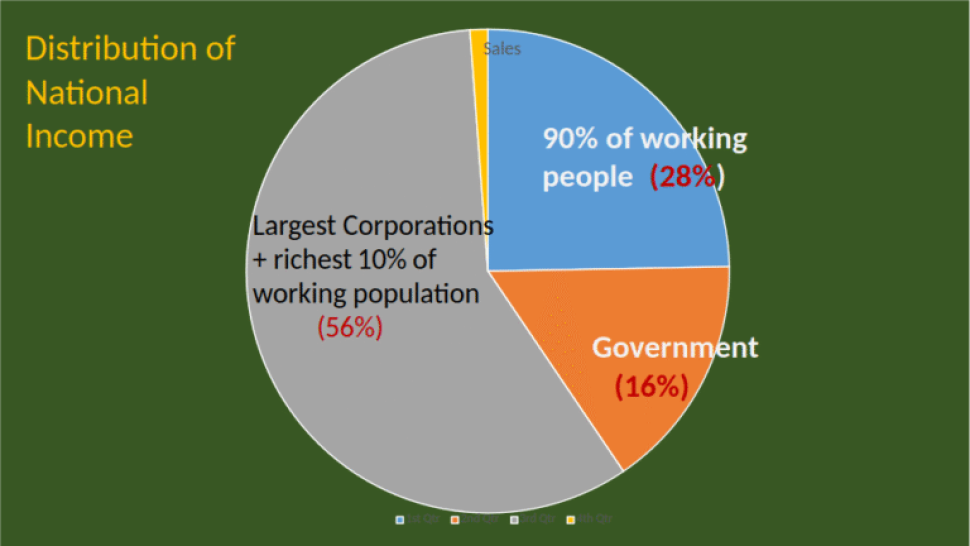
These rules have led to the de-industrialisation of advanced countries in Europe and the US, and wage suppression in the developing countries in the Global South which had to, under this system, compete with their peers to attract foreign direct investment. The net impact of the international economic system created in the last 45 years is reflected in the pie chart reflecting income distribution in Malaysia in 2024.

Image
Distribution of national income

Currently, 90% of the Malaysian population receives 28% of total national income, while the Malaysian government receives 16%. (The Malaysian’s government share was 30% of GDP in 1988, before we started lowering our corporate tax rate). The richest 10% of the population and the companies with more than 50 employees receive 56% of the national income.4 This is the “price” of “success” under the rules based economic order that has built up since 1980s.

The globalisation we have experienced has resulted in a huge increase in the productivity of the global economy. However, the major beneficiary of this growth in productivity, are the largest MNCs in the world and the richest 0.1% of humanity who have become obscenely wealthy. Competition for investments from these MNCs has resulted in wages remaining stagnant and declining government revenue in almost all countries. Many countries in the global South are hugely in debt and are food insecure. Even the countries that grew their economies (like Malaysia — 24 fold in the past 50 years!) are unable to use the income generated in their economies to provide a better quality of life for their citizens or to mitigate against climate change.

Recalibrating the economy to serve the people

Multi National centric Globalisation cannot be rapidly reversed. Our national economies are now highly integrated in regional and international networks, and too rapid a disarticulation will lead to loss of jobs and economic chaos. We, the PSM, have been trying to develop practical medium- term strategies to build a more equitable society. We have been proposing to our progressive partners in SE Asia that Comrade Samir Amin’s proposal for partial de-linking from the global economy and the formation of regional blocks, should be the central strategy to

  1. retain a larger portion of the value created by the labour of the ordinary workers, farmers and business people in our region
  2. share a larger portion of the wealth created in ASEAN with the people who created it through higher prices for primary agricultural products, higher pay for our workers and more robust and comprehensive social protection schemes — such as high-quality health care, old age pension, reasonably priced rental residences, etc.

SE Asia has a population of 680 million. That should provide sufficient economies of scale for the local manufacture of most of the goods we use in daily life, except for things like advanced medical technologies like robotic surgery and passenger airplanes. A policy of import substitution at an ASEAN level should be discussed by progressive movements in the region. This policy would reduce dependence on economies outside the region, generate more jobs for the youth in ASEAN, and reduce outflow of local currency. It would also spur technological research and innovation at ASEAN level. The ASEAN member states will need to carefully and fairly apportion the manufacturing opportunities as well as associated job creation equitably among themselves, on the basis of population size to ensure continued buy-in on this endeavour.

The process of import substitution might require tariffs to keep the ASEAN market from being flooded with cheaper products from outside. We need to uphold the principle that one of the primary roles of the economy is to generate enough jobs for all the people in that society who need work. The “right to life” is an empty slogan if it does not encompass the “right to livelihood” — to be offered work at a reasonable wage level. The principle of “Free trade” should not be used to undermine our people’s right to decent jobs.

We need many new rules to move towards a better ASEAN. For example, ASEAN countries should commit to increasing corporate tax to 30% of profits over a period of 10 years. That would require Malaysia to increase its corporate tax rate by 0.6% annually as we are at 24% currently. Thailand, with a corporate tax of 19% at present, would have to go up 1.1% annually to make the target of 30% by 10 years. Increasing government revenue would help government provide better services to the people and to do serious climate mitigation work which is grossly overdue. Increase in government expenditure would augment aggregate demand, and this will provide a larger market for the businesses in the ASEAN region.

We need to explain the importance of this programme to the people and to businesses, because we need to cultivate political support to demand that the ASEAN Free Trade Agreement be modified to include a new provision that a tariff of certain percentage must be levied incrementally5 against the exports of any ASEAN member state that fails to adhere to the increment in corporate tax agreed at ASEAN level.

Another programme that needs to be considered at ASEAN level is to overcome wage suppression and attain a living wage for all. At present the minimum wages in ASEAN are at different levels. Jakarta is at about 75% of Malaysia’s minimum wage. Sulawesi and Cambodia are at about 50% of Malaysia’s. ASEAN nations should commit to increase the minimum wage in all ASEAN countries by 10% each year for the next 10 years, starting from their differing starting points — so that at 10 years, we would be at double today’s wage rate though still at different absolute levels. The benefits are obvious — lower income families would live better, eat more nutritious food and have better financial security. Businesses of all sizes would have a larger market to sell to.6 The increase in manufacturing and commercial activities would generate jobs that are desperately required all over ASEAN. Quite probably, government tax collection would also go up.

As in the case of the proposal to increase corporate tax progressively, we would need to work this into the existing ASEAN Free Trade Agreement. Any country that attempts to gain by keeping its wages static but nevertheless benefit from the expanding regional market created by wage increases in other ASEAN countries should be incurred a penalty in the form of a tariff of, perhaps 5%, against all its exports to other ASEAN countries. This penalty tariff would be cumulative, increasing for each year that country failed to implement the increase in minimum wage.

Would this lead to a flight of investment capital? Unlikely that capital will flee to advanced countries or to NE Asia. As explained earlier, the wage level in ASEAN is about 1/6th to 1/12 of that in Europe, the US and North East Asia. Translocation of investment capital to neighbouring ASEAN countries has been the possibility that national policy makers have had to be wary about. But if ASEAN countries had a unified policy on wage increase, where would international capital run to? The wages in the advanced countries would still be more than 3 times higher even after we managed to double ASEAN wage rates.

Africa might be a choice for international capital still dependent on very low wages. If that develops, we (being progressive internationalists) should not begrudge poorer African nations this opportunity to attract investments, create jobs and build their economies. Africa is still the poorest and most marginalized continent. But being one of the last remaining bastions of overly suppressed wages, they would be in a better bargaining power to insist on more decent returns for their countries in terms of wages and technology transfer.

APEC 2025 — and a message of hope

Would discussion of the themes outlined in the section above take place in the APEC summit? I seriously doubt. Most of the government leaders who will be attending APEC have been exposed to World Bank–IMF–World Trade Organisation dogma for the past 30 years such that they are unable to think outside that neoliberal policy framework.

The Message of Hope7 can only come from Progressive Movement. We have the responsibility of putting forward an alternative vision of a world where the vast wealth created by the growth of technology and science is utilized to benefit the ordinary people and the planet on the basis of solidarity. It is our duty to chart out a realistic (and believable) roadmap in that direction. And we need to rally people to this vision and attempt to take political power in our respective countries.

Rosa Luxemberg’s observation that the choice human society faces is either Socialism or Barbarism remains relevant. The Left has a crucial role to play in ensuring that it’s the former!

Jeyakumar Devaraj is Chairperson of Parti Sosialis Malaysia.

  • 1

    There is no single minimal wage rate in the US. It varies State by State. It is as low as USD 7.50 in certain States and as high as USD 16.50 in New York and California. The weighted average US Minimum Wage, taking into account the population of the individual States is about USD 12.50 per hour. Minimum wage in Malaysia now is RM 1700 per month. This works out to RM 1700 div by 25 days div by 8 hrs per day – RM 8.50 per hour, which is equivalent to USD 2.01 per hour. (at the exchange rate of RM 4.22 to the US Dollar)

  • 2

    Private consumption makes up approximately 68% of US GDP – 23% on goods and 45% on services. Approximately half of these goods are imported. In addition, the tariffs against certain countries such as Brazil, China and India are much higher than the tariffs on ASEAN countries.

  • 3

    Real = after taking into account the effect of inflation.

  • 4

    The percentage accruing to the top 1% at a global level would be more than the 56% figure quoted in the Malaysian analysis. This is because, Malaysia’s top 10% of individuals and firms are several steps down the global “pecking order” and they are forced to give up a major portion of the surplus they have extracted from their workers. The firms higher than them in the global value chains squeeze these surpluses from them. Refer to John Smith’s Imperialism in the 21st Century for a detailed description of this phenomenon.

  • 5

    Incrementally here means that if a particular ASEAN member State fails to raise corporate taxes by the agreed percentage for a second year, another increase in the tariff rate would have to be added to the one declared after the first default.

  • 6

    Implicit in these plans is the perception that the Left alliance that takes over government in any country in SE Asia, will not be in a position to implement a full “socialist” program that includes taking control of all productive assets by the State immediately. It is our perception that any such attempt would lead to economic mayhem and a steep drop in living standards. We think that we instead need to aim for the following

    a) increase the material wellbeing of the ordinary citizen by immediately expanding social protection programs, and then later working towards increasing jobs and wage rates. A progressive larger share of the income generated by the economy should be shared with the working classes.

    b) making food, energy and pharmaceutical self-sufficiency high priority targets

    c) building grassroots democratic structures – by mandating unions in all work places with more than 5 workers, and by organizing people to set up residential communities that can participate in community budgeting. Empowering people to take over the management of the economy and society should be the aim. Involving people in the transformation of society is crucial. (Marta Harnecker’s book, “Rebuilding the Left”, is well worth reading!)

    d) wherever possible, new industries should be owned by the government or “Government Linked Companies” and managed by workers, cooperatives or communities.

    In other words, our expectation is that the incoming “left” government would be managing (hopefully competently) a capitalist economy for the first 2 or even 3 decades, while building the capacity of ordinary people, and laying the groundwork for the progressive socialization of production, and further progress towards socialism.

  • 7

    Some comrades still like to shout slogans like “Smash the system” and “Revolution now”. This is unlikely to appeal to people outside our echo-chambers. I can understand the anger against the unfair system and the frustration that young people feel, but the point, as Marx said, is to change the world. To change the world, we need the masses on our side in overwhelming numbers. There isn’t much appetite for anarchy among ordinary people in Malaysia. Yes, times are difficult, but there have also been significant improvements. Life expectancy at birth in Malaysia was 57 years in 1960. It is now 75 years. Maternal mortality was 242 per 100,000 births in 1960. It is now about 25.7 per 100,0000 (2023). Literacy has gone up. Most adults have their own handphones and are incredibly well connected. There has been an improvement in material conditions over the past 70 years. This “Smash the system” slogan will not rally the majority. But a narrative that given the greatly enhanced productive capacity of our society, life could be so much less stressful if that increase in productive capacity is used based on solidarity with all, might succeed to win people to our program especially if we can put forward a believable line of march. And if espoused by a political movement that has been consistently with the people, lobbying for bread and butter issues affecting the masses – decent wages, old age pension, decent health care, affordable housing, etc.


Islam in America: Sanctioned Intolerance and Indifference


by  | Nov 6, 2025 | ANTIWAR.COM

When prejudice targets Black, Jewish, or Latino communities, Americans respond with collective outrage. But bigotry against Muslims? It’s far less taboo and routinely brushed aside – even openly condoned in certain circles. Islamophobia isn’t fringe; it’s woven into the fabric of American society and etched into its national identity.

With few avenues for recourse, millions of Muslim Americans have grown accustomed to thickening their skin and weathering the backlash stemming from their faith – a belief practiced by nearly two billion people worldwide, a quarter of humanity. Why is such blatant partiality tolerated? Is Islamophobia truly born of fear, as its name suggests, or have Americans been conditioned by political and foreign interests determined to barricade the U.S. from the Muslim world?

I have witnessed this reality firsthand since the fall of 2001 – at the onset of a career in federal law enforcement that intersected with a personal relationship that would forever reshape my life. On the morning of 9/11, I was driving to the Pentagon for scheduled interviews as a background investigator, unaware of how profoundly that week would alter both history and my ideology. At the time, I knew little about Islam, but days later I would meet – and eventually marry – a Palestinian-American whose perspective enlightened my understanding of faith, humanity, and the world’s uneven balance of power.

Structural bias against Muslims is especially entrenched within military, intelligence, and law enforcement sectors. While employed as a Special Agent with the U.S. Department of Homeland Security, I’ll never forget attending a terrorism seminar hosted by former CIA officials who propagated widespread misconceptions about Islam: that Muslims sought the annihilation of all Jews and Christians, that martyrs were literally promised “72 virgins,” and that Muslim women were universally oppressed – forced to wear hijab, denied higher education, and coerced into arranged marriages. Yet through my wife, colleagues, and countless Muslim families I’ve known for decades – the reality is quite the contrary. Muslim households are like any others, with women often serving as the anchors that hold the family unit together.

Over the past twenty-five years, I’ve recognized dynamics that are part of a larger-scale phenomenon: Islamophobia has evolved from individual prejudice into institutionalized bias – embedded in communities, workplaces, government agencies, and the media alike. Policies framed as patriotism or security measures routinely single out Muslim Americans, while political rhetoric and news coverage reinforce caricatures that bear little resemblance to reality. This is not merely ignorance or fear – it is systemic, sustained because it serves political, geopolitical, and territorial interests.

That distorted perception permeates institutions and communities alike: mosques, like other minority places of worship, are routinely subjected to harassment and vandalism. Yet unlike attacks on other religious communities, these incidents rarely prompt meaningful accountability, and public response is strikingly muted. According to the ACLU, “anti-Muslim sentiment has spiked” in recent years. Rawand Abdelghani, a board member at the Nueces Mosque in Austin, Texas, noted, “Since October 2023, we’ve definitely seen a rise in Islamophobia.” This prejudice, more than any other, has become America’s tolerated bigotry.

Further illustrating this resentment, coordinated efforts to block the construction of new mosques have emerged across the United States – prompting an uncomfortable question: would the same tactics be used to obstruct the building of new synagogues or churches?

The political arena reflects the same double standard, as recent statements make emphatically clear. On October 2, 2025, Senator Ted Cruz labeled New York mayoral candidate Zohran Mamdani a “jihadist” on national television – drawing little collective criticism. The incident is a stark reminder of Islamophobia’s normalization at the highest levels of power. I’ve witnessed the same dynamic personally: when I criticized America’s one-sided Israel-Palestine policy in 2003 – around the time American activist Rachel Corrie was killed in Gaza by an Israeli armored bulldozer – a DHS colleague dismissively told me I “shouldn’t have married a terrorist.” Whether broadcast on cable news or whispered in the break room, the message is clear: Muslim Americans are all too often presumed suspect, and anyone who contests the narrative becomes fair game. It is a culture of sanctioned discrimination masquerading as national security.

Beyond America’s borders, U.S. perceptions and policy are shaped by foreign actors, including the Israeli government, whose strategies and rhetoric foster anti-Muslim division. Prime Minister Benjamin Netanyahu has long blurred the line between “militant Islam” and Islam itself, portraying the faith as a global threat. By repeatedly invoking “Judeo-Christian” values, he casts Jews and Christians as natural allies while portraying Muslims as outsiders, reinforcing an us-versus-them narrative. This message has been amplified by his son, Yair Netanyahu, whose incendiary social media posts about Muslims – such as “Terror has a religion and it is Islam” and “Not all Muslims are terrorists, but all terrorists are Muslims” – have further linked hostility toward Islam with the defense of the West.

Overcoming this cycle requires both moral clarity and structural reform: dismantling norms that perpetuate anti-Muslim prejudice, engaging the Islamic world with fairness rather than ulterior motives, and supporting Palestinian rights with dignity. It also means holding Israel’s government accountable when its actions conflict with U.S. objectives, because American foreign policy should never be dictated by blind loyalty to any international power.

Only by confronting intolerance at home and recalibrating its engagement abroad can America restore credibility, foster genuine religious pluralism, and uphold justice without exception. Until it reckons with this sanctioned intolerance, the nation will continue betraying the very ideals it professes to uphold.

Reprinted from the Colorado Times Recorder with the author’s permission.

Jamie Haase is a security professional and former Special Agent with U.S. Immigration and Customs Enforcement’s Homeland Security Investigations (HSI). His commentary on domestic and foreign policy has appeared in HuffPost, AlterNet, and other outlets. Follow him on Twitter @jamisonhaase and on Substack at The Diplomatic Pouch.

Washington’s Double Standard on Terrorism Betrays the Spirit of Liberty


by Sophia Gonzalez | Nov 7, 2025 | ANTIWAR.COM


The U.S. government says its “war on terror” protects freedom. In practice, every new intervention narrows the perimeter of freedom at home. The language of confronting evil abroad has become a cover for expanding state power, channeling public money to defense contractors, and normalizing surveillance that would have been unthinkable a generation ago. The pattern is familiar: the more expansive the mission overseas, the more elastic the constraints on government at home.

The contradiction is starkest in Gaza. U.S. officials condemn terrorism but continue to arm and shield an ally whose campaign has killed tens of thousands and devastated the territory. Humanitarian agencies report mass displacement, widespread hunger, and a crippled health system. In the diplomatic arena, Washington has repeatedly vetoed U.N. Security Council resolutions calling for an immediate ceasefire even as it advances fresh weapons packages.

This moral blind spot is not confined to one conflict. During the Cold War, Washington funneled support to the Afghan mujahideen – a decision memorialized in official records – only to confront successor movements in later decades. In Syria, Kurdish-led forces became the principal U.S. partner against ISIS even as NATO ally Turkey labeled affiliated groups terrorists and pressed military campaigns against them. Definitions shift with alliances; the underlying violence does not.

The Iranian exile group known as the Mujahedin-e Khalq (MEK) offers another example of strategic elasticity. The group’s history includes attacks that killed U.S. citizens in 1970s Tehran, a fact acknowledged by U.S. government sources. Decades later, after an intense and well-funded lobbying effort, the State Department removed the MEK from its Foreign Terrorist Organization list in 2012.

Endless war feeds on fear, and fear consolidates power. Drone warfare was sold as precise and surgical, yet senior commanders themselves warned that killing civilians can be counterproductive – the “insurgent math” that every innocent death creates new enemies. The broader empirical record is mixed, but even the optimistic studies concede a pattern of backlash risks and strategic tradeoffs that should caution against routine reliance on force.

Sanctions are often marketed as a humane alternative to war, yet U.N. experts have repeatedly warned that sweeping unilateral measures punish entire populations, triggering shortages and eroding basic rights – effects difficult to square with a professed commitment to human dignity. If policy aims include stability and liberty, collective punishment is a poor instrument.

Meanwhile, the political economy of intervention hardens. The world’s major arms producers reported another rise in revenues in 2023, with U.S. firms accounting for roughly half of global sales – momentum propelled by ongoing conflicts and procurement cycles that outlast headlines. The incentives are aligned for more of the same.

If opposing terrorism were truly the goal, policy would prioritize ending the interventions that nurture it. That would mean halting arms transfers that fuel atrocities, rejecting collective punishment via sweeping sanctions, and abandoning the conceit that liberty can be delivered from 30,000 feet. Security grows from peace, commerce, and diplomacy – not from empire.

The libertarian tradition teaches that freedom and empire cannot coexist. Every bomb dropped abroad echoes at home as expanded surveillance authorities and normalized exceptions to the rule of law. To defend the American republic, policymakers should discard the imperial reflex that keeps creating enemies and rediscover a foreign policy consistent with the spirit of liberty.

Ultimately, reclaiming liberty demands moral courage – the courage to admit that power cannot purchase peace, that domination cannot deliver safety, and that genuine security begins with restraint. When the nation learns once again to measure strength not by the size of its arsenal but by the integrity of its principles, it will rediscover the freedom it claims to defend.

Sophia Gonzalez is an American activist and political analyst focusing on U.S. strategy, Middle East affairs, and global security. A peace and human rights advocate, she writes to challenge interventionism and promote diplomacy. Find her on X (@SophiaGnzlz) or contact her at Gonzalez.initial@gmail.com.


AP identifies people killed by Trump's boat strikes — and they are not all terrorists

MURDER ON THE HIGH SEAS

Sarah K. Burris
November 7, 2025 
RAW STORY


A vessel burns in this still image taken from a video released September 15, 2025, depicting what U.S. President Donald Trump said was a U.S. military strike on a Venezuelan drug cartel vessel that had been on its way to the United States, the second such strike carried out against a suspected drug boat in recent weeks. 

Donald Trump via Truth Social/via REUTERS THIS IMAGE HAS BEEN SUPPLIED BY A THIRD PARTY. NO RESALES. NO ARCHIVES. MANDATORY CREDIT. TPX IMAGES OF THE DAY 

Verification lines: Reuters checked the footage through our AI detection tool and found no evidence of manipulation. However, portions of the footage are partly blurred, making it impossible to confirm if the video is manipulated. Thorough verification is an ongoing process, and Reuters will continue to review the footage as more information becomes available.

The Associated Press investigated the identities of those killed in President Donald Trump’s military strikes on boats in the Caribbean and found that many were not the hardened criminals Trump claimed.

"One was a fisherman struggling to eke out a living on $100 a month. Another was a career criminal. A third was a former military cadet. And a fourth was a down-on-his-luck bus driver," the report said.

Senators were given a classified briefing on Thursday, where Senate Intelligence Vice Chairman Mark Warner (D-VA) expressed confidence that the intelligence being used to justify the bombings was legitimate. Nonetheless, the Pentagon’s secrecy has fueled concern and skepticism among the public, CNN reported.

AP conducted dozens of interviews in Venezuelan coastal towns, finding families who dispute Trump’s portrayal of their loved ones as “narco-terrorists.” Most were “low-level” laborers taking dangerous jobs for $500 per trip. “They were laborers, a fisherman, a motorcycle taxi driver. Two were small-time criminals,” the report said. Only one was linked to a crime boss providing smuggling services.

The boats weren’t carrying fentanyl or heading to Florida; they shipped cocaine to nearby Trinidad and other islands, and then to Europe. The bulk of Colombian cocaine for the U.S. typically leaves Colombia via the Pacific. The boats appeared to be carrying cocaine instead of the deadlier opioids, which kill tens of thousands in America each year.

The families complain that their relatives should have been given "due process" rather than what Venezuela's ambassador to the U.N. called “extrajudicial executions.”

As the AP explained, "In the past, their boats would have been interdicted by the U.S. authorities and the crewmen charged with federal crimes, affording them a day in court."

Since September, at least 69 people have been killed by the strikes.

Read the complete profiles of the men here.
Senate Republicans block bid to limit Trump’s war powers on Venezuela


U.S. Senate Republicans on Thursday blocked a resolution that would have barred President Donald Trump from launching military action against Venezuela without congressional approval, underscoring deep divisions over the administration’s escalating campaign in the Caribbean.


Issued on: 07/11/2025 
By: FRANCE 24

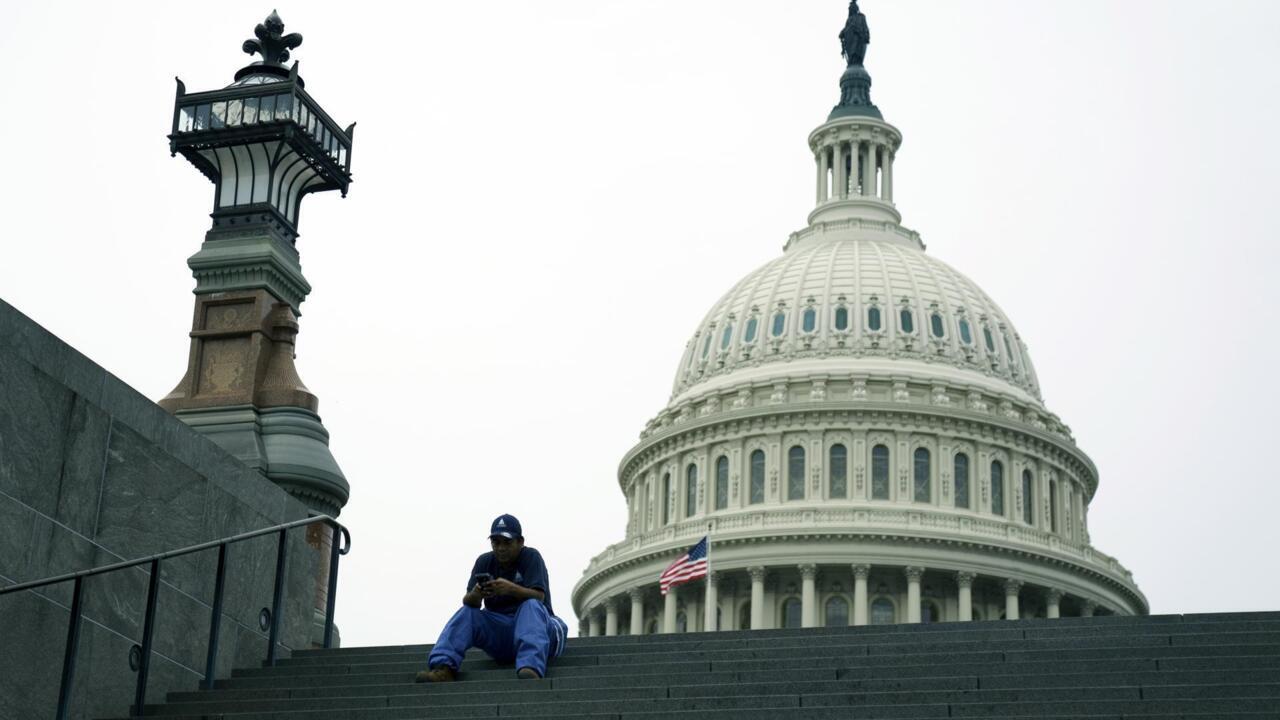
A member of staff sits on steps close to the US Capitol, Washington, DC USA, 30 September 2025. © ©Will Oliver, EFE


U.S. Senate Republicans blocked a resolution on Thursday that would have prevented President Donald Trump from attacking Venezuela without congressional authorisation, a day after administration officials told lawmakers that Washington is not currently planning strikes on Venezuelan territory.

The Senate voted 51 to 49, largely along party lines, against a measure that would have brought the war powers resolution up for a vote.

Only two of Trump’s fellow Republicans joined Democrats in backing the measure, in a show of the party’s support for Trump’s military build-up in the southern Caribbean after two months of deadly strikes against boats off Venezuela.

The Trump administration says that since early September, U.S. forces have launched at least 16 strikes against such vessels in the Pacific and southern Caribbean, killing more than 65 people.

The prolonged campaign has heightened concern that Trump will launch an attack on Venezuela itself, prompting the introduction of the bipartisan resolution. Its lead sponsors were Democrats Tim Kaine of Virginia and Adam Schiff of California, and Republican Senator Rand Paul of Kentucky.

Trump has dangled the possibility of land attacks on Venezuela for weeks, saying at one point that he had authorised the Central Intelligence Agency to conduct covert operations in the country.

He later denied he was considering strikes inside Venezuela, even as Washington continued to build up a large military presence in the Caribbean with fighter jets, warships and thousands of troops.

Secretary of State Marco Rubio and Secretary of Defence Pete Hegseth briefed congressional leaders and the Republican chairs and top Democrats on national security committees on the issue on Wednesday.

“Based on that briefing, I think the administration does not want to go to war with Venezuela,” Adam Smith of Washington, the ranking Democrat on the House of Representatives Armed Services Committee, told the Atlantic Council.

“But then again, President Trump is rather known for his—what would be the best way to put this—chaotic approach to things. He’s one to change his mind very quickly. So who knows?”

READ MOREUS Supreme Court signals doubts over Trump’s sweeping tariff powers
National security concerns

Senator Mark Warner of Virginia, the top intelligence committee Democrat, said the legal justification for the boat strikes laid out by administration officials did not include justification for direct attacks on Venezuelan territory.

“Nothing in the legal opinion even mentions Venezuela,” Warner told reporters as he left Wednesday’s briefing.

A senior administration official said attacks against land targets would be justified on national security grounds.

Some legal experts say the strikes may violate international law as well as U.S. laws against murder and prohibitions on assassination.

Members of Congress from both parties have complained they have received scant information, such as who was killed, evidence of drug trafficking, the build-up’s cost, or the administration’s long-term Latin American strategy.

During debate on the resolution on Thursday, Senate Democratic leader Chuck Schumer of New York called on the Trump administration to hold a briefing for all 100 senators. Democrats have also called for a meeting with the full House of Representatives.

The administration has said those targeted were “narco-terrorists” transporting drugs that endangered Americans, without providing evidence or publicly explaining the legal justification for attacking the boats rather than stopping them and arresting those on board.

The U.S. Constitution requires any president to obtain Congress’s approval before launching a prolonged military operation.

“The time is right for Congress to step in and reassert our congressional responsibility,” Schiff told a news conference before Thursday’s vote.

Opposing the resolution, Senator Jim Risch of Idaho, the Republican chairman of the Senate Foreign Relations Committee, said Trump had the authority he needed as commander-in-chief. “I wish my colleagues would join me today in congratulating the president for what he has done,” he said.

It was only the latest attempt to rein in Trump’s war powers. The Senate blocked a resolution last month, by a vote of 51–48, that sought to stop the boat strikes. That vote was also mostly along party lines, with the same two Republicans—Paul and Lisa Murkowski of Alaska—backing the measure.

Kaine and Schiff told reporters on Thursday they would consider options for trying another resolution after the vote.

(FRANCE 24 with Reuters)