Ontario Clears OPG to Launch $26.8B Pickering Nuclear Refurbishment
Ontario has given Ontario Power Generation the formal go-ahead to begin executing the refurbishment of the Pickering Nuclear Generating Station’s Units 5–8, marking one of Canada’s largest energy infrastructure commitments in decades. The decision clears OPG to advance detailed planning ahead of project execution in early 2027.
The province’s approval enables OPG to start transitioning Pickering into its next operational phase, securing 2.1 gigawatts of low-carbon baseload power for more than 30 additional years. That represents enough electricity to supply over two million homes and will help Ontario meet steeply rising electricity demand tied to industrial growth, electrification and population expansion.
The green light allows OPG to begin the definition phase of Pickering’s refurbishment through 2026, leveraging over 7,000 lessons learned from the Darlington Refurbishment and the utility’s ongoing small modular reactor (SMR) program. Construction and component replacement work will begin in 2027, with completion expected in the mid-2030s.
With an estimated all-in cost of $26.8 billion, the Pickering overhaul ranks among the largest infrastructure projects in the country. According to the Conference Board of Canada modelling, the project is projected to add $38.2 billion to Ontario’s GDP and $41.6 billion nationally over its lifespan. Roughly 85–90% of spending will remain in Ontario, bolstering the province’s nuclear supply chain and creating substantial regional economic benefits.
Employment impacts are similarly significant: refurbishment and continued operations are expected to support an average of 7,500 jobs annually across Canada, including 30,500 jobs per year during the refurbishment phase.
Major contracting has already begun, including a $2.1-billion award to CanAtom for early engineering and procurement tied to the retube, feeder and boiler replacement program.
Pickering’s four-unit overhaul mirrors elements of Darlington’s multi-year life-extension—such as replacing 380 fuel channels per reactor—but adds considerable complexity. Unlike Darlington, Pickering’s project includes the replacement of all 48 steam generators, a first-of-its-kind scope for Ontario’s CANDU fleet.
The project also includes construction of a 1.5-kilometre deep-water intake system to secure colder cooling water—an infrastructure element Pickering lacks from its original design.
Pickering holds an operating licence valid through 2028. OPG has applied for a new 10-year licence from the Canadian Nuclear Safety Commission that would cover refurbishment activities and post-refurbishment operations.
Ontario is in the midst of the largest nuclear build-out in Canadian history. Alongside Darlington’s completed and ongoing refurbishment stages, the province is advancing the G7’s first grid-connected SMR at Darlington, expanding the Bruce Nuclear site, and now embarking on Pickering’s full life-extension. Together, these moves are designed to ensure long-term grid reliability while meeting aggressive climate and electrification targets.
By Charles Kennedy for Oilprice.com
Pickering refurbishment gets government go-ahead
The Ontario government has approved Ontario Power Generation's plan to refurbish four Candu nuclear reactors at Pickering, clearing the way for a start to the execution phase of the project, subject to final regulatory approvals.
_11527.jpg)
"For more than 50 years, nuclear power has been the backbone of Ontario's energy grid, with the Pickering Nuclear Generating Station as one of the best-performing and continuously operating nuclear stations in the world," Minister of Energy and Mines Stephen Lecce said as he announced the government's approval.
"To deliver on our major jobs plan to get Canadians working, extending the life of the facility will create jobs for tens of thousands of skilled workers while we build up the Ontario supply chain and keep 90 per cent of our project spend in this country."
Pickering units 5-8 - known as Pickering B - began operations in the mid-1980s and had been scheduled to end electricity production this year, but in 2022 the provincial government directed OPG to keep them in operation until 2026 and to reassess the feasibility of refurbishing the units. The government gave OPG the go-ahead to begin the initiation phase of the refurbishment project in January 2024, and one year later, it gave its permission for the start of the project definition phase.
The final budget for the Pickering refurbishment is CAD26.8 billion (USD19.1 billion), but according to a study by the Conference Board of Canada, the mega-project - which will enable the plant to continue in operation for up to 38 more years - will increase Ontario's GDP by CAD38.2 billion in 2024 dollars over the project's lifespan, including CAD17 billion during the refurbishment phase, and increase Canada's national GDP by CAD41.6 billion over its lifespan.
Some 30,500 jobs will be created during refurbishment, while the station's operation will sustain 6,700 jobs. To reduce costs, the government says it will continue exploring potential financial instruments that would benefit ratepayers, while OPG "continues to explore other optimal financing arrangements".
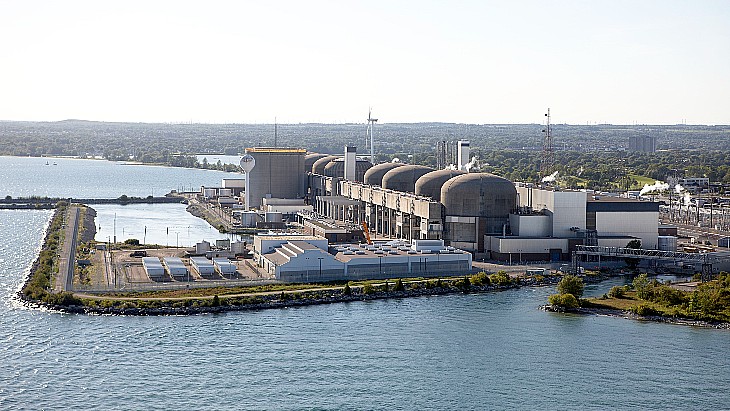
Pickering (Image: OPG)
Refurbishment of CANDU reactors is a major undertaking in which thousands of parts - including major components such as steam generators and pressure tubes - are inspected or replaced before the reassembled reactor returns to service. OPG has been carrying out refurbishment of four units at its Darlington site, and thousands of lessons learned there will be incorporated at the Pickering refurbishment which the company said is a more complex and larger project than Darlington. The work at Pickering will include replacing all 48 steam generators across the four units - components that were inspected rather than replaced at Darlington.
With the green light from the government, OPG said it will continue to advance the definition phase, which will last through much of 2026. It has already signed contracts for the refurbishment with Ontario-based suppliers, including a CAD2.1-billion contract with CanAtom for early engineering and procurement to prepare for the execution of the project's Retube Feeder and Boiler Replacement Program. It expects to begin the Project Execution Phase in early 2027, with completion expected by the mid-2030s.
"This is a truly remarkable moment for Pickering Nuclear, our employees, and the community," OPG President and CEO Nicolle Butcher said. "We are ready to leverage all of our ongoing lessons and experience from our Darlington Refurbishment and the construction of the G7's first Small Modular Reactor to deliver another successful nuclear refurbishment for Ontario. Through this project, we will ensure this important station continues to play a key role in our future - by generating critical energy and economic benefits, sustaining high-quality jobs, and ensuring Ontario and Canada's energy security."
Pickering units 1 and 4 - the last of the four units making up Pickering A - ceased commercial operations in 2024.
Britain’s Nuclear Reform Set to Stall Over Legal Concerns
- Labour is reportedly pausing nuclear-sector reforms despite a sweeping report urging planning and regulatory changes to cut costs and accelerate new projects.
- Legal concerns raised by a government adviser have prompted Reeves to withhold the recommendations from the upcoming Budget, delaying growth-focused measures.
- Industry leaders, MPs across parties, and think tanks argue that fully adopting the review is essential to lowering energy costs, boosting investment, and reviving UK economic growth.
The Labour government is set to hold fire on pushing through sweeping reforms to nuclear energy due to a legal adviser’s concerns over the “UK’s environmental, trade and human rights obligations”, it has been reported.
The Innovate UK member John Fingleton published a damning report on red tape blocking the expansion of the country’s nuclear industry on Monday.
His extensive report prompted calls from across the political spectrum for Rachel Reeves to accept recommendations easing planning rules and lowering costs for investors.
But ITV News has now reported that the Chancellor will not include the growth-focused recommendations in her Budget speech on Wednesday.
The broadcaster reported that the Chancellor will make reforms “subject to further work and review” after a government adviser voiced concerns about the legal crossovers in the paper with UK obligations.
The landmark report on nuclear energy underscored the need for radical changes to the planning and regulatory system to allow more plants to be built to support the UK’s drive to lead on AI.
Fingleton outlined how £700m was being spent by Hinkley Point C bosses on protecting one salmon every ten years in its “fish disco” project that uses noise to keep animals away from the plant in Somerset.
His report said investors and builders had to deal with a “fragmented” system of environmental or community regulators and red tape to get projects over the line, leading the UK to be the “most expensive” place to build nuclear power.
Labour government urged to back growth
MPs from different parties, growth activists and think tanks have joined up to call for 28 recommendations in the report to be accepted by the Chancellor at the Budget.
A letter signed by Labour Growth Group chair Chris Curtis and groups including the Centre for British Progress, Tony Blair Institute and the YIMBY Alliance said: “Britain has the chance to once again lead the world in building nuclear power, which is the backbone of industrial communities and jobs across the country, and also at the heart of our climate ambitions.
“There is a once in a generation opportunity to build the energy and industrial infrastructure of the future on these islands.”
Reform UK’s Zia Yusuf and the Conservative Party’s Kemi Badenoch also spoke out in support of the review.
Lawrence Newport, the head of campaign group Looking for Growth, told City AM: “Such a significant shift would set Britain on a clear path towards affordable energy and, consequently, economic growth.
Indeed, reducing energy prices is a prerequisite for any government hoping to reverse decades of stagnation and decline. With cheaper energy, British businesses could start and scale here uninhibited.
“Rachel Reeves must make a decision. If the Chancellor really is as serious about growth as she says, if she actually wants to make our energy cheap again, she will accept all of the Nuclear Regulatory Review’s recommendations.”
By Mauricio Alencar via CityAM
GDES, KEPCO KPS team up for Spanish and French markets
_48460.jpg)
The agreement was signed on 17 November at Korea Electric Power Corporation's headquarters in Naju-si, South Korea, in a ceremony led by Ho-Kwang Jun, Executive Vice President of KEPCO Plant Service & Engineering (KEPCO KPS), and Héctor Dominguis, CEO of Grupo Dominguis Energy Services (GDES).
GDES said the alliance will enable both companies to share know-how, resources and capabilities "in pursuit of common objectives". It said the partnership "brings together GDES's long-standing expertise in the European nuclear sector and KEPCO KPS's strong technological capabilities as a leading South Korean provider of operation, diagnostics and maintenance services for energy facilities".
KEPCO KPS is a South Korean public company, operating in 25 countries and employing around 5,800 people. The company is widely recognised for its technical and operational excellence and specialises in diagnostics, performance improvement and operation and maintenance (O&M) services for both conventional and renewable energy facilities. Its technology-driven approach is supported by dedicated R&D centres focused on digitalisation, predictive maintenance and advanced solutions for the management of critical assets.
GDES has more than 45 years of experience in the nuclear sector. The group has participated in the construction of Spain's nuclear power plants, as well as in their maintenance and decommissioning, "becoming a European benchmark with a presence in projects in Spain, France, Sweden, Switzerland (CERN), the United Kingdom and Italy".
"Through this alliance, GDES strengthens and broadens its innovation, technology and O&M capabilities, reinforcing its value proposition for the Spanish nuclear sector while accelerating its strategic expansion in international markets," the company said.
Dutch support for molten salt reactor demonstrator facility

The announcement was made at the Made for Nuclear event, where Thorizon and a wide network of partners signed a joint Ambition Agreement to accelerate the project. The coalition brings together leading Dutch industrial companies including VDL Groep, nuclear operator EPZ and engineering and construction firm Haskoning, supported by a strong ecosystem of universities, knowledge institutes, manufacturing, energy and high-tech service providers. Several Dutch provinces have confirmed their engagement and are now assessing potential sites for the demonstrator, as well as opportunities to establish an innovation hub around the facility with testing capabilities for materials and components.
The Thorizon Pioneer is part of Thorizon's roadmap to industrialise molten salt reactors (MSRs). The facility will be a smaller, non-commercial version of the Thorizon reactor focused on validating the reactor core without electricity production. The Thorizon Pioneer will be the first nuclear molten salt installation operating in Europe, the company said, providing unique opportunities for research and development.
"It is designed to demonstrate Thorizon's ability to design, license and build a nuclear installation," Thorizon said. "The Pioneer will also enable the qualification of supply chain partners, testing of key materials and components, which is central to lowering construction and operating costs in the full-scale reactor."
"The Netherlands has a great and entrepreneurial manufacturing and services industry, skills we intend to combine with the R&D expertise and manufacturing expertise in nuclear," said Thorizon CEO Kiki Lauwers. "We can build on the knowledge of the Pallas medical isotope reactor and ongoing research at TU Delft and Differ. We hope to continue the strong cooperation in Europe to make this project a success and thank our partners and the provinces involved for this opportunity."
MSRs use molten fluoride salts as primary coolant, at low pressure. They may operate with epithermal or fast neutron spectrums, and with a variety of fuels. Much of the interest today in reviving the MSR concept relates to using thorium (to breed fissile uranium-233), where an initial source of fissile material such as plutonium-239 needs to be provided.
To prepare for European licensing, Thorizon said it is engaged in a joint preparatory safety review with the Dutch, French and Belgium nuclear safety authorities. The next major milestone is securing a suitable site. Over the coming months, Thorizon will work with several provinces and others to evaluate potential locations, ideally one already licensed for research-reactor activities. In parallel, the company is advancing the design of the Pioneer, expanding engineering collaboration with industrial partners and finalising the financing strategy for the demonstrator.
The project will be supported through a combination of private investment and public funding. Thorizon is backed by Positron Ventures, Invest-NL and the regional development agencies of Zeeland and North Holland, and has secured grants from the French government, the European Commission's Joint Transition Fund in Zeeland and the Province of Brabant. The initiative is also prioritised by the European Commission within the EU SMR Alliance.
Thorizon - a spin-off from NRG, which operates the High Flux Reactor in Petten in the Netherlands - is developing a 250 MWt/100 MWe molten salt reactor, targeted at large industrial customers and utilities. The molten salt fuel adopted by Thorizon uses a combination of long-lived elements from reprocessed used nuclear fuel and thorium. The reactor will be able to recycle long-lived waste from existing nuclear facilities. The Thorizon One concept is unique in that the core is composed of a set of cartridges that is replaced every five to ten years. This, the company says, overcomes two molten salt design obstacles: material corrosion and handling of used fuel volumes.
The company says it is conducting pre-feasibility studies at three nuclear-designated sites in France, Belgium and the Netherlands, targeting construction by 2030.
Equinix signs up for power from first Stellaria reactor
_44458.jpg)
The agreement between Stellaria and Equinix is part of several Equinix initiatives in the field of alternative energy. In August, the company announced collaborations with five energy providers, including Stellaria in France, to support the growth of its AI-ready data centres.
The Stellarium reactor proposed by Stellaria - a spin-off from the French Alternative Energies and Atomic Energy Commission (CEA) - will be very compact (measuring 4 cubic metres) and will be able to use a diversified range of nuclear fuels (uranium, plutonium, MOX, minor actinides, even thorium). Stellaria says the reactor is "the world's first reactor to operate with a liquid fuel capable of destroying more waste than it produces".
"We chose Stellaria because it is one of the few companies in the world capable of making our high-performance AI data centres energy resilient, while combining high security and flexibility," said Régis Castagne, Managing Director, Equinix France.
"Their Stellariums natively generate 250 MWe of clean energy and uniquely consume their own waste, eliminating the need for on-site storage and addressing a major operational challenge. This breakthrough will allow Equinix to operate with secure, carbon-free energy 24/7. It represents a major step forward in building the next generation of sustainable digital infrastructure."
California-headquartered Equinix operates more than 270 data centres in 77 major metropolitan areas around the world. Equinix data centres are currently covered by 100% renewable energy in Europe, and the company is investing significantly in renewable energy power purchase agreements in France. The company is now expanding its energy portfolio to support the development of reliable and sustainable nuclear electricity to power its high-performance AI data centres with Stellaria.
"The signing of this first contract is an important milestone for Stellaria. It sends a strong signal to the sector and proves that our roadmap is credible, with the deployment of our Stellariums planned for 2035. The digital sector is fully engaged in the sustainability to reduce environmental impact: this contract lays the foundation for lifetime energy autonomous data centres, and we are proud to support a major player like Equinix in this project," said Stellaria CEO Nicolas Breyton.
Molten salt reactors (MSRs) use molten fluoride salts as primary coolant, at low pressure. They may operate with epithermal or fast neutron spectrums, and with a variety of fuels. Much of the interest today in reviving the MSR concept relates to using thorium (to breed fissile uranium-233), where an initial source of fissile material such as plutonium-239 needs to be provided. There are a number of different MSR design concepts, and a number of interesting challenges in the commercialisation of many, especially with thorium.
Kyrgyzstan considering possible Russian SMR plant
Kyrgyzstan is exploring the possibility of building its first nuclear power plant using Russian small modular reactors, Vladimir Putin has said.

In a statement after talks with Kyrgyzstan's President Sadyr Japarov, the Russian President said: "Energy is one of the most important sectors of Russian-Kyrgyz cooperation. Our country fully meets Kyrgyzstan's gasoline and diesel needs, and does so on preferential terms, without levying export duties, which also has a direct economic impact on the republic."
He also said Gazprom supplies natural gas, Russian companies participate in the design and modernisation of hydroelectric power plants and joint construction of a large solar power plant is planned.
"Rosatom is implementing a large-scale reclamation programme for uranium mining sites. The possibility of constructing the republic's first nuclear power plant using advanced Russian small modular reactor technologies is being explored. These reactors, I emphasise, meet the most stringent safety and environmental protection requirements," he said.
In September, during the World Atomic Week international forum in Moscow, Altynbek Rysbekov, Deputy Minister of Energy of Kyrgyzstan, said the country was working with Rosatom "to determine which areas could [be] suitable for a nuclear power plant and what capacity it should have", according to the in-house Strana Rosatom publication.
In the published text of his speech after the talks, Kyrgyzstan's president did not refer directly to nuclear energy plans, but talked about the close links between the two countries and their future development: "Our government agencies have been instructed to accelerate joint efforts to supplement the bilateral agenda with new promising areas and identify new areas of mutual interest. Just now ... a new set of bilateral documents has been signed in the areas of education, healthcare, migration, security, economic and military-technical cooperation. I am pleased to add that the contractual and legal framework between the two countries includes more than 400 documents."
Russia has developed land-based and floating small modular reactor (SMR) plants featuring the RITM-200N water-cooled reactor, which is adapted from nuclear-powered icebreaker technology, with thermal power of 190 MW or electric power of 55 MW and with an intended service life of 60 years.
The first export order has been signed with Uzbekistan for two of the units to feature alongside two large VVER-1200 units at the country's first nuclear power plant. The first SMR unit is scheduled to go critical in late 2029.
Electricity generation in Kyrgyzstan is mainly from hydro (over 90%). The country has no nuclear power, but in January 2022 signed a memorandum of cooperation with Rosatom for a feasibility study into the construction of an SMR plant based on the RITM-200N. The country has a history of uranium mining, but no uranium mining is carried out there today

