Friday, November 28, 2025


Robots that rethink: A SMU project on self-adaptive embodied AI


Singapore Management University

SMU Assistant Professor Zhu Bin 

image: 

SMU Assistant Professor Zhu Bin is leading research to build embodied AI systems that adapt their actions when the world around them changes.

view more 

Credit: Singapore Management University


By Vince Chong

SMU Office of Research Governance & Administration – It might not be ubiquitous just yet but embodied artificial intelligence is slowly but surely cementing its place in the world. Robotic systems equipped with sensors and cameras help with everything from factory assembly to surgery, while autonomous, self-driving cars and drones are science fiction no more.

Despite these advances though, there is a limit to what embodied AI can do in unpredictable, everyday environments like homes or offices. Say, a robotic arm may be programmed within perimeters to make a cup of coffee. But hide the cup in a nearby cupboard and the task breaks down. 

It is “simple but frustrating” observations like these that sparked one of SMU Assistant Professor of Computer Science Zhu Bin’s latest projects, which won an Academic Research Fund (AcRF) Tier 2 grant from the Singapore Ministry of Education (MOE).

“In the area of embodied AI, robots could execute a fixed script perfectly. But the moment something changed, like a cup being misplaced, even the most advanced robot may fail [since it’s not in the coded script],” he told the Office of Research Governance & Administration (ORGA). 

“[Filling] that gap between static intelligence and adaptive reasoning inspired this project.” 

The award-winning research Self-Adaptive Planning with Environmental Awareness for Embodied Agents lays the foundation for the next generation of adaptive embodied systems, the computer science expert said, referring to AI “that can reason about why and how to act, not just what to do.” 

This could then be applied successfully to elder care to help with complex, multi-stepped tasks such as meal preparation, medication reminders, and light household chores. Or in healthcare, where they could be put more effectively to work as rehabilitation or therapy companions to track a patient’s movements and adapting exercises based on fatigue or recovery progress.

This is particularly salient in Singapore where elder care and healthcare are “critical” concerns due to its ageing population, the research notes. It adds that such innovations can help drive “socially responsible advancements while contributing to Singapore’s vision of becoming a global leader in AI and smart technologies.”

“In practical terms, the potential applications are broad and socially meaningful,” Professor Zhu said. 

The project is led by Professor Zhu and involves Assistant Professor Kotaro Hara, also of the School of Computing and Information Systems, SMU, as well as Franklin Li Mingzhe, a doctoral candidate, and Associate Professor Patrick Carrington, both of the Human-Computer Interaction Institute at Carnegie Mellon University in the US. 

Gruelling AI training

At its core, the project tackles three key problems in embodied AI’s current form, Professor Zhu explained.

Firstly, many current systems rely too heavily on large language models (LLMs) trained on general world knowledge, which can lead to “unrealistic or irrelevant plans”. Examples of LLMs include AI-powered applications such as ChatGPT and DeepSeek that are designed to understand and produce human-like text. 

Secondly, the research notes, embodied AI, as it is, lacks awareness of environmental changes, and is hence unable to track surrounding changes, even small ones. Lastly, it is inflexible and incapable of adapting to elements that are out of place vis-à-vis its coded blueprint. 

The project aims to resolve these issues through, among other things, vigorous and detailed training. This includes feeding its AI software with roughly 200 distinct kitchen tasks in video form, each repeated about 300 times. 

In total, the system will analyse and learn from some 60,000 high-quality video sequences aimed at tracking all potential changes in the task environment. As the project notes, existing work in video understanding “often neglects the complexities of tracking objects … in dynamic, interactive environments.”

“By incorporating first-person perspectives and real-time object state tracking, [the project] will provide new insights into building embodied AI systems,” it states.

The project also plans to develop a LLM to allow an embodied agent to refine tasks on the fly based on real-time feedback. In other words, it allows the robot to learn from what it sees and senses to refine its next move on the spot, rather than rigidly following a preset script. This, Professor Zhu added, makes the agent “more flexible, reliable, and responsive in everyday situations.”

Hence, using the earlier coffee-making example, if a robot is unable to find a mug in the expected location, it may then infer through its LLM that mugs are typically stored in cupboards. It will then update its task plan to include new subgoals such as "open cupboard" and "search for mug" before making that cup of coffee. 

As the research notes, the “success of this project could reshape the research landscape in embodied agents.”

Modular, plug-and-play approach

Not surprisingly, Professor Zhu said, his team’s research will be designed in a way that can be directly integrated with future adaptive AI models. This is to avoid falling behind the curve given the rapid pace of technological development.

“Our focus is on general and transferable algorithms, not on a single model snapshot,” he said.

“Rather than competing with every new model, we will design our framework to be modular and plug-and-play. That’s how we remain relevant and resilient in a fast-moving field.”

The academic is also sanguine about the risk of AI misbehaving or going rogue, a concern that has emerged lately among experts. Is he at all worried, particularly with using embodied agents to help physically weaker demographics such as the elderly and infirmed?

Safety, he said, is always a key consideration in any project that “aims to move embodied AI systems towards deployment in the physical world.” The best methods to mitigate concerns are “through human-in-the-loop supervision, rule-based constraints, and extensive real-world testing” before any deployment in sensitive contexts like elder care or healthcare. 

“These ensure that embodied agents act within well-defined boundaries and always under human oversight,” Professor Zhu said.

“Ultimately, the goal is to develop empathetic, environment-aware AI assistants that complement human care and promote safer, more independent living.”


 

SMU and South Korea to create seminal AI deepfake detection tool


Singapore Management University
SMU Associate Professor He Shengfeng 

image: 

SMU Associate Professor He Shengfeng is working on the first-ever multilingual system suitable for Asia, with commercialisation prospects.

view more 

Credit: Singapore Management University


SMU Office of Research Governance & Administration – In a coup for Singapore Management University (SMU), a team led by Associate Professor of Computer Science He Shengfeng has edged out competing research institutions to clinch a grant for developing a groundbreaking deepfake detection system.

The Artificial Intelligence (AI) project, when completed in an estimated three years’ time, promises to have widespread commercial applications. It would also be the first multilingual deepfake data set that includes dialectal variants such as Singlish and Korean dialects.

“Many existing tools don’t perform well on Asian languages, accents, or content,” Professor He told SMU’s Office of Research Governance & Administration (ORGA) in an email interview. “We’re focused on building something that fits the specific needs of our region.”

A detection tool that understands different linguistic, socio-cultural and environmental characteristics was a key requirement in the grant call issued in March 2025 by AI Singapore (AISG) and South Korea’s Institute for Information & Communication Technology Planning & Evaluation (IITP). AISG is a Singapore Government-wide initiative with several coordinating agencies. Under the grant, a bilateral research team would produce a tool suited to Singaporean and South Korean contexts.

SMU’s partner is Sungkyunkwan University (SKKU) whose Principal Investigator is Associate Professor Doowon Jeong. The collaboration is one that creates “a strategic attack and defense loop”, said Professor He, whereby the Singapore side focuses on creating and spotting fake videos, while the South Koreans zoom in on whether a video is real and on tracing its history.

“So we’re building a cycle where one team learns to make and detect, and the other strengthens the tools to verify and protect. It’s like testing and improving a security system by acting as both the attacker and defender,” Professor He explained.

How DeepShield will break new ground

The team has named their proposed system DeepShield, which aims to make several breakthroughs in the global race to combat realistic fake media that have been used to spread misinformation, fraud and identify theft.

“Unlike prior work narrowly focused on facial deepfakes, we introduce the first unified interpretable detection system capable of handling diverse and multi-modal manipulations – including object insertions, lighting alterations, background swaps, and voice dubbing – within a single, explainable pipeline,” according to their proposal paper.

Second, the team plans to create the first invertible embedding framework for video forensics, embedding invisible yet reversible signatures into edited content. “This enables not only tamper detection but full content restoration without extra storage – offering a breakthrough in traceable AI-generated media and digital provenance,” said Professor He.

Third, the system will be “inherently localised”, supporting dialect-aware detection tailored for deployment in culturally diverse regions like Singapore and Korea. This ensures that detection is not biased toward English or Western content, the team said in a video presentation of their proposal.

Overall, DeepShield aims to position itself as “not merely a detection tool, but a next-generation AI governance layer for digital media integrity – setting it apart from commercial offerings in both ambition and design”.

Work commences in January 2026. The team will begin scouring large-scale, publicly available datasets such as the YouTube8M dataset, which contain videos that are non-personal, diverse in content and widely used in academic research. They target to collect around 200,000 annotated video clips, which will be screened by AI tools as well as human staff who will verify samples for clarity, relevance, and public appropriateness, said Professor He.

As for deepfake versions, he added, they will be generated by the researchers themselves to enable full control over what was modified and to allow accurate annotation. “This setup allows us to scale data collection while maintaining transparency and quality control,” he said.

Roping in industry big names

Crucial to success is the involvement of industry players in the development and testing phases. 

One is Singapore-based Ensign InfoSecurity, the largest cybersecurity service provider in Asia, which will support a testbed simulating telecom and public sector video stream screening. In South Korea, SKKU will collaborate with Deepbrain AI, a generative AI company that specialises in hyper-realistic AI avatars, to evaluate the system in a cloud-based setting for enterprise media applications. 

Their combined involvement “ensures our system is tested in high-traffic, user-facing platforms particularly for news verification and short-form video integrity”, said the bilateral team.

If all proceeds smoothly, the team envisions “a start-up spin-off that would offer services such as deepfake forensics, media authenticity verification, enterprise compliance, digital governance platforms”. In addition, they said, there may be licensing opportunities to governments, banks, media platforms such as TikTok and Tencent, and AI auditing agencies across Asia.

The ambitious project is “more complex” than anything he has attempted, said Professor He, who was named in 2023 and 2024 among the world’s top two-percent most-cited scientists using citation metrics (excluding self-cites) in the annual lists compiled by Stanford University and Elsevier.

“We’re not just building a new algorithm in the lab,” he said. “We’re working across countries, cultures, and languages, and involving both academic teams and companies. We have to think about data collection, system design, real-world testing, and even policy implications. That makes it more demanding, but also more meaningful.”

UH, OH

Africa’s forests have switched from absorbing to emitting carbon, new study finds


Analysis led by University of Leicester shows the African continent lost approximately 106 billion kilograms of forest biomass per year between 2010 and 2017


University of Leicester

Professor Heiko Balzter & Dr Nezha Acil 1 

image: 

Professor Heiko Balzter, Dr Nezha Acil (right) and University of Leicester colleagues at a zoobotanical garden at the Museu Emilio Goeldi in Belém, with trees and animals from the Amazon.

view more 

Credit: University of Leicester


Groundbreaking new research warns that Africa’s forests, once vital allies in the fight against climate change, have turned from a carbon sink into a carbon source.

A new international study published in Scientific Reports and led by researchers at the National Centre for Earth Observation at the Universities of Leicester, Sheffield and Edinburgh reveals that Africa’s forests, which have long absorbed carbon dioxide from the atmosphere, are now releasing more carbon than they remove.

This alarming shift, which happened after 2010, underscores the urgent need for stronger global action to protect forests, a major focus of the COP30 Climate Summit that concluded last week in Brazil.

Using advanced satellite data and machine learning, the researchers tracked more than a decade of changes in aboveground forest biomass, the amount of carbon stored in trees and woody vegetation. They found that while Africa gained carbon between 2007 and 2010, widespread forest loss in tropical rainforests has since tipped the balance.

Between 2010 and 2017, the continent lost approximately 106 billion kilograms of forest biomass per year. That is equivalent to the weight of about 106 million cars. The losses are concentrated in tropical moist broadleaf forests in countries such as the Democratic Republic of Congo, Madagascar, and parts of West Africa, driven by deforestation and forest degradation. Gains in savanna regions due to shrub growth have not been enough to offset the losses.

Professor Heiko Balzter, senior author and Director of the Institute for Environmental Futures at the University of Leicester, said: “This is a critical wake-up call for global climate policy. If Africa’s forests are no longer absorbing carbon, it means other regions and the world as a whole will need to cut greenhouse gas emissions even more deeply to stay within the 2°C goal of the Paris Agreement and avoid catastrophic climate change. Climate finance for the Tropical Forests Forever Facility must be scaled up quickly to put an end to global deforestation for good.”

The research draws on data from NASA’s spaceborne laser instrument called GEDI and Japan’s ALOS radar satellites, combined with machine learning and thousands of on-the-ground forest measurements. The result is the most detailed map to date of biomass changes across the African continent, covering a decade, at a resolution fine enough to capture local deforestation patterns.

The findings come as the COP30 Presidency announced the new Tropical Forests Forever Facility, which aims to mobilise billions of Pounds for climate finance. It would pay forested countries to leave their tropical forests untouched.  The results show that without urgent action to stop forest loss, the world risks losing one of its most important natural carbon buffers.

Dr Nezha Acil, co-author from the National Centre for Earth Observation at the University of Leicester’s Institute for Environmental Futures, said: “Stronger forest governance, enforcement against illegal logging, and large-scale restoration programs such as AFR100, which aims to restore 100 million hectares of African landscapes by 2030, can make a huge difference in reversing the damage done.”

Dr Pedro Rodríguez-Veiga, who carried out the bulk of the analysis at NCEO and University of Leicester and now working at Sylvera Ltd., said: “This study provides critical risk data for Sylvera and the wider voluntary carbon market (VCM), and shows that deforestation isn’t just a local or regional issue — it’s changing the global carbon balance. If Africa’s forests turn into a lasting carbon source, global climate goals will become much harder to achieve. Governments, the private sector, and NGOs must collaborate to fund and support initiatives that protect and enhance our forests.”

The work was supported with public investment by the UK Natural Environment Research Council (NERC), the European Space Agency (ESA), and partner institutions across Europe and Africa.

  • The study, “Loss of tropical moist broadleaf forest has turned Africa’s forests from a carbon sink into a source,” was conducted by an international team from the University of Leicester, University of Sheffield, University of Helsinki, University of Edinburgh, Wageningen University & Research, GFZ Potsdam, Sylvera Ltd and other institutions. DOI: 10.1038/s41598-025-27462-3 Link: https://www.nature.com/articles/s41598-025-27462-3 (to go live after embargo lifts)
  • Tropical Forests Forever Facility: https://tfff.earth/

Professor Heiko Balzter and Dr Nezha Acil at the COP30 Climate Summit in Belém, Brazil.

Credit

University of Leicester


Salvors Remove Historic Tugboat That Sank and Spilled Oil in Washington

historic tug sank
The historic wooden tug sunk on September 17 (Photos courtesy of Unified Command and WDE)

Published Nov 28, 2025 8:45 PM by The Maritime Executive


Salvors have completed the delicate task of deconstructing and removing the debris of a World War II-era wooden hull tugboat that sank at the Bremerton Marina in Washington. The historic tug Dominion, a 130-foot vessel that was built in 1944, sank in September, causing a massive oil spill and prompting agencies to mobilize a major response operation to mitigate pollution threats and protect the environment.

The vessel was considered to be one of the last of her kind and a popular local attraction. Built for the U.S. Navy in 1944, the wooden-hulled boat was hull number 14 and would remain active with the Navy until she was sold in 1958. Acquired by Foss Maritime Company of Tacoma, Washington, she was renamed Patricia Foss. She remained active for another 18 years until being retired in 1976. She was laid up and sold in 1980 and had been the subject of multiple restoration efforts.
 

Dominion tug (Facebook)


Following her sinking on September 17, the Washington Department of Ecology (WDE) had overseen two attempts to lift the tug. During the second attempt, responders discovered the integrity of the vessel was compromised to the extent that multiple dewatering pumps were not enough to overcome the water continuously flowing into the vessel. After it was clear the vessel could not be refloated, the vessel was lowered back into the water. 

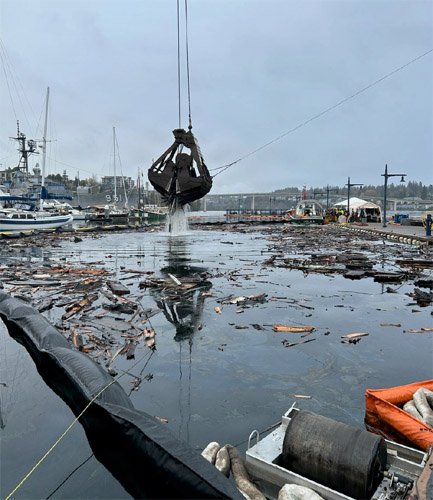
The WDE went ahead to reclassify the privately-owned sunken tug as a “marine debris,” paving the way for her deconstruction on site instead of removal of the wreck. In effect, contractors deployed equipment to tear the former tug into pieces that were loaded on a barge and transported to a salvage yard in Seattle.

Contractors deployed boom, skimmers, and absorbents throughout the response to recover oil, with other teams monitoring shorelines near the incident site throughout the response. A curtain was placed around the sunken vessel to contain the spread of debris, followed by the crane attachment removing portions of the vessel piece by piece.


Crews tried to lift and dewater the tug, but the integrity was compromised they reported (WDE)


The Coast Guard, which was overseeing the operation, gave an account of the task stating that during the destruction of the vessel, the curtain successfully contained the majority of oiled debris. During the operation, they report approximately 22,018 gallons of oil/water mix, 190 tonnes of solid waste and debris, and 60 tonnes of metal were recovered. Crews also decontaminated 61 vessels in the Bremerton Marina, with contaminated debris being transported to a hazardous waste facility in Oregon for proper disposal.

“This incident serves as a reminder to boat owners to minimize the amount of fuel they store onboard,” said Dave Byers, State On Scene Coordinator for WDE. “Oil is toxic to the aquatic environment and can cause harm to Washington’s environmental, cultural, and economic resources.”


Unable to dewater the vessel, the decision was made to deconstruct the vessel onsite (Unified Command)


Apart from the Coast Guard and WDE, the Suquamish Tribe, Port of Bremerton, and the National Oceanic and Atmospheric Administration were involved in the operation. While the cause of the tug’s sinking is still under investigation, the Coast Guard said that individuals or businesses adversely affected by the oil spill may be eligible for compensation. The historic tug was privately owned when it sank.

 SCI-FI-TEK 70 YRS IN THE MAKING...

Conceptual design completed for Japan's FAST fusion demo project


The Fusion by Advanced Superconducting Tokamak project, designed to demonstrate fusion energy power generation in Japan in the 2030s, has reached its first key milestone, Starlight Engine and Kyoto Fusioneering have announced.
 
(Image: Kyoto Fusioneering)

The Conceptual Design Report has been put together in the year since the project's launch in November 2024, and involved the two companies and researchers and experts from a number of Japanese universities and public institutions, as well as support from a number of other Japanese companies.

The Fusion by Advanced Superconducting Tokamak (FAST) device, to be sited in Japan, aims to generate and sustain a plasma of deuterium-tritium (D-T) reactions, demonstrating an integrated fusion energy system that combines energy conversion including electricity generation and fuel technologies. The project will employ a tokamak configuration, chosen for its well-established data and scalability.

Targeting a power generation demonstration by the end of the 2030s, FAST will address remaining technical challenges en route to commercial fusion power plants. The FAST Project Office notes that power generation refers to producing energy from fusion reactions, but does not imply net positive power production where electricity output exceeds electricity consumption.

The project team said the conceptual design work involved "designing the fusion energy plant for power generation demonstration, assessing technical and engineering feasibility, clarifying the project direction, conducting safety and economic evaluations, and defining the plant's fundamental design specifications".

"With the completion of the conceptual design phase, the project will now shift to engineering design, accelerated engineering R&D, and will proceed with site selection, site preparation, regulatory approvals, and the procurement of long-lead items, with the aim of construction after 2028," it said.

Kiyoshi Seko, CEO of Starlight Engine Ltd and President and COO of Kyoto Fusioneering Ltd, said: "Completing the conceptual design in just one year is a result of Japan's decades of research achievement. FAST is now moving into the engineering design phase. We will harness the strength of Japan's manufacturing industry and accelerate the project with a sense of urgency."

Satoshi Konishi, co-founder and CEO of Kyoto Fusioneering, said: "First and foremost, it's a great achievement to complete the conceptual design activities within the planned one-year timeframe. We succeeded in creating an innovative design that incorporates new technologies essential for commercial plants, such as high-temperature superconducting magnets, liquid breeding blanket systems, and highly efficient tritium fuel cycle systems, by mobilising domestic experts. Preparations for safety design, regulatory approvals, and site selection are steadily progressing. In the next engineering design phase we expect to fully leverage our strengths in plant engineering and our broad network across diverse industries, including finance and construction."

Kenzo Ibano, Assistant Professor, Osaka University, said: "Thanks to the power of industry-academia collaboration, we have successfully produced Japan’s first CDR for a power generation demonstration project. Working alongside researchers with decades of experience and private-sector partners in driving this project forward is both stimulating and rewarding, giving a strong sense of mission."

The Conceptual Design Report is due to be presented at the 42nd Annual Meeting of the Japan Society of Plasma Science and Nuclear Fusion Research being held from 1 December.

Other academics and businesses participating in and supporting the FAST project include Professor Akira Ejiri, University of Tokyo and Professor Takaaki Fujita, Nagoya University, as well as Sumitomo Mitsui Banking Corporation, Electric Power Development (J-Power), JGC JAPAN Corporation, Hitachi, Fujikura, Furukawa Electric, Marubeni Corporation, Kajima Corporation, Kyocera, Mitsui & Co., Mitsui Fudosan, and Mitsubishi Corporation.

Argentina nominates Grossi for UN Secretary General role


Argentina has officially nominated the current Director General of the International Atomic Energy Agency, Rafael Mariano Grossi, to be the next Secretary General of the United Nations, for the years 2027 to 2031.
 
Grossi addressing UN's General Assembly in 2023 (Image: L Felipe/UN)

The country’s foreign office said Grossi has had "a distinguished career spanning more than four decades as an official in the Argentine diplomatic corps and, more recently, as head of the IAEA, whose leadership was recognised when he was elected for a second term in 2023. His main achievements were aimed at contributing to international peace and security through open, efficient, present management with evident results".

It added that "his deep knowledge of the multilateral system, his ability to promote diplomatic dialogue, his proven performance in situations of conflict and serious international crises as an impartial and effective interlocutor, his technical and linguistic competence and his commitment to the Charter of the United Nations, make him an excellent candidate".

Grossi, 64, became IAEA director general in 2019. He was re-elected unopposed for a second term in 2023. His time in office has coincided with the Russia-Ukraine war and has seen him playing a mediator role over the safety and security of nuclear facilities, including Zaporizhzhia Nuclear Power Plant, which came under Russian military control in early March 2022, and which is on the frontline of the two countries' forces.

Before becoming the sixth director general of the IAEA he was Argentina's Ambassador to Austria and the country's Permanent Representative to the Vienna-based International Organisations, including the IAEA.

The current secretary general of the United Nations is Antonio Gutteres. The official start of the nominations process for selecting his successor was launched on Tuesday with a letter sent to member states by Annalena Baerbock, president of the UN General Assembly, and Michael Imran Kanu, President of the Security Council.

It said: "The position of Secretary General is one of great importance and one that requires the highest standards of efficiency, competence and integrity and a firm commitment to the purposes and principles of the Charter of the United Nations. We invite candidates to be presented who have proven leadership and managerial abilities, extensive experience in international relations and strong diplomatic, communication and multilingual skills. Noting with regret that no woman has ever held the position of Secretary-General, and convinced of the need to guarantee equal opportunities for women and men in gaining access to senior decision-making positions, Member States are encouraged to strongly consider nominating women as candidates. We note the importance of regional diversity in the selection of Secretaries-General."

The UN Security Council is scheduled to select its preferred candidate in July 2026. With a number of candidates expected to have been nominated for the role, the Security Council members meet and aim to reach consensus - and may hold secret ballots with the options of 'encourage' or 'discourage' for each of the candidates. Once the Security Council has agreed on a candidate they are expected to be appointed by a vote of the UN's General Assembly.

Turkiye re-elected to council of UN’s

International Maritime Organization


November 28, 2025    Middle East Monitor 


Ministry of Foreign Affairs building in Ankara, Turkey. 

[Photo by Diego Cupolo/NurPhoto via Getty Images]

Turkiye has been reelected to the council of the UN’s International Maritime Organization (IMO), the Turkish Foreign Ministry announced Friday, Anadolu reports.

In a statement, the ministry said the result highlights Turkiye’s active and trusted role in maritime safety, environmental protection, international shipping, and port services.

“Turkiye will continue to make tangible contributions to multilateral cooperation in the maritime sector.”

Since first seeking a seat in 1999, Turkiye has maintained uninterrupted representation on the IMO Council, demonstrating its longstanding expertise and capacity in global maritime affairs, the ministry added.

The 34th assembly of the UN agency is ongoing in London through Dec. 3.