Saturday, November 29, 2025

MAGA evangelicals have 'coopted' Jesus and turned Christianity into an 'absurd farce': analysis


(REUTERS) DEVIL HORNS HEAVY METAL SYMBOLISM
ALSO GOOD AGAINST THE EVIL EYE 


November 24, 2025 
ALTERNET


President Donald Trump’s "wrecking-ball approach to America has a precedent: the MAGA evangelical perversion of Jesus’s message of radical love to one of hate and aggression," writes The Guardian's Bill McKibben.

McKibben notes that Trump's " most revealing and defining moments – not its most important, nor cruelest, nor most dangerous, nor stupidest, but perhaps its most illuminating," came when he started posting plans of his gilded ballroom and then posted an AI video dumping feces on American cities.


"He has done things 10,000 times as bad – the current estimate of deaths from his cuts to USAID is 600,000 and rising, and this week a study predicted his fossil fuel policies would kill another 1.3 million. But nothing as definitional," McKibben says.

But "no one – not Richard Nixon, not Andrew Jackson, not Warren Harding, not anyone – would have imagined boasting about defecating on the American citizenry," he notes.

" Trump has managed to turn America’s idea of itself entirely upside down. And he has done it with the active consent of an entire political party," McKibben adds.


McKibben says that those, including himself, raised as "mainline Protestant Christians" should not be surprised by any of this.

"We have watched over the years as rightwing evangelical churches turned the Jesus we grew up with into exactly the opposite of who we understood him to be," he writes.

"At its most basic, they turned a figure of love into a figure of hate who blesses precisely the cruelties that he condemned in the Gospel; we went from 'the meek shall inherit the Earth' to 'the meek shall die of cholera'," he says.

McKibben says that despite this, he and his fellow Christians have not fought back against this effectively, if at all.

"What particularly hurts is the fact that at no point did we manage to fight back, not effectively anyway. Without intending to, we surrendered control of the idea of Jesus. It is a story that may provide some insights into how to fight the attack on democracy."

McKibben explains how Christianity has morphed into something completely different than it was in the 1950s when a majority of Americans subscribed to some form of the religion.

"Now the most public and powerful forms of Christianity, the vast and often denominationally independent megachurches and TV ministries, are as wildly different from that version of Protestantism as Donald Trump is from Eisenhower," he says.

Today's "newly ascendant version of Christianity," McKibben explains, is a far cry from that.

"The Jesus of this imagination – muscular, aggressive and American – is a different man than the one I grew up worshipping," he says. "The idea that he can be invoked to justify cutting off aid to foreign countries and bundling immigrants into the back of unmarked vans is repulsive to me, but also mystifying – as if gravity suddenly pulled objects upward."

McKibben says that "I am less concerned with the shrinkage of the mainline church than with the replacement of its Jesus with this very different one."

Allie Beth Stuckey, "one heir to Charlie Kirk’s place at the top of Maga Christianity," McKibben writes, has a very different version of the Jesus he grew up worshipping.

"She is a distillation of the currently dominant American Christianity, and above all, her Jesus rejects empathy," he says.

"Basing your support for ICE raids on terrified immigrants on a relatively obscure passage in a relatively obscure Old Testament story is a good example of what is known as prooftexting – the citing of some verse somewhere to support your predetermined beliefs," he explains.

The Bible, McKibben says, also says nothing on much of the culture wars MAGA mouthpieces use verse to attack.

It "has almost nothing to say about the rest of their favorite culture war hobby horses – you can find five scattered references to what might be homosexuality in the Bible, though recent scholarship makes clear they were actually attacks on prostitution and abuse," he writes.

And while the Bible says nothing about transgender people, he writes, "57 percent of the Republican party’s advertising spending in her race had reportedly gone to attacking transgender people, a topic – again – that Jesus ignored."

"None of that spending went to attacking Elon Musk (a recently self-proclaimed “cultural Christian”), who had managed to kill 600,000 poor people by 'feeding USAID into a woodchipper' in the first weekend of his Doge campaign," McKibben notes.

The parallels in today's MAGA movement are there, but they are lost on them completely, he explains.

"If you think I am being hyperbolic here, a 'rich young ruler' actually presented himself to Jesus and asked what he should do, and Jesus said he should sell his stuff and give it to the poor. This is what Jesus was about." he writes.

The hypocrisy, McKibben notes, has become downright farcical.

"The idea that personal salvation – as opposed to concern for others – was at the heart of Christianity always bordered on the heretical, but over the decades it has morphed into the absurd farce we see now, where Jesus is held to bless every show of dominance and aggression we can imagine," he says.

More people are becoming aware of this and acknowledging and fighting against it, he says.

Rep. James Talarico (D-TX), a part-time Presbyterian seminary student, has surged on the "strength of his forthright declaration of the kind of retro Christianity," McKibben says.

In a sermon Talarico gave two years ago, he said, "Jesus came to transform the world. Christian nationalism is here to maintain the status quo. They have coopted the Son of God. They have turned this humble rabbi into a gun-toting, gay-bashing, science-denying, money-loving, fear mongering fascist. And, it is incumbent upon all Christians to confront it, and denounce it.”

McKibben says Pope Leo's recent words condemning the Trump administration's cruelty show demonstrate this denunciation as well, and he hopes there will be more.

"America is best defended, in other words, by reference to the best about American history, just as Christianity is best defended by reference to what makes it distinctive and beautiful, which is the example of Jesus," he says.



Christian singers caught in Trump's deportation net falsely branded 'worst of worst'


Delmar Gomez (left) and Eber Gomez. (Courtesy of Gomez family)


LONG READ
November 25, 2025

On the night of Oct. 8, a man named Delmar Gomez drove to pick up his younger brother from a mechanic’s shop on Lamar Avenue. He never came home.

On the return trip, law enforcement officers with the Memphis Safe Task Force pulled over his 2011 Toyota Tundra pickup and arrested the brothers on immigration charges.

The Guatemalan brothers — both longtime Memphians — are known in national Pentecostal Christian circles as well-traveled worship singers, performing at churches from New York to Florida.

They were moved from one immigration detention center to another, finally arriving at a lockup in Louisiana, more than 300 miles from Memphis. The younger brother, Eber Gomez, a 30-year-old with no known criminal record, was soon deported, leaving behind a wife and two young children in Memphis.

Delmar Gomez, a 38-year-old husband and father of four U.S. citizen children, is still holding on. Though he had only minor motor vehicle violations on his record, he’s spent more than 40 days in an immigration detention as he heads into a hearing Tuesday that could result in his deportation.


Not only did the Trump administration lock up the brothers, the government published a news release with false information portraying Delmar Gomez as one of 11 “worst of the worst” immigrant criminals in Memphis.

The allegations deeply upset his wife, Sandra Perez.

“I want people to know that all of the charges that they’re accusing him of now are false, that none of that is true,” she told the Institute for Public Service Reporting in a Spanish-language interview. “He’s a person who is very respectful, honest, very hardworking. He is a good person.”

The news release included the false claim that Delmar Gomez had been arrested on an aggravated assault charge. The claim was re-published on at least one local TV station’s website.

In a second version of the news release, the Trump administration published Delmar Gomez’s mug shot and misidentified him as “Miguel Torres, a criminal illegal alien from Mexico arrested for selling synthetic narcotics, vehicle theft, traffic offense and drug possession.” The same caption also appears under another man’s photo.Delmar Gomez was misidentified as “Miguel Torres” in this Department of Homeland Security news release.

Weeks later, the government has not corrected the misidentification, or explained how it happened, even after a reporter repeatedly asked about it.


The situation reflects broader issues. The Trump administration is conducting a massive immigration crackdown in Memphis and across the country, spending billions of dollars to arrest, detain and deport people, using stories of criminal immigrants as justification for harsh treatment.

The arrest and detention of the Guatemalan singing brothers illustrates the sharp contrast between the administration’s rhetoric — that it’s arresting hard-core criminals — and the reality on the ground in Memphis and across the country: that it’s mostly arresting immigrants with minor criminal records or no criminal record at all.

As of this month, 74% of immigrants in Immigration and Customs Enforcement (ICE) detention had no criminal convictions, according to the Transactional Records Access Clearinghouse at Syracuse University. Many of those who were convicted committed only minor offenses, such as traffic violations.

Detailed numbers for Memphis are not available. The top state prosecutor in the Memphis area, Steve Mulroy, told The Institute in October that immigration arrests account for about 20% of total task force arrests, and most of the immigrants have no criminal history other than unlawful presence in the United States.


Delmar Gomez’s wife Sandra acknowledges her husband entered the country illegally in January 2005, more than 20 years ago. He was 17 at the time.

Sandra said Delmar was unable to gain legal immigration status, but has lived a clean life.

Delmar Gomez’s attorney, Skye Austin with advocacy group Latino Memphis, said she is aware of the federal government’s news release that included the false information.

“When I was first made aware of it, my immediate thought was, ‘Do people think that all Hispanics look alike?’ ” Austin said. “Do people think that it is OK to mix up names and faces and histories?”


There is no evidence that Gomez was ever accused of aggravated assault, drug dealing, vehicle theft or any other major crime, she said.

The Institute for Public Service Reporting conducted its own independent records search and was unable to locate any such criminal charges against Delmar Gomez.

Austin said Gomez’s entire criminal history consists of six traffic tickets issued over a period of nearly two decades, from 2006 to this spring. The tickets were for violations such as driving without a license and without insurance — both misdemeanors, and an Atlanta ticket for driving too fast for conditions and a related driving charge. The most recent ticket came this March, when he was cited for following too closely and driving with an expired tag, she said, adding that prosecutors dropped those charges.

“I think that people should view this as unjust and that this is the opposite of the narrative that we’ve seen where criminals are being taken into detention,” she said. “Because my client’s not a criminal. He is an everyday hard worker just trying to provide for his family.”


From work and singing to detention

Delmar Gomez’s wife Sandra spoke in an interview in the kitchen of her family’s East Memphis home, which is decorated with a poster depicting the Ten Commandments.

She said she learned of the arrests when Eber Gomez called her on the way back from the mechanic’s shop, when the two brothers were in Delmar’s truck. Delmar was driving, but Eber blamed himself for what happened, she said, because if hadn’t needed the ride, Delmar wouldn’t have gone on the errand at all.

“He just told me ‘I’m sorry, it’s my fault that they stopped us.’” she said. “And I told him ‘It’s not true.’

He said ‘Yes it is. Listen.’ And I heard them (law enforcement officers) talking in English.”

“‘Now we can’t do anything,’ he told me. That’s all he said.”

Sandra Perez is a stay-at-home mother to four children who range in age from 17 to three. Delmar Gomez is the family’s primary breadwinner and earns money mainly by mowing yards. He has a lineup of about 60 houses, and he and his father typically mow about 30 yards one week, then about 30 more the next, his wife said.

He’s also a lead vocalist for a Christian band called Agrupacion Vision Emanuel, or Vision of Emanuel Group, which has produced studio recordings and professionally edited music videos.

In the band’s music videos, Delmar Gomez stands in front of as many as 15 musicians, singing passionately at scenic locations including Shelby Farms, the Overton Park shell, and near the “Memphis” sign on Mud Island. One of the videos has been watched more than 400,000 times.

His younger brother Eber Gomez has worked as a roofer and sang with a different touring band called Adoradores de Cristo Memphis, which means “Christ Worshipers of Memphis.”

The two bands have traveled as far away as Chicago, Florida, Alabama, New York and Atlanta to perform at weddings, church anniversaries and other Pentecostal church events, family members said.

Delmar Gomez’s band doesn’t treat these performances as a money-making endeavor, his wife said.

“They don’t charge. They go for faith. If the brothers (at the other churches) want, they give them an offering for their expenses, and if they don’t, they cover their own expenses,” his wife said. “They go for love of the work of God.”

Amid a surge of well over 1,000 federal agents and state troopers in Memphis, community groups say law enforcement officers are arresting and detaining immigrants every day here, often in traffic stops.

The Memphis Safe Task Force has released little information about the immigration arrests. In a statement early this month, the task force said it had made 319 immigration arrests in October.

That’s about 17% of about 1,900 total arrests.

As of November 17, the task force arrest total had risen to 2,790 arrests, Supervisory Deputy U.S. Marshal Ryan Guay said in an email to The Institute.

He did not say how many of these were immigration arrests, referring questions to the Department of Homeland Security, which did not respond.

Delmar Gomez was taken to an ICE office near the airport, then an immigration prison in Mason, Tennessee, then a lockup in Alabama, and finally to a big ICE prison in Jena, Louisiana, his wife said.

She said she wants one thing. “That they let him go,” she said through tears. “That he can be with my family and with me, because he’s been a good person. To be together as a family and work on the things of God, that’s been our desire.

“We’re a very decent family, and it’s unfair what they’re accusing him of.”

Mass deportation campaign

The federal government generally has treated unlawful presence in the United States as a civil violation, not a crime. Under prior presidents, including Republican George W. Bush and Democrats such as Barack Obama and Joe Biden, it’s unlikely people like the Guatemalan singers would ever have been detained.

The background: Businesses wanted a low-cost, reliable workforce. Congress didn’t want to increase legal immigration.

The federal government found a solution: quietly tolerate illegal immigration. Consequently, the government usually enforced immigration law only at the border.

But in non-border areas like Memphis, the federal government rarely bothered to expel unauthorized immigrants, unless the immigrants committed crimes. Unauthorized immigrants like Delmar Gomez could live normal lives – working and raising families, but they often had no way to gain legal status.

The Trump administration has thrown out the practice of non-enforcement and is arresting people who have allegedly committed civil immigration violations, but have no other criminal history. It is also arresting some people who have legal immigration papers, and has even arrested and detained U.S. citizens, most of them of Hispanic origin.

The October 20 news release involving Delmar Gomez demonstrates how Trump’s government is also publishing false information about specific immigrants in Memphis and across the nation.

It’s part of a broader pattern by President Trump and his administration of portraying immigrants as dangerous and evil. Trump famously launched his first presidential campaign in 2015 by calling Mexicans “rapists” and claimed in a presidential debate last year that Haitian immigrants in Ohio are eating other people’s cats and dogs.

Today, the administration sometimes labels immigrants as “terrorists” as justification for deporting them.

In high-profile cases, including a big raid on an apartment building in Chicago, nonprofit news outlet ProPublica has found that those claims were frequently false — that the so-called “terrorists” are often ordinary immigrants with no criminal records.

In fact, multiple studies from the Cato Institute, the U.S. Department of Justice and other researchers have concluded that immigrants are less likely than U.S. citizens to commit crimes — even if the immigrants are in the country illegally.

The Institute contacted the White House for comment for this story. Spokeswoman Abigail Jackson responded by criticizing the reporter.

“Violent criminal illegal aliens who murder, rape, and assault innocent American citizens deserve to be condemned in the strongest possible terms. It’s despicable for any so-called journalist to try and compare these monsters with law-abiding immigrants. This is why no one trusts the media.”

News release includes unverifiable claims

Memphis TV station Action News 5, which had originally re-published the government’s false aggravated assault claim about Delmar Gomez, has since broadcast a follow-up story saying there’s no evidence to support it.

Not only does the government’s October 20 news release include false information about Delmar Gomez, it also includes unverifiable information about at least four other men arrested in the Memphis area.

For instance, the news release says a man named Jardi Caal Requena was arrested “for domestic violence and for making a physical threat.” A reporter with The Institute found no criminal records for anyone with this name in local or federal courts.

The news release claims that a man named Simeon Sosa-Camargo had been convicted of “smuggling aliens into the U.S.”

Federal records show that a man with the same name was convicted in Texas for at least three cases of entering and re-entering the U.S. illegally.

But The Institute found no record that he was ever convicted of human smuggling.

The news release says a man named Wilmer Flores Godoy was convicted of “illegal alien in possession of a firearm and arrested for larceny.” A man named Wilmer Flores was arrested on a felony domestic violence charge in the Memphis area in 2024, and the case was dismissed in October.

But a reporter found no local or federal court records related to gun possession or larceny.

Delmar Gomez is misidentified in the news release as Miguel Torres, a man from Mexico whom the feds accused of drug dealing, vehicle theft, traffic offense and drug possession.

A search for the real Miguel Torres turned up little – the name is common, with hundreds of criminal cases against people with that name in the nationwide federal court system.

But a reporter found no records that matched those allegations for Torres in the Shelby County criminal court system or in federal courts for the western district of Tennessee.

The Department of Homeland Security did not respond to written questions about the Delmar Gomez case and the other men mentioned in the Oct. 20 news release.

Younger brother accepts deportation

The father of the two brothers, Ramiro Gomez, told a reporter he originally had eight children. One of them, Jaime Gomez, was a heavy drinker who was found dead in the Mississippi River several years ago, he said.

By contrast, he said arrested sons Delmar and Eber are clean-living family men. “What I want is for my sons to come back. My grandchildren need them,” he said.

Days after that interview, on Oct. 30, the younger brother, Eber, accepted deportation back to Guatemala, according to an online system that allows people to search immigration court hearings by an identifying number. He arrived back in Guatemala on Saturday, Nov. 8, his father said.

Ramiro Gomez said he had spoken with his son briefly by phone from Guatemala, but he didn’t have a chance to talk with him about why he accepted deportation.

However, the Trump administration has made it extremely difficult for detained immigrants to win release on bond. Instead, detained immigrants are forced to fight their deportation cases from behind bars.

Critics say that by denying bond, the government is using the hardship of imprisonment to grind down immigrants’ will and ability to fight and pressure them to sign paperwork accepting deportation.

Ramiro Gomez said the deportation has caused severe hardship for his son’s wife and their two children. “She’s still at home and paying rent and food for the children.”

Delmar continues to fight deportation

Delmar Gomez remains behind bars in Louisiana. As of today, he’s been locked up for 48 days.

He is scheduled for an individual hearing Tuesday before Immigration Judge Maithe Gonzalez at the lockup in Jena, Louisiana.

Gomez’s attorney Skye Austin will appear via remote link from Memphis and argue for “cancellation of removal” — an immigration judge’s formal ruling that he should not be deported.

Her argument: Delmar Gomez has lived in in the U.S. at least 10 years continuously, and his deportation would harm his four U.S. citizen children. “I also have to prove that he is a person of good moral character and has not been convicted of a crime that would have serious immigration consequences.”

What would she say if an ICE attorney argues that his six traffic tickets for driving without a license, speeding and other violations show bad moral character?

“So, my pushback would be that a number of these traffic violations have been (dropped by prosecutors) or closed, and that my client does everything in his power to pay the fines and make sure that he has nothing pending with the court. He’s not causing any judicial delay or anything of that nature.”

Austin said she’s collected dozens of reference letters to present to the immigration court on her client’s behalf.

“Seven local ministers have written me letters, and that’s on top of again, neighbors, friends, clients of SeƱor Delmar just wanting to let people know, ‘Hey, this is a good man. I know him personally. I’ve known him for years,’ et cetera, et cetera.”

Most immigrants who go before Judge Gonzalez lose their cases, according to data from the Transactional Records Access Clearinghouse.

In 2024 and 2025, the judge decided 148 asylum cases and denied about 87% of them, slightly higher than the denial rate of 78% across judges at the Jena immigration court.

“Mommy, where did Papi go?”

Meanwhile, Delmar Gomez’s children are struggling with his absence.

His oldest child, 17-year-old high school senior Nancy Gomez, said her father had only a limited education in Guatemala and is pushing for her to study.

She’s already been accepted to the University of Memphis.

“He always has given me advice on everything that I do and always has been proud of me and everything that I have done. And then I just want to see him again. I feel really something that has been taken away from me that I want back. Every time he came from work, I would hear his truck coming in, but now I haven’t heard that and I just want to hear it again,” she said.

“When the house is quiet and he comes from work, he fills the environment with his laughter. And he always be talking about his day and asks us about our day, how it was. And I just want to see him back. I just miss him a lot.”

As the adults showed a reporter a family album during a recent visit, the youngest child, three-year-old Betuel, spoke up.

“Mommy, where did Papi go?” he said in Spanish, crying.

His mother picked him up, gave him a hug and kissed him.

“He went to sing, my love,” his mother said.

“He’s working?” the boy said.

“Yes, my love.”

As of Monday the news release with the false information identifying the Guatemalan singer as a Mexican drug dealer remains on the official Department of Homeland Security website, uncorrected.
INTERNECINE FEUDING
Conservative media war pits pro-Trump networks against each other


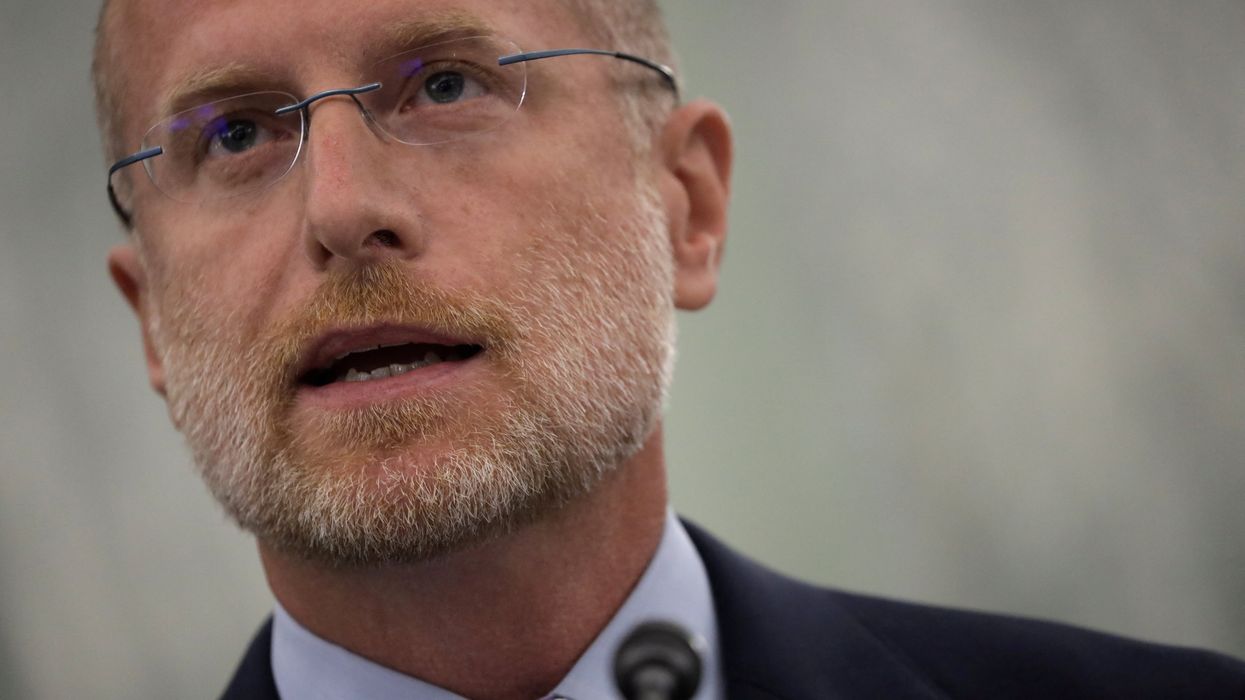
Commissioner of Federal Communications Commission Brendan Carr testifies during an oversight hearing held by the U.S. Senate Commerce, Science, and Transportation Committee to examine the Federal Communications Commission (FCC), in Washington, U.S. June 24, 2020. Alex Wong/Pool via REUTERS/File Photo
November 28, 2025 
ALTERNET

Two powerful groups of media executives very friendly to President Donald Trump are currently embroiled in a fight that puts FCC chair Brendan Carr in an awkward position, reports Politico's John Hendel.

"The nation’s largest TV station owners want Carr’s Federal Communications Commission to loosen the rules that limit how many stations a single company can operate, a goal that many conservatives have been pressing for years," Hendel writes.

These owners, however, have a "formidable opponent in Trump confidant Chris Ruddy, the majority owner of Newsmax Media, who wants to keep the rules in place and now appears to be making headway with the president," he explains.

Trump took to Truth Social Sunday to demonstrate that headway, Hendel notes.

"NO EXPANSION OF THE FAKE NEWS NETWORKS,” Trump wrote, "echoing Ruddy’s argument that removing the ownership cap would hurt conservatives," Hendel explains.

“If anything, make them SMALLER!” Trump added.

Carr, Hendel writes, "has shown a knack for disruptive, MAGA-pleasing culture-war moves, like his public upbraiding of comedian Jimmy Kimmel and accusing '60 Minutes' of being unfriendly to conservatives," but now he's conflicted.

"Carr has signaled he may want to change the 21-year-old limit on TV station ownership, which was intended to prevent any one broadcaster from too much power over what Americans see on television," Hendel explains. "Loosening the ownership rule would allow right-leaning companies like Sinclair Broadcast Group to expand."

Large TV station owners are hitting a growth limit, Hendel writes, so "a larger cap would give more power to station owners — seen by many conservatives as an ideological counterweight to the mainstream national networks that control TV programming."

Newsmax's Ruddy, however, is standing in the way, Hendel says.

"Ruddy is trying to block any change, arguing that the cap — which limits a broadcaster’s reach to 39 percent of U.S. households — preserves the right market balance between TV broadcasters and cable outlets, and allows a greater mix of voices," he writes.

“It’s not going to work,” Ruddy tells Politico. "The president doesn’t want this, and so I have no doubt that he will not support the FCC going to extraordinary but potentially illegal lengths.”

Joining Ruddy is Charles Herring, president of the pro-Trump One America News Network (OANN) cable channel, who, Hendel writes, "shares a marketplace wariness of TV station owners gobbling up too much power."

“Independent [and] diverse voices will disappear,” wrote Herring in an X post.

Under Trump, this has turned "into a political tug-of-war and an influence battle between big names on the right," Hendel says.


Former Trump press secretary Sean Spicer recently wrote an op-ed in right-wing outlet The Daily Caller in which he argued that Carr should lift the cap.

“Conservatives who believe in free enterprise should not be vocally encouraging Big Brother to continue barring broadcast TV companies like Sinclair and Nexstar from competing in the free market,” argued Spicer, a contributor to Nexstar’s cable network NewsNation.

Nexstar, Hendel notes, is "trying to usher through a $6.2 billion deal to buy rival station owner Tegna, a merger that would only be possible if Carr relaxes the cap. The new company would operate 265 TV stations, reaching more than half the country."

Ruddy, however, says "that the FCC is working to go against the interests of the president and his supporters — and really against most consumers.”


“We have a history of big companies going in and giving conservative think tanks money to do reports and stand on issues,” Ruddy adds “And it’s not working.”

Through all this, Trump "is being pulled in both directions on an issue he cares a great deal about: what’s on television," he writes.


“If this would also allow the Radical Left Networks to ‘enlarge,’ I would not be happy,” Trump wrote.

"That will likely give broadcasters and their conservative allies room to try to counter Ruddy’s narrative — and some are already casting the issue accordingly," Hendel explains.

On Monday, Nexstar said that "Americans want more access to local news and a variety of voices without the filter of the coastal elites."

For now, the person truly stuck in the middle is Carr.

"Carr’s path to lifting the cap is uncertain, and his own staff say they’re likely to end up in court over the issue. Detractors don’t even believe the agency has the authority to unleash this consolidation at all, saying it’s a matter for Congress," Hendel says.

"We haven’t made a final decision there yet,” Carr told Politico on Nov. 18. “I continue to be very open minded.”

Conservative 'confusion' after MAGA revealed as 'propaganda coup': constitutional scholar


President Donald Trump, Vice President JD Vance, and Secretary of Veterans Affairs Doug Collins walk towards the stage during Veterans Day ceremonies at Arlington National Cemetery in Arlington, Virginia, Tuesday, November 11, 2025. (Official White House Photo by Daniel Torok)

November 26, 2025 
ALTERNET


On Newsweek’s new video podcast "The 1600," constitutional scholar and lifelong conservative Justin Stapley warns that the MAGA movement’s problems run far deeper than any single election cycle.

Stapley, host of The Conservative Underground podcast, argues that the "GOP’s outward strength under President Donald Trump masks a party increasingly defined by internal division, ideological drift, and the growing influence of populism and online-driven extremism," Newsweek says.

"Speaking with Newsweek's Carlo Versano, Stapley warns that Trump’s personal dominance has masked the extent to which traditional conservatism has been sidelined, leaving Republicans unprepared for what comes after Trump," they write.

In response to Versano saying "Republicans got smoked" in the November elections, Stapley, who is also the state director of the Utah Reagan Caucus, says the problem runs deeper than just one election cycle.

"What we’ve discovered is that the last 10 years haven’t been a direct ideological shift so much as a propaganda coup," he says.

"People will walk up with a swagger, red MAGA hat, angry look, and say, 'Oh, we've got a zombie Reaganite over here.' And then everyone else will stop and say, 'Wait, I thought we liked Reagan.' There’s confusion among ordinary Republicans," he adds.

Those "ordinary Republicans," he explains, are not part of the MAGA movement and are still steeped in Reaganism.

"Ordinary Republicans still embrace Reaganism and traditional conservatism because they understand the country is built on deep philosophical roots," he says. If people want to abandon all that because it's 'holding us back,' that’s not what many Republicans signed up for."

Stapley is no Trump fan, saying, that while we've had some bad presidents before, "he’s worse because we’ve gutted the checks and balances that used to exist."

"Congress has become almost an empty branch of government — even though it was meant to be the 'first among equals.' The modern presidency has grown and grown. Congress has become the president’s foot soldiers," he says.

Stapley also explains that there is a crack in the MAGA base because Trump "can't please everyone," and he sees MAGA morphing into something entirely different that what it is currently.

"We may soon see 'America First' meaning something very different from MAGA," he says.

"Trump still holds the MAGA brand, but you have people like Marjorie Taylor Greene, Nick Fuentes, Tucker Carlson, Matt Walsh saying 'I’m America First, and I’m America Only.'"

Without Trump on the ballot in 2028, Stapley says Republicans have work to do.

"Republicans need to figure out their identity. People say they’ve remade themselves into a blue-collar populist party with a bigger coalition. But that coalition doesn’t show up without Trump," he says.

They also need to realize the truth about Trump.

"Even with Trump, we’ve overestimated his strength. He’s run in three consecutive presidential elections and never broken 50 percent," he says. "He has a 47 percent ceiling unless he’s running against a candidate who’s mentally not there or one who didn’t go through a Democratic selection process."
Don’t Let Trump Make America’s Waterways Toxic Again

The question is whether the nation values its water enough to resist the administration’s wholesale attack on environmental protections.


In the spring, thousands of herring swim upstream in the Charles River to spawn.
(Photo by Derrick Z. Jackson)

Derrick Z. Jackson
Nov 25, 2025
Common Dreams


This spring and summer, I was awed by the majesty of waterways cleaned up in the Northeast by the strong environmental laws we’ve had in place over the last half century.

At home in Cambridge, Massachusetts, I walked along the banks of the Charles River as it winds its way through greater Boston. In the mid 20th century, it was so fouled by industrial pollution that boaters who fell into the water were advised to get tetanus shots. Today, thousands of river herring speed upstream in the spring to spawn. One morning, I came upon six great blue herons grabbing herring out of the water as gulls swooped down for the leftovers. The Charles is now its own wildlife refuge.


Trump EPA’s Rollback of Wetlands Protections Is Latest ‘Gift’ to Polluters, Groups Say


Trump Ripped Over ‘Reckless’ Plan to Drill for Oil Off California, Florida

I also ventured south to the Bombay Hook National Wildlife Refuge in Delaware, where I witnessed migrating bald eagles descending from the sky to pluck fish out of the water and great blue herons gobbling up white perch bigger than their heads. Once a swampy muck, it was transformed into what it is today thanks to a segregated African American Civilian Conservation Corps team 85 years ago. Its marshes are so important for migratory birds that the Obama administration poured more resources into it in the Delaware River Basin Conservation Act.

Heading north, my wife and I canoed on the Penobscot River and the Androscoggin River in Maine. Both rivers once had the oxygen literally sucked out of them by poisons from paper mills, tanneries, chemical companies, sewage facilities, and farm runoff. It was so polluted that Suzanne Clune, an 11-year-old girl who lived along the Androscoggin, wrote Maine Sen. Ed Muskie to complain about the stench from floating dead fish. Her letter was one of the inspirations for Muskie to introduce a bill in 1971 that would become the Clean Water Act.

The current occupants of the White House, Congress, and the Supreme Court are clearly bent on tearing the Clean Water Act to shreds.

Five decades later, the river teems with wildlife. My wife and I saw eagles, herons, kingfishers, and osprey snapping up fish; moose and deer munching in marshes; harrier hawks patrolling the marshes for mice and voles; and beavers slapping their tails.

As enthralling as our encounter was with Maine wildlife, we paddled on not knowing if their habitat—or the habitat in Massachusetts and Delaware—will continue to be protected. The current occupants of the White House, Congress, and the Supreme Court are clearly bent on tearing the Clean Water Act to shreds. This month, in the administration’s latest move to hand the fate of our waterways and wetlands back to polluters, the Environmental Protection Agency (EPA) officially proposed to remove most wetlands from federal protection.

Reversals Underway


The formerly filthy Charles River, a natural boundary between Boston and Cambridge, is now a wildlife refuge. (Photo by Derrick Z. Jackson)

In 2023, the Supreme Court, which President Donald Trump packed in his first term to create a conservative supermajority, set the stage for the EPA’s announcement by ruling that countless wetlands and ephemeral Western streams were not worthy of protection. Earlier this year, the high court also ruled that the EPA cannot punish polluters when their raw sewage discharges jeopardize water quality.

Confident that the Supreme Court will defend it against environmental group challenges, the second Trump administration is proposing a 2026 fiscal year budget that would slash at least $5 billion from a slew of EPA, Interior Department, and US Department of Agriculture programs that protect water quality, foster water conservation, and fund water pollution science.

The EPA’s budget itself is slated for a 55% cut. Among the biggest targets are the agency’s State Revolving Fund program that supports water infrastructure projects; water management projects in the West; Superfund cleanups; the US Geological Survey’s water, energy, mineral, and ecosystem research; and the US Fish and Wildlife Service’s conservation and science programs.

As a paddler and river rambler, I have certainly profited from the gift of a half century of clean water protections, marveling at heron spearing herring and eagles careening in the sky.

Those proposed cutbacks come on top of those already made this year, including the cancellation of nearly 800 EPA environmental justice grants and a $2.5 billion cut from the $3 billion Biden administration program addressing injustices in marginalized communities. Many of the canceled grants involve projects protecting water, including removing lead, PFAS, and other toxic chemicals from drinking water; preventing floods; cleaning watersheds to protect wildlife; and upgrading wastewater and sewer systems.

EPA Administrator Lee Zeldin is also relaxing rules or extending deadlines on wastewater and coal ash from coal plants and handing coal ash dump oversight back to the states. He has proposed to repeal mercury and air toxics emissions limits and compliance procedures. He withdrew stricter standards for wastewater discharges from the meat and poultry industry that can cause oxygen-depleting algal blooms lethal to fish and contaminate drinking water.

To justify such sweeping cutbacks, which threaten the health of people, wildlife, and entire ecosystems, the Trump administration claims it is saving taxpayers billions of dollars in “waste” when in fact it is rewarding the polluting industries that have bankrolled Republican campaigns for decades.

The smokescreen of “waste” also obscures the goal of conservatives, as laid out loud and clear in the Heritage Foundation’s Project 2025 blueprint, to ignore environmental injustice in communities of color that have endured centuries of displacement, disinvestment, discrimination, and disproportionate pollution. The Biden administration EPA identified a $625-billion backlog in drinking water infrastructure needs, a critical issue for African American communities exposed to lead via multiple sources, including tainted drinking water.

Benefits of Renewal
A pair of eagles perched over the Penobscot River in Maine look for lunch. 
(Photo by Derrick Z, Jackson)


Cleaning up US waterways not only benefits public health, it also benefits the economy. The Environmental Data and Governance Initiative, a nonprofit research collaborative, estimates that the $2.5 billion in canceled grants would have resulted in $6.4 billion worth of economic activity and created 65,000 jobs. The Supreme Court’s ruling that puts wetlands at risk, meanwhile, will undermine the critical role they play as nurseries for the nation’s commercial and recreational fisheries that were worth at least $321 billion in 2022 and accounted for 2.3 million jobs.

Clean water also is vitally important for the outdoor recreation industry. In 2022 alone, Americans spent nearly $400 billion on fishing, hunting, and wildlife watching. Then there are the health threats to consider. A 2024 report by the Centers for Disease Control and Prevention estimated that waterborne pathogens annually cause more than 7 million illnesses, 118,000 hospitalizations, and 6,630 deaths at a cost of $3.33 billion.

The Trump administration’s attack on environmental safeguards comes amid a string of good news stories directly tied to the Clean Water Act. Examples include:This fall, Chicago held its first sanctioned swim in the Chicago River since 1927 to celebrate a recovery that earned the waterway this year’s Thiess International River Prize.
Other US rivers that have won the Thiess Prize recently include the James River in Virginia, the San Antonio River in Texas, the Niagara River in New York, and my hometown Charles River.
Out West, dam removals at the behest of Indian nations enabled Indigenous kayakers to be the first people in more than a century to navigate the Klamath River—a Thiess Prize finalist and American River’s 2024 River of the Year—all the way from its headwaters in the Cascade mountains to the Pacific Ocean. Spawning salmon are swimming upstream once more.

In 2022, on the 50th anniversary of the Clean Water Act, the National Wildlife Federation published a report that singled out four rivers as emblematic success stories: the Columbia, Des Plaines, Potomac, and Cuyahoga, which famously caught on fire in 1969.


Much More Work to Do


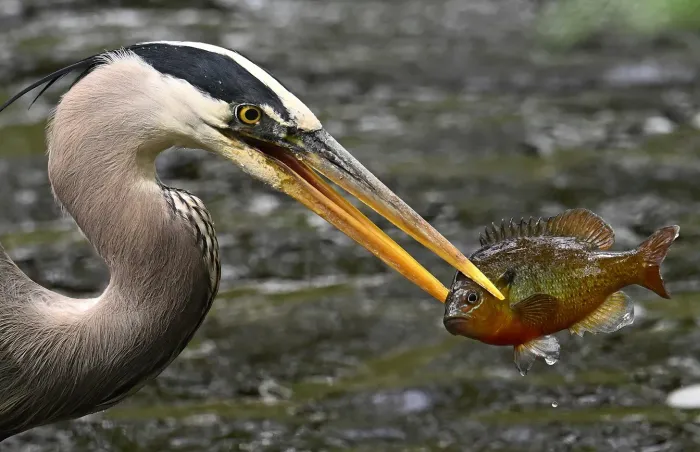
A heron snatches a sunfish out of the Charles River. 
(Photo by Derrick Z. Jackson)

This is not the time to turn back the clock. Although the Chicago River is now clean enough to swim in again, 68% of Chicago children below the age of 6 drink lead-contaminated water. And, according to the EPA’s own data, at least half of the US population drinks water contaminated by PFAS, the so-called “forever chemicals” that have been linked to cancer and other diseases.

The EPA’s National Rivers and Streams Assessment, updated last year, found that the percentage of rivers and streams with healthy and diverse fish communities increased from 25% to 35%—not even close to half. According to the assessment, nearly half of rivers and streams are still in fair or poor condition for fish.

More work also needs to be done on the rivers I visited earlier this year. Mercury remediation efforts have just begun on the Penobscot, for example. During heavy rains, the Charles is still at the mercy of antiquated pipes that discharge raw sewage into it.

Acclaimed author Maya Angelou explained perfectly why we need to clean up our rivers. “When we cast our bread upon the waters,” she wrote, “we can presume that someone downstream whose face we will never know will benefit from our action, as we who are downstream from another will profit from that grantor’s gift.”

As a paddler and river rambler, I have certainly profited from the gift of a half century of clean water protections, marveling at heron spearing herring and eagles careening in the sky. We are so close into turning once-toxic waters into wildlife refuges and are so much more aware—especially after the Flint water crisis—of the value of pristine drinking water.

The question is whether the nation values its water enough to resist this wholesale attack on environmental protections. It is crystal clear what levels of pollution the Trump administration is willing to cast upon the waters. We should not have to wait for another young girl to write a letter about dead fish floating in a river to get a senator’s attention.

This article first appeared at the Money Trail blog and is reposted here at Common Dreams with permission.
Ozymandias on the Potomac: American Decline in the Fossil Fuel Age

By the time Donald Trump leaves office in 2029, this country will be distinctly on the imperial decline amid fast-paced changes that will make electric vehicles universal and solar-powered electricity an economic imperative.


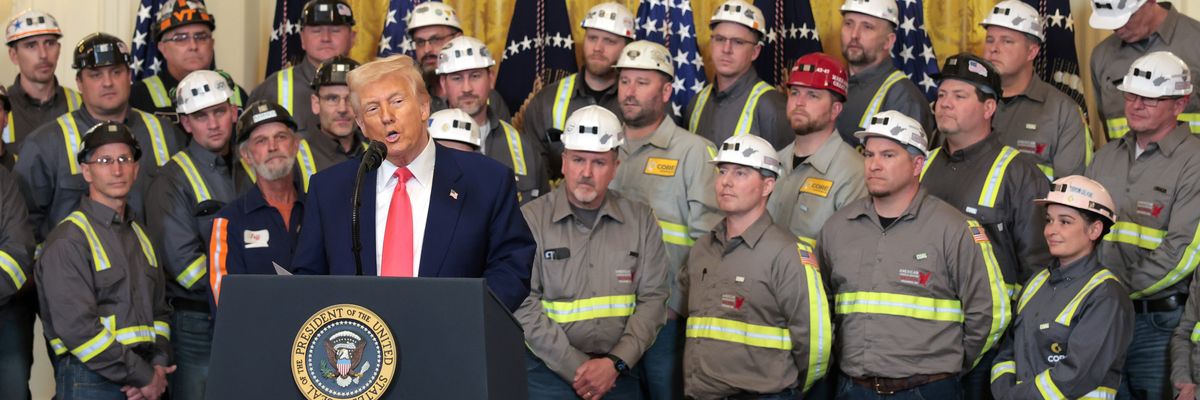
U.S. President Donald Trump speaks alongside coal and energy workers during an executive order signing ceremony in the East Room of the White House on April 8, 2025 in Washington, D.C.
(Photo: Anna Moneymaker/Getty Images)


LONG READ


Alfred W. Mccoy
Nov 28, 2025
TomDispatch

At the dawning of the British Empire in 1818, the romantic poet Percy Bysshe Shelley penned a memorable sonnet freighted with foreboding about the inevitable decline of all empires, whether in ancient Egypt or then-modern Britain.

In Shelly’s stanzas, a traveler in Egypt comes across the ruins of a once-monumental statue, with “a shattered visage lying half sunk” in desert sands bearing the “sneer of cold command.” Only its “trunkless legs of stone” remain standing. Yet the inscription carved on those stones still proclaims: “My name is Ozymandias, King of Kings: Look on my works, ye Mighty, and despair!” And in a silent mockery of such imperial hubris, all the trappings of that awesome power, all the palaces and fortresses, have been utterly erased, leaving only a desolation “boundless and bare” as “the lone and level sands stretch far away.”

Taken too literally, those verses might lead us to anticipate some future traveler finding fragments of St. Paul’s Cathedral scattered on the banks of the Thames River in London or stones from the Washington Monument strewn in a kudzu-covered field near the Potomac. Shelley is, however, offering us a more profound lesson that every empire teaches and every imperialist then forgets: Imperial ascent begets an inevitable decline.

Imperial Washington

Indeed, these days Donald Trump’s Washington abounds with monuments to overblown imperial grandeur and plans for more, all of which add up to an unconvincing denial that America’s global imperium is facing an Ozymandias-like fate. With his future Gilded Age ballroom meant to rise from the rubble of the White House’s East Wing, his plans for a massive triumphal arch at the city’s entrance, and a military parade of tanks and troops clanking down Constitution Avenue on his birthday, who could ever imagine such a thing? Not Donald Trump, that’s for sure.

In a celebration of his “works” that are supposedly making the “mighty despair” in foreign capitals around the world, his former national security adviser, Robert C. O’Brien, has recently argued in Foreign Affairs that the president’s “policy of peace through strength” is reversing a Democrat-induced decline of U.S. global power. According to O’Brien, instead of crippling NATO (as his critics claim), President Trump is “leading the biggest European rearmament of the postwar era”; unleashing military innovation “to counter China”; and proving himself the “indispensable global statesman by driving efforts to bring peace to… long-standing disputes” in Gaza, the Congo, and, quite soon, Ukraine as well. Even in North America, according to O’Brien, Trump’s attempt to acquire Greenland has forced Denmark to expand its military presence, putting Russia on notice that the West will compete for control of the Arctic.

As it happens, whatever the truth of any of that may be, the policy elements that O’Brien cites are certain to prove largely irrelevant to the ceaseless struggle for geopolitical power among the globe’s great empires. Or, to borrow a favorite Trumpian epithet from the president’s “cornucopia of crudeness,” in the relentless, often ruthless world of grand strategy, none of those factors amounts to a hill of “shit.”

Indeed, O’Brien’s epic catalogue of Trump’s supposed foreign policy successes cleverly avoids any mention of the central factor in the rise and fall of every dominant world power for the past 500 years: energy. While the United States made genuine strides toward a green energy revolution under President Joe Biden, his successor, the “drill, baby, drill” president, has seemed determined not just to destroy those gains, but to revert to dependence on fossil fuels “bigly,” as Trump would say. In a perplexing paradox, President Trump’s systematic attack on alternative energy at home will almost certainly subvert America’s geopolitical power abroad. How and why? Let me explain by dipping my toes in a bit of history.

For the past five centuries, the rise of every global empire has rested on an underlying transformation (or perhaps revolution would be a more accurate word for it) in the form of energy that drove its version of the world economy. Innovation in the basic force behind its rising global presence gave each successive hegemonic power — Portugal, Spain, England, the United States, and possibly now China — a critical competitive advantage, cutting costs and increasing profits. That energy innovation and the lucrative commerce it created infused each successive imperium with intangible but substantial power, impelling its armed forces relentlessly forward and crushing resistance to its rule, whether by local groups or would-be imperial rivals. Although scholars of imperial history often ignore it, energy should be considered, as I argued in my book To Govern the Globe, the determinative factor in the rise and fall of every global hegemon for the past five centuries.

Iberia’s Mastery of Muscle

In the fifteenth century, the Iberian powers — Portugal and Spain — manipulated the ocean winds and maximized the energy output of the human body, giving them new forms of energy that allowed their arid lands and limited populations to conquer much of the globe. By replacing the square sail of lumbering Mediterranean ships with a triangular sail, agile Portuguese vessels like the famed caravela de armada doubled their capacity to tack close to the wind, allowing them to master the world’s oceans.

By 1500, Portuguese warships had navigation instruments that allowed them to cross the widest bodies of water, sails to beat into the strongest headwinds, a sturdy hull for guns and cargo, and lethal cannons that could destroy enemy fleets or breach the walls of port cities. As a result, a small flotilla of Portuguese caravels soon conquered colonies on both sides of the South Atlantic Ocean and seized control of Asian sea lanes from the Red Sea to the Java Sea.

For the next three centuries, such sailing ships would transport 11 million African captives across the Atlantic to work as slaves in a new form of agriculture that was both exceptionally cruel and extraordinarily profitable: the sugar plantation. The output of Europe’s free yeoman farmers was then constrained by the limits of the individual body and the temperate climate’s short six-month growing season. By contrast, enslaved laborers, massed into efficient teams in tropical latitudes, were driven year-round to the brink of death and beyond to extract unprecedented productivity and profits from those plantations. Indeed, even as late as the nineteenth century, the U.S. southern slave plantation was, according to an econometric analysis, 35% more efficient than a northern family farm.

After developing the sugar plantation, or fazenda, as a new form of agribusiness on small islands off the coast of Africa in the fifteenth century, the Portuguese brought that system to Brazil in the sixteenth century. From there, it migrated to European colonies in the Caribbean, making that cruel commerce synonymous with the slave trade for nearly four centuries. So profitable was the slave plantation for its owners that, unlike almost every other form of production, it did not die from natural economic causes but would instead require the full force of the British navy to do it in.

The Dutch Harness the Winds

But the true masters of wind power would prove to be the Dutch, whose technological prowess would allow their small land, devoid of natural resources, to conquer a colonial empire that spanned three continents. In the seventeenth century, the Dutch drive for scientific innovation led them to harness the winds as never before, building sailing ships 10 times the size of a Portuguese caravel and windmills that, among other things, replaced the tedious hand sawing of logs to produce lumber for shipbuilding. With giant sails spanning over 90 feet, a five-ton shaft generating up to 50 horsepower, and several sawing frames with six steel blades each, a windmill’s four-man crew could turn 60 tree trunks a day into uniform planks to maintain the massive Dutch merchant fleet of 4,000 ocean-going ships.

By 1650, the Zaan district near Amsterdam, arguably Europe’s first major industrial area, had more than 50 wind-driven sawmills and was the world’s largest shipyard, launching 150 hulls annually (at half the cost of English-built vessels). Many of these were the Dutch-designed fluitschip, an agile three-masted cargo vessel that cut crew size, doubled sailing speed, and could carry 500 tons of cargo with exceptional efficiency.

Through its commercial acumen and mastery of wind power, tiny Holland defeated the mighty Spanish empire in the Thirty Years War (1618-48), then fought the British to a standstill in three massive naval wars, while building an empire that reached around the world — from the Spice Islands of Indonesia to the city of New Amsterdam on the island of Manhattan.

When Coal Was King

As Holland’s commercial empire began to fade, however, Great Britain was already launching an energy transition to coal-fired steam energy that would leave the wind and muscle power of the Iberian age in the dust of history. And the industrial revolution that went with it would build the world’s first truly global empire.

The Scottish inventor James Watt perfected the steam engine by 1784. Such machines began driving railways in 1825 and the Royal Navy’s warships in the 1840s. By then, an armada of steam engines was transforming the nature of work worldwide — driving sawmills, pulling gang plows, and sculpting the earth’s surface with steam shovels, steam dredges, and steam rollers. Between 1880 and 1900, the number of steam engines in the United States would triple from 56,000 units to 156,000, accounting for 77% of all American industrial power. To fuel that age of steam and steel, Britain’s coal production climbed to a peak of 290 million tons in 1913, while worldwide production reached 1.3 billion tons.

Coal was the catalyst for an industrial revolution that fused steam technology with steel production to make Britain the master of the world’s oceans. From the end of the Napoleonic wars in 1815 until the outbreak of World War I in 1914, tiny Britain with just 40 million people would preside over a global empire that controlled a quarter of all humanity directly through colonies and another quarter indirectly through client states. In addition to its vast territorial empire, Britannia ruled the world’s waves, while its pound sterling became the global reserve currency, and London the financial center of the planet.

America’s Petrol-Powered Hegemony

Just as Britain’s imperial age had coincided with its coal-driven industrial revolution, so Washington’s brand-new world order focused on crude oil to feed the voracious energy needs of its global economy. By 1950, in the wake of World War II, the U.S. petrol-powered economy was producing half the world’s economic output and using that raw economic power for commercial and military dominion over most of the planet (outside the Sino-Soviet communist bloc).

By 1960, the Pentagon had built a nuclear triad that gave it a formidable strategic deterrent, as five nuclear-powered submarines armed with atomic warheads trolled the ocean depths, while 14 nuclear-armed aircraft carriers patrolled the world’s oceans. Flying from 500 U.S. overseas military bases, the Strategic Air Command had 1,700 bombers ready for nuclear strikes.

As American automobile ownership climbed from 40 million units in 1950 to 200 million in 2000, the country’s oil consumption surged from 6.5 million barrels daily to a peak of 20 million. During those same decades, the federal government spent $370 billion to cover the country with 46,000 miles of interstate highways, allowing cars and trucks to replace railroads as the ribs of the nation’s transportation infrastructure.

To drive the carbon-fueled economy of Washington’s world order, there would be a dramatic, five-fold increase in the global consumption of liquid fossil fuels during the last half of the twentieth century. As the number of motor vehicles worldwide kept climbing, crude oil rose from 27% of global fossil-fuel consumption in 1950 to 44% by 2003, surpassing coal to become the world’s main source of energy.

To meet this relentlessly rising demand, the Middle East’s share of global oil production climbed from just 7% in 1945 to 35% in 2003. As the self-appointed guardian of the Persian Gulf whose vast oil reserves represented some 60% of the world’s total, Washington would become embroiled in endless wars in that tumultuous region, from the Gulf War of 1990-91 to its present-day interventions in Israel and Iran.

Whether thanks to Britain’s coal-fired factories or America’s auto traffic, all those carbon emissions were already producing signs of global warming that, by the 1990s, would set alarm bells ringing among scientists worldwide. From the “pre-industrial” baseline of 280 parts per million (ppm) in 1880, carbon dioxide concentrations in the atmosphere kept climbing to 410 ppm by 2018, resulting in the rising seas, devastating fires, raging storms, and protracted droughts that came to be known as global warming.

As evidence of the climate crisis became undeniable, the world’s nations responded with striking unanimity by signing the 2015 Paris Climate Agreement to cut carbon emissions and surge investments into alternative energy that soon yielded significant breakthroughs in both cost and efficiency. Within four years, the International Energy Agency predicted that dramatic drops in the cost of solar panels meant that solar energy would soon be “the new king of the world’s electricity markets.” Indeed, as technology slashed the cost of battery storage and solar panels, the International Renewable Energy Agency reported in 2024 that the solar generation of electricity had become 41% cheaper than fossil fuels, while offshore wind was 53% cheaper — a truly significant disparity that will, as technology continues to slash the cost of solar energy, render the use of coal and natural gas for electricity an economic irrationality, if not an utter absurdity.

In the game of empires, seemingly small margins can have large consequences, often marking the difference between dominance and subordination, success and failure — whether the 35% advantage of enslaved over free labor, the 50% cost advantage for Dutch sailing craft over British ones, and now a 41% savings for solar over fossil fuels. Moreover, the day is fast coming when fossil-fuel electricity will cost more than twice as much as alternative energy from solar and wind power.

To assure America’s economic future, the administration of President Joe Biden began investing trillions of dollars in alternative energy by building battery plants, encouraging massive wind and solar projects, and continuing a consumer subsidy to sustain Detroit’s transition to electric vehicles. In January 2025, however, Donald Trump entered the White House (again) determined to roll back the global green revolution. After quitting the Paris climate accord and labeling climate change a “hoax” or “the green new scam,” President Trump has halted construction of major offshore wind projects, ended the subsidy for electric vehicle purchases, and opened yet more federal lands for coal and oil leases. Armed with extraordinary executive powers and a single-minded determination, he will predictably delay, if not derail, America’s transition to alternative energy, missing market opportunities and undercutting the country’s economic competitiveness by chaining it to overpriced fossil fuels.

China’s Green-Energy Ride to Global Power

While Washington was demolishing America’s green energy infrastructure, Beijing has been working to make China a global powerhouse for alternative energy. Ten years ago, its leaders launched a “Made in China 2025” program to storm the heights of the global economy by becoming the world leader in 10 strategic industries, eight of which involved some aspect of the green-energy transformation, including “new materials,” “high-tech ships,” “advanced railways,” “energy-saving and new energy vehicles,” and “energy equipment.” Those “new materials” include China’s virtual monopoly on rare earth minerals, which are absolutely critical to the manufacturing of the key components for renewable energy — specifically, wind turbines, solar panels, energy storage systems, electric vehicles, and hydrogen extraction. In sum, Beijing is already riding the green energy revolution in a serious bid to become the world’s “leading manufacturing superpower” by 2049, while erasing America’s economic edge and its global hegemony in the bargain.

So, you might ask, have any of those seemingly pie-in-the-sky plans already become an economic reality? Given China’s recent progress in key energy sectors, the answer is a resounding yes.

Under its economic plan, China has already come to dominate the world’s solar power industry. In 2024, it cut the wholesale price of its solar panel exports in half and nearly doubled its exports of panel components. To replace its old export “trio” of clothing, furniture, and appliances, Beijing has mandated a “new trio” of solar panels, lithium batteries, and electric cars. And to put what’s happening in perspective, imagine that, in just the month of May, China installed enough wind and solar energy to power a country as big as Poland, reaching an impressive figure that represents half the world’s “total installed solar capacity.” By 2024, China was already producing at least 80% of the world’s solar panel components, dominating the global market, and undercutting would-be competitors in Europe and the U.S. Driving all that explosive growth, China’s investment in clean energy has reached nearly $2 trillion, representing 10% of its gross domestic product, and has been growing at three times the rate of its overall economy, meaning it would soon account for a full 20% of its entire economy.

With similar determination, its electric vehicles (EVs) are now beginning to capture the global car market. By 2024, 17.3 million electric cars were made worldwide, and China produced 70% of them. Not only are Chinese companies opening massive robotic assembly plants worldwide to crank out such cars by the millions, but they are also making the world’s cheapest and best cars — with the YangWang U9-X hitting a world speed record of 308 miles per hour; BYD’s latest plug-in hybrid models, priced at only $13,700 and capable of traveling a record 1,200 miles on a single charge and single tank of gas; the YangWang U8 with a capacity to literally drive across water; and the Xiaomi SU-7 displaying a high-tech driver interface that makes a Tesla look like a Ford Pinto.

Since an EV is just a steel box with a battery, technology will soon allow low-cost electric vehicles to completely eradicate gas guzzlers, enabling China to conquer the global car market — with full electric cars like the self-driving BYD Seagull sedan already priced at $8,000, models like BYD’s Han with a 5-minute charge time that’s faster than pumping a tank of gas, and sedans like the Nio ET7 with a standard range on a single charge of 620 miles. And most of that extraordinary technological progress has happened in less than four years, essentially the time remaining in Donald Trump’s second term in office.

An Agenda for America’s Economic Future

By discouraging alternative energy and encouraging fossil fuels, President Trump is undercutting America’s economic competitiveness in the most fundamental way imaginable. Amid an historic transformation in the world’s energy infrastructure (comparable in scope and scale to the coal-fired industrial revolution), the United States will spend the next three years under his watch digging coal and burning oil and natural gas, while the rest of the industrial world follows China as it pursues technological innovation to the furthest frontiers of the human imagination. Indeed, the latest annual report from the world’s energy watchdog, the International Energy Agency, states bluntly that the transition away from fossil fuels is “inevitable” as the world, “led by a surge in cheap solar power in… the Middle East and Asia,” installs more green energy capacity in the next five years than it has in the last 40 combined.

By the time Donald Trump leaves office in 2029, this country will be distinctly on the imperial decline amid fast-paced changes that will make electric vehicles universal and solar-powered electricity an economic imperative. And just as the Dutch used energy technology to capture their imperial moment in the seventeenth century, so the Chinese will undoubtedly do the same in this century.

After all, how can the United States produce competitive products, even for domestic consumption (much less export), if our costs for energy, the basic component of every economic activity, become double those of our competitors? Simply put, it won’t be possible.

If, however, when Donald Trump’s term in office is done, this country moves quickly to recover its capacity for economic rationality, it should be able to regain some version of its place in the world economy. For once the United States rejoins the green energy revolution, it can use its formidable engineering ingenuity to accelerate the development of this transformative technology — simultaneously reducing the CO2 emissions that are choking the planet and securing the livelihoods of average American workers in the bargain.


© 2023 TomDispatch.com


Alfred W. Mccoy
Alfred W. McCoy is professor of history at the University of Wisconsin-Madison is the author of "In the Shadows of the American Century: The Rise and Decline of U.S. Global Power". Previous books include: "Torture and Impunity: The U.S. Doctrine of Coercive Interrogation" (University of Wisconsin, 2012), "A Question of Torture: CIA Interrogation, from the Cold War to the War on Terror (American Empire Project)", "Policing America's Empire: The United States, the Philippines, and the Rise of the Surveillance State", and "The Politics of Heroin: CIA Complicity in the Global Drug Trade".
Full Bio >