Tuesday, December 02, 2025

White House confirms admiral ordered 2nd strike on alleged drug boat


By AFP
December 1, 2025


Since the initial strikes in early September, over 20 more vessels have been targeted in the Caribbeana and eastern Pacific, including this boat in mid-September - Copyright US President Donald Trump's TRUTH Social account/AFP HANDOUT


W.G. DUNLOP

A US admiral acting under the authority of Defense Secretary Pete Hegseth ordered a “double-tap” military operation that targeted survivors of an initial attack on an alleged drug smuggling boat, the White House said Monday.

The legality of the Trump administration’s deadly strikes against alleged drug traffickers in the Caribbean and Pacific has already been questioned, and reports of the follow-up attack on survivors have triggered further accusations of a possible war crime.

A total of 11 people were killed in the two strikes in early September, the first in a months-long military campaign that has so far left more than 80 dead.

President Donald Trump’s administration insists it is effectively at war with alleged “narco-terrorists,” and the White House said Admiral Frank Bradley, who currently leads US Special Operations Command, had acted legally and properly in ordering the second strike on the survivors.

Bradley “worked well within his authority and the law directing the engagement to ensure the boat was destroyed and the threat to the United States of America was eliminated,” White House Press Secretary Karoline Leavitt told journalists.

Hegseth “authorized Admiral Bradley to conduct these kinetic strikes,” she said.

US media reported last week that an initial September 2 strike left alive two people who were killed in a subsequent attack to fulfill Hegseth’s orders, but Pentagon spokesman Sean Parnell insisted that “this entire narrative was false.”

Subsequent strikes that left survivors were followed by search-and-rescue efforts that recovered two people in one case and failed to find another later in October.


– ‘Over the line’ –


Hegseth has insisted that the strikes — so far conducted in international waters — are legal, saying in a recent post on X that the military action is “in compliance with the law of armed conflict — and approved by the best military and civilian lawyers, up and down the chain of command.”

However, the military action on September 2 would appear to run afoul of the Pentagon’s own Law of War Manual, which states: “For example, orders to fire upon the shipwrecked would be clearly illegal.”

Democratic Senators Jacky Rosen and Chris Van Hollen have said the September 2 strikes may be a war crime, while another lawmaker from the party, Senator Mark Kelly, called Monday for Congress to investigate.

“I’m concerned that if there were, in fact, as reported, survivors clinging to a damaged vessel, that that could be over a line,” the former fighter pilot and astronaut told a news conference.

Kelly was one of six lawmakers who released a video last month saying “illegal orders” can be refused — a move that infuriated Trump and sparked a Pentagon probe into the “potentially unlawful comments” by the retired Navy officer.

Trump has deployed the world’s biggest aircraft and an array of other military assets to the Caribbean, insisting they are there for counter-narcotics operations.

Regional tensions have flared as a result of the strikes and the military buildup, with Venezuela’s leftist leader Nicolas Maduro accusing Washington of using drug trafficking as a pretext for “imposing regime change” in Caracas.

Maduro, whose re-election last year was rejected by Washington as fraudulent, insists there is no drug cultivation in Venezuela, which he says is used as a trafficking route for Colombian cocaine against its will.

'Oh boy': Hegseth stuns as he hurls admiral under the bus on bombshell kill order


Daniel Hampton
December 1, 2025 
RAW STORY

Defense Secretary Pete Hegseth stunned observers Monday night with his decision to distance himself from a controversial military strike that reportedly killed people who survived the administration's initial strike on an alleged drug boat in the Caribbean.

The strike in question occurred on Sept. 2 and targeted suspected drug boats near Venezuela. Hegseth was reported to have been directly involved in the controversial operation. After the initial strike, survivors were found clinging to wreckage.

A source with direct knowledge claimed Hegseth gave an order to "kill everybody," which the military carried out. The strike led to significant political fallout, with Senate Majority Leader John Thune (R-SD) notably refusing to directly back Hegseth earlier Monday. Additionally, Senate Minority Leader Chuck Schumer (D-NY) accused Hegseth of being a "known liar" on CNN, and retired Rear Adm. William Baumgartner described it as a "tremendous failure in planning."

The White House has shifted its narrative, with White House Press Secretary Karoline Leavitt eventually confirming that Admiral Frank M. "Mitch" Bradley ordered the second strike, claiming it was "well within his authority."

And on Monday night, Hegseth himself appeared to point the finger at Bradley.

"Let’s make one thing crystal clear: Admiral Mitch Bradley is an American hero, a true professional, and has my 100% support. I stand by him and the combat decisions he has made — on the September 2 mission and all others since. America is fortunate to have such men protecting us. When this @DeptofWar says we have the back of our warriors — we mean it," he wrote on X.

Observers were taken aback by the Defense secretary's post, with many social media critics likening it to Hegseth throwing Bradley under the bus.

CNN reporter Haley Britzky flagged Hegseth's specific phrasing.

“And the combat decisions he has made," she said.

Sam Stein of The Bulwark wrote on X, "Hegseth putting the decision all on Bradley even as he defends the decision."

Tom Nichols, staff writer at The Atlantic, mocked on X, "Let's make one thing crystal clear: That guy over there is the guy you want."

CNN's Natasha Bertrand noted on X, "Hegseth again distancing himself from responsibility over the Sept 2 strike, emphasizing that it was a combat decision Adm. Bradley made— but that he supports."

Dan Pfeiffer, Co-host of Pod Save America, wrote on X, "And the blame shifting has begun..."

Sen. Chris Murphy (D-CT) simply wrote on X, "oh boy."

"Admiral, you’re a stand-up guy. Be a real shame if you spoke up and something happened to your pardon," mocked social media user Ryan Clarke on X.

Former Republican Travis McColley wrote on X, "Quick reminder to all in the administration. They will have your back until you no longer have value. You will not know when that is approaching, but you will know when it happens."

Fox host accuses Trump's Pentagon chief of throwing top military official under the bus
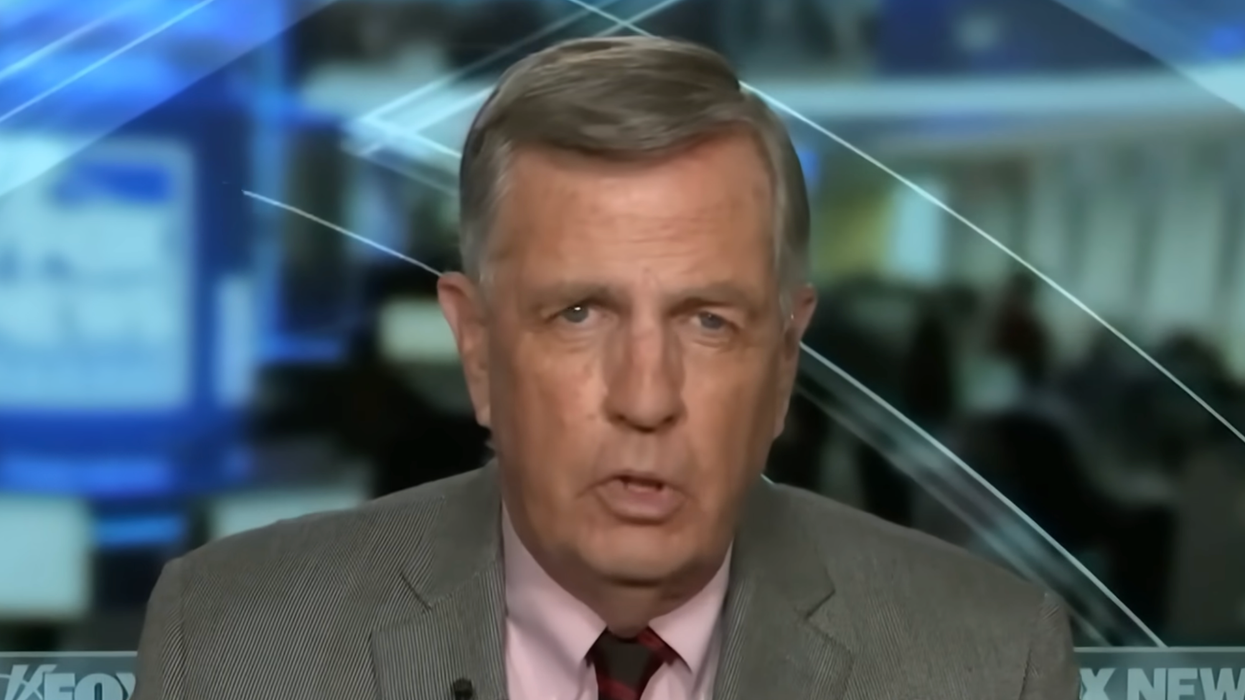

Fox News chief political analyst Brit Hume on Fox Business on September 16, 2025 (Image: Screengrab via Fox Business / YouTube)

December 01, 2025  
ALTERNET

Fox News host Brit Hume may be a longtime colleague of Defense Secretary Pete Hegseth (who was a former part-time weekend host on the network), but that didn't stop him from taking a jab at President Donald Trump's top military official.

On Monday, as blowback continues to escalate in response to a Washington Post report about Hegseth supposedly ordering that two survivors of a destroyed boat be killed, Hegseth posted a statement to his official X account that appeared to praise Admiral Frank M. Bradley. While the Post's sources said Hegseth gave the order to "kill everybody," the White House clarified that Adm. Bradley — the commander of the U.S. Special Operations Command (SOCOM) — is the one who actually approved the secondary strike on September 2, 2025 that killed the two survivors.

"Let’s make one thing crystal clear: Admiral Mitch Bradley is an American hero, a true professional, and has my 100 percent support," Hegseth posted. "I stand by him and the combat decisions he has made — on the September 2 mission and all others since. America is fortunate to have such men protecting us."

The statement was almost immediately scrutinized by various journalists, experts and commentators, including Hume. The conservative network's chief political analyst quote-posted Hegseth and argued the defense secretary was demonstrating "how to point the finger at someone while pretending to support him."

Atlantic contributor Tom Nichols — who is also a retired professor at the U.S. Naval War College — also piled on, tweeting: "'Let's make one thing crystal clear: That guy over there is the guy you want.'"

Former Fox News, CNN and MSNBC journalist David Shuster accused Hegseth of "stabbing the admiral in the back," and suggested the Pentagon leader "try taking some responsibility." Vinny Green, who is the former chief operating officer of fact-checking website Snopes, responded to Hegseth's post with a GIF of South Park character Eric Cartman getting thrown under a bus.

"Wow. You cook up a cruel and ineffective strategy based on illegal extrajudicial killings (i.e. murder), force the military to carry it out based on a nonsensical [White House] legal interpretation, then throw the commander under the bus at the first blowback. Incredible," wrote Max Hoffman, who is a foreign policy advisor to Sen. Bernie Sanders (I-Vt.)

Hegseth just sent a 'chilling signal' to the Defense Department: senator

Matthew Chapman
December 1, 2025 
RAW STORY

Secretary of Defense Pete Hegseth gave a "chilling" message to all the generals working beneath him in his response to the exploding scandal over the killing of unarmed shipwreck survivors, Sen. Chris Murphy (D-CT) told CNN's Erin Burnett on Monday's edition of "OutFront."


The killings, first reported last week, have been widely condemned by experts as war crimes. Hegseth's response has been twofold: to categorically stand by the order, but also to claim that it wasn't even his order in the first place.

"So Secretary Hegseth has just posted something that I wanted to ask you about," said Burnett. "He said: 'Let’s make one thing crystal clear: Admiral Mitch Bradley is an American hero, a true professional, and has my 100% support. I stand by him and the combat decisions he has made — on the September 2 mission and all others since. America is fortunate to have such men protecting us. When this @DeptofWar says we have the back of our warriors — we mean it.'"

"Okay, let me just translate this into, he's pinning this on Bradley, okay?" said Burnett. "He's saying that that's — that's what that's about, right? I mean, where do you see this heading?"

"He is passing the buck," said Murphy. "He sort of sees the freight train that is coming, right? That both Republicans and Democrats are coming to the conclusion that this was an illegal, wildly immoral act. And he is shifting the blame. It's the opposite of the buck stops here. And, boy, it's a chilling signal to everyone in the chain of command that the Secretary of Defense does not have your back."

"Now, in this case, it seems likely that he actually did give the order that he gave the order to kill everyone on that boat, and those in the chain of command were simply following his orders," Murphy added. "But he is basically telling everyone, all of his generals, all of the professional staff at the Department of Defense, that I'm going to save myself if things get tough. And that's just devastating for American national security."


Trump defense secretary crossed 'a bright legal line': constitutional law expert


U.S. Defense Secretary Pete Hegseth gestures as he meets with El Salvador Defense Minister Rene Merino Monroy at the Pentagon in Washington, D.C., U.S., April 16, 2025. REUTERS/Ken Cedeno
December 01, 2025 
ALTERNET


The White House on Monday confirmed prior reports that Secretary of Defense Pete Hegseth directed U.S. forces to fire a second time on survivors of an initial strike on a boat in the Caribbean Sea. Writing for the New Republic, former U.S. Attorney and constitutional law expert Harry Litman accused Hegseth of breaking a "foundational" rule of warfighting and crossing a "bright legal line."

The Trump administration has been engaged in a widely criticized campaign of strikes on boats in the Caribbean, claiming with little to no evidence that the crafts are linked to Venezuelan drug smuggling. According to a report from the Washington Post, on September 2, U.S. forces fired a second time against survivors of an initial strike, in line with an order from Hegseth to "kill them all." Such a strike would, according to legal experts, very likely amount to a war crime, with U.S. laws specifically singling out attacks on "shipwrecked" individuals as a clear example of an unlawful military action.

White Press Secretary Karoline Leavitt on Monday confirmed that the strike occurred, but also appeared to pass direct blame from Hegseth to a subordinate officer, Admiral Frank M. Bradley, and insisted that the strikes were conducted in accordance with laws governing armed conflicts.

In his piece from Monday, Litman characterized this incident in unsparing terms, calling the reports "like something out of Apocalypse Now" and arguing that the "the second strike appears to cross one of the clearest lines in the law of armed conflict."

"The Defense Department’s Law of War Manual prohibits declaring 'no quarter,' forbids conducting operations 'on the basis that there shall be no survivors,'" Litman wrote. "And states unequivocally that 'persons placed hors de combat [out of the fight] may not be made the object of attack,' including those incapacitated by shipwreck, unless they commit a fresh hostile act or attempt escape.

"This rule is foundational," he stressed.

Litman further wrote that the Trump administration's efforts to investigate six Democratic lawmakers over a video urging military members to disobey "unlawful orders," when contrasted against the reports about the second boat strike, create a grim reminder of some of the darkest chapters in U.S. history, when the government opted to go after people who spoke about official misconduct rather than the misconduct itself.

"It’s an all too familiar — and invariably regretted — story in American constitutional life," Litman wrote. "From World War I sedition prosecutions to McCarthy-era investigations to parts of the post-9/11 surveillance apparatus, some of the country’s worst civil liberties violations began with the assumption that dissent was a threat. In nearly every case, the government insisted at the time that extraordinary circumstances justified extraordinary measures. In nearly every case, history delivered a harsher verdict."

'It's a confession': Conservative lawyers call new Hegseth comment an 'admission of guilt'


David McAfee
November 30, 2025 
RAW ST0RY


Pete Hegseth (Reuters)

Pete Hegseth was put on notice over the weekend by two conservative lawyers, including a former prosecutor, who said the Defense Secretary's defense to a major new scandal "makes no legal sense" and is not really "a defense."

Observers' eyebrows were raised after it was reported by the Washington Post in a bombshell story that Hegseth ordered the killing of two survivors of one of controversial drug vessel bombings. Some analysts questioned whether it was murder, or even a war crime.

Former prosecutor Andrew McCarthy, who served as an assistant U.S. attorney for the Southern District of New York, recently said he has no love for the “craven video” Sen. Mark Kelly (D-Ariz.) and five Democrats released to the public advising military members to ignore illegal orders. At the same time, McCarthy suggested President Donald Trump’s executive power abuses in reacting to it represent a whole “new level” of threat.

Now, in an essay late Saturday night, the conservative weighed in on Hegseth's new scandal.

"If this happened as described in the Post report, it was, at best, a war crime under federal law. I say 'at best' because, as regular readers know, I believe the attacks on these suspected drug boats — without congressional authorization, under circumstances in which the boat operators pose no military threat to the United States, and given that narcotics trafficking is defined in federal law as a crime rather than as terrorist activity, much less an act or war — are lawless and therefore that the killings are not legitimate under the law or armed conflict," the attorney wrote.

McCarthy goes even further, suggesting that, "even if you buy the untenable claim that they are combatants, it is a war crime to intentionally kill combatants who have been rendered unable to fight. It is not permitted, under the laws and customs of honorable warfare, to order that no quarter be given — to apply lethal force to those who surrender or who are injured, shipwrecked, or otherwise unable to fight."

He continued, writing, "The operation, led by SEAL Team 6, was directed from Fort Bragg, N.C., by Admiral Frank M. 'Mitch' Bradley, then the head of Joint Special Operations Command. Admiral Bradley is said to have ordered the attack against the two survivors of the first strike in order to comply with Hegseth’s directive to kill the boat’s operators."

While Bradley reportedly claimed "the survivors were still legitimate targets because they could theoretically call other traffickers to retrieve them and their cargo," and Hegseth issued a response saying these were always meant to be deadly attacks, McCarthy isn't sold.

"Neither Hegseth’s statement nor the explanation attributed to Bradley... makes legal sense," the former prosecutor wrote. "The laws of war, as they are incorporated into federal law, make lethal force unlawful if it is used under certain circumstances. Hence, it cannot be a defense to say, as Hegseth does, that one has killed because one’s objective was 'lethal, kinetic strikes.'"

Conservative attorney George Conway shared McCarthy's essay and wrote, "Indeed, it's a confession and admission of guilt to heinous crimes."

Read the full piece here (subscription required).


Venezuela president 'provoked' Trump by singing John Lennon's Imagine: conservative

WAS IT HIS SINGING OR THE SONG?!

David Edwards
December 1, 2025


Venezuela's President Nicolas Maduro gestures as he takes part in a march with young members of the United Socialist Party of Venezuela (PSUV) in Caracas, Venezuela, November 13, 2025. REUTERS/Leonardo Fernandez Viloria

Conservative pundit Walter Curt argued that President Donald Trump should invade Venezuela after the country's president, Nicolás Maduro, sang John Lennon's "Imagine" as a call for peace.

"I believe that an attack on a drug cartel stronghold on the ground in Venezuela is imminent," Real America's Voice host Jake Novak told Curt on Monday before playing a clip of Maduro singing a line from "Imagine."

"Let it be known across the world, though, that a sure way to provoke military action is to sing John Lennon's 'Imagine,' which I think is actually necessary," Curt argued. "The moment I saw this, but whenever this first came out, I said, all right, double the bounty, send the Marines."

"I think there's a major play we're making down there for the entire region by going out of Venezuela," he noted. "Everyone seems to forget that Venezuela also has, you know, the world's largest oil reserves."

"But, you know, any time you're singing John Lennon's 'Imagine,' I think you should immediately be invaded by the Marines, paratroopers. Send 'em all."

Frustration in Indonesia as flood survivors await aid

Tukka (Indonesia) (AFP) – Officials in Indonesia and Sri Lanka battled Wednesday to reach survivors of deadly flooding in remote, cut-off regions as the toll in the disaster that hit four countries topped 1,300.


Issued on: 03/12/2025 - FRANCE24

Damage to infrastructure including many broken bridges is making relief work in Indonesia difficult © AMANDA JUFRIAN / AFP

In Indonesia, there is growing frustration among survivors of catastrophic flooding and landslides over the pace of the rescue effort and aid delivery.

Humanitarian groups said the scale of the challenge was almost unprecedented even for a country that has faced no shortage of natural disasters.

Monsoon rains paired with two rare tropical storm systems, sometimes known in the region as cyclones, dumped record deluges across Sri Lanka, and parts of Indonesia's Sumatra, southern Thailand and northern Malaysia last week.

In Indonesia, the toll hit 753 on Wednesday, but the number of missing also increased to 650.

The rising figures reflect information that is only trickling in as many regions remain either physically cut off by flood damage or isolated by electricity and communications failures, or both.

"It's very challenging logistically to respond," said Ade Soekadis, executive director of Mercy Corps Indonesia, an aid group.

"The extent of the damage and the size of the affected area is really huge."

The group is hoping to send hygiene equipment and water both from Jakarta and locally.

He said reports of food and water shortages were already "very concerning" and the situation will be "more problematic as time goes by".


'Like an earthquake'

At an evacuation centre in Padan, 52-year-old Reinaro Waruwu told AFP he was "disappointed" in the government's immediate response and the slow arrival of aid.


In some areas of Indonesia, the floodwaters have yet to recede © YT HARIONO / AFP


"Some waited a day and night before receiving help, so they couldn't be saved," he said, surrounded by evacuees sitting on mats on the floor in the hall-turned-shelter.

"I am frustrated, it doesn't need to be said twice. The response was not quick," he added.

Like many, he described the arrival of floodwaters and landslides as a disaster without precedent.

"It came like an earthquake.. I thought 'Well, if I am going to die, then so be it,'" he said, beginning to sob heavily.

He managed to escape the rising waters, but his neighbours were buried alive in debris.

Traumatised, he could not even eat on arrival, and since then food has been patchily available, though vegetables arriving on Tuesday offered a "semblance of hope", he said.

Nearby, Hamida Telaumbaunua, 37, described watching her entire kitchen swept away by floodwaters.

"My heart... this was the first time I experienced such a flood," she said.

Her home was lost entirely, along with everything but the few possessions she took when she left.

Some of the worst-hit areas in Sri Lanka are the central tea-growing regions where landslides carrying away hills © Ishara S. KODIKARA / AFP


"It's hard to think about what lies ahead. Maybe as long as we're still here, it's okay, but later... I don't know what will happen."

The weather system that hit Indonesia also brought heavy rains to Thailand, killing at least 176 people, and Malaysia, where two people were killed.
Sri Lanka 'open' for tourists

Though floods are common in Asia during monsoon season, climate change is making heavy rain events more frequent because a warmer atmosphere holds more moisture.

Warmer oceans can also turbocharge storm systems.

A separate weather system, Cyclone Ditwah, brought torrential rain and deadly floods and landslides to much of Sri Lanka last week.

At least 465 people were killed, and authorities have estimated the disaster's cost at up to $7 billion.

"Our initial estimate is that we will need about six to seven billion dollars for the reconstruction," said Prabath Chandrakeerthi, the Commissioner-General of Essential Services.

Chandrakeerthi said existing laws that allow a person to be declared dead only after being missing for six months could be shortened to expedite the issuance of death certificates.

The government has said it will offer 25,000 rupees ($83) to families to help clean their homes. Those who lost homes will receive up to $8,000.

Over 1.5 million people have been affected, with over 200,000 in state-run shelters.

Despite the disaster, the tourism-reliant country welcomed a luxury cruiseliner to Colombo port on Tuesday, authorities said.

The arrival sends "a clear message to the world: Sri Lanka is safe, open, and ready to embrace visitors once again," the country's tourist board said.

burs-sah/kaf

© 2025 AFP
How deforestation turbocharged Indonesia’s deadly floods


By AFP
December 2, 2025


Experts, environmentalists and even government officials have pointed to the role of deforestation in Indonesia's deadly floods
 - Copyright AFP CHAIDEER MAHYUDDIN


Marchio Gorbiano and Dessy Sagita

The deadly flooding that has killed hundreds in Indonesia was largely the result of monsoon rains and a rare tropical storm. But something else may have played a role: deforestation.

Environmentalists, experts and even Indonesia’s government have pointed to the role forest loss played in flash flooding and landslides that washed torrents of mud into villages and stranded residents on roofs.

Forests help absorb rainfall and stabilise the ground held by their roots, and their absence makes areas more prone to flash flooding and landslides.

Indonesia is regularly among the countries in the world with the largest annual forest loss.

Mining, plantations and fires have caused the clearance of large tracts of the country’s lush rainforest over recent decades.

In 2024, over 240,000 hectares of primary forest was lost, and that was less than the year before, according to analysis by conservation start-up The TreeMap’s Nusantara Atlas project.

“Forests upstream act as a protective barrier, a bit like a sponge,” explained David Gaveau, founder of The TreeMap.

“The canopy captures some of the rain before it reaches the ground. The roots also help stabilise the soil. When the forest is cleared upstream, rainwater runs off rapidly into rivers creating flash floods.”

– ‘Prevent deforestation’ –


Environmentalists have long urged the government to better protect the country’s forests, which are a key carbon sink, absorbing planet-warming carbon dioxide.

Indonesia’s forests are also home to enormous biodiversity and some of the world’s most threatened species, including orangutans.

And in the wake of the flooding, even the country’s president urged action.

“We must truly prevent deforestation and forest destruction,” President Prabowo Subianto said Friday as the scale of the disaster began to emerge.

“Protecting our forests is crucial.”

The floods carried not only collapsed hillsides and torrents of mud, but also timber that fuelled speculation about the link between deforestation and the disaster.

On one beach in Padang, AFP saw workers dressed in orange using chainsaws to break up massive logs strewn along the sand.

The forestry ministry is reportedly investigating claims of illegal logging in affected areas, and Forestry Minister Raja Juli Antoni called the disaster a chance to “evaluate our policies”.

“The pendulum between the economy and ecology seems to have swung too far towards the economy and needs to be pulled back to the centre,” he said over the weekend.

That is a message environmentalists in Indonesia have long delivered.

In one of the worst-affected areas, Batang Toru, “there are seven companies operating along the upstream region,” said Uli Arta Siagian, forest and plantation campaign manager for conservation group Walhi.

“There is a gold mine that has already cleared around 300 hectares of forest cover… the Batang Toru Hydropower Plant has caused the loss of 350 hectares of forest,” she told AFP.

Large tracts of forest have also been converted into palm oil plantations.

“All of this contributes to increasing our vulnerability.”

– Protection and restoration –

Sumatra, where the flood damage was concentrated, is particularly vulnerable because its river basins are relatively small, explained Kiki Taufik, head of Greenpeace Indonesia’s forest campaign.

“The massive change in forest cover is the main factor in the occurrence of flash floods,” he told AFP, accusing the government of “recklessly and carelessly” granting permits for mines and plantations.

Deforestation rates in Sumatra are among the highest in Indonesia, according to Herry Purnomo, country director at the Center for International Forestry Research and World Agroforestry (CIFOR-ICRAF).

Losing forest also raises flooding risks because soil washes into rivers, raising the riverbed and reducing the capacity of waterways to absorb sudden torrential downpours, he said.

Two things are needed, added Herry, a professor at IPB University in Bogor: “Prevent deforestation, avoid it, and also carry out restoration.”

 Hundreds of thousands of Asia flood survivors face food and fuel shortages

Hundreds of thousands of people stranded by the violent floods that have swept through in Sri Lanka, Indonesia, Thailand and Malaysia were on Tuesday facing increasingly alarming shortages of food and fuel. More than 1,300 have been killed in the torrents triggered by monsoon rains and cyclones.


Issued on: 02/12/2025 
By: FRANCE 24

Governments and aid groups on Tuesday worked to rush aid to hundreds of thousands stranded by deadly flooding that has so far killed at least 1,338 people: 744 in Indonesia, 410 in Sri Lanka, 181 in Thailand and three in Malaysia.

Torrential monsoon season deluges paired with two separate tropical cyclones last week dumped heavy rain across the region.

Climate change is producing more intense rain events because a warmer atmosphere holds more moisture, and warmer oceans can turbocharge storms.

The floodwaters have now largely receded, but the devastation means hundreds of thousands of people are now living in shelters and struggling to secure clean water and food.


READ MORELooting reported as Indonesia and Sri Lanka battle deadly floods

In Indonesia's Aceh, one of the worst-affected regions, residents told AFP that survivors who could afford to were stockpiling supplies.


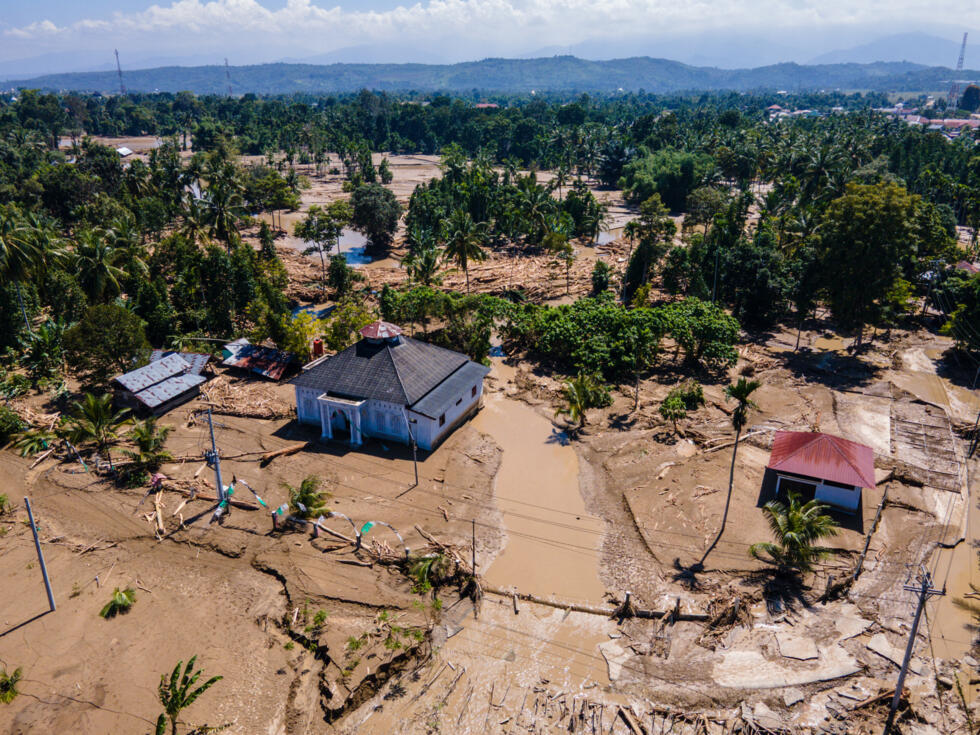
Mud surrounds a mosque in a flood-affected area in Meureudu, in Indonesia's Aceh province © Chaideer Mahyuddin, AFP


"Road access is mostly cut off in flood-affected areas," 29-year-old Erna Mardhiah said as she joined a long queue at a petrol station in Banda Aceh.

"People are worried about running out of fuel," she added from the line she had been in for two hours.

The pressure has caused skyrocketing prices.

"Most things are already sky-high ... chillies alone are up to 300,000 rupiah per kilo ($18), so that's probably why people are panic-buying," she said.

On Monday, Indonesia's government said it was sending 34,000 tons of rice and 6.8 million litres of cooking oil to the three worst-affected provinces, Aceh, North Sumatra and West Sumatra.

"There can be no delays," Agriculture Minister Andi Amran Sulaiman said.
Food shortage risk

Aid groups said they were working to ship supplies to affected areas, warning that local markets were running out of essential supplies and prices had tripled already.

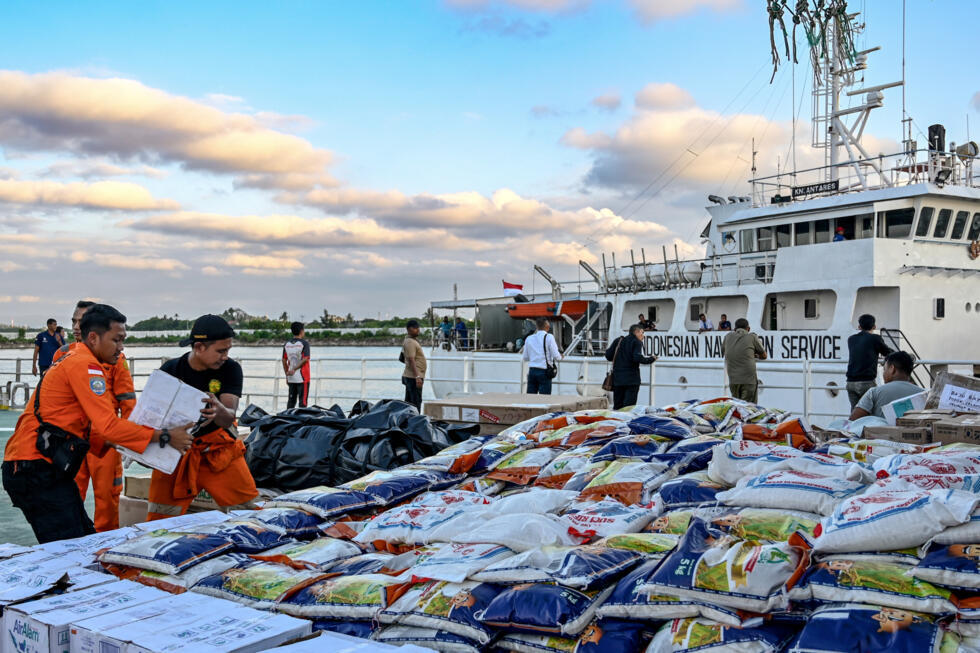
Governments and aid groups are working to ship supplies to affected areas across Indonesia and Sri Lanka © Chaideer Mahyuddin, AFP


"Communities across Aceh are at severe risk of food shortages and hunger if supply lines are not reestablished in the next seven days," charity group Islamic Relief said.

A shipment of 12 tonnes of food from the group aboard an Indonesian navy vessel was due to arrive in Aceh on Tuesday.

A million people have evacuated from their homes, according to the disaster agency.

Survivors have described terrifying waves of water that arrived without warning.

In East Aceh, Zamzami said the floodwaters had been "unstoppable, like a tsunami wave".

"We can't explain how big the water seemed, it was truly extraordinary," said the 33-year-old, who like many Indonesians goes by one name.

People in his village sheltered atop a local two-storey fish market to escape the deluge and were now trying to clean the mud and debris left behind while battling power and telecommunications outages.

A storm brought heavy rains across all of Sri Lanka, triggering flash floods and deadly landslides that killed at least 390 people © Ishara s. Kodikara, AFP


"It's difficult for us (to get) clean water," he told AFP on Monday.

"There are children who are starting to get fevers, and there's no medicine."

The weather system that inundated Indonesia also brought heavy rain to southern Thailand.
Colombo floodwaters recede

A separate storm brought heavy rains across all of Sri Lanka, triggering flash floods and deadly landslides.

Some of the worst-hit areas in the country's centre are still difficult to reach.

President Anura Kumara Dissanayake has declared a state of emergency to deal with what he called the "most challenging natural disaster in our history".

Unlike his Indonesian counterpart, he has called for international aid.

Sri Lanka's air force, backed by counterparts from India and Pakistan, has been evacuating stranded residents and delivering food and other supplies.

In the capital Colombo, floodwaters were slowly subsiding on Tuesday.

The speed with which waters rose around the city surprised local residents used to seasonal flooding.

"It is not just the amount of water, but how quickly everything went under."

Rains have eased across the country, but landslide alerts remain in force across most of the hardest-hit central region, officials said.

(FRANCE 24 with AFP)


Flooding Kills 1,000+ Across South Asia as Climate Crisis Fuels More Extreme Rain

“We need to confront climate change effectively,” Indonesia’s president said.


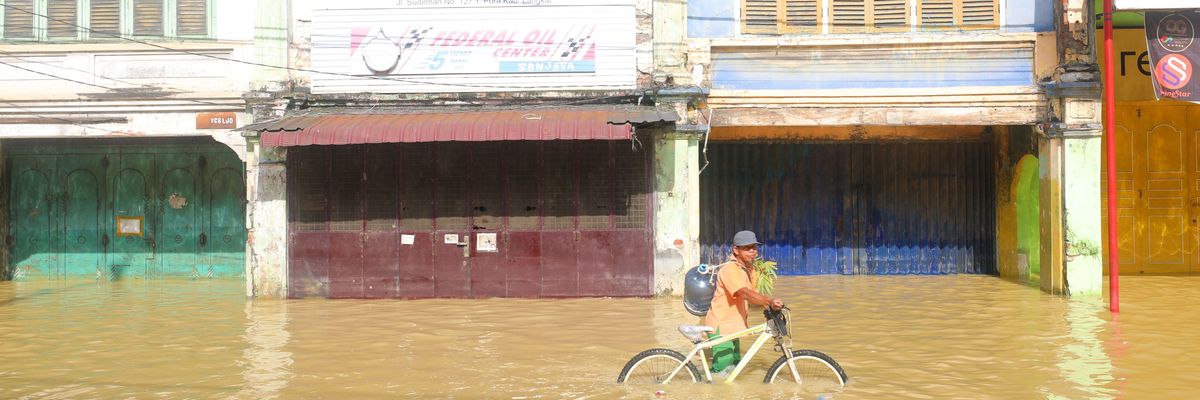
People wade through a flooded road on November 30, 2025, in Sumatra, Indonesia.
(Photo by Li Zhiquan/China News Service/VCG via Getty Images)


Stephen Prager
Dec 01, 2025
COMMON DREAMS


More than 1,100 people across South Asia have died after torrential rains fueled by warming temperatures caused widespread flooding and landslides in recent days.

Following days of unprecedented cyclone conditions, people across Indonesia, Malaysia, and Thailand have been left with their homes destroyed and forced to flee for their lives. A separate cyclone in Sri Lanka has left hundreds more dead.
RECOMMENDED...


Trump’s Climate Policies Could Cause Mass Death of Global Poor, Analysis Warns

The worst devastation has been seen in Indonesia, where Cyclone Senyar has claimed over 500 lives as of Sunday. On the island of Sumatra, rescue teams have struggled to reach stranded people as roads have been blocked by mudslides and high floodwaters. Many areas are still reportedly unreachable.

As Reuters reported Monday, more than 28,000 homes have been damaged across the country and 1.4 million people affected, according to government figures. At least 464 were reported missing as of Sunday.

Other countries in the region were also battered. In Thailand, the death toll was reported at 176 as of Monday, and more than 3 million people are reported to be affected. The worst destruction has been in the southern city of Hat Yai, which on November 21 alone experienced 335mm of rain, its single largest recorded rainfall in over 300 years.

At least two more have been killed in Malaysia, where nearly 12,000 people still remain in evacuation centers.

Sri Lanka has witnessed similar devastation in recent days from another storm, Cyclone Ditwah, that formed around the same time as Senyar. Floods and mudslides have similarly killed at least 330 people, and destroyed around 20,000 homes, while leaving around a third of the country without electricity. More than 200 people are missing, and over 108,000 are in state-run shelters, officials say.

Work has begun in Indonesia to restore damaged roads, bridges, and telecommunication services. But after he visited survivors in Sumatra, Indonesian President Prabowo Subianto said that the work will extend beyond merely recovering from the storm.

“We need to confront climate change effectively,” Prabowo told reporters. “Local governments must take a significant role in safeguarding the environment and preparing for the extreme weather conditions that will arise from future climate change.”

Southeast Asia was top-of-mind for many attendees at last month’s COP30 climate summit in Brazil. As Winston Chow, a professor of urban climate at Singapore Management University and part of the UN’s Intergovernmental Panel on Climate Change (IPCC), told the Straits Times, this is because the region “is highly vulnerable to climate change.”

“As a whole, it faces multiple climate risks and hazards, such as rising temperatures, sea-level rise, increasing droughts and floods, and the intensification of extreme events like typhoons,” he continued.

In recent years, the region has been hit by annual devastating heatwaves, resulting in record-shattering temperatures. In Myanmar, where temperatures exceeded 110°F last April, Radio Free Asia reported that 1,473 people died from extreme heat in just one month.

Floods have likewise grown more deadly in recent years. Just this month, floods killed dozens more people in Vietnam, and a pair of typhoons killed hundreds more in the Philippines and forced over a million people to evacuate their homes.

While it’s difficult to determine the extent to which any one disaster was caused by climate change, in aggregate, they are growing more intense as the planet warms.

“As the world’s oceans and atmosphere warm at an accelerating rate due to the rise in greenhouse gases from burning fossil fuels, tropical cyclones are expected to become more intense,” explained Steve Turton, an adjunct professor of environmental geography at CQUniversity Australia in The Conversation on Sunday. “This is because cyclones get their energy from warm oceans. The warmer the ocean, the more fuel for the storm.”


According to the National Centers for Environmental Information, part of the US National Oceanic and Atmospheric Administration, October 2025 was the third-warmest October on record globally and had above-average tropical cyclone activity.

“The warming atmosphere is supercharging the global water cycle, and peak rainfall rates are increasing,” Turton said. “When more rain falls in a short time, flash flooding becomes more likely.”

At COP30, protesters from across Southeast Asia assembled to demand action from global leaders. On November 10, shortly after her home in Manila was battered by a pair of typhoons, 25-year-old activist Ellenor Bartolome savaged corporations and world leaders who have continued to block global action to reduce fossil fuel usage.

“It gets worse every year, and for every disaster, it is utterly enraging that we are counting hundreds of bodies, hundreds of missing people... while the elite and the corporations are counting money from fossil fuels,” she told attendees as they entered the conference.

Ultimately, many climate activists and scientists left the conference enraged yet again, as the final agreement stripped out all language related to fossil fuels.


Adaptation Finance Low-Balled, Glaring Omission of Just Transition Away from Fossil Fuels in New COP30 Text

Friday November, 21 2025, 
Union of Concerned Scientists (UCS)


BELÉM, Brazil - The annual UN climate talks, COP30, are entering their final hours after a fire briefly shut down the venue yesterday. Early this morning, the COP Presidency released a raft of new negotiations text including an updated version of Brazil’s Mutirão, an overarching political package for climate outcomes put forward by the Presidency. Despite its omission from the latest text, there is increasing support for a roadmap for a transition away from fossil fuels, endorsed by over 80 countries. Also this morning, Colombia led a press conference presenting the Belém Declaration on the Transition Away from Fossil Fuels, highlighting the growing number of countries at COP30 calling for a global just transition from fossil fuels to clean energy.

Below is a quote from Dr. Rachel Cleetus, senior policy director for the Climate and Energy program at the Union of Concerned Scientists, who is on the ground at COP30.

“The new texts released this morning are disappointing across the board and the Mutirão text is much weaker than the earlier version. The COP Presidency must intensify its efforts to bridge differences, including in open and transparent plenaries in these final hours, to secure an ambitious outcome at COP30.

“The lack of finance for a clean energy transition and adaptation from richer nations—a critical part of the Paris Agreement—remains an ongoing obstacle to securing bold and fair outcomes. Political leaders from wealthier countries must show a willingness to meet their responsibilities instead of once again forcing those least responsible for the climate crisis into an inequitable compromise.

“Adaptation finance, which is a top priority for climate vulnerable nations coming into this COP, has been low-balled yet again. Lower income countries are unjustly enduring blow-after-blow from climate impacts caused primarily by heat-trapping emissions from rich nations, impacts that will worsen as the world overshoots 1.5 C of global warming. A strong outcome on funding for adaptation is essential to restore trust and deliver a fair outcome at COP30.

“The Mutirão text has completely dropped mention of a roadmap for a just transition away from fossil fuels, a glaring omission of an urgent call championed here by more than 80 countries. Fossil fuels are the root cause of the climate crisis and there is no credible pathway to meet science-based climate goals without a fast, fair, funded phaseout of fossil fuels. Lower income nations cannot make this transition rapidly, nor can they close the vast energy poverty gap that millions suffer from today, without funding from richer countries. Public finance is essential.

“More and more countries are demanding a just transition away from fossil fuels to clean energy to protect people and the planet while building thriving economies. The Belém Declaration led by Colombia is a bold complement to the roadmap nations are calling to include in the Mutirão, setting a high bar for ambition. How we make the transition away from fossil fuels to clean energy is crucial to ensuring this transition serves the needs of people, not fossil fuel interests bent on extracting profits. In addition to ramping up renewable energy and energy efficiency, a just transition must include support for workers currently dependent on fossil fuels for their livelihoods and for communities suffering from fossil fuel pollution.

“At COP28 in Dubai, nations agreed to transition away from fossil fuels. Now at COP30, billed as the ‘implementation COP,’ world leaders must secure a just transition package that sets the world firmly on a path to turn that commitment into reality within this critical decade and beyond.”


The Union of Concerned Scientists is the leading science-based nonprofit working for a healthy environment and a safer world. UCS combines independent scientific research and citizen action to develop innovative, practical solutions and to secure responsible changes in government policy, corporate practices, and consumer choices.

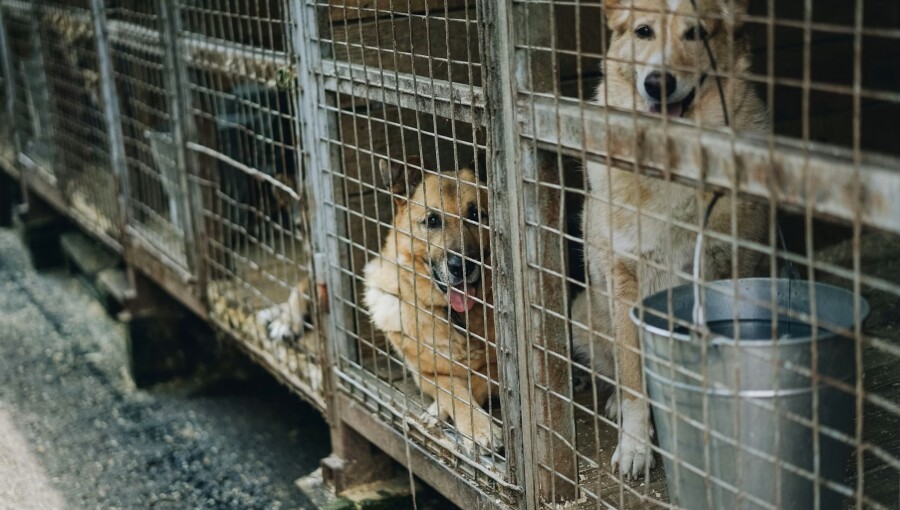
Stopping dog meat sales in Indonesia is more about shuffling paperwork than morality

Stopping dog meat sales in Indonesia is more about shuffling paperwork than morality
/ Sasha Sashina - Unsplash
By bno - Surabaya Office December 3, 2025

Dog meat consumption in Indonesia sits at the intersection of cultural food traditions, public health challenges, animal welfare concerns, and political risk. Unlike many mainstream livestock animals, dogs are increasingly recognised as companions in urban households, service roles, and community protection efforts across Indonesia. This evolving social perception has built momentum for legal intervention, particularly as rabies remains a deadly risk in several regions.

Although national legislation has yet to impose a blanket prohibition on dog meat consumption, especially in rural areas, provinces and cities are now accelerating local frameworks to restrict its trade and processing. The capital, Jakarta, has become a focal point of this regulatory shift, influencing discourse in neighbouring provinces and reigniting long-dormant legislative discussions.

Jakarta legalises ban, establishing a major precedent

Jakarta introduced a binding provincial rule in late 2025 that outlaws the trade and slaughter of animals categorised as carriers of rabies for food-related purposes. The Jakarta Governor, Pramono Anung, became a central figure in the rollout by confirming the regulation’s operational date as November 24, which was publicly shared via his Instagram channel, MerahPutih.com reports. This regulatory milestone positions dog and cat meat sales as formally unlawful in Jakarta. The policy’s intention was framed as a safeguard for public health, sanitation, and zoonotic disease prevention, rather than an assessment of cultural dietary customs.

The newly enacted rule, numbered 36/2025, extends beyond household pets to include a larger group of rabies-transmitting species such as monkeys, bats, civets, and similar animals, explicitly banning them from market circulation for dietary uses. The regulation establishes clear supply-side restrictions, making the sale of live dogs, raw meat, or processed food products from rabies-transmitting animals illegal if directed for consumption. Markets under Jakarta governance are now expected to adhere to these health classifications when selling or slaughtering animals.

The Jakarta food marketplace operator, Pasar Jaya, had previously confirmed that dog meat sellers operated within parts of Jakarta, including at Pasar Senen, which motivated regulatory tightening and enforcement commitments from the provincial leadership.

To ensure compliance, the ban includes escalating administrative penalties. For initial breaches, authorities are expected to issue written cautions and temporarily confiscate rabies-transmitting animals for disease monitoring, especially where symptoms such as rabies are detected. Repeat offences allow the government to seize animals again, close businesses, or remove trading permits entirely. The ban, according to the governor, completed a campaign promise to activists advocating for domestic animal protection and stricter consumer health measures, Antaranews reports.

Jakarta legislator Hardiyanto Kenneth emphasises sustained advocacy by animal welfare communities, veterinarians, and activists, Tempo.co reports. He highlighted the governor’s political resolve in establishing firm legal controls despite the complexity of navigating culturally sensitive consumption habits. Kenneth underscored that activists had pushed for years to solidify Jakarta’s regulation against dog and cat meat trading. He further cited resident concern over rabies spread, calling the issue a public health imperative rather than a symbolic cultural revision.

Kenneth also reinforced legislative backing for enforcement oversight, urging Jakarta’s Dinas Ketahanan Pangan, Kelautan dan Pertanian Provinsi DKI Jakarta to coordinate monitoring, conduct routine checks, and deliver firm administrative enforcement when necessary. He stressed that the rule protects citizens from rabies, a serious zoonotic disease risk that public institutions must prioritise. This marked Jakarta’s political transition toward building a humane and modernised livestock health governance model, grounded in consumer protection and portable to possible future national frameworks.

Additionally, Kenneth applauded Pramono’s campaign fulfilment, recognising it as a milestone in Jakarta’s urban development narrative, with potential influence across provinces wrestling with enforcement gaps. He urged exporters and local traders to ignore the rule to be held accountable through multi-agency operations and licencing oversight.

Antaranews also documented Pramono’s regulatory endorsement, reiterating that rule 36/2025 shuts supply routes permitting dog meat distribution for consumption in Jakarta.

Bantul at the heart of controversy and enforcement barriers

Just outside Jakarta’s regulatory lens, however, a viral video circulated in late 2025 showing dogs packed into sacks in an alleged dog meat supply chain in Bantul, Yogyakarta, sparking public outrage and new regional commitments, detiknews reports. Gubernur Daerah Istimewa Yogyakarta, Sri Sultan Hamengku Buwono X responded by confirming that new regulatory reinforcement was being prepared to restrict the dog meat trade. He noted that local authorities had been unable to act due to the absence of enforceable trading laws prohibiting dog meat consumption.

Although the DIY administration had previously distributed a regional circular in 2023 to control the distribution of rabies-transmitting animals for food purposes, he publicly acknowledged that the circular lacked sufficient enforcement weight.

Sultan proposed strengthening the circular into a governor decree, elevating the administrative enforceability of dog meat restrictions across districts and cities, which may require consultation with regencies and municipalities. This gap between administrative intent and enforcement authority has been a repeated theme in the national dog meat discourse, illustrating how regulatory escalation often encounters friction in the informal trading economy.

Sultan’s announcement followed police inspections led by AKP I Nengah Jeffry who verified the location of dog meat processing stalls in Bantul at Kapanewon Bambanglipuro where authorities recorded five active food stalls selling dog meat products. Jeffry confirmed that police had inspected the viral video site but found no animals being traded at the time, although processed dog meat sales were occurring. However, due to the absence of enforceable trading prohibition laws, police actions remained advisory in nature, focusing on outreach rather than obstruction. Local enforcement lacked regulatory authority to issue legal penalties, as Indonesia’s penal code currently sanctions animal abuse but does not prohibit consuming dog meat itself.

Legislature begins drafting fundamental food safety law

The legislative body in DIY has restarted regulatory drafting to supply the province’s first framework governing all animal-sourced food safety controls, including animal health conditions, slaughtering standards, and processed meat quality oversight. The proposal, named Pemberian Jaminan Keamanan Pangan dan Mutu Pangan Asal Hewan, is only in initial stages. The head of DIY legal drafting committee Yuni Satia Rahayu confirmed that the policy remains in early academic drafting, requiring comprehensive supporting research before the legislative process advances, HarianJogja reports.

Rahayu explained that the proposal aims to govern the health and safety controls for all animal-derived food products in the province, including mainstream livestock, non-mainstream meat, and rabies-transmitting species such as dogs. The proposal will form the province’s first consolidated foundation for animal-sourced food safety governance, establishing public inspection authority, legal penalties, oversight mechanisms, and trader compliance education. She also confirmed that when passed, the regulation may introduce surveillance pathways, compliance support, and penalties for breaches involving illegal or unsafe meat trade.

Human rights, religious freedom

In one of the most sensitive and related controversies in late 2025, national ministry Kementerian Imigrasi dan Pemasyarakatan confirmed that authorities had opened investigative proceedings to examine an allegation that a correctional facility administrator coerced Muslim detainees to eat dog meat, a dietary violation under Islamic law. The facility administrator under scrutiny, Chandra Sudarto, remains under internal review, with sanctions promised if coercion is proven. This allegation was released publicly by Indonesia’s national parliament member Mafirion, who argued that regardless of detainee status, religious freedom and dietary boundaries remain protected rights under human rights frameworks.

Mafirion demanded administrative suspension and law enforcement progression to restrict social polarisation around the matter. The ministry spokesperson Rika Aprianti confirmed formal provincial verification had been initiated, promising administrative action if abuse or coercion is evident, CNBC Indonesia reports.

From local experiment to national implications

As is, Jakarta’s binding rule creates Indonesia’s most substantial experiment in stopping the dog meat trade by using a public health classification strategy, targeting supply channels rather than cultural beliefs. Bantul, lacking enforceable laws, reveals the compliance risk that may redirect trade rather than reduce it. DIY legislature, now drafting the region’s first animal-sourced food safety regulation, reflects how local controversy has revived legal prioritisation.

What happens next will not be decided only in government offices. Tracking supply routes, educating consumers, supporting traders in transition, expanding rabies prevention, and unifying veterinary inspection standards will determine whether regulations sustainably reshape behaviour or reorganise the contours of informal trade in man's best friend.

If Europe wants war with Russia, 'we are ready': Putin

Issued on: 02/12/2025 - 

Russian President Vladimir Putin said Tuesday that Russia was "ready" for war if Europe seeks one, accusing Europe of trying to sabotage a deal on the Ukraine conflict before he met with US envoys. FRANCE 24's Gulliver Cragg reports from Kyiv.


Video by:  Gulliver CRAGG


Flaws In Putin’s Art Of No-Deal For Peace Become Apparent – Analysis
The Jamestown Foundation
By Pavel K. Baev


Frantic negotiations for a truce in Russia’s 45-month-long war against Ukraine in the last two weeks of November are likely to continue late into December. U.S. negotiators have faced backlash from other Western leaders following the November 19 leak of a draft U.S.–Russian peace proposal that heavily favored Moscow.

Leaked phone calls between top Kremlin advisers Yuri Ushakov and Kirill Dmitriev and between Ushakov and U.S. Special Envoy Steve Witkoff heightened the controversy (Carnegie Politika, November 27). Ukrainians were shocked by Witkoff’s readiness to integrate many Russian demands into the 28-point proposal. The initial proposal was at least partly drafted during a meeting between unofficial U.S. advisor Jared Kushner, Witkoff, and Dmitriev (The Insider; Reuters, November 26). European leaders were angered by their exclusion from the drafting process. They took issue with the proposed appropriation of frozen Russian financial assets, the majority of which are in European banks and remain a matter of internal debate in the European Union (Meduza, November 21).

Several rounds of revisions and Ukrainian input have curtailed and clarified the now roughly 19-point proposal, which Witkoff is set to present to Russian President Vladimir Putin in Moscow this week (RBC, November 28). The problem for Putin is that rejecting this updated plan could antagonize U.S. President Donald Trump. Suggesting changes would mean accepting the basic framework of the updated draft, which reportedly dismisses aspects of the Russian demand to address “root causes” of the war by increasing the number of troops that Ukraine is allowed to keep and potentially leaving the question of Ukraine’s future North Atlantic Treaty Organization (NATO) membership open (Nezavisimaya Gazeta, November 26).

Even the initial 28-point plan departed from many of the Kremlin’s maximalist demands that it has presented as non-negotiable since the start of its full-scale invasion of Ukraine, which some hyper-nationalist Russian commentators criticized (Topwar.ru, November 24). The initial leaked plan’s ceiling of 600,000 for Ukrainian troops—which Kyiv rejects as a matter of principle—is seven times higher than Moscow’s original demand. Without any restrictions on key weapon systems, Ukraine’s army could become a “steel porcupine,” extensively armed to deter further Russian aggression (Nezavisimaya Gazeta, November 23).

The stance that Putin appears to assume to avoid further compromises is the demand for a full retreat of the Ukrainian forces from the Donetsk oblast, justified by the assumption that continued steady Russian advances are inevitable (Izvestiya, November 27). The real situation in the battle for Pokrovsk is somewhat different from the triumphant reports from Chief of the Russian General Staff Valery Gerasimov, but what matters for Putin’s intention to delay genuine peace talks is the assumption that giving up Ukrainian-held territory is unacceptable to Kyiv (The Insider, November 28).


Ukrainian President Volodymyr Zelenskyy may nevertheless be compelled—amid a very difficult domestic political situation—to take the risk of agreeing to withdraw from Donbas on the condition of Russian retreat from smaller occupied territories in the Dnipro, Kharkiv, Mykolaiv, and Sumy regions, if a “stabilization force” of European “coalition of the willing” is deployed, backed by strong U.S. security guarantees (The Moscow Times, November 25; Radio Svoboda, November 27). This diplomatic maneuver is likely to be resented by Ukrainian troops, but their anger can be redirected toward Putin, who is loath to accept any conditions that would ensure Ukraine’s sovereignty and its anchoring to Europe (Novaya Gazeta Europe, November 28).

The main incentive Witkoff can offer Putin to show greater flexibility is the prospect of a new meeting with Trump. Hungarian Prime Minister Viktor Orbán said during his Moscow visit last Friday that Budapest would be a perfect place to make a peace deal (Izvestiya, November 29). Russian public opinion is ready to accept a cessation of hostilities as a “victory,” and some mainstream pundits are advancing arguments for the benefits of preserving the Kremlin’s territorial gains, even if incomplete, and for rehabilitating the new provinces and restoring Russia’s strength (Rossiiskaya Gazeta, November 24). The Kremlin’s war of attrition has depleted Russia’s human and financial resources, and many regions are reducing payments to sign up for contracts to serve in the war zone (see EDM, October 21; Radio Svoboda, November 30). Underfunding for infrastructure inevitably results in various breakdowns, with the serious damage to the space launch site at the Baikonur cosmodrome in Kazakhstan and the failed test of the Sarmat intercontinental missile just two examples (Naked Science, November 29; The Moscow Times, November 30).

Putin may have a more positive view of Russia’s economic performance than most experts, but the enforcement of new U.S. sanctions against Rosneft and Lukoil has clearly upset him (Kommersant, November 28). The sharp drop in oil export revenues is a serious setback for government efforts to slow the rapidly rising budget deficit, but Putin appears to be less concerned about macroeconomic impacts and more concerned about the unexpected application of U.S. sanctions (Glavportal, November 26). Putin

Putin appears to hope for a swift resumption of unimpeded economic relations with the United States. The drafts disregard EU reservations about lifting sanctions, and the initial 28-point draft contained the odd provision that all “ambiguities of the last 30 years” would be considered settled (Vedomosti, November 21). Corrupt and sanctioned “oligarchs” with close ties to Putin, such as Yuri Kovalchuk and Gennady Timchenko, have already begun discussing new joint ventures, including access to gas fields and rare-earth metals, with anonymous U.S. partners (The Moscow Times, November 30). Ukraine, in the meantime, has expanded its war against the Russian energy sector by directly hitting two tankers of the Russian “shadow fleet” in the Black Sea with naval drones (Vzglyad, November 29).

Putin makes proposals for an end to his war so beneficial for Russia that they are unacceptable for Kyiv, and attempts to blame Ukraine for the lack of peace. This art of no-deal has repeatedly been exposed as fraud through determined efforts by Zelenskyy, his many allies in Europe, and some politicians and experts in Washington. Profits from doing business with Russia are a mirage—the economic environment in Putin’s militarized autocracy would remain, even after a hypothetical ceasefire, harsh and severely corrupt. No beautiful peace can come from the ugly war that makes a lot of sense for the ageing dictator in the Kremlin. If Putin’s calculus is altered by consistent and collective Western pressure, however, a difficult compromise could be reached that would neutralize his obsession with subjugating Ukraine.


About the author: Dr. Pavel K. Baev is a senior researcher at the International Peace Research Institute, Oslo (PRIO).

Source: This article was published by The Jamestown Foundation


The Jamestown Foundation

The Jamestown Foundation’s mission is to inform and educate policy makers and the broader community about events and trends in those societies which are strategically or tactically important to the United States and which frequently restrict access to such information. Utilizing indigenous and primary sources, Jamestown’s material is delivered without political bias, filter or agenda. It is often the only source of information which should be, but is not always, available through official or intelligence channels, especially in regard to Eurasia and terrorism.
Malaysia says search for long-missing flight MH370 to resume

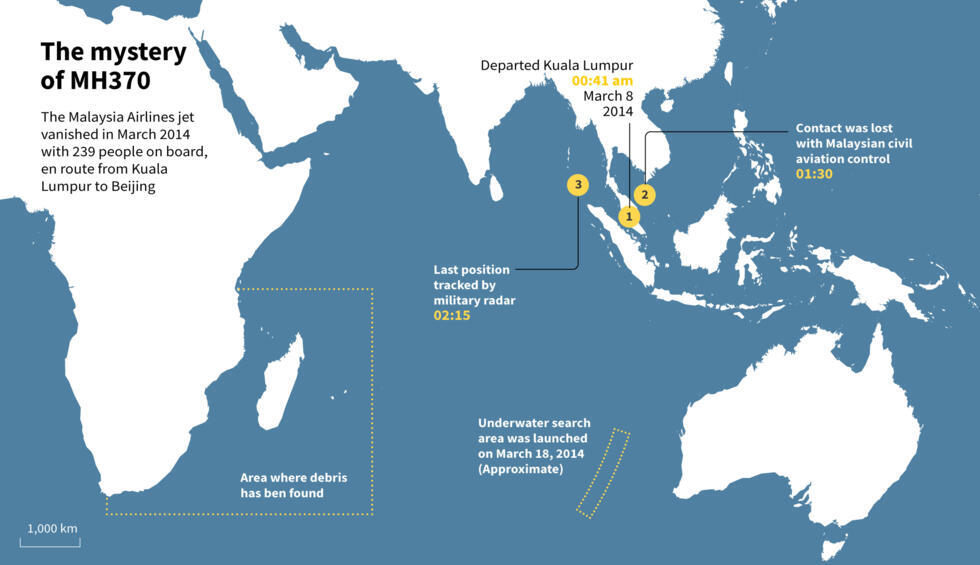
Kuala Lumpur (AFP) – The search for missing Malaysia Airlines flight MH370 will resume at the end of December, Malaysia's transport ministry said on Wednesday, more than a decade after the plane disappeared.


Issued on: 03/12/2025 - FRANCE24

MH370 carrying 239 people vanished from radar screens on March 8, 2014, while en route from Kuala Lumpur to Beijing in one of aviation's greatest enduring mysteries © Mohd RASFAN / AFP/File

The Boeing 777 carrying 239 people vanished from radar screens on March 8, 2014, while en route from Kuala Lumpur to Beijing in one of aviation's greatest enduring mysteries.

Two-thirds of the passengers were Chinese, while the others included Malaysians, Indonesians and Australians, as well as Indian, American, Dutch and French nationals.

The mystery of MH370 © John SAEKI, Nicholas SHEARMAN / AFP

Despite the largest search in aviation history, the plane has not been found.

Kuala Lumpur said in a statement it "wishes to update that the deep-sea search for (the) missing wreckage of Malaysia Airlines Flight MH370 will be resuming on 30 December 2025".


Maritime exploration firm Ocean Infinity will be conducting the search "in (a) targeted area assessed to have the highest probability of locating the aircraft", the ministry said.

The latest search in the southern Indian Ocean was suspended in April as it was "not the season".

It was conducted on the "no find, no fee" principle as Ocean Infinity's previous search, with the government only paying out if the firm finds the aircraft.

Ocean Infinity, based in Britain and the United States, led an unsuccessful hunt in 2018, before agreeing to launch a new search this year.

An initial Australia-led search covered 120,000 square kilometres (46,300 square miles) in the Indian Ocean over three years but found hardly any trace of the plane other than a few pieces of debris.

The ministry said the latest development underscores its commitment in "providing closure to the families affected by the tragedy".

Previous searches for MH370, including the massive Australia-led initial search, have yielded no results © LSIS BRADLEY DARVILL / AUSTRALIAN DEFENCE/AFP/File

Relatives of the victims had voiced hope in February that a new search could finally bring some answers.

When contacted by AFP, relatives of victims were not immediately available for comment.


Aviation mystery

The plane's disappearance has long been the subject of theories -- ranging from the credible to outlandish -- including that veteran pilot Zaharie Ahmad Shah had gone rogue.

A final report into the tragedy released in 2018 pointed to failings by air traffic control and said the course of the plane was changed manually.

Investigators said in the 495-page report that they still did not know why the plane vanished and refused to rule out that someone other than the pilots had diverted the jet.

Relatives of passengers lost on the flight have continued to demand answers from Malaysian authorities.

Family members of Chinese passengers gathered in Beijing outside government offices and the Malaysian embassy in March on the 11th anniversary of the flight's disappearance.

Attendees of the gathering shouted, "Give us back our loved ones!", with some holding placards asking, "When will the 11 years of waiting and torment end?"

© 2025 AFP