Wednesday, December 24, 2025

Women and girls fear for their safety in the Philippines, as earthquake aftershocks continue to rock Northern Cebu

Monday 8 December 2025, by Mary Therese L. Norbe


As the world spearheads 16 Days, an annual awareness campaign to prevent violence against women and girls that covers the period from November 25 to December 10, a new humanitarian analysis conducted by CARE in the Philippines reveals a stark reality. In Northern Cebu province of Philippines, thousands of women, girls, and boys are living and sleeping in the open. They have no walls, no lighting, and no sense of safety they once knew. “Living Without Fear” is CARE’s focus during the 16 Days awareness campaign.


The 6.9-magnitude earthquake that struck the region in late September, followed by tens of thousands of aftershocks, has forced families to abandon damaged homes and move into makeshift shelters across the municipalities of Daanbantayan, Medellin, and San Remigio. With darkness, displacement, and continuous tremors now part of daily life, women and girls face heightened risks of harassment, violence, and trauma.

“A world without fear is not only about freedom from violence; it is about having a safe home, dignity, and the ability to sleep at night without being terrorized,” said Reiza S. Dejito, Country Director of CARE Philippines. “In Northern Cebu, that sense of safety has been shattered. Women are holding their families together—acting as emotional anchors—while they themselves are living in fear of the dark, and of the ground shaking beneath them. We cannot talk about recovery if women are afraid to close their eyes at night.”

The assessment highlights how the crisis has disproportionately affected women and girls:

Loss of Safe Spaces: The destruction of homes, toilets and bathrooms has forced women to use makeshift latrines or bathe in communal areas with little to no privacy.

Increased Safety Risks: Women reported feeling unsafe relieving themselves at night due to poor lighting and the location of temporary latrines.

Mobility Restrictions: In San Remigio, the emergence of sinkholes has restricted movement, with mothers fearing for their children’s safety and their own as they navigate daily chores.

Disproportionate Burden: While men’s livelihoods in farming and fishing have been disrupted, women have taken on increased unpaid care duties, managing households in open fields while neglecting their own health, including recovery from childbirth.

“We don’t stay inside the house anymore; we spend most of our time outside,” shared a woman from Barangay Bakhawan, Daanbantayan, during a focus group discussion. “We eat, wash clothes, bathe, and sleep outside because we are too afraid to go back in” she further added.

A call for protection-focused humanitarian aid

The findings reinforce the urgent message of CARE’s global “Without Fear” campaign: women and girls should never have to live in conditions where fear is normalized.

In the context of Northern Cebu, this means prioritizing:

Well-lit bathrooms and toilets reduce risks at night.
Durable shelters that help rebuild a sense of safety, privacy, and dignity
Dignity kits and menstrual hygiene supplies tailored to women, girls, and boys.
Mental health and psychosocial support, including psychosocial first aid, safe spaces for women, girls, and boys, caregiver support, and trauma-informed services that address the fear, anxiety, and distress triggered by continuous aftershocks.
Cash assistance for urgent, self-identified needs, enabling families—especially women—to regain agency and make decisions that support their own recovery.

CARE Philippines, through the SAFER project, and its partners in the ACCESS Project, are providing cash assistance, hygiene kits, and shelter repair support in Cebu. However, more resources are needed to ensure that the unique needs of women, girls, and boys—from safety lighting to psychosocial support—are fully met.

“Recovery is not just about rebuilding structures; it is about rebuilding the peace of mind that allows a woman to live without fear,” added Dejito.

CARE delivers this assistance alongside local partners to ensure our work respects local culture and meets the needs of communities. In Cebu, CARE is working with the Central Visayas Network of NGOs to provide mental health and psychosocial support. This is part of CARE’s wider humanitarian response which includes collaboration with ACCORD Inc, AADC, MINCODE, KAMI, CorDisRDS, and TABI, alongside the 14-member ACCESS project consortium.

5 December 2025

Source: CARE.


Attached documen\tswomen-and-girls-fear-for-their-safety-in-the-philippines-as_a9301.pdf (PDF - 907.3 KiB)
Extraction PDF [->article9301]

Philippines
After Typhoon Tino (Kalmaegi): Mourn and Rage for Accountability and demand for ecological transformation
Manifesto for an Ecosocialist Revolution: Possible consequences in the Philippines
Introduction to the Manifesto for an Ecosocialist Revolution: Work Less, Live Better
Social revolts and environmental issues in South Asia
Walden Bello looks back on Filipino and global struggles


Mary Therese L. Norbe  is a spokesperson for CARE in the Philippine
s.


\

Greta Thunberg Arrested in UK for Supporting Palestine Action and Opposing Gaza Genocide

Thunberg joined a call for British officials to meet with the lawyers of Palestine Action protesters who have been on a hunger strike in prison.


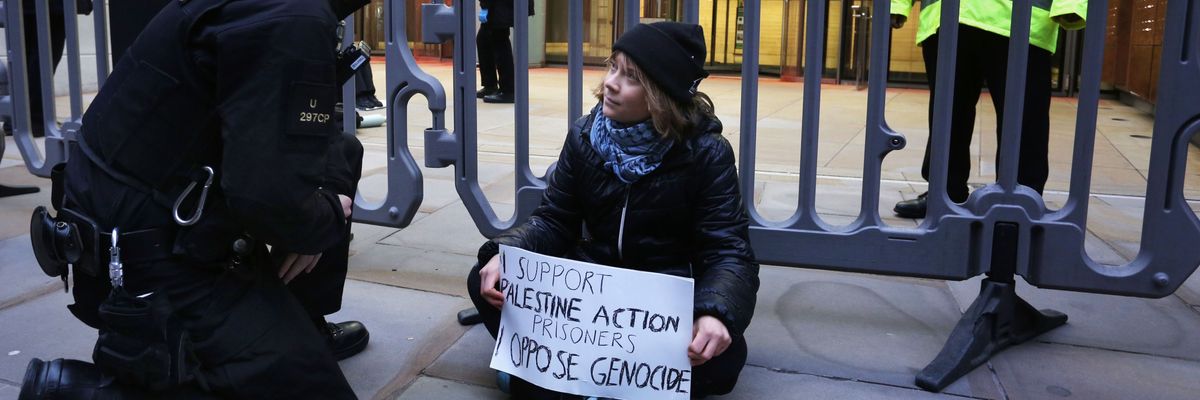
Activist Greta Thunberg joins a protest outside the offices of Aspen Insurance and holds a sign saying “I support Palestine Action prisoners, I oppose genocide” on December 23, 2025 in London.
(Photo by Martin Pope/Getty Images)

Julia Conley
Dec 23, 2025
COMMON DREAMS

“Because in the world we live in, Western leaders can arm a genocide and walk free—while Greta Thunberg is arrested as a dangerous terrorist supporter.”

That was the assessment of journalist Owen Jones on Tuesday after the Swedish climate justice leader was arrested in London outside the offices of Aspen Insurance, a company that provides services to an Israeli weapons maker, where she had been seated on the ground with a sign stating, “I support Palestine Action prisoners, I oppose genocide.”

The protest was in solidarity with demonstrators who have been imprisoned for taking part in nonviolent direct actions with the UK-based group Palestine Action. The government banned Palestine Action in July as a terrorist group, making it the first group to be declared as such under part of the UK Terrorism Act that defines “serious damage to property” as an act of terror—rather than violence against people.

Under the law, anyone who displays items or clothing that “arouse reasonable suspicion” of support for Palestine Action can be punished with up to six months in prison.


Thunberg is one of thousands of people who have taken to the streets in support since the group’s proscription, and one of about 2,000 people who have been arrested for doing so. Two other activists were also arrested on suspicion of criminal damage.

In Thunberg’s case, a spokesperson for City of London police said “she has been arrested for displaying an item (in this case a placard) in support of a proscribed organization (in this case Palestine Action) contrary to section 13 of the Terrorism Act 2000.”

The protest was specifically in support of eight people who have been on a hunger strike to protest their imprisonment and Israel’s continued attacks and blocking of essential aid in Gaza.

At least two of the prisoners are in their 52nd day of the hunger strike, and medical professionals have raised grave concerns about their health. Advocates in the UK have also demanded that the Labour government meet with lawyers for the detainees. On Monday, attorneys for the activists said in a letter that the government’s refusal to meet with them violates the Ministry of Justice’s policy for handling cases of hunger strikes.

“It is up to the state to intervene and put an end to this by meeting these reasonable demands that pave the way for the freedom of all those who choose to use their rights trying to stop a genocide, something the British state has failed to do themselves,” said Thunberg.

Member of Parliament Zarah Sultana, co-founder of the socialist Your Party, said that government leaders in the UK, who have continued to back Israel’s attacks on Gaza, should be imprisoned, rather than those protesting.

“Greta Thunberg has just been arrested for opposing genocide,” said Sultana. “Meanwhile, [Prime Minister] Keir Starmer—complicit in the genocide of the Palestinian people—walks free. He should be arrested and sent to The Hague.”

Journalist Matt Kennard said images of police confiscating Thunberg’s sign and arresting her “will be studied in history books.”

Fascism is already here,” he added.


Greta Thunberg Arrested in Protest Supporting Palestine Action Hunger Strikers

Thunberg spoke out in support of hunger strikers in the UK, some of whom have refused food for over 50 days.

By Sharon Zhang , 
December 23, 2025

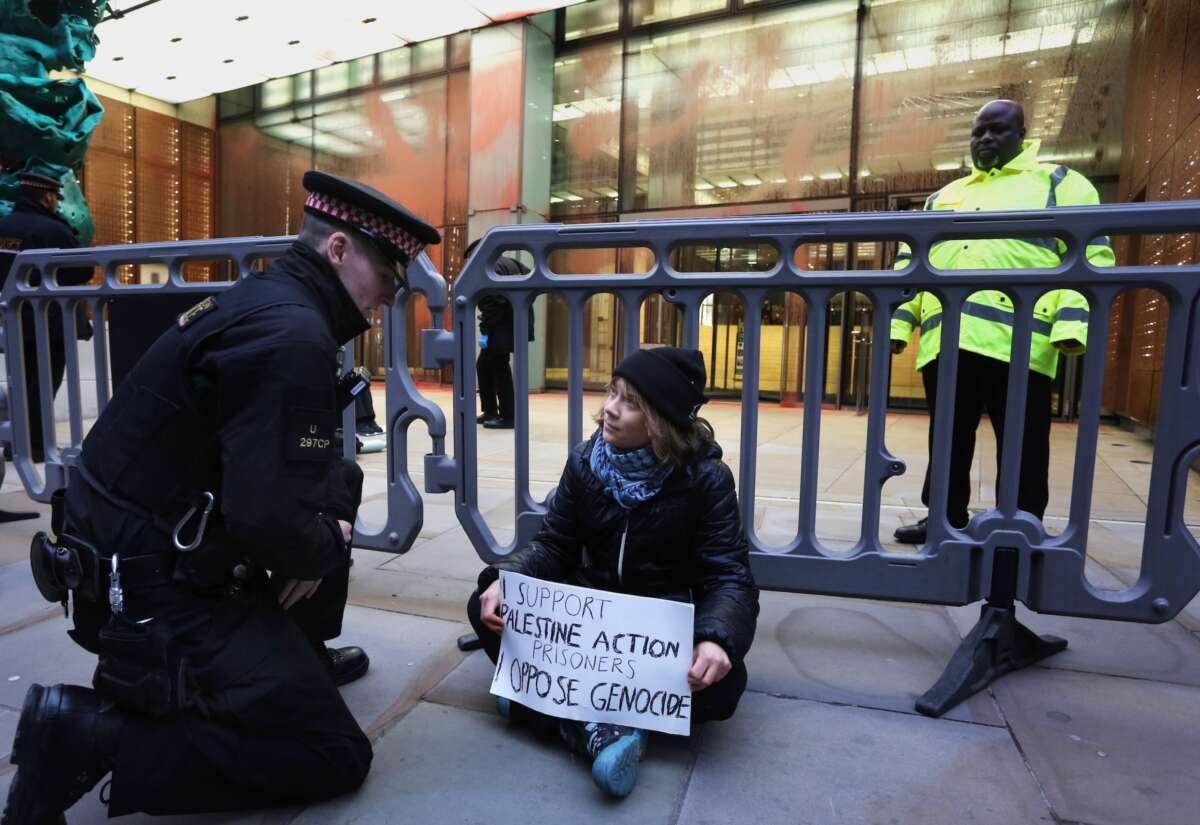
Activist Greta Thunberg joins the protest outside the offices of Aspen Insurance and holds a sign saying 'I support Palestine Action Prisoners I oppose Genocide' on December 23, 2025 in London, England.Martin Pope / Getty Images

Police arrested activist Greta Thunberg in London on Tuesday while she was participating in a protest supporting imprisoned hunger strikers linked to proscribed group Palestine Action.

Images of the arrest show Thunberg seated on the ground at the protest holding a sign that reads, “I support Palestine Action prisoners” and “I oppose genocide.”

Police confronted her as she joined demonstrators outside of a building used by Aspen Insurance, which protesters said they targeted because it provides services to Israeli arms manufacturer Elbit Systems. Protesters also sprayed red paint on the building’s facade as part of their demonstration.

Thunberg was released shortly after her arrest, Prisoners For Palestine reported, while two others remain detained.

In a post on Instagram after her release, Thunberg continued to express support for the strikers. “The U.K. has immense blood on its hands, sowing the colonial seeds to what is now a fullblown genocide in Gaza,” she wrote. “Now they are leaving young people to die in prison without trial in a hunger strike. These are brave people who stood up and took action for humanity — doing the government’s job.”

Related Stor

Children Are Dying of Cold Exposure as Winter Hits Gaza
Israel has continued to restrict the entry of tents, tarps, and blankets into Gaza amid the bone-chilling rains. By Shahad Ali , Truthout December 20, 2025


Advocacy group Defend Our Juries condemned Thunberg’s arrest, saying: “Has the state now turned to arresting anyone who shows support for prisoners locked up beyond the legal time limit? Or are police now instructed to arrest anyone for publicly opposing genocide? OR could we expect Greta’s imminent release with an apology from police for her wrongful arrest?”

The protest was held in support of Palestine Action-linked protesters who are on the 52nd day of a hunger strike as of Tuesday. The prisoners are being held in pre-trial detention for far longer than the U.K.’s 6-month limit.

Eight people have participated in the strikes. Four strikers, Amu Gib, Heba Muraisi, Teuta Hoxha and Kamran Ahmed, have been on strike for over 50 days, while one activist, Lewie Chiaramello, is on his 30th day, refusing food every other day because he has diabetes. Three other activists, Qesser Zuhrah, Jon Cink and Umer Khalid, have ended their hunger strikes for health reasons.

The protesters are demanding an end to the U.K.’s ban on Palestine Action — a ban that experts have said is a potential breach of international law — as well as bail for those imprisoned and the shutdown of Elbit.

Hunger strikers have initiated legal action against the U.K. government, saying that Justice Secretary David Lammy is ignoring strikers as their health is increasingly at stake. In a letter sent Monday, protesters requested a meeting with Lammy to discuss ways to resolve the situation.

The letter came after another missive signed by hundreds of doctors last week, warning that the protesters are at risk of serious health complications and death.

Member of Parliament Zarah Sultana said last week that authorities were delaying sending an ambulance for Zuhrah when she needed one last Wednesday, only sending one after a protest erupted in support of the activist.
Women cannot win decent work and freedom from violence under the anti-democratic regime in Indonesia:

Monday 8 December 2025, by Perempuan Mahardhika


Ahead of the commemoration of the International Day for the Elimination of Violence Against Women [1] from 25 November to 10 December, Free Women association [2] held a press conference to announce simultaneous actions in Jakarta, Palu, Samarinda and Manokwari [3] on the opening day of the campaign, 25 November 2025. This year, Free Women adopted the theme "Decent Work and Freedom from Violence Will Not Be Achieved Under an Anti-Democratic Regime."


The Chair of Free Women, Mutiara Ika Pratiwi, opened the press conference by emphasising that this year’s commemoration carries particular urgency amid Indonesia’s democratic decline.

"On the occasion of the International Day for the Elimination of Violence Against Women, observed globally from 25 November to 10 December, Free Women will conduct simultaneous national actions in four cities under the theme ’Decent Work and Freedom from Violence Will Not Be Achieved Under an Anti-Democratic Regime’. This is an effort to strengthen the global commitment of the women’s movement to end torture and violence against women," said Mutiara.

She recalled the history of 25 November as the day the Mirabal Sisters were murdered by the dictator Trujillo, as a sign that violence against women has always been a strategy of authoritarian regimes.

Mutiara highlighted that Indonesia’s democratic regression has been confirmed by various global indices, including Freedom House, the Global State of Democracy Indices and the Economist Intelligence Unit. [4]

"We are witnessing the persecution of activists, discrimination against minority groups, and ongoing conflict in Papua [5]. This situation runs parallel to the dismissal of trade union activists in various regions as a form of union-busting," she said firmly.

In such conditions, violence against women continues to rise.

"According to combined data from the Ministry of Women’s Empowerment and Child Protection, the National Commission on Violence Against Women and the Federation of Women’s Liberation [6], there were 35,533 cases of violence against women throughout 2024, an increase of 2.4 per cent from the previous year. Femicide cases reached 290 in 2024. Yet government attention remains minimal," Mutiara stated.

She also highlighted the state’s denial of past violence, including Culture Minister Fadli Zon’s statements regarding the mass rapes targeting ethnic Chinese women in May 1998 [7], as well as the stalled investigation into the murder and rape of Marsinah [8], who has now been designated a National Hero.

"The neglect of past violence against women reveals the character of an anti-democratic regime with a vested interest in perpetuating gender inequality," she added.

Sarah, Coordinator of Free Women Jakarta, explained that conditions for young people are becoming increasingly uncertain. Young people are trapped under an authoritarian regime.

"Under this authoritarian and anti-democratic regime, young people live under immense pressure: shrinking employment opportunities, mass layoffs without security, increasingly expensive education, environmental destruction caused by extractive development, and the ongoing criminalisation of thousands of critical young people." [9]

She added:

"We live in vulnerability, uncertainty and crisis. That is why this action is important—to show that women and young people will not remain silent."

From Palu, Stevi, Coordinator of Free Women Palu, highlighted the increase in systematic violence.

"We are seeing a rise in violence against women, sexual violence and femicide in Palu. In Central Sulawesi, there were 2 recorded femicide cases in 2024 and 2 more in 2025. All of this demonstrates the weakness of state protection systems," she said firmly.

Stevi also described the conditions of women workers in nickel industrial zones [10]:

"Women workers frequently experience sexual violence, and five victims of sexual violence were even dismissed in October. Pregnant women workers lack safe facilities. The police have yet to show any solidarity with victims."

Angelina Djopari, Coordinator of Free Women Manokwari, described the situation for women in West Papua, which remains far from safe and decent. [11]

"Female honorary government employees [12] in Manokwari are demanding decent wages and their basic rights. Sexual violence in universities and government institutions is very high, including in secondary schools. We are pushing for a Regional Regulation on the Protection of Women and Children, as well as counselling facilities for victims," she explained.

Meanwhile, Risna highlighted the tense situation in West Papua, particularly in conflict areas such as Bintuni.

"Access is very difficult and dangerous. Government funding has run out, and women and children are the most affected victims. To enter conflict areas, strict permission from authorities is required. This is not a safe situation for civilians," she said. [13]

She added that the cement and mining industries continue to receive accommodation from local government:

"Workers are paid below the provincial minimum wage and work in inhumane conditions."

Naya, Coordinator in Samarinda, explained that the 25 November action in Samarinda would take the form of symbolic actions at various public locations.

"We will unfurl our demands at universities and public spaces," she said.

She also emphasised the impact of extractivism in East Kalimantan [14]:

"Research shows that water from former mining sites consumed by communities is dangerous. Many fish are contaminated with coal waste. In Balikpapan, six children drowned in mining pits, yet women are blamed as if they failed to look after their children. But the question that should be asked is: why are there such enormous pits without barriers near residential areas?"

Furthermore, opportunities for decent work for women remain minimal.

"Promises of job vacancies lead to the exploitation of women workers with long hours and very low wages. Additionally, criminalisation since August has created an unconducive situation—many comrades remain under city arrest or are political prisoners in Samarinda," Naya explained.

She concluded with aspirations for change:

"We want to live safely, free from all forms of violence, to have decent working environments, freedom to organise, and freedom from the threat of criminalisation."

Closing the press conference, Mutiara Ika reiterated the main message of the action:

"Tomorrow’s action is an affirmation that decent work and freedom from violence will not be achieved without democracy. Under this anti-democratic regime, women no longer want to be the pillars propping up crisis—women want systemic change." [15]

She also warned that:

"Environmental destruction, land grabbing and intimidation against women defending their living spaces are worsening. Every anti-democratic regime always uses violence to maintain power." [16]

Mutiara also addressed the international situation, particularly the strengthening of anti-democratic governments in various countries, and the importance of cross-border solidarity. She stressed the need to support the people of Myanmar facing elections under the control of the military junta, as well as the people of Palestine who continue to experience genocide.

"The elections organised by Myanmar’s junta are sham elections. And in Palestine, despite ceasefire commitments, genocide continues," said Mutiara.

24 November 2025

Source: Free Women association. Translated for ESSF by Wendy Lim.

Attached documentswomen-cannot-win-decent-work-and-freedom-from-violence_a9302.pdf (PDF - 933.3 KiB)
Extraction PDF [->article9302]

Footnotes


[1] The International Day for the Elimination of Violence Against Women is observed annually on 25 November. The date was chosen in 1999 by the United Nations General Assembly to honour the Mirabal sisters, three Dominican political activists who were assassinated on that date in 1960 by the Trujillo dictatorship.


[2] On the activities of Free Women, see "Indonesia: Free Women and its activities", Europe Solidaire Sans Frontières. Available at: http://www.europe-solidaire.org/spip.php?article42996


[3] Palu is the capital of Central Sulawesi province; Samarinda is the capital of East Kalimantan province; and Manokwari is the capital of West Papua province.


[4] Indonesia’s democratic decline has accelerated under President Prabowo Subianto. See Wendy Lim and Mark Johnson, "Indonesia Left Media Review: Confronting Deepening Authoritarianism", Europe Solidaire Sans Frontières, November 2025. Available at: https://europe-solidaire.org/spip.php?article76766


[5] Papua has experienced decades of armed conflict between Indonesian security forces and independence movements. See "Papua: Government not seen as serious about resolving armed conflict in Papua", Europe Solidaire Sans Frontières, December 2024. Available at: http://www.europe-solidaire.org/spip.php?article73194


[6] The Federasi Pembebasan Perempuan (FPL) is the Federation of Women’s Liberation, an Indonesian feminist organisation.


[7] During the May 1998 riots that preceded the fall of President Suharto, ethnic Chinese communities were targeted with widespread violence, including at least 85 documented cases of sexual violence, with 52 confirmed rapes. A government Joint Fact-Finding Team established by President B.J. Habibie verified these findings. In June 2025, Culture Minister Fadli Zon dismissed these documented atrocities as "rumours" and questioned whether they had ever occurred, prompting widespread condemnation from human rights organisations and survivors’ groups.


[8] Marsinah (1969–1993) was a trade union activist at a watch factory in East Java who was kidnapped, tortured and murdered after leading a strike demanding minimum wage compliance. Her body showed signs of rape and brutal torture. The military is widely believed to have been responsible, but no one has ever been brought to justice. In November 2025, she was posthumously designated a National Hero, though her murder case remains officially unsolved.


[9] On the criminalisation of activists, see "Indonesia: Stop State Violence! Revoke Parliamentary Facilities and Allowances! End Repression Against the People! Deliver Justice for Victims!", Indonesian Women’s Alliance (API), Europe Solidaire Sans Frontières, September 2025. Available at: https://europe-solidaire.org/spip.php?article76104


[10] Indonesia is the world’s largest nickel producer. The rapid expansion of nickel processing facilities, particularly in Sulawesi, has attracted significant investment but has also been associated with poor labour conditions, environmental damage and worker rights violations.


[11] On women’s struggles in Papua, see "IWD rally in Jayapura take up theme ’Respect, protect and fulfill women’s rights in Papua’", Europe Solidaire Sans Frontières. Available at: https://europe-solidaire.org/spip.php?article74453


[12] Pegawai honorer are contract workers employed by the Indonesian government on temporary terms, typically without the benefits, job security or salary levels of permanent civil servants.


[13] See "Manokwari Student Alliance: Oppose Policies That Do Not Side with the Papuan People", Europe Solidaire Sans Frontières, September 2025. Available at: https://europe-solidaire.org/spip.php?article76104


[14] East Kalimantan is a major coal-producing province and has also been designated as the site of Indonesia’s new capital, Nusantara. The region has experienced extensive environmental degradation from mining activities.


[15] See also Indonesian Women’s Alliance (API), "Impoverished, Killed, Criminalised! Women Fight Back and Challenge the State!", Europe Solidaire Sans Frontières, March 2025. Available at: http://www.europe-solidaire.org/spip.php?article74468


[16] See "Indonesia: Prabowo’s golden Indonesia — oligarchy style militarism", Europe Solidaire Sans Frontières, January 2025. Available at: http://www.europe-solidaire.org/spip.php?article73996

Women
Women and girls fear for their safety in the Philippines, as earthquake aftershocks continue to rock Northern Cebu
“Russia has erased Ukrainian feminist history”
The Crisis of Social Reproduction, Women’s Agency, and Feminism in China
We fight, we have rights: How soldiers’ democracy powers Ukraine’s resistance
Algerian feminists at the frontiers of solidarity


Perempuan Mahardhika
The Mahardhika Women’s Organization fights for the freedom of women from all forms of violence and discrimination, from oppressive cultures and poverty.


Condé Nast Upheaval Signals a New Level 

of Corporate War on Media Workers

Facing the impacts of mergers and displacement by AI, media unions are fighting for democracy and freedom of expression.


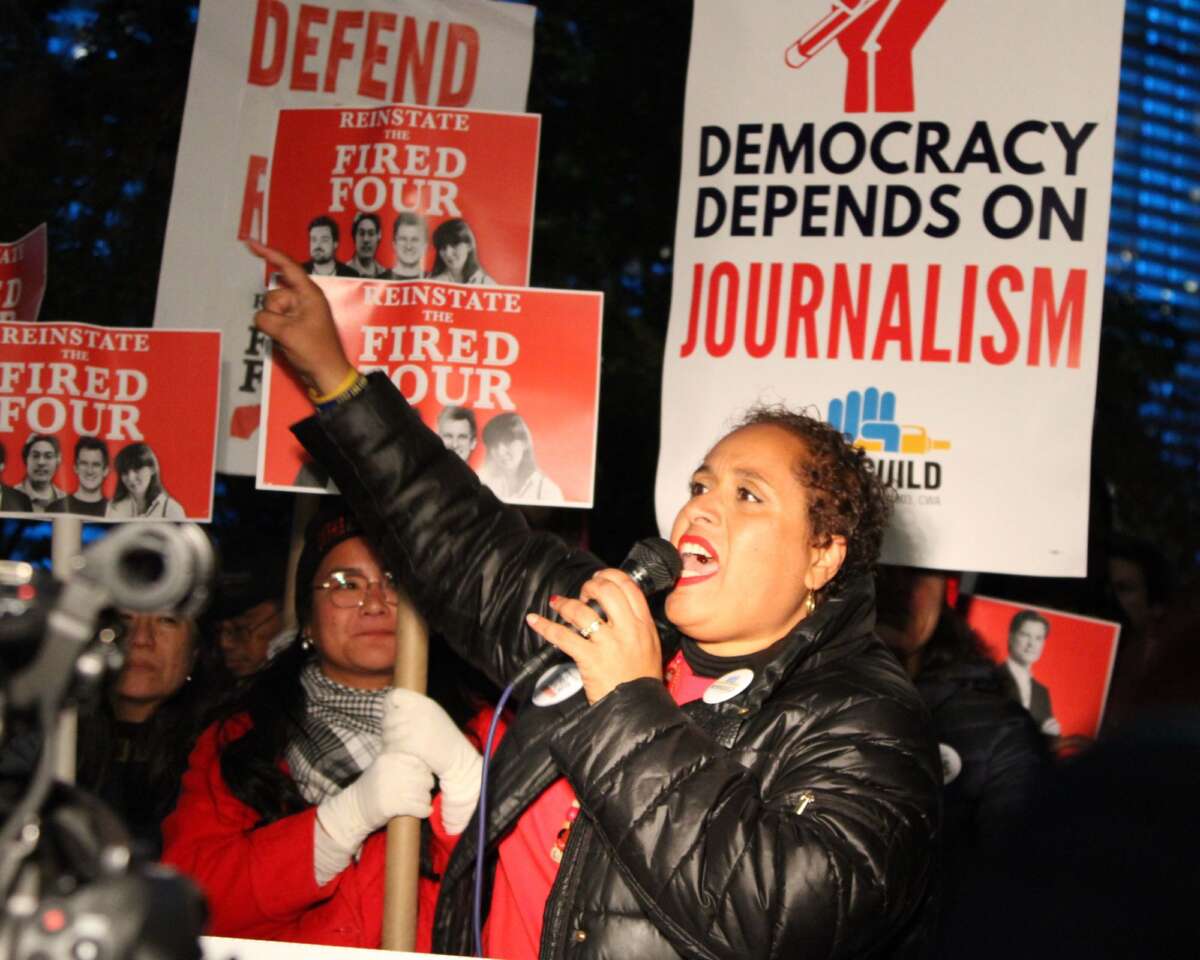
Susan DeCarava, president of New York NewsGuild-CWA, speaks during a rally with the Condé Nast union and the NewsGuild of New York to demand the reinstatement of four fired workers, on November 12, 2025, in New York City.The New York City Central Labor Council, AFL-CIO / @CentralLaborNYC via X


While media executives orchestrate mega-merger deals this winter, media workers are facing a maelstrom of job cuts and anti-union hostility, with old patterns of inequity surfacing in a wave of corporate consolidation and technological disruption.

Those two faces of corporate media were in the spotlight earlier this month, when red-clad members of the New York NewsGuild stood passing out flyers outside the Paris Theater, which was premiering the “New Yorker at 100” — a documentary paean to the magazine’s history of pioneering journalism. The NewsGuild’s flyers informed the audience that the media empire behind the publication was attacking its unionized staff.

In their announcement of the protest, union co-chair and New Yorker editor Daniel Gross, who was featured in the documentary, said, referring to the publication’s parent company, “Condé Nast’s ham-handed union busting is an embarrassment to the celebrated magazines that it owns.”

Last month, four journalists and prominent activists with Condé Nast’s union, Condé United, were abruptly sacked after they protested a spate of layoffs at another celebrated Condé Nast publication, Teen Vogue. A group of roughly 20 editorial staffers from the union gathered by the human resources department at Condé Nast’s 1 World Trade Center offices to confront the company’s Chief People Officer Stan Duncan with pointed questions about the layoffs. They did not get any answers, but within 24 hours, several of the leaders of the action got fired or suspended without pay, according to the Guild. What the union calls the “Fired Four” — Bon Appetit digital producer Alma Avalle; Wired senior White House reporter Jake Lahut; New Yorker senior fact checker Jasper Lo; and Condé Nast Entertainment videographer Ben Dewey — have now launched a campaign of their own.

The Guild has denounced the company’s treatment of the Fired Four as blatant union busting: Avalle is the vice president of the Guild, and Lo and Dewey had both previously served as vice chairs for their units. And the arc of labor conflict over just a few days — from the gutting of the staff at a major youth publication to the canning of other journalists who challenged the management’s decision — suggests a new level of intolerance for media workers who are vigilant about democracy inside and outside Condé Nast headquarters.


Condé Nast Fires Union Leaders After They Confront Bosses on Teen Vogue Layoffs
The firings and gutting of Teen Vogue come amid a hard right pivot by media companies under Trump. By Sharon Zhang , Truthout November 12, 2025


Condé Nast has not responded to a request for comment.

On the surface, such layoffs seem like a regular occurrence in corporate media these days, as many news outlets shed workers to cope with financial turmoil. For Condé Nast, which has in recent years undergone a number of strategic consolidations and plowed money into e-commerce and tech rather than journalism, the absorption of Teen Vogue into Vogue.com reflects the latest effort to revamp the publication’s brand as a commercial and social media entity.

Over the past decade, Teen Vogue had become known for its incisive coverage of issues and movements ranging from sexual assault to Black Lives Matter to union organizing. But the shedding of most of its staff in November — including its politics editor and other union members — along with an announcement that its focus would shift to “cultural leadership,” might signal the end of the outlet’s political journalism. The Roosevelt Institute, which had awarded Teen Vogue its 2025 Freedom of Speech medal, criticized the restructuring as “evidence that corporate concentration eliminates innovative ideas and silences voices with less power.”

Avalle was not entirely surprised when she was fired after asking hard questions about the decimation of Teen Vogue’s staff. But the immediate firing of current and former union leaders suggested that the management is trying to warn other union members that there will be consequences for dissent. While conflicts between the union and management had previously played out in the grievance process, Avalle told Truthout, in her recollection, “No one had ever been suspended, no one had been terminated for taking part in a union activity. This feels like a massive, massive escalation in that regard.”

“Labor issues, and particularly the way that media companies interact with their own workers, are often the thing that reveals how big of a lie the concept of the liberal media is,” she said. The company “has been renowned as a part of the liberal-left media …. You look at the way it deals with its unions and that is not what I would call liberal, left behavior. That is not embodying these sorts of progressive values that people on Fox News love to deride. They are behaving like the conservative bosses that they are.”

Around the time that Teen Vogue’s reporting staff was getting slashed, Trey Sherman, an assistant producer with “CBS Evening News Plus” who had also worked as an assistant producer with CBS’s Race and Culture Unit, posted a viral video upon losing his job when his program was slashed. After asking around, he discovered several white coworkers on his small team had, unlike him, been able to get reassigned to other divisions.

While the rationale for who stayed and who was let go was unclear, Sherman told Truthout, the outcome was discriminatory: “Every person on the team who was laid off was a person of color.”

The loss of those staffers came at the same time that the entire Race and Culture Unit was dissolved, which tracked with what Sherman and his coworkers had long perceived as structural inequity pervading the organization. As a former contractor with the division that specifically dealt with issues of racial and cultural diversity, Sherman believes institutional discrimination might deepen as CBS and other media outlets systematically dismantle diversity, equity and inclusion programs and policies. Layoffs and restructuring at other media companies like NBC have similarly targeted journalists of color and diversity initiatives that, like Race and Culture, had emerged in the wake of the 2020 Black Lives Matter protests.

Even though layoffs are happening en masse throughout the company’s ranks, Sherman said, “the result is that these corporations are creating an environment where women and people of color are bearing the brunt of cost-cutting measures harder than anyone else. We are disproportionately impacted.”

The dissolution of the Race and Culture Unit unfolded as CBS — which has not responded to a request for comment — installed right-wing commentator Bari Weiss at its helm. Under CEO and Donald Trump crony Larry Ellison, CBS’s rightward shift — which also includes establishing a “bias monitor” to keep newsroom “wokeness” in check — comes just as CBS’s parent company, Paramount Skydance, aims for a hostile takeover of Warner Bros. The deal would be another megamerger in an increasingly consolidated, financially volatile media landscape. Consolidation is one of the structural factors associated with the homogenization and erosion of the integrity of journalism, at the expense of media diversity — in terms of the stories that get told, who is telling them, and the range of sources delivering news to the public.

The concentration of power in a handful of media corporations leaves underrepresented communities vulnerable, Sherman said: “There really are supposed to be laws that protect all of us, our economy, the society, workers, everyone, from the consolidation of media that we see happening.… The fact that Black and Brown people and women can be pushed out of corporate America and really have no legal recourse sounds to me like maybe the law is wrong. If it’s supposed to protect us from monopolies or duopolies or whatever kind of concentration of power.”

Sherman hopes he can help develop new platforms and alternative institutions for voices like his, which are finding ever-fewer opportunities in the mainstream media for creative expression. With corporate outlets turning away from underrepresented communities, he’s seeking to “create a place for all these people who have been pushed out.”

The challenges besetting media workers like Sherman and the Fired Four go beyond precarity and layoffs. Tech “disruption” in corporate media institutions could lead to the displacement of human reporters by artificial intelligence tools that instantaneously generate professional-looking prose.

The NewsGuild recently organized a nationwide Week of Action under the banner of “News, Not Slop,” demanding that the industry implement ethical principles when adopting AI technologies to ensure that human journalists remain at the helm and that AI innovations are not used to undermine livelihoods, dilute the craft of journalism, or spread misinformation.

ProPublica environment journalist and Guild member Mark Olalde said in a statement, “There is no AI function, no matter how advanced, that can replace a human’s ability, our ability, to fully consider journalism’s ethical implications, to relate with a story’s subjects through lived experience or to approach an investigation with thoughtfulness and integrity.”

But while the limitations of AI can seem clear to principled journalists, profit-minded bosses may not be convinced. The problem comes back to the power gap between the people who control the media outlets versus the people who do the work. After all, management could make the cold calculation that replacing reporters with AI not only saves labor costs but also preempts union trouble from unruly staffers who demand more power, pay, or protections at work.

Within the union, Avalle said, “there are pretty massive discussions about how we as journalists, and how we as a worker organization of journalists, can be pushing for regulation of AI in a way that keeps folks with issues about objectivity comfortable, but at the same time, advocates for our ability to keep doing our jobs as workers, advocates for the rights of our members to continue doing work that is vital for the Republic.”

The scene outside the Paris Theater spoke to that dual role Avalle’s union is playing — pushing for democracy in journalism workplaces and championing free expression through their members’ work. While their boss hosted a swanky celebration of the New Yorker’s history, outside, rank-and-file Guild workers handed out flyers that spoke to the future of media the old-fashioned way, one printed page at a time.


This article is licensed under Creative Commons (CC BY-NC-ND 4.0), and you are free to share and republish under the terms of the license.

Michelle Chen
Michelle Chen is a contributing editor at Dissent Magazine, and a contributing writer at The Nation, In These Times and Truthout. She is also a co-producer of the “Asia Pacific Forum” podcast and Dissent Magazine’s “Belabored” podcast, and teaches history at the City University of New York. Follow her on Twitter: @meeshellchen.


New study finds movement of fishing fleets can reveal shifts in marine ecosystems


UC Santa Cruz researchers show how fishermen followed tuna that ventured beyond their typical territory due to unusually warm ocean temperatures


University of California - Santa Cruz

Bluefin purse seiner 

image: 

A bluefin purse seiner in the Pacific Ocean, off the coast of Mexico.

view more 

Credit: Credit: Andre Boustany


SANTA CRUZ, Calif. – Researchers at the University of California, Santa Cruz, have already leveraged the vast troves of geolocation data from vessel-tracking systems to pinpoint where whales and other large marine species are endangered by ship traffic and industrial fishing.

Now, in a new study led by Heather Welch at UC Santa Cruz's Institute of Marine Sciences, researchers show how the geolocation data generated by satellites for the global Vessel Monitoring System (VMS) can reveal where marine heatwaves are affecting the behavior of ecologically and economically valuable species. In a PNAS article to be published on December 22, the authors describe how tracking data on fishing reflected low albacore abundance in the north Pacific in 2023 due to a marine heatwave.

The year 2023 is important because that was when unusually warm ocean temperatures dispersed albacore more widely and made them cost-prohibitive to target. The following year, state governors requested a federal fisheries disaster be declared to provide economic assistance to the albacore fishery in light of the low harvests in 2023.

The request was made over a year after the 2023 season ended. In their study, the researchers say that the poor fishing season may have been recognized sooner if the near real-time VMS data had been recognized back then as a way to detect anomalies in marine conditions. And that, the study’s authors emphasize, is their most significant finding: that fishing fleets can serve as ecosystem sentinels.

“We have so much data on fishing vessel activity,” said Welch, an associate specialist at the Institute of Marine Sciences (IMS). “These data are traditionally used for surveillance, and it is exciting that they may also be useful for understanding ecosystem health.”

Human ecosystem sentinels

The concept of "ecosystem sentinels" as living sensors of changing conditions in their surroundings has been gaining traction among researchers seeking to better understand the impact of humans and climate change on natural habitats that are difficult to directly observe. The concept has been applied to animals ranging from birds to whales, and at UC Santa Cruz, the sentinel strategy may best be embodied by the elephant seals of Año Nuevo.

“Animals have been forewarning risk going back to the canary in the coalmine, s,” said Elliott Hazen, adjunct professor of ecology and evolutionary biology. “So when sentinels help us get out in front of ecosystem change, that both helps protect species and can save time and money.”

But if marine apex predators make for ideal ecosystem sentinels, the team behind this new study say fishermen fit that bill perfectly. They are highly tuned to changes in their environment, especially because those fluctuations can seriously impact their bottom line. "Fishermen can have wide-ranging movements allowing them to effectively sample large portions of the seascape," the authors state. "Importantly, fishermen are conspicuous and their activities are actively monitored via several near real-time, high-resolution data streams including vessel tracking systems, satellite mapping, and shoreside landing receipts."

Ocean warming’s toll on fisheries

More precise ecosystem monitoring could also help avert fishery collapses that hurt local economies and communities. Over the past few decades, long-term warming due to climate change and short-term spikes associated with El Niño and marine heatwaves have led to clashes among competing fleets, strain on fish-processing infrastructure, and overfishing. For instance, a 2012 heatwave in the Gulf of Maine drove lobsters into shallow waters, leading to a record catch that outpaced processing capacity and consumer demand. Lobster prices fell to 70% below normal and the market crashed. 

In another case, failure to recognize the impact of long-term warming on Gulf of Maine cod about a decade ago resulted in catch quotas that overestimated population levels and ultimately led to overfishing. The authors say that insights from fishing fleets as ecological sentinels may help accelerate management action to lessen the socio-economic and ecological harms of ocean warming.

Albacore and bluefin, the species at the heart of this study, are migratory temperate tunas that are seasonally targeted by West Coast fishermen during the summer and fall. Both species have been observed shifting northward and inshore during warm water conditions. In their analysis, the researchers found that VMS-tracked fleet movements mirrored the movements of the tunas. For example, the tunas and the fishery shifted north during a 2014-2016 marine heatwave, but remained in their normal distributions during subsequent heatwaves in 2019 and 2023. 

A new approach for a changing climate

This new study found that VMS was six times better at predicting shifts in tuna distribution than sea-surface temperature anomalies–a measurement traditionally used by researchers to correlate changing environmental conditions to ecological disruptions. Climate change is disrupting the relationship between environmental indices and ecosystem state, explained co-author Allison Cluett.

“As warming produces unexpected ecological responses to environmental variability, real-time observations of ecosystem health—such as those provided by fishing vessels—are increasingly important,” said Cluett, an assistant project scientist at IMS.

However, the authors acknowledge that confounding factors such as fishery-management actions like closures or quota changes can interfere with the strategy of employing fishermen as ecosystem sentinels. “Noise isn’t a reason to disregard this incredibly rich volume of data,” Welch said. “But it does mean we need to carefully review inferences from fishery sentinels to prevent noise from causing harm.”

Other members of the research team at UC Santa Cruz included Michael Jacox, Joshua Cullen, Rachel Seary, and Steven Bograd.