Tuesday, December 30, 2025


Source: The Lever

America’s health care spending is so out of control that the country’s economy is becoming dependent on it.

According to a report released last week by the US Department of Commerce, economic growth swelled in the third quarter of 2025. While that’s theoretically good news, an ever larger share of that consumer spending is devoted to health care costs: over the previous three months, expenditures on health care increased more than on any other goods or services. Health care spending, in fact, contributed more to the country’s gross domestic product growth than any other personal expenses.

The second-largest contributor to economic growth was an increase in consumer spending on nondurable goods — which, according to the US Bureau of Economic Analysis, “was mainly in prescription drugs.”

And these spending increases came before insurance premium bills are set to skyrocket next year for both individual and employer-sponsored health plans.

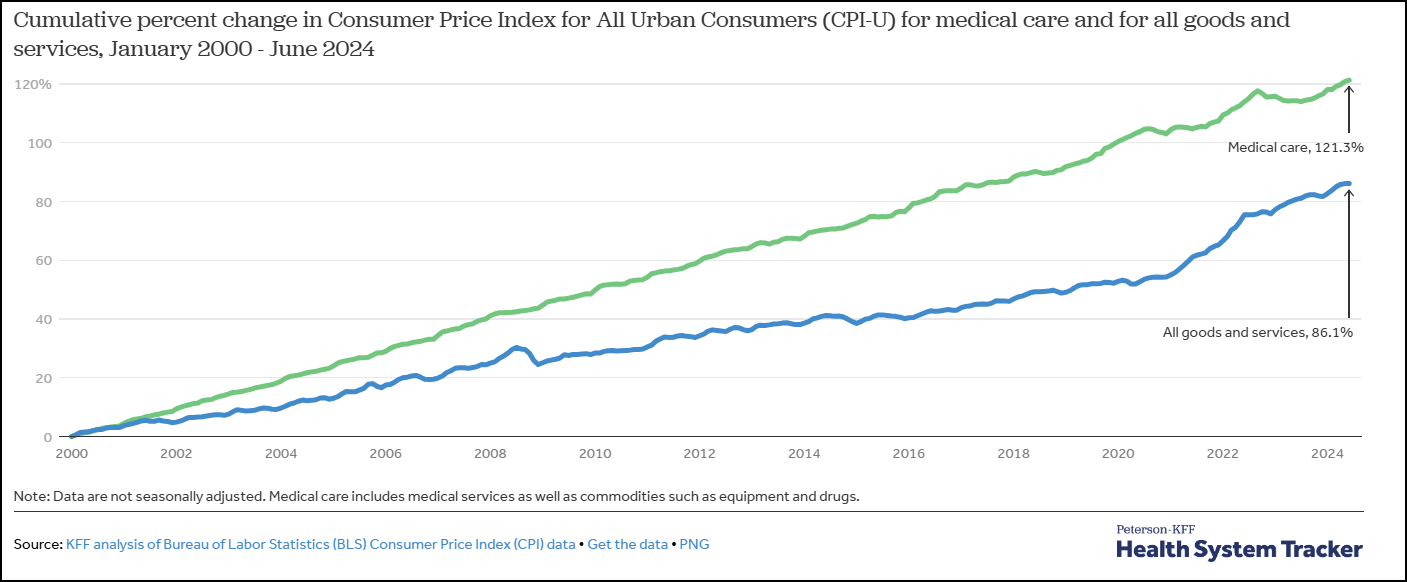
The rising cost of medical care, which includes medical procedures, nursing home services, insurance, drugs, and medical equipment, has long outpaced general inflation. Currently, health care spending represents about 18 percent of the US economy, meaning that roughly one out of every five dollars spent goes toward health care costs — more than what Americans spend on groceries or housing. In 1960, it was only 5 percent.

Source: Peterson-KFF Health System Tracker

Perhaps unsurprisingly, people in the United States are far outspending individuals in other high-income nations on health care–related costs. On average, other wealthy nations spend about half as much per person on health care as the US — even though American taxpayers subsidize the development costs of many of the drugs other countries pay far less for.

No wonder total US medical debt has surpassed $200 billion, with one in twelve US adults in debt over health care bills.

Medical spending is also fueling federal debt. According to the US Government Accountability Office, the costs of federal health programs like Medicare, Medicaid, and the Children’s Health Insurance Program accounted for roughly 31 percent of all federal program spending in 2024.

The solution is health care reform — reining in drug and procedure costs, cracking down on health care consolidation, cutting out price-gouging corporate middlemen, and ending systematic Medicare abuses, such as those common in for-profit Medicare Advantage plans. And, of course, moving forward with wildly popular Medicare for All.

But here’s the rub: as ever more of the country’s economy becomes tied to medical spending, it becomes increasingly difficult to challenge the corporations and reform the system that are consuming all of that money. As the Brookings Institution warned way back in 2008, “The high and rising cost of expanding coverage is a major reason why previous attempts to achieve universal coverage have not succeeded, and why reform will keep getting harder if we use the same approaches as in the past.”

Now, nearly twenty years later, has our health care system finally become too big to heal?


The Obscenities of Inequality: A Review of Trading Game, by Gary Steve

Source: Originally published by Z. Feel free to share widely.

Gary Stevenson has risen to fame on the back of his 2024 Sunday Times bestseller, Trading Game; an edgy rags to riches tale. Boy grows up poor in the London suburb of Ilford, in view of the Canary Wharf skyline. He progresses from a paper round to DFS stores selling bedwear. He and his family are often short of money. In school, he excels at maths. He applies for college and lands a place in the London School of Economics by winning a card game played with other applicants. He is in, with accompanying opportunities; which for him, turn out to be a job as currency trader in Citibank, in one of those Canary Wharf skyscrapers he used to gaze at. He quickly becomes a star earner. 

His roller-coaster journey eventually leads to the realisation that kids without predetermined or lucky opportunities, “have no reliable routes out of poverty” so they sell drugs and the like. But, “we are all the same. The difference is how rich our dads were…. you’re not better than us. It’s just two different games, from the very beginning. From birth.” 

Stevenson has a neat turn of phrase, a good eye for detail, and a sense of humour. Interesting things happen in each chapter: forward drama is sustained, with character development, conflicts and transformation, providing ready ingredients to compel attention.

Around the time the book came out, Stevenson launched his YouTube channel, Gary’s Economics (1.5 million subscribers as of October 2025). A kind of public information service, the channel hosts his talks and interviews. People are taking notice. This is his introduction: “I’m Gary Stevenson. I made millions of pounds working in The City, betting inequality was going to destroy our economy. On this channel I’m going to explain what is really happening in the economy – what this means for you, and what you can do about it.”

Most of the explanations echo what he says in his book. He notes the impact of changes in high finance strategies over the years; how, for example, until 2008, interest-rate management (mainly, printing of more money by government) 1. conquered inflation; 2. ended boom and bust; 3. achieved sustained economic growth.

He writes: “By the beginning of 2011, it had become clear to me that the market was wrong. Not just the market, but the economists, the universities, the Monetary Policy Committee in the Bank of England, the news, the whole fucking shitshow…these guys blew the world up using nothing but mathematics, idiocy and hubris”

A sustainable economy for all no longer seemed to matter. He tries to figure it out: “All these governments were spending more than their income year after year, and their debts were growing.” Stevenson saw the same with ordinary people: “outgoings more than their income… For everybody losing money, there’s someone who’s gaining” (this rule, he says, defines a monetary system). Regarding houses and the stock market, he deduced: “we were the balance. We’re the boys who’d be richer than our fathers in a world of children who’d be poor…it wasn’t a crisis of confidence… It was inequality. Inequality that would grow and grow, and get worse and worse until it dominated and killed the economy that contained it. It wasn’t temporary; it was terminal… cancer.”

At the zenith of his success trading in billions, these thoughts drove him to some neurotic behaviour and physical illness. His discomfort deepened. He knew he needed to get out. But then his real troubles start, as he recounts:

“When Citibank paid me that huge bonus, the bonus that I can’t remember, at the beginning of 2012, they took care to tie me tight to my screens. Some of the bonus was to be paid up front, which was the money I was investing. The rest was to be paid with a significant delay. A quarter in 2013; a quarter in 2014; a quarter in 2015; a quarter in 2016. So you see, at that point, I could not really leave. The bank owed me over a million pounds. If I quit, I’d lose it all.”

He went to HR, hoping to leave to join a financial charity, as his contract seemed to permit. They indulged his hope, letting him apply, even though, “the paperwork package to leave and go to charity was enormous.”

In early 2013, he was called to a meeting with one of his managers, who only tightened the noose: “I’m afraid to tell you that the option is only possible with the approval of bank management. Bank management will not be giving approval.” In other words, you can leave but the money stays here, because his application was rejected. He remained trapped and humiliated. But he would not accept the suffocating conditions of his station. He went off sick. He got legal advice. He would play the long game and wear them out until they let him go with what he was owed. And after a year of constructive dismissal, hanging around being micromanaged yet paid to do nothing, they give in. He walks, bonus granted. 

Near the end of the book, he looks back and wonders if he really outsmarted Citibank at all: “How do we ever know which of our wins, and which of our losses were from luck, and which ones were from skill?” Like trading. “I made money in 2011 and 2012, by betting on the collapse of the global economy, the slow but constant and certain collapse of living standards for ordinary people, for ordinary families, the descent of hundreds of millions of families across the world into inescapable poverty”

But then, “what do we do? Do we let it happen?… We can bet on the end of the world… we can all of us get rich from the end of the world, but not stop it, just watch it collapse.” 

He excelled at bank gambling because he could accurately discern major societal trends, from how people were living, rather than from economic models others relied on. The tolerance of growing inequality is what concerns him. The link between income inequality and democratic erosion has been well established but little policy action taken to address it. John Cassidy, writer of Capitalism and Its Critics, saw that while academics usefully keep ideas alive, what drives social changes are material conditions and political movements, galvanised by crisis. One current obstacle is minimal labour organisation, even as signs of desire appear for more managed capitalism, in recognition of market limitations. Without strong government systems and international solidarity, democracy fails to thrive. 

Inequality.org monitors America’s 100 largest low-wage corporations, CEO pay, and formerly illegal stock buybacks which have climbed since 2019, while median worker pay drops below U.S. inflation. Stevenson concluded that inequality was the winning trade. “The rich get the assets; the poor get the debt; and then the poor have to pay their whole salary to the rich every year just to live in a house. The rich use that money to buy the rest of the assets from the middle class; spending power disappears permanently from the economy; the rich becoming much richer and the poor…just die”

A good example of how private companies profit off human misery such as asylum-seeking, then dump on public services when funds dry up, appears anonymously, titled ‘Hotel Britannica’, in the April 2025 issue of Fence Magazine. Stevenson’s credible positions on these dystopian elements have gained as much traction as the likes of Farage, albeit with contrasting views and motives. Spending more on workers and the environment would mean less shareholder dividends and executive pay. Business Roundtables fight against benefitting other stakeholders. Ecological economists like Josh Farley chime with Stevenson’s detection of chinks in economic theory promises, whose actual outcomes include faster ecological collapse, public health declines, and increasing inequality and social disconnection. A framework prioritising ecological stewardship, cooperation, and well-being gains support. 

In an overview of catastrophe risk, F. U. Jehn examines the United Nations Office for Disaster Risk Reduction (UNDRR) report, “Hazards with Escalation Potential: Governing the Drivers of Global and Existential Catastrophes” (Stauffer et al., 2023), along with the WEF’s 2025 Global Risks Report. Inequality emerges as the key issue, very seriously influencing many other potential risks, while also primarily responsible for past crises. But the Global North seems intent on business as usual, and zero-sum logic, in reviving national industries and strengthening militaries, as if indifferent to exacerbated international fragmentation, and abandoning collective improvement of the global economic order. As Planet Critical’s Rachel Donald put it: “Most dangerous among us are those whose violence is permissible… because they are never forced to come face to face with those on whose backs they have built their kingdoms. Inequality has created societies where a minority are freed from the consequences of their actions.”

Ed Zitron uses terms like the Rot Economy and Shareholder Supremacy to convey inherent neoliberal selfishness. A critical tool proposed by the New Economics Foundation (NEF) is an extreme wealth line (EWL) – a metric or set of metrics which indicate the point at which extreme wealth concentration harms democracy, society, the economy, and the environment. This confronts the insidious role of extreme wealth in everyone’s quality of life, revises wealth norms, promotes fairer economics and policies including wealth taxation, as Rutger Bregman famously urged at Davos. Instead, with business as usual, wealth accumulation is rewarded by innumerable inducements, concessions and depreciation asymmetries. Reversing such perverse wealth transfers requires macroeconomic measurement reform to gauge actual wealth redistribution, and microeconomic policies to protect workers. This is the raison d’être of global campaigns like, End Austerity, comprising civil society organisations, trade unions, activists, and researchers calling to end austerity measures imposed by international financial institutions towards realising rights, development and social justice. For economically-hit deprived communities, Oxford professor Paul Collier narrows solutions down to devolved governance and serious long-term investment redistribution as top supports for people to get back on their feet. 

In unpublished writings exploring ecology, Karl Marx imagined indigenous communism sustaining capitalist degrowth, to include community ownership, coops, mutual aid, and short work weeks, rather than sustainable development goals and green deals with growth imperatives. Instead of curbing transnational drivers of environmental degradation such as mining and cattle-ranching, offshore nature financing of conservation and carbon trading gives cover to opaque land and asset grabbing, where wealthy agents consolidate control over global impoverished labourers. Offshore: Stealth Wealth and the New Colonialism, Brooke Harrington’s book, inspects ‘the system’, the professional enablers who counsel the ultra-wealthy on ways to save and hide huge fortunes in secret offshore accounts. 

On learning an RAF squadron was owned by a hedge fund, Craig Murray discovered how layers of subsidiary companies disguise ownership, and facilitate tax avoidance, and other forms of corruption, like consultancy contracts and associate directorships. Companies making unprecedented profits from manmade wars and famines, including Microsoft, Amazon & Google, are described by a 2025 UN report as a ‘joint criminal enterprise’. Time will tell if the writer about ‘necrocapitalism’, George Tsakraklides is correct in his evaluation of the Palestine conflict: “Palestine had to go because it wasn’t making anyone any serious money, like an employee given the boot with no notice. For capitalism, Palestine was yet another forest: its value could only be redeemed once it was turned into woodchip and casinos with a sea-view.” Writing of the crises which plague capitalism 177 years ago, Marx and Engels observed that “not only has the bourgeoisie forged the weapons that bring death to itself; it has also called into existence the men who are to wield those weapons — the modern working class.”

For a 2014 paper, political scientists reviewed 1,779 policy debates and found that preferences backed by popularity will never succeed if some elites did not approve as well. Legitimacy is defended with surveillance-heavy guard and spy labour, at the expense of services. Rob Larson’s book, Mastering The Universe, portrays the gratuitous largesse insisted on by the rich. In an enjoyable rant by Cory Doctorow, billionaires’ compulsions for personal sovereignty turns them into toddlers seething to avoid all normal constraints. Sociologist Steven Vass notes a 50-year trend in class inequality linked to social divisions, increased neglect of the common good, and political corruption. Neoliberal logic corporatises states. The journal, Environmental Science & Technology Letters, reports on mechanisms of entanglement embedded by vested interests through funding, data and executive functions, which influence public servants involved in protecting people and planet. This trap works better the more precarity becomes the workplace norm.  

People trod on eventually say enough and at least try to reassert their primacy. Studying systemic criminality, Koenraad Priels insists on the need to go beyond policy reforms, and organise, with like-minded legal and human rights actors, for institutional and legal accountability, so as to litigate many state crimes, including elite impunity, ecocide, war racketeering, and institutional capture. He recently got the ball rolling by filing such a complaint at the ECHR, in the belief that, as the polycrisis was created by human choice, primarily by bankers and militaries, so can it be reversed, once gaping inroads into the pursuit of truth and the rule of law are plugged and repaired. Recent statements by Pope Leo establish him as adhering to his predecessor Francis’ convictions on the urgency of addressing social injustices and environmental destruction. Developing nations especially need to beware conditions for foreign capital promising globalisation benefits, as swapping sovereignty for dependence on such investment often forecloses preferred future possibilities in international trade and internal stability. 

In her book, Reimaging Prosperity, Marija Bartl warns against competitiveness policies, which elicit anxiety and are unfair. Specialists Kate Pickett and Richard Wilkinson confirm their previous findings, as well as Stevenson’s thesis, that health, social and environmental crises are sustained by inequality, which itself has worsened. They too recommend wealth taxes, plus universal basic income, and truly democratic policymaking e.g. citizens’ assemblies. participatory budgeting. Feminist scholars in particular would restore commons as the most promising socio- political structure for instilling widespread cooperation, collective care, and just governance. An international collaboration working on clear proposals for deep systemic change that cannot be expected from insider power players, the Centre for Research on Multinational Corporations (SOMO) aligns with a vision to target what Ray McGovern dubbed the MICIMATT (Military-Industrial-Congressional-Intelligence-Media-Academia-Think-Tank), to define interconnected sectors of influence on policy-making. Stevenson’s outreach to other concerned figures segues with this partnership model. 

Critics have not neglected Stevenson, with media articles, especially one in the Financial Times, quoting former colleagues disputing his claims, but this clutching at straws pales in the headlights of his sincerity. He is a member of Patriotic Millionaires UK, who describe themselves as, ‘millionaires fighting inequality. To move money from the rich & create political economies where wealth does not mean power.’

He closes Trading Game with these lines: “I don’t know; I suppose games are like that. Sometimes you win and sometimes you lose. And, you know, what’s more important than winning? I don’t know. I can think of nothing.”       

Fortunately. Gary Stevenson has thought a lot about what’s more important than the few winning, and is among those doing something about the gap. 

Caroline Hurley is a Degrowther and Fallibilist, who lives in a sustainable community in rural Ireland. Her range of poetry, fiction, reviews and other non-fiction has featured in a variety of publications including Books Ireland Magazine, ZNetwork, Ireland’s Own Magazine, Arena Magazine (Au), Village Magazine, Dublin Review of Books, and elsewhere.                 


Source: London Review of Books

On 16 October the Associated Press reported that a ‘clash’ between the Indonesian military (TNI) and the West Papua National Liberation Army (TPNPB) had left fourteen people dead. According to the AP, the TNI said they faced ‘military-grade weapons’ during a six-and-a-half hour battle in Soanggama, a village in Intan Jaya Regency. The details of the weapons seized from the TPNPB paint a different picture: a home-made rifle, binoculars, four air rifles and some rounds of ammunition.

As the TPNPB told the AP, only three of the dead were connected to the armed struggle. The report omitted a fifteenth victim, a 75-year-old woman who fell into a river and drowned while being chased by soldiers. Another victim, Agus Kogoya, was executed after producing his identity card: he shared a surname with a TPNPB fighter.

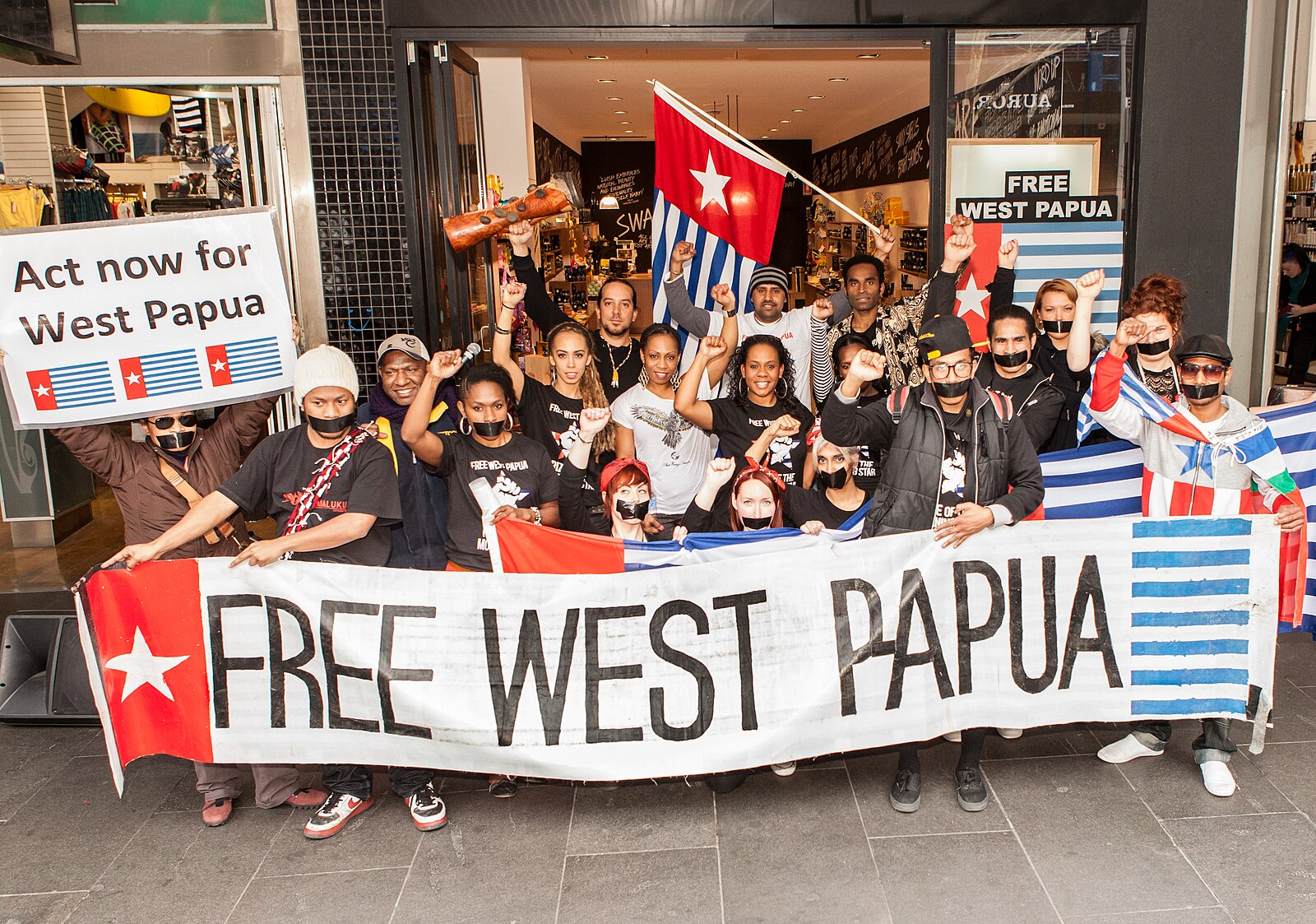
Indonesia has occupied West Papua since 1963. A media blackout, enforced for decades, means the scant press coverage is often drawn largely from TNI press releases. What happened in Soanggama seems to have been less a ‘clash’ than a massacre. The three confirmed TPNPB members were captured and tortured before being killed.

In the days that followed, the Indonesian airforce bombarded Kiwirok in the Star Mountains, near the border with Papua New Guinea. Aerial attacks have increased in frequency throughout 2025, reflecting both the sophistication of Indonesia’s arsenal and its reluctance to be drawn into close-range combat with the TPNPB.

The conflict in West Papua may be the world’s most unequal war: raids on military bases have improved the TPNPB’s fighting capacity, but they still often face Indonesian jets and missiles armed only with bows and arrows. The activist Tom Beanal, who died in 2023, once asked if West Papua was colonised by Indonesia or by the entire world. Munitions recovered by Lamek Taplo, the TPNPB commander in Kiwirok, include Serbian mortars, Chinese drones and bombs manufactured by the French arms company Thales. Taplo was killed by one such bomb on 19 October, shortly after recording video testimony of the attack that he hoped would force the UN to intervene. Standing in the fallout zone of an Indonesian missile, Taplo offered his beleaguered troops a final prayer: ‘God please raise up our nature and our ancestors; the ones eaten by Indonesia in Kiwirok.’

To say, as Indonesia does, that increased guerrilla attacks are behind the current escalation in West Papua, is begging the question. Control of West Papua’s resources has long been the principal strategic goal of Indonesia’s occupation, informing how and where it deploys its soldiers and its settlers. Much of Intan Jaya lies within the concession zone of the vast Wabu Block gold mine, including the Hitadipa and Sugapa districts, where in May five Papuans were executed and seven others disappeared. Begun in 2020, Wabu Block’s development has seen soldiers pour into Intan Jaya, spawning new TNI checkpoints – 31 in the last three months – and consequent restrictions on everyday life. In this highly militarised atmosphere, markers of Papuan identity such as dreadlocks become symbols of TPNPB membership, inviting beatings or arbitrary arrests.

At the same time, punitive bombing raids have destroyed villages across Intan Jaya, forcing thousands into makeshift camps. Just over 80,000 West Papuans were internally displaced at the beginning of the year; that figure has now increased to more than 100,000. Perhaps one in ten West Papuans has been a refugee in the last five years. By clearing Indigenous people from their land, the TNI both eases the extraction process and seeds future conflict: displacement allows extraction which leads to further displacement.

The cycle is compounded by the TNI’s financial interests in the mines and plantations that they work to protect. A 2021 report identified a number of military figures – active-duty personnel along with retired generals – as investors in the companies behind Wabu Block. The highest profile shareholder is Luhut Pandjaitan, a four-star general and former investment minister, who brought a defamation case against two Indonesian solidarity activists who accused him of profiting from the mine. They were acquitted in January 2024.

Pandjaitan’s involvement in Wabu Block is a measure of the TNI’s relative independence from Jakarta, which endured in West Papua past the fall of Suharto’s New Order. President Prabowo Subianto, a former general accused of atrocities in East Timor, inherited a number of ambitious industrial ventures in West Papua from his predecessor, Joko Widodo, including the largest deforestation project in human history and the 4000km Trans-Papua Highway, intended both to increase production on existing agribusiness initiatives and to encourage new ones.

Seen at first as a reformer, Widodo won Papuan votes on a promise to loosen media access and address atrocities such as the 2014 Bloody Paniai massacre, in which five children were killed and seventeen wounded. At the end of his first term, however, Widodo appointed his one-time electoral rival Prabowo as defence minister. (On assuming the presidency in 2024, Prabowo selected Widodo’s eldest son, Gibran Rakabuming Raka, as vice president.)

Rather than rein in the TNI, Widodo confirmed their status as an autonomous power in West Papua. A law passed in 2021 increased the number of provinces there from two to five, ensuring an expanded checkpoint and surveillance regime and giving the military an increased role in administration. Only one soldier involved in Bloody Paniai was put on trial and he was acquitted of all charges in 2022. The combination of a hands-off approach to military command and a terra nullius view of economic development produced the bloodiest phase of the occupation for two decades.

Where Widodo accommodated the TNI, Prabowo is leading it, synthesising the political and military dimensions of Indonesian rule. He has abandoned the euphemistic language of ‘development’, declared Suharto a national hero and instructed Papua’s regional governors to dress in military fatigues during their inauguration.

In another linguistic shift, the TNI have announced that they will stop referring to the TPNPB as KKB (Armed Criminal Group), instead reverting to the traditional designation OPM (Free Papua Movement). In West Papua, OPM doesn’t refer to a particular armed group but to the more general spirit of liberation and resistance to which the vast majority of West Papuans adhere. As one Papuan refugee described it, ‘OPM is not an organisation, it is just a feeling that everyone has for their own fate.’ From this revolutionary perspective, every West Papuan is OPM. But as Soanggama showed, a version of this idea is also held by the Indonesian military: they’re all OPM when they’re dead.Email

Douglas Gerrard is a writer and researcher based in London.


Source: Originally published by Z. Feel free to share widely.

For anyone paying even modest attention to the current administration’s foreign policy posture, a Christmas Day bombing justified as “protecting Christians from ISIS” in Nigeria was neither shocking nor clarifying. It fits a familiar rhetorical script. What it did not fit was reality.

Nigeria’s violence is real, devastating, and long-standing, but it is not best understood as a campaign of religious extermination. Insecurity there is driven primarily by land disputes, criminal networks, resource competition, ethnic fragmentation, and profound state fragility. Religious identity often becomes the language through which these conflicts are narrated, but it is not their root cause. Reducing Nigeria’s crisis to a story of Christian genocide is not only analytically lazy, it is misleading.

What makes the Christmas Day strike especially troubling is its direct contradiction of the administration’s own stated national security doctrine. That strategy criticizes decades of U.S. foreign policy built on vague platitudes masquerading as strategy and calls instead for disciplined, outcome-driven statecraft with clear political end states.

Yet a one-off bombing on Christmas Day, absent any coherent diplomatic or political framework, is precisely the behavior the strategy claims to reject. What is the actual political or strategic objective? To scare ISIS? To coerce Nigerian authorities into protecting Christians from a genocide that U.S. officials themselves have not demonstrated exists? If there is a theory of change here, it has not been articulated, because it likely does not exist.

The irony is hard to miss. While the administration claims to be acting on behalf of Nigerian Christians, Nigerians themselves remain subject to a partial U.S. visa ban and heightened entry restrictions that, in practice, sharply limit access. This restricts lawful migration pathways for students, professionals, families, asylum seekers, and religious minorities alike, treating an entire population as a presumptive security risk rather than as individuals with rights and agency. Bombing in the name of Nigerian Christians abroad while partially closing America’s doors to them at home does not project moral clarity. It exposes a foreign policy that instrumentalizes human suffering rhetorically while reproducing exclusion materially.

The selectivity of outrage is equally revealing. While Nigeria receives outsized rhetorical and military attention, the administration has been far quieter about Sudan. Thousands of civilians, including Christians, have been killed in Sudan amid mass atrocities carried out by the Rapid Support Forces, particularly in Darfur. U.N. investigators and human-rights groups warn that ethnically targeted violence, church destruction, and attacks on religious minorities there approach genocidal levels. The disparity in attention raises uncomfortable questions about consistency and motive.

This is not an isolated set of decisions but a recurring pattern. Complex global crises are simplified, sensationalized, and weaponized for domestic political signaling rather than addressed through serious diplomacy, multilateral engagement, or long-term strategy. From fantastical claims of a genocide facing Afrikaners in South Africa to open-ended counterterrorism strikes in Somalia conducted without a clear political end state, spectacle substitutes for strategy.

This pattern is also visible in the administration’s hostility toward Venezuela. If the objective is regime change, what happens if it succeeds? Who governs, with what legitimacy, and with what capacity to stabilize a country already devastated by poverty, criminal networks, and institutional collapse? And if regime change fails, is there a diplomatic off-ramp, or does coercion simply become indefinite policy? Drug trafficking is a serious regional problem, but it extends far beyond any single leader. Removing Nicolás Maduro from power would not resolve the structural drivers of the trade, suggesting motivations that go well beyond counternarcotics alone.

Lest we forget history. The United States spent decades using sanctions, covert action, and isolation to unseat Fidel Castro. He remained in power until his death, and the political system he built still governs Cuba. Pressure without a viable political settlement often hardens into permanence rather than producing change.

The intervention in Nigeria raises the same strategic questions about rationale, proportionality, and end goals. Are these bombings symbolic gestures or the start of an open-ended campaign? If they continue, what is the theory of change, and what is supposed to be different on the ground months or a year from now? Conservative talking points erase the real drivers of violence–land competition, resource scarcity, criminality, and state weakness–replacing them with a simplified narrative of religious persecution. That framing is especially questionable given that residents and local officials report the targeted town of Jabo had no history of interreligious violence and no known ISIS presence.

Nor is this approach securing legitimacy at home. Polling by CBS News shows roughly 70 percent of Americans oppose armed conflict in Venezuela. While polling specific to Nigeria has yet to emerge, past public resistance to open-ended foreign interventions suggests this bombing is unlikely to enjoy sustained domestic support.

What did earn the United States legitimacy abroad was sustained engagement with root causes through foreign assistance. Long-term investments in governance, development, conflict prevention, and humanitarian relief addressed instability before it metastasized into violence. Foreign assistance was imperfect, and I have no shortage of criticism for how it was often designed and politicized. But it remained one of the few tools that allowed the United States to exercise influence without coercion.

That credibility has now been hollowed out. By dismantling development and democracy programs and slashing humanitarian aid, the administration has eroded a core pillar of American soft power. Humanitarian organizations and public-health analysts estimate that disruptions linked to recent foreign-assistance cuts have already contributed to over 600,000 preventable deaths worldwide. You cannot bomb your way to legitimacy after defunding the very systems designed to prevent conflict and save lives.

The bottom line is this. Manufactured crises and political theater are fooling no one. They are not making the world safer, they are not advancing U.S. interests, and they are certainly not putting America first. Absent strategy, planning, and clear political end states, they amount to performative uses of force that waste resources at a time when many Americans are already feeling the strain of a rising cost of living. Endless, contradictory conflicts sharpen neither U.S. credibility abroad nor security at home. We deserve better.

Jared O. Bell, PhD, syndicated with PeaceVoice, is a former U.S. diplomat and scholar of human rights and transitional justice, dedicated to advancing global equity and systemic reform.Email