Tuesday, December 30, 2025

Chinese homeschool students embrace freer youth in cutthroat market


By AFP
December 29, 2025


Estella, 14, a homeschooled student, does a Spanish class from her bedroom in Shanghai - Copyright AFP Hector RETAMAL


Mary YANG

Fourteen-year-old Estella spends her weekdays studying Spanish, rock climbing or learning acupuncture in her living room as part of her homeschooling since she left China’s gruelling public school system.

Her parents withdrew her from her Shanghai school three years ago, worried she was struggling to keep up with a demanding curriculum they believe will soon be outdated in the era of artificial intelligence (AI).

They are among a small number of parents in China who are rethinking the country’s rigorous education system, in which school days can last 10 hours, with students often working late into the evening on extra tutoring and homework.

“In the future, education models and jobs will face huge changes due to AI,” Estella’s mother Xu Zoe told AFP, using a pseudonym.

“We wanted to get used to the uncertainty early.”

Homeschooling is banned in China, although authorities generally overlook rare individual cases.

Just 6,000 Chinese children were homeschooled in 2017, according to the non-profit 21st Century Education Research Institute. By comparison, China had roughly 145 million primary and middle school students that year.

But that number of homeschoolers had increased annually by around 30 percent from 2013, the institute said.

Supporters say looser schedules centred around practical projects and outdoor activities help nourish creativity that is squashed by the national curriculum.

In Shanghai, Estella’s school day ended at 5:00 pm, and she often spent around four hours a night on homework.

“Instead of just doing a stressful exam in school, I will do the things I was interested (in),” said Estella, who, unlike many students her age, will not be cramming for high school entrance exams she would have taken next year.

Her parents have hired tutors in science, maths, Spanish and gym, and together with Estella decide her schedule.

On a Tuesday afternoon, she was the youngest at a nearby climbing gym, hoisting herself up the wall after a day of online Spanish studies from her living room and an acupuncture lesson taught by her mother.

Xu, 40, said her daughter has grown more confident since leaving the highly competitive public school system.

“We don’t use societal standards to evaluate ourselves but rather, what kind of person we want to be,” she told AFP.


– ‘Jobs are disappearing’ –


Experts say Chinese people are increasingly questioning the value of traditionally prized degrees from elite universities in an oversaturated market.

In 2023, fewer than one in five undergraduates from Shanghai’s prestigious Fudan University found jobs immediately after graduation.

The country’s unemployment rate for 16- to 24-year-olds reached a two-year high of 18.9 percent in August, according to the National Bureau of Statistics.

“(China) has out-produced. Too many PhDs, too many Masters, too many undergraduates. The jobs they are trying to get are disappearing,” Yong Zhao, an author on China’s education system, told AFP.

Chinese authorities have tried to counter the competitive learning culture by cracking down on cram schools in recent years — but tutoring, paid under the table, remains in demand.

While homeschooling is technically illegal, Zhao said families can generally “get away with it without causing too much attention”.

One mother in Zhejiang province, who wished to remain unidentified for fear of repercussions, said she used an AI chatbot to create a lesson plan on recycling for her nine-year-old homeschooled son.

“The development of AI has allowed me to say that what you learn in a classroom, you don’t need anymore,” she told AFP.

Her son studies Chinese and maths using coursework from his former public school in the mornings and spends afternoons working on projects or outdoor activities.

However, his mother, a former teacher, plans to re-enrol her son when he reaches middle school.

“There’s no way to meet his social needs at home,” she said.


– ‘Don’t be afraid’ –


Time with children her age was one of the biggest losses for 24-year-old Gong Yimei, whose father pulled her out of school at age eight to focus on art.

She studied on her own with few teachers, and most of the people she called friends were twice her age.

But at home, Gong told AFP she had more free time to consider her future.

“You ask yourself, ‘What do I like? What do I want? What is the meaning of the things I do’?” said Gong, who hopes to launch an education startup.

“It helped me more quickly find myself.”

Back in Shanghai, college is an uncertainty for Estella, whose family plans to spend time in Europe or South America to improve her Spanish.

Her mother, Xu, is hopeful that homeschooling may become more mainstream in China. Xu said she would encourage other parents considering it to take the leap.

“You don’t need to be afraid,” she said.
WTF


Trump admin rushes to demolish 13 more historic DC buildings as preservationists fight back


Alexander Willis
December 30, 2025
RAW STORY


Demolition of the East Wing of the White House continues where U.S. President Donald Trump's proposed ballroom will be built, in Washington, D.C. on Oct. 23, 2025. REUTERS/Kevin Lamarque

Not long after its demolition of the historic East Wing of the White House, the Trump administration is now looking to expedite the demolition of more than a dozen historic buildings in Washington, D.C. – and leading preservation organizations are fighting back.

According to documents obtained by The Washington Post, Homeland Security Secretary Kristi Noem is seeking emergency approval to demolish 13 historic buildings at the historic federal campus St. Elizabeths, established by Congress in 1855 and originally called the “Government Hospital for the Insane,” the newspaper reported Tuesday.

In a memo obtained by the Post, Noem said that the buildings constituted “a present risk to life and property” given that the buildings sit on the DHS’ West Campus complex, and that their vacancy could be used by “individuals seeking to cause harm to personnel,” including those seeking to carry out “active shooter scenarios.”

DHS filed an emergency notification with the General Services Administration (GSA) – the federal agency that manages government property – to expedite the buildings’ demolition, giving preservationist organizations just three days to respond to the inquiry. Not only did preservationist groups push back on the request, but some disputed Noem’s assessment as “problematic.”

“If the space within these vacant buildings is accessible, [it’s the GSA and Homeland Security that have] “failed to effectively secure them,” reads a joint letter sent to the GSA from the National Trust for Historic Preservation and the D.C. Preservation League, according to the Post.

“A unilateral declaration like this is problematic because it bypasses the procedural safeguards designed to ensure stability, legitimacy and fairness. [Noem’s concerns over safety] imply a fundamental flaw in the facility’s security as a whole.”

The DHS’ rush to demolish historic buildings in Washington follows President Donald Trump’s controversial efforts to construct his White House ballroom, a project that saw the demolition of the historic East Wing that has been condemned by critics and historians alike.
Artists Cite Trump’s ‘Ego’ and ‘Overt Racism’ While Canceling Kennedy Center Performances

“When American history starts getting treated like something you can ban, erase, rename, or rebrand for somebody else’s ego, I can’t stand on that stage and sleep right at night,” said folk singer Kristy Lee.


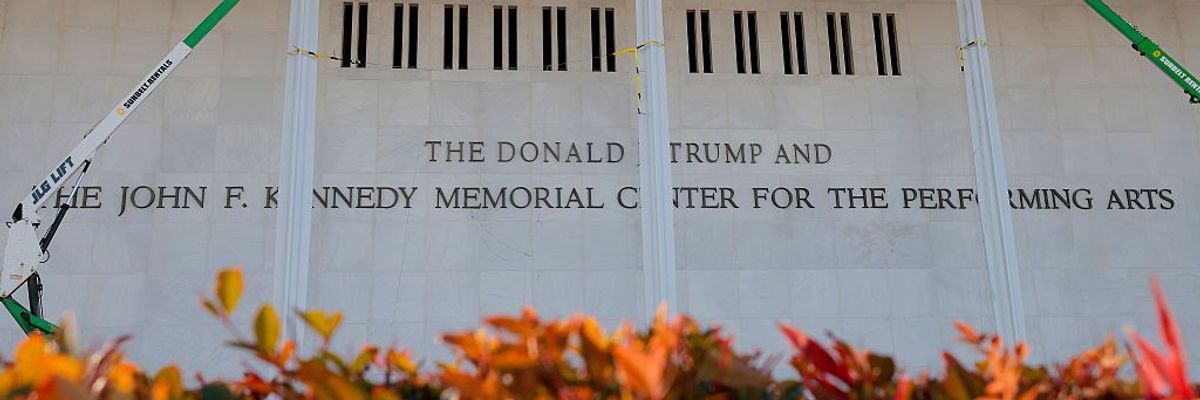
Workers adjust the name of the “John F. Kennedy Memorial Center for the Performing Arts” on December 19, 2025 in Washington, DC.
(Photo by Heather Diehl/Getty Images)


Brad Reed
Dec 30, 2025
COMMON DREAMS


President Donald Trump’s decision to slap his name on the side of the John F. Kennedy Center for the Performing Arts is not going over well with many of the artists scheduled to perform there.

Days after the annual Kennedy Center Christmas Eve jazz concert was canceled over performers’ objections to the name change, more artists have decided to withdraw in protest over the president’s actions, leading to the cancelation of New Year’s Eve festivities at the center.

‘Gross’: Critics Recoil After Trump-Appointed Board Adds His Name to Kennedy Center


‘This Is a Desecration!’ DC Residents Rage After Trump Slaps His Name Atop Kennedy Center

A Monday report from the Washington Post quoted saxophonist Billy Harper, a member of the jazz ensemble the Cookers that had been set to perform on New Year’s Eve, as saying his group did not want to play in a venue that had been unofficially renamed after the current president.

“I would never even consider performing in a venue bearing a name... that represents overt racism and deliberate destruction of African American music and culture,” said Harper. “After all the years I spent working with some of the greatest heroes of the anti-racism fight like Max Roach and Randy Weston and Rahsaan Roland Kirk and Stanley Cowell, I know they would be turning in their graves to see me stand on a stage under such circumstances and betray all we fought for, and sacrificed for.”

The Cookers weren’t the only artists to withdraw from a scheduled performance at the Kennedy Center, as the New York-based dance company Doug Varone and Dancers also announced Monday that they were withdrawing from April performances at the venue.

In a social media post announcing the cancelation, the company explicitly linked its decision to Trump’s renaming of the building.

“With the latest act of Donald J. Trump renaming the Center after himself, we can no longer permit ourselves nor ask our audiences to step inside this once great institution,” the company explained.

Doug Varone, the head of the company, told the New York Times that his decision to cancel the performance was “financially devastating but morally exhilarating,” and he noted that the troupe was set to take a $40,000 hit from withdrawing.

Folk singer Kristy Lee last week also announced she would not be performing at a scheduled Kennedy Center show in January, even while acknowledging that doing so “hurts” her financially.

However, she emphasized that “losing my integrity would cost me more than any paycheck,” and argued that “when American history starts getting treated like something you can ban, erase, rename, or rebrand for somebody else’s ego, I can’t stand on that stage and sleep right at night.”

Trump-appointed Kennedy Center chairman Richard Grenell has lashed out bitterly at artists for canceling their performances, and accused them of having “a form of derangement syndrome.” Grenell has also threatened to sue the jazz musicians who withdrew from the Christmas Eve performance for $1 million in damages.
Our trust in AI systems to make moral decisions is a long way off


By Dr. Tim Sandle
SCIENCE EDITOR
DIGITAL JOURNAL
December 29, 2025


Chatbots are seen as one of the greatest annoyances - Copyright AFP OLIVIER MORIN


AI continues to advance across all fields and in differing ways, at different levels of sophistication. However, our acceptance of AI depends on the context in which we seek to use it. Meal recommendations is one thing, morality is another.

This is not least because studies have demonstrated how AI systems tend to take on human biases and amplify them. In addition, people interacting with biased AI systems can then become even more biased themselves, creating a potential snowball effect wherein minute biases in original datasets become amplified by the AI, which increases the biases of the person using the AI.

As an example, AI systems like ChatGPT can develop ‘us versus them’ biases similar to humans — showing favouritism toward their perceived ‘ingroup’ while expressing negativity toward ‘outgroups’.
Artificial moral advisors

Artificial moral advisors (AMAs) are systems based on artificial intelligence (AI) that are starting to be designed to assist humans in making moral decisions based on established ethical theories, principles, or guidelines. While prototypes are being developed, at present AMAs are not yet being used to offer consistent, bias-free recommendations and rational moral advice.

Yet as such machines powered by artificial intelligence increase in their technological capacities and move into the moral domain it is critical that governments and technologists understand how people think about such artificial moral advisors.

It would appear there is some way to go.

Research from the University of Kent’s School of Psychology has explored how people would perceive these advisors and if they would trust their judgement, in comparison with human advisors.

The study found that while artificial intelligence might have the potential to offer impartial and rational advice, people still do not fully trust it to make ethical decisions on moral dilemmas.
A significant aversion

The research shows that people have a significant aversion to AMAs (compared with humans) giving moral advice, even when the advice given is identical, while also showing that this is particularly the case when advisors — human and AI alike — gave advice based on utilitarian principles (actions that could positively impact the majority).

Advisors who gave non-utilitarian advice (e.g. adhering to moral rules rather than maximising outcomes) were trusted more, especially in dilemmas involving direct harm. This suggests that people value advisors — human or AI — who align with principles that prioritise individuals over abstract outcomes.

Even when participants agreed with the AMA’s decision, they still anticipated disagreeing with AI in the future, indicating inherent scepticism.

This is perhaps because trusting AI in such matters is not simply about the level of accuracy or the degree of consistency; it also about the aligning with human values and expectations.

The research appears in the journal Cognition, titled “People expect artificial moral advisors to be more utilitarian and distrust utilitarian moral advisors.”
FacebookTwitterLinkedInEmailShare
Renault launches a range of eco-friendly engine oils


By Dr. Tim Sandle
SCIENCE EDITOR
DIGITAL JOURNAL
December 29, 2025


French President Emmanuel Macron stands by a new electric Renault R5 E-Tech at the Paris Motor Show - Copyright GETTY IMAGES NORTH AMERICA/AFP/File STEPHEN BRASHEAR

Renault Group has become the first automotive manufacturer to introduce a complete range of premium engine oils with lower carbon footprints. Automotive lubricants are produced and used in considerable volumes. The oils are formulated into engine oils, transmission fluids, and other automotive lubricants, providing necessary vehicle performance. Conventional oils, however, are produced through environmentally damaging processes.

Renault has introduced the range in collaboration with Castrol. These are engine oils made with Re-Refined Base Oils (RRBO). Renault has developed the oils to ensure high performance, engine protection, and the preservation of the manufacturer’s warranty.

Re-refined base oils are high-quality lubricants produced from used oils, offering significant environmental benefits and contributing to a circular economy in the lubricant industry.
Environmental impact

In terms of the environmental impact, the use of RRBO is estimated to be able to reduce the carbon footprint by 15% for the RN17 Oil specification, marking a step forward in lowering CO₂ production emissions into a more circular automotive industry.

The reason why the environmental impact is low is because the process of re-refining used oil significantly reduces waste and prevents environmental contamination. It conserves resources by allowing the same oil to be reused multiple times, leading to lower carbon emissions—up to 80% less compared to virgin oil production.

To derive at this assessment, cradle-to-gate lifecycle carbon intensity comparisons were conducted by Castrol, in accordance with the Greenhouse Gas Protocol Product Life Cycle Accounting & Reporting Standard.

In addition, the re-refining process is generally more energy-efficient than producing new base oils from crude oil, saving energy and reducing the overall carbon footprint.

The development helps to enable used oil recycling, reduces waste, uses less crude oil, and helps lower Scope 3 emissions.
Scope 3 emissions & the circular economy

The GHG Protocol Corporate Standard classifies a company’s GHG emissions into three ‘scopes’. Scope 1 emissions are direct emissions from owned or controlled sources. Scope 2 emissions are indirect emissions from the generation of purchased energy. Scope 3 emissions are all indirect emissions (not included in scope 2) that occur in the value chain of the reporting company, including both upstream and downstream emissions.

The standard covers the accounting and reporting of seven greenhouse gases covered by the Kyoto Protocol – carbon dioxide (CO2), methane (CH4), nitrous oxide (N2O), hydrofluorocarbons (HFCs), perfluorocarbons (PFCs), sulphur hexafluoride (SF6) and nitrogen trifluoride (NF3).
Renault roll-out

Starting with the RN17 (5W-30) product which covers over 50% of Renault Group’s vehicles in Europe, this new oil formulation will be extended to formulations for all models by 2026.

Combined with RN700 and RN710 already launched and to be followed by RN720 and AN2022 in 2026, Renault Group will then be able to offer a full range of premium engine oils for all its models, formulated to include RRBO.

Commenting on the roll-out, François Delion, Vice President Global After-Sales at Renault Group says: “This launch makes Renault Group the first OEM to provide its entire recent vehicle range with next-generation lubricants formulated with re-refined base oil…It’s a true demonstration that sustainability can go hand-in-hand with uncompromising performance and quality, over the complete lifecycle of the vehicle.”


'Big issue': Analysts reveal Trump's true intentions behind focus on Minnesota fraud

Robert Davis
December 29, 2025 
RAW STORY


President Donald Trump is not being honest about his intentions for focusing his attention on social services fraud committed in Minnesota.

The fraud cases gained renewed attention over the weekend after a right-wing influencer named Nick Shirley posted a video on X that claimed to find $110 million in child care fraud committed by Somalians in Minnesota. Trump and several MAGA voices have focused intently on the cases, using them to attack Trump's political foes like Minnesota Gov. Tim Walz, a Democrat.

Former Trump communications director Anthony Scaramucci and British journalist Katty Kay discussed the story on a new episode of the podcast "The Rest is Politics US." They argued that Trump's true intentions for focusing on the story is to change the subject of the 2026 midterm from the economy to immigration.

"The step-back, the bigger picture is about welfare and fraud and government and trust in government and thrown into that [is] immigration, particularly Muslim immigrants, because these most Somali immigrants will be Muslim immigrants and you've got a kind of toxic mix there of things that will be brought up," Kay said. "I can imagine the Haitian immigrants and eating the dogs and the cats was brought up in the last election campaign. This is going to resurface in the midterms."

"That's the big issue for me," Scaramucci said. "If I look at the midterms coming up and giving people a a preview of this, it's going to be about presidential approval rating. It's going to be about jobs and inflation. It's going to be about the state of the economy."

Trump's approval rating has steadily fallen since he took office in January. According to The Economist, his approval rating stands at 39%, which represents a 17-point decline since the beginning of the year.

Trump's approval rating on the economy is also hovering in the mid-30s, according to polls.

A recent AP-NORC poll found that immigration is one of Trump's strongest issues, with a 49% approval rating.
Trump flings open the door for founder of
firm that funneled Kremlin cash to GOP influencer

Matthew Chapman
December 29, 2025
RAW STORY

The Trump administration is authorizing visas for the founders of an infamous company
 that facilitated payments from the Russian government to pro-Trump influencers, The Bulwark reported on Monday evening.

Specifically, Lauren Chen, a Canadian right-wing activist who founded the YouTube channel Tenet Media, is getting a second chance after being driven from the United States in disgrace.

"The September 2024 indictment from the Southern District of New York targeted Tenet’s FARA-skirting Russian funders, not Chen or her husband, Liam Donovan. But the Canadian couple were clearly described in the indictment as allegedly scheming with RT employees to direct $10 million to Tenet and even create a fictional persona to mislead one pundit about the source of the funding," said the report. "In the wake of the indictment, Chen lost her work visa and was forced to leave the country. She also vanished from social media. It seemed unlikely she would return to the United States anytime soon."

Tenet Media had been a MAGA platform that paid for commentary from a number of far-right figures, including Tim Pool, Benny Johnson, and Dave Rubin.

None of them were specifically charged with a crime in connection with the Russian cash flowing through Tenet Media to their operations, and indeed Pool has said the FBI reached out to him as a potential crime victim.

Nonetheless, Chen and her husband could soon be right back to work with a new lease on life from the Trump administration.

"This holiday season, Chen and her husband were back in Nashville, where she lived while running Tenet. She broke the news herself, by announcing on Instagram and X on Christmas Day that she could now return to the United States, and specifically thanking the State Department’s Joe Rittenhouse, a senior adviser on consular affairs and former Trump presidential campaign worker, for his help," said the report. "'The biggest thank you to Joe Rittenhouse at the State Department for moving mountains to ensure we were able to return in time for the holidays!' Chen wrote on Instagram."

Per the report, "Rittenhouse does appear to be a fan of right-wing media. In August, he posted a picture with his feet up on a desk in what appeared to be a government office building, watching a video from right-wing British YouTuber 'Sargon of Akkad,'" who is famous for his anti-immigrant content.
Watchdog Warns Trump and Burgum’s Halting of Offshore Wind Projects Is Illegal

“Burgum’s actions on offshore wind appear to be motivated by the personal financial interests of those in the administration, not our collective national interests.”


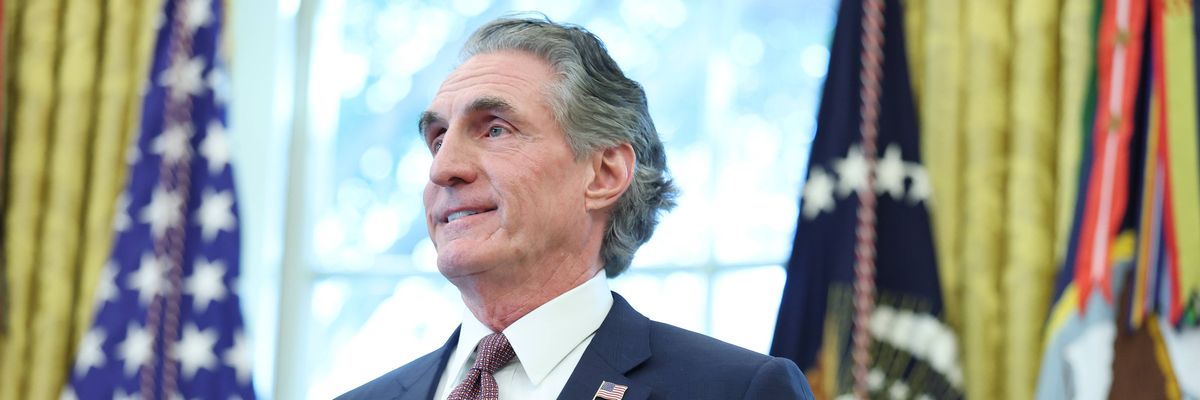
US Interior Secretary Doug Burgum speaks during an event with President Donald Trump in the Oval Office at the White House on October 6, 2025 in Washington, DC.
(Photo by Anna Moneymaker/Getty Images)


Julia Conley
Dec 29, 2025
COMMON DREAMS

A week after the US Department of the Interior said it was immediately halting five offshore wind projects in the interest of “national security,” a watchdog group told congressional committees Monday that the move is “not legally defensible” and raises “significant” questions about conflicts of interest concerning a top DOI official’s investments in fossil gas.

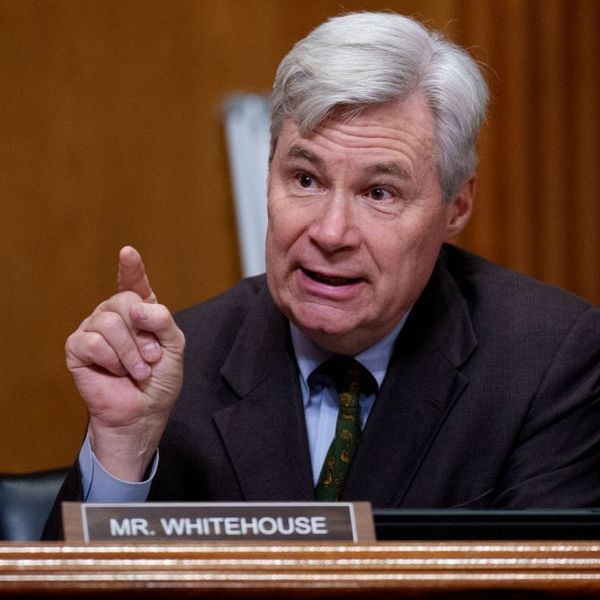
Timothy Whitehouse, executive director of Public Employees for Environmental Responsibility (PEER), wrote to the top members of the Senate Energy and Natural Resources Committee and the House Committee on Natural Resources regarding the pause on projects off the coasts of Virginia, New York, Rhode Island, Connecticut, and Massachusetts—projects that account for billions of dollars in investment, employ thousands of people, and generate sustainable energy for roughly 2.5 million homes and businesses.
.


Trump Continues ‘War Against Renewables’ With Halt of Five Offshore Wind Farms

The announcement made by Interior Secretary Doug Burgum last week pertained to “five vague, perfunctory, cookie-cutter orders” halting the projects, wrote Whitehouse, but PEER is concerned that the orders were issued to evade the Congressional Review Act (CRA), under which the action to halt the projects likely constitutes a “major rule.”

Whitehouse explained:
Under the CRA, a rule that meets any one of three criteria (an annual effect on the economy of $100,000,000 or more; a major increase in costs or prices for consumers, individual industries, federal, state, or local government agencies, or geographic regions; or in pertinent part significant adverse effects on competition, employment, investment, productivity, or innovation) is a major rule. Interior’s pause likely meets all three.

As a major rule under the CRA, the pause cannot take effect until at least 60 days after BOEM provides Congress the requisite notification and report under the CRA, which, according to GAO’s database, has not yet occurred. Congress must use its oversight authority to unveil the truth and, as appropriate, and to enforce the rule of law.

He said in a statement that “Burgum’s move is designed to bypass all congressional and public input.”


The CRA states that a rule is “the whole or a part of an agency statement of general or particular applicability and future effect designed to implement, interpret, or prescribe law or policy or describing the organization, procedure, or practice requirements of an agency.”

Press statements by the DOI and by Burgum last week were “statements of general applicability and imminent future effect, designed to implement policy,” wrote Whitehouse, who also said the interior secretary embarked on “a coordinated rollout with Fox News entities.”

On December 22, Fox anchor Maria Bartiromo asked Burgum at 8:00 am Eastern, “What next action did you want to tell us about this morning?” Five minutes later, FoxNews.com published its first story on Burgum’s orders, citing a press release that had not yet been made public and including a quote from the secretary about the “emerging national security risk” posed by the offshore wind projects.

“If last week’s actions are allowed to stand, future presidents will have unchecked authority under the guise of national security to target federal leases related to entire disfavored energy industries for political purposes.”

Burgum’s announcement to Fox came at least one to two hours before Bureau of Ocean Energy Management (BOEM) acting Director Matthew Giacona provided the orders to the lessees running the five wind projects.

Further, wrote Whitehouse, “Burgum’s voluminous public comments in the hours and days since the pause further show the true purpose of Interior’s singular action.”

“The national security pretext quickly gives way to broad and spurious talking points about the ‘Green New Scam,’ how ‘wind doesn’t blow 24-7’ (evincing Burgum’s seeming unfamiliarity with energy storage technologies), and unyielding promotion of liquified natural gas projects,” wrote Whitehouse.

Aside from the alleged illegality of Burgum’s order, PEER pointed to Giacona’s potential conflicts of interest with BOEM operations and specifically with halting wind projects. Giacona is a “diligent filer” of financial disclosure forms required by the Ethics in Government Act, noted Whitehouse—but those forms point to potential benefits he may reap from shutting down offshore wind infrastructure.

Giacona reported his purchase of interests in the United States Natural Gas Fund (UNG) on September 16. The fund tracks daily price movements of “natural” gas delivered at the Henry Hub in Louisiana and is subject to regulation by the Commodity Futures Trading Commission.

“Accordingly, a government employee who has an interest in UNG also has a potential conflict of interest with the underlying holdings of UNG (currently primarily natural gas futures contracts at the Henry Hub),” wrote Whitehouse.

PEER does not know whether Giacona continues to hold a financial interest in UNG or whether the offshore wind pause will have a “direct and predictable effect on a financial interest in UNG,” but Whitehouse noted that Burgum and DIO have entwined the pause with the promotion of liquefied natural gas.

“It is disconcerting that Mr. Giacona temporarily had even a de minimis financial interest in natural gas futures while also leading the agency that manages the development of natural gas resources on the outer continental shelf,” wrote Whitehouse, adding that Giacona also sold interests in the United States Oil Fund on September 3, while overseeing BOEM.

Based on Giacona’s investments, said Whitehouse, “Burgum’s actions on offshore wind appear to be motivated by the personal financial interests of those in the administration, not our collective national interests. This is another misguided step in transforming the federal government into a franchise of the fossil fuel industry.”

“On public lands across the United States, the Department of the Interior has tens of thousands of additional active leases related to oil, gas, wind, solar, and geothermal production and mining for energy-related minerals,” he added. “If last week’s actions are allowed to stand, future presidents will have unchecked authority under the guise of national security to target federal leases related to entire disfavored energy industries for political purposes.”


New State Laws Aim to Protect Environment, Consumers as Trump Wages All-Out War on Climate

“The gridlock and partisanship we see in Washington, DC can be dispiriting. But history shows that states can build momentum that eventually leads to change at the federal level.”


Harry the Happy Dragon, the mascot for Harris Teeter, on reusable plastic bags
 for sale at a grocery store on December 22, 2025 in Durham, North Carolina.
(Photo by Al Drago/Getty Images)


Brad Reed
Dec 29, 2025
COMMON DREAMS


Even as President Donald Trump and his administration have been ripping up environmental and consumer protection regulations, a number of state laws are set to take effect next year that could at least mitigate some of the damage.

A Monday statement from Environment America and the Public Interest Network highlighted a number of new laws aimed at curbing corporate polluters and enhancing consumer welfare.


11 House Democrats Help GOP Pass ‘Disastrous’ Pro-Polluter Permitting Bill


Senate Dems Stop Permitting Talks Over Trump’s ‘Reckless and Vindictive Assault’ on Wind Power

First, the groups highlighted “Right to Repair” laws set to take effect in Washington, Nevada, Oregon, and Colorado, which give people the right to repair their own appliances and electronics without burdensome costs or barriers.

The groups lavished particular praise on Colorado’s “Right to Repair” laws that they said provide “the broadest repair protections in the country,” with new regulations that will give businesses in the state “access to what they and independent repair providers need to fix their electronics themselves.”

Illinois, meanwhile, will fully phase out the sale of fluorescent lightbulbs, which will be replaced by energy-efficient LED bulbs. The groups estimate that eliminating the fluorescent bulbs will collectively save Illinois households more than $1.5 billion on their utility bills by 2050, while also reducing energy waste and mercury pollution.

Illinois also drew praise for enacting a ban on polystyrene foam foodware that will take effect on January 1.

The groups also highlighted the work being done in Oregon to protect consumers with legislation mandating price transparency to eliminate surprise junk fees on purchases; prohibiting ambulance companies from socking out-of-network patients with massive fees for rides to nearby hospitals; and placing new restrictions on the ability of medical debt to negatively impact a person’s credit score.

California also got a mention in the groups’ release for closing a loophole that allowed supermarkets to continue using plastic bags and for creating a new privacy tool for consumers allowing them to request that online data brokers delete all of the personal information they have gathered on them over the years.

Emily Rusch, vice president and senior director of state offices for the Public Interest Network, contrasted the action being taken in the states to protect consumers and the environment with a lack of action being done at the federal level.

“The gridlock and partisanship we see in Washington, DC can be dispiriting,” said Rusch. “But history shows that states can build momentum that eventually leads to change at the federal level. As we build on this progress in 2026, we look forward to working with anyone—Republican, Democrat, or independent—with whom we can find common ground.”
Stephen Miller, Frank Sinatra, and the Promise and Limits of American Liberalism ​

Looking back at exemplary moments of American liberalism to counter MAGA rhetoric is an entirely understandable and even comforting move to make, but there is no golden age to return to.

Frank Sinatra educates the youth in the 1945 short film “The House I Live in.”
(Photo: YouTube/Screengrab)

Jeffrey C. Isaac
Dec 29, 2025
Common Dreams


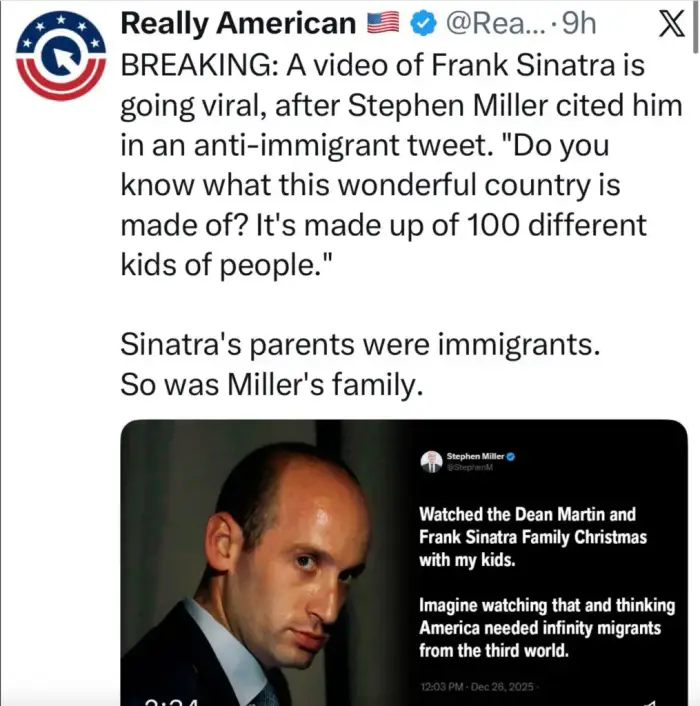
Stephen Miller misses no opportunity to exult in racism and xenophobia. Friday’s Common Dreams headline gets right to the point regarding Miller’s most recent offense: “‘Horrible Racist’ Stephen Miller Slammed for Using Classic TV Christmas Special to Bash Immigrants.”

Apparently Miller spent Christmas day watching a 1967 holiday special called “Christmas with The Martins and The Sinatras” and, being the miserable misanthrope that he is, the show—featuring Dean Martin and Frank Sinatra, two very famous children of first-generation Italian Americans—prompted him to wax nostalgic about a world in which America was Great and there was no mass immigration. Everything that Miller says or does deserves outrage, and his X post was no exception. One form the justified outrage has taken recently crossed my Facebook feed:


The Sinatra video that has gone viral is a clip from a 10-minute film short that premiered in November, 1945 called “The House I Live In.” It’s a powerful film, featuring a young and very charismatic Sinatra both speaking and singing against bigotry and for toleration and cultural pluralism.

The film begins with Sinatra, playing himself, in the studio recording a love song. He then takes a break, goes outside, and encounters a group of boys on an unnamed American city street who are very much modeled on Hollywood’s 1940s “Dead End Kids.” He finds them taunting a young, somewhat different-looking boy who is pretty clearly Jewish, and stops to interrupt the taunting and to engage them in conversation about the meaning of “America.”

When the boys inform him that they are bullying the (Jewish) boy because “we don’t like his religion,” Sinatra teases them: “You must be a bunch of those Nazi werewolves I’ve been reading about.” When one of the boys incredulously suggests he is “screwy” to think this, Sinatra replies: “Not me, I’m an American.” When the boys insist that they too are Americans, and one of them volunteers that his father had indeed been wounded in the war, Sinatra points out that the dad had probably needed a blood transfusion, and then points to the excluded boy: “Maybe his pop’s blood saved your dad’s life.”

Sinatra then delivers a monologue:
Look fellas. Religion makes no difference, except maybe to a Nazi or somebody who’s stupid. Why, people all over the world worship God in many different ways. God created everybody. He didn’t create one people better than another. Your blood’s the same as mine, mine’s the same as his. Do you know what this wonderful country is made of? It’s made up of a hundred different kinds of people and a hundred different ways of talking. A hundred different ways of going to church. But they’re all American ways. Wouldn’t we be silly if we went around hating people because they comb their hair different than ours?... My dad came from Italy. But I’m an American. But should I hate your father because he came from Ireland or France or Russia? Wouldn’t I be a first-class fathead?

He then tells them a story about how, after Pearl Harbor, American airmen had inspired the entire country by bravely bombing a Japanese battleship: “They sank it, and every American threw his head back and felt much better. The pilot of that ship was named Colin Kelly, an American and a Presbyterian. And you know who dropped the bombs? Meyer Levin, an American and a Jew. You think maybe they should have called the bombing off because they had different religions?”

Sinatra then heads back to the recording studio. But before entering, he stops to sing for the boys the song he is recording inside, “The House I Live In.” Here are the lyrics:
What is America to me?
A name, a map, the flag I see,
A certain word, “Democracy.”
What is America to me?

The house I live in,
A plot of earth, a street,
The grocer and the butcher
And the people that I meet,

The children in the playground,
The faces that I see;
All races, all religions,
That’s America to me.

A place I work in
A worker by my side
A little town or city
Where my people lived and died
The howdy and the handshake
The air of feeling free
And the right to speak my mind out
That’s America to me

The things I see about me
The big things and the small
The little corner newsstand
And the house a mile tall
The wedding and the churchyard
A laughter and the tears
And the dream that’s been a growing
For 180 years

The town I live in
The street, the house, the room
Pavement of the city
Or a garden all in bloom
The church, the school, the clubhouse
The millions lights I see
But especially the people
That’s America to me.


Sinatra then smiles, returns to the studio, and the boys walk off together, inviting the Jewish kid to join them, while the music of “America the Beautiful” plays in the background.

The film is very powerful and uplifting. It is emblematic of the spirit of American liberalism in the immediate aftermath of WWII, a spirit perhaps symbolized by the stardom of Sinatra, the child of working-class Italian immigrants who grew up in Hoboken, New Jersey. Critics of Miller, and of President Donald Trump, are right to invoke the film, and to evoke the idealism of Rooseveltian liberalism, as a reproach to MAGA xenophobia.

At the same time, there are at least three important ways that the film exemplifies the limits of Rooseveltian idealism and the depth of the forms of illiberalism repudiated in the very lyrics of “The House That I Live In”—forms of illiberalism with which we are still reckoning today.

The first relates to the political circumstances surrounding the song itself. The music was written by Earl Robinson, a composer and folk musician from Seattle who belonged to the Communist Party from the 1930s through the 1950s; collaborated with Paul Robeson, Pete Seeger, and other well-known leftist artists and performers; and was blacklisted during the McCarthy period. And the lyrics were written by Lewis Allan, the pseudonym of Abel Meeropol, also a Communist at the time, who also composed the lyrics to “Strange Fruit,” the anti-lynching song made famous by Billie Holiday, and later adopted the sons of Julius and Ethel Rosenberg after their parents were executed as Soviet agents in 1953.

Robinson and Meeropol were two of the hundreds of writers, artists, musicians, and performers who made seminal contributions to American culture during the 1930s and 1940s in connection with the Popular Front, described by historian Michael Kazin as “a vigorously democratic and multiracial movement in the arts and daily life that was sponsored but not controlled by the Communist Party.” The patriotic rhetoric of “The House I Live In”—both the song and the film—bears the traces of Popular Front leftism even as the connections to the left, and to anti-capitalism, were as disguised, and erased, as the actual name of the lyricist.

The second is the way in which the film’s repudiation of antisemitism, and its message of tolerance, is advanced—through an understandable anti-fascist patriotism that is juxtaposed to evil “Nazi werewolves” and invading “Japs.” Sinatra’s uplifting story of the bombing of the Japanese battleship Hiruma three times uses the racist term “Japs.” Erased from the story are some very memorable recent events: the wartime incarceration of well over 100,000 Japanese Americans; the 1945 American fire-bombing of Tokyo that killed over 100,000 Japanese civilians; and the atomic bombings of Hiroshima and Nagasaki in August, 1945, months before the film’s release. (It is worth nothing that the film’s producer-director, Mervyn Leroy, also produced the 1944 film “30 Seconds Over Tokyo,” a glorification of the 1942 “Doolittle Raid,” the first US bombing of Tokyo, starring Spencer Tracy). The film’s valorization of American democracy is thus linked to a racially-tinged narrative of American innocence with increasingly illiberal ramifications as the Cold War evolved.

And there is, finally, the striking fact that while Sinatra powerfully gives voice to the idea that “God created everybody, he didn’t create one people better than another,” and that “your blood’s the same as mine, mine’s the same as his,” every person in the film—Sinatra, the boys, the studio orchestra—is white.

To point these things out is not to disparage “The House I Live In,” a very important cultural creation that contained genuinely progressive elements while also condensing some of the contradictions of its time. It is simply to note the complexity of the recurrent historical contests over what it means to be “an American,” and the lack of innocence of even the most appealing episodes of the past. Trumpism is xenophobic, racist, deeply anti-liberal, and literally reactionary. Looking back at exemplary moments of American liberalism to counter MAGA rhetoric is an entirely understandable and even comforting move to make. Rewatching “The House I Live In” this holiday season was genuinely uplifting for me. But post-WWII liberalism at its height was no Golden Age, and we can no more return to it than we can to the time of Andrew Jackson, or William McKinley, or 1920s racist Madison Grant, or George Wallace, or Bull Connor, or whoever it is that warms Stephen Miller’s deformed and shriveled heart.

Our work is licensed under Creative Commons (CC BY-NC-ND 3.0). Feel free to republish and share widely.

Jeffrey C. Isaac
Jeffrey C. Isaac is James H. Rudy Professor of Political Science at Indiana University, Bloomington. His books include: "Democracy in Dark Times"(1998); "The Poverty of Progressivism: The Future of American Democracy in a Time of Liberal Decline" (2003), and "Arendt, Camus, and Modern Rebellion" (1994).
Full Bio >