The US Doesn’t Need a Party, It Needs a Revolution
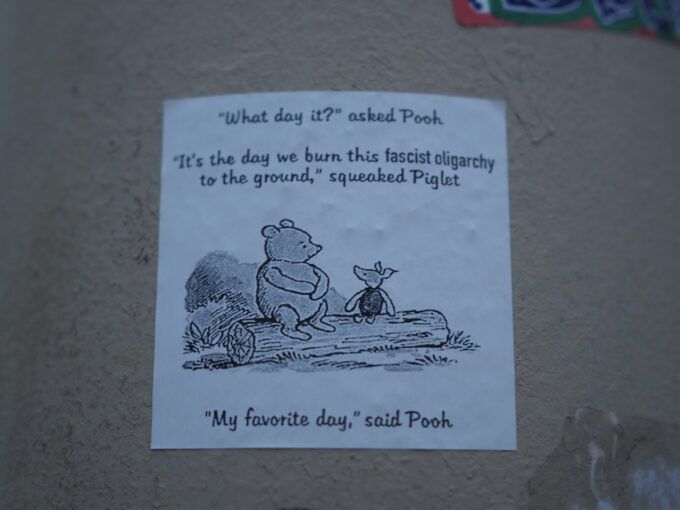
Photograph by Nathaniel St. Clair
Two hundred and fifty years ago, European colonists mostly from Britain were conspiring to chase the elements of the British monarchy from the shores of what we now call the United States. Many of those in the conspiracy were mostly interested in personal financial gain, whether it was measured in stolen land, enslaved humans or actual coinage. Freedom for all was not on the agenda for most of the men involved. However, freedom to keep their profits was. Over the years, the struggle by the humans left out of the founding fathers’ intentions has waxed and waned, occasionally winning those freedoms only to see them become weakened over time, mostly via the courts but almost as often through legislation and white supremacists in the White House.
Fifty years ago—1976—the year began with Washington and its media machine hyping the two hundredth birthday of the United States. The resignation of President Richard Nixon some seventeen months earlier was celebrated as proof of the superiority of the US way of governance. You know, no one was above the law and all that stuff. To top it all off, the year 1976 was also a presidential election year; another example of the durability of the “experiment in democracy” being touted by the mainstream media no matter what its political leaning. The then liberal Washington Post and New York Times shouted the same misleading malarkey about the land of the free and the home of the brave as New Hampshire’s right-wing Manchester Union Leader (now New Hampshire Union Leader) and William F. Buckley, Jr.’s National Review. Tributes to the nation’s history never seemed to mention the genocide of the indigenous that paved the highways and laid the rails across the amber waves of grain, while the fate of the millions forced to take the Atlantic crossing into slavery that consumed their descendants as well was most often framed in terms of denouement as a result of civil war. Rarely, if ever, was the situation of most African-American working people in the 1970s touted as proof of the success of the white man’s American dream. That dream had, as Langston Hughes reminded us, been deferred for far too long. Indeed, it had exploded only a few years before the big Bicentennial bash and been put down by thousands of cops and troops.
I was working as a short order cook at an IHOP in 1976. The best thing about the job was the access to food and the fac that my paycheck—as paltry as it was—covered my expenses and left me with money to spend on various entertainments, from beer to weed and concerts. This had a lot more to do with the price of things (and my side gig of selling weed to friends) in the mid-1970s than it had to do with the $2.50 an hour I was making for my fifty-hour work weeks. The US Left, which was in disarray but still capable of raising a fuss, was planning protest actions for the big day when the Bicentennial party would climax in a spasm of nationalist celebration from sea to shining sea. If Irving Berlin were alive, his royalties would certainly jump in the year to come. Francis Scott Key’s paean to the rocket’s red glare would be set on permanent repeat. The rulers were still convinced that God was on their side and that this land was their land. And don’t you forget it. The ultraleft in the form of the Maoists of the Revolutionary Communist Party and the remnants and political allies of the Weather Underground were looking towards Philadelphia for their marches, while the more mainstream Left formed a coalition called the Peoples’ Bicentennial Commission and began acquiring permits for their rally in DC. Meanwhile, the official celebration that took place every July Fourth on the National Mall was booking bands and musicians. The myth became ever more magnified.
It’s now 2026. Fifty years later. The nation intends to celebrate its two hundred fiftieth birthday even as it becomes a mere shadow of what it proclaimed it wanted to be. If nothing else, we can see the emptiness of words in the wake of history, although this might be the place to note that some of the finest words we hear repeated regarding the founders of the nation were first written by men who owned slaves and celebrated the murders of the indigenous. Francis Scott Key was an attorney who represented slavers in cases challenging their abductions of runaways while he traded in slaves himself. And we know the rap sheet on Thomas Jefferson. Pretty words can only hide ugly truths for so long.
1976 was the historical moment just before the advent of neoliberal capitalism. The free marketeers’ ongoing attack on the so-called welfare state was enjoined in Britain and the United States. Democratic presidential candidate Jimmy Carter made speeches that claimed the private sector could do many, if not most, things better than the public sector. Those sentiments were magnified by Ronald Reagan, the ultra-right’s candidate in the Republican party. It’s a reasonable argument that Reagan’s 1976 campaign was the beginning of his successful 1980 campaign for the White House. It’s also quite reasonable to conclude that that campaign began at least back in 1964 with Barry Goldwater who, at least had the wisdom to reject the support of the so-called Christian right wing. It would be Reagan’s embrace of that bunch of zealots (calling themselves the Moral Majority) that would propel the US into the long dark night of Reagan’s morning in America. Just like the champions of capital had proclaimed a hundred years earlier, the Christian god and the god of capital were united in their own pursuit of happiness at everyone else’s expense. When the nascent racism of the US white nation was added into the mixture, a new Trinity was conceived. Like they say on the TV, “Praise the Lord©.” And like they say in the Pentagon: “and pass the ammunition.”
Despite the ravings of countless cheerleaders, neoliberalism was never a unique economics untethered to the history of capitalism; it is a logical step in capitalism’s destructive thrust. Fascist government is the political means by which capital and those who operate within its mechanism ensure their pursuit of profit proceeds. This is where we are currently at—the government of the United States operates primarily, if not yet completely, in the service of capital and those who hold the bulk of that capital. Marxists and capitalists alike agree that this 250th birthday is the anniversary of a nation that put the capitalists in charge, transferring power to a capitalist class and unleashing market forces through debt, land reform, and institutions designed serve that market.
As far as I’m concerned there isn’t much to celebrate when it comes to this national birthday. Washington’s military is murdering people on the high seas and bombing Africans under the guise of religion. Domestically, unaccountable enforcers kidnap citizens and non-citizens alike in scenes reminiscent of police states around the world. Its war industry arms a genocide while provoking conflict across the globe. The rich and the super-rich profit from the rampage. The world can ill afford another twenty years of this, much less two hundred and fifty.

No comments:
Post a Comment