Wednesday, December 31, 2025

Wind Power’s Lost Year May Be Setting Up a Reset in 2026

  • 2025 was a difficult year for clean energy, with major U.S. tax rollbacks and weak European auctions leading to widespread cancellations of solar, wind, and storage projects.

  • Policy adjustments are now improving the outlook for wind in 2026, as Europe raises auction price caps, reforms tender designs, accelerates permitting, and shifts toward more stable revenue models

2025 has proven to be an annus horribilis for clean energy after Trump’s One Big Beautiful Bill Act (OBBBA) rolled back major tax credits and imposed new restrictions, pressuring early-stage solar and wind energy pipelines. Indeed, a Cleanview analysis of U.S. power projects has revealed that developers have cancelled 1,891 power projects with a combined 266 GW of generation capacity in the current year, including 86,466 MW of solar power, 79,045 MW of storage and 54,328 MW of wind power projects. Meanwhile, Europe has witnessed disappointing auctions for new wind power capacity across the continent, highlighting that the industry's woes extend beyond U.S. shores. But the experts are now saying the worst could be in the rear-view mirror, with the global wind energy industry poised for an improved outlook in 2026, driven by strong demand, technological advancements and more supportive policy frameworks. Global wind power generation is set to accelerate, with renewables expected to overtake coal as the largest source of electricity globally by 2026.

In response to project cancellations and auction failures in 2024-2025, policymakers in Europe are adapting wind energy strategies through a variety of measures, most notably by increasing auction price caps and reforming auction designs to manage market risks. Other key adaptations include accelerated permitting processes, new financial incentives and a shift away from "negative bidding".

To wit, the UK government, raised the maximum strike prices for its Allocation Round 6 (AR6) Contracts for Difference (CfD) scheme in 2024 to reflect soaring supply chain costs and high interest rates. This adjustment made projects more financially viable and resulted in a more successful AR6 auction compared to the failed AR5 in 2023, which received no bids for offshore wind. Similarly, Germany and Denmark are moving away from auction designs that required developers to pay for the right to build projects (negative bidding), a practice that deterred investment, instead transitioning towards a greater use of Contracts for Difference (CfDs) which offer more stable and predictable revenue streams for developers.

Some policy makers are adjusting the allocation of risk between developers and the government. For example, in the Netherlands, rules for certain tenders were eased, reducing the required investment per site and limiting developer liability during the initial years of the permit.

A major focus is on strategic grid development to integrate the growing capacity of wind energy efficiently. Initiatives like the UK's Offshore Transmission Network Review (OTNR) and the EU's TEN-E Regulation promote coordinated, "networked" systems to reduce costs and environmental disruption. Policymakers are also focusing on accelerating the often-lengthy and bureaucratic permitting process. The EU's Renewable Energy Directive III introduced "go-to areas" with pre-assessed environmental impacts to cap permitting times for new projects at 12 months. Likewise, the UK's Offshore Wind Environmental Package is designed to cut average permitting time by 40% through better data sharing and coordinated assessments.

On the technological front, continued advancements are driving down costs and improving efficiency.  Development of advanced blade designs and larger turbines (e.g., above 15 MW class) is increasing energy capture and lowering the levelized cost of energy (LCOE). Larger turbines utilize massive rotors and longer blades to sweep a significantly greater area. This allows them to capture more wind energy at higher altitudes where winds are often stronger and more consistent, directly boosting electricity generation. Advanced blade designs incorporate sophisticated aerodynamic profiles and materials that optimize how the blades interact with the wind, maximizing the efficiency of energy conversion. Meanwhile, the integration of AI and data analytics in wind farm operations is enabling predictive maintenance, optimized performance, and integration into real-time energy markets, reducing operational costs and unplanned downtime.

Capital has not left the sector, but it has become more selective. 

Publicly traded wind-focused equities have rebounded in 2025 after a weak prior year, supported by rising electricity demand from data centers, electrification, and tighter power markets rather than by subsidy expansion alone. As of mid-year, wind-linked funds such as the First Trust Global Wind Energy ETF have outperformed broader equity benchmarks, reflecting expectations that project economics improve as auction terms reset and supply-chain pressures ease. 

At the same time, investors remain cautious, with balance-sheet strength, grid access, and contract structure increasingly determining which developers can move projects forward. Cost competitiveness remains a core support: multiple independent analyses show that new onshore wind capacity is among the lowest-cost sources of new electricity generation in many regions, often competing directly with new gas-fired power even without direct subsidies.

The recovery narrative is uneven, particularly in the United States. 

While technology and power-market fundamentals are improving, U.S. offshore wind continues to face policy uncertainty beyond subsidies and auctions. Washington has paused certain offshore wind leasing and reviews on national security grounds, introducing new risk that has nothing to do with project economics.

By Alex Kimani for Oilprice.com


U.S. Blockade Leaves $900 Million of Venezuelan Oil Stranded at Sea

  • New data suggest nearly $900 million worth of Venezuelan crude is stuck on tankers due to U.S. naval enforcement.

  • The blockade is already slowing exports, raising logistical and financial pressure on Venezuela and its allies.

  • While Chevron continues limited imports under a waiver, broader oil flows to Cuba and China are increasingly constrained.

With a two-month "quarantine" placed on Venezuelan oil by the Trump administration in a foreign policy move called "gunboat diplomacy," new data estimate that roughly $900 million worth of crude is currently loaded on tankers, unable to depart Venezuela due to the U.S. blockade.

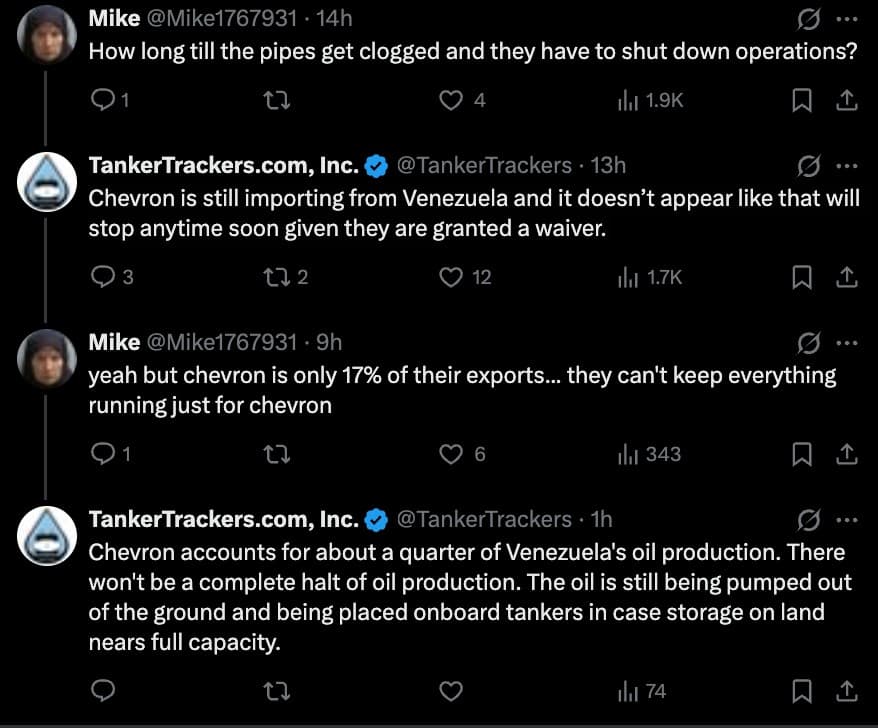
"Based on our visual analysis from both shore and space, we estimate that there are around 17.5 million barrels of crude oil floating onboard tankers in Venezuela which are unable to depart due to the ongoing US blockade," independent research Tanker Trackers wrote on X. "That's around $900M of oil."

Tanker Trackers responded to a question on X about how long it would take for land-based oil and gas operations in Venezuela to become "clogged" due to the blockade. The research firm noted, "Chevron is still importing from Venezuela, and it doesn't appear that will stop anytime soon, given they are granted a waiver."

Here's the conversation:

T

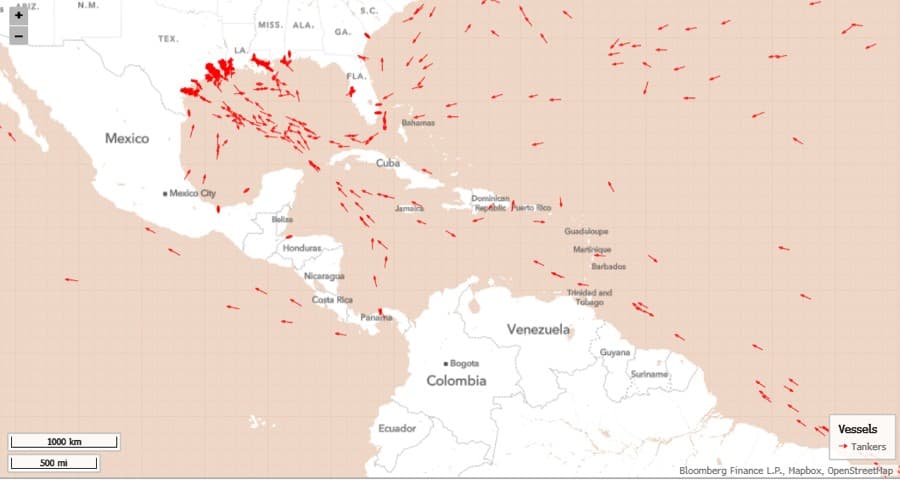
Current tankers sailing in the Caribbean with destinations to the U.S. and/or China.

Tank

Last week, the Trump administration directed U.S. military forces to enforce a two-month "quarantine" on Venezuelan oil exports, signaling ramped-up sanctions enforcement.

According to a U.S. military official cited by Reuters, while military options remain available, the near-term strategy prioritizes economic pressure through strict enforcement of sanctions to pressure Venezuela.

Operationally, the U.S. Coast Guard has intercepted two Venezuelan dark fleet tankers and forced a third to retreat into the Atlantic Basin.

Our assessment: The gunboat diplomacy posture is designed to disrupt Venezuela-Cuba-China oil flows, tighten financial pressure, and accelerate regime instability in both Caracas and Havana.

China is furious and has wargamed a potential conflict with the U.S. in the Caribbean. Okay Beijing ...

By Zerohedge

Where are The World's Rare Earth Minerals Located?

Rare earth elements (REEs) are the backbone of modern technology, from EV motors and wind turbines to smartphones and precision-guided systems.

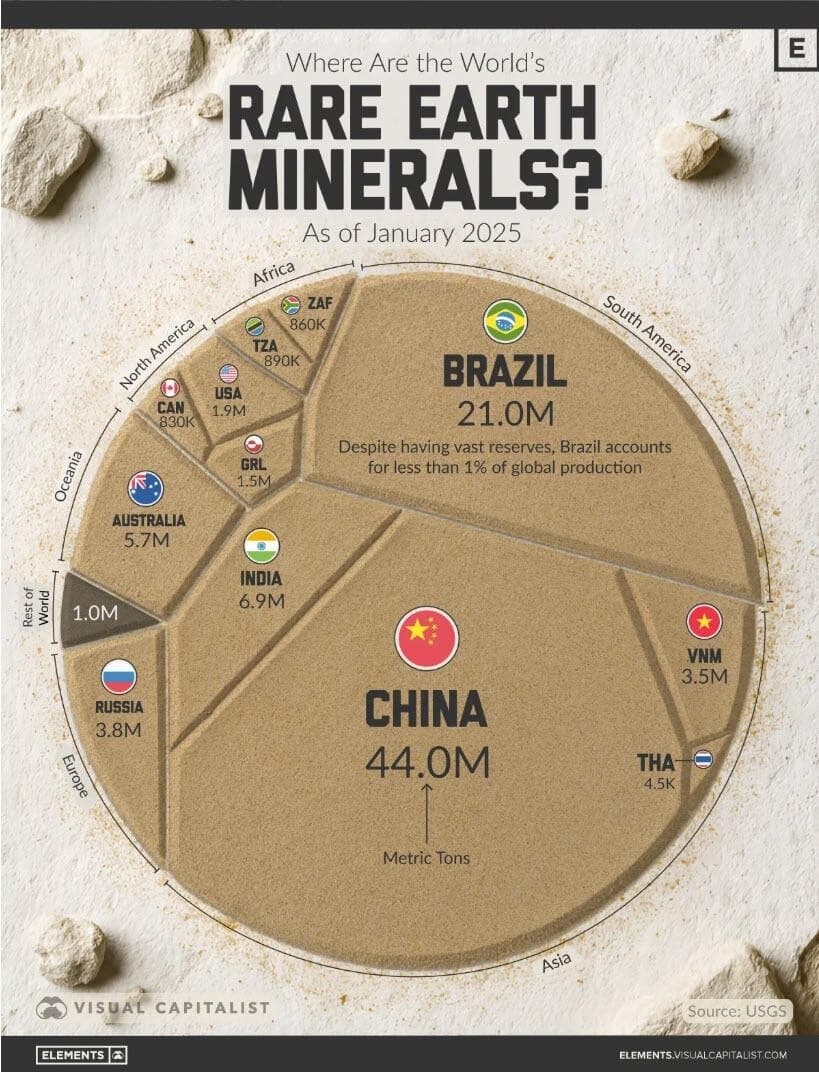
This map, via Visual Capitalist's Bruno Venditti, breaks down where the world’s known rare earth reserves are located in 2025, highlighting how concentrated they are across a handful of countries.

The data for this visualization comes from the U.S. Geological Survey (USGS).

The distribution is highly uneven. China alone holds nearly half of the global total, followed by Brazil’s sizable deposits. By contrast, many advanced economies have limited reserves.

A Heavily Concentrated Reserve Base

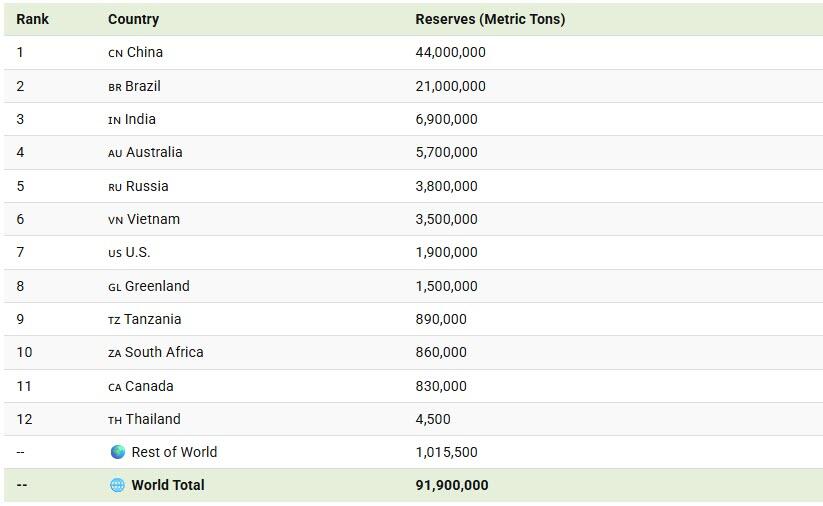
China leads with 44.0 million metric tons, about 48% of the world total of 91.9 million metric tons. Brazil is a clear second at 21.0 million tons (23%), reflecting large ionic clay and hard-rock deposits that are still early in development.

India (6.9 million tons) and Australia (5.7 million tons) round out the top tier, while Russia (3.8 million tons) and Vietnam (3.5 million tons) are also ahead of the United States. Together, the top six countries account for roughly four-fifths of known reserves.

Advanced Economies: Small Shares, Big Demand

The United States holds just 1.9 million metric tons of rare earths (2%), underscoring its reliance on trade and midstream processing to secure supply. In recent months, the Trump administration has sought to reduce U.S. dependence on Chinese materials by funding domestic mining projects, streamlining permits, and partnering with allies to diversify supply chains.

In October, President Trump and President Xi Jinping agreed to reduce tariffs in exchange for China maintaining the flow of rare earth exports.

Emerging Players

Canada (0.83 million tons) and the EU-adjacent Greenland (1.5 million tons) have meaningful but smaller bases.

Africa and the Arctic feature emerging sources: Tanzania (0.89 million tons) and South Africa (0.86 million tons) join Greenland as potential growth nodes if infrastructure and processing scale.

By Zerohedge.com

Will Saudi Arabia/UAE Tensions Over Yemen Threaten OPEC Status Quo?


The latest flare-up between Saudi Arabia and the United Arab Emirates over Yemen looks dramatic on the surface, but OPEC cohesion, not missiles or militias, is what ultimately matters to the oil markets, which is why the latest public spat between Saudi Arabia and the UAE over Yemen created just a temporary blip in crude prices.

Saudi forces intercepted this week what they said was an unauthorized UAE-linked shipment of weapons and military equipment destined for southern Yemen. The Saudi-led coalition dished out an airstrike on the southern Yemeni port of Mukalla after Riyadh framed it as a security breach. Abu Dhabi claimed that the equipment was intended for its own counterterrorism forces and denied that it was arming separatist groups.

In the end, the UAE said it would pull out its remaining forces out of Yemen, according to Reuters.

It is messy, public, and awkward — especially given that Saudi Arabia and the UAE sit at the core of OPEC’s decision-making. Yet for oil markets, the immediate impact is close to zero. And that is precisely because OPEC is not a club held together by shared values, shared foreign policy, or shared views on Yemen

OPEC works because its members can disagree (even loudly) on politics while still coordinating production plans.

We have seen this before, although perhaps not on this scale. Saudi-Emirati tensions over Yemen are not new. Both countries entered the conflict together in 2015, then gradually diverged as their interests in southern Yemen split. Riyadh prioritizes territorial unity and border security. Abu Dhabi has backed southern factions it sees as better aligned with its maritime and security goals. Those differences have simmered for years, and yet they haven’t blown up OPEC policy.

There is precedent to draw on for the oil market. In 2021, the UAE openly threatened to block an OPEC+ deal over production baselines, arguing that its rapidly expanding capacity was being unfairly constrained. A compromise eventually resolved the dispute, but exposed OPEC’s real sticking point: capacity growth versus quota discipline.

That dynamic is far more relevant heading into 2026 than any Yemen-related spat. Next year is already looking like it will be a tense one for OPEC, with forecasts warning of oversupply and softer prices, even as OPEC itself has avoided endorsing the glut narrative. But managing production targets in that environment will require cohesion—harmony over Yemen is not required.

Saudi Arabia’s challenge is not that its partners occasionally clash outside the oil market. It is ensuring that those clashes do not bleed into production policy when restraint matters most. Yemen noise may test diplomatic bandwidth, but history suggests that OPEC can function perfectly well without everyone holding hands, as long as they still agree on the math.

By Julianne Geiger for Oilprice.com


Why Saudi Arabia Just Moved Into Syria’s Oil And Gas Fields

  • Saudi Arabia’s entry into Syria’s oil and gas sector is part of a Western-backed post-Assad strategy.

  • The agreements are operational and Gulf-led, with Saudi and UAE energy firms moving quickly into oil and gas services, field development, and seismic work.

  • The broader objective is geopolitical, not just economic.

Saudi Arabia’s recent agreements with the Syrian Petroleum Company to help revive and develop Syria’s long-neglected oil and gas fields are not a benevolent Gulf gesture but the latest step in a carefully sequenced post-Assad strategy shaped in Washington and London. The removal of Bashar al-Assad last December -- driven as much by Syria’s pivotal geography and Mediterranean frontage as by the desire of the new U.S. administration to demonstrate its willingness to unseat entrenched autocrats -- created a vacuum that Western planners were determined not to fill with another Iraq-style occupation. Instead, they have opted for a reconstruction model fronted by powerful Arab states, with Western firms embedded behind them. The UAE’s early lead in resuscitating Syria’s gas sector was the first signal of this shift; Riyadh’s move into that sector – and its vital oil space too -- is the second, and it aligns neatly with Washington’s broader effort to re-anchor regional influence and revive the architecture of Arab?Israeli normalisation that defined Donald Trump’s first term.

The agreements between Saudi Arabia and Syria are not the usual airy-fairy declarations of intent designed to signal political goodwill with little practical follow-through. They are operational, detailed, and being driven directly by Riyadh’s Ministry of Energy, which is overseeing four of its key companies -- TAQA, ADES Holding, Arabian Drilling, and the Arabian Geophysical and Surveying Company (ARGAS) -- as they move into Syria to provide services, technical support, and field development across both oil and gas. ARGAS will deliver 2D and 3D seismic surveying and associated technical services to support exploration and drilling, while Arabian Drilling is set to supply rigs, conduct drilling and workover operations, and provide workforce training and development, according to company releases. TAQA will handle advanced, integrated solutions for the construction and maintenance of oil and gas fields and wells, and ADES Holding will initially focus on boosting output across five gas fields -- Abu Rabah, Qamqam, North Al?Faydh, Al?Tiyas, and Zumlat al?Mahar. These moves build on the UAE’s own push into Syria’s gas sector, following Dana Gas’s preliminary agreement on 12 November with Syria’s state oil company to redevelop key fields. Together, these Gulf-led initiatives will operate alongside Western efforts, after the July announcement that U.S. firms Baker Hughes, Hunt Energy, and Argent LNG are working on a broader plan to rebuild Syria’s oil, gas, and power sectors. That plan is initially centred on areas west of the Euphrates, with expansion eastward expected as soon as conditions allow.

Related: Why China Is Driving Short-Term Oil Prices But OPEC Still Holds the Lever

Despite fourteen years of civil war, the companies now moving into Syria still have substantial potential to work with. Before hostilities erupted, the country was producing around 316 billion cubic feet per day of dry natural gas and held proven reserves of 8.5 trillion cubic feet. Russia’s Stroytransgaz had begun developing the South?Central Gas Area in 2009, and by 2011, this work had lifted Syria’s natural gas output by roughly 40%. Combined oil and gas exports accounted for a quarter of government revenues at the time, making Syria the eastern Mediterranean’s leading hydrocarbon producer. After Russia’s heavy military intervention to shore up President al-Assad, Moscow and Damascus signed the 2015 Cooperation Plan, which covered the restoration of at least 40 energy facilities -- initially gas, later offshore oil -- alongside a major build-out of the power sector, analysed in full in my latest book on the new global oil market order. This included the full reconstruction of the Aleppo thermal plant, installation of the Deir Ezzor plant, and capacity expansions at the Mharda and Tishreen facilities, all aimed at reenergising the national grid and restoring central control to Damascus. In short, from the West’s perspective, much of the groundwork for Syria’s energy revival has already been laid -- and paid for -- by Russia.

A similar story applies to Syria’s oil sector. Another component of the 2015 Cooperation Plan was the repair and capacity?boosting upgrade of the Homs refinery (the other being in Banias), with Phase 1 targeting 140,000 barrels per day (bpd), Phase 2 aiming for 240,000 bpd, and Phase 3 for 360,000 bpd. Moscow’s intention was that Homs could also refine Iranian crude routed through Iraq, with onward shipments into southern Europe. Before the civil war, Syria was producing around 400,000 bpd from proven reserves of 2.5 billion barrels; earlier still -- before recovery rates declined due to the lack of enhanced oil recovery techniques -- output had approached 600,000 bpd. Europe imported more than US$3 billion of Syrian oil annually up to 2011, much of it destined for Germany, Italy, and France via the Mediterranean export terminals at Banias, Tartus, and Latakia. A wide range of international oil companies operated in Syria at the time, including the UK’s Shell, Petrofac, and Gulfsands Petroleum; France’s then?Total; China National Petroleum Corporation; India’s ONGC; Canada’s Suncor Energy; and Russia’s Tatneft and Stroytransgaz.

As the events since 2011 have repeatedly shown, Syria was never just another Middle Eastern ally; it was the linchpin of Moscow’s entire regional strategy. It offered something Russia had coveted for decades: a warm?water military presence on the Mediterranean, outside NATO’s containment arc, and within striking distance of Europe’s southern flank. The Kremlin’s naval facility at Tartus and the airbase at Hmeimim gave Moscow permanent, hard?power reach into the Levant, the eastern Mediterranean, and North Africa -- a capability it had lacked since the collapse of the Soviet Union. Syria also provided Russia with a forward operating platform for intelligence collection through its base just outside Latakia, and for arms sales, and diplomatic leverage, all underpinned by deep involvement in the country’s energy sector. More broadly, just before al?Assad’s removal by Washington and London, Russia and Iran were finalising plans for the long?anticipated ‘Land Bridge’ -- a corridor running from Tehran to Syria’s Mediterranean coastline, designed to massively expand weapons flows into southern Lebanon and the Golan Heights for use against Israel, also detailed in my latest book on the new global oil market order. Supporting infrastructure for this route was already being laid through the US$17 billion Iraq–China Strategic Development Road, intended to run from Basra to southern Turkey and plug directly into China’s Belt and Road Initiative.

For Iran, the objective was to bind the Islamic world into what it sees as an existential struggle against the broadly Judeo-Christian democratic alliance of the West, with the U.S. at its centre. This dovetailed neatly with the Chinese and Russian push for a multi-polar world in which Washington anchors only one of three dominant spheres of influence — the others led by Beijing and Moscow. The same logic has underpinned President Xi Jinping’s increasingly assertive Middle East policy, reflected in his meetings with regional leaders in December 2022 and January 2023. The agenda was clear: finalise a China–Gulf Cooperation Council Free Trade Agreement (covering Bahrain, Kuwait, Oman, Qatar, Saudi Arabia, and the UAE) and to forge a “deeper strategic cooperation in a region where U.S. dominance is showing signs of retreat”.

Neither Washington nor London could tolerate a Russia-anchored Syria – one with rebuilt energy infrastructure, restored export capacity, and permanent military bases – that would have given Moscow a durable geopolitical foothold on NATO’s southern doorstep. The removal of al-Assad and the shift to a new Western-inspired reconstruction model is therefore not simply about rebuilding Syria; it is about dismantling the most valuable Middle Eastern asset Russia had acquired in a generation. The model being used is the one initiated by Trump in his first term – a series of ‘relationship normalisation’ deals signed between major Arab countries and the West’s leading geopolitical partner in the Middle East, Israel. The UAE had been the first major signatory to such a deal, on 13 August 2020, and has long figured in Washington’s plans as a strategic partner to counter the influence of Iran, Russia, and China, a theme also explored in my latest book on the new global oil market order. U.S. officials have also regarded Saudi Arabia as a potential participant in such arrangements, encouraged by broadly positive comments from Crown Prince Mohammed bin Salman, with the likelihood of progress increasing in the event of a leadership transition in Riyadh. Against this backdrop, the new energy agreements in Syria involving the UAE and Saudi Arabia are not a loose collection of Gulf investment initiatives but a deliberate reengineering of the country’s energy and political architecture. The UAE and Saudi Arabia supply the regional legitimacy; Western firms provide the technical and operational backbone; and Washington shapes the overarching strategic design. In the process, Russia’s years of investment, military intervention, and energy?sector entrenchment have been quietly pushed aside, replaced by a reconstruction model that restores Western influence, draws key Arab states more tightly into the U.S. orbit, and reopens the pathway to broader regional normalisation.

By Simon Watkins for Oilprice.com


U.S. Pressures Mexico Over Fuel Supply to Crisis-Hit Cuba


  • U.S. lawmakers are pressuring the U.S. Administration to demand Mexico end its subsidized oil shipments to Cuba by leveraging the 2026 renegotiation of the USMCA trade agreement.

  • Mexico, through a subsidiary of its state oil company Pemex, has defended its shipments of fuel to Cuba as humanitarian aid intended to prevent widespread blackouts on the island.

  • An investigation found that Mexico shipped over $3 billion worth of subsidized fuel to Cuba in just four months of 2025, a figure three times higher than the shipments during the final two years of the previous administration.

The U.S. blockade of Venezuela to prevent sanctioned tankers from shipping oil to and from the South American country is not the only geopolitical game involving the United States in its backyard in the Western Hemisphere. 

U.S. lawmakers are not happy with Mexico sending fuel shipments to Cuba. Power outages and massive blackouts have become more frequent on the Communist-run island since shipments from sanctioned Venezuela dwindled and left Cuba’s petroleum-dependent power system at the mercy of alternative supplies.  

Some of this supply has come over the years from Mexico, which continues to insist that the shipments are of a humanitarian nature and aim to “avoid a crisis of blackouts”.  

U.S. lawmakers representing Miami and Florida have urged the Trump Administration to pressure Mexico with the Cuba card when 

The United States-Mexico-Canada Agreement (USMCA) comes up for review in 2026. They insist the U.S. Administration should require Mexico to end shipments of oil to Cuba, along with stepping up efforts to combat narco cartels. 

In just four months of 2025, between May and August, Mexico shipped more than $3 billion worth of subsidized fuel to Cuba through Gasolinas Bienestar, a subsidiary of state oil company Pemex, according to an investigation by Mexicanos Contra la Corrupción y la Impunidad (MCCI). The figure is three times higher than the total shipments during the final two years of the previous administration. 

MCCI found that at least 58 fuel shipments — including gasoline, diesel, and crude — departed from Mexican ports over just four months. The cargoes were tracked through maritime monitoring platforms, showing consistent routes between Mexico and Cuba. 

Mexico’s President Claudia Sheinbaum this week defended the country’s supply of fuel to Cuba, the most recent of which was an 80,000-barrel shipment from Pemex. 

Cuba is in desperate need of oil and fuel to keep the lights on, especially in light of the U.S. blockade offshore Venezuela, which further restricts vital supplies that previously flowed from Venezuela to the island nation. 

Even before the blockade, for the fifth time this year, Cuba suffered a massive power outage after a partial collapse of the electrical grid. 

Cuba’s power system has deteriorated in recent years as the fuel and oil supply crisis has hit the old oil-fueled power plants heavily.  

Cuba’s power generation is heavily dependent on oil products. According to the International Energy Agency (IEA), Cuba’s energy supply is mainly oil-based, with oil products accounting for more than 80% of power generation.

Oil also represents 84% of Cuba’s total energy supply. 

However, Cuba’s imports of oil and fuel, mostly from Venezuela, Russia, and Mexico, have slumped as production at these countries has been constrained by a lack of investment in Mexico’s case, and U.S. sanctions in Venezuela and Russia’s case.  

Cuba’s outdated power plants and weak grid now supply just 50–70% of electricity demand in the country, causing almost daily blackouts and repeated nationwide outages.

Reliance on poor-quality heavy crude and unstable oil imports from Venezuela has forced Cuba to turn to Mexico and China for emergency fuel shipments. Cuba is also considering investment in solar power generation to try to replace some of its dependence on oil for its electricity supply.   

Mexico’s Sheinbaum said this week, “Later, we will make public what the price is as well as the cost to transport and unload the oil.”

“The motives are humanitarian for the people of Cuba,” the Mexican president added, as carried by the Latin Times.  

But Miami Republican U.S. Rep. Carlos Giménez, who chairs the House Homeland Security Subcommittee on Transportation and Maritime Security, last month called on U.S. Secretary of State Marco Rubio and Treasury Secretary Scott Bessent to ensure “Mexico ends its disturbing relationship with the murderous regime in Havana.” 

In a letter obtained by the Miami Herald, Giménez asked Rubio and Bessent to demand in the 2026 renegotiation of the USMCA that Mexico “step up efforts in combating and eliminating narco-terrorist organizations… halt trafficking of medical professionals from Cuba, victims of modern-day slavery” and “demand Mexico end its oil shipments to the regime in Havana.”  

By Tsvetana Paraskova for Oilprice.com 

The Permian Is Drowning in Its Own Wastewater

  • The Permian basin's massive oil production from hydraulic fracturing generates huge amounts of wastewater, and the industry is running out of safe places to dispose of it.

  • The Texas Railroad Commission has restricted new disposal wells due to widespread increases in reservoir pressure, leading to drilling hazards, ground deformation, and seismic activity.

  • Potential solutions, such as treating the water for release into rivers, face regulatory hurdles and would add significant, unwelcome costs to producers operating below $60 per barrel West Texas Intermediate.

The Permian Basin is the largest contributor to U.S. oil production, accounting for nearly half of total production in both 2024 and 2025. But success comes at a price, and in the Permian’s case, the price is huge amounts of wastewater—and the industry is running out of places to store it.

Hydraulic fracturing, which is the dominant way of extracting oil in the Permian, is a water-intensive process. Fracking involves injecting chemicals and sand into the horizontal well to open up the oil-bearing rock and keep it open. The longer the laterals got, the more water needed to be injected. This water, which is mixed with chemicals, then gets disposed of in special wells. But there are too many of those, and they are overflowing, according to reports.

The first signs of serious trouble emerged earlier this year, when the Texas Railroad Commission sent out notices to companies applying for licenses for wastewater disposal wells in the basin, stating that there were ground pressure issues caused by wastewater disposal. The number of new ones was to be restricted.

Wastewater disposal, the Railroad Commission wrote in the letters sent out in May, “has resulted in widespread increases in reservoir pressure that may not be in the public interest and may harm mineral and freshwater resources in Texas.” The RRC added that “Drilling hazards, hydrocarbon production losses, uncontrolled flows, ground surface deformation, and seismic activity have been observed.”

It is difficult to find a solution to this problem without compromising oil production, and while local communities may not have a big problem with that, the industry will. So decision-makers in relevant positions are considering options. One of these, per a recent Bloomberg report, is releasing the water—after treating it—into local rivers. 

The report cited regulatory filings concerning the issue of permits to energy companies to treat their wastewater and then release it into the Pecos River near New Mexico. Texas Pacific Land Corp. and NGL Energy Partners were two of the companies named as potential receivers of such a permit. At least one of these could be awarded by the end of March 2026, the Bloomberg report also said, citing Texas Pacific Land Corp.

If the wastewater problem is to be solved, however, more such permits would be needed—unless opposition to them emerges and spreads. There is also the issue of additional costs, Bloomberg noted. Treating the water to make it of suitable quality to be poured into a river would add to oil producers’ costs, and this is not the time to have more costs pile up for most producers, with West Texas Intermediate firmly below $60 per barrel. What’s more, Bloomberg reports that the safety of the whole procedure of releasing treated water into rivers has not yet been confirmed.

The Texas Commission on Environmental Quality has already signaled it will not be handing out wastewater-to-river permits like candy. The watchdog told Bloomberg it was monitoring the water quality at four locations along the Pecos River and two locations in its Red Bluff Reservoir—while considering the first of those permits.

The Wall Street Journal, meanwhile, reported that while regulators are looking for solutions to the wastewater problem, pressure is building in the rock, suggesting it may come to affect production. There is so much wastewater across the Permian that it is moving into old wellbores, causing geysers that cost a lot to clean up, the publication said, adding that pressure in injection reservoirs in some parts of the Permian has reached 0.7 pounds per square inch per foot. This is 0.2 pounds higher than the threshold over which liquid can flow up to the surface and potentially affect drinking water.

The Wall Street Journal noted that drillers in the Delaware Basin are pumping between 5 and 6 barrels of fluid for every barrel of oil they recover. That, it appears, is a lot, and the practice, as suggested by these reports, is unsustainable. The current solutions also appear to be falling short, mostly consisting of switching from deep disposal wells to shallower ones to avoid changes in seismic activity, as reported by the U.S. Geological Survey.

The shallow disposal wells have fixed the seismic problem and are currently receiving three-quarters of all wastewater produced in the Permian, the WSJ reported, noting, like Bloomberg, the unwanted water geysers that the migrating water is causing. One of these costs $2.5 million to plug, with the Texas Railroad Commission also shutting the injection wells that it suspected were leading to leaks, the Wall Street Journal wrote.

Meanwhile, the industry is trying to fortify its wells against wastewater seeping from injection wells, which also leads to additional costs. “Bit by bit, it adds cost, it adds complexity, it adds mechanical challenges,” one Chevron executive told the WSJ. On top of this, the wastewater is seeping into the oil and gas reservoirs, and there seems little that anyone can do about it except spend more to remove it. The issue with excess wastewater in Texas remains a challenge to an industry that is pumping almost half of the nation’s oil.

By Irina Slav for Oilprice.com