Eitay Mack
29/Dec/2025
THE WIRE
INDIA
The establishment of mutual embassies with Fiji and with a state unrecognised by the international community does not signal a diplomatic breakthrough. Rather, it underscores the distress and deepening desperation in which Israel finds itself after more than two years of a multi-front war.
The establishment of mutual embassies with Fiji and with a state unrecognised by the international community does not signal a diplomatic breakthrough. Rather, it underscores the distress and deepening desperation in which Israel finds itself after more than two years of a multi-front war.
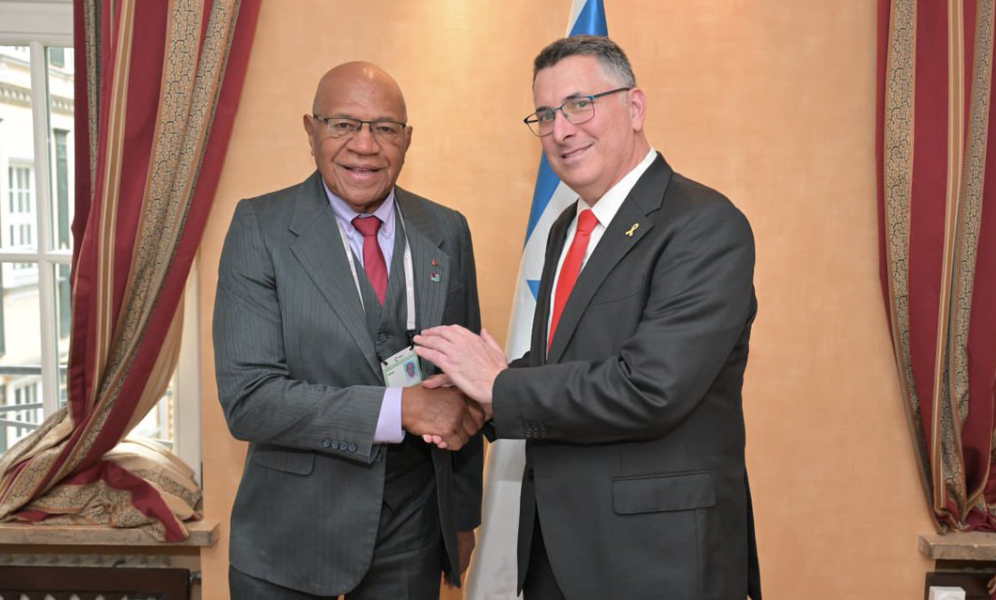
Israel's foreign minister Gideon Sa’ar announced on X that a Fijian embassy would open in Jerusalem and an Israeli embassy in Fiji. Photo: X/ @gidonsaar.
On December 26, Israel’s foreign minister Gideon Sa’ar made an announcment on X regarding Israel’s recognition of the Republic of Somaliland – a separatist region in Somalia that has been seeking unsuccessfully for years to secede – and the mutual opening of embassies: “Following the decision of Prime Minister Benjamin Netanyahu and the President of Somaliland Abdirahman Mohamed Abdullahi, today we signed an agreement on mutual recognition and the establishment of full diplomatic relations, which will include the appointment of ambassadors and the opening of embassies.”
On December 18, minister Sa’ar announced on X that a Fijian embassy would open in Jerusalem and an Israeli embassy in Fiji. Sa’ar told Fiji’s Prime Minister, Sitiveni Rabuka, “You are a true friend of Israel and a man of faith.”
But the establishment of mutual embassies with Fiji and with a state unrecognised by the international community does not signal a diplomatic breakthrough. Rather, it underscores the distress and deepening desperation in which Israel finds itself after more than two years of a multi-front war.
In light of the widespread hunger, destruction, and killing in the Gaza strip, tectonic shifts have occurred in public opinion in Israel’s two most important allies, Germany and the United States, and Germany has imposed a partial arms embargo on Israel. Boycotts, sanctions, and arms embargoes against Israel have become central planks in the platforms of left-wing parties across Europe. Were it not for the ceasefire in October, the sanctions package advanced against Israel in the European Union might have moved forward.
With the ceasefire, Israel’s diplomatic relations did not snap back like a spring to their pre-war state. Proceedings in the genocide case at the ICJ continue, and despite the sanctions imposed by President Donald Trump on the ICC, the arrest warrant against Netanyahu has not been canceled.
The world sees how, since the signing of the ceasefire, Israeli terror and ethnic cleansing in the West Bank have continued with full force; how hundreds more civilians in Gaza have been killed in Israeli attacks; and how Israel is doing everything it can to sabotage progress under President Trump’s plan, including statements by the defense minister about intentions to establish settlements in Gaza.
Therefore, Jan van Aken, leader of Germany’s left-wing party Die Linke, called on the German government in an interview with Haaretz – despite the ceasefire – to impose immediate sanctions on Israel, freeze its special trade agreements with the European Union, and completely halt all arms shipments, arms purchases, and military cooperation between the two countries. Although the German government lifted its arms embargo on Israel following the ceasefire, and Chancellor Friedrich Merz visited Israel in early December and met with Netanyahu, Van Aken’s remarks nonetheless align with a sentiment that is steadily gaining momentum among the German public.
When there is a global wave against the State of Israel, it becomes weak and vulnerable to pressure. The country’s foreign ministry knows this well from its experience confronting waves of severed relations with Israel after the wars of 1967 and 1973. An example of Israel being pressured by a state of marginal standing was the episode of the crisis in relations with Gabon.
After the 1967 war, the first wave of severed relations began – one Israel tried to stem by every possible means. According to Foreign Ministry cables opened to the public in the State Archives, in June 1970 Joséphine Bongo, the wife of Gabon’s president and dictator Omar Bongo, arrived for a visit to Israel. The visit – organised by Israel from the outset to curry favor with the dictator – blew up when the then Prime Minister Golda Meir was forced to cancel her attendance at a tea party in Joséphine Bongo’s honour in order to attend the funeral of Minister Yisrael Barzilai at Kibbutz Negba.
The dictator was furious both at Meir’s absence from the tea party and at the fact that Israeli radio and television did not adequately cover the “historic” visit of his wife. Accordingly, he ordered his wife and his ambassador to Israel to return immediately to Gabon. Only after exhausting negotiations and Israel’s granting the dictator weapons and other military equipment worth $200,000 as a gift did relations return to normal, and at the UN General Assembly in September 1972 Gabon abstained from a vote against Israel. Nevertheless, about a year later, Gabon joined the second wave of severed relations in the wake of the 1973 war.
In the future – when Israel’s foreign ministry files from the Gaza war and its aftermath are opened, or earlier through journalistic investigations – we will learn what the state of Israel was prepared to do to preserve its diplomatic relations around the world, at the very time minister Sa’ar was tweeting and opening embassies.
Eitay Mack is a human rights lawyer and activist based in Jerusalem.

No comments:
Post a Comment