An inherently soft-spoken woman, Begum Zia, earned the respect of people from all walks of life, and her unifying role during the movement attracted the youth en masse who joined her party’s students’ wing and played an active role in toppling Ershad in 1990.
A K M Wahiduzzaman
Updated on: 31 December 2025
OUTLOOK/INDIA
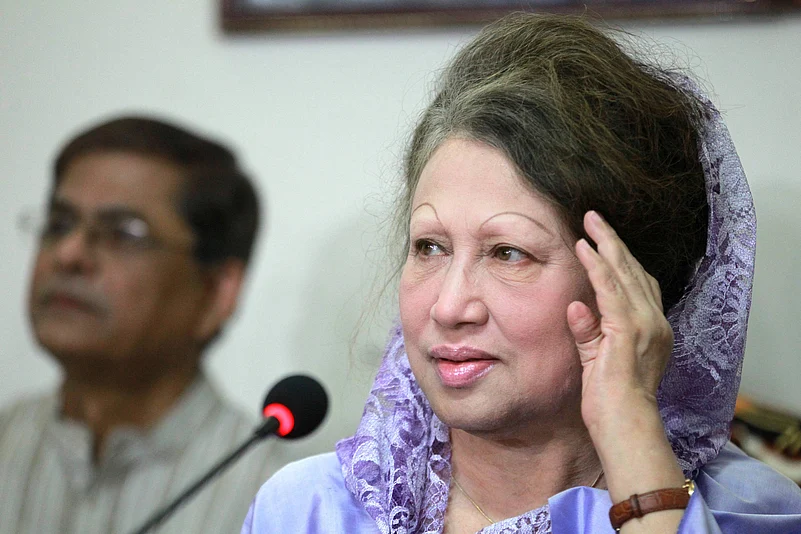
Begum Zia presided over a government in the early 1990s that would shape the country’s next three decades. Photo: IMAGO / ZUMA Press Wire
Summary of this article
Widowed at a young age, Begum Khaleda Zia chose public struggle over private safety, leading an uncompromising movement against Hussain Muhammad Ershad’s military dictatorship and playing a decisive role in restoring democracy in Bangladesh in 1990.
As Bangladesh’s first female prime minister, she shaped the country’s political and economic trajectory through electoral victories, democratic consolidation, women’s education initiatives, economic liberalisation, expansion of the garments industry, and key social and financial reforms.
Despite years of political persecution, imprisonment, and legal harassment, she remained steadfast in advocating democracy, countering extremism, and advancing women’s economic freedom—leaving behind a legacy of courage, reform, and resistance that continues to inspire the nation.
It was never an easy decision for her. After losing her husband in her mid-thirties, any widow with two young children in Muslim-majority Bangladesh would likely find it most comfortable to live a quiet life, focusing on raising her sons to take care of the family in the future. But history will remember her for prioritising her country’s interests over her family. She took up the fight against the dictatorship of Hussain Muhammad Ershad in the early 1980s and led it from the front in an uncompromising manner, which led to the fall of Ershad’s brutal regime in 1990.
Begum Khaleda Zia, Bangladesh’s beacon of hope, the first female prime minister who oversaw the democratic transition after almost a decade of autocracy in the early 1990s, died on December 30th in the Evercare Hospital of Dhaka at the age of 79.
Khaleda Zia's State Funeral Today At 2pm In Dhaka

Khaleda Zia: The End of a Political Legacy
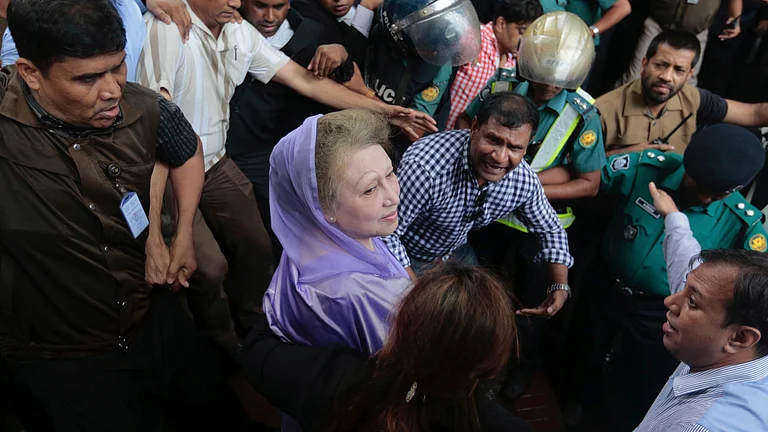
Bangladesh Premier League: December 30 Games Postponed After Ex-PM Khaleda Zia’s Death

Khaleda Zia, Former Bangladesh PM And BNP Chief, Dies At 80
Her political journey began in 1983, when she joined the Bangladesh Nationalist Party (BNP), founded by her husband, President Zia. By then, Ershad, the army chief, usurped the democratically elected BNP government and took over the country. Begum Zia decided to challenge Ershad’s rule and, during her struggle for democracy, unlike her contemporary leaders, never budged or compromised, which earned her the title “Uncompromising Leader” among the masses.
An inherently soft-spoken woman, Begum Zia, earned the respect of people from all walks of life, and her unifying role during the movement attracted the youth en masse who joined her party’s students’ wing and played an active role in toppling Ershad in 1990.
In 1991, her party, the BNP, which was severely attacked by Ershad’s regime during its almost decade-long rule, won a majority of constituencies, thanks to her leadership. She won in all five constituencies she contested, while her Awami League counterpart, Sheikh Hasina, lost in all but one, that too from Gopalganj. Khaleda Zia’s stint as an undefeated leader continued in the next elections; she was never defeated in fair polls.
Begum Zia presided over a government in the early 1990s that would shape the country’s next three decades. Today, Bangladesh has a higher percentage of women in the workforce, universities, and school classrooms; the credit goes to her. After being elected in 1991, her government pushed for mandatory primary schooling, offered generous stipends for female students, and meals for all. By the end of her tenure, the male-to-female ratio in primary schools increased, and in five years, almost 3 million more female students enrolled.
She prioritised economic liberalisation, which led to more women being employed in the country’s burgeoning ready-made garments industry. The number of RMG factories under her tenure increased threefold, and employment in the sector increased by 29%. Her government also implemented some consequential economic reforms. With her support, the finance minister, Saifur Rahman, disciplined the banks, put the stock market in order, and launched a drive to increase tax collections, which contributed to the higher spending in the social safety net.
In her second stint as the prime minister in the early 2000s, her government oversaw the liberalisation of global textile trade, and despite the withdrawal of quotas, Bangladesh’s RMG exports increased. Khaleda Zia rescued Bangladesh from the growing threat of extremists and militant groups who orchestrated several bombings since the late 1990s, almost obliterating their networks within a few years. She was the first prime minister to ban polybags to save the environment and put a stop to cheating during public examinations through strict monitoring. In 2006, when she left the office, Bangladesh marked a 6.7% GDP growth, despite the turbulence on the streets.
After a military-backed caretaker regime took over Bangladesh in 2007, she and her family were implicated in false cases, a practice continued by successive Sheikh Hasina-led governments. Despite the legal harassment, she remained unbowed and mobilised people against the oppression of the Sheikh Hasina regime, for which she was sent to jail in a case that, according to experts cited by the US State Department, lacked evidence. Even from jail, she inspired thousands of her followers to fight for democracy, as reflected in the speeches of the student leaders who became the face of the 2024 July uprising.
Until her death, Begum Khaleda Zia consistently advocated for the restoration of democracy that led to her arrests, and despite these numerous attempts to silence her, she chose not to be quiet. Her determination to stand firm in her pursuit of reforms aimed at enhancing women’s economic freedom and increasing their participation in the workforce — particularly in a Muslim-majority country — serves as a textbook example of empowering women.
Begum Khaleda Zia left a legacy of standing up for rights against all odds. This legacy will inspire the nation for centuries to come.
The author is the Information and Technology Affairs Secretary of the Bangladesh Nationalist Party-BNP.
Published At: 31 December 2025

No comments:
Post a Comment