Thursday, January 15, 2026

'Unusual and aggressive': FBI raid on Washington Post reporter's home sparks press freedom alarm

Search of journalist Hannah Natanson's home comes amid lawsuits against major outlets, tighter Pentagon media rules and cuts to public broadcasting under President Trump.


The journalist was obtaining and reporting classified and illegally leaked information from a Pentagon contractor, an official says. / AP


If the byproduct of Wednesday's raid on a Washington Post journalist's home is to deter probing reporting of government action, the Trump administration could hardly have chosen a more compelling target.

Hannah Natanson, nicknamed the “federal government whisperer” at the Post for her reporting on President Donald Trump's changes to the workforce, had a phone, two laptops and a Garmin watch seized in the search of her Virginia home, the newspaper said.

A warrant for the raid said it was connected to an investigation into a government contractor accused of illegally retaining classified government materials, said Matt Murray, the Post's executive editor, in an email to his staff. The Post was told that Natanson and the newspaper are not a target of the investigation, he said.

Attorney General Pam Bondi said that the search was done at the request of the Defense Department and that the journalist was “obtaining and reporting classified and illegally leaked information from a Pentagon contractor.”


RelatedTRT World - 'Dark day for press freedom': Pentagon reporters turn in their badges after rejecting new rules


Government raids to homes of journalists highly unusual

Jameel Jaffer, executive director of the Knight First Amendment Institute at Columbia University, has been working on press freedom issues for a decade and said a government raid on a journalist's home is so unusual he couldn't remember the last time it happened. He said it can't help but have a chilling effect on journalism.

“I strongly suspect that the search is meant to deter not just that reporter but other reporters from pursuing stories that are reliant on government whistleblowers,” Jaffer said. “And it's also meant to deter whistleblowers.”

In a first-person piece published by the Post on Christmas Eve, Natanson wrote about how she was inundated with tips when she posted her contact information last February on a forum where government employees were discussing the impact of Trump administration changes to the federal workforce.

She was contacted by 1,169 people on Signal, she wrote. The Post was notably aggressive last year in covering what was going on in federal agencies, and many came as a result of tips she received — and was still getting. “The stories came fast, the tips even faster,” she wrote.

Natanson acknowledged the work took a heavy toll, noting one disturbing note she received from a woman she was unable to contact. “One day, a woman wrote to me on Signal, asking me not to respond,” she wrote. “She lived alone, she messaged, and planned to die that weekend. Before she did, she wanted at least one person to understand: Trump had unraveled the government, and with it, her life.”

Natanson did not return messages from The Associated Press. Murray said that “this extraordinary, aggressive action is deeply concerning and raises profound questions and concern around the constitutional protections for our work.”

The action “signals a growing assault on independent reporting and undermines the First Amendment,” said Tim Richardson, journalism and disinformation program director at the advocacy group PEN America. Like Jaffer, he believes it is intended to intimidate.


Sean Spicer, Trump's press secretary at the beginning of his first term, said the concerns are premature. If it turns out that Natanson did nothing wrong, then questions about whether the raid was an overreach are legitimate, said Spicer, host of the political news show “The Huddle” on streaming services.

“If Hannah did something wrong, then it should have a chilling effect,” he said.

A law passed in 1917 makes it illegal for journalists to possess classified information, Jaffer said. But there are still questions about whether that law conflicts with First Amendment protections for journalists. It was not enforced, for example, when The New York Times published a secret government report on US involvement in Vietnam in 1971.

“It’s the government’s prerogative to pursue leakers of classified material,” the Post said in an editorial. “Yet journalists have First Amendment rights to gather and publish such secrets, and the Post also has a history of fighting for those freedoms.”


Not the first action taken against the press

The raid was made in context of a series of actions taken against the media during the Trump administration, including lawsuits against The New York Times and the BBC. Most legacy news organisations no longer report from stations at the Pentagon after they refused to sign on new rules restricting their reporting set by Defence Secretary Pete Hegseth. Funding for public broadcasting has been choked off due to Trump's belief that its news coverage leaned left.

Some news outlets have also taken steps to be more aligned with the administration, Jaffer said, citing CBS News since its corporate ownership changed last summer. The Washington Post has shifted its historically liberal opinion pages to the right under owner Jeff Bezos.

The Justice Department over the years has developed, and revised, internal guidelines governing how it will respond to news media leaks. In April, Bondi issued new guidelines saying prosecutors would again have the authority to use subpoenas, court orders and search warrants to hunt for government officials who make “unauthorised disclosures” to journalists.

The moves rescinded a policy from President Joe Biden’s Democratic administration that protected journalists from having their phone records secretly seized during leak investigations.

“Leaking classified information puts America’s national security and the safety of our military heroes in serious jeopardy,” White House press secretary Karoline Leavitt said in a post on X. “President Trump has zero tolerance for it and will continue to aggressively crack down on these illegal acts moving forward.”

The warrant says the search was related to an investigation into a system engineer and information technology specialist for a government contractor in Maryland who authorities allege took home classified materials, the Post reported. The worker, Aurelio Perez-Lugones, is accused of printing classified and sensitive reports at work and some were found at his Maryland home, according to court papers.


China urges Canada to ‘deepen cooperation’ against ‘interference’ as premiers set to meet

Meeting comes after Canadian prime minister arrives in Beijing to hold meetings with Chinese president, premier

Berk Kutay Gokmen |15.01.2026 - TRT WORLD


ISTANBUL

China on Thursday urged Canada to “deepen cooperation” against "interference" and enhance bilateral relations as the premiers of the two countries are set to meet in Beijing.

Ahead of a meeting between China's Premier Li Qiang and Canadian Prime Minister Mark Carney in Beijing, Chinese Foreign Minister Wang Yi told his Canadian counterpart Anita Anand that Beijing is willing to “strengthen communication with Canada,” according to a statement from the Chinese Foreign Ministry.

Beijing is willing to “enhance trust, eliminate interference, and deepen cooperation with Canada, to bring bilateral relations forward on a steady and sound track in solid strides under the new circumstances,” Wang said.

Carney reached China on Wednesday for a four-day visit, marking the first trip to China by a Canadian premier in eight years.

Former Canadian Prime Minister Justin Trudeau had last visited China in 2017.

During his trip, Carney is scheduled to meet with Chinese President Xi Jinping, Premier Li, and other government and business leaders.

According to a Canadian statement, the meetings will aim to elevate engagement on "trade, energy, agriculture, and international security."

Canada and China established diplomatic relations in 1970, and the bilateral trade volume stood at around $67 billion at the end of 2024.
More deaths than births in Europe for the first time since 1918

Claire Lemaire

15 January 2026
BRUSSELS SIGNAL


For the first time since the end of the First World War, more people are dying than are being born in Europe.

That is according to figures published yesterday by France’s national statistical office, INSEE. The trend now affects the entire continent, including countries where fertility rates used to be relatively high.

In its annual demographic report, INSEE reported that deaths outnumbered births in Europe in 2025. It said that was not because of an exceptional rise in mortality but due to a sustained fall in births combined with an ageing population.

In France for instance, 651,000 people died in 2025 while 645,000 babies were born — a difference of 6,000. For the first time since the end of the Great War, the natural population balance turned negative.

“This is a very logical demographic evolution,” said Peter Vanden Houte, Chief Economist at ING Belgium, speaking to Brussels Signal today.

“Since the early 1970s, with the arrival of the contraceptive pill, the number of births in Europe has declined sharply,” he said. “The baby boom of the 1950s and 1960s has therefore gradually become the largest segment of the population.”

At the same time, he said, “the number of women who are of childbearing age has structurally declined,” while “in recent years we have also seen a significant increase in the age at which women have their first child.”

“All of this means that fewer children are being born, while among the post-war baby boomers, the number of deaths is increasing,” Vanden Houte said.

According to the INSEE figures, the shift is the result of long-term trends. Birth numbers have been declining almost continuously since 2007. Last year, the number of births fell to its lowest level since 1918, while deaths continued to rise as the large post-war generations reached older age.

The average number of children per woman has also dropped to levels not seen since 1918, according to INSEE. At the same time, deaths are increasing even in the absence of major health crises as the population grows older.

Similar demographic patterns are visible across Europe, including in regions that were long considered more resilient.

“It’s no secret that advanced Europe has aged very rapidly over the last 70 years… this is now visible across the whole continent” said Beata Javorcik, Chief Economist at the European Bank for Reconstruction and Development, speaking at a conference yesterday.

Fertility in Europe has fallen from around five children per woman 150 years ago to about two today. The same applies, she said, to eastern European Union member states, where fertility used to be higher than in the rest of the continent, but where the rates are now well below replacement.

As a result, the workforce is shrinking faster than the population as a whole, a trend that is already weighing on economic growth. “Demographic trends are already shaving off growth in GDP per capita,” Javorcik said.

Zsolt Darvas, a senior researcher at the Brussels-based Bruegel think-tank, confirmed that the “problem” was no longer limited to certain regions.

“It used to be said that demographic decline was mainly a southern European issue,” he said. “But eastern Europe is now even lower — lower than Italy or Spain, for that matter.”

According to Darvas, all advanced economies now have fertility rates well below replacement and are running at around 1.6 children per woman.

Even in Scandinavia, often cited as a positive model, social policies can soften the decline but cannot reverse it, Darvas added.

In countries that introduced financial aid and incentives for parents in the last years, such as Hungary for instance, fertility rates continue to decline, he said.
Chinese student numbers at Harvard rise despite Trump visa crackdown


By SCMP
Published Jan 15, 2026 

Enrollment from mainland China grew 4.5% in 2025 even as Washington tightened vetting, revoked thousands of student visas


Students walk on campus at Harvard University in Cambridge, Massachusetts, U.S., Nov. 19, 2025, as it opens a probe into individuals mentioned in the Jeffrey Epstein files recently released by Congress, after the documents showed a close relationship between its former president, Larry Summers, and the late convicted sex offender. Reuters-Yonhap

Enrollment at Harvard for Chinese students rose in the autumn from a year earlier, even as the Donald Trump administration moved to rein in visas for them and limit foreign enrollment and funding at the prestigious university.

The number of students from mainland China rose from 1,390 in autumn 2024 to 1,452 in autumn 2025 — an increase of 4.5 percent — according to Harvard data released on Friday.

Hong Kong student enrollment rose from 68 to 73, while enrollment from Macau, which is in the single digits, decreased.


The increase in Chinese students is notable as Harvard’s foreign student population had faced significant scrutiny in the early months of the second Trump administration, with U.S. Homeland Security secretary Kristi Noem publicly citing its engagement with China as a reason for the crackdown.

U.S. Secretary of State Marco Rubio in May said that the State Department and the U.S. Department of Homeland Security would work to “aggressively revoke” visas of Chinese students with Communist Party ties or in “critical fields” and to tighten vetting of applicants from mainland China and Hong Kong. Republican lawmakers, meanwhile, have introduced measures in the past year to curb Chinese student access to the U.S., citing concerns over potential espionage.

Washington and Beijing have been locked in geopolitical fights on everything from technology to tariffs. Beijing, for its part, has issued study abroad warnings for its students against U.S. states that have imposed restrictions on engagement with China and accused Washington of disproportionate scrutiny of its nationals at U.S. borders.

Harvard, which has been supportive of its foreign students despite being the main target of the Trump administration’s efforts to reshape higher education, is continuing its fight against the administration with two legal challenges over funding cuts and foreign student enrollment restrictions pending a final outcome.

The administration’s campaign against Harvard started with a focus on alleged campus antisemitism but widened into an attack on diversity programmes and perceived political bias. Last year, it froze billions in research funding and blocked the Ivy League school from enrolling foreign students, demanding changes in governance, hiring and admissions.


David Weeks, co-founder and chief operating officer of Sunrise International, a firm that advises overseas universities on recruiting Chinese students, said that the increase was a “meaningful signal for Harvard and to a slightly lesser extent for U.S. higher education.”

Elite U.S. brands still have a strong gravitational pull, especially in China, Weeks said. “Many will apply to third-country options as hedges, but if they land their U.S. ‘reach’ school, they often still take it because the perceived long-term credential value is hard to match.”

Weeks added that Chinese students’ risk tolerance is higher than many observers assume.

“Overall Chinese enrollment in the U.S. is down from its 2019 peak, but that decline likely reflects the more risk-averse segment of Chinese students shifting to alternatives … Many Chinese families have lived through prior U.S.–China ‘lurch cycles’ like the 2018 trade war, so they evaluate shocks differently compared to markets like India,” he said.


Students walk past Widener Library at Harvard University in Cambridge, Massachusetts, U.S., Nov. 19, 2025, as it opens a probe into individuals mentioned in the Jeffrey Epstein files recently released by Congress, after the documents showed a close relationship between its former president, Larry Summers, and the late convicted sex offender. Reuters-Yonhap


Harvard saw a slight increase in overall foreign student enrollment compared with the autumn of 2024. The proportion of international students at Harvard in the autumn of 2025 rose slightly to 28.1 per cent, or 6,836 students — a roughly 1 per cent increase reflecting a gain of 43 foreign students.

While small, it is a change that goes against national trends. Foreign enrollment at U.S. universities overall declined by about 1 percent over a comparable period, while new foreign student enrollment fell by 17 percent, according to partial data from the Institute of International Education’s Open Doors report, which is sponsored by the State Department.

The second Trump administration has taken numerous steps to restrict international students, including new social media vetting procedures during visa processing, travel bans, threats to deport foreigners for expressing political speech and proposals to change the H-1B programme — a key work visa often used by international graduates.

On Monday, the State Department said it had revoked over 100,000 visas since Trump took office last January, among them some 8,000 student visas.

Trump has spoken out against Harvard, but in contrast to others in his administration, has voiced support for Chinese and other international students, calling foreign enrollment a business matter and saying he would accept 600,000 Chinese students.

Chinese students remain the largest foreign student group at Harvard. Nationwide, they are the second largest at about 266,000, behind students from India.

Since the rhetoric against them picked up last year, students from China have expressed mixed feelings towards going to the U.S., with some saying it did not change their plans, others looking elsewhere. Some note that it is difficult to take specific announcements seriously because of the frequency of policy changes.

It is not the first time they have been targeted. Under his first term, Trump issued a presidential proclamation restricting students with ties to certain universities in China from coming to the U.S.

Thousands march in Caracas calling for Maduro's release amid US military intervention

"Unity is not up for debate. Anyone conspiring against unity is conspiring against Venezuela, and everyone must contribute to it," a ruling party official says.


The march was organised by the ruling United Socialist Party of Venezuela (PSUV). / AFP

TRT WORLD
2 hours ago

Thousands of demonstrators marched in Venezuela’s capital Caracas on Wednesday demanding the release of abducted President Nicolas Maduro following US air strikes.

The march was organised by the ruling United Socialist Party of Venezuela (PSUV) and drew large crowds carrying photographs of Maduro and former President Hugo Chavez, according to Venezuela News.

Addressing the rally, PSUV Vice President for Mobilisation Nahum Fernandez voiced full support for the government led by interim President Delcy Rodriguez and called for national unity.

“Unity is not up for debate,” Fernandez told the crowd. “Anyone conspiring against unity is conspiring against Venezuela. Everyone must contribute to this unity.”

Fernandez reiterated demands for Maduro’s release, stressing that the gathering was a protest rather than a celebration. “We want Maduro freed and Cilia to return. We demand that both return to the country,” he said, referring to First Lady Cilia Flores.

Separately, dozens of motorcyclists formed convoys along Caracas’ main thoroughfares, circling central areas of the capital to show support for Maduro.

Meanwhile, PSUV Secretary General Diosdado Cabello announced that educators would also take to the streets on Thursday to mark Teachers’ Day.

Speaking during a televised broadcast, Cabello said Venezuelans had been protesting since the first day of what he described as a US military attack, demanding the release of their leaders.

He added that teachers would march to call for Maduro’s freedom and the return of his wife to the country


Trump calls Minnesota's food stamp program ‘giant Democrat scam’

US president’s statement comes after federal judge blocked his administration from withholding $80M to administer SNAP food aid for people on low incomes

Kanyshai Butun |15.01.2026 -  TRT/AA


ISTANBUL

US President Donald Trump on Thursday called the food stamp program in the state of Minnesota, known as SNAP, a “giant Democrat scam,” following a federal judge’s decision to block his administration from withholding $80 million to administer the program.

"California, Illinois, New York, and so many other places are equally as bad. It’s all a giant Democrat scam, with protection from the fake news media," Trump wrote on his social media platform Truth Social.

In Minnesota, investigations are underway into allegations of misuse of funds allocated under SNAP, particularly in Minneapolis, after federal authorities said that some businesses were not actually operating and were abusing federal funds.

“Does anybody believe that in Minneapolis (the state’s largest city), these are the food stamp businesses? There’s no food, there’s no cleanliness, there’s no service, there’s no nothing, except fraud,” said Trump.

“They get sent millions of dollars of taxpayer money, and laugh at how stupid the Americans are, but not anymore," he claimed.

Critics say that since Trump returned to office this January, his administration has used allegations of fraud with scant evidence as an excuse to cut off funding and cancel programs the Republican Party dislikes, or punish Democratic-led states. They say that in contrast, reports of corruption within Trump’s Cabinet and the executive office are never investigated.

“These people should be sent back to Somalia, or any other country from where they came,” Trump added.

Trump has long been critical of migrants from Somali and African migrants in general, and has used insulting language about the continent and its people, while saying there should be more white South African migrants and ones from “nice” countries “like Denmark (or) Switzerland.”

On Wednesday Trump said that his administration will suspend federal funding for sanctuary cities and states – which limit or deny cooperation with the national government in enforcing immigration law – starting Feb. 1, as part of its ongoing immigration crackdown.

The move follows the fatal shooting of a US citizen in Minneapolis by an Immigration and Customs Enforcement (ICE) officer, an incident that has sparked a political backlash and calls for state officials to be involved in the FBI’s investigation.

Trump administration officials later described the victim, Renee Good, as a domestic terrorist.​​​​​​​
US reinstates $2B in mental health, addiction funds after abrupt cuts

Restoration of money within 24 hours of announcing sweeping cuts is emblematic of Trump administration's aggressive, seemingly haphazard approach to spending

Seyit Kurt |15.01.2026 - TRT/AA


ISTANBUL

The US has reversed a decision to terminate nearly $2 billion in federal funding for mental health and addiction services, restoring grants less than a day after more than 2,000 programs nationwide were told their funding would end immediately, according to media reports.

An administration official confirmed late Wednesday that the funds were restored but did not explain the decision. The move followed intense bipartisan pressure from lawmakers, including a letter sent to Health and Human Services Secretary Robert F. Kennedy Jr. that was signed by about 100 members of the US House of Representatives, according to The New York Times.

The funding termination notices were issued Tuesday by the Substance Abuse and Mental Health Services Administration (SAMHSA) in a form letter, saying only that the services no longer aligned with the agency’s priorities, including “innovative programs and interventions that address the rising rates of mental illness and substance abuse conditions, overdose, and suicide.”

The cuts would have taken effect immediately.

Lawmakers said the move conflicted with congressional authority over spending, as under the US Constitution, Congress is supposed to have the “power of the purse.”

Rep. Rosa DeLauro of Connecticut, the top Democrat on the House Appropriations Committee, said the episode created “uncertainty and confusion” for families and health care providers and emphasized that Congress controls federal spending.

Several organizations reported abrupt losses before the reversal, including treatment providers, emergency medical services groups, and national mental health and addiction organizations.

Some grants were tied to programs reauthorized under the SUPPORT Act, which President Donald Trump signed into law in December.

Since returning to the White House last January, Trump has taken an aggressive approach to cutting government programs, laying off thousands of workers and canceling long-standing programs with little or no notice, despite money already appropriated.

In many cases – such as workers maintaining the US nuclear weapons arsenal, last March – workers have been fired followed by efforts to quickly rehire them, apparently after it became clear how important their jobs were.

Critics have blasted the approach, saying it was done with no planning or understanding, and undermined vital government functions.

After spending most of 2025 approving Trump’s funding priorities without question, some congressional Republicans have started to buck the president, restoring funds to science and health programs that Trump targeted for elimination.


Perceived Threat From Big Business Growing

January 15, 2026

WASHINGTON, D.C. — Americans still believe “big government” represents the biggest threat to the U.S. in the future, but the 57% saying so is down from percentages near 70% between 2013 and 2016. At the same time, 37% of Americans say “big business” is most threatening, essentially tying the high in Gallup’s trend. Just 5% of U.S. adults regard “big labor” as the greatest threat.

The current results are based on a Dec. 1-15 Gallup poll. Gallup first asked Americans to assess the threat posed by government, business and labor in 1965 and has done so periodically since.

Government has always been identified as the biggest threat, although the margins over business and labor were smaller in the earlier years of the trend than they have been since the 1980s. By then, concerns about government had risen to the majority level, dipping below 50% only once. The exception came in 2002 amid corporate accounting scandals that plagued Enron and other companies, when 38% chose big business and 47% big government.

In the 1960s, more Americans identified big labor rather than big business as the biggest threat — but in the 1970s and 1980s, the two were about even, each averaging around 20%. Since the 1990s, big government has typically been the clear majority response, with no more than 11% naming big labor and at least 21% naming big business as the biggest threat to the U.S.

Fewer Independents, Democrats See Government as Top Threat

Democrats’ and independents’ views of which entity poses the greatest threat have changed substantially over the past decade, with both groups showing double-digit increases in the percentages naming big business as the biggest threat and double-digit decreases for big government. Although down from 67% in 2016, a majority of independents (55%) still cite big government, compared with 40% naming big business (up from 26%). But Democrats’ top mention has switched from government (51%) to business (56%).

Republicans’ opinions have not changed meaningfully since 2016; they overwhelmingly identify big government (77%) as the biggest threat.

Throughout the past decade, no more than 7% of Americans in any party group have named big labor as the biggest threat.

One in Three See ‘Big Tech’ as Greatest Threat When Included

In 1965, Gallup could not have foreseen the influence that technology would come to have on U.S. society. This year, Gallup asked an alternative version of the question that included “big technology” as a fourth choice. This modified version of the trend question was asked in December among a nationally representative online sample using the Gallup Panel.

When included, big technology is viewed as the biggest threat by 32% of U.S. adults, ranking second to big government at 45% and ahead of big business at 20%, with only 3% choosing big labor.

With big technology included, six in 10 Republicans regard big government as the biggest threat, while 27% choose big technology. Big government also edges out big technology, 43% to 34%, among independents. Democrats divide fairly evenly in saying that big government (35%), big technology (34%) and big business (29%) represent the biggest threat to the U.S. in the future.

Bottom Line

As they have for six decades, Americans perceive big government as a bigger threat to the U.S. in the future than either big business or big labor. However, fewer identify big government as the top threat than did so in the 2010s; instead, a higher percentage say big business is, with the 37% doing so essentially matching the record high for that response. But when big technology is added as a choice, it eclipses big business for second place, although it still trails big government by a considerable margin.

Stay up to date with the latest insights by following @Gallup on X and on Instagram.

Learn more about how the Gallup Poll Social Series works. View complete question responses and trends (PDF download).


Opinion

Somaliland and the Israeli recognition: A post-mortem of Arab strategic impotence


A group of Somalis, carrying Somali flags and chanting slogans against Israeli Prime Minister Benjamin Netanyahu and Israel, protest Israel’s decision to recognize Somaliland, gathering in Mogadishu, the capital of Somalia, on December 28, 2025. [Abuukar Mohamed Muhidin – Anadolu Agency]

by Dr Mustafa Fetouri
Middle East Monitor.
January 15, 2026 

As 2026 dawns, the Arab world finds itself staring at a strategic catastrophe that is as much a product of its own making as it is a result of foreign design. The formal recognition of the Republic of Somaliland by Israel is not merely a diplomatic shift in the Horn of Africa; it is a definitive blow to the anti-normalisation camp and a stark revelation of the “strategic void” that now defines Arab foreign policy—if one ever existed.

While the League of Arab States (LAS) and the Organization of Islamic Cooperation (OIC) remain trapped in a cycle of hollow condemnations and “statements of concern,” the geopolitical map of the Red Sea is being redrawn with clinical precision.

Without a deep dive into history, it is essential to understand the present, one must look at the deep-seated historical roots of this manoeuvre. The recognition of Somaliland is a modern revival of the Israeli “Periphery Doctrine”—a strategy designed to leapfrog the hostile Arab core by building alliances with non-Arab or marginalised actors on the fringes.

This logic dates back to at least 1944, when the Jewish Organisation for Refugees petitioned the Ethiopian Empire to allocate the Harar region as a Jewish homeland. While the Ethiopian Emperor eventually refused—not out of principle, but because the Zionists demanded the entire province—the seed of a strategic alliance between the Horn and the future Zionist state was planted. Today, by recognising Somaliland, Israel is completing a pincer movement that secures its presence in the Bab al-Mandab, a feat it could never have achieved without the vacuum left by Arab indifference.

The Israeli focus in this perspective has always been on non-Arab countries that hold the vital resources upon which the Arab world depends—most notably, water. For decades, Israel’s long-term strategy has prioritised relations with Turkey, knowing that the water security of major Arab states like Syria and Iraq is tethered to Turkish headwaters. We see the same pattern today with Ethiopia; by building deep strategic and technical ties with Addis Ababa, Israel gains indirect leverage over the Nile, the very lifeblood of Egypt. This “hydro-diplomacy” ensures that while Arab states are busy with internal friction, their existential resources are increasingly influenced by a non-Arab periphery aligned with Tel Aviv.

The leadership in Hargeisa has played a masterful, if cynical, hand. After thirty years of seeking recognition from an Arab world that offered nothing but lip service to “Somali unity,” Somaliland realised that the road to international legitimacy—and the White House—runs through Tel Aviv.

In the prevailing logic of the Trump era and its aftermath, Somaliland offered itself as a candidate for the Abraham Accords. They understood a reality that Arab capitals refuse to acknowledge: Israel is the gatekeeper of American favour. By trading recognition for a seat at the table of normalisation, Hargeisa secured a strategic lifeline that the LAS was either unwilling or unable to provide.

The fundamental question facing Cairo, Riyadh, and Mogadishu today is: What can the Arab world offer Somaliland to turn it away from Israel?

The uncomfortable answer is: Nothing.

There is no economic package, no security guarantee, and no political roadmap currently on the table from any Arab or Islamic body that carries more weight than the recognition offered by Israel. We are witnessing “Zero-Value Arab Diplomacy.” Even Somalia itself, which claims Somaliland as its sovereign territory, is so weakened that it may eventually find itself forced to join the normalisation wave simply to stay relevant—regardless of Israel’s ties with Hargeisa. While this might seem like a far-fetched notion today, the history of the Arab-Israeli conflict is littered with “unthinkable” concessions that eventually became reality. Few would have predicted in the 1960s that Egypt and Jordan would eventually sign peace treaties at the expense of the Palestinian cause—the very cause they once defined as their “central” national struggle.

Perhaps the most telling indictment of the current Arab order occurred during the 28 December emergency meeting of the Arab League. In a display of profound political duplicity, the United Arab Emirates (UAE) presided over the session that heard delegate after delegate denounce the Israeli-Somaliland thaw. Yet, Abu Dhabi—with its massive investments in the Port of Berbera and its deep-rooted ties via the Abraham Accords—refused to sign the final statement of condemnation.

The UAE also remained conspicuously silent at the OIC and during the UN Security Council discussions. This “calculated malice” suggests that for some Arab powers, the fragmentation of Somalia and the expansion of Israeli influence are not threats to be countered, but business opportunities to be managed.

The international response has been equally cynical. During recent UN Security Council deliberations, the United States took a stance that can only be described as “strategic superficiality.” Washington’s logic—prevalent in the current Trumpian era—is that if the world can recognise a Palestinian state that lacks actual sovereignty, there is no logical barrier to recognising a Somaliland state that has functioned with de facto sovereignty for three decades. It is a shallow argument, but in a world where Arab influence has been reduced to a whisper, it is an argument that carries the day. The US deliberately twists fact of history that Palestine is not part of any other state but an occupied country demanding its freedom—a humanly strong case for recognition by all UN member states.

There is also the lingering, rumour that Israeli recognition is a “quid pro quo” for Somaliland agreeing to host forcibly displaced Palestinians from Gaza. While Hargeisa has officially denied this, and pan-Islamic sentiment among its people remains a formidable barrier, focusing solely on the success or failure of such a “resettlement” plan is a mistake. As seen in November 2025, when a mysterious flight of over 150 Palestinians landed in South Africa—reportedly coordinated by Israeli-linked groups—the intent to disperse the Palestinian population is no longer a secret; it is an active policy. However, for the Arab world, the damage is already done. Even if not a single Palestinian is relocated to the Horn of Africa, the strategic anchor that Israel has now dropped in Somaliland represents a permanent loss of Arab littoral control.

The “Somaliland crisis” is not a failure of international law; it is a failure of Arab vision. By ignoring the legitimate administrative stability of Hargeisa and offering no viable path for Somali reintegration, the Arab world created a vacuum. Israel, ever the opportunist, simply walked through the door that Arab neglect left wide open.

If the LAS continues to prioritise ink-on-paper statements over ground-level engagement, it will soon find that it no longer controls the shores of the Red Sea. The “Arab Lake” is being drained, and in its place, a new, non-Arab security architecture is rising—one where the Arab voice is not only unheard but entirely irrelevant despite being majority of shoring countries.

The views expressed in this article belong to the author and do not necessarily reflect the editorial policy of Middle East Monitor.


A construction crane falls onto a moving train in Thailand, killing at least 32 people


THE ASSOCIATED PRESS

January 15, 2026 

NAKHON RATCHASIMA, Thailand--A construction crane crashed onto a moving passenger train in northeastern Thailand on Wednesday, triggering a derailment that killed at least 32 people and injured dozens more.

The crash occurred in Nakhon Ratchasima, some 200 kilometers (135 miles) northeast of Bangkok, on a section of a planned high-speed rail project that is intended to eventually connect China with much of Southeast Asia.

The province’s Public Health Provincial Office said there were 32 fatalities and 64 injured victims, including seven with severe injuries. There were still three passengers missing among the 171 believed to have been on board the train, it said in a statement issued as night fell.

Authorities said the crane was being used to build an elevated part of the railway when it fell as the train was traveling from the capital, Bangkok, to Ubon Ratchathani province. Thailand’s Rail Transport Department said the crane was what is called a launching gantry crane, a self-supporting structure with vertical legs that usually runs on rails or wheels for mobility, allowing it to progress along with the construction project that it straddles. Such cranes are often used to help build elevated roads.

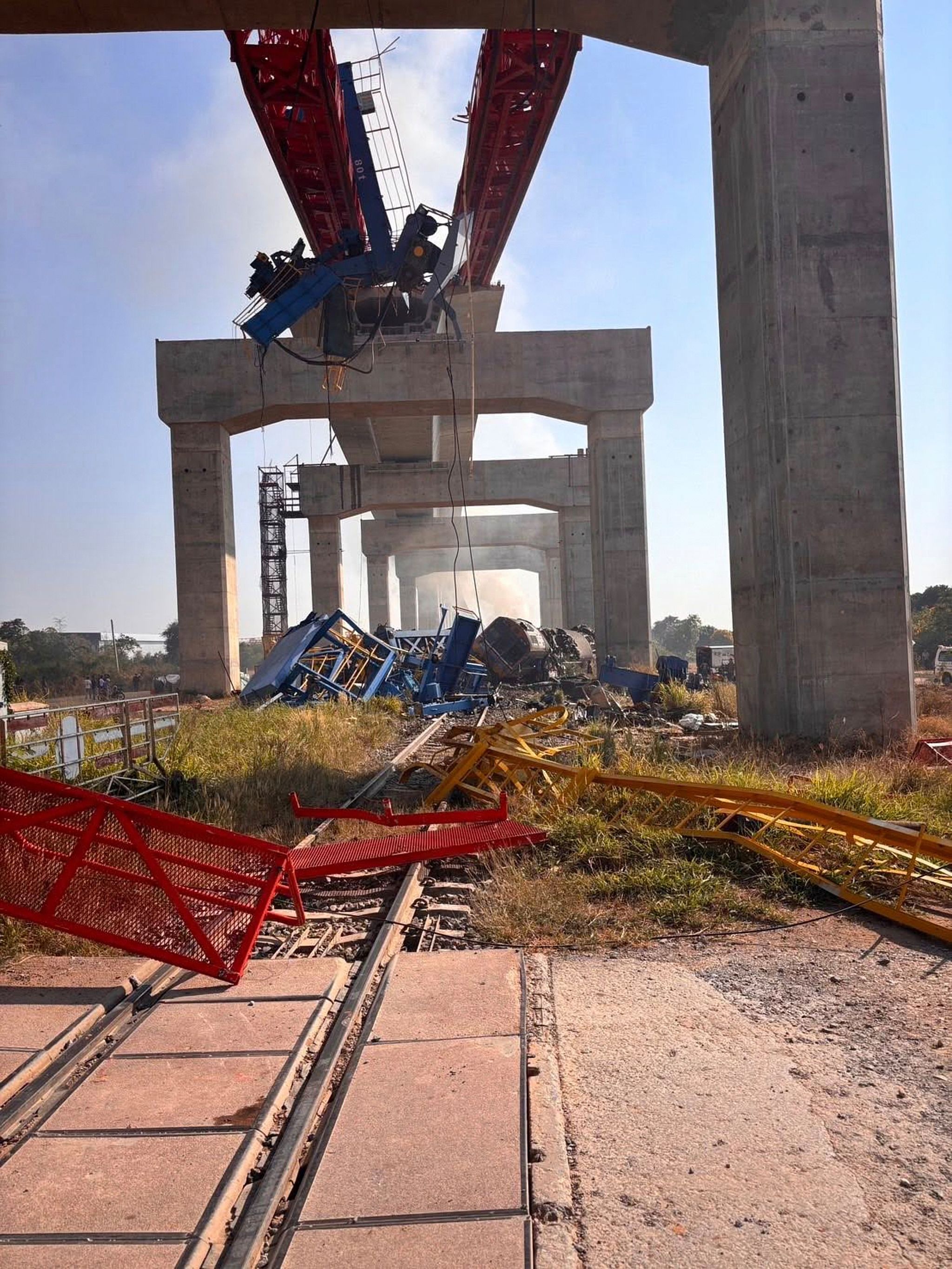
Images published in Thai media showed plumes of white, then dark, smoke rising from the crash site, with construction equipment dangling from girders between two concrete support pillars.

Rescue workers stood on top of overturned railway carriages, some of them with gaping holes torn on their sides, video from public broadcaster ThaiPBS showed. What appeared to be sections of the crane were scattered along the track.

Sixty-two year-old Samai Teechantuek, whose house is about 100 meters (yards) from the site of the accident, told The Associated Press of the horror of witnessing the accident, and hearing “the noises screeching, and then bam, bam, bam, all the way over there.”

“When the dust settled, I saw the top of the train carriage. I heard people shouting ‘save the children first!’” she said. “A conductor pulled people out. I saw them pulling many people out. People from the shop over there also ran out to help.”

“My legs were shaking. I was standing there shaking. I didn’t dare going any closer,” she said.

Transport Minister Phiphat Ratchakitprakarn said he ordered an investigation.

In August 2024, a railway tunnel on the planned route, also in Nakhon Ratchasima, collapsed, killing three workers. Days of heavy rainfall were believed to have been a factor in the collapse.

The elevated segment that collapsed is a part of a Thai-Chinese high-speed railway project linking the capital to the northeastern province of Nong Khai, bordering Laos. The two-stage rail project has a total investment cost of more than 520 billion baht ($16.8 billion) and is associated with an ambitious plan to connect China with Southeast Asia under Beijing’s Belt and Road Initiative. The section where the accident took place had a budget of more than 179 billion baht ($5.7 billion) and according to its original plans was expected to start operating in 2027.

Anan Phonimdaeng, acting governor of the State Railway of Thailand, said the project’s contractor is Italian-Thai Development, with a Chinese company responsible for design and construction supervision. He said he ordered the contractor to suspend operations at the site until the investigation of the accident is completed.

Anan said authorities will examine the responsibilities of both parties, and the Railway Department plans to take legal action against the contractor as a first step. Damage to the train was estimated to be more than 100 million baht ($3.2 million), while construction equipment suffered limited damage, he said.

A statement posted on the company’s website expressed condolences to the victims and said the company would take responsibility for paying compensation to the families of the dead and hospitalization expenses for the injured.

The main contractor for the route’s first stage between Bangkok and Nakhon Ratchasima, Italian-Thai Development, was also the directly responsible for construction of the segment where Wednesday’s accident occurred.

The rail accident sparked outrage because the company, also known as Italthai, was also the co-lead contractor for the State Audit Building in the Thai capital Bangkok, which collapsed during construction in March during a major earthquake.

About 100 people were killed in the collapse, which was the only major structure in Thailand to suffer such serious damage. Dozens of executives were indicted in connection with the disaster but none have yet been tried.

The involvement of Chinese companies in both projects has also drawn attention, as has Italthai’s and Chinese companies’ involvement in the construction of several expressway extensions in and around Bangkok where several accidents, some fatal, had occurred.

Prime Minister Anutin Charnvirakul, who was interior minister when the State Audit Building collapsed, said that the Comptroller General’s Department and Transport Ministry are responsible for blacklisting contractors, and the laws could not be amended in the brief time he was interior minister to expedite the matter.

In Beijing, Chinese Foreign Ministry spokesperson Mao Ning said the government was aware of the reports about the accident and had expressed condolences.

“The Chinese government attaches great importance to the safety of projects and personnel, and we are also learning about the situation,” she said. “At present, it appears that the relevant section is being constructed by a Thai company, and the cause of the accident is still under investigation.”

Another crane collapses in Thailand, killing two, after 32 die previous day

Thursday’s incident, on the outskirts of the capital Bangkok, follows a crane collapse the day before that killed dozens in the country’s northeast.


Cars drive next to a collapsed crane that crushed two vehicles during construction of an elevated highway in Samut Sakhon province, Thailand, January 15, 2026 [Thai Rescue Worker Association/Handout via Reuters]


By Al Jazeera Staff and News Agencies
Published On 15 Jan 2026

A crane collapse has killed two people on the outskirts of Thailand’s capital Bangkok, one day after a falling crane in the country’s northeast killed 32.

Thursday’s accident in Samut Sakhon province involved a crane being used to construct an elevated highway that fell onto the road below, Police Colonel Sitthiporn Kasi, superintendent at the local district police station, told the Reuters news agency. Another police official from the station told Reuters that five people ​had also been injured ‌in the accident.


Transport Minister Phiphat Ratchakitprakarn said the same building firm was also involved, linking Italian-Thai Development to the country’s second deadly crane collapse in two days, according to local media.

The company was contracted to build a section of a China-backed high-speed rail project where a huge crane collapsed on Wednesday in Nakhon Ratchasima province, northeast of Bangkok.

Local media reported that Thursday’s incident occurred in front of the Paris Inn Garden Hotel. Footage showed clouds of dust and rubble scattered across the site after the crane collapsed.

The Rama II Expressway, the site of the latest accident, hosts several major infrastructure projects, including tollway construction, and has seen several deadly accidents in recent years, earning it the nickname “Death Road”.

On Wednesday, the crane involved was being used to build an elevated track as part of a joint Thai-Chinese high-speed rail project, according to reports. The crane fell onto a moving train below, causing it to derail and briefly catch fire.
Advertisement

Transport Minister Ratchakitprakarn said in a statement that 195 passengers were on board the train and he had ordered a full investigation.

Al Jazeera’s Tony Cheng, reporting Wednesday from Bangkok, said the route that the train was taking is “very commonly used”, serving heavily populated regions of northeast Thailand.

“This route has been the site of a high-speed Chinese rail project, which has been under construction for quite some time now – about a decade,” he said.
Want to come back to this article? Save it for later.
Save

“It is supposed to be bringing a high-speed rail, which is on a concrete platform above the existing rail line,” he added.

Industrial and construction site accidents have long been common in Thailand.


Fatal back-to-back crane failures tied to same Thai firm: minister

Published: 15 Jan 2026 - 
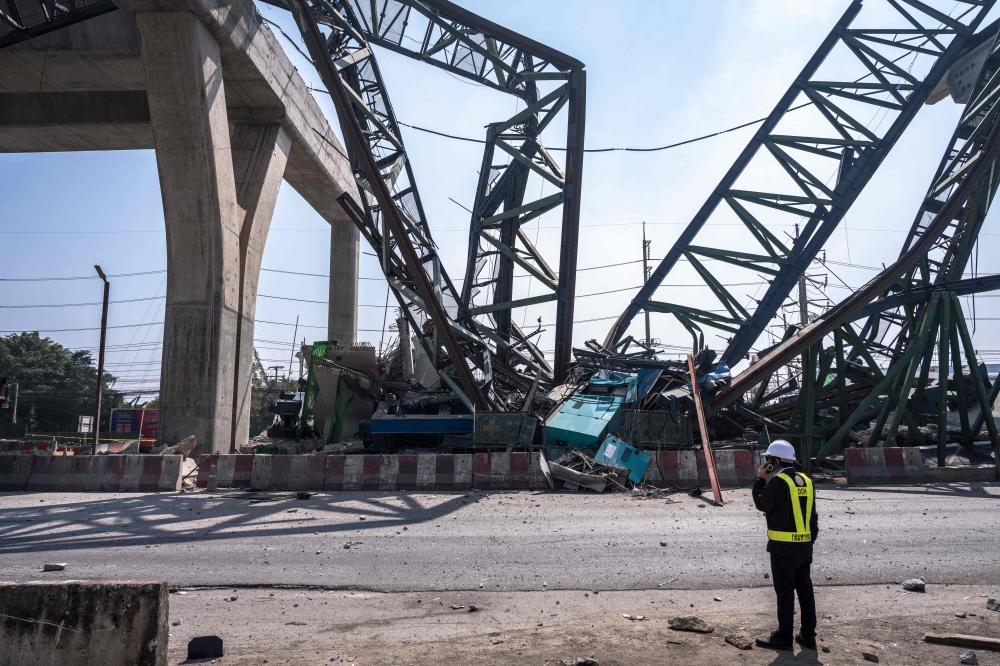


A recovery worker stands near the site of a construction crane collapse onto a highway in Samut Sakhon on the outskirts of Bangkok on January 15, 2026
. (Photo by Chanakarn Laosarakham / AFP)

AFP

Bangkok: The collapse of a highway construction crane killed two people near Bangkok on Thursday, with a Thai minister saying the building firm was also involved in a crane failure the day before that left 32 dead.

Car dashcam footage verified by AFP showed the moment the massive crane fell on Thursday, unleashing clouds of dust as well as rubble across the area as several vehicles pulled over or reversed to avoid falling debris.

Motorcycle-taxi driver Booncherd La-orium said he no longer felt safe driving in the suburb outside Bangkok.

"I had goosebumps just thinking about how risky it is to be here. It could have happened to me," the 69-year-old told AFP.

"I still can't get over yesterday's incident, and this morning I heard another one happened again."


Transport Minister Phiphat Ratchakitprakarn linked firm Italian-Thai Development to the country's second deadly crane collapse in two days, according to local media.

The company was contracted to build a section of a China-backed high-speed rail project where another huge crane fell on Wednesday, in Nakhon Ratchasima province, derailing a passenger train below and killing 32 of nearly 200 people on board.

"Yes, it is Italian-Thai. I still do not understand what happened," Phiphat told local media on Thursday.

"We have to find out the facts, whether it was an accident or something else," he said, adding that two people were killed.

The company -- one of Thailand's biggest construction firms -- has seen several deadly accidents at its sites in recent years.

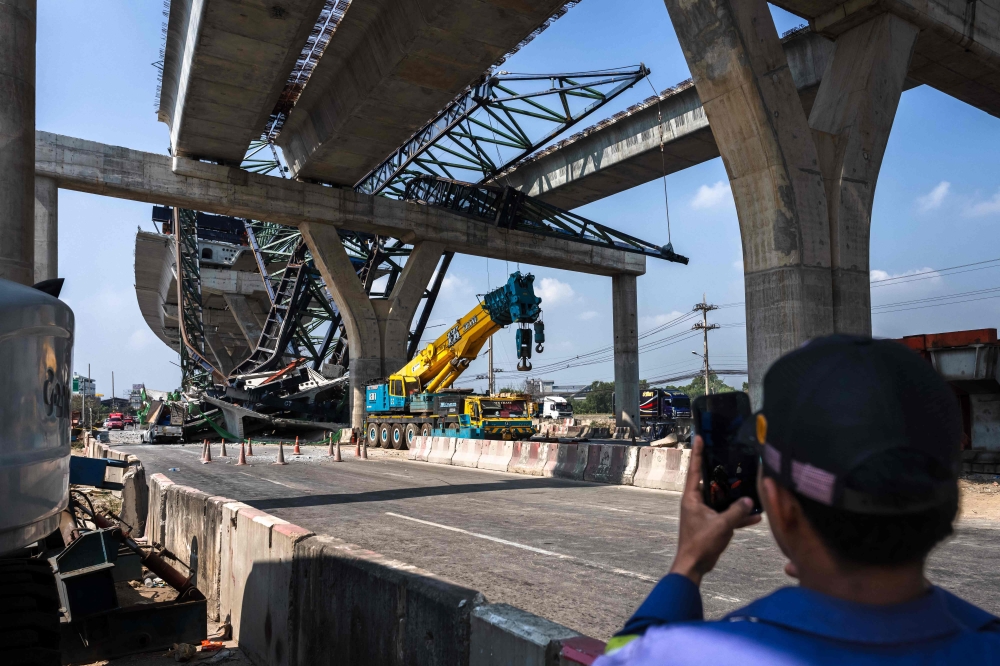
The crane that fell Thursday morning at the under-construction Rama II Expressway in Samut Sakhon province, outside Bangkok, left two people dead, local police chief Sitthiporn Kasi told AFP from the scene.


'That was close'

In other verified footage from the same vehicle as the dashcam, someone is heard saying: "I almost died... Please pull over first".

Another person replies: "That's okay now. It's not falling further. It's a crane collapse again in front of me."

"That was close," the first person says.


Rescue worker Sutthiwat Thanomsat told AFP he arrived at the scene shortly after the crane crashed down, and witnessed the aftermath of a pickup truck driver killed by the impact.

"Injured people were taken to a local hospital," he said.

The Rama II Expressway, a main artery linking the capital to Thailand's south, hosts several major infrastructure projects, including tollway construction.

Construction work has been underway for years to expand the road's capacity and reduce congestion but the project has been beset by delays and fatalities, earning it the nickname "Death Road".

Surachai Wongho, a 61-year-old retiree who drives on Rama II every day, said he is haunted by the thought that one day he could be hurt in an accident.

"It's the same incident happening over and over again in Thailand. It's time for the government to do something," he told AFP.


Condolences and compensation

The incident on Thursday followed the crane collapse in Nakhon Ratchasima, northeast of the capital Bangkok, one day earlier.

One of Thailand's deadliest rail accidents in years, a massive launching gantry crane, used by Italian-Thai in the construction of a high-speed rail project, collapsed Wednesday morning onto a passenger train below.

The health ministry said 32 people were confirmed dead, three were missing and 64 were hospitalised including seven in serious condition.

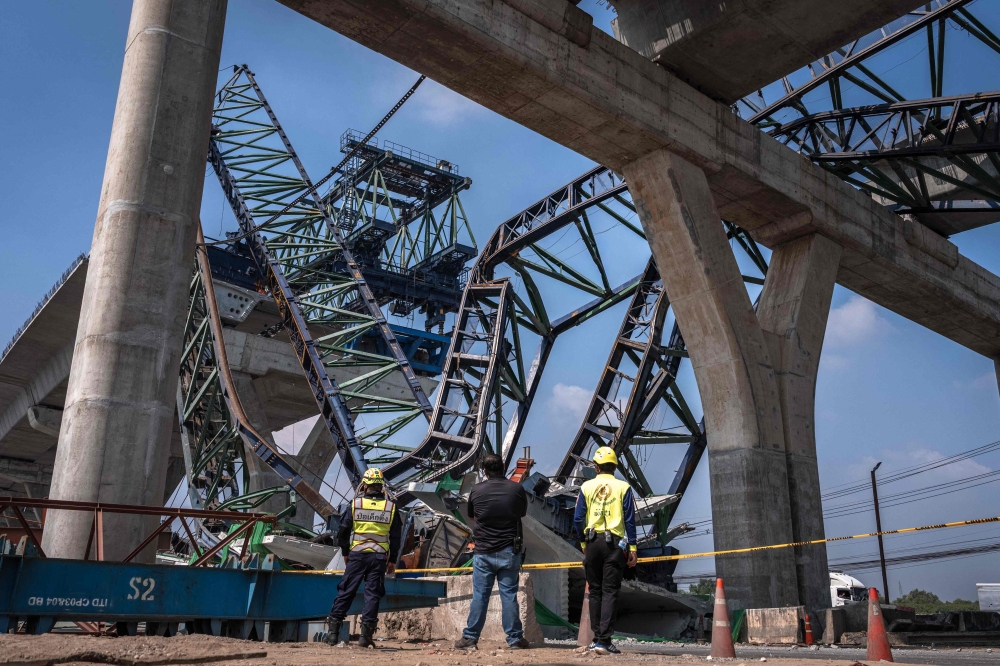
In Nakhon Ratchasima on Thursday, construction workers milled around the scene, snapping photos of the wreckage, as relatives of victims visited the site to mourn and pray in silence.
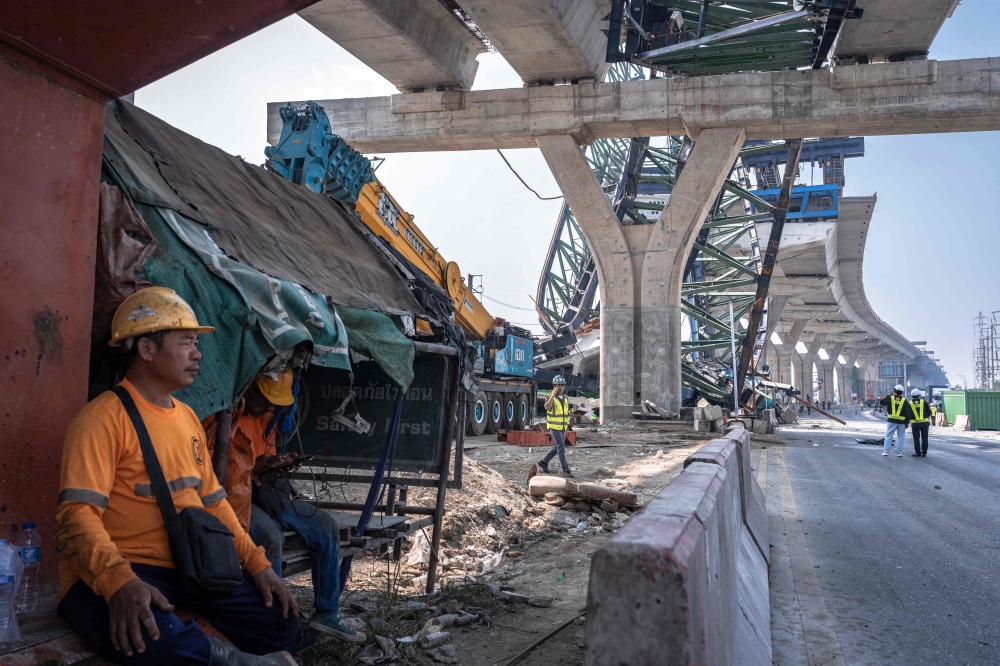


The crane was still hanging off giant concrete pillars, built to hold up the future elevated high-speed rail line -- a joint Thailand-China endeavour.

Italian-Thai expressed condolences on Wednesday, and promised to compensate the victims' families and cover medical expenses for the injured.

The nation's rail operator said it ordered Italian-Thai to halt construction until an investigation was completed.

Transport Minister Phiphat said Wednesday that all parties involved would be held accountable, including Italian-Thai and a Chinese consultancy company.

The crane operator was Thai and had fallen and died in Wednesday's accident, an Italian-Thai worker who declined to give her name told AFP.

Thailand’s acting PM calls for blacklisting of construction firm after crane collapse on train kills 32


Three people missing as rescue workers carry out clearing work after passenger train derails
Thursday 15 January 2026 
THE INDEPENDENT


At least 22 killed as construction crane collapses onto moving passenger train in Thailand

Thailand’s acting prime minister has called for tougher laws to blacklist the construction company involved in the deadly accident that led to a train crash killing 32 people.

Anutin Charnvirakul visited Nakhon Ratchasima province, northeast of Bangkok on Wednesday evening after a crane involved in the construction work plunged onto a moving train.

According to the latest update from Thailand’s public health office, as many as 32 people were dead and 64 injured, including seven who were critical.

Three passengers remain missing among the total 171 people who boarded the train.

The incident has sparked outrage after it emerged that the company Italian-Thai Development, which was responsible for the construction stretch that collapsed, was also the co-lead contractor in a Bangkok high-rise building that collapsed in March 2025 during an earthquake.

About 100 people were killed after the under-construction State Audit Building collapsed after a 7.7 magnitude earthquake epicentred in Myanmar struck. It was the only major structure in Thailand to suffer the damage.


open image in galleryRelatives of the victims react near the site where a construction crane fell into a passenger train on Wednesday, in Nakhon Ratchasima province (AP)

Mr Anutin, who boarded a helicopter to visit the site of the disaster after cancelling his campaign rally, said it was “clearly the fault of the construction company” as he offered sympathies to the families of the victims.


“It is time to change the law to blacklist construction companies that are repeatedly responsible for accidents,” he said.

The prime minister questioned why the contractor had not been barred from state projects earlier, noting a pattern of repeated incidents involving the same companies. He said accidents on this scale were not isolated.


He also fumed over the proposed compensation of 40,000 baht (£950 approx), calling it “inadequate”. He said the compensation should be in millions of baht per family as he questioned whether the governor of the State Railway of Thailand should resign, according to Thai Examiner.

Mr Anutin was picked by his party to stand as its candidate for prime minister in a general election in early February, as he bids to benefit from a wave of nationalism arising from an ongoing border conflict with Cambodia. Less than 100 days after he was elected premier, Mr Anutin dissolved parliament earlier this month when his minority government faced the threat of a no-confidence vote.
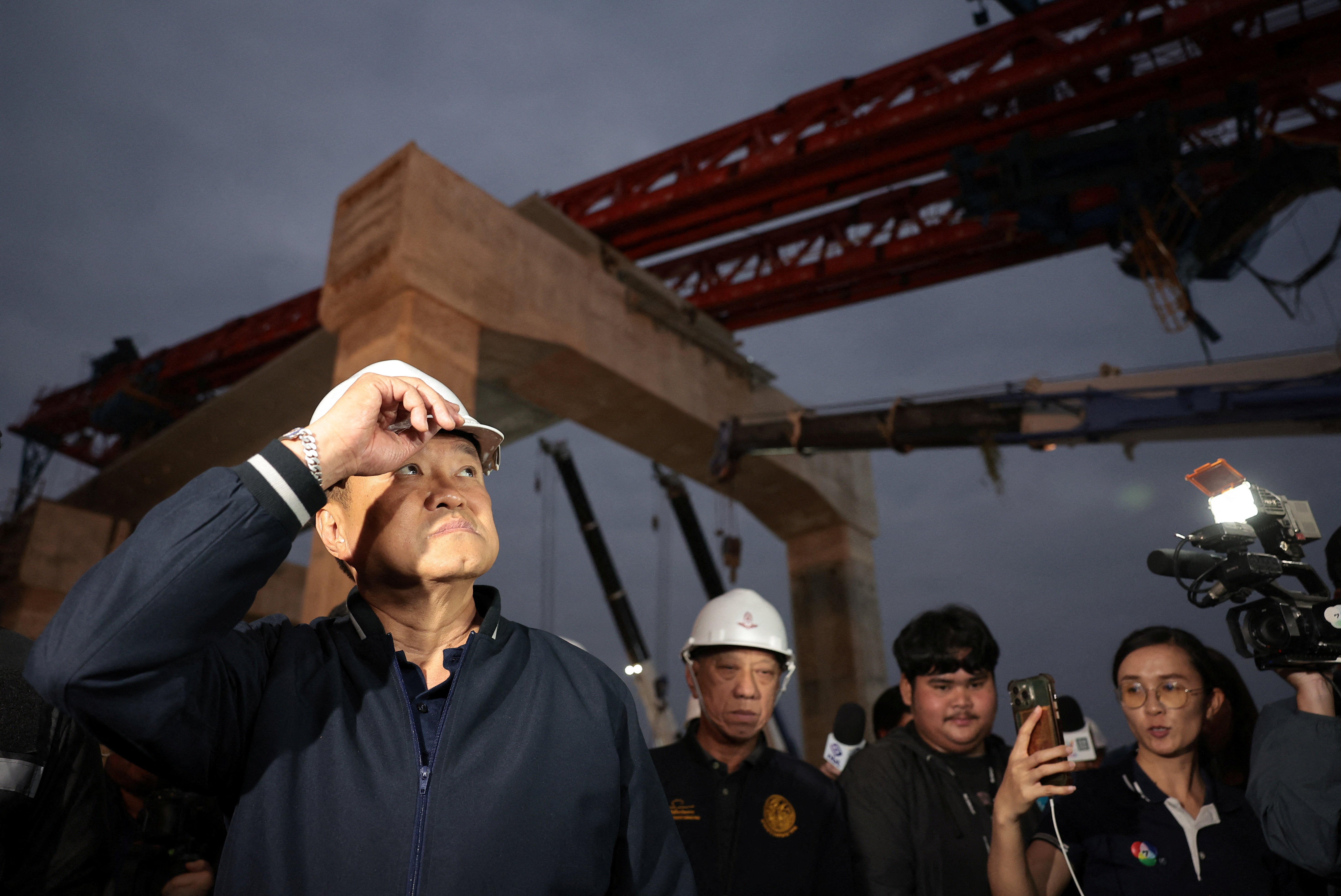

open image in galleryThailand's caretaker Prime Minister Anutin Charnvirakul, Bhumjaithai Party leader and prime ministerial candidate, visits the site where a train was derailed when a construction crane collapsed and fell onto its carriages, causing several casualties, in Sikhio district (REUTERS)

The crash occurred on part of a planned high-speed rail project that will eventually connect China with much of Southeast Asia.

The project's contractor is Italian-Thai Development, with a Chinese company responsible for design and construction supervision, said Anan Phonimdaeng, acting governor of the State Railway of Thailand.

He said authorities will examine the responsibilities of both parties, and the Railway Department plans to take legal action against the contractor as a first step.
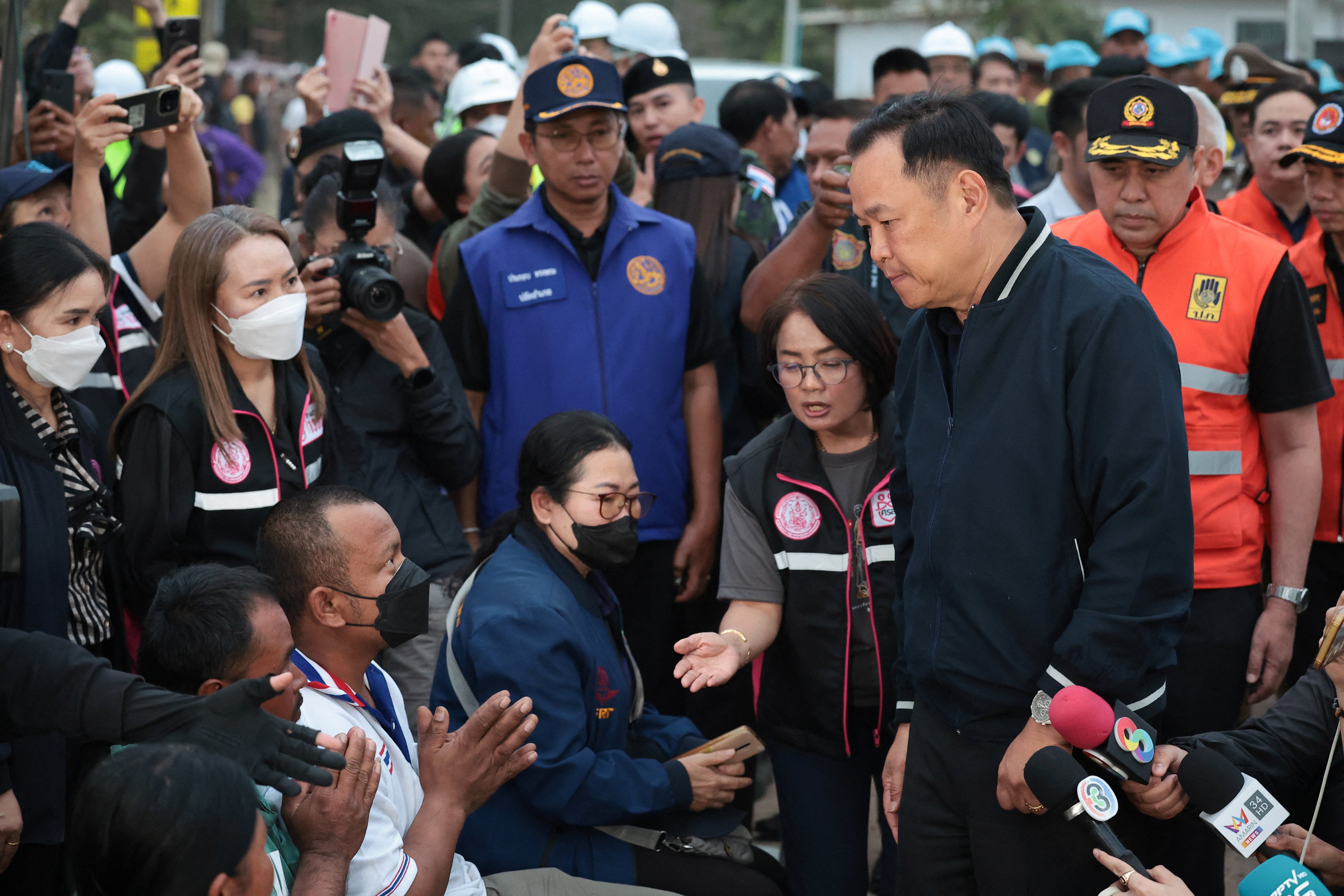

open image in galleryThailand's caretaker Prime Minister Anutin Charnvirakul, Bhumjaithai Party leader and prime ministerial candidate, visits the site (REUTERS)

The Italian-Thai Development PCL said it would take “full responsibility” of the accident and “provide full compensation and medical care” to the families of victims and the injured.

The Chinese foreign ministry said it would investigate the incident but added, “at present, it appears that the relevant section is being constructed by Thai companies, and the cause of the accident is still under investigation”.

A new construction accident on a road near Bangkok was reported on Thursday, just 24 hours after the construction crane accident.

There was no immediate official confirmation of deaths in Thursday’s accident, but the Facebook page of Fire & Rescue Thailand, which covers the activities of volunteer firefighters and rescue workers, said at least one person was killed.