Sunday, January 18, 2026


Have U.S. Tariffs Failed To Bite?

China’s Trade Surplus Hits a Record $1.2 Trillion

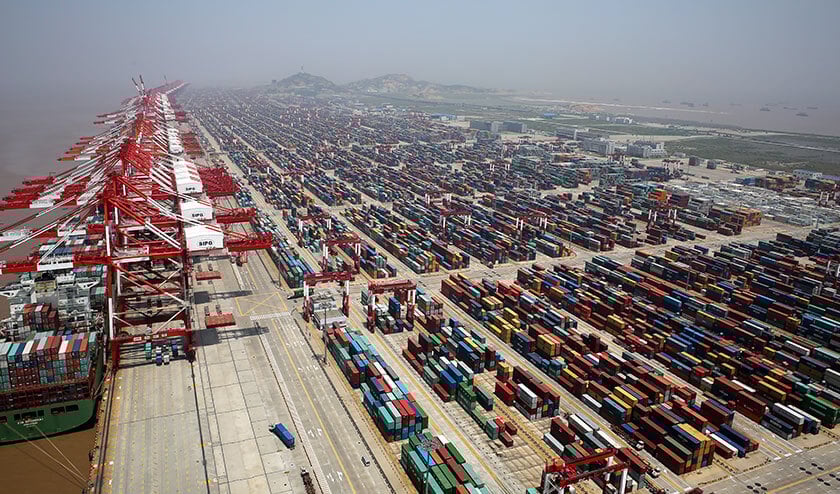
Shanghai container port
China's Shanghai port handed more than 55 million TEU in 2025 despite the trade and tariffs uncertainties (SIPG)

Published Jan 16, 2026 12:55 PM by The Conversation


[By Jiao Wang]

The numbers are in, and they paint a picture that defies the conventional wisdom of Washington’s trade hawks. In 2025, China’s trade surplus surged to a record high of US$1.2 trillion (£900 billion). In December alone, the surplus reached US$114 billion, driven by a higher-than-expected 6.6% growth in exports and 5.7% growth in imports.

The trade surplus refers to the amount by which Chinese exports outnumber its imports. And far from being strangled by external pressure – in particular from the US under Donald Trump – China’s export engine is running hotter than ever.

This creates a paradox for the ordinary observer. For several years, the narrative has been that the US is locked in a divisive trade war with China. This has brought sweeping tariffs intended to decouple the two economies and reduce American reliance on Chinese manufacturing.

Wrangling following Trump’s liberation day tariff announcement on April 2 2025 was apparently settled in November. This left the average tariff imposed on Chinese goods being imported to the US at 47%, down from 145%.

So if the world’s largest economy is shutting the door on Chinese goods, how can Beijing be posting its best export numbers in history? The answer suggests that the US has not won the trade war, and that China’s economy has proven far more adaptable than anticipated.

What happened in 2025 reveals a massive pivot in global trade flows. The tariffs did bite where they were intended: China’s direct exports to the US plummeted by 20% last year, and imports into China from the US fell by 14.6%. But while the front door to the American market was closing, China found other routes.

In 2025, exports to Africa continued to grow strongly by 26%, shipments to countries in the Association of Southeast Asian Nations (Asean) grew by 13%, and trade with Latin America climbed by 7%. Even exports to the EU managed an 8% rise, despite growing friction over European concerns about unfair competition from Chinese state-supported industries.

So, the 20% loss in the US market was mathematically overwhelmed by double-digit gains in the developing regions and emerging markets.

The ‘great reallocation’

Is this something completely new? No – China has been balancing its trade network continuously over the past decade, utilising its belt and road initiative. This is its strategy to boost trade through investment in new land and sea routes, which covers the historic Silk Road trade route.

In this way, China is seeking to reduce its dependence on western consumers. But there is a deeper layer to this success that explains why the trade war hasn’t reduced China’s global footprint.

Research has documented something called a “great reallocation” in supply chains, observed both in the first trade war – which began in 2018 when the US and China hit each other with tariffs in a struggle for trade dominance – and the current one. While direct US-China trade has decreased since 2018, the US has significantly increased imports from countries such as Vietnam and Mexico. And these “third-party countries” have simultaneously increased their imports of intermediate parts from China.

A Chinese container ship arrives in the Mexican port of Manzanillo. Fernando Macias Romo/Shutterstock
In 2025, this trend accelerated. Chinese firms are not just exporting final goods – they are shipping components to factories in south-east Asia and Mexico, which are then being assembled and shipped to the US at very low or zero tariffs, under respective bilateral trade agreements with the US.

This means the US is still effectively buying Chinese goods. It’s just paying a middleman to dodge the tariffs.

The implications of this ballooning surplus are different from previous eras. When China joined the World Trade Organization in 2001, the world worried about it “dumping” cheap textiles and toys.

Today, the friction is over high-value industries. China’s 2025 export boom was driven by cars plus mechanical and electrical products – specifically, the “new three”: electric vehicles, lithium batteries and solar panels.

China is no longer just the world’s factory floor. It is becoming a hi-tech supplier and often a competitor to advanced economies’ own suppliers – which is where the ongoing tension arises from.

However, this export reliance also signals a domestic weakness. With China’s housing market still subdued and domestic investment declining, Chinese firms are eager to find demands elsewhere to keep their factories humming.

In 2026, this momentum shows little sign of slowing. The Global PMI (purchasing managers’ index, an indicator that assesses global market conditions) showed five consecutive months of expansion in 2025. This suggests the global economy is picking up some speed, which is good news for Chinese exporters.

However, in the long run, China running a trade surplus with more than 170 countries creates a structural imbalance that may become politically unsustainable. The challenge in Beijing, Washington and beyond is to find an equilibrium before this “winner-takes-all” dynamic forces even more drastic protectionist responses.

About the author
Jiao Wang is Assistant Professor of Economics, University of Sussex Business School, University of Sussex

The Conversation

This article appears courtesy of The Conversation and may be found in its original form here

The opinions expressed herein are the author's and not necessarily those of The Maritime Executive.


Dominion Energy Received Injunction Against Offshore Wind Stop-Work Order

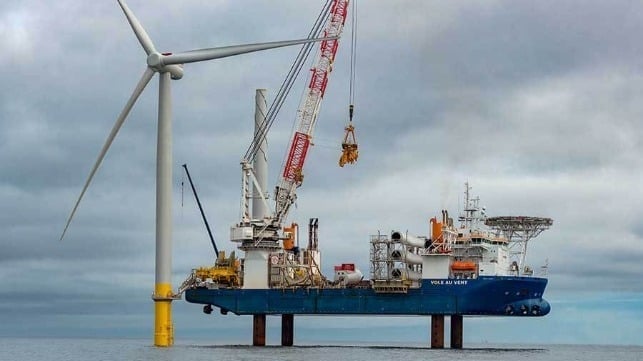
offshore wind farm installation
Dominion Energy said it would resume offshore work on the Virginia wind farm (Dominion Energy)

Published Jan 16, 2026 2:37 PM by The Maritime Executive


Virginia’s Dominion Energy, which is developing the Coastal Virginia Offshore Wind Project, became the third developer this week to receive an injunction against the Trump administration’s December 2025 stop-work order. Five projects received the order, with three now having received preliminary injunctions, and the other two projects in court seeking similar orders.

Judge Jamar Walker in the U.S. District Court for the Eastern District of Virginia issued a similar option to the judges hearing cases for Revolution Wind and Empire Wind. Judge Walker found that the order issued by the Department of the Interior and the Bureau of Ocean Energy Management on December 22 “would likely cause irreparable harm” to the utility company. Dominion Energy, unlike the other developers, is a state-regulated utility.

Dominion had filed the first challenge to the stop-work order, but Judge Walker had delayed an early ruling to give the government time to provide information to back up its stop-work order. He had asked for details on the confidential study reportedly conducted by the Pentagon, which was cited as the basis for the stop-work order. The government has vaguely referred to national security concerns and the potential for radar clutter from the turbine blades and towers.

During a hearing on Friday, January 16, Judge Walker said that he found the order “too broad,” and not specific to Dominion Energy’s project. He also indicated that he believed the concerns raised about potential radar interference were related to the operation of the wind farm and not its construction.

In its suit, Dominion Energy had called the order “arbitrary and illegal.” It countered the claims of national security by saying the project was vital to national security. It noted dramatic increases in power demand in Virginia, highlighting that its service area includes significant military installations and the world’s largest warship manufacturer (including Newport News, which is building the U.S.’s next generation of super carriers). Furthermore, it also highlighted that Virginia has the largest concentration of data centers and is playing a leading-edge role in the AI revolution.

The company responded to today’s ruling, saying that it would focus on safely restarting work on the project. Previous statements said the project is approximately 60 percent complete. It was expected to begin generating its power in the coming weeks. When completed, it will have 176 offshore wind turbines with a generating capacity of 2.6 GW.

The ruling follows Thursday’s decision, which also permits Equinor to resume work on the Empire Wind project off New York. Equinor had threatened to abandon its project if it did not receive the injunction this week.

At the beginning of the week, a third court also issued an injunction for the second time against the government so that Revolution Wind could resume construction. Revolution Wind is being developed by Ørsted in partnership with a division of BlackRock. 

Each of the companies has indicated a willingness to work with the government and said they had not received responses to requests for a briefing on the Pentagon’s report. The Trump administration has repeatedly sought ways to stop the development of wind energy and directed all of its departments to work together to stop the development. Dominion Energy said after today’s ruling, it would continue to seek “a durable resolution” through cooperation with the federal government.

Each of the cases has awarded a preliminary injunction based on the information presented, which blocks the government from enforcing the stop-work order. It is not a decision on the merits of the complaint challenging the stop-work order, but under U.S. law, courts only traditionally issue preliminary injunctions when they agree the action will cause serious harm and the companies have a solid case likely to prevail at trial.

After Thursday's ruling, a spokesperson for the White House vowed the administration would continue to fight against the development of offshore wind energy power.


Empire Wind Gets Court-Ordered Injunction Against U.S. to Resume Work

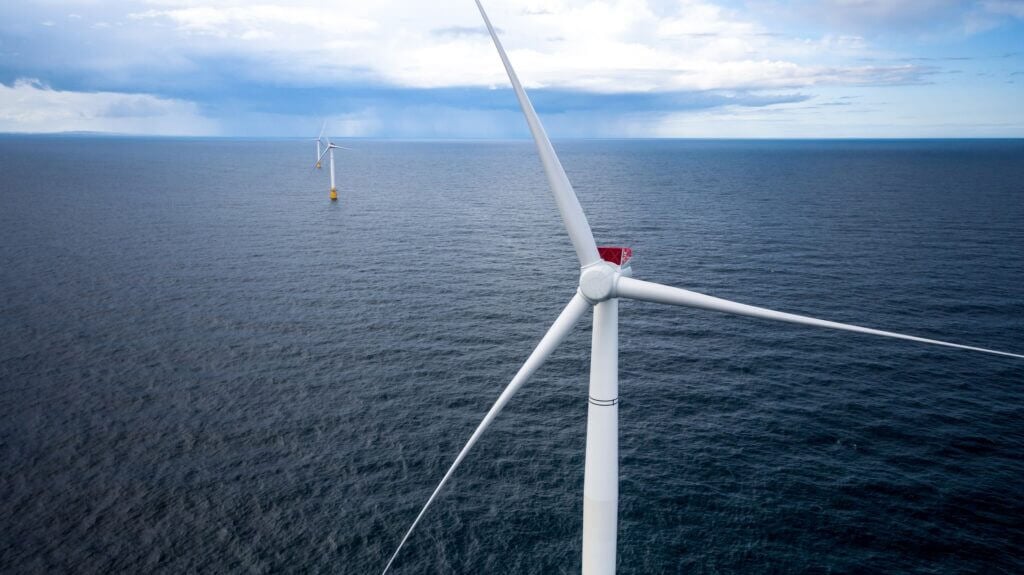
offshore wind farm
Empire Wind became the second under construction project to win an injunction against the U.S. stop-work order (file photo)

Published Jan 15, 2026 5:31 PM by The Maritime Executive


A U.S. District Court Judge on Thursday, January 15, found for Equinor and its Empire Wind offshore project issuing a preliminary injunction against the Trump administration’s December stop-work order on the construction of offshore wind farms. It was the second court this week to issue a preliminary injunction, with others expected to rule in the coming days, while today the judge said the court would expedite a decision on the underlying case.

The injunction issued for Empire Wind came one day before the company had said it would have to shut down the project and abandon the wind farm, which is approximately 60 percent completed. The company told the court the project is working on a tight, carefully orchestrated timeline, and that the delay since the December 22 order threatened the project. 

A heavy lift vessel has arrived on-site, and Equinor said it was critical that it, along with the crane, proceeded to place the topside for the project. It highlighted that the vessel is under contract and cannot linger at the sight. It said the company would find it difficult, if not impossible, to store the substation pending a later decision. The company also cited mounting costs from the delays and a threat to its project financing.

Judge Carl Nichols on the D.C. District Court heard the case on Wednesday and promised a quick decision regarding the request for the preliminary injunction. Today, the judge ruled the project would likely suffer “imminent irreparable harm” from the delay and granted the injunction while the merits of the case are being decided. 

Equinor and Empire Wind quickly issued a statement saying they were focusing on safely restarting construction activities. They said they would also continue to seek to engage with the government to ensure safe and responsible operations.

Equinor, Ørsted, and Dominion Energy, in their pending legal cases, emphasized the long permitting process, including reviews and approvals by the Department of Defense. Ørsted won a similar preliminary injunction on Monday, permitting it to restart work on Revolution Wind off the coast of Rhode Island. A hearing is scheduled for Friday for Dominion Energy’s request for an order to permit it to also resume work on its Coastal Virginia Offshore Wind project.

The Department of the Interior instructed five offshore wind farms under construction to stop work as of December 22. It cited new confidential research conducted by the Pentagon that showed a risk to national security. The reports said it is focusing on radar interference and “clutter” created by the wind turbine blades and towers.

A lawyer for Empire Wind, Ann Navaro, told the court that the Trump administration has not responded to requests for a confidential briefing on the new data. Similarly, Ørsted and Dominion Energy also said they have asked for a briefing and not received a response from the Pentagon. The judge in the Dominion Energy case has ordered the Pentagon to turn over data to the court.

Empire Wind, which is located south of New York’s Long Island, is reported to be 60 percent installed. It is due to be completed by 2027. The project had previously been ordered by the Trump administration to stop work for a month just before offshore work was scheduled to begin in the spring. That issue was settled in an out-of-court agreement after Norwegian government officials appealed to the White House, and New York State reportedly agreed to let a stalled pipeline project proceed.

A White House spokesperson told Bloomberg this afternoon that the federal government will keep fighting the offshore wind projects.

Judge Nichols today asked the government and Empire Wind to propose an expedited briefing schedule for the case. He set a January 20 deadline so that he can quickly decide the merits of the complaint against the stop-work order.

In addition to the cases for Empire Wind, Revolution Wind, and Coastal Virginia, Ørsted has filed a separate case for its Sunrise Wind project located off the coast of New York's Montauk Point. Today, Avangrid, which is developing Vineyard Wind 1, also reported that it has filed for a Temporary Restraining Order and Preliminary Injunction in the U.S. District Court for the District of Massachusetts, challenging the suspension order.

The states of Connecticut, Rhode Island, and New York have also joined the legal battle. Each of the states filed suit in support of the offshore wind projects, citing the harm to the state’s economic development from the order.


Russian and Ukrainian Strikes Are Raising War Risk Insurance Costs

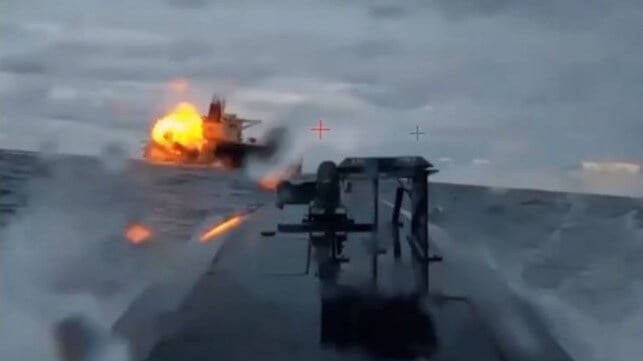
Ukrainian drone boats attack a shadow fleet tanker in the Black Sea, December 2025 (Courtesy Security Service of Ukraine)

Published Jan 15, 2026 11:43 PM by The Maritime Executive


War risk insurance is one of the biggest factors affecting whether shipowners will trade in a conflict zone, and high insurance rates are an effective means of deterring vessel traffic. When excessive, it adds hundreds of thousands of dollars in cost for every week spent in the coverage area. The recent intensification of conflict in the Black Sea has raised the stakes for insurers, and the costs are getting passed on to shipowners: costs are now as high as one percent of hull value for a port call in Ukrainian or Russian ports in the region, according to Bloomberg. For a newer Suezmax, war risk cover alone could cost $800,000 per voyage. 

The rates are changing rapidly based on events on the ground, industry outlet BeInsure reports, and insurers are reviewing their offered contracts on a daily cycle. Fresh attacks happen every week, both at Odesa on the Ukrainian side and Novorossiysk on the Russian side. 

On Tuesday, Ukrainian drones hit two Greek-owned tankers near the Caspian Pipeline Consortium terminal, the Matilda and the Delta Harmony. The two ships were operating within compliance with Western sanctions, and were in the area to pick up crude piped across the border into Russia from fields in Kazakhstan. One of the vessels was reportedly chartered by American oil major Chevron. Both were in ballast at the time of the strike, and both sustained only minor damage on deck. No injuries were reported. 

The attack was unusual in the selection of targets, as Ukraine has previously held off from striking compliant tanker tonnage, even though it has previously attacked the CPC terminal itself. 

In the wake of the attack, Greece's shipping ministry advised owners to take extra precautions near Russian Black Sea ports. In guidance seen by Reuters, the ministry recommended that ships should "proceed with an updated threat assessment for commercial ships located in the Black Sea and the maritime areas close to it."

Previously, Ukraine focused its attacks on terminal infrastructure, pipelines, offshore production platforms and shadow-fleet tankers. The vessels in the shadow fleet generally use obscure or second-tier insurers, as the leading marine insurance companies are all based in the G7 nations, where sanctions on Russia prohibit the act of insuring certain market-rate Russian oil cargoes. The shadow fleet is already a high-risk, under-insured or uninsured category; strikes on compliant vessels are a departure from the pattern, and a new risk factor for Western insurance companies. 

The situation is just as risky on the western side of the Black Sea. Russia has repeatedly hit terminals in and around Odesa, damaging vessels and injuring multiple crewmembers. On Thursday, a seafarer was injured in a Russian strike on the port of Chornomorsk, Ukraine; several containers were damaged, and a nearby vessel sustained minor damage.


Seafarer Injured in Russian Strike on Port of Chornomorsk

Containers
Courtesy Oleksiy Kuleba

Published Jan 15, 2026 2:39 PM by The Maritime Executive


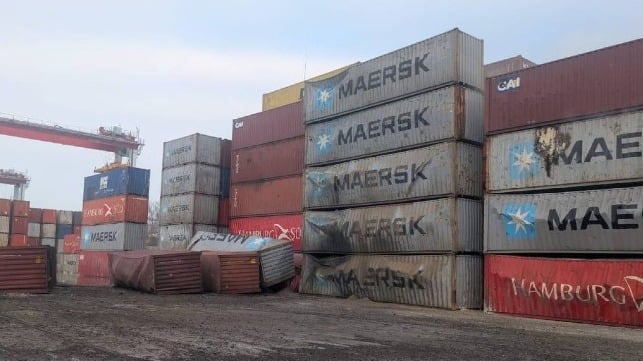
On Thursday, Russian forces attacked the port of Chornomorsk, Ukraine with a ballistic missile strike, destroying several containers. One crewmember from a nearby container ship was injured, according to development minister Oleksiy Kuleba. 

The crewmember was evacuated and is receiving medical care, Kuleba said. 

Three containers were damaged, and an oil spill occurred as a result, he added. The area has been boomed off to prevent pollution. 

"This is another act of Russian terror against civilian port infrastructure, international trade and navigation safety. Russia deliberately attacks facilities that ensure exports, logistics and food security," Kuleba said. "Ukraine continues to ensure the operation of ports and fulfill its international obligations, despite constant attacks by the aggressor."

Courtesy Oleksiy Kuleb


The strike is the latest in a series of tit-for-tat exchanges between Ukrainian and Russian forces. Ukraine has repeatedly attacked the tankers that call at Russia's Black Sea loading terminals, disrupting their operations, and it is widely suspected of a campaign to damage other Russia-linked vessels at far-flung locations abroad. It has also inflicted serious damage on Russia's Black Sea and Caspian Sea oil infrastructure. In retaliation, Russia has waged a campaign of missile strikes in and around Odesa, damaging merchant ships and impeding Ukraine's agricultural exports. 

On January 9, a Russian strike killed a seafarer and injured another in attacks on two cargo ships, one at Chornomorsk and another under way in the Black Sea.  Two more people were killed in a Russian attack on the Chornomorsk and Pivdennyi port complexes on January 7. Over the Christmas holidays, Russia conducted consecutive nightly attacks on Odesa's port, damaging administrative buildings, grain elevators and warehouses. Two vessels were reported damaged in the attacks, one of which was rendered unseaworthy.


Video: Shadow Tanker Attacked by Ukraine Refloated After 12 Days Aground

shadow tanker aground in Turkey
Qendil had been aground since January 4 (KEGM)

Published Jan 16, 2026 5:23 PM by The Maritime Executive


Turkish officials reported they have finally been able after 12 days to refloat a grounded shadow fleet tanker.  The ship was pulled from the rocks near Bozcaada, south of the Canakkale Strait.

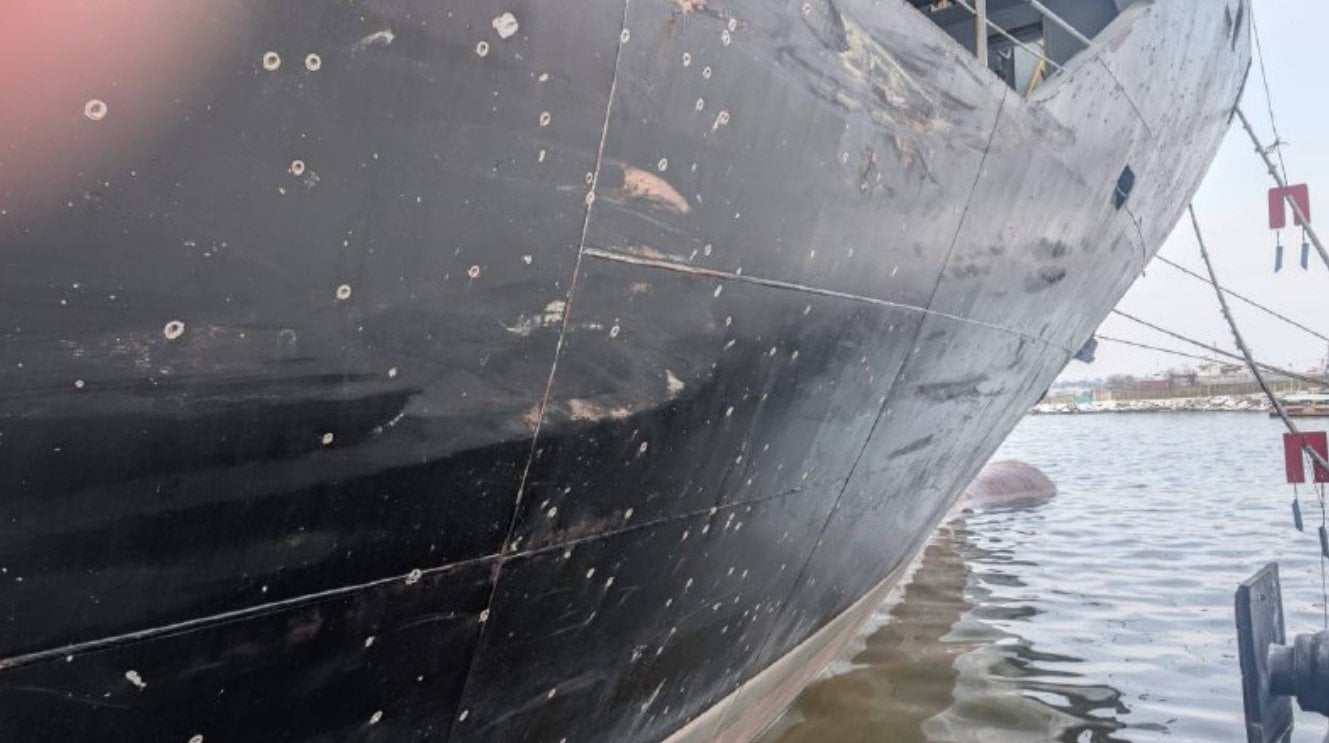
The ship named Qendil and reporting registry in Qatar has been operating for the past three years in the shadow fleet, making frequent trips between the Russian oil terminals near St. Petersburg and India. It was during the return from one of those trips that the tanker was attacked by Ukraine in the Mediterranean. The long-range drone attack struck the ship south of Crete, more than 2,000 km (1,250 miles) from the Ukrainian border.

Ukraine claimed to have heavily damaged the vessel, but it continued operating under its own power after making a sharp turn heading toward Greece. The ship made it to Aliaga, Turkey, and then, around December 30, anchored in a position near the Canakkale Strait. It was reportedly bound for the repair facilities at Yalova, Turkey.


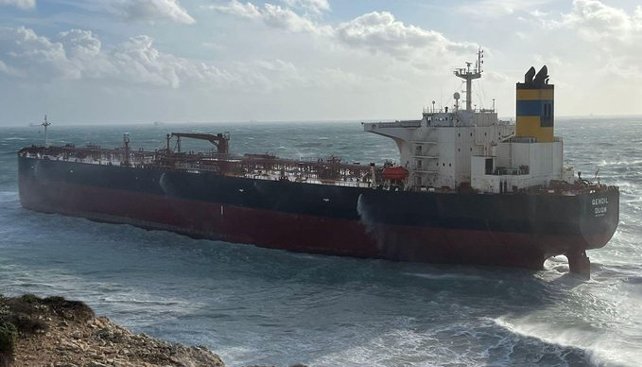
On January 4, it was spotted drifting reportedly in a strong storm, high waves, and wind. It came to rest aground about 100 meters offshore along the rocky coast. Turkey’s maritime safety agency, KEGM, responded and reported the ship was in ballast condition and there was no pollution.

There had been several attempts to reposition the vessel. Today, KEGM reports that three tugs, along with its emergency response vessel and two KEGM boats, undertook the effort. The 249-meter (817-foot) tanker was finally refloated. The video shows the ship being moved to a more secure location.

The ship, which was built in 2006, has been under sanctions from the UK since February 2025 and the EU in July 2025. It is an Aframax tanker (115,338 dwt) with the databases listing its owners in India. The ship is reported to have had three names in 2025 and been flag-hopping. It currently lists its flag as Oman, but earlier this year was listing Palau, Guinea-Bissau, and Djibouti.


As Suez Traffic Cautiously Returns, Houthis Make New Threats

Houthi parade
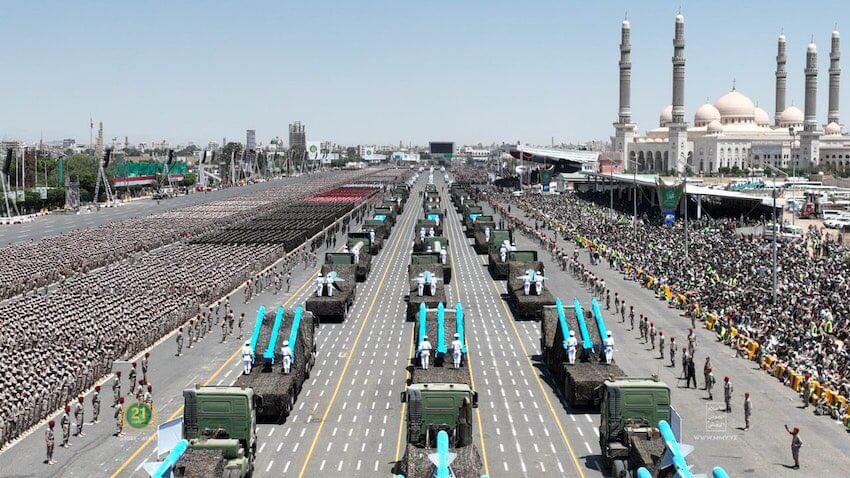
Houthis previously paraded their anti-ship missiles through the streets (Houthi media)

Published Jan 16, 2026 12:03 PM by The Maritime Executive


Shipping lines have been exploring a reopening of their container line services through the Suez Canal and the Red Sea.

CMA CGM has led the way. After having maintained some transits using naval protection during the conflict with the Houthis, the French carrier has returned two regular container line services starting this month. It follows the passage through the Red Sea by their French-flagged CMA CGM Jacques Saade and Marshall Island-flagged CMA CGM Adonis, both of whom have both made transits since Christmas without incident.

Danish shipping company Maersk has also been exploring a reopening, having sent the US-flagged containership Maersk Denver north through the Bab el Mandab Strait into the Red Sea on January 12, which followed a transit earlier in December by Singapore-flagged Maersk Sebarok. Maersk announced on January 15 that it is restoring its first route, one between the U.S. and India to sail through the Suez – Red Sea corridor. It said it would continue to closely monitor security in the region.

Although the last incident was on September 29, when the Dutch-flagged general cargo vessel MV Minervagracht fell victim to a Houthi attack, traffic through the Suez Canal has not yet recovered. Suez Canal traffic transits in 4Q25 were 19 percent lower than in 2023 and 45 percent lower than in 2024, figures skewed by an increase in product tanker transits, while container traffic has still not recovered.

This caution may be justified.

On January 15, Houthi leader Abdel Malek Al Houthi made new threats on Al Mayadeen television. He warned that reconnaissance was being conducted preparatory to the launching of attacks on what he described both as Israeli and Zionist fixed positions in Somaliland. He called the positions a threat to Houthi oversight of the Red Sea and Bab el Mandeb Straits.

The Houthis previously have never been very precise in their targeting threats, making very broad or perhaps imprecise interpretations of what constitutes an Israeli or Zionist target. It must be assumed, therefore, that Emirati and U.S.-operated sites are also vulnerable, and that such sites anywhere in the Red Sea and Gulf of Aden littoral are also covered by this Houthi threat.

It is unclear what sites, presumably for intelligence collection purposes, are maintained by the Israelis in Somaliland, although rumors have persisted for some time that such sites exist. Hilltop intercept and radar sites need not have a large footprint, and indeed could largely be unmanned, using satellite links to rebroadcast intercepts to safe locations for analysis. The Somaliland government, newly recognized by Israel, has already indicated its continuing support for military ties with Israel.

Similar sites may also have been supported by the Emirati presence on islands and coastal areas in the Red Sea and Gulf of Aden, although their presence has never been reliably established. The Yemeni Internationally Recognized Government (IRG), with much enhanced support from the Saudis, appears to have taken over the coastline south of Hodeida, with the Emiratis having left their recently-constructed airfields at Mocha and Dhubab. Based on a rush of heavy-lift cargo air movements, the Emiratis appear also to have left the Red Sea islands of Perim and Zuqar. The Emiratis still, however, have a foothold in Assab on Eritrea’s Red Sea coast. The UAE is also maintaining its military footprint at Berbera in Somaliland and Bosaso in Puntland on the south side of the Gulf of Aden, with the support of the autonomous governments of these areas and despite falling out with the Somali government.

The UAE has, for the moment, retained some form of presence on the island of Socotra. But Emirati companies, such as Prime Fishing, which used to wholesale the local fishing industry, have closed shop, as have hospitals, ADNOC selling fuel, and Eastern Triangle generating electricity. Socotrans serving in the UAE-sponsored local militia have been paid off. Social media has shown a Saudi force boarding ships in Mukalla en route to consolidate the IRG’s hold on Socotra. If, as is likely, there were intelligence collection sites in the Socotra Archipelago overlooking the Maritime Security Transit Corridor (MSTC), and they served a useful anti-Houthi purpose, it is possible that the IRG would wish to support their continued operation, notwithstanding a full Emirati withdrawal.

The geopolitical situation for the Houthis has also changed. While the Houthi leadership has declared its continuing support for the Iranian religious leadership, and is Iran’s last remaining reliable ally, Houthi ranks have been severely depleted by the targeted attacks on its leadership cadre last summer. Confidence (and bravado) has taken a knock, and the Houthis may be keen not to broaden any reactivation of hostilities, particularly with the USS Abraham Lincoln carrier strike group making its way to the region. But they remain an enduring threat to the maritime community.


U.S. Sanctions Captains, a Vessel, and Networks Supporting Houthis

Yemen port
Gas tanker offloading at Ras Issa port in Hodeida in 2023

Published Jan 16, 2026 7:25 PM by The Maritime Executive


The U.S. Department of the Treasury, through its Office of Foreign Assets Control, launched a new effort to break up the networks supporting the Houthis. They pointed to conduits and front companies used to finance the Houthis and smuggle materials with links to Iran.

Today’s action included the designation of five ship captains who had commanded vessels previously designated for delivering petroleum products to Houthi-controlled ports. The U.S. highlights that vessels have continued to deliver petroleum products to the Houthi-controlled ports, providing vital economic support to the militant group. OFAC had issued a humanitarian license to allow in-progress deliveries after the designation in March 2025 of the Houthis as a Foreign Terrorist Organization. Those licenses expired in April 2025.

“Despite the pressure of international sanctions, the Houthis continue to acquire a significant amount of revenue through illicit oil sales, generating over $2 billion annually.  As part of the Houthi oil sales operation, the Iranian government both sells and provides a free monthly shipment of oil to the Houthis using Iranian-owned or affiliated companies based in Dubai, UAE,” the U.S. asserts.

A shipping company named Albarraq Shipping they contend, continued to make deliveries using a tanker named Albarraq Z (71,522 dwt). Built in 2003, the vessel appears to have been acquired in 2025 for this purpose and was registered in the Comoros. The U.S. added it to the sanctions today.

The captain of the vessel was one of the individuals designated by OFAC. They also listed the captain of a vessel named Sarah that they said delivered LPG to Ras Isa port in June 2025, and the captain of the Atlantis MZ, which discharged gasoline in June 2025. They also listed the captain of the Akoya Gas, which discharged its cargo in Ras Isa in April, and the captain of the Valente, which discharged gas at Ras Isa in May 2025. 

The U.S. charges that the Houthis’ leaders are behind the oil and gas trade and sell the products at “exorbitant prices” to Yemenis. They report the proceeds are pocketed for personal gain and used to fund the group’s military operations.

The broader program also targeted the network that is helping the Houthis procure weapons and other equipment, as well as providing financial services. The U.S. cites key front companies, facilitators, and operatives located in Yemen, Oman, and the United Arab Emirates that are part of the Houthis’ vast revenue generation and smuggling networks.

The U.S. designated a total of 21 individuals and entities, including oil and gas facilitators in the UAE and front companies used to facilitate financial transactions between the Iranian government and Houthi-affiliated oil companies. They also targeted logistics firms and shipping facilitators used to transport weapons and other military-grade materials into Yemen. 

All of this came as the Houthis reappeared on Thursday, making new threats against Israeli installations in Somaliland. It was their first threat of new attacks since the ceasefire in Gaza agreed to in the fall of 2025.
 

Closing the Gap: EU Harmonization and the Future of Ship Recycling

Bansal
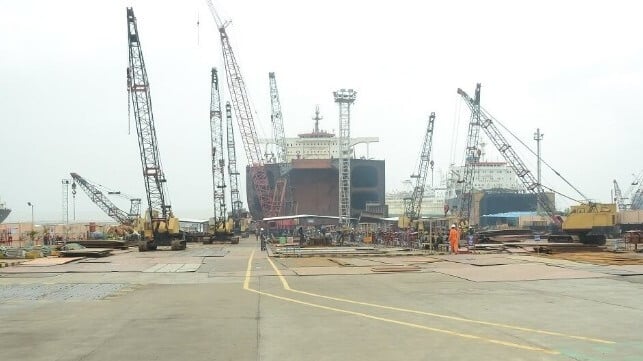
File image courtesy Bansal Shipbreakers

Published Jan 16, 2026 3:55 PM by Prof. Dr. Ishtiaque Ahmed


Global ship recycling no longer suffers from a lack of rules. It suffers from a failure to connect them. What is often described as a compliance gap is, in reality, a governance failure created by fragmented legal regimes that refuse to engage with where and how ship recycling actually takes place. The result is a system that is legally dense, institutionally complex, and operationally incoherent.

Bangladesh and India are today the world’s two largest ship-recycling states when measured by annual steel recovered from end-of-life vessels. In combination, they account for close to four-fifths of global ship-recycling activity. This dominance did not arise by accident, nor has it persisted through regulatory neglect. Over the past decade, both countries have undertaken extensive legal and technical reforms to align their domestic ship-recycling frameworks with international standards. These reforms were not symbolic. They followed detailed gap analyses comparing national law with the Hong Kong Convention and parallel assessments of hazardous-waste management regimes against Basel Convention requirements. Only after completing those exercises did India in 2019, and Bangladesh in 2023, ratify the Hong Kong Convention and restructure their approval systems, institutional oversight, and enforcement mechanisms to make compliance function in practice.

Under the Hong Kong Convention framework, the legal expectation is clear. Ships belonging to states parties should be recycled in facilities that meet convention standards. In response, a substantial number of South Asian recyclers have invested heavily in infrastructure, safety systems, training, waste-handling capacity, and compliance management. In India, close to 90 percent of facilities now operate within this framework. In Bangladesh, investment has followed a phased but accelerating trajectory. These developments reflect genuine regulatory convergence, not strictly paper compliance.

Yet despite this progress, the global system has reached an impasse. Roughly 30 percent of the world’s merchant fleet is owned by European shipping companies. Those beneficial owners operate under a regulatory regime that deliberately goes beyond international conventions. The EU Ship Recycling Regulation, operating in tandem with EU waste-shipment law, effectively prohibits EU-flagged ships and, in many cases, EU-owned ships from being recycled outside facilities appearing on an EU-approved list. That list currently contains no ship-recycling facilities in South Asia.

This exclusion is often framed as a question of standards. In reality, it reflects a deeper structural mismatch. EU requirements sit significantly above the Hong Kong Convention baseline, both substantively and institutionally. They assume advanced enforcement capacity, mature judicial oversight, and decades of regulatory consolidation. South Asian legal systems are improving rapidly, but they are not replicas of European governance models. That difference, however, cannot justify regulatory paralysis in an industry that depends on South Asia for its very existence.

The core problem is not that standards are too high. It is that no serious effort has been made to harmonize EU law with the geographical, economic, and industrial realities of South Asian ship recycling. The EU-approved list remains overwhelmingly concentrated in OECD states. Its aggregate capacity is negligible relative to global end-of-life shipping volumes, and its cost structure is fundamentally misaligned with the industry. Labor costs in OECD recycling facilities are commonly twenty to one hundred times higher than in India and Bangladesh. This is a significant efficiency gap. It determines, in practical terms, where ships can be feasibly dismantled at scale.

Cost, however, explains only part of the picture. Geography is equally decisive. South Asia enjoys a natural advantage that no regulatory reform can reproduce elsewhere. In Bangladesh, India, and Pakistan’s coastal belt, tidal variations of 30 to 40 feet are routine. This allows gravity-assisted beaching and dismantling, reduces dependence on heavy dock infrastructure, lowers energy demand, and permits sectional removal under controlled conditions when properly regulated. Decades of engineering, environmental, and occupational research confirm that no other region combines this tidal profile with an established industrial workforce, a secondary steel market, and deep supply-chain integration. This is not a policy preference. It is a physical constraint. No OECD coastline offers comparable conditions, and no amount of regulatory ambition can legislate geography out of existence.

Furthermore ship recycling, as per the ILO,  is the most dangerous activity and among the most labor-intensive activities in the maritime economy. As long as beaching remains the dominant dismantling method in international law , no high-income country can realistically compete with South Asia on cost, capacity, or throughput. India, Pakistan, and Bangladesh combine factors found nowhere else: extreme tidal variation, decades of accumulated technical experience, established re-rolling and resale markets, and a large workforce facing sustained employment pressure. Africa, meanwhile, is largely excluded by the Bamako Convention, while other developing regions lack comparable geography and industrial depth. Collectively, these factors make any meaningful relocation of global ship recycling beyond South Asia economically and legally unrealistic for the foreseeable future.

This reality exposes a structural contradiction in the current legal framework. EU-flagged ships may, in limited circumstances, be recycled outside the OECD if the receiving facility is EU-listed. Non-EU-flagged ships face a far more restrictive pathway. Once a vessel becomes waste within EU territory, the Basel Convention and, for many states, the Basel Ban Amendment effectively prohibit its export to non-OECD countries. This legal trap affects the remaining 70 percent of the global fleet that is not EU-flagged but nonetheless enters EU jurisdiction at end of life.

The result is regulatory gridlock. EU ships cannot access South Asian capacity because those yards are not listed. Non-EU ships cannot legally reach South Asia once classified as waste in EU territory. Both channels are blocked simultaneously. Shipowners are left navigating a compliance maze that no amount of good faith can resolve. In this context, harmonization is no longer a policy option. It is an operational necessity.

If the Basel Convention and the Basel Ban Amendment, which prohibit the export of hazardous waste from OECD to non-OECD states for any purpose including recycling, the Hong Kong Convention, which places no territorial restriction on the export of ships for recycling, and the EU Ship Recycling Regulation are to operate as a coherent system, new legal architecture is unavoidable. The most realistic path forward is a deliberate policy decision by OECD and EU states to extend their ship-recycling standards beyond their own territories through a system of certified equivalence.

Specifically, OECD states must recognize that ship-recycling facilities located outside the OECD may be treated as compliant for Basel purposes where they demonstrably meet OECD-level environmental, safety, and enforcement standards. In parallel, the EU must establish a formal pathway under its Ship Recycling Regulation for EU-standard certification of non-OECD facilities, particularly in South Asia, where global capacity actually exists.

Such an approach, arguably, does not dilute the Basel regime. It preserves its underlying logic. Basel was never intended to impose a blanket territorial prohibition divorced from performance. Its purpose is to prevent hazardous waste from being transferred to substandard facilities. Where a facility outside the OECD demonstrably operates at OECD standards, the scientific and legal justification for prohibition falls away. Compliance should turn on outcomes, not postal codes.

Under this model, EU-flagged ships recycled in EU-certified facilities outside the EU would remain fully compliant with EU law. At the same time, non-EU ships that become waste within EU jurisdiction could lawfully be exported to OECD-standard facilities in South Asia without breaching Basel obligations. The present contradiction dissolves. Both EU and non-EU ships gain access to safe, regulated recycling pathways aligned with global capacity.

This approach is practical, legally defensible, and grounded in existing regulatory practice. South Asian yards have already demonstrated that compliance trajectories can be managed through phased authorization, strict monitoring, and measurable benchmarks. Bangladesh’s recent experience with conditional approvals and structured reform illustrates that improvement is not speculative. What has been missing is international recognition of that trajectory.

The remaining question is financing. Upgrading and sustaining OECD- and EU-level compliance in South Asia will require long-term investment. How that investment should be structured, whether through polluter-pays mechanisms, shipowner levies, green transition funds, shared responsibility models, or blended public-private financing, is a legitimate and necessary next stage of research. Funding design, however, should follow legal clarity, not precede it.

Absent this policy shift, evasion will remain rational. Flag hopping will increase. Cash buyers will continue to dominate end-of-life transactions. Ownership chains will grow more opaque. Environmental and labor risks will remain concentrated in South Asia, while regulatory credit is claimed elsewhere. From a sustainability perspective, this arrangement is incoherent. Sustainability is not achieved by exporting responsibility while retaining moral authority. It is achieved by aligning law, economics, and geography.

For more than four decades, South Asia has been the nerve centre of global ship recycling. It will remain so for the foreseeable future. There is no alternative region with comparable capacity, workforce, market depth, and natural conditions. Unless ship recycling is reconceived as a permanently subsidized public service in high-income states, the global fleet will continue to rely on South Asia. The international community must acknowledge that reality. The real choice is no longer between regulation and flexibility. It is between functional governance and legal fiction.

Dr. Ishtiaque Ahmed is a Professor and Chair of the Department of Law at North South University, Bangladesh. A former Merchant Marine Engineering Officer, he holds a J.S.D. (Doctor of the Science of Law) from the University of Maine School of Law, USA, where he specialized in International Ship recycling laws and policy. He contributed to the drafting of Bangladesh’s Ship Recycling Rule 2025 (proposed) and revising Bangladesh Ship Recycling Act 2018 as the sole Legal Consultant. Dr. Ahmed is also a qualified Barrister of England, an active member of Chartered Institute of Arbitrators (MCIArb) in London and an Advocate of the Supreme Court of Bangladesh. His expertise lies at the intersection of maritime law, environmental regulation, and sustainable ship recycling practices. He can be reached at ishtiaque.ahmed@northsouth.edu.

The opinions expressed herein are the author's and not necessarily those of The Maritime Executive.


Wan Hai Delivers Fire-Damaged Ship for Recycling

fire-damaged containership
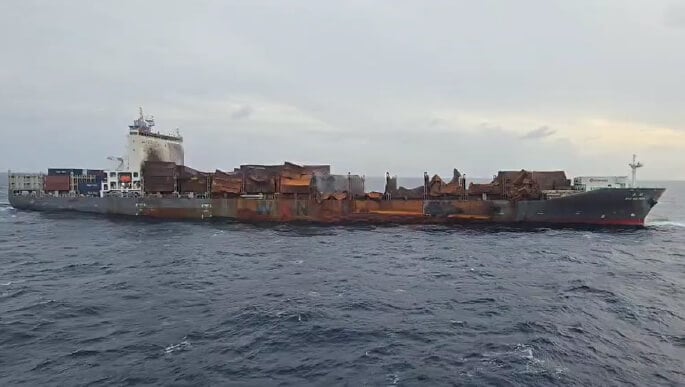
The fire was extinguished by late July leaving the Wan Hai 503 and its cargo heavily damaged (Indian DGS)

Published Jan 16, 2026 4:26 PM by The Maritime Executive


Wan Hai reports that the salvage operation for its vessel Wan Hai 503 has been completed seven months after a container fire killed four seafarers and forced the crew to abandon the vessel. The vessel, which was built in 2005, has now been delivered for recycling.

The container fire had begun on June 9, 2025, while the 4,250 TEU vessel was off the coast of India. There were reports of explosions from the forward part of the vessel, and 18 crewmembers were safely evacuated with the assistance of the Indian Navy and Indian Coast Guard. Six of the crewmembers were hospitalized with injuries, while four were reported missing.

The Indian authorities led the efforts to control the fire, which spread over a majority of the ship forward of the deckhouse and burned for weeks. After the fire was finally extinguished, they sought a port of refuge but were reportedly denied by both India and Sri Lanka. The hulk was instead towed to the UAE, where it finally arrived in mid-September, and after an inspection, was berthed for salvage.

The company reports that a total of 1,696 containers were salvaged from the vessel. Most of them had suffered fire damage except for the ones that had been stowed on the stern of the vessel.  Hapag-Lloyd was also sharing the vessel with cargo onboard for its customers.

The salvage operation was slowed by the extent of the debris on the vessel as well as the efforts to remove the firefighting water. The company said as of late December, 11,675 tons of fire water had been removed from the holds.

The clearance operation was completed by late December, with the hulk being towed from the Port of Jebel Ali in Dubai, which had provided the refuge for the salvage operation. As of January 12, the vessel had arrived at the designated berth at Drydock World Dubai and APT Global. Wan Hai notes that APT Global operates in compliance with the highest internationalstandards, and it will handle the recycling of the Wan Hai 503 according to the requirements of the Hong Kong International Convention.

The company had said the authorities were analyzing the cargo list and other data to ascertain the source of the fire. In its wake, there have been several changes, including India has begun the development of capabilities to be able to provide a port of refuge. The fire on the Wan Hai 503 had come after a Maersk vessel also experienced a box fire off India and ultimately went to the UAE for its port of refuge. Similarly, the X-Press Pearl had sought assistance at several ports, including in India, when the crew discovered leaking containers, which ultimately were blamed for the fire that claimed the newly built containership.

Wan Hai said it extends its sincere gratitude to all relevant authorities, partners, and professional teams for their invaluable support and collaboration throughout the recovery effort.