Sunday, January 18, 2026

China Halts Electricity Imports from Russia Due to Price Dispute

Russia is in negotiations with Beijing to potentially resume power supply to China, the Russian Energy Ministry told Reuters on Friday, after a Russian media report said that China halted electricity imports from Russia due to high prices. 

On Friday, Russian business daily Kommersant reported that China on January 1 stopped buying any electricity from Russia. 

The Chinese refusal to buy Russian electricity was the result of high Russian export prices, which in 2026 topped the domestic power prices in China for the first time, Kommersant reported, citing sources familiar with the matter. 

Russia’s electricity exports to China are unlikely to resume in 2026, as the higher Russian export price than Chinese domestic power prices since January 1 makes purchases uneconomical for Beijing, according to Kommersant’s sources. 

The electricity supply contract between Russia and China is valid until 2037. 

The Russian Energy Ministry could resume exports if China requests so, Kommersant noted. 

“Russia could resume electricity exports to China if it receives a corresponding request from Beijing and if mutually ?beneficial cooperation terms are reached,” the ministry told Reuters, commenting on the price dispute. 

Russia’s priority is to meet growing electricity demand in Russia’s Far East regions. Yet, Russia could resume supply to China if the parties reach a deal on pricing, the ministry added. 

Neither side, however, seeks to terminate the contract, said InterRAO, the Russian supplier exporting electricity to China.  

“At present, the parties are actively exploring opportunities for electricity trade,” InterRAO said. 

China and Russia, close as they are, have had several energy squabbles over prices that China deems unfavorable. 

One of the most prominent examples is the planned Power of Siberia 2 huge gas pipeline from Russia to China via Mongolia. A final agreement on the Power of Siberia 2 has been elusive due to some sticking points, including the price at which Russia’s Gazprom will deliver the gas. 

By Charles Kennedy for Oilprice.com


The Hidden Energy Costs of Artificial Intelligence

  • AI’s energy use is rising rapidly, but poor transparency and fast-changing technology make accurate projections nearly impossible.

  • Governments and companies are preparing for worst-case scenarios by accelerating energy development, sometimes at the expense of climate goals.

  • The real environmental impact of AI is driven by large-scale industrial deployment, not individual user behavior or isolated queries.

Projections for the AI sector’s energy needs in the coming years are massive in scale. The International Energy Agency expects AI’s energy demand to double between now and 2030, presenting a serious challenge for energy security in many nations and regions where large data center developments are planned. 

But planning ahead for data center development and their associated energy needs is an almost impossible task. The real and future energy use of artificial intelligence is incredibly hard to pin down due to the rapid growth and advancement of the technology, as well as the lack of disclosure requirements imposed on AI firms. Accurate projections for the future are therefore all but impossible, since we don’t even know how much energy AI is using in the present moment. But we do know that it’s a whole lot.

The result of all this uncertainty is an enormous amount of hand-wringing on the part of end-users and rapid - panicked, even - investment in new and expanded energy production capacity on the part of the private and public sectors alike. “The energy resources required to power this artificial-intelligence revolution are staggering, and the world’s biggest tech companies have made it a top priority to harness ever more of that energy, aiming to reshape our energy grids in the process,” stated the MIT Technology Review in a May 2025 report


World leaders are left with little option but to prepare for the most intensive scenarios. Already, countries around the world are fast-tracking new energy development, often at the risk of climate goals. “From the deserts of the United Arab Emirates to the outskirts of Ireland’s capital, the energy demands of AI applications and training running through these centres are driving the surge of investment into fossil fuels,” Financial Times reported in August.

Better and more responsible policy around AI and its supporting industries will necessarily depend on better and more available data about AI’s energy use – but major questions remain unanswered about how much will that use fluctuate as levels of both integration and efficiency increase, and how much does the way that users interact with these platforms influence the energy footprint of large language models.

The subject of how much energy an individual AI query uses is currently a subject of much debate. There is even a question as to whether our politeness with large language models – using extra computing power to say please and thank you to models like ChatGPT – is directly driving up energy usage and costing companies like OpenAI millions. No matter how many times ChatGPT receives the input “thank you” it has to run a fresh “inference”, performing “a full computational pass through the model.” All those individual computations add up, and add up in a big way.

Of course, the concern over a few extra polite words is extremely small potatoes compared to the myriad other, more demanding ways that AI is being used. Nevertheless, a recent op-ed for The Conversation argues that the “persistence of the idea” that all those drops in the ocean add up to an important impact “suggests that many people already sense AI is not as immaterial as it appears.” The article goes on to state that “that instinct is worth taking seriously.”

On the other hand, this mentality is also diverting attention from the real problem of AI’s environmental impact. Individual queries and user-end activity is virtually negligible compared to what’s happening on the producer end of the equation. The spread of AI is not user-driven. Rather, it’s industry-driven, and being indiscriminately integrated across virtually every economic sector there is at a rapid pace, and with serious energy consequences. 

“AI’s integration into almost everything from customer service calls to algorithmic “bosses” to warfare is fueling enormous demand,” the Washington Post reported last August. “Despite dramatic efficiency improvements, pouring those gains back into bigger, hungrier models powered by fossil fuels will create the energy monster we imagine.”

By Haley Zaremba for Oilprice.com


JP Morgan Boss Sounds Alarm on AI Bubble and Sticky Inflation Threat

  • Jamie Dimon, CEO of JP Morgan, issued a stern warning to global markets, cautioning against underestimating geopolitical risks, sticky inflation, and the threat of an AI bubble.

  • The bank announced its fourth-quarter 2025 earnings, which included a hefty increase in loan loss provisions to $4.7 billion, taking a seven per cent chunk out of the firm's profit.

  • JP Morgan announced a £10 billion investment in the UK, including a new Canary Wharf headquarters, following Chancellor Rachel Reeves' attempts to foster closer ties with global financiers.

The boss of JP Morgan, Jamie Dimon, has warned global markets not to underestimate current risks, as the US banking giant hiked its provisions for bad loans.

The world’s most influential banker said that whilst the US economy had remained “resilient” and consumer and business trends were “generally healthy,” ongoing risks persisted.

“Markets seem to under-appreciate the potential hazards – including from complex geopolitical conditions, the risk of sticky inflation and elevated asset prices,” Dimon said.


Dimon also weighed in on growing agitation surrounding the independence of the Federal Reserve after Trump’s latest attack on chair Jerome Powell.

“Anything that chips away” at the central bank’s independence “is not a good idea,” he said on Tuesday, adding “everyone we ‍know believes in Fed independence”.

The banking titan’s warning to markets come after he sounded the alarm on an AI bubble telling the BBC he was “far more worried than others.”

“Most people involved won’t do well. Some of the money being invested will probably be lost,” he said.

Fears of an AI bubble have sent jitters across the UK following pledges of capital injections from US giants into the UK economy.

Microsoft earmarked £22bn to build the country’s largest supercomputer and AI infrastructure. Meanwhile, chipmakers Nvidia and OpenAI laid out plans to create the largest AI computing facility in Europe.

Still, markets have continued to notch record highs despite ongoing concerns. The FTSE 100 smashed the 10,000 milestone in its first trading session of the year, whilst S&P and Dow Jones wrapped up last week’s with new highs after rallies in chipmakers.

The banking chief has also issued warnings around the rise of private credit, following the collapse of car parts maker First Brands and subprime auto lenders Primalend and Tricolour.

Dimon cautioned more “cockroaches” were likely to emerge in a credit downturn, telling an analyst call that some banks’ underwriting of loans to private credit “won’t be as good as you think”.

Dimon hikes provisions for sour loans

The renewed concerns came as JP Morgan released its fourth-quarter earnings update for 2025, where the bank notched $46.8bn (£35bn) in managed revenue.

The bank officially announced it will become the new issuer of the Apple Card, a move expected to bring over $20bn in card balances to the Chase platform.

But JP Morgan continued the trend of bulking up its financial cushion amid broader economic nerves, with loan loss provisions rising to $4.7bn in the final quarter from $2.6bn the year prior and $3.4bn in the third quarter.

The hefty increase took a chunk out of the firm’s bottom line, with profit falling to $13bn, a seven per cent drop compared to the prior-year quarter.

Chris Beauchamp, chief market analyst at IG, said: “This is another great set of numbers from JPMorgan, notable for strong client inflows and payments revenues… investors worried about overstretched equities can at least ease back on concerns about earnings.”

This week Dimon is expected to introduce Chancellor Rachel Reeves as they jointly host an event at next week’s World Economic Forum, according to Sky News.

The roundtable gathering in Davos, Switzerland, will be attended by bosses of the world’s biggest multinational firms and comes as Reeves attempts to curry favour with global financiers in her bid to make Britain an investment destination.

Reeves has maintained a close relationship with the American banking boss as part of her attempts to drive economic growth across the UK.

Following the Autumn Budget – where banks were able to skirt a highly-anticipated tax raid – JP Morgan announced a whopping £10bn investment into the UK with a new Canary Wharf office.

The project is expected to create an additional 7,800 jobs across construction and other local industries. Once finished, it will house up to 12,000 and serve as the bank’s main headquarters in the UK, and it will be the bank’s biggest presence across Europe, the Middle East and Africa.

JP Morgan contributes nearly £7.5bn to the local economy and supports 38,000 jobs.

By City AM 


Inside Brazil’s Race to Secure Gas Supply

  • TAG’s compressor, LNG interconnections, and SEAP-linked projects aim to replace LNG imports and unlock domestic gas flows to the Northeast.

  • NTS focuses on reinforcing Southeast corridors to offset falling Bolivian supply and integrate pre-salt production.

  • TBG faces rising supply risk, with biomethane and proposed Argentine imports emerging as critical stopgaps.

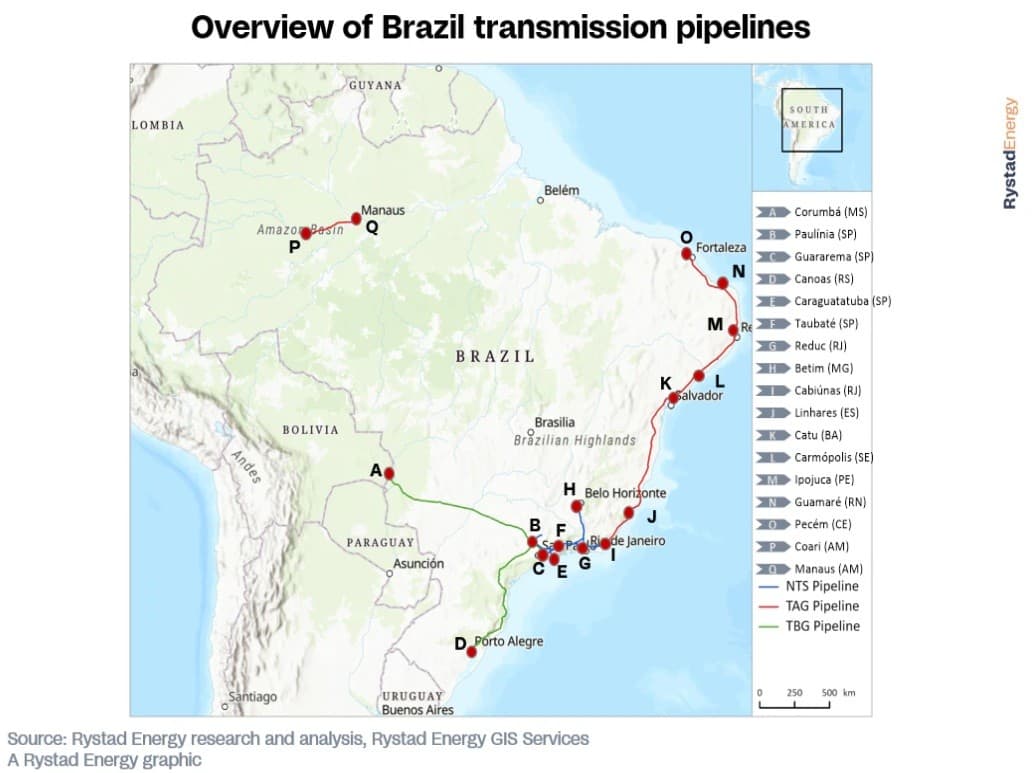
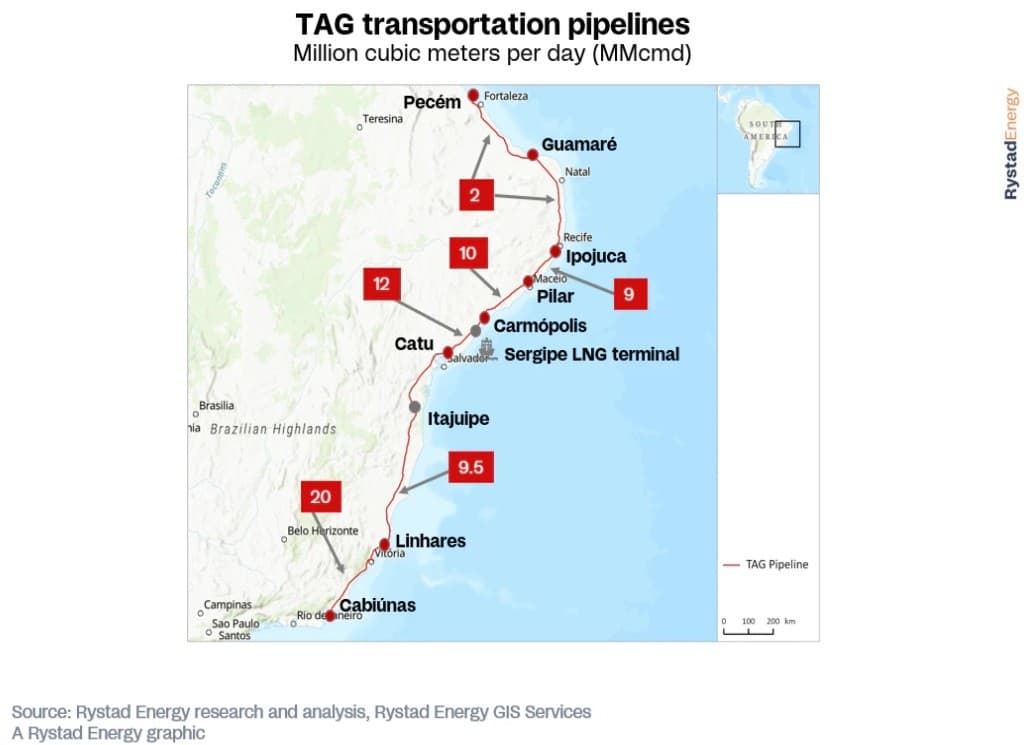
TAG is the gas transmission operator responsible for the main transport corridor connecting Cabiunas, Brazil (Point I), the biggest gas injection point in the country, located from Rio de Janeiro to Ceara (Point O). TAG will play a central role in integrating new domestic gas supply from the Sergipe Alagoas deepwater project (SEAP), liquefied natural gas (LNG) entry points, and demand centers across Brazil’s Southeast and Northeast regions.

Pipe

The ECOMP Itajuipe compressor station proposal addresses a bottleneck in TAG’s pipeline network that limits gas flow from Southeast to Northeast above the Catu station (K). Installing a compressor on the Cacimbas–Catu (GASCAC) pipeline would add 3 million cubic meters per day (MMcmd) of transfer capacity, raising total capacity from 9.4 to 12.4 MMcmd, enabling domestic gas from the Southeast to replace LNG imports in the Northeast. Currently, LNG imports at Bahia LNG are necessary for the region's high gas power demand. The project aligns with Raia's expected supply from 2028 and is needed until the Sergipe-Alagoas project begins in 2030. Estimated capex is about $150 million.


Since 2024, TAG has been connected to Eneva’s LNG terminal in Sergipe (point L) via a dedicated pipeline, adding a private LNG entry point to the grid. The $65 million project improves short-term supply flexibility in the Northeast and gives Eneva’s Porto de Sergipe I power plant the option to switch between LNG and grid gas based on pricing.

TAG is also evaluating the Gasoduto dos Goytacazes (GASOG) project—a 45.5 km pipeline linking GNA’s LNG terminal at Porto do Acu to the GASCAV system in Campos dos Goytacazes. With an initial bidirectional capacity of 12 MMcmd (expandable to 18 MMcmd), the $190 million project would enable the 3 GW thermal complex at Acu to tap grid gas and unlock new supply sources to meet future industrial demand.

On the supply side, the SEAP development in the Sergipe-Alagoas Basin includes two FPSO-based systems (SEAP I & II). Gas will reach shore via the Rota SEAP offshore pipeline, pre-processed for network injection. While the full pipeline could handle up to 18 MMcmd, only SEAP II—bringing 10 MMcmd—has reached FID. SEAP I, still awaiting FID, could add another 6–7 MMcmd. TAG has already planned the onshore connection, with start-up aligned to Petrobras’ timeline.

Further north, the Veredas project aims to expand capacity into Ceara through a phased duplication of the Nordestao pipeline. Phase I would add 4 MMcmd between Pernambuco and Ceara (points M to O), easing current bottlenecks. Integration with SEAP gas could further meet growing demand in Ceara. Higher volumes will require upstream reinforcements from Cabiúnas or Bahia. Project execution depends on demand commitments, potentially supported by reactivating two thermal power plants in the 2026 LRCAP auction. Estimated Phase I capex is $500 million.

In parallel, TAG and Origem Energia have signed a non-binding agreement to build Brazil’s first gas storage facility using depleted reservoirs in the Alagoas Basin (point L). Initial storage capacity is planned at 100 million cubic meters per year, expandable to 500 million cubic meters, with investment reaching up to $200 million over several phases.

Finally, gas processing capacity is set to grow with PetroReconcavo’s UPGN Miranga in Bahia. The plant will start at 0.95 MMcmd (expandable to 1.5 MMcmd), with operations expected by July 2027 and FID in 2026. With $65 million in capex, the project offers an alternative to Petrobras’ Catu facility, whose shared processing agreement expires in June 2027, giving PetroReconcavo more control over its output.

Brazil

NTS strengthens network amid declining Bolivian imports and rising pre-salt supply

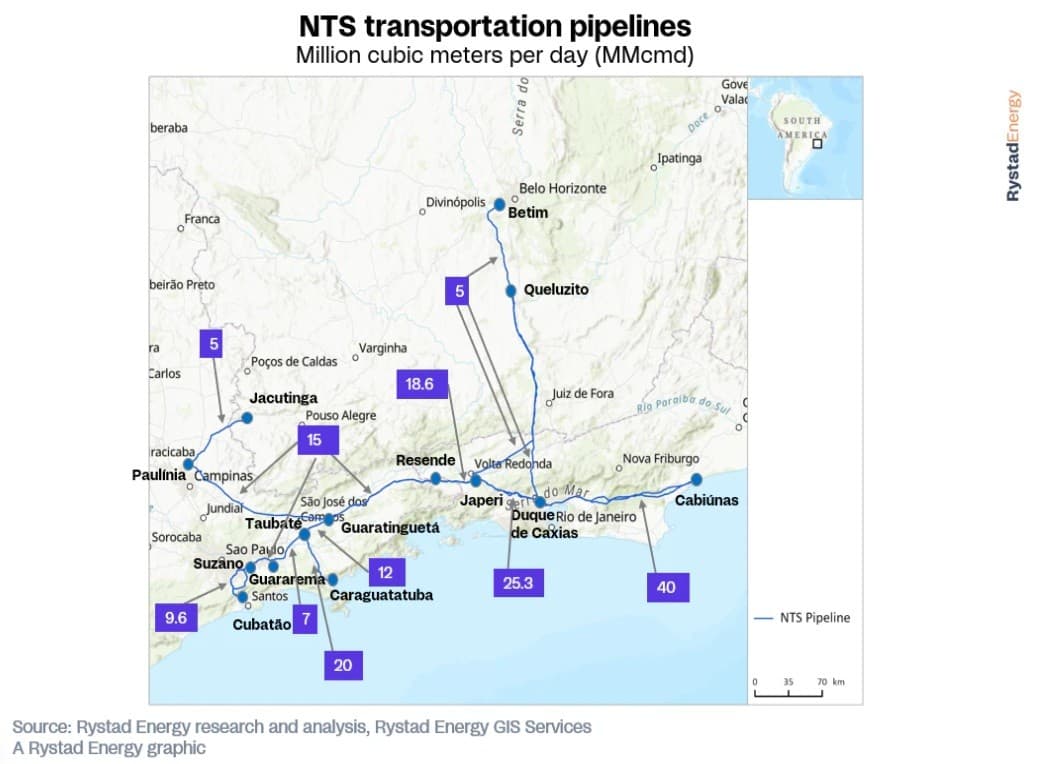
NTS continues to play a central role in connecting Brazil’s main gas production hubs to its largest consumption centers, Rio de Janeiro and Sao Paulo, together representing over 50% of national gas demand in 2024.

The recently completed GASBEX pipeline links southern Minas Gerais to the national grid via the GASCAR system, delivering up to 0.3 MMcmd to industrial consumers in Extrema and nearby areas. Spanning 28 km with a $40 million investment, the project supports GASMIG’s expansion and helps secure long-term industrial gas demand growth.

The Corredor Pré-Sal Sul aims to expand capacity between Rio and Sao Paulo by duplicating pipelines and adding compression. Once fully developed, it could enable up to 40 MMcmd of interstate flow and 25 MMcmd to TBG via Paulínia (point B), helping offset declining Bolivian imports. However, the first step—the Japeri compression project—has yet to reach FID and is critical to avoiding a potential supply shortfall by 2027. The full corridor remains on hold, with an estimated $1.5 billion capex.

The GASINF project proposes a 100-km bidirectional link from Porto do Acu to the NTS network, enabling either injection of LNG into the grid or delivery of domestic gas to power plants at the port. The $380 million project complements ongoing discussions around an onshore LNG terminal and supports Acu’s ambitions as a gas and energy hub.

A separate project would connect the Sao Paulo LNG terminal to the gas grid. It’s currently under ANP regulatory review and would help offset declining domestic supply in the region by enhancing access to imported LNG and market liquidity for operator Edge.

In January 2025, TAG and NTS completed a new $9 million bidirectional interconnection in Macaé (point I), improving operational flexibility and allowing flows of 2–5 MMcmd. A proposed compressor station (ECOMP Macaé) could boost inter-network flows to 20 MMcmd, but has yet to be approved.

Lastly, the Equinor-operated Raia project will bring up to 16 MMcmd of pre-salt gas from the Campos Basin to the network by 2028 via a 200-km offshore export pipeline. Once operational, processed gas will flow to the Cabiúnas point, supporting domestic supply security and enhancing specification control.

Brazil

TBG’s supply security hinges on third-party infrastructure decisions

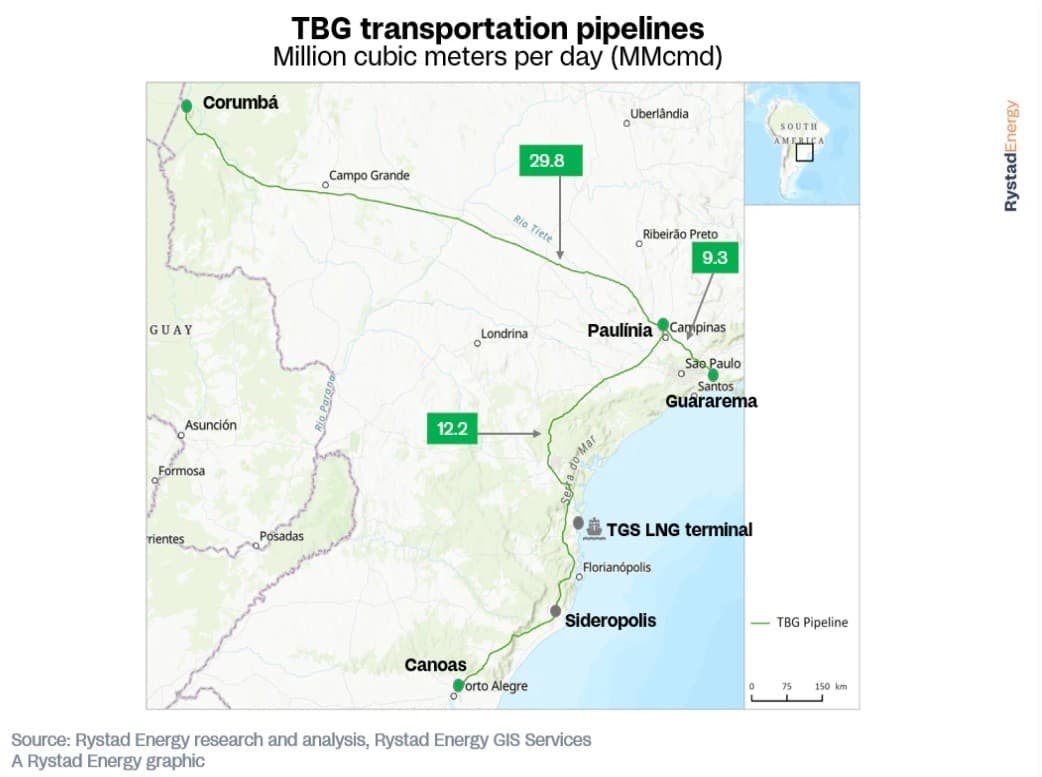
TBG operates the GASBOL corridor, Brazil’s key long-distance gas transmission system linking Bolivian imports to demand centers in the South and Southeast. While new trunklines are not planned, TBG is focusing on optimizing existing infrastructure to boost utilization and diversify supply.

One key initiative is the integration of biomethane hubs, such as Sao Carlos and Porecatu, allowing up to 1 MMcmd of renewable gas to be injected directly into the network. The Sao Carlos hub alone, at an estimated cost of $27 million, will consolidate dispersed biomethane production from Sao Paulo—leveraging nearby sugarcane bagasse—to a single entry point upstream of the Sao Carlos compression station.

However, the withdrawal of New Fortress Energy’s regasification unit from the Terminal Gas Sul has reduced LNG injection options. With Bolivian imports declining to 10–14 MMcmd in 2025 and Argentine imports limited to 0.4 MMcmd/month, alternative sources are insufficient to close the supply gap.

Brazil

To address this, a new cross-border pipeline from Argentina to Brazil is being proposed, running from Uruguaiana to Triunfo (point D), where it would connect to TBG’s existing network. Estimated at $1.7 billion, the project could transport up to 15 MMcmd but requires Argentina to expand its own pipeline capacity from Neuquén and secure long-term supply contracts with Brazilian buyers. TGN has presented a base case scenario of 10 MMcmd in gas exports to Brazil across multiple routes.

By Felicity Bradstock for Oilprice.com

Cuba’s Energy Crisis Will Worsen Without Venezuelan Oil

  • Cuba’s chronic blackouts stem from years of underinvestment and heavy reliance on imported oil, particularly from Venezuela.

  • The halt of Venezuelan oil shipments after U.S. intervention has elevated Mexico’s role as Cuba’s main supplier, drawing Washington’s criticism.

  • Without structural energy reform, Cuba remains vulnerable to geopolitical shocks and external pressure on its fuel supply.


Cuba has been experiencing a worsening energy crisis for several years, which has led it to rely heavily on Venezuela for its fuel. Following the United States' intervention in Venezuela earlier this month, Cuba is expected to lose a vital supply chain for fuel, putting increasing pressure on the government to respond to the energy crisis. In the short-term, this will likely mean relying more heavily on oil-rich neighbours, such as Mexico, to provide supplies. However, Cuba must look for a long-term solution to its energy problems to bring an end to the crisis and enhance security.

The ongoing energy crisis in Cuba has led to residents experiencing almost daily blackouts and gas cuts in recent months. The crisis was driven by years of underinvestment in the country’s transmission network, which led power plants to run below capacity. The country’s energy supply now falls far below the consumer demand. The regular blackouts have forced Cubans to invest in charcoal stoves, rechargeable batteries, and fans, which many residents can scarcely afford.

In March last year, Cuba’s national electrical grid collapsed, leaving most of the island’s population of 10 million without power. Major tourist hotels came to rely on generators, while many had no access to power at all. This has resulted in mass protests, as residents call for the government to address the crisis.


Venezuela has become one of Cuba’s main oil suppliers in recent years. Despite its dwindling oil production, Venezuela was shipping an average of 26,500 bpd to Cuba last year, according to ship tracking data and internal documents of state-run PDVSA. This was thought to cover around 50 percent of Cuba’s oil deficit, while Venezuela accounted for roughly 10 percent of Cuba’s trade in 2025.

However, no cargoes have reportedly left Venezuelan ports for Cuba since the U.S. intervention in the South American country earlier this month. Thirty-two members of Cuba's armed forces and intelligence services were killed during the U.S. attack. President Donald Trump has since warned Cuba that it should sign an agreement with Washington to ensure it continues to receive much-needed oil from Venezuela.

Trump posted on his Truth Social platform, “THERE WILL BE NO MORE OIL OR MONEY GOING TO CUBA – ZERO!” He added, “I strongly suggest they make a deal, BEFORE IT IS TOO LATE.”

Shortly after, Trump wrote, “Cuba lived, for many years, on large amounts of oil and money from Venezuela. In return, Cuba provided ‘Security Services’ for the last two Venezuelan dictators.” The president went on to say, “But not anymore! Most of those Cubans are DEAD from last week’s U.S.A. attack, and Venezuela doesn't need protection anymore from the thugs and extortionists who held them hostage for so many years. Venezuela now has the United States of America, the most powerful military in the World (by far!), to protect them, and protect them we will.”

Cuba’s president, Miguel Diaz-Canel, responded by writing on the X social media site, “Cuba is a free, independent and sovereign nation. No one tells us what to do.” He added, “Cuba does not attack; it has been attacked by the U.S. for 66 years, and it does not threaten; it prepares, ready to defend the homeland to the last drop of blood.” Meanwhile, Cuban Foreign Minister Bruno Rodriguez wrote on X that Cuba had the right to import fuel from any suppliers willing to export it. 

The halt of Venezuelan oil exports to Cuba has forced Mexico to step in. Mexico moved ahead of Venezuela in 2025 as Cuba’s main oil supplier, according to a recent Financial Times article, although President Claudia Sheinbaum was quick to say that Mexico is not shipping significantly more oil to Cuba than in previous years. President Sheinbaum said, “We are not sending more oil than we have historically… Of course, with the current situation in Venezuela, Mexico has obviously become an important supplier. Before, it was Venezuela.”

Mexico was estimated to have sent a daily average of 12,284 bpd of crude to Cuba in 2025, contributing 44 percent of the Caribbean island’s crude imports, while Venezuela exported an estimated 9,528 bpd of oil to Cuba, accounting for 34 percent of its oil imports.

The Trump administration is less than impressed by the ongoing export of Mexican crude to Cuba, which could put increasing pressure on Sheinbaum to curb shipments due to the upcoming review of the North American USMCA free trade agreement. The Florida Republican Congressman Carlos Giménez recently threatened, “Make no mistake: if the Sheinbaum government continues to give away free oil to the terrorist dictatorship in Havana, there will be serious consequences as we renegotiate the USMCA.”

As the threats continue to mount, several Latin American countries are feeling increasing pressure from their northern aggressor to change their behaviour. President Trump is strongly encouraging Cuba to sign an agreement with Washington to ensure its oil supply and alleviate its ongoing energy crisis. While Mexico is feeling greater pressure to curb its increasingly vital oil exports to Cuba. 

By Felicity Bradstock for Oilprice.com

Canadian nickel exporters eye EU carbon boost


Canada is the world’s sixth-largest nickel producer

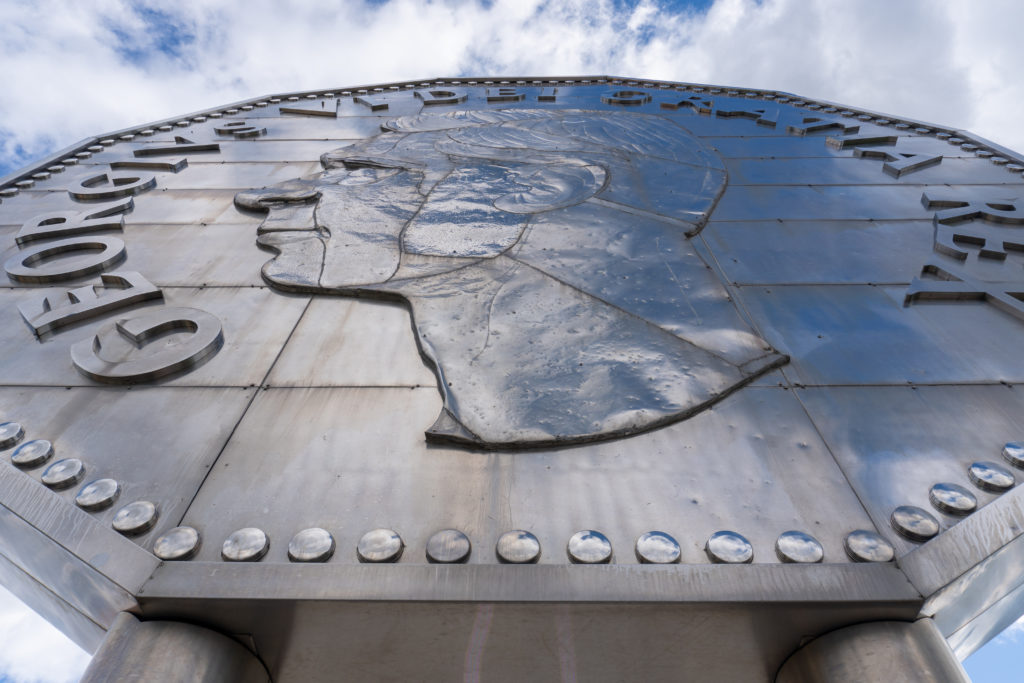
Big Nickel in Sudbury, Ontario. Stock image.

The European Union’s Carbon Border Adjustment Mechanism (CBAM), which took full effect this month, has imposed a carbon price on products imported from non-EU countries, including steel, iron, aluminum and cement.

European importers are now required to pay a carbon price equivalent to the cost of carbon allowances under the EU’s Emissions Trading Scheme, currently close to €90/tonne ($105/tonne).

On Dec. 18, the European Commission proposed expanding CBAM to cover 180 downstream products that typically contain a high share of steel and or aluminum, ranging from car parts and machinery to construction equipment and washing machines. The proposal will require approval from the Council of the EU and the European Parliament before taking effect.

Despite lobbying from Euromines, the Brussels-based association for European miners, nickel was not included in this round of expansion. Unlike copper, lead and zinc, which appear unlikely to be added, the European Commission has not ruled out including nickel in future updates, potentially from 2028, when the next legislative proposal is expected.

Such a move would be significant for Canadian nickel exporters. Under CBAM, Canadian nickel would be more cost competitive, as European importers would need to purchase fewer EU carbon allowances compared with imports from higher-emission producers. Canada’s power generation is relatively low-carbon compared with many other nickel-exporting countries, notably Indonesia, which relies heavily on coal-fired power.

“Most of the nickel coming from Canada has a low-carbon footprint compared with, for example, Indonesia, which has a massive carbon footprint,” Mark Selby, CEO of Canada Nickel (TSXV: CNC), told MINING.COM. “We will benefit from existing CBAM on steel, and if it gets extended to nickel, then we will benefit as well.”

Canada Nickel is advancing the Crawford nickel sulphide project north of Timmins, Ontario, toward construction by year-end 2026 and views Europe as a key export market. Nickel is a critical raw material for Europe’s green and digital transitions, including electric vehicles and batteries, as well as defence applications such as advanced weapon systems and aerospace components.

“We expect to produce 30,000 tonnes of nickel per year initially and then ramp up to 50,000 tonnes per year,” Selby said. “The bulk of that will be exported either directly or embedded in semi-finished stainless alloy and steel products outside of Canada. Around 30–40% of the nickel will be sold within Canada.”

The company has yet to sign offtake agreements with European buyers, but Selby said that is planned over the next 24 months as the project advances. He added that the project’s low carbon footprint gives it a strategic advantage in the European market.

With the Crawford project not expected to come online before the end of 2028, followed by a production ramp-up in 2029, Selby is hopeful nickel will be included under CBAM around that time.

First big test

Although CBAM reporting requirements took effect in 2023, the system remains largely untested, and critics have warned that its complexity could make compliance difficult to monitor. The full-scale launch in January next year will therefore be a key test for exporters and importers of CBAM-covered goods.

Photinie Koustavlis, vice president of economic affairs and climate change at the Mining Association of Canada, said a well-designed CBAM that accurately measures embedded emissions and reckognises credible domestic carbon pricing would tend to favour low-carbon nickel producers such as Canada.

“At the same time, we would need to look closely at the specific design details of any CBAM expansion to understand how carbon intensity would be measured, how different processing routes would be treated, and how Canadian exports would be affected,” Koustavlis told MINING.COM. “Ensuring transparency, robust methodology and fair treatment of responsible producers would be essential.”

Canada is the world’s sixth-largest nickel producer, with output of about 160,000 tonnes per year based on 2023 figures from the federal government. Indonesia is the largest producer, accounting for about 1.8 million tonnes, or 51% of global output.

Europe is heavily dependent on imported raw and processed nickel. In 2024, 100% of the EU’s mined nickel production came from just two sulphide nickel mines, both located in Finland. Canada is already an established exporter of nickel to the EU, with scope to increase its market share.

Koustavlis said independent analysis by London-based Skarn Associates consistently shows Canadian nickel has among the lowest carbon intensities globally, largely due to Canada’s clean electricity grid and sustained investments by producers to reduce emissions.

“By contrast, publicly available research indicates that nickel production in several major producing countries, particularly where coal is the dominant energy source, is significantly more carbon intensive,” she said. “A number of studies have shown that emissions from some Indonesian nickel operations can be multiple times higher than those from Canada.”


Factbox: EU nickel supply

The EU sources nickel ores and concentrates from Finland (39%), Canada (24%), Greece (19%), South Africa (8%) and the US (4%). 

The EU sources refined nickel from from Russia (29%), Finland (18%), Norway (11%), Canada (7%), Australia (7%), Greece (4%) and several smaller importers. 

Source: European Commission: Study on the critical raw materials for the EU, 2023


CBAM fast facts

CBAM took full effect on Jan. 1, following a transitional period or ‘soft launch’ that began in 2023.

Under CBAM, the obligation falls on the importer: Importers of steel and iron ore, aluminum, cement, fertilizers, electricity and hydrogen from non-EU countries will have to purchase and surrender CBAM certificates corresponding to the CO2 emissions linked to the products they import. 

The price for a CBAM certificate will be similar or equal to the price of CO2 allowances under the EU ETS. 1 CBAM certificate corresponds to 1 tonne of CO2 emissions.

As CBAM comes into effect, free CO2 allowances for heavy industry in the EU will gradually be phased out by 2034. The EU says this will create a level playing field globally for the trade of CBAM goods. 

The EU is looking to expand CBAM to cover additional products. On Dec. 18, it proposed to expand the scope to 180 downstream products but it has not ruled out including nickel in the future. 

Source: European Commission

___________
Andreas Walstad has written extensively about energy issues for almost two decades. Dividing his time between London and Brussels, he has a special focus on energy policy and regulation. He regularly speaks and moderates discussion panels at conferences.