Shewket Harki
RUDAW
MAY 24, 2025
Interview
Interview
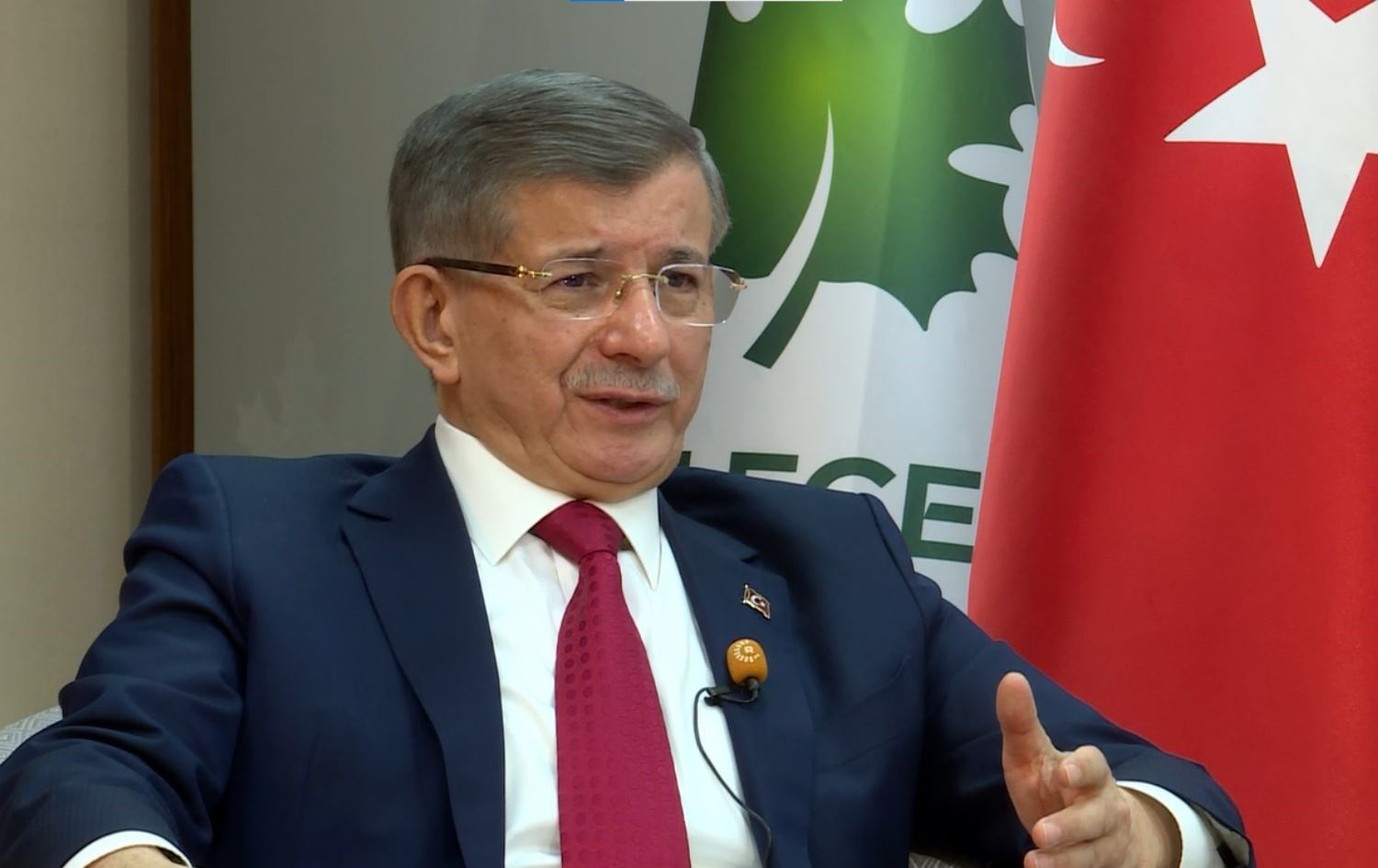
Ahmed Davutoglu speaking to Rudaw in Ankara on May 14, 2025. Photo: Rudaw
LONG READ
Ahmet Davutoglu, Turkey's former prime minister, told Rudaw that the next step in the peace talks between the Kurdistan Workers’ Party (PKK) and the Turkish state should be a “disarmament ceremony” in order to ensure the process does not fail.
"A ceremony, a meeting, where Iraqi and northern Iraqi officials are included, where Turkish officials are included, a symbolic arms surrender ceremony needs to be held as soon as possible. Then it's necessary to determine how the weapons will be liquidated," he said.
“My advice to everyone is that within 15 days, this disarmament ceremony, call it a ceremony, the public needs to see it,” he added.
The PKK announced its dissolution and an end to its four-decade armed struggle on May 12, responding to a call from its jailed leader, Abdullah Ocalan, to end the armed fight and pursue a political and democratic path.
Davutoglu, who is also the chairman of the opposition Future Party, said that once disarmament is accomplished, then the process can continue. He proposed a multi-step plan that includes recognition of Kurdish cultural rights in Turkey and a strong involvement of the parliament - as has been suggested by many Turkish politicians and PKK leaders.
He also said that Turkey should not see Syrian Kurds as a threat if officials in northeast Syria (Rojava) and Damascus reach an agreement.
Davutoglu, who played a key role as foreign minister during the failed 2013 peace process, said that it is important that there be no delays in order to see success this time.
The following is the full transcript of the interview with Ahmet Davutoglu done on May 14, 2025:
Rudaw: The most important development on the agenda is the organization's declared disarmament and self-dissolution decision. How do you evaluate this process? What needs to be done to prevent a deadlock especially at the point of laying down arms in the next phase of the process? How should the roadmap proceed from here?
Ahmet Davutoglu: Well, first let me express this. When we did a program here in November before going to Erbil, Mr. [Devlet] Bahceli had made his October 22 speech. You asked similar questions. I said then too, I support this process. We disagreed with Mr. Bahceli on many issues. Sometimes he tried to use "Serok Ahmet" [Kurdish for “President Ahmet”] mockingly about me from the podiums. I always responded with "Sersera, Serçeva” [Kurdish for “You are welcome”].
I am among those who advocate for friendship, brotherhood, and peace among all peoples of the Middle East in principle. One hundred years ago, our geography was divided, fragmented, cities were divided, tribes were divided, families were divided, Sykes-Picot tore us apart. Now it's time to gather these pieces. We need to compile and organize these pieces, respecting borders but not seeing borders as walls, preparing the decades ahead with economic integrations and intense cultural relations. The relationship between Turkey and the Kurdistan Region in northern Iraq is actually a beautiful example of this. Now when we look, the PKK terrorist organization has maintained its existence in all this geography for more than 40 years and has been in a position that keeps the fire of continuous tension ready, so to speak.
On the other hand, there were grave mistakes made especially during the September 12 [1980 military coup] period in Turkey. The denial of Kurdish identity, restriction of democratic rights, restrictions and bans on Kurdish language. In fact, terrorist organizations feed on authoritarian or dictatorial structures. Terrorist organizations use authoritarian structures as an excuse. The most important thing that will legitimize an authoritarian structure is to say "Look, there's a threat, there's a terrorist organization." And the terrorist organization says "Look, they're oppressing us, join me in violence." It's exactly like the relationship between ISIS and the Assad regime.
So how do we get out of this vicious circle, this dead end, this futile cycle? Wise people from all sides will come together and say we're all losing here. Let's find a formula where we all win. And this formula needs to be discussed without any prejudice. When the solution process started in 2013, I was foreign minister, everyone knows. I toured eastern and southeastern Anatolia step by step. I gave a conference in Diyarbakir and felt responsible for the solution process because I believed this was right for Turkey and for our region. Mr. Masoud Barzani came to Diyarbakir, Mr. Nechirvan Barzani came to Van. Very beautiful images emerged.
But the PKK then, with a wrong choice, instead of evaluating this climate, turned to exploiting it and trenches and barricades were dug. A struggle against terrorism had to be carried out necessarily. However, if that opportunity had been utilized, what is happening today would have happened much earlier. So what's different today? I believe we are in a more advantageous position today because for the first time, the extremes have united on the same issue. The proposal already came from us anyway, we always supported processes similar to the solution process. Mr. Bahceli and the nationalist wing in Turkey always opposed it. If this proposal, or similar thoughts, had come from us, which they were coming, there would be polarization again. The relations that started with the handshake and greeting between Mr. Bahceli and the DEM Party on October 1, I think, were the most important accelerating element of this process. After that, I met with Mr. Bahceli many times. After returning from Erbil, I sent a letter to Mr. Bahceli and Mr. Erdogan conveying my impressions after the Duhok conference and expressing my thoughts. The Syrian revolution had not yet happened.
Later, when the Syrian revolution happened, I sent it again. I mentioned all these elements in it and said that this momentum should be increased. I also conveyed my meetings with Mr. Masrour Barzani and Mr. Masoud Barzani there in this letter. Mr. Bahceli called to thank me and said "we need your state experience." He complimented me by saying "You are the statesman who knows these issues best in Turkey." Since then, I have been in constant contact with Mr. Bahceli. This week, I spoke with him on the phone again after this dissolution decision.
On the other hand, I met with the DEM delegation many times. I had a long meeting last week. Just before the dissolution of this congress, that is, just before the first decision was announced on Thursday. I told them the same thing. "Let's not miss the opportunity this time.” Since these extremes have united, our duty is to take this to a more advanced stage.
Let me state openly: Mr. Erdogan's long silence after October 22 worried me too. And in almost every speech I made in the Turkish Grand National Assembly, I called on Mr. Erdogan to take ownership. I said "Don't do this as arm wrestling between you and Mr. Bahceli. Take ownership." After all, this is an issue that the President of the Republic of Turkey should take ownership of. We have differences of opinion, economy, policies, political ethics law, etc. But we're behind you on this issue. Continue. Therefore, I had contacts with all parties. Recently I also sent a letter to Tayyip Erdogan at that time, and with officials conducting this business at the state level. I expressed very clearly to all of them, this is a historic opportunity.
So where are we now? Yes, the dissolution decision is correct. There's a saying by Churchill that I love very much. Let me say it in English as he said it… "This is not the end. This is not the beginning of the end. This is just the end of the beginning." He says this for a process.
There are elements in the dissolution decision announcement that disturb Turkish public opinion. I told those who told me this, these things are said. Let's look at the result. I don't agree with these. Some views in the statement may be very sharp views, but I look at the result. Will the organization liquidate itself or not? Let's get this result, those statements will be forgotten. Everyone makes somewhat high-dose statements to their own neighborhood. We need to be patient.
But now we are at the beginning. What needs to be done from now on? In my speech at the Turkish Grand National Assembly today, I listed what needs to be done one by one in nine items. First, if the organization is to be liquidated, what does liquidation mean? Liquidation of the organization's armed structure means disarmament. I'm calling from here and I'm sure the officials in northern Iraq [Kurdistan Region] will join my call. When it's delayed, many people, many circles will provoke. Israel is at the top of those disturbed by this agreement because it wants chaos in the region. There may be many other actors.
A ceremony, a meeting, where Iraqi and northern Iraqi officials are included, where Turkish officials are included, a symbolic arms surrender ceremony needs to be held as soon as possible. Then it's necessary to determine how the weapons will be liquidated. If weapons are buried somewhere and taken out with a provocation five months later, Turkey and the region cannot discuss this for another ten years, 20 years.
Second is the organization's human structure. We know that the majority of the current organizational structure has not been involved in any crime. Rehabilitation of those not involved in crimes, legal formulas for those involved in crimes, and for senior officials - their number varies between 30 and 50 - keeping them under control in a country that supports Turkey and won't disturb Turkey, somehow this work needs to be done.
Third, these terrorist structures are also a financial sector not only in Turkey but in the world. In the 1990s, there was largely drug trafficking behind this structure, money laundering occurred, it exists in all structures. Therefore, it's necessary to dismantle the organization's financial structure and network. As long as those who benefit from this financial structure continue to exist, they will continue to provoke because they will be unemployed. We've seen this in many other things in the past.
Fourth, the Turkish government should declare a very comprehensive democratic opening. While the organization's human element is somehow integrated into life, there is no consistency in keeping Selahattin Demirtas, Ekrem Imamoglu, Umit Ozdag in prison just for expressing their thoughts, whatever their views are, or journalists. Therefore, all these works need to be introduced and resolved with a democratic opening.
Fifth, the Turkish Grand National Assembly needs to be activated on this issue. The president should gather all political leaders who have groups in the Turkish Grand National Assembly or are influential in public opinion and we should now discuss this issue. Because when the government does it, it has a limit, it's one side. But everyone is there in the Turkish Grand National Assembly. It should turn to that.
Seventh, the process should operate very transparently. The president should explain the process with all these elements and put forward the roadmap by making a speech in the nature of a national address.
Eighth, civil society organizations - of course, martyr and veteran associations are very sensitive - should participate in the process in a way that includes them in the process and develops a discourse without disturbing them.
Now I come to the most fragile, most important thing, the ninth point. The regional dimension of this must be well studied. Syrian Kurds should somehow enter this equation. Since relations between northern Iraq and Turkey are very intense, I don't see a problem there. The Iraqi government also wants this to be overcome. There's no problem there either. Support is declared in the statements made by the Talabani side, Sulaimani side, and the KDP [Kurdistan Democratic Party]. Mr. Barzani and the KDP never had any problems about this anyway. They acted together with Turkey.
Now the issue to be resolved is Syria, the dissolution of the organizational structure in Syria. But a trilateral mechanism needs to be established between Turkey, the Damascus administration, and the democratic representatives of Syrian Kurds. With this trilateral mechanism, the participation of Syrian Kurds in the Syrian administration as equal citizens should be guaranteed. No foreign power's patronage should be accepted.
What pleases and gives me hope in this process is that Turkey is healing its own wound without any external influence. The organization is making a decision on its own. And regional factors - northern Iraq’s Kurdistan Regional Government, Iraq, Syrian administration - all of them have somehow become stakeholders in this process. Now in Syria, definitely under Turkey's leadership, with such a structure, Turkey should see the Kurds in Syria not as a threat, but as an opportunity, as Turkey's natural extension. Syrian Kurds are not at a level that can threaten Turkey.
Something like this came to me in recent days after this announcement on this issue. They said, "The PKK is dissolving itself but dissolving in Iraq. The structure will continue in Syria as terror." I said, "You're talking like this because you don't know the geography. The Syrian border is not like Iraq. Between Qandil and Turkey's border, there are rows of mountains, many valleys, and many difficult elements. In Syria, the Jazira region is completely flat plain. So how long would it take for Turkey to conduct an operation to Qandil when there's a threat. In Syria, if there's a threat, it can stop and prevent it immediately."
There's also something I think I skipped in between. We also have to realize the Mesopotamian basin economic integration. That is, a common project needs to be developed that includes all elements in Mesopotamia, including Turkey, Iraq, Syria and Kurdish peoples in Turkey, Iraq, Syria as well as all elements in Mesopotamia such as Arabs, Turkmens, Kurds, Sunnis, Yazidis, all of them. All of them should be included in a joint Mesopotamia project. This is a concept I mentioned in strategic depth. There can be no peace by dividing the Mesopotamian basin. The Mesopotamian basin should be a peace basin and these borders don't appear as sharp borders. So let me say openly, the picture is clear in my mind.
If we go correctly, if we don't make mistakes, if we don't fall for provocations, if this business is not sacrificed to small political calculations, I am hopeful. I hope that all political actors in Turkey, starting with the president, already Mr. Devlet Bahceli’s stance on this issue is more determined, and all political actors in Turkey such as DEM Party, Selahattin Demirtas, Imrali, [Abdullah] Ocalan, all those who will personally carry out this disarmament action will not take a wrong step and will not miss this historic opportunity.
For the beginning of the process, Mr. Devlet Bahceli's handshake with DEM Party deputies in parliament is mostly accepted as a milestone, as the beginning. Did the process really start with this handshake? Or was there preparation beforehand? Under what conditions and where did the process begin?
State bureaucracy, both MIT [National Intelligence Organization] and security bureaucracy, always think about such scenarios, such studies. They are always prepared. I know from my own experience, we were always prepared for security when necessary, negotiation when negotiation was necessary. So the state has a strong background on this issue. I consider that with the experience and preparation of the National Intelligence Organization in Turkey and Mr. Ibrahim Kalin, you know we have always had a close relationship from his past academic life. Similarly, Foreign Minister Hakan Fidan is a friend who has conducted these processes. I have known both of them since the 1990s. Therefore, I believe that state institutions are prepared. But no matter how prepared the bureaucracy is, it's the political will that starts the business. And it's the political will that will carry it forward. Mr. Bahceli, although not in government, triggered this political will. He paved the way for the emergence of this political will.
That day is not a coincidence. That is, on October 1, the evening of that meeting, there was also a meeting with the DEM Party at the reception. I was also at the reception. We had contact with both sides. After greeting them, when we met with Bahceli, he turned and said "Mr. Prime Minister, we need your state experience more than ever today." He said this in front of the press. This was the only dialogue that emerged between Mr. Bahceli and me after years. He usually criticizes me, and I criticized him a lot too because this is politics. I didn't adopt some approaches. His saying this in front of the press had caught everyone's attention.
I'm saying this for this reason - Mr. Bahceli probably had a construct in his mind by the time those days came around. After all, he is also a politician of decades. Bahceli had a preparation for an opening attitude. In this sense, Mr. Bahceli’s initiation of the process and the expressions he used, very brave statements, had the effect of a psychological revolution. It transformed psychology.
Of course, those who will sabotage this business from his own circle, from more nationalist circles, I'm not saying nationalist. Look, everyone loves their tribe, but those who will sabotage this business are Turkish nationalists and Kurdish nationalists. I distinguish nationalists because nationalists don't recognize any other identity. Nationalism is patriotism, everyone loves their fellow townsman, loves their tribe, loves their people. There's nothing wrong with that. When you say my people are superior, I am superior, everyone will be subject to me, no one will speak except me, this is nationalism. I distinguish between the two. Mr. Bahceli displayed a patriotic nationalism. Turkish nationalists opposed it.
From the DEM Party’s perspective, they also adopted a democratic, patriotic line. But some Kurdish elements also accused them of treason. So now, this business will succeed with the joint effort of reasonable people who think about future generations, who are sad about the youth we've lost, whether Turkish youth or Kurdish youth. Bahceli triggered this.
Why do you think Ocalan made such a decision?
Now, during past solution process periods, Ocalan's speeches would come to me too. As a minister, as prime minister, I would study what he said, how his mindset works. I mean, not just about Ocalan. Whoever I'm dealing with, when an official sits across from me, when I meet someone or before an official meeting, I profile the entire personal profile of the person I'm going to meet. Due to my research curiosity as an academic, I try to understand their entire network, how their mind works. This is the same in my relationship with [former] German Chancellor Merkel or when we met with Putin or with American presidents.
Now when we look at the records from that time, from the meetings held by state officials, from that process in 2013, I have something in my mind to do a mental analysis even though I've never met or talked to him. Of course, a long period of detention, the rhetoric of the Cold War period. But an effort to overcome this rhetoric. The Cold War is over. These structures are Cold War products. September 12 is also a Cold War product. These structures are also Cold War products. Now there's an effort in Ocalan to get out of this Cold War product mentality. He had it then too. His reading of the world, experience, and finally when I look at what he does, he refers to the experience with [late Turkish President Turgut] Ozal, the efforts made to lay down arms in 1993. After the late Ozal, efforts were made by the late [PM Necmettin] Erbakan. Then the solution processes. I have the opinion that behind the failure of many processes, someone mixed it up.
Now we all, of course, compared to them, even though there's some age difference between us - look, Mr. Devlet Bahceli and Ocalan's ages are probably similar, they're approximately close - we're all actually in the same pot and we'll leave a legacy. The question is what kind of legacy we'll leave behind. And I'm sure this is important for all politicians, politicians who have reached a certain maturity, men of action. What will I leave behind? From that perspective, I believe this is a chance, everyone's last chance. Mr. Bahceli, may God give him a long life, hopefully he won't have any health problems, but we've all entered that pot now. We'll think about what we'll leave behind. Then those who remain should take lessons from what we've experienced before. I hope these lessons are learned.
A similar initiative happened during your tenure as prime minister, but the desired result, at least today's result, couldn't be achieved. If you were to make a comparison, what was forcing the conditions that day? What developments make the conditions more favorable regionally today?
Now when the DEM Party delegation came with the late Sirri Sureyya Onder, while talking with them, Sirri Sureyya said something that touched me too. "Mr. Prime Minister, we came here to convey the messages we received from Imrali [where Ocalan is held] to other leaders. But we came to listen to you. What do you advise us after the experience we had in the past?" I expressed my opinions. "Look, we shouldn't think about the mistakes made in 2013," I said.
What was the mistake made? First of all, the decision taken should have been implemented quickly. That's why I say, disarmament should have happened a little while ago. After 2013 Newroz [Kurdish New Year], there was the departure of groups from Turkey in June, then disarmament. But when that couldn't happen, the second phase could never be entered. Now we shouldn't delay. My advice to everyone is that within 15 days, this disarmament ceremony, call it a ceremony, the public needs to see it. Turkish public opinion also had our martyrs. But in the end, yes, the martyrs reached their goal. Because Turkey is not divided. Turkey is not fragmented. Turkey is not lost. Turkey is not this, not that. This is the difference.
Second, there should be no security vulnerability. The freedom-security balance is something I always defend in political philosophy. If you maximize security and destroy freedom, you go to dictatorship. Security-free freedom also leads to chaos. After a while, so many complaints started coming to us from our Kurdish citizens in east and southeast [Turkey] that it was as if the state had withdrawn from the southeast, left the field to trenches and barricades. Such a thing should never happen, and there's no such situation today. It is not possible for such a thing to happen in the field today because there's no such terrorist presence in the field.
Third is the regional conjuncture. I published a book called Systemic Earthquake and the Struggle for World Order in 2020. I mentioned it in our last conversation too. I said there, now if I have time one day, I'm thinking of writing about 2013. Just 2013. Why? Because there was a solution process in Turkey. Right after that, the Gezi [Park protests] events happened in May. Just when the armed elements were about to leave Turkey, the Gezi events happened. It may have started with justified reasons at first. I didn't think it was right to build a barracks in Taksim either. I didn't think it was right to build a hotel instead of the barracks. But over time, this was provoked. When the December 17-25 events [criminal probe into government corruption] happened after that, at the end of 2013, the terrorist organization fell into this delusion, is this government going?
The regional conjuncture changed. From March 2013, but mainly in April and May, ISIS emerged. And ISIS poisoned the Syrian and Iraqi climate. Our relationship with Syrian Kurds, we brought [Democratic Union Party (PYD) top official] Salih Muslim here and talked at that time. How many heavy attacks were made on me. Now everyone is meeting, how many heavy attacks were made on me. I said I would meet with Syrian Kurds without intermediaries. I was foreign minister, I never backed down. I'm sure of myself. After that, I think an important factor was the coup in Egypt. The libertarian, democratic nature of the Arab Spring was corrupted. A connection was established between terror and dictatorial structures. After that, chemical weapons were used in Syria in August. When you look at all of these, violence, dictatorial structures, authoritarian structures and terror entered the region. A process that completely ruined the climate in the issue between Turkey and the terrorist organization was experienced.
Now none of these exist. Now there's a very suitable regional conjuncture. Why is there such a suitable regional conjuncture? Because there's an administration in Syria that supports Turkey, that will take into account what Turkey says. For example, in Deir ez-Zor, just south of Hasaka, south of the Jazira region, there's a Syrian governor who graduated from Mardin University and speaks Turkish. So why should we be afraid? The Syria issue is being brought up as a factor that raises tensions in Turkey. On the contrary, I believe that the conjuncture in Syria is an advantage if evaluated well and no mistakes are made. Relations between Turkey and the Kurdistan Regional Government in northern Iraq are so close that everyone wants this issue to be resolved. Is it a coincidence that Iraqi Prime Minister [Mohammed Shia’] Sudani came to Turkey just before this decision?
Therefore, regional parameters are suitable. When we look at global factors, the Trump administration wants to withdraw from Syria. So PYD or some extreme elements there cannot fall into a delusion - “Let's lean on America, let's cooperate with Israel so that we have leverage against Turkey.” America will withdraw from there, it has already evacuated most of the bases. There's no longer a regime close to Russia in Syria and Russia is not currently conducting air operations in northern Syria to protect bases. Therefore, this area is very open to Turkey. I see the chance of a solution very high right now with a prudent policy.
In the interview we did right at the beginning of the process, you pointed out a discord between Mr. Erdogan and Devlet Bahceli, or rather within the People's Alliance. Can we talk about this discord as of today? Has the process turned into a state policy?
Now, I was openly worried at that time. I also know Bahcelii's character, Mr. Erdogan's character as well as their approaches. At the time, I saw Bahceli making very brave forward statements while Mr. Erdogan was silent. Everyone became suspicious. I also asked this question many times from the parliament podium that this is the right thing. But I said, you're not in a joint statement somehow, or a common mindset. I said there are three possibilities. Either you've divided the work, one of you is a good cop, one is a bad cop, or one of you makes more positive statements, the other acts more cautiously. If you have such an agreement between you, it's not bad, you can carry this for a while. Second, I said, if you have a disagreement, sit down and talk. And come before the people, let the president make a statement. Say this is a state policy. This will relax the people. You’re arm wrestling with each other. You're narrowing each other's space for maneuver. Don't do this. You'll harm the state, Turks, and Kurds.
Now at the point we've reached, with Mr. Erdogan's meeting with the DEM Party delegation in April, then the meetings he held within the AKP [Erdogan’s ruling Justice and Development Party], looking at the information reflected to us from outside, since the instruction to take ownership has also gone, I now see that state institutions are also taking ownership of this issue. These are not just comments, I'm also saying them as information. Therefore, I believe it has turned into a healthier state policy. But what should happen is still that the president should come out and share this transparently with the public saying this is a state policy and this is our roadmap, and should hold a special meeting with political leaders to convey confidential matters and ask for their support.
I've made too many references but I'll refer to the same interview again. At the beginning of the interview, you started with a sentence saying "I send my greetings to my brothers in the Kurdistan Region." Mr. Bahceli reacted very harshly at that time in the group meeting, you remember. Today, Mr. Bahceli names Ocalan as the founding leader of the organization and expresses his gratitude to him. I'm curious about your comment on this frankly.
Let me say openly, I don't look at this. For example, I could turn and say, “I have this right. Mr. Bahceli, you attacked me for years. Every time I said the Kurdish problem, you made Kurds chant 'Serok Ahmet' to me. You attacked me. You criticized me. Now do you see where you are?" But I will not. I could turn to Mr. Erdogan and say, "In the 2023 elections when there was the table of six, 'the seventh leg of this table of six is the PKK, they're cooperating with terrorists,'” he came at us. People protested against us on the streets. I don't say "Why did I do this, look where you've come.” Okay, if I experienced a difficulty because of this stance I found right, I see it as a result of that right stance, right position. I don't turn to my interlocutors and say "Look what you did to me, now did you see? Look, you saw the truth." They did it. They must have realized their mistakes since they're changing their attitudes now, and I look at it maturely. Therefore, we need to leave the things in the past behind. Rumi has a beautiful saying. "Yesterday stayed yesterday, my dear. Today we need to say new things.” All politicians need to say new things today.
As far as we can see, the process so far is mostly a process run by intelligence and security bureaucracy. The importance of political actors and parliament's involvement in the process is referred to a lot. How do you evaluate it? Will political parties and parliament be involved in this process?
Definitely. There are many question marks in the public's mind right now. Parliament must be involved to eliminate these question marks and convince the public. Why? For example, even AKP members doubt a lot today. Where are we going, what are we becoming, the nationalist segment, the mass base, and AKP members can be convinced when Mr. Erdogan says something. MHP members can be convinced when Mr. Bahceli says it.
But Mr. Bahceli or Erdogan cannot convince a Republican People's Party member. Since we support it, there's no need for conviction on our part. We're explaining to our base and will continue to explain. But is it easy to explain to a Zafer [Victory] Party base? Is it easy to explain to a IYI [Good] Party base? Now if political leaders are convinced, they will turn to their bases and say friends, we're opposing the government but Turkey has a common interest for all of us on this issue.
Now if I'm doing politics in Turkey, I think that in four years, there will be presidential elections, government elections in three years. If I'm coming to power, I want this problem solved. Why should I face the problem? That's why I said this in my speech in parliament today that they're criticizing us too. Our own friends are also criticizing us. We're in opposition. "Why are we supporting?" they say. Why? Let's criticize. Look, they uprooted us. What didn't they say to us? They called us terrorists. They said everything to you. You endured all this. Now is the perfect time. You hit them too. Say, “Look, you said this. Where are you now? Hit them." I tell them too, government and state are two different things. I oppose the government but I don't oppose the state. The state does not belong to Turks, Kurds, Sunnis, Alevis, AKP, MHP, the Future Party. The state is the common property of 85 million. When I see its benefit, the nation's benefit, the state's survival here, I explain it.
I'm expressing this to say this. If the president gathers the leaders, shares the roadmap in a confidential meeting, and they go and share it with deputies in parliament, all the regulations likely to come out of parliament will pass very easily. Therefore, this needs to be shared here.
I actually had a question related to this. Both Ocalan and other interlocutors have expectations and demands for new legal regulations, new constitution, anti-terrorism law. Mr. Efkan Ala also emphasized this. He said a new reform process will begin in parliament. Would you, as the Future Party, contribute to such legislative work?
Of course, but the most important thing, I always say climate, when disarmament is realized and the climate becomes suitable, every issue is discussed more easily. In the shadow of weapons, not ideas but threats clash. When weapons are lifted, ideas are discussed. Then we look at legal arrangements that are in the interest of all the people of Turkey. If these legal arrangements are not for the personal or institutional benefit of one person or one party but for the benefit of the whole nation, of course we support them. But if this whole process is being done just to extend the rule of AKP and People's Alliance, we look there too. If there's really a benefit for the nation, we support it. If there's no benefit for the nation, we will never allow this process to be sacrificed to personal calculations, party calculations.
On the other hand, Kurds also have demands. There are certain demands and expectations, especially regarding the mother tongue issue and the definition of citizenship in the constitution. What should be done in this process to meet the demands of Kurds?
These are exactly the issues that should be discussed in parliament. What is parliament anyway? The parliamentary tradition is a platform where social demands meet and are resolved. It's brought to the agenda and discussed. If you ask our opinion, we've seen the right to education in our mother tongue as a human right in our party program. We say teach Kurdish and use it in education. Therefore, we don't see a problem in this regard and in terms of what I've said in the past. Other issues, constitutional issues, are issues that can be resolved by achieving consensus, agreement. If considered in a healthy way, all of these can be overcome.
Along with the process, the situation of prisons is also on the agenda. Especially Mr. Selahattin Demirtas' situation is being discussed a lot. Will this process pave the way for the release of Mr. Demirtas and other detainees?
As I just mentioned, it should pave the way. I had tough exchanges with Mr. Demirtas as I did with Mr. Bahceli in the past. He also made statements that I think poisoned and negatively affected the process at that time. But all of these are in the past. When some circles, aggressive immoral circles attacked Demirtas’ wife with certain expressions, I called her about 2-3 years ago. I said, with my wife, “I had a lot of political fights with your husband, but your honor is as sacred as my wife's honor. If you need anything, I'll come and wait at your house.” Now it's time to meet at common ground in Turkey.
You have a political fight with Mr. Demirtas but a politician should be in the field, not in prison. Therefore, not just Demirtas, even Umit Ozdag, who said very harsh insults to me, [should be released]... I'm stating openly, anyone who provokes Turk against Kurd, Kurd against Turk, Turk against Arab, Arab against Turk serves Israel's agenda, serves the agenda of foreign powers, serves the agenda of imperialists… Everyone should say “Yes! Turkey is breathing. It's breathing.” Critics shouldn't be immediately detained. Journalists should come out too. Turkey doesn't lose anything from these, it gets stronger.
There's also the issue of the right to hope being discussed for Ocalan. Do you support this?
Bahceli started his statement from here anyway. I don't see any harm in anything foreseen by Turkey's legal system and commitments. This is also a matter within the legal system. Council of Europe, human rights, this right exists in many things. This also needs to be done by convincing society. It shouldn't be a tool for someone's provocation while the process is going on. After disarmament happens, these issues are discussed so easily. As long as Turkey is cleansed of terrorism, no one is anyone's enemy, they can be political rivals, everyone respects this, all these issues are discussed, I don't think there will be a problem.
You mentioned in the introduction, but after this disarmament issue, many scenarios are being written about and drawn in Turkish media about the organization's executive staff. Would it be appropriate for them to be sent to another country, stay in Iraq, come to Turkey?
I don't think it would be right at this stage… Sometimes the Kurdish problem shouldn't turn into a Turkish problem inside. While solving the Kurdish problem, we shouldn't cause a reaction among Turks and make this fail. I don't think they will make such a demand anyway. I know that the agreement reached is in this direction with them. I think this is right too.
In countries that don't have problems with Turkey, where there's no suspicion that their presence will be used against Turkey, I won't count the countries with problems, I won't count the countries that could be, they can continue their lives under something with Turkey's consent and the opportunities provided by those countries, both freedom but also under supervision from one side. This could be in certain parts of Iraq, by agreeing with Iraq. It could be a country like Qatar where Turkey supports. I said this on the television program the other day that if it's Europe, it could be Norway, which has past experience in these matters and has almost no problems with Turkey, where Turkey's interests don't conflict. But in any case, a supervision condition that won't disturb Turkey needs to be provided along with rehabilitation.
According to some intelligence reports, there are said to be approximately between 5,000 and 6,000 armed fighters. Could a general amnesty be on the agenda for these armed fighters for a more serious and rapid normalization?
Because there wasn't a mass participation in the PKK, the terrorist organization, I think the vast majority of the current human element may really not have committed a crime against Turkey. I don't have a figure but an estimate. I think these should be rehabilitated without any problems. Others who have decisions about them, who have verdicts about them, some arrangements can be made for them after this disarmament. But this also shouldn't disturb the public conscience.
How do you evaluate the coordination and role of Iraq, Kurdistan Regional Government, and Turkey in the process?
I think this is the most sensitive, most important issue. Already when looked at from the 90s, 80s, even after the Gulf War, there was always a connection between Turkey's northern Iraq policy and the PKK's presence there. Think of the hammer force, think of the Halabja events, think of the mass migration of Kurds to Turkey. Think of the PKK's infiltration attempts among these elements at that time. I always see the northern Iraq regional Kurdish administration as both Turkey's natural extension in this region and over time such symbiotic relationships have emerged that when I go out to Erbil bazaar, I feel as at home as in Konya bazaar. This place belongs to us. When I say it belongs to us, I don't mean expansion as a country, but culturally it's a part of us, an Iraqi Kurd, a Kurd in Erbil too. For example, when we toured Van Bazaar with Nechirvan Barzani, he must have felt the same thing.
Therefore, we need to use this beautiful climate here now. The crowning of this process is also here. The most sensitive issue there, let me state openly, is the Sinjar [Shingal] region. Measures need to be taken to prevent the formation of any corridor or logistic corridor between Sinjar and Makhmur. This is of course something to be done in coordination with the northern Iraq’s regional Kurdish administration.
Would coordination between Turkey and the Kurdistan Region be sufficient in the collection of weapons and disarmament process? Or is there a need for a third eye? I'm asking especially in terms of the United Nations dimension.
I don't think that would be right. It undermines trust. The Iraqi central government, of course, since the land is Iraqi territory, maybe there are aspects they can contribute here, and the Iraqi Kurdistan Regional Government and Turkey. I believe this trilateral mechanism will be sufficient. The involvement of structures like the United Nations brings many global actors into play. At least evaluations begin in the United Nations Security Council. This disturbs Turkey.
If I were in office right now, I would see this issue as a dispute that needs to be resolved between Turks and Kurds, between two peoples who have generally lived together throughout history, a dispute between brothers. Now, when looked at in modern terms, this region is our region, all of ours, our borders are clear. Iraq's borders, Turkey's borders, Kurdistan Region's borders within itself, within Iraq.
Therefore, we don't need foreigners. We know ourselves. Let me say what I said in today's speech. I asked who we are. We are those who made Anatolia a common homeland with Malazgirt, who resisted the Crusaders with Saladin Ayubi. And I have a saying I always say. I would want to be a Kurd in Alp Arslan's army, a Turk in Saladin's army. We are two peoples who have experienced 400-500 years of common state experience, who fought the War of Independence and Gallipoli War together, and who have never experienced ethnic conflict with mutual Turkish and Kurdish identities throughout this whole process, and we founded this state together, the Republic.
When I say this sometimes, they say there were Kurdish rebellions in the Ottoman Empire in the past. Turkmens also had rebellions. I'm a Turkmen. The Jelali rebellions weren't with Kurds, most were Turkmen tribes. Dispute with the state is a different thing. But Turks and Kurds didn't fight with Turkish and Kurdish identity. Let me mention Konya, Yunak is ours, Kulu too, Cihanbeyli too. People who migrated there 300-400 years ago, migrated from the east. Kurds live together with Turks. Go about 30 kilometers from where we're broadcasting now, in Haymana, everyone thinks Kurds in Turkey are only in the east and southeast. In Haymana, the closest district of Ankara, Kurds speak Kurdish in Haymana. The Kurdish population is predominant. I always say the world's largest - let me say this, Mr. Bahceli was very angry - the world's largest Kurdish city is Istanbul. When I say this, there are Turks in Istanbul too, there's everything, but after all, what's different from Iraq or Syria, Kurds are everywhere in Turkey. They're everywhere. And this is a beautiful thing. In terms of being a nation, in terms of being a conscious citizen, in terms of citizenship identity, this is a very strong feeling. Therefore, let's walk on this ground. We don't need a third eye. We don't need another eye. We all have two eyes. These two eyes are enough.
You'll have a regional visit soon. As far as we know, you'll also visit Sulaimani. For a while, for the last few years, flights cannot be made from Sulaimani Airport due to Turkey closing its airspace. Considering the process, shouldn't this embargo on Sulaimani Airport be lifted now?
It should be opened. Look, between 2012 and 2013, I was always going to and from Erbil as foreign minister. I said "Friends, why don't we go to Sulaimani? Are our Kurdish brothers in Erbil our brothers but not those in Sulaimani?" Of course we know the differences of opinion between KDP and PUK, and in the past, relations between Turkey and KDP were much more intense, based on much more trust. But we should approach the entire Kurdistan Region. It's a memory I never forgot. Maybe I mentioned it in past programs. I said I'll go to Sulaimani. Of course, we're in contact with Mr. Nechirvan, Mr. Masoud, all of them at the same time. When the late Mr. Talabani was lying in his sickbed, I went there. A Turkish foreign minister had come to Sulaimani for the first time. It's surprising.
However, we as the Turkish Ministry of Foreign Affairs had made Erbil a neighbor's door. When the meeting was starting, I still remember Safeen Dizayee, I told him, "Mr. Safeen, write me a sentence, a paragraph, something. Write me a Kurdish text conveying my health and well-being wishes to Mr. Talabani." He wrote it for me, we practiced a bit together. I read it, he checked it, I read it again, and so on. Then I went out and started speaking Kurdish. Everyone pricked up their ears thinking I would speak English or Turkish. When they realized I was speaking Kurdish, they applauded for minutes. I never forgot. If you love your brother, you'll love their language too, you'll love their culture, you'll love everything about them. You won't see it as a threat. Last year I attended a forum in Duhok. It was a few months ago, I went to Duhok in November. It was very nice and I congratulate them. It was a very professional organization. Qubad Talabani [KRG Deputy PM and senior PUK member] called me three months ago. I've known him since 2004, 2005. I hadn't seen him for a while. He invited me to the [Delphi] Forum Sulaimani. I said okay. We also consulted in Turkey. I said I'll come. Now it coincided with what's happening in this process…
The process also has a Syria and Rojava dimension undoubtedly. Will the disarmament process prepare the ground for Turkey to establish diplomatic relations with the autonomous administration in Rojava, with the actors there?
It should. If I were in office, I would do this without hesitation. That's why I said at the beginning, a trilateral mechanism can be established between Turkey, democratic Kurdish representatives in the Rojava region - I'm not saying in terms of any armed structure - and the Damascus administration, the Syrian administration. How the transition process will be managed can be discussed. We shouldn't shy away from these at all. In fact, before Mr. Bahceli or around those days, when I said this, it made quite an impact. "Turkey shouldn't be disturbed by any autonomy if Syrians agree," I said. We don't see anyone as an enemy. We shouldn't. If Syrians agree, if there's an agreement between Damascus and Rojava, if they say we've decided on this, Turkey shouldn't see this as a threat. As long as Syria's stability is ensured. Syria's unity and integrity shouldn't be disrupted.
Because once it's disrupted, if Syria is fragmented like Iraq, it becomes Lebanonized - a Druze region would emerge, an Alawite region would emerge, a Kurdish region would emerge, a Turkmen region would emerge, and an Arab region would emerge. However, right now we need integration, not fragmentation. I hope Syria will be positively affected by this whole process and reconciliation will be achieved between parties in Syria with Turkey's mediation, under its auspices if necessary.
Finally, I want to ask, from the Future Party dimension, now we imagine a Turkey without arms, without conflict. What kind of program and roadmap will you follow as the Future Party, especially regarding the fundamental rights and freedoms of Kurds in the new process?
We are the most prepared party on this issue because, after all, our party's program is clear. We used very clear expressions in the 2019 program. And of course, my experience from the past has a certain effect on party policies. As I mentioned earlier, I'm perhaps one of the rare people who is in constant contact with all parties without exception right now.
I'm doing this only for a constructive contribution. As the Future Party, we held a Kurdish workshop in Van in 2021. We did it in Diyarbakır in 2022. We have a 10-point declaration for solving the Kurdish problem that we announced there. Look at it. Everything being discussed today is there. Everything is there. How the solution will be, what will happen, everything is there. We summarized this in ten points. So from that perspective, we have respected names of Kurdish politics in our party, representing our Kurdish citizens, those coming from the nationalist wing in Turkey, from the conservative wing, from AKP, from wings close to MHP. As a party that has blended these, we will make every contribution to the process. We'll call wrong wrong, right right. As long as this process isn't poisoned. As long as it doesn't shift to a wrong axis by some external actors or some opportunists inside.
"A ceremony, a meeting, where Iraqi and northern Iraqi officials are included, where Turkish officials are included, a symbolic arms surrender ceremony needs to be held as soon as possible. Then it's necessary to determine how the weapons will be liquidated," he said.
“My advice to everyone is that within 15 days, this disarmament ceremony, call it a ceremony, the public needs to see it,” he added.
The PKK announced its dissolution and an end to its four-decade armed struggle on May 12, responding to a call from its jailed leader, Abdullah Ocalan, to end the armed fight and pursue a political and democratic path.
Davutoglu, who is also the chairman of the opposition Future Party, said that once disarmament is accomplished, then the process can continue. He proposed a multi-step plan that includes recognition of Kurdish cultural rights in Turkey and a strong involvement of the parliament - as has been suggested by many Turkish politicians and PKK leaders.
He also said that Turkey should not see Syrian Kurds as a threat if officials in northeast Syria (Rojava) and Damascus reach an agreement.
Davutoglu, who played a key role as foreign minister during the failed 2013 peace process, said that it is important that there be no delays in order to see success this time.
The following is the full transcript of the interview with Ahmet Davutoglu done on May 14, 2025:
Rudaw: The most important development on the agenda is the organization's declared disarmament and self-dissolution decision. How do you evaluate this process? What needs to be done to prevent a deadlock especially at the point of laying down arms in the next phase of the process? How should the roadmap proceed from here?
Ahmet Davutoglu: Well, first let me express this. When we did a program here in November before going to Erbil, Mr. [Devlet] Bahceli had made his October 22 speech. You asked similar questions. I said then too, I support this process. We disagreed with Mr. Bahceli on many issues. Sometimes he tried to use "Serok Ahmet" [Kurdish for “President Ahmet”] mockingly about me from the podiums. I always responded with "Sersera, Serçeva” [Kurdish for “You are welcome”].
I am among those who advocate for friendship, brotherhood, and peace among all peoples of the Middle East in principle. One hundred years ago, our geography was divided, fragmented, cities were divided, tribes were divided, families were divided, Sykes-Picot tore us apart. Now it's time to gather these pieces. We need to compile and organize these pieces, respecting borders but not seeing borders as walls, preparing the decades ahead with economic integrations and intense cultural relations. The relationship between Turkey and the Kurdistan Region in northern Iraq is actually a beautiful example of this. Now when we look, the PKK terrorist organization has maintained its existence in all this geography for more than 40 years and has been in a position that keeps the fire of continuous tension ready, so to speak.
On the other hand, there were grave mistakes made especially during the September 12 [1980 military coup] period in Turkey. The denial of Kurdish identity, restriction of democratic rights, restrictions and bans on Kurdish language. In fact, terrorist organizations feed on authoritarian or dictatorial structures. Terrorist organizations use authoritarian structures as an excuse. The most important thing that will legitimize an authoritarian structure is to say "Look, there's a threat, there's a terrorist organization." And the terrorist organization says "Look, they're oppressing us, join me in violence." It's exactly like the relationship between ISIS and the Assad regime.
So how do we get out of this vicious circle, this dead end, this futile cycle? Wise people from all sides will come together and say we're all losing here. Let's find a formula where we all win. And this formula needs to be discussed without any prejudice. When the solution process started in 2013, I was foreign minister, everyone knows. I toured eastern and southeastern Anatolia step by step. I gave a conference in Diyarbakir and felt responsible for the solution process because I believed this was right for Turkey and for our region. Mr. Masoud Barzani came to Diyarbakir, Mr. Nechirvan Barzani came to Van. Very beautiful images emerged.
But the PKK then, with a wrong choice, instead of evaluating this climate, turned to exploiting it and trenches and barricades were dug. A struggle against terrorism had to be carried out necessarily. However, if that opportunity had been utilized, what is happening today would have happened much earlier. So what's different today? I believe we are in a more advantageous position today because for the first time, the extremes have united on the same issue. The proposal already came from us anyway, we always supported processes similar to the solution process. Mr. Bahceli and the nationalist wing in Turkey always opposed it. If this proposal, or similar thoughts, had come from us, which they were coming, there would be polarization again. The relations that started with the handshake and greeting between Mr. Bahceli and the DEM Party on October 1, I think, were the most important accelerating element of this process. After that, I met with Mr. Bahceli many times. After returning from Erbil, I sent a letter to Mr. Bahceli and Mr. Erdogan conveying my impressions after the Duhok conference and expressing my thoughts. The Syrian revolution had not yet happened.
Later, when the Syrian revolution happened, I sent it again. I mentioned all these elements in it and said that this momentum should be increased. I also conveyed my meetings with Mr. Masrour Barzani and Mr. Masoud Barzani there in this letter. Mr. Bahceli called to thank me and said "we need your state experience." He complimented me by saying "You are the statesman who knows these issues best in Turkey." Since then, I have been in constant contact with Mr. Bahceli. This week, I spoke with him on the phone again after this dissolution decision.
On the other hand, I met with the DEM delegation many times. I had a long meeting last week. Just before the dissolution of this congress, that is, just before the first decision was announced on Thursday. I told them the same thing. "Let's not miss the opportunity this time.” Since these extremes have united, our duty is to take this to a more advanced stage.
Let me state openly: Mr. Erdogan's long silence after October 22 worried me too. And in almost every speech I made in the Turkish Grand National Assembly, I called on Mr. Erdogan to take ownership. I said "Don't do this as arm wrestling between you and Mr. Bahceli. Take ownership." After all, this is an issue that the President of the Republic of Turkey should take ownership of. We have differences of opinion, economy, policies, political ethics law, etc. But we're behind you on this issue. Continue. Therefore, I had contacts with all parties. Recently I also sent a letter to Tayyip Erdogan at that time, and with officials conducting this business at the state level. I expressed very clearly to all of them, this is a historic opportunity.
So where are we now? Yes, the dissolution decision is correct. There's a saying by Churchill that I love very much. Let me say it in English as he said it… "This is not the end. This is not the beginning of the end. This is just the end of the beginning." He says this for a process.
There are elements in the dissolution decision announcement that disturb Turkish public opinion. I told those who told me this, these things are said. Let's look at the result. I don't agree with these. Some views in the statement may be very sharp views, but I look at the result. Will the organization liquidate itself or not? Let's get this result, those statements will be forgotten. Everyone makes somewhat high-dose statements to their own neighborhood. We need to be patient.
But now we are at the beginning. What needs to be done from now on? In my speech at the Turkish Grand National Assembly today, I listed what needs to be done one by one in nine items. First, if the organization is to be liquidated, what does liquidation mean? Liquidation of the organization's armed structure means disarmament. I'm calling from here and I'm sure the officials in northern Iraq [Kurdistan Region] will join my call. When it's delayed, many people, many circles will provoke. Israel is at the top of those disturbed by this agreement because it wants chaos in the region. There may be many other actors.
A ceremony, a meeting, where Iraqi and northern Iraqi officials are included, where Turkish officials are included, a symbolic arms surrender ceremony needs to be held as soon as possible. Then it's necessary to determine how the weapons will be liquidated. If weapons are buried somewhere and taken out with a provocation five months later, Turkey and the region cannot discuss this for another ten years, 20 years.
Second is the organization's human structure. We know that the majority of the current organizational structure has not been involved in any crime. Rehabilitation of those not involved in crimes, legal formulas for those involved in crimes, and for senior officials - their number varies between 30 and 50 - keeping them under control in a country that supports Turkey and won't disturb Turkey, somehow this work needs to be done.
Third, these terrorist structures are also a financial sector not only in Turkey but in the world. In the 1990s, there was largely drug trafficking behind this structure, money laundering occurred, it exists in all structures. Therefore, it's necessary to dismantle the organization's financial structure and network. As long as those who benefit from this financial structure continue to exist, they will continue to provoke because they will be unemployed. We've seen this in many other things in the past.
Fourth, the Turkish government should declare a very comprehensive democratic opening. While the organization's human element is somehow integrated into life, there is no consistency in keeping Selahattin Demirtas, Ekrem Imamoglu, Umit Ozdag in prison just for expressing their thoughts, whatever their views are, or journalists. Therefore, all these works need to be introduced and resolved with a democratic opening.
Fifth, the Turkish Grand National Assembly needs to be activated on this issue. The president should gather all political leaders who have groups in the Turkish Grand National Assembly or are influential in public opinion and we should now discuss this issue. Because when the government does it, it has a limit, it's one side. But everyone is there in the Turkish Grand National Assembly. It should turn to that.
Seventh, the process should operate very transparently. The president should explain the process with all these elements and put forward the roadmap by making a speech in the nature of a national address.
Eighth, civil society organizations - of course, martyr and veteran associations are very sensitive - should participate in the process in a way that includes them in the process and develops a discourse without disturbing them.
Now I come to the most fragile, most important thing, the ninth point. The regional dimension of this must be well studied. Syrian Kurds should somehow enter this equation. Since relations between northern Iraq and Turkey are very intense, I don't see a problem there. The Iraqi government also wants this to be overcome. There's no problem there either. Support is declared in the statements made by the Talabani side, Sulaimani side, and the KDP [Kurdistan Democratic Party]. Mr. Barzani and the KDP never had any problems about this anyway. They acted together with Turkey.
Now the issue to be resolved is Syria, the dissolution of the organizational structure in Syria. But a trilateral mechanism needs to be established between Turkey, the Damascus administration, and the democratic representatives of Syrian Kurds. With this trilateral mechanism, the participation of Syrian Kurds in the Syrian administration as equal citizens should be guaranteed. No foreign power's patronage should be accepted.
What pleases and gives me hope in this process is that Turkey is healing its own wound without any external influence. The organization is making a decision on its own. And regional factors - northern Iraq’s Kurdistan Regional Government, Iraq, Syrian administration - all of them have somehow become stakeholders in this process. Now in Syria, definitely under Turkey's leadership, with such a structure, Turkey should see the Kurds in Syria not as a threat, but as an opportunity, as Turkey's natural extension. Syrian Kurds are not at a level that can threaten Turkey.
Something like this came to me in recent days after this announcement on this issue. They said, "The PKK is dissolving itself but dissolving in Iraq. The structure will continue in Syria as terror." I said, "You're talking like this because you don't know the geography. The Syrian border is not like Iraq. Between Qandil and Turkey's border, there are rows of mountains, many valleys, and many difficult elements. In Syria, the Jazira region is completely flat plain. So how long would it take for Turkey to conduct an operation to Qandil when there's a threat. In Syria, if there's a threat, it can stop and prevent it immediately."
There's also something I think I skipped in between. We also have to realize the Mesopotamian basin economic integration. That is, a common project needs to be developed that includes all elements in Mesopotamia, including Turkey, Iraq, Syria and Kurdish peoples in Turkey, Iraq, Syria as well as all elements in Mesopotamia such as Arabs, Turkmens, Kurds, Sunnis, Yazidis, all of them. All of them should be included in a joint Mesopotamia project. This is a concept I mentioned in strategic depth. There can be no peace by dividing the Mesopotamian basin. The Mesopotamian basin should be a peace basin and these borders don't appear as sharp borders. So let me say openly, the picture is clear in my mind.
If we go correctly, if we don't make mistakes, if we don't fall for provocations, if this business is not sacrificed to small political calculations, I am hopeful. I hope that all political actors in Turkey, starting with the president, already Mr. Devlet Bahceli’s stance on this issue is more determined, and all political actors in Turkey such as DEM Party, Selahattin Demirtas, Imrali, [Abdullah] Ocalan, all those who will personally carry out this disarmament action will not take a wrong step and will not miss this historic opportunity.
For the beginning of the process, Mr. Devlet Bahceli's handshake with DEM Party deputies in parliament is mostly accepted as a milestone, as the beginning. Did the process really start with this handshake? Or was there preparation beforehand? Under what conditions and where did the process begin?
State bureaucracy, both MIT [National Intelligence Organization] and security bureaucracy, always think about such scenarios, such studies. They are always prepared. I know from my own experience, we were always prepared for security when necessary, negotiation when negotiation was necessary. So the state has a strong background on this issue. I consider that with the experience and preparation of the National Intelligence Organization in Turkey and Mr. Ibrahim Kalin, you know we have always had a close relationship from his past academic life. Similarly, Foreign Minister Hakan Fidan is a friend who has conducted these processes. I have known both of them since the 1990s. Therefore, I believe that state institutions are prepared. But no matter how prepared the bureaucracy is, it's the political will that starts the business. And it's the political will that will carry it forward. Mr. Bahceli, although not in government, triggered this political will. He paved the way for the emergence of this political will.
That day is not a coincidence. That is, on October 1, the evening of that meeting, there was also a meeting with the DEM Party at the reception. I was also at the reception. We had contact with both sides. After greeting them, when we met with Bahceli, he turned and said "Mr. Prime Minister, we need your state experience more than ever today." He said this in front of the press. This was the only dialogue that emerged between Mr. Bahceli and me after years. He usually criticizes me, and I criticized him a lot too because this is politics. I didn't adopt some approaches. His saying this in front of the press had caught everyone's attention.
I'm saying this for this reason - Mr. Bahceli probably had a construct in his mind by the time those days came around. After all, he is also a politician of decades. Bahceli had a preparation for an opening attitude. In this sense, Mr. Bahceli’s initiation of the process and the expressions he used, very brave statements, had the effect of a psychological revolution. It transformed psychology.
Of course, those who will sabotage this business from his own circle, from more nationalist circles, I'm not saying nationalist. Look, everyone loves their tribe, but those who will sabotage this business are Turkish nationalists and Kurdish nationalists. I distinguish nationalists because nationalists don't recognize any other identity. Nationalism is patriotism, everyone loves their fellow townsman, loves their tribe, loves their people. There's nothing wrong with that. When you say my people are superior, I am superior, everyone will be subject to me, no one will speak except me, this is nationalism. I distinguish between the two. Mr. Bahceli displayed a patriotic nationalism. Turkish nationalists opposed it.
From the DEM Party’s perspective, they also adopted a democratic, patriotic line. But some Kurdish elements also accused them of treason. So now, this business will succeed with the joint effort of reasonable people who think about future generations, who are sad about the youth we've lost, whether Turkish youth or Kurdish youth. Bahceli triggered this.
Why do you think Ocalan made such a decision?
Now, during past solution process periods, Ocalan's speeches would come to me too. As a minister, as prime minister, I would study what he said, how his mindset works. I mean, not just about Ocalan. Whoever I'm dealing with, when an official sits across from me, when I meet someone or before an official meeting, I profile the entire personal profile of the person I'm going to meet. Due to my research curiosity as an academic, I try to understand their entire network, how their mind works. This is the same in my relationship with [former] German Chancellor Merkel or when we met with Putin or with American presidents.
Now when we look at the records from that time, from the meetings held by state officials, from that process in 2013, I have something in my mind to do a mental analysis even though I've never met or talked to him. Of course, a long period of detention, the rhetoric of the Cold War period. But an effort to overcome this rhetoric. The Cold War is over. These structures are Cold War products. September 12 is also a Cold War product. These structures are also Cold War products. Now there's an effort in Ocalan to get out of this Cold War product mentality. He had it then too. His reading of the world, experience, and finally when I look at what he does, he refers to the experience with [late Turkish President Turgut] Ozal, the efforts made to lay down arms in 1993. After the late Ozal, efforts were made by the late [PM Necmettin] Erbakan. Then the solution processes. I have the opinion that behind the failure of many processes, someone mixed it up.
Now we all, of course, compared to them, even though there's some age difference between us - look, Mr. Devlet Bahceli and Ocalan's ages are probably similar, they're approximately close - we're all actually in the same pot and we'll leave a legacy. The question is what kind of legacy we'll leave behind. And I'm sure this is important for all politicians, politicians who have reached a certain maturity, men of action. What will I leave behind? From that perspective, I believe this is a chance, everyone's last chance. Mr. Bahceli, may God give him a long life, hopefully he won't have any health problems, but we've all entered that pot now. We'll think about what we'll leave behind. Then those who remain should take lessons from what we've experienced before. I hope these lessons are learned.
A similar initiative happened during your tenure as prime minister, but the desired result, at least today's result, couldn't be achieved. If you were to make a comparison, what was forcing the conditions that day? What developments make the conditions more favorable regionally today?
Now when the DEM Party delegation came with the late Sirri Sureyya Onder, while talking with them, Sirri Sureyya said something that touched me too. "Mr. Prime Minister, we came here to convey the messages we received from Imrali [where Ocalan is held] to other leaders. But we came to listen to you. What do you advise us after the experience we had in the past?" I expressed my opinions. "Look, we shouldn't think about the mistakes made in 2013," I said.
What was the mistake made? First of all, the decision taken should have been implemented quickly. That's why I say, disarmament should have happened a little while ago. After 2013 Newroz [Kurdish New Year], there was the departure of groups from Turkey in June, then disarmament. But when that couldn't happen, the second phase could never be entered. Now we shouldn't delay. My advice to everyone is that within 15 days, this disarmament ceremony, call it a ceremony, the public needs to see it. Turkish public opinion also had our martyrs. But in the end, yes, the martyrs reached their goal. Because Turkey is not divided. Turkey is not fragmented. Turkey is not lost. Turkey is not this, not that. This is the difference.
Second, there should be no security vulnerability. The freedom-security balance is something I always defend in political philosophy. If you maximize security and destroy freedom, you go to dictatorship. Security-free freedom also leads to chaos. After a while, so many complaints started coming to us from our Kurdish citizens in east and southeast [Turkey] that it was as if the state had withdrawn from the southeast, left the field to trenches and barricades. Such a thing should never happen, and there's no such situation today. It is not possible for such a thing to happen in the field today because there's no such terrorist presence in the field.
Third is the regional conjuncture. I published a book called Systemic Earthquake and the Struggle for World Order in 2020. I mentioned it in our last conversation too. I said there, now if I have time one day, I'm thinking of writing about 2013. Just 2013. Why? Because there was a solution process in Turkey. Right after that, the Gezi [Park protests] events happened in May. Just when the armed elements were about to leave Turkey, the Gezi events happened. It may have started with justified reasons at first. I didn't think it was right to build a barracks in Taksim either. I didn't think it was right to build a hotel instead of the barracks. But over time, this was provoked. When the December 17-25 events [criminal probe into government corruption] happened after that, at the end of 2013, the terrorist organization fell into this delusion, is this government going?
The regional conjuncture changed. From March 2013, but mainly in April and May, ISIS emerged. And ISIS poisoned the Syrian and Iraqi climate. Our relationship with Syrian Kurds, we brought [Democratic Union Party (PYD) top official] Salih Muslim here and talked at that time. How many heavy attacks were made on me. Now everyone is meeting, how many heavy attacks were made on me. I said I would meet with Syrian Kurds without intermediaries. I was foreign minister, I never backed down. I'm sure of myself. After that, I think an important factor was the coup in Egypt. The libertarian, democratic nature of the Arab Spring was corrupted. A connection was established between terror and dictatorial structures. After that, chemical weapons were used in Syria in August. When you look at all of these, violence, dictatorial structures, authoritarian structures and terror entered the region. A process that completely ruined the climate in the issue between Turkey and the terrorist organization was experienced.
Now none of these exist. Now there's a very suitable regional conjuncture. Why is there such a suitable regional conjuncture? Because there's an administration in Syria that supports Turkey, that will take into account what Turkey says. For example, in Deir ez-Zor, just south of Hasaka, south of the Jazira region, there's a Syrian governor who graduated from Mardin University and speaks Turkish. So why should we be afraid? The Syria issue is being brought up as a factor that raises tensions in Turkey. On the contrary, I believe that the conjuncture in Syria is an advantage if evaluated well and no mistakes are made. Relations between Turkey and the Kurdistan Regional Government in northern Iraq are so close that everyone wants this issue to be resolved. Is it a coincidence that Iraqi Prime Minister [Mohammed Shia’] Sudani came to Turkey just before this decision?
Therefore, regional parameters are suitable. When we look at global factors, the Trump administration wants to withdraw from Syria. So PYD or some extreme elements there cannot fall into a delusion - “Let's lean on America, let's cooperate with Israel so that we have leverage against Turkey.” America will withdraw from there, it has already evacuated most of the bases. There's no longer a regime close to Russia in Syria and Russia is not currently conducting air operations in northern Syria to protect bases. Therefore, this area is very open to Turkey. I see the chance of a solution very high right now with a prudent policy.
In the interview we did right at the beginning of the process, you pointed out a discord between Mr. Erdogan and Devlet Bahceli, or rather within the People's Alliance. Can we talk about this discord as of today? Has the process turned into a state policy?
Now, I was openly worried at that time. I also know Bahcelii's character, Mr. Erdogan's character as well as their approaches. At the time, I saw Bahceli making very brave forward statements while Mr. Erdogan was silent. Everyone became suspicious. I also asked this question many times from the parliament podium that this is the right thing. But I said, you're not in a joint statement somehow, or a common mindset. I said there are three possibilities. Either you've divided the work, one of you is a good cop, one is a bad cop, or one of you makes more positive statements, the other acts more cautiously. If you have such an agreement between you, it's not bad, you can carry this for a while. Second, I said, if you have a disagreement, sit down and talk. And come before the people, let the president make a statement. Say this is a state policy. This will relax the people. You’re arm wrestling with each other. You're narrowing each other's space for maneuver. Don't do this. You'll harm the state, Turks, and Kurds.
Now at the point we've reached, with Mr. Erdogan's meeting with the DEM Party delegation in April, then the meetings he held within the AKP [Erdogan’s ruling Justice and Development Party], looking at the information reflected to us from outside, since the instruction to take ownership has also gone, I now see that state institutions are also taking ownership of this issue. These are not just comments, I'm also saying them as information. Therefore, I believe it has turned into a healthier state policy. But what should happen is still that the president should come out and share this transparently with the public saying this is a state policy and this is our roadmap, and should hold a special meeting with political leaders to convey confidential matters and ask for their support.
I've made too many references but I'll refer to the same interview again. At the beginning of the interview, you started with a sentence saying "I send my greetings to my brothers in the Kurdistan Region." Mr. Bahceli reacted very harshly at that time in the group meeting, you remember. Today, Mr. Bahceli names Ocalan as the founding leader of the organization and expresses his gratitude to him. I'm curious about your comment on this frankly.
Let me say openly, I don't look at this. For example, I could turn and say, “I have this right. Mr. Bahceli, you attacked me for years. Every time I said the Kurdish problem, you made Kurds chant 'Serok Ahmet' to me. You attacked me. You criticized me. Now do you see where you are?" But I will not. I could turn to Mr. Erdogan and say, "In the 2023 elections when there was the table of six, 'the seventh leg of this table of six is the PKK, they're cooperating with terrorists,'” he came at us. People protested against us on the streets. I don't say "Why did I do this, look where you've come.” Okay, if I experienced a difficulty because of this stance I found right, I see it as a result of that right stance, right position. I don't turn to my interlocutors and say "Look what you did to me, now did you see? Look, you saw the truth." They did it. They must have realized their mistakes since they're changing their attitudes now, and I look at it maturely. Therefore, we need to leave the things in the past behind. Rumi has a beautiful saying. "Yesterday stayed yesterday, my dear. Today we need to say new things.” All politicians need to say new things today.
As far as we can see, the process so far is mostly a process run by intelligence and security bureaucracy. The importance of political actors and parliament's involvement in the process is referred to a lot. How do you evaluate it? Will political parties and parliament be involved in this process?
Definitely. There are many question marks in the public's mind right now. Parliament must be involved to eliminate these question marks and convince the public. Why? For example, even AKP members doubt a lot today. Where are we going, what are we becoming, the nationalist segment, the mass base, and AKP members can be convinced when Mr. Erdogan says something. MHP members can be convinced when Mr. Bahceli says it.
But Mr. Bahceli or Erdogan cannot convince a Republican People's Party member. Since we support it, there's no need for conviction on our part. We're explaining to our base and will continue to explain. But is it easy to explain to a Zafer [Victory] Party base? Is it easy to explain to a IYI [Good] Party base? Now if political leaders are convinced, they will turn to their bases and say friends, we're opposing the government but Turkey has a common interest for all of us on this issue.
Now if I'm doing politics in Turkey, I think that in four years, there will be presidential elections, government elections in three years. If I'm coming to power, I want this problem solved. Why should I face the problem? That's why I said this in my speech in parliament today that they're criticizing us too. Our own friends are also criticizing us. We're in opposition. "Why are we supporting?" they say. Why? Let's criticize. Look, they uprooted us. What didn't they say to us? They called us terrorists. They said everything to you. You endured all this. Now is the perfect time. You hit them too. Say, “Look, you said this. Where are you now? Hit them." I tell them too, government and state are two different things. I oppose the government but I don't oppose the state. The state does not belong to Turks, Kurds, Sunnis, Alevis, AKP, MHP, the Future Party. The state is the common property of 85 million. When I see its benefit, the nation's benefit, the state's survival here, I explain it.
I'm expressing this to say this. If the president gathers the leaders, shares the roadmap in a confidential meeting, and they go and share it with deputies in parliament, all the regulations likely to come out of parliament will pass very easily. Therefore, this needs to be shared here.
I actually had a question related to this. Both Ocalan and other interlocutors have expectations and demands for new legal regulations, new constitution, anti-terrorism law. Mr. Efkan Ala also emphasized this. He said a new reform process will begin in parliament. Would you, as the Future Party, contribute to such legislative work?
Of course, but the most important thing, I always say climate, when disarmament is realized and the climate becomes suitable, every issue is discussed more easily. In the shadow of weapons, not ideas but threats clash. When weapons are lifted, ideas are discussed. Then we look at legal arrangements that are in the interest of all the people of Turkey. If these legal arrangements are not for the personal or institutional benefit of one person or one party but for the benefit of the whole nation, of course we support them. But if this whole process is being done just to extend the rule of AKP and People's Alliance, we look there too. If there's really a benefit for the nation, we support it. If there's no benefit for the nation, we will never allow this process to be sacrificed to personal calculations, party calculations.
On the other hand, Kurds also have demands. There are certain demands and expectations, especially regarding the mother tongue issue and the definition of citizenship in the constitution. What should be done in this process to meet the demands of Kurds?
These are exactly the issues that should be discussed in parliament. What is parliament anyway? The parliamentary tradition is a platform where social demands meet and are resolved. It's brought to the agenda and discussed. If you ask our opinion, we've seen the right to education in our mother tongue as a human right in our party program. We say teach Kurdish and use it in education. Therefore, we don't see a problem in this regard and in terms of what I've said in the past. Other issues, constitutional issues, are issues that can be resolved by achieving consensus, agreement. If considered in a healthy way, all of these can be overcome.
Along with the process, the situation of prisons is also on the agenda. Especially Mr. Selahattin Demirtas' situation is being discussed a lot. Will this process pave the way for the release of Mr. Demirtas and other detainees?
As I just mentioned, it should pave the way. I had tough exchanges with Mr. Demirtas as I did with Mr. Bahceli in the past. He also made statements that I think poisoned and negatively affected the process at that time. But all of these are in the past. When some circles, aggressive immoral circles attacked Demirtas’ wife with certain expressions, I called her about 2-3 years ago. I said, with my wife, “I had a lot of political fights with your husband, but your honor is as sacred as my wife's honor. If you need anything, I'll come and wait at your house.” Now it's time to meet at common ground in Turkey.
You have a political fight with Mr. Demirtas but a politician should be in the field, not in prison. Therefore, not just Demirtas, even Umit Ozdag, who said very harsh insults to me, [should be released]... I'm stating openly, anyone who provokes Turk against Kurd, Kurd against Turk, Turk against Arab, Arab against Turk serves Israel's agenda, serves the agenda of foreign powers, serves the agenda of imperialists… Everyone should say “Yes! Turkey is breathing. It's breathing.” Critics shouldn't be immediately detained. Journalists should come out too. Turkey doesn't lose anything from these, it gets stronger.
There's also the issue of the right to hope being discussed for Ocalan. Do you support this?
Bahceli started his statement from here anyway. I don't see any harm in anything foreseen by Turkey's legal system and commitments. This is also a matter within the legal system. Council of Europe, human rights, this right exists in many things. This also needs to be done by convincing society. It shouldn't be a tool for someone's provocation while the process is going on. After disarmament happens, these issues are discussed so easily. As long as Turkey is cleansed of terrorism, no one is anyone's enemy, they can be political rivals, everyone respects this, all these issues are discussed, I don't think there will be a problem.
You mentioned in the introduction, but after this disarmament issue, many scenarios are being written about and drawn in Turkish media about the organization's executive staff. Would it be appropriate for them to be sent to another country, stay in Iraq, come to Turkey?
I don't think it would be right at this stage… Sometimes the Kurdish problem shouldn't turn into a Turkish problem inside. While solving the Kurdish problem, we shouldn't cause a reaction among Turks and make this fail. I don't think they will make such a demand anyway. I know that the agreement reached is in this direction with them. I think this is right too.
In countries that don't have problems with Turkey, where there's no suspicion that their presence will be used against Turkey, I won't count the countries with problems, I won't count the countries that could be, they can continue their lives under something with Turkey's consent and the opportunities provided by those countries, both freedom but also under supervision from one side. This could be in certain parts of Iraq, by agreeing with Iraq. It could be a country like Qatar where Turkey supports. I said this on the television program the other day that if it's Europe, it could be Norway, which has past experience in these matters and has almost no problems with Turkey, where Turkey's interests don't conflict. But in any case, a supervision condition that won't disturb Turkey needs to be provided along with rehabilitation.
According to some intelligence reports, there are said to be approximately between 5,000 and 6,000 armed fighters. Could a general amnesty be on the agenda for these armed fighters for a more serious and rapid normalization?
Because there wasn't a mass participation in the PKK, the terrorist organization, I think the vast majority of the current human element may really not have committed a crime against Turkey. I don't have a figure but an estimate. I think these should be rehabilitated without any problems. Others who have decisions about them, who have verdicts about them, some arrangements can be made for them after this disarmament. But this also shouldn't disturb the public conscience.
How do you evaluate the coordination and role of Iraq, Kurdistan Regional Government, and Turkey in the process?
I think this is the most sensitive, most important issue. Already when looked at from the 90s, 80s, even after the Gulf War, there was always a connection between Turkey's northern Iraq policy and the PKK's presence there. Think of the hammer force, think of the Halabja events, think of the mass migration of Kurds to Turkey. Think of the PKK's infiltration attempts among these elements at that time. I always see the northern Iraq regional Kurdish administration as both Turkey's natural extension in this region and over time such symbiotic relationships have emerged that when I go out to Erbil bazaar, I feel as at home as in Konya bazaar. This place belongs to us. When I say it belongs to us, I don't mean expansion as a country, but culturally it's a part of us, an Iraqi Kurd, a Kurd in Erbil too. For example, when we toured Van Bazaar with Nechirvan Barzani, he must have felt the same thing.
Therefore, we need to use this beautiful climate here now. The crowning of this process is also here. The most sensitive issue there, let me state openly, is the Sinjar [Shingal] region. Measures need to be taken to prevent the formation of any corridor or logistic corridor between Sinjar and Makhmur. This is of course something to be done in coordination with the northern Iraq’s regional Kurdish administration.
Would coordination between Turkey and the Kurdistan Region be sufficient in the collection of weapons and disarmament process? Or is there a need for a third eye? I'm asking especially in terms of the United Nations dimension.
I don't think that would be right. It undermines trust. The Iraqi central government, of course, since the land is Iraqi territory, maybe there are aspects they can contribute here, and the Iraqi Kurdistan Regional Government and Turkey. I believe this trilateral mechanism will be sufficient. The involvement of structures like the United Nations brings many global actors into play. At least evaluations begin in the United Nations Security Council. This disturbs Turkey.
If I were in office right now, I would see this issue as a dispute that needs to be resolved between Turks and Kurds, between two peoples who have generally lived together throughout history, a dispute between brothers. Now, when looked at in modern terms, this region is our region, all of ours, our borders are clear. Iraq's borders, Turkey's borders, Kurdistan Region's borders within itself, within Iraq.
Therefore, we don't need foreigners. We know ourselves. Let me say what I said in today's speech. I asked who we are. We are those who made Anatolia a common homeland with Malazgirt, who resisted the Crusaders with Saladin Ayubi. And I have a saying I always say. I would want to be a Kurd in Alp Arslan's army, a Turk in Saladin's army. We are two peoples who have experienced 400-500 years of common state experience, who fought the War of Independence and Gallipoli War together, and who have never experienced ethnic conflict with mutual Turkish and Kurdish identities throughout this whole process, and we founded this state together, the Republic.
When I say this sometimes, they say there were Kurdish rebellions in the Ottoman Empire in the past. Turkmens also had rebellions. I'm a Turkmen. The Jelali rebellions weren't with Kurds, most were Turkmen tribes. Dispute with the state is a different thing. But Turks and Kurds didn't fight with Turkish and Kurdish identity. Let me mention Konya, Yunak is ours, Kulu too, Cihanbeyli too. People who migrated there 300-400 years ago, migrated from the east. Kurds live together with Turks. Go about 30 kilometers from where we're broadcasting now, in Haymana, everyone thinks Kurds in Turkey are only in the east and southeast. In Haymana, the closest district of Ankara, Kurds speak Kurdish in Haymana. The Kurdish population is predominant. I always say the world's largest - let me say this, Mr. Bahceli was very angry - the world's largest Kurdish city is Istanbul. When I say this, there are Turks in Istanbul too, there's everything, but after all, what's different from Iraq or Syria, Kurds are everywhere in Turkey. They're everywhere. And this is a beautiful thing. In terms of being a nation, in terms of being a conscious citizen, in terms of citizenship identity, this is a very strong feeling. Therefore, let's walk on this ground. We don't need a third eye. We don't need another eye. We all have two eyes. These two eyes are enough.
You'll have a regional visit soon. As far as we know, you'll also visit Sulaimani. For a while, for the last few years, flights cannot be made from Sulaimani Airport due to Turkey closing its airspace. Considering the process, shouldn't this embargo on Sulaimani Airport be lifted now?
It should be opened. Look, between 2012 and 2013, I was always going to and from Erbil as foreign minister. I said "Friends, why don't we go to Sulaimani? Are our Kurdish brothers in Erbil our brothers but not those in Sulaimani?" Of course we know the differences of opinion between KDP and PUK, and in the past, relations between Turkey and KDP were much more intense, based on much more trust. But we should approach the entire Kurdistan Region. It's a memory I never forgot. Maybe I mentioned it in past programs. I said I'll go to Sulaimani. Of course, we're in contact with Mr. Nechirvan, Mr. Masoud, all of them at the same time. When the late Mr. Talabani was lying in his sickbed, I went there. A Turkish foreign minister had come to Sulaimani for the first time. It's surprising.
However, we as the Turkish Ministry of Foreign Affairs had made Erbil a neighbor's door. When the meeting was starting, I still remember Safeen Dizayee, I told him, "Mr. Safeen, write me a sentence, a paragraph, something. Write me a Kurdish text conveying my health and well-being wishes to Mr. Talabani." He wrote it for me, we practiced a bit together. I read it, he checked it, I read it again, and so on. Then I went out and started speaking Kurdish. Everyone pricked up their ears thinking I would speak English or Turkish. When they realized I was speaking Kurdish, they applauded for minutes. I never forgot. If you love your brother, you'll love their language too, you'll love their culture, you'll love everything about them. You won't see it as a threat. Last year I attended a forum in Duhok. It was a few months ago, I went to Duhok in November. It was very nice and I congratulate them. It was a very professional organization. Qubad Talabani [KRG Deputy PM and senior PUK member] called me three months ago. I've known him since 2004, 2005. I hadn't seen him for a while. He invited me to the [Delphi] Forum Sulaimani. I said okay. We also consulted in Turkey. I said I'll come. Now it coincided with what's happening in this process…
The process also has a Syria and Rojava dimension undoubtedly. Will the disarmament process prepare the ground for Turkey to establish diplomatic relations with the autonomous administration in Rojava, with the actors there?
It should. If I were in office, I would do this without hesitation. That's why I said at the beginning, a trilateral mechanism can be established between Turkey, democratic Kurdish representatives in the Rojava region - I'm not saying in terms of any armed structure - and the Damascus administration, the Syrian administration. How the transition process will be managed can be discussed. We shouldn't shy away from these at all. In fact, before Mr. Bahceli or around those days, when I said this, it made quite an impact. "Turkey shouldn't be disturbed by any autonomy if Syrians agree," I said. We don't see anyone as an enemy. We shouldn't. If Syrians agree, if there's an agreement between Damascus and Rojava, if they say we've decided on this, Turkey shouldn't see this as a threat. As long as Syria's stability is ensured. Syria's unity and integrity shouldn't be disrupted.
Because once it's disrupted, if Syria is fragmented like Iraq, it becomes Lebanonized - a Druze region would emerge, an Alawite region would emerge, a Kurdish region would emerge, a Turkmen region would emerge, and an Arab region would emerge. However, right now we need integration, not fragmentation. I hope Syria will be positively affected by this whole process and reconciliation will be achieved between parties in Syria with Turkey's mediation, under its auspices if necessary.
Finally, I want to ask, from the Future Party dimension, now we imagine a Turkey without arms, without conflict. What kind of program and roadmap will you follow as the Future Party, especially regarding the fundamental rights and freedoms of Kurds in the new process?
We are the most prepared party on this issue because, after all, our party's program is clear. We used very clear expressions in the 2019 program. And of course, my experience from the past has a certain effect on party policies. As I mentioned earlier, I'm perhaps one of the rare people who is in constant contact with all parties without exception right now.
I'm doing this only for a constructive contribution. As the Future Party, we held a Kurdish workshop in Van in 2021. We did it in Diyarbakır in 2022. We have a 10-point declaration for solving the Kurdish problem that we announced there. Look at it. Everything being discussed today is there. Everything is there. How the solution will be, what will happen, everything is there. We summarized this in ten points. So from that perspective, we have respected names of Kurdish politics in our party, representing our Kurdish citizens, those coming from the nationalist wing in Turkey, from the conservative wing, from AKP, from wings close to MHP. As a party that has blended these, we will make every contribution to the process. We'll call wrong wrong, right right. As long as this process isn't poisoned. As long as it doesn't shift to a wrong axis by some external actors or some opportunists inside.