Friday, December 19, 2025

WSJ editors melt down as red state Republicans 'fold' to unions

Matthew Chapman
December 19, 2025
RAW STORY


State of Utah flag. (Photo credit: zmotions/ Shutterstock)

The conservative Wall Street Journal editorial board was enraged Friday that the Utah Republican Party backed down from its war on public sector unions, and on Friday, the editors made their thoughts clear.

This comes after the Utah GOP, having passed a law to outlaw public sector bargaining earlier this year, capitulated as unions gathered enough signatures to place the policy up for a vote next November.

"Government unions negotiate rich salaries and benefits. Then lawmakers invariably have to raise taxes to pay for them. Rinse and repeat," wrote the board. "Government unions, unlike those in the private sector, don’t have to worry about driving their employers out of business if they make excessive demands. Public officials also have an incentive to roll over to government unions to win their support in the next election. This is why Wisconsin Republicans in 2011 limited collective bargaining" — a controversial policy that is currently under litigation.

"The reforms didn’t prevent unions from advocating for anything," the board raged. "They simply couldn’t negotiate labor agreements that bound all employees, including those who don’t want to be part of the union. In this way, the reforms ensured that public workers could advocate for themselves in negotiations with employers — and that unions couldn’t impede the success of teachers and students."

Yet "rather than defend their reforms, Republicans folded," the board wrote. "Unions turned up the heat and peddled falsehoods. Surrender tells union leaders they can bully Republicans the next time."

The board took a swipe at Utah Gov. Spencer Cox for trying to strike a conciliatory tone with the unions, saying his main goal is “to refocus this conversation to ensure government is doing its best to support our first responders, educators, and all those who serve our state.”

"Mr. Cox’s pleas for civility in public discourse have been welcome. But repealing the reforms is a show of political weakness, not civility," wrote the board. "Public unions don’t want to sing kumbaya with Republicans. They want to dominate the state’s politics. The teachers union has sued to block the state’s education savings accounts. Now that unions know they have Republicans on the run, what other salutary state policies will they try to undo?"

Defence spending surge adds to strain on public finances in Central and Southeast Europe

Defence spending surge adds to strain on public finances in Central and Southeast Europe
The IRON DEFENDER-25 exercises involved 30,000 soldiers from the Polish Armed Forces and NATO allied countries. / Polish defence ministry
By bne IntelliNews December 18, 2025

Countries across Central and Southeast Europe are sharply increasing defence spending to meet Nato commitments and respond to heightened regional security risks, a shift that is placing growing pressure on public finances and widening budget deficits, particularly in smaller economies with limited fiscal buffers.

In northeast Europe, Poland and the Baltic states are set to become some of Nato’s highest defence spenders relative to gross domestic product by 2026, while governments from Central Europe to the Balkans are grappling with the trade-off between military investment and fiscal discipline. 

This is partly alleviated by a range of measures rolled out by the European Commission to help member states step up defence spending in response to the deteriorating security environment. 

Central to this effort is a temporary emergency funding scheme worth up to €150bn, delivered through a loan facility known as Security Action for Europe (SAFE). In parallel, governments are being granted greater fiscal leeway through the activation of the national escape clause, which allows countries to temporarily depart from standard budget rules in exceptional circumstances, provided long-term debt sustainability is preserved.

This flexibility has been triggered by heightened geopolitical risks, chiefly Russia’s continued war against Ukraine, which gave an impetus to expand Europe’s defence industrial capacity. Under the EU’s revised economic governance framework, member states can raise public spending or tolerate higher deficits without breaching the Stability and Growth Pact.

Defence outlays by EU member states reached €343bn in 2024 and are forecast to climb to €381bn in 2025. Spending is expected to rise to 2.1% of GDP in 2025, up sharply from 1.6% in 2023, according to European Council data.

Still, economists and credit rating agencies warn that while defence outlays may support short-term economic activity, sustained increases risk crowding out public services, pushing up borrowing costs and complicating compliance with EU fiscal rules once temporary exemptions expire.

Surge in defence spending in Northern Europe 

Under the figures approved in early December in the 2026 budget bill, Poland’s total defence spending is planned at PLN200bn (€47.5bn), which is equal to about 4.8% of the Polish GDP.

That makes Poland Nato's top spender in relative terms and has earned Warsaw praise from the US, which otherwise accuses many other European Nato member states of "freeloading" by not meeting their defence spending commitments.

The defence component is one of the largest expenditure items in the 2026 budget, as Poland has long grown extremely wary of possible Russian aggression after — and if — Moscow manages to bring Ukraine to heel.

There are similarly large commitments to defence spending in the Baltic states, whose governments also see Russia as an existential threat. They are set to be among Nato’s highest defence spenders relative to economic output, reflecting structural security priorities rather than cyclical budget expansion. The wider defence budgets, and resulting higher deficits, are expected to significantly increase public borrowing in all three countries.

In 2026, Lithuania’s defence spending will rise to €4.8bn, equivalent to 5.38% of GDP, including €700.3mn from the Defence Fund. Defence outlays will increase by almost €1.6bn and account for nearly 14% of total government expenditure.

Lithuania is heading for a wider budget deficit and rising public debt in 2026, the International Monetary Fund (IMF) warned in November, naming defence commitments as one of the factors expected to lead to a deterioration in the fiscal outlook next year.

The country’s national audit office projects public debt rising to 42.6% of GDP this year and exceeding 50% by 2028, faster than previously expected. Updated estimates put debt at 53.8% of GDP by 2028, breaching targets in the medium-term fiscal plan.

“If we want security – an increase in defence spending to 5% of GDP – while maintaining the quality of public services, we must urgently create sustainable sources of revenue,” auditor general Irena Segaloviciene said in November, warning that debt could approach the 60% of GDP risk threshold.

Lithuania’s central bank governor Gediminas Simkus has proposed developing state-backed retail investment products to help finance defence needs, while political leaders have stressed that the 5.38% of GDP defence commitment is non-negotiable.

Latvia’s defence budget for 2026 is planned at around €2.16bn, equivalent to approximately 4.8-5.0% of GDP. In Latvia, the general government deficit is expected to rise from 2.9% of GDP in 2025 to 3.3% in 2026, remaining around 3.6% in the medium term, largely due to defence spending, the finance ministry said.

Rating agency S&P said on December 5 that Latvia’s policy framework should allow deficits and debt to remain manageable, assuming the war in Ukraine does not spill into Nato territory.

However, economists have issued warnings. Citadele Bank chief economist Karlis Purgailis described the draft budget as a “weak compromise”, noting that cuts outside defence were limited, leaving a structurally high deficit. SEB Banka’s Dainis Gaspuitis warned that rising debt and fiscal unpredictability could pose longer-term risks, arguing that difficult decisions had merely been postponed.

Estonia’s defence budget is projected at around €2.4bn, or roughly 6% of GDP. The budget deficit is projected to widen to 4.5% of GDP in 2026, driven largely by higher defence spending. The government plans to raise an additional €500mn through bond issuance to help cover the gap.

The conservative Isamaa party has criticised the fiscal trajectory, proposing amendments to reduce the deficit to 3% of GDP and warning that discipline will be required once temporary exemptions for defence spending expire.

Estonia has also struggled to restart economic growth, compounding concerns over the sustainability of higher borrowing.

Higher spending in Central Europe 

The new Czech government led by populist billionaire Andrej Babiš has announced it will review the 2026 budget prepared by its predecessor, meaning the country will begin the year under a provisional budget regime.

Former Prime Minister Petr Fiala’s cabinet approved a 2026 budget with a deficit of CZK286bn (€11.8bn), deepening from this year’s CZK241bn shortfall. The wider deficit reflects higher defence spending and a loan to expand the Dukovany nuclear power plant, both exempt from budget responsibility rules.

Economists warn that repeated reliance on exemptions risks weakening fiscal credibility, particularly as defence commitments under Nato continue to rise.

Slovakia’s defence budget for 2026 amounts to €2.87bn, or 2% of GDP, marking a year-on-year increase of €90.4mn. The country is set to meet Nato’s minimum defence investment target.

The draft budget is expected to pass parliament despite the government’s narrow majority. While defence allocations remain modest compared with Baltic peers, analysts caution that Slovakia’s limited fiscal space leaves little margin for further expansion without cuts elsewhere.

Hungary’s parliament approved the 2026 state budget with a projected deficit target of 3.7% of GDP back in June, a goal that analysts widely consider unsustainable given the country's current fiscal trajectory. The budget targets a deficit of HUF4.2 trillion (€10.4bn). 

Defence expenditures are targeted at HUF2 trillion, in line with Hungary's commitment to Nato to keep defence spending at 2% of GDP. However, it is spending on electorally popular areas such as the government’s family policy measures that will leave a huge gap in the budget. Election years have consistently seen a worsening of the fiscal balance, and with the ruling Fidesz now heading into a closely contested race, the government is likely to roll out further spending measures or tax cuts to bolster voter support. 

Delayed adoption 

Romania’s 2026 defence budget plan has been delayed and is unlikely to be finalised until January due to fiscal consolidation talks. The Romania’s four-party ruling coalition is gradually moving closer, agreeing on December 17 on the final bills to be included in a second package of budgetary measures, HotNews reported, citing a coalition press release.

According to the European Commission’s latest forecast, Bucharest’s defence expenditure is projected to gradually increase from 1.6% of GDP in 2024 to 2.0% of GDP in 2027. 

The government plans to rely more heavily on non-market funding sources, including EU resilience funds, the SAFE defence facility and loans from international financial institutions, Stefan Nanu, head of the Public Debt Management Agency, told Reuters in early December.

Adoption of Bulgaria’s 2026 budget has been delayed, first by mass protests against some of the provisions in the draft budget, and later by the collapse of Prime Minister Rosen Zhelyazkov’s government in December. 

On December 17, the parliament approved a temporary extension of the 2025 budget to cover the first three months of 2026, ensuring government spending and revenue collection can continue until a full 2026 State Budget is adopted.

The OECD warned on December 2 that Bulgaria faces fiscal pressure from weaker-than-expected VAT revenues, potentially forcing cuts in capital spending to keep the deficit within EU limits. Defence spending is set to rise gradually under Nato commitments, reaching 5% of GDP by 2035.

Spending increases planned in Southeast Europe 

Croatia’s 2026 budget projects higher defence spending, economic growth and a declining debt ratio. Prime Minister Andrej Plenković said defence outlays would rise gradually towards 3.5% of GDP by 2035.

Croatia plans to procure military equipment worth nearly €2bn, financed partly through the EU’s SAFE instrument. However, the European Commission has warned Zagreb that projected spending increases risk breaching EU fiscal guidelines once temporary flexibility expires.

Slovenia’s defence spending is estimated at €906mn in 2024 and over €1.4bn in 2025 in current prices.

Slovenian Prime Minister Robert Golob warned in May that allocating 5% of GDP to defence would undermine Slovenia’s competitiveness unless defence spending could be effectively connected with the development of other sectors.

On June 23, Golob announced that Slovenia will devote 2% of GDP to core defence capabilities. An additional 1.5% of GDP is planned for broader defence-related areas, including healthcare, infrastructure, cybersecurity and artificial intelligence, while a further 1.5% could be channelled into strengthening national resilience, such as civil protection, shelters, research and development and other supporting capacities. These allocations form part of a long-term, gradual strategy extending to 2035.

In 2025, Slovenia is already spending 2% of GDP on defence, with plans to raise this to 2.2% in 2026 and to increase it by a further 0.2% each year thereafter. A mid-term review scheduled for 2029 will evaluate whether continued increases remain justified.

Public support for a sharp rise in defence spending is limited. Most Slovenians oppose increasing defence expenditure to 5% of GDP, according to a survey commissioned by the daily Delo.

At the same time, Slovenia plans to allocate around €43mn by the end of the year to support Ukraine’s air defence capabilities under the PURL initiative.

On July 23, the government adopted a new strategy for the development of the defence industry and technological base, including plans to establish a holding company to invest in domestic projects and firms. Slovenia has also launched a new state-owned company, Dovos, focused on defence, security and resilience.

Public support for sharp increases remains limited, and a mid-term review in 2029 will reassess the pace of spending growth.

Aspiring EU members 

Nato members outside of the EU are also boosting defence spending. North Macedonia's defence spending is estimated at $315mn in 2024, with plans to raise it to $358mn in 2025, according to a Nato document.

The country's defence spending has remained above the 2% of GDP benchmark for some time and is set to rise further due to ongoing army modernisation and infrastructure projects, Prime Minister Hristijan Mickoski said in May.

“We have long been above that 2% threshold,” Mickoski said, adding that with army modernisation programmes and infrastructure projects under way, these expenditures are expected to increase further.

As part of the modernisation effort, a new artillery battery comprising six 105mm Boran howitzers and related equipment was officially presented at an army barracks in Prilep on July 18, the defence ministry announced.

The howitzers, manufactured in Turkey, represent a key element of the continued upgrade of North Macedonia’s armed forces. Their acquisition underlines the country’s commitment to strengthening its defence capabilities and to meeting Nato standards, while also reinforcing strategic cooperation with Nato allies, particularly Turkey.

Montenegro has also stepped up defence spending in line with Nato guidelines, surpassing the 2% of GDP benchmark in 2024 and 2025, with outlays reaching €127mn last year, up 19.8% from 2023, and plans in place to increase spending to €161mn.

A significant share of the budget is directed towards modernisation, with 30.4% allocated to major equipment in 2024, placing Montenegro above the Nato median.

The sustained rise in defence investment is seen as progress towards the country’s longer-term objective of meeting core capability requirements by 2035, and has been positively assessed by Nato as a sign of Montenegro’s commitment to collective security. 

In Albania, the parliament provisionally approved the 2026 defence budget in November, which Defence Minister Pirro Vengu called a milestone for modernising the Armed Forces, revitalising the domestic defence industry, and enhancing civil emergency capabilities. 

The budget rises by 12% from 2025 to ALL58.9bn (€603mn or 2.12% of GDP), reflecting a strategic commitment to national security beyond Nato requirements. It allocates ALL13bn for personnel, improving salaries, living conditions, and career opportunities, and ALL16.3bn for operational readiness, including equipment, training, and international missions. Capital investments receive ALL29bn, focusing on technological upgrades, digitalisation, and expanding the Made in Albania defence sector, which now produces ammunition, drones and armoured vehicles. 

“For the first time, defence is not only an expenditure, but also a source of income and development,” Vengu said, according to a defence ministry statement. 

Investment boost? 

The EU and its member states are facing growing fiscal strain, driven not only by rising domestic defence budgets but also by the continuing need to support Ukraine. Although European countries have stepped up military assistance this year, the increase has not been sufficient to compensate for the withdrawal of US backing, and the largest EU economies still lag well behind Nordic donors.

According to the Kiel Institute for the World Economy, European military support for Ukraine dropped sharply in the second half of 2025. New pledges have failed to make up for the pause in US aid, with total commitments expected to fall to their lowest level since Russia launched its full-scale invasion in 2022. The institute warned that without a substantial late-year surge in assistance, Ukraine risks entering 2026 with a serious funding and capability gap.

At the same time, Europe must address deeper structural weaknesses highlighted in Mario Draghi’s recent competitiveness report, including weak productivity growth, ageing populations, high energy costs and intensifying global rivalry. The green and digital transitions further add to investment pressures. Draghi estimates that an extra €800bn annually will be needed for green, digital and defence priorities,. 

Meanwhile, the Commission’s ReArm Europe/Readiness 2030 plan, which seeks to mobilise another €800bn in defence spending.

There is also expected to be a positive impact from higher defence spending. With foreign direct investment inflows into Central and Eastern Europe at their lowest level in a decade, defence spending is now seen as a key driver of public investment. 

The EU support for defence spending, initially through the €150mn SAFE instrument, is kicking in ahead of the expiry of the Recovery and Resilience Facility, launched in February 2021 to repair the economic damage caused by the COVID-19 crisis, which is due to conclude at the end of 2026.

Defence investment spending has been rising rapidly. In 2024, defence investment surged by 42% from the previous year to an all-time high of €106bn. This momentum is expected to carry into 2025, with investment projected to approach €130bn, according to European Council data.

Spending patterns are also shifting. For the sixth consecutive year in 2024, EU member states exceeded the collective benchmark that calls for at least 20% of defence budgets to be devoted to investment. That year, nearly a third of total defence expenditure — 31% — was channelled into investment, the highest proportion on record. Current forecasts suggest this share climbed further in 2025

LA REVUE GAUCHE - Left Comment: Search results for PERMANENT ARMS ECONOMY

'Desecration!' Internet rips 'thug' Trump for slapping his name on beloved monument

Nicole Charky-Chami
December 19, 2025 
RAW STORY


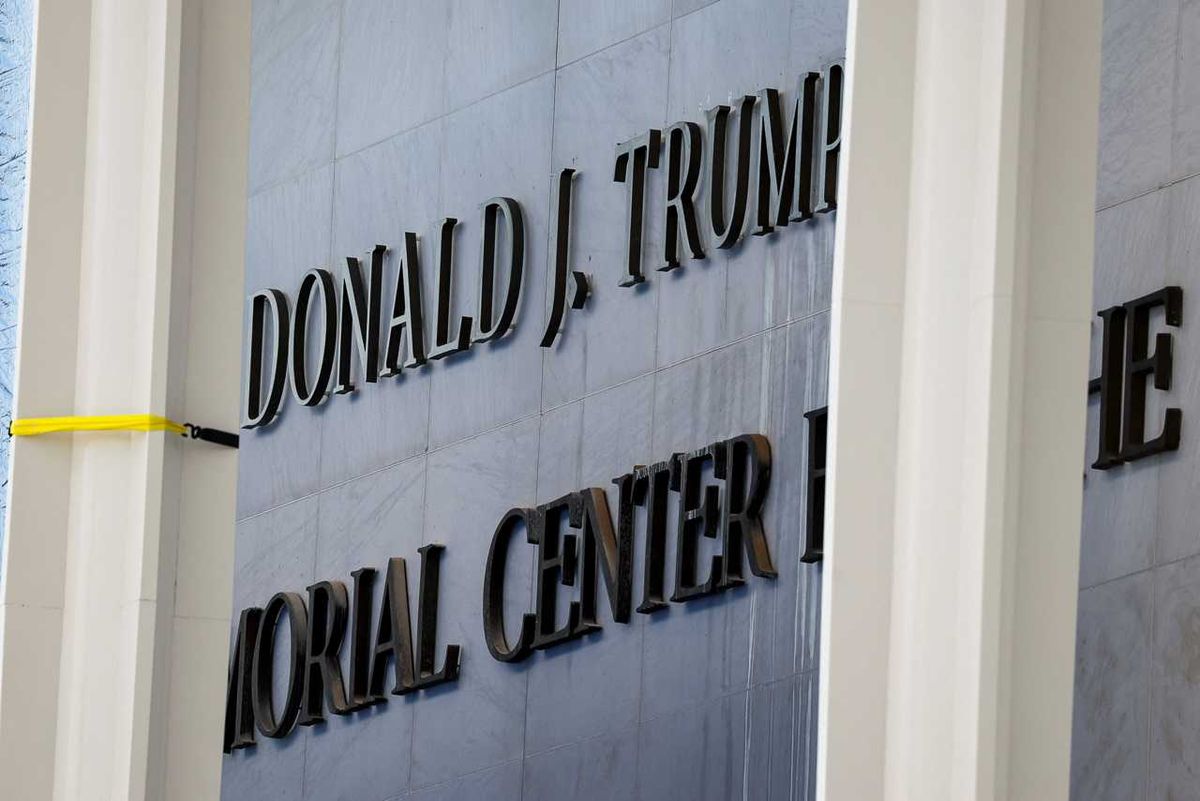
The newly added lettering for President Donald Trump's name is displayed at the facade of the John F. Kennedy Center for the Performing Arts, a day after its board announced it would rename the institution The Donald J. Trump and The John F. Kennedy Memorial Center for the Performing Arts, in Washington, D.C. on Dec. 19, 2025. REUTERS/Kevin Lamarque

President Donald Trump caused an uproar online Friday as he slapped his name on the Kennedy Center for Performing Arts, flouting a federal law prohibiting changes to the building's name.

Washington, D.C. resident Andrew Howard had sharp words after watching the building change names in front of his eyes.

"I'm feeling like democracy died today. This is history happening today, and we should all be shocked. Shocked that a felon, a convicted felon, and a thug and by all means a grifter, has just stuck his name on top of a national monument. This is a desecration," Howard said.

Other people had reactions to the news on social media:

"I’m at the combination Pizza Hut and Kennedy Center," Jeopardy! host Ken Jennings wrote on Bluesky.

"Just to be clear. It’s the John F Kennedy center legally. Just like it’s still the department of defense," former U.S. Rep. Adam Kinzinger (R-IL) wrote on Bluesky.

"Renaming the Kennedy Center, our national fine arts center, after such a coarse, lowbrow, and ignorant buffoon is America at its very stupidest," Canadian comedian Deven Green wrote on Bluesky.

"The Kennedy Center is still the Kennedy Center, and will always be the Kennedy Center. Just like the Gulf of Mexico," Canadian urban planner Brent Toderian wrote on Bluesky.


Trump's name added to Kennedy Center building despite federal law against it

David Edwards
December 19, 2025
RAW STORY


U.S. President Donald Trump's name is added at the facade of the John F. Kennedy Center for the Performing Arts, a day after its board announced it would rename the institution The Donald J. Trump and The John F. Kennedy Memorial Center for the Performing Arts, in Washington, D.C., U.S., December 19, 2025. REUTERS/Kevin Lamarque

President Donald Trump's name has been added to the John F. Kennedy Center for the Performing Arts despite a federal law prohibiting changes to the building's name.

On Thursday, the White House claimed that the Center's board had voted "unanimously" to add Trump's name.

"The Kennedy Center Board of Trustees voted unanimously today to name the institution The Donald J. Trump and The John F. Kennedy Memorial Center for the Performing Arts," spokesperson Roma Daravi said in a statement.

By Thursday afternoon, Trump's name had been added to the Kennedy Center website. On Friday, photos of his name being installed on the building's exterior circulated on social media.

The move, however, likely violates federal law.

"After December 2, 1983, no additional memorials or plaques in the nature of memorials shall be designated or installed in the public areas of the John F. Kennedy Center for the Performing Arts," the U.S. code states.


‘Gross’: Critics Recoil After Trump-Appointed Board Adds His Name to Kennedy Center

“Some things leave you speechless, and enraged, and in a state of disbelief,” said journalist Maria Shriver, a niece of the late President John F. Kennedy.


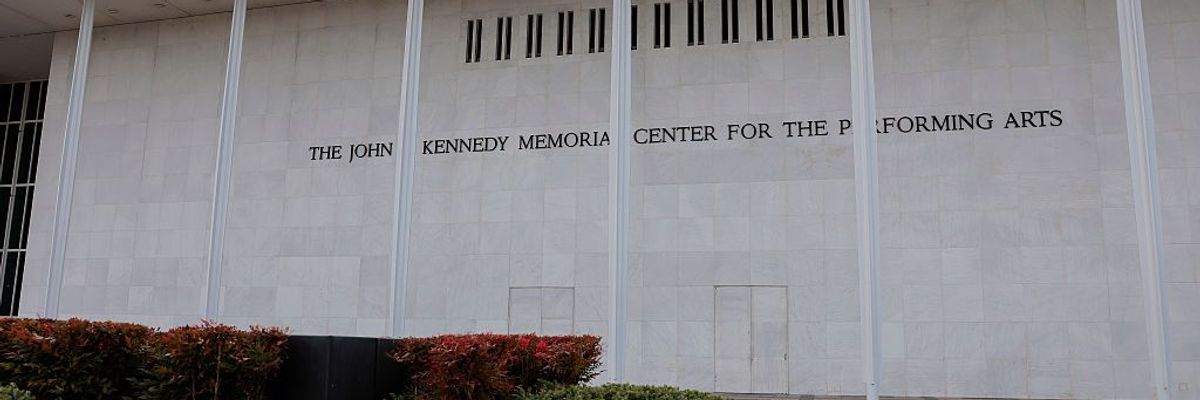
The John F. Kennedy Memorial Center for the Performing Arts is seen on December 18, 2025 in Washington, DC.
(Photo by Heather Diehl/Getty Images)

Brad Reed
Dec 18, 2025
COMMON DREAMS

White House press secretary Karoline Leavitt on Thursday drew an outraged reaction after she announced that members of the John F. Kennedy Center for the Performing Arts board, who were appointed by President Donald Trump, had voted to add his name to the building.

In a post on X, Leavitt announced that the building would henceforth be known as the “Trump-Kennedy Center,” despite the fact that the building was originally named by the US Congress in the wake of President John F. Kennedy’s assassination in 1963.


‘Evil and Disgusting’: From Sabrina Carpenter to Franklin the Turtle, ‘Violent’ Memes by Trump Officials Rebuked


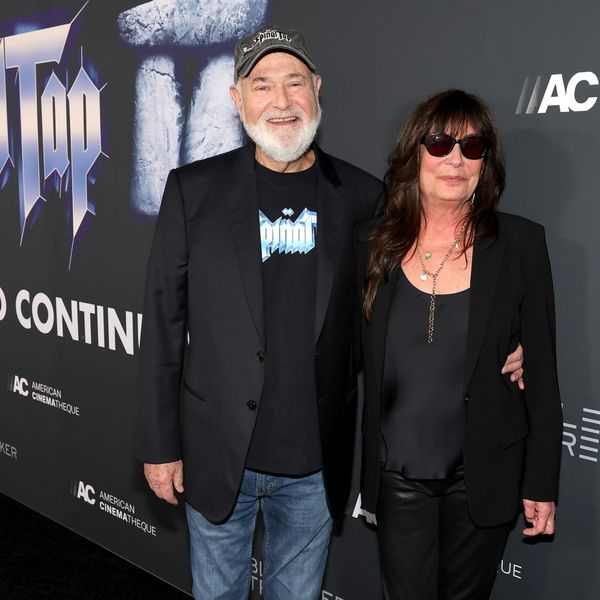
‘A Monstrosity’: Trump Blames Killing of Rob Reiner and Wife on Director’s Anti-Trump Views

“I have just been informed that the highly respected Board of the Kennedy Center... have just voted unanimously to rename the Kennedy Center to the Trump-Kennedy Center,” Leavitt wrote on X, “because of the unbelievable work President Trump has done over the last year in saving the building. Not only from the standpoint of its reconstruction, but also financially, and its reputation.”

Despite Leavitt’s claim, it does not appear that the vote in favor of renaming the building was unanimous. Rep. Joyce Beatty (D-Ohio), an ex-officio Kennedy Center board member, said after the vote that she had been muted during a call where other board members had voted to add Trump’s name to the building, and was thus “not allowed to speak or voice my opposition to this move.”

Journalist Terry Moran noted that the Kennedy Center board does not have the power to rename the building without prior approval of US Congress.

“Congress establishes these institutions through law, and only a new law can rename them,” Moran wrote, and then commented, “also—gross.”

Members of the Kennedy family also expressed anger at the move to rename the center.

Former US Rep. Joe Kennedy III (D-Mass.) wrote on Bluesky that “the Kennedy Center is a living memorial to a fallen president and named for President Kennedy by federal law,” and “can no sooner be renamed than can someone rename the Lincoln Memorial, no matter what anyone says.”

Journalist Maria Shriver, a niece of the late president, could barely express her anger at the decision.

“Some things leave you speechless, and enraged, and in a state of disbelief,” she wrote. “At times such as that, it’s better to be quiet. For how long, I can’t say.”

Shortly afterward, Shriver wrote another post in which she attacked Trump for being “downright weird” with his obsession with having things named after himself.

“It is beyond comprehension that this sitting president has sought to rename this great memorial dedicated to President Kennedy,” she said. “It is beyond wild that he would think adding his name in front of President Kennedy’s name is acceptable. It is not. Next thing perhaps he will want to rename JFK Airport, rename the Lincoln Memorial, the Trump Lincoln Memorial. The Trump Jefferson Memorial. The Trump Smithsonian. The list goes on.”


Fox News hosts blast Trump over 'repulsive' White House plaques


Image via Screengrab.

December 19, 2025  
ALTERNET


Donald Trump got a sharp rebuke from his Fox News on Friday as hosts decried the recent addition of insulting plaques about Democratic presidents at the White House as "trolling" and "repulsive."

While not the largest and eye-catching change Trump has made to the White House, his addition of a "Presidential Walk of Fame" has nonetheless made headlines for insulting jabs at his political opponents. When the feature was first introduced in September, former President Joe Biden was represented with a photo of an autopen instead of a portrait, referencing the tool for signatures which Trump has falsely claimed invalidates some of the executive orders and pardons that his predecessor issued.

More recently, reporters noticed the addition of new plaques beneath the photos of Biden, Barack Obama and Bill Clinton. Under Biden's photo, the new plaque reads "Sleepy Joe Biden was, by far, the worst President in American History. Taking office as a result of the most corrupt Election ever seen in the United States, Biden oversaw a series of unprecedented disasters that brought our Nation to the brink of destruction." It also added references to Trump's long-debunked claim that Biden's win in the 2020 election was the result of widespread voter fraud.

The new plaque for Obama refers to him as "divisive" and attacks him for the passage of the "Unaffordable Care Act" and joining the Paris Climate Accords. It also repeated Trump's unfounded claims that the Obama administration spied on his 2016 campaign and fabricated claims that it colluded with Russia. While less directly insulting, Clinton's plaque was given a new note about his wife, Hillary Clinton, losing the 2016 election to Trump.

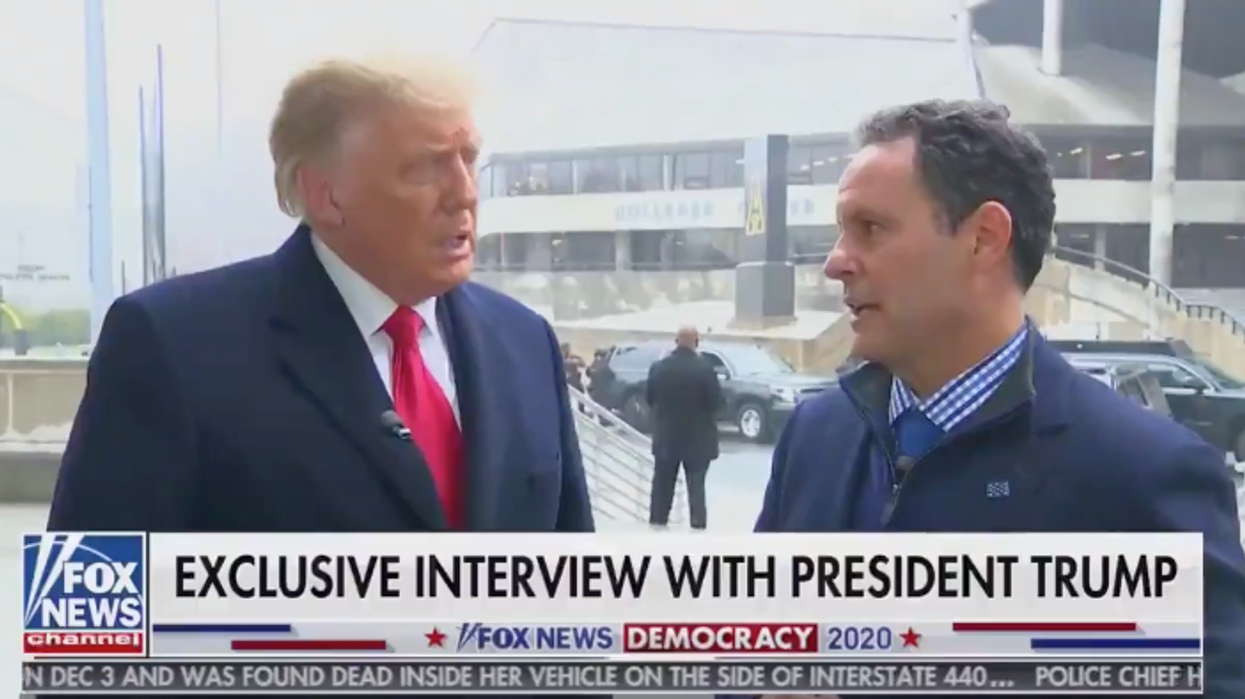
During a Friday broadcast, Fox News anchor Brian Kilmeade said that he was not in favor of these changes and suggested that Trump's two plaques add bits of mockery to balance things out.“

No, I’m not for this at all,” Kilmeade said. “So they’ve got to mock President Trump or put something on his plaque... I am not for the autopen. If [Trump] is going to do it outdoors, just put the profiles up there. I am not for dispelling or saying anything bad. Plus, a lot of presidents that people think were bad, ended up being looked at as great. I don’t think it’s going to happen with Joe Biden. But I am not for the trolling."

One of Kilmeade's co-anchors, Jessica Tarlov, agreed with his sentiments, calling the new plaques "repulsive behavior."


A Petty, Vicious Wall Of Shame


Newly revisionist, still tacky Presidential Wall of Shame
Photo by Brendan Smialowski/AFP via Getty Images


Abby Zimet
Dec 18, 2025
FUTURE
COMMON DREAMS


The awful keeps spewing. The latest proof there is truly, repulsively no bottom: The most broken, powerful human being on the planet has added to his crappy, gaudy, reality-show “Presidential Walk of Fame” bronze plaques below the photos denoting a boorish, revisionist “history” of each president. Inevitably, he lobs the crudest insults at his direct predecessors - “divisive” Obama, “crooked” Biden - while praising his own supreme reign. America on the fucking, endless, childish ugly of it: “This is so exhausting.”

As always, there are of course more substantive horrors underway. Pam Bondi has told the FBI to create a list of domestic terrorist groups - the non-existent Antifa and anyone else who espouses “radical gender ideology, anti-Americanism, anti-capitalism or anti-Christianity” - and establish a “cash reward system” to encourage them to snitch on each other. Because what climate change/it still snows doesn’t it?, Trump is also dismantling Colorado’s National Center for Atmospheric Research, home to the largest federal research lab on climate change and natural disasters.

In addition, because what science?, anti-vax crackpot RFK Jr’s Health and Human Services (sic) Department has terminated seven multi-million-dollar grants to the American Academy of Pediatrics, which is now suing said crackpot for his COVID vaccine changes. The initiatives were aimed at reducing sudden infant death, improving adolescent health, preventing fetal alcohol syndrome, identifying autism early and other worthy goals; officials said they were cancelled because the group used “identity-based language,” including “racial disparities” and “pregnant people.” Really.

Finally, Pee Wee German Stephen Miller issued a fascist mission statement in support of our pointless, upcoming war against Venezulela, arguing the U.S. has long “operated as a ‘reverse empire’” that enriched foreign nations and sacrificed our wealth and security while “all we got in return were migrants.” “No more,” he raves. “America’s might will secure America’s rights...For Americans, first and always.” By which, many clarified, he means, “rich white people. Everyone else to the camps.” Other comments: “Sounds like Chap. 15 in Mein Kampf,” “Sounds better in the original German,” and, “Miller is a grotesque, shrill, squirrel of a thing.”

All of these efforts, lest we forget, have been undertaken to please a small, sick, empty shell of a man who Avatar director James Cameron calls “the most narcissistic asshole in history since fucking Nero.” Now, in a particularly infuriating (for those of us who cherish facts) and petty move, he’s now installed “a tantrum cast in bronze,” a wall of grievance-oozing plaques added to the photos along his cheesy, race-to-the-bottom “Presidential Walk of Fame” outside the West Wing “as a tribute to past Presidents, good, bad and somewhere in the middle.” And “as a student of history” (sic), Press Barbie hilariously brags, Trump himself authored “many of its eloquently written descriptions” - evidently what he’s been doing when not golfing. One patriot: “Well done, dumbass.”

They are, of course, crude, juvenile, self-serving garbage. Reagan’s plaque boasts he was “a fan” of Trump. Bill Clinton’s notes “his wife Hillary” lost to Trump. The plaque for “Barack Hussein Obama” acknowledges him as our first Black President before calling him “one of the most divisive political figures in American history.” He allegedly “passed the highly ineffective Unaffordable Care Act,” caused the spread of ISIS (no mention of W’s contributions), weaponized federal bureaucracies against opponents, spied on Trump’s 2016 campaign and created “the Russia Russia Russia hoax, the worst political scandal in American history.” Sigh.

Biden, already trolled with the image of an autopen - the eloquent author is 12 - gets worse. “Sleepy Joe Biden was, by far, the worst President in American History.” He “took office (in) the most corrupt Election ever seen” and “oversaw a series of unprecedented disasters that brought our nation to the brink of destruction” - pot/kettle - with high inflation, weaponized law enforcement, Green New Scam, “abolishing” the Southern Border, insane asylums, “Afghanistan Disaster.” His “devastating weakness” made Russia invade Ukraine and Hamas attack Israel. He issued “blanket pardons to Radical Democrat thugs” and “the Biden crime family.” Sigh redux.

But “despite it all” - trumpets please - the manchild king triumphed in a landslide to “SAVE AMERICA!” Now he’s “delivered” on his promise to “usher in the Golden Age of America,” and “THE BEST IS YET TO COME!” Some beg to differ. They suggest his plaque should read, “Pedophile, Narcissist, Rapist, and Convicted Felon.” They marvel, “Damn, his dick really is that tiny.” They exclaim, “This is insane,” “What the actual fuck,” “God I hate this man,” “This is embarrassing,” and, “I am at my wit’s end.” In all, notes Canadian pundit Dean Blundell, “The United States of America is going through some things right now.”

More came In Wednesday night’s “prime time unraveling.” His racist, dementetd, drug-addled, “nothingburger” of a meltdown, in which “basically nothing he is saying is true,” was brutally summarized as, “Old man yells at country,” “WHAT THE FUCK WAS THAT?”, his “Pettysburg Address,” “a 19-minute nervous breakdown,” his “Norma Desmond imitation,” “what presidential panic looks like,” “Stop talking about Epstein,” “lie harder and louder,” “the Worst Wing,” “Nazis On Drugs,’” “authoritarian fantasy at its finest” - colossal invasion! drug prices down 600% in magic math! the first peace in the Middle East in 3,000 years!“, ”This wasn’t confidence. This was agitation.“ From MAGA: ”Why is he yelling at us?“ ”He’s talking so fast he sounds panicked,“ ”the most pointless presidential address (in) American history.“ From Newsom: 100 ”Me Me Me Me Me’s.“ From us: For God’s and our sanity’s sake, once and for all, fucking quiet Piggy.


Trump's golf club restaurant infested with 'maggots and mold': report


President Donald Trump on his Bedminster, New Jersey golf course on July 28, 2022 (Image: Shutterstock)

December 19, 2025  
ALTERNET

Health code violations were so severe at one of President Donald Trump's golf resorts that Trump himself complained, according to a new lawsuit.

The Daily Beast reported Friday on a lawsuit recently filed by a former manager at Trump's Bedminster, New Jersey club, who claims she was fired for bringing attention to persistent health and safety issues at the club's restaurant, and for calling out the culture of male managers' predatory behavior toward female employees.

Former clubhouse manager Justine Sacks alleged in her lawsuit — which was filed in Monmouth County, New Jersey Superior Court — that guests were routinely served expired food, that kitchen staff were often intoxicated on the job and that there were even "maggots and mold" in the restaurant's soft serve ice cream machine. Additionally, male managers once allegedly made a combined 20 phone calls to female staff inviting them to their homes late at night.

In May of 2023, county health department officials cited the Bedminster club's restaurant for 18 violations, and gave it the lowest inspection grade in the county, according to the Beast. Some of the violations included expired milk in the kitchen and a sink without any soap available. And half of those violations were categorized as "critical," with inspectors calling them "an unacceptable health risk."

Trump's complaint was lodged in September of 2023, when, according to the lawsuit, the then-former president "complained about the flies in the Clubhouse" after swarms of flies were seen throughout the facility due to "unkempt, unsanitary working areas." Sacks alleged that while Eric Trump emailed staff and urged them to keep all facilities in compliance with health and safety guidelines, he only communicated the message to male managers.

Sacks then accused management of firing her three days after the damning health inspection, even though she had made complaints to her superiors for years. According to the lawsuit, Bedminster general manager David Schutzenhofer told Sacks to back off her complaints about drunk kitchen staff, saying their behavior was "commonplace" in the restaurant industry and thaty she was "wrapped too tight."

This isn't the first time a former Bedminster employee has sued the golf course. In 2023, former employee Alice Bianco also sued the club alleging sexual harassment from her superiors, and alleged that former Trump lawyer Alina Habba manipulated her into signing a non-disclosure agreement and offered her a "paltry" sum of money in exchange for her signature. Bianco filed an official ethics complaint against Habba in New Jersey.

Click here to read the Beast's report in its entirety (subscription required).
Who Will Side With the People Over the ‘Architects of AI’?

In a functioning democracy, we would have at least one political party that would fly the banner of the 53% of us who are wary of unchecked artificial intelligence.


Time shares its covers naming the “Architects of AI” as 2025 “Person of the Year.”
(Photo by Time/X)

Will Bunch
Dec 19, 2025
the Philadelphia Inquirer


“This is the West, sir. When the facts become legend, print the legend.” —journalist in the 1962 film, The Man Who Shot Liberty Valance

The top editors at Time (yes, it still exists) looked west to Silicon Valley and decided to print the legend last week when picking their Person of the Year for the tumultuous 12 months of 2025. It seemed all too fitting that its cover hailing “The Architects of AI” was the kind of artistic rip-off that’s a hallmark of artificial intelligence: 1932’s iconic newspaper shot, “Lunch Atop a Skyscraper,” “reimagined” with the billionaires—including Elon Musk and OpenAI’s Sam Altman—and lesser-known engineers behind the rapid growth of their technology in everyday life.S


‘Who Will Be in Charge?’ Sanders Warns of AI Future Dominated by Handful of Billionaires


Hakeem Jeffries Pilloried for Putting Pro-Industry Democrats on AI Policy Task Force, Despite Voter Distrust of Big Tech

Time‘s writers strived to outdo the hype of AI itself, writing that these architects of artificial intelligence “reoriented government policy, altered geopolitical rivalries, and brought robots into homes. AI emerged as arguably the most consequential tool in great-power competition since the advent of nuclear weapons.”

OK, but it’s a tool that’s clearly going to need a lot more work, or architecting, or whatever it is those folks out on the beam do. That was apparent on the same day as Time‘s celebration when it was reported that Washington Post editors got a little too close to the edge when they decided they were ready to roll out an ambitious scheme for personalized, AI-driven podcasts based on factors like your personal interests or your schedule.

Time magazine got one thing right. Just as its editors understood in 1938 that Adolf Hitler was its Man of the Year because he’d influenced the world more than anyone else, albeit for evil, history will likely look back at 2025 and agree that AI posed an even bigger threat to humanity than Trump’s brand of fascism.

The news site Semafor reported that the many gaffes ranged from minor mistakes in pronunciation to major goofs like inventing quotes—the kind of thing that would get a human journalist fired on the spot. “Never would I have imagined that the Washington Post would deliberately warp its own journalism and then push these errors out to our audience at scale,” a dismayed, unnamed editor reported.

The same-day contrast between the Tomorrowland swooning over the promise of AI and its glitchy, real-world reality felt like a metaphor for an invention that, as Time wasn’t wrong in reporting, is so rapidly reshaping our world. Warts and all.

Like it or not.

And for most people (myself included), it’s mostly “or not.” The vast majority understands that it’s too late to put this 21st-century genie back in the bottle, and like any new technology there are going to be positives from AI, from performing mundane organizing tasks that free up time for actual work, to researching cures for diseases.

But each new wave of technology—atomic power, the internet, and definitely AI—increasingly threatens more risk than reward. And it’s not just the sci-fi notion of sentient robots taking over the planet, although that is a concern. It’s everyday stuff. Schoolkids not learning to think for themselves. Corporations replacing salaried humans with machines. Sky-high electric bills and a worsening climate crisis because AI runs on data centers with an insatiable need for energy and water

The most recent major Pew Research Center survey of Americans found that 50% of us are more concerned than excited about the growing presence of AI, while only 10% are more excited than concerned. Drill down and you’ll see that a majority believes AI will worsen humans’ ability to think creatively, and, by a whopping 50-to-5% margin, also believes it will worsen our ability to form relationships rather than improve it. These, by the way, are two things that weren’t going well before AI.

So naturally our political leaders are racing to see who can place the tightest curbs on artificial intelligence and thus carry out the will of the peop... ha, you did know this time that I was kidding, didn’t you?

It’s no secret that Donald Trump and his regime were in the tank from Day One for those folks out on Time‘s steel beam, and not just Musk, who—and this feels like it was seven years ago—donated a whopping $144 million to the Republican’s 2024 campaign. Just last week, the president signed an executive order aiming to press the full weight of the federal government, including Justice Department lawsuits and regulatory actions, against any state that dares to regulate AI. He said that’s necessary to ensure US “global AI dominance.”

This is a problem when his constituents clearly want AI to be regulated. But it’s just as big a problem—perhaps bigger—that the opposition party isn’t offering much opposition. Democrats seem just as awed by the billionaire grand poobahs of AI as Trump. Or the editors of Time.

Also last week, New York Democratic Gov. Kathy Hochul—leader of the second-largest blue state, and seeking reelection in 2026—used her gubernatorial pen to gut the more-stringent AI regulations that were sent to her desk by state lawmakers. Watchdogs said Hochul replaced the hardest-hitting rules with language drafted by lobbyists for Big Tech.

As the American Prospect noted, Hochul’s pro-Silicon Valley maneuvers came after her campaign coffers were boosted by fundraisers held by venture capitalist Ron Conway, who has been seeking a veto, and the industry group Tech:NYC, which wants the bill watered down.

It was a similar story in the biggest blue state, California, where Gov. Gavin Newsom in 2024 vetoed the first effort by state lawmakers to impose tough regulations on AI, and where a second measure did pass but only after substantial input from lobbyists for OpenAI and other tech firms. Silicon Valley billionaires raised $5 million to help Newsom—a 2028 White House front-runner—beat back a 2021 recall.

Like other top Democrats, Pennsylvania Gov. Josh Shapiro favors some light regulation for AI but is generally a booster, insisting the new technology is a “job enhancer, not a job replacer.” He’s all in on the Keystone State building massive data centers, despite their tendency to drive up electric bills and their unpopularity in the communities where they are proposed.

Money talks, democracy walks—an appalling fact of life in 2025 America. In a functioning democracy, we would have at least one political party that would fly the banner of the 53% of us who are wary of unchecked AI, and even take that idea to the next level.

A Harris Poll found that, for the first time, a majority of Americans also see billionaires—many of them fueled by the AI bubble—as a threat to democracy, with 71% supporting a wealth tax. Yet few of the Democrats hoping to retake Congress in 2027 are advocating such a levy. This is a dangerous disconnect.Who Will Side With the People Over the ‘Architects of AI’?

In a functioning democracy, we would have at least one political party that would fly the banner of the 53% of us who are wary of unchecked artificial intelligence.

Time magazine got one thing right. Just as its editors understood in 1938 that Adolf Hitler was its Man of the Year because he’d influenced the world more than anyone else, albeit for evil, history will likely look back at 2025 and agree that AI posed an even bigger threat to humanity than Trump’s brand of fascism. The fight to save the American Experiment must be fought on both fronts.


INSTANT REVISIONISM

Description of FCC as ‘Independent’ Scrubbed From Agency Website After Chair Says It Isn’t


One critic called the removal—which came immediately after FCC Chair Brendan Carr ignored nearly a century of historical precedent by claiming the agency is not independent—”a chilling authoritarian touch.”


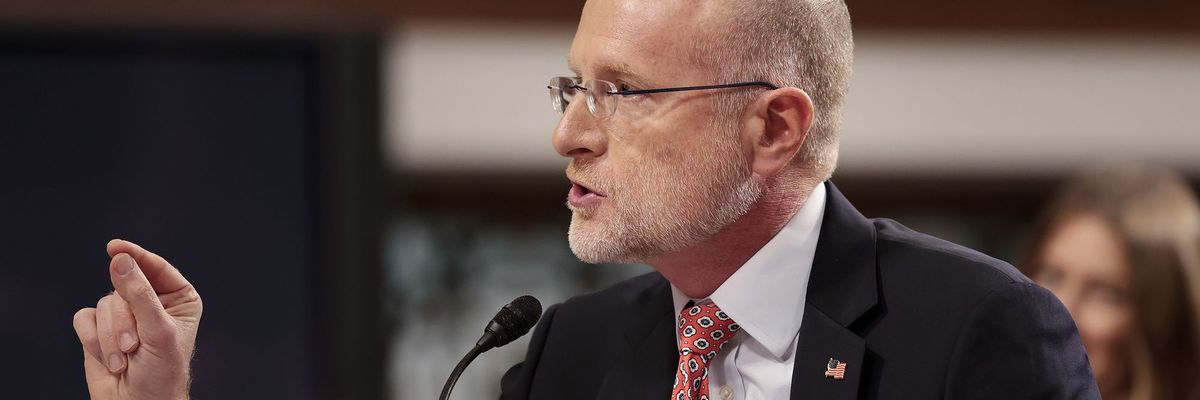
Federal Communications Commission Chair Brendan Carr speaks during a Senate hearing in the US Capitol in Washington, DC on December 17, 2025.
(Photo by Heather Diehl/Getty Images)

Brett Wilkins
Dec 17, 2025
COMMON DREAMS

Federal Communications Commission Chair Brendan Carr stunned many observers Wednesday by suggesting that the FCC is subordinate to President Donald Trump—an assertion followed almost immediately by the removal of the word “independent” from the agency’s website.

Pressed by Democratic—and some Republican—lawmakers during a contentious Senate Commerce Committee hearing that addressed the FCC’s mission of independently implementing and enforcing US communications laws and regulations, Carr said that “formally speaking, the FCC is not independent.”

Sen. Ben Ray Luján (D-NM) read aloud from the FCC’s website, which at the time proclaimed the agency’s independence.

“Is your website lying?” asked Luján.

“Possibly,” replied Carr.

Within minutes of Carr’s testimony, the mission statement on the FCC’s website no longer described the agency as “independent.”


Addressing Carr’s apparent fealty to Trump, Sen. Andy Kim (D-NJ) asked, “If you don’t think that the FCC is independent, then is President Trump your boss?”

Carr replied: “President Trump has designated me as chairman of the FCC. I think it comes as no surprise that I’m aligned with President Trump on policy.”

A former telecommunications attorney, Carr has been criticized for siding with corporations and against the public interest on nearly ever major issue to come before the FCC. Many of his views are laid out in the chapter on the FCC he authored for Project 2025, the Heritage Foundation-led blueprint for a far-right overhaul of the federal government.

As chair, Carr has been accused by critics including Democratic lawmakers—some of whom have demanded his firing or resignation—of being a Trump sycophant, especially over his role in getting ABC late-night talk show host Jimmy Kimmel suspended for joking about the assassination of far-right firebrand Charlie Kirk.

Asked by Kim if it would be appropriate “for the president or senior administration officials to give you direction to pressure media companies,” Carr declined to directly answer the question.

“The easy answer is, ‘No.’ It’s not a hypothetical,” the senator said. “Trump is not your boss. The American people are your boss.”

Matt Wood, general counsel and vice president of policy at the advocacy group Free Press Action, said that “if Brendan Carr proved anything today, it’s only that he’s willing to shout down senators and contort his supposed free speech principles to protect Trump’s ego and attack Trump’s critics.”

Wood lamented that Carr “proudly trashed his own agency’s historical independence.”

“Right after senators pointed out the contradiction between the FCC’s online description and Carr’s claim that Donald Trump ultimately called the shots, language noting the agency’s independence disappeared from the FCC.gov website—a chilling authoritarian touch,” he added.
Trump's 'blizzard of lies' suggests GOP facing 'very ugly' midterm: Nobel economist


Adam Lynch
December 19, 2025  
ALTERNET

Nobel Laureate Paul Krugman said the purpose of President Donald Trump’s speech was to turn around Trump’s "cratering public approval" on his handling of the economy, but all it really did was outline the cliff waiting for Republicans next year as the president fails to deliver meaningful improvements for Americans.

“It was a blizzard of lies,” said Krugman. “I can’t find a single factual assertion Trump made that was true.”

But lies, boasts and tearing down Joe Biden’s legacy won’t send voters to the polls for Republicans, said Krugman. Take Trump’s persistent claim “that the world despised the US economy a year ago and now admires his achievements.”

“One year ago, our country was dead. We were absolutely dead. Our country was ready to fail. Totally fail. Now we’re the hottest country anywhere in the world. And that’s said by every single leader that I’ve spoken to over the last five months,” Trump claimed, in spite of headlines in October 2024 proclaiming “The American economy has left other rich countries in the dust.”

Krugman said Trump also filled his speech with false claims that overall prices are coming down, using turkeys, eggs and gasoline as examples, despite his policies having very little influence over the price of these items.

“Egg prices, for example, fluctuate wildly over time, not because of anything the government does, but because of the vagaries of bird flu,” Krugman said, adding that the latest report on consumer prices showing lower inflation than expected “was seriously distorted by the effects of the government shutdown,” according to other economists.

This leaves Krugman’s “best guess” to be “that troubling inflation, and with it public concern about affordability, will persist.”

Healthcare, meanwhile, is about to explode in cost and Republicans and Trump keep refusing to do anything about it, Krugman wrote. Trump claimed he would replace current Obamacare subsidies with a different kind of subsidy system, but Krugman said congressional Republicans "will never approve subsidies adequate to make health insurance affordable” and “because the Republican plan would be far stingier than the one currently in place [and] millions of people will be forced to drop their insurance.”

This means younger and relatively more healthy people will drop their coverage, and leave the pool filled with older and sicker people who will raise premiums even further.

“But leaving the short-run politics aside, the speech revealed something important: Namely, Trump has no idea how to govern,” Krugman said. “Faced with adversity, he’s unable to propose policies to improve the situation. All he can do is continue to gaslight the public and claim that everything is great, while smearing his opponents.”

“That was a short speech, but it presages a very long next three years for ordinary Americans,” Krugman said. “And for congressional Republicans, it presages a very ugly November 2026.”


Read Krugman’s column at his Substack here.

Warren Warns ‘Trump Could Be Setting the Stage’ for Next Financial Crash


Discussing the post-2008 financial rules, Trump’s Treasury chief told a Fox host that “we have to take the financial system out of this straitjacket.”


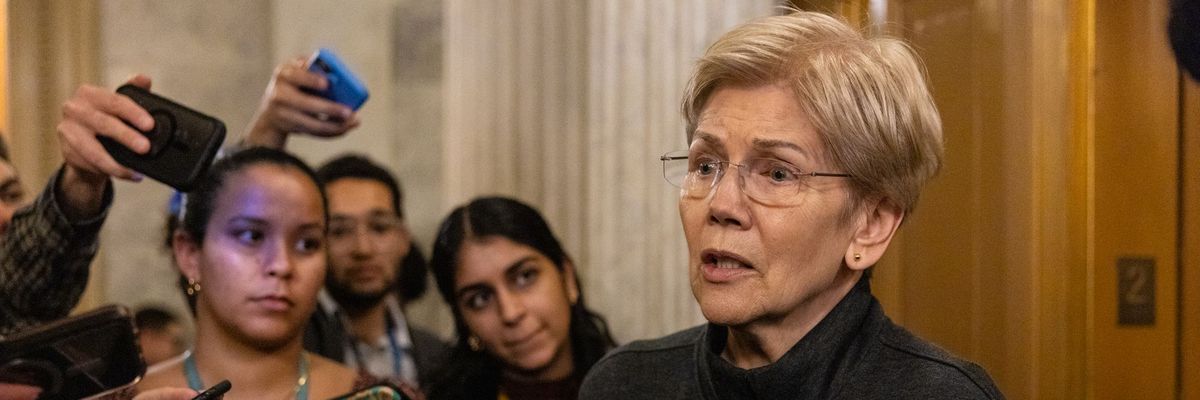
US Sen. Elizabeth Warren (D-Mass.) speaks to reporters following a vote on Capitol Hill in Washington, DC on November 9, 2025.
(Photo by Anna Rose Layden/Getty Images)

Jessica Corbett
Dec 17, 2025
COMMON DREAMS

President Donald Trump’s administration “wants to turn the clock back to 2008 and let Wall Street run wild.”

That’s how US Sen. Elizabeth Warren (D-Mass.) responded on Wednesday to Treasury Secretary Scott Bessent’s comments to Fox Business Network host Maria Bartiromo about the administration’s deregulatory push.

Without naming it, Bessent took aim at the Dodd-Frank Wall Street Reform and Consumer Protection Act, a 2010 law that Warren, then a longtime Harvard University professor, fought for in the wake of the 2008 financial crisis.

Recalling that era, Warren said: “We all know how that ended—with taxpayers bailing out Wall Street while millions lost their homes and got fired from their jobs. Donald Trump could be setting the stage for the next crash.”

Warren was far from alone in calling out Bessent after journalist Aaron Rupar noted that during the Fox interview, the ex-hedge fund manager said: “I chair something called FSOC, the Financial Stability Oversight Council, and these 2008, 2009, 2010 financial rules were too tight. They have hamstrung the American financial system. It was time for a change. We’re gonna be safe, smart, and sound in terms of our deregulation. But we have to take the financial system out of this straitjacket.”

University of Michigan business law professor Jeremy Kress said: “Fact check: The decade following the Dodd-Frank Act marked the longest period of economic growth in US history. The main problem with the post-2008 reforms is that they did not do nearly enough to limit the nonbank risk-taking that Bessent and his allies have enabled.”


Progressive political commentator and YouTuber Kyle Kulinski declared, “These people are hell-bent on creating a new Great Depression.”

Dean Baker, senior economist at the Center for Economic and Policy Research, said, “Remember BLEAT: Bessent Lies about Everything All the Time.”

The Fox appearance on Tuesday came after Bessent earlier this month announced an overhaul to the structure of FSOC—which was established by Dodd-Frank—and wrote in the introduction letter to the council’s annual report that it “would shift its focus from ‘prophylactic’ regulatory and supervisory policies to an approach aimed at removing red tape in areas like artificial intelligence, in a bid to spur economic growth,” as Politico summarized at the time.

As Politico also reported:
Markets groups and members of Congress expressed their concern over the changes. In a letter to Bessent... Sen. Elizabeth Warren (D-Mass.) expressed concern that the FSOC has met fewer times this year than in any past year of its existence and that the council is “sabotaging its own authorities.” Dennis Kelleher, CEO of Better Markets, an advocacy group focused on regulation, stated that “undermining the FSOC is undermining the economy and the financial system.”

Sharing the Politico report on social media earlier this month, Kress said that “this is a dereliction of duty by the Financial Stability Oversight Council. But if there is a silver lining, it is that the Trump administration now unequivocally owns whatever crisis lies ahead.”