Saturday, December 27, 2025

DANIELLE SMITH'S HALLWAY MEDICINE
'I want justice for Prashant': Wife of Indian-origin man who died in Canada hospital demands accountability

Prashant Sreekumar, an accountant based in Edmonton, died on December 22 after what was suspected to be a cardiac arrest at the Grey Nuns Hospital in Alberta

Our Web Desk & PTI 
27.12.25, 


Prashant Sreekumar's wife Niharika at the hospitalVideograb

The wife of a 44-year-old Indian-origin man who died after waiting over eight hours for treatment at a Canadian hospital has demanded accountability from the facility, even as questions are being raised about delays, staffing pressures and gaps in healthcare infrastructure.

Prashant Sreekumar, an accountant based in Edmonton, died on December 22 after what was suspected to be a cardiac arrest at the Grey Nuns Hospital in Alberta.

His death has since drawn attention within the Indian community in Canada, with leaders pointing to long waiting times and a shortage of hospital beds.

Also Read
Canada: Indian-origin man dies after eight hours-long ER wait in Edmonton hospital


According to local media reports, Prashant was taken to the hospital after experiencing severe chest pain at work. He was checked in at triage and asked to wait in the emergency room.

Hospitl staff conducted an electrocardiogram (ECG) and offered him Tylenol for pain. Nurses continued to monitor his blood pressure, but he remained in the waiting area for more than eight hours.

When he was finally taken into the treatment area, he died within seconds. “I want justice for Prashant,” his wife Niharika told Postmedia late on Friday.

“She wants to see hospital staff held accountable for the way her husband was treated in the emergency department, and questions whether negligence or even racism played a role,” the Calgary Sun, a Postmedia outlet, reported.

“We are all Canadian citizens. We have worked and paid so much into the tax bucket in this country and the one time Prashant needed medical help, he was not given it,” Niharika said.

Prashant’s death has left Niharika struggling both emotionally and financially. The couple has three children aged three, 10 and 14.

While both Prashant and Niharika are accountants, Prashant had become the sole breadwinner because their youngest child requires round-the-clock care.

Three days after her husband’s death, Niharika told Postmedia, “I was enjoying my life, now I’m going to just live every day hoping that it will pass.”

She added, “I loved him so dearly. He was not only my husband, he was my only friend in this country. I don’t have as many friends. He had so many friends. What am I gonna do now?”

The incident has also sparked wider concern about the state of Canada’s healthcare system. Varinder Bhullar, a family friend and Indian community leader who had used Prashant’s accounting services, said the system has been declining over the years.

“It's getting worse,” Bhullar said, comparing the current situation with his experience when he arrived in Canada 30 years ago.

Bhullar noted that patients reporting chest pain are usually attended to quickly.

“In this case, they did do an ECG when he walked into the ward with chest pain. There was no issue in the ECG. Then they did some blood work, in which too, they did not detect anything,” he told PTI Videos.

He said this may have led to a “false indication” for hospital staff. “However, his blood pressure kept on going up. And that part, I think, was ignored, that warning was ignored by the health care professionals,” Bhullar said.

“They did notice that his blood pressure was going up and that is where I think the mistake happened. But at the same time, there has been no increase in beds. And that is also a root cause of it,” he added, pointing to inadequate hospital infrastructure.

Bhullar stressed that this was not an isolated case and said many community members approach him with similar complaints. He, however, rejected suggestions that race played a role.

“No, completely no. From healthcare professionals, I have never experienced any racism. In fact, on my social media page, there was a comment by a white person, who said he was sitting on the next chair when Prashant Shreekumar was waiting. He was waiting for nine hours with chest pain as well. I would not say this is related to racism. But I would say this is negligence either by the healthcare professional or it's a system failure where the waits are too long,” Bhullar said.

In a statement to Postmedia, Karen MacMillan, interim chief operating officer of acute and primary care at Covenant Health, said the case is with the office of the chief medical examiner.

“We are deeply saddened regarding the death of a 44-year-old male patient at the Grey Nuns Community Hospital in Edmonton on December 22, 2025. We offer our sympathy to the patient’s family and friends. There is nothing more important than the safety and care of our patients and staff,” the statement said, adding that the hospital could not comment on specifics at this stage.

In New Delhi, the Ministry of External Affairs said the matter rests with Canadian authorities.

Responding to a question, spokesperson Randhir Jaiswal said, “The person is of Indian origin but he happens to be, I understand, a Canadian national. So the Canadian government should take responsibility in the matter.”

Union boss piles pressure on PM Starmer to rejoin EU customs union as he calls for 'closest possible economic and political relationship' with Euro bloc


By ELIZABETH HAIGH, 
DAILY MAIL
27 December 2025


A leading union boss is piling the pressure on Sir Keir Starmer to rejoin the EU customs union as he calls for the 'closest possible' economic relationship with the Euro bloc.

Paul Nowak, the leader of the Trades Union Congress and the most senior trade unionist in the UK, said the government should look at 'every possible' opportunity for relations with the EU, including re-entering the customs union.

In an interview with the BBC, he said the Prime Minister should pursue the 'closest possible economic and political relationship with the European Union' going into 2026.

Labour's election manifesto explicitly ruled out rejoining the customs union, but there have been growing tensions over the issue in government.

The Prime Minister previously said he wants to 'reset' the UK's relationship with the EU, before his Health Secretary - and some would say leadership rival - went one step further.

In an interview with The Observer on Sunday, Wes Streeting suggested he might like to see a return to the customs union, saying the best way to boost the economy would be a 'closer trading relationship' with the EU.

'The reason why leaving the EU hit us so hard as a country is because of the enormous economic benefits that came with being in the single market and the customs union,' he said.

'This is a country and a Government that wants a closer trading relationship with Europe. The challenge is that any economic partnership we have can't lead to a return to freedom of movement.'


Paul Nowak, the leader of the Trades Union Congressand the most senior trade unionist in the UK, said the government should look at 'every possible' opportunity for relations with the EU


Sir Keir Starmer is facing Cabinet splits over the issue, but Downing Street says it will stick to Labour's manifesto, which ruled out rejoining the customs union

And earlier this month 13 Labour MPs rebelled against Starmer and support a motion from the Liberal Democrats calling for negotiations for a bespoke customs union arrangement.

But Downing Street claims it is still committed to its manifesto pledge and the UK will not rejoin any such agreement anytime soon.

Now trade unionist Mr Nowak has become the latest voice to put pressure on Starmer.

'Absolutely the Government should rule nothing out,' he told the BBC. 'They should look at every option for our relationship with the European Union, up to and including a customs union.

'I go round workplaces week in, week out – aerospace, automotive, steel – and having a good deal with Europe is essential.'

Mr Nowak added: '2026 really needs to be the year when the government gets to grips with the cost of living crisis.'

He also argued that a closer relationship with Brussels has become ever more important since Donald Trump returned to the White House, arguing the President is not a 'reliable ally' to Britain.

As head of the TUC, Mr Nowak represents 47 trade unions with a collective membership of more than five million, having taken up the role in 2023.

His comments on the customs union are sure to make an already tricky situation for Starmer even more difficult.

The Conservatives and Reform UK vehemently oppose rejoining, arguing that any such move would essentially hand control of Britain's ability to negotiate bespoke trade deals with other countries back to the EU.

But Labour will also be keen to keep the unions onside as they make up an important part of the party's membership and funds - giving around £10 million last year.

Yet if the UK were to rejoin the customs union, it would likely have to adopt the EU's tariff rates, including the higher tariff imposed on imports from Europe by the US.

It is also unclear what would happen to the trade deals secured with countries outside of Europe since Brexit.

As well as his comments on trade, Mr Nowak also had a message for the government on the rising influence of Nigel Farage's Reform UK.

He said Starmer should not try to match Farage's immigration policies and that the solution is not to try and 'out-Reform Reform'.

'My job isn't to tell union members they have voted the wrong way. The responsibility is on the government to demonstrate that mainstream politics can deliver the change people want,' Mr Nowak said.
Labour Is Building Farage’s State


TRIBUNE
12.27.2025


By restricting jury trials, removing protest rights and expanding surveillance, Labour is entrenching an authoritarian legal infrastructure that a far-right government will not hesitate to exploit.


Labour's authoritarian policies will be inherited by Reform. 
(Leon Neal/Getty Images)


In Whigs and Hunters, Marxist historian E. P. Thompson explained how law, though shaped by class power, could also enable resistance, because governing through legal forms bound the state to limits it could not fully control. Those limits sustained a long tradition in which ordinary people could contest abuses of authority from within the law itself, above all through the jury trial.

Responding to critics of government plans to abolish jury trials for all but the ‘most serious’ cases, such as rape and murder, justice secretary David Lammy dismissed opposition as defending ‘tradition for tradition’s sake’. But, as Lammy knows, having once described jury trials as a ‘fundamental part of our democratic settlement’, this tradition has for more than three centuries provided a means by which citizens have restrained the reach of state power.

That role has been most visible in overtly political trials. Across modern British history, defendants have admitted their actions, and juries have nevertheless refused to criminalise them where those actions were driven by conscience. This includes anti-war activists who damaged military equipment, like the Seeds of Hope activists who vandalised a Hawk fighter jet bound for Indonesia’s murderous war in East Timor, and the Trident Ploughshare defendants acquitted after sabotaging aircraft used in the Iraq War. In both cases, juries treated admitted damage as justified efforts to prevent greater crimes.

More recently, juries have acquitted climate protesters, including Greenpeace activists at Kingsnorth who damaged a coal power station and argued they were preventing greater harm, as well as Extinction Rebellion defendants cleared of charges such as public nuisance and obstruction. These verdicts show the jury as the point at which ordinary citizens can exercise judgment over the reach of state power. It is precisely this function that gives jury trial its democratic value, and that has made it a target of political pressure.

The legal basis for this tradition can be traced to 1670, when two Quakers were tried for unlawful assembly under the Conventicle Act, which outlawed religious gatherings outside the Church of England. The jury accepted that the men had preached openly to a gathered crowd, yet declined to convict. When the judge ordered the jury to change its verdict and punished them for refusing, one juror, Edward Bushel, challenged his imprisonment. The Court of Common Pleas responded with its landmark ruling that jurors could not be punished for their verdicts.

By affirming jury independence, Bushel’s Case created space for judgment beyond mechanical application of the law, establishing the jury as the point where law meets popular judgment.

That settlement began to unravel in earnest after the acquittal of the Colston Four in 2022. The defendants were cleared of criminal damage after the jury accepted that toppling Edward Colston’s statue was protected political expression, carried out in opposition to the public glorification of a slave trader. A furious political backlash followed. Then justice secretary Robert Buckland denounced the verdict as ‘perverse’, and the government moved swiftly to narrow the scope of what juries are permitted to consider in protest cases.

The appeal courts were asked to ‘clarify’ the law, encouraging judges to adopt a stricter gatekeeping role over human-rights arguments. Questions of proportionality, political context, and freedom of expression were increasingly treated as matters for judges to resolve in advance, rather than issues for juries to weigh. In practice, this meant many defendants were prevented from putting those arguments before a jury at all, making acquittals far less likely.

This narrowing was reinforced through legislation. The Police, Crime, Sentencing and Courts Act 2022 and the Public Order Act 2023 created new, tightly defined protest offences, including locking on and interference with infrastructure. By specifying offences in granular detail and lowering thresholds for criminal liability, the legislation reduced the relevance of motive or context, further shrinking the space in which juries might refuse to criminalise activism.

Since taking power last year, Labour has extended this approach, most starkly through the proscription of Palestine Action, under which thousands of peaceful protesters have been arrested under anti-terror laws. Once an organisation is proscribed, juries are left with little room to exercise judgment, closing off the kinds of decisions that have historically allowed citizens to refuse to punish political dissent.

Labour’s parallel push for mandatory digital ID, expanded facial-recognition technology, and restrictions on ‘repeated protests’ further enlarges the state’s capacity to monitor, manage, and punish political opposition. Taken together, these measures amount to a significant reshaping of the state’s relationship with protest movements and political dissent.

Labour MPs may regard these expanded powers as benign in their own hands, aimed narrowly at what they see as the more disruptive edges of climate and anti-war activism. Yet there has been strikingly little recognition of the danger of entrenching an oppressive legal infrastructure that will outlast their government. With Reform leading the polls and on course to take power at the next election, the danger is no longer abstract. Powers already being exercised by Labour could be readily expanded and weaponised by a far-right government.

Reform’s senior figures have been explicit in their hostility to trade unions, protest, and activism, routinely branding movements as extremist or illegitimate and calling for outright bans and harsher sentences. The party’s close alignment with big business and fossil-fuel interests, combined with its antagonism towards climate action, gives it a clear incentive to suppress movements that challenge extractive industries and corporate power.

This is what is at stake in Labour’s restriction of jury trials and its narrowing of the political space for resisting state power. The right to refuse and contest abuses of authority will only grow more vital in a Britain shaped by Farage’s politics. MPs supporting these clampdowns should recognise they are constructing a ready-made toolkit for repression. Keir Starmer’s premiership may prove short-lived, but the authoritarian legal infrastructure consolidated on his watch could be his most enduring and consequential legacy.
Contributors

Karl Hansen is editor-at-large at Tribune.

How Effective Are Protests? Historians Say: Very.

Source: The Guardian

Trump’s first and second terms have been marked by huge protests, from the 2017 Women’s March to the protests for racial justice after George Floyd’s murder, to this year’s No Kings demonstrations. But how effective is this type of collective action?

According to historians and political scientists who study protest: very. From emancipation to women’s suffrage, from civil rights to Black Lives Matter, mass movement has shaped the arc of American history. Protest has led to the passage of legislation that gave women the right to vote, banned segregation and legalized same-sex marriage. It has also sparked cultural shifts in how Americans perceive things like bodily autonomy, economic inequality and racial bias.

But as with any tool, there are ways to sharpen and blunt a protest’s impact. Here’s what decades of research tells us about what protest can and can’t do.

Protests can affect elections

When Carmen Perez-Jordan was first asked to organize a national protest for women’s rights, following Donald Trump’s first presidential election win, she did not anticipate that it would become the largest single-day protest in American history. On 21 January 2017, more than 500,000 protesters took to the streets of Washington DC, and as many as 4 million participated in affiliated demonstrations nationwide.

Looking back, Perez-Jordan says the Women’s March engaged millions of people in activism for the first time, inspired other movements like  and pushed people to see women’s issues beyond reproductive rights. “It was unquestionably impactful,” Perez-Jordan said. “The Women’s March proved that millions will rise up when democracy and human rights are at stake.”

Research confirms that the Women’s March incited tangible change. In particular, it directly prompted an unprecedented surge in female candidates for elected office, which scholars attribute to feeling empowered to draw attention to issues that have historically been dismissed. During the 2018 midterms, more than 500 women ran in congressional races, nearly doubling numbers from 2016.

The protest also changed electoral results. According to one study, regions in which protests had higher turnouts saw positive shifts in votes for Democratic candidates at the county level. Another showed that voters were more likely to support women and candidates of color due to the empowering effect of the protest.

And it isn’t only on the left that this trend can be seen. By the same token, localities that saw greater participation during the 2009 Tea Party protests also witnessed more Republican support during the 2010 midterms, one study finds. This shows the outsize impact a single protester can have, the study’s authors say. That’s because having one more attender at a demonstration rallies more support for a political cause than acquiring one more vote during an election does.

According to the often-cited 3.5% rule, if 3.5% of a population protests against a regime, the regime will fail. Developed by political scientists Erica Chenoweth and Maria Stephan, who researched civil resistance campaigns from 1900 to 2006, the rule has seen renewed interest in leftist circles recently, especially with No Kings protests attracting historic numbers.

“I understand why people are drawn to it,” Chenoweth said on an episode of the podcast You Are Not So Smart earlier this year. “It looks like a magic number, looks like a number that provides people with certainty and guarantee. And it’s also a surprisingly modest number.”

According to Chenoweth, the number refers to peak, not cumulative participation. She also says 3.5% is not absolute – even non-violent campaigns can succeed with less participation, according to her 2020 update to the rule.

Protests foster lifelong civic engagement

Momentum begins with a first protest, research shows. Citizens who participate in one demonstration are more likely to take part in another.

For example, protesters who took part in the 1964 Freedom Summer – a movement to register Black voters in Mississippi during the civil rights movement – were more likely to engage in activism over the course of their lifespans than those who intended to join the protest, but ultimately did not.

“It tells us that the impact of protesting is more about action than intent,” said Jeremy Pressman, professor of political science at the University of Connecticut. “There is something about being in it that teaches you a certain skillset and makes you feel comfortable in that setting.”

For that reason, protests can build coalitions and networks that can be called upon for future fights. Pressman calls this “organizational success” and says it can be measured by growth in an organization’s membership, funding or even media attention. “You could have a policy failure in that they didn’t adopt a law, but that campaign may have led you to double the size of your organization so you’re more prepared and powerful for your next fight,” he said.

This dynamic can be especially critical in smaller towns and close-knit communities, scholars say, where people may fear voicing an opinion that goes against the grain. In a Trump-leaning county, for instance, a person may not feel comfortable vocalizing a position considered progressive, according to Omar Wasow, assistant professor of political science at the University of California, Berkeley. However, if that same individual sees an anti-Trump protest, they might feel encouraged by the thought that they have neighbors who see things the way they do. “That allows me to know I’m not alone,” he said.

Nonviolence is key

One protesting strategy has been shown time and again to be most effective in the US: nonviolence.

The seminal example of this is the civil rights movement, said Robb Willer, professor of sociology at Stanford University. From refusing to board buses during the Montgomery bus boycott, to refusing to leave a white-only lunch counter in Greensboro, North Carolina, to marching in towns and cities across the nation, civil rights activists showed “extreme discipline” when it came to maintaining nonviolent tactics, he said.

Together, these protesting strategies work towards creating a sympathetic movement that is more likely to sway public opinion, research shows.

In the context of civil rights, the movement’s ability to elicit violence from its opponents – such as in 1965, when armed police violently attacked peaceful protesters crossing the Edmund Pettus Bridge in Selma, Alabama – only strengthened public support for the cause. “When the state is perceived as engaging in excess use of force, that tends to generate very sympathetic coverage, and that drives concern,” explained Wasow.

In the same way, protests that engage in violent tactics tend to lose the support of the public, even if it’s only a minority who are involved in the disturbances, and even when a cause is otherwise viewed favorably. Such was the case with the anti-racist counter-protests that unfolded in response to the 2017 Unite the Right rally in Charlottesville, Virginia. Although it was a white nationalist protester who plowed through a crowd and killed one woman, footage of counter-protesters throwing objects and brawling in the streets lowered their public esteem.

Other tactics that aren’t necessarily violent, but that are destructive nonetheless – like property destruction, setting fires or shutting down interstate highways – can have a similar effect, Willer explained. “People react very negatively to protest tactics that they view as risking harm to people,” he said.

Protests help people feel more effective and hopeful in their own lives

While legislative shifts and movement-building are important markers of impact, another way to gauge success is by considering how a demonstration affects the lives of its participants. In that sense, Pressman says, “it’s important to broaden the menu of what success and failure look like” by gauging success beyond legislation.

For one thing, protesting can improve emotional wellbeing.

Research shows, for example, that people who were part of the Act Up movement to raise awareness of and demand research into HIV-Aids in the 1980s and 90s continued to feel validated years later having participated in such an impactful movement. “It reshaped the kind of identity and emotional context in which some of the protesters were protesting,” said Pressman.

But shifting to that framework requires thinking less about how protests might shape political strategy and greater focus on whether a movement’s participants feel effective, hopeful and like they are part of a larger community. Said Wasow: “It is important not to get so focussed on big-picture consequences that we lose sight of protest as a way to hold on to one’s agency.”

This is also key since protests rarely incite policy or cultural changes overnight. Often, their rates of impact are much more gradual. For that reason, looking at them through a historical lens – when movements can be digested in terms of years, or even decades – is a helpful way to appreciate the tangible effect of taking to the streets.

“Protests often have a subtle cascade effect,” said Wasow. “These are long-term fights.”

Protest Matters
TRIBUNE
12.22.2025

As a floundering Labour government continues to sneer that it prefers ‘power’ to ‘protest’, we should remember that direct action has always been an important adjunct to party politics — and that, in an essential sense, protest is power.


Jeremy Corbyn MP Committee to Stop War in the Gulf banner passes Houses of Parliament. (Photo by John Harris / reportdigital.co.uk)

The right to protest, the right to free speech, and the right to be heard are absolutely essential in any democratic society. That’s why these rights are clearly enshrined in both the Universal Declaration of Human Rights and the European Convention on Human Rights.

The history of Britain is itself one of protest, protests that brought about fundamental changes which developed our unique constitution. We’re the only country in the world that has had a continuous form of government for well over a 1,000 years, and it is protests that have signposted huge changes in our constitutional arrangements. Perhaps the most significant were the Peasants’ Revolts of 1381. The English Civil War, in which the forces of the monarchy were decisively defeated, also brought about the fundamental separation of power between the Crown and Parliament, and the right of Parliament to override the King — and this was followed by the 1688 Bill of Rights.

Later, the huge demonstrations against the overwhelming power of the executive against the working-class communities that rose up in the late eighteenth and early nineteenth centuries were a significant factor in the development of our economy. Notable examples include the Peterloo Massacre of 1819, the uprisings that took place in the coal mining areas in the North East, in the mining communities in Shropshire, and, of course, the many uprisings in South Wales during that same period. They were all driven by people demanding their right to be heard and the right to free speech — and indeed they helped to expedite the Great Reform Act of 1832.

The Chartist demonstrations in the mid-nineteenth century were also an amazing example of the power of popular protest to bring about significant political change. Indeed, all the demands of the Chartists were met within seventy years, barring their request for annual parliamentary elections. The right of protest is therefore now enshrined in law, and the great protests such as those of the suffragettes before the First World War are now revered as iconic examples of the power of people to bring about change.

The leaders of the suffragettes are all now extolled as national heroes. Under the current anti-terror legislations the government is proposing, they would be imprisoned for their actions. I think our home secretary should think for a moment about the history of this country — how women got the right to vote, and how we gained the democratic processes that we have.

A Life of Protest

I’ve been on many protests over the years. There are far too many to mention in a single article such as this, but some protests do stand out. One was in El Salvador in the 1980s. I had travelled there as part of a delegation in solidarity with Salvadorian trade unions on their May Day march. The organisers helpfully got a banner made for our small delegation — ‘Los Britanicos en Solidaridad con el Pueblo de El Salvador’ — and gave it to us to carry. It was a very wide banner, and it occupied the whole of the street. I thought it was a bit over the top, but they insisted. So we took the banner to the back of the march to join in with our support. The organisers then came rushing round and said, ‘No, no, you should be at the front!’ And I protested that we were guests; we were there in solidarity; we were not there to lead the march. And they kept on insisting, saying: ‘The police are here. They’ll probably shoot us, but they probably won’t shoot you. So will you please march at the front?’ So we did.

Since then I’ve been on many protests. Many Tribune readers will remember student protests over the years (many of which I’ve been involved in), which have often been about student poverty and, more recently, tuition fees. John McDonnell, myself, and other colleagues in the Socialist Campaign Group in Parliament joined in all those protests well before I became leader of the Labour Party. And as leader of the Labour Party, I also supported protests, particularly the junior doctors’ marches and their dispute with the then-government about their appalling pay and conditions.

Protest Works

I’ve also been involved in many protests in our wonderful community of Islington. Prior to being elected as the mp for Islington North, I was a member of Haringey Council, and at various times had been the chair of Public Works, which is responsible for transport policy and also the planning committee. In those capacities, and as a political activist, I opposed the Archway Road widening in the seventies and eighties. The road would have been widened all through Haringey and thus driven more traffic into Islington. On one occasion, we marched down Holloway Road, and as we marched, we were all asked to carry ropes in the shape of a double-decker bus. Each one of the rope enclosures was to demonstrate the seventy-odd people who could be travelling on the bus, rather than those who were traveling by car. Eventually a public inquiry was held at Archway Central Hall, and the inspector reported in favour of the logical, rational argument that London did not need more motorways; rather, it needed better public transport. It was a magical day in Parliament when the secretary of state confirmed in an answer to me that the Archway Road widening would not go ahead.

On a smaller level, we did a protest on Matias Road in Stoke Newington, where the children crossing into Newington Green School were put at risk by what was then a lot of commuter traffic. We organised a protest by walking across the road in successive waves during the rush hour, in order to make it safe for the children to cross in order to encourage a pedestrian crossing to be installed. One was installed very soon afterwards. We made our point there.

Likewise protests that we organised against the putative closure of the Barking to Gospel Oak line, which took place at the same time as we’d been opposing the Archway Road widening. And that was, again, ultimately successful. The line was kept open. It was then invested in, electrified, and is now an extraordinarily busy and vital rail link in London.

Protests were also mounted against racists in our society, when the National Front managed to buy a house in Avenell Road, opposite the Arsenal stadium, as a way of using it as basis for their distribution of racist leaflets amongst Arsenal supporters in the 1980s. We organised a march all around Highbury, saying, ‘Highbury says no to the National Front.’ And a lot of us joined in that march. Eventually, the house was closed down, and the National Front very soon afterwards disappeared from the political scene in Islington.

There have been many other protests we’ve helped to bring into being. One in particular, in defence of Whittington Hospital, was the magnificent event in 2010 when 5,000 people marched along Holloway Road to Whittington Hospital and demanded that the ae department be kept open. And eventually, after a lot of pressure from most of North London’s mps and local authorities, Andy Burnham, who was then health secretary, finally agreed that he would ensure the ae department was kept open — and it was.

I’ve been involved in peace protests all my life. My first was a Campaign for Nuclear Disarmament demonstration in the early 1960s in Trafalgar Square. I got the train from Shropshire as a young school student and was amazed at the demonstration, the conversations, the quality of the speeches, and that wonderful sense of unity — the feeling of everyone being together on a protest. On that occasion, it was for a world free of nuclear weapons — and very early opposition to the Vietnam War.

Perhaps the most extraordinary protest I’ve been involved in was the 2003 national protest against the Iraq War when we had four separate feeder marches going to Hyde Park. It was my pleasure and honour to march with the late Peter Maxwell Davies, whose music I adore and love, to Hyde Park for that rally of well over 1 million people. It’s true that we didn’t stop the war, but it’s also true we did help to educate hundreds of thousands of people about the alternatives to war and the lies that we were being told about Iraq. Those who promoted the war in Iraq have never politically recovered from it. Those of us who opposed the war in Iraq are vibrant, active, and will never give up on the search for peace.

Defend the Right to Protest


Iam no stranger to police repression of protest. I have been arrested on some protests, including ones in solidarity with the victims of Bloody Sunday (in London in 1972) and, most famously, the big anti-apartheid demonstration in 1984. I was not actually arrested for ‘obstruction’, but rather under the ‘Diplomatic Immunity Act’, a clause relating to any behaviour deemed ‘offensive’ by a visiting diplomatic mission. They asked me, ‘How do you plead?’ And I said, ‘I’ve come here to be as offensive as possible.’ We were all exonerated from the charges. We were given compensation, and all of it was given to the anti-apartheid movement.

The police had a heavy presence at the poll tax protests too. I was on the plinth in Trafalgar Square getting ready to speak against the poll tax to a vast crowd in Trafalgar Square. And just as we were about to speak, the police came to the platform and demanded, or rather instructed, that we end the rally and close it down at that point, which I thought was very ill-advised. A vast crowd of people had come for the rally. They were all already very well organised and angry about the poll tax — and this, of course, made them angrier. The rally was then broken up by the police, and rioting took place in the streets all around Trafalgar Square afterwards.

This was, to me, an object lesson in how the police should not behave when there is a large group of people present. You need to keep them together, and you need to make sure that their right for their political voice to be heard is safeguarded.

Today, the right to protest is seriously under threat from the government’s use of the Terrorism Act 2000 to proscribe Palestine Action. When the Act was being introduced, I took part in the parliamentary debates on it. I asked Jack Straw, who was home secretary at the time, for an assurance that the overwhelming powers that the government was giving to itself in the Act would not be used to curtail the right of legitimate protest within our society. He assured me it would not — that it would be a very un-British thing to do, and that as far as he was concerned, there was that right of civil disobedience and protest that would always be in our society and would not be criminalised. Now, twenty-five years later, those assurances are worthless. The Act is being used to proscribe Palestine Action, and to criminalise well over 1,000 people who’ve done nothing more than hold up placards.

This month, Home Secretary Shabana Mahmood announced that continuous protests are offensive and should not be allowed, and that, therefore, the police will have powers to prevent demonstrations. Steve Howell gave a very good response to this when he said, ‘Let me make it easy for Shabana Mahmood. The people who find continuous bombing of their families in their homes and the death of their children offensive are those in Gaza.’ We have the right to continue to speak out about it.

Protest matters, protest is important, and protest is an intrinsic part of our political life. I think that whoever our political representatives are, they should be prepared to remember where our democracy came from, why protest is vital, and be prepared to join in. Whether it is a protest to get a pedestrian crossing, a protest against a war, or a protest for clean air and clean water and our environment, they all matter. And they all — in the end — make a difference.


Contributors

Jeremy Corbyn is the Member of Parliament for Islington North and a member of the Independent Alliance group of MPs.
UK

Unison Isn’t New Labour’s Playground Anymore
12.19.2025  
TRIBUNE


Andrea Egan’s victory in Unison’s leadership election is a win for millions of workers whose lives have played second fiddle to Labour’s right-wing careerists for too long — and could lead to a revival of British trade unionism.


Left-winger Andrea Egan was elected as Unison's new general secretary. (Credit: NQ)


In Get In, the first major account of Keir Starmer’s steady takeover of the Labour Party, journalists Patrick Maguire and Gabriel Pogrund describe a scene from one of Starmerism’s major tactical victories over the party’s left: a hastily introduced a motion at 2021’s party conference that would double the threshold of nominations for MPs to make future leadership bids from 10 to 20 per cent.

The move, strongly opposed by delegates, was a method of blocking a Jeremy Corbyn-like figure from standing in the future. But after scores of Starmer loyalists and shadow ministers failed to convince affiliated trade unions and members to lend the motion their support, it was carried over the line at the last minute, winning with 53 percent. The weak link was the Unison, which moved to support Starmer’s plans at the eleventh hour.

After the result, which left the Labour right ecstatic at having closed the door to any future left-wing leadership challenger, Starmer’s chief of staff Morgan McSweeney discussed Unison’s decision with Rob Hill, a former Labour councillor married to the union’s general secretary, Christina McAnea.

Maguire and Pogrund write that, when asked why Christina had risked her standing with incensed trade unionists to support the motion, he responded that his wife acted on principle: ‘She couldn’t sleep,’ he said. ‘She knew it was the right thing to do. She had to back you.’
The Fleas Bite Back

It wasn’t the first defeat for a Labour left grappling with a post-Corbyn era. But it was a decisive one, signalling a real shift in power towards the right-wing Parliamentary Labour Party (PLP). A jubilant Starmer recognised the vote as ‘a major step forward’ in reverting Labour to a party of corporate sleaze, war and racism — of ‘shaking off the fleas’, as a senior Labour figure once referred to Labour members (who, in this case, were opposing genocide).

Yesterday, the fleas bit back. With 58,579 votes, left-winger Andrea Egan triumphed in Unison’s general secretary election, beating McAnea with nearly 60 percent of the vote. Egan, a social worker from Bolton, has become the first rank-and-file member of the union to lead it (McAnea, a former GMB official, was given a senior role under her right-wing predecessor, Dave Prentis, in 2018 before leading). She will also be the first Unison leader to have been expelled from Labour, having fallen foul of the party’s anti-socialist purge in 2022.

Egan’s victory has shocked the political sphere. Approving statements have been released from left-leaning Labour organisations such as Momentum and Mainstream. Warm comments from health minister Wes Streeting and former Labour deputy leader Tom Watson have followed, while pro-business lobbying group Labour First warned that fellow right-wingers must be serious about the need to grow Unison’s ‘moderate’ groupings.

Their fear is justified. Egan’s victory is the biggest defeat for Labour’s right wing since Jeremy Corbyn’s leadership election in 2015. From its creation, Unison has nearly invariably walked in line with Labour’s neoliberal leadership. In power, it has been a consistent passive supporter of whatever Labour offered. Out of power, it has served as a life raft for Labour right-wingers to factionalise against socialist opponents and draw comfortable wages for little work, as evidenced so plainly in the packing out of Unison roles with anti-Corbyn organisers.

But surprise was genuine in Egan’s camp, too. Many supporters of Time for Real Change (TFRC), the faction that backed Egan, believed (with real justification) that the incumbent had the full weight of the union’s machinery behind her, and was bound for victory. For the past year, Unison’s internal communications had put McAnea front-and-centre to members. ‘Judging by the newsletters with [McAnea’s] face on, you’d think she’d warriored through every dispute herself,’ one Unison member in social care told Tribune.
‘If You Do Fuck All, What Do You Expect?’

But for many ordinary Unison members, such concerted attempts to familiarise McAnea only put a face and name to the leader of a union that has failed to fight for them. To say that Unison’s outgoing leadership is light on successfully strengthening its members’ hand is putting it mildly, but some recent examples have drawn particular ire.

The most obvious is this summer’s consultative ballot of all NHS workers over accepting a 3.6 per cent pay increase. With Unison holding most seats on the staff council that negotiates wages with the government, this could have been a real moment of struggle for a union containing thousands of workers hit with over a decade of real-terms pay cuts.

McAnea chose otherwise. Unison members did not receive the ballot email from ‘Unison’, but in the name of a broadly unknown union officer. Several members told Tribune that they were convinced it was an act designed to intentionally drive down engagement and help a struggling government whose election victory was heavily bankrolled by Unison’s leadership.

As a result, most members were left in the dark: voter turnout stood at a pitiful 26 percent. Of this number, only 18 percent said they would be willing to take strike action. Documents sent to branches showed that nearly no branches gained more than 30 per cent of members voting in the ballot, and none mobilised more than 50 per cent.

Whether members are right or wrong in saying that this amateurism was an attempt to guarantee a smooth ride for their friends in Westminster, it is still a shambolic mishandling of people’s lives. It has led to Unison members being industrially neutered and materially worse off. Right now, the British Medical Association (BMA) is demanding a 26 per cent pay rise for junior doctors; in the same workplaces, Unison NHS members on the lowest-paid band will continue to require ‘emergency uplifts’ from employers to meet the legal requirement of the minimum wage.

In retrospect, it does seem unthinkable that such a poor operation should or could be rewarded with a fresh mandate. As a Glasgow nurse told Tribune: ‘Someone had to lose. And if you do fuck all, and do fuck all this badly, then what do you expect, really?’
Fighting Low Expectation Trade Unionism

Though Egan takes the leadership, the structure she inherits is far from helpful. An immediate obstacle is the union’s national executive committee (NEC), on which the right wing have a majority of 12. It is an incoherent coalition which includes Blairites, ‘independents’ and Organised Left, a Communist Party of Britain (CPB)-led faction that supported McAnea’s re-election. Whether some votes will sense the way the wind is blowing is unclear; indeed, so too is the question of how the CPB adapts to changed circumstances, although many hope that, with McAnea’s unexpected demise, they can return to a somewhat more dignified industrial tradition.

But a massive problem will come in attempts at bureaucratic wrecking from right-wingers installed into senior positions. Stuart Hall’s comment that ‘the right-wing of the labour movement has no ideas of any compelling quality except the instinct for short-term political survival’ couldn’t be truer for many Unison figures. The same people who wouldn’t break a sweat over members’ pay will fight like lions for their own, and all healthy democratic procedure or connection to reality will be thrown out the window.

In just the past few years, former left-wing leadership candidate Paul Holmes has been suspended, as has TFRC supporter and NEC vice-president Julia Mwaluke. Steve North, a former NEC member and Salford branch secretary, was suspended in May from a complaint made by a senior official in 2023. The animosity directed at North — who has been denied the right to call witnesses by senior officers investigating his case — is clearly down to his role as chair of the NEC’s staffing committee, a pivotal role for appointing union positions.

Perhaps most bizarrely is the treatment of Dan Sartin, an NEC member accused of creating a ‘hostile work environment’ for taking a while to let someone speak after they raised their ‘virtual hand’ and for ‘failing to intervene’ when a Unison member accused officials of having ‘boozy lunches’. Maggi Ferncombe, who played a role in this investigation (and also served as chair of London Labour and Unison’s head of political strategy), has now been elevated at the last minute to become Assistant General Secretary.

As Unison members start trying to take back their union, this skulduggery will intensify: such maneouvring is central to the survival of a low-expectation trade unionism which encourages the minimal participation that makes their comfortable jobs safer. Already, members have demanded the pulling of an advertisement for the vital AGS — Chief Operating Officer role, with North arguing that McAnea is a ‘lame duck’ and ‘must not be allowed to participate in any decisions impacting the future of our union.’

North is clearly right to demand that a new mandate must be immediately reflected in the organisation’s operations. Egan’s victory represents the waning influence of a slovenly right-wing politics that has dominated Unison’s infrastructure throughout its existence. Free of any institutional debt to such force, this moment could begin a renewal of public sector trade unionism in Britain.

But for this to happen, the new leadership must be unsparing. As anyone can understand from the years of Corbyn’s Labour, progressives refusing to internally confront some of Britain’s most destructive, cynical careerists in the name of a wider ‘unity’ will prove catastrophic. In this regard, Egan would be best not to study Corbyn’s lackadaisical attitude towards the people who eventually destroyed him, but in Starmer’s ability to tear apart the situation he received and make it his own.

The legitimacy is there, and thousands passionately want it. Egan’s victory has already sent an immediate jolt. On the day of the election result, hundreds of Unison care workers thronged Parliament to oppose Labour’s cruel changes to migrant workers’ visa rules. Joining the event were dozens of MPs that no trade unionist would consider a ‘familiar face’, suddenly curious at a new Unison that may not continue greeting their general disinterest in class politics with the same unquestioning financial generosity and personal chumminess. Let’s hope this jolt to their complacency is only the first surprise.
Contributors

John Tranter is a community worker and organizer in Lancashire, England.

Lou Woods is a nurse and Unison member from Durham.
Carney pledges another $2.5B in economic aid to Ukraine during Zelenskyy's stopover in Canada
JUST DROPPED BY FOR THE CHEQUE

LARGEST UKRAINIAN DIASPORA OUTSIDE OF UKRAINE

Story by National Post Staff


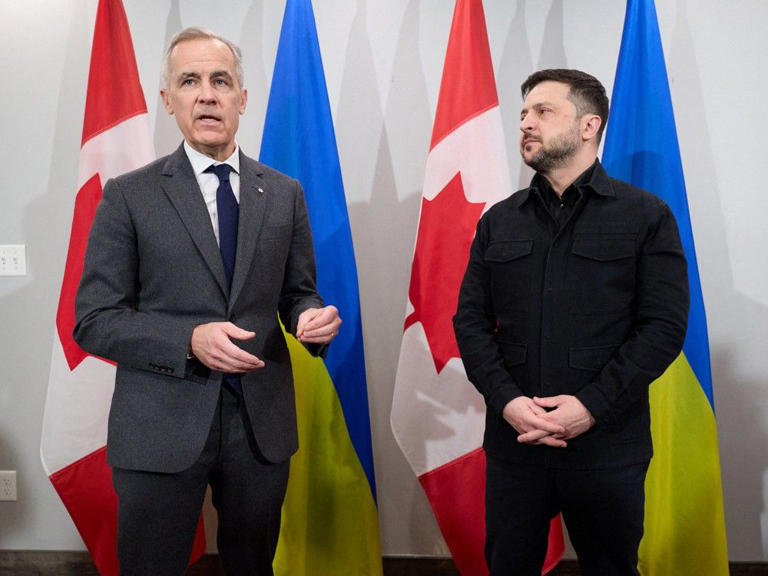
Ukrainian President Volodymyr Zelensky, right, and Canadian Prime Minister Mark Carney during a press conference before their meeting in Halifax on Saturday.

Prime Minister Mark Carney announced more financial aid for Ukraine ahead of a meeting with President Volodymyr Zelenskyy in Halifax on Saturday.

The two met at the city’s airport, where Zelenskyy landed en route to peace talks scheduled with U.S. President Donald Trump on Sunday. He’d arrived from Kyiv, where at least one person was killed and more than two dozen others were injured in a series of Russian airstrikes overnight.

Carney called the latest attack “barbarism” and said it underscores the importance of supporting Ukraine and helping foster a “just and lasting peace and a true reconstruction.”

To that end, Carney pledged a further “$2.5 billion worth of economic assistance that helps unlock financing from the (International Monetary Fund), from the World Bank, from the European Bank for Reconstruction and Development, to begin this process of rebuilding.”


According to the Kiel Institute tracking of aid to Ukraine , Canada has allocated approximately $13.5 billion in financial aid — third amongst all nations behind only the U.S. and European Union, but first based on the percentage of GDP.


Related video: Canada pledges additional USD 2.5 billion economic aid for Ukraine (The Canadian Press)


At the G7 Summit in Alberta this summer, Carney announced a $2 billion aid package to help Ukraine make military purchases. Kiel now tallies Canada’s military assistance at just over $7 billion, eighth on its list.

Canada has also provided roughly $900 million in humanitarian support.

Zelenskyy thanked Carney for the additional support and said Saturday’s attack involving more than 500 drones and 40 missiles — including hypersonic weapons — is “Russia’s answer on our peace efforts.

“It really shows that (Vladimir) Putin doesn’t want peace and we want peace,” he said.

In a post on Telegram, the Russian defence ministry said its strikes “targeted energy infrastructure used by Ukraine’s armed forces as well as defence industry facilities.”


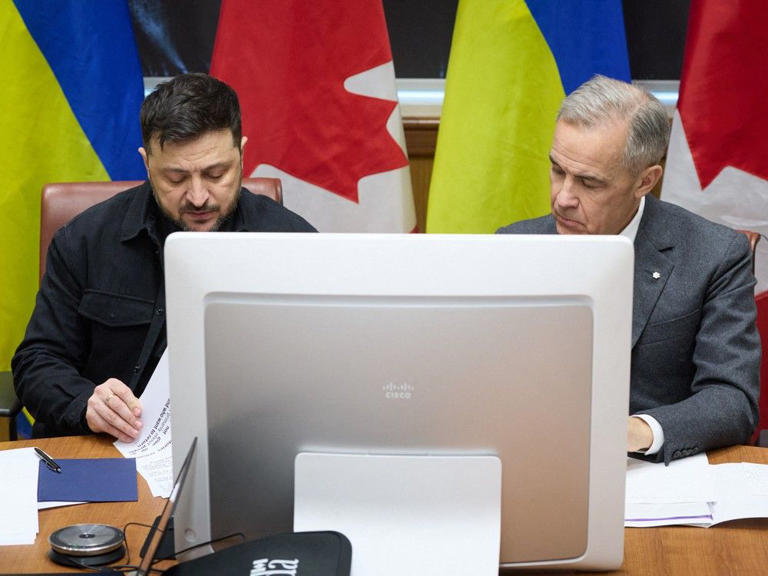
Establishing a lasting peace in Ukraine requires “a willing Russia,” Mark Carney said Saturday, denouncing the “barbarism” of Moscow’s latest bombardment of Kyiv as he met with Volodymyr Zelensky.© HANDOUT

Following their bilateral meeting, Carney and Zelenskyy held a video call with European leaders, during which they will “go through all the issues, provide updates, and exchange details” of the U.S.-backed peace plan to end Russia’s nearly four-year invasion of Ukraine, AFP reported.

“At a crucial moment in this process, under President Zelenskyy’s leadership, we have the conditions, the possibility of a just and lasting peace,” Carney said Saturday. “But that requires a willing Russia.”

The Halifax meeting followed a phone call between the two leaders on Boxing Day, during which Carney commended Zelenskyy’s ongoing peace efforts and the courage of the Ukrainian people, according to the prime minister’s office.

Our website is the place for the latest breaking news, exclusive scoops, longreads and provocative commentary. Please bookmark nationalpost.com and sign up for our daily newsletter, Posted, here.

What Part Is Canada Playing in Trump’s Murder Spree at Sea?

Ottawa should break its silence now and speak out against the unlawful attacks and extrajudicial killings of civilians by US military forces in the Caribbean and Eastern Pacific.


Canadian Foreign Affairs Minister Anita Anand (left) and US Secretary of State Marco Rubio (right) in Washington, DC on Aug. 21, 2025.
(Photo: US Department of State)

Rick Arnold
Dec 27, 2025
Common Dreams


The question should be easy enough for Canada’s federal government to answer: Has Canada provided military intelligence since September 2025 to US forces delivering lethal air strikes on small boats in the Caribbean and eastern Pacific that have killed dozens of civilians? In recent weeks, Canadian organizations and individuals have written to their MPs and to ministers, including Foreign Affairs Minister Anita Anand, asking this same question. The silence from Parliament Hill has been resounding.

Anand’s only comment related to the killings and Canada’s possible complicity came at the end of the recent meeting of G7 foreign ministers. As reported Nov. 12 by The Hill Times, Anand said, “I would say it is within the purview of US authorities to make that determination.” This was a blow to Canada’s international human rights reputation, especially after the United Kingdom had publicly declared that these killings were extrajudicial and it would stop sharing intelligence with US forces immediately.
RECOMMENDED...


‘Do Not Become Inured’: Death Toll From Trump Boat Strikes Tops 100 After Latest Murders


UN Experts Say Those Ordering and Carrying Out US Boat Strikes Should Be ‘Prosecuted for Homicide’

Canada has been attempting ‘smoke and mirrors’ with its Department of National Defence arguing that Canadian intel only goes to the US Coast Guard (USCG). However the USCG is under the direct command of the US Department of War so any intel the USCG gathers is being shared more widely. But now, in the latest escalation Dec. 10, it was the USCG itself that led the seizure of an oil tanker off the coast of Venezuela. This oil tanker seizure has been denounced internationally and leaves Canada with nowhere to hide in arguing that Canadian intel is not being used for illegal US actions in the Caribbean.

While attention in the United States has focused on Defence Secretary Pete Hegseth in one of the attacks, the U.N. High Commissioner for Human Rights and other U.N. experts have warned that the air strikes violate international human rights law and must stop. The presidents of Mexico, Brazil and Colombia have spoken in opposition to the killings and called for their cessation. France’s foreign minister said the US strikes violated international law. Leaders of the Caribbean Community (CARICOM) reaffirmed the principle of maintaining the Caribbean as a Zone of Peace.

Strikes on the small boats are part of a large military build-up by the United States in the Caribbean and come during a long campaign of threats and sanctions against the government of President Nicolás Maduro that seem intended to induce “regime change.” Unsubstantiated allegations of his government’s involvement in drug-trafficking are akin to the false “weapons of mass destruction” story used by the United States to justify its 2003 invasion of Iraq.


Our people-powered journalism cannot survive without you

Your support allows Common Dreams to continue covering the stories and amplifying the voices that the corporate media never will. Make a tax-deductible year-end gift to ensure we can sustain the reporting needed to meet the challenges of 2026.


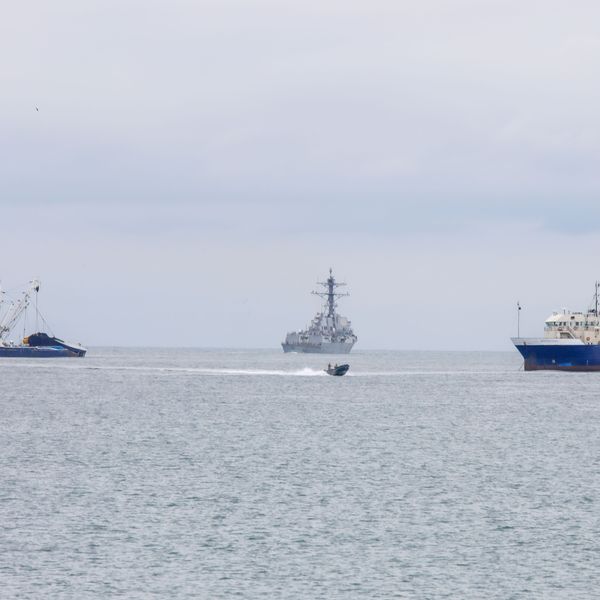
How did Canada get into this mess? In October 2010, Canada signed a Memorandum of Understanding with the US that built on a 2006 Canadian initiative called Operation Caribbe. After the signing of the 2010 MOU, the Canadian government’s website stated that Operation Caribbe was now to contribute “to US-led enhanced counter-narcotics operations in the Caribbean Sea and the eastern Pacific Ocean” with Royal Canadian Navy warships and Royal Canadian Airforce aircraft deployed to “find and track” vessels “of interest” for “interception” by the US forces.

While international law allows for the interdiction of vessels if they are suspected of carrying drugs, the Trump administration’s readiness to treat the Caribbean and eastern Pacific like a war-zone and to disregard international law by not inspecting the boats or arresting their crews for subsequent trial, puts a spotlight on Canada’s military collaboration and potential complicity in these U.S kill operations.

An investigation by Project Ploughshares confirmed that at least two of the early US attacks on small craft “relied on advanced electro-optical/infrared (EO/IR) sensor systems built in Hamilton, Ontario, by L3Harris WESCAM,” likely mounted on a MQ-9 Reaper drone. “These sensors, sold in large volumes to the US government, are designed to surveil below aircraft, identify potential targets, and coordinate airstrikes with precision.” Canadian weapons components and technology have been detected in other theatres of war despite Canada’s promises that this had been stopped. Ottawa should see to it that all future sales to the US fully comply with the Arms Trade Treaty so they are no longer used in US military operations leading to human rights violations and breaches of international law.

Canada should follow the lead of the United Kingdom and not contribute intelligence to U.S operations in the Caribbean. It should put Canadian participation in Operation CARIBBE on hold, so long as extrajudicial high seas killings and illegal seizures of vessels are being carried out by US forces under orders from the Trump administration.

Ottawa should break its silence now and speak out against the unlawful attacks and extrajudicial killings of civilians by US military forces in the Caribbean and Eastern Pacific. By doing so Canada would join the international chorus of countries condemning these unlawful actions while also calling on the United States government to cease further attacks.


This piece first appeared at the NB Media Co-Op and appears here with permission.


An Urgent Message From Our Co-Founder


Dear Common Dreams reader,

The U.S. is on a fast track to authoritarianism like nothing I've ever seen. Meanwhile, corporate news outlets are utterly capitulating to Trump, twisting their coverage to avoid drawing his ire while lining up to stuff cash in his pockets.

That's why I believe that Common Dreams is doing the best and most consequential reporting that we've ever done.

Our small but mighty team is a progressive reporting powerhouse, covering the news every day that the corporate media never will. Our mission has always been simple: To inform. To inspire. And to ignite change for the common good.

Now here's the key piece that I want all our readers to understand: None of this would be possible without your financial support.

That's not just some fundraising cliche. It's the absolute and literal truth. We don't accept corporate advertising and never will. We don't have a paywall because we don't think people should be blocked from critical news based on their ability to pay. Everything we do is funded by the donations of readers like you.

Will you donate now to help power the nonprofit, independent reporting of Common Dreams?

Thank you for being a vital member of our community. Together, we can keep independent journalism alive when it’s needed most.

- Craig Brown, Co-founder


Our work is licensed under Creative Commons (CC BY-NC-ND 3.0). Feel free to republish and share widely.


Rick Arnold
Rick Arnold was born and raised in Venezuela. He graduated in Latin American Studies from Yale University and is the current chair of the Trade Justice Group of the Northumberland Chapter of the Council of Canadians.
Full Bio >
Trump Is Just the Gilded Nail in the Coffin of the American Century

If the first 25 years of the 21st century have proved anything, it is that America was emotionally, morally, and intellectually incapable of acting as a global leader.


An AI-generated video posted on social media on February 25, 2025 by US President Donald Trump showed a Trump hotel in Gaza.
(Photo: screenshot/ Truth Social)

David Hearst
Dec 27, 2025
Middle East Eye

It is tempting to distill all the chaos, hatred, and blood spilled in 2025 into the small frame of one man: Donald Trump.

It is true that Trump richly deserves the accolade of being the worst, but also the most consequential president in modern US history.

This president has bombed Iran, allowed Israel to invade Southern Syria, finished the decimation of Gaza, and embarked on the annexation of the occupied West Bank. The Emirati-funded and armed ethnic cleansing of Sudan means little to him. A death toll of up to half a million Sudanese is of no consequence.

Three months after unveiling his “big beautiful peace plan,” a reality is established on the ground in Gaza that is its parametrical opposite—an ugly, petty recipe for war without end.

Never has so much been expected of a mind that is truly so small.

Israel is not even content to leave over 2 million Palestinians in Gaza shivering and starving in tents. When storms flooded them out, Israelis cheered.

Killing Palestinians has become an Israeli national obsession.

Israel Katz, the defense minister, has just announced plans to settle northern Gaza permanently: “We are deep inside Gaza and we will never leave all of Gaza; there will be no such thing. We are here to protect and prevent what happened,” Katz said.

So much for any hope of a full withdrawal envisaged by the Trump plan.

A ‘Moral Collapse’


Bounced like a pinball between Moscow and Kyiv, Trump has been unable to secure in Ukraine in a year what he promised as a candidate to achieve within days.

When Bob Reiner, a Hollywood director and long-time critic, was killed along with his wife by his son, in a family tragedy so deep it should elicit sympathy from any parent, Trump’s bile could not contain itself.

Reiner’s death was his own fault because he had driven others “crazy” with his obsession with Donald Trump, the president declared on Truth Social.

This is the mentality of the man to whom every rich Arab state in the Middle East has paid good money and now looks to for salvation.

Never has so much been expected of a mind that is truly so small.

This is the man whom Syria expects to force Israel to stop arming the Druze in Sweida, as a Washington Post investigation disclosed.

This is the man whom Turkey hopes will force the Kurds to join the as-yet nonexistent national armed forces of Syria; the man whom Qatar hopes will install an international stabilization force on the borders of Gaza, the man from whom Saudi Arabia wants a nuclear reactor, the man on whom the leader of Egypt—most likely the next Arab leader to fall—depends on for his very survival.

The only power that profits from this chaos is the power that is not involved: The meta story of 2025 is the confirmation of China as crown prince, as a world leader in waiting—a rise that has been handed to it on a silver plate.

More valuable to China than all its own strategic patience, planning, and thinking added together has been the moral collapse of America. All China has had to do is weather Trump’s tariff tantrums and watch the US collapse unprompted under its own weight.
Turning Victory Into Defeat

How did the US pluck defeat from the jaws of victory? Arrogance, hubris, the belief that as the last man standing, we were the only man standing, are all part of the story.

So the outgoing liberal elites of America and Europe, who have been in power for so long, are surely deluding themselves if they ascribe the chaos of 2025 to the rise of the extreme right at home and abroad.

We are not only seeing out one terrible year, but the first quarter of the century. It has been a terrible start.

The wars fought in defense of democracy destroyed all belief in the system at home.

If you compare how powerful America and the West were in Christmas 1991, when I watched the Soviet flag descend on the building of the Russian Supreme Soviet and chart a course to where they are now, you can only come to one conclusion: that when America had the chance to become the world’s uncontested leader, it blew it.

In 1991, America held the monopoly over the use of force abroad. Today, there are as many drone attacks as there are state actors or non-state actors who own them.

In 1991, Russia was on its knees. Today, its forces menace not just Ukraine but the whole of Western Europe.

In 1991, the streets of Russia were so pro-Western that there was a debate in the media as to whether they should continue using the word West, as Russia was now part of it.

Today, they are prepared to sacrifice a whole generation of Russian youth in a war that is framed in Moscow as a war with America.

Losing wars is another part of the jigsaw.

The Pentagon and NATO headquarters in Brussels should really have asked themselves a long time ago, why Western alliances “of the willing” have not won a war since Kosovo in 1998.

Interventions in Afghanistan, Iraq, Yemen, Libya, and Syria have all been defeats. Whether those interventions were declared or undeclared, whether they were led from the front or from behind closed doors, the result was the same.

The quick thrill of toppling regimes was followed in each country by the sober reality of insurgency, civil war, and ultimately military withdrawal.
Imagined Foes

Ideology also played its part. I do not mean the ideology of “radical Islam,” but the ideology that made the US and its allies such an aggressive world force.

It goes far beyond 19th-century imperialism, which, by comparison, was fairly limited in its ambitions.

It is the belief that at any one time in history, Western liberal democracy is faced by an implacable, transnational, and existential foe.

During the Cold War, it was communism. After it, al-Qaeda became a world threat. Then came Daesh, or the so-called Islamic State.

Today, it is the Muslim Brotherhood; and soon, it will be Islam itself.

Even though these imagined foes have nothing in common with each other, they are given the same characteristics.

During the Vietnam War, it was the Domino theory, a theory that warned if the dominoes of Southeast Asia were allowed to fall to communism, Australia would be next.

In the days of al-Qaeda, this was replaced by “the crescent of crisis,” which stretched from Iraq to Somalia.

This ideology preexisted major events like the attacks on the Twin Towers in 2001, and helped transform what should have been a limited anti-terrorist operation into an all-out “war on terror.”

It was critical to this project that the West did not define the enemy.

Hence, Vladimir Putin’s first bloody war as prime minister and later president of Russia, the war he launched on Chechnya, was merrily folded into George W Bush’s “war on terror.”

The then-British Prime Minister Tony Blair was duly sent by Washington to invite Putin to meet Queen Elizabeth II, as the horrors of Russian counterinsurgency were tried out on the Chechens 22 years before the same techniques were applied to the Ukrainians.

But what did it matter, Western intelligence calculated. They were only Muslims.

Now, 25 years on, America seems congenitally incapable of learning from its mistakes.
Terminal Decline

When Dick Cheney, the former vice president and the architect of the war on terror, died recently, the tributes came in thick and fast.

Former President Bill Clinton extolled Cheney’s “unwavering sense of duty,” while former Vice President Kamala Harris called him a “devoted public servant” who gave “so much of his life to the country he loved.” CNN‘s front-page story lauded him for helping “his daughter stand up to Trump.”

They praised a man who constructed an elaborate double lie as a pretext for the invasion of Iraq: that Saddam Hussein had weapons of mass destruction and that he had links with al-Qaeda.

We only need a real financial collapse to recreate the conditions of the 1930s.

In 2004, Cheney said: “I continue to believe, I think there’s overwhelming evidence [of a]… connection between al-Qaeda and the Iraqi government.”

There have been many attempts to assess the human cost of the Iraq war. The latest in 2023 by Brown University researchers, using United Nations data, concluded that the invasion of Iraq and related “war on terror” campaigns killed more than 4.5 million people.

This figure includes about 1 million direct deaths and 3.5 million indirect deaths. The wars also killed 7,000 US troops and 8,000 contractors, according to the study.

There is something in the psyche of an imperial power in terminal decline that blocks out the obvious truth: The wars fought in defense of democracy destroyed all belief in the system at home.

Even before a new generation of ideologues assumed power in Washington, the old regime of liberal Zionists, like Joe Biden, had armed and allowed Israel to do most of the killing in Gaza, the West Bank, south Lebanon, and Syria.

So, the collapse of moral governance is truly a bipartisan achievement. The year 2025 capped 25 years of failure.
A New Leadership

What happens next? It is alas very far from being goodbye to all that, because all of the unfinished business in the Middle East and Ukraine will keep on coming back to haunt the retreating West.

You can only keep on supporting Israel by blinding yourself to the daily reality of what Israel is doing in the West Bank.

Even if Israel changes its prime minister and slows down its settlement scheme, it will become evident that the Palestinian state recognised as a sovereign nation by 157 of the 193 UN member states is impossible to create.

It is to the West Bank, not Gaza, that all eyes should be turning in 2026.

Israel’s mission to annex the West Bank can be as clearly seen through Christian eyes as it is through Muslim ones, as Middle East Eye‘s Lubna Masarwa and Peter Oborne report on how Christians in Bethlehem face an existential threat.

The pressure on governments by their people will grow. They will do their best to outlaw demands for Palestinian justice. But the more they seek to oppress, the more of a domestic civil rights issue Palestine will become.

The real sin of British Prime Minister Keir Starmer’s government has not so much been to keep as close to Washington as possible on Israel, but to establish the infrastructure of an authoritarian government that will be fully used by his potential successor, Nigel Farage.

The late Prime Minister Margaret Thatcher’s refusal to grant “special category status” to the 1981 Irish hunger strikers is being replicated today, even though her response led to the death of 10 men, including the MP Bobby Sands, and a government capitulation on the core demand.

No matter.

Lord Timpson, the UK’s prisons minister, is intrepidly following in Thatcher’s footsteps in the way he is dealing with the hunger strike by youths on remand for taking part in direct action on behalf of Palestine Action.

Timpson said: “We are very experienced at dealing with hunger strikes. Unfortunately, over the last five years, we have averaged over 200 hunger strike incidents every year, and the processes that we have are well-established and they work very well—with prisons working alongside our NHS [National Health Service] partners every day, making sure our systems are robust and working—and they are.”

We will see in 2026 how long that confidence in the system lasts if one of those hunger strikers dies. We will also see the divide that has opened up between Israel and the Jewish diaspora getting wider.

If 2025 was the year when the fig leaf around Israel’s true genocidal character dropped away, the first years of the next quarter of this century will be dominated by more Jews in America demanding and creating an entirely different political leadership.

The ideologues of “Israel First“ are fighting an ugly and vicious losing battle, and they know it.

This is supposed to be America’s century. If the first 25 years have proved anything, it is that America was emotionally, morally, and intellectually incapable of acting as a global leader.

At the moment that failure is leading to the rise of the extreme right all over the West and potentially the rise of fascists. We only need a real financial collapse to recreate the conditions of the 1930s.

If that, in turn, spurns a new generation of leaders capable once again of governing with authority, morality, and modesty, then it will have been a lesson worth waiting for. But at what price?


© 2023 Middle East Eye


David Hearst
David Hearst is the Editor of the Middle East Eye.
Full Bio >