Sunday, December 28, 2025

Yemen’s Southern Transitional Council says close to declaring statehood in south


‘The south is approaching a decisive moment embodied by the declaration of a state, and this hope has become nearly complete,’ says head of STC’s National Assembly


Mohammed Sameai and Betul Yilmaz
 |28.12.2025 - TRT/AA
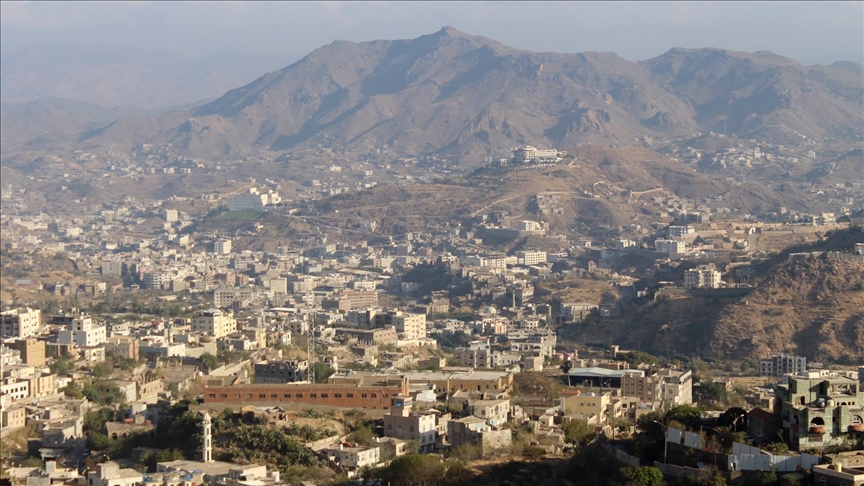
Yemen (Photo by Said Ibicioglu)

SANAA, Yemen/ ISTANBUL

Yemen’s Southern Transitional Council (STC) said that it is getting closer to declaring an independent state in the south.

“The south is approaching a decisive moment embodied by the declaration of a state, and this hope has become nearly complete,” Ali al-Kathiri, head of the STC’s National Assembly, said on Saturday during a meeting with local dignitaries and tribal figures from Hadramout, as cited by the council’s official website.

He called for “fortifying the internal front against any chaos or divisions in order to preserve the achievements made,” he added.

Addressing local and regional calls for the withdrawal of STC forces from Hadramaut and Al-Mahra provinces in eastern Yemen, Kathiri claimed that the STC “has not attacked anyone.”

“The people of the south are defending their land, which they liberated,” he said.

Kathiri expressed willingness to “maintain relations with brothers in the Arab Coalition countries, foremost among them Saudi Arabia and the United Arab Emirates.”

He, however, expressed rejection of “any attempts to break the will of the people of the south by parties that failed to liberate their own areas and are seeking to liquidate the cause of the southern people,” in reference to the internationally recognized government fighting the Houthi group.

There was no immediate comment from the Yemeni government, Saudi Arabia or the UAE on the comments.

On Friday evening, Hadramout witnessed a new military escalation that resulted in casualties during clashes between STC forces and the Hadramout Tribes Alliance, which calls for self-rule in the province.

Subsequently, Yemeni Presidential Leadership Council Chairman Rashad al-Alimi called on the Saudi-led coalition to take all necessary measures to protect civilians in Hadramout and support the army in enforcing de-escalation.

He also renewed his demand for the immediate withdrawal of STC forces from Hadramout and Mahra.

Since Dec. 3, the STC forces have taken control of parts of Hadramout following clashes with the Hadramout Tribes Alliance and government-aligned First Military Region forces. Four days later, STC forces expanded their control to Mahra, which had been under government authority.

The STC repeatedly claims that successive governments have politically and economically marginalized southern regions and calls for their separation from the north—claims rejected by the Yemeni authorities, as they insist on preserving the country’s territorial unity.

On May 22, 1990, the Yemen Arab Republic (North) unified with the People’s Democratic Republic of Yemen (South) to form the Republic of Yemen.

Saudi coalition will counter Yemen separatists undermining de-escalation


Saudi defence minister urges Yemen’s STC to withdraw “peacefully” from seized provinces, Hadramout and al-Mahra.

Forces of Yemen's main separatist group, the Southern Transitional Council, arrive in a mountainous area where they are launching a military operation in the southern province of Abyan, Yemen [File: Reuters/Stringer]

By Al Jazeera and News Agencies
Published On 27 Dec 2025

The Saudi-led coalition in Yemen says it will respond to any separatist military movements that undermine de-escalation efforts in the southern region, as Riyadh doubles down on calls for the group to “peacefully” withdraw from recently seized eastern provinces.

Saudi Arabia’s Defence Minister Khalid bin Salman said on X on Saturday that “it’s time” for troops from the separatist Southern Transitional Council (STC) to “let reason prevail by withdrawing from the two provinces and doing so peacefully”.

Brigadier General Turki al-Maliki, the spokesman for the Saudi-led coalition, said “any military movements that violate these [de-escalation] efforts will be dealt with directly and immediately in order to protect civilian lives and ensure the success of restoring calm,” according to the Saudi Press Agency.

Al-Maliki also accused the STC separatists of “serious and horrific human rights violations against civilians”, without providing evidence.

The statements came a day after the STC accused Saudi Arabia of launching air strikes on separatist positions in Yemen’s Hadramout province, and after Washington called for restraint in the rapidly escalating conflict.

Earlier this month, forces aligned to the STC took over large chunks from the Saudi-backed government in the provinces of Hadramout and al-Mahra. The STC and the government have been allies for years in the fight against the Iran-allied Houthi rebels.

Abdullah al-Alimi, a member of the Yemeni Presidential Leadership Council, the governing body of the internationally recognised government, welcomed the Saudi defence minister’s remarks, considering them to “clearly reflect the kingdom’s steadfast stance and sincere concern for Yemen’s security and stability”, he said on X.

Rashad al-Alimi, the head of the Presidential Leadership Council, said after an emergency meeting late on Friday that STC movements posed “serious violations against civilians”.

The STC, which has previously received military and financial backing from the United Arab Emirates (UAE), is seeking to revive the formerly independent state of South Yemen. The group warned on Friday that they were undeterred after strikes it blamed on Saudi Arabia hit their positions.

Diplomacy, de-escalation?

In Washington, US Secretary of State Marco Rubio said: “We urge restraint and continued diplomacy, with a view to reaching a lasting solution.”

Azerbaijan, meanwhile, said it welcomed efforts led by both Saudi Arabia and the UAE to de-escalate ongoing tensions in Yemen.

Following Friday’s raids, Yemen’s government urged the Saudi-led coalition to support its forces in Hadramout, after separatists seized most of the country’s largest province.

The government asked the coalition to “take all necessary military measures to protect innocent Yemeni civilians in Hadramout province and support the armed forces”, the official Yemeni news agency said.

A Yemeni military official said on Friday that about 15,000 Saudi-backed fighters were amassed near the Saudi border but had not been given orders to advance on separatist-held territory. The areas where they were deployed are at the edges of territory seized in recent weeks by the STC.

Separatist advances have added pressure on ties between Saudi Arabia and the UAE, close allies who support rival groups within Yemen’s government.

On Friday, the UAE welcomed Saudi efforts to support security in Yemen, as the two Gulf allies sought to present a united front.

Yemen’s government is a patchwork of groups that includes the separatists, and is held together by shared opposition to the Houthis.

The Houthis pushed the government out of Yemen’s capital, Sanaa, in 2014, and secured control over most of the north.
'Make emitters responsible': Thailand's clean air activists


By AFP
Dec 28, 2025


Skyscrapers are seen amidst high air pollution levels in Bangkok, Jan. 20. AFP-Yonhap

BANGKOK — A finance specialist who struggled after running in smog and a doctor who fears for the health of his children are among the activists spearheading landmark air pollution legislation in Thailand despite political uncertainty.

Each winter, large parts of Thailand are plagued by haze caused by weather patterns, seasonal burning, vehicle exhaust and industrial emissions.

Years of efforts to tackle the problem, including work-from-home policies and rules on crop stubble burning, have done little to alleviate the issue.


Now, there is a glimmer of hope for fresh action in the form of the Clean Air bill, which would enshrine the right to breathable air, tax emitters and offer public information on the sources of pollution.

Wirun Limsawart, who has helped lead the push for the measure as part of the Thailand Clean Air Network (CAN), grew up in southern Nakhon Si Thammarat.

But it wasn't until he returned to Thailand in 2018 after a decade abroad that he realised the scale of the country's pollution problem.

He began to worry about the impact of the dirty air on his three children.

"It made me question my role as an anthropologist and a doctor," he told AFP.

"What can I do?"


Medical anthropologist and physician Dr. Wirun Limsawart, one of the co-founders of Thailand Clean Air Network poses at Thailand's Parliament complex in Bangkok. AFP-Yonhap

The son of a seamstress and a mechanic, Wirun was a straight-A student who studied at one of Thailand's top medical schools.

"My parents always showed me what it meant to genuinely care for others in their work, so that kind of embedded in me," the 49-year-old said.

"I chose a career path that allowed me to help people."

His life has been marked by illness.

In his early twenties, Wirun collapsed on a bus and was diagnosed with a brain tumour.

After chemotherapy and years of follow-up tests, the experience deepened his desire to better understand patients.

"My role was switched to become a patient... I wanted to genuinely understand patients from a doctor's perspective."

After eight years as a general practitioner in some of Thailand's poorest and most remote regions, he obtained a master's degree and PhD in anthropology at Harvard University.

He now works at the Ministry of Public Health as an anthropological doctor, blending medical research with studying human behaviour.

'My problem, too'

Wirun's pollution worries led him to a panel discussion in Bangkok on the issue in 2019, and the conversations evolved into CAN, which has spent several years advancing clean air legislation.

More than 20,000 people backed the group's call for action — surpassing the threshold for public-initiated legislation — and a draft bill passed the Thai parliament's lower house in October.

"We need to make emitters responsible," Wirun said.

But that goal is facing a new hurdle after Thailand's prime minister dissolved parliament this month, putting the bill on hold.

Still, the measure could be brought back after general elections early next year, if there is political will, according to Weenarin Lulitanonda, CAN's co-founder.

"In Thailand, and particularly in the very highly uncertain political environment, one of the things that Thais are certain of is a huge amount of uncertainty," she said.

"Right now, honestly, it's anyone's guess. We really don't know until general elections are held."

An outdoor run in 2018 drew Weenarin into clean air activism. The experience left her with a piercing headache she later learned was caused by Bangkok's seasonal smog.

More than 10 million people required treatment for pollution-related health problems in Thailand in 2023, according to the health ministry.

Weenarin had previously lived in New Zealand and never worried about air quality, but the more she looked into the issue, the more she was determined to do something about it.

"How is it possible that (in Thailand) someone has no information about what they are breathing?" she said, recalling the question that pushed her into activism.

Having studied finance and worked at the World Bank, Weenarin began contacting experts to understand the problem before helping establish CAN.

She said her motivation is simple: "If there were an alternative to breathing, I wouldn't care."

Clean-air reforms rarely start with governments or businesses, Weenarin said, and she worries too few Thais see the crisis as their problem.

"Don't vote for anybody who doesn't have clean air legislation as a key political manifesto and a commitment ... follow them, become the political watchdog that we all need to be," she said.

She is determined to keep fighting though, so "enough Thais wake up and say this is my problem, too."
Crucial power line repairs begin at Zaporizhzhia plant under IAEA truce

28/12/2025, Sunday


The International Atomic Energy Agency has announced the start of critical repairs to a damaged power line near the Zaporizhzhia Nuclear Power Plant in Ukraine, facilitated by a local ceasefire brokered by the UN watchdog. IAEA Director General Rafael Grossi thanked both Russia and Ukraine for agreeing to a temporary 'window of silence' for the work, which aims to prevent a nuclear accident. The repairs are expected to last several days.


Critical repair work has commenced at the Zaporizhzhia Nuclear Power Plant (ZNPP) in Ukraine under a temporary local ceasefire arranged by the International Atomic Energy Agency. The UN nuclear watchdog announced on Sunday that the repairs to a crucial external power line, expected to last a few days, are part of ongoing efforts to avert a potential nuclear disaster amid the continuing military conflict.

A Temporary 'Window of Silence'

IAEA Director General Rafael Grossi stated that the agency's team on the ground is monitoring the repairs, which aim to restore power transmission between switchyards at the ZNPP and the nearby Zaporizhzhia Thermal Power Plant. Grossi expressed gratitude to both Russian and Ukrainian authorities for agreeing to what he termed a new temporary "window of silence," describing it as essential for strengthening nuclear safety and security at the facility, which has been under Russian military control since March 2022.

Damage Attributed to Military Activity


The need for the urgent repairs stems from damage detected earlier this month to a transmission line connecting the two power plants. The IAEA reported on December 19 that the damage, located between an autotransformer and the thermal plant's switchyard, was "reportedly due to military activity." Initially, the plant's management—operating under Russian occupation—stated that access to the affected area could not be granted for security reasons, delaying the repair assessment. The newly brokered ceasefire has now allowed technicians to access and fix the critical infrastructure.

Persistent Risks at Europe's Largest Nuclear Plant

The Zaporizhzhia plant, Europe's largest nuclear power station, has been a persistent point of international concern since the war began. Both Moscow and Kyiv have repeatedly accused each other of shelling and endangering the facility, raising fears of a catastrophic nuclear incident. IAEA experts have been stationed at the site since September 2022 to monitor safety and provide technical assistance. The current repair operation underscores the fragile state of the plant's external power supplies, which are vital for cooling and other essential safety functions, especially during wartime.

BB EXITS STAGE RIGHT

Muslims are...: When Brigitte Bardot was fined for anti-Islam remarks

Brigitte Bardot's career was not only marked by stardom and animal-rights activism, but also by repeated convictions for "inciting racial hatred". French courts fined her repeatedly for remarks in which she accused Muslims of "destroying" France and "imposing" their practices.


French film actor Brigitte Bardot appears at the Mount Royal Hotel in London on April 9, 1959. (File photo/AP)


India Today World Desk
New Delhi,
Dec 28, 2025 
Written By: Anuja Jha


French film icon Brigitte Bardot, who died aged 91 on Sunday, was not only remembered for redefining female stardom in post-war cinema but also for a long trail of court cases over remarks targeting Muslims, immigrants and minority communities.


Bardot, who rose to global fame with the 1956 film And God Created Woman, was fined six times between 1997 and 2008 alone for controversial statements about Islam and its followers.

One of the most prominent cases dates back to 2008, when a Paris court fined her for describing Muslims as “this population that is destroying us, destroying our country by imposing its acts,” remarks prosecutors said went far beyond free speech.


“I am fed up with being under the thumb of this population which is destroying us, destroying our country and imposing its acts,” Bardot had written, a passage that became central to the case.

She also said France was being “invaded by sheep-slaughtering Muslims” and warned of the “Islamisation of France” in her writings, according to Reuters. The court later fined her €15,000, while prosecutors sought a tougher punishment, saying she was a repeat offender.

'MANIA FOR THROAT-CUTTING'

Bardot’s legal troubles over Islam-related remarks dated back decades. In 1998, she faced charges of “provocation of hatred and racial discrimination” after linking Islamic rituals to violence, as per a report by The Independent.

“Islamists have a mania for throat-cutting,” Bardot said at the time. “I’m not making it up. You just have to look at the television.”

She also wrote that Muslims were “cutting the throats of women and children” and warned that “they’ll cut our throats one day and it will serve us right.” An appeals court later fined her for describing France as being “invaded” by Muslims.

LETTERS ATTACKING RITUAL SLAUGHTER

Bardot repeatedly framed her remarks around animal welfare, particularly ritual slaughter associated with Islam and Judaism. In a letter to then French president Nicolas Sarkozy that later became public, she attacked Eid al-Adha practices.

Brigitte Bardot gestures during a demonstration to protest the duration of the transport of animals for butchery in Paris, Feb. 26, 1995. (AP photo/ file)

In 2014, she published an open letter in several leading French newspapers calling for a ban on halal and shehita, or Jewish ritual slaughter, referring to them as “ritual sacrifice,” according to The Times of Israel.

The letter drew condemnation from Jewish organisations. The European Jewish Congress said her depiction of shehita was “deeply offensive” and showed “clear insensitivity for minority groups.”


REUNION ISLAND CASE

In 2021, a French court fined Bardot €20,000 over a 2019 open letter targeting residents of Runion Island, a French territory in the Indian Ocean.

According to Agence France-Presse, cited by Vanity Fair and the New York Post, Bardot described the island’s residents as “natives [who] have kept their savage genes” and a “degenerate population still soaked in barbarous ancestral traditions.”

She accused locals, particularly the Hindu Tamil community, of inhumanely slaughtering goats and invoked “the cannibalism of past centuries.”

APOLOGIES WITHOUT RETREAT

While Bardot occasionally expressed regret in court, she rarely withdrew her positions. During a 2004 hearing, she apologised but said, “I never knowingly wanted to hurt anybody. It is not in my character,” according to the BBC. She added, “Among Muslims, I think there are some who are very good and some hoodlums, like everywhere.”

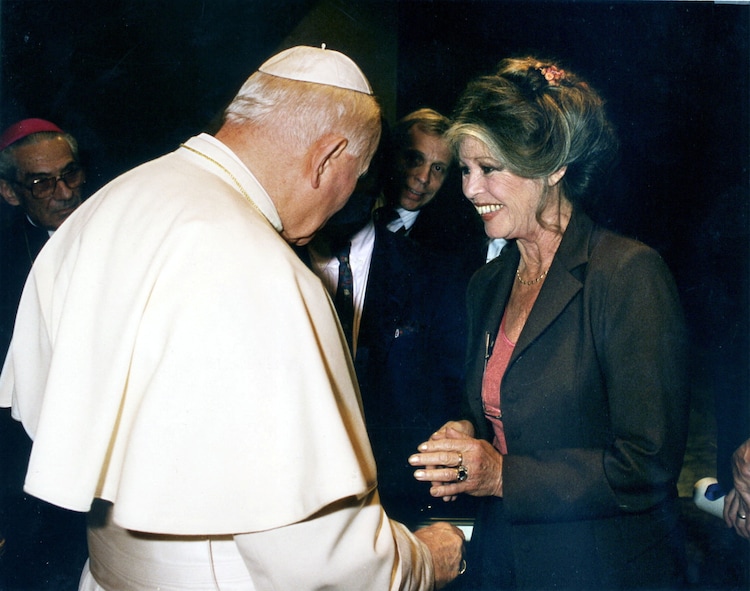
Brigitte Bardot with the Pope at the Vatican. (File photo/Reuters)


FAR-RIGHT TIES

Bardot’s views often intersected with far-right politics. She married Bernard d’Ormale, a former adviser to France’s National Front, in 1992 and later publicly supported Marine Le Pen, once calling her “the Joan of Arc of the 21st century.”
advertisemen

Though she insisted her comments were driven by concern for animals, French courts repeatedly ruled that Bardot’s language constituted racial hatred — cementing a legacy that remained as polarising as her cinematic fame.

- Ends

(With inputs from Reuters, AP)


How frogs went from right-wing meme to anti-ICE protest symbol

Laura Blasey
Max Matza
BBC

Getty Images
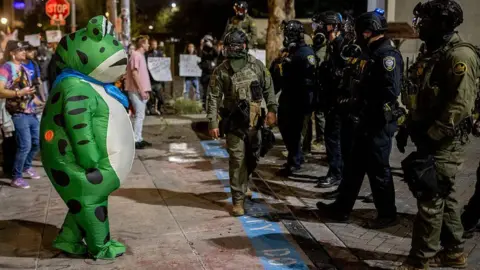
Immigration agents in Portland spraying crowd control chemicals into a protester's frog costume went viral in October


The revolution will not be televised, but it might have webbed feet and bulging eyes.

It also might have a unicorn's horn or a chicken's feathers.

As protests against the Trump administration continue in US cities, demonstrators are adopting the energy of a community costume parade or block party. They've taught salsa lessons, handed out snacks and ridden unicycles as armed law enforcement look on.

Mixing humour and politics - a tactic social scientists call "tactical frivolity" - is not new. But it has become a defining feature of American protest in the Trump era, embraced by both left and right.

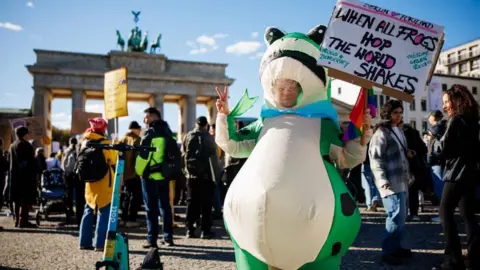
And one symbol has emerged as particularly salient - the frog. It began when video footage of a confrontation between a man in a frog suit and immigration enforcement agents in Portland, Oregon went viral, and has since spread to protests across the country.

"There's a lot going on with that little inflatable frog," says LM Bogad, a professor at University of California, Davis and a Guggenheim Fellow who specialises in performance art.

From Pepe to Portland


It's hard to talk about protests and frogs without talking about Pepe, a cartoon character embraced by far-right groups during Donald Trump's 2016 presidential campaign.

When the meme first took off online, the image was used to signal certain emotions. Later, it was deployed to show support for Trump, including one notable meme retweeted by Trump himself, depicting Pepe with Trump's signature suit and hair.

Pepe was also depicted in right-wing online communities on 4chan, 8chan and Reddit in darker contexts, as Adolf Hitler or a member of the violent white supremacist group the Ku Klux Klan. Online conservatives traded "rare Pepes" and set up cryptocurrency in his name. His catchphrase, "feels good, man", was deployed as an inside joke.

But Pepe didn't start out so controversial


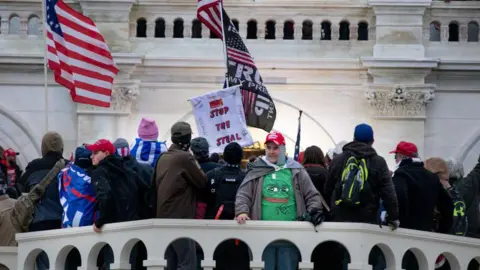
A man seen wearing a Pepe shirt during the 6 January 2021 riot at Capitol Hill, where Trump supporters attempted to prevent his loss to Joe Biden

Its creator, artist Matt Furie, has been vocal about his distaste for how the image has been used. Pepe was supposed to be simply a "chill frog-dude" in this artist's universe of characters.

The frog first appeared in a series of comics in 2005 - apolitical and best known for pulling his pants all the way down to pee. In the 2020 documentary Feels Good Man, which chronicles Mr Furie's efforts to wrest back control of his work, he said his Pepe drawing was inspired by his experiences with friends and roommates in his 20s.

Early in his career, Mr Furie experimented with uploading his work to the nascent social web, where other users began to borrow, remix and reinvent his character. As Pepe spread into the more extreme corners of the internet, Mr Furie tried to disavow the frog, even killing him off in a comic strip.

But Pepe lived on.

"It shows you that we don't control symbols," says Prof Bogad. "They can change and shift and be reworked."

Until recently, the popularity of Pepe meant that frogs were largely associated with the right. But that changed on 2 October, when the confrontation between a protester dressed in an inflatable frog costume with a blue neck scarf and an immigration officer went viral.


The moment came just days after Trump ordered the National Guard to Portland, calling the city "war-ravaged". Protesters began to gather in droves on a single block just outside an immigration enforcement facility.

Tensions were high and an immigration officer sprayed a chemical agent at a protester, aiming directly into the air intake fan of the puffy frog costume.

The protester, Seth Todd, responded with a joke, saying he had tasted "spicier tamales". But the incident went viral nonetheless.

Mr Todd's attire was not too unusual for Portland, known for its quirky culture and left-wing protests that revel in the absurd - public yoga and 80s-style aerobics lessons, and nude cycling groups. The city's unofficial motto is "Keep Portland Weird".

The frog even played a role in the ensuing legal battle between the Trump administration and the city, which argued the National Guard deployment was unlawful.

While the court ruled in October that Trump had the right to deploy troops, one judge dissented, referencing in her minority ruling the protesters' "well-known penchant for wearing chicken suits, inflatable frog costumes, or nothing at all when expressing their disagreement with the methods deployed by ICE".

"Observers may be tempted to view the majority's ruling, which accepts the government's characterisation of Portland as a war zone, as merely absurd," Judge Susan Graber wrote. "But today's decision is not merely absurd."

Trump's deployment was "permanently" blocked by courts just a month later, and troops have reportedly departed the area.

But by then, the frog had become a potent anti-administration symbol for the left.

The costume was spotted across the country at No Kings protests last autumn. There were frogs - and unicorns and axolotls and dinosaurs - in San Diego and Atlanta and Boston. They were in small towns like Williamsport, Pennsylvania, and big international cities like Tokyo and London.

The frog costume was back-ordered on Amazon and rose in price.

Controlling the optics


What brings both frogs together - Pepe and the Portland frog - is the interplay between the humorous, benign cartoon amphibian and a deeper political meaning. This is what political scientists call "tactical frivolity".

The strategy rests on what Prof Bogad calls the "irresistible image" - often silly, it's a "disarming and charming" display that calls attention to your ideas without obviously explaining them to a viewer. It's the goofy costume you wear, or the symbol you draw, or the meme you share.

Prof Bogad is both an expert in the subject and a veteran practitioner himself. He's written a book on the subject, Tactical Performance: The Theory and Practice of Serious Play, and taught workshops around the world.

"You could go back to the Middle Ages - when people are dominated, they use absurdity to speak the truth a little bit and still have plausible deniability."

The idea of this approach is three-fold, Prof Bogad says.

As protesters take on a powerful opposition, a silly costume takes control of the optics. "It makes it look worse if you respond with violence," he says.

Second, an image can set a certain tone for those within the movement and would-be supporters. In Portland "it was like a radical costume ball and we all got invited", Prof Bogad says.

Crucially, this kind of tactic can offer political cover for criticism. Sometimes that shows up in claims of political memes as "just a joke" - a defence against critics who would brand your views as dangerous. But it's especially useful in circumstances where government criticism can be dangerous, Prof Bogad says.


EPA
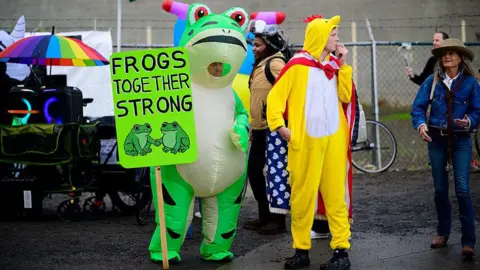
A frog costume spotted in Berlin during the No Kings protests

The costumes have been frequently seen at protests in Washington DC


He points to Otpor, the Serbian pro-democracy protest movement that supported efforts to overthrow Yugoslav dictator Slobodan Milosevic in 2000 through pranks and street comedy. For years, critics of Chinese President Xi Jinping have shared images of Winnie the Pooh to signal their opposition online, where more bold-faced criticism could face censorship.

Pro-democracy protesters in Hong Kong have also embraced Pepe, unaware of its political affiliations in the US.

"Of course, authoritarians don't like to be laughed at," Prof Bogad says. This kind of symbolism works because "without even giving a speech, you are undermining the authoritarian script".

At home in Oregon, a group of Portlanders doubled down on the viral fame and banded together to form "Operation Inflation", which collects and distributes inflatable costumes to protesters.

They started a website where supporters can donate $35 to buy suits "for community members to wear at ICE protest sites to help deflate (pun intended) the tensions surrounding protests".

Brooks Brown, a co-founder of Operation Inflation, says the point is to "shift the story that's being told" by the Trump administration that all protesters are part of a violent mob.

"Our job is to build a different stage, and to force them onto ours," he says.

Mr Brown says the inflatables bear similarities with the Civil Rights era of the 1960s, when protesters would often dress in their Sunday finest and sit motionless as they were harassed by counter-protesters and arrested by aggressive police.

Pepe, Mr Brown says, "was a fascist symbol for 4chan. And now we're being reclaimed. Feels good, man."

By late October, his group had bought more than 350 outfits and is planning a "pipeline" to send supplies to other cities where inflatables have been used at protests.

Once synonymous with the right, the Portland frog has now been sometimes dubbed the "Antifa Frog" online - referencing the decentralised, leftist movement that opposes far-right causes and has been designated a domestic terrorist group by Trump.

Memes depict him fighting Pepe - two frogs battling for national attention.
Trump’s inner circle is filled with architects of Project 2025. Here are the policies they have implemented so far

About half of the policies in the ultra-conservative manifesto have been implemented by the Trump administration, writes Ariana Baio

Ariana Baio
Sunday 28 December 2025 
THE INDEPENDENT


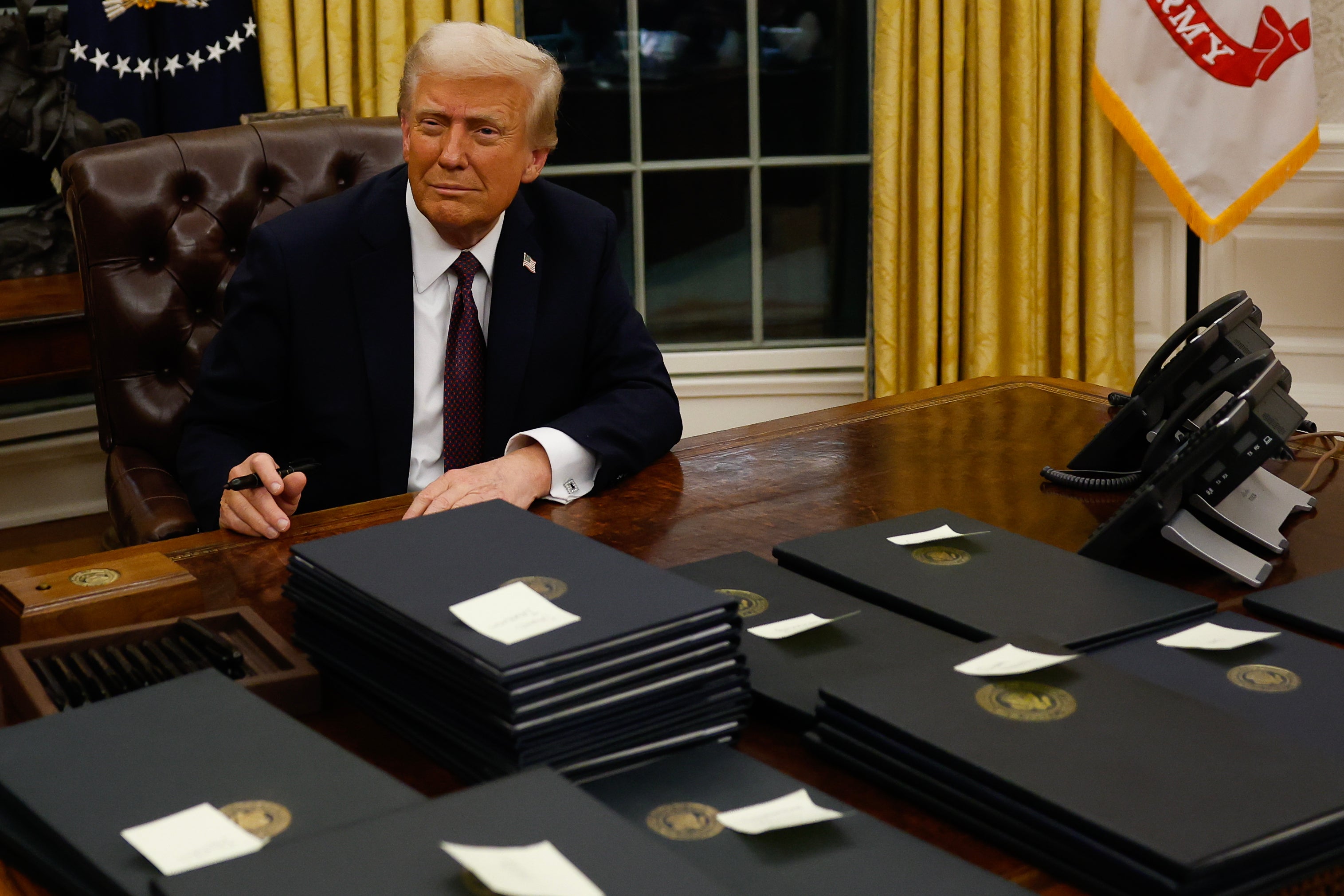
Approximately half of the recommendations in Project 2025 have become official policies, presidential directives or overall goals of the Trump administration in the first 12 months of President Donald Trump’s second term.

The nearly 1,000-page ultra-conservative policy blueprint emerged from the Heritage Foundation think tank in 2023 and was widely seen as a possible manifesto for a second Trump turn despite denials by the candidate himself and many of those around him.

Filling the federal workforce with political appointees, phasing out the Department of Education, rolling back major Biden administration-era policies on climate change, axing diversity polices and offices, as well as ramping up immigration deportations, were some of the major policy changes that aligned with the conservative mandate.

It’s an unsurprising finding, given that major Trump administration officials are authors or contributors to Project 2025, including Office of Management and Budget director Russell Vought, border czar Tom Homan, FCC chairman Brendan Carr, CIA director John Ratcliffe, trade adviser Peter Navarro, SEC chairman Paul Atkins and many more.

Yet, the president appeared to downplay his understanding of it in June 2024 when he declared, “I know nothing about Project 2025” and “I have no idea who is behind it.”


Many of Trump’s executive orders appear to align closely with Project 2025’s recommendations (Getty Images)

Here are the areas where The Independent found Trump administration polices that reflected ideas set out in the 887 pages of Project 2025.

The federal workforce

Project 2025’s recommendations regarding the restructuring of the executive office and federal workforce have some of the most significant overlap with the Trump administration’s agenda.

The overall goal for the federal workforce, specifically within the executive branch, was to remove career civil servants and ensure that most employees are aligned with the president’s agenda while also reducing the size of the workforce by making cuts to grants and funding.


Project 2025 called for reinstating Trump’s first-term executive order, making 50,000 employees easier to dismiss by classifying them under Schedule F, designating them as at-will roles which made it easier to fire them. Trump did that on day one. Also successfully implemented was Project 2025’s call for the Office of Personnel Management to take more control over the federal workforce hiring process.


Thousands of federal employees have been forcibly removed from their positions through reductions-in-force at the hands of the Trump administration – though Project 2025 does encourage the president to be ‘wary’ of such (AFP via Getty Images)

While the Department of Government Efficiency was not part of Project 2025, its swift efforts to make sweeping cuts have helped cut down the workforce. Approximately 317,000 employees have left government jobs.


In addition, Project 2025 calls for the president to exert more authority over the executive branch by pushing for the Supreme Court to overturn a precedent that prohibits the president from firing individuals. The high court is currently considering this case.

Cuts to grants and funding

Project 2025 recommends that nearly every government department and agency conduct thorough reviews of grants and contracts to ensure no money is being allocated to projects that do not align with the president’s agenda.

Trump has fulfilled that goal, first by attempting to freeze all grants and then by taking a steadier approach to cutting back funding for polices or projects he does not agree with. Much of that impacted the U.S. Agency for International Development.

Throughout the year, the administration has cut funding to nonprofits or organizations embarking on green energy projects, as well as scrapping research projects aimed at renewable energy.

Project 2025 explicitly asks the administration to cut funding to public media such as NPR, PBS and the Corporation for Public Broadcasting – all of which the president has done.


rump and Education Secretary Linda McMahon have vowed to shut down the Department of Education and move its functions to separate departments – a suggestion from Project 2025 (REUTERS)

Education

Trump and Secretary of Education Linda McMahon have made it clear they intend to phase out the Department of Education – a suggestion Project 2025 clearly recommends.

While completely shutting down the department requires an act of Congress, Project 2025 lists ways the administration can reduce the department’s powers. The Trump administration has turned many of those suggestions into policy.

That includes getting rid of Biden’s student loan forgiveness policy, removing protections for transgender or nonbinary students, scrapping diversity initiatives, and promoting parents’ choice.

Trump also implemented Project 2025’s call for the administration to withhold or review accreditation for colleges and universities that adopt DEI policies or are not deemed to be doing enough to protect religious freedom.

Immigration

Project 2025’s policies on harsher immigration policies are synonymous with the Trump administration and, if anything, the president has taken further steps to crack down on legal and nonlegal immigration than the mandate suggests.


Cracking down on immigration has been a staple policy of the administration – both a promise from Trump’s campaign and a suggestion from Project 2025 (Getty Images)

The president has tightened restrictions on foreign-born worker visas, penalized “sanctuary” cities, directed harsher penalties against undocumented immigrants with criminal records, expanded countries with travel bans and sought to redefine birthright citizenship (though Project 2025 does not call for that.)

Project 2025 asks the president to consider utilizing the National Guard or other military personnel to assist in immigration operations along the border and to consider increasing federal law enforcement presence in “sanctuary” cities.

Trump has taken up both suggestions and also combined them to deploy the National Guard in cities conducting immigration operations.

DEI and protections for LGBTQ+

The Trump administration quickly fulfilled Project 2025’s goal of removing all mentions of diversity, equity and inclusion in department policies, but it has also taken up suggestions to punish those who participated in promoting DEI.

Trump also removed protections for transgender individuals by redefining “sex” and “gender” to no longer include nonbinary or trans people, which Project 2025 calls for.

The administration also restored a former Trump administration policy that prohibits transgender individuals from serving in the military and eliminated a Biden-era policy to protect transgender student-athletes.


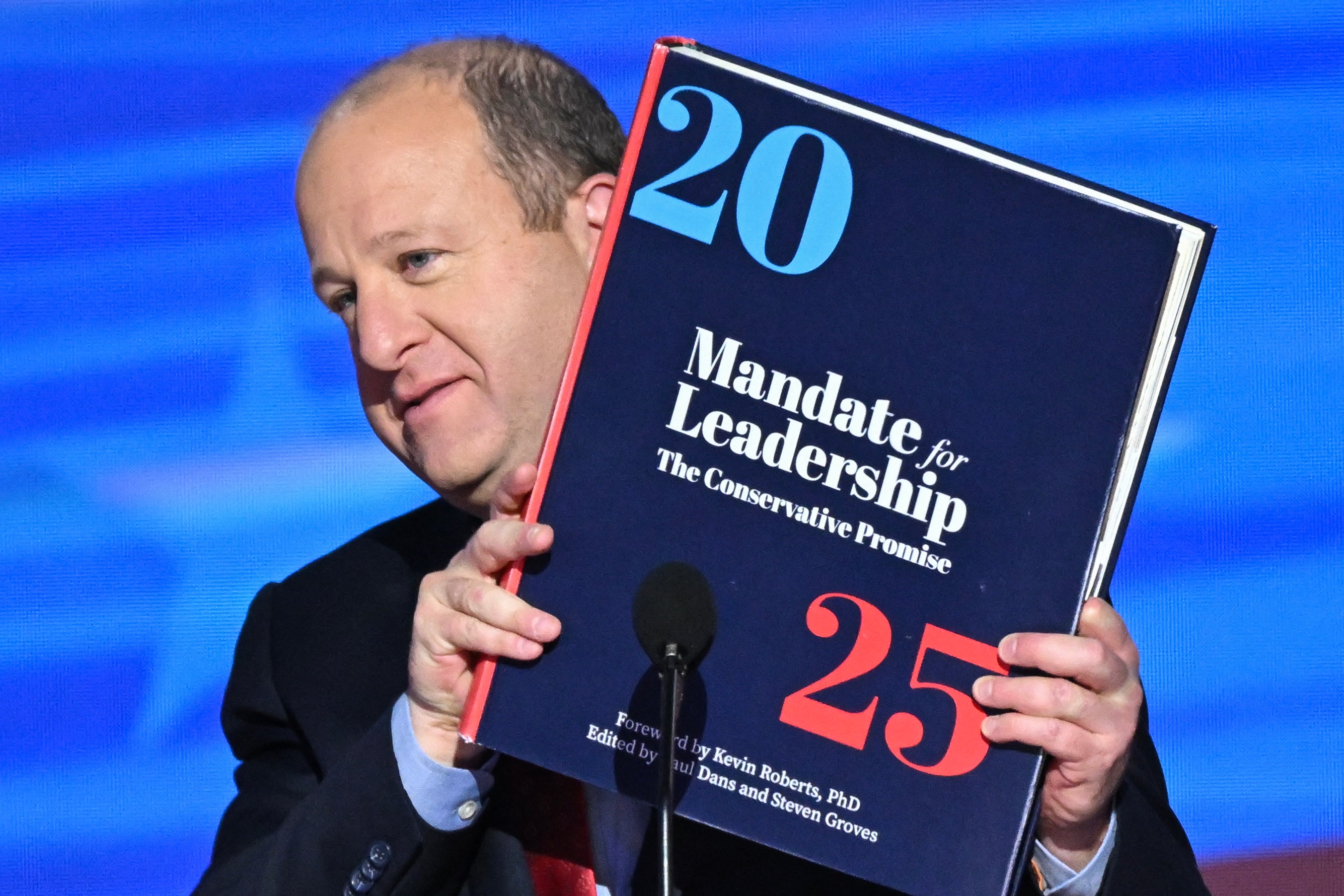
Democrats including Colorado governor Jared Polis used warnings about Project 2025 to try to sway voters away from Trump – however, the president distanced himself from the Heritage Foundation’s mandate (AFP/Getty)

The administration has taken up other specific suggestions in Project 2025, such as eliminating Medicaid funding to Planned Parenthood, modernizing nuclear facilities, and removing environmental protections to increase oil and gas drilling.

Going into 2026, the administration is likely to take up other suggestions in Project 2025 that it wasn’t able to implement swiftly – namely, implementing policies and goals that combat China.
‘Does anyone know what Somaliland is?’ Trump responds after Israel’s sudden move

Ryan Prosser
Published December 27, 2025
METRO UK


Reports suggest Trump is not interested in acknowledging Muslim-majority Somaliland 

Donald Trump has indicated he is not yet prepared to fully recognise Somaliland.

On Friday, Israel broke ranks to become the first state to formally support the breakaway republic.


Somaliland is located on the Horn of Africa and shares borders with Djibouti to the north, Ethiopia to the south and west, and Somalia, from which it has broken away, to the east.

Israeli PM Benjamin Netanyahu vowed to bring up the subject during his scheduled meeting with the US president on Monday.

However, the New York Post reported Trump was not interested in acknowledging the Muslim-majority state.

‘Does anyone know what Somaliland is, really?’, he is quoted as asking at his West Palm Beach golf course.

Israeli Prime Minister Benjamin Netanyahu became the first world leader to formally recognise Somaliland on Friday (Picture: Reuters)

Somaliland, a former British protectorate, has offered to join the Abraham Accords, which comprises Arab nations that have normalised relations with Israel.

It has successfully held democratic elections and is viewed as a stable entity, in contrast with unstable Somalia.

It has also extended an offer of land for a possible US naval base in the Gulf of Aden in the Red Sea.

However, Trump seemed largely dismissive of both suggestions. He remarked, ‘big deal’ and added that all proposals were ‘under study’.

‘I study a lot of things and always make great decisions and they turn out to be correct,’ he said.

Abdirahman Mohamed Abdullahi has been the president of Somaliland since 2024 (Picture: Reuters)

The president further suggested his talks with Netanyahu would be dominated by the situation in the Gaza Strip rather than other affairs.

Among US proponents for Somaliland is arch Trump loyalist Congressman Scott Perry, who has submitted an act to recognise the nation.


A former British protectorate, Somaliland gained de facto independence from its civil war-torn neighbour in 1991.


While it enjoys strong relations with neighbouring Ethiopia and some Arab nations including the UAE, other countries in the region advocate against its independence, including Egypt and Turkey.

Somali president condemns Israel's Netanyahu for ‘blatant attack’ on Somalia’s sovereignty

In his address to special joint session of federal parliament, Hassan Sheikh Mohamud warns that Israel's recognition of breakaway Somaliland region risks further destabilizing the Horn of Africa region

Mohamed Dhaysane |28.12.2025 - TRT/AA

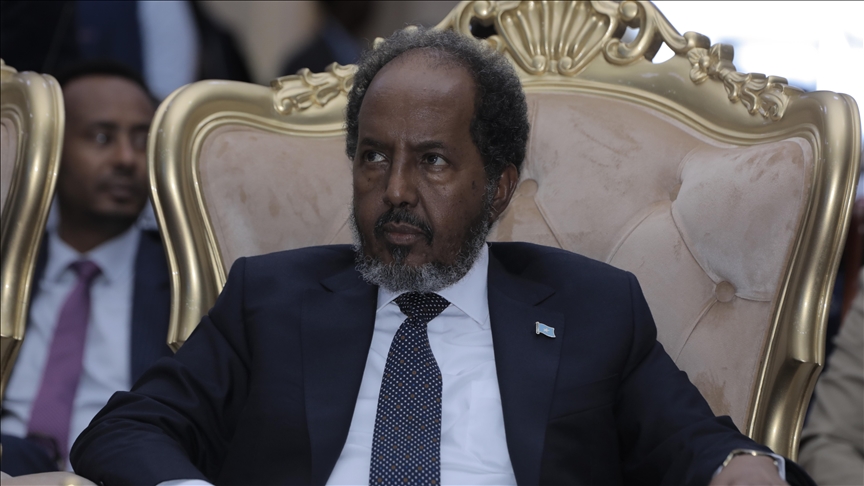
President of Somalia Hassan Sheikh Mohamud


MOGADISHU, Somalia

Somali President Hassan Sheikh Mohamud on Sunday condemned Israeli Prime Minister Benjamin Netanyahu for his "blatant attack" on Somalia's sovereignty and territorial integrity, as well as his "disregard for international law and established norms" during the joint parliament's special session to discuss the issue.

In his address to a special joint session of the federal parliament in the capital, Mogadishu, Mohamud strongly condemned Israel's recognition of the breakaway Somaliland region.

“Such null and void actions risk further destabilizing the Horn of Africa region and reviving extremist elements, undermining the significant gains made in the fight against international terrorism,” the president warned.

He said his country is committed to defending its sovereignty and territorial integrity.

He added that the breakaway Somaliland region will “remain an inseparable part of the Federal Republic of Somalia.”

Mohamud also held a consultative meeting with former national leaders and opposition figures as part of ongoing efforts to strengthen national cohesion and unity in the face of Israel’s violations of the sovereignty and territorial integrity.

Israel became the world’s first country to recognize Somaliland as a sovereign state on Friday, drawing condemnation from Türkiye, a close ally of Somalia, and countries in Africa and the Middle East, among others.

Somaliland, which has lacked official recognition since declaring independence from Somalia in 1991, operates as a de facto independent administrative, political, and security entity, with the central government struggling to assert control over the region and its leadership unable to secure international recognition of independence.

EU backs Somalia’s unity after Israel's Somaliland recognition

The EU said it encourages meaningful dialogue between Somaliland and the Federal Government of Somalia.

The European Union has said respecting Somalia’s unity, sovereignty and territorial integrity is “key for the peace and stability of the entire Horn of Africa region,” following Israel’s recognition of Somaliland as an independent state a day earlier.

In a statement on Saturday, the bloc said it “reaffirms the importance of respecting the unity, the sovereignty and the territorial integrity of the Federal Republic of Somalia,” in line with its constitution and the charters of the African Union and the UN.

The EU said it “encourages meaningful dialogue between Somaliland and the Federal Government of Somalia to resolve long-standing differences.”

The recognition of the Somaliland region by Israeli Prime Minister Benjamin Netanyahu is against international law, Somali President Hassan Sheikh Mohamud said.

“The illegal aggression of PM Netanyahu in recognising a part of Somalia’s northern region is against international law,” Mohamud wrote on X.

“Meddling with Somalia’s internal affairs is contrary to established legal & diplomatic rules. Somalia & its people are one: inseparable by division from afar,” he added.

Israel became the world’s first country on Friday to recognise Somaliland as a sovereign state, drawing condemnation from Türkiye and countries in Africa and the Middle East, among others.

Arab-Islamic Statement Rejects Link Between Israel’s Recognition of Somaliland and Attempts to Expel Palestinians


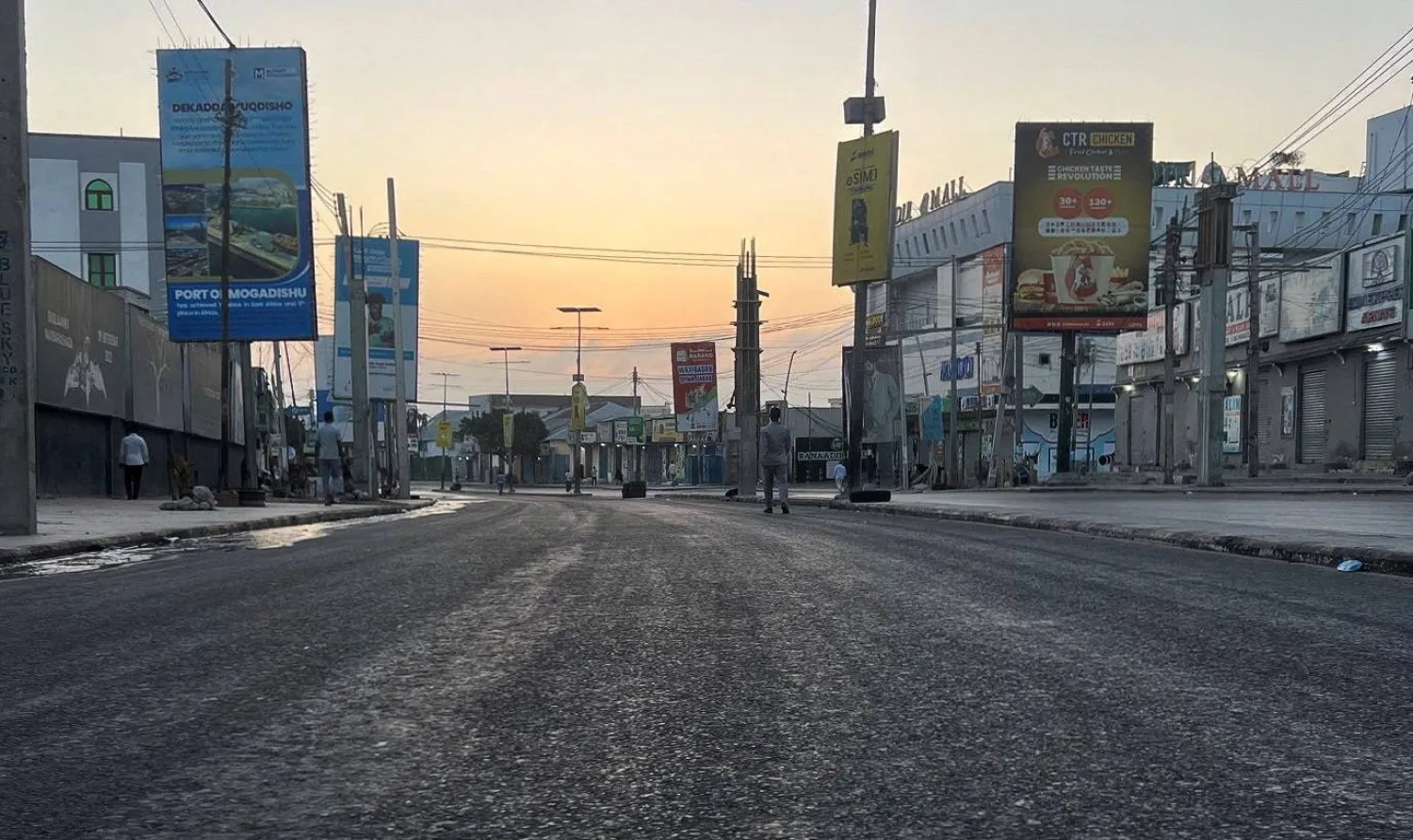
People walk along a street before the opening of polling stations for voting in the municipal elections in Hodan district of Mogadishu, Somalia December 25, 2025. REUTERS/Feisal Omar

Asharq Al Awsat
28 December 2025 
AD ـ 08 Rajab 1447 AH

A growing number of countries are rejecting Israel's recognition of Somalia’s breakaway region of Somaliland as an independent nation, the first by any country in more than 30 years.

A joint statement by more than 20 mostly Middle Eastern or African countries and the Organization of Islamic Cooperation on Saturday rejected Israel's recognition “given the serious repercussions of such unprecedented measure on peace and security in the Horn of Africa, the Red Sea and its serious effects on international peace and security as a whole.”

The joint statement also noted “the full rejection of any potential link between such measure and any attempts to forcibly expel the Palestinian people out of their land.”

Israeli Prime Minister Benjamin Netanyahu’s office said Friday that he, Israeli Foreign Minister Gideon Saar and Somaliland’s president, Abdirahman Mohamed Abdullahi, signed a joint declaration “in the spirit of the Abraham Accords.”

Somalia’s federal government on Friday strongly rejected what it described as an unlawful move by Israel, and reaffirmed that Somaliland remains an integral part of Somalia’s sovereign territory.

African regional bodies also rejected Israel's recognition. African Union Chairperson Mahmoud Ali Youssouf said that any attempt to undermine Somalia’s sovereignty risks peace and stability on the continent.

East African governing body IGAD said in a statement that Somalia’s sovereignty was recognized under international law and any unilateral recognition “runs contrary to the charter of the United Nations” and agreements establishing the bloc and the African Union.

The US State Department on Saturday said that it continued to recognize the territorial integrity of Somalia, "which includes the territory of Somaliland.”


Trump says he’s protecting Nigerian Christians. His admin is blocking them from coming to the US

Trump administration has overhauled nation’s refugee admissions system and severely restricted legal pathways for African immigrants


Alex Woodward in New York
Sunday 28 December 2025
THE INDEPENDENT


The United States launched more than a dozen Tomahawk cruise missiles on Nigeria on Christmas Day after President Donald Trump accused the West African country’s government of failing to protect persecuted Christians.

U.S. military officials said the attack, which they said was coordinated with Nigerian authorities, targeted ISIS-linked groups that Trump has accused of “targeting and viciously killing, primarily, innocent Christians at levels not seen for many years, and even Centuries.”


But the strikes follow the Trump administration’s drastic reduction of the number of refugees admitted into the United States each year, while adding Nigeria to a growing list of countries where travel and immigration into the country has been severely restricted.

Over the last decade, Nigerians received an average of 128,000 immigrant and nonimmigrant visas on an annual basis, nearly all of which will now face severe restrictions, blocking most legal pathways into the country, according to an analysis from the American Immigration Council.

Nigeria, the most populous country in Africa, has long been plagued by violence, and analysts and local officials have argued that Nigerians of many faiths — including Christians and Muslims — have suffered under the web of armed groups in conflicts that the Trump administration has now waded into.


open image in galleryThe US military launched Christmas Day airstrikes in Nigeria after the Trump administration accused the government of failing to stop ISIS-linked groups from targeting Christians (AP)

The Trump administration’s operation appears to follow a months-long narrative from Republican officials and Trump-aligned Christian evangelical groups that Christians are the targets. Last month, the president suggested the United States could enter the country “guns-a-blazing,” and he has since promised more attacks if the “slaughter of Christians continues.”


The Christmas strikes hit Sokoto State, a majority-Muslim area where recent violence is linked to a group called Lakurawa, according to the Armed Conflict Location and Event Data Project. Some analysts have linked the group to the Islamic state while others have argued a connection to a rival al-Qaeda outfit Jama’at Nusrat al-Islam wal-Muslimin.

Trump’s targeting of the area, coupled with the American narrative, is “politically convenient,” according to Mustapha Alhassan, a security analyst in Nigeria who spoke to The Washington Post.


“Nigerians would welcome the help if it was hitting precise targets,” he said. “But that doesn’t seem to be what is happening. All of this is to what end?”

In October, Trump designated Nigeria a “country of particular concern” under the U.S. International Religious Freedom Act.


The largely symbolic label is given to countries that have “engaged in severe violations of religious freedom” and instructs nations to “take targeted responses to violations of religious freedom.”

Nigerian President Bola Ahmed Tinubu has said that the “characterization of Nigeria as religiously intolerant does not reflect our national reality, nor does it take into consideration the consistent and sincere efforts of the government to safeguard freedom of religion and beliefs for all Nigerians.”


open image in galleryThe Trump administration has meanwhile severely restricted Nigerians from traveling into the US and cut off legal immigration pathways as it overhauls the nation’s refugee system (REUTERS)

At the same time, the Trump administration is limiting the number of refugees admitted into the United States each year — and handing most of those limited slots to white South Africans.

Refugee admissions will now explicitly prioritize Afrikaners for resettlement, and the ceiling for admissions has been radically reduced from 125,000 people to only 7,500 for the next year.

The move represents a stark break from a refugee policy informed by humanitarian needs, not ideology or identity, according to refugee resettlement groups.

The administration’s latest expansion of the travel ban bars people from an additional seven countries from entering the United States on immigrant and non-immigrant visas, while Nigeria has been added to a list of countries banned from all immigrant visas and all tourist, student, and exchange visitor visas.


U.S. officials are “using the language of security to justify blanket exclusions that punish entire populations, rather than utilizing individualized, evidence-based screening,” Global Refuge president Krish O’Mara Vignarajah said earlier this month in response to the expanded travel ban.

“Security is essential, but it demands precision,” Vignarajah added. “Blanket bans only serve to weaken our system by replacing careful vetting with collective punishment.”
He billed himself as President Maga. But he loves to be a global tough guy

Despite his America First agenda, Trump is no stranger to foreign entanglements – as shown in Syria, and Somalia, and Yemen, and Venezuela…


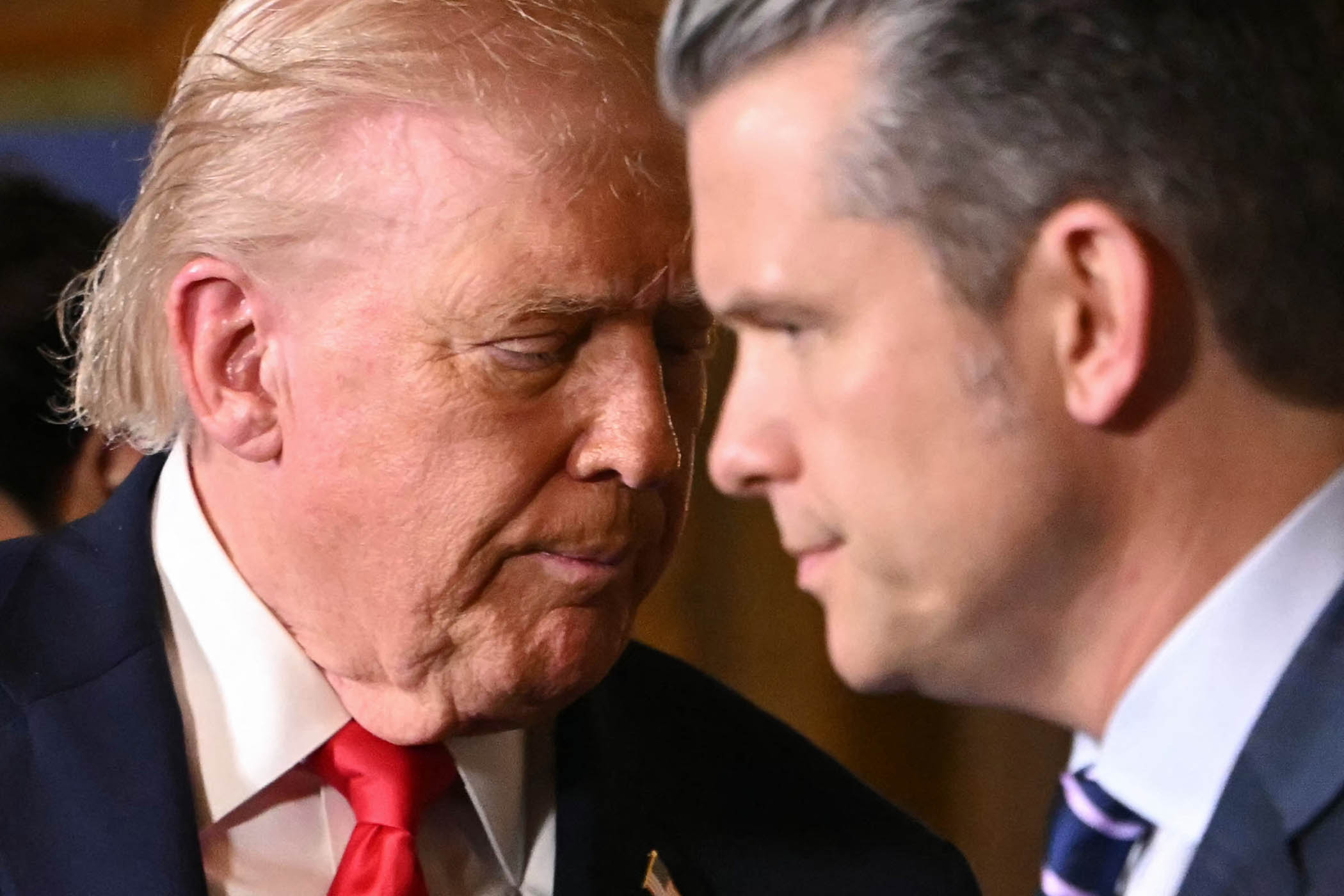
Donald Trump with defence secretary Pete Hegseth

Fred Harter
Reporter
THE OBSERVER
Sunday, 28 December 2025


Donald Trump celebrated Christmas Day by launching Tomahawk cruise missiles against Islamic State jihadists in a remote corner of Nigeria, who were, he said, “viciously killing” Christians.

“I have previously warned these Terrorists that if they did not stop the slaughtering of Christians, there would be hell to pay, and tonight, there was,” Trump said, before wishing the “dead Terrorists” a “MERRY CHRISTMAS”.

The strikes were part of a broader pattern. Despite Trump’s promises to put America first and halt “endless wars”, during his second term he has enthusiastically projected American military strength into far-flung places.

Earlier this month, Trump authorised a “massive strike” against Syria, in retaliation for a jihadist attack against American forces in the country. He has also targeted Iran’s nuclear facilities, launched a bombing campaign against Houthi rebels in Yemen, and ramped up airstrikes in Somalia.

Then there is Venezuela, where Trump is threatening regime change. His administration alleges president Nicolás Maduro belongs to a terrorist group and it has assembled a vast armada in the Caribbean that includes the world’s largest aircraft carrier. US forces have seized two oil tankers and sunk at least 29 alleged drug boats off Venezuela, killing over 100 people.

Analysts are struggling to discern a strategic thread running through these actions. After all, Trump originally won the Republican nomination in 2015 by campaigning against America’s involvement in Iraq and Afghanistan.

“He starts out as this quasi-isolationist. Now he turns out to spend more time on foreign policy than domestic policy,” said Michael O’Hanlon, director of foreign policy research at the Brookings Institution in Washington DC. “Why is this purported Maga Republican interested in every corner of the globe?” One answer is that few American presidents can resist the urge to police the world and deploy military firepower at their disposal, said O’Hanlon. Another is that these moves are aimed at a domestic audience at a time when the president’s approval rating is flagging, rather than effecting change overseas. Targeting Venezuela’s regime plays well with Latin American voters in Florida, while killing Nigerian terrorists in the name of protecting Christians on Christmas Day pleases evangelicals.

In both countries, Trump’s approach has been impulsive. His administration has not clearly outlined what would come after Maduro in Venezuela, and a few cruise missiles will not address the causes of decades of insecurity in Nigeria.

“Force is being used in almost a performative way,” said Leslie Vinjamuri, president of the Chicago Council on Global Affairs. “Trump likes ... being seen as a strong man, and he’s using force to show America is tough, resilient. But there doesn’t seem to be any grand strategy to all this. He doesn’t seem to care about delivering objectives on the ground.”

In this sense, Trump’s use of military might resembles his peacemaking. The US president claims to have solved eight wars. One of these, between Cambodia and Thailand, broke out again a few months after a US-brokered peace deal was signed. Fighting also continues in the eastern Congo, despite an accord agreed in Washington between the Congolese and Rwandan presidents. Another conflict didn’t actually exist: Trump claims to have brought peace between Egypt and Ethiopia, two countries that were not at war.

Despite his America First agenda, Trump is no stranger to foreign entanglements. During his first term he escalated US strikes in Somalia to unprecedented levels, authorised the assassination of Iranian general Qasem Soleimani and backed Kurdish groups against the Islamic State in Syria.

“We’ve forgotten that wherever Trump inherited ongoing wars, he intensified the air campaign,” said Michael Hanna, of the International Crisis Group. “What makes the second term different is that the personnel in place are in no way a check on Trump’s impulses. In fact, they seem to magnify and amplify. There’s a heavy emphasis executing [his] wishes.” Striking targets from the air or sea without putting boots on the ground represents a low-risk, high-reward approach, even if parts of Trump’s Maga base are unsettled at the prospect of US-enforced regime change in Venezuela, and brokering peace deals burnishes the president’s self-image as a deal maker. “I’ve never seen Trump as an isolationist,” said Vinjamuri. “He’s certainly unilateral, and he’s transactional. But he’s always had a very big international agenda, despite the inconsistency of his approach.”


Photograph by Andrew Caballero-Reynolds/AFP via Getty Images
Asylum not found: Why Russians are being deported from the United States

Pyotr Voronov
28 December 2025
THE INSIDER

In early December, the Trump administration sent a fourth planeload of deportees back to Moscow. Russians currently in the United States are increasingly encountering refusals of their requests for political asylum, and the White House has announced that the government is suspending decisions on such applications. These steps are part of a broader trend toward tightening the asylum system, driven by a shortage of immigration judges and strict government quotas on the detention of undocumented migrants.

LONG READ


Content

Special flights to Moscow


From the border to detention


In search of asylum


A quota-driven system


One for all and all for the same thing


Доступно на русском языке


Special flights to Moscow

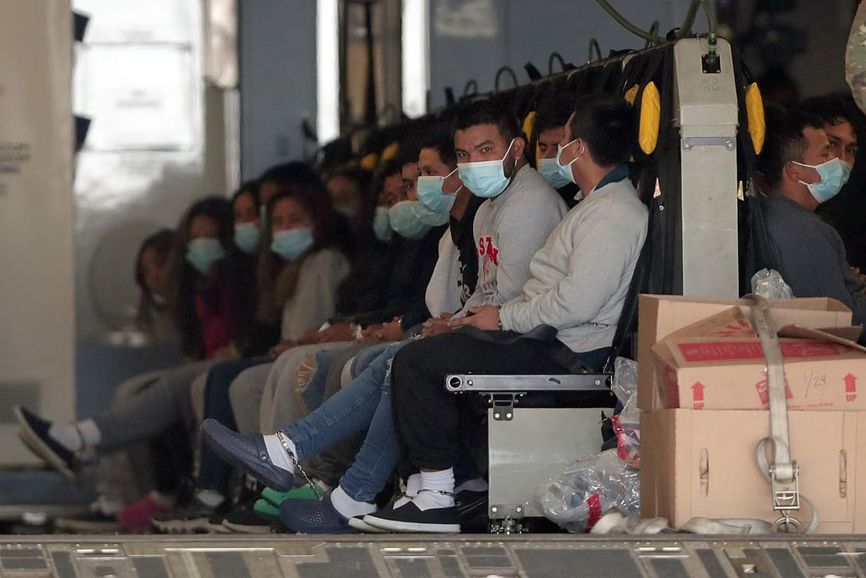
On Dec. 7, a special deportation flight carrying citizens of Iran, Russia, and several Arab countries took off from the United States. At a stopover in Cairo, most of the passengers were transferred to a plane bound for Kuwait, while 60 Russians were escorted to a special flight to Moscow. It arrived in the Russian capital early on the morning of Dec. 9.

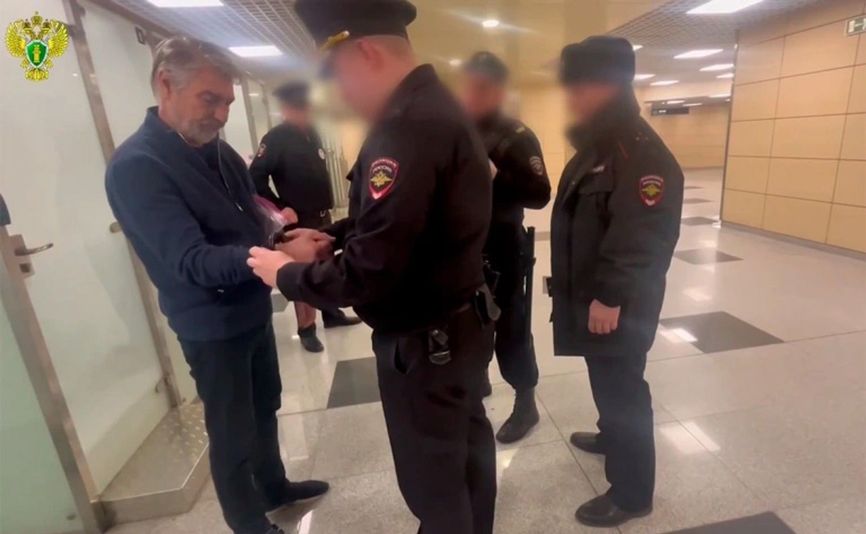
According to Dmitry Valuev, the head of the NGO Russian America for Democracy in Russia, upon arrival in Moscow the deportees were questioned by officers of the FSB, and one of them, Zair Syamiullin, was detained on charges of fraud. Russian men were also handed draft notices requiring them to register with military enlistment offices.


Zair Syamiullin
Russia’s Prosecutor General’s Office


The deportation flight was the fourth since the start of 2025, with earlier iterations occurring in June, August, and September. This is an innovation of the Trump administration, Valuev explains: under Biden and previous presidents, no such deportations of Russians were conducted.

Immigration attorney Lia Djamilova notes that the special flights mark a move towards a new form of equality in America’s approach towards potential newcomers — albeit an undesirable one: “[The United States] has always taken a harsh approach to migrants, but previously you had to be Latin American or African for that to apply. Now they have also stopped handling Russian-speaking and post-Soviet people with care.”

The Trump administration is using special deportation flights to expel migrants from other countries as well. Since the beginning of the year, such flights have sent more than 18,000 people to Venezuela. Immigration lawyer Marina Sokolovskaya believes this practice will only expand: the Department of Homeland Security has already purchased its own Boeing aircraft, and in 2026 the process will likely accelerate “because there will no longer be a need to deal with charter flights.”

Previously, U.S. authorities deported Russian citizens on regular commercial flights or offered them the option of leaving the country on their own, which sometimes made it possible to avoid being sent to Russia.

Previously, U.S. authorities deported Russians on regular flights or offered them the option of leaving the country on their own, which sometimes made it possible to avoid being sent to Russia

“Most Russians are deported in small groups of two or three on regular civilian commercial flights. In the U.S. they are escorted to the plane and sent to a third country. After that, it’s a matter of luck. Some people managed to get away during these transfers,” says attorney Yulia Nikolaeva.

From the border to detention


There are still no exact figures on how many Russians have been deported from the U.S. in 2025. The website of Immigration and Customs Enforcement (ICE) states that since the beginning of the year 127 Russian citizens have been expelled. Immigration lawyers note, however, that these data may be incomplete, and that a fuller picture will only emerge after the annual report is published in early 2026. For comparison: 58 Russians were deported from the U.S. in 2022, 222 in 2023, and 455 in 2024.

The sharp increase in deportations was linked to a decision by the Biden administration to place Russians and citizens of a number of former Soviet states detained at the U.S.–Mexico border into temporary migrant detention centers, unlike migrants from other countries.

“Citizens of other countries continued to be allowed across the border under the CBP One program, while citizens of Russia and five other former Soviet countries were simply kept under arrest without any grounds. When Trump came in, he announced that he was closing the border and the CBP One program, and that everyone who crossed the border would be detained. So Trump’s policy essentially equalized everyone: the new administration treats all immigrants harshly, without a discriminatory focus specifically on Russian citizens,” attorney Nikolaeva told The Insider.

Since 2019, Russians have increasingly used the southern border to enter the U.S. According to Marina Sokolovskaya, whereas five years ago Russian speakers at the U.S.-Mexico border were a rarity, officers with knowledge of Russian, Kyrgyz, and other languages from the former Soviet space are now in high demand.

Officers who speak Russian, Kyrgyz, and other languages of post-Soviet countries are now working at the U.S.-Mexico border

The practice of detentions continued under the Trump administration as well. According to immigration lawyers, once people are placed under arrest, their chances of being released and of having their asylum applications approved drop dramatically. This is due both to the way immigration judges view those detained at the border and to the difficulty of obtaining legal assistance, especially if migrants have no relatives or acquaintances at liberty who could help find an attorney.

As Nikolaeva notes, people in migrant detention centers often waive their right to appeal because it is “inevitably associated with several more months, or even years, of waiting for results. People who are free do not face this problem — they can continue living and working while the appeal is under review.”

Under Trump, the option to apply for asylum directly at the border was also eliminated, and the CBP One app that refugees previously used to schedule an appointment at a border crossing in order to request asylum is now used only to arrange migrants’ self-deportation.

In addition, to reduce the number of potential asylum seekers, an expedited deportation procedure was introduced. If immigration officers determine during the interview that a migrant has failed to demonstrate a risk of potential persecution in their home country, the person is immediately deported — without access to an immigration court.

As a result, the number of people attempting to cross the U.S.-Mexico border in an open manner has fallen sharply. “Compared with several thousand refugees a day under Biden, the number of people seeking asylum has now dropped by several times, to the hundreds per day. Russians make up an extremely small share of them,” Dmitry Valuev explains.

However, some immigration lawyers believe that the authorities may be deliberately understating the statistics on crossings. “The figures are, of course, significantly lower than they were before. But people are still continuing to cross the border,” says Nikolaeva.

In search of asylum

There is also no information on what share of deported Russians were asylum seekers. It is known that since the beginning of 2022, Russian citizens have filed more than 15,000 such applications, of which around 72% were approved in the period up to mid-2024 — one of the highest rates among all nationalities. However, starting in the final months of Biden’s tenure, the share of approved applications began falling towards its current level of 46%, while the share of denials rose to 32%.

According to Valuev’s observations, immigration courts have increasingly been issuing decisions on asylum seekers from Russia that “completely ignored the existing threats these people face in their home country — such as criminal cases, inclusion on Rosfinmonitoring’s list of extremists and terrorists, and placement of these people in wanted databases.”

Attorney Lia Djamilova has also observed a rise in such cases: “Right now I see many Russians who clearly qualify for asylum — it was created for people like them. But they are still denied. I have a feeling that you could be Navalny in an immigration prison in America, and you would still be denied.”

Such denials sometimes force migrants to take extreme measures. Yulia Nikolaeva cites the case of a husband and wife who were held in different detention centers. Both lost their cases, after which the husband wanted to waive his appeal in order to be deported to Russia more quickly and arrested there — his hope was that the American court would then understand the danger his wife faced and approve her appeal to remain in the U.S.

Again, rather than representing a campaign targeting Russians, the current developments appear to be part of a larger trend under Trump 2.0. Approval rates for asylum applications in general fell to 14% in 2025. Over the previous three years, it had averaged 28%.

The White House has already dismissed dozens of immigration judges whom the authorities believe granted asylum too liberally (even as migration agencies are actively advertising on social media for new hires). “Naturally, those who approved asylum applications more often than others are being fired. Right now, you can count on one hand the judges with a high approval rate,” Lia Djamilova says.

The White House has dismissed dozens of immigration judges whom the authorities believe granted asylum to migrants too liberally

To make up for the resulting shortage of judges — who were already struggling to cope with a backlog of hundreds of thousands of applications — the Trump administration decided to bring in military lawyers from the Pentagon. Collectively, they have issued deportation rulings in 78% of cases.

A quota-driven system

Previously, temporary detention centers mostly held asylum seekers and other migrants taken into custody at the U.S.-Mexico border. Now, however, they are now increasingly holding people who have already applied for asylum and were awaiting a decision while living and working in the U.S. In the past, arrests of migrants inside the country were generally linked to cases involving violent crimes. Now only 7% of those detained had previously been convicted of such offenses.

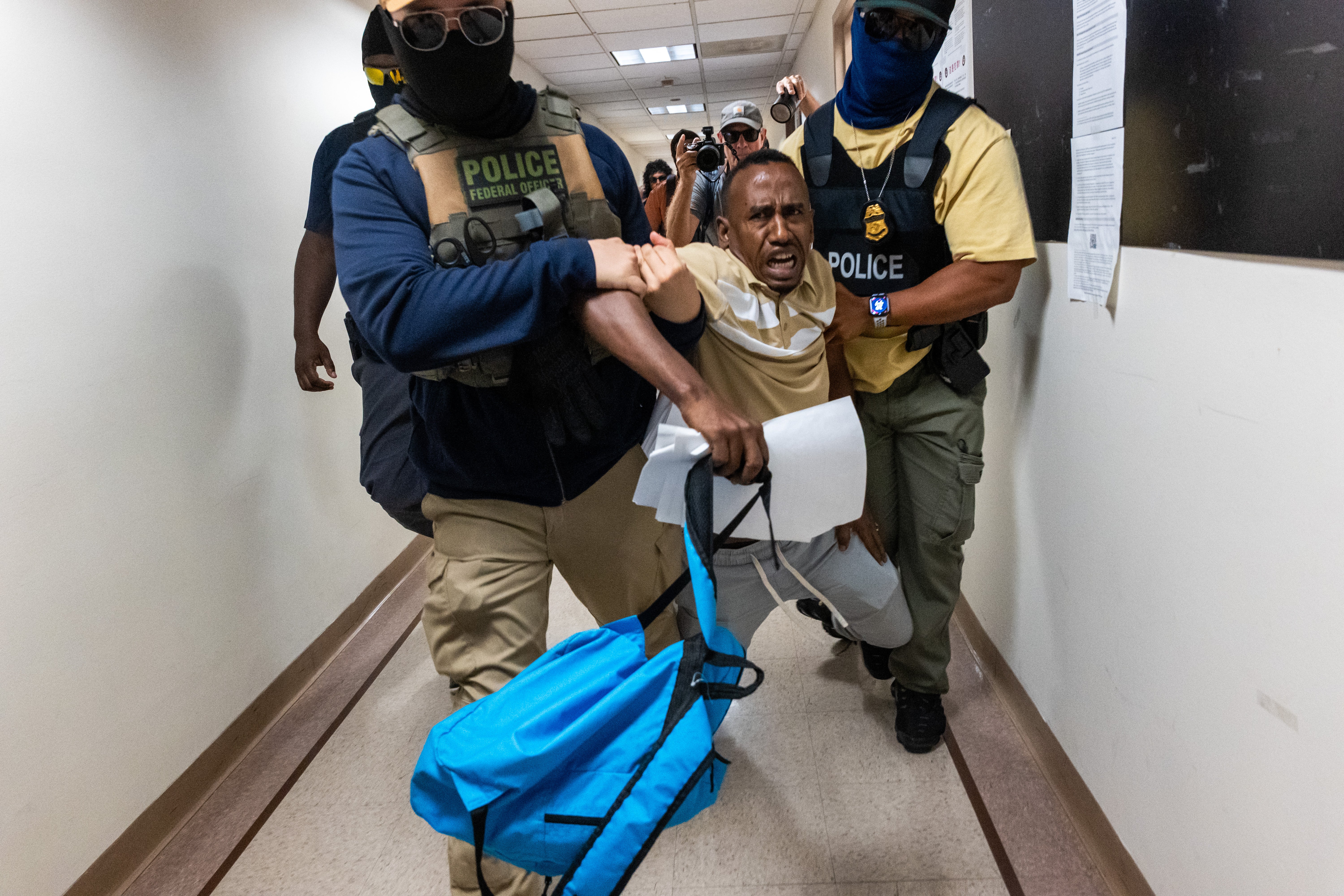
Under Trump, the justifications for detaining asylum applicants include traffic checks, especially of long-haul truck drivers (among whom there are many migrants, including Russians and others from former Soviet countries). In many large cities, migration authorities carry out mass raids directly on the streets, with agents in masks and plain clothes officers taking people away in unmarked vehicles. Because law enforcement officers often focus only on race, they sometimes detain U.S. citizens as well — since the beginning of 2025, at least 170 such incidents have been recorded.

Human rights advocates are also raising the alarm over the growing practice of arrests inside courthouse buildings, where migrants come for scheduled hearings regarding their asylum cases. However, such detentions have gradually ceased due to public outcry.

“Civil society worked well here. People mobilized, large group chats were formed, and they didn’t allow people to be arrested quietly,” Lia Jamilova says. “They explained migrants’ rights, recommended attorneys, and urged them not to sign papers with ICE, because those arrests were illegal. After that, ICE stopped arrests in courts. They realized it was too public and too awkward.”

According to Jamilova , in conversations with her and other immigration lawyers, ICE officers sometimes admit that the reason for detaining their clients is the need to meet performance targets imposed from above:

“They have quotas, but no one to arrest. These officers are climbing the walls, crying crocodile tears in private conversations about being forced to do this. They arrest parents at daycare centers, they arrest people when they come to check in. Because there’s nowhere to find ‘bad’ migrants, they take anyone.”

As early as February, White House deputy chief of staff Stephen Miller was demanding that at least 1,000 migrants be detained every day, and in May the quota was raised to 3,000 people. As a result, people who were previously left alone are increasingly being picked up. Yulia Sokolovskaya gives one such example: “We had a client detained whose husband is currently serving in the U.S. Army and is being sent to combat zones. We managed to get her released, although the chances were 0.5%. ICE officers now have no taboos at all — even military service is no longer an argument, although it had always been considered sacred. As they told us, ‘nothing personal, guys — just numbers.’”

Although ICE has so far failed to meet the target (an average of about 800 people are detained daily), the overall number of arrests has already sharply increased. In an effort to boost staffing levels, the agency’s leadership has lowered recruitment standards and shortened training periods for new agents. To assist with arrests, personnel from the Department of Homeland Security, the Border Patrol, the Drug Enforcement Administration, and even agents from the FBI, the Secret Service, and the Internal Revenue Service are also being deployed.

Against the backdrop of mass arrests of migrants, conditions in temporary detention centers have deteriorated sharply. Since the beginning of the year, the number of detainees has increased by 70%, now totaling more than 66,000 people. Human rights advocates note that migrants are often held in cramped and unsanitary conditions, with many forced to sleep on the floor and deprived of access to doctors and lawyers. Some detainees are placed in solitary confinement for several days or even weeks, in violation of ICE’s own rules.

For example, at the recently opened Fort Bliss center in Texas, 45 migrants were able, through an attorney, to submit a complaint alleging beatings and intimidation by staff. Guards reportedly choked and beat detainees, squeezed their genitals, and threatened them with deportation to Africa or imprisonment in El Salvador.


Human rights organizations have filed a complaint alleging that immigrants at Fort Bliss, Texas are subjected to brutal beatings by guards
AP

Migrants were intimidated with handcuffs, bags placed over their heads, and threats to abandon them in the desert. Several were beaten so severely that they required hospitalization — and after treatment, they were sent to solitary confinement. In total, since the beginning of the year, 30 migrants have already died in such centers, the highest figure recorded over the past twenty years.


One for all and all for the same thing

In late November, Afghan national, Ramanullah Lakanwal opened fire on National Guard service members in Washington, killing one and seriously wounding another. Because the shooter was granted political asylum in 2025, the White House also ordered a pause in decisions on almost all refugee applications processed through USCIS, even for those who entered the US legally — the only allowable exception was for white citizens of South Africa.

Yulia Sokolovskaya notes that the consequences of the attack on the National Guard are already being felt: “This killing completely tied our hands. We had just started to notice that in a number of states the asylum review process had sped up and was finally running smoothly. Now you come to an interview with a client, and they are once again sent back to waiting. It’s unclear how long this may last.”

Although Lakanwal was in the U.S. entirely legally — thanks to his cooperation with the CIA during Operation Enduring Freedom — Donald Trump announced a suspension of the review of all immigration applications filed by Afghan citizens. They were soon joined by citizens of another 38 countries, who were similarly barred from entering the U.S. The suspension led to the cancellation of naturalization ceremonies and interviews for green card applicants, and also stripped citizens of those countries of the ability to extend their work and student visas.

Residents of these countries who already hold permanent resident status in the U.S. are set to undergo repeat screening by immigration authorities, with the possibility that their green cards could be revoked. USCIS also plans to strip several hundred people of U.S. citizenship if it was obtained fraudulently or in violation of existing rules.

On Dec. 13, a mass shooting occurred at Brown University, leaving 11 students dead, and two days later, a professor at the Massachusetts Institute of Technology was killed. The suspect turned out to be Portuguese citizen Claudio Neves Valente. In 2017, he obtained permanent resident status in the U.S. through the green card lottery. Shortly afterward, the Trump administration announced an indefinite suspension of that program.

Immigration lawyers warn that in the race to meet targets handed down from the White House, immigration authorities often detain migrants indiscriminately, significantly increasing the risk of deportation for Russians living in the US.

According to sources speaking with The Insider, the highest risk of deportation now applies to Russians who lack any legal status other than a pending asylum application — especially if they are already in detention. “As a diaspora in the U.S., we need to prepare for tougher restrictive measures and for building a strategy to protect the most vulnerable people,” Dmitry Valuev says.