Sunday, July 11, 2021

Expat pill couriers: Lifeline in medicine-starved Lebanon

Issued on: 11/07/2021 - 
Lebanese pharmacies have staged a nationwide strike to protest the severe shortage of medicine Anwar AMRO AFP

Beirut (AFP)

Barely two hours after Lydia landed from Marseille in France, friends and relatives flocked to her apartment to collect drugs that have vanished from Lebanese pharmacies because of crippling shortages.

They started knocking on her door as early as 7:30 am -- before she even had a chance to unpack two suitcases and a backpack stuffed with medicine she had purchased from France for more than $1,000.

"I didn't even have a chance to sleep, but I understand because there's nothing worse than running out of medicine," especially if you have a chronic illness, the woman in her sixties said from her home in Baabdat, north of Beirut.

Lydia, like many other Lebanese expats, has become a courier for family and friends grappling with a raft of shortages due to what the World Bank has termed one of the world's worst financial crises since the 1850s.

As pharmacies run out of hundreds of medicines, including over-the-counter pain killers, the suitcase of a Lebanese expat, once teeming with gifts and duty-free purchases, now resembles a portable pharmacy.

"I brought everything: antibiotics, medicine for hypertension, cholesterol, diabetes, Parkinson's and cancer as well as many antidepressants," Lydia told AFP.

Her parents also recently flew in from Marseille carrying medicine for 12 people in four large suitcases, she said.

The expat deliveries, Lydia said, remind her of Lebanon's 1975-1990 civil war.

"The crisis has revived wartime reflexes, especially a sense of social solidarity," Lydia said.

But "what is happening today is unprecedented and surreal," she added. "We have never seen such shortages in medicine or fuel... We have never felt this suffocated."#photo1

- Shopping in Cyprus -

Lebanon's foreign currency reserves are fast depleting and the cash-strapped state has started to gradually reduce subsidies on key imports including fuel and flour.

Medicine importers say hundreds of drugs have disappeared from the market, as the central bank owes suppliers abroad millions of dollars and they can no longer open new lines of credit.

For its part, the government accuses importers of hoarding medicine with the aim of selling it at a higher price once medicine subsidies are reduced by the state and drugs become more expensive.

For the Lebanese people, the shortages have triggered a worldwide drug hunt. As for pharmacies, they staged a nationwide strike Friday protesting the lack of supplies.

In the neighbouring island of Cyprus, pharmacists can now spot Lebanese customers scouring for supplies to take back home.

Tracy Najjar made a trip to Cyprus last month with her husband Paul to temporarily escape Lebanon's crisis, but also to stock up on medical supplies.

"The pharmacist immediately guessed we were Lebanese," she said.#photo2

"He told us that another Lebanese couple had come in two days earlier to buy a ton of drugs," she added.

Tracy, who lost her three-year-old daughter Alexandra in the Beirut port blast that killed more than 200 people last summer, said she bought some of the most basic supplies.

They included eye drops, powdered milk, antidepressants and drugs for high blood pressure.

Apart from family and friends, beneficiaries often include strangers who reach out over social media, now a key platform for buying and exchanging medicine.

- Certain death -


President Michel Aoun this month pledged to continue subsidising medication and medical supplies selected by the health ministry on a priority basis.

The central bank has for months urged the health ministry to identify priority drugs, but a list has yet to be finalised.

The central bank said last week it would earmark $400 million to support key products including medicine and flour.

The head of the medicine importers' syndicate said the bank had promised it $50 million a month in subsidies for medicine -- just half of importers' current bills for that period.

Expecting shortages only to worsen, Ahmad, a 58-year-old parking attendant, warned that the situation is turning deadly.

The 58-year-old father of three suffers from high blood pressure and diabetes but can't find the pills prescribed by his doctors.#photo3

"I can not even find the generics," he said.

He tried to do without for a few weeks but his blood pressure quickly climbed.

He reached out to a cousin in Istanbul and a friend in the United Arab Emirates to secure the medication, at a cost much higher than the subsidised prices he would have paid if available in Lebanon.

"We either die because we can't find medicine or we die because we have run out of money after spending it all on drugs brought in from abroad," he said.

"Either way, they are killing us," he added, referring to Lebanon's under-fire political class.

© 2021 AFP
Colorado ranchers face not just drought but rising social pressures


Issued on: 11/07/2021
Cattle rancher Janie VanWinkle, seen standing near a reservoir on her Colorado ranch during a record-hot summer, says drought is only one problem facing fellow ranchers Patrick T. FALLON AFP/File

Grand Junction (United States) (AFP)

"The grass should be up to here," Janie VanWinkle says, holding a hand next to her knee above the scant growth on her ranch in Colorado, which -- just as in 2020, and 2018 -- is again being hit by devastating drought.

"Here we are again," she says, wearing a checkered shirt and a persistent smile that belies her ranch's woes at a time when record high temperatures have been scorching much of the US West.

"The soil moisture is just completely depleted, you can dig down four feet and there's no moisture in the dirt. So that's the cumulative effect that makes it tougher than previous droughts."


But the drought is only one of many challenges facing ranchers, not only in Mesa County where she lives, but across the West.

"The drought's right here in your face, you never get away from that," she says. "So it feels like we are always under attack, whether it's 'fake' meat, wolves, animal rights, environmental issues -- you name it."

Colorado provides a case study of the modern tensions between cities and the countryside, between the metropolis of Denver -- a haven for digital start-ups and progressive movements -- and sparsely inhabited regions where ranchers spend hours on horseback checking on their grazing herds.

Janie VanWinkle, her husband Howard, and their son Dean own about 450 head of cattle, after selling 70 last fall in expectation of the coming drought, and 35 in June as their hay stock began to run low.

They are constantly juggling between buying more feed as its price rises, and selling more cattle.

While the survival of the ranch is not immediately threatened, this will be a bad year: Janie VanWinkle estimates that her cattle will weigh 100 to 120 pounds (45 to 55 kilograms) less than usual when they are sold to feedlots in the fall.

- 'Emotional cost' -

Looking ahead, the most likely scenario "is that these drier conditions will be the norm," said Russ Schumacher, a professor of atmospheric science at Colorado State University.#photo1

"It will take years of above normal precipitation -- not just one year -- to get out of these conditions," he added.

The higher temperatures brought on by climate change are magnifying the consequences of low rain- and snowfall, Schumacher said.

When her son came home from college, Janie VanWinkle recalled, "Dean was like, 'You guys need to be irrigating!'

"But we are! We have been!" she said. "It’s just not doing anything, because it's been so hot."

She worries about what the future holds for her son -- the fifth generation of ranchers in the family -- not just because of the drought but because of an increasing tangle of societal pressures.

In March, Colorado's Democratic governor urged people to observe a day without meat; the state voted in 2020 to reintroduce wolves, which prey on cattle; and real-estate developers and tourism promoters keep buying up prime ranchland.

An NGO that campaigns against animal cruelty recently sought to organize a statewide referendum that would have banned artificial insemination and the slaughter of cattle less than five years old (instead of the more typical age of less than two years).

"All of these things come together and it does create a huge emotional toll on our ranchers and our livestock producers. It's brutal," said VanWinkle, who was the previous president of the Colorado Cattlemen's Association.

In the long run, "social perception is going to change things more than drought," she said. "It's sometimes just totally overwhelming."

- 'Biggest upcyclers' -


Dean VanWinkle, who recently completed his college studies in animal science, remains convinced that the cattle-ranching industry can adapt and survive -- even flourish -- while respecting the environment.#photo2

"Cattle are the biggest upcyclers, really, that there is," he said, referring to their ability to transform hay into protein.

"Ultimately," he added, "cattle themselves are pretty much climate neutral."

That claim is widely disputed. Worldwide, cattle are responsible for 14.5 percent of the greenhouse gas emissions behind climate change, according to the United Nations.

The rate in the United States is lower, however -- four percent, according to the US Environmental Protection Agency.

The American industry boasts that it produces as much meat now as in 1977, but with herds that are 33 percent smaller, owing to progress in genetics and nutrition.

"The producers are extremely adaptive," said Kim Stackhouse-Lawson, who heads a sustainable livestock initiative at Colorado State University in collaboration with the industry.

Among possible developments, she mentioned breeds better adapted to different climates, new technologies like drones or computer-linked "necklaces" to guide cattle, and diversification by ranchers into eco-tourism or hunting expeditions.

"I believe that the future is bright," said Brackett Pollard, who wears two hats, as a rancher and a banker.

"We've learned through the pandemic, where prices were exceptionally high, that people are willing to pay a lot for our product," said Pollard, who raises several hundred head of cattle at his ranch near the town of Rifle.

© 2021 AFP
Walking with Myanmar's anti-junta fighters


Issued on: 11/07/2021 - 
Members of Myanmar's Karenni People Defense Force (KPDF) take part in military training at their camp near Demoso in Kayah state STR AFP

Kayah State (Myanmar) (AFP)

In their camp hidden in the forested hills of Kayah state near the Thai border, Myanmar anti-junta volunteers practice firing their homemade weapons, do physical training, and play guitar in between skirmishes with the military.

Myanmar has been in turmoil since the military ousted Aung San Suu Kyi's elected government in February and launched a bloody crackdown on pro-democracy protests.

In some areas civilians have formed "defence forces" to combat the State Administration Council, as the junta dubs itself, often using hunting rifles or weapons manufactured at makeshift factories.


"I've been away from my family more than three months," one member of the defence force at the camp told AFP on condition of anonymity.#photo1

"I will return home after this revolution."

During that time the group of roughly 60 has fought around twenty skirmishes with the Myanmar military, or Tatmadaw, he said.

Communication is patchy in the country's eastern states, and AFP was unable to verify the number of clashes.

Since the coup, fighting between Myanmar's military and rebel groups in the east of the country has displaced an estimated 100,000 people, the UN said last month.

Locals in Kayah state have accused the military of using artillery shells that have landed in villages.#photo2

That has only hardened resolve to take up arms.

"We will never forget and forgive till the end of the world" reads a tattoo across the neck of one volunteer.

The wooden rifle of another has "Spring Revolution" carved into the butt and barrel in Burmese script.

In a mixture of combat camouflage and T-shirts, the volunteers go on patrol, navigating single track paths through the jagged hills.

They practice firing their motley assemblage of weapons at a makeshift firing range.

During downtime, one plays guitar on a bench while another resting inside a tent checks his weapon.#photo3

More than 890 people have been killed by the junta's security forces since February 1, according to a local monitoring group.

As well as the rise of local self-defence forces, analysts believe hundreds of anti-coup protesters from Myanmar's towns and cities have trekked into insurgent-held areas to receive military training.

The civilian fighters are often outnumbered and outgunned in clashes with Myanmar's military -- one of Southeast Asia's most battle-hardened and brutal.#photo4

But the volunteers are determined to fight on.

"If we all fight, we will win," one told AFP.

"I believe we can win."

© 2021 AFP
G-20 finance ministers back plan to stop use of tax havens

By DAVID McHUGH


1 of 14
 PROTEST PHOTOS
Italian Policemen in riot gears clash with demonstrators during a protest against the G20 Economy and Finance ministers and Central bank governors' meeting in Venice, Italy, Saturday, July 10, 2021. (AP Photo/Luca Bruno)

Top finance officials representing most of the world’s economy have backed a sweeping revision of international taxation that includes a 15% global minimum corporate levy to deter big companies from resorting to low-rate tax havens.

Finance ministers from the Group of 20 countries endorsed the plan at a meeting Saturday in Venice.

U.S. Treasury Secretary Janet Yellen said the proposal would end a “self-defeating international tax competition” in which countries have for years lowered their rates to attract companies. She said that had been “a race that nobody has won. What it has done instead is to deprive us of the resources we need to invest in our people, our workforces, our infrastructure.”

The next steps include more work on key details at the Paris-based Organization for Economic Cooperation and Development and then a final decision at the Group of 20 meeting of presidents and prime ministers on Oct. 30-31 in Rome.

Implementation, expected as early as 2023, would depend on action at the national level. Countries would enact the minimum tax requirement into their own laws. Other parts could require a formal treaty. The draft proposal was approved July 1 in talks among more than 130 countries convened by the OECD.

Italy hosted the finance minister’s meeting in Venice because it holds the rotating chair of the G-20, which makes up more than 80% of the world economy. The event also attracted around 1,000 protesters under the banner “We Are The Tide,” an umbrella group of environmental and social justice activists, including opponents of large cruise ships and the hordes of tourists they bring to the lagoon city. A small group scuffled Saturday with police after breaking away from an approved demonstration area.

The U.S. already has a minimum tax on overseas earnings, but President Joe Biden has proposed roughly doubling the rate to 21%, which would more than comply with the proposed global minimum. Raising the rate is part of a broader proposal to fund Biden’s jobs and infrastructure plan by raising the domestic corporate tax rate to 28% from 21%.

Yellen said she was “very optimistic” that Biden’s infrastructure and tax legislation “will include what we need for the United States to come into compliance” with the minimum tax proposal.

Republicans in the Congress have expressed opposition to the measure. Rep. Kevin Brady of Texas, the top Republican on the tax-writing Ways and Means Committee, has blasted the OECD deal, saying, “This is an economic surrender to China, Europe and the world that Congress will reject.”

The international tax proposal aims to deter the world’s biggest firms from using accounting and legal schemes to shift their profits to countries where little or no tax is due — and where the company may do little or no actual business. Under the minimum, companies that escape taxes abroad would pay them at home. That would eliminate incentives for using tax havens or for setting them up.

From 2000-2018, U.S. companies booked half of all foreign profits in seven low-tax jurisdictions: Bermuda, the Cayman Islands, Ireland, Luxembourg, the Netherlands, Singapore and Switzerland.

A second part of the tax plan is to permit countries to tax a portion of the profits of companies that earn profits without a physical presence, such as through online retailing or digital advertising. That part arose after France, followed by other countries, imposed a digital service tax on U.S. tech giants such as Amazon and Google. The U.S. government regards those national taxes as unfair trade practices and is holding out the threat of retaliation against those countries’ imports into the U.S. through higher import taxes.

Under the tax deal, those countries would have to drop or refrain from national taxes in favor of a single global approach, in theory ending the trade disputes with the U.S. U.S. tech companies would then face only the one tax regime, instead of a multitude of different national digital taxes.

___

McHugh reported from Frankfurt, Germany.
Yellen: Compete on economic strengths, not low tax rates


By DAVID McHUGH  today

1 of 9
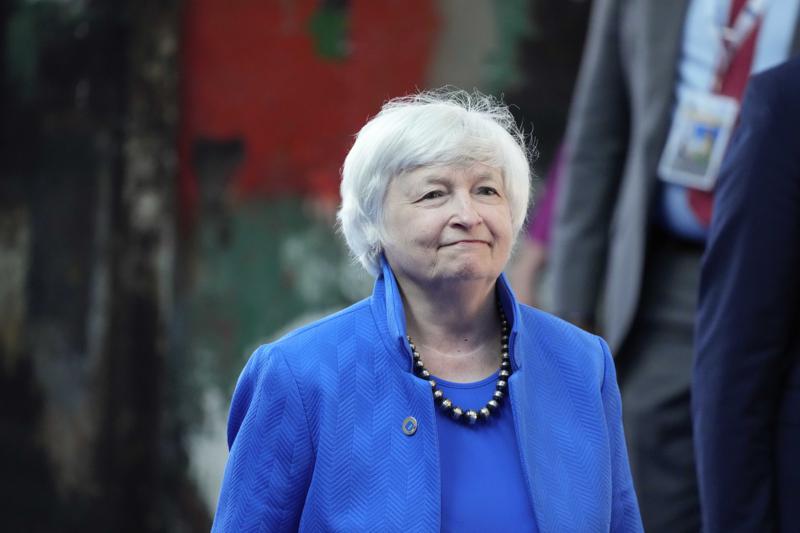
United States Secretary of the Treasury Janet Yellen speaks arrives to attend a press conference at a G20 Economy and Finance ministers and Central bank governors' meeting in Venice, Italy, Sunday, July 11, 2021. (AP Photo/Luca Bruno)

U.S. Treasury Secretary Janet Yellen said Sunday that deterring the use of tax havens will let countries compete on economic fundamentals — instead of by offering ever-lower tax rates that deprive governments of money for infrastructure and education.

Yellen spoke after finance ministers from the Group of 20 major economies endorsed a global minimum corporate tax of at least 15%, a measure aimed at putting a floor under tax rates and discouraging companies from using low-rate countries as tax havens.

“This deal will end the race to the bottom,” she said at a news conference after the end of the meeting in Venice.

“Instead of asking the question: ‘Who can offer the lowest tax rate?,’ it will allow all of our countries to compete on the basis of economic fundamentals – on the skill of our workforces, our capacity to innovate, and the strength of our legal and economic institutions.”

“And this deal will give our nations the ability to raise the necessary funding for important public goods like infrastructure, R&D, and education.”

The global minimum proposal faces political and technical hurdles before it would take effect. Details are to be ironed out in coming weeks at the Organization for Economic Cooperation and Development in Paris, followed by a final endorsement by presidents and prime ministers of the Group of 20 at an Oct. 30-31 meeting in Rome.

Countries would then need to legislate the rate into their own laws. The idea is for headquarters countries to tax their companies’ foreign earnings at home if those earnings go untaxed in low-rate countries. That would remove the reason for using complex accounting schemes to move profits to subsidiaries in low-tax nations where the companies may do little or no actual business.

The U.S. already has such a tax on overseas profits, but the rate is below the 15% minimum. Congressional Republicans have expressed opposition to President Joe Biden’s proposal to raise the rate on overseas corporate profits to 21% to help pay for infrastructure and investments in clean energy. The Democratic president has only a narrow majority in Congress.

Three European Union countries that took part in talks over the minimum tax have refused to endorse the proposal. Ireland, Hungary and Estonia could obstruct adoption in Europe, where tax matters at the EU level require unanimity. Ireland, whose low tax rates are part of its pro-business economic model, has said its 12.5% headline rate is a fair rate.

The tax proposal would also give countries the right to tax part of the profits of big global companies that earn money in their jurisdiction but have no physical presence. Examples would include online retailing and digital advertising.

Some countries, led by France, have already started imposing such taxes on U.S. tech companies such as Google and Amazon. The U.S. considers such taxes to be unfair trade practices and has threatened retaliation through tariffs on imported goods. Under the tax deal, countries would drop those taxes in favor of a single global approach.
Yellen: US regulators to assess risk posed by climate change

By MARTIN CRUTSINGER

1 of 2
United States Secretary of the Treasury Janet Yellen arrives to attend a press conference at a G20 Economy, Finance ministers and Central bank governors' meeting in Venice, Italy, Sunday, July 11, 2021. (AP Photo/Luca Bruno)

WASHINGTON (AP) — U.S. Treasury Secretary Janet Yellen says she will lead an effort by top U.S. regulators to assess the potential risk that climate change poses to America’s financial system, part of a wide-ranging initiative launched by the Biden administration.

Yellen says the regulatory review, which will be done by the Financial Stability Oversight Council, will examine whether banks and other lending institutions are properly assessing the risks to financial stability. She chairs the committee, which includes Treasury, the Federal Reserve, the Securities and Exchange Commission and other financial regulators.

“The current financial system is not producing reliable disclosures,” Yellen said in remarks prepared for the Venice International Conference on Climate and released in Washington.

As part of President Joe Biden’s whole-of-government approach, Yellen said, the council will examine what should be done to improve current regulations on climate-related financial disclosures.

The council was created by Congress in 2010 to improve regulatory coordination in the wake of the 2008 financial crisis.

Banking executives are concerned that the administration’s effort could lead to increased regulatory oversight that will drive up banks’ cost of doing business and lessen their ability to make loans.

Yellen said the United States also intended to enlist the support of the International Monetary Fund, the World Bank and other multilateral development banks to focus more resources on combating climate change. The World Bank and the regional development banks are leading sources of the loans used by poor nations for dams and other development projects.

“Developing countries are particularly vulnerable to climate change with poverty, food security and health outcomes impacted by extreme weather shocks,” Yellen said.

She said the administration is backing international efforts to mobilize $100 billion per year from a variety of public and private sources to support efforts by developing countries to combat climate change.

Yellen said she planned to convene a meeting of the heads of the international lending institutions to discuss ways to better align their efforts with the Paris climate agreement. The Trump administration pulled the United States out of the Paris climate agreement, but Biden reversed that decision after taking office this year.

Since taking over as Treasury secretary, Yellen has been one of the leading voices in the administration to boost government efforts to combat climate change.

The administration is also making a big push to include huge investments to slow global warming in the multitrillion-dollar infrastructure spending measures Biden is pushing Congress to approve. That effort has run into Republican opposition with various Biden climate initiatives striped out of a bipartisan infrastructure measure.

Environmentalists say a larger, Democratic-only package that is now being developed needs to meet Biden’s ambitious climate promises such as moving the country to carbon-free production of electricity and becoming a global leader in use of electric vehicles and the creation of millions of jobs in solar, wind and other clean-energy industries.

The Venice international conference on climate Sunday followed a meeting of finance officials from the Group of 20 major economies in Venice on Saturday. That group backed a sweeping revision of international taxation that includes a 15% global minimum tax on corporations to deter big companies from seeking out low-rate tax havens.

The measure is scheduled to be a key agenda item when Biden and other G-20 leaders meet for a summit in Rome on Oct. 30-31.
Boris Johnson’s £11.6bn climate fund to be swiped from aid budget

Exclusive: UN agreement says money should be ‘new’ – making UK stance like ‘a bailiff leaving a bunch of flowers’, prime minister told

Rob Merrick
Deputy Political Editor@Rob_Merrick

Boris Johnson’s promise of more than £11bn to help poorer countries adapt to the climate emergency will be paid for by even deeper cuts to the UK’s other overseas aid projects, The Independent has learned.

Failure to provide fresh funding leaves the prime minister’s claim to be leading the world on the environment in tatters ahead of hosting the Cop26 summit in the autumn, campaigners say.


It also breaks a United Nations-brokered agreement that the cash must be “new and additional”, they claim, with one likening it to “a bailiff leaving a bunch of flowers”.

The government has been criticised on all sides for its existing £4bn-a-year aid cuts, with a project in Malawi to help farmers adapt to climate change among the latest to have fallen victim. At least three similar schemes are expected to follow.

The World Health Organisation has already warned that “hundreds of thousands of people” will die from the cuts, amid fury that MPs have been denied the vote on the move they were promised.

Recommended
Boris Johnson must ‘turn rhetoric into action’ to tackle climate and nature crises, says top scientist

Government told to ‘stop dragging heels’ amid delay to net zero review


In Cornwall last month, the prime minister hailed his £11.6bn climate commitment to the developing world – spread over 5 years – and vowed to pester other countries to stump up cash before Cop26 in Glasgow.

“We, as the rich nations of the Earth, we need to build our credibility with those countries in asking them to make cuts in CO2,” he said- in relation to contributions to a hoped-for $100bn UN annual fund.

“Because this country, which started the Industrial Revolution, is responsible for a huge budget of carbon that’s already in the atmosphere.”

But the government has now quietly conceded that the entire £11.6bn – worth around £2.3bn each year, between 2021 and 2026 – will come from official development assistance (ODA), the aid budget.

Mr Johnson is already under fire for breaking a promise to give MPs a vote on the decision to slash aid spending from 0.7 to 0.5 per cent of national output, swiping £4bn a year from the pot.


Catherine Pettengell, UK director of the Climate Action Network, said the promise of “new and additional” resources for the flagship UN Climate Adaptation Fund was being broken.

“Reducing the aid budget, while at the same time drawing on it as the only source of climate finance, will inevitably harm the most vulnerable in society,” she said.

Tracy Carty, Oxfam’s senior climate adviser, said: “We welcome the UK’s commitment to climate finance, but when it’s coming from a declining aid budget it’s a bit like your bailiff leaving a bunch of flowers.”

And Preet Gill, the shadow international development secretary, condemned “empty greenwashing” that would hit “the world’s most vulnerable people and weaken their ability to take action on the climate crisis”.

The revelation that no new money will be made available comes after the government’s independent climate advisers warned the aid cuts are already “undermining” the climate finance pledge.

The Prosper (Promoting Sustainable Partnerships for Empowered Resilience) project in Malawi is working with farmers to “reduce the impact of climate shocks” through new agricultural practices, better irrigation and early warning systems.

But the £25m scheme, funded from the government’s Building Resilience and Adapting to Climate Change (BRACC) programme, has now been axed, despite being given an A** rating – forcing staff redundancies and the closure of four district offices.

“The cut has dealt a severe blow to our efforts to build the resilience of extremely poor communities in Malawi to adapt and cope with climate shocks such as droughts,” said Danny Harvey, executive director of the aid agency Concern Worldwide.

The world’s richest countries first committed to spending $100bn a year on a Climate Adaptation Fund to help poor nations adapt to global heating way back in 2009 – but only $79bn has been raised.

The UK is seen as being “somewhere in the middle” of the G7, behind France, Germany, Japan and Canada, but ahead of the US and Italy.

The fund recognises the “guilt” of industrialised nations – for centuries of carbon emissions – and is meant to help developing countries protect themselves against the devastating effects of global heating, while cutting their own emissions.

At Cancun in 2010, the Cop16 summit, rich countries promised funding would be “new and additional”, noting the “urgent and immediate needs of developing countries that are particularly vulnerable to the adverse effects of climate change”.

But the government has now revealed that the entire £11.6bn counts as ODA – meaning no extra funding will be brought forward.

Furthermore, only £1.4bn will be allocated to climate finance in 2021-22, raising fears that most of the spending will be left to the end of the five-year period.

But, in Cornwall, Mr Johnson suggested the UK had gone as far as it intends to, saying: “We are now asking other countries to make a change.

“We are going to be on everybody’s case between now and the summer, and on into the autumn, to get those commitments and to make sure that we get the world into the right place for Cop.”

The Foreign Office defended the arrangement on the grounds that the “international climate finance commitments are new and additional to any previous commitments” to the UN fund.

“While the seismic impact of the pandemic on the UK economy has forced us to take tough but necessary decisions, the UK aid budget this year will still be more than £10bn, making us one of the biggest donors in the G7,” a spokesperson said.
Philanthropists including Bill and Melinda Gates pledge £100m to cover part of UK foreign aid cut


Billionaires stepping in to partially restore the UK’s foreign aid budget has been described as ‘embarrassing’

Lamiat Sabin@LamiatSabin


The Bill and Melinda Gates Foundation is reported to be one of the world’s largest charities
(AP)


The government is under increasing pressure to reverse its multibillion-pound cut to foreign aid, after a group of charities and super-rich philanthropists pledged to help plug the gap with emergency funds.

Criticism of the government’s cut, which equates to a shortfall of £4 billion a year, came from Labour and the Archbishop of Canterbury.


It comes after a report revealed that the consortium of charities, which includes the Bill and Melinda Gates Foundation, will today pledge more than £100 million to a one-year plan to partially replace the cuts

The donation by the charities – including the Children’s Investment Fund Foundation, the ELMA Foundation and Open Society Foundations – is to target projects tackling preventable diseases and offering family planning, according to The Sunday Times.

The UN’s family planning agency (UNFPA) is set to lose about 85 per cent of its funding from the UK, a cut of approximately £130m.

Prime minister Boris Johnson’s government had announced in November last year a reduction in foreign aid from 0.7 per cent of national income – which is enshrined in law – to 0.5 per cent.

The government said the financial impact of the Covid-19 pandemic had forced ministers to take “tough but necessary decisions”.

As a group of about 50 Tory MPs, including Mr Johnson’s predecessor Theresa May, continues to demand a Parliamentary vote on the government’s decision to slash the foreign aid budget

The emergency funding from the charities was welcomed by the Archbishop of Canterbury, Justin Welby, who said it was “desperately needed”, but he called on the government to restore its commitment to spend 0.7 per cent of national income on foreign aid.

Labour’s shadow international development secretary Preet Kaur Gill said the philanthropists’ decision to step in had embarrassed the UK.

“This is a shameful moment for this Conservative government,” Ms Gill said in a statement.

“As low income countries continue to battle against the pandemic, this contribution to try and plug some of the gap left by the government’s slashing of life saving paid programmes is welcome, but it will only be able to prevent the very worst of the damage caused.

“The government’s decision to cut the aid budget, against the wishes of Parliament, has already cost lives and they must reverse it or put to a vote as soon as possible.”

A government spokesperson has said that the UK will “return to spending 0.7% of GNI [gross national income] on international development as soon as the fiscal situation allows.”
US alarmed as Saudi lawsuits threaten to expose secrets


Issued on: 11/07/2021 - 
Former Saudi spymaster Saad Aljabri has alleged in a lawsuit that Saudi Crown Prince MBS has sent assassins to kill him in Canada where he lives in exile -
 Aljabri family/AFP/File


Riyadh (AFP)

Two lawsuits pitting Saudi Arabia's de facto ruler against a former intelligence czar threaten to expose highly sensitive US government secrets, prompting Washington to consider a rare judicial intervention, documents show.

The cases in US and Canadian courts centre on corruption allegations levelled by state-owned Saudi companies against Saad Aljabri, a former spymaster who long worked closely with American officials on covert counterterrorism operations.

That marks the latest twist in a long-running feud between Crown Prince Mohammed bin Salman (MBS) and Aljabri.

Aljabri's patron, Prince Mohammed bin Nayef (MBN), is currently in Saudi detention after being deposed as heir to the throne in a 2017 palace coup.

The legal drama sheds light on Shakespearean rivalries in the top echelons of the Saudi royal family, but Washington fears that a bitter courtroom showdown risks exposing sensitive information related to its covert operations.

A rare US Justice Department filing in a Massachusetts court in April noted Aljabri's intention to "describe information concerning alleged national security activities".

"The (US) government is considering whether and how to participate in this action, including if necessary and applicable, through an assertion of appropriate governmental privileges," the filing said, without elaborating.

In a second filing a month later, the Justice Department asked the court for more time as national security matters require "'delicate' and 'complex' judgements by senior officials".

The filing said the government was prepared to "provide further information" to the court in secret.

Legal experts have said Washington could invoke the "state secrets privilege", which would allow it to resist a court-ordered disclosure of information deemed harmful to US national security.

The CIA declined to comment to AFP. The Justice Department, which experts say only rarely intervenes in civil lawsuits, did not respond to a request for comment.

- 'Vendetta' -


Last year, Aljabri alleged in another lawsuit that MBS sent "Tiger Squad" assassins to kill him in Canada, where he lives in exile, while detaining two of his children to pressure him to return home.

The feud took a new turn this March when state-run company Sakab Saudi Holding accused Aljabri of embezzling $3.47 billion while working at the Ministry of Interior under MBN. It urged the Massachusetts court to freeze his $29 million Boston property assets.

This came weeks after multiple state-owned companies sued Aljabri in Toronto on similar allegations. A Canadian court subsequently announced a worldwide freeze of Aljabri's assets.

While denying any financial wrongdoing, Aljabri's legal team says he is caught in the rivalry between MBS and MBN, who has not been publicly seen since his detention in March 2020.

State-run Sakab, which court filings say was established in 2008 by MBN, was part of a network of front companies to provide cover for clandestine security operations with the United States.

In order to prove his innocence, the court would need to probe Sakab's finances, including how they were used to "finance sensitive programs" operated in partnership with the CIA, the US National Security Agency and the US Defense Department, said a filing by Aljabri.

"Dr Saad would never expose covert counterterrorism projects that saved thousands of lives, including Americans," a source close to the former spymaster told AFP.

"Unfortunately, MBS's blind vendetta against Dr Saad has cornered him in a position where he is compelled to do so in order to defend himself in court."

- 'Endanger lives' -

While the Justice Department considers moves to prevent any disclosure of state secrets in Massachusetts, it remains unclear how it could do the same in the Ontario court, over which it has no direct sway.

The Aljabri source acknowledged any exposure could endanger "those who participated in (counterterrorism) operations, reveal sources and methods, and hinder... similar operations in the future".

A US lawyer representing MBS declined to comment on the litigation.

But a source close to the Saudi leadership repeated multi-billion dollar corruption allegations, while accusing Aljabri of "poisoning the Saudi-US relationship".

Several US officials who have worked alongside Aljabri have voiced support for him, with some acknowledging that he was privy to sensitive information.

"Dr Saad worked directly with at least the CIA, FBI, Department of Homeland Security, White House, Department of State, and Department of the Treasury," former CIA official Philip Mudd wrote in a US court affidavit.

"When the United States had actionable intelligence or tactical information, we gave it to Dr Saad."

In its April filing, the Justice Department said it anticipated engaging with both sides to understand their positions, suggesting it was keen for an out-of-court settlement.

"The more important thing for me is that MBS is holding Dr Saad's kids, essentially extorting Dr Saad," Daniel Hoffman, a former director of the CIA's Middle East division, told AFP.

"That's very much against the humanitarian values of the United States."

© 2021 AFP
'Not worth it': LA restaurants boost pay to lure wary workers

Issued on: 11/07/2021 -
Los Angeles restaurants wanting to land a qualified worker increasingly have to stand out from the crowd Frederic J. BROWN AFP/File
4 min
ADVERTISING


Los Angeles (AFP)

Businesses have reopened in Los Angeles and elsewhere in the United States, with "We're hiring" signs everywhere. But if life has a pre-Covid feel, a new challenge has arisen for restaurants: workers are not willing to return at any cost.

"We are dealing with a staffing shortage that I have not experienced in my career," said Skyler Gamble, a manager at Acme Hospitality, which oversees several restaurants in Santa Barbara around two hours' drive north of Los Angeles.

"Our experience in the last six to nine months as business levels have rebounded, is that fewer and fewer candidates respond to job postings."

The hospitality industry was slammed by coronavirus and pandemic-related restrictions, shedding millions of jobs.

But any restaurateurs counting on a return to normal have experienced a rude awakening.

Classified ads abound on the internet -- waiters, cooks and bartenders are in high demand.

But in a major shift in power, employers wanting to land a qualified worker increasingly have to stand out from the crowd.#photo1

Craig Martin, who owns Cafe 50's on Santa Monica Boulevard in Los Angeles, has to replace a cook. Faced with a lack of applications, he is offering a $2,000 hiring bonus -- $500 per month over four months.

Like many who are trying to hire, Martin blames pandemic-related unemployment benefits for the apparent labor shortage.

Many former service industry employees are "not even thinking to look for jobs," he said.

- 'Not rushing back' -

The reality is more complex, said Enrique Lopezlira, director of the low-wage work program at the UC Berkeley Labor Center.

Employers complaining about the market should acknowledge that they are simply unable to find workers "at the wage and quality of job" they are willing to offer, he said.#photo2

Many hospitality workers do not receive paid sick leave or health care benefits, and are "still not willing to come back into the labor force because they still feel very much at risk of the virus," particularly with Covid variants spreading, he said.

The issue of childcare, especially during the summer months, is also affecting women's return to the workplace.

For University of California Berkeley economist Sylvia Allegretto, there is "definitely not a worker shortage."

"But employers find it strange that workers are taking their best options as the economy opens up and not rushing back to the lowest paying jobs with low to no benefits," said Allegretto.

- 'Abused at work' -


Before the pandemic, Kenzie McMillan worked as a waitress at a Hollywood restaurant.

Overnight in March 2020, she lost her job with "no heads up, no warning," and without compensation.

When her former boss called in June last year asking her to return, she said no. Going back to work would have meant losing her unemployment benefits, and she feared passing the virus to a housemate who has an autoimmune disease.

"It's not worth it, again I wasn't getting paid enough," said the 27 year-old, who did not get medical insurance at the restaurant job, and was getting "tired" from the physical demands of the work.

For Allegretto, it is clear that employers are going to have to "up their game to compete for workers."#photo3

Both Acme Hospitality and Martin -- of Cafe 50's -- said they have increased their wages.

But it is "hard to forecast" whether the improved pay and benefits currently on offer in many establishments will remain once the economy fully recovers, which is not likely until late next year, said Lopezlira.

"The whole workforce has changed," said McMillan, who sees parallels with the #MeToo movement.

Women were exploited "for so long until they were like, 'oh, actually I don't have to do this and I can actually say no,'" she said.

McMillan found a new job in April, at a trendy Hollywood hotel, where she is paid $17.50 an hour and finally has medical insurance.

"We've realized that we don't actually have to be abused at work," she said.

© 2021 AFP
Six years a slave: Indian farm workers exploited in Italy


Issued on: 11/07/2021 - 
In the Agro Pontino, a major hub for greenhouse farming, floriculture and buffalo mozzarella production, Indians have been a presence since the mid-1980s 
Filippo MONTEFORTE AFP/File

Sabaudia (Italy) (AFP)

When Balbir Singh refers to his ordeal, he uses the Italian word "macello", which roughly translates as "mess" -- but it is hardly enough to convey what the migrant Indian farm worker has endured.

For six years, he lived in what can only be described as slave-like conditions tending cattle in the province of Latina, a rural area south of Rome that is home to tens of thousands of Indian migrant workers like him.

"I was working 12-13 hours a day, including Sundays, with no holidays, no rest," Singh told AFP.

The farm owner paid him 100 to 150 euros ($120 to $175) a month, he said, which amounts to less than 50 cents an hour.

The legal minimum for farm workers is around 10 euros an hour.

Singh was rescued by a police raid on March 17, 2017 after appealing for help via Facebook and WhatsApp to local Indian community leaders and an Italian rights activist.

Officers found him living in a caravan, with no gas, hot water or electricity, and eating the leftovers that his boss either threw in the bin or gave to chickens and pigs.

Singh had to wash in the stables, with the same hosepipe he used to clean cattle, and it was made clear to him he should not complain.#photo1

"When I found a lawyer ready to help me, (the owner) told me... 'I'll kill you, I'll dig a hole, throw you in it, and fill it up'... he had a gun, I saw it," he recalled.

Singh said he was beaten up a couple of times, and had his identity papers taken away.

His former employer is now on trial for labour exploitation, while Singh is living in a secret location for fear of retribution.

- Brutal exploitation -


Singh's story is extreme, but it fits into a wider picture of brutal exploitation of migrant farm labourers in the Agro Pontino -- the Pontine Marshes, the plain around Latina -- and elsewhere in Italy.

The UN's special rapporteur on contemporary forms of slavery estimated in 2018 that more than 400,000 agricultural workers in Italy risk being exploited and almost 100,000 likely face "inhumane conditions".

Last month, a 27-year-old from Mali collapsed and died in the southeastern Apulia region after working a day in the fields in temperatures of up to 40 degrees Celsius (104 degrees Fahrenheit).

In the Agro Pontino, a major hub for greenhouse farming, floriculture and buffalo mozzarella production, Indians have been a presence since the mid-1980s.

They work on land drained from marshes in the 1930s, one of the biggest public works projects enacted under dictator Benito Mussolini.

Sociologist Marco Omizzolo, the rights activist who helped free Singh, says between 25,000 and 30,000 Indians live in the Agro Pontino, mostly Sikhs from the Punjab region.#photo2

Under an illegal but well-established system, they live under the thumb of "caporali", the gangmasters who recruit farm labourers on behalf of land owners.

Typically, they are offered contracts but then are paid for only a fraction of their work.

"You may work 28 days, but they'll mark only four on your pay slip, so at the end of the month you may get 200, 300 euros," Omizzolo told AFP.

"Formally, it is all by the book," he added.

The reality is far grimmer, as shown by a recent police investigation that offered fresh evidence of widespread opioid abuse among the Indian community.

That operation led to the arrest of a doctor in the beach town of Sabaudia. He was accused of illegally prescribing more than 1,500 boxes of Depalgos, a powerful painkiller containing Oxycodone and given to cancer patients, to 222 Indian farm workers.

"The drug presumably allowed them to work longer in the fields by relieving pain and fatigue," Latina chief prosecutor Giuseppe De Falco told AFP.

- 'Fight for rights' -

The problem of exploitation of farm workers has not gone unnoticed in parliament. It was under an anti-caporali law passed in 2016 that Singh's employer was prosecuted.

But unions say there are still too few checks and labour inspectors to enforce the law properly.

Sociologist Omizzolo, who works with the Eurispes think tank, spent years researching farm labour abuse in the Latina area -- some of it undercover.

He lived for three months in Bella Farnia, a village mostly occupied by Indians, working incognito in the fields.#photo3

He, too, now lives under police protection, after several death threats.

In 2019, he was given a knighthood by President Sergio Mattarella in recognition of his "courageous work".

In 2016, the sociologist was instrumental, along with the Flai Cgil trade union, in organising the first-ever strike of the Agro Pontino's Indian workers.

Since then, their hourly pay has risen from three euros or less per hour to around five euros -- although this is still only half the legal minimum.

Omizzolo recognises the working conditions are still far from ideal. But the protest, he said, made the Indians understand that "it pays to fight for your rights."

© 2021 AFP


Sotheby's sells diamond for $12.3 million in crypto, most expensive digital currency transaction ever

Sotheby's sold a Banksy artwork for $12.9 million worth of cryptocurrency in May

Sotheby's just set the world record for the most expensive piece of jewelry ever sold for cryptocurrency, auctioning off a 101.38-carat diamond for $12.3 million of either Bitcoin or Ether on Friday.


The cryptocurrency sale of the pear-shaped D Flawless diamond, named "The Key 10138," shows Sotheby's "commitment to innovation," the company said.

"Diamonds are keys to understanding the history of the Earth, reminding us of our human condition and the transcendental power of beauty," Wenhao Yu, Deputy Chairman of Sotheby’s Jewellery in Asia, said about the sale.

"With the name ‘The Key 10138,' we wanted to celebrate this enlightening virtue, while also alluding to the crucial function of digital keys in the world of NFTs and cryptocurrency."

The Key 10138 is one of only ten diamonds with more than 100 carats to ever come to auction and is the second largest pear-shaped diamond to ever appear on the public market. (Photo courtesy of Sotheby's)

The auction house accepted Bitcoin or Ether through Coinbase, a cryptocurrency exchange that went public earlier this year.

It's far from Sotheby's first foray into cryptocurrency.

In May, during an auction headlined "DISRUPTOR OF ART MEETS DISRUPTOR OF FINANCE," Sotheby's sold a piece of artwork by Banksy for $12.9 million in cryptocurrency.

A month before that, Sotheby's accepted cryptocurrency for a batch of non-fungible tokens, or NFTs, which are unique digital assets that use blockchain technology to verify scarcity.
Can Europe escape Gazprom's energy stranglehold?

When it comes to gas supplies to the EU, Russia's state-owned corporation steps on the brakes. Is Russia building up political pressure in order to push through the operation of the Nord Stream 2 pipeline?


Europe needs Russian gas to stay warm when temperatures drop


Trouble is brewing on the European gas market. In the wake of a long, cold winter, natural gas reservoirs are unusually low and should, in principle, be refilled very quickly. Russia's state-owned corporation Gazprom could increase supplies.

The market leader, however, has not done that, despite prices recently reaching a 13-year high. In turn, there is growing concern across Europe that there may be insufficient gas supplies for the upcoming winter.
No additional transit through Ukraine

Gazprom has not booked any additional gas transit through Ukraine in July, although deliveries of Russian natural gas to the EU will drop by more than 2 billion cubic meters this month.

Due to scheduled maintenance, the two remaining transportation routes to Germany will be temporarily discontinued. The Yamal pipeline across Belarus and Poland was shut down this week, and the much larger Nord Stream pipeline through the Baltic Sea will be closed between July 13 and July 23.

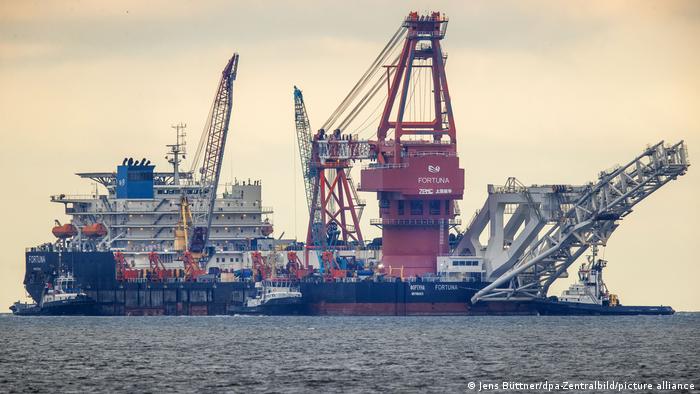
Russia's "Fortuna" vessel is one of two ships which are laying pipes for the controversial Nord Stream 2 pipeline


"It appears Gazprom not only optimizes price and quantity, but that it would rather exert pressure in order to ensure completion of the Nord Stream 2 pipeline," Joachim Endress, head of the Berlin-based consulting firm Ganexo, observes in his second-quarter 2021 Gas Market Report.

Gazprom insists that it fulfills all its obligations.

"Long-term contracts are the basis of our business in Europe. We strictly fulfill our customers' orders, and we book transit capacities accordingly, not vice versa," the corporation's press department told DW.
Unusually empty natural gas reservoirs in Germany, Austria

Gazprom's fulfillment of its contractual obligations has not been challenged. The question remains why the corporation was not — despite high demand and prices — increasing its supplies to Europe and what exactly it was doing to fulfill those obligations, Heiko Lohmann, a Berlin-based independent gas market expert, told DW.

"What's notable, and this is really something new, is that Gazprom obviously fulfills its contracts by taking significantly more gas than usual from reservoirs in Europe and, possibly, even by purchasing trading quantities on the European market. At least, that's what I hear from dealers," Lohmann said.

As a result of this approach, Gazprom's two most important reservoirs in Europe — the first, the largest in the EU, in the northwestern German town of Rehden, the other, in the western Austrian town of Haidach — were almost totally depleted at the beginning of summer, and replenishment has only just begun. "This is utterly unusual for Gazprom and calls for political interpretation," the expert said.

Nord Stream 2 'crucially important' for EU energy security

No secure supply without Russia


Such interpretation can be found rather easily in official Russian media. State news agency Novosti offered the following explanation for the strategy and tactics of the state-owned Russian gas corporation: "During the assessment of any move by the corporation on the European market one should always bear in mind one crucial fact: Gazprom must finish construction of the Nord Stream 2 pipeline."


Austria's largest natural gas reservoir is located in Haidach, near Salzburg


The Novosti article straightforwardly recognizes that "Russia withholds its supplies" and not just with the aim of replenishing both corporation and public coffers. "The second — and no less important — aim is to accustom our Western partners to the obvious idea: guaranteeing their own security of supply is only possible in close partnership with Russia."

It appears, at the moment, that Europe will, via Ukraine, only receive as much gas as stipulated in the Russian-Ukrainian five-year transit contract concluded at the end of 2019. For Gazprom, it makes no sense to provide less as the booked quantity must be paid completely either way. The corporation, however, also doesn't want to book additional capacities at a much higher charge.
Political pressure from Moscow in favor of Nord Stream 2?

The contract, however, stipulates that during the first year, 2020, transit quantities should amount to 65 billion cubic meters, but that they are reduced thereafter, in 2021 to 2024, to 40 billion cubic meters annually, since Gazprom assumed at the time of signing that construction of Nord Stream 2 would be completed — which was thwarted by US sanctions.

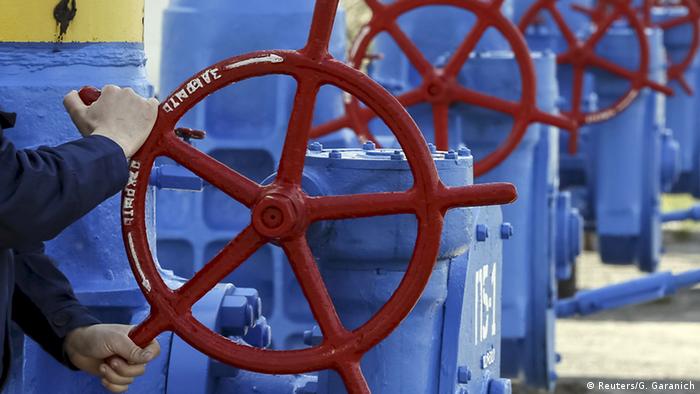
A gas-compressor station in Boyarka, near Kyiv: Ukraine is a key transit country for gas supplies to Western Europe

This is what brings about the current situation: Europe receives, via Ukraine, significantly less gas than it likely will need. At the same time, Gazprom fulfills its contractual obligations by letting its European reservoirs run dry, and the corporation can afford itself extended maintenance service to both its pipelines into the EU.

Ultimately, all this could lead to a situation in which, at some point in autumn perhaps, Russia's state-owned corporation tells the Europeans to choose between two alternatives: Either grant an operating license for Nord Stream 2 — construction of which will probably have been completed by then — with its capacity of 55 billion cubic meters very quickly, or face major gas supply problems during the winter as reservoirs are still half empty, and the Russian energy giant can choose not to increase gas deliveries through Ukraine

Also at stake: the role of natural gas in decarbonization

This scenario is supported by the fact that, during an auction on July 5, Gazprom did not want to book additional transit capacities in either Ukraine or Poland for one year in advance, arguing that this could still be done on a monthly or quarterly basis. This seems to be another clear signal that, from autumn 2021, the Russian state-owned corporation plans to service increased gas demand in Europe exclusively through its own new pipeline in the Baltic Sea.

A protester at a Fridays for Future demonstration in Cologne, Germany


For the time being, Heiko Lohmann, who has said, "It would be much more comfortable for Europe to have this pipeline," does not believe that such an obvious attempt at blackmailing Europe is possible.

"Thus far, Gazprom has never really exerted pressure on its Western European buyer countries — at least, it has never become known," he said. "If a precedent happened now, for the first time, this would have devastating consequences for Gazprom in the political debate."

For if Gazprom actually began "to exert overt pressure" in autumn, this would enormously fuel an already heated debate in Europe about the short-, medium- and long-term role of gas within the framework of decarbonization and strengthen the position of all those who champion a much quicker withdrawal from using natural gas, Lohmann told DW.

Initially, though, Europe would have a serious supply problem.


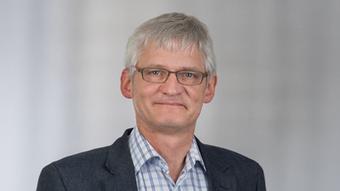
Heiko Lohmann is an independent gas market expert
Birds are dying in the United States and no one knows why

There's a new epidemic, this time among birds. An illness is infecting them in the US capital ― and it's spreading. Experts say the cause is unknown.


No one knows what is killing the birds in large numbers


While humans and other animals continue to grapple with COVID-19, a new epidemic seems to have hit multiple bird species in North America.

Across the United States, people have been finding dead birds. The birds appear to have been hit by a wave of mysterious illnesses since April.

Ornithologists (bird experts) say the dead or ailing aviators tend to have swollen eyes as well as neurological issues that seem to be causing the birds to lose balance.

"It’s not unusual to see birds with eye problems," says Jim Monsma, director and founder of the animal rescue center City Wildlife in Washington, D.C.

Monsma has worked in animal protection and rehabilitation within urban areas for 25 years, especially in the D.C. area.

But it took Monsma and his colleagues a while to realize that what they were seeing was "not usual."

"We didn’t know at first we were dealing with an epidemic," Monsma says.


Birds are dying in alarming numbers in Washington, D.C. and elsewhere in the US
Looking for the cause

They now think that multiple bird species have been contracting an odd illness for about two months. And the illness has spread at least 965 kilometers (600 miles) from the capital, across the Midwest regions of the United States and into the state of Indiana.

The United States Geological Survey (USGS) published a report on the mysterious bird deaths in early June. Details remain hazy, but experts are trying to trace the epidemic back to its origins.

"The first one we saw was in April. In the beginning of June, that's when we started sending birds to an animal center, where they were alarmed to hear our numbers at the time. Now, we're up to just under 200 that are infected," Monsma says.
Still no diagnosis

Animal centers have been examining the birds for a possible cause of death or illness, but tests have been inconclusive so far.

"West Nile [disease] is ruled out. . . Everything has been ruled out. To date, we still do not know," says Monsma, citing tests conducted by Wildlife's clinic director, Cheryl Chooljian.

The USGS is just as baffled by the epidemic.

"At this point, the USGS doesn't have updates beyond the interagency statement," says Marisa Lubeck, a spokesperson with the department.


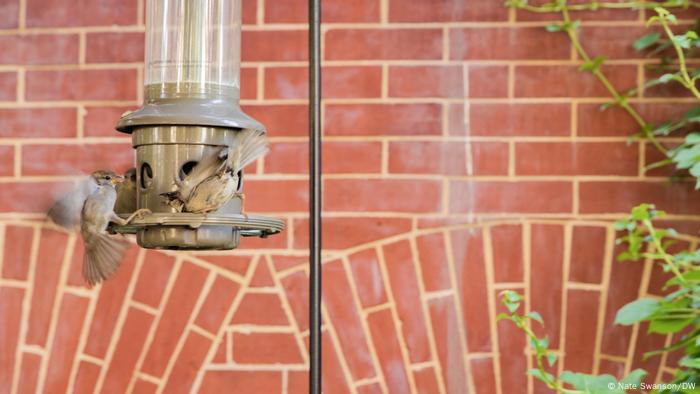
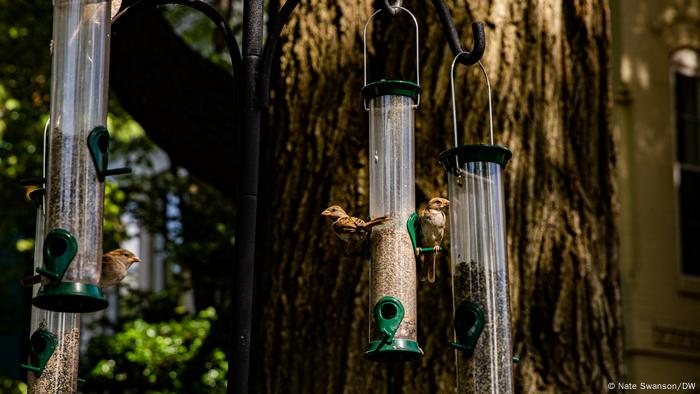
One theory is that birds pass the mysterious disease to each other while hanging out at bird feeders

Theories for the illness


Experts do still have their theories. And one of them links the disease with the arrival of Brood-X cicadas that made their appearance around late April to early May — the same time people started to notice the dead birds.

It's just a theory, but it is something to work on, according to ornithologists. And continued research is important because another bird flu could prove very dangerous for people as well.

"We are losing our population of birds at an alarming rate," says Monsma, including Fledglings, European Starlings, Bluejays and others.

"About a third of the species in America are decreasing rapidly. It's spreading to other species," he says. "And we certainly cannot rule out the possibility that it might spread to humans."

He says that historically and currently "when you see an outbreak among animals, it's a cause for worry. It's something you don't want to dismiss."

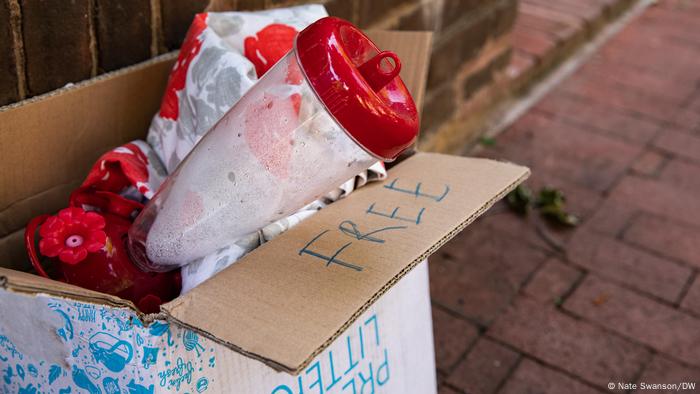
Some residents in Washington, D.C. have already gotten rid of their bird feeders in an effort to contain the disease


Don't feed the birds

There is some hope for the winged creatures ― the amount of sick birds reported to City Wildlife has gone down over the past two weeks. To eliminate the spread of the disease among various species, Monsma says City Wildlife has informed D.C., Maryland and Virginia to take precautions and take down bird feeders or bird baths. Some residents have already gotten rid of their feeders, while others have taken another route and attached bird skeletons to them to ward off birds that regularly come to visit.

The United States Geological Survey advises to cease feeding birds until the epidemic is over. If feeders and bird baths are kept, they are to be cleaned with a 10% bleach solution. Pets are to be kept away from sick or dead birds.

But even with the numbers of infections decreasing, there is no end in sight yet. Experts say the public can help by sticking to the cautionary measures in order to contain the illness before it is too late.

Opinion: Tokyo Olympics without fans is the least they can do

Due to the pandemic, the Olympic Games will take place without spectators for the first time. Unlike UEFA, the organizers in Tokyo have shown the minimal level of responsibility, says DW's Stefan Nestler.


You won't see any spectators here for a while yet

"We had no choice," said Seiko Hashimoto, the head of the Tokyo Olympics Organizing Committee, after announcing the decision to ban spectators from next month's Games.

It's been clear for several months that foreign visitors would not be able to travel to Japan, but organizers had hoped to allow 10,000 local fans per event in order to create at least a semblance of Olympic flare.

But now, it's official: for the first time ever, the Olympic Games will take place in empty arenas. Welcome to Tokyo 2021: The Coronavirus Games.

The organizing committee had no other option but to pull the plug after discussions with the Japanese government and the International Olympic Committee (IOC). Hard facts and the general atmosphere saw to that.

For the last three weeks, COVID-19 infection rates have continued to rise in Japan. As in many other countries across the world, the highly infectious delta variant is chiefly responsible.

DW's Stefan Nestler

DW's Stefan Nestler

The deteriorating situation has only added to a public mood that was already increasingly critical of the Olympics, with many in Japan fearing that the Games could turn into a super spreader event.

The virus as a souvenir

The concerns are understandable. The biggest sporting event in the world combined with a pandemic — the two just don't match.

Over 11,000 athletes plus thousands of coaches, team members, officials and journalists from all over the world are expected to descend on Tokyo. The probability of at least some of them bringing the virus with them is surely close to 100%, as is the likelihood that others will end up taking it back home with them as an unwanted souvenir.

Of course, the nuclear option would have been to cancel the Games altogethet, which could hardly be expected just two weeks before the opening ceremony.

But, in banning spectators from the events, the organizers in Tokyo are at least taking a minimal amount of responsibility — which is more than can be said for European football's governing body, UEFA, and their European Championships.

UEFA has facilitated the spread of the virus with partly, and sometimes completely, full stadiums and has willingly accepted the risk of potential deaths.

This op-ed was adapted from German by Matt Ford.

World Bank estimates cost of rebuilding Gaza at $485 mln after Israeli bombardment


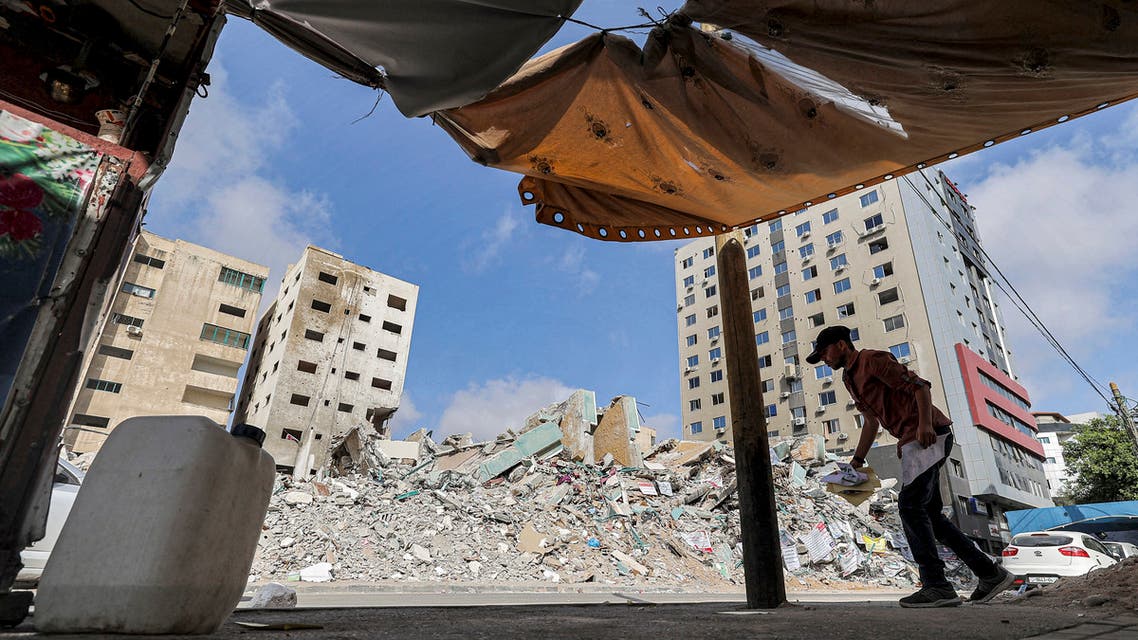
A Palestinian holding fragments of papers walks past the rubble of a building destroyed by Israeli airstrikes in Gaza, June 10, 2021. (Reuters)

The Associated Press
Published: 08 July ,2021

Rebuilding Gaza after the latest devastating war between Israel and the territory’s militant Hamas rulers will cost up to $485 million, the World Bank said.

The report says it will take up to $380 million to repair the physical damage alone, with more required for other recovery needs. Israel carried out waves of airstrikes during the 11-day conflict in May and Palestinian militants fired thousands of rockets, most of which were intercepted. More than 260 people were killed, the vast majority of them Palestinians.

For all the latest headlines, follow our Google News channel online or via the app.

Gaza has been under a crippling Israeli and Egyptian blockade since Hamas seized power from rival Palestinians forces in 2007 and is still scarred from three previous wars between Israel and the Islamic militant group.

The World Bank said the war caused up to $190 million in economic losses, in a territory where unemployment already hovered around 50 percent.

It says over 4,000 homes were demolished or partially damaged.

“This is yet another unfortunate episode in which the Palestinian people in Gaza saw themselves in the midst of conflict and destruction,’’ said Kanthan Shankar, the World Bank director for the West Bank and Gaza.

The report, carried out with the United Nations and the European Union, was released Tuesday.

At least 254 people were killed in Gaza during this latest war, including 67 children and 39 women, according to the Gaza health ministry. Hamas has acknowledged the deaths of 80 militants. Twelve civilians, including two children, were killed in Israel, along with one soldier.

Israel blamed the civilian losses on Hamas, which placed rocket launchers and other military infrastructure in residential neighborhoods. The military said it made every effort to spare civilians.

Gaza’s more than 2 million Palestinian residents have borne the brunt of recurrent conflicts and hostilities during the past three decades.

Movement in and out of the territory is heavily restricted, power outages are frequent, and Gaza is also coping with a coronavirus outbreak.
US states got more money from Washington than they needed for Covid-19 relief

REUTERS/EVELYN HOCKSTEIN

Post-Covid states have money to spend; where is it all going?

By Raymond Scheppach
Professor of Public Policy, University of Virginia
Published July 9, 2021

Across the country, states got huge infusions of cash from the federal government to help them deal with the effects of the Covid-19 pandemic; the most recent infusion of money comes from the American Rescue Plan Act of 2021, which was President Biden’s Covid-19 stimulus plan. Naomi Schalit, senior politics editor of The Conversation, interviewed the University of Virginia’s Raymond Scheppach about whether the federal government gave the states more money than they needed. Scheppach is a state budget expert who ran the National Governors Association for 28 years, worked in the Congressional Budget Office for seven years, and is considered an authority on state and federal relations. He says the flood of federal money may have been a rare occurrence in federal-state relations: too much of a good thing.
What can states do with the latest infusion of money from the federal government?

States will get $195.3 billion over the next year in extremely flexible funds to be spent essentially on any healthcare costs or to offset any negative economic effects related to Covid-19.

In addition, states can invest the funds to improve drinking water quality, support wastewater and stormwater treatment capacity, and expand broadband access.

Given that the impact of Covid-19 differed substantially by state, it appears that the drafters of the legislation wanted to cover all of the direct health and economic costs of the pandemic. But in situations where individual states had less need, they could use the additional funds for infrastructure, where virtually every state has substantial needs.
Are there limits on how the money can be spent?

The two major restrictions are that states could not use the funds to lower taxes or to make extraordinary deposits to pension funds. The pension restriction exists because a number of senators believe states such as Illinois, Connecticut, New Jersey, and Kentucky have been irresponsible in not setting aside enough money to pay for even half of their future pension liability

The only other restriction is that all funds need to be obligated or committed by Dec. 31, 2024, and spent by the last day of 2026. During most past economic downturns, states have often assisted local government, but this is not necessary this time as the legislation also included $154.7 billion to other governments such as cities, counties, tribes, and territories.

Overall, the funds in this stimulus were far more flexible than those in the American Recovery and Reinvestment Act of 2009, a stimulus bill passed during the Great Recession to limit the economic contraction and help states weather the economic downturn. While substantial funds were provided to states in that package, most had to be used for state-administered federal programs such as highway construction and maintenance, housing weatherization for low-income individuals and families and the construction wastewater treatment systems.
Did states receive more federal money for pandemic recovery than they need?

To answer this question, it is important to look back over the last year to see how much the Covid-19 pandemic affected state finances, and to look forward to see how rapidly the economy and thus state revenues will recover.

It appears that the pandemic-related economic downturn in states was quite muted, confounding everyone’s expectation, including mine.

First, revenues have held up surprisingly well. For example, sales tax revenues actually grew by 0.5% in fiscal year 2020 and are on track to increase 2% in fiscal year 2021. This is largely because consumers continued to shop but did so online as opposed to in malls. Most states now tax online sales. A few states depend heavily on revenues from the extraction of oil and gas, and that source held up well as prices recovered much faster than expected and production levels were maintained.

Most important, income tax revenues were also up 0.3% in fiscal year 2020, and are on track to be up 2.8% in fiscal year 2021. This is because many middle- and higher-income individuals shifted from the office to working from home with little unemployment interruption.

On the spending side, early action by the federal government largely cushioned the traditional explosion of Medicaid spending that happens during an economic downturn. On March 18, 2020, the Families First Coronavirus Response Act was signed into law, and it included an increase of 6.2% in the share that the federal government paid to states for their Medicaid spending. This additional Medicaid money from the federal government allowed states to use the 6.2% they had originally budgeted for Medicaid for other needs, like education. One example: For a small state like Connecticut, this could be over $550 million.

The other factor that is important to calculating whether the states got too much money is how much state revenues will rebound over the next year.

The pent-up demand for travel, entertainment, and eating out in restaurants means the US economy is estimated to have grown 8.6% during the second quarter of 2021 and 6.4% in 2021, relative to 2020. Consumers have money to spend as the savings rate was up substantially during the pandemic.

This all adds up to a rapid recovery and will quickly translate into similar growth in state sales tax and income tax revenues, the two largest sources of state revenues. Additionally, Medicaid enrollment will shrink as individuals find jobs and get employer-paid healthcare once again, further lowering state spending.

So, did states receive too much money in the Biden rescue plan? The answer is definitely yes, given that state revenues never declined very much, coupled with the federal government’s assistance in offsetting the spike in Medicaid, and the fact that the current recovery will be robust in terms of state revenues all support this conclusion.
What are the economic challenges for states in the future?

Many states are increasing their spending for fiscal year 2022 by double-digit percentages, such as Vermont at 14.5%, Pennsylvania at 21.3%, and North Carolina at 11.6%. Much of these funds will be spent on elementary, secondary, and higher education, as well as Medicaid.

Once the federal money is all spent, many states may be looking at a serious budget problem: not enough money to support the spending levels they’ve assumed in their fiscal year 2022 budgets. That will likely happen when the economy slows, and actual revenues fall short of the levels assumed in their budgets.

States will also have difficult decisions this year regarding how much should go into current operations and how much goes to long-run investments, like further spreading broadband.

Spending all the federal money by the mandated end date of Dec. 31, 2026, may also be difficult, and there is the potential risk that the federal government will take back any uncommitted funds. That would put pressure on states to spend or lose the funding, which could lead to some bad, or at least inefficient, choices. Quickly solved problems could take precedence over ones that may be more serious, but take more time to address.

For example, a state might commit funds to wastewater treatment, where it can be spent quickly, as opposed to highways, where the need is greater but the planning horizon is longer.

This article is republished from The Conversation under a Creative Commons license. Read the original article.