Showing posts sorted by relevance for query HINDUTVA ZIONISM. Sort by date Show all posts

Wednesday, May 08, 2024

How India moved closer to Israel under the Narendra Modi government

For decades, New Delhi supported the Palestinian cause. Then it started to shift towards Israel with the rise of 
Hindu nationalist BJP.

MOHAMMAD ASIF KHAN


Indian Prime Minister Narendra Modi, who is vying for a third term in office, has openly embraced engagement with Israel, especially since his landmark visit to Israel in 2017. / Photo: AP

On October 7, 2023, Indian Prime Minister Narendra Modi was among the first leaders to condemn Hamas’s attack on Israel. His tweet, which labelled Hamas as “terrorists”, marked a shift from India’s policy that has not officially designated the Palestinian resistance group as a terrorist organisation.


This tweet reflects a broader change in India’s foreign policy regarding the Israel-Palestine conflict. India, once a staunch supporter of the Palestinian cause, has grown closer to Israel under Modi’s leadership.

During Israel’s ongoing war on Gaza, the Indian government was slow to support a ceasefire. India abstained from a United Nations General Assembly vote, which called for an Israeli ceasefire. But it later voted for a resolution demanding the unconditional release of Israeli hostages held in Gaza.

This has led to questions about whether New Delhi has abandoned its long-standing support for Palestine and shifted towards the Zionist state.

Azad Essa, author of “Hostile Homelands: The New Alliance Between India and Israel”, believes that India’s closeness to Israel is deeply connected with the anti-Muslim sentiment entrenched in Modi’s politics and his supporters.

“Many Indians have become major supporters of Israel because the government has managed to create a narrative that the modernising project in India is closely linked with being partners with Israel and that they both face similar enemies in the form of Muslims.”

The past support for Palestine

India’s historical support for Palestine was rooted in its own struggle against the British colonisation. Leaders like Jawaharlal Nehru, India’s first Prime Minister and country’s founder Mahatma Gandhi supported Palestinians during India’s fight for independence.

Gandhi once said, “Palestine belongs to the Arabs in the same sense that England belongs to the English or France to the French.”

Nehru also noted the importance of Palestine, stating, “Palestine is essentially an Arab country and must remain so” and “the right of the Jews for a homeland should not come at the expense of a homeland of the Arab population of Palestine.”

Post-colonial India opposed the United Nations Partition Plan for Palestine in 1947 and supported Palestinian independence.

Despite recognising Israel in 1950, India leaned towards its Arab allies during the Cold War. It supported Egypt during the Suez Crisis in 1956 and recognised the Palestinian Liberation Organization (PLO) in 1974. The PLO was even allowed to open an office in New Delhi in 1975.


Yasser Arafat, the then chairman of the PLO, visited India multiple times and developed a close bond with then-Prime Minister Indira Gandhi. He referred to Indira as his “sister,” underscoring their strong relation.

However, India’s foreign policy changed significantly after the dissolution of the Soviet Union in 1991. New Delhi began gravitating toward the US, and leaders in India realised that the “Door to Washington opens in Tel Aviv”.

India established formal diplomatic relations with Israel in 1992 under Prime Minister PV Narasimha Rao’s leadership.

But that relationship between the two countries has flourished since Modi and his Hindu nationalist Bharatiya Janata Party (BJP) came to power in 2014.

Modi, who is vying for a third term in office, has openly embraced engagement with Israel, especially since his landmark visit to Israel in 2017.

At the time, Israeli Prime Minister Benjamin Netanyahu hailed Modi as a “revolutionary leader in the true sense of the term”, and described India’s relationship with Israel as a “marriage made in heaven”.

Two sides of same coin

The ‘Modi and Bibi’ bromance reflects a deep-seated admiration among generations of Hindutva (an extremist ideology that advocates for the dominance of Hindus and Hinduism within India) supporters for Zionism and Israel.

Early proponents of Hindutva, such as Vinayak Damodar Savarkar, supported the establishment and recognition of Israel. Savarkar once said, “If the Zionists’ dreams are ever realized, if Palestine becomes a Jewish state, it will gladden us almost as much as our Jewish friends.”

Apoorvanand, a political commentator and a Hindi professor at the University of Delhi, says both are racist ideologies.

“Hindutva advocates for a Hindu-dominant ideology aiming to establish a Hindu nation, while Zionism sought a Jewish state in Palestine. Both ideologies assert the superiority of their respective people and the need for a separate homeland.”


On its part, Modi’s BJP denies similarities between Hindutva and Zionism, saying it supports a two-state solution.

"There is no departure from historical support for Palestine. Any comparisons between Zionism and Hindutva are baseless and politically motivated,” said Shazia Ilmi, BJP’s spokesperson.

"India supports a two-state solution to resolve the Israel-Palestine conflict. Our policy is based on reality and facts.”

Brothers in arms


India and Israel have a strong trade link, especially in the arms sector. Over the past decade, India has purchased military equipment from Israel worth $2.9 billion. This includes items such as radars, surveillance and combat drones, and missiles.

India is the world’s largest arms importer and the biggest customer for Israel’s military products. Israel is the second-largest supplier of military equipment to India, after Russia. Around 42.1 percent of all Israeli arms exports went to India.

Despite the war in Gaza, and skirmishes with Iran, and Hezbollah in Lebanon, Israel’s military exports to India have continued without interruption. This is noteworthy, especially considering that Israel has delayed exports worth over $1.5 billion to other countries.

A significant part of this cooperation is the co-production of the Hermes 900 drone. This drone, produced in Hyderabad, India, is set to join the Israeli army’s fleet of unmanned aerial vehicles (UAVs) amidst the current war in Gaza.

Recently, India and Israel conducted a joint security drill. The drill was held against the backdrop of heightened security for the Israeli mission in New Delhi.


A cesspool of hate


India has been a major hub for the widespread dissemination of misinformation and aggressive discourse targeting Palestinians, spanning both mainstream media and social media platforms.

Indian media, including prominent outlets such as Republic TV, NDTV, Times of India, and Times Now, played a significant role in disseminating misinformation campaign of the so-called beheading of 40 babies by Hamas.

Indian social media, especially on platform X, is flooded with false anti-Palestinian content, often shared by far-right/right-wing individuals aligned with India's BJP.

Analysis by Al Jazeera's Narrative Research Lab found a significant bias in favor of Israel among Indian users, with a five-to-one ratio in support, as evidenced by tweets and hashtags like "#IstandwithIsrael."


The lonely Muslim 


Under Modi’s government, there's been a noticeable difference in the handling of demonstrations related to Palestine and Israel. Palestine solidarity activists have faced a brutal crackdown, while Israel's allies have had a free hand.

Mir Suneem Gul, a student at Jamia Millia Islamia University, was detained during a pro-Palestine protest.

"We remained silent throughout our detention. Meanwhile, on that same day, demonstrations in support of Israel were permitted to take place outside the Israeli embassy without any hindrance,” she tells TRT World.

Vishnu Gupta, a Hindu nationalist and president of the Hindu Sena, who organised the pro-Israel rally, says both Hindus and Jews have a common enemy.


"The reason for supporting Israel is that all the Hindus feel a sense of brotherhood with our Jewish brothers in Israel because we face a similar problem of Islamic terrorism in our country.”

“Indian Muslims who are supporting Palestine, are directly supporting terrorism in India.”

New Delhi’s actions have created a feeling of alienation among many Indian Muslims.

“It's frustrating because you see the government's visible partiality, supporting one particular side, which is evident through their actions. You feel appalled by these conditions, living among people where trust is eroded due to what has happened,” says Gul.

Despite all this, the Indian government has strived to strike a balance. Diplomatically, they have endorsed the two-state solution and advocated for a ceasefire in Gaza at the UN. Furthermore, they have extended aid to Gaza, which includes 6.5 tonnes of medical supplies, 32 tonnes of disaster relief materials, and a $2.5 million contribution to the UNRWA for humanitarian aid.

In navigating its shifting alliances, India faces a delicate task of balancing its act between historic support for the Palestinian cause and growing bonhomie with Israel.


SOURCE: TRT WORLD

Mohammad Asif Khan
Mohammad Asif Khan is an Indian journalist based in New Delhi.

Tuesday, September 14, 2021

Are Hindu reformers anti-Hindu?
Published September 14, 2021 -

The writer is Dawn’s correspondent in Delhi.


LIKE other religions Hinduism has faced challenges from ancient times from within its fold and outside. Hindutva is a modern invention and the idea of a right-wing militarist nation state it panders to would not be possible before the advent of the nation states that came with the Treaty of Westphalia in 1648. Some Muslim ideologues opposed the movement for Pakistan also on similar lines, saying there was no sanction for a nation state in Islam.

The three-day international conference on ‘Dismantling Global Hindutva’ ended on Sunday with important insights into Hinduism itself, but the discussions also revived memories of the pitfalls of similar projects and criticisms attempted in the recent and distant past.

One takeaway from the conference was that critiquing Hindutva, the militant philosophy that set out to model Hindus on the European fascism of the 1930s (by replacing European Jews with Indian Muslims and Christians as targets of hate) would remain incomplete if B.R. Ambedkar’s call for the destruction of the Hindu caste system remained unheeded. Ambedkar canvassed for equal and secular rights for everyone, starting with the liberation of the Dalits from Hinduism’s Brahminical hold and women from its patriarchal fold.

Read: How to dismantle Hindutva?


Organisers of the conference offered a word of caution. “To equate Hinduism and Hindutva is to fall into the narrow, bigoted, and reductionist fiction that instrumentalises Hinduism by erasing the diverse practices of the religion, the debates within the fold, as well as its conversations with other faiths. If the poet A.K. Ramanujan reminds us about the importance of acknowledging Three Hundred Ramayanas, then Hindutva seeks to obliterate that complexity into a monolithic fascism.”


Hinduism as we know it today has been in ferment since its inception.

A scholarly intervention made a less-discussed argument that underscored many commonality of views between Hindutva practitioners and Zionist settler class Jews in occupied Palestine. Akanksha Mehta particularly focused on the affinities between women activists of Hindutva and Jewish settler women. She introduced a different perspective to the currently overstated comparisons between the Taliban and Hindutva practices. Their colonial project and the economic underpinning of Hindutva and Zionism together with hidebound social and gender iniquities perpetuated within both groups present a remarkable similarity.

Ambedkar had noted the absence of a defining feature of Hinduism other than the caste. There were anti-idolatry Hindu sects and there were worshippers of deities and images and nature. In Bengal, they worship Durga as slayer of evil and protector of her followers. In swaths of Uttar Pradesh the role is given to Hanuman — sankatmochan, who clears the path of personal and social impediments. In Maharashtra, Ganapati is the vighna-haran or remover of obstacles dogging the followers.

Ambedkar listed Hindus who followed Muslim customs, observed circumcision and buried their dead. He pointed to Muslims who called Brahmin and Muslim priests to together preside over their weddings. It is a relic of the mediaeval Bhakti movement that Muslims and Hindus are entwined in the worship of common saints, particularly in Punjab. Atheists and monotheists also came out of the Vedic fold in early Hinduism and its accompanying Brahminical practices. Nastikas took a materialist view of the world and were opposed to Brahminical rituals. They were shunned as a class as were followers of Buddha and Mahavira.

I got a call from a close friend from Mumbai on Friday, a Jain with a modern lens. “I’m calling you to forgive me for any wrong I may have done you,” he said to my complete surprise. It was part of a period of Jain rituals, Sumedh Shah confided. It was observed over several days and ended with the quest for forgiveness from friends and family. The discussion veered around to a Jain belief that they were the original Indian atheists. And since Mahavira was the 24th teerthankar, a contemporary of Buddha around 600 BC, the claim would tend to put the atheism of Jains ahead of the Hindu nastikas.


Be that as it may, the point is that Hinduism as we know it today has been in ferment since its inception, not unlike other religions that branched off from their original purposes of peace and harmony, as Swami Vivekanand observed, into puritanism, mysticism and even bloodletting by acquiring weaponised and sectarian forms.


For close to two centuries in India, Hindu reformers have been trying to tweak Hinduism. Of these the most persistent but not entirely successful lot belonged to the Bengal Renaissance — from Ram Mohan Roy (1772-1833) to Rabindranath Tagore (1861-1941). The question is: were the reformers anti-Hindu or Hindu-phobic, to use the term thrown by many right-wing Hindus at their critics. Supporters of militant Hindu groups in the US and India have used such terms to describe and even threaten rival Hindus against critiquing India’s current tryst with what is otherwise regarded as a great religion of the world.

The Bengal Renaissance canvassed support for banning child marriage, encouraging widow remarriage and scientific education, discouraging superstition and sati — the practice of Hindu widows being forced to sit on their husband’s funeral pyre.

The Bengal effort was, however, a social movement largely aloof from politics. The synthesis of politics and social reforms was to flower with Gandhi. When he arrived on the scene from South Africa, the political churning against colonialism had already spread from Bengal to Maharashtra and Punjab, but it had acquired pronouncedly Hindu motifs. The use of religion for anti-colonial mobilisation also tempted Muslim leaders like Maulana Azad. He applied the Bengal model to unfolding events in Turkey to woo Muslims to the Congress.

Gandhi strove to use religion to bring Hindus and Muslims together, but his attempt at reforming Hinduism was slammed as vacuous by Ambedkar, and as too emasculated for a fascist project by leaders like Savarkar and Golwalkar. It may not be wrong to ask, therefore: if Ambedkar failed to annihilate the Hindu caste system, what’s the chance the virulent Hindutva project could be dismantled with well-meaning intellectual cogitation?

The writer is Dawn’s correspondent in Delhi.

jawednaqvi@gmail.com

Published in Dawn, September 14th, 2021

Friday, November 14, 2025


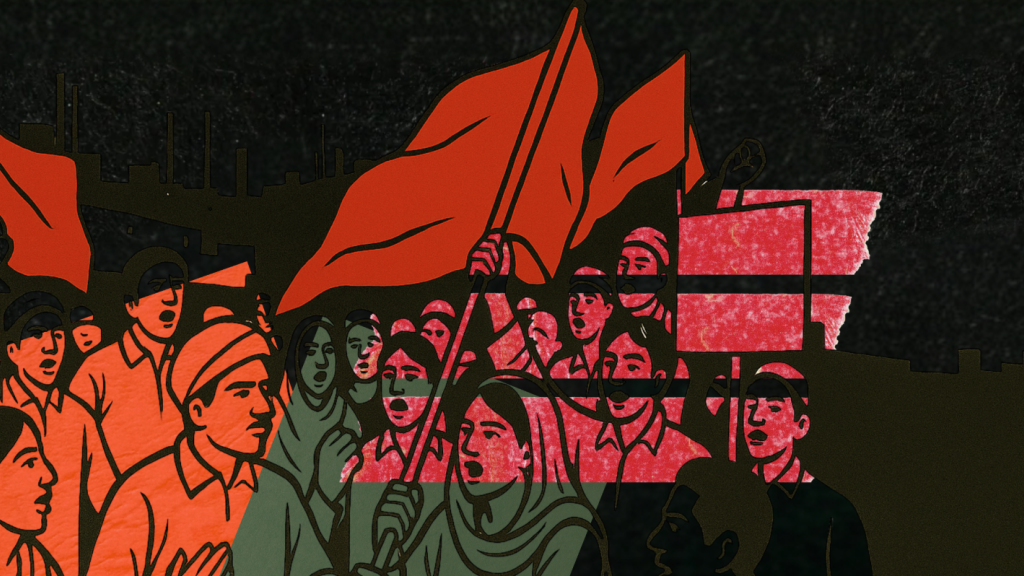
Forging the steel of unity: Left politics in contemporary Pakistan

Jahmoor graphic

First published at Jamhoor.

Jamhoor has published two articles that explicitly attack the position and politics of the Haqooq-e-Khalq Party (HKP), particularly our stance during the recent Indo-Pak war. While both articles took an unnecessarily hostile and polemical tone to mischaracterize HKP’s position, they nonetheless provide an opportunity for dialogue on the ideological and political divergences within Pakistan’s Left. I engage in this debate in the spirit of propelling the discussion forward on how to reconstruct a Left capable of meeting the challenges of the contemporary moment.

In this article, I make three broad interventions. First, I respond to Ayyaz Malick’s criticism of our positions, exposing the ahistorical and, ultimately, apolitical character of his argument. Second, I engage with Syed Azeem and Umar Ali’s polemic, demonstrating how it represents a messianic form of politics that takes flight from any concrete reality (or even possibility), an analytical framework that can only end in disappointment and dissolution. Both perspectives, I argue, only worsen the paralysis and disorientation of the Left at a moment when the decaying imperialist system is preparing for wars of annihilation in the global South and social movements struggle to forge popular unity. Finally, I argue that the way forward for the Left in Pakistan is to simultaneously address the concerns of sovereignty, imperialist intervention and internal repression, with all the contradictions that such a task entails.

Contradictions abound

Mallick’s article levels a number of allegations against HKP without either justifying his claims or addressing the key issues at stake. The title of his essay, “Anti-Imperialism and Geopolitical Binaries,” encapsulates his central charge: that we “reduce everything happening” to geopolitical rivalries between the US and China. Yet, he offers no proof for this sweeping claim. This lack of evidence for what is presumably his primary argument stems from the simple fact that HKP’s position on the Indo-Pak war was not based on the US-China rivalry. Instead, it was a response to the very real threat posed to the region by Indian belligerence and grounded in Pakistan’s right to self-defense. His mischaracterization then enables a series of further accusations, including calling our multi-ethnic leadership “Lahori Left,” “jingoistic” and “chauvinist”, and participates in the long tradition of sectarianism that has crippled the Left in Pakistan.

Let us briefly recount the core of his analysis. He claims that a “sub-imperialist power” (India), endowed with both the ambition and the capability (hence, sub-imperialist) to establish regional hegemony and guided by an ideology (Hindutva) he deems worse than Zionism, launched an attack on a neighbouring country (Pakistan) — a state whose political economy is shaped by opportunistic rent-seeking and which has a sordid record of internal repression, primarily in its peripheries. Note that he describes Hindutva as an ideology worse than Zionism, a force that has not only perpetrated genocide in Gaza, but has also participated in the destruction of several countries across the Middle East. As with most wars of aggression since the onset of the unipolar order, we are faced here — in the case of both Zionism and Hindutva — with hegemonic powers seeking to establish hegemony over countries ruled by repressive governments. This is hardly an ideal configuration, but historical contradictions seldom appear in neat moral binaries. Actual history unfolds through such contradictions — constantly in motion, colliding and recombining — producing unexpected situations that demand difficult, and at times tragic, political choices.

Any serious political commentator can decipher that the primary question raised by this collision of contradictions is whether the weaker country, despite its neo-colonial structure, retains the right to defend itself. No answer to such a question would be ideal. Does the Iranian government, with its long record of repression against Leftists, women and minorities, have a right to defend itself when attacked ferociously by a genocidal Zionist entity, backed by the US? Did this right not also extend to Libya, Syria, Iraq, Yemen, Afghanistan and other states that were far from ideal? What should be the stance of the Left when a (sub-)imperialist power unleashes its violence to turn these civilizations into vast wastelands?

One can immediately identify the difficult nature of these questions, and why they have long divided the Left, as the challenge of sustaining external sovereignty collides with ongoing struggles for internal justice. But this is precisely the contradictory terrain upon which history unfolds, the ground from which events erupt that demand decisions from political actors. The perplexing element of Mallick’s writing, however, is that he simply evades the key question confronted by the Left in the aftermath of Indian aggression. By his own account, an Israel-backed sub-imperialist power (worse than Zionism) attacked Pakistan in pursuit of regional hegemony. Yet, astonishingly, this historical conflagration does not, for him, merit a concrete political stance beyond polite calls for “peace and self-determination,” abstractions that no one can dispute in principle (HKP both called for peace and welcomed the ceasefire). He unfortunately retreats into the comfort of “safe scholarship,” avoiding the inconvenient necessity of decision when confronted with an actual historical situation. 

The Haqooq-e-Khalq Party did not evade this question. On each of these occasions, our party has upheld the right of countries to defend their sovereignty against foreign aggression. While we called for peace throughout the conflict with India and welcomed the ceasefire, we were pleased when Pakistan was able to curb the attack (with Chinese support) by a government led by genocidal maniacs whose spokespersons were calling for turning Pakistan into Gaza. India’s use of Israeli-made drones deep into Pakistani territory left little doubt about its intent. Similarly, we were not ashamed to cheer when Iranian missiles hit targets in Israeli territories, which provided a brief moment of joy to Palestinians enduring genocide as the world shamefully watched. Intellectuals should not pretend that they were the only ones calling for peace while others were excited about the prospect of war between the two nuclear-armed rivals. The bitter truth is that, faced with a belligerent, fascistic, and expansionist neighbour intent on aggression—and with no peace movement in India to challenge its belligerence — the restoration of military equilibrium by the Pakistan Air Force was the only means of securing even a tenuous peace in the region. 

It is difficult to see what conclusion other than upholding Pakistan’s right to self-defense could follow from Mallick’s own analysis of the balance of forces involved. Yet, he substitutes the urgency of decision with oscillation between pedantic analysis of Pakistan’s political economy as an opportunistic rentier state and impassioned rhetoric about the corrosive impacts of military intervention in the political sphere, particularly in the peripheries. His underlying suggestion seems to be that by recognizing the right to self-defense, the Left relinquishes its own right to criticize the state. Yet, he provides no justification for this claim, relying instead on sweeping statements — such as accusing HKP of “war patriotism” that supposedly takes “no consideration” for the concerns of those in the periphery.

This is an extraordinary accusation, which Mallick does not even attempt to justify beyond rhetorical hyperbole. By what principle of politics, let alone of dialectical thought, does upholding a country’s right to self-defense automatically mean forfeiting any “consideration” of the state’s excesses? Did the Soviet Union’s alliance with Britain and the US (two regressive imperialist powers) in the fight against Nazi annihilation mean that it thereby forever lost the right to fight imperialism? Did Mao’s decision to join forces with the Kuomintang government to defend China’s sovereignty against Japanese invasion permanently disqualify him from attacking the militarism, warlordism, and feudalism exemplified by that same Kuomintang? Or, to take another example, did extending support to the French partisans defending their territorial sovereignty against Nazi forces amount to endorsing French colonialism then ravaging Africa and East Asia

Indeed, in each case, the fulfillment of the immediate objectives of wartime alliances at the end of the Second World War gave rise to the re-emergence of older conflicts: the onset of the Cold War, the acceleration of the Chinese civil war between the Kuomintang and the Communists, and the intensification of anti-colonial revolts against British, French, and Portuguese colonial rule. If such tactical alliances, which included the sharing of military and intelligence resources, did not foreclose the possibility of future conflicts, why would HKP’s public statements on a 3-day conflict prevent us from critiquing and resisting militarized forms of capitalism in Pakistan?

In fact, HKP members proudly remain among the most prominent Left critics of the current hybrid regime, from opposing the Pakistani state’s suicidal policies in Afghanistan to providing legal aid to persecuted PTI political workers; from exposing exploitative mineral deals with the US to organizing with Sindhi and Punjabi farmers against the establishment-backed resource grabs in the name of corporate farming. Recently, we organized protests against Pakistani state repression in Kashmir as part of our firm commitment to the Kashmiri people’s right to self-determination. Our criticisms of the Pakistani military do not make us Indian agents, just as upholding Pakistan’s right to self-defense does not make us its allies. It merely means that, rather than remaining captive to fixed analytical categories, we are responding to contradictions as they collide and transform in an actual historical situation. Those who find this delicate dialectic too exhausting — and who desire an absolute Manichean division between good and evil—will never develop a strategic orientation adequate to a terrain riven by multiple contradictions. Or to quote Lenin, “whoever wishes to see a pure social revolution will never live to see it.

Messianic expectations

Before commenting on the substance of Azeem and Ali’s argument, it is again important to underline the unfortunately hostile and accusatory tone of the article. For example, they present HKP’s participation in elections as evidence that the party has “sidelin[ed] ongoing people’s struggles” in order to “enter mainstream national politics in Pakistan as a ‘big-tent’ progressive and social democratic party.” Proof of this supposed shift? None whatsoever. A quick glance at our social media platforms is enough to show the kinds of activities we have been engaged in over the past year. In any case, no Left group in Pakistan (including HKP) can credibly claim to have become the vector of people’s struggles in the country, let alone to have developed hegemony in society. Thus, we must be guided by humility and camaraderie as we rebuild a Left decimated by state repression and debilitating sectarian attitudes.

Let us then focus on two key differences with our comrades that are crucial to the reconstruction of the Left. The first concerns their dismissal of the Left’s central role in Pakistan’s mass struggles for democracy as “tailism,” “NGOism” or “liberalism”. In particular, they single out the Movement for the Restoration of Democracy (MRD), a popular front against the counter-revolutionary, US-backed dictatorship of General Zia-ul-Haq, as emblematic of this supposedly compromised politics. Consider how they suggest that the “traditional Left’s” incorrect positions led it to “eventually merging with the Movement for the Restoration of Democracy (MRD) in the 1980s and arriving at their final ideological destination of NGOs and human rights by the 1990s and 2000s.”

Again, we are not provided any reason to believe why participating in a mass alliance for democracy against a brutal military dictatorship somehow necessitated NGOs as the “final destination” of the Left. This logical leap appears even more suspect when one considers the rich history of sacrifice, including imprisonment and martyrdom, made by Left activists throughout the 1980s. Yet this dismissal offers a window into our divergence on the question of democratic rights, which seems to underlie the thinking of the two LUMS professors.

The history of democratic struggles has never rested on the generosity of feudal or bourgeois classes or their imperialist backers. Even in Europe, the expansion of mass democracy — including the extension of suffrage to workers, women, and minorities — was won through militant organizing from below, and was often met with severe state repression. Lenin was keenly aware of this when he criticized the British Left for its disinterest in electoral politics, regarding such abstention as a form of escapism from the terrain of actually existing struggles. The question of democratic rights is even more contentious in the postcolony, where the ruling classes’ preferred mode of governance is to suspend juridical rights, a condition re-inforced by countless CIA-backed military coups against democratically elected governments across the global South.

The situation in Pakistan is no different, as Washington identified the military as its preferred strategic partner in the region in the 1950s, setting in motion the decimation of left-wing and progressive organizations in the first decade of the nascent state. This explains why the first wave of mass struggles against the authoritarian Ayub regime was led by Left-wing student groups and trade unions. Pakistan’s current Constitution emerged from these struggles for dignity and equality, combined with the courage of Bangladeshis in resisting the genocidal violence unleashed by the state. This fragile achievement was reversed by the US-backed Zia dictatorship, which made the formation of the MRD a historical necessity in the renewed fight against authoritarianism.

For us, the MRD’s ability to unite trade unions, oppressed nationalities, and the women’s movement in a federal struggle for social justice represents an ideal formation—one that came closest to building an alternative, popular hegemony in Pakistan. The courageous women’s movement, represented by the Sindhiyani Tehreek in Sindh and the Women’s Action Forum in Punjab, fought against the dictatorship’s regressive laws despite a monstrous crackdown and the relentless demonization of women activists. It is both disrespectful and counterproductive to view these struggles, which claimed over a thousand lives in Sindh alone, as a sideshow to some imagined “authentic” Leftist struggle happening elsewhere. In truth, they constitute an essential part of the very tradition that has made the survival of Left forces possible today.

To reject these battles, arising from the everyday experiences of the oppressed, as mere “tailism” or “social movementism” is not only to betray our own history but also to refuse engagement with the burning questions of the present, as the hybrid regime dismantles the hard-won juridical and political rights of our people. Without participating in these concrete struggles for dignity, we exit the terrain of history, reduced instead to moral posturing in anticipation of an absolutely pure socialist politics that will never arrive.

The second disagreement concerns geopolitics, where the authors characterize India as a Brahmanical-fascist state and China as a social-imperialist and expansionist one. To make the latter claim, they point to sharpening contradictions in the peripheries around the Belt and Road Initiative (BRI) investments, and to the Chinese state’s reluctance to support revolutionary movements in South Asia. China’s internal dynamics, including its adherence to socialism, require a separate debate altogether. Yet, it is pertinent to note here that the US containment policy against China does not stem from concerns for democracy or human rights. As Jason Hickel has recently demonstrated, US antagonism stems from China’s success in improving life standards (wages have risen eightfold since 2005), ending its subordination as a peripheral source of cheap labour and raw materials, while simultaneously achieving technological parity with the West. Overcoming these two structural pillars of imperialism, wage differentials and technological inferiority, represents an unprecedented achievement for a country of the global South. The clumsily executed trade tariffs, the escalating tech wars, and the dangerous military encirclement of China are thus counter-revolutionary measures geared precisely at reversing the remarkable gains made by the Chinese people under the leadership of the Communist Party.

Yet, it is bewildering to witness Azeem and Ali equate China and the US as imperialists. Imperialism is not merely a set of exploitative contracts between governments; it is an entire architecture of military, economic and cultural domination designed to annihilate the sovereignty of the colonized to facilitate capital accumulation in the metropole. No understanding of imperialism is possible without considering the destructive military conquests of Africa, Asia and the Americas, the opium wars, the slave trade, and the decimation of societies that refused to surrender. In the contemporary moment, imperialism cannot be conceived in a political register without considering the centrality of NATO (and its 800 military bases), the CIA, the IMF and the World Bank—key elements of a distinct architecture geared towards breaking the will of the people, whether through structural adjustments, regime change, sanctions or outright war. We must be particularly sensitive to this destructive core of imperialism at a moment when the US-Zionist alliance has destroyed several states across the Middle East for refusing to yield to Western diktats, with the people of Gaza paying the heaviest price in a televised genocide.

The Chinese state neither has the military architecture (with only a single overseas base) to obliterate other states, nor has it used its considerable economic influence to impose regime change, structural adjustments or economic sanctions. Erasing these basic material and historical facts evacuates politics from analytical categories, reducing concepts such as imperialism to mere descriptions of asymmetry in inter-state relations. The consequence of this erasure is strategic disorientation, as exhibited in the article. For example, the authors make a grand proposal that the Pakistani Left should “align with the masses of Pakistan in waging a genuine anti-imperialist struggle against Western imperialism, Indian aggression, and Chinese expansionism and social imperialism.” To make things clear, they reject calls for an “abstract peace” in favour of “revolutionary militant people’s struggles,” a euphemism for the People’s War strategy of Maoist groups in India which they cite approvingly.

This is an apocalyptic vision for the Pakistani Left. Rather than prioritizing the expansion of democratic rights, the reconfiguration of the internal political economy to defeat parasitic ruling classes, the renegotiation of CPEC projects to center working-class and local concerns, or the strategic use of the economic shift towards Asia to advance the prosperity for our people, the authors propose waging simultaneous war on Indian, Chinese, and Western imperialism (why not add Iran and Russia?). Since we know that wars are not fought on sentiment alone, one may ask the innocent question: who would fund the weapons, technology, training and logistics that the proposed “people’s militias” would require to fight this epic war? More pertinently, how would this region-wide conflagration avoid falling into the strategic calculus of the Pentagon, which seeks to intervene in and exploit such regional cleavages to turn the global South into a theater of permanent devastation? We are offered no answers.

The strategy then seems to reject “piecemeal” politics of “social movementism” in favour of “deep organizing” that will prepare for a final battle that takes on the combined military might of India, Pakistan and China to bring salvation for the oppressed. There is little consideration of the logistics of this strategy, nor is any evidence presented to indicate that such a war is supported by any significant section of the “people’s movements” currently underway in Pakistan. Thus, this proposal is merely an escape from the material realities that constrain the terrain of Left politics in Pakistan, a classic case of messianic expectation replacing strategic analysis.

A new strategic orientation: What are we fighting for?

In the realm of politics, strategic thinking cannot limit itself to fighting the status quo. Instead of merely focusing on what we are fighting against, we must also clarify what it is that we are fighting for. It requires a sober analysis of the global, national, and regional situation that both constrains and opens opportunities for the reconstruction of the Left. Perhaps a historical situation, analogous to our contemporary moment, can aid in illuminating the path forward.

In 1927, Chiang Kai-shek, the young general leading the Kuomintang nationalists, was at the pinnacle of his fame and power. After years of war and political turmoil since the collapse of the Qing dynasty, he managed to unite the country as a modern Republic. His forces were supplied weapons by both the US and the Soviet Union, ideological rivals who sought to enhance their influence in Asia. In the midst of the dizzying shifts and chaos in the global order during the inter-war period, China appeared as an unexpected candidate for regional stability and progress.

Yet, this apparent stability proved to be the calm before the storm. Chiang refused to undertake the internal reforms necessary to modernize the economy, dismantle the parasitic classes (feudals and warlords) that monopolized the country’s resources, institutionalize democratic reforms, or address the sharpening ethnic divides across China. To make matters worse, he unleashed a brutal crackdown on all forces advocating social reform, beginning with the mass murder of Chinese Communists in Shanghai in 1927 and culminating in the brutal campaign of suppression during the heroic Long March.

Eventually, the decadent order sapped the vitality out of the national project, forcing Chiang’s forces to face humiliating defeats at the hands of the invading Japanese forces. Mao joined forces with the Kuomintang to face the “principal contradiction” represented by the Japanese imperial forces in the mid-1930s, but he was clear that the nationalists were hopelessly inadequate to shoulder the burden of defending China’s sovereignty. A national sovereign project could only be sustained if it was premised upon the popular classes and sought to radically transform China’s internal political economy, a task bequeathed to the Chinese Communist Party.

It is this dialectical method that utilizes the gap between the opportunities opened by history and their betrayal by the ruling classes that propels revolutionary movements forward. Consider contemporary Pakistan, which has now established a security umbrella that is unprecedented in the Muslim World and being simultaneously courted by the West, China and the Middle East. It could provide the conditions of possibility for a sovereign project that positions Pakistan as a gateway for different civilizations, becoming an engine for economic activity and bringing desperately needed peace and prosperity to the people of the region. Yet, much like Chiang’s Republic, the hybrid regime in Pakistan (and the parasitic classes it represents) is singularly incapable of undertaking reforms that can usher in the new era.

The obscenely luxurious lifestyles of the elites are sustained by Pakistan’s rentier political economy, fueled by debt and dollar wars that eschew any serious economic reforms. The country has historically rented its geostrategic location to the US in order to receive cheap dollars that are washed away in speculative projects (such as real estate) or whisked away in secret foreign assets. This myopic strategic thinking has resulted in ongoing deindustrialization, necessitating new loans to pay the older ones, placing the country’s financial policies under the tutelage of viceroys from the IMF, who impose conditions that further strangle the economy. Yet, while this vicious cycle of war, debt and structural adjustment allows bonanzas for the elites, it results in death, destruction and immiseration for the people of Pakistan.

The simultaneous rise in inflation and unemployment has pushed poverty levels to almost 40 percent, with 25 million children out of school (10 million of them in Punjab alone). The peripheries suffer not only the wrath of economic deprivation, but also destabilization from the fallout of misguided security policies, which have destroyed lives and livelihoods, while placing these regions under a permanent state of emergency. Moreover, the lack of industrial planning is being compensated for through the plunder of natural resources, as exhibited by the Pakistan Green Initiative that aims to sell Sindh’s water, Punjab’s lands, Khyber Pakhtunkhwa’s and Balochistan’s minerals, and Gilgit-Baltistan’s tourism industry to the highest international bidder. For local populations, this translates into perpetual displacement and exploitation, with the military’s relentless might unleashed against those daring to resist the expropriation of their lands and resources.

No stable form of hegemony, let alone an independent foreign policy, can be built upon an unproductive, loan-dependent rentier system. The Pakistani state’s vacillation between the US and China, the prime minister’s nauseating sycophancy towards Trump over Gaza, the constant tensions with Afghanistan, and the botching of CPEC all reveal the incoherence of a decaying order. It is thus crucial to avoid confusing the country’s right to self-defense against foreign aggressors with an acceptance of state excesses on the domestic front. In fact, with the specter of war and destruction looming as the US attempts to use Pakistan in its China containment policy, the need for intensifying internal struggles and building a country-wide mass front is more urgent than ever before.

Yet, the key question is what could be the basis for this alliance? I have already indicated that the old alliance between the Left and ethnonationalists is now hopelessly inadequate for this task. As Umair Javed has recently shown, the 18th Amendment has precipitated the integration of political elites from the peripheries into provincial structures of power and patronage, creating concentrated loci of power and resources at the provincial level, a departure from the 1960s struggle against the One-Unit system that neatly pitted each provincial leadership against the center. Moreover, the demographic shifts, particularly the displacement and centrality of Pashtun migrant labour in Punjab, Sindh and Balochistan, and the destruction of economic infrastructure in South Punjab after repeated floods, are increasingly pitting oppressed groups against one another rather than against the state. The ethnic tensions in Sindh, the brutal murder of Punjabi, Seraiki and Pashtun workers in Balochistan, the disputes over the census in both provinces, and the PML-N’s conscious attempts to stoke Punjabi majoritarianism are reflections of ethnic fault lines turning into open conflict, weakening the possibility of popular democratic struggle against the establishment and economic elites.

The divergence is acute on the global front as well. For example, various liberal and ethnonationalist groups welcomed US presence in Pakistan and Afghanistan, supported US drone strikes, and lobbied Washington for sanctions on Pakistan. More recently, a militant group announced support for Indian strikes on Pakistan and sought Modi’s help in dismembering the country, while other sections of the same group have been accused of seeking support from Israel. Even if one momentarily brackets the (gigantic) moral dilemmas that arise out of these alignments, it is a nonviable policy even at a strategic level. The US neither has the will nor the capacity to provide long-term support to its “allies” in different parts of the world. Afghanistan, Iraq, Libya, Syria, and Yemen, all victims of US military bombardment, were reduced to wastelands as part of the US crusade for “democracy” and “human rights,” demonstrating how its ability to destroy far exceeds its capacity to rebuild. Moreover, the US embrace of the Pakistan military—Trump declared Asim Munir his “favourite Field Marshal”—is further proof that a reliance on external forces for liberation is a colossal mistake.

Are we then permanently condemned to our own silos, oscillating between militarized violence, imperialist aggression, religious bigotry and outbursts of ethnic hatred? Fortunately, significant historical trends point toward a different path. The economic and social interdependence of the country’s different regions reveals shared interests and common aspirations for democratization, prosperity, and social justice. The very material subsistence of working masses across Pakistan depends upon the equitable distribution of land, agricultural output, water, revenue, and other natural and economic resources. Politically, Punjab and Sindh long served as bastions of support for the PPP’s left-wing populism, with hardly any Punjabi leader matching the popularity attained by Sindh’s Zulfikar Ali Bhutto. In recent years, Imran Khan’s vocal opposition to drone strikes and incessant military operations has turned him into an unbeatable force across Khyber Pakhtunkhwa, far outpacing traditional nationalist forces, while also enjoying considerable support in other provinces. Still more recently, the Baloch Yakjehti Committee’s struggle received overwhelming support from different sections across Punjab, with even mainstream political figures joining its cause. As ever, the people remain ahead of the intellectuals, who continue to be imprisoned within their analytical categories.

The material basis for these emerging solidarities is the pervasive economic crisis and political crackdown across the country, exemplified by the blatant theft of the people’s mandate in Punjab in the 2024 elections and the continued incarceration of PTI’s leadership. One need not agree with the political orientation of the PTI to decipher that it points to a real possibility of a country-wide political formation, a task the Left has practically surrendered to the Right.

It is time to reclaim a universalist project that mobilizes the shared aspirations of the vast majority of our people. This task entails rebuilding a popular front that simultaneously fights for the sovereignty of the country, the democratization of its politics, and the economic prosperity of its people. The defense of sovereignty implies a resolute anti-imperialist line that not only resists economic and military imperialist intervention against Pakistan, but also pushes Pakistan towards regional cooperation with its neighbors. Similarly, the struggle for democracy, including the fight against the military’s stranglehold over the electoral process, media, judiciary, security policy and parliament, is a central feature of the dialectics of liberation in Pakistan. This battle also includes an end to inter-provincial disparities, genuine local democracy, as well as advancing the rights of women and minorities in the face of reactionary assaults.

The vision for a shared prosperity necessitates wresting power from the parasitic classes addicted to wars and the IMF, increasing our surplus capacity through robust industrial planning and investment in sustainable human development, and transforming the country into a gateway to a prosperous Asia. To address historical faultlines, the concerns of smaller provinces must be centered in any development policy, including the recognition of the rights of each province over its natural resources. Indeed, socialism is incomplete if it is not geared towards addressing historical grievances and economic unevenness produced by militarized forms of capitalism.

Finally, this project will require a renewed engagement with existing categories to reinscribe them with new meanings Terms such as Pakistan, Islam or democracy cannot be left vacant for the elites or the Right to use as emotive vehicles for reactionary agendas. There is no reason for us to accept that those ruling elites who sold the country’s future repeatedly to the highest bidder have any right to distribute certificates of loyalty to political dissidents. On the other hand, it was precisely the Left that insisted on Pakistani sovereignty whenever the state moved into the US security and financial ambit, leading to the famous National Student Federation slogan Kaun Bachaye ga Pakistan? Tulba Mazdoor aur Kissan! (Who will save Pakistan? Students, workers and peasants!). Similarly, Islam carries an ideological density within the region’s psyche that cannot be wished away. Recent scholarship by Layli Uddinand Asmer Safi reminds us of the vast intellectual and political work in the sub-continent that developed an affinity between Islam and socialism, and that can still aid us in illuminating the path forward.

These terms are not fixed categories but sites of struggle upon which a new national popular project can be created. We must not disarm ourselves in the ideological battle by rejecting these terms in favour of a pristine politics outside all existing nomenclature. Instead, our method must be dialectical, one that utilizes contradictions immanent to these categories in order to transform their inner content. More concretely, one can imagine new ways of being Pakistani and being Muslim that are not beholden to the suffocating definitions of the state or the bigotry of the reactionary Right, just like one can imagine resisting the military establishment without positing the collapse of the country into competing exclusionary ethno-nationalist statelets as the only viable destination for progressive politics. Such a project would have the potential to unite the largest possible coalition of people within Pakistan and present a credible alternative to the crumbling status quo.

Eventually, however, the steel of unity is forged in the fire of ongoing battles for dignity. From protecting the ecologies of Sindh and Gilgit-Baltistan to defending the devastated rural world of Punjab, from challenging enforced disappearances in Balochistan to resisting military excesses in the former FATA, and from organizing workers, women and students to defending Kashmir’s right to self-determination, each battle is an iteration of the heroic attempt to reclaim our common humanity. The forbidden encounters and unexpected solidarities that emerge within these movements point the way forward.

The task for a political organization is to weave together these different threads into a common political project that seeks to overthrow the existing state of affairs. It is a herculean task indeed, but we always knew that revolution was no dinner party.

Ammar Ali Jan is a historian and general secretary of the Haqooq-e-Khalq Party in Pakistan. He is a cabinet member of the Progressive International.

Monday, October 28, 2024

AU CONTRAIRE

What was Good for the Nazis is Good for the Zionists

October 28, 2024
Source: Originally published by Z. Feel free to share widely.

Palestinians try to put out a fire after an Israeli airstrike on a house in the Shaboura refugee camp in the city of Rafah, southern of the Gaza Strip, on November 17, 2023. (Abed Rahim Khatib/Flash90)

History offers few more stark instances of oppressed peoples copycatting the ideological predilections and political praxis of their erstwhile oppressors once they come into their own than the parallels between the Nazis and the zionists who, originating in the last quarter of the nineteenth century, emerged as a political force out of the incalculable suffering of the Jewish people.

It is germane to underline at the outset that Zionism is not the same as Judaism: where the latter is a religious faith dating back to some four millenia, the former is an ethno-nationalist ideology akin, for example, to Hindutva in current day India.

And just as those who have followed Hindu religious practices for some thousands of years do not approve of Hindutva, so also orthodox Jews remain opposed to Zionism because, like Hindutva, it is less a faith than a totalitarian theory of state.

We should recall that the right-wing RSS in India was, on record, an admirer of the Third Reich for having raised “race pride” to its “peak” (Golwalker in We, Our Nationhood Defined, 1938).

And such are the ironies of history that since after the end of the second world war and the establishment of the Zionist state of Israel, the Hindutva right wing in India has bestowed its admiration on the Zionist state for fending off the Arabs as the Nazis had the Jews.

Emerging from this, another interested shibboleth must also receive intellectual and political burial: just as opposition to Hindutva is not an anti-Hindu phenomenon, so also opposition to the Zionist state of Israel is not, emphatically, an anti- semitic marker.

As has been noted above, Jews of real religious faith are the sternest critics of the state of Israel.

lebensraum

From the 1880s onward, the driving impetus of German nationalism was the desire for lebensraum (living space).

The humiliation suffered by the German forces in the first world war, codified ignominiously in the terms and conditions of the Versailles Treaty which further curtailed Germany’s geographical spread rankled to a point that the chief inspiration for the German call to war was to extend German territories to the East by force, enslavement, or extermination.

The ideological/ philosophical justification for this expansionist agenda came from the Nazi view that the Aryans were the master race (Herrenvolk), destined by virtue of their racial purity/ superiority to oust from existence the inferior races, chiefly the Jews and Slavic ones who inhabited Germany and countries to the East, such as Poland, Czechoslovakia, Ukraine, Russia.

The Jews were particularly a target for extermination because they were first non-Christian (it is no secret that the Catholic church had a cosy understanding with the Nazis), having betrayed Jesus, and then in control, ostensibly, of the financial heartstrings of Europe.

Out of a beleaguered Judaism was to emerge a Jewish nationalist movement captioned Zionism.

In complicity between European and American ideologues, the dreadful experience of the Jewish people was made occasion for a double whammy in 1948: by helping Zionists to grab Palestinian Arab lands the Europeans, the British in the forefront, achieved the ouster of massive numbers of Jews from Europe, and the Zionist a political state of their own.

Some 800, 000 Palestinian Arabs were externed from their homes and hearths that had continuously belonged to them for much more than a millennium.

Just to note, between the time of the first world war and the full colonial occupation of Palestine by the Zionists, the latter had come to spawn violent gangs such as the Stern and Irgun groups who often resorted to what are today called “terrorist” methods to make their point. Perhaps the first modern act of “terrorism” was the blowing up of the King David hotel in Tel Aviv, a blast in which some ninety or so people, including many Britains, lost their lives.

Further to note, one of these early terrorists was to become prime minister of the state of Israel; his name was Menachem Begin.

Since the formation of the Apartheid state of Israel, the Zionists have sought to implement their own version of lebensraum agenda.

There are some innocent watchers and commentators who think that if only the occupied Palestinians learnt to get used to their subservient existence in full measure, without resorting to their right to resist as granted by international law to occupied peoples, all would be well in that beleaguered region of the world.

Well, that is not exactly what the Zionists have ever had in mind.

From the first it has been their objective to follow the German Third Reich and ethnically cleanse the entire land of Palestine, that is, the enclave of Gaza and the West Bank in pursuit of the totalitarian objective of achieving a “greater Israel” that extends from the Jordan river to the Mediterranean.

This, at bottom, is why the Zionist regime shows no interest in either a one state or a two state solution to the problem; the Zionist purpose has always been to either push Palestinians in the West Bank into Jordan, and the Gazan Palestinian refugees far into the Egyptian Sinai.

Failing this, the quite overt idea is simply to exterminate the Palestinians in any which way they can, namely, to achieve their complete extermination.

Already, voices are going up to install settlements in Gaza as in the occupied West Bank as one tested means of ousting the Palestinians from their land there as well.

If the Nazis had sought to justify their expansionism in the name of the supremacist prerogative of the master race, the Zionists draw the justification for their now genocidal pogrom on the basis of some verses in the Torah, chiefly the Books of Genesis and Samuel, which they argue accords to them the status of the chosen people whom Jehova had meant to settle in these lands called Palestine.

Authority for the massacre of the Palestinians is drawn from the Hebrew Bible which refers to the tribe of the Amalek, descendants of Esau, who, it is said, sought to attack the Israelites as Moses led them out of Egypt.

The Amalek, it is written, occupied the Negev regions of the current day Israel, and have since come to symbolise all enemies of Israel.

Correspondingly, since Jehova enjoined the elimination of the Amalek, the Zionists argue that this gives them the carte blanche to employ any and every means, however gruesome and revolting (some 18,000 children have been slaughtered in Gaza over the last year) to eliminate all those who seek to displace them from their “chosen” land.

The Zionist pursuit of lebensraum, as we are now seeing in full perspective, is not a jot more humane than was that of the Nazis.

The Differences

Hitler never had it so good as Netanyahu.

After that first episode of “appeasement” of the Nazis–the first time that word came into the currency of political discourse–by Britain and France, allowing the Third Reich to cross over into Czechoslovakia, the German war machine was to begin to encounter military opposition from European and British “democracies”.

You see, whereas the likes of Churchill were perfectly willing to let Hitler carry on with his assault on the East side, hoping that the ultimate victims would be the Soviet communist regime, they had not bargained for such things as the London bombings, etc.

In the current case of the Zionists led by Netanyahu, however, there is no opposition whatsoever from anyone but those most directly affected.

We are to understand that, after all, Israel is the only precious democracy in that blighted region full of dicey Islamic peoples.

Thus, powers who had finally felt obliged to take on the German Third Reich are today the staunchest allies of the Zionist regime, as the latter becomes the current day Nazis and the Palestinians the current day Jews of holocaust days.

Those that oppose the Zionist state are dubbed anti-semitic “terrorists”, whereas citizen groups across Europe which had taken up voluntary armed opposition to the Nazis during the second world war were properly called “resistance” fighters.

Thus it is that we never know when “resistance” fighters become “terrorists” and vice versa.

As I write, in contrast to the poor Fuhrer, Netanyahu is indeed the strongest leader in the world whom not even Uncle Sam may reprimand beyond expressing that hypocritical desire for the war to end, even as arms and munitions continue to flow to the warring Zionist state.

(There was of course that time too when such great corporations as General Motors and the Ford establishment were supplying munitions and motor vehicles to the German Third Reich.)

Much to the chagrin of devoted Muslims here, there, and elsewhere, the notion of the Muslim Ummah (the worldwide conglomerate of believing Muslims who recognise only Islam as a nation rather than the modern nation-state), the abandonment of the Palestinians by the Organisation of Islamic States, beyond politic noises of distress, seems the unkindest betrayal.

That this view flows from a rather juvenile notion of what constitutes the politics of nations and of the world remains a mere academic regret.

If anything, in the wake of the making of Israel, ironically, it was the Hindu Gandhi who was to say with bold conviction that Palestine belonged to the Arabs as much as France to the French and England to the British.

And Gandhi, the arch Hindu, was as much the enemy of ethno-nationalist Hindutva forces as orthodox and anti-Zionist Jews today are of the Zionists. Hindutva forces today see the Zionists as the role model in the project at hand, that of achieving a Hindutva state in India like the Zionist one in Israel.

And the clout of that state may be gauged from the circumstance that neither the United Nations nor the International Criminal Court or the International Court of Justice seems to have the least jurisdiction over that chosen regime.

Fooling nobody, of course, is the open secret that such immunity is, after all, underwritten by the complicity of the United States of America, Republicans and Democrats alike.


ZNetwork is funded solely through the generosity of its readers.  Donate


Badri Raina is a well-known commentator on politics, culture and society. His columns on the Znet have a global following. Raina taught English literature at the University of Delhi for over four decades and is the author of the much acclaimed Dickens and the Dialectic of Growth. He has several collections of poems and translations. His writings have appeared in nearly all major English dailies and journals in India.

Saturday, February 03, 2024

Here’s How the Hindu Supremacist Movement Is Infiltrating US Politics

As the 100-year-old movement in India celebrates a key victory, a new report reveals its ties with the US far right.

By Samantha Agarwal , TRUTHOUT   February 2, 2024
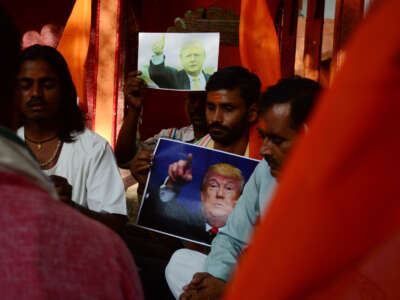
Activists of Vishwa Hindu Parishad (VHP) conduct Hindu rituals to ensure a win for U.S. presidential candidate Donald Trump in Allahabad, India, on May 18, 2016.
RITESH SHUKLA / NURPHOTO VIA GETTY IMAGES

At 1:30 am on the bitterly cold night of January 22, around 50 people gathered at New York City’s Times Square. The crowd had assembled to watch a live telecast of the consecration of the Ram Mandir, a temple to the Hindu deity Rama in the northern Indian city of Ayodhya, led by Prime Minister Narendra Modi. Built on the ruins of a 16th-century mosque destroyed by a Hindu supremacist mob in 1992, the new state-sponsored Ram temple has become a milestone in the 100-year march to power of the Hindu supremacist movement, also known as Hindutva.

On this winter night, members of the Indian diaspora had congregated in one of the country’s most visible public spaces to bear witness to what they saw as a historic achievement. The crowd glanced expectantly at the towering screens, and, when energy lagged, a few among them led the group in chants of “Jai Shri Ram” (hail Lord Ram) and waved triangular, saffron-colored flags — an unmistakable symbol of the Hindu supremacist movement. (The slogan Jai Shri Ram has been appropriated as a Hindu supremacist slogan over a course of a number of violent campaigns and has become a murder cry during lynchings and assassinations.) Yet, as time dragged on, it became clear that the awaited livestream was not forthcoming.

Whether the advertising space was in fact secured for a screening or not was in the end immaterial. The “news” of the Times Square live telecast had been disseminated in the Indian media and had thus served to validate a story that Hindu supremacists have spent years cultivating: that the Indian diaspora is unanimous in its support for Modi’s India. In fact, the use of Times Square as a symbol of global legitimacy, even when such expressions have been deeply contested, has been a repeated strategy of the Hindu far right in the U.S.

It seemed even the hopeful Times Square attendees understood this ars bellica on some level, which kept their mood from souring too much. “It was supposed to be out here… but it’s too bad,” said Paras Pandhare, with a shrug and a laugh. For Pandhare and other attendees that evening, the moment they had gathered to celebrate was a grand historical occasion, marking the end of what they deemed to be a five-century era of subservience. “India is on the rise again, and it deserves to be,” Pandhare added pridefully.

The Centrality of the Ram Temple to Hindu Supremacist Politics


In a way, the Times Square debacle reflected the broader dynamics that color Hindu nationalism, and in particular the Ram temple movement. As in many fascist movements of the past, its membership and supporters have been far less concerned with facts than with the larger aim of reclaiming the nation from their imagined enemies. The central premise of the Ram temple movement — that a Mughal king named Babur demolished a Ram temple to build the Babri Mosque on the exact birthplace of Lord Ram — are claims that arose in the 19th century from various Hindu groups, but have never been proven, and are unlikely to ever be.

RELATED STORY
Blocking our organizations’ X accounts in India is another sign of the Indian government’s attempts to stifle dissent.
By Rasheed Ahmed & Sunita Viswanath , TRUTHOUT December 16, 2023

In the 1980s, the Vishwa Hindu Parishad (VHP), a mass cultural organization which formed in 1964 as part of the Hindu supremacist movement, capitalized on this mythology, turning it into a national campaign to replace the Babri Masjid (mosque) with a new Ram temple. A few years later, the newly formed Bharatiya Janata Party (BJP), which rules India today, helped propel the “Ram Janmabhoomi” (birthplace of Ram) campaign into the mainstream, first through a 10-state, 10,000-kilometer “rath yatra” (chariot procession) in 1990 and then in 1992 in the demolition of the mosque. The razing of the mosque set off a series of interreligious riots that killed at least 2,000 people, most of them Muslim. This is considered by many to be one of the most tragic moments in India’s post-independence history.

Nonetheless, the Ram temple issue has been a watershed for Hindu supremacists and especially the BJP. Prior to this campaign, in the federal elections of 1984, the BJP won a paltry two seats in the Indian parliament. By 1989, its strength had grown to 85 seats. Ten years later, its seat share had nearly doubled to 161. Today, it has a full majority in India’s multiparty democracy at 303 of the 543 seats. In the past 35 years, the temple has gone from being a site of grievance for Hindu supremacists to a symbol of their triumph. Its construction further rounds out a full decade of Narendra Modi’s rule, during which India saw rising casteist and religious violence, the passage of discriminatory citizenship and anti-conversion laws which target Muslims and Christians, and political disenfranchisement of Indian-occupied Kashmir.

Although the dust from the inauguration of the temple has barely settled, in anticipation of the upcoming national elections Hindu supremacist groups in India and the U.S. are already lining up the next violent usurpation. Times Square rang with chants translating to “Ayodhya is just a preview, Kashi and Mathura are next,” threatening the destruction of two other historically contested mosques. The VHP’s U.S.-based affiliate, the Vishwa Hindu Parishad of America, also put out a press release demanding that a mosque in Kashi be converted into a temple. The promise for the destruction of more mosques and the communal violence that will inevitably follow, will continue to be used to buttress the Hindu far right’s majoritarian claims.

The Global Reach of Hindu Supremacy


The Hindu nationalist project has long been transnational, and has deep roots in the U.S. A report detailing this history has recently been launched by a new coalition called Savera: United Against Supremacy, which describes itself as a multiracial, interfaith platform against the rising tide of supremacist politics. Titled “The Global VHP’s Trail of Violence,” this report highlights the growing connections between the Hindu supremacist movement in the United States and the American far right, as well the former’s complicity in multiple instances of deadly anti-minority violence in India.

In particular, the report draws attention to the Vishwa Hindu Parishad of America, or VHP-A, established in 1970, which is the apex Hindu supremacist organization in the U.S with 21 chapters around the country. Although the VHP-A claims to be “legally separate and operationally independent” of the VHP in India, in moments of celebration — as in the past week — it has often been keen to emphasize its central role in the broader Hindu supremacist movement, and in advancing the programmatic agenda of the VHP.

While the VHP-A was not officially connected to the Times Square gathering, it claimed credit for organizing a number of parallel events including large gatherings in San Francisco, Houston, Chicago and Washington, D.C. In these celebrations, the VHP-A boasted of its role in supporting the demolition of the mosque and the construction of the Ram Mandir, corroborating the revelations of the Savera report. In addition to calling for more mosque demolitions, it recently announced a new pan-U.S. “rath yatra” or chariot march, using the same term used by the movement that demolished the Babri Masjid in 1992 and sparked frequent incidents of communal violence in its wake. This hate caravan that caused widespread violence in India will now be an affront to Muslims in the U.S.

The Savera report shows that the VHP-A has played a continuous role in Hindu supremacist violence, not just during the Ram Janmabhoomi movement, but also in the 2002 anti-Muslim riots in the state of Gujarat, the 2008 anti-Christian riots in the state of Odisha and the infamous 2020 riots in India’s capital of Delhi. In this latest spate of violence, a VHP-A member from Houston, Sachin Chitlangia, both helped run the online platform of and personally raised over $115,000 for Kapil Mishra, who is widely seen as one of the key architects of the Delhi violence.

The VHP-A also tried to platform another hatemonger and monk, Yati Narsinghanand Saraswati, an instigator of the Delhi riots, at an online religious event a year later. “Those we call Muslims in our current era were called demons in earlier eras,” Narsinghanand has said. “Islam should be eradicated from Earth … all Muslims should be eliminated.” The VHP-A had to pull back after progressive groups raised a stink, but their associate Vibhuti Jha went ahead, inviting Narsinghanand to his channel. Jha himself said that “our youth must be trained for war.”

But while VHP-A has contributed to violence in India, it has also worked to fortify far right groups and movements in the U.S. For example, the report recounts the 2012 Stop Islamization of Nations Conference, hosted by infamous Islamophobes Robert Spencer and Pamela Geller, whose organizations have been designated by the Southern Poverty Law Center as hate groups. At the conference, Babu Suseelan, a long time Hindu supremacist leader and VHP member based in the U.S., preached, “If we do not kill the bacteria, the bacteria will kill us. Muslims will breed like rats and they will be a majority.” He continued, “Islam can be stopped! And it can be wiped out.”

“The extent to which Hindu supremacist groups are emerging as important players in global far right and anti-Muslim networks is a matter of deep concern, and we hope Savera’s report sparks further investigation into the topic,” said Wendy Via, co-founder of the Global Project Against Hate and Extremism. This is illustrated by the ways in which Spencer has increasingly pandered to an Indian far right audience, including by writing his Twitter handle in Devanagari (the alphabet used for Sanskrit, Hindi, and other Indian languages). In toto, the Savera report documented nearly a dozen such links between far right actors in the U.S. and the VHP-A, its members and affiliates.

© SAVERA 2024 – REPRINTED UNDER CC 4.0

The extent to which the Hindu far right is seeding Trump-aligned candidates is also touched upon. The former 2024 Republican presidential candidate Vivek Ramaswamy, who attended two fundraiser galas hosted by the VHP-A’s advocacy wings, is a well-known example. But Ramaswamy is just the tip of a much broader phenomenon. A notable example mentioned in the Savera report is Manga Anantatmula, a VHP-A leader who played a critical role in the campaign against affirmative action that eventually resulted in the 2023 Supreme Court decision which ruled affirmative action protections unconstitutional. (Immediately following the decision, VHP-A’s advocacy wing tweeted: “We welcome #AffirmativeAction ruling by the #SCOTUS.”)

Anantatmula has since used that involvement to launch her congressional election campaign in Virginia’s 16th district. In a recent episode framed around strategies to flip Indian American votes to the far right on Vibhuti Jha’s show (Jha has run for state office on a Republican ticket as well), Anantatmula invoked the alarmist discourse of white supremacists in her messaging to Hindus. “Let’s not be daydreamers, thinking that bringing your paycheck home is enough to take care of your family. No, your next generation is about to be hanged,” she said. “If they think that Hindus are safe in this country, they are not safe.”

Finally, Hindu nationalists have been savvy enough not to limit their allegiances to the right-wing camp. There are a number of prominent Democrats including Ro Khanna (D-California), Tulsi Gabbard (D-Hawaii), Raja Krishnamoorthi (D-Illinois) and Preston Kulkarni (Texas congressional candidate) who have accepted campaign contributions from Hindu nationalists and are friendly with the VHP-A or allied organizations. Some of them, like Maryland’s Gov. Wes Moore and Lt. Gov. Aruna Miller, deny their ties to Hindu supremacists while depending heavily on these very groups for campaign finance. Although this is not a focus of the Savera report, it is important to understand how so-called liberal Indian Americans are also contributing to the right-wing compact.

The Intersectional Struggle Against the Hindu Far Right


In this context, South Asians in the U.S. have an important role and responsibility in building mass resistance to Hindu supremacy. We can start by educating individuals within our communities about the threat posed by Hindutva (Hindu supremacy) and U.S.-based organizations like the VHP-A. Savera’s new report goes a long way in supplying the information that is needed for such a conversation. Other useful resources include Georgetown’s Bridge Initiative’s VHPA Factsheet, Hindutva Watch and the anti-Hindutva Harassment Manual by the South Asia Scholar Activist Collective.

Moreover, from supremacist chants at Times Square to Anantatmula’s credentials in the attack on affirmative action, it is evident that Hindu supremacy and white supremacy are increasingly joined at the hip — and that many actors in both movements seem willing to put aside their internal contradictions to advance a common majoritarian agenda. The same can be said of the deepening political, economic and ideological ties between Zionism and Hindutva, the stakes of which have never been higher. The Hindu supremacists have not only cheered on Israel’s genocidal assault on Gaza but have capitalized on it to demonize Muslims in India.

Additionally, the U.S. foreign policy establishment’s effort to make India a “strategic defense partner” in the U.S.’s rivalry with China has revealed the bipartisan nature of Hindutva’s U.S. base. While the Obama administration worked to rehabilitate Modi (after he was blacklisted by the U.S. government for nearly 10 years due his role in the 2002 Gujarat pogroms) as part of its “Pivot to Asia” policy, President Donald Trump signed over $3 billion in arms deals with India. And despite Modi’s worsening record of human rights abuses, the Biden administration has now given a “free pass” to Modi in order to maintain this “strategic” partnership. Not even an attempted assassination of a U.S. citizen seems to have gotten in the way of another $4 billion in drone sales to India under the current U.S. administration. Biden’s enabling of the first livestreamed genocide in world history further suggests that no caste atrocity or anti-Muslim pogrom will be too much for the U.S. to stomach in the course of its imperial pursuits.

In this context, the South Asian progressives must concentrate on building new movement coalitions that are not only interracial, internationalist and interfaith but also grassroots and responsible to members rather than “national interests.” Defeating the far right will further require us to take an unwavering stance against casteism, racism and ethnonationalism in all of their manifestations. The formation of Savera is thus a welcome development. If the existential challenges we face are so deeply interconnected, movements on the left must cross traditional siloes too, the coalition argues in its report. “It’s a moment of great crisis and precarity, but also one that has produced deep clarity about our interconnectedness.”


SAMANTHA AGARWALl is currently a Changemaker Postdoctoral Fellow in the School of International Service at American University. Her work is on the intersection of caste inequality and ethnonationalism in India.


SEE