It’s possible that I shall make an ass of myself. But in that case one can always get out of it with a little dialectic. I have, of course, so worded my proposition as to be right either way (K.Marx, Letter to F.Engels on the Indian Mutiny)
Friday, May 23, 2025
Scientists reveal how deep-earth carbon movements shape continents and diamonds
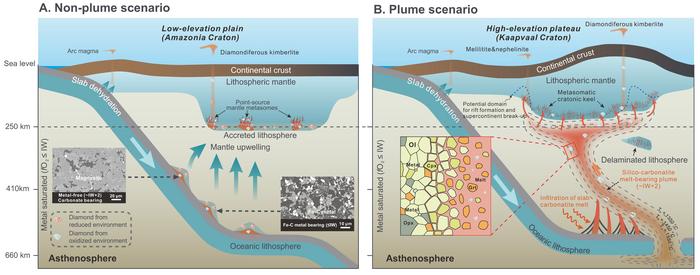
Schematic illustration showing the role of slab carbonatite melts on mantle redox states, sublithospheric diamond formation, and craton evolution under nonplume and plume scenarios.
A new study published in Science Advances by researchers from the Guangzhou Institute of Geochemistry of the Chinese Academy of Sciences (GIG-CAS), along with international collaborators, reveals that deeply subducted carbonates can cause significant variations in the redox states of Earth's mantle. This process influences the formation of sublithospheric diamonds and plays a role in the long-term evolution of cratons—ancient stable parts of the continental lithosphere.
The research team conducted high-pressure experiments simulating depths between 250 and 660 kilometers to investigate how carbonatite melts, derived from subducted slabs, interact with metallic iron-bearing mantle rocks. Their findings indicate that in "nonplume" environments (cooler mantle settings), carbonatite melts undergo progressive reduction, leading to the formation of immobile diamonds that help stabilize the craton. Conversely, under hotter, plume-influenced conditions, the carbonatite melts tend to oxidize the surrounding mantle, which weakens the lithosphere and may trigger lithosphere delamination, surface uplift, and widespread volcanic activity.
"The redox state of the deep mantle is a critical factor controlling how volatiles, such as carbon, cycle between Earth's surface and its interior," said Prof. YU Wang, the study's corresponding author. "Our experiments show that the fate of subducted carbon is heavily influenced by mantle temperature and redox conditions, shaping continent evolution over geological time."
By comparing the composition of minerals formed in their experiments with natural diamond inclusions from cratons in Africa and South America, the researchers found clear evidence that different mantle environments produce distinctly different redox signatures. These variations directly determine whether subducted carbon forms stable diamonds or contributes to lithospheric destabilization.
This study not only advances our understanding of deep carbon storage and mobility in Earth's interior but also has implications for interpreting the ages of diamond formation and predicting craton stability in response to future tectonic events.
The study was primarily supported by the National Natural Science Foundation of China, the National Key R&D Program of China, and the Strategic Priority Research Program of CAS.
Tsukuba, Japan—A recent study has mathematically clarified how the presence of crystals and gas bubbles in magma affects the propagation of seismic P-waves. The researchers derived a new equation that characterizes the travel of these waves through magma, revealing how the relative proportions of crystals and bubbles influence wave velocity and waveform properties.
The ratio of crystals to bubbles in subterranean magma reservoirs is crucial for forecasting volcanic eruptions. Due to the inaccessibility of direct observations, scientists analyze seismic P-waves recorded at the surface to infer these internal characteristics. Previous studies have predominantly focused on the influence of gas bubbles, with limited consideration given to crystal content. Moreover, conventional models have primarily addressed variations in wave velocity and amplitude decay, without capturing detailed waveform transformations.
In this study, the researchers developed a new equation from integrating two distinct mathematical models of magma flow. The results show that P-wave velocity decreases as the proportion of bubbles increases relative to crystals, with bubbles exerting a more significant influence than crystals. Conversely, attenuation effects were found to be more strongly affected by crystals. The analysis further revealed that waveform characteristics depend on frequency and bubble content, with discernible differences emerging between the two underlying models.
The new equation enables the time-dependent calculation of P-waveforms based on the bubble and crystal content in magma. Looking ahead, the research team intends to integrate this model with machine learning techniques to estimate the internal composition of magma from observed P-waveforms, with the goal of enhancing the accuracy of volcanic eruption prediction systems.
### This study was partially supported by the JSPS KAKENHI (Nos. 21J20389 and 22K03898), by the JKA and its promotion funds from the KEIRIN RACE, and by a Komiya Research Grant from the Turbomachinery Society of Japan. This study was partly based on the results obtained from a project subsidized by the New Energy and Industrial Technology Development Organization (NEDO) (No. JPNP20004). This work was also partially supported by the Top Runners in Strategy of Transborder Advanced Research (TRiSTAR) program conducted as part of the Strategic Professional Development Program for Young Researchers by MEXT.
Original Paper
Title of original paper: Weakly nonlinear wave propagation in magma containing crystals and bubbles

No comments:
Post a Comment