It’s possible that I shall make an ass of myself. But in that case one can always get out of it with a little dialectic. I have, of course, so worded my proposition as to be right either way (K.Marx, Letter to F.Engels on the Indian Mutiny)
(The Conversation) — Two hundred years ago, the Erie Canal was often derided as a ‘folly.’ Yet the waterway went on to transform the American frontier.
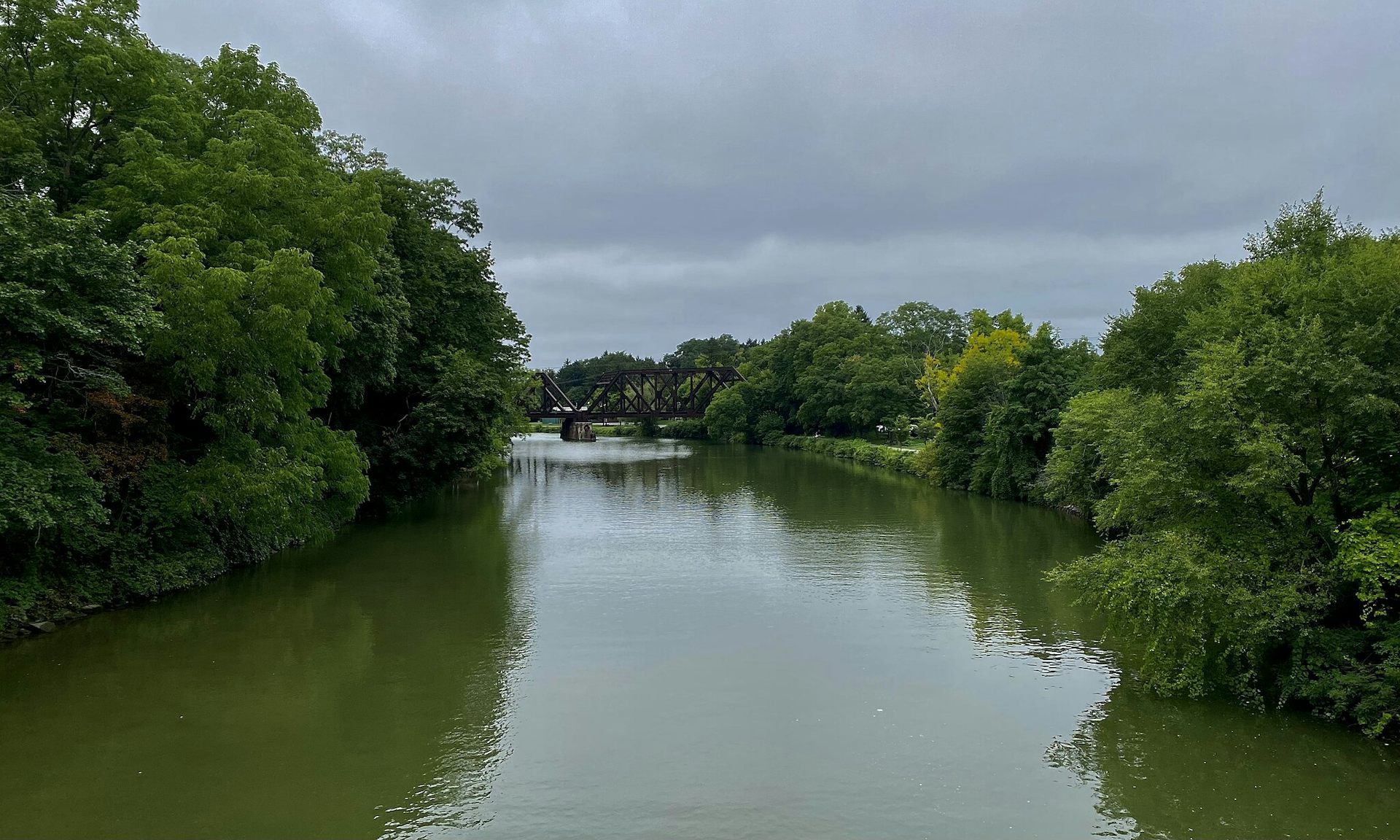
The Erie Canal, seen here in Pittsford, N.Y., opened up western regions to trade, immigration and social change. (Andre Carrotflower via Wikimedia Commons, CC BY-SA) Matthew Smith October 22, 2025
(The Conversation) — Two hundred years ago, on Oct. 26, 1825, New York Gov. DeWitt Clinton boarded a canal boat by the shores of Lake Erie. Amid boisterous festivities, his vessel, the Seneca Chief, embarked from Buffalo, the westernmost port of his brand-new Erie Canal.
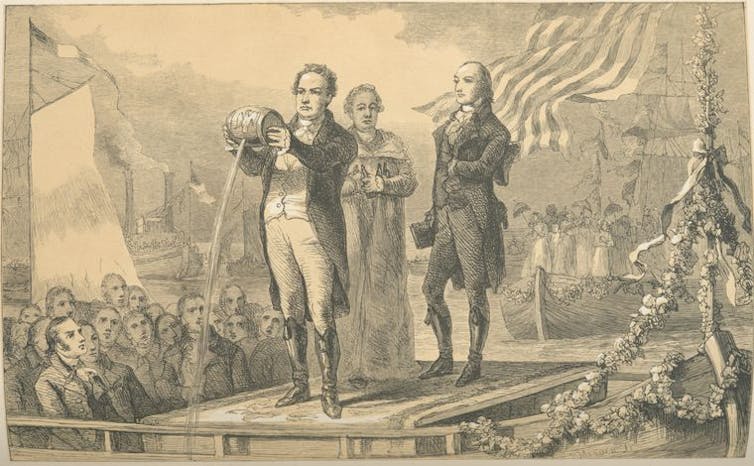
Clinton and his flotilla made their way east to the canal’s terminus in Albany, then down the Hudson River to New York City. This maiden voyage culminated on Nov. 4 with a ceremonial disgorging of barrels full of Lake Erie water into the brine of the Atlantic: pure political theater he called “the Wedding of the Waters.”
The Erie Canal, whose bicentennial is being celebrated all month, is an engineering marvel – a National Historic Monument enshrined in folk song. Such was its legacy that as a young politician, Abraham Lincoln dreamed of becoming “the DeWitt Clinton of Illinois.”
As a historian of the 19th-century frontier, I’m fascinated by how civil engineering shaped America – especially given the country’s struggles to fix its aging infrastructure today. The opening of the Erie Canal reached beyond Clinton’s Empire State, cementing the Midwest into the prosperity of the growing nation. This human-made waterway transformed America’s economy and immigration while helping fuel a passionate religious revival.
But like most big achievements, getting there wasn’t easy. The nation’s first “superhighway” was almost dead on arrival. Clinton’s folly
The idea of connecting New York City to the Great Lakes originated in the late 18th century. Yet when Clinton pushed to build a canal, the plan was controversial.
The governor and his supporters secured funding through Congress in 1817, but President James Madison vetoed the bill, considering federal support for a state project unconstitutional. New York turned to state bonds to finance the project, which Madison’s ally Thomas Jefferson had derided as “madness.”
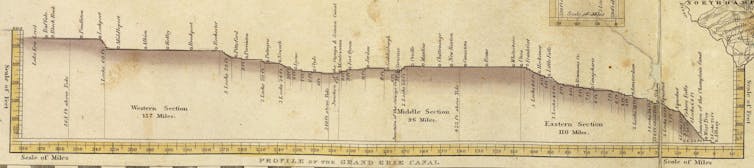
Construction began on July 4, 1817. Completed eight years later, the canal stretched some 363 miles (584 kilometers), with 18 aqueducts and 83 locks to compensate for elevation changes en route. All this was built with only basic tools, pack animals and human muscle – the latter supplied by some 9,000 laborers, roughly one-quarter of whom were recent immigrants from Ireland.
Despite its naysayers, the Erie Canal paid off – literally. Within a few years, shipping rates from Lake Erie to New York City fell from US$100 per ton to under $9. Annual freight on the canal eclipsed trade along the Mississippi River within a few decades, amounting to $200 million – which would be more than $8 billion today.
Commerce drove industry and immigration, enriching the canal towns of New York – transforming villages like Syracuse and Utica into cities. From 1825-1835, Rochester was the fastest-growing urban center in America.
By the 1830s, politicians had stopped ridiculing America’s growing canal system. It was making too much money. The hefty $7 million investment in building the Erie Canal had been fully recouped in toll fees alone.
Religious revival
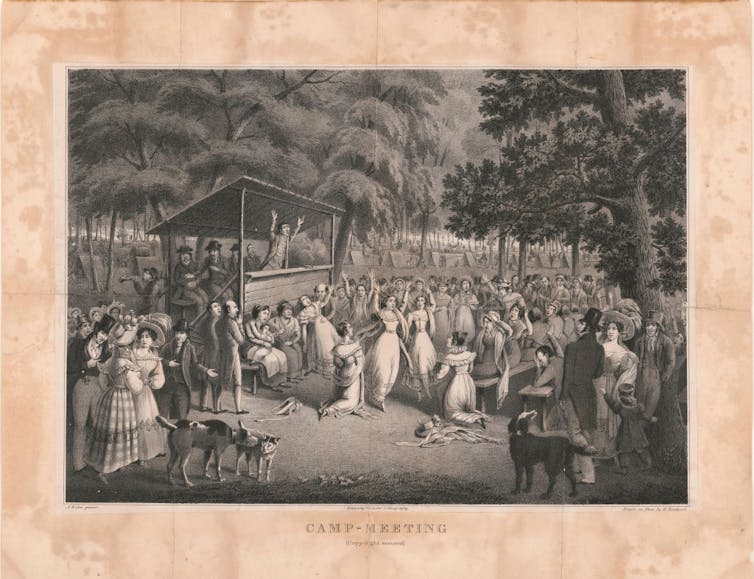
Nor was its legacy simply economic. Like many Americans during the Industrial Revolution, New Yorkers struggled to find stability, purpose and community. The Erie Canal channeled new ideas and religious movements, including the Second Great Awakening: a nationwide movement of Christian evangelism and social reform, partly in reaction to the upheavals of a changing economy.
Though the movement began at the turn of the century, it flourished in the hinterlands along the Erie Canal, which became known as the “Burned-Over District.” Revivalists like Charles Grandison Finney – America’s most famous preacher at the time – found a lively reception along this “psychic highway,” as one author later dubbed upstate New York.
Some denominations, like the Methodists, grew dramatically. But the “Burned-Over District” also gave birth to new churches after the canal’s creation. Joseph Smith founded the Church of Jesus Christ of Latter-day Saints, often known as Mormons, in Fayette, New York, in 1830. The teachings of William Miller, who lived near the Vermont border, spread west along the canal route – the roots of the Seventh-day Adventist Church.
As Clinton predicted, the Erie Canal was “a bond of union between the Atlantic and Western States,” uniting upstate New York and the agrarian frontier of the Midwest to the urban markets of the Eastern seaboard.
In the mid-1820s, Ohio Gov. Ethan Allen Brown praised America’s canals “as veins and arteries to the body politic” and commissioned two canals of his own: one to link the Ohio River to the Erie Canal, completed in 1832; and another to link the Miami River, completed in 1845. These canals in turn connected to numerous smaller waterways, creating an extensive network of trade and transportation.
While America’s canal boom brought prosperity, this wealth came at a cost to many Indigenous communities – a cost that is only slowly being acknowledged. The Haudenosaunee, often known by the name “Iroquois,” especially paid the price for the Erie Canal. The confederacy of tribes was pressured into ceding lands to the state of New York, and further displaced by ensuing frontier settlement.
Past and future
As the U.S. nears its 250th birthday on July 4, 2026, the official website of this commemoration urges Americans “to pause and reflect on our nation’s past … and look ahead toward the future we want to create for the next generation and beyond.”
Overcoming gridlock demands bipartisan consensus on basic concerns. Technology changes, but the demands of infrastructure – from rebuilding roads and bridges to expanding broadband and sustainable energy networks – and the will needed to address them, persist. As the Erie Canal reminds us, American democracy has always been built upon concrete foundations.
(Matthew Smith, Visiting Assistant Professor of History, Miami University. The views expressed in this commentary do not necessarily reflect those of Religion News Service.)
The Conversation religion coverage receives support through the AP’s collaboration with The Conversation US, with funding from Lilly Endowment Inc. The Conversation is solely responsible for this content.
U.S. canal and railroad developers put Irish migrants to work in the 1850s. Workers who succumbed to injuries, exhaustion, and disease were buried without ceremony. In Malvern, Pennsylvania, grave researcher Frank Watson spoke of teenaged and adult workers buried in a human “trash heap.” A Chicago-area mass-grave marker observes:
“They arrived sick and penniless, and took hard and dangerous jobs building the Chicago & Alton Railroad. Known but to God, they rest here in individual anonymity – far from the old homes of their heirs – yet forever short of the new homes of their hopes.”
Some years ago I came across my father’s family name in an old news story about Irish workers buried near a railway. And I wondered: Were we related? My father’s family swore they came from French nobility, not from the shanty Irish like your mother.
But JFK became president the year I was born and the narrative was bound to shift. JFK too had forebears who fled the potato famine. (We say “famine” so we can forget it was deliberate starvation. As Sinéad O’Connor reminded everyone, Ireland’s food was shipped to England; Irish people caught eating anything except potatoes could be shot dead.)
The Fitzgeralds and Kennedys first worked in Boston as common tradespeople. Eventually, they’d run shops and bars, and make successful bids for political posts. Who, in the all-encompassing quest for Standard of Living, had time to look back?
Noel Ignatiev explored the way Irish Catholics climbed up the U.S. class ladder in How the Irish Became White. That book might have been a user’s manual for my forebears as it explains how they did in fact become white. Meanwhile, JFK publicly vowed that the USA would be first on the moon. And it was. JFK’s key project leader was Wernher von Braun, who’d developed Nazi Germany’s “vengeance weapons”—the V-2 rockets.
Humans had entered some new phase, some kind of hyper-self-domestication. Trains weren’t built so much to move ordinary people as to deliver freight and luxury goods. Apollo 11 got resources that could have funded vital social networks. Gil Scott-Heron called it. Making a nation (for some) Number One eclipsed real values.
But getting back to the shamrocks and beer…Now comes Saint Patrick’s Day in all its whiskey-soaked and dollar-shop green glory.
A Star Performance
Patrick—the bishop Patricius—claimed credit for converting Ireland to Catholicism in the 5th century:
“Never before did they know of God except to serve idols and unclean things. But now, they have become the people of the Lord, and are called children of God. The sons and daughters of the leaders of the Irish are seen to be monks and virgins of Christ!”
Now, if the Anthropocene Awards are ever produced for star-quality performances, nominate Patrick. Why bother to learn from others when you can stamp out their knowledge instead? And this was superhero-level stamping-out. Unless, more likely, Patrick is just a diversion, superimposed on history to blot out the druidic take on the universe.
The Collins Dictionary traced the root meaning of the word druid to the term oak-wise. We need more oak wisdom.
But a 5th-century Roman Catholic “patron saint of Ireland” had no use for it. And in a later century—Sinéad told us all about this, too—the British pope Adrian IV handed Ireland to England, setting the stage for the British to eventually starve the Irish people and ban the Irish language, forcing them to leave, die, or live with no memory of their cultural story.
Of course, the Anthropocene epoch is riddled with crimes against humanity; who was Patrick, but one of history’s common tormentors? Patrick, like any other conqueror, could have championed a different route, guided by the connections humans knew before the times of nations and borders, before we authorized some to routinely confine and control others.
Point of Contention
Naomi Klein, a few years ago, objected to the term Anthropocene:
“Diagnoses like this erase the very existence of human systems that organised life differently: systems that insist that humans must think seven generations in the future; must be not only good citizens but also good ancestors; must take no more than they need and give back to the land in order to protect and augment the cycles of regeneration.”
So at essence, Klein has a “Not all humans…” take. There’s an idea that indigenous communities have no connection to human-driven extinctions or geological crises. Is that so? Indigenous humans set out to domesticate living communities more than 10,000 years ago.
Now, a quest to declare the Anthropocene an official geological epoch has stalled as experts debate just how far back they’ll pin the starting point. The official working group focuses on measurable, physical evidence of human-caused changes—microplastics, coal, pesticides—and situates the start of the Anthropocene in 1952, pointing to the global plutonium fallout from nuclear weapon testing.
Wait, though. We were deep into the Anthropocene by the 1950s. I Love Lucy was already on in 1952. It was the year Hasbro unveiled Mr. Potato Head, that breakthrough use of plastic which turned children into TV advertising consumers. The first patent for a bar code product was issued that year. In 1952, according to a study guide from the Michigan Farm Bureau: “The first Herringbone parlor is used. This helped farmers move a row of cows in together for milking in one clean space.”
Cows, you might remember, are the descendants of some of Earth’s most formidable animals—the aurochs. Living in their natural habitat, carrying out their evolution on their terms, was their birthright. But we humans developed breeding technologies to make them smaller, turn them into our underlings, fence them in, kill them, eat their flesh and drink what we could pull from their teats. By the 1600s we had killed off the last of their free-living ancestors.
We could say humans entered our current, late stage of hyper-self-domestication by the time petkeeping became popular, back in the Elizabethan era. The Anthropocene was fully fledged much earlier. Never mind. As my friend Patricia Fairey emailed, “At the current rate the Anthropocene won’t last long.”
And now, the vernal equinox approaches. Let’s turn off our computers, go out to the oaks, and welcome it.
Lee Hall holds an LL.M. in environmental law with a focus on climate change, and has taught law as an adjunct at Rutgers–Newark and at Widener–Delaware Law. Lee is an author, public speaker, and creator of the Studio for the Art of Animal Liberation on Patreon.
Tuesday, May 02, 2023
REST IN POWER
Gordon Lightfoot, Canadian Singer/Songwriter, Dies at 84
Story by Katie Atkinson • Yesterday
Billboard Gordon Lightfoot, Canadian Singer/Songwriter, Dies at 84
Related video: Gordon Lightfood dead at 84 (cbc.ca) Duration 3:14 View on Watch
Gordon Lightfoot, the Canadian singer/songwriter behind the folk hits “The Wreck of the Edmund Fitzgerald,” “Sundown” and “If You Could Read My Mind,” died at age 84 on Monday (May 1), his family has announced.
“Gordon Lightfoot passed away this evening in a Toronto hospital at 7:30 p.m.,” a statement on Lightfoot’s Facebook page announced, promising “more to come.”
Earlier this month, Lightfoot had canceled his upcoming U.S. and Canada tour dates due to health issues. “Gordon Lightfoot announces the cancellation of his U.S. and Canadian concert schedule for 2023,” a statement read at the time. “The singer is currently experiencing some health related issues and is unable to confirm rescheduled dates at this time.”
Lightfoot’s six-decade career began in the early 1960s on the Toronto folk circuit and went worldwide in the 1970s thanks to a string of influential hits. He scored four top 10 hits on the Billboard Hot 100 in the ’70s, starting with “If You Could Read My Mind,” which peaked at No. 5 in 1971. Next up were “Sundown” — his lone No. 1 — and “Carefree Highway” (No. 10), both from 1974’s Sundown — also his only No. 1 album on the Billboard 200.
Finally, there was the most epic song of his catalog, “The Wreck of the Edmund Fitzgerald,” which was released in 1976 and peaked at No. 2 on the Hot 100. The song told the story of the fatal sinking of the SS Edmund Fitzgerald a year earlier in Lake Superior, which killed all 29 men aboard the Great Lakes freighter. “They might have split up or they might have capsized/ They may have broke deep and took water/ And all that remains is the faces and the names/ Of the wives and the sons and the daughters,” the poetic lyrics read.
Lightfoot was inducted into the Songwriters Hall of Fame in 2012. He won 13 Juno Awards in his native Canada, capped by his induction into the Canadian Music Hall of Fame in 1986. He won four Juno Awards for male vocalist of the year (1971-73 and 1975) and two for composer of the year (1973 and 1977). Lightfoot was nominated for four Grammys (but never won) — best folk performance for Did She Mention My Name (1968), best pop vocal performance, male for “If You Could Read My Mind” (1971) and song of the year and best pop vocal performance, male for “The Wreck of the Edmund Fitzgerald” (1976).
Lightfoot is survived by his wife, actress Kim Hasse, whom he married in 2011. He had six children from his past relationships, including two previous marriages.
Gordon Lightfoot, Canadian Folk-Rock Troubadour, Dead at 84
Story by Andy Greene • Yesterday
Rolling Stone Gordon Lightfoot, Canadian Folk-Rock Troubadour, Dead at 84
Gordon Lightfoot — a genius-level Canadian singer-songwriter whose most enduring works include “If You Could Read My Mind,” “Sundown,” “Carefree Highway,” “Early Morning Rain,” and “Rainy Day People” — died on Monday, the CBC confirmed. He was 84.
Lightfoot’s deceptively simple songs, which fused folk with pop and country rock, have been covered by everyone from Bob Dylan, Neil Young, Elvis Presley and Johnny Cash to the Grateful Dead, Barbra Streisand, Jerry Lee Lewis, Eric Clapton, Jimmy Buffett, and the Replacements.
He scored a series of hits in his native Canada throughout the Sixties, but most Americans first heard his work in 1970 when “If You Could Read My Mind” reached Number Five on the Hot 100. The deeply personal song chronicles the agonizing breakdown of his marriage, casting much of the blame on himself. “I never thought I could act this way,” he wrote. “And I’ve got to say that I just don’t get it/I don’t know where we went wrong/But the feeling’s gone and I just can’t get it back.”
“I can’t think of any Gordon Lightfoot song I don’t like,” Bob Dylan once said. “Every time I hear a song of his, it’s like I wish it would last forever.”
Lightfoot was born November 17, 1938 in Orillia, Ontario. His parents recognized his singing ability at a young age and placed him in Orillia’s St. Paul’s United Church. He eventually taught himself piano and guitar, playing in large-ensemble pop-folk groups across Canada. After a stint at the Westlake College of Music in Los Angeles, he began playing in folk clubs around Canada. He released two singles in 1962 (“It’s Too Late, He Wins” and “(Remember Me) I’m the One”) that charted regionally, and his profile grew considerably when Ian and Sylvia, the Kingston Trio, Peter, Paul and Mary, and Judy Collins turned his songs — most notably “Earning Morning Rain” — into hits.
He signed a management contract with famed manager Albert Grossman in 1965 that helped land Lightfoot spots on The Tonight Show and the Newport Folk Festival. He played an acoustic set shortly before Dylan made history by playing his first electric set. “I remember Albert and the musicologist Alan Lomax getting into a wrestling match in the afternoon of that day,” Lightfoot told Rolling Stone in 2019. “Joan Baez, Donovan and I, we all stood around and watched. It was over the drum kit. They were trying to stay traditional, and somebody brought the drum kit onstage for the first time. It was quite a kerfuffle over it. It was a hot day in Newport. And a dry day. And I remember the dust was flying.”
In 1966, he released his debut LP Lightfoot!, which he followed up the next year with The Way I Feel. The latter album featured drummer Kenny Buttrey and guitarist/bassist/harmonica player Charlie McCoy. Later that year, Dylan used them as his backing band on John Wesley Harding. “I heard the sound that Gordon Lightfoot was getting,” Dylan told Rolling Stone in 1969. “I figured if he could get that sound, I could. But we couldn’t get it.”
The success of “If You Could Read My Mind” in 1970 was the start of a stunning run of hits, including “Sundown,” “Carefree Highway,” and “Rainy Day People.” The biggest came in 1976 after he read an article in Newsweek about the the sinking of the bulk carrier SS Edmund Fitzgerald on Lake Superior on November 10, 1975. He called the epic maritime disaster song, “The Wreck of the Edmund Fitzgerald.”
“It was quite an undertaking to do that,” he said in a 2014 Reddit AMA. “I went and bought all of the old newspapers, got everything in chronological order, and went ahead and did it because I already had a melody in my mind and it was from an old Irish dirge that I heard when I was about three and a half years old….I think it was one of the first pieces of music that registered to me as being a piece of music.”
Despite the huge success he had as a recording artist, many of his songs are best known by their cover versions. Bob Dylan included his own rendition of “Early Morning Rain” on his 1970 LP Self Portrait, and Elvis Presley covered the same song two years later. “I was really impressed with the recording,” Lightfoot said in 2015. “It was probably the most important recording that I have by another artist.”
Lightfoot developed a severe drinking problem in the late Seventies that took a tremendous toll on his personal life and career. “I was either writing, recording, touring, or doing television,” Lightfoot once told Low Country Today. “I drank way too much. But I gave that up in 1982 thanks to the help of my sister and a bad breakup. I knew I had to quit to keep myself sharp and stay in the game.”
By the time he sobered up, MTV was ascendent and his album sales took a major shift downward. But he continued to tour and record heavily. He was back in the news in 1986 when he noticed that Whitney Houston’s “The Greatest Love of All” was melodically very similar to “If You Could Read My Mind.”
“The first time I heard [“The Greatest Love of All”] was on an elevator,” he told Alabama.com in 2015. “What I finally figured out was there was a total of about 24 bars that were just really, really … It was really obvious and I noticed it. So what I did was I actually initiated a lawsuit for plagiarism but three weeks later I let it go because I understood that it was affecting Whitney Houston who had an appearance coming up at the Grammy Awards and the suit wasn’t anything to do with her. The suit was against her producer (and the song’s cowriter), Michael Masser. Now they’re dragging Whitney into this and I withdrew it. I said, ‘Forget it. We’re withdrawing this.'”
In 2002, Lightfoot suffered an abdominal aortic aneurysm and spent six weeks in a coma. He eventually recovered after four surgeries. “I was ashamed at the amount of blood they went through,” he told Rolling Stone. “It would have been better off if I had died. I think it was 28 units.”
Doctors performed a tracheotomy on him during his hospital stay, causing vocal cord damage that greatly weakened his singing voice, but he was back onstage by 2004. “I wanted to recover, I wanted to sing again,” he told the State Journal-Register. “I wasn’t sure — they had to take a lot of muscles out of my stomach and I wasn’t sure if I would have the kind of breathing control that I would need. But gradually it worked back and I started practicing.”
In 2019, he was the subject of the documentary Gordon Lightfoot: If You Could Read My Mind. Around that time, he celebrated his 80th birthday with an extensive tour that wrapped up last October at the Club Regent Casino in Winnipeg. He was due to return to the road in April, but canceled at the last minute due to unspecified health problems. “We thank you for respecting his privacy,” his team wrote in a statement. “He continues to focus on his recovery.”
Gordon Lightfoot Dies: Canada’s PM Justin Trudeau Remembers ‘One of Our Greatest Singer-Songwriters’
Gordon Lightfoot, the late, legendary Canadian singer and songwriter, is being remembered for his contribution to his country’s folk songbook, and for inspiring generations of musicians and fans.
Lightfoot, who wrote the songs “The Wreck of the Edmund Fitzgerald,” “Sundown” and “If You Could Read My Mind,” and many other across a celebrated, decades long-career, died Monday (May 1) in a Toronto hospital at age 84.
Born in Ontario, Lightfoot’s six-decade career began in the early 1960s on the Toronto folk circuit and went worldwide in the 1970s thanks to a string of influential hits. He scored four top 10 hits on the Billboard Hot 100 in the ’70s, starting with “If You Could Read My Mind,” which peaked at No. 5 in 1971. Next up were “Sundown” — his lone No. 1 — and “Carefree Highway” (No. 10), both from 1974’s Sundown — also his only No. 1 album on the Billboard 200.
During his lifetime, he collected 13 Juno Awards in his native Canada, capped by his induction into the Canadian Music Hall of Fame in 1986, and in 2012 was elevated into the Songwriters Hall of Fame in 2012.
Canada’s Prime Minister Justin Trudeau led tributes. “We have lost one of our greatest singer-songwriters,” he states. Lightfoot “captured our country’s spirit in his music – and in doing so, he helped shape Canada’s soundscape. May his music continue to inspire future generations, and may his legacy live on forever. To his family, friends, and many fans across the country and around the world: I’m keeping you in my thoughts at this difficult time.”
As the sad news spread on social media, fans and fellow artists chimed in.
“This one is really hard to write,” reads a statement from countryman Bryan Adams. “Once in a blue moon you get to work and hang out with one of the people you admired when you were growing up. I was lucky enough to say Gordon was my friend and I’m gutted to know he’s gone. The world is a lesser place without him. I know I speak for all Canadians when I say: thank you for the songs Gordon Lightfoot. Bless your sweet songwriting heart, RIP dear friend.”
Brian Wilson, Belinda Carlisle, author Stephen King and many others weighed in on the passing of a great. See the reaction on social media below.
Tributes came fast across social media following the news of the death of beloved Candian singer-songwriter Gordon Lightfoot on Monday night.
The folk icon died Monday at the age of 84, according to his tour publicist.
The Orillia, Ont.-born singer-songwriter, known for such hits as The Wreck of Edmund Fitzgerald and If You Could Read My Mind , had most recently cancelled all of his North American tour date due to “health issues” that weren’t specified.
A cause of death wasn’t immediately known.
“We have lost one of our greatest singer-songwriters. Gordon Lightfoot captured our country’s spirit in his music – and in doing so, he helped shape Canada’s soundscape. May his music continue to inspire future generations and may his legacy live on forever,” Prime Minster Justin Trudeau tweeted.
Added author Stephen King: “He was a great songwriter and a wonderful performer. Sundown, you better take care/If I catch you creepin’ ’round by back stairs.”
Broadcaster Joe Bowen added: “Very sad day with the passing of Canadian Icon Gordon Lightfoot. His longtime drummer Barry Keane arranged for us to meet Gordon several times. A huge piece of Canadian Music History has left us. RIP Gordon
Canadian George Stroumboulopoulos also shared a tribute. “He sat on top of the mountain. He shared what he saw. For so many around the world, they knew our stories because of him. Rest in peace Gord. Golden forever. Gordon Lightfoot 1938-2023.”
Listen To Lightfoot's New Music Exclusive 'I Got Sick And Was Out Of The Game' Postmedia News • Yesterday
Awards, admirers and key albums: Some facts about Gordon Lightfoot Story by The Canadian Press • Yesterday
Some facts about Gordon Lightfoot, the folk singing legend who died Monday night at age 84.
Born: Nov. 17, 1938, Orillia, Ont.
Musicians who have performed Lightfoot songs: Bob Dylan, Peter, Paul & Mary, Ian & Sylvia, Richie Havens, Glen Campbell, Anne Murray, Nana Mouskouri, Harry Belafonte, Elvis Presley, Barbra Streisand, George Hamilton IV.
Awards: Order of Canada, Governor General's Award, inducted into the Canadian Music Hall Of Fame, the Canadian Broadcast Hall of Fame and the Canadian Country Music Hall of Fame, 12 Juno Awards (including one in 1970 when it was called the Gold Leaf), as well at four top folk singer RPM Awards — the 1960s predecessor to the Junos — and four Grammy nominations.
Albums include:
"Lightfoot!" (1966)
"The Way I Feel" (1967)
"Did She Mention My Name" (1968)
"Back Here On Earth" (1968)
"Sunday Concert" (1969)
"If You Could Read My Mind" (1970)
"Summer Side Of Life" (1971)
"Don Quixote" (1972)
"Old Dan’s Records" (1972)
"Sundown" (1973)
"Cold On the Shoulder" (1975)
"Summertime Dream" (1976)
"Endless Wire" (1978)
"Dream Street Rose" (1980)
"Shadows" (1982)
"Salute" (1983)
"East Of Midnight" (1986)
"Waiting For You" (1993)
"A Painter Passing Through" (1998)
"Harmony" (2004)
"Solo" (2020)
This report by The Canadian Press was first published May 1, 2023.
The Canadian Press
Gordon LightFoot Last Video 3 hours Before Death. He Knew it
Cricket Star
Premiered 10 hours ago #gordonlightfoot #gordonlightfootdied
Gordon Lightfoot's musical career began at a young age. Growing up in Orillia, Ontario, he learned to play piano and drums before picking up the guitar at the age of ten. His parents were both musically inclined, and his mother was a choir director and pianist. His interest in music led him to perform at local events and eventually to form a band, The Two Tones, with his friend, Terry Whelan.
In 1958, Lightfoot moved to Los Angeles to pursue a career in music, but he struggled to find success in the competitive music scene. He returned to Canada and settled in Toronto, where he began to make a name for himself in the city's burgeoning folk scene. He was soon signed to United Artists Records and released his first album, "Lightfoot!", in 1964.
The album featured the hit single "Early Morning Rain," which quickly became a classic and has since been covered by countless artists. Lightfoot's distinctive voice and intricate guitar work caught the attention of music fans and critics alike, and he soon became one of Canada's most popular folk singers.
Over the next few years, Lightfoot continued to release successful albums, including "The Way I Feel" (1967), "Did She Mention My Name?" (1968), and "Sit Down Young Stranger" (1970). His songs often dealt with themes of love, loss, and nature, and his poetic lyrics and haunting melodies captured the hearts of listeners around the world.
In the 1970s, Lightfoot's popularity continued to soar. His albums "Don Quixote" (1972), "Sundown" (1974), and "Summertime Dream" (1976) all received critical acclaim and were commercial successes. He also became known for his powerful live performances, and his concerts drew crowds of devoted fans.
In 1976, Lightfoot suffered a near-fatal illness when an abdominal aortic aneurysm ruptured. He underwent multiple surgeries and spent several months in the hospital, but he eventually made a full recovery and returned to music. He continued to tour and record throughout the 1980s and 1990s, releasing albums like "Salute" (1983), "East of Midnight" (1986), and "A Painter Passing Through" (1998).
Throughout his career, Lightfoot has received numerous awards and accolades. He has been nominated for 16 Juno Awards, Canada's top music award, and has won six times. He was also inducted into the Songwriters Hall of Fame in 2012 and received a Lifetime Achievement Award at the 2017 SOCAN Awards.
Lightfoot's impact on Canadian music and culture is immeasurable. His songs have become part of the national consciousness, and his voice and guitar work have inspired countless musicians. He is often referred to as Canada's greatest songwriter and is considered a national treasure in his home country.
Despite health issues and a slowing of his touring schedule in recent years, Lightfoot continues to perform and record. He remains an active presence in the music world and a beloved figure to his legions of fans.
The Edmund Fitzgerald sunk in Lake Superior on today's date in 1975 taking 29 men with her.
It was far from the deadliest shipwreck in the history of the Great Lakes. But none are more enduring. November 10 marks the anniversary of the loss of the Edmund Fitzgerald, a 729-foot ore carrier in Lake Superior that was lost amid one of the worst storms in Great Lakes history on Nov. 10, 1975. All 29 men on board the Fitzgerald were lost and researchers still debate the cause of the wreck, which remains in the public consciousness.
“I think that’s one of the reasons that the Fitzgerald stays with people,” said Bruce Lynn, executive director of the Great Lakes Shipwreck Museum at Whitefish Point. “No one really understands why it sank, and it’s still a mystery. It’s sort of the age old, man-versus-elements aspect.”
The Fitzgerald, which was based in Milwaukee, was the flagship of the Columbia Transportation division of Cleveland mineral concern Oglebay Norton. It was launched on June 7, 1958 and quickly became one of the most revered ships on the lakes. Though it was no longer the longest ship on the inland seas by 1975, it was still considered the “Queen of the Lakes” both on and offshore.
The ship regularly made ore runs between upper Lake Superior and ports southward, and on the morning of Sunday, Nov. 9, 1975, loaded at Superior, Wisc. for another routine voyage. In the past week alone, the Fitzgerald had sailed from Toledo to Silver Bay, Minn., loaded for a run to Ashtabula, Ohio, and sailed back to Superior to load again for a scheduled run to the Detroit area.
The Fitzgerald finished loading 26,000 tons of taconite pellets, which held substantial qualities of iron, and left Superior just after 2 p.m. in mild conditions. By evening, though the weather started to deteriorate, and by Monday afternoon and evening, recorded gusts of 90 miles per hour were coupled with blinding snow squalls and 30-foot seas.
"It’s hard to compare the bad storms throughout the years, and shipping has changed over time, with better weather reporting and safety procedures,” remarked Lynn. “But there’s no doubt that the 1975 storm was clearly one of the worst.”
One of the few options was to reach safety in Whitefish Bay in northern Michigan. Trailing behind the Fitzgerald was another giant ore carrier, the Arthur M. Anderson, which kept in radio contact with the Fitzgerald during the storm.
Seeking some protection, the Fitzgerald hugged the northern shoreline of Lake Superior, but around 3 p.m., the ship is believed to have sailed over Six Fathom Shoal, a treacherous reef that was not properly documented on industry maps. Shortly after, Fitzgerald captain Ernest McSorley radioed the Anderson that he had “a bad list” to starboard and indicated his pumps were not keeping up.
Many, including Anderson captain Bernie Cooper, believe the Fitzgerald suffered damage in the incident that may have proven fatal. Around 4 p.m., the storm disabled both of the Fitzgerald’s radars, and to make matters worse, the weather also knocked out the light beacon at Whitefish Point, at the top of the bay.
Around 7:10 p.m., with the Fitzgerald nine miles from Whitefish Bay and traveling at reduced speed because of the horrific conditions, the Anderson made its last radio contact. McSorley’s last words were “we are holding our own.”
Shortly before that, Cooper reported two massive waves as high as 35 feet that rocked his ship. Cooper and others since have wondered if the enormous waves caused the Fitzgerald, riding low from its earlier damage, to be lifted from the rear and driven downward into the frigid, swirling water.
No distress calls from the Fitzgerald were made, and only fragments of debris, including remnants of two lifeboats and several unused life preservers, were found in a three-day search. The ship was later discovered laying in two sections at the bottom, with debris and its load of pellets spilled in between.
In a highly controversial finding, a Coast Guard Marine Board of Inquiry determined in 1977 that hatch covers on deck had not been properly tightened, causing water to infiltrate the ship. The finding has been bitterly denounced by many mariners and researchers.
"The truth is, we really don’t know why the Fitzgerald went down,” commented Lynn. “There are a number of theories, and it’s a tough call. It’s still being debated today.”
In 1976, Canadian folk-pop singer Gordon Lightfoot wrote The Wreck of the Edmund Fitzgerald, which further captured the imagination of the North American public and helped ensure the ship’s place in lore. The haunting melody and lyrics launched the song to #2 on the Billboard charts and remains a favorite on classic radio today.
The Fitzgerald is the last major shipwreck on the Great Lakes, where Lynn and others estimate that over 6,000 ships have been lost. However, small planes and watercraft are routinely reported missing on the five lakes.
Lynn says the Fitzgerald is “by far, the most famous shipwreck on the lakes. It’s the one that most visitors to our museum talk about, and our exhibit on the Fitzgerald draws the most attention. The Lightfoot song, the mystery that surrounds the ship, it’s a combination of factors. It’s a really good story, and one that still resonates.”
Tom Emery is a freelance writer and historical researcher from Carlinville, Illinois. He may be reached at ilcivilwar@yahoo.com.
In England and the Commonwealth the rule of the Master over his 'servants' was postulated under the Master Servant Act which determined the condition of the working class as one of indentured servitude. This Act remained the basis of labour law in Canada even after it was reformed. However its concept of a fiduciary responsibility of the worker to the boss remains as the basis of all labour relations law to this day in the British Commonwealth.
Because America was founded upon the concept of the free land movement, which Edwin Gibbon Wakefield so bitterly complained about, this concept was actively resisted and the liberal ideal of a free contract for labour was embraced.
It was for this reason French and Irish Canadians in the 19th Century often traveled freely to the United States to work, and then came back home to farm. Which lead to bitter complaints from Nativist Americans about 'illegal immigrants' and 'Papists'.
DAVID MONTGOMERY THE TANNER LECTURES ON HUMAN VALUES Delivered at Brasenose College, Oxford University April 29, May 3, and May 6, 1991
Master-and-servant legislation in Britain and the United States shared the same roots in the fourteenth-century Statute of Laborers and the Elizabethan Statute of Artificers. The law imposed criminal sanctions against workers who left their employment without the master’s permission. Those sanctions applied to wage earners as well as to slaves, indentured servants, and apprentice.23 In 1823 the British Parliament renewed the law’s provision that abandoning work could lead to criminal prosecution before a justice of the peace and a sentence of up to three months at hard labor after which the workers’ still owed their masters all contracted labor time. The new British law did, however, eliminate the magistrates’ powers of supervision of conditions of employment, which had been part of the Elizabethan law but had lapsed into disuse. Daphne Simon has calculated that during the 1860s an average of ten thousand men and women in England and Wales were prosecuted each year for leaving their jobs, most of them agricultural laborers, household workers, miners, and workers in potteries and cutlery trades.
During the same decade that Britain’s Parliament renewed the law of criminal sanctions, American courts discarded it. A book by Robert J. Steinfeld sheds important light on this development. Steinfeld argues that the decisive legal judgments hinged on the claims of owners of indentured servants, and they were couched in language that sharply contrasted the legal position of wage earners to that of slaves. Although all northern states by 1820 either had prohibited chattel slavery or had decreed the eventual manumission of all children subsequently born to slaves, migrants from Europe who had contracted themselves into temporary bondage for specified periods of time continued to arrive and be sold in the ports of Philadelphia, New York, and Baltimore. Pennsylvania, the most common destination of such servants, had enacted regulations of the trade by 1818, to require schooling for servants’ children and to inhibit the separation of families and the sale of servants outside of the state.
Virtually all the new arrivals were sold to rural employers — for labor in the fields, within households, or on construction projects. In the northern cities the rapid disappearance of journeymen residing within the households of employing artisans, the substitution of day-to-day money wages for board and services provided by the master’s wife (“found”), and the large influx of immigrant journeymen after 1790 had undermined the eighteenth century reliance of Philadelphia’s artisans on indentured whites and of New York’s artisans on black slaves. In New York City, where the owning of slaves had been remarkably equally distributed throughout the white population before the Revolution, most slaves of 1800 were found in households of the wealthy, and bondspeople still employed by artisans had declined to only 18 percent of the total. White artisans, laborers, and household workers alike vociferously objected to being called “servants” and to physical punishments, which they considered badges of servitude.26 Both chattel slavery in its New York and New Jersey agricultural strongholds and indentured servitude on Pennsylvania farms were plagued with runaways and with (often successful) efforts of bondspeople to negotiate better terms with their owners. Shane White’s study of the decline of slavery in New York has produced evidence of many black slaves negotiating their way to freedom through long-term indentures, especially after the enactment of the gradual manumission law of 1799. Simultaneously, popular antipathy toward bondage for white people created difficulties for owners who sought to enforce the terms of indentures.
The troubled persistence of indentured servitude is revealed by the experiences of Ludwig Gall — ironically a German follower of Charles Fourier — who came to Pennsylvania in 1819 in search of a site for a phalanstery. Gall brought eleven servants with him. When they arrived in Philadelphia, Gall recorded: They had scarcely come ashore when they were greeted as countrymen by people who told them that contracts signed in Europe were not binding here; . . . that they were free as birds here; that they didn’t have to pay for their passage, and nobody would think ill of them if they used the money instead to toast the health of their European masters. . . , The last scoundrel said: “Follow me, dear countrymen; don’t let yourselves be wheedled away into the wilderness.”
Gall resorted to the threat of debtors’ prison to make his “companions” repay their passage. He brought one defiant servant before a justice of the peace and had him incarcerated, only to discover that he (Gall) had to pay the prisoner’s maintenance, and a late payment the second week set the man free. Although that servant seems to have enjoyed his stay with a “boisterous group” of three hundred debtors, who “formed their own little republic” in the Walnut Street prison, the other ten were persuaded by the threat of jail to indenture themselves to Gall for three to four years, in return for Gall’s promise to pay them ten dollars a year.
Gall’s troubles did not end there. His anxiety to rush the servants out of the city before they learned the ways of American life was well founded: five men whom he had boarded apart from his family deserted him the day he left Philadelphia. The remaining servants made Gall cut short his westward journey in Harrisburg. Five days after his departure from Philadelphia, he wrote: “Two of my servants deserted me between Montjoie and here [Harrisburg]; and my choice was to continue the journey with hired help, whom I should have to pay $2 a day, or stay here perforce.” He rented “a pretty country house” with thirty-six tillable acres, “precisely as much as the [one man and two women] who remained true to me can care for with two horses.”
Alas, the remaining man did not “remain true” for long. He soon demanded a seat at the family table and a good Sunday suit, and on Gall’s refusal, he absconded. A neighborhood farmer captured the man and had him jailed by the justice of the peace. From prison the man spent six weeks negotiating the terms of his, own release, while Gall paid his maintenance. His prison had cards, whiskey, and in fact, growled Gall, “Methodists with a misplaced love of humanity supplied him and his fellows with an abundance of food and drink. . . . Indeed, everything was in vain. In the end I had to let the fellow go.”
Just to rub it in, the “French-speaking Swiss immigrant,” whom Gall hired in the servant’s place, threatened to drag Gall before a justice of the peace for asking him to feed the horses on Sunday (in violation of state Sabbath laws). Gall settled out of court: paying the hired man half the anticipated fine.
The Chesapeake and Ohio Canal Company reproduced Gall’s experience on a larger scale, when it brought some five hundred laborers from Ireland in 1829, only to have them depart for Baltimore or to nearby railroad construction, where higher wages were available. Prosecution of the runaways proved prohibitively costly to the company, and juries refused to convict the workers. Even a federal judge who was willing to enforce Maryland’s 1715 statute against runaway servants acknowledged that bound wage labor was “opposed to the principles of our free institutions and . . . repugnant to our feelings.” Both the canal laborers and those working nearby on the new railroad struck several times during the next six years over wages and over control of hiring, inducing President Jackson to dispatch federal troops in 1834 to maintain order. But no worker faced imprisonment for breach of contract, such as they would have risked in England.
The repugnance felt by the federal judge had been written into law by the Supreme Court of Indiana in an 1821 ruling on The case of Mary Clark, a woman of color. The case was brought by a free black woman in a free state, whose master made the familiar claim that she had bound herself voluntarily in 1816 “to serve him as an indented servant and house-maid for 20 years.” When her suit for habeas corpus was denied by a lower court, Clark appealed to the state supreme court, which set her free with the resounding declaration that no one but apprentices, soldiers, and sailors could be subjected to criminal prosecution for deserting a job in violation of a contract. Because a contract for service “must be performed under the eye of the master” and might “require a number of years,” enforcement of such performance by law “would produce a state of servitude as degrading and demoralizing in its consequences, as a state of absolute slavery.”
Although legal commentaries soon began to quote The case of Mary Clark, it did not appear frequently as a cited precedent until after the Civil War. By that time the adoption by former Confederate states of Black Codes — labor codes applying specifically to African Americans, whose central feature was the imposition of criminal prosecution for those who failed to sign one-year labor contracts, or who left a job after they had signed such a contract — had evoked a vigorous reaction, first from black southerners and then from the federal Congress. “I hope soon to be called a citizen of the U.S. and have the rights of a citizen,” a black soldier from South Carolina had written in 1866. “I am opposed myself to working under a contract. I am as much at liberty to hire a White man to work as he to hire me, I expect to stay in the South after I am mustered out of service, but not to hire myself to a planter.”
The soldier’s conception of liberty was enshrined in the 1866 Civil Rights Act, and subsequently in the Fourteenth Amendment to the Constitution, both of which nullified contractual requirements of the Black Codes, and put in their place national principles of “freedom of contract” to regulate both economic and family life. The promise sought by the black soldier of equal application of the principle of employment at will had become the law of the land. Its practical significance for the daily lives of southern rural workers provides an especially dramatic illustration of the impact of democracy on the law of wage labor and will receive close attention in my final lecture.